THE FIRST 5 PRESIDENTS:
THOMAS JEFFERSON (#3)
SSUSH6c
THOMAS JEFFERSON
• Thomas Jefferson led the nation's Democratic-Republican Party and was a vocal critic of
the Federalists' push for a stronger central government at the expense of the states.
• Once Jefferson was elected President in the contentious election of 1800, he was
responsible for defending and leading the nation toward prosperity. Although his
political philosophy leaned toward a de-centralized federal government, he actually
expanded the power of the presidency during his two terms in office.
• Jefferson was the first President to take the oath of office in the new national capital in
Washington, DC. He tried to set a simplistic tone for his presidency by having a more
informal inauguration without much fanfare.
• Jefferson did highlight the need for the country’s political divisions to heal and for both
political parties to move forward. A famous line from Jefferson’s first inaugural speech is,
“We are all Republicans – we are all Federalists.” Jefferson served two terms as
President of the United States, during which he dealt with many domestic and foreign
policy issues.
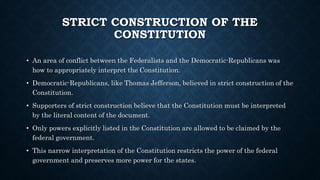
STRICT CONSTRUCTION OF THE
CONSTITUTION
• An area of conflict between the Federalists and the Democratic-Republicans was
how to appropriately interpret the Constitution.
• Democratic-Republicans, like Thomas Jefferson, believed in strict construction of the
Constitution.
• Supporters of strict construction believe that the Constitution must be interpreted
by the literal content of the document.
• Only powers explicitly listed in the Constitution are allowed to be claimed by the
federal government.
• This narrow interpretation of the Constitution restricts the power of the federal
government and preserves more power for the states.
LOOSE INTERPRETATION OF THE
CONSTITUTION
• In contrast, Federalists supported loose construction of the Constitution.
• This approach to constitutional interpretation claims that there are implied powers
granted to the federal government in the Constitution.
• These powers may not be explicitly listed but are still granted to the federal
government through the “elastic clause” in Article 1 of the Constitution.
• The clause grants Congress the power to pass all laws which shall be “necessary and
proper” for carrying out the business of the government.
• Federalists argued that this vague wording purposely left implied powers to the
government in the event of unforeseen circumstances.
• The Democratic-Republicans opposed such unrestricted power. While Jefferson
ideologically was a strong advocate of strict construction, his actions as president, in
some ways, practiced loose construction.
THE LOUISIANA PURCHASE
• The purchase of the Louisiana territory from France is an example of Thomas
Jefferson’s expansion of presidential power through loose construction- even though
he claimed to be a strict constructionist.
• Louisiana was originally a part of New France. However, the region had been
subject to much transition and had changed hands several times. At the time of
Jefferson’s election, Louisiana was ruled by Spain but was home to many American
merchants and farmers.
• In 1800, the territory changed hands again when the French general, Napoleon
Bonaparte, retrieved Louisiana from Spain.
• New Orleans was the key port in the region and was an important outlet of
American farm goods produced in the Ohio River Valley..
THE LOUISIANA PURCHASE
• President Jefferson sent Robert Livingston and James Monroe to France to inquire
about the purchase of New Orleans for the United States in order to secure a
permanent port on the Mississippi River.
• Napoleon, seeing an opportunity to finance his ongoing conflicts in Europe and a
way to keep the British from expanding in North America, agreed to sell the entire
region, not just the port at New Orleans, to the United States for $15 million.
• Livingston and Monroe had been prepared to pay up to $10 million for just New
Orleans.
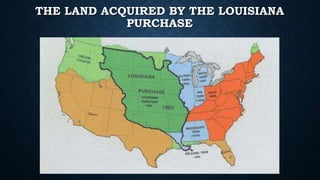
• The Louisiana Purchase doubled the size of the United States. Through this deal,
lands critical for future expansion were acquired and the United States had secured
the port at New Orleans to export American goods abroad.
THE LAND ACQUIRED BY THE LOUISIANA
PURCHASE
THE LOUISIANA PURCHASE
• Nowhere in the Constitution is the President given the power to purchase land from
another country.
• Jefferson entered the presidency as a strict constructionist, but his purchase of
Louisiana was an action beyond the provisions of the Constitution. The Louisiana
Purchase is an example of how Thomas Jefferson expanded the power of the presidency
as the Constitution makes no provision for this type of presidential action.
• With the acquisition of approximately 875,000 square miles of new land, gathering
information about the region and the opportunities it might offer to Americans was
important to Thomas Jefferson.
• More settlers were moving to the Ohio River Valley in the Northwest Territory by 1800.
• Jefferson had sensed that the destiny of the nation was tied to the Mississippi River
Valley. Jefferson worried that as more people moved to these isolated areas, the
challenges of communicating and trading with the east coast could prompt the areas in
the west to secede from the United States.
LEWIS & CLARK EXPEDITION
• No one was exactly sure what lay between St. Louis and the Pacific Ocean. Jefferson
sent Meriwether Lewis and William Clark on a government-funded exploration of
Louisiana and the western lands all the way to the Pacific Ocean.
• On their 16-month journey, Lewis and Clark charted the trails west, mapped rivers
and mountain ranges, wrote descriptions and collected samples of unfamiliar
animals and plants, and recorded facts and figures about the various American
Indian tribes and customs west of the Mississippi River.
• Most significantly, Lewis and Clark reached the Pacific Ocean and established a
legal claim to the Oregon territory along the Columbia River. This claim allowed for
the future expansion of the United States to the Pacific Ocean.
• The Lewis and Clark expedition and subsequent claim to the Oregon territory were
not presidential powers listed in the Constitution. This is another example of the
strict constructionist President’s actions falling in line with the loose constructionist
ideology.
MARBURY V. MADISON
• In particular, the Marbury v. Madison Supreme Court decision was issued during
Jefferson’s tenure.
• This ruling was critical in shifting power from the states to the federal judicial
branch regarding the interpretation of laws – established Judicial Review.
• Judicial Review gives the Supreme court to determine if a law is constitutional or
unconstitutional.
• Jefferson, who had supported the states’ right to nullify a federal law through the
Virginia and Kentucky Resolutions, was opposed to this shift in power.
• Another topic that could be introduced concerning Jefferson’s presidency would be
his use of the military to stop the Barbary Pirates in North Africa from extorting
payments from US ships as they passed through the Mediterranean Sea.
PRESIDENCY OF THOMAS JEFFERSON
• Jefferson was also faced with mounting international pressure as France and Great
Britain were once again at war.
• American ships and sailors were being harassed by both warring nations as the US
sought to boost trade with Europe.
• The issue of the impressment of US merchant sailors weighed heavily on Jefferson
who wanted to avoid war.
• His implementation of an embargo was an attempt to put economic pressure on the
British in order to force them to not interfere with American ships or sailors.
• Having students investigate Jefferson’s foreign policy efforts to deal with the
growing conflict with Britain will help them to better understand the causes of the
War of 1812 that breaks out during James Madison’s administration.

The first 5 presidents thomas jefferson

  • 1.
    THE FIRST 5PRESIDENTS: THOMAS JEFFERSON (#3) SSUSH6c
  • 2.
    THOMAS JEFFERSON • ThomasJefferson led the nation's Democratic-Republican Party and was a vocal critic of the Federalists' push for a stronger central government at the expense of the states. • Once Jefferson was elected President in the contentious election of 1800, he was responsible for defending and leading the nation toward prosperity. Although his political philosophy leaned toward a de-centralized federal government, he actually expanded the power of the presidency during his two terms in office. • Jefferson was the first President to take the oath of office in the new national capital in Washington, DC. He tried to set a simplistic tone for his presidency by having a more informal inauguration without much fanfare. • Jefferson did highlight the need for the country’s political divisions to heal and for both political parties to move forward. A famous line from Jefferson’s first inaugural speech is, “We are all Republicans – we are all Federalists.” Jefferson served two terms as President of the United States, during which he dealt with many domestic and foreign policy issues.
  • 3.
    STRICT CONSTRUCTION OFTHE CONSTITUTION • An area of conflict between the Federalists and the Democratic-Republicans was how to appropriately interpret the Constitution. • Democratic-Republicans, like Thomas Jefferson, believed in strict construction of the Constitution. • Supporters of strict construction believe that the Constitution must be interpreted by the literal content of the document. • Only powers explicitly listed in the Constitution are allowed to be claimed by the federal government. • This narrow interpretation of the Constitution restricts the power of the federal government and preserves more power for the states.
  • 4.
    LOOSE INTERPRETATION OFTHE CONSTITUTION • In contrast, Federalists supported loose construction of the Constitution. • This approach to constitutional interpretation claims that there are implied powers granted to the federal government in the Constitution. • These powers may not be explicitly listed but are still granted to the federal government through the “elastic clause” in Article 1 of the Constitution. • The clause grants Congress the power to pass all laws which shall be “necessary and proper” for carrying out the business of the government. • Federalists argued that this vague wording purposely left implied powers to the government in the event of unforeseen circumstances. • The Democratic-Republicans opposed such unrestricted power. While Jefferson ideologically was a strong advocate of strict construction, his actions as president, in some ways, practiced loose construction.
  • 5.
    THE LOUISIANA PURCHASE •The purchase of the Louisiana territory from France is an example of Thomas Jefferson’s expansion of presidential power through loose construction- even though he claimed to be a strict constructionist. • Louisiana was originally a part of New France. However, the region had been subject to much transition and had changed hands several times. At the time of Jefferson’s election, Louisiana was ruled by Spain but was home to many American merchants and farmers. • In 1800, the territory changed hands again when the French general, Napoleon Bonaparte, retrieved Louisiana from Spain. • New Orleans was the key port in the region and was an important outlet of American farm goods produced in the Ohio River Valley..
  • 6.
    THE LOUISIANA PURCHASE •President Jefferson sent Robert Livingston and James Monroe to France to inquire about the purchase of New Orleans for the United States in order to secure a permanent port on the Mississippi River. • Napoleon, seeing an opportunity to finance his ongoing conflicts in Europe and a way to keep the British from expanding in North America, agreed to sell the entire region, not just the port at New Orleans, to the United States for $15 million. • Livingston and Monroe had been prepared to pay up to $10 million for just New Orleans. • The Louisiana Purchase doubled the size of the United States. Through this deal, lands critical for future expansion were acquired and the United States had secured the port at New Orleans to export American goods abroad.
  • 7.
    THE LAND ACQUIREDBY THE LOUISIANA PURCHASE
  • 8.
    THE LOUISIANA PURCHASE •Nowhere in the Constitution is the President given the power to purchase land from another country. • Jefferson entered the presidency as a strict constructionist, but his purchase of Louisiana was an action beyond the provisions of the Constitution. The Louisiana Purchase is an example of how Thomas Jefferson expanded the power of the presidency as the Constitution makes no provision for this type of presidential action. • With the acquisition of approximately 875,000 square miles of new land, gathering information about the region and the opportunities it might offer to Americans was important to Thomas Jefferson. • More settlers were moving to the Ohio River Valley in the Northwest Territory by 1800. • Jefferson had sensed that the destiny of the nation was tied to the Mississippi River Valley. Jefferson worried that as more people moved to these isolated areas, the challenges of communicating and trading with the east coast could prompt the areas in the west to secede from the United States.
  • 9.
    LEWIS & CLARKEXPEDITION • No one was exactly sure what lay between St. Louis and the Pacific Ocean. Jefferson sent Meriwether Lewis and William Clark on a government-funded exploration of Louisiana and the western lands all the way to the Pacific Ocean. • On their 16-month journey, Lewis and Clark charted the trails west, mapped rivers and mountain ranges, wrote descriptions and collected samples of unfamiliar animals and plants, and recorded facts and figures about the various American Indian tribes and customs west of the Mississippi River. • Most significantly, Lewis and Clark reached the Pacific Ocean and established a legal claim to the Oregon territory along the Columbia River. This claim allowed for the future expansion of the United States to the Pacific Ocean. • The Lewis and Clark expedition and subsequent claim to the Oregon territory were not presidential powers listed in the Constitution. This is another example of the strict constructionist President’s actions falling in line with the loose constructionist ideology.
  • 10.
    MARBURY V. MADISON •In particular, the Marbury v. Madison Supreme Court decision was issued during Jefferson’s tenure. • This ruling was critical in shifting power from the states to the federal judicial branch regarding the interpretation of laws – established Judicial Review. • Judicial Review gives the Supreme court to determine if a law is constitutional or unconstitutional. • Jefferson, who had supported the states’ right to nullify a federal law through the Virginia and Kentucky Resolutions, was opposed to this shift in power. • Another topic that could be introduced concerning Jefferson’s presidency would be his use of the military to stop the Barbary Pirates in North Africa from extorting payments from US ships as they passed through the Mediterranean Sea.
  • 11.
    PRESIDENCY OF THOMASJEFFERSON • Jefferson was also faced with mounting international pressure as France and Great Britain were once again at war. • American ships and sailors were being harassed by both warring nations as the US sought to boost trade with Europe. • The issue of the impressment of US merchant sailors weighed heavily on Jefferson who wanted to avoid war. • His implementation of an embargo was an attempt to put economic pressure on the British in order to force them to not interfere with American ships or sailors. • Having students investigate Jefferson’s foreign policy efforts to deal with the growing conflict with Britain will help them to better understand the causes of the War of 1812 that breaks out during James Madison’s administration.