Case analysis of
Airborne express
Presented by:
Jeeshan mahfooz (16pgpm12)
Jyoti Rani (16pgpm13)
Karan Singh (16pgpm14)
Kaushik Dutta (16pgpm15)
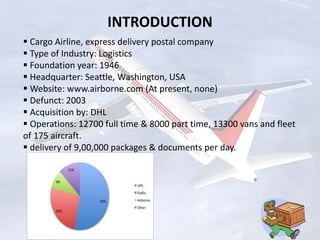
INTRODUCTION
 Cargo Airline, express delivery postal company
 Type of Industry: Logistics
 Foundation year: 1946
 Headquarter: Seattle, Washington, USA
 Website: www.airborne.com (At present, none)
 Defunct: 2003
 Acquisition by: DHL
 Operations: 12700 full time & 8000 part time, 13300 vans and fleet
of 175 aircraft.
 delivery of 9,00,000 packages & documents per day.
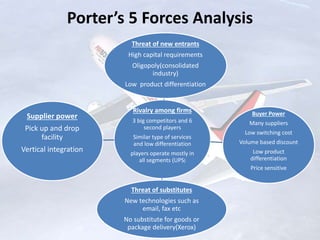
Porter’s 5 Forces Analysis
Rivalry among firms
3 big competitors and 6
second players
Similar type of services
and low differentiation
players operate mostly in
all segments (UPS)
Threat of new entrants
High capital requirements
Oligopoly(consolidated
industry)
Low product differentiation
Buyer Power
Many suppliers
Low switching cost
Volume based discount
Low product
differentiation
Price sensitive
Threat of substitutes
New technologies such as
email, fax etc
No substitute for goods or
package delivery(Xerox)
Supplier power
Pick up and drop
facility
Vertical integration
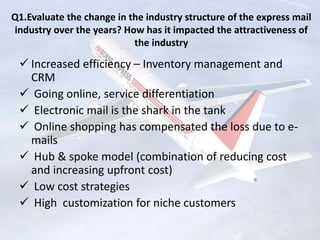
Q1.Evaluate the change in the industry structure of the express mail
industry over the years? How has it impacted the attractiveness of
the industry
 Increased efficiency – Inventory management and
CRM
 Going online, service differentiation
 Electronic mail is the shark in the tank
 Online shopping has compensated the loss due to e-
mails
 Hub & spoke model (combination of reducing cost
and increasing upfront cost)
 Low cost strategies
 High customization for niche customers
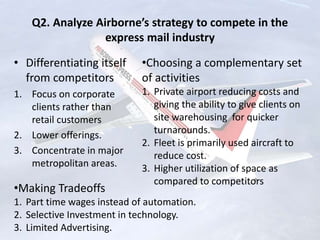
Q2. Analyze Airborne’s strategy to compete in the
express mail industry
• Differentiating itself
from competitors
1. Focus on corporate
clients rather than
retail customers
2. Lower offerings.
3. Concentrate in major
metropolitan areas.
•Choosing a complementary set
of activities
1. Private airport reducing costs and
giving the ability to give clients on
site warehousing for quicker
turnarounds.
2. Fleet is primarily used aircraft to
reduce cost.
3. Higher utilization of space as
compared to competitors
•Making Tradeoffs
1. Part time wages instead of automation.
2. Selective Investment in technology.
3. Limited Advertising.
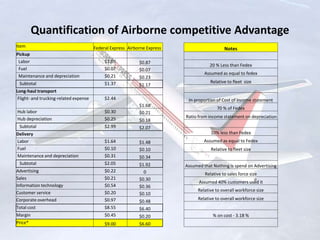
Quantification of Airborne competitive Advantage
Item Federal Express Airborne Express
Pickup
Labor $1.09 $0.87
Fuel $0.07 $0.07
Maintenance and depreciation $0.21 $0.23
Subtotal $1.37 $1.17
Long-haul transport
Flight- and trucking-related expense $2.44
$1.68
Hub labor $0.30 $0.21
Hub depreciation $0.25 $0.18
Subtotal $2.99 $2.07
Delivery
Labor $1.64 $1.48
Fuel $0.10 $0.10
Maintenance and depreciation $0.31 $0.34
Subtotal $2.05 $1.92
Advertising $0.22 0
Sales $0.21 $0.30
Information technology $0.54 $0.36
Customer service $0.20 $0.10
Corporate overhead $0.97 $0.48
Total cost $8.55 $6.40
Margin $0.45 $0.20
Price* $9.00 $6.60
Notes
20 % Less than Fedex
Assumed as equal to fedex
Relative to fleet size
In proportion of Cost of Income statement
70 % of Fedex
Ratio from income statement on depreciation
10% less than Fedex
Assumed as equal to Fedex
Relative to fleet size
Assumed that Nothing is spend on Advertising
Relative to sales force size
Assumed 40% customers used it
Relative to overall workforce size
% on cost - 3.18 %
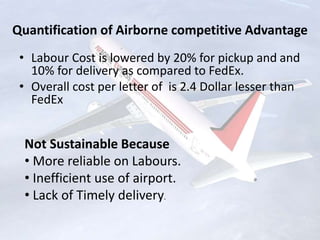
Quantification of Airborne competitive Advantage
• Labour Cost is lowered by 20% for pickup and and
10% for delivery as compared to FedEx.
• Overall cost per letter of is 2.4 Dollar lesser than
FedEx
Not Sustainable Because
• More reliable on Labours.
• Inefficient use of airport.
• Lack of Timely delivery.
Q4. Should Airborne follow the distance-based pricing
adopted by its main rivals at the time of the case?
• In 1996 UPS changed its prices to reflect the distance of the
parcel.
• In 1997, FedEx made the same changes – charging more for
packages that travel farther
• Will it work for Airborne?
• Customers are expecting this change simply as an industry
trend, so YES.
Q5. What should be your approach, as the President
and COO of Airborne, to strengthen the company's
position?
• Adopting distance- based pricing.
• Investing in International operations.
• RPS Alliance
• Focus on SMEs as business clients.
• Continued targeting of a customer segment
with lighter packages.
THANK YOU

Airborne Express

  • 1.
    Case analysis of Airborneexpress Presented by: Jeeshan mahfooz (16pgpm12) Jyoti Rani (16pgpm13) Karan Singh (16pgpm14) Kaushik Dutta (16pgpm15)
  • 2.
    INTRODUCTION  Cargo Airline,express delivery postal company  Type of Industry: Logistics  Foundation year: 1946  Headquarter: Seattle, Washington, USA  Website: www.airborne.com (At present, none)  Defunct: 2003  Acquisition by: DHL  Operations: 12700 full time & 8000 part time, 13300 vans and fleet of 175 aircraft.  delivery of 9,00,000 packages & documents per day.
  • 3.
    Porter’s 5 ForcesAnalysis Rivalry among firms 3 big competitors and 6 second players Similar type of services and low differentiation players operate mostly in all segments (UPS) Threat of new entrants High capital requirements Oligopoly(consolidated industry) Low product differentiation Buyer Power Many suppliers Low switching cost Volume based discount Low product differentiation Price sensitive Threat of substitutes New technologies such as email, fax etc No substitute for goods or package delivery(Xerox) Supplier power Pick up and drop facility Vertical integration
  • 4.
    Q1.Evaluate the changein the industry structure of the express mail industry over the years? How has it impacted the attractiveness of the industry  Increased efficiency – Inventory management and CRM  Going online, service differentiation  Electronic mail is the shark in the tank  Online shopping has compensated the loss due to e- mails  Hub & spoke model (combination of reducing cost and increasing upfront cost)  Low cost strategies  High customization for niche customers
  • 5.
    Q2. Analyze Airborne’sstrategy to compete in the express mail industry • Differentiating itself from competitors 1. Focus on corporate clients rather than retail customers 2. Lower offerings. 3. Concentrate in major metropolitan areas. •Choosing a complementary set of activities 1. Private airport reducing costs and giving the ability to give clients on site warehousing for quicker turnarounds. 2. Fleet is primarily used aircraft to reduce cost. 3. Higher utilization of space as compared to competitors •Making Tradeoffs 1. Part time wages instead of automation. 2. Selective Investment in technology. 3. Limited Advertising.
  • 6.
    Quantification of Airbornecompetitive Advantage Item Federal Express Airborne Express Pickup Labor $1.09 $0.87 Fuel $0.07 $0.07 Maintenance and depreciation $0.21 $0.23 Subtotal $1.37 $1.17 Long-haul transport Flight- and trucking-related expense $2.44 $1.68 Hub labor $0.30 $0.21 Hub depreciation $0.25 $0.18 Subtotal $2.99 $2.07 Delivery Labor $1.64 $1.48 Fuel $0.10 $0.10 Maintenance and depreciation $0.31 $0.34 Subtotal $2.05 $1.92 Advertising $0.22 0 Sales $0.21 $0.30 Information technology $0.54 $0.36 Customer service $0.20 $0.10 Corporate overhead $0.97 $0.48 Total cost $8.55 $6.40 Margin $0.45 $0.20 Price* $9.00 $6.60 Notes 20 % Less than Fedex Assumed as equal to fedex Relative to fleet size In proportion of Cost of Income statement 70 % of Fedex Ratio from income statement on depreciation 10% less than Fedex Assumed as equal to Fedex Relative to fleet size Assumed that Nothing is spend on Advertising Relative to sales force size Assumed 40% customers used it Relative to overall workforce size Relative to overall workforce size % on cost - 3.18 %
  • 7.
    Quantification of Airbornecompetitive Advantage • Labour Cost is lowered by 20% for pickup and and 10% for delivery as compared to FedEx. • Overall cost per letter of is 2.4 Dollar lesser than FedEx Not Sustainable Because • More reliable on Labours. • Inefficient use of airport. • Lack of Timely delivery.
  • 8.
    Q4. Should Airbornefollow the distance-based pricing adopted by its main rivals at the time of the case? • In 1996 UPS changed its prices to reflect the distance of the parcel. • In 1997, FedEx made the same changes – charging more for packages that travel farther • Will it work for Airborne? • Customers are expecting this change simply as an industry trend, so YES.
  • 9.
    Q5. What shouldbe your approach, as the President and COO of Airborne, to strengthen the company's position? • Adopting distance- based pricing. • Investing in International operations. • RPS Alliance • Focus on SMEs as business clients. • Continued targeting of a customer segment with lighter packages.
  • 10.