Dr. Vaishali
Professor, Ag. Biotechnology
SVPUA&T, Meerut
Definition:
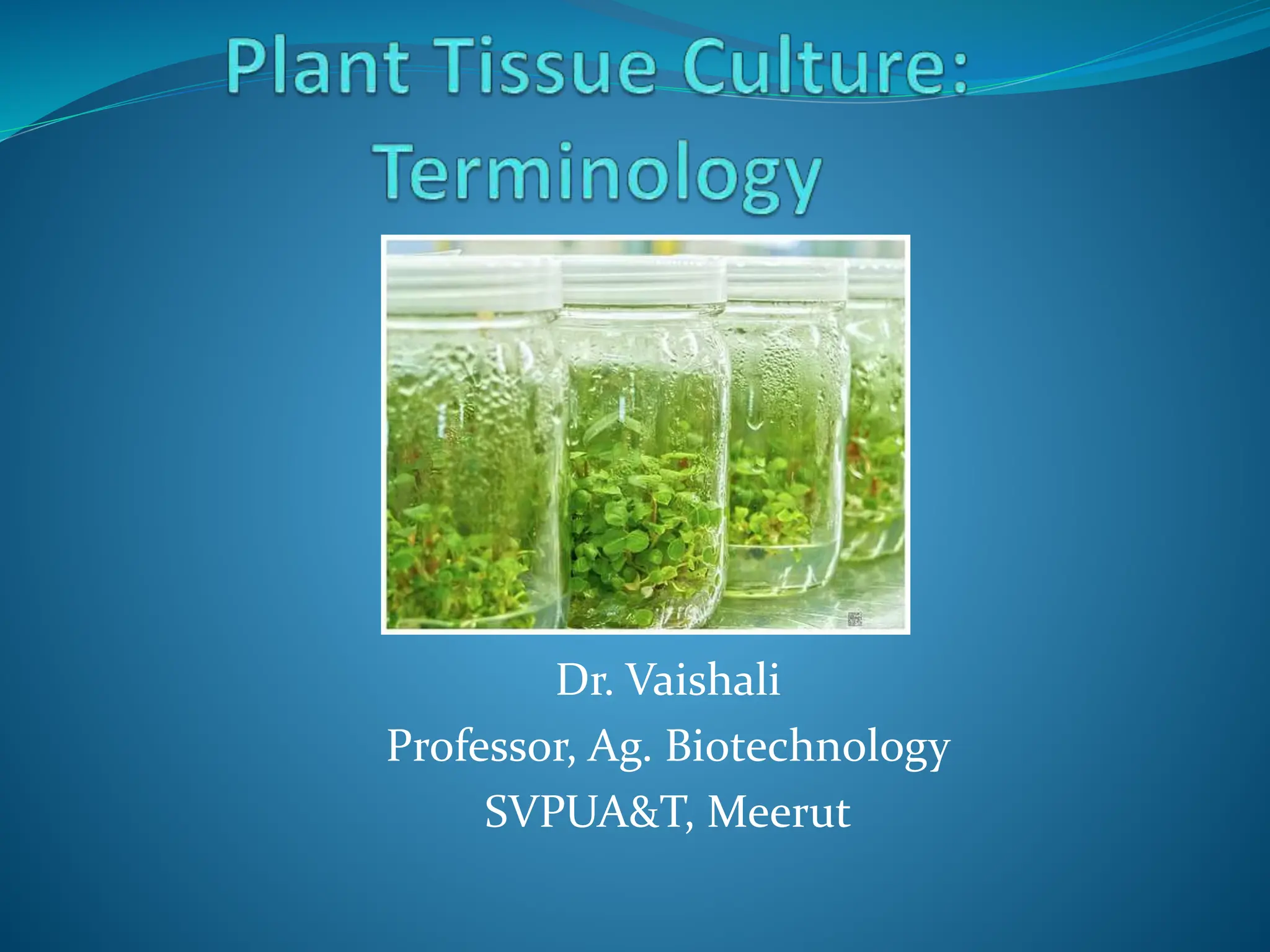
 Tissue culture is the method of ‘in vitro’ culture of
plant or animal cells, tissue or organ – on nutrient
medium under aseptic conditions usually in a glass
container.
 By plant tissue culture new plants may be raised in an
artificial medium from very small parts of plants, such
as, shoot tip, root tip, callus, seed, embryo, pollen
grain, ovule or even a single cell, whether the cultured
tissue develops into a plant or grows unorganized
depends on the genetic potential of the tissue and the
chemical and physical environment.
 1832 -Theodor Schwann said that cells could be cultured
outside the body of the organism if provided with proper
external conditions.
 1839- Sheoldein, Schwann, Rudolf proposed Cell theory
that the cell is the basic unit of life
 1902 -G. Haberlandt, a German botanist, cultured fully
differentiated plant cells isolated from different plants.
 He started his work in 1898. He used cells from palisade
tissues of leaves, cells from pith, epidermis and epidermal
hairs of various plants for culture in media -containing Knop’s
solution, aspergine, peptone and sucrose.
 The cultured cells survived for several months but the cells
failed to proliferate. This may be due to:
 (a) Use of very simple media,
 (b) Culture of highly differentiated cells and
 (c) Aseptic techniques were not used.
 1904- Hanning cultured embryo from cruceferous plants
 1922-Kolte and Robbins introduced root and shoot tip
culture
 1926- Went discovered natural auxin –IAA
 1955- Skoog and Miller discovered Kinetin for cell division
 1957- Skoog and Miller discovered Plant growth harmone
-Auxin& cytokinin
 1962- Murashige and Skoog developed MS media
 1968- Guha and Maheshwari produced first haploid
plants from pollen grains of dhatura
 In India, the work on tissue culture was initiated during
1950s at University of Delhi by Shri Panchanan Maheshwari
who developed haploid production was a land-mark in the
development of in-vitro culturing of plants.
 Shri S.C. Maheshwari and Sipra Guha made a remarkable
contribution in the development of plant tissue culture in
India..
Aseptic
Free of microorganisms.
Aseptic Technique
Procedures used to prevent the introduction of fungi,
bacteria, viruses, mycoplasma or other microorganisms
into cultures.
Autoclave
A machine capable of sterilizing wet or dry items with
steam under pressure. Pressure cookers are a type of
autoclaves.
Callus
An unorganized, proliferate mass of differentiated plant
cells, a wound response.
Auxin
A group of plant growth regulators that promotes callus growth, cell
division, cell enlargement, adventitious buds, and lateral rooting.
 Endogenous auxins are auxins that occur naturally.
Ex- Indole-3-acetic (IAA).
 Exogenous auxins are auxins that are man-made or synthetic.
Ex- 2,4-Dichlorophenoxyacetic acid (2,4-D),
Indole-3-Butyric acid (IBA),
α-Naphthaleneacetic acid (NAA)
4-Chlorophenoxyacetic acid (CPA).
Cytokinin
A group of plant growth regulators that regulate growth and morphogenesis
and stimulate cell division.
 Endogenous cytokinins
Ex- zeatin and 6-γ,γ-dimethylallylaminopurine (2iP).
 Exogenous cytokinins
Ex- include 6-furfurylaminopurine (kinetin)
6-benzylaminopurine (BA or BAP).
Clonal Propagation
Asexual reproduction of plants that are considered to be
genetically uniform and originated from a single individual or
explant.
Chemically Defined Medium
A nutritive solution for culturing cells in which each component is
specifiable and ideally of known chemical structure.
Micropropagation
In vitro Clonal propagation of plants from shoot tips or nodal
explants, usually with an accelerated proliferation of shoots
during subcultures.
Passage
The transfer or transplantation of cells or tissues with or without
dilution or division, form one culture vessel to another.
Regeneration
In plant cultures, a morphogenetic response to a stimulus that
results in the products of organs, embryos, or whole plants.
Somaclonal Variation
Phenotypic variation, either genetic or epigenetic in origin, displayed
among somaclones.
Somaclones
Plants derived from any form of cell culture involving the use of
somatic plant cells.
Subculture
See “Passage”. With plant cultures, this is the process by which the
tissue or explant is first subdivide, then transferred into fresh culture
medium.
Totipotency
A cell characteristic in which the potential for forming all the cell types
in the adult organism are retained.
Undifferentiated
With plant cells, existing in a state of cell development characterized
by isodiametric cell shape, very little or no vacuole, a large nucleus, and
exemplified by cells comprising an apical meristem or embryo.
Differentiated
Cells that maintain, in culture, all or much of the specialized structure
and function typical of the cell type in vivo. Modifications of new cells
to form tissues or organs with a specific function.
Gibberellins
A plant growth regulator that influences cell enlargement. Endogenous
growth forms of gibberellin include Gibberellic Acid (GA3).
Hormones
Growth regulators, generally synthetic in occurrence, that strongly
affects growth (i.e. cytokinins, auxins, and gibberellins).
Medium
A nutritive solution, solid or liquid, for culturing cells.
Agar
a polysaccharide powder derived from algae used to gel a medium.
Agar is generally used at a concentration of 6-12 g/liter.
Acclimatization
It is a process of gradual hardening of the cultured
plants from laboratory to field so that the regenerated
plants should adjust to field conditions.
Androgenesis
It is a process of regeneration of plants from pollen
grains. Such plants are haploids.
Auxenic or Aseptic culture
Cultures devoid of foreign or undesired life forms are
called auxenic culture.
Explant
Small piece of viable tissues isolated from parent plant
is called explant .
Basal medium
Most of the media contain inorganic salts of major and
minor elements, vitamins and sucrose. A medium with
these ingredients is called basal medium.
Callus
Mass of undifferentiated cells produced in tissue culture is
called callus. The callus is highly vacuolated and
unorganised cells.
Clone
A clone is a group of plants produced from a single explant
through asexual reproduction. All the members of a clone
have the same genotype as'" that of the parent. They are
identical in genotype. Phenotypic differences within a
clone are due to external factors.
Inoculation
Transfer of explant to culture medium is called inoculation.
Cryobiology
It is a technique of preservation of plant tissues and cells in
liquid nitrogen at196°C. This is highly significant for
storage of germplasm of those crops which do not produce
seeds and reproduce only by vegetative means.
In vitro
Cells/tissues grown in controlled condition in laboratory.
Organogenesis
Process of differentiation of callus initially into embryo like
structure (embryoids) and then showing organ like
roots/shoots
Protoplast
Animal, plant or fungal cell from which the entire cell
wall has been removed.
Regeneration
Production of entire plant from explant is called
regeneration.
Shoot tip culture
Culture of shoot tip (shoot apical meristem) along with one or
more leaf primordia or mature leaves is called shoot tip
culture.
Somatic embryogenesis
Process of production of embryo from somatic cells is called
somatic embryogenesis and such embryo is called embryoid.
Stock plant
The plant from which explant is taken is called stock plant.
Suspension culture
A type of liquid culture in which cells or cell aggregates grow
and multiply.
Transplant stage
Process of transfer of regenerated plants from test tube (i.e. in
vitro) to the soil is called transplant stage.
WHY? Tissue culture
 The production of clones of plants that
produce particularly good flowers, fruits, or
have other desirable traits.
 The production of multiples of plants in
the absence of seeds or
necessary pollinators to produce seeds.
 The regeneration of whole plants from
plant cells that have been genetically
modified.
 The production of plants in sterile
containers reduces disease transmission
How?
Adult plant cells are totipotent, meaning they have the ability
to give rise to a fully differentiated plant. Because of this, it is
possible to collect cells from a mature plant and use those cells
to produce clones of that plant.
Basic requirements for PTC
There are three fundamental principles
(1) Tissue source
(2) nutrient medium.
(3) Aseptic condition
Plant Tissue Culture Procedure
 The following is the general process of plant tissue culture. There are
specific steps for the regeneration of a complete plant from an
explant cultured on the nutrient medium. These steps are:
 Selection and Sterilisation of Explant: A suitable explant is
chosen and excised from the donor plant and the explant is sterilized
using disinfectants.
 Preparation and Sterilisation of the Culture Media: A suitable
culture media is prepared with specific components for the growth
of the explant, the culture is then sterilized.
 Inoculation: The sterilized plant is inoculated on the culture
medium under aseptic conditions.
 Incubation: The cultures are then incubated in the culture room
with appropriate conditions of light, temperature, and humidity for
successful culturing.
 Sub-Culturing: Cultured cells are transferred to a fresh nutrient
medium to obtain the plantlets.
 Transfer of Plantlets: After the hardening process (i.e.,
acclimatization of plantlets to the environment), the plantlets are
transferred to the greenhouse or in pots.
Application of Plant Tissue Culture
 In-plant biotechnology, the useful product is a plantlet and
they are used for many purposes. The plantlets can be
generated from these cells and give rise to highly valuable
transgenic plants.
 All the cells in callus or suspension plant tissue culture are
derived from a single explant by mitotic division.Hence, all
plantlets regenerated from a callus or suspension culture
have the same genotype and constitute a clone. These
plantlets are utilized in rapid clonal propagation.
 Mutagens are added to single-cell liquid cultures for the
induction of mutations.
 Tolerance to stress like toxins, salts, drought, pollutants,
flooding, etc. can also be obtained by providing them in a
culture medium by increasing dosage. The surviving healthy
cells are taken to a solid medium for raising resistant plants.
Application of tissue culture
 Crop improvement
 Horticulture
 Synthetic seeds production
 Forestry
 Propagation of rare plants
 Production of secondary metabolite
 Shortening of breeding cycle
 Production of disease-free plants
 To conserve rare or endangered plant species
 Production of identical sterile hybrid species can be
obtained

Tissue culture terminology.pptx

  • 1.
    Dr. Vaishali Professor, Ag.Biotechnology SVPUA&T, Meerut
  • 2.
    Definition:  Tissue cultureis the method of ‘in vitro’ culture of plant or animal cells, tissue or organ – on nutrient medium under aseptic conditions usually in a glass container.  By plant tissue culture new plants may be raised in an artificial medium from very small parts of plants, such as, shoot tip, root tip, callus, seed, embryo, pollen grain, ovule or even a single cell, whether the cultured tissue develops into a plant or grows unorganized depends on the genetic potential of the tissue and the chemical and physical environment.
  • 4.
     1832 -TheodorSchwann said that cells could be cultured outside the body of the organism if provided with proper external conditions.  1839- Sheoldein, Schwann, Rudolf proposed Cell theory that the cell is the basic unit of life  1902 -G. Haberlandt, a German botanist, cultured fully differentiated plant cells isolated from different plants.  He started his work in 1898. He used cells from palisade tissues of leaves, cells from pith, epidermis and epidermal hairs of various plants for culture in media -containing Knop’s solution, aspergine, peptone and sucrose.  The cultured cells survived for several months but the cells failed to proliferate. This may be due to:  (a) Use of very simple media,  (b) Culture of highly differentiated cells and  (c) Aseptic techniques were not used.
  • 5.
     1904- Hanningcultured embryo from cruceferous plants  1922-Kolte and Robbins introduced root and shoot tip culture  1926- Went discovered natural auxin –IAA  1955- Skoog and Miller discovered Kinetin for cell division  1957- Skoog and Miller discovered Plant growth harmone -Auxin& cytokinin  1962- Murashige and Skoog developed MS media  1968- Guha and Maheshwari produced first haploid plants from pollen grains of dhatura  In India, the work on tissue culture was initiated during 1950s at University of Delhi by Shri Panchanan Maheshwari who developed haploid production was a land-mark in the development of in-vitro culturing of plants.  Shri S.C. Maheshwari and Sipra Guha made a remarkable contribution in the development of plant tissue culture in India..
  • 7.
    Aseptic Free of microorganisms. AsepticTechnique Procedures used to prevent the introduction of fungi, bacteria, viruses, mycoplasma or other microorganisms into cultures. Autoclave A machine capable of sterilizing wet or dry items with steam under pressure. Pressure cookers are a type of autoclaves. Callus An unorganized, proliferate mass of differentiated plant cells, a wound response.
  • 8.
    Auxin A group ofplant growth regulators that promotes callus growth, cell division, cell enlargement, adventitious buds, and lateral rooting.  Endogenous auxins are auxins that occur naturally. Ex- Indole-3-acetic (IAA).  Exogenous auxins are auxins that are man-made or synthetic. Ex- 2,4-Dichlorophenoxyacetic acid (2,4-D), Indole-3-Butyric acid (IBA), α-Naphthaleneacetic acid (NAA) 4-Chlorophenoxyacetic acid (CPA). Cytokinin A group of plant growth regulators that regulate growth and morphogenesis and stimulate cell division.  Endogenous cytokinins Ex- zeatin and 6-γ,γ-dimethylallylaminopurine (2iP).  Exogenous cytokinins Ex- include 6-furfurylaminopurine (kinetin) 6-benzylaminopurine (BA or BAP).
  • 9.
    Clonal Propagation Asexual reproductionof plants that are considered to be genetically uniform and originated from a single individual or explant. Chemically Defined Medium A nutritive solution for culturing cells in which each component is specifiable and ideally of known chemical structure. Micropropagation In vitro Clonal propagation of plants from shoot tips or nodal explants, usually with an accelerated proliferation of shoots during subcultures. Passage The transfer or transplantation of cells or tissues with or without dilution or division, form one culture vessel to another. Regeneration In plant cultures, a morphogenetic response to a stimulus that results in the products of organs, embryos, or whole plants.
  • 10.
    Somaclonal Variation Phenotypic variation,either genetic or epigenetic in origin, displayed among somaclones. Somaclones Plants derived from any form of cell culture involving the use of somatic plant cells. Subculture See “Passage”. With plant cultures, this is the process by which the tissue or explant is first subdivide, then transferred into fresh culture medium. Totipotency A cell characteristic in which the potential for forming all the cell types in the adult organism are retained. Undifferentiated With plant cells, existing in a state of cell development characterized by isodiametric cell shape, very little or no vacuole, a large nucleus, and exemplified by cells comprising an apical meristem or embryo.
  • 11.
    Differentiated Cells that maintain,in culture, all or much of the specialized structure and function typical of the cell type in vivo. Modifications of new cells to form tissues or organs with a specific function. Gibberellins A plant growth regulator that influences cell enlargement. Endogenous growth forms of gibberellin include Gibberellic Acid (GA3). Hormones Growth regulators, generally synthetic in occurrence, that strongly affects growth (i.e. cytokinins, auxins, and gibberellins). Medium A nutritive solution, solid or liquid, for culturing cells. Agar a polysaccharide powder derived from algae used to gel a medium. Agar is generally used at a concentration of 6-12 g/liter.
  • 12.
    Acclimatization It is aprocess of gradual hardening of the cultured plants from laboratory to field so that the regenerated plants should adjust to field conditions. Androgenesis It is a process of regeneration of plants from pollen grains. Such plants are haploids. Auxenic or Aseptic culture Cultures devoid of foreign or undesired life forms are called auxenic culture. Explant Small piece of viable tissues isolated from parent plant is called explant .
  • 13.
    Basal medium Most ofthe media contain inorganic salts of major and minor elements, vitamins and sucrose. A medium with these ingredients is called basal medium. Callus Mass of undifferentiated cells produced in tissue culture is called callus. The callus is highly vacuolated and unorganised cells. Clone A clone is a group of plants produced from a single explant through asexual reproduction. All the members of a clone have the same genotype as'" that of the parent. They are identical in genotype. Phenotypic differences within a clone are due to external factors. Inoculation Transfer of explant to culture medium is called inoculation.
  • 14.
    Cryobiology It is atechnique of preservation of plant tissues and cells in liquid nitrogen at196°C. This is highly significant for storage of germplasm of those crops which do not produce seeds and reproduce only by vegetative means. In vitro Cells/tissues grown in controlled condition in laboratory. Organogenesis Process of differentiation of callus initially into embryo like structure (embryoids) and then showing organ like roots/shoots Protoplast Animal, plant or fungal cell from which the entire cell wall has been removed. Regeneration Production of entire plant from explant is called regeneration.
  • 15.
    Shoot tip culture Cultureof shoot tip (shoot apical meristem) along with one or more leaf primordia or mature leaves is called shoot tip culture. Somatic embryogenesis Process of production of embryo from somatic cells is called somatic embryogenesis and such embryo is called embryoid. Stock plant The plant from which explant is taken is called stock plant. Suspension culture A type of liquid culture in which cells or cell aggregates grow and multiply. Transplant stage Process of transfer of regenerated plants from test tube (i.e. in vitro) to the soil is called transplant stage.
  • 16.
    WHY? Tissue culture The production of clones of plants that produce particularly good flowers, fruits, or have other desirable traits.  The production of multiples of plants in the absence of seeds or necessary pollinators to produce seeds.  The regeneration of whole plants from plant cells that have been genetically modified.  The production of plants in sterile containers reduces disease transmission
  • 17.
    How? Adult plant cellsare totipotent, meaning they have the ability to give rise to a fully differentiated plant. Because of this, it is possible to collect cells from a mature plant and use those cells to produce clones of that plant.
  • 18.
    Basic requirements forPTC There are three fundamental principles (1) Tissue source (2) nutrient medium. (3) Aseptic condition
  • 19.
    Plant Tissue CultureProcedure  The following is the general process of plant tissue culture. There are specific steps for the regeneration of a complete plant from an explant cultured on the nutrient medium. These steps are:  Selection and Sterilisation of Explant: A suitable explant is chosen and excised from the donor plant and the explant is sterilized using disinfectants.  Preparation and Sterilisation of the Culture Media: A suitable culture media is prepared with specific components for the growth of the explant, the culture is then sterilized.  Inoculation: The sterilized plant is inoculated on the culture medium under aseptic conditions.  Incubation: The cultures are then incubated in the culture room with appropriate conditions of light, temperature, and humidity for successful culturing.  Sub-Culturing: Cultured cells are transferred to a fresh nutrient medium to obtain the plantlets.  Transfer of Plantlets: After the hardening process (i.e., acclimatization of plantlets to the environment), the plantlets are transferred to the greenhouse or in pots.
  • 20.
    Application of PlantTissue Culture  In-plant biotechnology, the useful product is a plantlet and they are used for many purposes. The plantlets can be generated from these cells and give rise to highly valuable transgenic plants.  All the cells in callus or suspension plant tissue culture are derived from a single explant by mitotic division.Hence, all plantlets regenerated from a callus or suspension culture have the same genotype and constitute a clone. These plantlets are utilized in rapid clonal propagation.  Mutagens are added to single-cell liquid cultures for the induction of mutations.  Tolerance to stress like toxins, salts, drought, pollutants, flooding, etc. can also be obtained by providing them in a culture medium by increasing dosage. The surviving healthy cells are taken to a solid medium for raising resistant plants.
  • 21.
    Application of tissueculture  Crop improvement  Horticulture  Synthetic seeds production  Forestry  Propagation of rare plants  Production of secondary metabolite  Shortening of breeding cycle  Production of disease-free plants  To conserve rare or endangered plant species  Production of identical sterile hybrid species can be obtained