Vulnerability Management in
                 an Application Security World


                         Dan Cornell
                         Global Membership Committee
                         Denim Group
                         dan@denimgroup.com
AppSec DC                (210) 572-4400
                         Twitter: @danielcornell
November 12th, 2009


                      The OWASP Foundation
                      http://www.owasp.org
Agenda
 Background
 A Little Bit of Theatre
 You Found Vulnerabilities – Now What?
 Vulnerability Management – The Security Perspective
 Defect Management – The Development Perspective
 Making it Work
 Case Studies
 Demo
 Questions

                                               OWASP    2
Background

Dan Cornell
  OWASP: Sprajax, Open Review, San Antonio Chapter,
   Global Membership Committee
  Principal at Denim Group www.denimgroup.com
  Software Developer: MCSD, Java 2 Certified
   Programmer
Denim Group
  Application Development and Remediation
      Java and .NET
  Application Security
      Assessments, penetration tests, code reviews, training,
       process consulting
                                                         OWASP   3
A Little Bit of Theatre


                          OWASP   4
A Little Bit of Theatre

This is a one-act play entitled: “We Found Some
 Vulnerabilities”

Need a volunteer


                                        OWASP      5
Audience Composition?

Software Developer
Infrastructure Security
Application Security
Project Manager
Other
All of It


                           OWASP   6
You Found Vulnerabilities – Now What?


                                   OWASP   7
You Found Vulnerabilities – Now What?

 Security Industry is too focused on finding vulnerabilities
    Especially in application security this typically isn’t hard
 Finding vulnerabilities is of some value
 Fixing vulnerabilities is of great value
 Mark Curphey: Are You a Builder or a Breaker
    http://securitybuddha.com/2008/09/10/are-you-a-builder-or-a-breaker/


 Organization’s goal is to understand their risk exposure
  and bring that in-line with their policies
 Finding vulnerabilities is only the first step on that road


                                                               OWASP        8
Vulnerability Management – The Security
Perspective


                                   OWASP   9
Vulnerability Management – The Security
Perspective
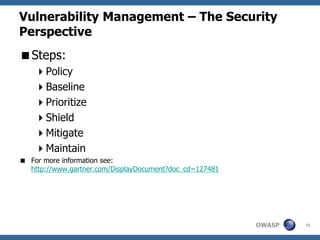
Steps:
    Policy
    Baseline
    Prioritize
    Shield
    Mitigate
    Maintain
 For more information see:
  http://www.gartner.com/DisplayDocument?doc_cd=127481


                                                         OWASP   10
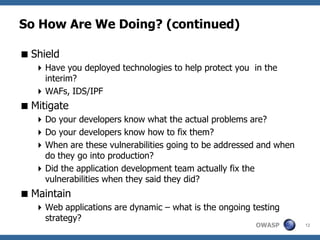
So How Are We Doing?

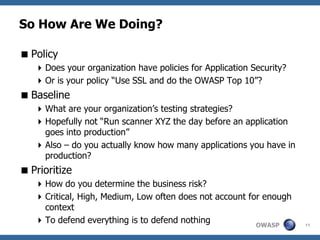
 Policy
    Does your organization have policies for Application Security?
    Or is your policy “Use SSL and do the OWASP Top 10”?
 Baseline
    What are your organization’s testing strategies?
    Hopefully not “Run scanner XYZ the day before an application
     goes into production”
    Also – do you actually know how many applications you have in
     production?
 Prioritize
    How do you determine the business risk?
    Critical, High, Medium, Low often does not account for enough
     context
    To defend everything is to defend nothing            OWASP       11
So How Are We Doing? (continued)

 Shield
    Have you deployed technologies to help protect you in the
     interim?
    WAFs, IDS/IPF
 Mitigate
    Do your developers know what the actual problems are?
    Do your developers know how to fix them?
    When are these vulnerabilities going to be addressed and when
     do they go into production?
    Did the application development team actually fix the
     vulnerabilities when they said they did?
 Maintain
    Web applications are dynamic – what is the ongoing testing
     strategy?
                                                         OWASP       12
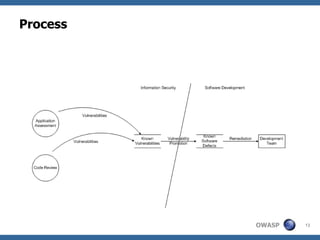
Process


          OWASP   13
Defect Management – The Developer
Perspective


                                    OWASP   14
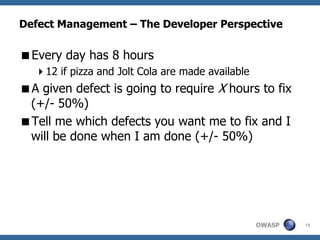
Defect Management – The Developer Perspective

Every day has 8 hours
  12 if pizza and Jolt Cola are made available
A given defect is going to require X hours to fix
 (+/- 50%)
Tell me which defects you want me to fix and I
 will be done when I am done (+/- 50%)


                                                  OWASP   15
Why is Vulnerability Management Hard for
Application-Level Vulnerabilities
Actual business risk is challenging to determine
People who find the problems do not typically
 know how to fix them
  Or at the very least they are not going to be the
   people who fix them
People who have to fix the problems often do
 not understand them


                                                OWASP   16
Why is Vulnerability Management Hard for
Application-Level Vulnerabilities
Infrastructure fixes are typically cookie-cutter,
 Application fixes are much more varied
   Patches and configuration settings
   Versus a full custom software development effort
Software development teams are already
 overtaxed
Applications no longer under active development
 may not have development environments,
 deployment procedures, etc


                                               OWASP   17
Making It Work


                 OWASP   18
Making It Work

Application security vulnerabilities must be
 treated as software defects
Use risk and effort to prioritize


                                           OWASP   19
Application Vulnerabilities as Software
Defects
Track them in your defect management system
 (bug tracker)
Select defects to address for each development
 cycle or release
  Serious vulnerabilities may require out-of-cycle
   releases


                                                OWASP   20
Risk and Effort

Risk crossed with remediation effort
Risk: STRIDE and DREAD (there are others)

Effort: Development hours and other resources


                                        OWASP    21
Risk Calculation Exercise

Quantitative risk can be hard to calculate

Weighted Cost = Likelihood of occurrence x Cost
 of occurrence

What is the chance (%) that Amazon.com will
 have a publicly-accessible SQL injection
 vulnerability exploited within the next year?
What would the financial damage be to
 Amazon.com if a publicly-accessible SQL
 injection vulnerability was exploited?    OWASP   22
STRIDE

Spoofing Identity
Tampering with Data
Repudiation
Information Disclosure
Denial of Service
Elevation or Privilege


                          OWASP   23
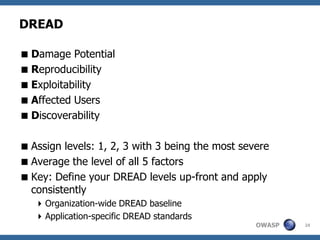
DREAD

 Damage Potential
 Reproducibility
 Exploitability
 Affected Users
 Discoverability

 Assign levels: 1, 2, 3 with 3 being the most severe
 Average the level of all 5 factors
 Key: Define your DREAD levels up-front and apply
  consistently
    Organization-wide DREAD baseline
    Application-specific DREAD standards
                                                  OWASP   24
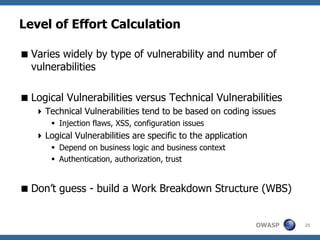
Level of Effort Calculation

 Varies widely by type of vulnerability and number of
  vulnerabilities

 Logical Vulnerabilities versus Technical Vulnerabilities
    Technical Vulnerabilities tend to be based on coding issues
        Injection flaws, XSS, configuration issues
    Logical Vulnerabilities are specific to the application
        Depend on business logic and business context
        Authentication, authorization, trust


 Don’t guess - build a Work Breakdown Structure (WBS)


                                                               OWASP   25
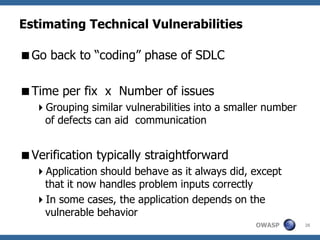
Estimating Technical Vulnerabilities

Go back to “coding” phase of SDLC

Time per fix x Number of issues
  Grouping similar vulnerabilities into a smaller number
   of defects can aid communication


Verification typically straightforward
  Application should behave as it always did, except
   that it now handles problem inputs correctly
  In some cases, the application depends on the
   vulnerable behavior
                                                OWASP       26
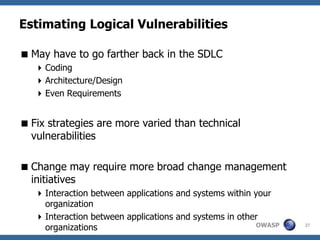
Estimating Logical Vulnerabilities

 May have to go farther back in the SDLC
    Coding
    Architecture/Design
    Even Requirements


 Fix strategies are more varied than technical
  vulnerabilities

 Change may require more broad change management
  initiatives
    Interaction between applications and systems within your
     organization
    Interaction between applications and systems in other
     organizations                                        OWASP   27
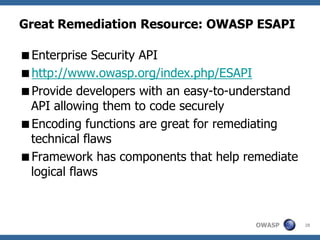
Great Remediation Resource: OWASP ESAPI

Enterprise Security API
http://www.owasp.org/index.php/ESAPI
Provide developers with an easy-to-understand
 API allowing them to code securely
Encoding functions are great for remediating
 technical flaws
Framework has components that help remediate
 logical flaws


                                       OWASP     28
Case Studies


               OWASP   29
Case Studies

Authentication FUBAR
Legacy Nightmares
When Tools Fail


                        OWASP   30
Authentication FUBAR

Situation
  Several public-facing flagship applications under
   moderate ongoing development
Vulnerabilities
  Various SQL injection and XSS
  Authorization problems
  Pervasive poor deployment practices (backup files,
   configuration issues)
  Verbose HTML comments with sensitive information
  Major, fundamental issue with Authentication
      Along the line of using SSNs to authenticate users to a
       system
                                                         OWASP
      Connected to many partner organizations
                                                                 31
Authentication FUBAR (continued)

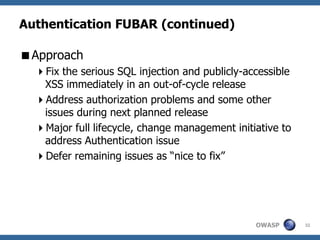
Approach
  Fix the serious SQL injection and publicly-accessible
   XSS immediately in an out-of-cycle release
  Address authorization problems and some other
   issues during next planned release
  Major full lifecycle, change management initiative to
   address Authentication issue
  Defer remaining issues as “nice to fix”


                                                OWASP      32
Legacy Nightmares

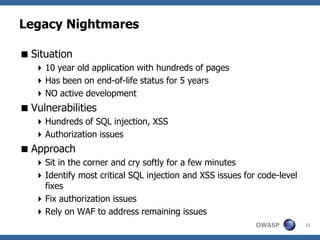
 Situation
    10 year old application with hundreds of pages
    Has been on end-of-life status for 5 years
    NO active development
 Vulnerabilities
    Hundreds of SQL injection, XSS
    Authorization issues
 Approach
    Sit in the corner and cry softly for a few minutes
    Identify most critical SQL injection and XSS issues for code-level
     fixes
    Fix authorization issues
    Rely on WAF to address remaining issues
                                                            OWASP         33
When Tools Fail

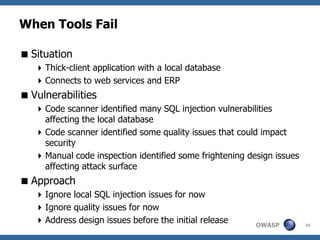
 Situation
    Thick-client application with a local database
    Connects to web services and ERP
 Vulnerabilities
    Code scanner identified many SQL injection vulnerabilities
     affecting the local database
    Code scanner identified some quality issues that could impact
     security
    Manual code inspection identified some frightening design issues
     affecting attack surface
 Approach
    Ignore local SQL injection issues for now
    Ignore quality issues for now
    Address design issues before the initial release     OWASP         34
Recommendations

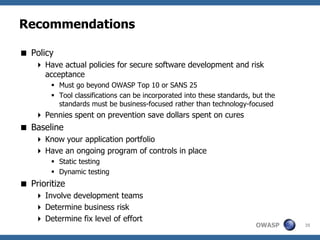
 Policy
     Have actual policies for secure software development and risk
      acceptance
         Must go beyond OWASP Top 10 or SANS 25
         Tool classifications can be incorporated into these standards, but the
          standards must be business-focused rather than technology-focused
     Pennies spent on prevention save dollars spent on cures
 Baseline
     Know your application portfolio
     Have an ongoing program of controls in place
         Static testing
         Dynamic testing
 Prioritize
     Involve development teams
     Determine business risk
     Determine fix level of effort
                                                                         OWASP     35
Recommendations (continued)

 Shield
    Consider using adding signatures to WAFs or web-relevant
     IDS/IPS systems
    Understand that these do not address the underlying problem
 Mitigate
    Features > Performance > Security
       (unfortunate fact of life in many cases)
    Communicate the business risk and compliance implications
    Work into development schedules as resources are available
    Consider out-of-cycle releases for serious vulnerabilities
 Maintain
    Web applications are dynamic and attacks evolve – this is an
     ongoing process
                                                          OWASP     36
Demo


       OWASP   37
Questions?

Dan Cornell
dan@denimgroup.com
Twitter: @danielcornell

(210) 572-4400

Web: www.denimgroup.com
Blog: denimgroup.typepad.com


                               OWASP   38

Vulnerability Management In An Application Security World: AppSecDC

  • 1.
    Vulnerability Management in an Application Security World Dan Cornell Global Membership Committee Denim Group dan@denimgroup.com AppSec DC (210) 572-4400 Twitter: @danielcornell November 12th, 2009 The OWASP Foundation http://www.owasp.org
  • 2.
    Agenda  Background  ALittle Bit of Theatre  You Found Vulnerabilities – Now What?  Vulnerability Management – The Security Perspective  Defect Management – The Development Perspective  Making it Work  Case Studies  Demo  Questions OWASP 2
  • 3.
    Background Dan Cornell OWASP: Sprajax, Open Review, San Antonio Chapter, Global Membership Committee Principal at Denim Group www.denimgroup.com Software Developer: MCSD, Java 2 Certified Programmer Denim Group Application Development and Remediation  Java and .NET Application Security  Assessments, penetration tests, code reviews, training, process consulting OWASP 3
  • 4.
    A Little Bitof Theatre OWASP 4
  • 5.
    A Little Bitof Theatre This is a one-act play entitled: “We Found Some Vulnerabilities” Need a volunteer OWASP 5
  • 6.
    Audience Composition? Software Developer InfrastructureSecurity Application Security Project Manager Other All of It OWASP 6
  • 7.
    You Found Vulnerabilities– Now What? OWASP 7
  • 8.
    You Found Vulnerabilities– Now What?  Security Industry is too focused on finding vulnerabilities  Especially in application security this typically isn’t hard  Finding vulnerabilities is of some value  Fixing vulnerabilities is of great value  Mark Curphey: Are You a Builder or a Breaker  http://securitybuddha.com/2008/09/10/are-you-a-builder-or-a-breaker/  Organization’s goal is to understand their risk exposure and bring that in-line with their policies  Finding vulnerabilities is only the first step on that road OWASP 8
  • 9.
    Vulnerability Management –The Security Perspective OWASP 9
  • 10.
    Vulnerability Management –The Security Perspective Steps: Policy Baseline Prioritize Shield Mitigate Maintain  For more information see: http://www.gartner.com/DisplayDocument?doc_cd=127481 OWASP 10
  • 11.
    So How AreWe Doing?  Policy  Does your organization have policies for Application Security?  Or is your policy “Use SSL and do the OWASP Top 10”?  Baseline  What are your organization’s testing strategies?  Hopefully not “Run scanner XYZ the day before an application goes into production”  Also – do you actually know how many applications you have in production?  Prioritize  How do you determine the business risk?  Critical, High, Medium, Low often does not account for enough context  To defend everything is to defend nothing OWASP 11
  • 12.
    So How AreWe Doing? (continued)  Shield  Have you deployed technologies to help protect you in the interim?  WAFs, IDS/IPF  Mitigate  Do your developers know what the actual problems are?  Do your developers know how to fix them?  When are these vulnerabilities going to be addressed and when do they go into production?  Did the application development team actually fix the vulnerabilities when they said they did?  Maintain  Web applications are dynamic – what is the ongoing testing strategy? OWASP 12
  • 13.
    Process OWASP 13
  • 14.
    Defect Management –The Developer Perspective OWASP 14
  • 15.
    Defect Management –The Developer Perspective Every day has 8 hours 12 if pizza and Jolt Cola are made available A given defect is going to require X hours to fix (+/- 50%) Tell me which defects you want me to fix and I will be done when I am done (+/- 50%) OWASP 15
  • 16.
    Why is VulnerabilityManagement Hard for Application-Level Vulnerabilities Actual business risk is challenging to determine People who find the problems do not typically know how to fix them Or at the very least they are not going to be the people who fix them People who have to fix the problems often do not understand them OWASP 16
  • 17.
    Why is VulnerabilityManagement Hard for Application-Level Vulnerabilities Infrastructure fixes are typically cookie-cutter, Application fixes are much more varied Patches and configuration settings Versus a full custom software development effort Software development teams are already overtaxed Applications no longer under active development may not have development environments, deployment procedures, etc OWASP 17
  • 18.
  • 19.
    Making It Work Applicationsecurity vulnerabilities must be treated as software defects Use risk and effort to prioritize OWASP 19
  • 20.
    Application Vulnerabilities asSoftware Defects Track them in your defect management system (bug tracker) Select defects to address for each development cycle or release Serious vulnerabilities may require out-of-cycle releases OWASP 20
  • 21.
    Risk and Effort Riskcrossed with remediation effort Risk: STRIDE and DREAD (there are others) Effort: Development hours and other resources OWASP 21
  • 22.
    Risk Calculation Exercise Quantitativerisk can be hard to calculate Weighted Cost = Likelihood of occurrence x Cost of occurrence What is the chance (%) that Amazon.com will have a publicly-accessible SQL injection vulnerability exploited within the next year? What would the financial damage be to Amazon.com if a publicly-accessible SQL injection vulnerability was exploited? OWASP 22
  • 23.
    STRIDE Spoofing Identity Tampering withData Repudiation Information Disclosure Denial of Service Elevation or Privilege OWASP 23
  • 24.
    DREAD  Damage Potential Reproducibility  Exploitability  Affected Users  Discoverability  Assign levels: 1, 2, 3 with 3 being the most severe  Average the level of all 5 factors  Key: Define your DREAD levels up-front and apply consistently  Organization-wide DREAD baseline  Application-specific DREAD standards OWASP 24
  • 25.
    Level of EffortCalculation  Varies widely by type of vulnerability and number of vulnerabilities  Logical Vulnerabilities versus Technical Vulnerabilities  Technical Vulnerabilities tend to be based on coding issues  Injection flaws, XSS, configuration issues  Logical Vulnerabilities are specific to the application  Depend on business logic and business context  Authentication, authorization, trust  Don’t guess - build a Work Breakdown Structure (WBS) OWASP 25
  • 26.
    Estimating Technical Vulnerabilities Goback to “coding” phase of SDLC Time per fix x Number of issues Grouping similar vulnerabilities into a smaller number of defects can aid communication Verification typically straightforward Application should behave as it always did, except that it now handles problem inputs correctly In some cases, the application depends on the vulnerable behavior OWASP 26
  • 27.
    Estimating Logical Vulnerabilities May have to go farther back in the SDLC  Coding  Architecture/Design  Even Requirements  Fix strategies are more varied than technical vulnerabilities  Change may require more broad change management initiatives  Interaction between applications and systems within your organization  Interaction between applications and systems in other organizations OWASP 27
  • 28.
    Great Remediation Resource:OWASP ESAPI Enterprise Security API http://www.owasp.org/index.php/ESAPI Provide developers with an easy-to-understand API allowing them to code securely Encoding functions are great for remediating technical flaws Framework has components that help remediate logical flaws OWASP 28
  • 29.
    Case Studies OWASP 29
  • 30.
    Case Studies Authentication FUBAR LegacyNightmares When Tools Fail OWASP 30
  • 31.
    Authentication FUBAR Situation Several public-facing flagship applications under moderate ongoing development Vulnerabilities Various SQL injection and XSS Authorization problems Pervasive poor deployment practices (backup files, configuration issues) Verbose HTML comments with sensitive information Major, fundamental issue with Authentication  Along the line of using SSNs to authenticate users to a system OWASP  Connected to many partner organizations 31
  • 32.
    Authentication FUBAR (continued) Approach Fix the serious SQL injection and publicly-accessible XSS immediately in an out-of-cycle release Address authorization problems and some other issues during next planned release Major full lifecycle, change management initiative to address Authentication issue Defer remaining issues as “nice to fix” OWASP 32
  • 33.
    Legacy Nightmares  Situation  10 year old application with hundreds of pages  Has been on end-of-life status for 5 years  NO active development  Vulnerabilities  Hundreds of SQL injection, XSS  Authorization issues  Approach  Sit in the corner and cry softly for a few minutes  Identify most critical SQL injection and XSS issues for code-level fixes  Fix authorization issues  Rely on WAF to address remaining issues OWASP 33
  • 34.
    When Tools Fail Situation  Thick-client application with a local database  Connects to web services and ERP  Vulnerabilities  Code scanner identified many SQL injection vulnerabilities affecting the local database  Code scanner identified some quality issues that could impact security  Manual code inspection identified some frightening design issues affecting attack surface  Approach  Ignore local SQL injection issues for now  Ignore quality issues for now  Address design issues before the initial release OWASP 34
  • 35.
    Recommendations  Policy  Have actual policies for secure software development and risk acceptance  Must go beyond OWASP Top 10 or SANS 25  Tool classifications can be incorporated into these standards, but the standards must be business-focused rather than technology-focused  Pennies spent on prevention save dollars spent on cures  Baseline  Know your application portfolio  Have an ongoing program of controls in place  Static testing  Dynamic testing  Prioritize  Involve development teams  Determine business risk  Determine fix level of effort OWASP 35
  • 36.
    Recommendations (continued)  Shield  Consider using adding signatures to WAFs or web-relevant IDS/IPS systems  Understand that these do not address the underlying problem  Mitigate  Features > Performance > Security  (unfortunate fact of life in many cases)  Communicate the business risk and compliance implications  Work into development schedules as resources are available  Consider out-of-cycle releases for serious vulnerabilities  Maintain  Web applications are dynamic and attacks evolve – this is an ongoing process OWASP 36
  • 37.
    Demo OWASP 37
  • 38.
    Questions? Dan Cornell dan@denimgroup.com Twitter: @danielcornell (210)572-4400 Web: www.denimgroup.com Blog: denimgroup.typepad.com OWASP 38