SESSION ID:
Mobile Application Assessment By The
Numbers – A Whole-istic View
MBS-F02
Dan Cornell
CTO
Denim Group
@danielcornell
#RSAC
Agenda
u  Background
u  Mobile Application Threat Model
u  Assessment Methodology
u  Data Collected
u  Findings
u  Types of Vulnerabilities Identified
u  Where Vulnerabilities Were Identified
u  How Vulnerabilities Were Identified
2
Background
#RSAC
Introduction
u  Data comes from:
u  61 Assessments
u  20 Applications
u  What we found:
u  957 Vulnerabilities
u  Assessment with the most vulnerabilities: 3 assessments had 10 Critical vulnerabilities
u  Assessments with the least vulnerabilities: only three assessments had one
vulnerability (all others had more)
4
#RSAC
Research Background
u  Mobile application threat model
u  Assessment methodology
u  Static versus dynamic testing
u  Automated versus manual testing
u  Why CWE?
u  Assessment data
5
#RSAC
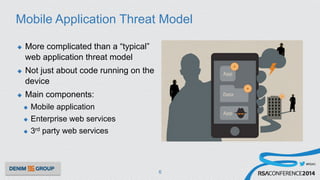
Mobile Application Threat Model
u  More complicated than a “typical”
web application threat model
u  Not just about code running on the
device
u  Main components:
u  Mobile application
u  Enterprise web services
u  3rd party web services
6
#RSAC
Assessment Methodology
u  Testing activities
u  Combination of both static and dynamic activities
u  Combination of automated tools, manual review of automated test results and manual testing
u  Tools include Fortify SCA, IBM Rational AppScan, Portswigger BurpSuite
u  Scope can include:
u  Code running on the device itself
u  Enterprise services
u  3rd party supporting services
7
#RSAC
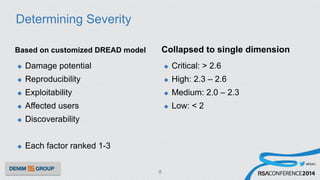
Determining Severity
Based on customized DREAD model
u  Damage potential
u  Reproducibility
u  Exploitability
u  Affected users
u  Discoverability
u  Each factor ranked 1-3
Collapsed to single dimension
u  Critical: > 2.6
u  High: 2.3 – 2.6
u  Medium: 2.0 – 2.3
u  Low: < 2
8
#RSAC
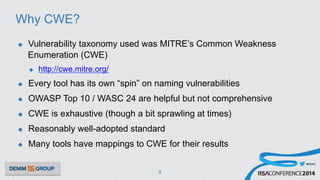
Why CWE?
u  Vulnerability taxonomy used was MITRE’s Common Weakness
Enumeration (CWE)
u  http://cwe.mitre.org/
u  Every tool has its own “spin” on naming vulnerabilities
u  OWASP Top 10 / WASC 24 are helpful but not comprehensive
u  CWE is exhaustive (though a bit sprawling at times)
u  Reasonably well-adopted standard
u  Many tools have mappings to CWE for their results
9
#RSAC
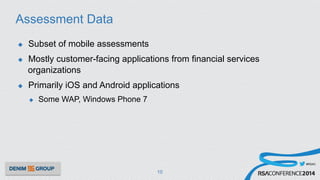
Assessment Data
u  Subset of mobile assessments
u  Mostly customer-facing applications from financial services
organizations
u  Primarily iOS and Android applications
u  Some WAP, Windows Phone 7
10
What Did We Find?
#RSAC
Types of Vulnerabilities Found
u  Top 10 Most Prevalent CWEs – Overall
u  Top 10 Most Prevalent CWEs – Critical/High Risk
12
#RSAC
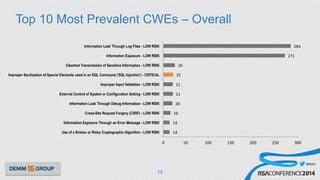
Top 10 Most Prevalent CWEs – Overall
13
14	
  
14	
  
16	
  
20	
  
21	
  
21	
  
22	
  
26	
  
271	
  
284	
  
0	
   50	
   100	
   150	
   200	
   250	
   300	
  
Use of a Broken or Risky Cryptographic Algorithm - LOW RISK
Information Exposure Through an Error Message - LOW RISK
Cross-Site Request Forgery (CSRF) - LOW RISK
Information Leak Through Debug Information - LOW RISK
External Control of System or Configuration Setting - LOW RISK
Improper Input Validation - LOW RISK
Improper Sanitization of Special Elements used in an SQL Command ('SQL Injection') - CRITICAL
Cleartext Transmission of Sensitive Information - LOW RISK
Information Exposure - LOW RISK
Information Leak Through Log Files - LOW RISK
#RSAC
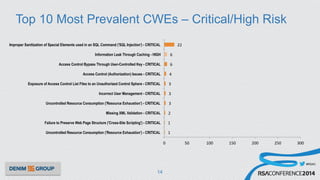
Top 10 Most Prevalent CWEs – Critical/High Risk
14
1	
  
1	
  
2	
  
3	
  
3	
  
3	
  
4	
  
6	
  
6	
  
22	
  
0	
   50	
   100	
   150	
   200	
   250	
   300	
  
Uncontrolled Resource Consumption ('Resource Exhaustion') - CRITICAL
Failure to Preserve Web Page Structure ('Cross-Site Scripting') - CRITICAL
Missing XML Validation - CRITICAL
Uncontrolled Resource Consumption ('Resource Exhaustion') - CRITICAL
Incorrect User Management - CRITICAL
Exposure of Access Control List Files to an Unauthorized Control Sphere - CRITICAL
Access Control (Authorization) Issues - CRITICAL
Access Control Bypass Through User-Controlled Key - CRITICAL
Information Leak Through Caching - HIGH
Improper Sanitization of Special Elements used in an SQL Command ('SQL Injection') - CRITICAL
#RSAC
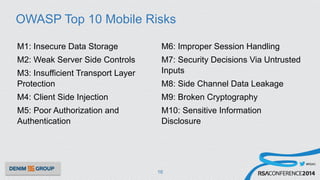
OWASP Top 10 Mobile Risks
u  Similar to the OWASP Top 10 Web Application Risks, but targeted at
mobile applications (obviously)
u  Top risks to mobile applications:
u  https://www.owasp.org/index.php/
OWASP_Mobile_Security_Project#tab=Top_Ten_Mobile_Risks
u  Work in progress to update this based on industry-contributed data
15
#RSAC
OWASP Top 10 Mobile Risks
M1: Insecure Data Storage
M2: Weak Server Side Controls
M3: Insufficient Transport Layer
Protection
M4: Client Side Injection
M5: Poor Authorization and
Authentication
M6: Improper Session Handling
M7: Security Decisions Via Untrusted
Inputs
M8: Side Channel Data Leakage
M9: Broken Cryptography
M10: Sensitive Information
Disclosure
16
#RSAC
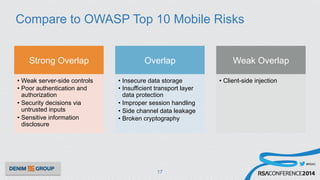
Compare to OWASP Top 10 Mobile Risks
17
Strong Overlap
•  Weak server-side controls
•  Poor authentication and
authorization
•  Security decisions via
untrusted inputs
•  Sensitive information
disclosure
Overlap
•  Insecure data storage
•  Insufficient transport layer
data protection
•  Improper session handling
•  Side channel data leakage
•  Broken cryptography
Weak Overlap
•  Client-side injection
#RSAC
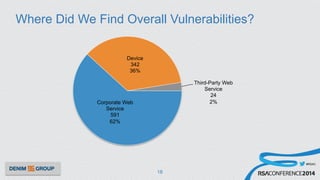
Where Did We Find Overall Vulnerabilities?
18
Corporate Web
Service
591
62%
Device
342
36%
Third-Party Web
Service
24
2%
#RSAC
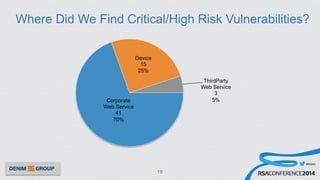
Where Did We Find Critical/High Risk Vulnerabilities?
19
Corporate
Web Service
41
70%
Device
15
25%
ThirdParty
Web Service
3
5%
#RSAC
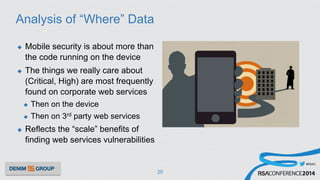
Analysis of “Where” Data
u  Mobile security is about more than
the code running on the device
u  The things we really care about
(Critical, High) are most frequently
found on corporate web services
u  Then on the device
u  Then on 3rd party web services
u  Reflects the “scale” benefits of
finding web services vulnerabilities
20
#RSAC
How Did We Find Vulnerabilities?
u  Static vs. dynamic testing
u  Automated vs. manual testing
u  What techniques identified the most vulnerabilities?
u  What techniques identified the most serious vulnerabilities?
21
#RSAC
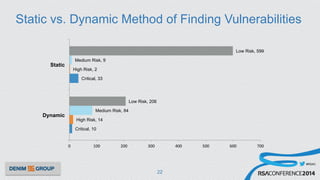
Static vs. Dynamic Method of Finding Vulnerabilities
22
Critical, 10
Critical, 33
High Risk, 14
High Risk, 2
Medium Risk, 84
Medium Risk, 9
Low Risk, 206
Low Risk, 599
0	
   100	
   200	
   300	
   400	
   500	
   600	
   700	
  
Dynamic
Static
#RSAC
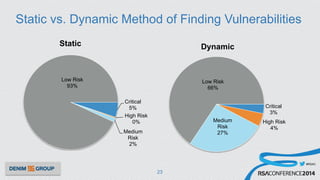
Static vs. Dynamic Method of Finding Vulnerabilities
23
Critical
5%
High Risk
0%
Medium
Risk
2%
Low Risk
93%
Static
Critical
3%
High Risk
4%
Medium
Risk
27%
Low Risk
66%
Dynamic
#RSAC
Critical and High Risk Vulnerabilities
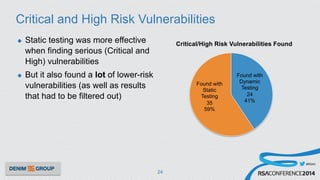
u  Static testing was more effective
when finding serious (Critical and
High) vulnerabilities
u  But it also found a lot of lower-risk
vulnerabilities (as well as results
that had to be filtered out)
24
Found with
Dynamic
Testing
24
41%
Found with
Static
Testing
35
59%
Critical/High Risk Vulnerabilities Found
#RSAC
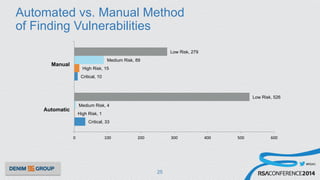
Automated vs. Manual Method
of Finding Vulnerabilities
25
Critical, 33
Critical, 10
High Risk, 1
High Risk, 15
Medium Risk, 4
Medium Risk, 89
Low Risk, 526
Low Risk, 279
0	
   100	
   200	
   300	
   400	
   500	
   600	
  
Automatic
Manual
#RSAC
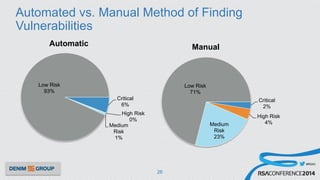
Automated vs. Manual Method of Finding
Vulnerabilities
26
Critical
6%
High Risk
0%
Medium
Risk
1%
Low Risk
93%
Automatic
Critical
2%
High Risk
4%Medium
Risk
23%
Low Risk
71%
Manual
#RSAC
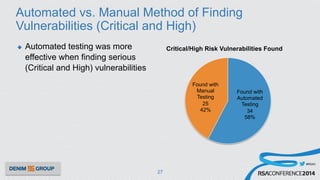
Automated vs. Manual Method of Finding
Vulnerabilities (Critical and High)
u  Automated testing was more
effective when finding serious
(Critical and High) vulnerabilities
27
Found with
Automated
Testing
34
58%
Found with
Manual
Testing
25
42%
Critical/High Risk Vulnerabilities Found
#RSAC
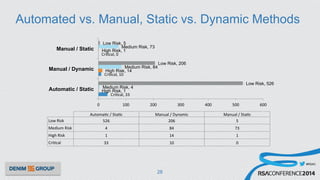
Automated vs. Manual, Static vs. Dynamic Methods
28
Cri.cal,	
  33	
  
Cri.cal,	
  10	
  
Cri.cal,	
  0	
  
High Risk, 1
High Risk, 14
High Risk, 1
Medium Risk, 4
Medium Risk, 84
Medium Risk, 73
Low Risk, 526
Low Risk, 206
Low Risk, 5
0	
   100	
   200	
   300	
   400	
   500	
   600	
  
Automatic / Static
Manual / Dynamic
Manual / Static
Automa.c	
  /	
  Sta.c	
   Manual	
  /	
  Dynamic	
   Manual	
  /	
  Sta.c	
  
Low	
  Risk	
   526	
   206	
   5	
  
Medium	
  Risk	
   4	
   84	
   73	
  
High	
  Risk	
   1	
   14	
   1	
  
Cri.cal	
   33	
   10	
   0	
  
#RSAC
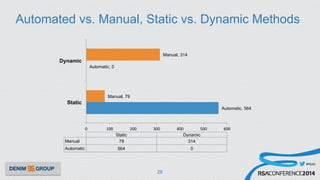
Automated vs. Manual, Static vs. Dynamic Methods
29
Automatic, 564
Automatic, 0
Manual, 79
Manual, 314
0	
   100	
   200	
   300	
   400	
   500	
   600	
  
Static
Dynamic
Static Dynamic
Manual 79 314
Automatic 564 0
#RSAC
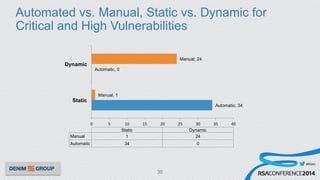
Automated vs. Manual, Static vs. Dynamic for
Critical and High Vulnerabilities
30
Automatic, 34
Automatic, 0
Manual, 1
Manual, 24
0	
   5	
   10	
   15	
   20	
   25	
   30	
   35	
   40	
  
Static
Dynamic
Static Dynamic
Manual 1 24
Automatic 34 0
#RSAC
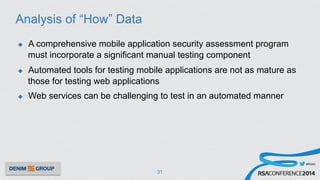
Analysis of “How” Data
u  A comprehensive mobile application security assessment program
must incorporate a significant manual testing component
u  Automated tools for testing mobile applications are not as mature as
those for testing web applications
u  Web services can be challenging to test in an automated manner
31
#RSAC
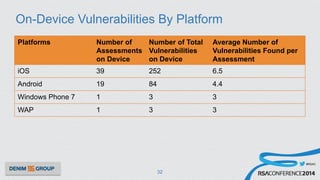
On-Device Vulnerabilities By Platform
Platforms Number of
Assessments
on Device
Number of Total
Vulnerabilities
on Device
Average Number of
Vulnerabilities Found per
Assessment
iOS 39 252 6.5
Android 19 84 4.4
Windows Phone 7 1 3 3
WAP 1 3 3
32
#RSAC
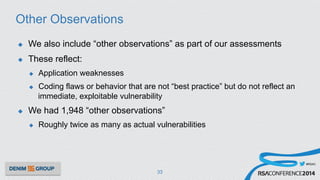
Other Observations
u  We also include “other observations” as part of our assessments
u  These reflect:
u  Application weaknesses
u  Coding flaws or behavior that are not “best practice” but do not reflect an
immediate, exploitable vulnerability
u  We had 1,948 “other observations”
u  Roughly twice as many as actual vulnerabilities
33
#RSAC
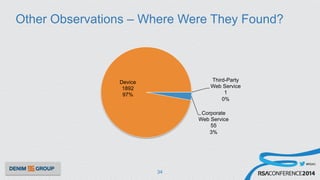
Other Observations – Where Were They Found?
34
Corporate
Web Service
55
3%
Device
1892
97%
Third-Party
Web Service
1
0%
#RSAC
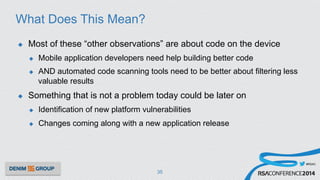
What Does This Mean?
u  Most of these “other observations” are about code on the device
u  Mobile application developers need help building better code
u  AND automated code scanning tools need to be better about filtering less
valuable results
u  Something that is not a problem today could be later on
u  Identification of new platform vulnerabilities
u  Changes coming along with a new application release
35
#RSAC
Conclusions
u  What To Test?
u  Mobile “apps” are not standalone applications
u  They are systems of applications
u  Serious vulnerabilities can exist in any system component
u  How To Test?
u  Mobile application testing does benefit from automation
u  Manual review and testing is required to find the most serious issues
u  A combination of static and dynamic testing is required for coverage
36
#RSAC
Recommendations
u  Plan your mobile application assessment strategy with coverage in mind
u  Evaluate the value of automation for your testing
u  More “cost” than simply licensing – deployment time and results culling
u  Look for opportunities to streamline
u  Fast application release cycles can require frequent assessments
u  Control scope:
u  Assess application changes (versus entire applications)
u  Manage cost of reporting
37
#RSAC
Next Steps (For Us)
u  Incorporate more assessment data
u  Possible collaboration with OWASP Top 10 Mobile Risks
u  Currently being reworked based on data sets such as ours
u  Better analysis of applications over time
38

Mobile Application Assessment By the Numbers: a Whole-istic View

  • 1.
    SESSION ID: Mobile ApplicationAssessment By The Numbers – A Whole-istic View MBS-F02 Dan Cornell CTO Denim Group @danielcornell
  • 2.
    #RSAC Agenda u  Background u  MobileApplication Threat Model u  Assessment Methodology u  Data Collected u  Findings u  Types of Vulnerabilities Identified u  Where Vulnerabilities Were Identified u  How Vulnerabilities Were Identified 2
  • 3.
  • 4.
    #RSAC Introduction u  Data comesfrom: u  61 Assessments u  20 Applications u  What we found: u  957 Vulnerabilities u  Assessment with the most vulnerabilities: 3 assessments had 10 Critical vulnerabilities u  Assessments with the least vulnerabilities: only three assessments had one vulnerability (all others had more) 4
  • 5.
    #RSAC Research Background u  Mobileapplication threat model u  Assessment methodology u  Static versus dynamic testing u  Automated versus manual testing u  Why CWE? u  Assessment data 5
  • 6.
    #RSAC Mobile Application ThreatModel u  More complicated than a “typical” web application threat model u  Not just about code running on the device u  Main components: u  Mobile application u  Enterprise web services u  3rd party web services 6
  • 7.
    #RSAC Assessment Methodology u  Testingactivities u  Combination of both static and dynamic activities u  Combination of automated tools, manual review of automated test results and manual testing u  Tools include Fortify SCA, IBM Rational AppScan, Portswigger BurpSuite u  Scope can include: u  Code running on the device itself u  Enterprise services u  3rd party supporting services 7
  • 8.
    #RSAC Determining Severity Based oncustomized DREAD model u  Damage potential u  Reproducibility u  Exploitability u  Affected users u  Discoverability u  Each factor ranked 1-3 Collapsed to single dimension u  Critical: > 2.6 u  High: 2.3 – 2.6 u  Medium: 2.0 – 2.3 u  Low: < 2 8
  • 9.
    #RSAC Why CWE? u  Vulnerabilitytaxonomy used was MITRE’s Common Weakness Enumeration (CWE) u  http://cwe.mitre.org/ u  Every tool has its own “spin” on naming vulnerabilities u  OWASP Top 10 / WASC 24 are helpful but not comprehensive u  CWE is exhaustive (though a bit sprawling at times) u  Reasonably well-adopted standard u  Many tools have mappings to CWE for their results 9
  • 10.
    #RSAC Assessment Data u  Subsetof mobile assessments u  Mostly customer-facing applications from financial services organizations u  Primarily iOS and Android applications u  Some WAP, Windows Phone 7 10
  • 11.
  • 12.
    #RSAC Types of VulnerabilitiesFound u  Top 10 Most Prevalent CWEs – Overall u  Top 10 Most Prevalent CWEs – Critical/High Risk 12
  • 13.
    #RSAC Top 10 MostPrevalent CWEs – Overall 13 14   14   16   20   21   21   22   26   271   284   0   50   100   150   200   250   300   Use of a Broken or Risky Cryptographic Algorithm - LOW RISK Information Exposure Through an Error Message - LOW RISK Cross-Site Request Forgery (CSRF) - LOW RISK Information Leak Through Debug Information - LOW RISK External Control of System or Configuration Setting - LOW RISK Improper Input Validation - LOW RISK Improper Sanitization of Special Elements used in an SQL Command ('SQL Injection') - CRITICAL Cleartext Transmission of Sensitive Information - LOW RISK Information Exposure - LOW RISK Information Leak Through Log Files - LOW RISK
  • 14.
    #RSAC Top 10 MostPrevalent CWEs – Critical/High Risk 14 1   1   2   3   3   3   4   6   6   22   0   50   100   150   200   250   300   Uncontrolled Resource Consumption ('Resource Exhaustion') - CRITICAL Failure to Preserve Web Page Structure ('Cross-Site Scripting') - CRITICAL Missing XML Validation - CRITICAL Uncontrolled Resource Consumption ('Resource Exhaustion') - CRITICAL Incorrect User Management - CRITICAL Exposure of Access Control List Files to an Unauthorized Control Sphere - CRITICAL Access Control (Authorization) Issues - CRITICAL Access Control Bypass Through User-Controlled Key - CRITICAL Information Leak Through Caching - HIGH Improper Sanitization of Special Elements used in an SQL Command ('SQL Injection') - CRITICAL
  • 15.
    #RSAC OWASP Top 10Mobile Risks u  Similar to the OWASP Top 10 Web Application Risks, but targeted at mobile applications (obviously) u  Top risks to mobile applications: u  https://www.owasp.org/index.php/ OWASP_Mobile_Security_Project#tab=Top_Ten_Mobile_Risks u  Work in progress to update this based on industry-contributed data 15
  • 16.
    #RSAC OWASP Top 10Mobile Risks M1: Insecure Data Storage M2: Weak Server Side Controls M3: Insufficient Transport Layer Protection M4: Client Side Injection M5: Poor Authorization and Authentication M6: Improper Session Handling M7: Security Decisions Via Untrusted Inputs M8: Side Channel Data Leakage M9: Broken Cryptography M10: Sensitive Information Disclosure 16
  • 17.
    #RSAC Compare to OWASPTop 10 Mobile Risks 17 Strong Overlap •  Weak server-side controls •  Poor authentication and authorization •  Security decisions via untrusted inputs •  Sensitive information disclosure Overlap •  Insecure data storage •  Insufficient transport layer data protection •  Improper session handling •  Side channel data leakage •  Broken cryptography Weak Overlap •  Client-side injection
  • 18.
    #RSAC Where Did WeFind Overall Vulnerabilities? 18 Corporate Web Service 591 62% Device 342 36% Third-Party Web Service 24 2%
  • 19.
    #RSAC Where Did WeFind Critical/High Risk Vulnerabilities? 19 Corporate Web Service 41 70% Device 15 25% ThirdParty Web Service 3 5%
  • 20.
    #RSAC Analysis of “Where”Data u  Mobile security is about more than the code running on the device u  The things we really care about (Critical, High) are most frequently found on corporate web services u  Then on the device u  Then on 3rd party web services u  Reflects the “scale” benefits of finding web services vulnerabilities 20
  • 21.
    #RSAC How Did WeFind Vulnerabilities? u  Static vs. dynamic testing u  Automated vs. manual testing u  What techniques identified the most vulnerabilities? u  What techniques identified the most serious vulnerabilities? 21
  • 22.
    #RSAC Static vs. DynamicMethod of Finding Vulnerabilities 22 Critical, 10 Critical, 33 High Risk, 14 High Risk, 2 Medium Risk, 84 Medium Risk, 9 Low Risk, 206 Low Risk, 599 0   100   200   300   400   500   600   700   Dynamic Static
  • 23.
    #RSAC Static vs. DynamicMethod of Finding Vulnerabilities 23 Critical 5% High Risk 0% Medium Risk 2% Low Risk 93% Static Critical 3% High Risk 4% Medium Risk 27% Low Risk 66% Dynamic
  • 24.
    #RSAC Critical and HighRisk Vulnerabilities u  Static testing was more effective when finding serious (Critical and High) vulnerabilities u  But it also found a lot of lower-risk vulnerabilities (as well as results that had to be filtered out) 24 Found with Dynamic Testing 24 41% Found with Static Testing 35 59% Critical/High Risk Vulnerabilities Found
  • 25.
    #RSAC Automated vs. ManualMethod of Finding Vulnerabilities 25 Critical, 33 Critical, 10 High Risk, 1 High Risk, 15 Medium Risk, 4 Medium Risk, 89 Low Risk, 526 Low Risk, 279 0   100   200   300   400   500   600   Automatic Manual
  • 26.
    #RSAC Automated vs. ManualMethod of Finding Vulnerabilities 26 Critical 6% High Risk 0% Medium Risk 1% Low Risk 93% Automatic Critical 2% High Risk 4%Medium Risk 23% Low Risk 71% Manual
  • 27.
    #RSAC Automated vs. ManualMethod of Finding Vulnerabilities (Critical and High) u  Automated testing was more effective when finding serious (Critical and High) vulnerabilities 27 Found with Automated Testing 34 58% Found with Manual Testing 25 42% Critical/High Risk Vulnerabilities Found
  • 28.
    #RSAC Automated vs. Manual,Static vs. Dynamic Methods 28 Cri.cal,  33   Cri.cal,  10   Cri.cal,  0   High Risk, 1 High Risk, 14 High Risk, 1 Medium Risk, 4 Medium Risk, 84 Medium Risk, 73 Low Risk, 526 Low Risk, 206 Low Risk, 5 0   100   200   300   400   500   600   Automatic / Static Manual / Dynamic Manual / Static Automa.c  /  Sta.c   Manual  /  Dynamic   Manual  /  Sta.c   Low  Risk   526   206   5   Medium  Risk   4   84   73   High  Risk   1   14   1   Cri.cal   33   10   0  
  • 29.
    #RSAC Automated vs. Manual,Static vs. Dynamic Methods 29 Automatic, 564 Automatic, 0 Manual, 79 Manual, 314 0   100   200   300   400   500   600   Static Dynamic Static Dynamic Manual 79 314 Automatic 564 0
  • 30.
    #RSAC Automated vs. Manual,Static vs. Dynamic for Critical and High Vulnerabilities 30 Automatic, 34 Automatic, 0 Manual, 1 Manual, 24 0   5   10   15   20   25   30   35   40   Static Dynamic Static Dynamic Manual 1 24 Automatic 34 0
  • 31.
    #RSAC Analysis of “How”Data u  A comprehensive mobile application security assessment program must incorporate a significant manual testing component u  Automated tools for testing mobile applications are not as mature as those for testing web applications u  Web services can be challenging to test in an automated manner 31
  • 32.
    #RSAC On-Device Vulnerabilities ByPlatform Platforms Number of Assessments on Device Number of Total Vulnerabilities on Device Average Number of Vulnerabilities Found per Assessment iOS 39 252 6.5 Android 19 84 4.4 Windows Phone 7 1 3 3 WAP 1 3 3 32
  • 33.
    #RSAC Other Observations u  Wealso include “other observations” as part of our assessments u  These reflect: u  Application weaknesses u  Coding flaws or behavior that are not “best practice” but do not reflect an immediate, exploitable vulnerability u  We had 1,948 “other observations” u  Roughly twice as many as actual vulnerabilities 33
  • 34.
    #RSAC Other Observations –Where Were They Found? 34 Corporate Web Service 55 3% Device 1892 97% Third-Party Web Service 1 0%
  • 35.
    #RSAC What Does ThisMean? u  Most of these “other observations” are about code on the device u  Mobile application developers need help building better code u  AND automated code scanning tools need to be better about filtering less valuable results u  Something that is not a problem today could be later on u  Identification of new platform vulnerabilities u  Changes coming along with a new application release 35
  • 36.
    #RSAC Conclusions u  What ToTest? u  Mobile “apps” are not standalone applications u  They are systems of applications u  Serious vulnerabilities can exist in any system component u  How To Test? u  Mobile application testing does benefit from automation u  Manual review and testing is required to find the most serious issues u  A combination of static and dynamic testing is required for coverage 36
  • 37.
    #RSAC Recommendations u  Plan yourmobile application assessment strategy with coverage in mind u  Evaluate the value of automation for your testing u  More “cost” than simply licensing – deployment time and results culling u  Look for opportunities to streamline u  Fast application release cycles can require frequent assessments u  Control scope: u  Assess application changes (versus entire applications) u  Manage cost of reporting 37
  • 38.
    #RSAC Next Steps (ForUs) u  Incorporate more assessment data u  Possible collaboration with OWASP Top 10 Mobile Risks u  Currently being reworked based on data sets such as ours u  Better analysis of applications over time 38