Arpan Deyasi
Dept of ECE, RCCIIT, Kolkata, India
Course: MCE203A
VSAT & DSB-TV
5/11/2020 1Arpan Deyasi, RCCIIT, MCE203A
5/11/2020 2Arpan Deyasi, RCCIIT, MCE203A
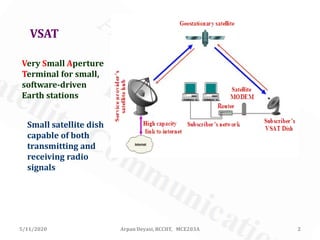
Very Small Aperture
Terminal for small,
software-driven
Earth stations
Small satellite dish
capable of both
transmitting and
receiving radio
signals
VSAT
5/11/2020 Arpan Deyasi, RCCIIT, MCE203A 3
Mostly designed at 6/4 GHz, 14/11-12 GHz and
30/20 GHz frequency bands
Involves FDMA or TDMA techniques
Date rate: 4 Kbps – 16 Mbps
Used for reliable transmission of data, voice, video,
audio via satellite
VSAT
5/11/2020 4Arpan Deyasi, RCCIIT, MCE203A
VSAT
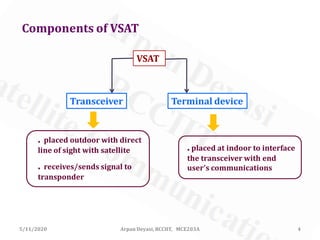
Transceiver Terminal device
. placed outdoor with direct
line of sight with satellite
. receives/sends signal to
transponder
. placed at indoor to interface
the transceiver with end
user’s communications
Components of VSAT
5/11/2020 5Arpan Deyasi, RCCIIT, MCE203A
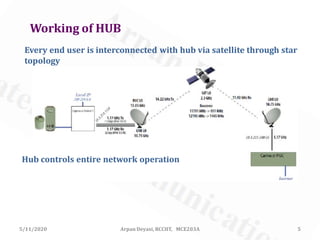
Working of HUB
Every end user is interconnected with hub via satellite through star
topology
Hub controls entire network operation
5/11/2020 6Arpan Deyasi, RCCIIT, MCE203A
Configuration of VSAT
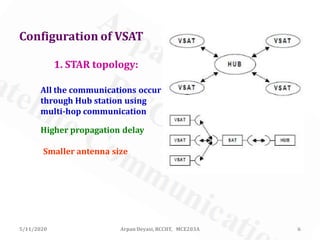
1. STAR topology:
All the communications occur
through Hub station using
multi-hop communication
Higher propagation delay
Smaller antenna size
5/11/2020 Arpan Deyasi, RCCIIT, MCE203A 7
Used by TDMA VSATs
High central hub investment
1. STAR topology:
Ideally suited for interactive
data applications
Large organizations demand it
for centralized data processing
requirements
Classified into Shared Hub and
distributed Hub types
5/11/2020 Arpan Deyasi, RCCIIT, MCE203A 8
• In Shared Hub Network type, one large hub station is used and
all the VSATs are divided into sub-networks
• Each sub-network is assigned to particular CUG (Closed User
Group)
• Different CUG is created for all the clients separately
• Each CUG will have their own inbound and outbound RF carriers
VSATs in all the CUGs use the same one Hub station
1. STAR topology:
o In Distributed Hub Network type, each network will have its
own hub station known as "min-Hub“
o This mini hub is located near the client's premises
o In this network, all the clients will have its own traffic hub
dedicated to its own CUG
5/11/2020 9Arpan Deyasi, RCCIIT, MCE203A
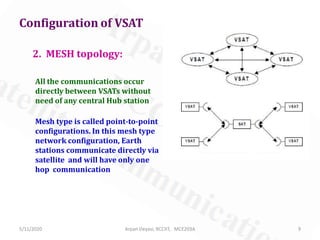
2. MESH topology:
All the communications occur
directly between VSATs without
need of any central Hub station
Mesh type is called point-to-point
configurations. In this mesh type
network configuration, Earth
stations communicate directly via
satellite and will have only one
hop communication
Configuration of VSAT
5/11/2020 Arpan Deyasi, RCCIIT, MCE203A 10
Used for telephony applications
2. MESH topology:
Lower propagation delay
Used by FDMA VSATs
Lower central hub investments
Larger antenna size
Suited for high data-traffic
5/11/2020 11Arpan Deyasi, RCCIIT, MCE203A
minimize overall cost of network
improves data communication
3. Combination of STAR & MESH topology:
5/11/2020 Arpan Deyasi, RCCIIT, MCE203A 12
Multiple Access Techniques in VSAT
[i] PAMA: Permanently Assigned Multiple Access
[ii] DAMA: Demand Assigned Multiple Access
5/11/2020 Arpan Deyasi, RCCIIT, MCE203A 13
In PAMA, every user is assigned a fixed channel, irrespective of
whether it is used or not
This is very inefficient as the channels are allotted to users even
when there is no requirement
PAMA is also known as Fixed Assigned Multiple Access (FAMA)
PAMA protocols are considered the most effective techniques for
those satellite networks with a small number of terminals
Permanently Assigned Multiple Access (PAMA)
5/11/2020 Arpan Deyasi, RCCIIT, MCE203A 14
Permanently Assigned Multiple Access (PAMA)
Advantages of PAMA:
Perfect for constant-bit-rate-type sources
Straightforward scheduler
Channel usage is contention-free
Disadvantages of PAMA:
Considerable bandwidth usage
Not flexible while working with terminals having
variable bit rates
5/11/2020 15Arpan Deyasi, RCCIIT, MCE203A
Demand Assigned Multiple Access (DAMA) is a protocol used in
satellite communications, particularly VSAT systems
DAMA enables efficient and instantaneous assignment of
transponder channels on a first come, first served basis
according to data priority
Typical VSAT systems use DAMA for point-of-sale (POS)
transactions, such as credit card, polling or radio frequency
identification; remote location Internet access and mobile
maritime communications
Demand Assigned Multiple Access (DAMA)
5/11/2020 16Arpan Deyasi, RCCIIT, MCE203A
Characteristics of VSAT systems
1. Reliable communication: error-free digital communication
with more than 99.7% reliability
2. Remote communication: remote diagnosis, monitoring and
data streaming services are possible
3. Network management: Easier network monitoring and
control
5/11/2020 17Arpan Deyasi, RCCIIT, MCE203A
4. Time: deployment takes 1-1.5 months
5. Maintenance: single point contact for operation,
maintenance, fault isolation, trouble shooting
6. Cost: Comparatively less compared with leased line
7. Flexibility: enormous expansion capability even in
remote places
Characteristics of VSAT systems
5/11/2020 18Arpan Deyasi, RCCIIT, MCE203A
Advantages of VSAT
Brings service directly to end-user by reducing
hierarchical distribution network and therefore,
hierarchical cost
5/11/2020 19Arpan Deyasi, RCCIIT, MCE203A
Limitations of VSAT
High initial cost for launching satellite in Geo-synchronous orbit
Requires clear line of sight between dish and satellite
Higher latency
Probability of damaging of antenna
Rain attenuation detoriates performance
5/11/2020 20Arpan Deyasi, RCCIIT, MCE203A
Uses of VSAT
Receiving internal communications
Interactive distance learning courses
Financial management
Data processing
Telemetry & Data collection
Virtual Private Network
Remote location access
5/11/2020 Arpan Deyasi, RCCIIT, MCE203A 21
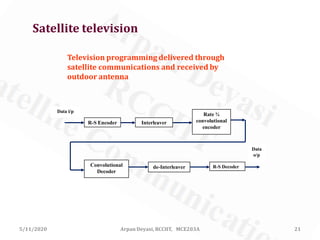
Satellite television
Television programming delivered through
satellite communications and received by
outdoor antenna
R-S Encoder Interleaver
Rate ¾
convolutional
encoder
Convolutional
Decoder
de-Interleaver R-S Decoder
Data i/p
Data
o/p
5/11/2020 Arpan Deyasi, RCCIIT, MCE203A 22
Working principle
Uplink dish is pointed towards a specific satellite and uplink
signal is transmitted within a frequency range
Signal received by transponder and send to satellite
Transponder re-transmit the downlink signal to Earth
Set-top box demodulates and converts it in desired form
5/11/2020 Arpan Deyasi, RCCIIT, MCE203A 23
Features of Satellite TV
High definition
Simple user interface
Internal drive
Remote management
Digital video recorder
Detailed program information
Keyword search
Favorite list
5/11/2020 24Arpan Deyasi, RCCIIT, MCE203A
https://www.rfwireless-world.com/Tutorials/satellite-network-
configuration.html
https://www.techopedia.com/
A. K. Maini, V. Agarawal, “Satellite Communications”, Wiley, 1st Ed.,
2019
T. Pratt, C. Bostian, J. Allnutt, “Satellite Communications”, John
Wiley & Sons, 2nd Ed., 2003
References

VSAT

  • 1.
    Arpan Deyasi Dept ofECE, RCCIIT, Kolkata, India Course: MCE203A VSAT & DSB-TV 5/11/2020 1Arpan Deyasi, RCCIIT, MCE203A
  • 2.
    5/11/2020 2Arpan Deyasi,RCCIIT, MCE203A Very Small Aperture Terminal for small, software-driven Earth stations Small satellite dish capable of both transmitting and receiving radio signals VSAT
  • 3.
    5/11/2020 Arpan Deyasi,RCCIIT, MCE203A 3 Mostly designed at 6/4 GHz, 14/11-12 GHz and 30/20 GHz frequency bands Involves FDMA or TDMA techniques Date rate: 4 Kbps – 16 Mbps Used for reliable transmission of data, voice, video, audio via satellite VSAT
  • 4.
    5/11/2020 4Arpan Deyasi,RCCIIT, MCE203A VSAT Transceiver Terminal device . placed outdoor with direct line of sight with satellite . receives/sends signal to transponder . placed at indoor to interface the transceiver with end user’s communications Components of VSAT
  • 5.
    5/11/2020 5Arpan Deyasi,RCCIIT, MCE203A Working of HUB Every end user is interconnected with hub via satellite through star topology Hub controls entire network operation
  • 6.
    5/11/2020 6Arpan Deyasi,RCCIIT, MCE203A Configuration of VSAT 1. STAR topology: All the communications occur through Hub station using multi-hop communication Higher propagation delay Smaller antenna size
  • 7.
    5/11/2020 Arpan Deyasi,RCCIIT, MCE203A 7 Used by TDMA VSATs High central hub investment 1. STAR topology: Ideally suited for interactive data applications Large organizations demand it for centralized data processing requirements Classified into Shared Hub and distributed Hub types
  • 8.
    5/11/2020 Arpan Deyasi,RCCIIT, MCE203A 8 • In Shared Hub Network type, one large hub station is used and all the VSATs are divided into sub-networks • Each sub-network is assigned to particular CUG (Closed User Group) • Different CUG is created for all the clients separately • Each CUG will have their own inbound and outbound RF carriers VSATs in all the CUGs use the same one Hub station 1. STAR topology: o In Distributed Hub Network type, each network will have its own hub station known as "min-Hub“ o This mini hub is located near the client's premises o In this network, all the clients will have its own traffic hub dedicated to its own CUG
  • 9.
    5/11/2020 9Arpan Deyasi,RCCIIT, MCE203A 2. MESH topology: All the communications occur directly between VSATs without need of any central Hub station Mesh type is called point-to-point configurations. In this mesh type network configuration, Earth stations communicate directly via satellite and will have only one hop communication Configuration of VSAT
  • 10.
    5/11/2020 Arpan Deyasi,RCCIIT, MCE203A 10 Used for telephony applications 2. MESH topology: Lower propagation delay Used by FDMA VSATs Lower central hub investments Larger antenna size Suited for high data-traffic
  • 11.
    5/11/2020 11Arpan Deyasi,RCCIIT, MCE203A minimize overall cost of network improves data communication 3. Combination of STAR & MESH topology:
  • 12.
    5/11/2020 Arpan Deyasi,RCCIIT, MCE203A 12 Multiple Access Techniques in VSAT [i] PAMA: Permanently Assigned Multiple Access [ii] DAMA: Demand Assigned Multiple Access
  • 13.
    5/11/2020 Arpan Deyasi,RCCIIT, MCE203A 13 In PAMA, every user is assigned a fixed channel, irrespective of whether it is used or not This is very inefficient as the channels are allotted to users even when there is no requirement PAMA is also known as Fixed Assigned Multiple Access (FAMA) PAMA protocols are considered the most effective techniques for those satellite networks with a small number of terminals Permanently Assigned Multiple Access (PAMA)
  • 14.
    5/11/2020 Arpan Deyasi,RCCIIT, MCE203A 14 Permanently Assigned Multiple Access (PAMA) Advantages of PAMA: Perfect for constant-bit-rate-type sources Straightforward scheduler Channel usage is contention-free Disadvantages of PAMA: Considerable bandwidth usage Not flexible while working with terminals having variable bit rates
  • 15.
    5/11/2020 15Arpan Deyasi,RCCIIT, MCE203A Demand Assigned Multiple Access (DAMA) is a protocol used in satellite communications, particularly VSAT systems DAMA enables efficient and instantaneous assignment of transponder channels on a first come, first served basis according to data priority Typical VSAT systems use DAMA for point-of-sale (POS) transactions, such as credit card, polling or radio frequency identification; remote location Internet access and mobile maritime communications Demand Assigned Multiple Access (DAMA)
  • 16.
    5/11/2020 16Arpan Deyasi,RCCIIT, MCE203A Characteristics of VSAT systems 1. Reliable communication: error-free digital communication with more than 99.7% reliability 2. Remote communication: remote diagnosis, monitoring and data streaming services are possible 3. Network management: Easier network monitoring and control
  • 17.
    5/11/2020 17Arpan Deyasi,RCCIIT, MCE203A 4. Time: deployment takes 1-1.5 months 5. Maintenance: single point contact for operation, maintenance, fault isolation, trouble shooting 6. Cost: Comparatively less compared with leased line 7. Flexibility: enormous expansion capability even in remote places Characteristics of VSAT systems
  • 18.
    5/11/2020 18Arpan Deyasi,RCCIIT, MCE203A Advantages of VSAT Brings service directly to end-user by reducing hierarchical distribution network and therefore, hierarchical cost
  • 19.
    5/11/2020 19Arpan Deyasi,RCCIIT, MCE203A Limitations of VSAT High initial cost for launching satellite in Geo-synchronous orbit Requires clear line of sight between dish and satellite Higher latency Probability of damaging of antenna Rain attenuation detoriates performance
  • 20.
    5/11/2020 20Arpan Deyasi,RCCIIT, MCE203A Uses of VSAT Receiving internal communications Interactive distance learning courses Financial management Data processing Telemetry & Data collection Virtual Private Network Remote location access
  • 21.
    5/11/2020 Arpan Deyasi,RCCIIT, MCE203A 21 Satellite television Television programming delivered through satellite communications and received by outdoor antenna R-S Encoder Interleaver Rate ¾ convolutional encoder Convolutional Decoder de-Interleaver R-S Decoder Data i/p Data o/p
  • 22.
    5/11/2020 Arpan Deyasi,RCCIIT, MCE203A 22 Working principle Uplink dish is pointed towards a specific satellite and uplink signal is transmitted within a frequency range Signal received by transponder and send to satellite Transponder re-transmit the downlink signal to Earth Set-top box demodulates and converts it in desired form
  • 23.
    5/11/2020 Arpan Deyasi,RCCIIT, MCE203A 23 Features of Satellite TV High definition Simple user interface Internal drive Remote management Digital video recorder Detailed program information Keyword search Favorite list
  • 24.
    5/11/2020 24Arpan Deyasi,RCCIIT, MCE203A https://www.rfwireless-world.com/Tutorials/satellite-network- configuration.html https://www.techopedia.com/ A. K. Maini, V. Agarawal, “Satellite Communications”, Wiley, 1st Ed., 2019 T. Pratt, C. Bostian, J. Allnutt, “Satellite Communications”, John Wiley & Sons, 2nd Ed., 2003 References