Satellite Communication
Overview
• Satellite is a microwave repeater in the
space.
• There are about 750 satellite in the space,
most of them are used for communication.
• They are:
– Wide area coverage of the earth’s surface.
– Transmission delay is about 0.3 sec.
– Transmission cost is independent of distance.
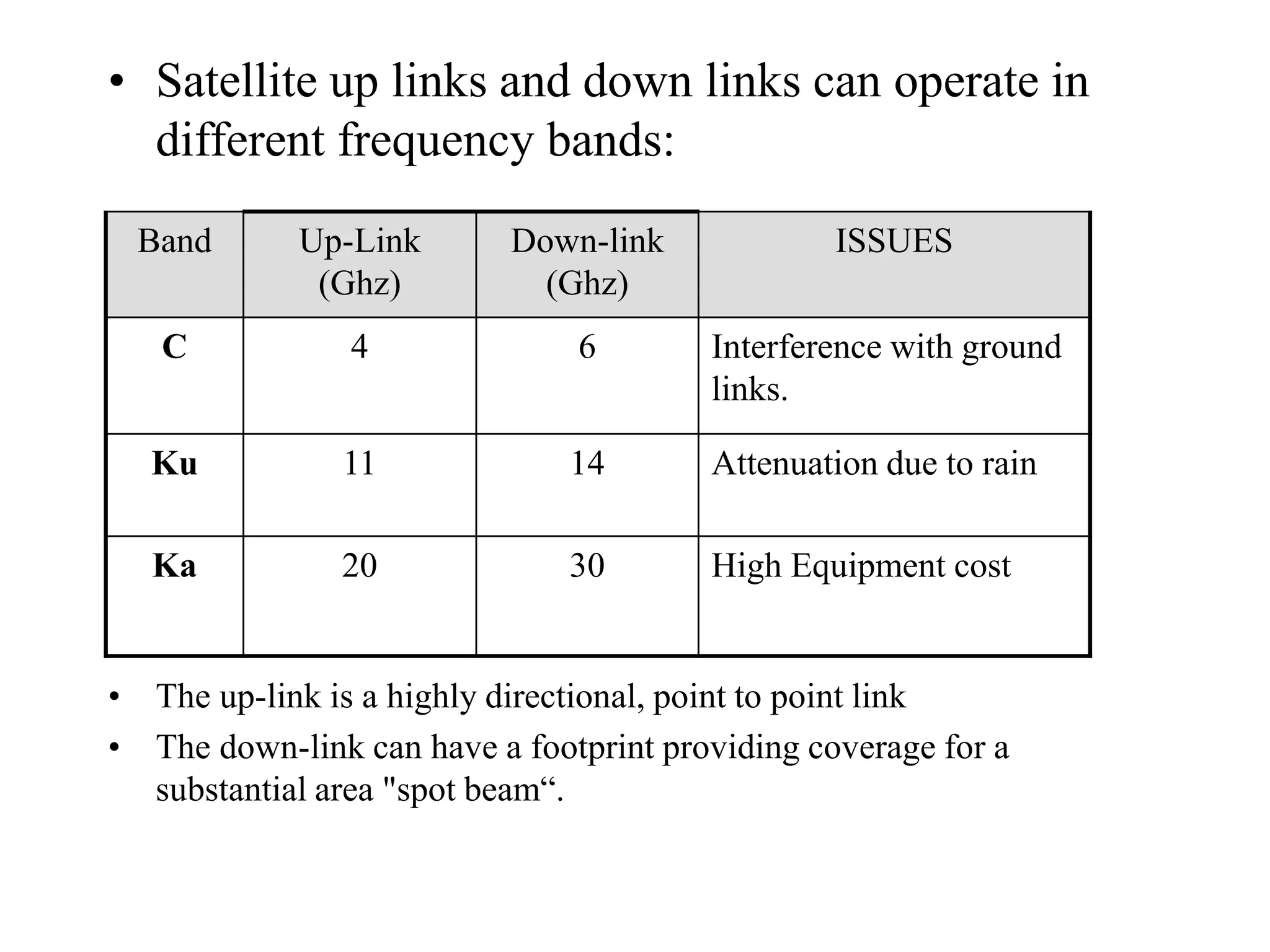
• Satellite up links and down links can operate in
different frequency bands:
• The up-link is a highly directional, point to point link
• The down-link can have a footprint providing coverage for a
substantial area "spot beam“.
Band Up-Link
(Ghz)
Down-link
(Ghz)
ISSUES
C 4 6 Interference with ground
links.
Ku 11 14 Attenuation due to rain
Ka 20 30 High Equipment cost
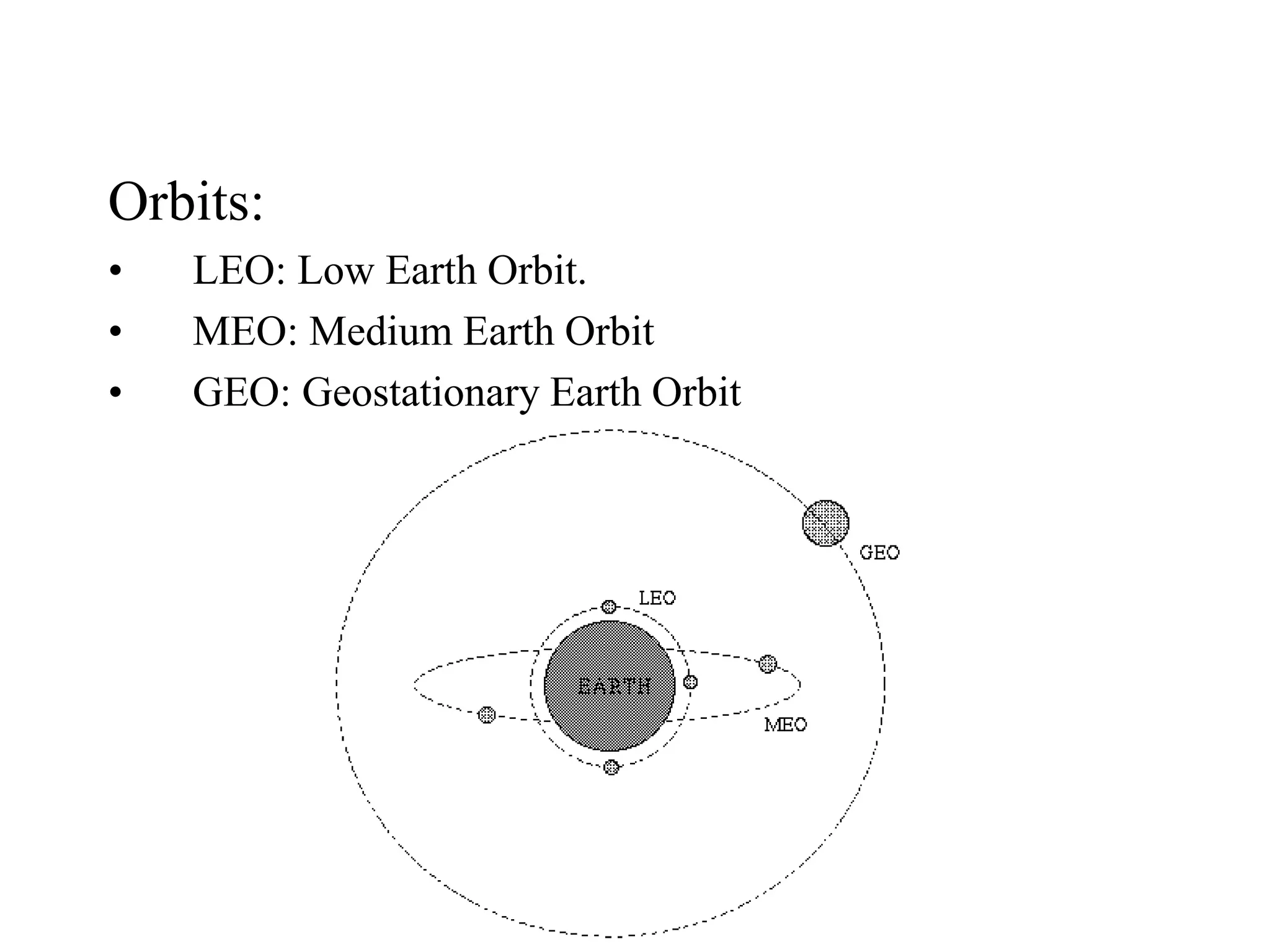
Orbits:
• LEO: Low Earth Orbit.
• MEO: Medium Earth Orbit
• GEO: Geostationary Earth Orbit
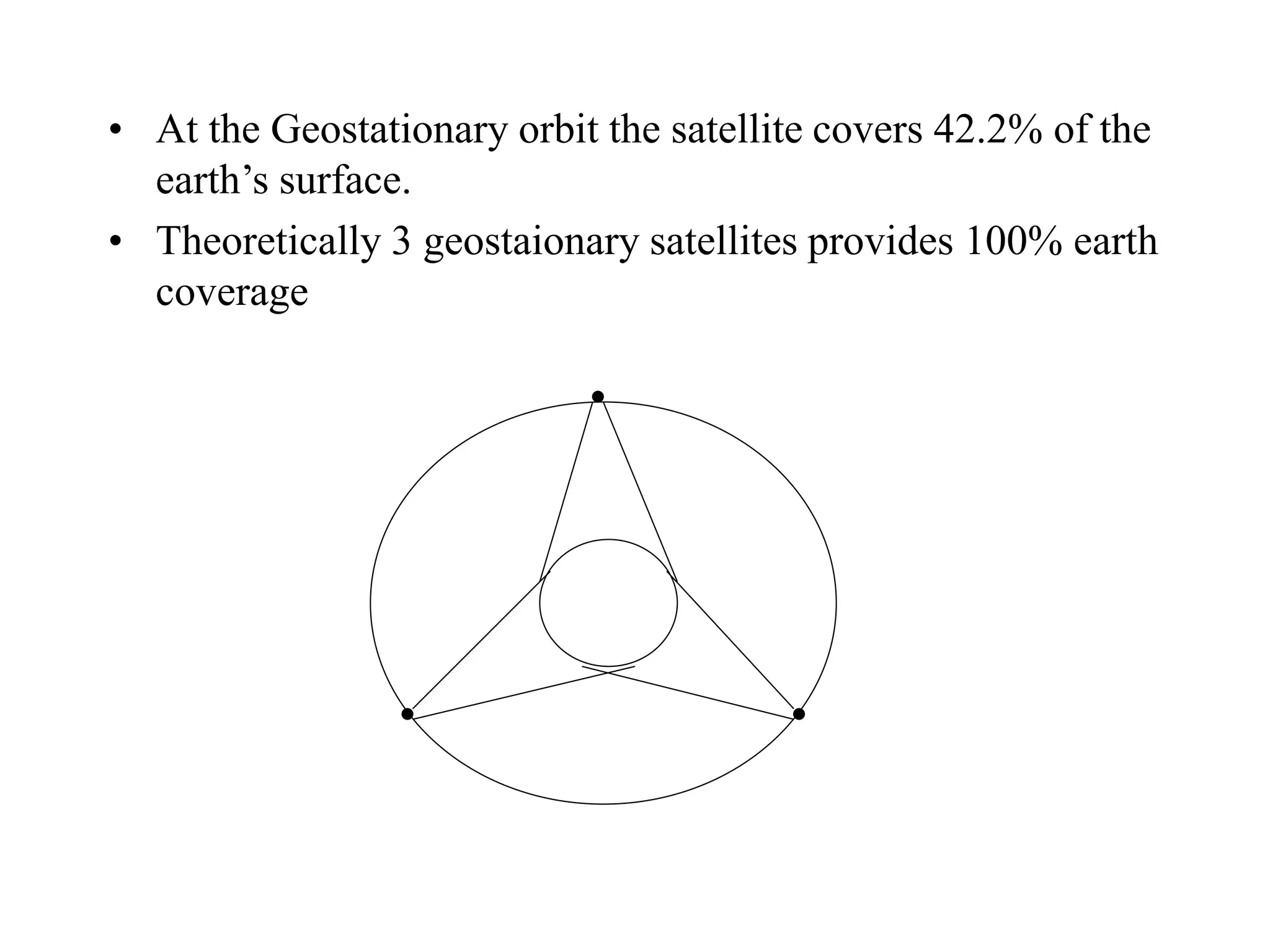
• At the Geostationary orbit the satellite covers 42.2% of the
earth’s surface.
• Theoretically 3 geostaionary satellites provides 100% earth
coverage
MAC(Media Access Control)
protocols for satellite links
• ALOHA:
• Every station can transmit any time
• Very low efficiency 18- 36 %.
• FDMA (Frequency Division Multiple Access)
• It is the oldest and most common.
• the available satellite channel bandwidth is broken
into frequency bands for different earth stations.
• TDMA (Time Division Multiple Access)
• channels are time multiplexed sequentially
• Each earth station gets to transmit in a fixed time
slot only.
• More than one time slot can be assigned to stations
with more bandwidth requirements.
• Requires time synchronization between the Earth
Stations.
• CDMA : (Code Division Multiple Access)
• Combination of time/frequency multiplexing
( a form of spread spectrum modulation).
• It provides a decentralized way of providing
separate channels without timing synchronization. It
is a relatively new scheme but is expected to be
more common in future satellites.
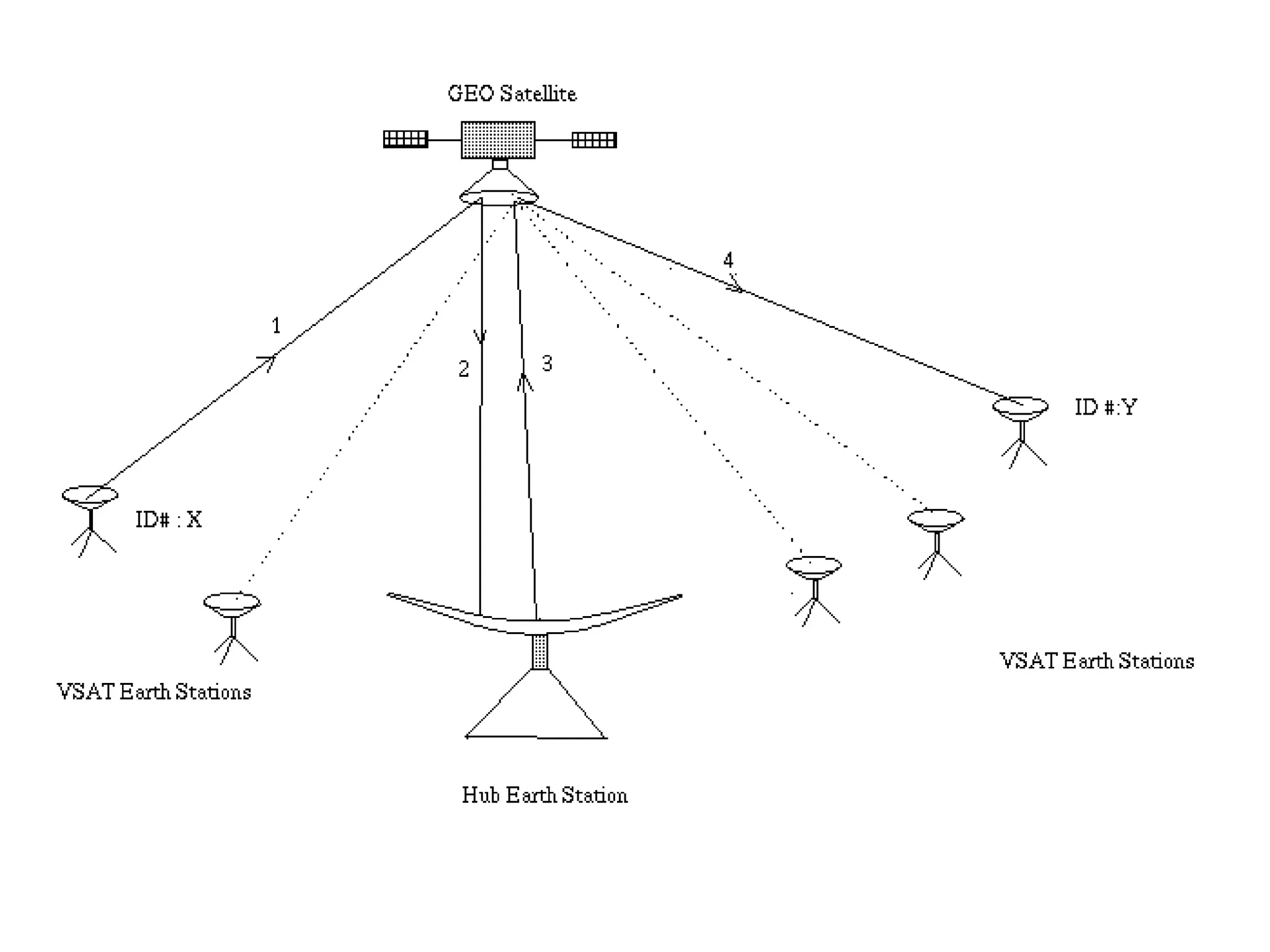
VSAT Network
• At the Very Small Aperture Terminal a lower performance
microwave transceiver and lower gain dish antenna
(smaller size) is used.
• VSAT networks are arranged in a star based topology.
• Ideal for centralized networks with a central host (Banking
institutions with branches all over the country).
• Use the S-ALOHA and TDMA
DirecPC services:
• One of the most useful applications of VSAT
networks
• Comes with an ISA computer card, a RF dish
antenna (2 ft dia) equipped with an LNA, and
supporting software.
Supporting two kinds of services
1. Digital Package Delivery
2. Turbo Internet
1. Digital Package Delivery
• downloading files at a speed 100 times faster than
that supported by public telephone network.
• Large files can be received by multiple DirecPC
end points.
• The download requests are made using the
standard analog modem over telephone lines.
2. Turbo Internet
• The end user overcomes the telephone line
barrier and is capable of receiving data at 400
kbps.
• A connection is setup with the local ISP (internet
server provider) using the analog telephone line
modem.
• All mouse and keyboard actions in the web
browser are communicated to the web server on
the other end using this link.
satellite communication systems in military application

satellite communication systems in military application

  • 1.
  • 2.
    Overview • Satellite isa microwave repeater in the space. • There are about 750 satellite in the space, most of them are used for communication. • They are: – Wide area coverage of the earth’s surface. – Transmission delay is about 0.3 sec. – Transmission cost is independent of distance.
  • 3.
    • Satellite uplinks and down links can operate in different frequency bands: • The up-link is a highly directional, point to point link • The down-link can have a footprint providing coverage for a substantial area "spot beam“. Band Up-Link (Ghz) Down-link (Ghz) ISSUES C 4 6 Interference with ground links. Ku 11 14 Attenuation due to rain Ka 20 30 High Equipment cost
  • 4.
    Orbits: • LEO: LowEarth Orbit. • MEO: Medium Earth Orbit • GEO: Geostationary Earth Orbit
  • 5.
    • At theGeostationary orbit the satellite covers 42.2% of the earth’s surface. • Theoretically 3 geostaionary satellites provides 100% earth coverage
  • 6.
    MAC(Media Access Control) protocolsfor satellite links • ALOHA: • Every station can transmit any time • Very low efficiency 18- 36 %. • FDMA (Frequency Division Multiple Access) • It is the oldest and most common. • the available satellite channel bandwidth is broken into frequency bands for different earth stations.
  • 7.
    • TDMA (TimeDivision Multiple Access) • channels are time multiplexed sequentially • Each earth station gets to transmit in a fixed time slot only. • More than one time slot can be assigned to stations with more bandwidth requirements. • Requires time synchronization between the Earth Stations. • CDMA : (Code Division Multiple Access) • Combination of time/frequency multiplexing ( a form of spread spectrum modulation). • It provides a decentralized way of providing separate channels without timing synchronization. It is a relatively new scheme but is expected to be more common in future satellites.
  • 8.
    VSAT Network • Atthe Very Small Aperture Terminal a lower performance microwave transceiver and lower gain dish antenna (smaller size) is used. • VSAT networks are arranged in a star based topology. • Ideal for centralized networks with a central host (Banking institutions with branches all over the country). • Use the S-ALOHA and TDMA
  • 10.
    DirecPC services: • Oneof the most useful applications of VSAT networks • Comes with an ISA computer card, a RF dish antenna (2 ft dia) equipped with an LNA, and supporting software. Supporting two kinds of services 1. Digital Package Delivery 2. Turbo Internet
  • 11.
    1. Digital PackageDelivery • downloading files at a speed 100 times faster than that supported by public telephone network. • Large files can be received by multiple DirecPC end points. • The download requests are made using the standard analog modem over telephone lines.
  • 12.
    2. Turbo Internet •The end user overcomes the telephone line barrier and is capable of receiving data at 400 kbps. • A connection is setup with the local ISP (internet server provider) using the analog telephone line modem. • All mouse and keyboard actions in the web browser are communicated to the web server on the other end using this link.