A
 PRESENTATION
     ON
DAMODAR VALLEY
 CORPORATION


  PRESENTED BY:
 ANUJ KUMAR SINGH   1
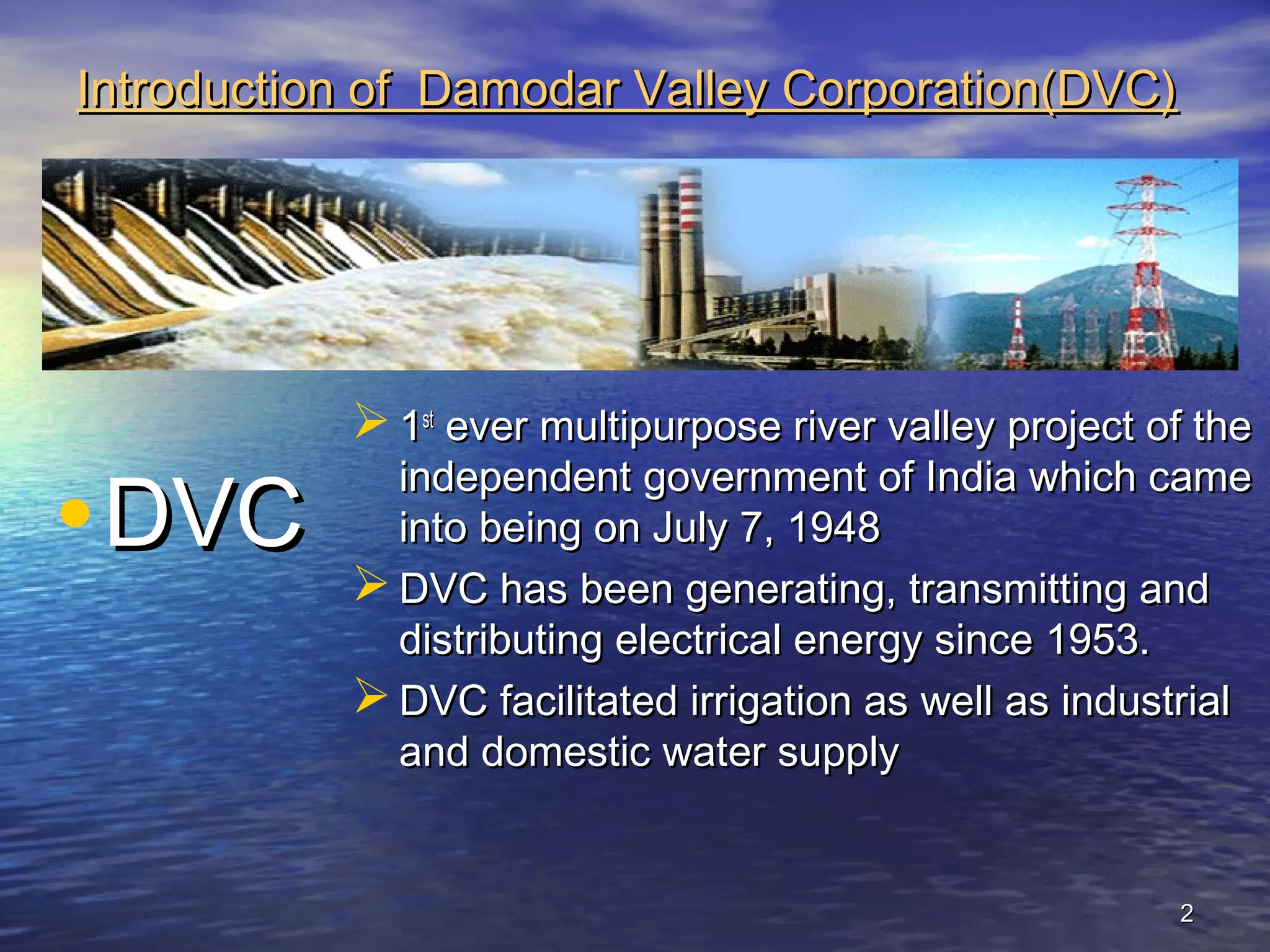
Introduction of Damodar Valley Corporation(DVC)


            1st ever multipurpose river valley project of the

• DVC
             independent government of India which came
             into being on July 7, 1948
            DVC has been generating, transmitting and
             distributing electrical energy since 1953.
            DVC facilitated irrigation as well as industrial
             and domestic water supply


                                                         2
Corporate Mission

FLOOD CONTROL.
GENERATION, TRANSMISSION AND
 DISTRIBUTION OF ELECTRICAL
 ENERGY.
WATER SUPPLY FOR INDUSTRIAL
 AND DOMESTIC USE.


                                3
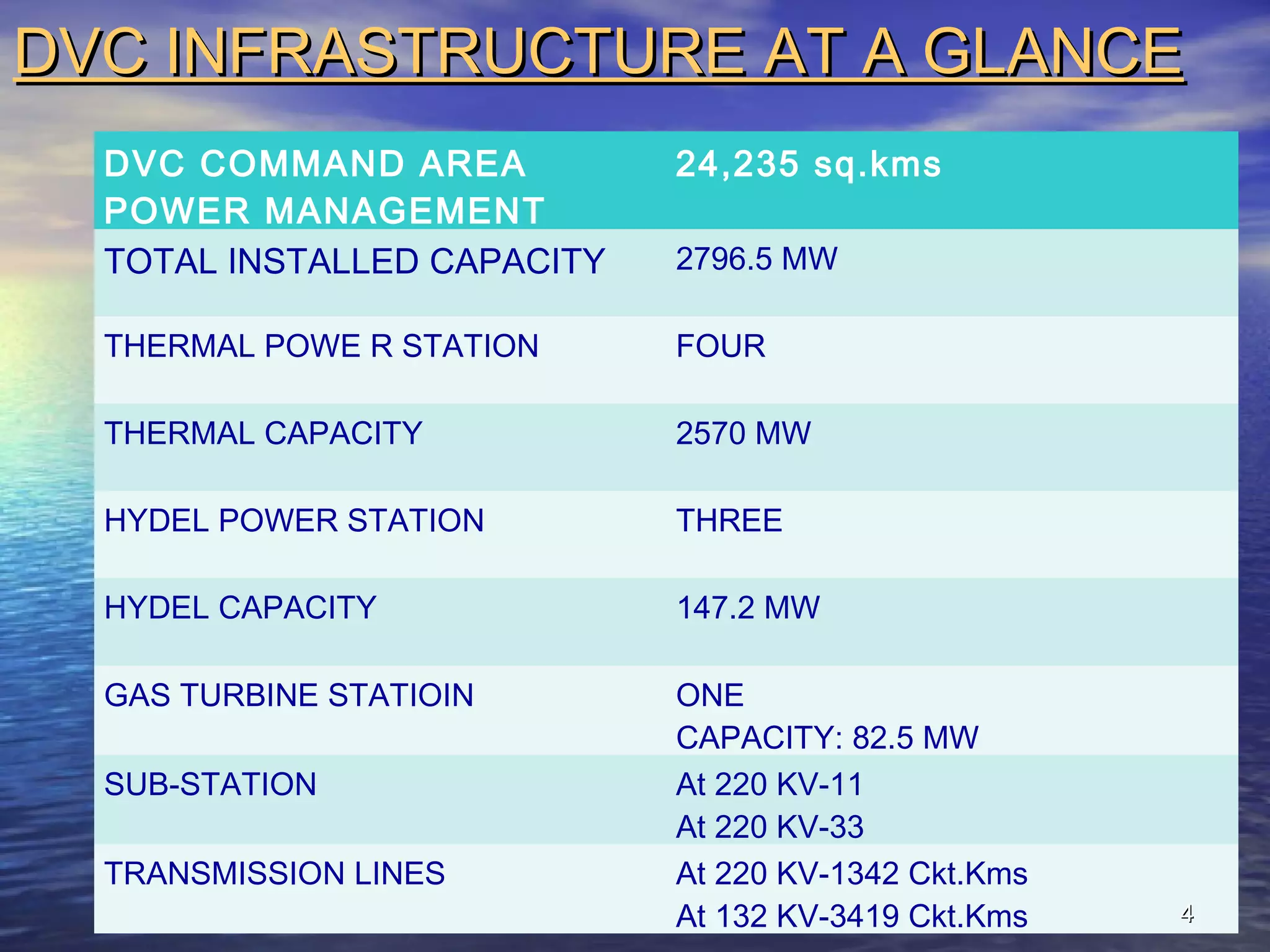
DVC INFRASTRUCTURE AT A GLANCE
  DVC COMMAND AREA           24,235 sq.kms
  POWER MANAGEMENT
  TOTAL INSTALLED CAPACITY   2796.5 MW

  THERMAL POWE R STATION     FOUR

  THERMAL CAPACITY           2570 MW

  HYDEL POWER STATION        THREE

  HYDEL CAPACITY             147.2 MW

  GAS TURBINE STATIOIN       ONE
                             CAPACITY: 82.5 MW
  SUB-STATION                At 220 KV-11
                             At 220 KV-33
  TRANSMISSION LINES         At 220 KV-1342 Ckt.Kms
                             At 132 KV-3419 Ckt.Kms   4
Vary Small Aperture Terminal(VSAT)

VSAT networks provides:

• Reliability in transmission of data (data, voice, video)
• Allocation of resources to different users (bandwidth,
  amplification power)

• Provide point-to-multipoint (broadcast), multipoint-to-
  point (data collection), point-to-point communications
  and broadband multimedia services.

• An ability to have direct access to users and user
  premises.
                                                             5
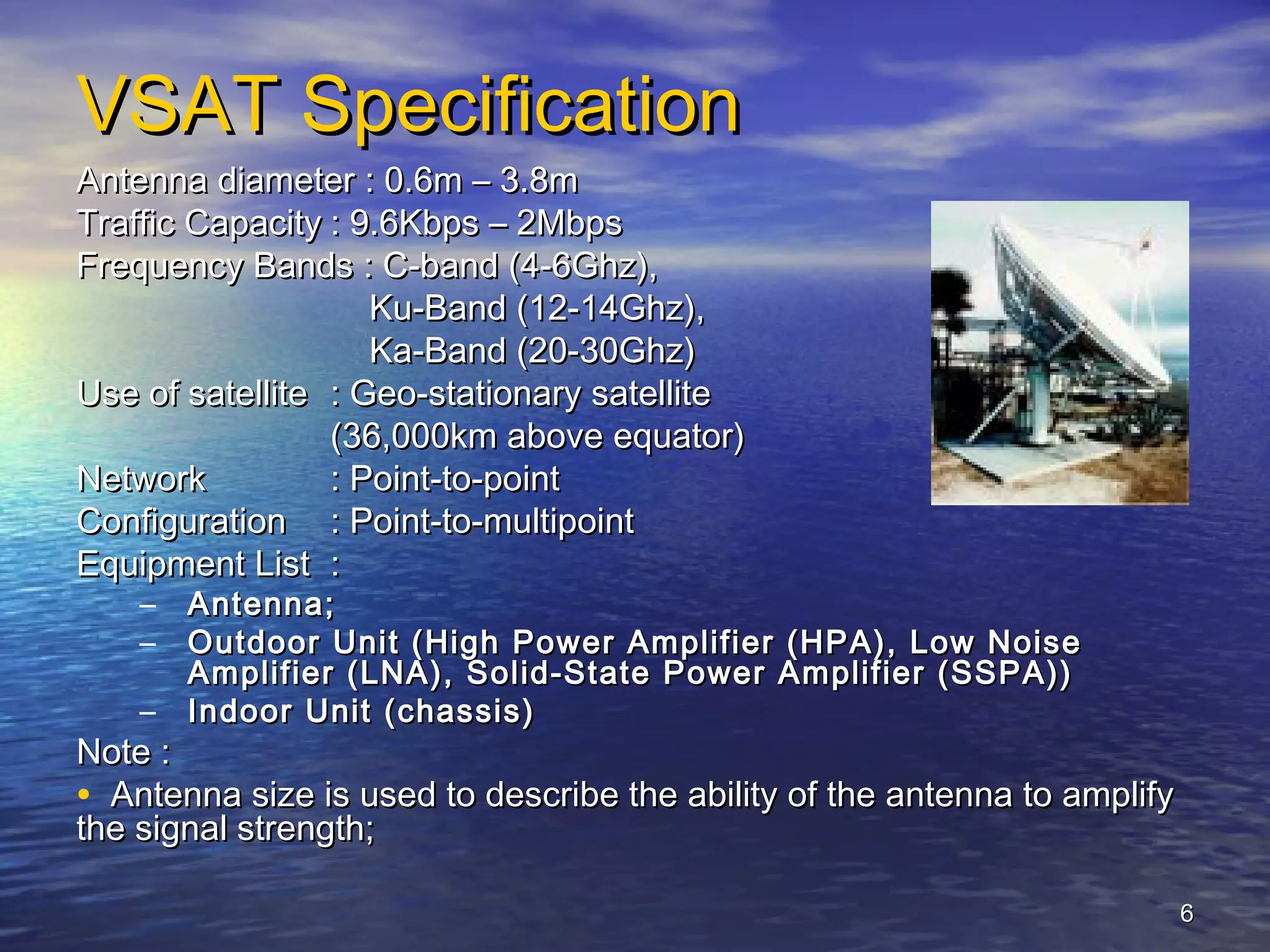
VSAT Specification
Antenna diameter : 0.6m – 3.8m
Traffic Capacity : 9.6Kbps – 2Mbps
Frequency Bands : C-band (4-6Ghz),
                    Ku-Band (12-14Ghz),
                    Ka-Band (20-30Ghz)
Use of satellite : Geo-stationary satellite
                 (36,000km above equator)
Network          : Point-to-point
Configuration : Point-to-multipoint
Equipment List :
    –   Antenna;
    –   Outdoor Unit (High Power Amplifier (HPA), Low Noise
        Amplifier (LNA), Solid-State Power Amplifier (SSPA))
    –   Indoor Unit (chassis)
Note :
• Antenna size is used to describe the ability of the antenna to amplify
the signal strength;

                                                                           6
VSAT Services
• Interactive real time application:
   – Point of Sale/retail/Banking (eg. ATM)
   – Corporate data
• Telephony
   – Rural : individual subscribers
   – Corporate Telephony
• Intranet, Internet and IP infrastructure
   – Multimedia delivery (eg. video streaming)
   – Interactive distance learning/ training
• Direct-to-home
   – Broadband Internet access for consumers and
     businesses
                                                   7
VSAT Accessing Scheme
The objective of VSAT networks:
 - is to maximize the use of common satellite
   and other resources amongst all VSAT
   sites.
The method:
- by optimizing the use of satellite capacity,
   and spectrum utilization in a flexible and
   cost-effective manner.


                                             8
VSAT Characteristic and
Advantage
• Reliability: Reliable satellite transmission
  of data, voice and video between an
  unlimited number of geographically
  dispersed sites or from these sites to
  headquarters


• Flexibility: The VSAT networks offer
  enormous expansion capabilities; On the
  other hand, VSATs offer unrestricted and
  unlimited reach. Additional VSATs can be
  rapidly installed to support the network
  expansion to any site, no matter however
  remote.                                  9
• Network Management: Network
 monitoring and control of the entire VSAT
 network is much simpler than a network of
 leased lines, easily integrates end-to-end
 monitoring and configuration control for all
 network subsystems.


• A low mean-time to repair - few hours,
 compare to leased lines which extends up
 to a few days. Essentially, lesser elements
 imply lower MTTR. Uptime of up to 99.5
 percent is achievable on a VSAT network.
 This is significantly higher than the typical
 leased line uptime of approximately 80-
 85%.                                          10
• Cost: VSAT network offers significant
 savings over 2-3 years timeframe. The
 service charges depend on the bandwidth
 which is allocated to the network in line
 with customer requirements.


• Link Budgets: RF equipment would cater
 to the requirements of the network
 topology and satellite modems in use. The
 link Budget estimates the ground station
 and satellite EIRP (Effective Isotropic
 Radiated Power) required. Calculations of
 signal levels through the system to ensure
 the quality of service should normally be
 done, prior to the establishment of a
 satellite link.                           11
Opportunities in VSAT technology
•   Voice over IP (VoIP) via satellite
•   Frame Relay via satellite
•   ATM via satellite
•   Video-on-demand via satellite
•   Multimedia application
    – Internet/e-mail connection
    – Telemedicine
    – Distance learning

                                         12
Satellite Communication
is a technology of data transmission whether one-way data
broadcasting or two-way interactive using frequency
as a medium.
Consist of :
       Space Segment or Satellite ( eg. Measat, Intelsat,
       Inmarsat )
       Ground Segment or earth station which includes
       Antenna, Outdoor Unit, Inter Facility Link, Indoor Unit
       and Customer Premises Equipmen.
                                                                 13
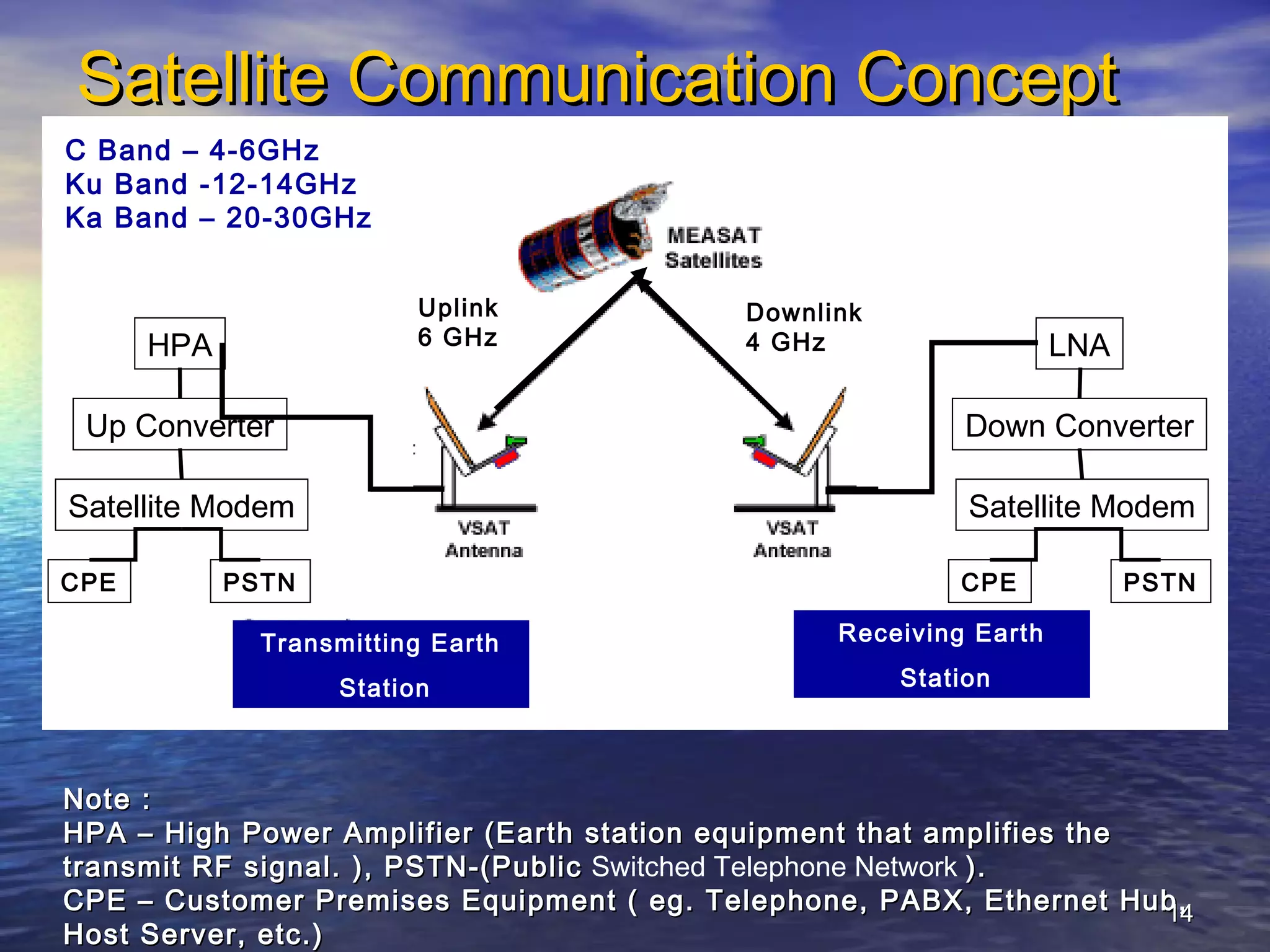
Satellite Communication Concept
C Band – 4-6GHz
Ku Band -12-14GHz
Ka Band – 20-30GHz


                         Uplink             Downlink
      HPA                6 GHz              4 GHz                   LNA

 Up Converter                                               Down Converter

Satellite Modem                                             Satellite Modem

CPE         PSTN                                           CPE            PSTN

              Transmitting Earth                  Receiving Earth

                   Station                             Station


Note :
HPA – High Power Amplifier (Earth station equipment that amplifies the
transmit RF signal. ), PSTN-(Public Switched Telephone Network ).
CPE – Customer Premises Equipment ( eg. Telephone, PABX, Ethernet Hub, 14
Host Server, etc.)
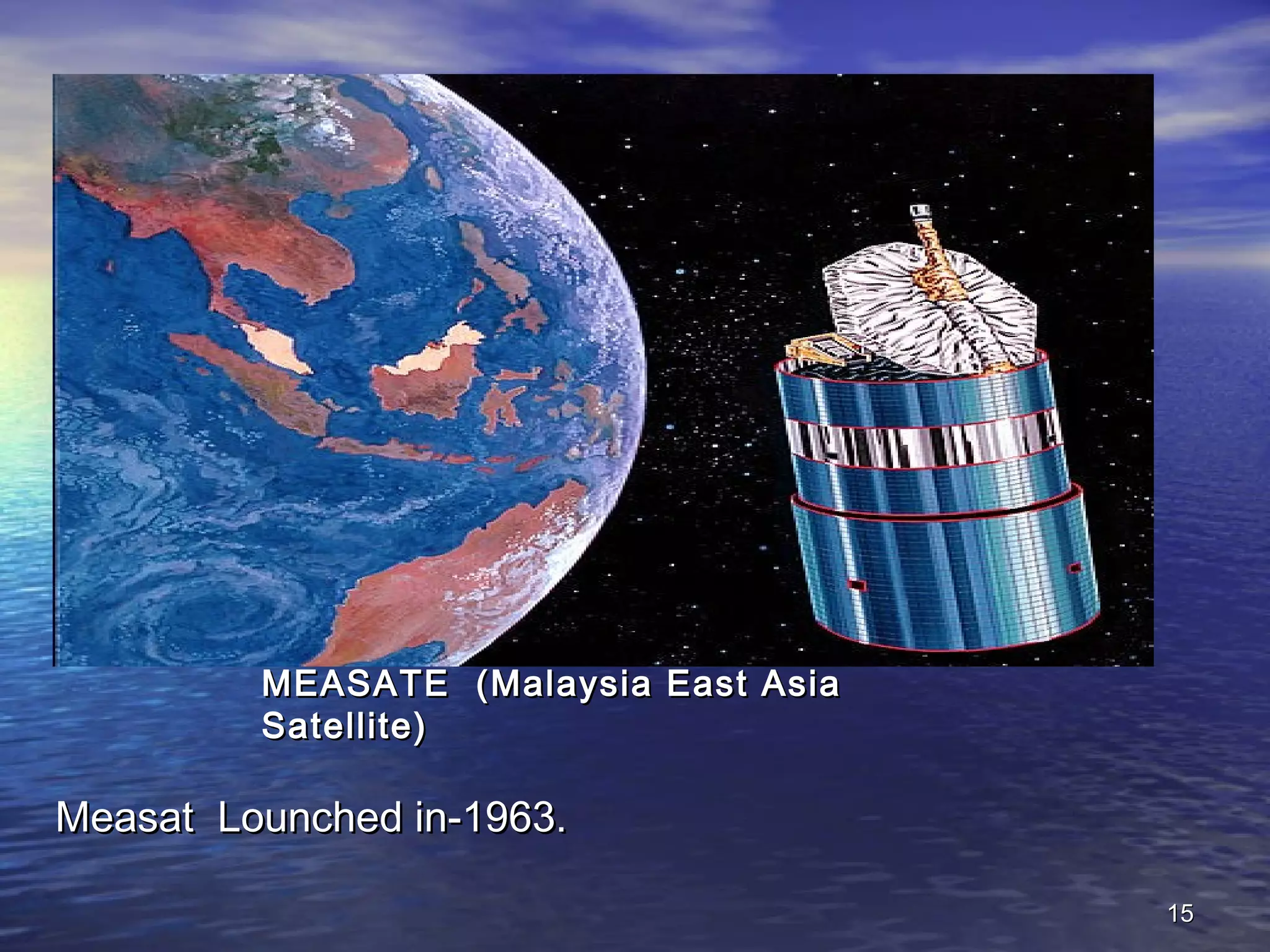
MEASATE (Malaysia East Asia
         Satellite)

Measat Lounched in-1963.

                                       15
Type of Satellite Service
• International Telephony – using Public Switched
  Telephone Network (PSTN)
  – Intermediate Data Rate (IDR)
  – Time Division Multiple Access (TDMA)
• Broadcasting
  –   TV Uplink
  –   Television Receive Only (TVRO)
  –   Digital Satellite News Gathering (DSNG)


                                                16
Accessing Scheme


                   17
TDMA (Time-Division Multiple
Access)
• When numerous remote sites communicate with
  one central hub, this design is similar to packet-
  switched networks.

• Because of competition with one another for
  access to the central hub, it restrict the
  maximum bandwidth to most cases is about 19.2
  kbps.

                                                   18
TDMA (Time-Division Multiple
 Access)


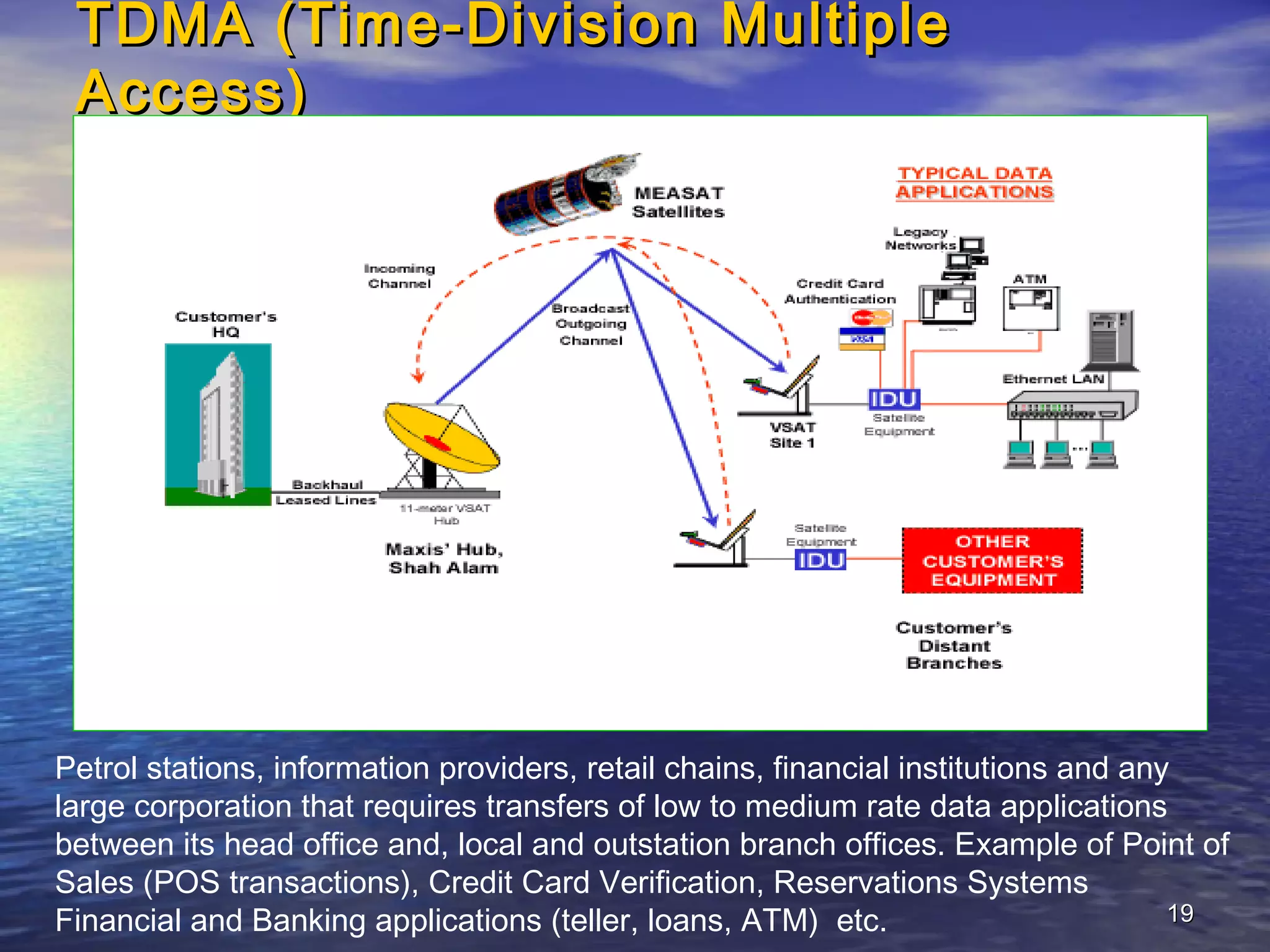
Petrol stations, information providers, retail chains, financial institutions and any
large corporation that requires transfers of low to medium rate data applications
between its head office and, local and outstation branch offices. Example of Point of
Sales (POS transactions), Credit Card Verification, Reservations Systems
Financial and Banking applications (teller, loans, ATM) etc.                         19
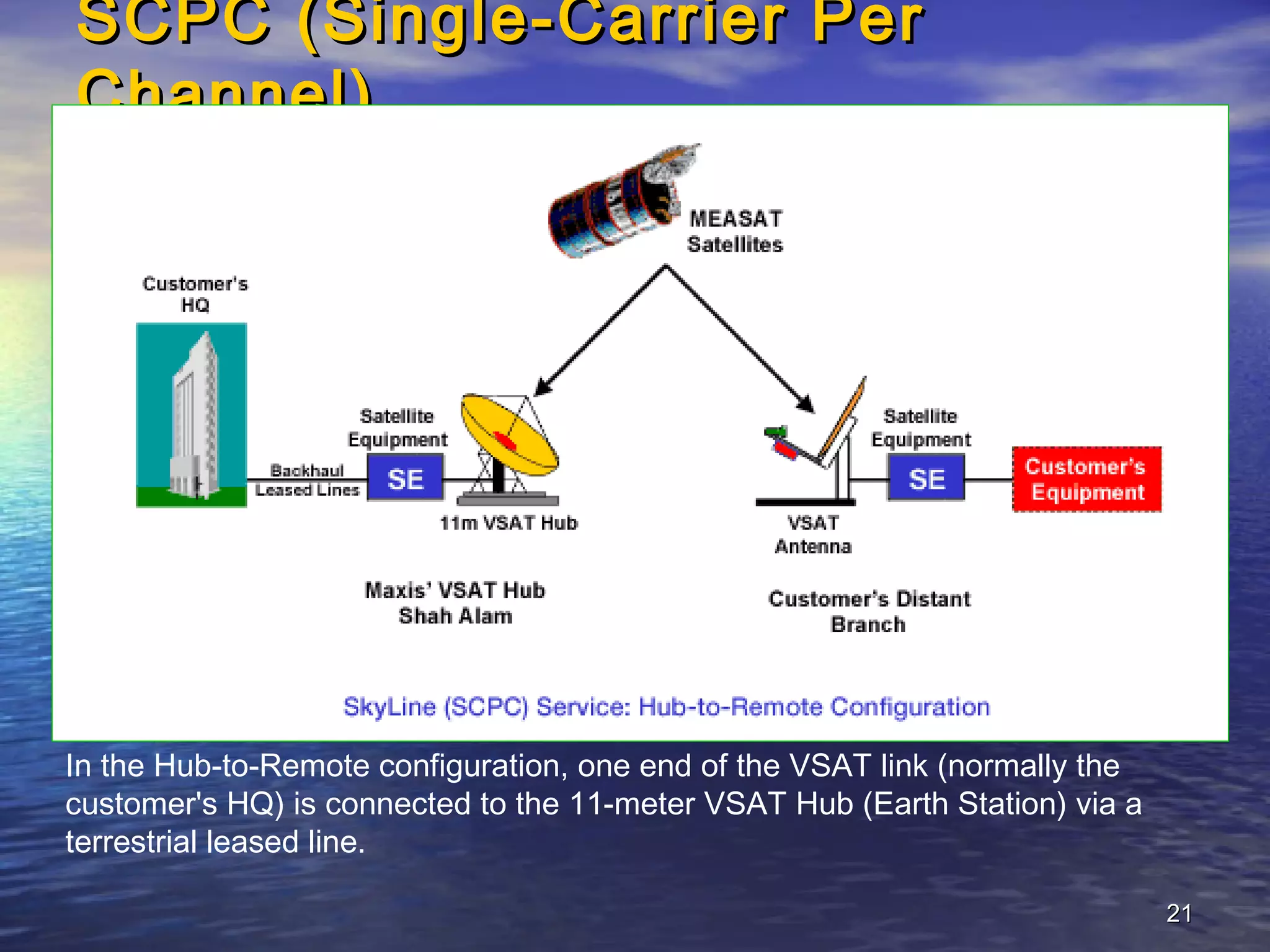
SCPC (Single-Carrier Per
Channel)

• SCPC-based design provides a point-to-
 point technology,

• Indicated bandwidth up to 2 Mbps
• Usually use in an international VSAT
 services in Asia-Pacific.


                                           20
SCPC (Single-Carrier Per
Channel)


In the Hub-to-Remote configuration, one end of the VSAT link (normally the
customer's HQ) is connected to the 11-meter VSAT Hub (Earth Station) via a
terrestrial leased line.

                                                                             21
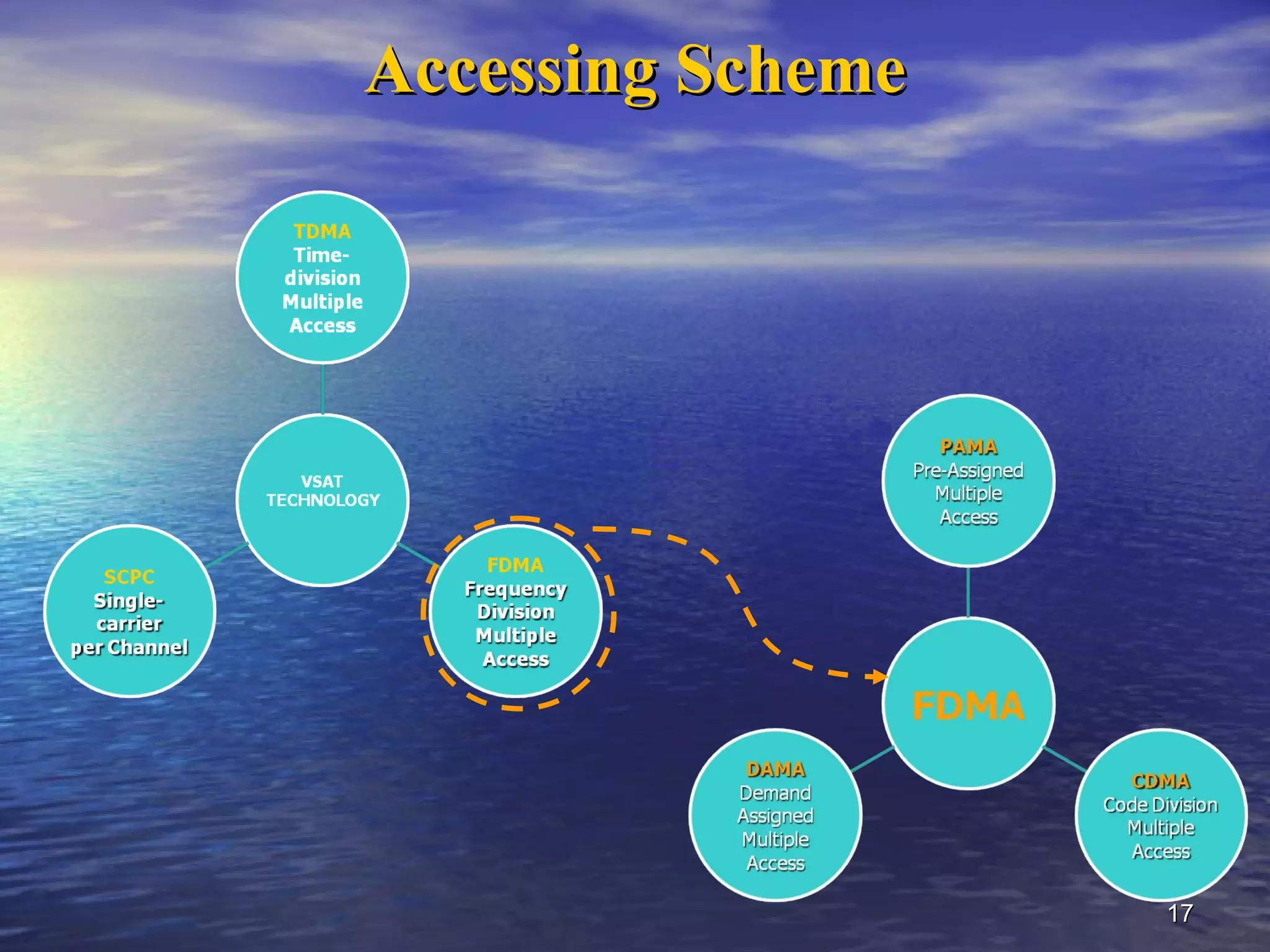
FDMA (Frequency Division Multiple Access)

• Oldest method for channel allocation.
• The satellite channel bandwidth is broken into
  frequency bands for different earth stations.

• The earth stations must be carefully power-
  controlled to prevent the microwave power
  spilling into the bands for the other channels.
3 Type:
• PAMA (Pre-Assigned Multiple Access);
• DAMA (Demand Assigned Multiple Access); and
• CDMA (Code Division Multiple Access).           22
PAMA (Pre-Assigned Multiple Access)

• The VSATs are pre-allocated a designated
 frequency Equivalent of the land based
 leased line solutions.

• PAMA solutions use the satellite
 resources constantly.

• PAMA connects high data traffic sites
 within an organization.
                                          23
DAMA (Demand Assigned Multiple Access);

• The network uses a pool of satellite channels, which are
  available for use by any station in that network.

• On demand a pair of available channels is assigned, so
  that a call can be established.

• Once the call is completed, the channels are returned to
  the pool for an assignment to another call.

• DAMA offers point-to-point voice, fax, data requirements
  and supports video-conferencing.

                                                           24
CDMA (Code Division Multiple Access)

• The data signal is combined with a high bit rate code
  signal which is independent of the data.

• The incoming composite data/code signal with a locally
  generated and correctly synchronized replica of the
  code.

• Mainly used for interference rejection or for security
  reasons in military systems.


                                                           25
THANK YOU


            26

Ppt on training

  • 1.
    A PRESENTATION ON DAMODAR VALLEY CORPORATION PRESENTED BY: ANUJ KUMAR SINGH 1
  • 2.
    Introduction of DamodarValley Corporation(DVC)  1st ever multipurpose river valley project of the • DVC independent government of India which came into being on July 7, 1948  DVC has been generating, transmitting and distributing electrical energy since 1953.  DVC facilitated irrigation as well as industrial and domestic water supply 2
  • 3.
    Corporate Mission FLOOD CONTROL. GENERATION,TRANSMISSION AND DISTRIBUTION OF ELECTRICAL ENERGY. WATER SUPPLY FOR INDUSTRIAL AND DOMESTIC USE. 3
  • 4.
    DVC INFRASTRUCTURE ATA GLANCE DVC COMMAND AREA 24,235 sq.kms POWER MANAGEMENT TOTAL INSTALLED CAPACITY 2796.5 MW THERMAL POWE R STATION FOUR THERMAL CAPACITY 2570 MW HYDEL POWER STATION THREE HYDEL CAPACITY 147.2 MW GAS TURBINE STATIOIN ONE CAPACITY: 82.5 MW SUB-STATION At 220 KV-11 At 220 KV-33 TRANSMISSION LINES At 220 KV-1342 Ckt.Kms At 132 KV-3419 Ckt.Kms 4
  • 5.
    Vary Small ApertureTerminal(VSAT) VSAT networks provides: • Reliability in transmission of data (data, voice, video) • Allocation of resources to different users (bandwidth, amplification power) • Provide point-to-multipoint (broadcast), multipoint-to- point (data collection), point-to-point communications and broadband multimedia services. • An ability to have direct access to users and user premises. 5
  • 6.
    VSAT Specification Antenna diameter: 0.6m – 3.8m Traffic Capacity : 9.6Kbps – 2Mbps Frequency Bands : C-band (4-6Ghz), Ku-Band (12-14Ghz), Ka-Band (20-30Ghz) Use of satellite : Geo-stationary satellite (36,000km above equator) Network : Point-to-point Configuration : Point-to-multipoint Equipment List : – Antenna; – Outdoor Unit (High Power Amplifier (HPA), Low Noise Amplifier (LNA), Solid-State Power Amplifier (SSPA)) – Indoor Unit (chassis) Note : • Antenna size is used to describe the ability of the antenna to amplify the signal strength; 6
  • 7.
    VSAT Services • Interactivereal time application: – Point of Sale/retail/Banking (eg. ATM) – Corporate data • Telephony – Rural : individual subscribers – Corporate Telephony • Intranet, Internet and IP infrastructure – Multimedia delivery (eg. video streaming) – Interactive distance learning/ training • Direct-to-home – Broadband Internet access for consumers and businesses 7
  • 8.
    VSAT Accessing Scheme Theobjective of VSAT networks: - is to maximize the use of common satellite and other resources amongst all VSAT sites. The method: - by optimizing the use of satellite capacity, and spectrum utilization in a flexible and cost-effective manner. 8
  • 9.
    VSAT Characteristic and Advantage •Reliability: Reliable satellite transmission of data, voice and video between an unlimited number of geographically dispersed sites or from these sites to headquarters • Flexibility: The VSAT networks offer enormous expansion capabilities; On the other hand, VSATs offer unrestricted and unlimited reach. Additional VSATs can be rapidly installed to support the network expansion to any site, no matter however remote. 9
  • 10.
    • Network Management:Network monitoring and control of the entire VSAT network is much simpler than a network of leased lines, easily integrates end-to-end monitoring and configuration control for all network subsystems. • A low mean-time to repair - few hours, compare to leased lines which extends up to a few days. Essentially, lesser elements imply lower MTTR. Uptime of up to 99.5 percent is achievable on a VSAT network. This is significantly higher than the typical leased line uptime of approximately 80- 85%. 10
  • 11.
    • Cost: VSATnetwork offers significant savings over 2-3 years timeframe. The service charges depend on the bandwidth which is allocated to the network in line with customer requirements. • Link Budgets: RF equipment would cater to the requirements of the network topology and satellite modems in use. The link Budget estimates the ground station and satellite EIRP (Effective Isotropic Radiated Power) required. Calculations of signal levels through the system to ensure the quality of service should normally be done, prior to the establishment of a satellite link. 11
  • 12.
    Opportunities in VSATtechnology • Voice over IP (VoIP) via satellite • Frame Relay via satellite • ATM via satellite • Video-on-demand via satellite • Multimedia application – Internet/e-mail connection – Telemedicine – Distance learning 12
  • 13.
    Satellite Communication is atechnology of data transmission whether one-way data broadcasting or two-way interactive using frequency as a medium. Consist of : Space Segment or Satellite ( eg. Measat, Intelsat, Inmarsat ) Ground Segment or earth station which includes Antenna, Outdoor Unit, Inter Facility Link, Indoor Unit and Customer Premises Equipmen. 13
  • 14.
    Satellite Communication Concept CBand – 4-6GHz Ku Band -12-14GHz Ka Band – 20-30GHz Uplink Downlink HPA 6 GHz 4 GHz LNA Up Converter Down Converter Satellite Modem Satellite Modem CPE PSTN CPE PSTN Transmitting Earth Receiving Earth Station Station Note : HPA – High Power Amplifier (Earth station equipment that amplifies the transmit RF signal. ), PSTN-(Public Switched Telephone Network ). CPE – Customer Premises Equipment ( eg. Telephone, PABX, Ethernet Hub, 14 Host Server, etc.)
  • 15.
    MEASATE (Malaysia EastAsia Satellite) Measat Lounched in-1963. 15
  • 16.
    Type of SatelliteService • International Telephony – using Public Switched Telephone Network (PSTN) – Intermediate Data Rate (IDR) – Time Division Multiple Access (TDMA) • Broadcasting – TV Uplink – Television Receive Only (TVRO) – Digital Satellite News Gathering (DSNG) 16
  • 17.
  • 18.
    TDMA (Time-Division Multiple Access) •When numerous remote sites communicate with one central hub, this design is similar to packet- switched networks. • Because of competition with one another for access to the central hub, it restrict the maximum bandwidth to most cases is about 19.2 kbps. 18
  • 19.
    TDMA (Time-Division Multiple Access) Petrol stations, information providers, retail chains, financial institutions and any large corporation that requires transfers of low to medium rate data applications between its head office and, local and outstation branch offices. Example of Point of Sales (POS transactions), Credit Card Verification, Reservations Systems Financial and Banking applications (teller, loans, ATM) etc. 19
  • 20.
    SCPC (Single-Carrier Per Channel) •SCPC-based design provides a point-to- point technology, • Indicated bandwidth up to 2 Mbps • Usually use in an international VSAT services in Asia-Pacific. 20
  • 21.
    SCPC (Single-Carrier Per Channel) Inthe Hub-to-Remote configuration, one end of the VSAT link (normally the customer's HQ) is connected to the 11-meter VSAT Hub (Earth Station) via a terrestrial leased line. 21
  • 22.
    FDMA (Frequency DivisionMultiple Access) • Oldest method for channel allocation. • The satellite channel bandwidth is broken into frequency bands for different earth stations. • The earth stations must be carefully power- controlled to prevent the microwave power spilling into the bands for the other channels. 3 Type: • PAMA (Pre-Assigned Multiple Access); • DAMA (Demand Assigned Multiple Access); and • CDMA (Code Division Multiple Access). 22
  • 23.
    PAMA (Pre-Assigned MultipleAccess) • The VSATs are pre-allocated a designated frequency Equivalent of the land based leased line solutions. • PAMA solutions use the satellite resources constantly. • PAMA connects high data traffic sites within an organization. 23
  • 24.
    DAMA (Demand AssignedMultiple Access); • The network uses a pool of satellite channels, which are available for use by any station in that network. • On demand a pair of available channels is assigned, so that a call can be established. • Once the call is completed, the channels are returned to the pool for an assignment to another call. • DAMA offers point-to-point voice, fax, data requirements and supports video-conferencing. 24
  • 25.
    CDMA (Code DivisionMultiple Access) • The data signal is combined with a high bit rate code signal which is independent of the data. • The incoming composite data/code signal with a locally generated and correctly synchronized replica of the code. • Mainly used for interference rejection or for security reasons in military systems. 25
  • 26.