VOYAGER 1 & 2
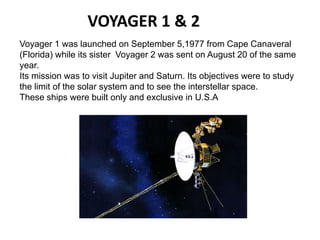
Voyager 1 was launched on September 5,1977 from Cape Canaveral
(Florida) while its sister Voyager 2 was sent on August 20 of the same
year.
Its mission was to visit Jupiter and Saturn. Its objectives were to study
the limit of the solar system and to see the interstellar space.
These ships were built only and exclusive in U.S.A
Jupiter
Voyager 1 and 2 probes
explored Jupiter, before
beginning their journey into
interstellar space. Here you
will find some of these
emblematic images, such as
"The Pale Blue Dot" -
famously - and which are
still the only images close to
Uranus and Neptune.
Saturn
The Voyager made
this photo when I
passed through
Saturn in 1980. As we
can see Saturn has a
few rings, which is
what stands out most
in it.
Urano
This is Urano and in its
part the sol, the sun is
starting to rise.
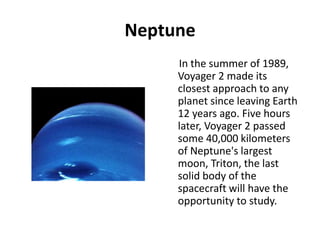
Neptune
In the summer of 1989,
Voyager 2 made its
closest approach to any
planet since leaving Earth
12 years ago. Five hours
later, Voyager 2 passed
some 40,000 kilometers
of Neptune's largest
moon, Triton, the last
solid body of the
spacecraft will have the
opportunity to study.
The End

Voyager 1 & 2

  • 1.
    VOYAGER 1 &2 Voyager 1 was launched on September 5,1977 from Cape Canaveral (Florida) while its sister Voyager 2 was sent on August 20 of the same year. Its mission was to visit Jupiter and Saturn. Its objectives were to study the limit of the solar system and to see the interstellar space. These ships were built only and exclusive in U.S.A
  • 2.
    Jupiter Voyager 1 and2 probes explored Jupiter, before beginning their journey into interstellar space. Here you will find some of these emblematic images, such as "The Pale Blue Dot" - famously - and which are still the only images close to Uranus and Neptune.
  • 3.
    Saturn The Voyager made thisphoto when I passed through Saturn in 1980. As we can see Saturn has a few rings, which is what stands out most in it.
  • 4.
    Urano This is Uranoand in its part the sol, the sun is starting to rise.
  • 5.
    Neptune In the summerof 1989, Voyager 2 made its closest approach to any planet since leaving Earth 12 years ago. Five hours later, Voyager 2 passed some 40,000 kilometers of Neptune's largest moon, Triton, the last solid body of the spacecraft will have the opportunity to study.
  • 6.