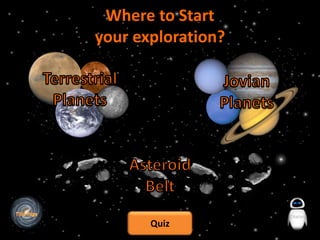
Where to Start
your exploration?


       Quiz
Citation
                                            Pictures
Jovian planets picture: http://aschy.kicks-ass.net/solsys/raw/misc/Jovian.jpg
Neptune:
http://www.solarviews.com/raw/nep/neptunes.jpg
Saturn
http://www.harrisburgacademy.org/computer/decade%20project/20062007/2007%20students/6th%20grade/luke/space%20web
page/Saturn.jpg
Uranus
http://nssdc.gsfc.nasa.gov/planetary/image/uranus_voy2.jpg
Jupiter
http://wallpapers-sky.com/wp-content/uploads/2011/06/Planet-Jupiter-wallpaper.jpg
Mercury
http://twittface.net/wp-content/uploads/2011/02/solar-mercury2.jpg
Venus:
http://sos.noaa.gov/images/Solar_System/venus.jpg
Mars:
http://www.parabolicarc.com/wp-content/uploads/2008/08/marsglobe2.jpg
Asteroid belt
http://www.indiana.edu/~geol105/images/gaia_chapter_2/asteroids_compare4.jpg
EVA
http://ipadwallpaper.eu/wallpapers/2/eva-wall-e.jpg


                                              Main Menu                                     Continue on your journey
Citation
  Sputnik:
                                  Pictures and more
  http://www.celestiamotherlode.net/catalog/images/screenshots/various/satellites_Sputnik_1_1__K
  ukanotas.jpg
  Rovers:
  http://www.scientificamerican.com
  Cassini:
  http://forum.celestialmatters.org/userpix/7_cassini_1.jpg
  NASA Research about all planets and exploration:
  http://solarsystem.nasa.gov/missions/profile.cfm?Sort=Target&Target=SolarSys&MCode=JWST
  Messenger:
  http://www.celestiamotherlode.net/catalog/images/screenshots/various/spacecraft_Messenger_1_
  _Cham.jpg


“Wait I forgot something”
         Go Back
                                                    Main Menu                                      Continue on your journey
Citation
                                          TEKS
       Knowledge and skill:
       (11) Earth and space. The student understands the organization of our
       solar system and the relationships among the various bodies that
       comprise it. The student is expected to:
       (A) describe the physical properties, locations, and movements of the
       Sun, planets, Galilean moons, meteors, asteroids, and comets;
       (B) understand that gravity is the force that governs the motion of our
       solar system; and
       (C) describe the history and future of space exploration, including the
       types of equipment and transportation needed for space travel.


“Wait I forgot something”
         Go Back
                                          Main Menu
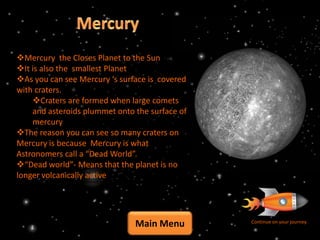
Mercury the Closes Planet to the Sun
It is also the smallest Planet
As you can see Mercury ‘s surface is covered
with craters.
    Craters are formed when large comets
    and asteroids plummet onto the surface of
    mercury
The reason you can see so many craters on
Mercury is because Mercury is what
Astronomers call a “Dead World”.
“Dead world”- Means that the planet is no
longer volcanically active


                               Main Menu        Continue on your journey
It wasn’t until the Space age of 1950s that
astronomers got the opportunity to see the
surface of Mercury. This is because mercury
is about 57 million miles at it’s closest
distance to the Earth.
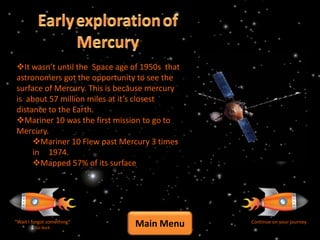
Mariner 10 was the first mission to go to
Mercury.
     Mariner 10 Flew past Mercury 3 times
     in 1974.
     Mapped 57% of its surface


“Wait I forgot something”
         Go Back
                                Main Menu      Continue on your journey
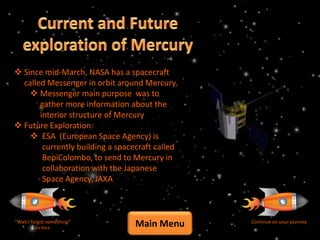
 Since mid-March, NASA has a spacecraft
  called Messenger in orbit around Mercury.
     Messenger main purpose was to
       gather more information about the
       interior structure of Mercury
 Future Exploration:
     ESA (European Space Agency) is
        currently building a spacecraft called
        BepiColombo, to send to Mercury in
        collaboration with the Japanese
        Space Agency, JAXA


“Wait I forgot something”
         Go Back
                                  Main Menu      Continue on your journey
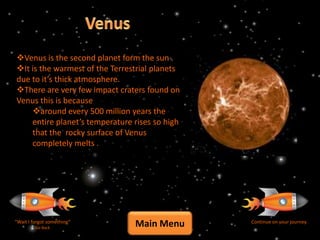
Venus is the second planet form the sun .
It is the warmest of the Terrestrial planets
due to it’s thick atmosphere.
There are very few impact craters found on
Venus this is because
    around every 500 million years the
    entire planet’s temperature rises so high
    that the rocky surface of Venus
    completely melts .


“Wait I forgot something”
         Go Back
                                Main Menu       Continue on your journey
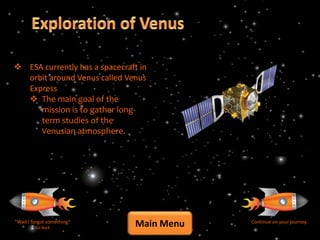
 ESA currently has a spacecraft in
  orbit around Venus called Venus
  Express
   The main goal of the
     mission is to gather long-
     term studies of the
     Venusian atmosphere.


“Wait I forgot something”
         Go Back
                                Main Menu   Continue on your journey
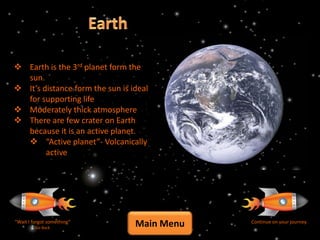
 Earth is the 3rd planet form the
  sun.
 It’s distance form the sun is ideal
  for supporting life
 Moderately thick atmosphere
 There are few crater on Earth
  because it is an active planet.
   “Active planet”- Volcanically
        active


“Wait I forgot something”
         Go Back
                                 Main Menu   Continue on your journey
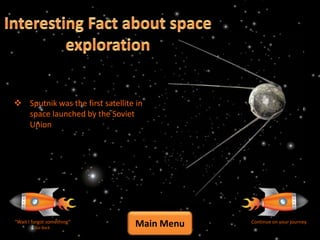
 Sputnik was the first satellite in
  space launched by the Soviet
  Union


“Wait I forgot something”
         Go Back
                                 Main Menu   Continue on your journey
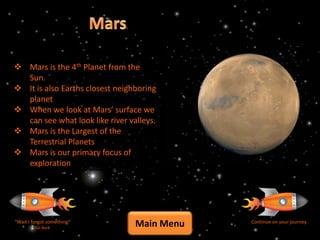
 Mars is the 4th Planet from the
  Sun.
 It is also Earths closest neighboring
  planet
 When we look at Mars’ surface we
  can see what look like river valleys.
 Mars is the Largest of the
  Terrestrial Planets
 Mars is our primary focus of
  exploration


“Wait I forgot something”
         Go Back
                                 Main Menu   Continue on your journey
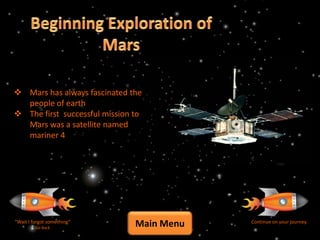
 Mars has always fascinated the
  people of earth
 The first successful mission to
  Mars was a satellite named
  mariner 4


“Wait I forgot something”
         Go Back
                               Main Menu   Continue on your journey
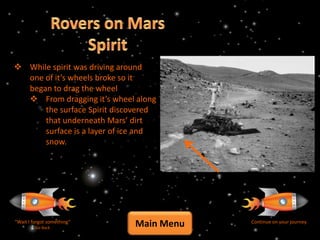
 While spirit was driving around
  one of it’s wheels broke so it
  began to drag the wheel
   From dragging it’s wheel along
      the surface Spirit discovered
      that underneath Mars’ dirt
      surface is a layer of ice and
      snow.


“Wait I forgot something”
         Go Back
                             Main Menu   Continue on your journey
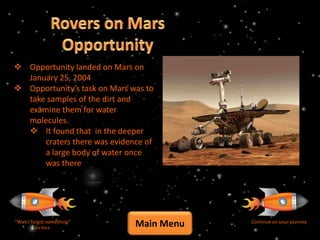
 Opportunity landed on Mars on
  January 25, 2004
 Opportunity’s task on Mars was to
  take samples of the dirt and
  examine them for water
  molecules.
   It found that in the deeper
      craters there was evidence of
      a large body of water once
      was there


“Wait I forgot something”
         Go Back
                              Main Menu   Continue on your journey
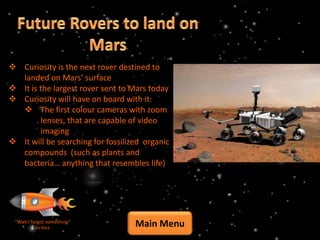
 Curiosity is the next rover destined to
  landed on Mars’ surface
 It is the largest rover sent to Mars today
 Curiosity will have on board with it:
   The first colour cameras with zoom
        lenses, that are capable of video
        imaging
 It will be searching for fossilized organic
  compounds (such as plants and
  bacteria… anything that resembles life)


 “Wait I forgot something”
          Go Back
                                   Main Menu
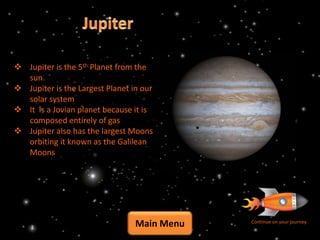
 Jupiter is the 5th Planet from the
  sun.
 Jupiter is the Largest Planet in our
  solar system
 It is a Jovian planet because it is
  composed entirely of gas
 Jupiter also has the largest Moons
  orbiting it known as the Galilean
  Moons


                                 Main Menu   Continue on your journey
 The voyager missions (voyger1 and
  Voyger2) were the first missions to
  Jupiter in the 1970s
   The Voyager missions found
       active volcano on Jupiter’s
       moons
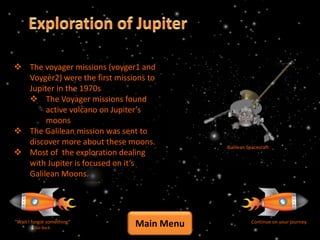
 The Galilean mission was sent to
  discover more about these moons.
                                           Galilean Spacecraft
 Most of the exploration dealing
  with Jupiter is focused on it’s
  Galilean Moons.


“Wait I forgot something”
         Go Back
                               Main Menu              Continue on your journey
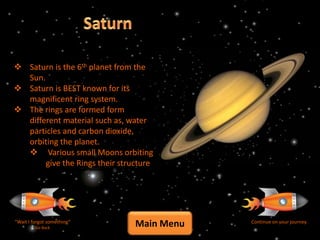
 Saturn is the 6th planet from the
  Sun.
 Saturn is BEST known for its
  magnificent ring system.
 The rings are formed form
  different material such as, water
  particles and carbon dioxide,
  orbiting the planet.
   Various small Moons orbiting
       give the Rings their structure


“Wait I forgot something”
         Go Back
                                Main Menu   Continue on your journey
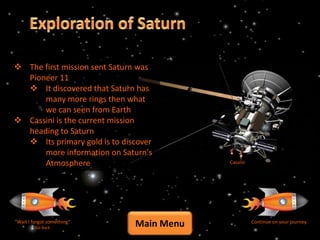
 The first mission sent Saturn was
  Pioneer 11
   It discovered that Saturn has
      many more rings then what
      we can seen from Earth
 Cassini is the current mission
  heading to Saturn
   Its primary gold is to discover
      more information on Saturn's
      Atmosphere                          Cassini


“Wait I forgot something”
         Go Back
                              Main Menu             Continue on your journey
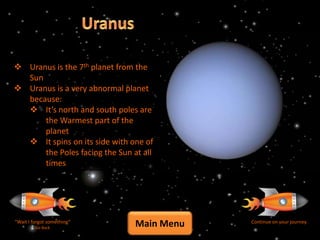
 Uranus is the 7th planet from the
  Sun
 Uranus is a very abnormal planet
  because:
   It’s north and south poles are
      the Warmest part of the
      planet
   It spins on its side with one of
      the Poles facing the Sun at all
      times


“Wait I forgot something”
         Go Back
                                Main Menu   Continue on your journey
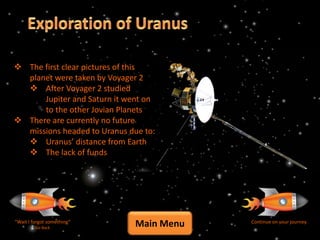
 The first clear pictures of this
  planet were taken by Voyager 2
   After Voyager 2 studied
      Jupiter and Saturn it went on
      to the other Jovian Planets
 There are currently no future
  missions headed to Uranus due to:
   Uranus’ distance from Earth
   The lack of funds


“Wait I forgot something”
         Go Back
                              Main Menu   Continue on your journey
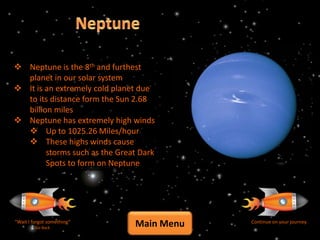
 Neptune is the 8th and furthest
  planet in our solar system
 It is an extremely cold planet due
  to its distance form the Sun 2.68
  billion miles
 Neptune has extremely high winds
   Up to 1025.26 Miles/hour
   These highs winds cause
        storms such as the Great Dark
        Spots to form on Neptune


“Wait I forgot something”
         Go Back
                               Main Menu   Continue on your journey
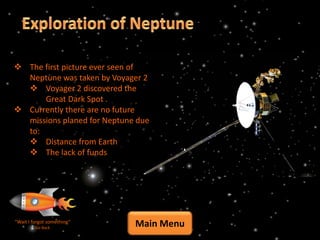
 The first picture ever seen of
  Neptune was taken by Voyager 2
   Voyager 2 discovered the
      Great Dark Spot .
 Currently there are no future
  missions planed for Neptune due
  to:
   Distance from Earth
   The lack of funds


“Wait I forgot something”
         Go Back
                             Main Menu
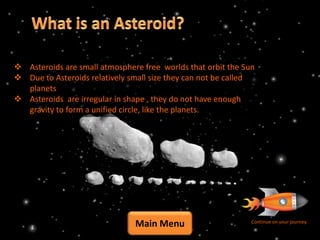
 Asteroids are small atmosphere free worlds that orbit the Sun
 Due to Asteroids relatively small size they can not be called
  planets
 Asteroids are irregular in shape , they do not have enough
  gravity to form a unified circle, like the planets.


                               Main Menu                      Continue on your journey
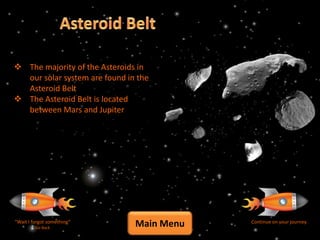
 The majority of the Asteroids in
  our solar system are found in the
  Asteroid Belt
 The Asteroid Belt is located
  between Mars and Jupiter


“Wait I forgot something”
         Go Back
                               Main Menu   Continue on your journey
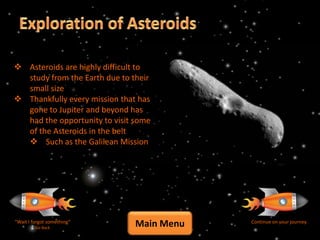
 Asteroids are highly difficult to
  study from the Earth due to their
  small size
 Thankfully every mission that has
  gone to Jupiter and beyond has
  had the opportunity to visit some
  of the Asteroids in the belt
   Such as the Galilean Mission


“Wait I forgot something”
         Go Back
                               Main Menu   Continue on your journey
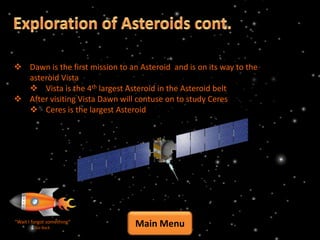
 Dawn is the first mission to an Asteroid and is on its way to the
  asteroid Vista
   Vista is the 4th largest Asteroid in the Asteroid belt
 After visiting Vista Dawn will contuse on to study Ceres
   Ceres is the largest Asteroid


“Wait I forgot something”
         Go Back
                                 Main Menu
What is a Dead World?
A. A place where people die
B. A planet that is no longer
   volcanically active
C. A planet where people once lived
   but have now become extended
D.A lost Planet
Continue to the next
     Question
Back to the Question
What was the name of the first satellite to
 orbit Mars?

 A. Mariner 4
 B. Sputnik
 C. Rover
 D.Odyssey
Continue to the next
     Question
Back to the Question
What is the name of the future Rover
 mission to Mars?

 A. Spirit
 B. Rover 2
 C. Sputnik
 D.Curiosity
Continue to the next
     Question
Back to the Question
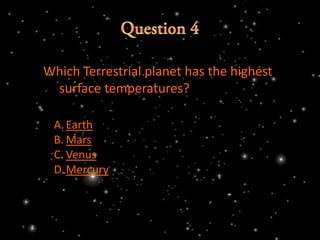
Which Terrestrial planet has the highest
 surface temperatures?

 A. Earth
 B. Mars
 C. Venus
 D.Mercury
Continue to the next
     Question
Back to the Question
Which Jovian planet has the Galilean
 Moons orbiting it?

 A. Jupiter
 B. Saturn
 C. Neptune
 D.Uranus
Continue to the next
     Question
Back to the Question
What is the name of the current
 mission to Saturn?

 A. Voyager 1
 B. Pioneer
 C. Cassini
 D.Voyager 2
Continue to the next
     Question
Back to the Question
Which planet rotates with the poles
 facing the Sun?

 A. Neptune
 B. Venus
 C. Uranus
 D.Mars
Continue to the next
     Question
Back to the Question
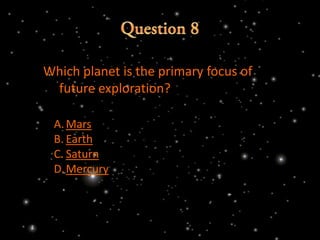
Which planet is the primary focus of
 future exploration?

 A. Mars
 B. Earth
 C. Saturn
 D.Mercury
Continue to the next
     Question
Back to the Question
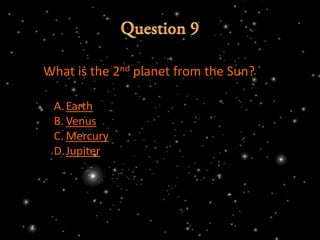
What is the 2nd planet from the Sun?

 A. Earth
 B. Venus
 C. Mercury
 D.Jupiter
Continue to the next
     Question
Back to the Question
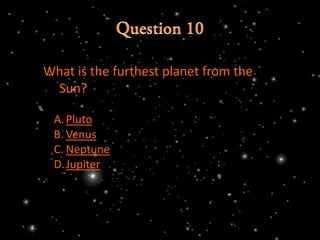
What is the furthest planet from the
 Sun?

 A. Pluto
 B. Venus
 C. Neptune
 D.Jupiter
Continue to the next
     Question
Back to the Question
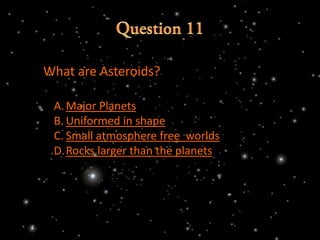
What are Asteroids?

 A. Major Planets
 B. Uniformed in shape
 C. Small atmosphere free worlds
 D.Rocks larger than the planets
Continue to the next
     Question
Back to the Question
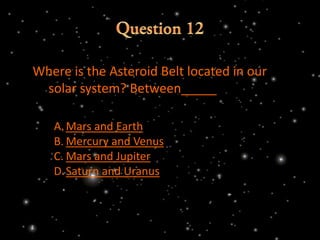
Where is the Asteroid Belt located in our
 solar system? Between_____

   A. Mars and Earth
   B. Mercury and Venus
   C. Mars and Jupiter
   D.Saturn and Uranus
Continue to the next
     Question
Back to the Question
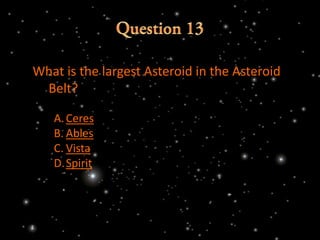
What is the largest Asteroid in the Asteroid
 Belt?

   A. Ceres
   B. Ables
   C. Vista
   D.Spirit
Main Menu
Back to the Question

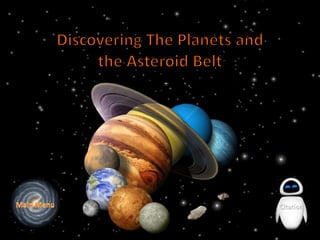
Discovering the Solar System

  • 2.
    Where to Start yourexploration? Quiz
  • 3.
    Citation Pictures Jovian planets picture: http://aschy.kicks-ass.net/solsys/raw/misc/Jovian.jpg Neptune: http://www.solarviews.com/raw/nep/neptunes.jpg Saturn http://www.harrisburgacademy.org/computer/decade%20project/20062007/2007%20students/6th%20grade/luke/space%20web page/Saturn.jpg Uranus http://nssdc.gsfc.nasa.gov/planetary/image/uranus_voy2.jpg Jupiter http://wallpapers-sky.com/wp-content/uploads/2011/06/Planet-Jupiter-wallpaper.jpg Mercury http://twittface.net/wp-content/uploads/2011/02/solar-mercury2.jpg Venus: http://sos.noaa.gov/images/Solar_System/venus.jpg Mars: http://www.parabolicarc.com/wp-content/uploads/2008/08/marsglobe2.jpg Asteroid belt http://www.indiana.edu/~geol105/images/gaia_chapter_2/asteroids_compare4.jpg EVA http://ipadwallpaper.eu/wallpapers/2/eva-wall-e.jpg Main Menu Continue on your journey
  • 4.
    Citation Sputnik: Pictures and more http://www.celestiamotherlode.net/catalog/images/screenshots/various/satellites_Sputnik_1_1__K ukanotas.jpg Rovers: http://www.scientificamerican.com Cassini: http://forum.celestialmatters.org/userpix/7_cassini_1.jpg NASA Research about all planets and exploration: http://solarsystem.nasa.gov/missions/profile.cfm?Sort=Target&Target=SolarSys&MCode=JWST Messenger: http://www.celestiamotherlode.net/catalog/images/screenshots/various/spacecraft_Messenger_1_ _Cham.jpg “Wait I forgot something” Go Back Main Menu Continue on your journey
  • 5.
    Citation TEKS Knowledge and skill: (11) Earth and space. The student understands the organization of our solar system and the relationships among the various bodies that comprise it. The student is expected to: (A) describe the physical properties, locations, and movements of the Sun, planets, Galilean moons, meteors, asteroids, and comets; (B) understand that gravity is the force that governs the motion of our solar system; and (C) describe the history and future of space exploration, including the types of equipment and transportation needed for space travel. “Wait I forgot something” Go Back Main Menu
  • 6.
    Mercury the ClosesPlanet to the Sun It is also the smallest Planet As you can see Mercury ‘s surface is covered with craters. Craters are formed when large comets and asteroids plummet onto the surface of mercury The reason you can see so many craters on Mercury is because Mercury is what Astronomers call a “Dead World”. “Dead world”- Means that the planet is no longer volcanically active Main Menu Continue on your journey
  • 7.
    It wasn’t untilthe Space age of 1950s that astronomers got the opportunity to see the surface of Mercury. This is because mercury is about 57 million miles at it’s closest distance to the Earth. Mariner 10 was the first mission to go to Mercury. Mariner 10 Flew past Mercury 3 times in 1974. Mapped 57% of its surface “Wait I forgot something” Go Back Main Menu Continue on your journey
  • 8.
     Since mid-March,NASA has a spacecraft called Messenger in orbit around Mercury.  Messenger main purpose was to gather more information about the interior structure of Mercury  Future Exploration:  ESA (European Space Agency) is currently building a spacecraft called BepiColombo, to send to Mercury in collaboration with the Japanese Space Agency, JAXA “Wait I forgot something” Go Back Main Menu Continue on your journey
  • 9.
    Venus is thesecond planet form the sun . It is the warmest of the Terrestrial planets due to it’s thick atmosphere. There are very few impact craters found on Venus this is because around every 500 million years the entire planet’s temperature rises so high that the rocky surface of Venus completely melts . “Wait I forgot something” Go Back Main Menu Continue on your journey
  • 10.
     ESA currentlyhas a spacecraft in orbit around Venus called Venus Express  The main goal of the mission is to gather long- term studies of the Venusian atmosphere. “Wait I forgot something” Go Back Main Menu Continue on your journey
  • 11.
     Earth isthe 3rd planet form the sun.  It’s distance form the sun is ideal for supporting life  Moderately thick atmosphere  There are few crater on Earth because it is an active planet.  “Active planet”- Volcanically active “Wait I forgot something” Go Back Main Menu Continue on your journey
  • 12.
     Sputnik wasthe first satellite in space launched by the Soviet Union “Wait I forgot something” Go Back Main Menu Continue on your journey
  • 13.
     Mars isthe 4th Planet from the Sun.  It is also Earths closest neighboring planet  When we look at Mars’ surface we can see what look like river valleys.  Mars is the Largest of the Terrestrial Planets  Mars is our primary focus of exploration “Wait I forgot something” Go Back Main Menu Continue on your journey
  • 14.
     Mars hasalways fascinated the people of earth  The first successful mission to Mars was a satellite named mariner 4 “Wait I forgot something” Go Back Main Menu Continue on your journey
  • 15.
     While spiritwas driving around one of it’s wheels broke so it began to drag the wheel  From dragging it’s wheel along the surface Spirit discovered that underneath Mars’ dirt surface is a layer of ice and snow. “Wait I forgot something” Go Back Main Menu Continue on your journey
  • 16.
     Opportunity landedon Mars on January 25, 2004  Opportunity’s task on Mars was to take samples of the dirt and examine them for water molecules.  It found that in the deeper craters there was evidence of a large body of water once was there “Wait I forgot something” Go Back Main Menu Continue on your journey
  • 17.
     Curiosity isthe next rover destined to landed on Mars’ surface  It is the largest rover sent to Mars today  Curiosity will have on board with it:  The first colour cameras with zoom lenses, that are capable of video imaging  It will be searching for fossilized organic compounds (such as plants and bacteria… anything that resembles life) “Wait I forgot something” Go Back Main Menu
  • 18.
     Jupiter isthe 5th Planet from the sun.  Jupiter is the Largest Planet in our solar system  It is a Jovian planet because it is composed entirely of gas  Jupiter also has the largest Moons orbiting it known as the Galilean Moons Main Menu Continue on your journey
  • 19.
     The voyagermissions (voyger1 and Voyger2) were the first missions to Jupiter in the 1970s  The Voyager missions found active volcano on Jupiter’s moons  The Galilean mission was sent to discover more about these moons. Galilean Spacecraft  Most of the exploration dealing with Jupiter is focused on it’s Galilean Moons. “Wait I forgot something” Go Back Main Menu Continue on your journey
  • 20.
     Saturn isthe 6th planet from the Sun.  Saturn is BEST known for its magnificent ring system.  The rings are formed form different material such as, water particles and carbon dioxide, orbiting the planet.  Various small Moons orbiting give the Rings their structure “Wait I forgot something” Go Back Main Menu Continue on your journey
  • 21.
     The firstmission sent Saturn was Pioneer 11  It discovered that Saturn has many more rings then what we can seen from Earth  Cassini is the current mission heading to Saturn  Its primary gold is to discover more information on Saturn's Atmosphere Cassini “Wait I forgot something” Go Back Main Menu Continue on your journey
  • 22.
     Uranus isthe 7th planet from the Sun  Uranus is a very abnormal planet because:  It’s north and south poles are the Warmest part of the planet  It spins on its side with one of the Poles facing the Sun at all times “Wait I forgot something” Go Back Main Menu Continue on your journey
  • 23.
     The firstclear pictures of this planet were taken by Voyager 2  After Voyager 2 studied Jupiter and Saturn it went on to the other Jovian Planets  There are currently no future missions headed to Uranus due to:  Uranus’ distance from Earth  The lack of funds “Wait I forgot something” Go Back Main Menu Continue on your journey
  • 24.
     Neptune isthe 8th and furthest planet in our solar system  It is an extremely cold planet due to its distance form the Sun 2.68 billion miles  Neptune has extremely high winds  Up to 1025.26 Miles/hour  These highs winds cause storms such as the Great Dark Spots to form on Neptune “Wait I forgot something” Go Back Main Menu Continue on your journey
  • 25.
     The firstpicture ever seen of Neptune was taken by Voyager 2  Voyager 2 discovered the Great Dark Spot .  Currently there are no future missions planed for Neptune due to:  Distance from Earth  The lack of funds “Wait I forgot something” Go Back Main Menu
  • 26.
     Asteroids aresmall atmosphere free worlds that orbit the Sun  Due to Asteroids relatively small size they can not be called planets  Asteroids are irregular in shape , they do not have enough gravity to form a unified circle, like the planets. Main Menu Continue on your journey
  • 27.
     The majorityof the Asteroids in our solar system are found in the Asteroid Belt  The Asteroid Belt is located between Mars and Jupiter “Wait I forgot something” Go Back Main Menu Continue on your journey
  • 28.
     Asteroids arehighly difficult to study from the Earth due to their small size  Thankfully every mission that has gone to Jupiter and beyond has had the opportunity to visit some of the Asteroids in the belt  Such as the Galilean Mission “Wait I forgot something” Go Back Main Menu Continue on your journey
  • 29.
     Dawn isthe first mission to an Asteroid and is on its way to the asteroid Vista  Vista is the 4th largest Asteroid in the Asteroid belt  After visiting Vista Dawn will contuse on to study Ceres  Ceres is the largest Asteroid “Wait I forgot something” Go Back Main Menu
  • 30.
    What is aDead World? A. A place where people die B. A planet that is no longer volcanically active C. A planet where people once lived but have now become extended D.A lost Planet
  • 31.
    Continue to thenext Question
  • 32.
    Back to theQuestion
  • 33.
    What was thename of the first satellite to orbit Mars? A. Mariner 4 B. Sputnik C. Rover D.Odyssey
  • 34.
    Continue to thenext Question
  • 35.
    Back to theQuestion
  • 36.
    What is thename of the future Rover mission to Mars? A. Spirit B. Rover 2 C. Sputnik D.Curiosity
  • 37.
    Continue to thenext Question
  • 38.
    Back to theQuestion
  • 39.
    Which Terrestrial planethas the highest surface temperatures? A. Earth B. Mars C. Venus D.Mercury
  • 40.
    Continue to thenext Question
  • 41.
    Back to theQuestion
  • 42.
    Which Jovian planethas the Galilean Moons orbiting it? A. Jupiter B. Saturn C. Neptune D.Uranus
  • 43.
    Continue to thenext Question
  • 44.
    Back to theQuestion
  • 45.
    What is thename of the current mission to Saturn? A. Voyager 1 B. Pioneer C. Cassini D.Voyager 2
  • 46.
    Continue to thenext Question
  • 47.
    Back to theQuestion
  • 48.
    Which planet rotateswith the poles facing the Sun? A. Neptune B. Venus C. Uranus D.Mars
  • 49.
    Continue to thenext Question
  • 50.
    Back to theQuestion
  • 51.
    Which planet isthe primary focus of future exploration? A. Mars B. Earth C. Saturn D.Mercury
  • 52.
    Continue to thenext Question
  • 53.
    Back to theQuestion
  • 54.
    What is the2nd planet from the Sun? A. Earth B. Venus C. Mercury D.Jupiter
  • 55.
    Continue to thenext Question
  • 56.
    Back to theQuestion
  • 57.
    What is thefurthest planet from the Sun? A. Pluto B. Venus C. Neptune D.Jupiter
  • 58.
    Continue to thenext Question
  • 59.
    Back to theQuestion
  • 60.
    What are Asteroids? A. Major Planets B. Uniformed in shape C. Small atmosphere free worlds D.Rocks larger than the planets
  • 61.
    Continue to thenext Question
  • 62.
    Back to theQuestion
  • 63.
    Where is theAsteroid Belt located in our solar system? Between_____ A. Mars and Earth B. Mercury and Venus C. Mars and Jupiter D.Saturn and Uranus
  • 64.
    Continue to thenext Question
  • 65.
    Back to theQuestion
  • 66.
    What is thelargest Asteroid in the Asteroid Belt? A. Ceres B. Ables C. Vista D.Spirit
  • 67.
  • 68.
    Back to theQuestion