1
2
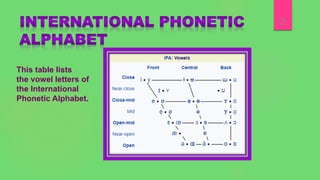
This table lists
the vowel letters of
the International
Phonetic Alphabet.
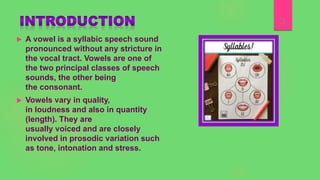
 A vowel is a syllabic speech sound
pronounced without any stricture in
the vocal tract. Vowels are one of
the two principal classes of speech
sounds, the other being
the consonant.
 Vowels vary in quality,
in loudness and also in quantity
(length). They are
usually voiced and are closely
involved in prosodic variation such
as tone, intonation and stress.
3
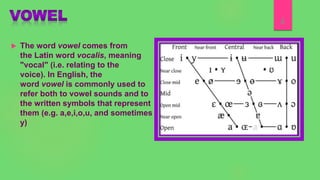
 The word vowel comes from
the Latin word vocalis, meaning
"vocal" (i.e. relating to the
voice). In English, the
word vowel is commonly used to
refer both to vowel sounds and to
the written symbols that represent
them (e.g. a,e,i,o,u, and sometimes
y)
4
 There are two complementary definitions of vowel, one phonetic and the
other phonological.
 In the phonetic definition, a vowel is a sound, such as the English "ah" /ɑː/
or "oh" /oʊ/, produced with an open vocal tract; it is median (the air
escapes along the middle of the tongue), oral (at least some of the airflow
must escape through the mouth), frictionless and continuant. There is no
significant build-up of air pressure at any point above the glottis. This
contrasts with consonants, such as the English "sh" [ʃ], which have a
constriction or closure at some point along the vocal tract.
5
 In the phonological definition, a vowel is defined as syllabic, the sound
that forms the peak of a syllable. A phonetically equivalent but non-
syllabic sound is a semivowel. In oral languages, phonetic vowels
normally form the peak (nucleus) of many or all syllables,
whereas consonants form the onset and (in languages that have
them) coda. Some languages allow other sounds to form the nucleus of
a syllable, such as the syllabic (i.e., vocalic) l in the English
word table [ˈtʰeɪ.bl̩] (when not considered to have a weak vowel
sound: [ˈtʰeɪ.bəl]) or the syllabic r in the Serbo-
Croatian word vrt [ʋr̩̂t] "garden".
6
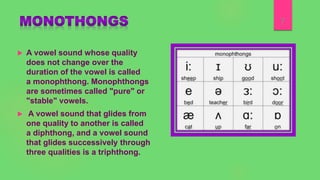
 A vowel sound whose quality
does not change over the
duration of the vowel is called
a monophthong. Monophthongs
are sometimes called "pure" or
"stable" vowels.
 A vowel sound that glides from
one quality to another is called
a diphthong, and a vowel sound
that glides successively through
three qualities is a triphthong.
7
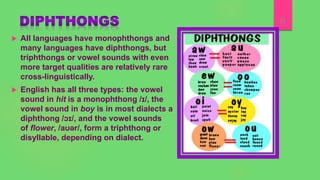
 All languages have monophthongs and
many languages have diphthongs, but
triphthongs or vowel sounds with even
more target qualities are relatively rare
cross-linguistically.
 English has all three types: the vowel
sound in hit is a monophthong /ɪ/, the
vowel sound in boy is in most dialects a
diphthong /ɔɪ/, and the vowel sounds
of flower, /aʊər/, form a triphthong or
disyllable, depending on dialect.
8
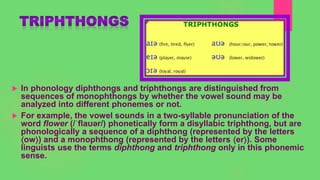
 In phonology diphthongs and triphthongs are distinguished from
sequences of monophthongs by whether the vowel sound may be
analyzed into different phonemes or not.
 For example, the vowel sounds in a two-syllable pronunciation of the
word flower (/ˈflaʊər/) phonetically form a disyllabic triphthong, but are
phonologically a sequence of a diphthong (represented by the letters
⟨ow⟩) and a monophthong (represented by the letters ⟨er⟩). Some
linguists use the terms diphthong and triphthong only in this phonemic
sense.
9
10

Vowels

  • 1.
  • 2.
    2 This table lists thevowel letters of the International Phonetic Alphabet.
  • 3.
     A vowelis a syllabic speech sound pronounced without any stricture in the vocal tract. Vowels are one of the two principal classes of speech sounds, the other being the consonant.  Vowels vary in quality, in loudness and also in quantity (length). They are usually voiced and are closely involved in prosodic variation such as tone, intonation and stress. 3
  • 4.
     The wordvowel comes from the Latin word vocalis, meaning "vocal" (i.e. relating to the voice). In English, the word vowel is commonly used to refer both to vowel sounds and to the written symbols that represent them (e.g. a,e,i,o,u, and sometimes y) 4
  • 5.
     There aretwo complementary definitions of vowel, one phonetic and the other phonological.  In the phonetic definition, a vowel is a sound, such as the English "ah" /ɑː/ or "oh" /oʊ/, produced with an open vocal tract; it is median (the air escapes along the middle of the tongue), oral (at least some of the airflow must escape through the mouth), frictionless and continuant. There is no significant build-up of air pressure at any point above the glottis. This contrasts with consonants, such as the English "sh" [ʃ], which have a constriction or closure at some point along the vocal tract. 5
  • 6.
     In thephonological definition, a vowel is defined as syllabic, the sound that forms the peak of a syllable. A phonetically equivalent but non- syllabic sound is a semivowel. In oral languages, phonetic vowels normally form the peak (nucleus) of many or all syllables, whereas consonants form the onset and (in languages that have them) coda. Some languages allow other sounds to form the nucleus of a syllable, such as the syllabic (i.e., vocalic) l in the English word table [ˈtʰeɪ.bl̩] (when not considered to have a weak vowel sound: [ˈtʰeɪ.bəl]) or the syllabic r in the Serbo- Croatian word vrt [ʋr̩̂t] "garden". 6
  • 7.
     A vowelsound whose quality does not change over the duration of the vowel is called a monophthong. Monophthongs are sometimes called "pure" or "stable" vowels.  A vowel sound that glides from one quality to another is called a diphthong, and a vowel sound that glides successively through three qualities is a triphthong. 7
  • 8.
     All languageshave monophthongs and many languages have diphthongs, but triphthongs or vowel sounds with even more target qualities are relatively rare cross-linguistically.  English has all three types: the vowel sound in hit is a monophthong /ɪ/, the vowel sound in boy is in most dialects a diphthong /ɔɪ/, and the vowel sounds of flower, /aʊər/, form a triphthong or disyllable, depending on dialect. 8
  • 9.
     In phonologydiphthongs and triphthongs are distinguished from sequences of monophthongs by whether the vowel sound may be analyzed into different phonemes or not.  For example, the vowel sounds in a two-syllable pronunciation of the word flower (/ˈflaʊər/) phonetically form a disyllabic triphthong, but are phonologically a sequence of a diphthong (represented by the letters ⟨ow⟩) and a monophthong (represented by the letters ⟨er⟩). Some linguists use the terms diphthong and triphthong only in this phonemic sense. 9
  • 10.

Editor's Notes

  • #5 grapevine channels carry information rapidly