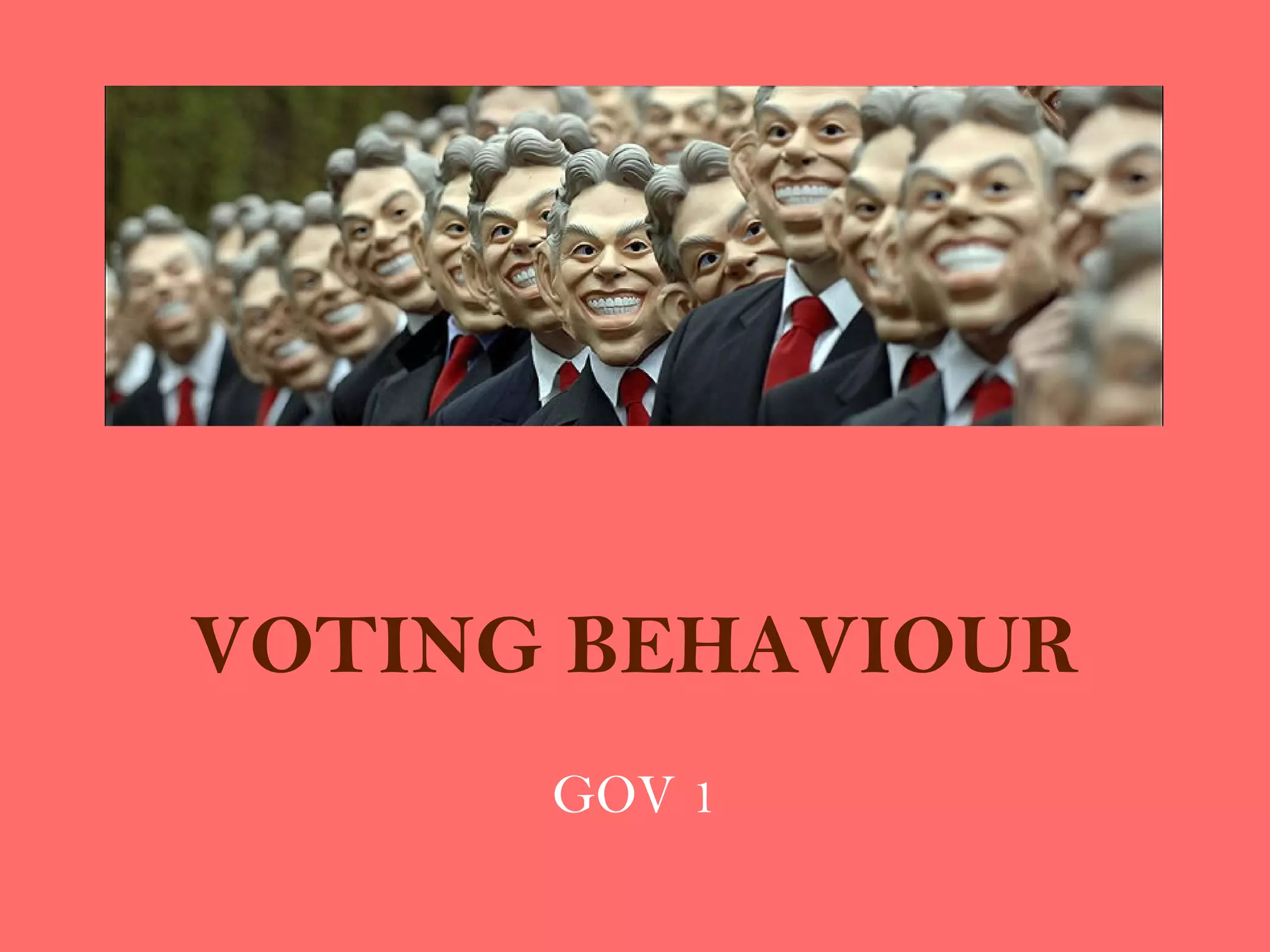
VOTING BEHAVIOUR
      GOV 1
KEY QUESTIONS
• What are the factors behind voting
  behaviour?
• Assess the effect of election campaigns and
  opinion polls on the outcomes of general
  elections.
• What role do the media play in winning or
  losing elections?
• How important is social class in voting
  behaviour?
Models of VB
• Party Identification

• Social Structures

• Rational Choice

• Issue Voting

• Party Leadership

• Tactical Voting
Influences on VB
• Election Campaigns

• Opinion Polls

• The Media

• Apathy
General Election Case Studies
• 1979 – Mrs Thatcher kicks 18 years of Tory rule

• 1997 – Mr Blair returns Labour to power with a
  historic landslide

• 2001 – A low point for democracy!

• 2005 – A victory for who?

• 2010 – a new way to do politics.
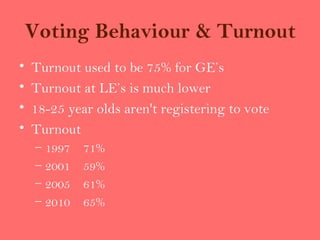
Voting Behaviour & Turnout
•   Turnout used to be 75% for GE’s
•   Turnout at LE’s is much lower
•   18-25 year olds aren't registering to vote
•   Turnout
     –   1997   71%
     –   2001   59%
     –   2005   61%
     –   2010   65%
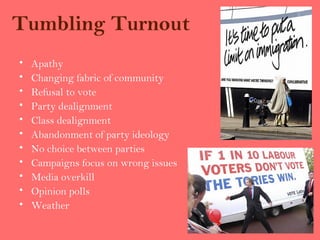
Tumbling Turnout
•   Apathy
•   Changing fabric of community
•   Refusal to vote
•   Party dealignment
•   Class dealignment
•   Abandonment of party ideology
•   No choice between parties
•   Campaigns focus on wrong issues
•   Media overkill
•   Opinion polls
•   Weather
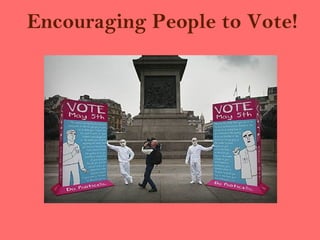
Encouraging People to Vote!
Why do people vote the way
•
                           they do? party? The Party
    Is it because people identify with a particular
    Identification Model
•   Is it because people’s voting habits are shaped by social factors?
    The Social Structures Model
•   Is it because people make rational choices? The Rational Choice
    Model
•   Is it because modern politics is dominated by a dominant
    ideology? The Dominant Ideology Model
•   When people don’t vote, is it Apathy?
•   What is Tactical Voting?


                                      ‘Vote Local!’
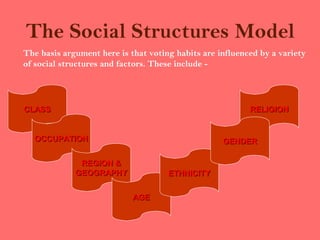
The Social Structures Model
The basis argument here is that voting habits are influenced by a variety
of social structures and factors. These include -


CLASS                                                     RELIGION


  OCCUPATION                                       GENDER

              REGION &
             GEOGRAPHY               ETHNICITY


                            AGE
Social Class
• Electorate divided into A, B, C1, C2, D & E’s
      • A, B, C1 = Conservative Voters
      • C2, D, E = Labour Voters


• Model dominated political thinking in 1960’s and 70’s

• Class dealignment

• Emergence of New Working Class
Social Class

 “Class is the basis of British party
politics; all else is embellishment and
                  detail”
               Pulzer 1975
   http://www.bbc.co.uk/comedy/collections/p007jyx1#p007n113


   http://www.youtube.com/watch?v=EKFTtYx2OHc&NR=1&feature=fvw
Gender, Age & Ethnicity


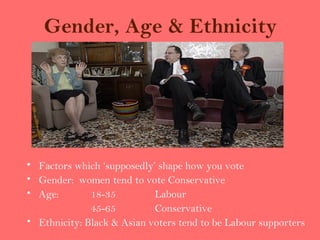
• Factors which ‘supposedly’ shape how you vote
• Gender: women tend to vote Conservative
• Age:        18-35         Labour
              45-65         Conservative
• Ethnicity: Black & Asian voters tend to be Labour supporters
Regional Factors
• Political parties tend to have ‘clumped’
  support
• Labour – industrial towns in North of
  England, Scotland & Wales
• Conservatives – London, South East suburbia
  & rural communities in England
• Liberal Democrats – evenly spread support
Party Deference

    “The Conservatives have had more
 experience over the centuries. Its in the
   blood for them, running the country.
  There’s more family background in the
 Conservatives, more of the aristocratic,
more heritage. They're gentlemen born. I
  think they're made for that sort of job”
  R Samuel – The Deference Voter 1960
Partisan and Class Theories
  “Broadly speaking the electorate was divided into
    large blocs which provided reliable and stable
   voting support for the Conservative and Labour
   parties. The interconnected phenomena of class
         and partisan alignment were like twin
    pillars….which supported and sustained stable
  party support on the part of individual voters and
           stable two-party system overall”
                     Denver 1994
Party Identification Model
• Voters identify with a political party in their youth
  and remain loyal voters as they age

• Choice of political party tends to be driven by social
  and economic factors
• http://www.bbc.co.uk/comedy/collections/p007jyx1#p007n19z


               1950’s                 90%+ of voters
               2000+                  55% of voters

• Party Dealignment
Partisan Alignment

“Generally speaking do you usually
 think of yourself as Conservative,
    Labour, a Liberal or what?”
       Butler & Stokes 1974
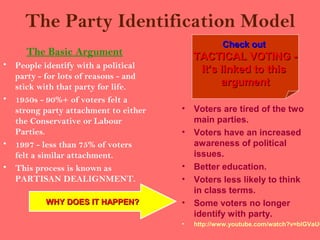
The Party Identification Model
                                                  Check out
     The Basic Argument                   TACTICAL VOTING -
• People identify with a political
                                           it’s linked to this
  party - for lots of reasons - and
  stick with that party for life.               argument
• 1950s - 90%+ of voters felt a
  strong party attachment to either   •   Voters are tired of the two
  the Conservative or Labour              main parties.
  Parties.                            •   Voters have an increased
• 1997 - less than 75% of voters          awareness of political
  felt a similar attachment.              issues.
• This process is known as            •   Better education.
  PARTISAN DEALIGNMENT.               •   Voters less likely to think
                                          in class terms.
          WHY DOES IT HAPPEN?         •   Some voters no longer
                                          identify with party.
                                      •   http://www.youtube.com/watch?v=blGVaUQ
Issue Voting
• Vote for a party based solely on their manifesto
  policies
• http://www.bbc.co.uk/comedy/collections/p007jyx1#p007n16m


• Model arose post 1979

• Parties traditionally focus on certain policy areas
   – Labour: health & education
   – Conservatives: taxes, economy & law
   – Liberal Democrats: environment

• Independent MPs
Rational Choice Model
• Voting behaviour influenced by:
   –   Parties track record
   –   Election manifesto
   –   Party leaders
   –   Key party players


• Voters make a rational decision not based on class or age or
  gender or party allegiance BUT on who will benefit them and
  their families
Rational Voter Theory
 “….issues that are defined in terms of alternative
 courses of government action and issues that are
  defined in terms of goals and values that govt
 may achieve…….It is natural that the analysis of
issues should have a bias towards issues that have
    meaning in terms of alternative policies”
               Butler & Stokes 1974
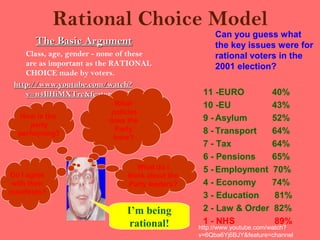
Rational Choice Model
                                                      Can you guess what
       The Basic Argument                             the key issues were for
    Class, age, gender - none of these                rational voters in the
    are as important as the RATIONAL                  2001 election?
    CHOICE made by voters.
 http://www.youtube.com/watch?
    v=n4IlHiMXTrc&feature=related                 11 -EURO             40%
                            What                  10 -EU               43%
                           policies
  How is the                                      9 - Asylum           52%
                          does the
      party
                            Party                 8 - Transport        64%
  performing?
                           have?
                                                  7 - Tax              64%
                                                  6 - Pensions         65%
                                  What do I       5 - Employment       70%
Do I agree                     think about the
with their                     Party leaders?     4 - Economy          74%
manifesto?
                                                  3 - Education        81%
                               I’m being          2 - Law & Order      82%
                                rational!         1 - NHS              89%
                                                 http://www.youtube.com/watch?
                                                 v=6Qba6Yj6BJY&feature=channel
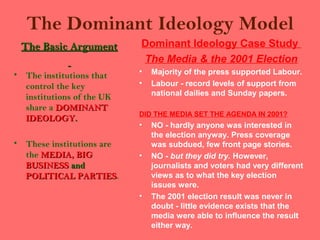
The Dominant Ideology Model
 The Basic Argument        Dominant Ideology Case Study
                           The Media & the 2001 Election
• The institutions that    •   Majority of the press supported Labour.
  control the key          •   Labour - record levels of support from
  institutions of the UK       national dailies and Sunday papers.
  share a DOMINANT
                           DID THE MEDIA SET THE AGENDA IN 2001?
  IDEOLOGY.
                           •   NO - hardly anyone was interested in
                               the election anyway. Press coverage
• These institutions are       was subdued, few front page stories.
  the MEDIA, BIG           •   NO - but they did try. However,
  BUSINESS and                 journalists and voters had very different
  POLITICAL PARTIES.
               PARTIES         views as to what the key election
                               issues were.
                           •   The 2001 election result was never in
                               doubt - little evidence exists that the
                               media were able to influence the result
                               either way.
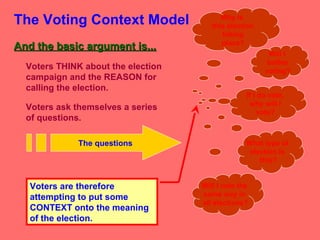
The Voting Context Model                  Why is
                                       this election
                                          taking
                                          place?
And the basic argument is...
                                                         Will I
                                                        bother
  Voters THINK about the election                       voting?
  campaign and the REASON for
  calling the election.
                                                  If I do vote,
                                                   why will I
  Voters ask themselves a series
                                                       vote?
  of questions.

             The questions                        What type of
                                                   election is
                                                      this?


   Voters are therefore             Will I vote the
   attempting to put some           same way in
                                    all elections?
   CONTEXT onto the meaning
   of the election.
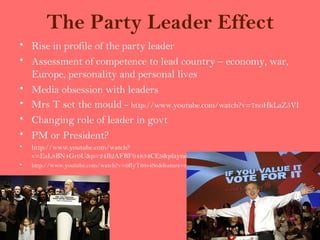
The Party Leader Effect
• Rise in profile of the party leader
• Assessment of competence to lead country – economy, war,
  Europe, personality and personal lives
• Media obsession with leaders
• Mrs T set the mould - http://www.youtube.com/watch?v=7noHkLaZ5VI
• Changing role of leader in govt
• PM or President?
•   http://www.youtube.com/watch?
    v=EaL8BN4Gr0U&p=24B2AFBF94834CE9&playnext=1&index=4
•   http://www.youtube.com/watch?v=0fIyT66s4So&feature=related
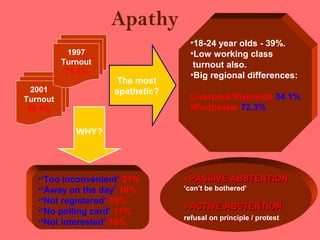
Apathy
                                   •18-24 year olds - 39%.
            1997                   •Low working class
          Turnout                   turnout also.
           71.4%                   •Big regional differences:
                     The most
  2001              apathetic?
Turnout                            Liverpool Riverside 34.1%
 59.4%                             Winchester 72.3%

             WHY?


   •‘Too inconvenient’ 21%       • PASSIVE ABSTENTION
   •‘Away on the day’ 16%        ‘can’t be bothered’
   •‘Not registered’ 15%
                                 • ACTIVE ABSTENTION
   •‘No polling card’ 11%
                                 refusal on principle / protest
   •‘Not interested’ 10%
Tactical Voting
• A product of FPTP system

• Voting for party A to keep out party B who you
  dislike because party C, your first choice, has no
  chance of winning

• 1997 Hazel Grove Constituency
   – Tory 1000 vote majority over Lib Dems
   – If you are a Labour supporter, who do you vote for?
Tactical Voting                         And your basic argument is...

                                      Voters choose to vote for a candidate
                                        that may not be their first choice
          1992                         candidate in order to prevent their
          May have                           least favourite party or
          reduced the                            candidate being
          Conservative                                elected
          majority by half.


 1997                      2001
 •More important role      •Strong evidence of tactical voting.
  in outcome of the        •Labour voters switched to Liberals
  election.                 in key constituencies.
 •‘More anti-tory voting   •‘Independent’ encouraged a
   than ever before’         tactical vote.
  (Butler and Stokes).
Influence of
campaigning, media,
 opinion polls……..
   “Political change was neither related to the
     degree of exposure nor to any particular
 programmes or arguments put forward by the
parties…..The inter-election years become more
    important than the 17 days campaigning,
 however intensive, because the swing is almost
entirely accounted for before the opening of the
                election campaign”
           Trenamen & McQuail 1961
Election Campaigns
• Jury out on influence of actual campaigns
• 1979-87
     – Labour poorly organised and unprofessional/ Conservatives use of
       powerful national negative advertising
• 1990 to today
     – Labour got slick and carefully managed campaigns/ Conservatives
       campaigning tired and focused on wrong issues
     – http://www.youtube.com/watch?v=zIBZ1QXi610
     – http://www.youtube.com/watch?v=OBcYytunF-Y
     – - 2010 campaign http://www.youtube.com/watch?
       v=4lyaV0igUDA&p=06BE5FAB442BA2DB&playnext=1&index=3
•   http://www.youtube.com/watch?v=Rqis1mkS2CE&feature=related
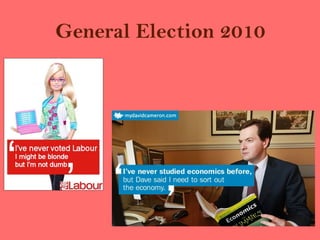
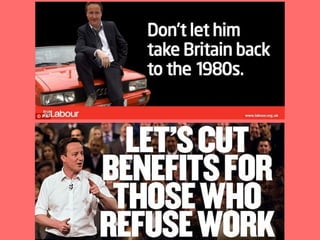
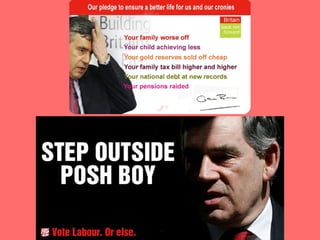
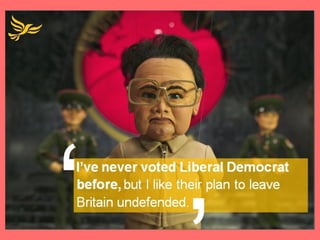
General Election 2010
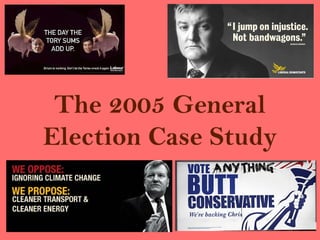
The 2005 General
Election Case Study
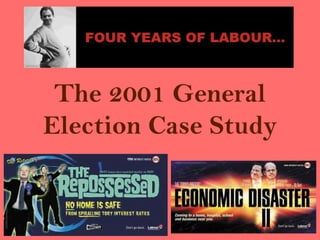
The 2001 General
Election Case Study
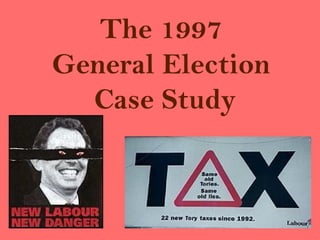
The 1997
General Election
  Case Study
Was the 1997 General election
 a text book example of the
  power of a well organised
campaign OR was it just time
        for a change ?
Opinion Polls
•   Disagreement on polls influence on elections
•   Polls often seen as election forecasts
•   Polls are a snapshot of voting intention
•   Best guide available for politicians and media
•   Cant be bothered or bandwagon effect
•   Different sampling methods
•   Sample sizes
Video Task
• Who conducted the BBC’s exit poll?
• What was the sample size?
• What was the forecast result for:
                        seats            share of vote
  –   Labour
  –   Conservative
  –   Lib Dems
  –   Others
• What Labour majority did the poll forecast?
• What percentage swing to the Tories did the poll
  forecast?
• What percentage swing did the Tories need to win?
The Media
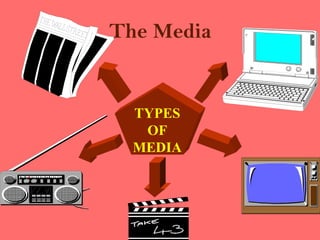
The Media


  TYPES
   OF
  MEDIA
The Media
• Difference of opinion on influence of media
• Looking at media content suggests there is some
  level of influence
• Editors decisions on what and what not to focus on
• http://www.youtube.com/watch?v=5eBT6OSr1TI&feature=related
• Influence of the newspapers – If The Sun backs you,
  you win!
• http://www.youtube.com/watch?v=CDw-1bYatIs&feature=related
• Labour recognised this, implemented a programme
  to charm and educate the media about NEW
  LABOUR
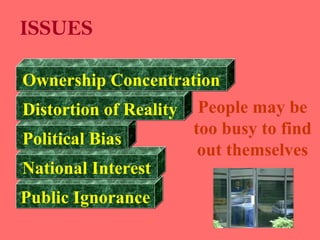
ISSUES

Ownership Concentration
Distortion of Reality People may be
                      too busy to find
Political Bias
                       out themselves
National Interest
Public Ignorance

Voting behaviour2

  • 1.
  • 2.
    KEY QUESTIONS • Whatare the factors behind voting behaviour? • Assess the effect of election campaigns and opinion polls on the outcomes of general elections. • What role do the media play in winning or losing elections? • How important is social class in voting behaviour?
  • 3.
    Models of VB •Party Identification • Social Structures • Rational Choice • Issue Voting • Party Leadership • Tactical Voting
  • 4.
    Influences on VB •Election Campaigns • Opinion Polls • The Media • Apathy
  • 5.
    General Election CaseStudies • 1979 – Mrs Thatcher kicks 18 years of Tory rule • 1997 – Mr Blair returns Labour to power with a historic landslide • 2001 – A low point for democracy! • 2005 – A victory for who? • 2010 – a new way to do politics.
  • 6.
    Voting Behaviour &Turnout • Turnout used to be 75% for GE’s • Turnout at LE’s is much lower • 18-25 year olds aren't registering to vote • Turnout – 1997 71% – 2001 59% – 2005 61% – 2010 65%
  • 7.
    Tumbling Turnout • Apathy • Changing fabric of community • Refusal to vote • Party dealignment • Class dealignment • Abandonment of party ideology • No choice between parties • Campaigns focus on wrong issues • Media overkill • Opinion polls • Weather
  • 8.
  • 9.
    Why do peoplevote the way • they do? party? The Party Is it because people identify with a particular Identification Model • Is it because people’s voting habits are shaped by social factors? The Social Structures Model • Is it because people make rational choices? The Rational Choice Model • Is it because modern politics is dominated by a dominant ideology? The Dominant Ideology Model • When people don’t vote, is it Apathy? • What is Tactical Voting? ‘Vote Local!’
  • 10.
    The Social StructuresModel The basis argument here is that voting habits are influenced by a variety of social structures and factors. These include - CLASS RELIGION OCCUPATION GENDER REGION & GEOGRAPHY ETHNICITY AGE
  • 11.
    Social Class • Electoratedivided into A, B, C1, C2, D & E’s • A, B, C1 = Conservative Voters • C2, D, E = Labour Voters • Model dominated political thinking in 1960’s and 70’s • Class dealignment • Emergence of New Working Class
  • 12.
    Social Class “Classis the basis of British party politics; all else is embellishment and detail” Pulzer 1975 http://www.bbc.co.uk/comedy/collections/p007jyx1#p007n113 http://www.youtube.com/watch?v=EKFTtYx2OHc&NR=1&feature=fvw
  • 13.
    Gender, Age &Ethnicity • Factors which ‘supposedly’ shape how you vote • Gender: women tend to vote Conservative • Age: 18-35 Labour 45-65 Conservative • Ethnicity: Black & Asian voters tend to be Labour supporters
  • 14.
    Regional Factors • Politicalparties tend to have ‘clumped’ support • Labour – industrial towns in North of England, Scotland & Wales • Conservatives – London, South East suburbia & rural communities in England • Liberal Democrats – evenly spread support
  • 15.
    Party Deference “The Conservatives have had more experience over the centuries. Its in the blood for them, running the country. There’s more family background in the Conservatives, more of the aristocratic, more heritage. They're gentlemen born. I think they're made for that sort of job” R Samuel – The Deference Voter 1960
  • 16.
    Partisan and ClassTheories “Broadly speaking the electorate was divided into large blocs which provided reliable and stable voting support for the Conservative and Labour parties. The interconnected phenomena of class and partisan alignment were like twin pillars….which supported and sustained stable party support on the part of individual voters and stable two-party system overall” Denver 1994
  • 17.
    Party Identification Model •Voters identify with a political party in their youth and remain loyal voters as they age • Choice of political party tends to be driven by social and economic factors • http://www.bbc.co.uk/comedy/collections/p007jyx1#p007n19z 1950’s 90%+ of voters 2000+ 55% of voters • Party Dealignment
  • 18.
    Partisan Alignment “Generally speakingdo you usually think of yourself as Conservative, Labour, a Liberal or what?” Butler & Stokes 1974
  • 19.
    The Party IdentificationModel Check out The Basic Argument TACTICAL VOTING - • People identify with a political it’s linked to this party - for lots of reasons - and stick with that party for life. argument • 1950s - 90%+ of voters felt a strong party attachment to either • Voters are tired of the two the Conservative or Labour main parties. Parties. • Voters have an increased • 1997 - less than 75% of voters awareness of political felt a similar attachment. issues. • This process is known as • Better education. PARTISAN DEALIGNMENT. • Voters less likely to think in class terms. WHY DOES IT HAPPEN? • Some voters no longer identify with party. • http://www.youtube.com/watch?v=blGVaUQ
  • 20.
    Issue Voting • Votefor a party based solely on their manifesto policies • http://www.bbc.co.uk/comedy/collections/p007jyx1#p007n16m • Model arose post 1979 • Parties traditionally focus on certain policy areas – Labour: health & education – Conservatives: taxes, economy & law – Liberal Democrats: environment • Independent MPs
  • 21.
    Rational Choice Model •Voting behaviour influenced by: – Parties track record – Election manifesto – Party leaders – Key party players • Voters make a rational decision not based on class or age or gender or party allegiance BUT on who will benefit them and their families
  • 22.
    Rational Voter Theory “….issues that are defined in terms of alternative courses of government action and issues that are defined in terms of goals and values that govt may achieve…….It is natural that the analysis of issues should have a bias towards issues that have meaning in terms of alternative policies” Butler & Stokes 1974
  • 23.
    Rational Choice Model Can you guess what The Basic Argument the key issues were for Class, age, gender - none of these rational voters in the are as important as the RATIONAL 2001 election? CHOICE made by voters. http://www.youtube.com/watch? v=n4IlHiMXTrc&feature=related 11 -EURO 40% What 10 -EU 43% policies How is the 9 - Asylum 52% does the party Party 8 - Transport 64% performing? have? 7 - Tax 64% 6 - Pensions 65% What do I 5 - Employment 70% Do I agree think about the with their Party leaders? 4 - Economy 74% manifesto? 3 - Education 81% I’m being 2 - Law & Order 82% rational! 1 - NHS 89% http://www.youtube.com/watch? v=6Qba6Yj6BJY&feature=channel
  • 24.
    The Dominant IdeologyModel The Basic Argument Dominant Ideology Case Study The Media & the 2001 Election • The institutions that • Majority of the press supported Labour. control the key • Labour - record levels of support from institutions of the UK national dailies and Sunday papers. share a DOMINANT DID THE MEDIA SET THE AGENDA IN 2001? IDEOLOGY. • NO - hardly anyone was interested in the election anyway. Press coverage • These institutions are was subdued, few front page stories. the MEDIA, BIG • NO - but they did try. However, BUSINESS and journalists and voters had very different POLITICAL PARTIES. PARTIES views as to what the key election issues were. • The 2001 election result was never in doubt - little evidence exists that the media were able to influence the result either way.
  • 25.
    The Voting ContextModel Why is this election taking place? And the basic argument is... Will I bother Voters THINK about the election voting? campaign and the REASON for calling the election. If I do vote, why will I Voters ask themselves a series vote? of questions. The questions What type of election is this? Voters are therefore Will I vote the attempting to put some same way in all elections? CONTEXT onto the meaning of the election.
  • 26.
    The Party LeaderEffect • Rise in profile of the party leader • Assessment of competence to lead country – economy, war, Europe, personality and personal lives • Media obsession with leaders • Mrs T set the mould - http://www.youtube.com/watch?v=7noHkLaZ5VI • Changing role of leader in govt • PM or President? • http://www.youtube.com/watch? v=EaL8BN4Gr0U&p=24B2AFBF94834CE9&playnext=1&index=4 • http://www.youtube.com/watch?v=0fIyT66s4So&feature=related
  • 27.
    Apathy •18-24 year olds - 39%. 1997 •Low working class Turnout turnout also. 71.4% •Big regional differences: The most 2001 apathetic? Turnout Liverpool Riverside 34.1% 59.4% Winchester 72.3% WHY? •‘Too inconvenient’ 21% • PASSIVE ABSTENTION •‘Away on the day’ 16% ‘can’t be bothered’ •‘Not registered’ 15% • ACTIVE ABSTENTION •‘No polling card’ 11% refusal on principle / protest •‘Not interested’ 10%
  • 28.
    Tactical Voting • Aproduct of FPTP system • Voting for party A to keep out party B who you dislike because party C, your first choice, has no chance of winning • 1997 Hazel Grove Constituency – Tory 1000 vote majority over Lib Dems – If you are a Labour supporter, who do you vote for?
  • 29.
    Tactical Voting And your basic argument is... Voters choose to vote for a candidate that may not be their first choice 1992 candidate in order to prevent their May have least favourite party or reduced the candidate being Conservative elected majority by half. 1997 2001 •More important role •Strong evidence of tactical voting. in outcome of the •Labour voters switched to Liberals election. in key constituencies. •‘More anti-tory voting •‘Independent’ encouraged a than ever before’ tactical vote. (Butler and Stokes).
  • 30.
    Influence of campaigning, media, opinion polls…….. “Political change was neither related to the degree of exposure nor to any particular programmes or arguments put forward by the parties…..The inter-election years become more important than the 17 days campaigning, however intensive, because the swing is almost entirely accounted for before the opening of the election campaign” Trenamen & McQuail 1961
  • 31.
    Election Campaigns • Juryout on influence of actual campaigns • 1979-87 – Labour poorly organised and unprofessional/ Conservatives use of powerful national negative advertising • 1990 to today – Labour got slick and carefully managed campaigns/ Conservatives campaigning tired and focused on wrong issues – http://www.youtube.com/watch?v=zIBZ1QXi610 – http://www.youtube.com/watch?v=OBcYytunF-Y – - 2010 campaign http://www.youtube.com/watch? v=4lyaV0igUDA&p=06BE5FAB442BA2DB&playnext=1&index=3 • http://www.youtube.com/watch?v=Rqis1mkS2CE&feature=related
  • 32.
  • 37.
  • 38.
  • 39.
  • 40.
    Was the 1997General election a text book example of the power of a well organised campaign OR was it just time for a change ?
  • 41.
    Opinion Polls • Disagreement on polls influence on elections • Polls often seen as election forecasts • Polls are a snapshot of voting intention • Best guide available for politicians and media • Cant be bothered or bandwagon effect • Different sampling methods • Sample sizes
  • 42.
    Video Task • Whoconducted the BBC’s exit poll? • What was the sample size? • What was the forecast result for: seats share of vote – Labour – Conservative – Lib Dems – Others • What Labour majority did the poll forecast? • What percentage swing to the Tories did the poll forecast? • What percentage swing did the Tories need to win?
  • 43.
  • 44.
    The Media TYPES OF MEDIA
  • 45.
    The Media • Differenceof opinion on influence of media • Looking at media content suggests there is some level of influence • Editors decisions on what and what not to focus on • http://www.youtube.com/watch?v=5eBT6OSr1TI&feature=related • Influence of the newspapers – If The Sun backs you, you win! • http://www.youtube.com/watch?v=CDw-1bYatIs&feature=related • Labour recognised this, implemented a programme to charm and educate the media about NEW LABOUR
  • 46.
    ISSUES Ownership Concentration Distortion ofReality People may be too busy to find Political Bias out themselves National Interest Public Ignorance