- The House of Lords –
Functions/Roles
The Core Functions of the House of Lords
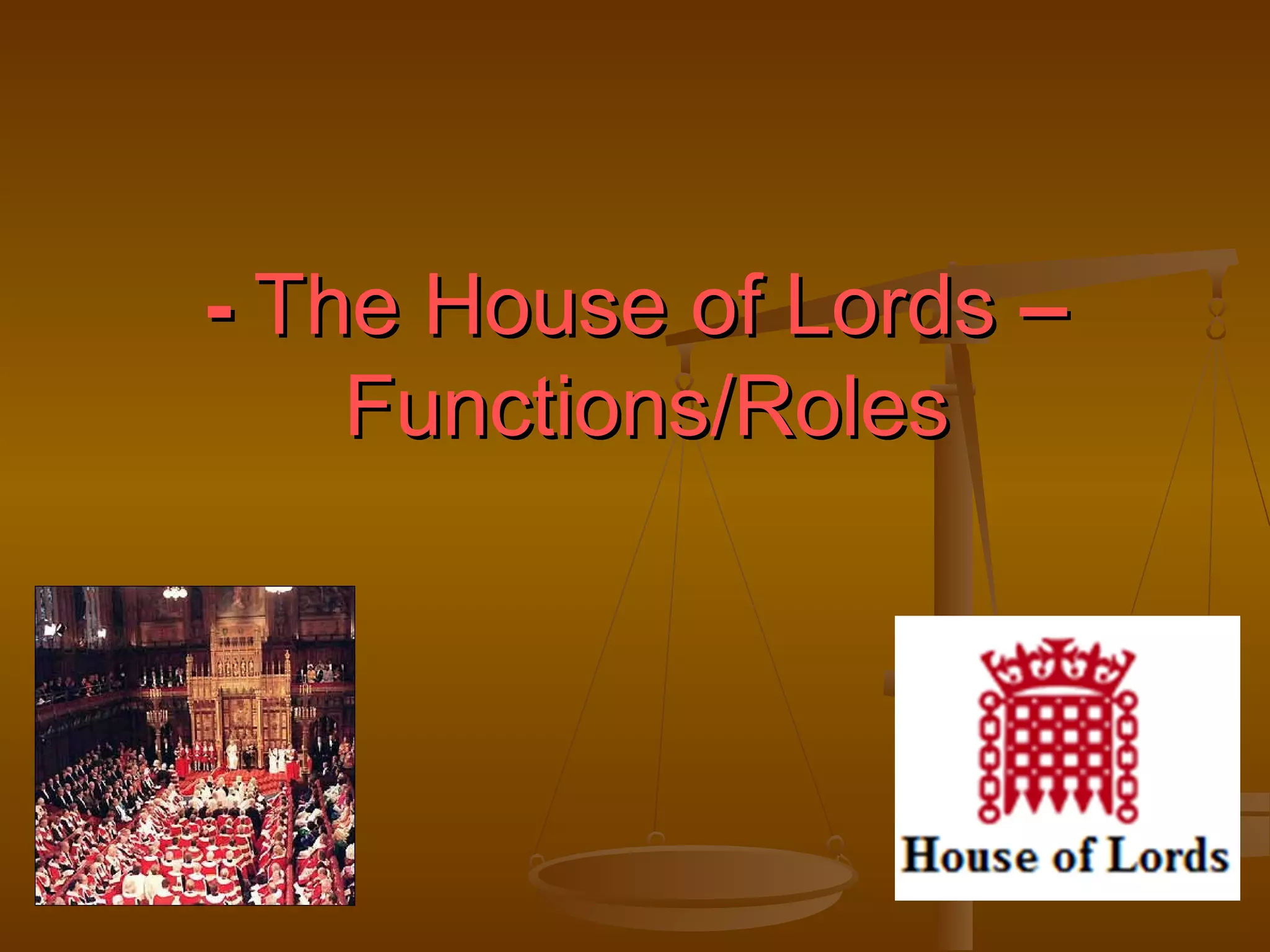
The House of Lords is the second chamber of the United Kingdom Parliament.
It plays an intrinsic role in revising legislation and keeps
governments accountable by scrutinising their activities . The
house complements the work of the commons, whilst members of the Lords are
not elected and unpaid. The house also has a wide range of experience
and provides a source of independent expertise . Further, it also
has a judicial role as the final court of appeal.

Thus, its core functions are:








Make laws

Holding Government to Account

Act as a forum of independent expertise

Carry out judicial work –It is the highest court in the UK
How Time is Spent in The Chamber
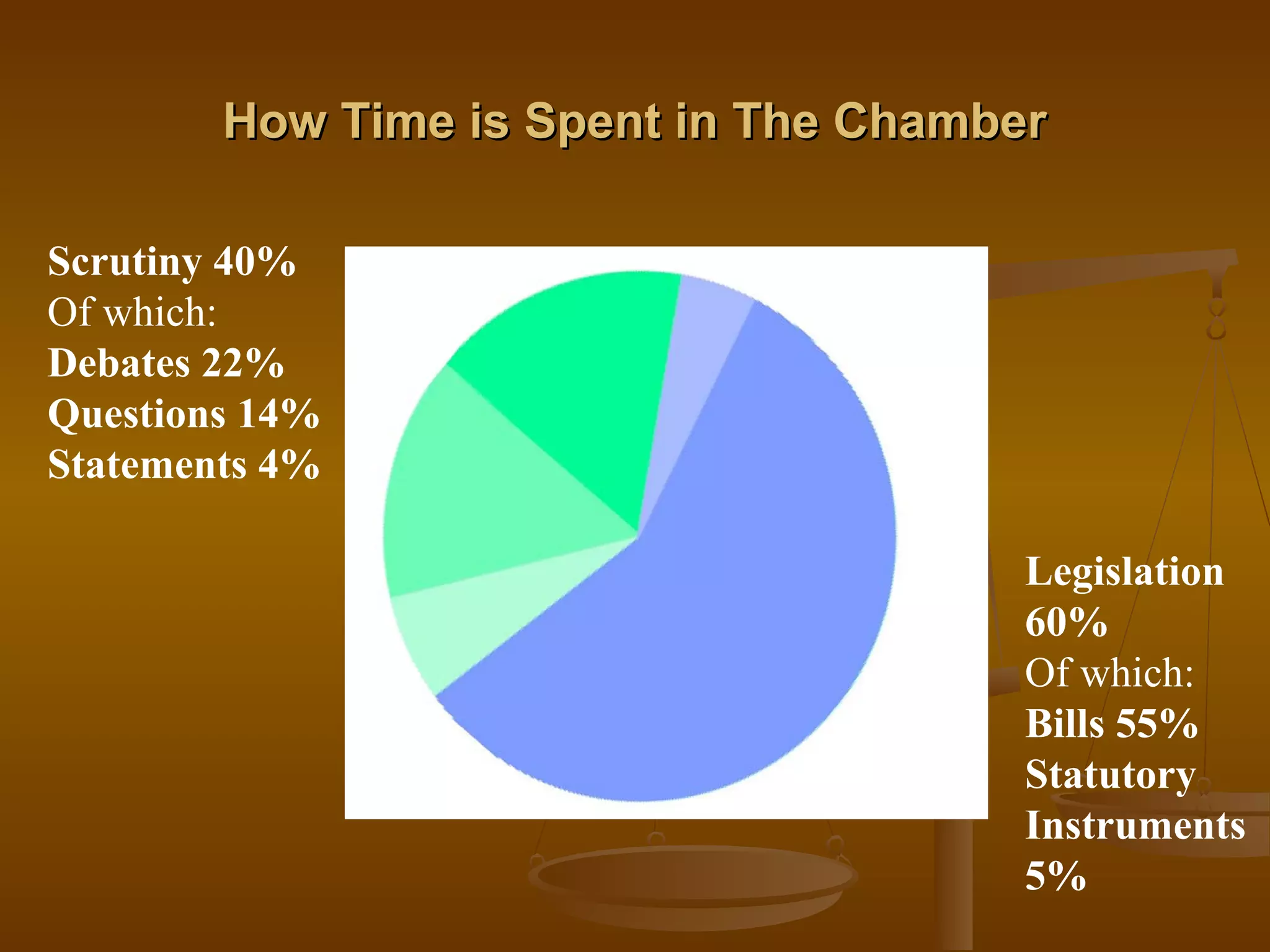
Scrutiny 40%
Of which:
Debates 22%
Questions 14%
Statements 4%
Legislation
60%
Of which:
Bills 55%
Statutory
Instruments
5%
Function One - Making Laws
The House of Lords makes a major contribution to initiating, scrutinising

and revising legislation.

Nearly 2/3 of time spent in the Chamber is devoted to legislation. Further, detailed
scrutiny of Bills in ‘Grand Committee’ amounted to the equivalent of 21 working
days in 2006-07.
Members spend hours preparing for the formal stages, both individually and in
groups with their own parties, independent crossbenchers and the Bishops.
Whilst relevant outside groups affected by the proposed legislation also meet to
discuss proposed changes.
Importantly, there is much consultation and negotiation with MPs in the Commons.
Pre Legislative Scrutiny


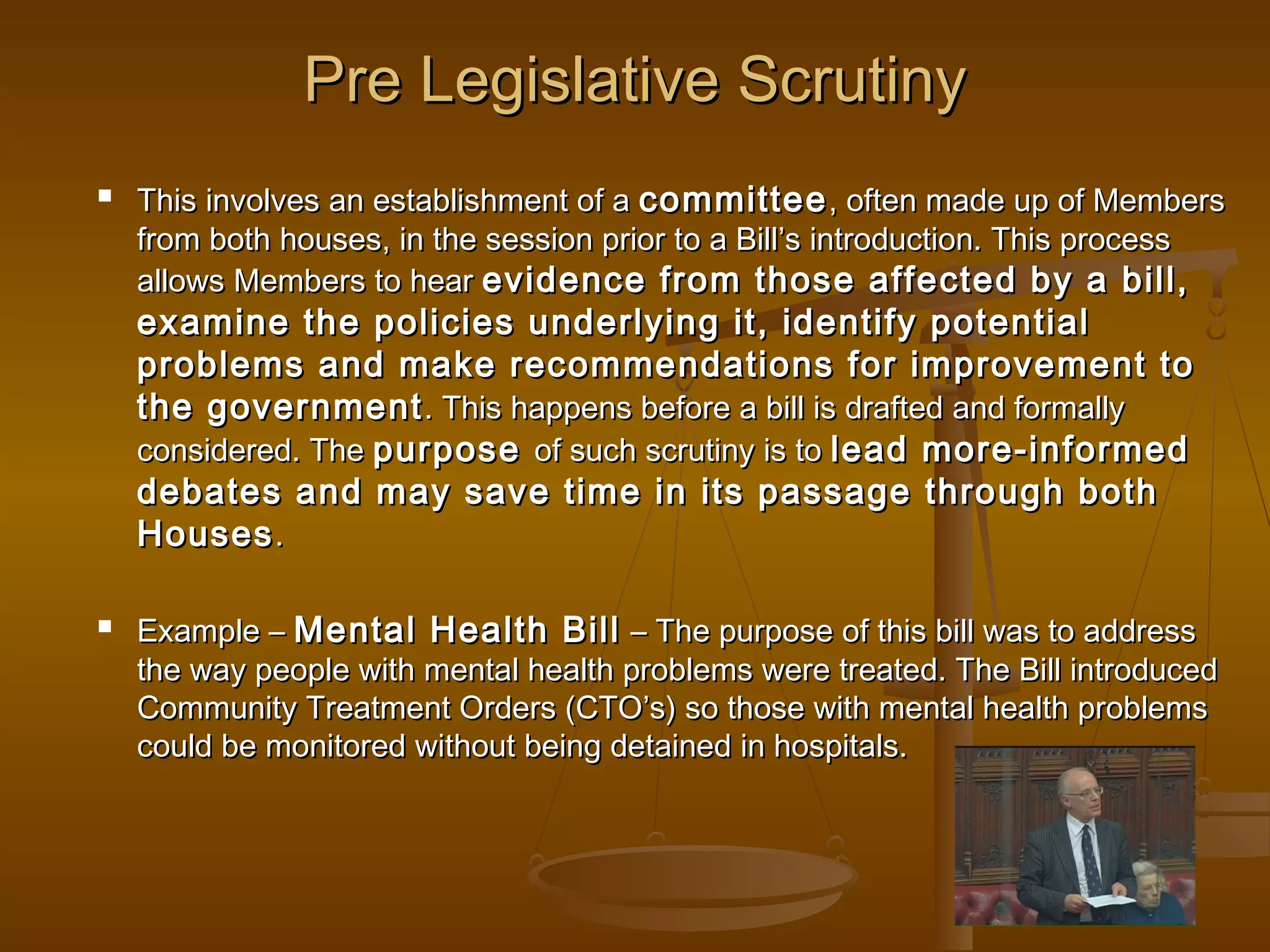
This involves an establishment of a committee , often made up of Members
from both houses, in the session prior to a Bill’s introduction. This process
allows Members to hear evidence from those affected by a bill,

examine the policies underlying it, identify potential
problems and make recommendations for improvement to
the government . This happens before a bill is drafted and formally
considered. The purpose of such scrutiny is to lead more-informed
debates and may save time in its passage through both
Houses .


Example – Mental Health Bill – The purpose of this bill was to address
the way people with mental health problems were treated. The Bill introduced
Community Treatment Orders (CTO’s) so those with mental health problems
could be monitored without being detained in hospitals.
Mental Health Bill




Issues and Concerns – There were concerns that the Bill had too many
powers to detain patients, without enough safeguards to protect them. For
example, people could be detained or put under a CTO without actually
committing an offence or even if there was no treatment for their conditions.
Members identified that better care and resources were needed, not
preventative detention.

Changes by the Lords included :

- Safeguards to ensure that people could only be detained if treatment was likely to
improve their condition – or prevent it from getting worse.
-

Measures so that people could not be considered to have a mental disorder
solely on the grounds of sexuality, criminality or cultural, political or religious
beliefs.

-

Renewal of detention only if the patient had been examined by a medical
practitioner.

-

As a result the Lords won valuable concessions to the Bill by way of right to
advocacy, grounds for diagnosis, guaranteed age appropriate services for
children and safeguards on the use of some types of therapy.
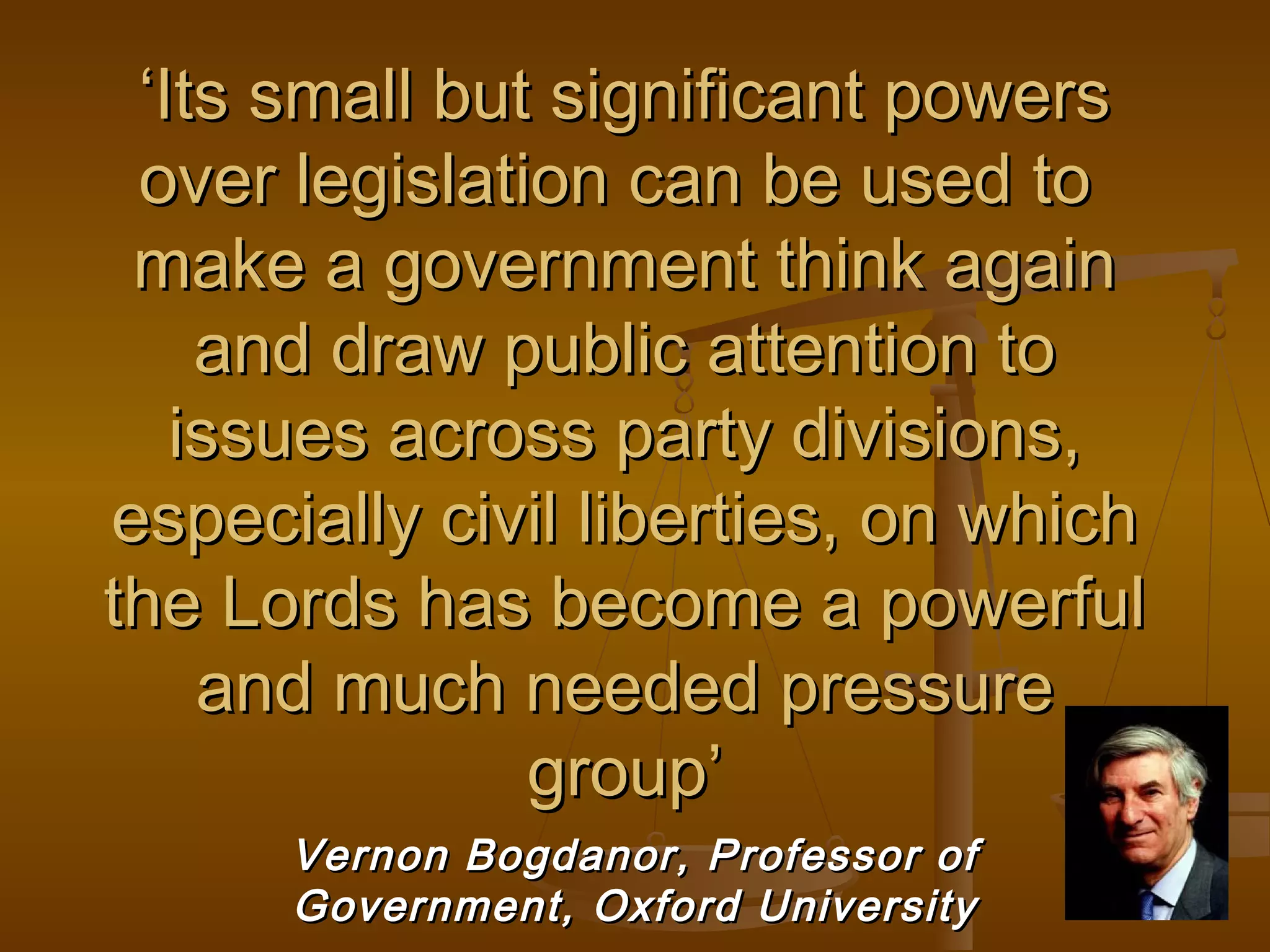
‘Its small but significant powers
over legislation can be used to
make a government think again
and draw public attention to
issues across party divisions,
especially civil liberties, on which
the Lords has become a powerful
and much needed pressure
group’
Vernon Bogdanor, Professor of
Government, Oxford University
Function Two - Holding Government to
Account




Key role of Parliament as a whole is to examine
executive action, challenge policy and hold
government to account .
The House of Lords spends around 40% of its time in the
Chamber scrutinising government.

Members of the house do this in two main ways:




Questioning government ministers and seeking information
Debating government policies and important developments or
events.
Questions
Questions are used as an important tool in keeping a check on
government activities , to raise issues of concern about
government policy or to seek information .

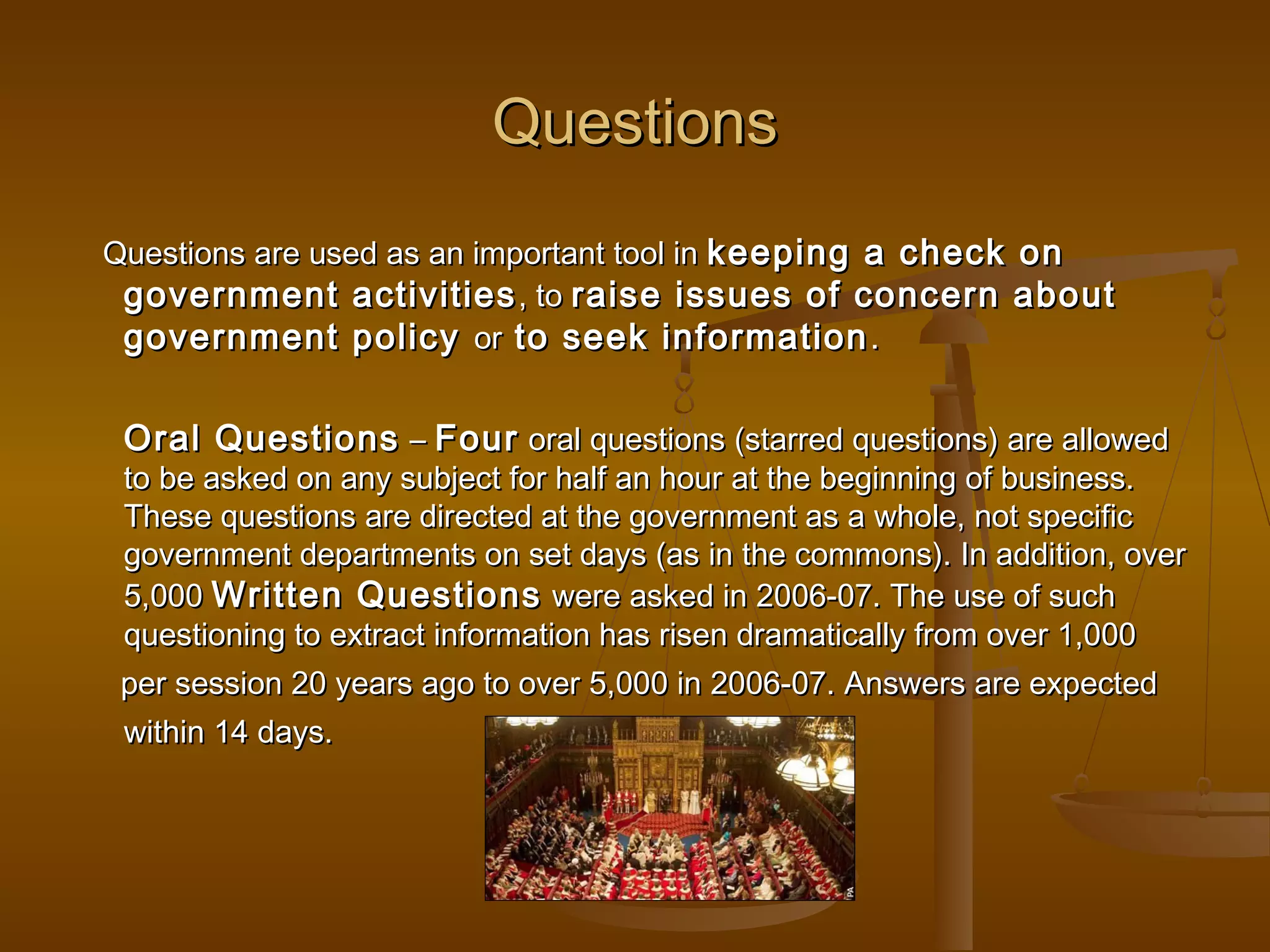
Oral Questions – Four oral questions (starred questions) are allowed

to be asked on any subject for half an hour at the beginning of business.
These questions are directed at the government as a whole, not specific
government departments on set days (as in the commons). In addition, over
5,000 Written Questions were asked in 2006-07. The use of such
questioning to extract information has risen dramatically from over 1,000
per session 20 years ago to over 5,000 in 2006-07. Answers are expected
within 14 days.
Statements


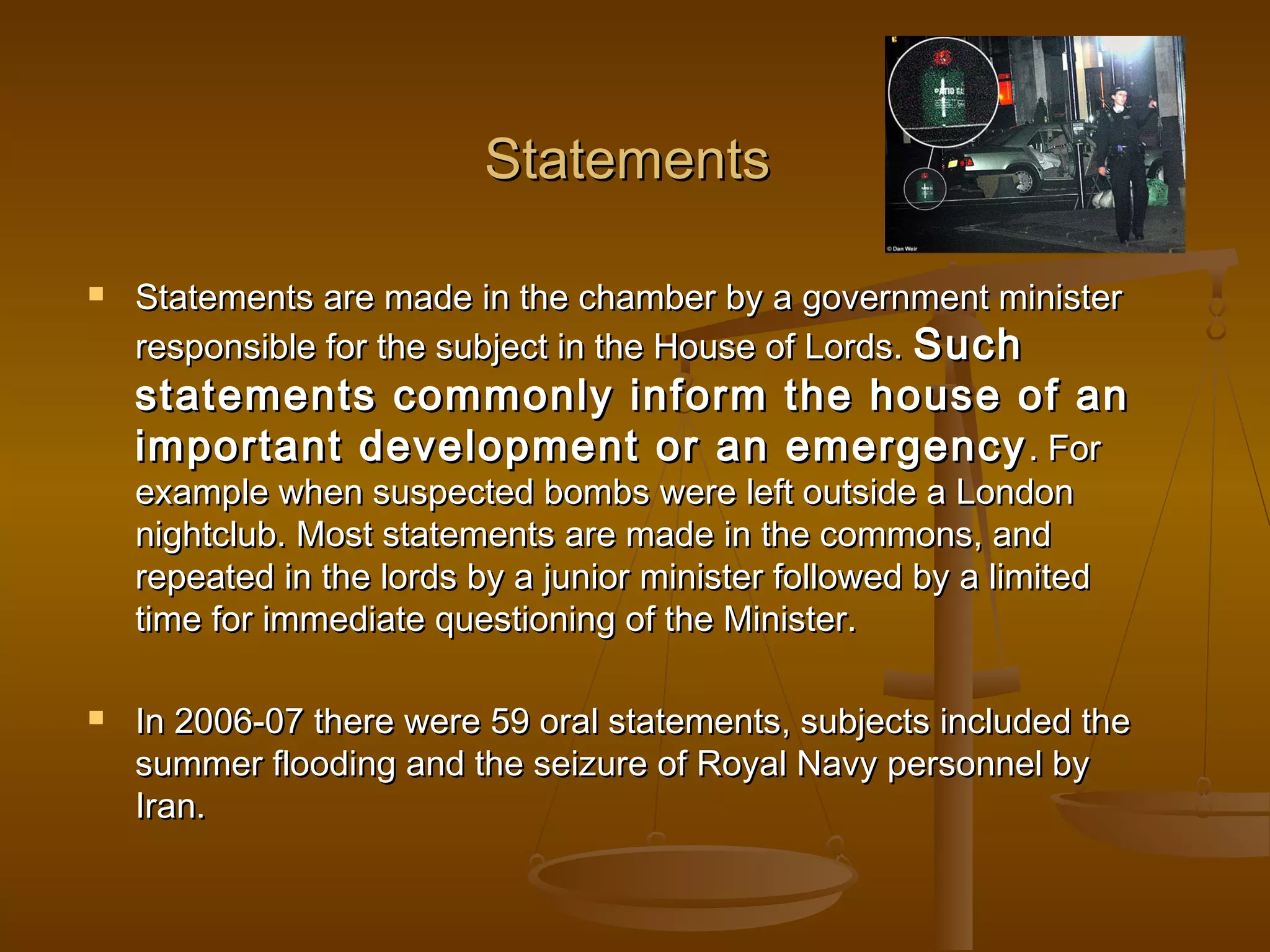
Statements are made in the chamber by a government minister
responsible for the subject in the House of Lords. Such

statements commonly inform the house of an
important development or an emergency . For
example when suspected bombs were left outside a London
nightclub. Most statements are made in the commons, and
repeated in the lords by a junior minister followed by a limited
time for immediate questioning of the Minister.


In 2006-07 there were 59 oral statements, subjects included the
summer flooding and the seizure of Royal Navy personnel by
Iran.
Debates



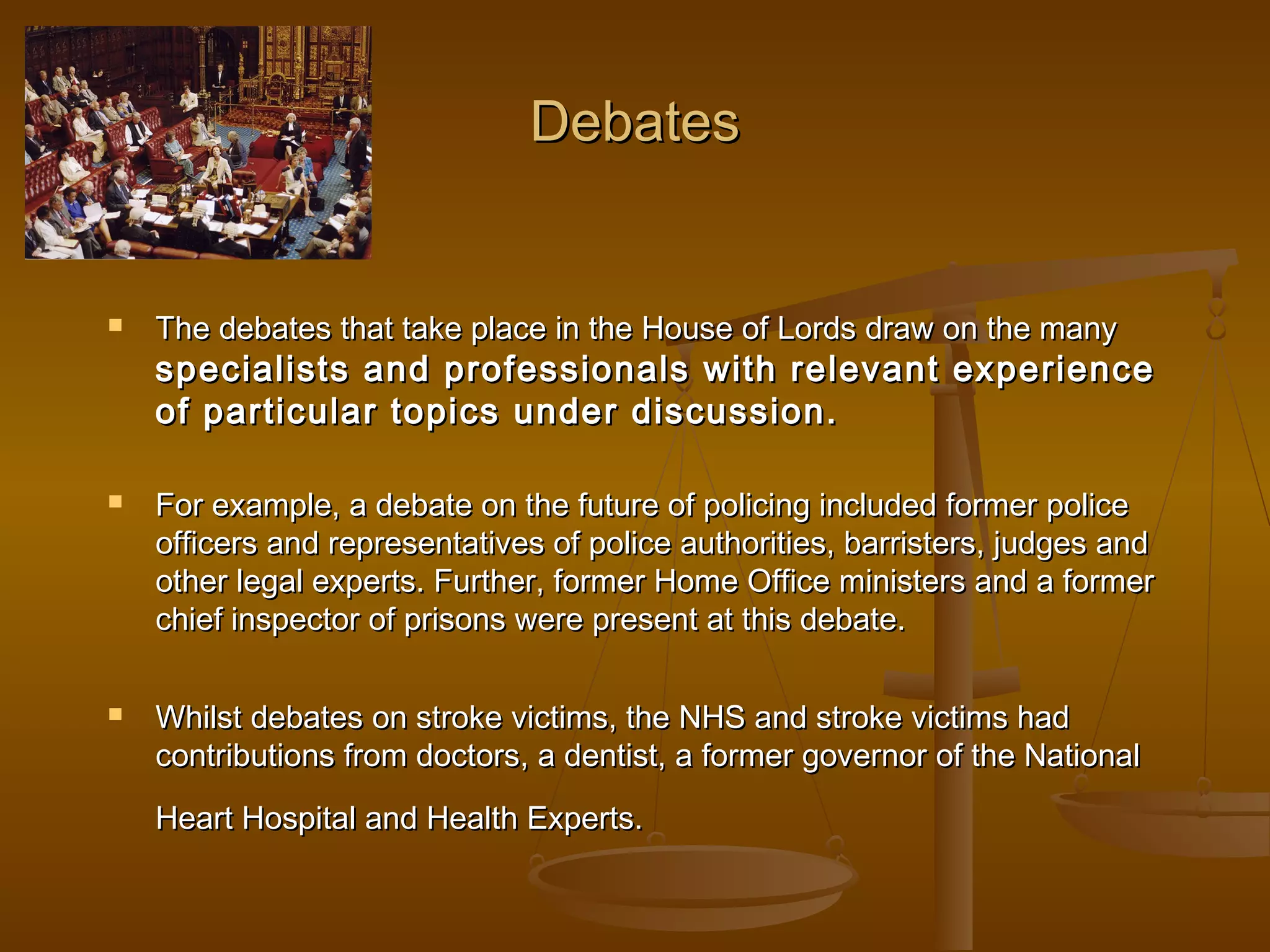
The debates that take place in the House of Lords draw on the many

specialists and professionals with relevant experience
of particular topics under discussion.




For example, a debate on the future of policing included former police
officers and representatives of police authorities, barristers, judges and
other legal experts. Further, former Home Office ministers and a former
chief inspector of prisons were present at this debate.
Whilst debates on stroke victims, the NHS and stroke victims had
contributions from doctors, a dentist, a former governor of the National
Heart Hospital and Health Experts.
Function Three – Act as a forum of Independent
Expertise


Lords committees reports, based on evidence gathered during an inquiry,
help to shape public policy and keep a check on government activity.

Permanent Committees include: European Union Committee , Economic

Affairs Committee and the Science and Technology
Committee .

Advantages of committee work includes:
Members of groups include experts in many fields, who bring authority to
committee findings and relevant experience – for example – the Science and
Technology Committees members include a former president of the Royal
Society, dentist, civil engineer and health care worker.
As party politics are less heated in the Lords , this can lead to a more
deliberative approach.
Further, as they do not have constituents to represent means they can
Example: The Science and Technology
Committee




The Science and Technology’s Committee’s remit is to consider science
and technology and to report to the House of Lords for recommendations for
action. The Committee draws heavily on the distinguished scientists and
policy makers who are in the house.

Personal Internet Security:
With the rise in the use of the Internet on a day to day basis for things
such as banking, shopping and social networking, the Committee examined
Internet security and personal online risks.
The Committee identified that the users of the Internet were expected to
protect themselves with very little support from the sate or the IT industry.
The Committee identified that unless more was done to protect Internet
users, confidence in it as a secure place to do business could be lost.
The Committee’s
Recommendations included:






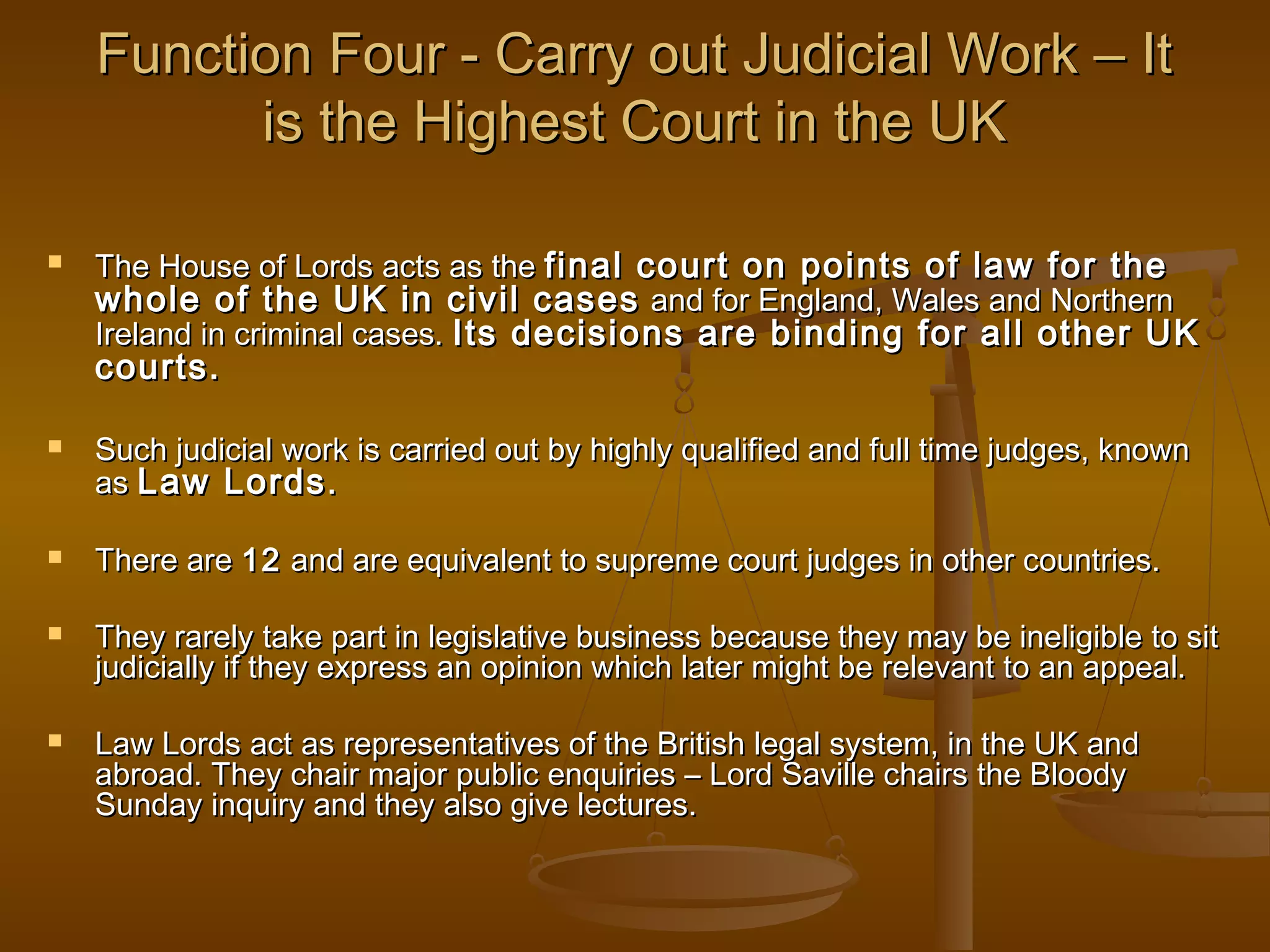
Police resources and skills were increased so e-crime could be
adequately tackled and a centralised reporting system could be set
up.
A legal obligation on business and government to send notification
to anyone affected by data security issues be introduced.
The IT industry to do more to improve the security of their products
and to protect users.
Function Four - Carry out Judicial Work – It
is the Highest Court in the UK


The House of Lords acts as the final court on points of law for the
whole of the UK in civil cases and for England, Wales and Northern
Ireland in criminal cases. Its decisions are binding for all other UK

courts.








Such judicial work is carried out by highly qualified and full time judges, known
as Law Lords .
There are 12 and are equivalent to supreme court judges in other countries.
They rarely take part in legislative business because they may be ineligible to sit
judicially if they express an opinion which later might be relevant to an appeal.
Law Lords act as representatives of the British legal system, in the UK and
abroad. They chair major public enquiries – Lord Saville chairs the Bloody
Sunday inquiry and they also give lectures.
The Powers of the Lords












The 1911 and 1949 Parliament Acts limited the powers of the House of Lords. The 1911
Act limited the legislation-blocking powers of the House of Lords. Provided provisions of
the Act are met, legislation can be passed without the approval of the House of Lords. The
first Parliament Act was amended by the second Parliament Act, the Parliament Act
1949 which further limited the power of the Lords by reducing the time that they could
delay bills, from two years to one. Whilst the Acts removed the powers of the Lords to
amend any Bills concerning money.
However, The House of Lords is an integral part of the law making process. All laws must
be agreed by both the House of Commons and Lords, before receiving the Queens
approval.
The House of Lords reviews bills sponsored by government which come from the
Commons.
A sizeable number of bills begin in the House of Lords each year, often because the bill is
technical rather than political but also to spread the legislative workload more evenly
between the two houses.
The House of Lords can propose and make changes known as ammendments. However
its powers are limited:
If it doesn’t approve a piece of legislation, it can only delay its passage into law for up to a
year. After this period, there are rules to ensure that the wishes of the House of Commons
and the Government of the day prevail.
The Powers of The Lords Continued …..


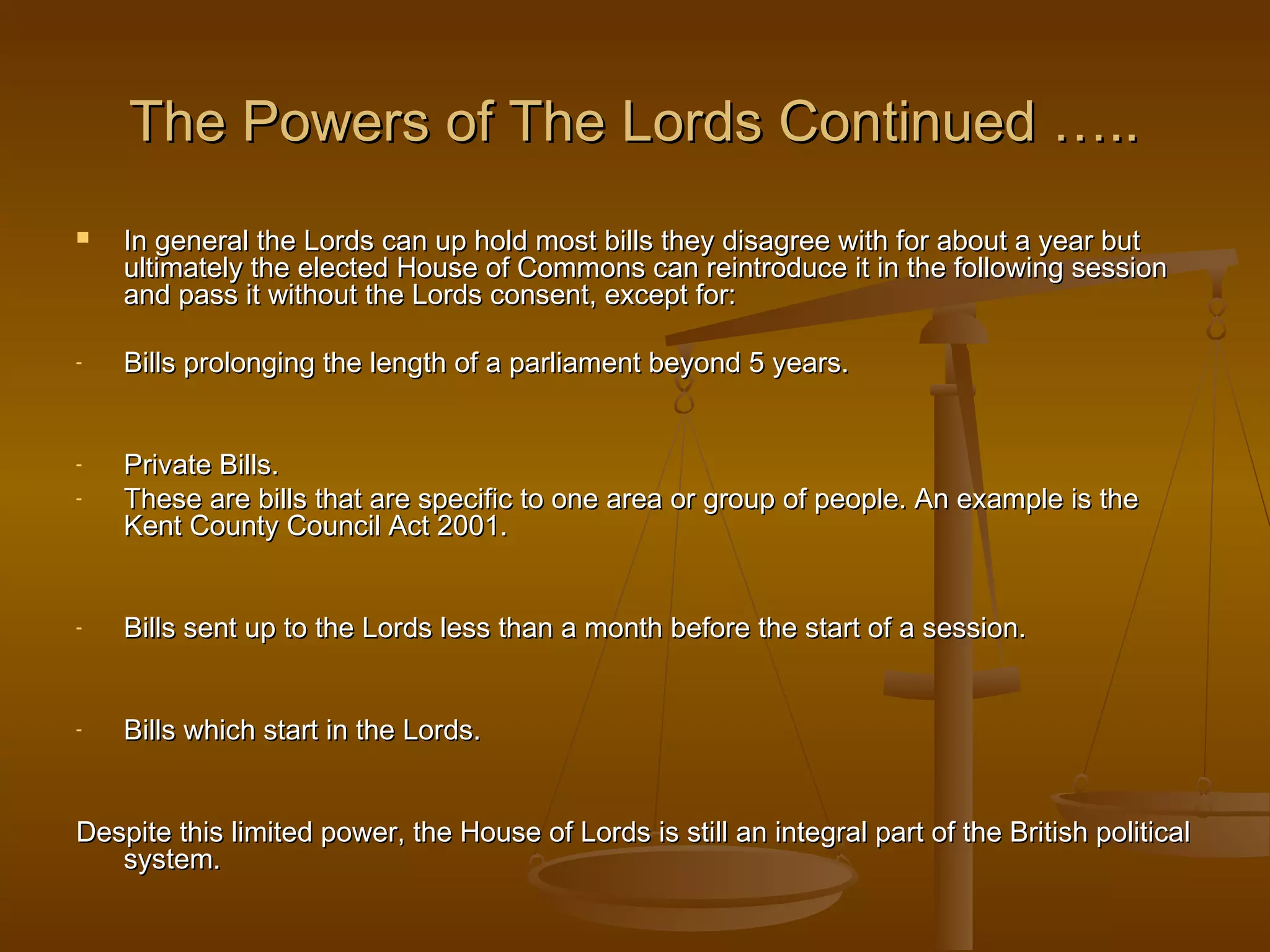
In general the Lords can up hold most bills they disagree with for about a year but
ultimately the elected House of Commons can reintroduce it in the following session
and pass it without the Lords consent, except for:

-

Bills prolonging the length of a parliament beyond 5 years.

-

Private Bills.
These are bills that are specific to one area or group of people. An example is the
Kent County Council Act 2001.

-

Bills sent up to the Lords less than a month before the start of a session.

-

Bills which start in the Lords.

Despite this limited power, the House of Lords is still an integral part of the British political
system.
House of Lords Bingo
Law Lords

Hereditary Peers

Life Peers

Oral Questions

Written Questions

Crossbenchers

Science and Technology Committee
Debates
1999
Lords committees
Upper House

Reform Act
Mental Health Bill
Private Bills

The house of lords – functions

  • 1.
    - The Houseof Lords – Functions/Roles
  • 2.
    The Core Functionsof the House of Lords The House of Lords is the second chamber of the United Kingdom Parliament. It plays an intrinsic role in revising legislation and keeps governments accountable by scrutinising their activities . The house complements the work of the commons, whilst members of the Lords are not elected and unpaid. The house also has a wide range of experience and provides a source of independent expertise . Further, it also has a judicial role as the final court of appeal. Thus, its core functions are:     Make laws Holding Government to Account Act as a forum of independent expertise Carry out judicial work –It is the highest court in the UK
  • 3.
    How Time isSpent in The Chamber Scrutiny 40% Of which: Debates 22% Questions 14% Statements 4% Legislation 60% Of which: Bills 55% Statutory Instruments 5%
  • 4.
    Function One -Making Laws The House of Lords makes a major contribution to initiating, scrutinising and revising legislation. Nearly 2/3 of time spent in the Chamber is devoted to legislation. Further, detailed scrutiny of Bills in ‘Grand Committee’ amounted to the equivalent of 21 working days in 2006-07. Members spend hours preparing for the formal stages, both individually and in groups with their own parties, independent crossbenchers and the Bishops. Whilst relevant outside groups affected by the proposed legislation also meet to discuss proposed changes. Importantly, there is much consultation and negotiation with MPs in the Commons.
  • 5.
    Pre Legislative Scrutiny  Thisinvolves an establishment of a committee , often made up of Members from both houses, in the session prior to a Bill’s introduction. This process allows Members to hear evidence from those affected by a bill, examine the policies underlying it, identify potential problems and make recommendations for improvement to the government . This happens before a bill is drafted and formally considered. The purpose of such scrutiny is to lead more-informed debates and may save time in its passage through both Houses .  Example – Mental Health Bill – The purpose of this bill was to address the way people with mental health problems were treated. The Bill introduced Community Treatment Orders (CTO’s) so those with mental health problems could be monitored without being detained in hospitals.
  • 6.
    Mental Health Bill   Issuesand Concerns – There were concerns that the Bill had too many powers to detain patients, without enough safeguards to protect them. For example, people could be detained or put under a CTO without actually committing an offence or even if there was no treatment for their conditions. Members identified that better care and resources were needed, not preventative detention. Changes by the Lords included : - Safeguards to ensure that people could only be detained if treatment was likely to improve their condition – or prevent it from getting worse. - Measures so that people could not be considered to have a mental disorder solely on the grounds of sexuality, criminality or cultural, political or religious beliefs. - Renewal of detention only if the patient had been examined by a medical practitioner. - As a result the Lords won valuable concessions to the Bill by way of right to advocacy, grounds for diagnosis, guaranteed age appropriate services for children and safeguards on the use of some types of therapy.
  • 7.
    ‘Its small butsignificant powers over legislation can be used to make a government think again and draw public attention to issues across party divisions, especially civil liberties, on which the Lords has become a powerful and much needed pressure group’ Vernon Bogdanor, Professor of Government, Oxford University
  • 8.
    Function Two -Holding Government to Account   Key role of Parliament as a whole is to examine executive action, challenge policy and hold government to account . The House of Lords spends around 40% of its time in the Chamber scrutinising government. Members of the house do this in two main ways:   Questioning government ministers and seeking information Debating government policies and important developments or events.
  • 9.
    Questions Questions are usedas an important tool in keeping a check on government activities , to raise issues of concern about government policy or to seek information . Oral Questions – Four oral questions (starred questions) are allowed to be asked on any subject for half an hour at the beginning of business. These questions are directed at the government as a whole, not specific government departments on set days (as in the commons). In addition, over 5,000 Written Questions were asked in 2006-07. The use of such questioning to extract information has risen dramatically from over 1,000 per session 20 years ago to over 5,000 in 2006-07. Answers are expected within 14 days.
  • 10.
    Statements  Statements are madein the chamber by a government minister responsible for the subject in the House of Lords. Such statements commonly inform the house of an important development or an emergency . For example when suspected bombs were left outside a London nightclub. Most statements are made in the commons, and repeated in the lords by a junior minister followed by a limited time for immediate questioning of the Minister.  In 2006-07 there were 59 oral statements, subjects included the summer flooding and the seizure of Royal Navy personnel by Iran.
  • 11.
    Debates  The debates thattake place in the House of Lords draw on the many specialists and professionals with relevant experience of particular topics under discussion.   For example, a debate on the future of policing included former police officers and representatives of police authorities, barristers, judges and other legal experts. Further, former Home Office ministers and a former chief inspector of prisons were present at this debate. Whilst debates on stroke victims, the NHS and stroke victims had contributions from doctors, a dentist, a former governor of the National Heart Hospital and Health Experts.
  • 12.
    Function Three –Act as a forum of Independent Expertise  Lords committees reports, based on evidence gathered during an inquiry, help to shape public policy and keep a check on government activity. Permanent Committees include: European Union Committee , Economic Affairs Committee and the Science and Technology Committee . Advantages of committee work includes: Members of groups include experts in many fields, who bring authority to committee findings and relevant experience – for example – the Science and Technology Committees members include a former president of the Royal Society, dentist, civil engineer and health care worker. As party politics are less heated in the Lords , this can lead to a more deliberative approach. Further, as they do not have constituents to represent means they can
  • 13.
    Example: The Scienceand Technology Committee   The Science and Technology’s Committee’s remit is to consider science and technology and to report to the House of Lords for recommendations for action. The Committee draws heavily on the distinguished scientists and policy makers who are in the house. Personal Internet Security: With the rise in the use of the Internet on a day to day basis for things such as banking, shopping and social networking, the Committee examined Internet security and personal online risks. The Committee identified that the users of the Internet were expected to protect themselves with very little support from the sate or the IT industry. The Committee identified that unless more was done to protect Internet users, confidence in it as a secure place to do business could be lost.
  • 14.
    The Committee’s Recommendations included:    Policeresources and skills were increased so e-crime could be adequately tackled and a centralised reporting system could be set up. A legal obligation on business and government to send notification to anyone affected by data security issues be introduced. The IT industry to do more to improve the security of their products and to protect users.
  • 15.
    Function Four -Carry out Judicial Work – It is the Highest Court in the UK  The House of Lords acts as the final court on points of law for the whole of the UK in civil cases and for England, Wales and Northern Ireland in criminal cases. Its decisions are binding for all other UK courts.     Such judicial work is carried out by highly qualified and full time judges, known as Law Lords . There are 12 and are equivalent to supreme court judges in other countries. They rarely take part in legislative business because they may be ineligible to sit judicially if they express an opinion which later might be relevant to an appeal. Law Lords act as representatives of the British legal system, in the UK and abroad. They chair major public enquiries – Lord Saville chairs the Bloody Sunday inquiry and they also give lectures.
  • 16.
    The Powers ofthe Lords       The 1911 and 1949 Parliament Acts limited the powers of the House of Lords. The 1911 Act limited the legislation-blocking powers of the House of Lords. Provided provisions of the Act are met, legislation can be passed without the approval of the House of Lords. The first Parliament Act was amended by the second Parliament Act, the Parliament Act 1949 which further limited the power of the Lords by reducing the time that they could delay bills, from two years to one. Whilst the Acts removed the powers of the Lords to amend any Bills concerning money. However, The House of Lords is an integral part of the law making process. All laws must be agreed by both the House of Commons and Lords, before receiving the Queens approval. The House of Lords reviews bills sponsored by government which come from the Commons. A sizeable number of bills begin in the House of Lords each year, often because the bill is technical rather than political but also to spread the legislative workload more evenly between the two houses. The House of Lords can propose and make changes known as ammendments. However its powers are limited: If it doesn’t approve a piece of legislation, it can only delay its passage into law for up to a year. After this period, there are rules to ensure that the wishes of the House of Commons and the Government of the day prevail.
  • 17.
    The Powers ofThe Lords Continued …..  In general the Lords can up hold most bills they disagree with for about a year but ultimately the elected House of Commons can reintroduce it in the following session and pass it without the Lords consent, except for: - Bills prolonging the length of a parliament beyond 5 years. - Private Bills. These are bills that are specific to one area or group of people. An example is the Kent County Council Act 2001. - Bills sent up to the Lords less than a month before the start of a session. - Bills which start in the Lords. Despite this limited power, the House of Lords is still an integral part of the British political system.
  • 18.
    House of LordsBingo Law Lords Hereditary Peers Life Peers Oral Questions Written Questions Crossbenchers Science and Technology Committee Debates 1999 Lords committees Upper House Reform Act Mental Health Bill Private Bills