MEMBERS:
MEGHA,
THILINI,
MEGHASHYAM
, FARAHIYAH,
ATIQAH,
YAP YONG
XING
MATHEMATICS
PYRAMID
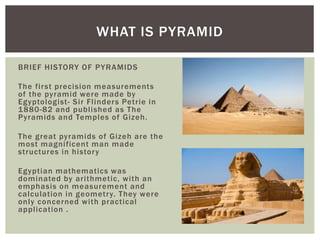
BRIEF HISTORY OF PYRAMIDS
The first precision measurements
of the pyramid were made by
Egyptologist- Sir Flinders Petrie in
1880-82 and published as The
Pyramids and Temples of Gizeh.
The great pyramids of Gizeh are the
most magnificent man made
structures in history
Egyptian mathematics was
dominated by arithmetic, with an
emphasis on measurement and
calculation in geometry. They were
only concerned with practical
application .
WHAT IS PYRAMID
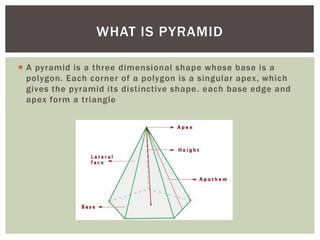
 A pyramid is a three dimensional shape whose base is a
polygon. Each corner of a polygon is a singular apex, which
gives the pyramid its distinctive shape. each base edge and
apex form a triangle
WHAT IS PYRAMID
The faces of a pyramid are all triangles. If
he base is a regular polygon, the triangles
are all congruent(that is same shape and
size), and isosceles (two sides the same
length)
if the apex is directly over the centre of a
regular base as it is above, it's called a
right pyramid.
if the apex is not the centre of the base, it
is called an oblique pyramid and the faces
are not congruent.
WHAT IS PYRAMID
• Right Pyramid vs Oblique Pyramid
• Regular Pyramid vs Irregular Pyramid
• Convex Pyramid vs Concave Pyramid
• Types of Pyramids by their base
TYPES OF PYRAMID
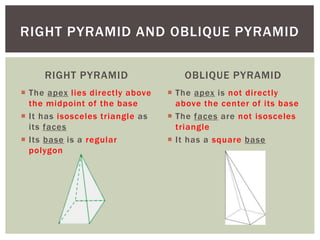
RIGHT PYRAMID
 The apex lies directly above
the midpoint of the base
 It has isosceles triangle as
its faces
 Its base is a regular
polygon
OBLIQUE PYRAMID
 The apex is not directly
above the center of its base
 The faces are not isosceles
triangle
 It has a square base
RIGHT PYRAMID AND OBLIQUE PYRAMID
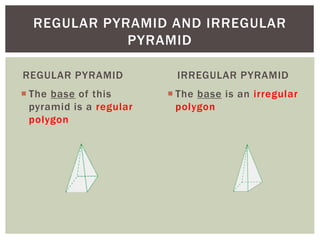
REGULAR PYRAMID
 The base of this
pyramid is a regular
polygon
IRREGULAR PYRAMID
 The base is an irregular
polygon
REGULAR PYRAMID AND IRREGULAR
PYRAMID
CONVEX PYRAMID
 It has convex polygon
as its base
- Convex means
extending outward
CONCAVE PYRAMID
 It has concave polygon
as its base
- Concave means having
an outline that goes
inward
CONVEX PYRAMID AND CONCAVE
PYRAMID
TRIANGULAR PYRAMID
The base is a triangle.
PENTAGONAL PYRAMID
The base is a pentagon.
SQUARE PYRAMID
The base is a pentagon.
HEXAGONAL PYRAMID
The base is a pentagon.
TYPES OF PYRAMID BY THEIR BASE
SURFACE AREA
The lateral surface area of a regular pyramid is the sum of the areas of its lateral
faces.
The total surface area of a regular pyramid is the sum of the areas of its lateral
faces and its base.
The general formula for the lateral surface area of a regular pyramid is
L.S.A.=1/2 pL
where p represents the perimeter of the base and l the slant height.
SURFACE AREA
The general formula for the total surface
area of a regular pyramid is
T.S.A.=1/2 pl + B
Where p represents the perimeter of the
base, l the slant height and B the area of
the base.
Find the lateral surface area of a regular
pyramid with a triangular base if each edge
of the base measures 88 inches and the slant
height is 55 inches.
The perimeter of the base is the sum of the
sides.
L.S.A = 1/2pl
p=3(8)=24inches
l= 5
L.S.A.=1/2(24)(5)=60inches^2
LATERAL SURFACE AREA
Find the total surface area of a regular pyramid with a square base if
each edge of the base measures 16 inches, the slant height of a side is
17 inches and the altitude is 15 inches.
T.S.A = 1/2pl + B
The perimeter of the base is 4 x s since it is a square.
p=4(16)=64inches
The area of the base is s^2
B=16^2 = 256 inches
T.S.A.=1/2(64)(17)+256
=544+256
=800inches^2
TOTAL SURFACE AREA
 Definition: The number of cubic units that will exactly fill a
pyramid.
VOLUME
FORMULA OF VOLUME OF
PYRAMID =
1/3 × BASE AREA ×
PERPENDICULAR HEIGHT
 Base as B and Height as H
 B is the area of the base of the
pyramid
H is its height. The height must
be measured as the vertical
distance from the apex down to
the base.
VOLUME
Prism can be cut into three
Different pyramid that do not Overlap . It can be shown
that these pyramid have the same volume .
Within the prism whose volume its base multiplied by its height is BH . If the
three pyramid are equal volume , then the volume of each pyramid is Bh/3
VOLUME
This pyramid has
base ABC and
vertex E.
This pyramid has
base ACF and
vertex E.
This pyramid
has base ACF
and vertex E.
Every pyramid, is EXACTLY one third the
volume of a triangular prism with the
same base and height . So the volume
of ANY Pyramid is (Area of its Base x
height) divided by three.
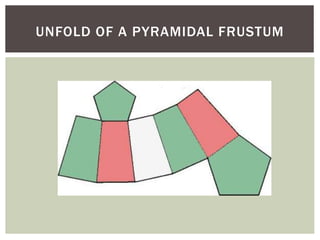
 It is a result of cutting a pyramid by a
plane parallel to the base and
separating the part containing the
apex.
 The lateral faces of a pyramidal
frustum are trapezoids
 The height of the pyramidal frustum is
the perpendicular distance
 The apothem is the height of any of its
sides
FRUSTUM OF PYRAMID
UNFOLD OF A PYRAMIDAL FRUSTUM
APOTHEM OF PYRAMIDAL FRUSTUM
To calculate, we have to have:
the height, the apothem of the
biggest base and the apothem of
the minor base.
Then apply the Pythagorean
theorem to determine the length of
the hypotenuse of the shaded
triangle to obtain the apothem
 Hypotenuse = square root of
(base2+ altitude2)
 So hypotenuse is equal to square
root of base square plus altitude
square
 Area is equal to perimeter of the large base plus perimeter of
the small base divided by two multiplied by the apothem of
the truncated pyramid
 Volume is equal to height divide by 3 multiplied by (area of
large base times small base plus square root of area of large
times small)
AREA AND VOLUME OF PYRAMIDAL
FRUSTUM
 http://hotmath.com/hotmath_help/topics/surface-area-of-a-
pyramid.html
 http://www.ditutor.com/solid_gometry/frustum_pyramid.html
 http://www.mathsisfun.com/geometry/pyramids.html
 http://www.ditutor.com/solid_gometry/types_pyramids.html
 http://study.com/academy/lesson/pyramid-in-math-
definition-lesson-practice-problems.html
REFERENCES

Maths Presentation

  • 1.
  • 2.
    BRIEF HISTORY OFPYRAMIDS The first precision measurements of the pyramid were made by Egyptologist- Sir Flinders Petrie in 1880-82 and published as The Pyramids and Temples of Gizeh. The great pyramids of Gizeh are the most magnificent man made structures in history Egyptian mathematics was dominated by arithmetic, with an emphasis on measurement and calculation in geometry. They were only concerned with practical application . WHAT IS PYRAMID
  • 3.
     A pyramidis a three dimensional shape whose base is a polygon. Each corner of a polygon is a singular apex, which gives the pyramid its distinctive shape. each base edge and apex form a triangle WHAT IS PYRAMID
  • 4.
    The faces ofa pyramid are all triangles. If he base is a regular polygon, the triangles are all congruent(that is same shape and size), and isosceles (two sides the same length) if the apex is directly over the centre of a regular base as it is above, it's called a right pyramid. if the apex is not the centre of the base, it is called an oblique pyramid and the faces are not congruent. WHAT IS PYRAMID
  • 5.
    • Right Pyramidvs Oblique Pyramid • Regular Pyramid vs Irregular Pyramid • Convex Pyramid vs Concave Pyramid • Types of Pyramids by their base TYPES OF PYRAMID
  • 6.
    RIGHT PYRAMID  Theapex lies directly above the midpoint of the base  It has isosceles triangle as its faces  Its base is a regular polygon OBLIQUE PYRAMID  The apex is not directly above the center of its base  The faces are not isosceles triangle  It has a square base RIGHT PYRAMID AND OBLIQUE PYRAMID
  • 7.
    REGULAR PYRAMID  Thebase of this pyramid is a regular polygon IRREGULAR PYRAMID  The base is an irregular polygon REGULAR PYRAMID AND IRREGULAR PYRAMID
  • 8.
    CONVEX PYRAMID  Ithas convex polygon as its base - Convex means extending outward CONCAVE PYRAMID  It has concave polygon as its base - Concave means having an outline that goes inward CONVEX PYRAMID AND CONCAVE PYRAMID
  • 9.
    TRIANGULAR PYRAMID The baseis a triangle. PENTAGONAL PYRAMID The base is a pentagon. SQUARE PYRAMID The base is a pentagon. HEXAGONAL PYRAMID The base is a pentagon. TYPES OF PYRAMID BY THEIR BASE
  • 10.
    SURFACE AREA The lateralsurface area of a regular pyramid is the sum of the areas of its lateral faces. The total surface area of a regular pyramid is the sum of the areas of its lateral faces and its base. The general formula for the lateral surface area of a regular pyramid is L.S.A.=1/2 pL where p represents the perimeter of the base and l the slant height.
  • 11.
    SURFACE AREA The generalformula for the total surface area of a regular pyramid is T.S.A.=1/2 pl + B Where p represents the perimeter of the base, l the slant height and B the area of the base.
  • 12.
    Find the lateralsurface area of a regular pyramid with a triangular base if each edge of the base measures 88 inches and the slant height is 55 inches. The perimeter of the base is the sum of the sides. L.S.A = 1/2pl p=3(8)=24inches l= 5 L.S.A.=1/2(24)(5)=60inches^2 LATERAL SURFACE AREA
  • 13.
    Find the totalsurface area of a regular pyramid with a square base if each edge of the base measures 16 inches, the slant height of a side is 17 inches and the altitude is 15 inches. T.S.A = 1/2pl + B The perimeter of the base is 4 x s since it is a square. p=4(16)=64inches The area of the base is s^2 B=16^2 = 256 inches T.S.A.=1/2(64)(17)+256 =544+256 =800inches^2 TOTAL SURFACE AREA
  • 14.
     Definition: Thenumber of cubic units that will exactly fill a pyramid. VOLUME FORMULA OF VOLUME OF PYRAMID = 1/3 × BASE AREA × PERPENDICULAR HEIGHT
  • 15.
     Base asB and Height as H  B is the area of the base of the pyramid H is its height. The height must be measured as the vertical distance from the apex down to the base. VOLUME Prism can be cut into three Different pyramid that do not Overlap . It can be shown that these pyramid have the same volume . Within the prism whose volume its base multiplied by its height is BH . If the three pyramid are equal volume , then the volume of each pyramid is Bh/3
  • 16.
    VOLUME This pyramid has baseABC and vertex E. This pyramid has base ACF and vertex E. This pyramid has base ACF and vertex E. Every pyramid, is EXACTLY one third the volume of a triangular prism with the same base and height . So the volume of ANY Pyramid is (Area of its Base x height) divided by three.
  • 17.
     It isa result of cutting a pyramid by a plane parallel to the base and separating the part containing the apex.  The lateral faces of a pyramidal frustum are trapezoids  The height of the pyramidal frustum is the perpendicular distance  The apothem is the height of any of its sides FRUSTUM OF PYRAMID
  • 18.
    UNFOLD OF APYRAMIDAL FRUSTUM
  • 19.
    APOTHEM OF PYRAMIDALFRUSTUM To calculate, we have to have: the height, the apothem of the biggest base and the apothem of the minor base. Then apply the Pythagorean theorem to determine the length of the hypotenuse of the shaded triangle to obtain the apothem  Hypotenuse = square root of (base2+ altitude2)  So hypotenuse is equal to square root of base square plus altitude square
  • 20.
     Area isequal to perimeter of the large base plus perimeter of the small base divided by two multiplied by the apothem of the truncated pyramid  Volume is equal to height divide by 3 multiplied by (area of large base times small base plus square root of area of large times small) AREA AND VOLUME OF PYRAMIDAL FRUSTUM
  • 21.
     http://hotmath.com/hotmath_help/topics/surface-area-of-a- pyramid.html  http://www.ditutor.com/solid_gometry/frustum_pyramid.html http://www.mathsisfun.com/geometry/pyramids.html  http://www.ditutor.com/solid_gometry/types_pyramids.html  http://study.com/academy/lesson/pyramid-in-math- definition-lesson-practice-problems.html REFERENCES