Ruchi Aggarwal et al Int. Journal of Engineering Research and Applications www.ijera.com
ISSN : 2248-9622, Vol. 4, Issue 5( Version 2), May 2014, pp.102-105
www.ijera.com 102 | P a g e
Voltage Stability Improvement of Grid Connected Wind Driven
Induction Generator Using Svc
Ruchi Aggarwal*1
, Sanjeev Kumar*2
Student*1
Asst .Professor*2
Electrical Engg.Department, Mullana University (MMU), Ambala
Abstract
Voltage stability is one of the major problem associated with wind power generating system which may be due
to fluctuating nature of wind, heavy load, fault occurrence or insufficient reactive power supply. The wind
power generating system most commonly employed with squirrel cage induction generator(SCIG) that needs the
support of an external device such as capacitor bank, FACTS devices etc. to support reactive power in order to
remain connected with the grid during voltage dips. The voltage stability of a wind driven induction generator
can be improved by using FACTS devices such as SVC, STATCOM.In this paper svc is used for voltage
stability improvement.
Keywords— SVC, squirrel cage induction generator, wind turbine,
I. INTRODUCTION
In recent years, wind resource is a kind of
renewable energy and becomes more and more
important in many countries.Wind power has its own
characteristics, such as discreteness, randomness, and
uncontrollability.With the increase of power capacity
of future wind farms in power system, the study of
how big integrated wind farms affect power system
operation becomes quite important.For this reason,
and in order to investigate the effects of wind farms
on the grid, adequate models must be used.Voltage
instability problems and collapse typically occur on
power system that is not able to meet demand of
reactive power, for considering heavy loads and fault
conditions.When wind farms are connected to a weak
network, the voltage stability is one of the most
important factors that affect wind farm’s stable
operation. The wind turbines have to be able to
continue uninterrupted operation under transient
voltage conditions to be in accordance with the grid
codes. An induction generator connected with a wind
turbine to generate electricity is sink of reactive
power. Different solutions are found to support the
transient behavior of squirrell cage induction
generators in case of changes in the grid voltage.
Mechanically switched capacitors, SVC,
Synchronous Condensers and Voltage Source Static
Var Compensator such as the STATCOM can be
used to regulate voltage as shunt compensator to
improve the grid interface of directly
connected asynchronous wind generators. The
voltage profile is main issue when considering stable
operation of wind farm In order to maintain stable
operation and avoid over-speed of the induction
generators, some control strategies which use FACTS
devices are presented to improve stability margin.
FACT devices are based on electronic power
converters and they provide the ability to make quick
adjustments and to control the electrical system.
FACTS devices can be connected in series, in parallel,
or in a combination of both.Applied to the electrical
networks, the Flexible AC Transmission System
(FACTS) devices allow an effective dynamic state as
well as a static state of the voltage control in the
power transmission and distribution as well as the
power quality control, by implementation of the
power electronic devices,such as Static Var
Compensator (SVC) and static synchronous
compensator(STATCOM).Unlike the fixed capacitor
banks, a static var compensator(SVC) can have better
control of the voltage profile at steady state and
improve the ride-through capability of the wind
turbine generators during disturbances[8].Shunt
FACTS devices play an important role in reactive
power flow in the power network. SVC will damp
out the oscillations and improves the overall system
stability.The system operating conditions change
considerably during disturbances.So the FACTS
devices are the most suitable source to support
reactive power within reach.These devices not only
provide continuously variable susceptances but also
ability to react fast[2].
II. VOLTAGE STABILITY
Voltage Stability is defined as the ability of
power system to maintain steady voltages at all buses
in the system after being subjected to a disturbance
from a given initial operating condition.Voltage
stability is a problem in power networks, which are
heavily load, faulted, or with insufficient reactive
power supply. The main reason for voltage instability
is the increased of load, for that reason, voltage
RESEARCH ARTICLE OPEN ACCESS
Ruchi Aggarwal et al Int. Journal of Engineering Research and Applications www.ijera.com
ISSN : 2248-9622, Vol. 4, Issue 5( Version 2), May 2014, pp.102-105
www.ijera.com 103 | P a g e
stability is also called load stability problem. Most of
problem found in power system realizes voltage
collapse as a static phenomenon.
Static voltage instability is mainly
associated with reactive power imbalance. This can
be improved by using FACTS devices such as SVC,
STATCOM. SVC by generating or by absorbing the
reactive power can improve the voltage stability.
Slowly developing changes in the power system
occur that eventually lead to a shortage of reactive
power and declining voltage. This phenomenon can
be seen from the plot of the voltage at receiving end
versus the power transferred. The plots are popularly
referred to as P-V curve or “Nose” curve. As the
power transfer increases, the voltage at the receiving
end decreases. Eventually, the critical (nose) point,
the point at which the system reactive power is out of
use, is reached where any further increase in active
power transfer will lead to very rapid decrease in
voltage magnitude. Before reaching the critical point,
the large voltage drop due to heavy reactive power
losses can be observed. The only way to save the
system from voltage collapse is to reduce the reactive
power load or add addition reactive power prior to
reaching the point of voltage collapse.
III. STATIC VAR COMPENSATOR
(SVC)
Static var compensator has been used since
the mid-1970’s.It addresses the problem of keeping
steady state and dynamic voltages with in bounds and
has some ability to control stability,but none to flow
active power flow. The svc uses thyristor valves to
rapidly add or remove shunt connected reactors
andor capacitors ,often in coordination with
mechanically reactors andor capacitors. The Static
Var Compensator (SVC) is a shunt device of the
Flexible AC Transmission Systems (FACTS) family
using power electronics to control power flow and
improve transient stability single line power injected
into or absorbed from the power system. When
system voltage is low, the SVC generates reactive
power (SVC capacitive). When system voltage is
high, it absorbs reactive power (SVC inductive).
The variation of reactive power is performed by
switching three-phase capacitor banks and inductor
banks connected on the secondary side of a coupling
transformer. Each capacitor bank is switched on and
off by three thyristor switches (Thyristor Switched
Capacitor or TSC). Reactors are either switched on-
off (Thyristor Switched Reactor or TSR) or phase-
controlled (Thyristor Controlled Reactor or
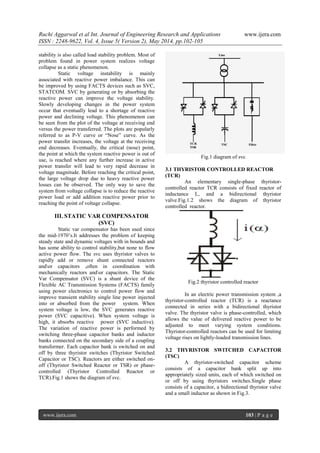
TCR).Fig.1 shows the diagram of svc.
Fig.1 diagram of svc
3.1 THYRISTOR CONTROLLED REACTOR
(TCR)
An elementary single-phase thyristor-
controlled reactor TCR consists of fixed reactor of
inductance L, and a bidirectional thyristor
valve.Fig.1.2 shows the diagram of thyristor
controlled reactor.
Fig.2 thyristor controlled reactor
In an electric power transmission system ,a
thyristor-controlled reactor (TCR) is a reactance
connected in series with a bidirectional thyristor
valve. The thyristor valve is phase-controlled, which
allows the value of delivered reactive power to be
adjusted to meet varying system conditions.
Thyristor-controlled reactors can be used for limiting
voltage rises on lightly-loaded transmission lines.
3.2 THYRISTOR SWITCHED CAPACITOR
(TSC)
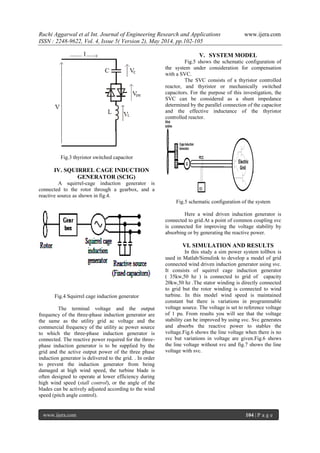
A thyristor-switched capacitor scheme
consists of a capacitor bank split up into
appropriately sized units, each of which switched on
or off by using thyristors switches.Single phase
consists of a capacitor, a bidirectional thyristor valve
and a small inductor as shown in Fig.3.
Ruchi Aggarwal et al Int. Journal of Engineering Research and Applications www.ijera.com
ISSN : 2248-9622, Vol. 4, Issue 5( Version 2), May 2014, pp.102-105
www.ijera.com 104 | P a g e
Fig.3 thyristor switched capacitor
IV. SQUIRREL CAGE INDUCTION
GENERATOR (SCIG)
A squirrel-cage induction generator is
connected to the rotor through a gearbox, and a
reactive source as shown in fig.4.
Fig.4 Squirrel cage induction generator
The terminal voltage and the output
frequency of the three-phase induction generator are
the same as the utility grid ac voltage and the
commercial frequency of the utility ac power source
to which the three-phase induction generator is
connected. The reactive power required for the three-
phase induction generator is to be supplied by the
grid and the active output power of the three phase
induction generator is delivered to the grid. . In order
to prevent the induction generator from being
damaged at high wind speed, the turbine blade is
often designed to operate at lower efficiency during
high wind speed (stall control), or the angle of the
blades can be actively adjusted according to the wind
speed (pitch angle control).
V. SYSTEM MODEL
Fig.5 shows the schematic configuration of
the system under consideration for compensation
with a SVC.
The SVC consists of a thyristor controlled
reactor, and thyristor or mechanically switched
capacitors. For the purpose of this investigation, the
SVC can be considered as a shunt impedance
determined by the parallel connection of the capacitor
and the effective inductance of the thyristor
controlled reactor.
Fig.5 schematic configuration of the system
Here a wind driven induction generator is
connected to grid.At a point of common coupling svc
is connected for improving the voltage stability by
absorbing or by generating the reactive power.
VI. SIMULATION AND RESULTS
In this study a sim power system tollbox is
used in Matlab/Simulink to develop a model of grid
connected wind driven induction generator using svc.
It consists of squirrel cage induction generator
( 35kw,50 hz ) is connected to grid of capacity
20kw,50 hz .The stator winding is directly connected
to grid but the rotor winding is connected to wind
turbine. In this model wind speed is maintained
constant but there is variations in programmable
voltage source. The voltage is set to reference voltage
of 1 pu. From results you will see that the voltage
stability can be improved by using svc. Svc generates
and absorbs the reactive power to stables the
voltage.Fig.6 shows the line voltage when there is no
svc but variations in voltage are given.Fig.6 shows
the line voltage without svc and fig.7 shows the line
voltage with svc.
Ruchi Aggarwal et al Int. Journal of Engineering Research and Applications www.ijera.com
ISSN : 2248-9622, Vol. 4, Issue 5( Version 2), May 2014, pp.102-105
www.ijera.com 105 | P a g e
Fig 6 line voltage without svc
Fig.7 line voltage with svc
VII. CONCLUSION
From the simulation results of SVC it is
found that SVC has a significant contribution to the
voltage stability of wind driven induction
generator..When the wind speed changes the wind
turbine become disconnected.This situation is not
allowable any more, due to the increasing wind
power capacity in the power networks. The inclusion
of SVC in fixed speed wind turbine improves voltage
stability and prevents the disconnection of this
WECS technology.,SVC maintain the terminal
voltage and ensure the system running continuously.
REFERENCES
[1] Avneesh kumar Vishwakarma,Dhaneshwari
Sahu, “Efficient Voltage Regulation In
Three Phase A.C Transmisssion Lines Using
Static Var Compensator”.International
General Of Advanced Research In
Electrical,Electronics And Instrumentation
Engg.vol.2,Issue 5,May 2013.
[2] Murari Lal Azad,Vikas Kumar, “Improving
Voltage Of Grid Connected To Wind Farm
Using Static Var Compensator”,MIT
International General Of Electrical And
Instrumentation
Engg.Vol.2,No.1,Jan.2012,ISSN 2230-7656
[3] Dr.Tarlokhan Kaur,Sandeep Kakran,
“Transient Stability Improvement Of Long
Transmission Line Using
SVC”,International General Of Advanced
Research In Electrical,Electronics And
Instrumentation Engg.Vol.1,Issue 4,October
2012,ISSN-2278- 8875
[4] Mrata Molinas, Tore Undeland, “Low
Voltage Ride Through Of Wind Farm With
Cage Generators: STATCOM Versus SVC”,
IEEE Transactions On Power Electronics,
Vol.23, No.3 May 2008.
[5] Narain G. Hingorani, Laszlo Gyugyi,
“Understanding FACTS”,, ISBN 0-7803-
3455.

Q4502102105

  • 1.
    Ruchi Aggarwal etal Int. Journal of Engineering Research and Applications www.ijera.com ISSN : 2248-9622, Vol. 4, Issue 5( Version 2), May 2014, pp.102-105 www.ijera.com 102 | P a g e Voltage Stability Improvement of Grid Connected Wind Driven Induction Generator Using Svc Ruchi Aggarwal*1 , Sanjeev Kumar*2 Student*1 Asst .Professor*2 Electrical Engg.Department, Mullana University (MMU), Ambala Abstract Voltage stability is one of the major problem associated with wind power generating system which may be due to fluctuating nature of wind, heavy load, fault occurrence or insufficient reactive power supply. The wind power generating system most commonly employed with squirrel cage induction generator(SCIG) that needs the support of an external device such as capacitor bank, FACTS devices etc. to support reactive power in order to remain connected with the grid during voltage dips. The voltage stability of a wind driven induction generator can be improved by using FACTS devices such as SVC, STATCOM.In this paper svc is used for voltage stability improvement. Keywords— SVC, squirrel cage induction generator, wind turbine, I. INTRODUCTION In recent years, wind resource is a kind of renewable energy and becomes more and more important in many countries.Wind power has its own characteristics, such as discreteness, randomness, and uncontrollability.With the increase of power capacity of future wind farms in power system, the study of how big integrated wind farms affect power system operation becomes quite important.For this reason, and in order to investigate the effects of wind farms on the grid, adequate models must be used.Voltage instability problems and collapse typically occur on power system that is not able to meet demand of reactive power, for considering heavy loads and fault conditions.When wind farms are connected to a weak network, the voltage stability is one of the most important factors that affect wind farm’s stable operation. The wind turbines have to be able to continue uninterrupted operation under transient voltage conditions to be in accordance with the grid codes. An induction generator connected with a wind turbine to generate electricity is sink of reactive power. Different solutions are found to support the transient behavior of squirrell cage induction generators in case of changes in the grid voltage. Mechanically switched capacitors, SVC, Synchronous Condensers and Voltage Source Static Var Compensator such as the STATCOM can be used to regulate voltage as shunt compensator to improve the grid interface of directly connected asynchronous wind generators. The voltage profile is main issue when considering stable operation of wind farm In order to maintain stable operation and avoid over-speed of the induction generators, some control strategies which use FACTS devices are presented to improve stability margin. FACT devices are based on electronic power converters and they provide the ability to make quick adjustments and to control the electrical system. FACTS devices can be connected in series, in parallel, or in a combination of both.Applied to the electrical networks, the Flexible AC Transmission System (FACTS) devices allow an effective dynamic state as well as a static state of the voltage control in the power transmission and distribution as well as the power quality control, by implementation of the power electronic devices,such as Static Var Compensator (SVC) and static synchronous compensator(STATCOM).Unlike the fixed capacitor banks, a static var compensator(SVC) can have better control of the voltage profile at steady state and improve the ride-through capability of the wind turbine generators during disturbances[8].Shunt FACTS devices play an important role in reactive power flow in the power network. SVC will damp out the oscillations and improves the overall system stability.The system operating conditions change considerably during disturbances.So the FACTS devices are the most suitable source to support reactive power within reach.These devices not only provide continuously variable susceptances but also ability to react fast[2]. II. VOLTAGE STABILITY Voltage Stability is defined as the ability of power system to maintain steady voltages at all buses in the system after being subjected to a disturbance from a given initial operating condition.Voltage stability is a problem in power networks, which are heavily load, faulted, or with insufficient reactive power supply. The main reason for voltage instability is the increased of load, for that reason, voltage RESEARCH ARTICLE OPEN ACCESS
  • 2.
    Ruchi Aggarwal etal Int. Journal of Engineering Research and Applications www.ijera.com ISSN : 2248-9622, Vol. 4, Issue 5( Version 2), May 2014, pp.102-105 www.ijera.com 103 | P a g e stability is also called load stability problem. Most of problem found in power system realizes voltage collapse as a static phenomenon. Static voltage instability is mainly associated with reactive power imbalance. This can be improved by using FACTS devices such as SVC, STATCOM. SVC by generating or by absorbing the reactive power can improve the voltage stability. Slowly developing changes in the power system occur that eventually lead to a shortage of reactive power and declining voltage. This phenomenon can be seen from the plot of the voltage at receiving end versus the power transferred. The plots are popularly referred to as P-V curve or “Nose” curve. As the power transfer increases, the voltage at the receiving end decreases. Eventually, the critical (nose) point, the point at which the system reactive power is out of use, is reached where any further increase in active power transfer will lead to very rapid decrease in voltage magnitude. Before reaching the critical point, the large voltage drop due to heavy reactive power losses can be observed. The only way to save the system from voltage collapse is to reduce the reactive power load or add addition reactive power prior to reaching the point of voltage collapse. III. STATIC VAR COMPENSATOR (SVC) Static var compensator has been used since the mid-1970’s.It addresses the problem of keeping steady state and dynamic voltages with in bounds and has some ability to control stability,but none to flow active power flow. The svc uses thyristor valves to rapidly add or remove shunt connected reactors andor capacitors ,often in coordination with mechanically reactors andor capacitors. The Static Var Compensator (SVC) is a shunt device of the Flexible AC Transmission Systems (FACTS) family using power electronics to control power flow and improve transient stability single line power injected into or absorbed from the power system. When system voltage is low, the SVC generates reactive power (SVC capacitive). When system voltage is high, it absorbs reactive power (SVC inductive). The variation of reactive power is performed by switching three-phase capacitor banks and inductor banks connected on the secondary side of a coupling transformer. Each capacitor bank is switched on and off by three thyristor switches (Thyristor Switched Capacitor or TSC). Reactors are either switched on- off (Thyristor Switched Reactor or TSR) or phase- controlled (Thyristor Controlled Reactor or TCR).Fig.1 shows the diagram of svc. Fig.1 diagram of svc 3.1 THYRISTOR CONTROLLED REACTOR (TCR) An elementary single-phase thyristor- controlled reactor TCR consists of fixed reactor of inductance L, and a bidirectional thyristor valve.Fig.1.2 shows the diagram of thyristor controlled reactor. Fig.2 thyristor controlled reactor In an electric power transmission system ,a thyristor-controlled reactor (TCR) is a reactance connected in series with a bidirectional thyristor valve. The thyristor valve is phase-controlled, which allows the value of delivered reactive power to be adjusted to meet varying system conditions. Thyristor-controlled reactors can be used for limiting voltage rises on lightly-loaded transmission lines. 3.2 THYRISTOR SWITCHED CAPACITOR (TSC) A thyristor-switched capacitor scheme consists of a capacitor bank split up into appropriately sized units, each of which switched on or off by using thyristors switches.Single phase consists of a capacitor, a bidirectional thyristor valve and a small inductor as shown in Fig.3.
  • 3.
    Ruchi Aggarwal etal Int. Journal of Engineering Research and Applications www.ijera.com ISSN : 2248-9622, Vol. 4, Issue 5( Version 2), May 2014, pp.102-105 www.ijera.com 104 | P a g e Fig.3 thyristor switched capacitor IV. SQUIRREL CAGE INDUCTION GENERATOR (SCIG) A squirrel-cage induction generator is connected to the rotor through a gearbox, and a reactive source as shown in fig.4. Fig.4 Squirrel cage induction generator The terminal voltage and the output frequency of the three-phase induction generator are the same as the utility grid ac voltage and the commercial frequency of the utility ac power source to which the three-phase induction generator is connected. The reactive power required for the three- phase induction generator is to be supplied by the grid and the active output power of the three phase induction generator is delivered to the grid. . In order to prevent the induction generator from being damaged at high wind speed, the turbine blade is often designed to operate at lower efficiency during high wind speed (stall control), or the angle of the blades can be actively adjusted according to the wind speed (pitch angle control). V. SYSTEM MODEL Fig.5 shows the schematic configuration of the system under consideration for compensation with a SVC. The SVC consists of a thyristor controlled reactor, and thyristor or mechanically switched capacitors. For the purpose of this investigation, the SVC can be considered as a shunt impedance determined by the parallel connection of the capacitor and the effective inductance of the thyristor controlled reactor. Fig.5 schematic configuration of the system Here a wind driven induction generator is connected to grid.At a point of common coupling svc is connected for improving the voltage stability by absorbing or by generating the reactive power. VI. SIMULATION AND RESULTS In this study a sim power system tollbox is used in Matlab/Simulink to develop a model of grid connected wind driven induction generator using svc. It consists of squirrel cage induction generator ( 35kw,50 hz ) is connected to grid of capacity 20kw,50 hz .The stator winding is directly connected to grid but the rotor winding is connected to wind turbine. In this model wind speed is maintained constant but there is variations in programmable voltage source. The voltage is set to reference voltage of 1 pu. From results you will see that the voltage stability can be improved by using svc. Svc generates and absorbs the reactive power to stables the voltage.Fig.6 shows the line voltage when there is no svc but variations in voltage are given.Fig.6 shows the line voltage without svc and fig.7 shows the line voltage with svc.
  • 4.
    Ruchi Aggarwal etal Int. Journal of Engineering Research and Applications www.ijera.com ISSN : 2248-9622, Vol. 4, Issue 5( Version 2), May 2014, pp.102-105 www.ijera.com 105 | P a g e Fig 6 line voltage without svc Fig.7 line voltage with svc VII. CONCLUSION From the simulation results of SVC it is found that SVC has a significant contribution to the voltage stability of wind driven induction generator..When the wind speed changes the wind turbine become disconnected.This situation is not allowable any more, due to the increasing wind power capacity in the power networks. The inclusion of SVC in fixed speed wind turbine improves voltage stability and prevents the disconnection of this WECS technology.,SVC maintain the terminal voltage and ensure the system running continuously. REFERENCES [1] Avneesh kumar Vishwakarma,Dhaneshwari Sahu, “Efficient Voltage Regulation In Three Phase A.C Transmisssion Lines Using Static Var Compensator”.International General Of Advanced Research In Electrical,Electronics And Instrumentation Engg.vol.2,Issue 5,May 2013. [2] Murari Lal Azad,Vikas Kumar, “Improving Voltage Of Grid Connected To Wind Farm Using Static Var Compensator”,MIT International General Of Electrical And Instrumentation Engg.Vol.2,No.1,Jan.2012,ISSN 2230-7656 [3] Dr.Tarlokhan Kaur,Sandeep Kakran, “Transient Stability Improvement Of Long Transmission Line Using SVC”,International General Of Advanced Research In Electrical,Electronics And Instrumentation Engg.Vol.1,Issue 4,October 2012,ISSN-2278- 8875 [4] Mrata Molinas, Tore Undeland, “Low Voltage Ride Through Of Wind Farm With Cage Generators: STATCOM Versus SVC”, IEEE Transactions On Power Electronics, Vol.23, No.3 May 2008. [5] Narain G. Hingorani, Laszlo Gyugyi, “Understanding FACTS”,, ISBN 0-7803- 3455.