Broadcast Models
There are 4 types of broadcast models :
1.Flat Model
2.Circular Multi Disk Model
3.Multi Disk Model
4.Skewed Model
Flat Model
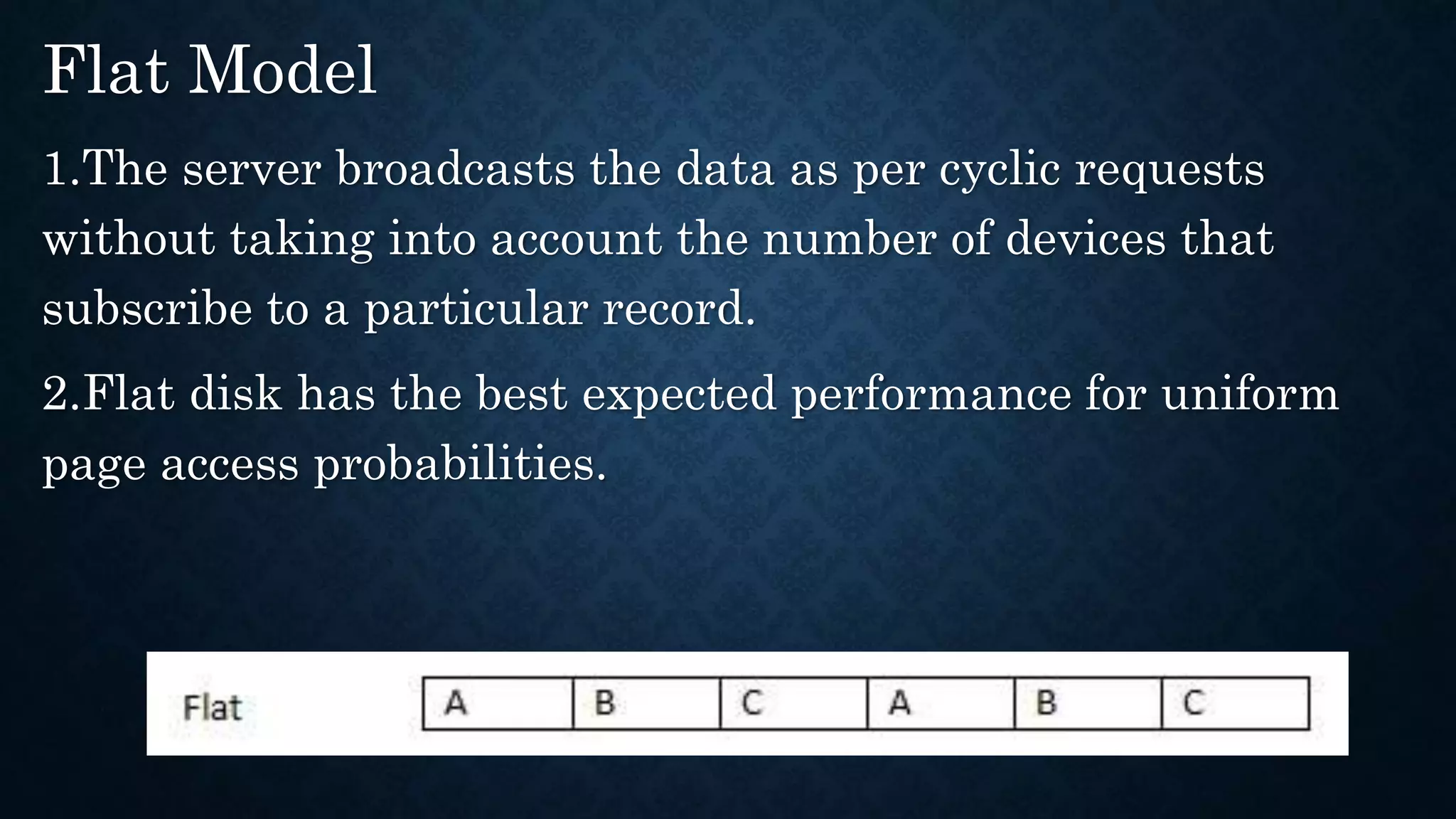
1.The server broadcasts the data as per cyclic requests
without taking into account the number of devices that
subscribe to a particular record.
2.Flat disk has the best expected performance for uniform
page access probabilities.
Circular Multi Disk Model
1.Each block of records pushed with a repetition
rate proportional to its hierarchical level
2.Record blocks R0,R1,R2,R3,R0,R1,R2,R3
transmitted in a single broadcast cycle.
3.All record blocks have an equal priority level.
Multi Disk Model
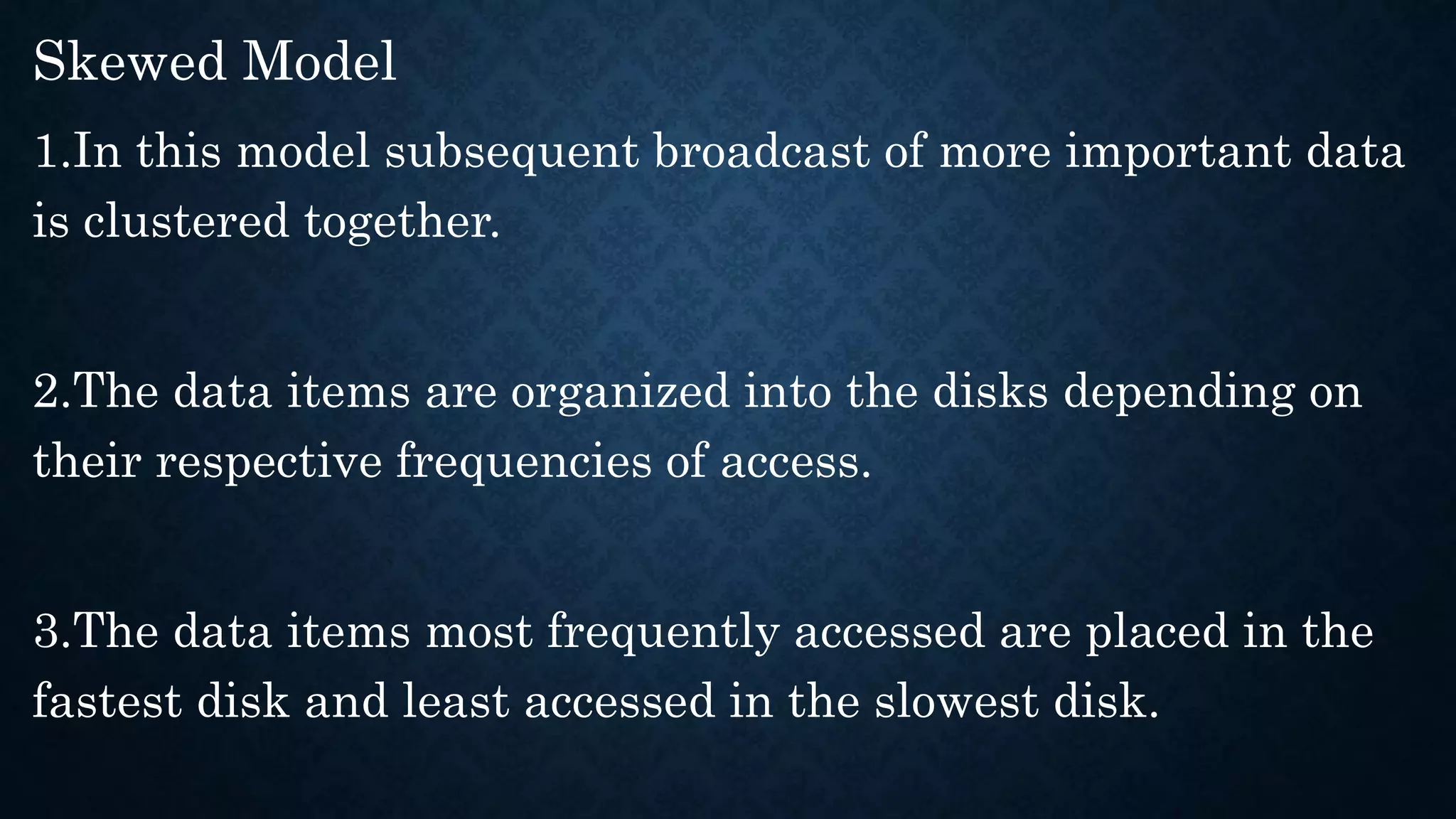
1.Here broadcast is structured as multiple disks of varying sizes,
each spinning at various rates.
3.Consider the below example where page A was stored on a single
page disk and that is spinning twice as fast as the second two-page
disk containing pages B and C.
Skewed Model
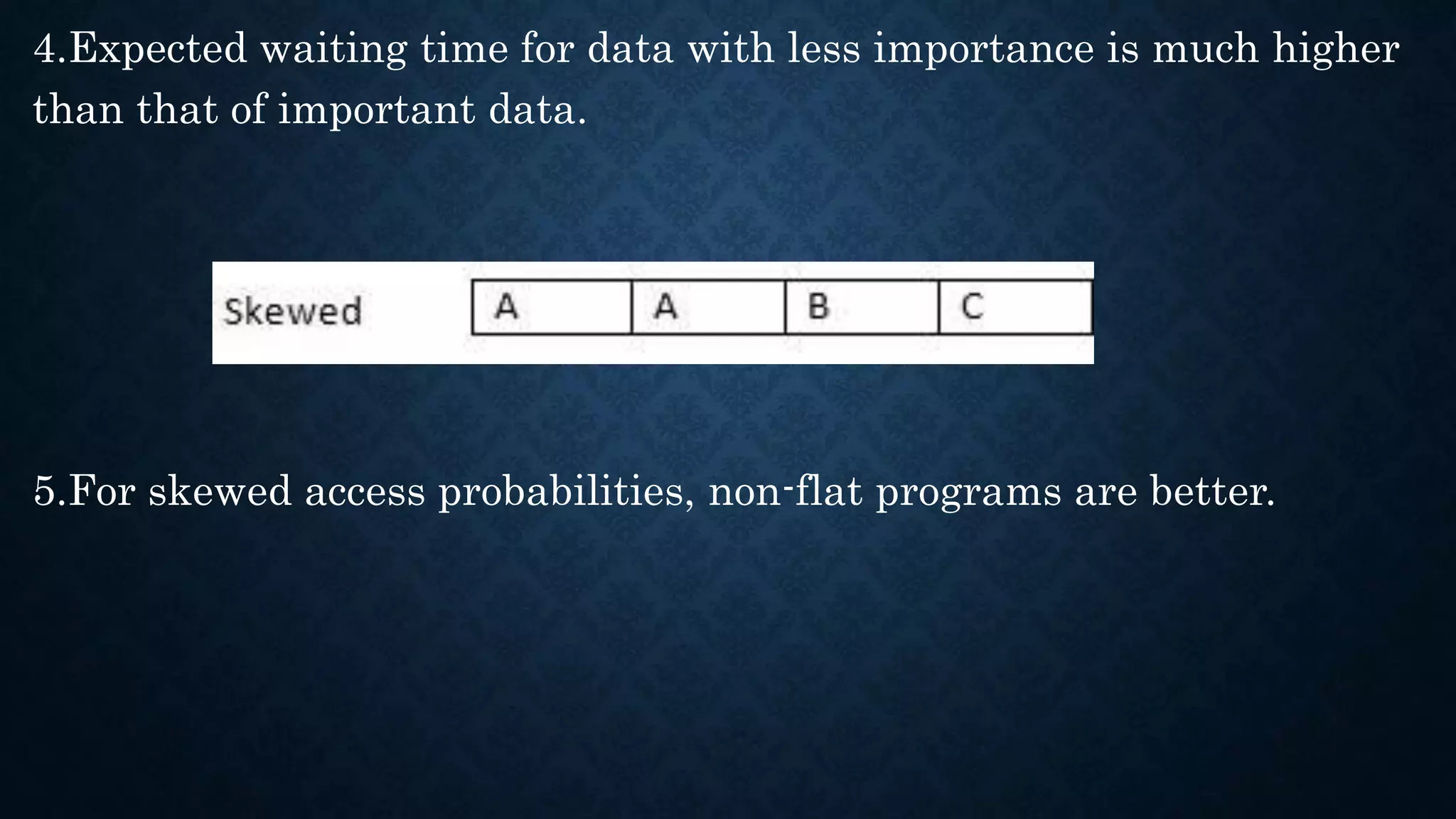
1.In this model subsequent broadcast of more important data
is clustered together.
2.The data items are organized into the disks depending on
their respective frequencies of access.
3.The data items most frequently accessed are placed in the
fastest disk and least accessed in the slowest disk.
4.Expected waiting time for data with less importance is much higher
than that of important data.
5.For skewed access probabilities, non-flat programs are better.

Broadcast Models

  • 1.
  • 2.
    There are 4types of broadcast models : 1.Flat Model 2.Circular Multi Disk Model 3.Multi Disk Model 4.Skewed Model
  • 3.
    Flat Model 1.The serverbroadcasts the data as per cyclic requests without taking into account the number of devices that subscribe to a particular record. 2.Flat disk has the best expected performance for uniform page access probabilities.
  • 4.
    Circular Multi DiskModel 1.Each block of records pushed with a repetition rate proportional to its hierarchical level 2.Record blocks R0,R1,R2,R3,R0,R1,R2,R3 transmitted in a single broadcast cycle. 3.All record blocks have an equal priority level.
  • 5.
    Multi Disk Model 1.Herebroadcast is structured as multiple disks of varying sizes, each spinning at various rates. 3.Consider the below example where page A was stored on a single page disk and that is spinning twice as fast as the second two-page disk containing pages B and C.
  • 6.
    Skewed Model 1.In thismodel subsequent broadcast of more important data is clustered together. 2.The data items are organized into the disks depending on their respective frequencies of access. 3.The data items most frequently accessed are placed in the fastest disk and least accessed in the slowest disk.
  • 7.
    4.Expected waiting timefor data with less importance is much higher than that of important data. 5.For skewed access probabilities, non-flat programs are better.