
The Vodka
By: Claudiu Petru Narita
Drinks of
the
world.
Origins of Vodka
• Comes from Russia and Poland, Vodka spells
in the following ways:
País Nombre o palabra
Russian eodka
Slovak and Czech Votka, vodka
Serbian and Croatian Vodka
Polish wódka
Spanish Vodka
Alcohol content of 37%
and 50% of its volume.
Origenis of Vodka
Vodka chemically understood as H2O + CH3-
CH2OH, i.e. water and ethanol, it's not used to
induce flavors. They had to induce a brandy, a
distillation imperfect flavor of a matter to came
from. The ideal of the alchemists was completely
isolate alcohol, even water. The vodka is pure
alcohol (water and alcohol), but not absolute
alcohol: alcohol without even only water. Absolute
alcohol is expensive to obtain and we only managed
to obtain it into the twentieth century.
Commercialization origins of
what in West we name
Vodka which is tasteless pure
alcohol West call is linked to
the Stolichnaya brand and
became popular at the end
of the Second World War. He
initially issued as "white
whiskey" and its slogan was
"no taste or smell." It was
very helpful for cocktails.
Russian names of vodka (vodka
and in the Western sense) that
give clues about mild flavor or
product origin.
Limonnaya means that it has
lemon flavor, Krepkaya means
strong, Moskovskaya, which
comes from Moscow.
Elaboration process
Broth
preparation
• Converting the grains into flour, water is added and the mixture is made under pressure.
During operation, the starch in the grains is converted into a mass of gel and then sugar
which, under the effect of the yeast, is transformed into alcohol during fermentation.
Fermentation takes about 40 hours.
Distillation
• takes place in a continuous distillation system or system "pot still" in stills isolated (or a
combination thereof) having from 2 to 5 stills; stills height (stainless steel parts of copper) is
20-40 meters in the case of large industrial productions. The common vodkas are distilled
twice, or three at most (eg Smirnoff). On the upper level of the market are a distillation
vodka 4 to 8 times.
Filtration
• vodka is then subjected to a filtering process, which aims to remove any impurities
that may persist in the liquid. Filtration varies from one distillery to another, but
the most common method is the use of organic carbon filters, usually birch or
apple wood.
Dissolution
• the final drink before the mixture contains 96% alcohol and is almost
devoid of taste and smell other than its own ethanol.
Long drinks and Cocktails
Bloody Mary
Long drinks and Cocktails
The Green Dragon
Long drinks and Cocktails
Bloody Mary
Cosmopolitan
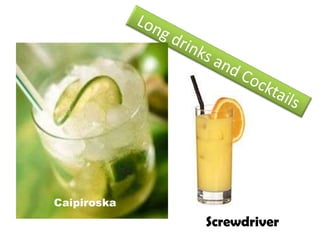
Caipiroska
Screwdriver
• http://claudyobcn.hubpages.co
m/hub/How-to-Drink-Fine-
Vodka
• www.wikipedia.org/wiki/Vodka
Source

The vodka

  • 1.
    The Vodka By: ClaudiuPetru Narita Drinks of the world.
  • 2.
    Origins of Vodka •Comes from Russia and Poland, Vodka spells in the following ways: País Nombre o palabra Russian eodka Slovak and Czech Votka, vodka Serbian and Croatian Vodka Polish wódka Spanish Vodka Alcohol content of 37% and 50% of its volume.
  • 3.
    Origenis of Vodka Vodkachemically understood as H2O + CH3- CH2OH, i.e. water and ethanol, it's not used to induce flavors. They had to induce a brandy, a distillation imperfect flavor of a matter to came from. The ideal of the alchemists was completely isolate alcohol, even water. The vodka is pure alcohol (water and alcohol), but not absolute alcohol: alcohol without even only water. Absolute alcohol is expensive to obtain and we only managed to obtain it into the twentieth century. Commercialization origins of what in West we name Vodka which is tasteless pure alcohol West call is linked to the Stolichnaya brand and became popular at the end of the Second World War. He initially issued as "white whiskey" and its slogan was "no taste or smell." It was very helpful for cocktails. Russian names of vodka (vodka and in the Western sense) that give clues about mild flavor or product origin. Limonnaya means that it has lemon flavor, Krepkaya means strong, Moskovskaya, which comes from Moscow.
  • 4.
    Elaboration process Broth preparation • Convertingthe grains into flour, water is added and the mixture is made under pressure. During operation, the starch in the grains is converted into a mass of gel and then sugar which, under the effect of the yeast, is transformed into alcohol during fermentation. Fermentation takes about 40 hours. Distillation • takes place in a continuous distillation system or system "pot still" in stills isolated (or a combination thereof) having from 2 to 5 stills; stills height (stainless steel parts of copper) is 20-40 meters in the case of large industrial productions. The common vodkas are distilled twice, or three at most (eg Smirnoff). On the upper level of the market are a distillation vodka 4 to 8 times. Filtration • vodka is then subjected to a filtering process, which aims to remove any impurities that may persist in the liquid. Filtration varies from one distillery to another, but the most common method is the use of organic carbon filters, usually birch or apple wood. Dissolution • the final drink before the mixture contains 96% alcohol and is almost devoid of taste and smell other than its own ethanol.
  • 5.
    Long drinks andCocktails Bloody Mary
  • 6.
    Long drinks andCocktails The Green Dragon
  • 7.
    Long drinks andCocktails Bloody Mary Cosmopolitan
  • 8.
  • 9.