Organizing for Cloud Operations –
Challenges and Lessons Learned
Khalid Hakim, VMware
Kevin Lees, VMware
OPT5215
#OPT5215
2
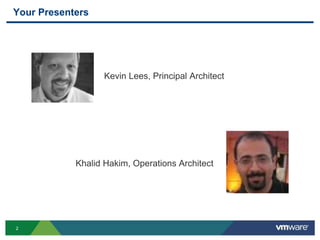
Your Presenters
Khalid Hakim, Operations Architect
Kevin Lees, Principal Architect
3
Key “Takeaways” for You
Premise:
 Organizational changes are key to IT’s success in the Cloud Era
• “Business as Usual” has CHANGED
• Transforming yields REAL results
• Transforming involves CHANGING the Operating Model
• There are IMPACTS and CHALLENGES but they can be OVERCOME
4
Transforming Involves CHANGING the
Operating Model
5
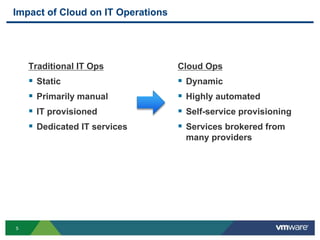
Impact of Cloud on IT Operations
Traditional IT Ops
 Static
 Primarily manual
 IT provisioned
 Dedicated IT services
Cloud Ops
 Dynamic
 Highly automated
 Self-service provisioning
 Services brokered from
many providers
6
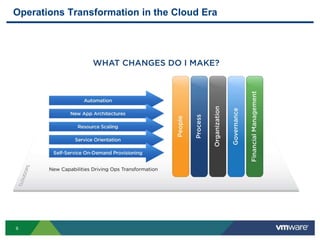
Operations Transformation in the Cloud Era
7
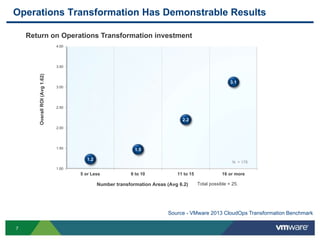
1.2
1.5
2.2
3.1
1.00
1.50
2.00
2.50
3.00
3.50
4.00
5 or Less 6 to 10 11 to 15 16 or more
OverallROI(Avg1.62)
Number transformation Areas (Avg 6.2) Total possible = 25.
Source - VMware 2013 CloudOps Transformation Benchmark
N = 178
Return on Operations Transformation investment
Operations Transformation Has Demonstrable Results
8
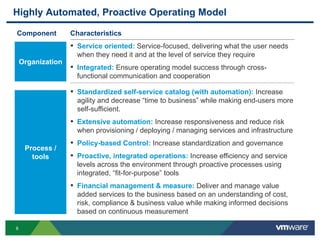
Highly Automated, Proactive Operating Model
Component Characteristics
Organization
▪ Service oriented: Service-focused, delivering what the user needs
when they need it and at the level of service they require
▪ Integrated: Ensure operating model success through cross-
functional communication and cooperation
DATA CENTER OF THE FUTURE – OPERATING MODEL
Process /
tools
▪ Standardized self-service catalog (with automation): Increase
agility and decrease “time to business” while making end-users more
self-sufficient.
▪ Extensive automation: Increase responsiveness and reduce risk
when provisioning / deploying / managing services and infrastructure
▪ Policy-based Control: Increase standardization and governance
▪ Proactive, integrated operations: Increase efficiency and service
levels across the environment through proactive processes using
integrated, “fit-for-purpose” tools
▪ Financial management & measure: Deliver and manage value
added services to the business based on an understanding of cost,
risk, compliance & business value while making informed decisions
based on continuous measurement
9
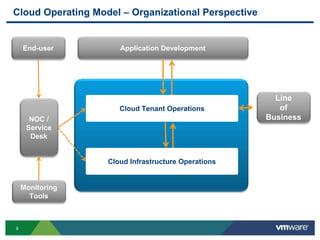
Cloud Operating Model – Organizational Perspective
Cloud Infrastructure Operations
Cloud Tenant Operations
NOC /
Service
Desk
Application Development
Monitoring
Tools
End-user
Line
of
Business
10
Organizational Impacts, Challenges and
Lessons Learned
11
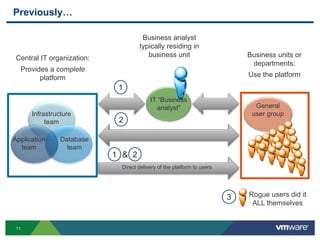
Previously…
Central IT organization:
Provides a complete
platform
Business units or
departments:
Use the platform
Rogue users did it
ALL themselves
3
2
Direct delivery of the platform to users
21 &
Infrastructure
team
Application
team
Database
team
Business analyst
typically residing in
business unit
1
IT “Business
analyst” General
user group
12
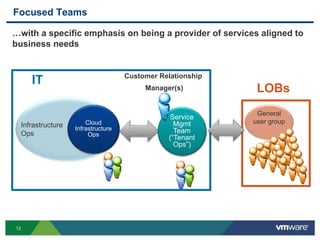
Focused Teams
…with a specific emphasis on being a provider of services aligned to
business needs
Infrastructure
Ops
Cloud
Infrastructure
Ops
Service
Mgmt
Team
(“Tenant
Ops”)
General
user group
IT
LOBs
Customer Relationship
Manager(s)
13
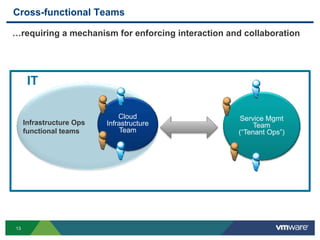
Infrastructure Ops
functional teams
Cross-functional Teams
…requiring a mechanism for enforcing interaction and collaboration
Cloud
Infrastructure
Team
Service Mgmt
Team
(“Tenant Ops”)
IT
14
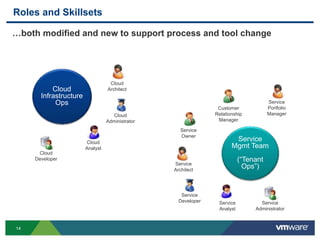
Roles and Skillsets
…both modified and new to support process and tool change
Cloud
Infrastructure
Ops
Service
Mgmt Team
(“Tenant
Ops”)
Cloud
Architect
Cloud
Administrator
Cloud
Analyst
Cloud
Developer
Service
Owner
Service
Portfolio
Manager
Service
Architect
Customer
Relationship
Manager
Service
Administrator
Service
Analyst
Service
Developer
15
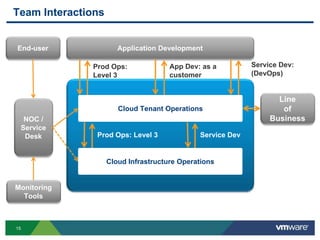
Cloud Infrastructure Operations
Cloud Tenant Operations
NOC /
Service
Desk
Application Development
Monitoring
Tools
End-user
Team Interactions
Line
of
Business
Prod Ops: Level 3 Service Dev
Prod Ops:
Level 3
App Dev: as a
customer
Service Dev:
(DevOps)
16
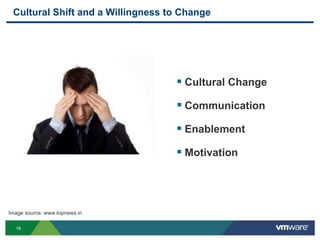
Cultural Shift and a Willingness to Change
 Cultural Change
 Communication
 Enablement
 Motivation
Image source: www.topnews.in
17
Taking It to the Next Level –
Other Impacts
18
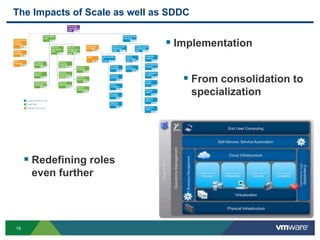
The Impacts of Scale as well as SDDC
 Implementation
 From consolidation to
specialization
 Redefining roles
even further
19
In Conclusion
20
Conclusions
 “Business as Usual” has CHANGED, but
 Transforming will yield demonstrable
RESULTS, but
 The operating model needs to CHANGE
which
 IMPACTS the organization resulting in
 CHALLENGES that
 Can be OVERCOME!
21
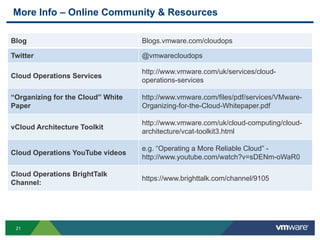
More Info – Online Community & Resources
Blog Blogs.vmware.com/cloudops
Twitter @vmwarecloudops
Cloud Operations Services
http://www.vmware.com/uk/services/cloud-
operations-services
“Organizing for the Cloud” White
Paper
http://www.vmware.com/files/pdf/services/VMware-
Organizing-for-the-Cloud-Whitepaper.pdf
vCloud Architecture Toolkit
http://www.vmware.com/uk/cloud-computing/cloud-
architecture/vcat-toolkit3.html
Cloud Operations YouTube videos
e.g. “Operating a More Reliable Cloud” -
http://www.youtube.com/watch?v=sDENm-oWaR0
Cloud Operations BrightTalk
Channel:
https://www.brighttalk.com/channel/9105
22
Other VMware Activities Related to This Session
 Group Discussions:
OPT1003-GD
Cloud Lifecycle Services with David Crane
THANK YOU
Organizing for Cloud Operations –
Challenges and Lessons Learned
Khalid Hakim, VMware
Kevin Lees, VMware
OPT5215
#OPT5215

VMworld 2013: Organizing for Cloud Operations – Challenges and Lessons Learned

  • 1.
    Organizing for CloudOperations – Challenges and Lessons Learned Khalid Hakim, VMware Kevin Lees, VMware OPT5215 #OPT5215
  • 2.
    2 Your Presenters Khalid Hakim,Operations Architect Kevin Lees, Principal Architect
  • 3.
    3 Key “Takeaways” forYou Premise:  Organizational changes are key to IT’s success in the Cloud Era • “Business as Usual” has CHANGED • Transforming yields REAL results • Transforming involves CHANGING the Operating Model • There are IMPACTS and CHALLENGES but they can be OVERCOME
  • 4.
  • 5.
    5 Impact of Cloudon IT Operations Traditional IT Ops  Static  Primarily manual  IT provisioned  Dedicated IT services Cloud Ops  Dynamic  Highly automated  Self-service provisioning  Services brokered from many providers
  • 6.
  • 7.
    7 1.2 1.5 2.2 3.1 1.00 1.50 2.00 2.50 3.00 3.50 4.00 5 or Less6 to 10 11 to 15 16 or more OverallROI(Avg1.62) Number transformation Areas (Avg 6.2) Total possible = 25. Source - VMware 2013 CloudOps Transformation Benchmark N = 178 Return on Operations Transformation investment Operations Transformation Has Demonstrable Results
  • 8.
    8 Highly Automated, ProactiveOperating Model Component Characteristics Organization ▪ Service oriented: Service-focused, delivering what the user needs when they need it and at the level of service they require ▪ Integrated: Ensure operating model success through cross- functional communication and cooperation DATA CENTER OF THE FUTURE – OPERATING MODEL Process / tools ▪ Standardized self-service catalog (with automation): Increase agility and decrease “time to business” while making end-users more self-sufficient. ▪ Extensive automation: Increase responsiveness and reduce risk when provisioning / deploying / managing services and infrastructure ▪ Policy-based Control: Increase standardization and governance ▪ Proactive, integrated operations: Increase efficiency and service levels across the environment through proactive processes using integrated, “fit-for-purpose” tools ▪ Financial management & measure: Deliver and manage value added services to the business based on an understanding of cost, risk, compliance & business value while making informed decisions based on continuous measurement
  • 9.
    9 Cloud Operating Model– Organizational Perspective Cloud Infrastructure Operations Cloud Tenant Operations NOC / Service Desk Application Development Monitoring Tools End-user Line of Business
  • 10.
  • 11.
    11 Previously… Central IT organization: Providesa complete platform Business units or departments: Use the platform Rogue users did it ALL themselves 3 2 Direct delivery of the platform to users 21 & Infrastructure team Application team Database team Business analyst typically residing in business unit 1 IT “Business analyst” General user group
  • 12.
    12 Focused Teams …with aspecific emphasis on being a provider of services aligned to business needs Infrastructure Ops Cloud Infrastructure Ops Service Mgmt Team (“Tenant Ops”) General user group IT LOBs Customer Relationship Manager(s)
  • 13.
    13 Infrastructure Ops functional teams Cross-functionalTeams …requiring a mechanism for enforcing interaction and collaboration Cloud Infrastructure Team Service Mgmt Team (“Tenant Ops”) IT
  • 14.
    14 Roles and Skillsets …bothmodified and new to support process and tool change Cloud Infrastructure Ops Service Mgmt Team (“Tenant Ops”) Cloud Architect Cloud Administrator Cloud Analyst Cloud Developer Service Owner Service Portfolio Manager Service Architect Customer Relationship Manager Service Administrator Service Analyst Service Developer
  • 15.
    15 Cloud Infrastructure Operations CloudTenant Operations NOC / Service Desk Application Development Monitoring Tools End-user Team Interactions Line of Business Prod Ops: Level 3 Service Dev Prod Ops: Level 3 App Dev: as a customer Service Dev: (DevOps)
  • 16.
    16 Cultural Shift anda Willingness to Change  Cultural Change  Communication  Enablement  Motivation Image source: www.topnews.in
  • 17.
    17 Taking It tothe Next Level – Other Impacts
  • 18.
    18 The Impacts ofScale as well as SDDC  Implementation  From consolidation to specialization  Redefining roles even further
  • 19.
  • 20.
    20 Conclusions  “Business asUsual” has CHANGED, but  Transforming will yield demonstrable RESULTS, but  The operating model needs to CHANGE which  IMPACTS the organization resulting in  CHALLENGES that  Can be OVERCOME!
  • 21.
    21 More Info –Online Community & Resources Blog Blogs.vmware.com/cloudops Twitter @vmwarecloudops Cloud Operations Services http://www.vmware.com/uk/services/cloud- operations-services “Organizing for the Cloud” White Paper http://www.vmware.com/files/pdf/services/VMware- Organizing-for-the-Cloud-Whitepaper.pdf vCloud Architecture Toolkit http://www.vmware.com/uk/cloud-computing/cloud- architecture/vcat-toolkit3.html Cloud Operations YouTube videos e.g. “Operating a More Reliable Cloud” - http://www.youtube.com/watch?v=sDENm-oWaR0 Cloud Operations BrightTalk Channel: https://www.brighttalk.com/channel/9105
  • 22.
    22 Other VMware ActivitiesRelated to This Session  Group Discussions: OPT1003-GD Cloud Lifecycle Services with David Crane
  • 23.
  • 25.
    Organizing for CloudOperations – Challenges and Lessons Learned Khalid Hakim, VMware Kevin Lees, VMware OPT5215 #OPT5215