

The Cloud Is About
More Than the Tech
Hello!
I’m Jeremy Livingston
VP Engineering @ Red Ventures
2
jeremylivingston livingstn jeremylivingston
Today’s Talk
● Why companies move to the cloud
● Implications on culture, org structure, and capabilities
● Bankrate.com’s migration to the cloud
● What we’ve learned - Mistakes, wins, and our evolution
3
The Bankrate.com Story
Hop into your time machine...
Place your screenshot here
5
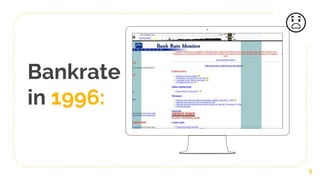
Bankrate
in 1996:
😱
6
Bankrate
today:
👍
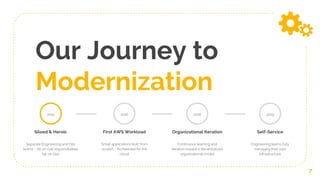
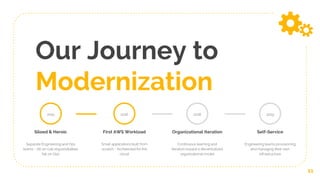
Our Journey to
Modernization
7
2015
Siloed & Heroic
Separate Engineering and Ops
teams - All on-call responsibilities
fall on Ops
First AWS Workload
Small applications built from
scratch - Architected for the
cloud
2016
Organizational Iteration
Continuous learning and
iteration toward a decentralized
organizational model
2018
Self-Service
Engineering teams fully
managing their own
infrastructure
2019
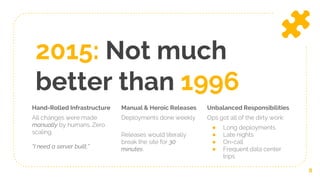
2015: Not much
better than 1996
Hand-Rolled Infrastructure
All changes were made
manually by humans. Zero
scaling.
“I need a server built.”
Manual & Heroic Releases
Deployments done weekly
Releases would literally
break the site for 30
minutes.
Unbalanced Responsibilities
Ops got all of the dirty work:
● Long deployments
● Late nights
● On-call
● Frequent data center
trips
8
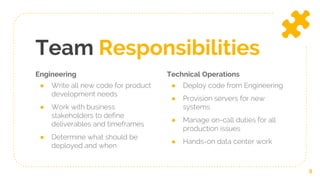
Engineering
● Write all new code for product
development needs
● Work with business
stakeholders to define
deliverables and timeframes
● Determine what should be
deployed and when
Team Responsibilities
Technical Operations
● Deploy code from Engineering
● Provision servers for new
systems
● Manage on-call duties for all
production issues
● Hands-on data center work
9
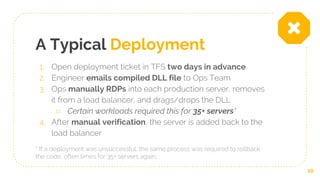
A Typical Deployment
1. Open deployment ticket in TFS two days in advance
2. Engineer emails compiled DLL file to Ops Team
3. Ops manually RDPs into each production server, removes
it from a load balancer, and drags/drops the DLL
○ Certain workloads required this for 35+ servers*
4. After manual verification, the server is added back to the
load balancer
* If a deployment was unsuccessful, the same process was required to rollback
the code, often times for 35+ servers again.
10
Our Journey to
Modernization
11
2015
Siloed & Heroic
Separate Engineering and Ops
teams - All on-call responsibilities
fall on Ops
First AWS Workload
Small applications built from
scratch - Architected for the
cloud
2016
Organizational Iteration
Continuous learning and
iteration toward a decentralized
organizational model
2018
Self-Service
Engineering teams provisioning
and managing their own
infrastructure
2019
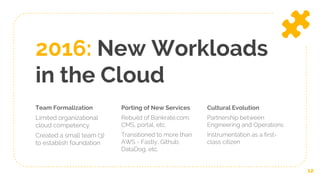
2016: New Workloads
in the Cloud
Team Formalization
Limited organizational
cloud competency
Created a small team (3)
to establish foundation
Porting of New Services
Rebuild of Bankrate.com,
CMS, portal, etc.
Transitioned to more than
AWS - Fastly, Github,
DataDog, etc.
Cultural Evolution
Partnership between
Engineering and Operations
Instrumentation as a first-
class citizen
12
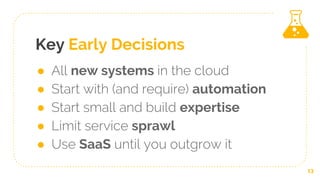
Key Early Decisions
● All new systems in the cloud
● Start with (and require) automation
● Start small and build expertise
● Limit service sprawl
● Use SaaS until you outgrow it
13
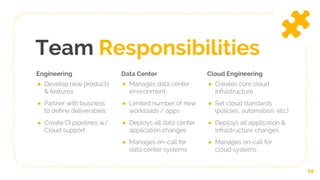
Team Responsibilities
Engineering
● Develop new products
& features
● Partner with business
to define deliverables
● Create CI pipelines w/
Cloud support
Data Center
● Manages data center
environment
● Limited number of new
workloads / apps
● Deploys all data center
application changes
● Manages on-call for
data center systems
Cloud Engineering
● Creates core cloud
infrastructure
● Set cloud standards
(policies, automation, etc.)
● Deploys all application &
infrastructure changes
● Manages on-call for
cloud systems
14
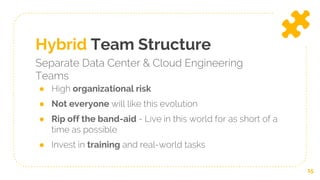
● High organizational risk
● Not everyone will like this evolution
● Rip off the band-aid - Live in this world for as short of a
time as possible
● Invest in training and real-world tasks
Hybrid Team Structure
Separate Data Center & Cloud Engineering
Teams
15
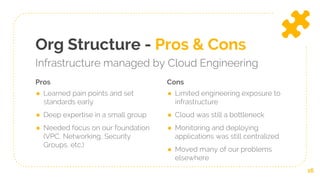
Pros
● Learned pain points and set
standards early
● Deep expertise in a small group
● Needed focus on our foundation
(VPC, Networking, Security
Groups, etc.)
Org Structure - Pros & Cons
Infrastructure managed by Cloud Engineering
Cons
● Limited engineering exposure to
infrastructure
● Cloud was still a bottleneck
● Monitoring and deploying
applications was still centralized
● Moved many of our problems
elsewhere
16
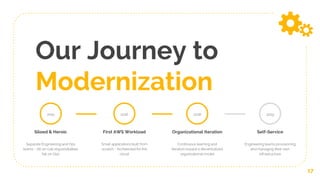
Our Journey to
Modernization
17
2015
Siloed & Heroic
Separate Engineering and Ops
teams - All on-call responsibilities
fall on Ops
First AWS Workload
Small applications built from
scratch - Architected for the
cloud
2016
Organizational Iteration
Continuous learning and
iteration toward a decentralized
organizational model
2018
Self-Service
Engineering teams provisioning
and managing their own
infrastructure
2019
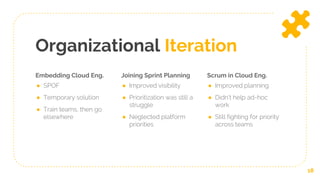
Organizational Iteration
Embedding Cloud Eng.
● SPOF
● Temporary solution
● Train teams, then go
elsewhere
Joining Sprint Planning
● Improved visibility
● Prioritization was still a
struggle
● Neglected platform
priorities
Scrum in Cloud Eng.
● Improved planning
● Didn’t help ad-hoc
work
● Still fighting for priority
across teams
18
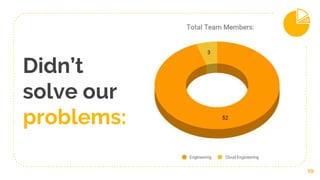
Didn’t
solve our
problems:
19
“
Shift infrastructure left.
20
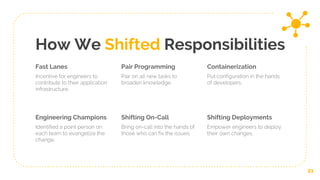
How We Shifted Responsibilities
Fast Lanes
Incentive for engineers to
contribute to their application
infrastructure.
Pair Programming
Pair on all new tasks to
broaden knowledge.
Containerization
Put configuration in the hands
of developers.
21
Engineering Champions
Identified a point person on
each team to evangelize the
change.
Shifting On-Call
Bring on-call into the hands of
those who can fix the issues.
Shifting Deployments
Empower engineers to deploy
their own changes.
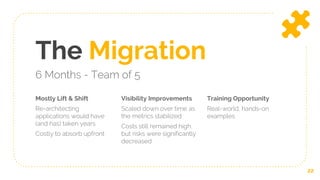
Mostly Lift & Shift
Re-architecting
applications would have
(and has) taken years
Costly to absorb upfront
The Migration
6 Months - Team of 5
Visibility Improvements
Scaled down over time as
the metrics stabilized
Costs still remained high,
but risks were significantly
decreased
Training Opportunity
Real-world, hands-on
examples
22
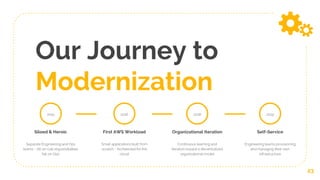
Our Journey to
Modernization
23
2015
Siloed & Heroic
Separate Engineering and Ops
teams - All on-call responsibilities
fall on Ops
First AWS Workload
Small applications built from
scratch - Architected for the
cloud
2016
Organizational Iteration
Continuous learning and
iteration toward a decentralized
organizational model
2018
Self-Service
Engineering teams provisioning
and managing their own
infrastructure
2019
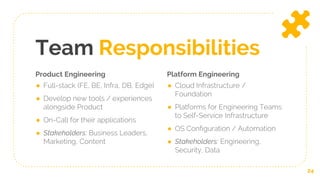
Product Engineering
● Full-stack (FE, BE, Infra, DB, Edge)
● Develop new tools / experiences
alongside Product
● On-Call for their applications
● Stakeholders: Business Leaders,
Marketing, Content
Team Responsibilities
Platform Engineering
● Cloud Infrastructure /
Foundation
● Platforms for Engineering Teams
to Self-Service Infrastructure
● OS Configuration / Automation
● Stakeholders: Engineering,
Security, Data
24
“
What’s next?
25
Key
Takeaways
26
“
Automate
everything.
27
“Bring engineers as close
to the infrastructure as
possible.
28
“ Use SaaS until
you outgrow
it.
29
“ Not everyone will
like this change.
(That’s okay!)
30
“
Don't try to fix
everything at once.
31
32
Thanks!
Any questions?
jeremylivingston livingstn jeremylivingston

The Cloud Is About More Than the Tech

  • 1.
    The Cloud IsAbout More Than the Tech
  • 2.
    Hello! I’m Jeremy Livingston VPEngineering @ Red Ventures 2 jeremylivingston livingstn jeremylivingston
  • 3.
    Today’s Talk ● Whycompanies move to the cloud ● Implications on culture, org structure, and capabilities ● Bankrate.com’s migration to the cloud ● What we’ve learned - Mistakes, wins, and our evolution 3
  • 4.
    The Bankrate.com Story Hopinto your time machine...
  • 5.
    Place your screenshothere 5 Bankrate in 1996: 😱
  • 6.
  • 7.
    Our Journey to Modernization 7 2015 Siloed& Heroic Separate Engineering and Ops teams - All on-call responsibilities fall on Ops First AWS Workload Small applications built from scratch - Architected for the cloud 2016 Organizational Iteration Continuous learning and iteration toward a decentralized organizational model 2018 Self-Service Engineering teams fully managing their own infrastructure 2019
  • 8.
    2015: Not much betterthan 1996 Hand-Rolled Infrastructure All changes were made manually by humans. Zero scaling. “I need a server built.” Manual & Heroic Releases Deployments done weekly Releases would literally break the site for 30 minutes. Unbalanced Responsibilities Ops got all of the dirty work: ● Long deployments ● Late nights ● On-call ● Frequent data center trips 8
  • 9.
    Engineering ● Write allnew code for product development needs ● Work with business stakeholders to define deliverables and timeframes ● Determine what should be deployed and when Team Responsibilities Technical Operations ● Deploy code from Engineering ● Provision servers for new systems ● Manage on-call duties for all production issues ● Hands-on data center work 9
  • 10.
    A Typical Deployment 1.Open deployment ticket in TFS two days in advance 2. Engineer emails compiled DLL file to Ops Team 3. Ops manually RDPs into each production server, removes it from a load balancer, and drags/drops the DLL ○ Certain workloads required this for 35+ servers* 4. After manual verification, the server is added back to the load balancer * If a deployment was unsuccessful, the same process was required to rollback the code, often times for 35+ servers again. 10
  • 11.
    Our Journey to Modernization 11 2015 Siloed& Heroic Separate Engineering and Ops teams - All on-call responsibilities fall on Ops First AWS Workload Small applications built from scratch - Architected for the cloud 2016 Organizational Iteration Continuous learning and iteration toward a decentralized organizational model 2018 Self-Service Engineering teams provisioning and managing their own infrastructure 2019
  • 12.
    2016: New Workloads inthe Cloud Team Formalization Limited organizational cloud competency Created a small team (3) to establish foundation Porting of New Services Rebuild of Bankrate.com, CMS, portal, etc. Transitioned to more than AWS - Fastly, Github, DataDog, etc. Cultural Evolution Partnership between Engineering and Operations Instrumentation as a first- class citizen 12
  • 13.
    Key Early Decisions ●All new systems in the cloud ● Start with (and require) automation ● Start small and build expertise ● Limit service sprawl ● Use SaaS until you outgrow it 13
  • 14.
    Team Responsibilities Engineering ● Developnew products & features ● Partner with business to define deliverables ● Create CI pipelines w/ Cloud support Data Center ● Manages data center environment ● Limited number of new workloads / apps ● Deploys all data center application changes ● Manages on-call for data center systems Cloud Engineering ● Creates core cloud infrastructure ● Set cloud standards (policies, automation, etc.) ● Deploys all application & infrastructure changes ● Manages on-call for cloud systems 14
  • 15.
    ● High organizationalrisk ● Not everyone will like this evolution ● Rip off the band-aid - Live in this world for as short of a time as possible ● Invest in training and real-world tasks Hybrid Team Structure Separate Data Center & Cloud Engineering Teams 15
  • 16.
    Pros ● Learned painpoints and set standards early ● Deep expertise in a small group ● Needed focus on our foundation (VPC, Networking, Security Groups, etc.) Org Structure - Pros & Cons Infrastructure managed by Cloud Engineering Cons ● Limited engineering exposure to infrastructure ● Cloud was still a bottleneck ● Monitoring and deploying applications was still centralized ● Moved many of our problems elsewhere 16
  • 17.
    Our Journey to Modernization 17 2015 Siloed& Heroic Separate Engineering and Ops teams - All on-call responsibilities fall on Ops First AWS Workload Small applications built from scratch - Architected for the cloud 2016 Organizational Iteration Continuous learning and iteration toward a decentralized organizational model 2018 Self-Service Engineering teams provisioning and managing their own infrastructure 2019
  • 18.
    Organizational Iteration Embedding CloudEng. ● SPOF ● Temporary solution ● Train teams, then go elsewhere Joining Sprint Planning ● Improved visibility ● Prioritization was still a struggle ● Neglected platform priorities Scrum in Cloud Eng. ● Improved planning ● Didn’t help ad-hoc work ● Still fighting for priority across teams 18
  • 19.
  • 20.
  • 21.
    How We ShiftedResponsibilities Fast Lanes Incentive for engineers to contribute to their application infrastructure. Pair Programming Pair on all new tasks to broaden knowledge. Containerization Put configuration in the hands of developers. 21 Engineering Champions Identified a point person on each team to evangelize the change. Shifting On-Call Bring on-call into the hands of those who can fix the issues. Shifting Deployments Empower engineers to deploy their own changes.
  • 22.
    Mostly Lift &Shift Re-architecting applications would have (and has) taken years Costly to absorb upfront The Migration 6 Months - Team of 5 Visibility Improvements Scaled down over time as the metrics stabilized Costs still remained high, but risks were significantly decreased Training Opportunity Real-world, hands-on examples 22
  • 23.
    Our Journey to Modernization 23 2015 Siloed& Heroic Separate Engineering and Ops teams - All on-call responsibilities fall on Ops First AWS Workload Small applications built from scratch - Architected for the cloud 2016 Organizational Iteration Continuous learning and iteration toward a decentralized organizational model 2018 Self-Service Engineering teams provisioning and managing their own infrastructure 2019
  • 24.
    Product Engineering ● Full-stack(FE, BE, Infra, DB, Edge) ● Develop new tools / experiences alongside Product ● On-Call for their applications ● Stakeholders: Business Leaders, Marketing, Content Team Responsibilities Platform Engineering ● Cloud Infrastructure / Foundation ● Platforms for Engineering Teams to Self-Service Infrastructure ● OS Configuration / Automation ● Stakeholders: Engineering, Security, Data 24
  • 25.
  • 26.
  • 27.
  • 28.
    “Bring engineers asclose to the infrastructure as possible. 28
  • 29.
    “ Use SaaSuntil you outgrow it. 29
  • 30.
    “ Not everyonewill like this change. (That’s okay!) 30
  • 31.
    “ Don't try tofix everything at once. 31
  • 32.