Chapter – 02
Migrating into a Cloud
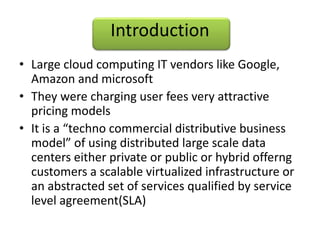
Introduction
• Large cloud computing IT vendors like Google,
Amazon and microsoft
• They were charging user fees very attractive
pricing models
• It is a “techno commercial distributive business
model” of using distributed large scale data
centers either private or public or hybrid offerng
customers a scalable virtualized infrastructure or
an abstracted set of services qualified by service
level agreement(SLA)
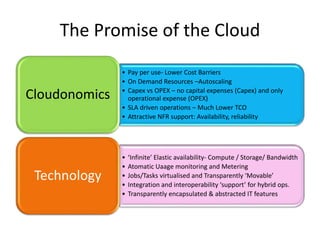
The Promise of the Cloud
• Pay per use- Lower Cost Barriers
• On Demand Resources –Autoscaling
• Capex vs OPEX – no capital expenses (Capex) and only
operational expense (OPEX)
• SLA driven operations – Much Lower TCO
• Attractive NFR support: Availability, reliability
Cloudonomics
• ‘Infinite’ Elastic availability- Compute / Storage/ Bandwidth
• Atomatic Uaage monitoring and Metering
• Jobs/Tasks virtualised and Transparently ‘Movable’
• Integration and interoperability ‘support’ for hybrid ops.
• Transparently encapsulated & abstracted IT features
Technology
The Cloud Service Offerings and
Deployment Models
• Abstract Compute/Storage/Bandwidth
Resources
• Amazon Web services[10.9]-
EC2,S3,SDB,CDN, cloudWatch
IaaS
IT folks
• Abstracted Programming Platform with
encapsulated infrastructure
• Goople Apps Engine(java/Python),
Microsoft Azure, Aneka[13]
Paas
Programmers
• Application with encapsulated
infrastructure & Platform
• Salesforce.com, Gmail, yahoo,Facebook,
Twitter
SaaS
Architects & Users
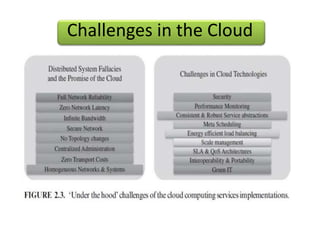
Challenges in the Cloud
Migrating into the Cloud
Why Migrates?
• Cloud is a techno-business model”
• Large-scale effort in several enterprises in
leveraging the cloud
• Cloudonomics deals with economic leveraging
• Economic and business enterprise
• Adoption or integration with cloud services is
a migration
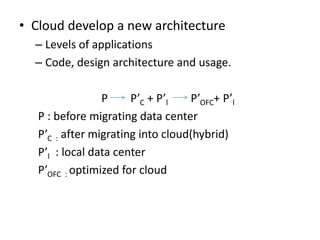
• Cloud develop a new architecture
– Levels of applications
– Code, design architecture and usage.
P P’C + P’l P’OFC+ P’l
P : before migrating data center
P’C : after migrating into cloud(hybrid)
P’l : local data center
P’OFC : optimized for cloud
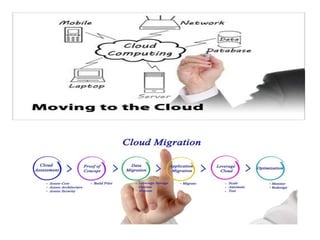
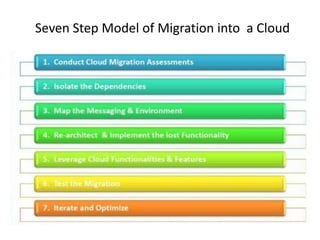
Seven Step Model of Migration into a Cloud
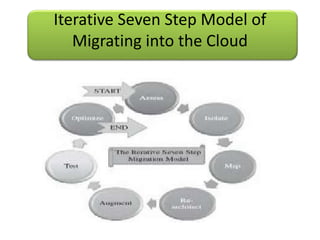
Iterative Seven Step Model of
Migrating into the Cloud
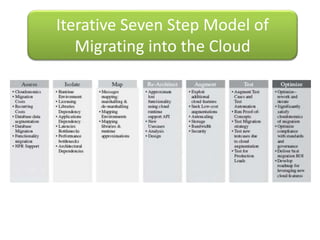
Iterative Seven Step Model of
Migrating into the Cloud
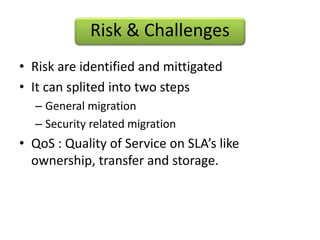
Risk & Challenges
• Risk are identified and mittigated
• It can splited into two steps
– General migration
– Security related migration
• QoS : Quality of Service on SLA’s like
ownership, transfer and storage.
Migrating into a cloud

Migrating into a cloud

  • 1.
  • 2.
    Introduction • Large cloudcomputing IT vendors like Google, Amazon and microsoft • They were charging user fees very attractive pricing models • It is a “techno commercial distributive business model” of using distributed large scale data centers either private or public or hybrid offerng customers a scalable virtualized infrastructure or an abstracted set of services qualified by service level agreement(SLA)
  • 3.
    The Promise ofthe Cloud • Pay per use- Lower Cost Barriers • On Demand Resources –Autoscaling • Capex vs OPEX – no capital expenses (Capex) and only operational expense (OPEX) • SLA driven operations – Much Lower TCO • Attractive NFR support: Availability, reliability Cloudonomics • ‘Infinite’ Elastic availability- Compute / Storage/ Bandwidth • Atomatic Uaage monitoring and Metering • Jobs/Tasks virtualised and Transparently ‘Movable’ • Integration and interoperability ‘support’ for hybrid ops. • Transparently encapsulated & abstracted IT features Technology
  • 4.
    The Cloud ServiceOfferings and Deployment Models • Abstract Compute/Storage/Bandwidth Resources • Amazon Web services[10.9]- EC2,S3,SDB,CDN, cloudWatch IaaS IT folks • Abstracted Programming Platform with encapsulated infrastructure • Goople Apps Engine(java/Python), Microsoft Azure, Aneka[13] Paas Programmers • Application with encapsulated infrastructure & Platform • Salesforce.com, Gmail, yahoo,Facebook, Twitter SaaS Architects & Users
  • 5.
  • 6.
    Migrating into theCloud Why Migrates? • Cloud is a techno-business model” • Large-scale effort in several enterprises in leveraging the cloud • Cloudonomics deals with economic leveraging • Economic and business enterprise • Adoption or integration with cloud services is a migration
  • 7.
    • Cloud developa new architecture – Levels of applications – Code, design architecture and usage. P P’C + P’l P’OFC+ P’l P : before migrating data center P’C : after migrating into cloud(hybrid) P’l : local data center P’OFC : optimized for cloud
  • 9.
    Seven Step Modelof Migration into a Cloud
  • 10.
    Iterative Seven StepModel of Migrating into the Cloud
  • 11.
    Iterative Seven StepModel of Migrating into the Cloud
  • 12.
    Risk & Challenges •Risk are identified and mittigated • It can splited into two steps – General migration – Security related migration • QoS : Quality of Service on SLA’s like ownership, transfer and storage.