Is your business winning? 
Sales Acceleration by Verde Martin
People buy things to realize their aspirations
Signs & Symptoms 
• Extreme growth or decline in business 
• Sales revenue increased but profitability is 
flat line or in decline 
• Turnover in sales team 
• Late in delivery 
• Pricing, cost, and quote issues 
• No strategic plan 
• No MVV
Signs & Symptoms 
• Absence of clearly defined sales process 
internally or externally 
• Lack of or confusion in marketing strategy 
• Customer retention issues 
• Employee engagement issues 
• Technology gaps 
• Customer service problems 
• Vision, direction, and forecast
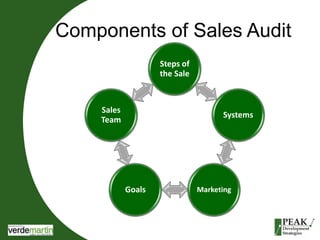
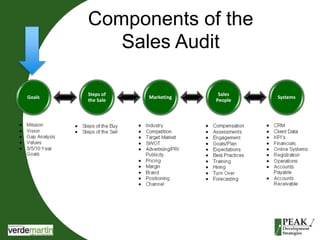
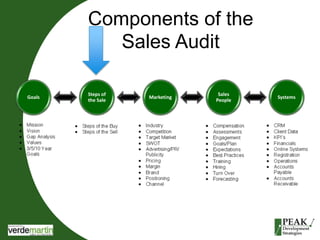
Components of Sales Audit 
Steps of 
the Sale 
Systems 
Goals Marketing 
Sales 
Team
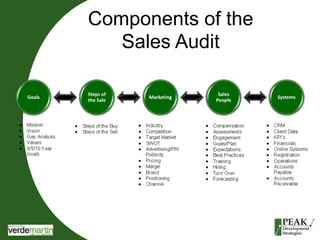
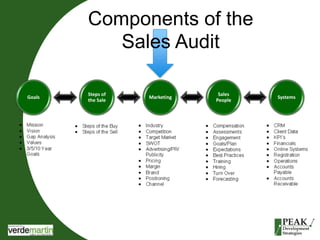
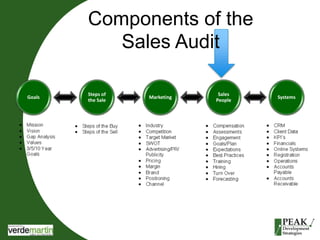
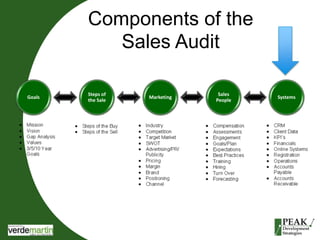
Components of the 
Sales Audit 
Goals 
Steps of 
the Sale 
Marketing 
Sales 
People 
Systems
Components of the 
Sales Audit 
Goals 
Steps of 
the Sale 
Marketing 
Sales 
People 
Systems
Special Glasses
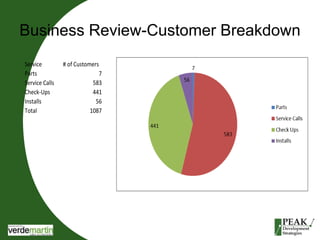
Business Review-Customer Breakdown 
Service # of Customers 
Parts 7 
Service Calls 583 
Check-Ups 441 
Installs 56 
Total 1087
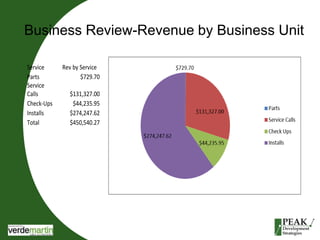
Business Review-Revenue by Business Unit 
Service Rev by Service 
Parts $729.70 
Service 
Calls $131,327.00 
Check-Ups $44,235.95 
Installs $274,247.62 
Total $450,540.27
Mission 
Mission: Why does the business exist? 
• “Understand the customer’s needs, 
repair before replacing, honor the quote, 
use fair pricing, and have a positive 
relationship with customers.”
Mission 
Contains 3 key components: 
• Key market – who is your target 
client/customer? (generalize if needed) 
• Contribution – what product or service do 
you provide to that client? 
• Distinction – what makes your product or 
service unique, so that the client would 
choose you?
Mission 
Examples: 
• Google: 
– mission is to organize the world's information and make it 
universally accessible and useful. 
• McDonald’s: 
– is to be the world's best quick service restaurant experience. Being 
the best means providing outstanding quality, service, cleanliness, 
and value, so that we make every customer in every restaurant 
smile 
• Mary Erlain: 
– is to help as many people as possible to develop themselves and 
discover their God-given gifts and talents
Vision 
Vision: Where is the business going? 
Inspires the business toward growth. 
Points everyone in the organization in the 
same direction. 
• “Fake (real company name) will meet all our 
customers heating and cooling needs.”
Vision 
• Outlines what the organization wants to be, 
or how it wants the world in which it 
operates to be. 
• It is a long-term view and concentrates on 
the future.
Vision 
Examples: 
• Amazon: 
– Our vision is to be earth's most customer centric company; to 
build a place where people can come to find and discover 
anything they might want to buy online. 
• Kraft Foods: 
– Helping people around the world eat and live better. 
• Mary Erlain: 
– Be a friend and confidant to those people whom I value in my 
world outside my immediate family.
Values 
Values: What you stand for and why you 
exist. Needs to be meaningful and 
inspirational to those inside the 
organization. Unchanged over time. 
• “Trust- service is guaranteed or you 
don’t pay. Fair Pricing. Understand the 
Customer
Values 
• Beliefs that are shared among the 
stakeholders of an organization. 
• Values drive an organization's culture and 
priorities and provide a framework in which 
decisions are made.
Values 
• Tasty Catering: 
1. Always moral, ethical and legal 
2. Treat all with respect 
3. Quality in everything we do 
4. High customer service standards 
5. A competitive and strong determination to be the best 
6. An enduring culture of individual discipline 
7. Freedom and responsibility within the culture of individual discipline
Goals 
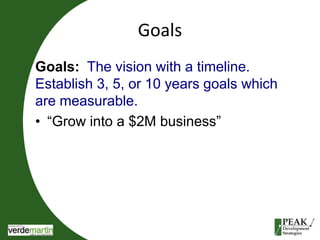
Goals: The vision with a timeline. 
Establish 3, 5, or 10 years goals which 
are measurable. 
• “Grow into a $2M business”
Goals 
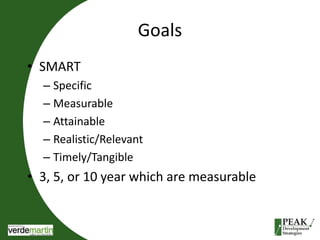
• SMART 
– Specific 
– Measurable 
– Attainable 
– Realistic/Relevant 
– Timely/Tangible 
• 3, 5, or 10 year which are measurable
Goals 
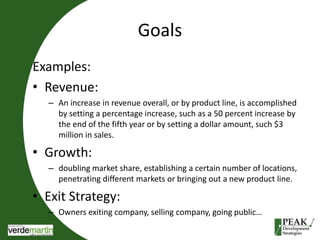
Examples: 
• Revenue: 
– An increase in revenue overall, or by product line, is accomplished 
by setting a percentage increase, such as a 50 percent increase by 
the end of the fifth year or by setting a dollar amount, such $3 
million in sales. 
• Growth: 
– doubling market share, establishing a certain number of locations, 
penetrating different markets or bringing out a new product line. 
• Exit Strategy: 
– Owners exiting company, selling company, going public…
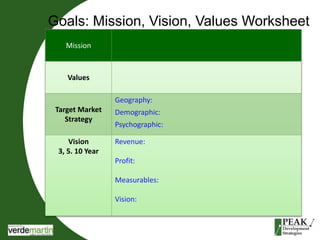
Goals: Mission, Vision, Values Worksheet 
Mission 
Values 
Target Market 
Strategy 
Geography: 
Demographic: 
Psychographic: 
Vision 
3, 5. 10 Year 
Revenue: 
Profit: 
Measurables: 
Vision:
Components of the 
Sales Audit 
Goals 
Steps of 
the Sale 
Marketing 
Sales 
People 
Systems
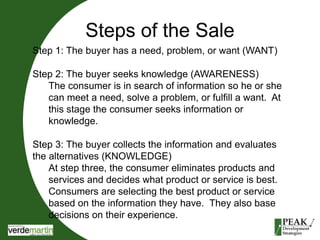
Steps of the Sale 
Step 1: The buyer has a need, problem, or want (WANT) 
Step 2: The buyer seeks knowledge (AWARENESS) 
The consumer is in search of information so he or she 
can meet a need, solve a problem, or fulfill a want. At 
this stage the consumer seeks information or 
knowledge. 
Step 3: The buyer collects the information and evaluates 
the alternatives (KNOWLEDGE) 
At step three, the consumer eliminates products and 
services and decides what product or service is best. 
Consumers are selecting the best product or service 
based on the information they have. They also base 
decisions on their experience.
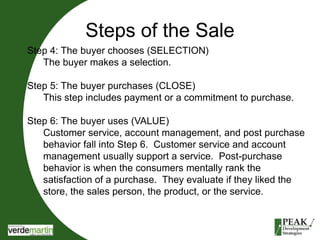
Steps of the Sale 
Step 4: The buyer chooses (SELECTION) 
The buyer makes a selection. 
Step 5: The buyer purchases (CLOSE) 
This step includes payment or a commitment to purchase. 
Step 6: The buyer uses (VALUE) 
Customer service, account management, and post purchase 
behavior fall into Step 6. Customer service and account 
management usually support a service. Post-purchase 
behavior is when the consumers mentally rank the 
satisfaction of a purchase. They evaluate if they liked the 
store, the sales person, the product, or the service.
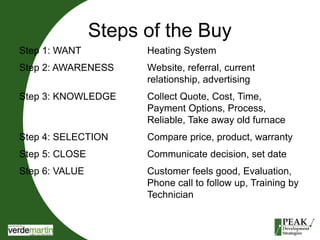
Steps of the Buy 
Step 1: WANT Heating System 
Step 2: AWARENESS Website, referral, current 
relationship, advertising 
Step 3: KNOWLEDGE Collect Quote, Cost, Time, 
Payment Options, Process, 
Reliable, Take away old furnace 
Step 4: SELECTION Compare price, product, warranty 
Step 5: CLOSE Communicate decision, set date 
Step 6: VALUE Customer feels good, Evaluation, 
Phone call to follow up, Training by 
Technician
Steps of the Sell 
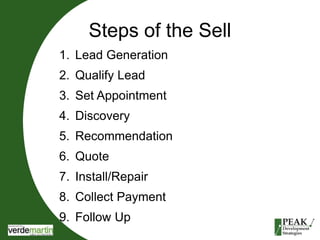
1. Lead Generation 
2. Qualify Lead 
3. Set Appointment 
4. Discovery 
5. Recommendation 
6. Quote 
7. Install/Repair 
8. Collect Payment 
9. Follow Up
Steps of the Sell 
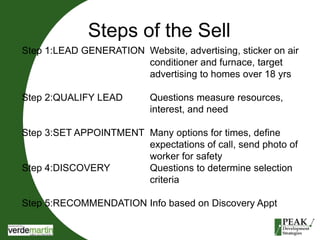
Step 1:LEAD GENERATION Website, advertising, sticker on air 
conditioner and furnace, target 
advertising to homes over 18 yrs 
Step 2:QUALIFY LEAD Questions measure resources, 
interest, and need 
Step 3:SET APPOINTMENT Many options for times, define 
expectations of call, send photo of 
worker for safety 
Step 4:DISCOVERY Questions to determine selection 
criteria 
Step 5:RECOMMENDATION Info based on Discovery Appt
Steps of the Sell 
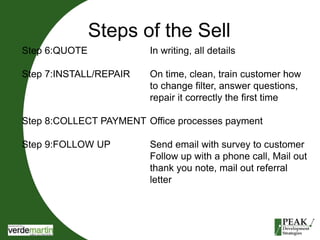
Step 6:QUOTE In writing, all details 
Step 7:INSTALL/REPAIR On time, clean, train customer how 
to change filter, answer questions, 
repair it correctly the first time 
Step 8:COLLECT PAYMENT Office processes payment 
Step 9:FOLLOW UP Send email with survey to customer 
Follow up with a phone call, Mail out 
thank you note, mail out referral 
letter
Components of the 
Sales Audit 
Goals 
Steps of 
the Sale 
Marketing 
Sales 
People 
Systems
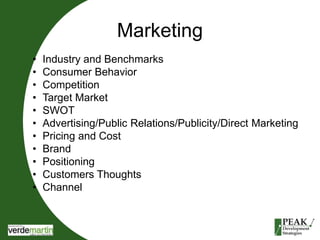
Marketing 
• Industry and Benchmarks 
• Consumer Behavior 
• Competition 
• Target Market 
• SWOT 
• Advertising/Public Relations/Publicity/Direct Marketing 
• Pricing and Cost 
• Brand 
• Positioning 
• Customers Thoughts 
• Channel
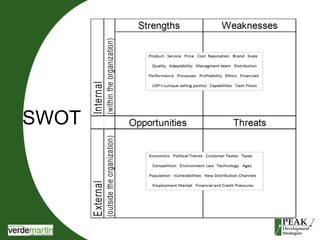
SWOT
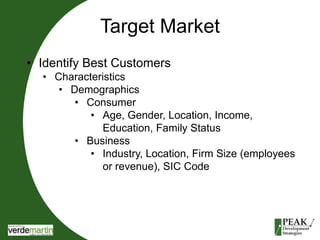
Target Market 
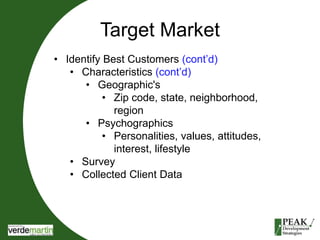
• Identify Best Customers 
• Characteristics 
• Demographics 
• Consumer 
• Age, Gender, Location, Income, 
Education, Family Status 
• Business 
• Industry, Location, Firm Size (employees 
or revenue), SIC Code
Target Market 
• Identify Best Customers (cont’d) 
• Characteristics (cont’d) 
• Geographic's 
• Zip code, state, neighborhood, 
region 
• Psychographics 
• Personalities, values, attitudes, 
interest, lifestyle 
• Survey 
• Collected Client Data
Networking 
Moment
Competition 
• Identify Top 5 Competitors 
• Price 
• Channel 
• What do they do different? 
• What do they do better?
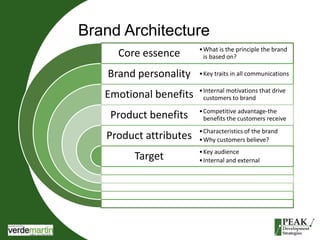
Brand Architecture 
Core essence 
Brand personality 
Emotional benefits 
Product benefits 
Product attributes 
Target 
•What is the principle the brand 
is based on? 
•Key traits in all communications 
• Internal motivations that drive 
customers to brand 
•Competitive advantage-the 
benefits the customers receive 
•Characteristics of the brand 
•Why customers believe? 
•Key audience 
• Internal and external
Components of the 
Sales Audit 
Goals 
Steps of 
the Sale 
Marketing 
Sales 
People 
Systems
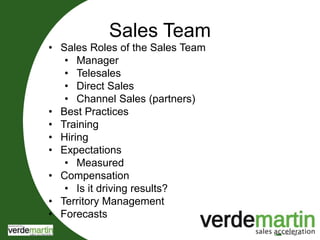
Sales Team 
• Sales Roles of the Sales Team 
• Manager 
• Telesales 
• Direct Sales 
• Channel Sales (partners) 
• Best Practices 
• Training 
• Hiring 
• Expectations 
• Measured 
• Compensation 
• Is it driving results? 
• Territory Management 
• Forecasts
KPI’s
Components of the 
Sales Audit 
Goals 
Steps of 
the Sale 
Marketing 
Sales 
People 
Systems
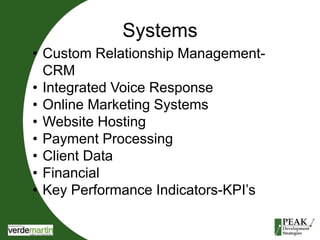
Systems 
• Custom Relationship Management- 
CRM 
• Integrated Voice Response 
• Online Marketing Systems 
• Website Hosting 
• Payment Processing 
• Client Data 
• Financial 
• Key Performance Indicators-KPI’s
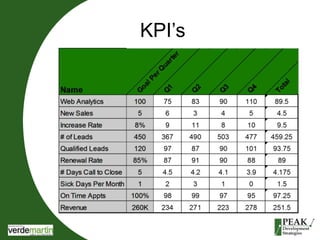
KPI’s
Goals 
Goals 
 Mission 
 Vision 
 Gap Analysis 
 Values 
 1-3 Year Goals 
 25 Year Goals
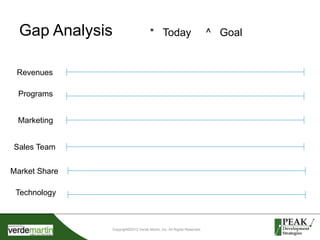
Gap Analysis 
Copyright©2012 Verde Martin, Inc. All Rights Reserved. 
Revenues 
Programs 
Marketing 
Sales Team 
Market Share 
Technology 
* Today ^ Goal
Purpose 
• What is the Purpose of your business? 
• Why are you in business? 
• Who do you serve? 
• Elevator speech:
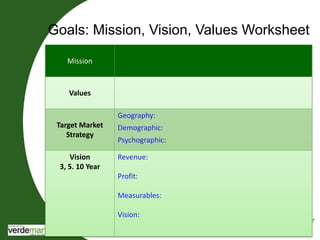
Goals: Mission, Vision, Values Worksheet 
Mission 
Values 
Target Market 
Strategy 
Geography: 
Demographic: 
Psychographic: 
Vision 
3, 5. 10 Year 
Revenue: 
Profit: 
Measurables: 
Vision:
KPI’s 
• What Key Performance Indicators can be 
associated with your goals? 
• Is the KPI obtainable? 
• Is the KPI measurable? 
– There should be at least one KPI for each Goal

Vm sales audit

  • 1.
    Is your businesswinning? Sales Acceleration by Verde Martin
  • 2.
    People buy thingsto realize their aspirations
  • 3.
    Signs & Symptoms • Extreme growth or decline in business • Sales revenue increased but profitability is flat line or in decline • Turnover in sales team • Late in delivery • Pricing, cost, and quote issues • No strategic plan • No MVV
  • 4.
    Signs & Symptoms • Absence of clearly defined sales process internally or externally • Lack of or confusion in marketing strategy • Customer retention issues • Employee engagement issues • Technology gaps • Customer service problems • Vision, direction, and forecast
  • 5.
    Components of SalesAudit Steps of the Sale Systems Goals Marketing Sales Team
  • 6.
    Components of the Sales Audit Goals Steps of the Sale Marketing Sales People Systems
  • 7.
    Components of the Sales Audit Goals Steps of the Sale Marketing Sales People Systems
  • 8.
  • 9.
    Business Review-Customer Breakdown Service # of Customers Parts 7 Service Calls 583 Check-Ups 441 Installs 56 Total 1087
  • 10.
    Business Review-Revenue byBusiness Unit Service Rev by Service Parts $729.70 Service Calls $131,327.00 Check-Ups $44,235.95 Installs $274,247.62 Total $450,540.27
  • 11.
    Mission Mission: Whydoes the business exist? • “Understand the customer’s needs, repair before replacing, honor the quote, use fair pricing, and have a positive relationship with customers.”
  • 12.
    Mission Contains 3key components: • Key market – who is your target client/customer? (generalize if needed) • Contribution – what product or service do you provide to that client? • Distinction – what makes your product or service unique, so that the client would choose you?
  • 13.
    Mission Examples: •Google: – mission is to organize the world's information and make it universally accessible and useful. • McDonald’s: – is to be the world's best quick service restaurant experience. Being the best means providing outstanding quality, service, cleanliness, and value, so that we make every customer in every restaurant smile • Mary Erlain: – is to help as many people as possible to develop themselves and discover their God-given gifts and talents
  • 14.
    Vision Vision: Whereis the business going? Inspires the business toward growth. Points everyone in the organization in the same direction. • “Fake (real company name) will meet all our customers heating and cooling needs.”
  • 15.
    Vision • Outlineswhat the organization wants to be, or how it wants the world in which it operates to be. • It is a long-term view and concentrates on the future.
  • 16.
    Vision Examples: •Amazon: – Our vision is to be earth's most customer centric company; to build a place where people can come to find and discover anything they might want to buy online. • Kraft Foods: – Helping people around the world eat and live better. • Mary Erlain: – Be a friend and confidant to those people whom I value in my world outside my immediate family.
  • 17.
    Values Values: Whatyou stand for and why you exist. Needs to be meaningful and inspirational to those inside the organization. Unchanged over time. • “Trust- service is guaranteed or you don’t pay. Fair Pricing. Understand the Customer
  • 18.
    Values • Beliefsthat are shared among the stakeholders of an organization. • Values drive an organization's culture and priorities and provide a framework in which decisions are made.
  • 19.
    Values • TastyCatering: 1. Always moral, ethical and legal 2. Treat all with respect 3. Quality in everything we do 4. High customer service standards 5. A competitive and strong determination to be the best 6. An enduring culture of individual discipline 7. Freedom and responsibility within the culture of individual discipline
  • 20.
    Goals Goals: Thevision with a timeline. Establish 3, 5, or 10 years goals which are measurable. • “Grow into a $2M business”
  • 21.
    Goals • SMART – Specific – Measurable – Attainable – Realistic/Relevant – Timely/Tangible • 3, 5, or 10 year which are measurable
  • 22.
    Goals Examples: •Revenue: – An increase in revenue overall, or by product line, is accomplished by setting a percentage increase, such as a 50 percent increase by the end of the fifth year or by setting a dollar amount, such $3 million in sales. • Growth: – doubling market share, establishing a certain number of locations, penetrating different markets or bringing out a new product line. • Exit Strategy: – Owners exiting company, selling company, going public…
  • 23.
    Goals: Mission, Vision,Values Worksheet Mission Values Target Market Strategy Geography: Demographic: Psychographic: Vision 3, 5. 10 Year Revenue: Profit: Measurables: Vision:
  • 24.
    Components of the Sales Audit Goals Steps of the Sale Marketing Sales People Systems
  • 25.
    Steps of theSale Step 1: The buyer has a need, problem, or want (WANT) Step 2: The buyer seeks knowledge (AWARENESS) The consumer is in search of information so he or she can meet a need, solve a problem, or fulfill a want. At this stage the consumer seeks information or knowledge. Step 3: The buyer collects the information and evaluates the alternatives (KNOWLEDGE) At step three, the consumer eliminates products and services and decides what product or service is best. Consumers are selecting the best product or service based on the information they have. They also base decisions on their experience.
  • 26.
    Steps of theSale Step 4: The buyer chooses (SELECTION) The buyer makes a selection. Step 5: The buyer purchases (CLOSE) This step includes payment or a commitment to purchase. Step 6: The buyer uses (VALUE) Customer service, account management, and post purchase behavior fall into Step 6. Customer service and account management usually support a service. Post-purchase behavior is when the consumers mentally rank the satisfaction of a purchase. They evaluate if they liked the store, the sales person, the product, or the service.
  • 27.
    Steps of theBuy Step 1: WANT Heating System Step 2: AWARENESS Website, referral, current relationship, advertising Step 3: KNOWLEDGE Collect Quote, Cost, Time, Payment Options, Process, Reliable, Take away old furnace Step 4: SELECTION Compare price, product, warranty Step 5: CLOSE Communicate decision, set date Step 6: VALUE Customer feels good, Evaluation, Phone call to follow up, Training by Technician
  • 28.
    Steps of theSell 1. Lead Generation 2. Qualify Lead 3. Set Appointment 4. Discovery 5. Recommendation 6. Quote 7. Install/Repair 8. Collect Payment 9. Follow Up
  • 29.
    Steps of theSell Step 1:LEAD GENERATION Website, advertising, sticker on air conditioner and furnace, target advertising to homes over 18 yrs Step 2:QUALIFY LEAD Questions measure resources, interest, and need Step 3:SET APPOINTMENT Many options for times, define expectations of call, send photo of worker for safety Step 4:DISCOVERY Questions to determine selection criteria Step 5:RECOMMENDATION Info based on Discovery Appt
  • 30.
    Steps of theSell Step 6:QUOTE In writing, all details Step 7:INSTALL/REPAIR On time, clean, train customer how to change filter, answer questions, repair it correctly the first time Step 8:COLLECT PAYMENT Office processes payment Step 9:FOLLOW UP Send email with survey to customer Follow up with a phone call, Mail out thank you note, mail out referral letter
  • 32.
    Components of the Sales Audit Goals Steps of the Sale Marketing Sales People Systems
  • 33.
    Marketing • Industryand Benchmarks • Consumer Behavior • Competition • Target Market • SWOT • Advertising/Public Relations/Publicity/Direct Marketing • Pricing and Cost • Brand • Positioning • Customers Thoughts • Channel
  • 34.
  • 35.
    Target Market •Identify Best Customers • Characteristics • Demographics • Consumer • Age, Gender, Location, Income, Education, Family Status • Business • Industry, Location, Firm Size (employees or revenue), SIC Code
  • 36.
    Target Market •Identify Best Customers (cont’d) • Characteristics (cont’d) • Geographic's • Zip code, state, neighborhood, region • Psychographics • Personalities, values, attitudes, interest, lifestyle • Survey • Collected Client Data
  • 37.
  • 38.
    Competition • IdentifyTop 5 Competitors • Price • Channel • What do they do different? • What do they do better?
  • 39.
    Brand Architecture Coreessence Brand personality Emotional benefits Product benefits Product attributes Target •What is the principle the brand is based on? •Key traits in all communications • Internal motivations that drive customers to brand •Competitive advantage-the benefits the customers receive •Characteristics of the brand •Why customers believe? •Key audience • Internal and external
  • 41.
    Components of the Sales Audit Goals Steps of the Sale Marketing Sales People Systems
  • 42.
    Sales Team •Sales Roles of the Sales Team • Manager • Telesales • Direct Sales • Channel Sales (partners) • Best Practices • Training • Hiring • Expectations • Measured • Compensation • Is it driving results? • Territory Management • Forecasts
  • 43.
  • 44.
    Components of the Sales Audit Goals Steps of the Sale Marketing Sales People Systems
  • 45.
    Systems • CustomRelationship Management- CRM • Integrated Voice Response • Online Marketing Systems • Website Hosting • Payment Processing • Client Data • Financial • Key Performance Indicators-KPI’s
  • 46.
  • 47.
    Goals Goals Mission  Vision  Gap Analysis  Values  1-3 Year Goals  25 Year Goals
  • 48.
    Gap Analysis Copyright©2012Verde Martin, Inc. All Rights Reserved. Revenues Programs Marketing Sales Team Market Share Technology * Today ^ Goal
  • 49.
    Purpose • Whatis the Purpose of your business? • Why are you in business? • Who do you serve? • Elevator speech:
  • 50.
    Goals: Mission, Vision,Values Worksheet Mission Values Target Market Strategy Geography: Demographic: Psychographic: Vision 3, 5. 10 Year Revenue: Profit: Measurables: Vision:
  • 51.
    KPI’s • WhatKey Performance Indicators can be associated with your goals? • Is the KPI obtainable? • Is the KPI measurable? – There should be at least one KPI for each Goal

Editor's Notes

  • #6 Served over 1000 businesses in the past 4 years All but 1 gained a 30% revenue bump in one year We audit 5 things The main focus on Steps of the Sale Most started business because you identified a need in the market
  • #9 Pause, Open Your Mind, Suspend Judgment Look at Your Business from the Outside Looking In What would your special glasses look like? Your going to teach yourself how to make the business better
  • #10 Data is the important stuff If you can’t measure it you have no idea how you are doing We believe in measuring everything
  • #40 Your BRAND is the image that a customer feels for your business. The Core essence are your values- are your values visible in your brand? For Fake it was not. We called 10 customers and asked Brand Personality- Traits in all communications? Your website, sales materials, script with customers, look at everything that touches the customer Emotional benefits- what drives people to select you? What emotion do you convey? At fake they offered safety, reliability, and a guarantee Product benefit- your competitive advantage. Fake- guarantee service and fair pricing. Target- who is your target market? Fake- people living in homes over 18 years old
  • #41 We all wished we had a Sales Super Hero When we meet with business owners we hear many concerns but primarily High Turn Over, Not Hitting Goal, Are any of you having any challenges with your sales teams that are different?
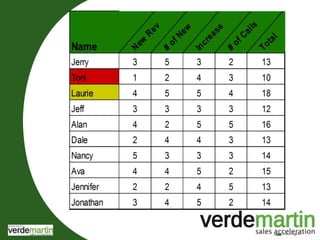
  • #44 To measure the team we create a spread sheet which measures items of importance Along the top we insert values we want to measure and assign a scale 1-5 then we rank For Fake we measured collection of information, payment collected, appearance, customer service, and on-time performance
  • #47 Measure Everything and Quarterly review to see where you are and where you want to go