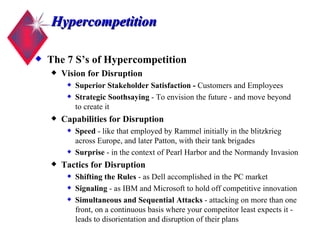
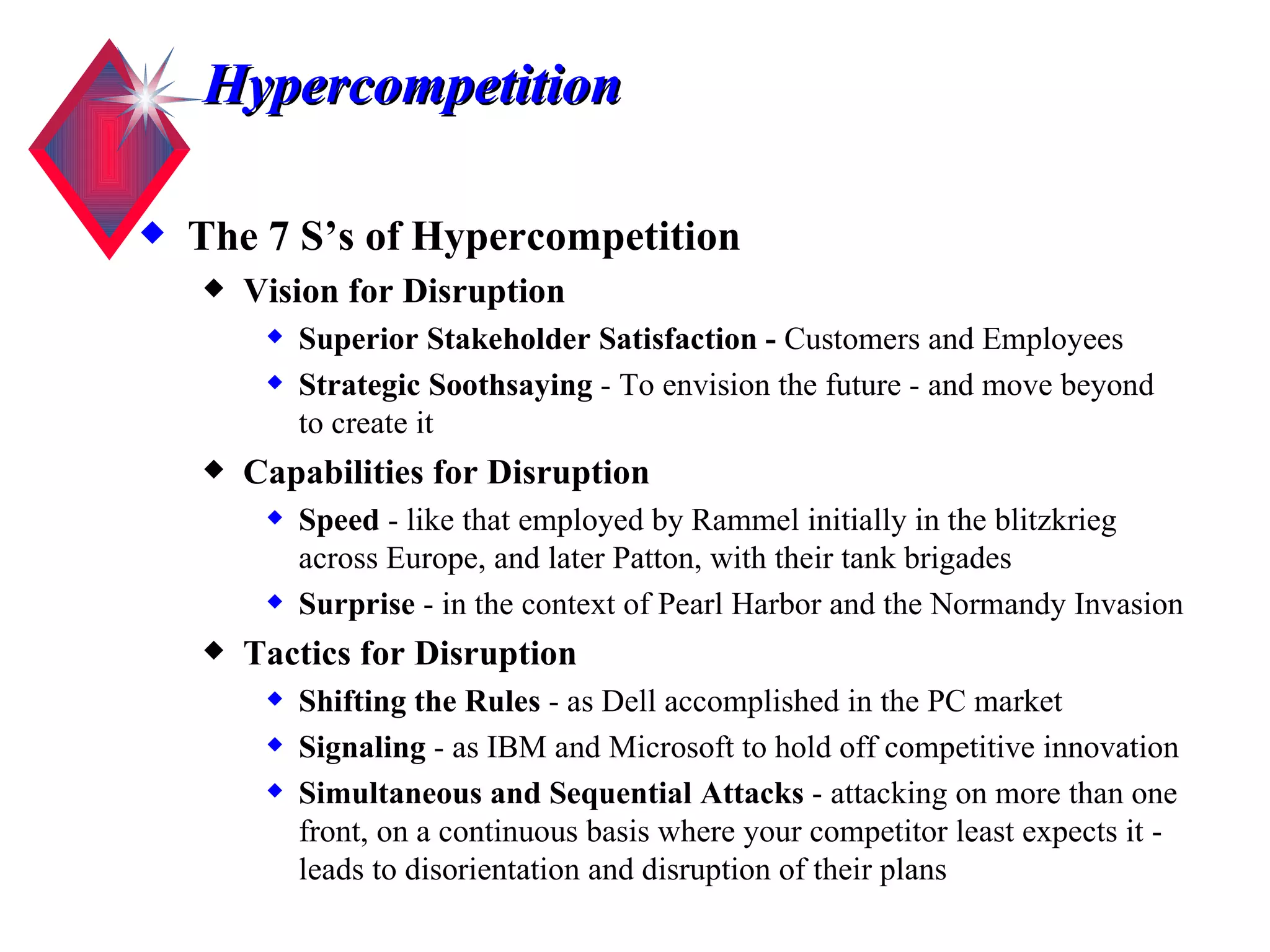
Hypercompetition The 7 S’s of Hypercompetition Vision for Disruption Superior Stakeholder Satisfaction -  Customers and Employees Strategic Soothsaying  - To envision the future - and move beyond   to create it Capabilities for Disruption Speed  - like that employed by Rammel initially in the blitzkrieg across Europe, and later Patton, with their tank brigades Surprise  - in the context of Pearl Harbor and the Normandy Invasion Tactics for Disruption Shifting the Rules  - as Dell accomplished in the PC market Signaling  - as IBM and Microsoft to hold off competitive innovation Simultaneous and Sequential Attacks  - attacking on more than one front, on a continuous basis where your competitor least expects it - leads to disorientation and disruption of their plans
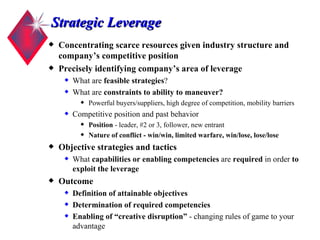
Strategic Leverage Concentrating scarce resources given industry structure and company’s competitive position Precisely identifying company’s area of leverage   What are  feasible strategies ?  What are  constraints to ability to maneuver? Powerful buyers/suppliers, high degree of competition, mobility barriers Competitive position and past behavior Position  - leader, #2 or 3, follower, new entrant Nature of conflict - win/win, limited warfare, win/lose, lose/lose Objective strategies and tactics What  capabilities or enabling competencies  are  required  in order  to exploit the leverage Outcome Definition of attainable objectives Determination of required competencies Enabling of “creative disruption”  - changing rules of game to your advantage
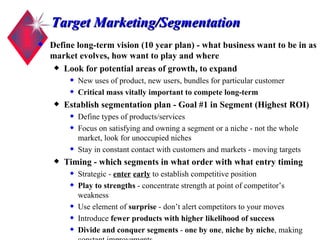
Target Marketing/Segmentation Define long-term vision (10 year plan) - what business want to be in as market evolves, how want to play and where Look for potential areas of growth, to expand New uses of product, new users, bundles for particular customer  Critical mass vitally important to compete long-term Establish segmentation plan - Goal  #1 in Segment  (Highest ROI) Define types of products/services Focus on satisfying and owning a segment or a niche - not the whole market, look for unoccupied niches Stay in constant contact with customers and markets - moving targets Timing - which segments in what order with what entry timing   Strategic -  enter   early  to establish competitive position Play to strengths  - concentrate strength at point of competitor’s weakness Use element of  surprise  - don’t alert competitors to your moves Introduce  fewer products   with higher likelihood of success Divide and conquer segments  -  one by one ,  niche by niche , making constant improvements
Differentiating/Positioning Differentiation - Key to Profitability No other strategic decision has larger profit impact than  superior differentiation Has to  register to customer  that you are   Better, faster, newer, more cost-effective than competition Me-too products/services don’t capture share of mind, poor ROI Must develop meaningful differences - that matter to customer Give customers what they want - when they want it Focus on one or two differentiators to be  clearly  superior Build upon them  and  sustain them over time Be first to market with them Positioning -  designing and communicating your distinct personality in the marketplace Positioning is what you do to the mind of the customer  Volvo - safety, IBM - service, BMW - performance SA  -  Leading the Way in the Information Age  Customers need to clearly describe your position  with great consistency Needs to be rooted in understanding of how Target market:   Defines value  and makes choices among products and competitors
Options to Differentiate Speed - React quickly. Capture the leadership position by being first to market. Get it to customer faster - Perform series of programs and processes simultaneously Reliability - Earn customer loyalty. Deliver products and services of consistent quality. Give the customer what they want, the way they want it, when they need it. Do what you say you are going to do. Do it consistently. If something happens - don’t make it the customer’s problem.  Service - Satisfy the customer - meet their needs for service. Augment the product - can achieve premium price for commodity product. Key to competing where there is product parity. Driving down level of dissatisfied customers also improves level on satisfied ones Technology - Innovate. Find new applications for emerging technologies and identify customer value. Bigger, faster, cheaper, new approach, disruptive
Options to Differentiate Relationships - Nurture them. Everyone in the organization must be market-driven. Devote more effort on  keeping profitable customers Cost much more to get new one than keep old one - up to five times more Not good enough to have the most technologically advanced product, provide good service - when everyone else can Objective - Keep customers you have and maximize lifetime value Focus on delighting the customer so they are not interested in leaving Fix the problems - highest leverage area  Design - Perception is everything. Design the look and feel of products to standout in marketplace. User -friendly - to start-up, to use, repair Deliver on dimensions important to customer Features - know what attributes customers value, will pay for and focus here. Personality - define yourself. Create distinct image. Achieve brand image for positioning and corporate personality that represents set of values customers are interested in
Innovation Gain innovative advantage - shorter innovation cycles capture new opportunities:  SPEED KILLS Build relationships  with major directional customers Anticipate customer needs  given changes in technology and lead them in development of information management solutions Keep abreast of  emerging, and  potentially disruptive technologies Improve product and process innovation capabilities  that support concept development and overall performance and cost enhancements Leverage capabilities with internal development group, suppliers, customers, associations, universities and partners Target design-to-prototype cycle time reduction of 25%+  Define and Achieve Leadership with Directional Customers Establish strategy for  each  Directional Customer Strategy defines needed products, services, marketing and selling strategies and efforts to achieve operational excellence in the eyes of this customer If  satisfy  the  “most difficult” customers  - this will pull organization to  higher level for rest of customer base
Top and Bottom Line Enhancements Ways Sales and Marketing can boost sales and profits   Identify market trends to access accurately the  future  profit potential of a business Analytical scenario of future market conditions Develop business strategy, marketing strategy and plan that Creates strategic leverage  and builds upon strengths/core competencies of the firm Identifies new competencies  needed to achieve/sustain leadership Utilizes customer profiling, segmentation, and target marketing to Grow current customer base and market segments   Identify and build profitable new market segments and niches Better match of product/service bundle to customer needs Achieves a differentiated market position  - competitive advantage in product/service offering, way you do business with customer Helps grow their business and impact their bottom line Provides higher value to reduce price competition Positions you as the best in category in the mind of the customer
Top and Bottom Line Enhancements Identify new product/service capability to add to product portfolio Serve current customers - reduce cost of sales Serve new customers Improve margins Identify and develop new channels to attract more customers and better serve them E-commerce Determine profitability of specific Products/Services, Sales territories, Customer groups, Accounts within them, Trade channels or channels to market, Order sizes Fully assign expenses associated with serving those accounts Understand which contribute how much to your profit Eliminate “losers” Prune unprofitable product/services  and  customers
Top and Bottom Line Enhancements Increase profits by spreading Sales and Marketing costs over larger sales volume Achieve differentiated product/service offering to make selling efforts easier and less expensive Develop  effective support programs  - Customer Service and E-commerce Support implementation of  new sales, marketing and customer service approaches - Customer Relationship Management  Large Account Management, Strategic and Conceptual Selling Sales and Marketing Automation Sales and Marketing activity profitability analysis  -  Improve productivity, spending efficiency and impact  of marketing tools - Sales Force, Advertising, Sales Promotion Sales and Marketing efficiency studies - how can sales and marketing activities be carried out more efficiently - Sales & Marketing Audit Critically examine overall marketing and sales plan - objectives, policies, strategies and programs in light of changing market conditions
Marketing Objectives and Tactics Goal - Customer retention ,  loyalty ,  share and value maximization Customer Targeting and Target Marketing Work to build relationships with  most profitable  customers   Market concentration - focus on customers where can best  improve   their profits  - reduce their costs, improve their sales or productivity  Make your joint growth a partnership Specific strategy  for  each market  and  specific offer  for  each customer   Win the battle for Customer Loyalty - Commit resources to win Set “extremely high” standards  and make customer satisfaction everybody’s business - everyone is responsible and its “my problem” Be obsessive in knowing, even better than the customer, what he wants Enables you to anticipate product/service needs Design products/services to maximize customer satisfaction  -delight them Focus on demands of most demanding customers  Create and manage expectations  - manage performance to achieve it  Strategic Alliances/Acquisitions - take the offensive, do it faster Provide complete package  desired by customer Compete effectively against “large” competitors  Use alliance to position for future acquisition  - eliminate fears/barriers
Plan of Attack - Top/Bottom Line Growth Prepare the Marketing and Sales programs  Identify market trends  to access  future  profit potential of a business Scenario of future market conditions - potential areas of change, growth Perform  Customer Profiling, Need & Competitive Assessment Market and Customer Segmentation opportunities, Directional Customers Identify New Opportunities/Needed Competencies to achieve/sustain competitive advantage, leadership position Understand how to help grow customer sales and profits, meet their needs Profitability Analysis  - products/services, territories, customers, accounts within them - what/who contribute how much to profits Identify strategy that  creates strategic leverage  and builds upon the strengths/core competencies  Create  Product/Service/Technology Roadmap Investigate potential of  disruptive  technologies, products, approaches Define  Differentiation  and  Positioning strategy  that provides Competitive advantage in product/service offering, way do business Best in category position in mind of customer Reduction in selling efforts, expense and emphasis on price Establish  products/service portfolio, pricing, promotion and sales approach to serve market and customer targets, improve profitability
Plan of Attack - Top/Bottom Line Growth Communicate/Execute the Marketing and Sales programs  Grow and maintain current customer base Develop high-level relationships with key customers Move away from unprofitable products/services, segments and customers Identify and  build position  within  profitable new market segments  and  niches Pursue  new   product/service  and  market opportunities ,  customers  to  diversify sales base Become customer and region neutral Investigate and  Pursue   Strategic Partnerships/Acquisitions Improve sales force and promotion effectiveness , productivity  CRM/S&M automation, SS, LAM Advertising, Sales Promotion  Develop  effective sales support programs  to attract more customers,  better serve them Customer Service Define and execute e-Commerce strategy Build  an energetic and achievement-oriented  Sales and Marketing team
Define need for increasing product/service coverage, presence to the sale and hit rate to grow market share Develop  and  implement tailored, winnable strategies  based upon: Growing specific customer satisfaction, sales and profitability Achieving meaningful differentiation/positioning  in mind of Customer When Airframe Manufacturers think of information management solutions - they think of  SA Will pursue 1-2 differentiators and be clearly superior - technology and  reliability, could possibly tie in design or features and speed Disrupting  the “status quo”  and  creating a continuous series of  temporary advantages Speed, Surprise, Change the Rules, Attack on more than one front  Identification of feasible strategies Understanding and utilizing  changes  in the  market and technology Leveraging strength and concentrating this strength in attacking weaknesses of  major competitors Brand image, portfolio of products and technologies, service/support organization  Understanding   differences in purchasing behavior by individuals and regions Implementing strategy in sequence to concentrate resources and win Targeted Sales and Marketing Strategy
Sales Strategy Focus  entire  Company on the customer - to help them achieve their strategy and bottom line Focus is on development of customer relationship - not the deal Sales works to  solve customer’s problems  - any and all of them Everyone works to secure account revenue/maximize customer service Objectives Satisfied Customers, Long-term Relationships, Repeat Business, Referrals Deliver Value  to and  Make Customers More Profitable and Successful Differentiate on  the  quality of ideas  and  tangible bottom-line impact  on customer’s business Need to understand customer’s industry/business as well as application   of products and services Can  impact Customer Speed and Productivity/Efficiency  - receipt of inbound  shipments, manufacturing process, shipment, marketing & sale and service of finished goods Can build  value proposition  around business know-how, supply chain optimization, operation support, ease of doing business, organizational strength as well as product/service design
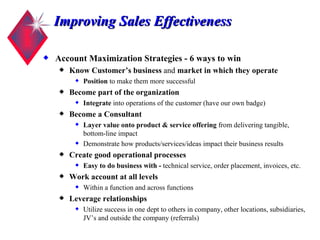
Improving Sales Effectiveness Account Maximization Strategies - 6 ways to win Know Customer’s business  and  market in which they operate Position  to make them more successful Become part of the organization Integrate  into operations of the customer (have our own badge) Become a Consultant  Layer value onto product & service offering  from delivering tangible, bottom-line impact Demonstrate how products/services/ideas impact their business results Create good operational processes Easy to do business with -  technical service, order placement, invoices, etc. Work account at all levels Within a function and across functions Leverage relationships Utilize success in one dept to others in company, other locations, subsidiaries, JV’s and outside the company (referrals)

Growth Toolkit

  • 1.
    Hypercompetition The 7S’s of Hypercompetition Vision for Disruption Superior Stakeholder Satisfaction - Customers and Employees Strategic Soothsaying - To envision the future - and move beyond to create it Capabilities for Disruption Speed - like that employed by Rammel initially in the blitzkrieg across Europe, and later Patton, with their tank brigades Surprise - in the context of Pearl Harbor and the Normandy Invasion Tactics for Disruption Shifting the Rules - as Dell accomplished in the PC market Signaling - as IBM and Microsoft to hold off competitive innovation Simultaneous and Sequential Attacks - attacking on more than one front, on a continuous basis where your competitor least expects it - leads to disorientation and disruption of their plans
  • 2.
    Strategic Leverage Concentratingscarce resources given industry structure and company’s competitive position Precisely identifying company’s area of leverage What are feasible strategies ? What are constraints to ability to maneuver? Powerful buyers/suppliers, high degree of competition, mobility barriers Competitive position and past behavior Position - leader, #2 or 3, follower, new entrant Nature of conflict - win/win, limited warfare, win/lose, lose/lose Objective strategies and tactics What capabilities or enabling competencies are required in order to exploit the leverage Outcome Definition of attainable objectives Determination of required competencies Enabling of “creative disruption” - changing rules of game to your advantage
  • 3.
    Target Marketing/Segmentation Definelong-term vision (10 year plan) - what business want to be in as market evolves, how want to play and where Look for potential areas of growth, to expand New uses of product, new users, bundles for particular customer Critical mass vitally important to compete long-term Establish segmentation plan - Goal #1 in Segment (Highest ROI) Define types of products/services Focus on satisfying and owning a segment or a niche - not the whole market, look for unoccupied niches Stay in constant contact with customers and markets - moving targets Timing - which segments in what order with what entry timing Strategic - enter early to establish competitive position Play to strengths - concentrate strength at point of competitor’s weakness Use element of surprise - don’t alert competitors to your moves Introduce fewer products with higher likelihood of success Divide and conquer segments - one by one , niche by niche , making constant improvements
  • 4.
    Differentiating/Positioning Differentiation -Key to Profitability No other strategic decision has larger profit impact than superior differentiation Has to register to customer that you are Better, faster, newer, more cost-effective than competition Me-too products/services don’t capture share of mind, poor ROI Must develop meaningful differences - that matter to customer Give customers what they want - when they want it Focus on one or two differentiators to be clearly superior Build upon them and sustain them over time Be first to market with them Positioning - designing and communicating your distinct personality in the marketplace Positioning is what you do to the mind of the customer Volvo - safety, IBM - service, BMW - performance SA - Leading the Way in the Information Age Customers need to clearly describe your position with great consistency Needs to be rooted in understanding of how Target market: Defines value and makes choices among products and competitors
  • 5.
    Options to DifferentiateSpeed - React quickly. Capture the leadership position by being first to market. Get it to customer faster - Perform series of programs and processes simultaneously Reliability - Earn customer loyalty. Deliver products and services of consistent quality. Give the customer what they want, the way they want it, when they need it. Do what you say you are going to do. Do it consistently. If something happens - don’t make it the customer’s problem. Service - Satisfy the customer - meet their needs for service. Augment the product - can achieve premium price for commodity product. Key to competing where there is product parity. Driving down level of dissatisfied customers also improves level on satisfied ones Technology - Innovate. Find new applications for emerging technologies and identify customer value. Bigger, faster, cheaper, new approach, disruptive
  • 6.
    Options to DifferentiateRelationships - Nurture them. Everyone in the organization must be market-driven. Devote more effort on keeping profitable customers Cost much more to get new one than keep old one - up to five times more Not good enough to have the most technologically advanced product, provide good service - when everyone else can Objective - Keep customers you have and maximize lifetime value Focus on delighting the customer so they are not interested in leaving Fix the problems - highest leverage area Design - Perception is everything. Design the look and feel of products to standout in marketplace. User -friendly - to start-up, to use, repair Deliver on dimensions important to customer Features - know what attributes customers value, will pay for and focus here. Personality - define yourself. Create distinct image. Achieve brand image for positioning and corporate personality that represents set of values customers are interested in
  • 7.
    Innovation Gain innovativeadvantage - shorter innovation cycles capture new opportunities: SPEED KILLS Build relationships with major directional customers Anticipate customer needs given changes in technology and lead them in development of information management solutions Keep abreast of emerging, and potentially disruptive technologies Improve product and process innovation capabilities that support concept development and overall performance and cost enhancements Leverage capabilities with internal development group, suppliers, customers, associations, universities and partners Target design-to-prototype cycle time reduction of 25%+ Define and Achieve Leadership with Directional Customers Establish strategy for each Directional Customer Strategy defines needed products, services, marketing and selling strategies and efforts to achieve operational excellence in the eyes of this customer If satisfy the “most difficult” customers - this will pull organization to higher level for rest of customer base
  • 8.
    Top and BottomLine Enhancements Ways Sales and Marketing can boost sales and profits Identify market trends to access accurately the future profit potential of a business Analytical scenario of future market conditions Develop business strategy, marketing strategy and plan that Creates strategic leverage and builds upon strengths/core competencies of the firm Identifies new competencies needed to achieve/sustain leadership Utilizes customer profiling, segmentation, and target marketing to Grow current customer base and market segments Identify and build profitable new market segments and niches Better match of product/service bundle to customer needs Achieves a differentiated market position - competitive advantage in product/service offering, way you do business with customer Helps grow their business and impact their bottom line Provides higher value to reduce price competition Positions you as the best in category in the mind of the customer
  • 9.
    Top and BottomLine Enhancements Identify new product/service capability to add to product portfolio Serve current customers - reduce cost of sales Serve new customers Improve margins Identify and develop new channels to attract more customers and better serve them E-commerce Determine profitability of specific Products/Services, Sales territories, Customer groups, Accounts within them, Trade channels or channels to market, Order sizes Fully assign expenses associated with serving those accounts Understand which contribute how much to your profit Eliminate “losers” Prune unprofitable product/services and customers
  • 10.
    Top and BottomLine Enhancements Increase profits by spreading Sales and Marketing costs over larger sales volume Achieve differentiated product/service offering to make selling efforts easier and less expensive Develop effective support programs - Customer Service and E-commerce Support implementation of new sales, marketing and customer service approaches - Customer Relationship Management Large Account Management, Strategic and Conceptual Selling Sales and Marketing Automation Sales and Marketing activity profitability analysis - Improve productivity, spending efficiency and impact of marketing tools - Sales Force, Advertising, Sales Promotion Sales and Marketing efficiency studies - how can sales and marketing activities be carried out more efficiently - Sales & Marketing Audit Critically examine overall marketing and sales plan - objectives, policies, strategies and programs in light of changing market conditions
  • 11.
    Marketing Objectives andTactics Goal - Customer retention , loyalty , share and value maximization Customer Targeting and Target Marketing Work to build relationships with most profitable customers Market concentration - focus on customers where can best improve their profits - reduce their costs, improve their sales or productivity Make your joint growth a partnership Specific strategy for each market and specific offer for each customer Win the battle for Customer Loyalty - Commit resources to win Set “extremely high” standards and make customer satisfaction everybody’s business - everyone is responsible and its “my problem” Be obsessive in knowing, even better than the customer, what he wants Enables you to anticipate product/service needs Design products/services to maximize customer satisfaction -delight them Focus on demands of most demanding customers Create and manage expectations - manage performance to achieve it Strategic Alliances/Acquisitions - take the offensive, do it faster Provide complete package desired by customer Compete effectively against “large” competitors Use alliance to position for future acquisition - eliminate fears/barriers
  • 12.
    Plan of Attack- Top/Bottom Line Growth Prepare the Marketing and Sales programs Identify market trends to access future profit potential of a business Scenario of future market conditions - potential areas of change, growth Perform Customer Profiling, Need & Competitive Assessment Market and Customer Segmentation opportunities, Directional Customers Identify New Opportunities/Needed Competencies to achieve/sustain competitive advantage, leadership position Understand how to help grow customer sales and profits, meet their needs Profitability Analysis - products/services, territories, customers, accounts within them - what/who contribute how much to profits Identify strategy that creates strategic leverage and builds upon the strengths/core competencies Create Product/Service/Technology Roadmap Investigate potential of disruptive technologies, products, approaches Define Differentiation and Positioning strategy that provides Competitive advantage in product/service offering, way do business Best in category position in mind of customer Reduction in selling efforts, expense and emphasis on price Establish products/service portfolio, pricing, promotion and sales approach to serve market and customer targets, improve profitability
  • 13.
    Plan of Attack- Top/Bottom Line Growth Communicate/Execute the Marketing and Sales programs Grow and maintain current customer base Develop high-level relationships with key customers Move away from unprofitable products/services, segments and customers Identify and build position within profitable new market segments and niches Pursue new product/service and market opportunities , customers to diversify sales base Become customer and region neutral Investigate and Pursue Strategic Partnerships/Acquisitions Improve sales force and promotion effectiveness , productivity CRM/S&M automation, SS, LAM Advertising, Sales Promotion Develop effective sales support programs to attract more customers, better serve them Customer Service Define and execute e-Commerce strategy Build an energetic and achievement-oriented Sales and Marketing team
  • 14.
    Define need forincreasing product/service coverage, presence to the sale and hit rate to grow market share Develop and implement tailored, winnable strategies based upon: Growing specific customer satisfaction, sales and profitability Achieving meaningful differentiation/positioning in mind of Customer When Airframe Manufacturers think of information management solutions - they think of SA Will pursue 1-2 differentiators and be clearly superior - technology and reliability, could possibly tie in design or features and speed Disrupting the “status quo” and creating a continuous series of temporary advantages Speed, Surprise, Change the Rules, Attack on more than one front Identification of feasible strategies Understanding and utilizing changes in the market and technology Leveraging strength and concentrating this strength in attacking weaknesses of major competitors Brand image, portfolio of products and technologies, service/support organization Understanding differences in purchasing behavior by individuals and regions Implementing strategy in sequence to concentrate resources and win Targeted Sales and Marketing Strategy
  • 15.
    Sales Strategy Focus entire Company on the customer - to help them achieve their strategy and bottom line Focus is on development of customer relationship - not the deal Sales works to solve customer’s problems - any and all of them Everyone works to secure account revenue/maximize customer service Objectives Satisfied Customers, Long-term Relationships, Repeat Business, Referrals Deliver Value to and Make Customers More Profitable and Successful Differentiate on the quality of ideas and tangible bottom-line impact on customer’s business Need to understand customer’s industry/business as well as application of products and services Can impact Customer Speed and Productivity/Efficiency - receipt of inbound shipments, manufacturing process, shipment, marketing & sale and service of finished goods Can build value proposition around business know-how, supply chain optimization, operation support, ease of doing business, organizational strength as well as product/service design
  • 16.
    Improving Sales EffectivenessAccount Maximization Strategies - 6 ways to win Know Customer’s business and market in which they operate Position to make them more successful Become part of the organization Integrate into operations of the customer (have our own badge) Become a Consultant Layer value onto product & service offering from delivering tangible, bottom-line impact Demonstrate how products/services/ideas impact their business results Create good operational processes Easy to do business with - technical service, order placement, invoices, etc. Work account at all levels Within a function and across functions Leverage relationships Utilize success in one dept to others in company, other locations, subsidiaries, JV’s and outside the company (referrals)