Download to read offline
![Nehaverma, Deepak Sharma / International Journal of Engineering Research and Applications
(IJERA) ISSN: 2248-9622 www.ijera.com
Vol. 3, Issue 4, Jul-Aug 2013, pp.681-688
681 | P a g e
Advanced Maximal Similarity Based Region Merging By User
Interactions
Nehaverma, Deepak Sharma
ABSTRACT
Image segmentation is a popular method
for dividing the image into various segments so as
to change the representation of an image into
something that is more meaningful and easier to
analyze[12]. This paper presents a new region
merging based interactive image segmentation
method. A novel maximal-similarity based region
merging mechanism is proposed to guide the
merging process with the help of markers in
which the user only need to mark the object
desired to be extracted. The sample image taken
for analysis is initially segmented using multi
level thresholding technique[1]. This technique is
used as it provides very good segmentation
results than any other method. The regions are
merged based on the similarity criteria depending
upon comparing the mean values of both the
regions to be merged. So, the similar regions are
then merged and the dissimilar regions are
merged together. Thus the merged object regions
are then extracted from the complex background.
The results of the proposed method has been
compared with the results of the previous
methods and it is observed that this method
provides very promising results and degree of
accuracy for extracting the desired object is
better in this case.
Key Words- Image Segmentation, MSRM, Multi
level Thresholding, Euclidean distance.
I. INTRODUCTION
Images are considered as one of the
important medium of conveying information in the
field of computer vision. By understanding images,
the information extracted from them can be used for
other tasks for example, navigation of robots,
extracting malign tissues from the body scans,
detection of cancerous cells and identification of an
airport from remote sensing data. Now there is need
of a method. With the help of which, we can
understand images and extract information or
objects. Image segmentation is used to fulfill the
above requirements[1]. The objective is used to
extract the object from the background. In general,
the color and texture features in a natural image are
very complex so that the fully automatic
segmentation of the object from the background is
very hard. Extensive research has been done in
many different approaches and algorithms for image
segmentation, but it is difficult to assess whether one
algorithm produce more accurate segmentations than
another, whether it be for a particular image or set of
images, or more generally for a whole class of
images.
Therefore, semi-automatic segmentation
methods incorporating user interactions have been
proposed and are becoming more and more popular.
The low level image segmentation methods such as
mean shift, watershed, level set and super-pixel
usually divide the image into very small regions.
Although they may have severe over segmentation,
these low level segmentation methods provide a
good basis for the subsequent high level operations,
such as region merging.
In this paper, we proposed a novel
interactive region merging method based on the
initial segmentation of multi level thresholding. This
technique provides no over segmentation as in other
methods, while preserving well the edge information
of the object. Because of no over segmentation, the
statistic features of each region, which will be
exploited by the proposed region merging method,
can be more robustly calculated and then can be
used in guiding the region merging process. In the
proposed scheme, the interactive information is
introduced as markers which are input by the users
to roughly indicate the position and main features of
the object and background. The markers are simple
lines (e.g. Green color). Then the proposed method
will calculate the similarity of different regions and
merge them based on the proposed maximal
similarity rule with the help of these markers. The
object will then be extracted from the background
when the merging process ends. Although the idea
of introducing markers into interactive segmentation
was used in Mean Shift’s scheme. With this scheme
the non marker regions if not find similarity with
the marked regions are merged and the marked
regions are merged with the similar unmarked
regions.
II. ADVANCED MAXIMAL
SIMILARITY BASED REGION
MERGING.
In our method, to divide the image into
various homogeneous regions, an initial
segmentation is required. There are many low level
segmentation methods, such as super-pixel, mean
shift; watershed and level set, any one of them can](https://image.slidesharecdn.com/dk34681688-130706050033-phpapp01/85/Dk34681688-1-320.jpg)
![Nehaverma, Deepak Sharma / International Journal of Engineering Research and Applications
(IJERA) ISSN: 2248-9622 www.ijera.com
Vol. 3, Issue 4, Jul-Aug 2013, pp.681-688
681 | P a g e
Advanced Maximal Similarity Based Region Merging By User
Interactions
Nehaverma, Deepak Sharma
ABSTRACT
Image segmentation is a popular method
for dividing the image into various segments so as
to change the representation of an image into
something that is more meaningful and easier to
analyze[12]. This paper presents a new region
merging based interactive image segmentation
method. A novel maximal-similarity based region
merging mechanism is proposed to guide the
merging process with the help of markers in
which the user only need to mark the object
desired to be extracted. The sample image taken
for analysis is initially segmented using multi
level thresholding technique[1]. This technique is
used as it provides very good segmentation
results than any other method. The regions are
merged based on the similarity criteria depending
upon comparing the mean values of both the
regions to be merged. So, the similar regions are
then merged and the dissimilar regions are
merged together. Thus the merged object regions
are then extracted from the complex background.
The results of the proposed method has been
compared with the results of the previous
methods and it is observed that this method
provides very promising results and degree of
accuracy for extracting the desired object is
better in this case.
Key Words- Image Segmentation, MSRM, Multi
level Thresholding, Euclidean distance.
I. INTRODUCTION
Images are considered as one of the
important medium of conveying information in the
field of computer vision. By understanding images,
the information extracted from them can be used for
other tasks for example, navigation of robots,
extracting malign tissues from the body scans,
detection of cancerous cells and identification of an
airport from remote sensing data. Now there is need
of a method. With the help of which, we can
understand images and extract information or
objects. Image segmentation is used to fulfill the
above requirements[1]. The objective is used to
extract the object from the background. In general,
the color and texture features in a natural image are
very complex so that the fully automatic
segmentation of the object from the background is
very hard. Extensive research has been done in
many different approaches and algorithms for image
segmentation, but it is difficult to assess whether one
algorithm produce more accurate segmentations than
another, whether it be for a particular image or set of
images, or more generally for a whole class of
images.
Therefore, semi-automatic segmentation
methods incorporating user interactions have been
proposed and are becoming more and more popular.
The low level image segmentation methods such as
mean shift, watershed, level set and super-pixel
usually divide the image into very small regions.
Although they may have severe over segmentation,
these low level segmentation methods provide a
good basis for the subsequent high level operations,
such as region merging.
In this paper, we proposed a novel
interactive region merging method based on the
initial segmentation of multi level thresholding. This
technique provides no over segmentation as in other
methods, while preserving well the edge information
of the object. Because of no over segmentation, the
statistic features of each region, which will be
exploited by the proposed region merging method,
can be more robustly calculated and then can be
used in guiding the region merging process. In the
proposed scheme, the interactive information is
introduced as markers which are input by the users
to roughly indicate the position and main features of
the object and background. The markers are simple
lines (e.g. Green color). Then the proposed method
will calculate the similarity of different regions and
merge them based on the proposed maximal
similarity rule with the help of these markers. The
object will then be extracted from the background
when the merging process ends. Although the idea
of introducing markers into interactive segmentation
was used in Mean Shift’s scheme. With this scheme
the non marker regions if not find similarity with
the marked regions are merged and the marked
regions are merged with the similar unmarked
regions.
II. ADVANCED MAXIMAL
SIMILARITY BASED REGION
MERGING.
In our method, to divide the image into
various homogeneous regions, an initial
segmentation is required. There are many low level
segmentation methods, such as super-pixel, mean
shift; watershed and level set, any one of them can](https://image.slidesharecdn.com/dk34681688-130706050033-phpapp01/75/Dk34681688-1-2048.jpg)
![Nehaverma, Deepak Sharma / International Journal of Engineering Research and Applications
(IJERA) ISSN: 2248-9622 www.ijera.com
Vol. 3, Issue 4, Jul-Aug 2013, pp.681-688
682 | P a g e
be used for this step. In this paper we have choose to
use multi level thresholding method for initial
segmentation because it has no over segmentation
which means the boundaries of the object remain
preserved. Segmentation is done in Matlab(7.13).
2.1 REPRESENTATION OF THE REGIONS.
After the initial segmentation is done, we
have many small regions available. We need to
represent these regions using some descriptor so as
to guide the region merging process. In many
aspects the regions can be defined such as color,
edge, texture, shape and size of the regions. Among
them the best descriptor is the color feature to
represent the object color feature statistics and is
widely used in object tracking and pattern
recognition. In Segmentation based on region
merging, the color feature is more robust than any
other feature descriptors. This is because the initially
segmented small regions of the desired object often
vary a lot in size and shape, while the colors of
different regions from the same object will have high
similarity[1]. Therefore, we use the color histogram
to represent each region in this paper.
The user will mark some regions as object
in the interactive image segmentation. The key issue
in region merging is how to determine the similarity
between the unmarked regions with the marked
regions so that the similar regions can be merged
with some logic control. Therefore, we need to
define a similarity measure between two regions R
and Q to accommodate the comparison between
various regions. There are some well-known
goodness-of-fit statistical metrics such as the
Euclidean distance, Bhattacharyya coefficient and
the log likelihood ratio statistic. Here, we choose to
use the Euclidean distance to measure the similarity
between R and Q. The RGB color space is used to
compute the Mean value of different regions. We
uniformly calculate the mean value of the object
under consideration, let it be ‘and the mean value of
its neighbor, let it be ‘Q’. If the mean value if less
than or equal to the pre defined threshold value than
the R will gets merged with Q otherwise not.
E.D = | (R-Ri)| + |(G-Gi)| + |(B-Bi)|.
Where, E.D is the Euclidean distance, and
R,G,B are the color values of region R, and
Ri,Gi,Bi are the color values of region Q. If two
regions have similar contents, their mean values will
be nearly similar. The RGB descriptor is a very
simple yet efficient way to represent the regions and
measure their similarity.
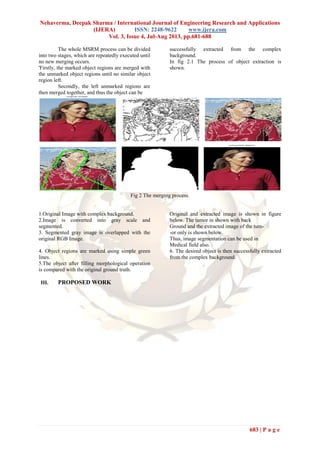
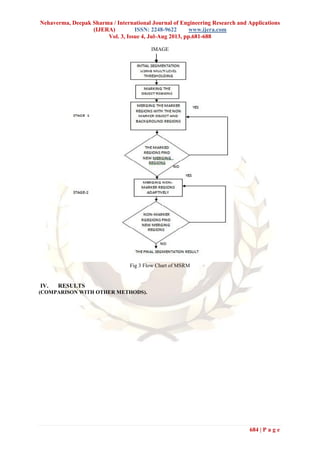
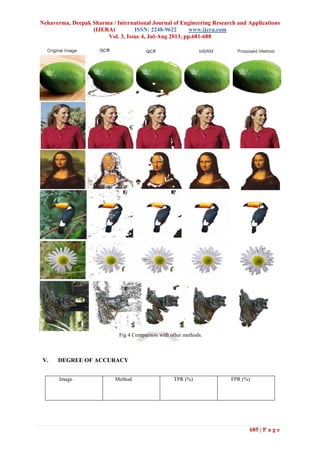
Fig 1 (a)Original image (b) Initial mean shift segmentation,(c)the interactive input by the user,(d) Segmentation
result by the proposed region merging method.
2.2 OBJECT MARKING.
The user need to specify the object in the
interactive image segmentation, the users can input
interactive information by drawing markers, which
could be lines, curves and strokes on the image.
The regions that have pixels inside the object
markers are thus called object marker regions. Fig.
1c shows examples of the object markers by using
simple green lines.
The marker regions cover only a small
part of the object. Those object regions that are not
marked by the user, i.e. the non-marker object
regions, should be identified and not be merged
with the background.
2.3 MERGING RULE FOR MAXIMAL
SIMILARITY.
After object marking, it is still a challenging
problem to extract accurately the object contour
from the background because only a portion of the
object is marked by the user. The proposed region
merging method merge
Two adjacent regions whose similarity is above a
preset threshold. These methods have difficulties in
adaptive threshold selection. A big threshold will
lead to incomplete merging of the regions
belonging to the object, while a small threshold can
easily cause over-merging, i.e. some object regions
are merged into the background. Moreover, it is
difficult to judge when the region merging stops.
Therefore a proper threshold has to be selected for
proper region merging.
2.4 THE MERGING PROCESS](https://image.slidesharecdn.com/dk34681688-130706050033-phpapp01/85/Dk34681688-2-320.jpg)
![Nehaverma, Deepak Sharma / International Journal of Engineering Research and Applications
(IJERA) ISSN: 2248-9622 www.ijera.com
Vol. 3, Issue 4, Jul-Aug 2013, pp.681-688
687 | P a g e
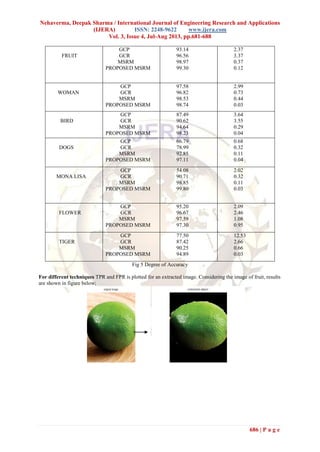
Fig 6 Plot for Sample Image- Fruit.
VI. CONCLUSION
In this research work, the sample image which
is used for analysis is subjected to initial
segmentation. Since there are a lot of techniques
for segmentation like mean shift, watershed, level
set. In this case, multi-level thresholding is used, as
it provides no over segmentation. The user was
then able to interact with the image by marking on
the object which is desired to be extracted. The
merging process is then applied and the desired
object is extracted from the background and it is
proved that this methods provides very good results
than previous techniques as the TPR (True positive
rate) is maximum and FPR (False positive rate) is
minimum which is desired.
VII. FUTURE SCOPE
The research has been limited to images
only. It can further be extended on videos including
videos in medical fields also like ECG, CT Scan
etc. Therefore it is suggested that one should try to
minimize the over segmentation in videos also as it
has been done in images and have got very
promising results.
REFERENCES
[1] [1] Jifeng Ning, LeiZhang, DavidZhang,
ChengkeWu “Interactive image
segmentation by maximal similarity based
region merging” Elsevier, Pattern
Recognition 43 (2010) 445 – 456.
[2] Pedro F. Felzenszwalb, Daniel P.
Huttenlocher “Efficient Graph Based
Image Segmentation”
[3] Toru Tamaki, Tsuyoshi Yamamura and
Noboru Ohnishi “Image segmentation and
object extraction based on geometric
features of regions” SPIE Vol.3653, Part
Two, 937-945.
[4] Jun Tang, "A color image segmentation
algorithm based on region growing,"
Computer Engineering and Technology
(ICCET), 2010 2nd International
Conference on, vol.6, no., pp.V6-634, V6-
637, 2010.
[5] Dewen Zhuang; Shoujue Wang, "Content-
Based Image Retrieval Based on
Integrating Region Segmentation and
Relevance Feedback" Multimedia
Technology (ICMT), 1,3,29-31,Oct2010.
[6] Wenbing Tao; Hai Jin; Yimin Zhang ,
"Color Image Segmentation Based on
Mean Shift and Normalized Cuts,"
Systems, Man, and Cybernetics, Part B:
Cybernetics, IEEE Transactions on ,
vol.37, no.5, pp.1382,1389, Oct. 2007.
93.14
96.56
98.97 99.3
2.3 3.37
0.37 0.120
20
40
60
80
100
120
GCP GCR MSRM PROPOSED
METHOD
TPR%
FPR%](https://image.slidesharecdn.com/dk34681688-130706050033-phpapp01/85/Dk34681688-7-320.jpg)
![Nehaverma, Deepak Sharma / International Journal of Engineering Research and Applications
(IJERA) ISSN: 2248-9622 www.ijera.com
Vol. 3, Issue 4, Jul-Aug 2013, pp.681-688
688 | P a g e
[7] Sapna,Varshney, S, Rajpal,N; Purwar, R,
“Comparitive study of image
segmentation techniques and object
matching using segmentation”, Methods
and models in computer science,2009.
[8] Zhen Wang; Meng Yang, "A fast
clustering algorithm in image
segmentation,," Computer Engineering
and Technology(ICCET),
[9] Dhara, B.C.; Chanda, B., "A Fast
Interactive Image Segmentation to Locate
Multiple Similar-colored Objects,"
Computer Vision, Pattern Recognition,
Image Processing and Graphics
(NCVPRIPG), 2011 Third National
Conference on , vol., no., pp.25,28, 15-17
Dec. 2011.
[10] Qiang Chen; Benben Xue; Quansen Sun;
Deshen Xia, "Interactive image
segmentation based on object contour
feature image," Image Processing (ICIP),
2010 17th IEEE International Conference
on , vol., no., pp.3605,3608, 26-29 Sept.
2010.
[11] Fric, M.; Kamencay, P.; Lukac, P.,
"Automatic segmentation and impact for
retrieval images," Signal Processing
Algorithms, Architectures, Arrangements,
and Applications Conference Proceedings
(SPA), 2011 , vol., no., pp.1,5, 29-30 Sept.
2011.
[12] Toru Tamaki, Tsuyoshi Yamamura
Noboru Ohnishi, “Image segmentation
and object extraction based on geometric
features of regions”, pp 937-945,1999.
[13] Reinhardt, J.M.; Higgins, W.E.,
"Automatic generation of image-
segmentation processes," Image
Processing, 1994. Proceedings. ICIP-94.,
IEEE International Conference , vol.3, no.,
pp.791,795 vol.3, 13-16 Nov 1994.
[14] Pedro F. Felzenszwalb, Daniel P.
Huttenlocher “Efficient Graph Based
Image Segmentation”.
[15] Yong Xia; Dagan Feng, "A General Image
Segmentation Model and its Application,"
Image and Graphics, 2009.ICIG '09. Fifth
International Conference on , vol., no.,
pp.227,231, 20-23 Sept. 2009.
[16] Shirakawa, S.; Nagao, T., "Evolutionary
image segmentation based on
multiobjective clustering," Evolutionary
Computation, 2009. CEC '09. IEEE
Congress on , vol., no., pp.2466,2473, 18-
21 May 2009.
[17] Shirakawa, S.; Nagao, T., "Evolutionary
image segmentation based on
multiobjective clustering," Evolutionary
Computation, 2009. CEC '09. IEEE
Congress on , vol., no., pp.2466,2473, 18-
21 May 2009.
[18] Wenbing Tao; Hai Jin; YiminZhang ,
"Color Image Segmentation Based on
Mean Shift and Normalized Cuts,"
Systems, Man, and Cybernetics, Part B:
Cybernetics, IEEE Transactions on ,
vol.37, no.5, pp.1382,1389, Oct. 2007.](https://image.slidesharecdn.com/dk34681688-130706050033-phpapp01/85/Dk34681688-8-320.jpg)

This document presents a new interactive image segmentation method called Advanced Maximal Similarity Based Region Merging (MSRM) using user interactions. The method first segments the image using multi-level thresholding. The user then marks regions of the desired object with markers. Regions are represented by color histograms and similarity is measured using Euclidean distance of mean color values. Regions are merged based on similarity, first merging marked and unmarked object regions, then merging remaining unmarked regions. Results show the proposed MSRM method achieves higher true positive rates and lower false positive rates than other interactive segmentation methods.


