Optical Communication Systems
1
Viterbi-Decoder in Optical
Communication Systems
Prepared By : Anisuzzaman Boni
Mat No : 33109062
Date : 27th May 2014
Optical Communication Systems
2
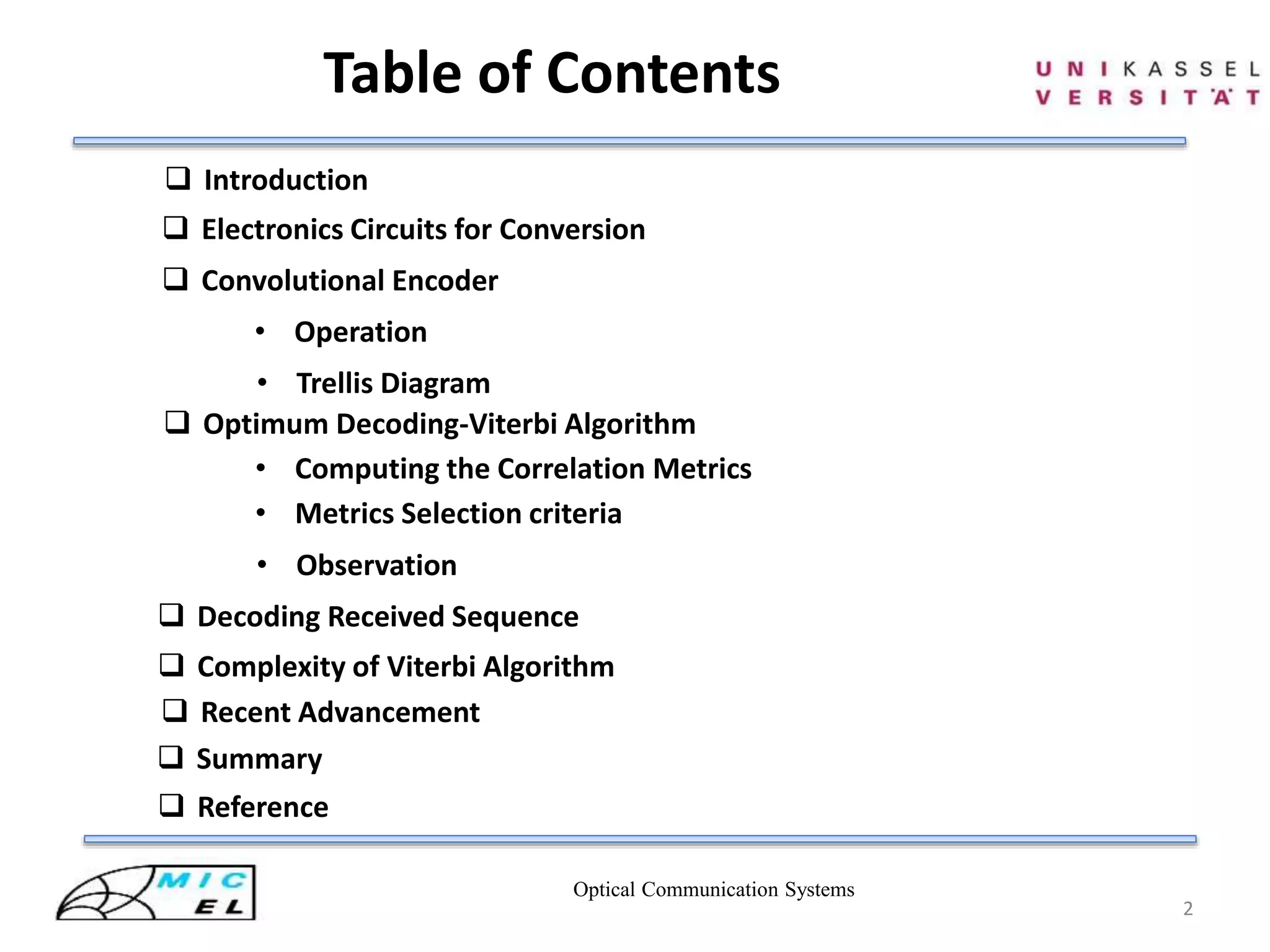
Table of Contents
 Introduction
 Electronics Circuits for Conversion
 Convolutional Encoder
• Operation
• Trellis Diagram
 Optimum Decoding-Viterbi Algorithm
• Computing the Correlation Metrics
• Metrics Selection criteria
• Observation
 Decoding Received Sequence
 Complexity of Viterbi Algorithm
 Recent Advancement
 Reference
 Summary
Optical Communication Systems
3
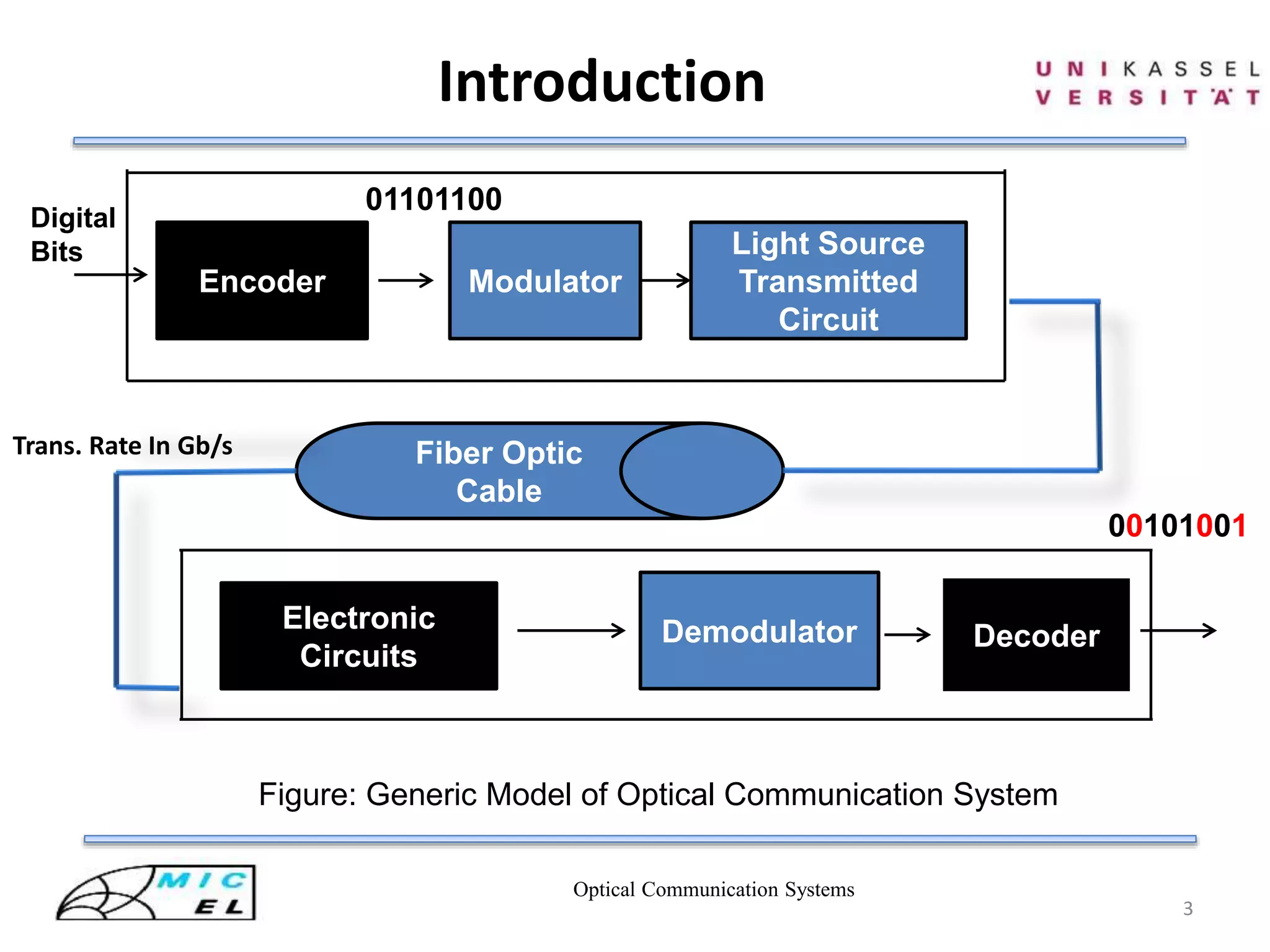
Modulator
Light Source
Transmitted
Circuit
Demodulator Decoder
Fiber Optic
Cable
Encoder
Digital
Bits
01101100
00101001
Figure: Generic Model of Optical Communication System
Introduction
Electronic
Circuits
Trans. Rate In Gb/s
Optical Communication Systems
4
Figure : Block diagram of MLSE based receiver of OC-192 fiber links
Electronic Circuits for Conversion
9.9Gbps
Viterbi Decoding
Ref [3]
Optical Communication Systems
5
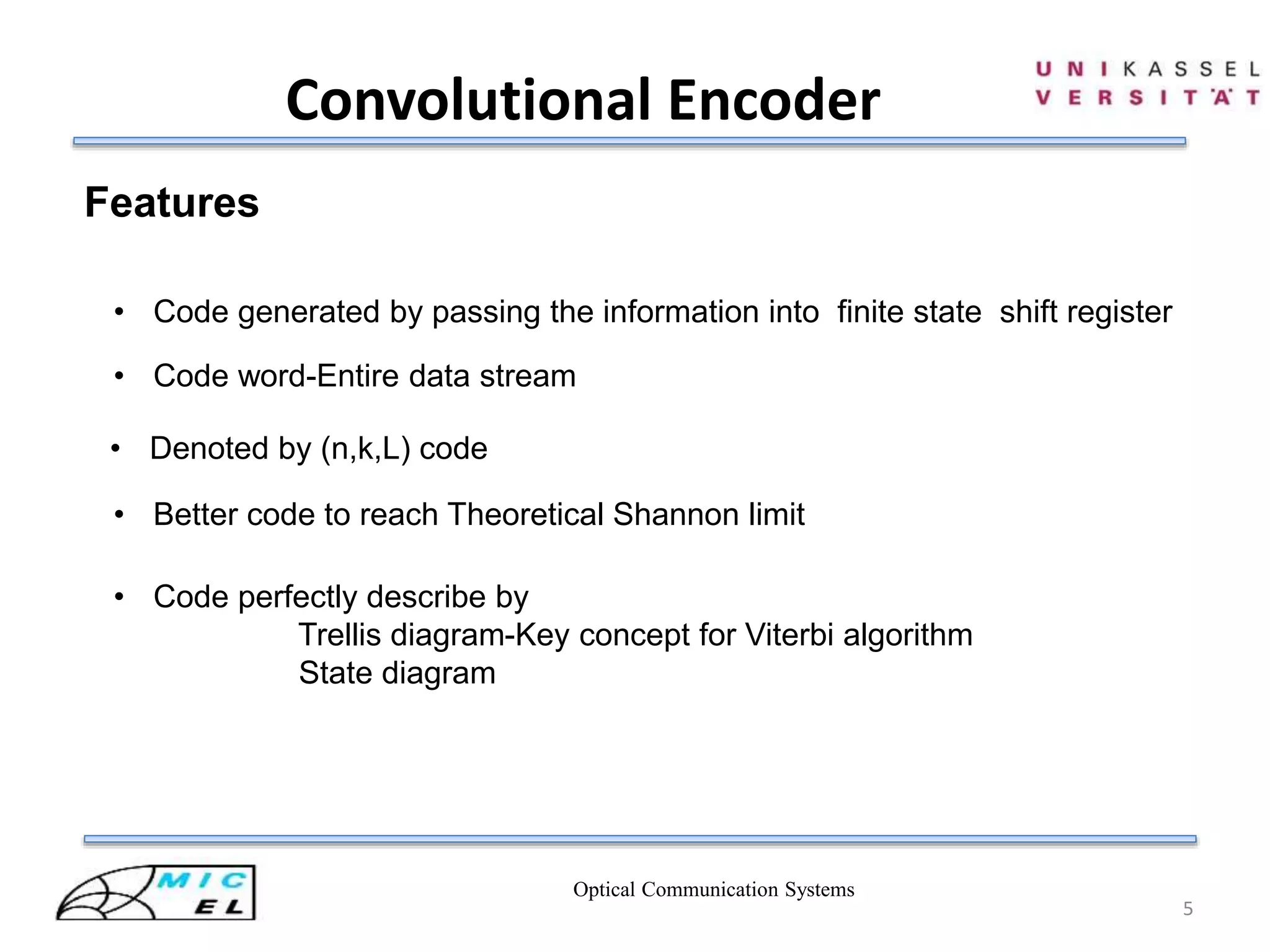
Convolutional Encoder
Features
• Code generated by passing the information into finite state shift register
• Code word-Entire data stream
• Denoted by (n,k,L) code
• Code perfectly describe by
Trellis diagram-Key concept for Viterbi algorithm
State diagram
• Better code to reach Theoretical Shannon limit
Optical Communication Systems
6
Convolutional Encoder
mj-2mj-1mj X1 X2
Shift Register
Encoded Bits
Figure: (2,1,2)bit Convolutional Encoder
Operation
I/P P/S N/
S
X1=mj
+mj-2
X2=mj+mj-1
+mj-2
O/P
0 0 0 00 0+0=0 0+0+0=0 00
1 0 0 10 1+0=1 1+0+0=1 11
0 0 1 00 0+1=1 0+0+1=1 11
1 0 1 10 1+1=0 1+0+1=0 00
0 1 0 01 0+0=0 0+1+0=1 01
1 1 0 11 1+0=1 1+1+0=0 10
0 1 1 01 0+1=1 0+1+1=0 10
1 1 1 11 1+1=0 1+1+1=1 01
P/S:Present State
N/S:New State
I/P:Input
O/P:Output
1 00 0 1
0 1
[2]
Optical Communication Systems
7
Trellis Diagram
I/P P/S N/S O/P
0 0 0 00 00
1 0 0 10 11
0 0 1 00 11
1 0 1 10 00
0 1 0 01 01
1 1 0 11 10
0 1 1 01 10
1 1 1 11 01
00
01
10
11
00
01
10
11
I/P: 0
1
00
11
11
00
01
10
10
01
Figure: Trellis diagram for (2,1,2) convolutional code
[2]
Optimum Decoding- Viterbi Algorithm
Optical Communication Systems
8
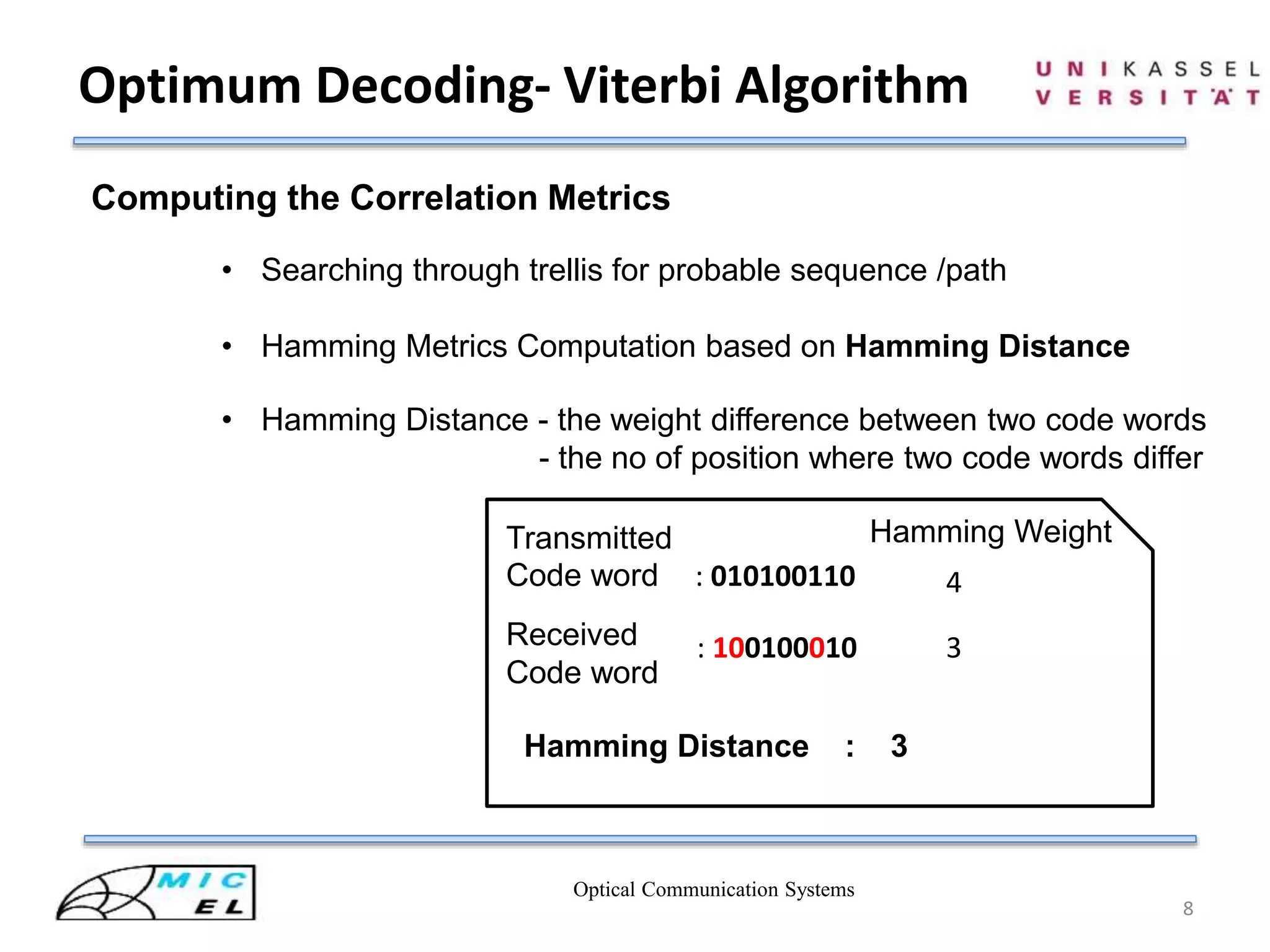
Computing the Correlation Metrics
• Searching through trellis for probable sequence /path
• Hamming Metrics Computation based on Hamming Distance
• Hamming Distance - the weight difference between two code words
- the no of position where two code words differ
Transmitted
Code word : 010100110
Hamming Weight
4
Received
Code word
: 100100010 3
Hamming Distance : 3
Optical Communication Systems
9
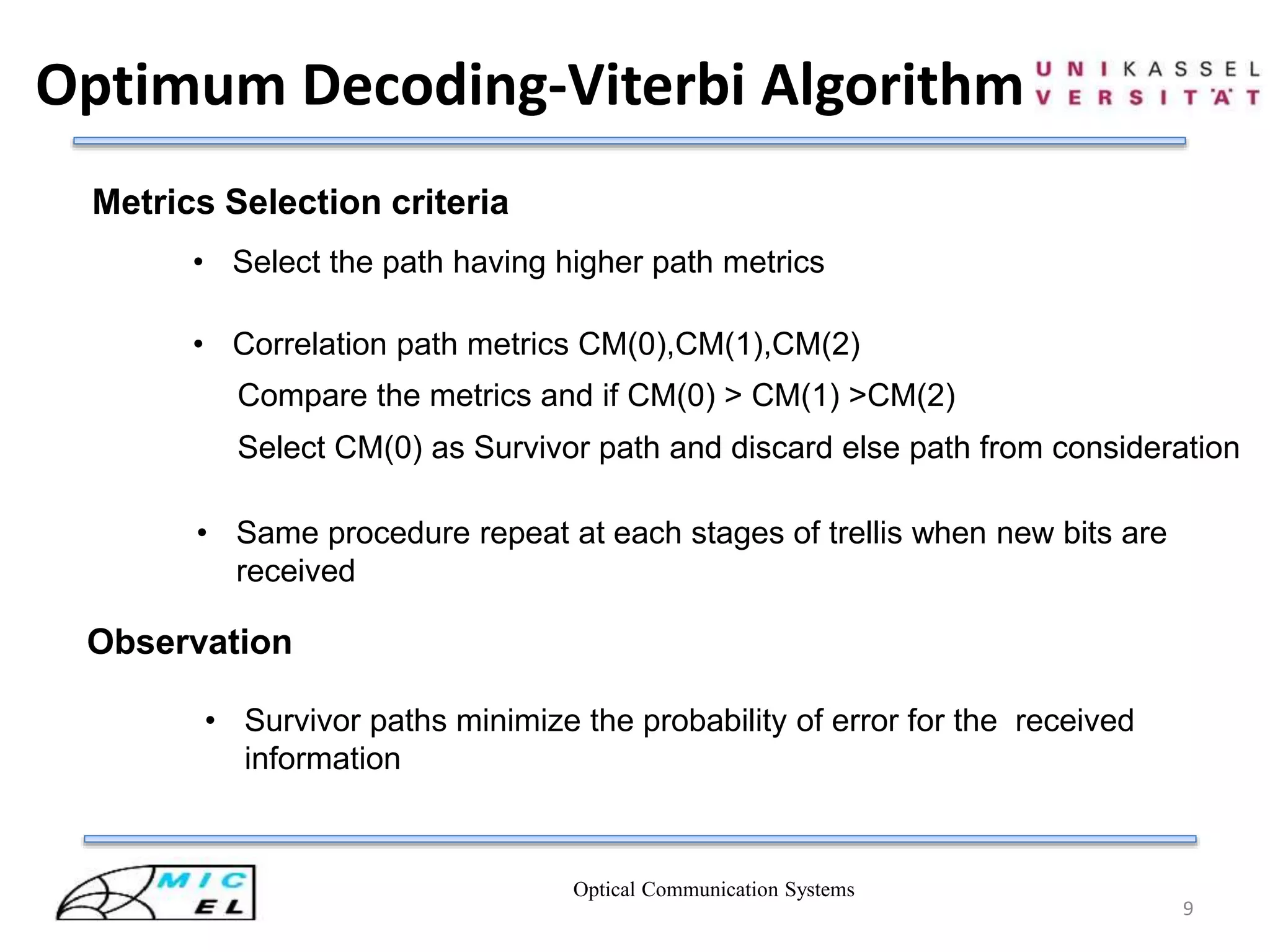
Metrics Selection criteria
• Select the path having higher path metrics
• Correlation path metrics CM(0),CM(1),CM(2)
Compare the metrics and if CM(0) > CM(1) >CM(2)
Select CM(0) as Survivor path and discard else path from consideration
• Same procedure repeat at each stages of trellis when new bits are
received
Observation
• Survivor paths minimize the probability of error for the received
information
Optimum Decoding-Viterbi Algorithm
Optical Communication Systems
10
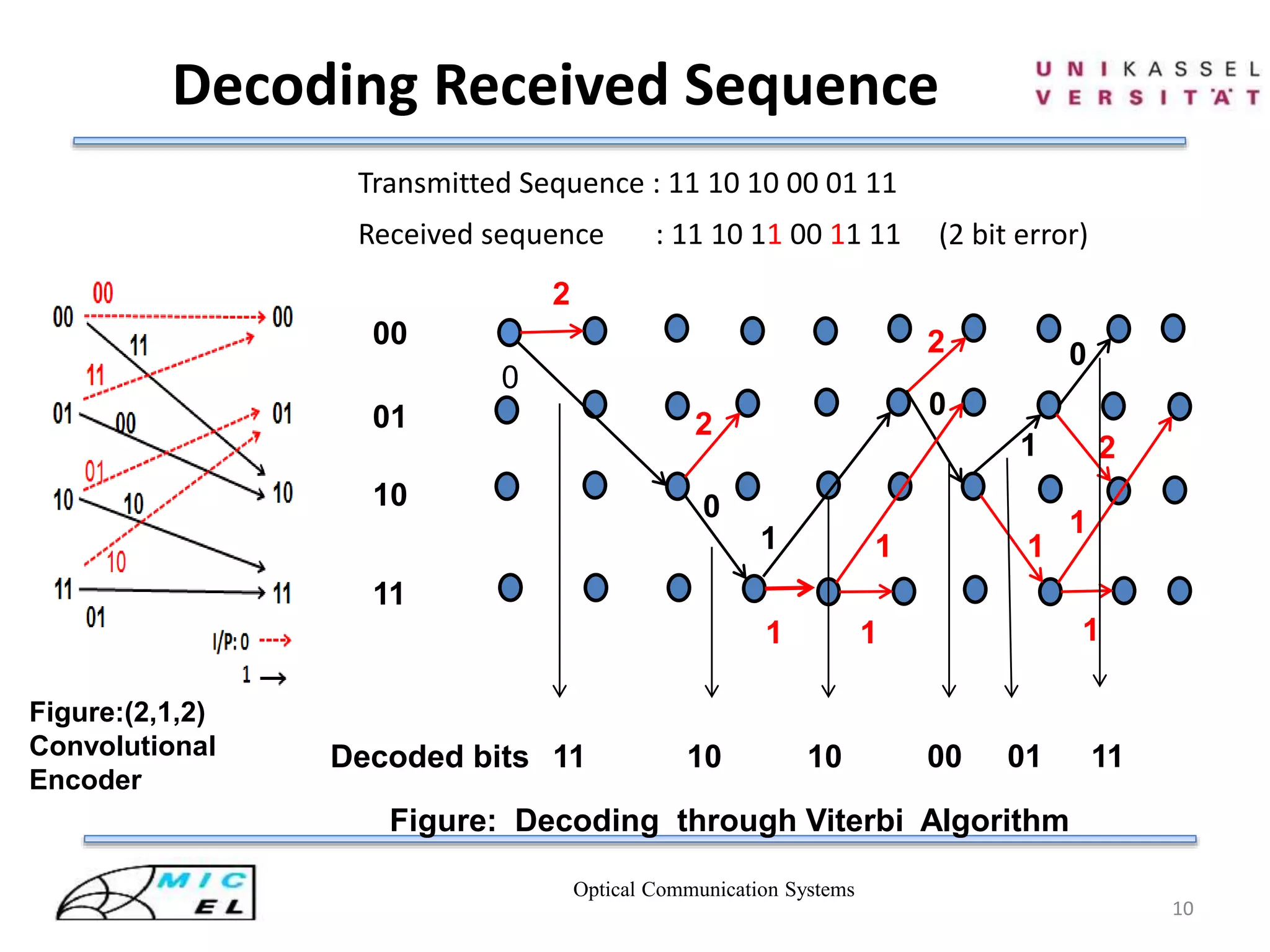
Decoding Received Sequence
Transmitted Sequence : 11 10 10 00 01 11
Received sequence : 11 10 11 00 11 11 (2 bit error)
00
01
10
11
2
0
2
0
1
1
2
0
1
1
0
2
1
11
1
11 10 10 00 01 11Decoded bits
Figure:(2,1,2)
Convolutional
Encoder
Figure: Decoding through Viterbi Algorithm
Optical Communication Systems
11
Complexity of Viterbi Algorithm
Computational Complexity
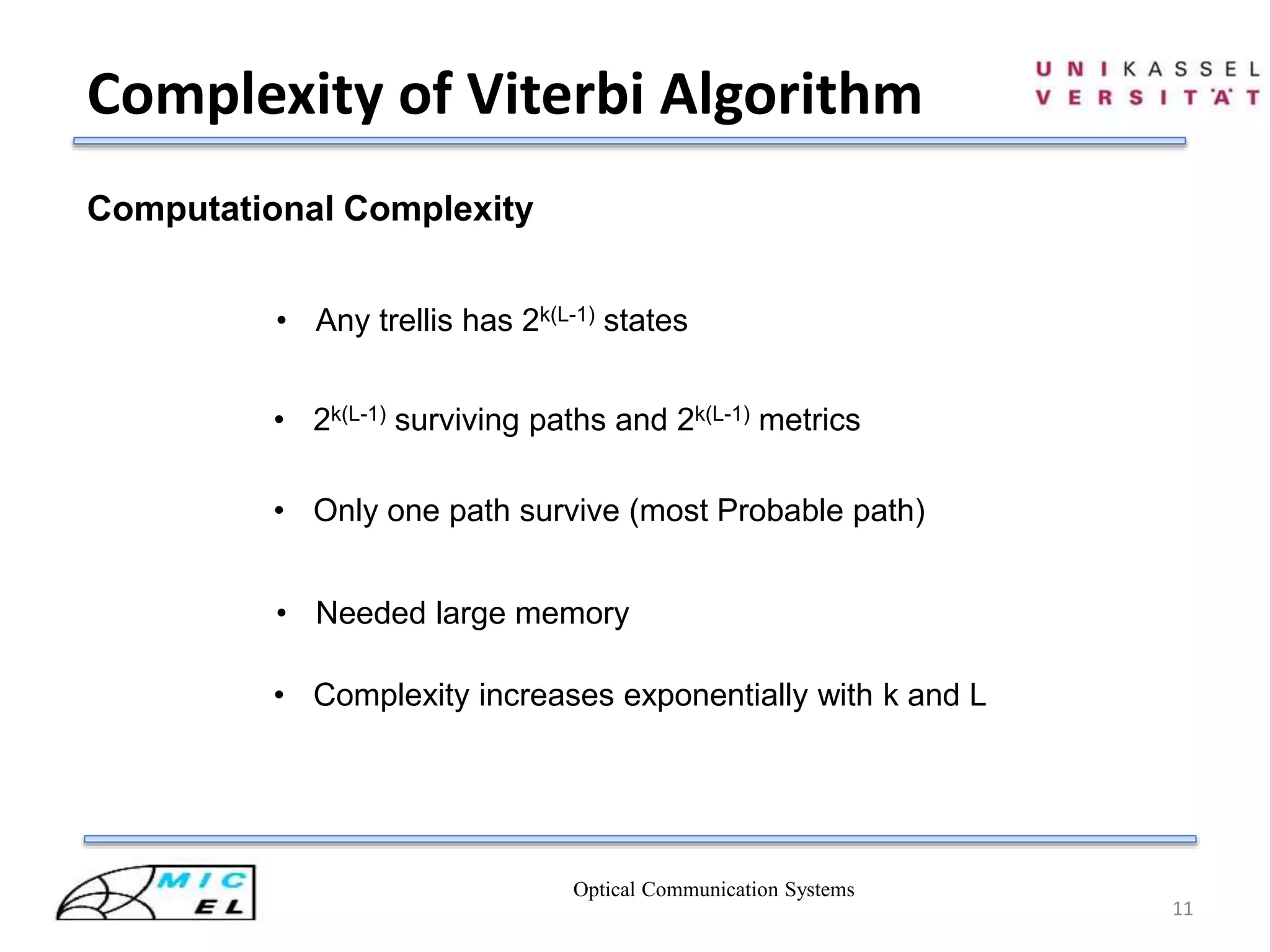
• Any trellis has 2k(L-1) states
• 2k(L-1) surviving paths and 2k(L-1) metrics
• Only one path survive (most Probable path)
• Needed large memory
• Complexity increases exponentially with k and L
Recent Advancement
Optical Communication Systems
12
Lazy Viterbi Algorithm
• Applicable for both block and convolutional code
• Much faster compare to original one
• Running time does not depend on the constraint length
• Algorithms work by not expanding any nodes until
it really needs to
Practically found:
Code with constraint length 6,the Lazy algorithm is about 50% faster
than normal Viterbi Algorithm when SNR > 6 dB
Ref [4]
Optical Communication Systems
13
Summary
• Most Optimum although having some drawbacks
• Very efficient to decode a large no of data
• Algorithm very easy to understand and implementing
in software is also easy
• Algorithm universally used in CDMA,GSM technology, satellite,
Wireless LAN
Optical Communication Systems
14
Reference
2. Enrico Forestieri Optical Communication Theory and Techniques .3rd
edition. 2005
4. Jhon,ibrahim. A Fast Maximum-Likelihood Decoder forConvolutional Codes.
Available at:http://people.csail.mit.edu/jonfeld/pubs/lazyviterbi.pdf
3. Hyeon,jonathan,jinki.An MSLE Receiver for Electronic Dispersion Compensation of
OC-192 Fiber Links,IEEE Journal of Solid State Circuits.Vol.41,No.11,November2006
1. Arunlal,Hariprasad.An efficient viterbi decoder. International Journal
Advanced Information Technology (IJAIT) Vol. 2, No.1, February 2012

Viterbi decoder in optical comm system

  • 1.
    Optical Communication Systems 1 Viterbi-Decoderin Optical Communication Systems Prepared By : Anisuzzaman Boni Mat No : 33109062 Date : 27th May 2014
  • 2.
    Optical Communication Systems 2 Tableof Contents  Introduction  Electronics Circuits for Conversion  Convolutional Encoder • Operation • Trellis Diagram  Optimum Decoding-Viterbi Algorithm • Computing the Correlation Metrics • Metrics Selection criteria • Observation  Decoding Received Sequence  Complexity of Viterbi Algorithm  Recent Advancement  Reference  Summary
  • 3.
    Optical Communication Systems 3 Modulator LightSource Transmitted Circuit Demodulator Decoder Fiber Optic Cable Encoder Digital Bits 01101100 00101001 Figure: Generic Model of Optical Communication System Introduction Electronic Circuits Trans. Rate In Gb/s
  • 4.
    Optical Communication Systems 4 Figure: Block diagram of MLSE based receiver of OC-192 fiber links Electronic Circuits for Conversion 9.9Gbps Viterbi Decoding Ref [3]
  • 5.
    Optical Communication Systems 5 ConvolutionalEncoder Features • Code generated by passing the information into finite state shift register • Code word-Entire data stream • Denoted by (n,k,L) code • Code perfectly describe by Trellis diagram-Key concept for Viterbi algorithm State diagram • Better code to reach Theoretical Shannon limit
  • 6.
    Optical Communication Systems 6 ConvolutionalEncoder mj-2mj-1mj X1 X2 Shift Register Encoded Bits Figure: (2,1,2)bit Convolutional Encoder Operation I/P P/S N/ S X1=mj +mj-2 X2=mj+mj-1 +mj-2 O/P 0 0 0 00 0+0=0 0+0+0=0 00 1 0 0 10 1+0=1 1+0+0=1 11 0 0 1 00 0+1=1 0+0+1=1 11 1 0 1 10 1+1=0 1+0+1=0 00 0 1 0 01 0+0=0 0+1+0=1 01 1 1 0 11 1+0=1 1+1+0=0 10 0 1 1 01 0+1=1 0+1+1=0 10 1 1 1 11 1+1=0 1+1+1=1 01 P/S:Present State N/S:New State I/P:Input O/P:Output 1 00 0 1 0 1 [2]
  • 7.
    Optical Communication Systems 7 TrellisDiagram I/P P/S N/S O/P 0 0 0 00 00 1 0 0 10 11 0 0 1 00 11 1 0 1 10 00 0 1 0 01 01 1 1 0 11 10 0 1 1 01 10 1 1 1 11 01 00 01 10 11 00 01 10 11 I/P: 0 1 00 11 11 00 01 10 10 01 Figure: Trellis diagram for (2,1,2) convolutional code [2]
  • 8.
    Optimum Decoding- ViterbiAlgorithm Optical Communication Systems 8 Computing the Correlation Metrics • Searching through trellis for probable sequence /path • Hamming Metrics Computation based on Hamming Distance • Hamming Distance - the weight difference between two code words - the no of position where two code words differ Transmitted Code word : 010100110 Hamming Weight 4 Received Code word : 100100010 3 Hamming Distance : 3
  • 9.
    Optical Communication Systems 9 MetricsSelection criteria • Select the path having higher path metrics • Correlation path metrics CM(0),CM(1),CM(2) Compare the metrics and if CM(0) > CM(1) >CM(2) Select CM(0) as Survivor path and discard else path from consideration • Same procedure repeat at each stages of trellis when new bits are received Observation • Survivor paths minimize the probability of error for the received information Optimum Decoding-Viterbi Algorithm
  • 10.
    Optical Communication Systems 10 DecodingReceived Sequence Transmitted Sequence : 11 10 10 00 01 11 Received sequence : 11 10 11 00 11 11 (2 bit error) 00 01 10 11 2 0 2 0 1 1 2 0 1 1 0 2 1 11 1 11 10 10 00 01 11Decoded bits Figure:(2,1,2) Convolutional Encoder Figure: Decoding through Viterbi Algorithm
  • 11.
    Optical Communication Systems 11 Complexityof Viterbi Algorithm Computational Complexity • Any trellis has 2k(L-1) states • 2k(L-1) surviving paths and 2k(L-1) metrics • Only one path survive (most Probable path) • Needed large memory • Complexity increases exponentially with k and L
  • 12.
    Recent Advancement Optical CommunicationSystems 12 Lazy Viterbi Algorithm • Applicable for both block and convolutional code • Much faster compare to original one • Running time does not depend on the constraint length • Algorithms work by not expanding any nodes until it really needs to Practically found: Code with constraint length 6,the Lazy algorithm is about 50% faster than normal Viterbi Algorithm when SNR > 6 dB Ref [4]
  • 13.
    Optical Communication Systems 13 Summary •Most Optimum although having some drawbacks • Very efficient to decode a large no of data • Algorithm very easy to understand and implementing in software is also easy • Algorithm universally used in CDMA,GSM technology, satellite, Wireless LAN
  • 14.
    Optical Communication Systems 14 Reference 2.Enrico Forestieri Optical Communication Theory and Techniques .3rd edition. 2005 4. Jhon,ibrahim. A Fast Maximum-Likelihood Decoder forConvolutional Codes. Available at:http://people.csail.mit.edu/jonfeld/pubs/lazyviterbi.pdf 3. Hyeon,jonathan,jinki.An MSLE Receiver for Electronic Dispersion Compensation of OC-192 Fiber Links,IEEE Journal of Solid State Circuits.Vol.41,No.11,November2006 1. Arunlal,Hariprasad.An efficient viterbi decoder. International Journal Advanced Information Technology (IJAIT) Vol. 2, No.1, February 2012