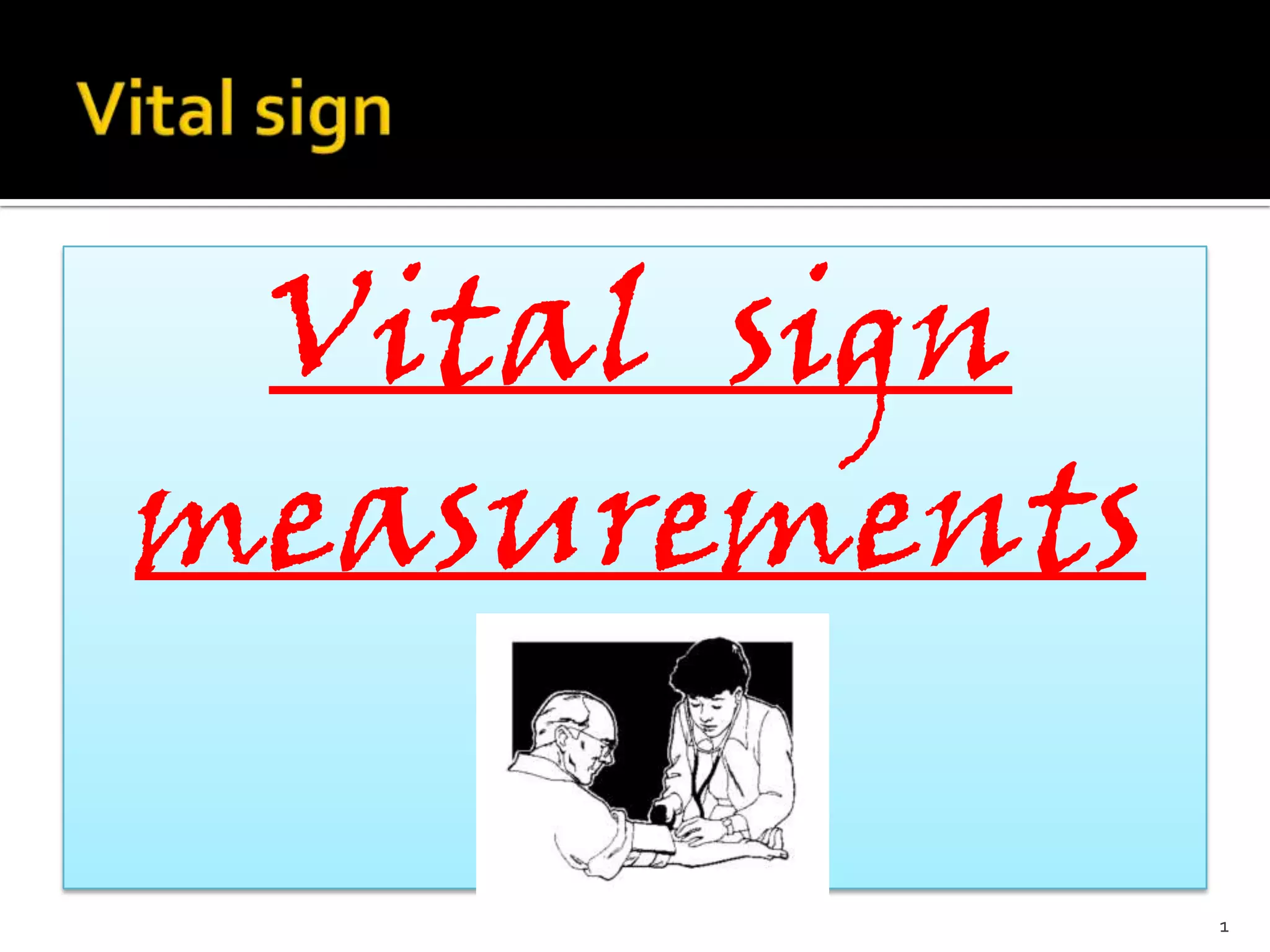
Vital sign
measurements
1
 Describe the procedures used to assess the vital
signs: temperature, pulse, respiration, and blood
pressure.
 Identify factors that can influence each vital
sign.
 Identify equipment routinely used to assess vital
signs.
 Identify rationales for using different routes for
assessing temperature.
 Take vital signs and interpret the finding.
 Document the vital signs.
2
 Vital signs reflect the body’s physiologic
status and provide information critical to
evaluating homeostatic balance.
 Includes:
 temperature,
 Pulse Rate,
 Respiratory Rate), and
 Blood Pressure)
3
 To obtain base line data about the patient
condition
 for diagnostic purpose
 For therapeutic purpose
4
 Vital sign tray
 Stethoscope
 Sphygmomanometer
 Thermometer
 Second hand watch
 Red and blue pen
 Pencil;
 Vital sign sheet
 Cotton swab in bowel
 Disposable gloves if available
 Dirty receiver kidney dish
5
 On admission – to obtain baseline date
 When a client has a change in health status or reports
symptoms such as chest pain or fainting
 According to a nursing or medical order
 Before and after the administration of certain
medications that could affect RR or BP (Respiratory
and CVS
 Before and after surgery or an invasive diagnostic
procedures
 Before and after any nursing intervention that could
affect the vital signs. E.g. Ambulation
 According to hospital /other health institution policy.
6
it is the hotness or coldness of the body.
It is the balance b/n heat production &
heat loss of the body.
Normal body temperature using
oral 370 Celsius or 98.6 0 F.
7
1. Core Temperature
 Is the temperature of internal organs and it
remains constant most of the time (37oc);
with range of 36.5-37.5oc.
 Is the Temperature of the deep tissues
of the body
 Remains relatively constant
 measure with thermometer
8
2. Surface Temperature:
o Surface body temperature: - is the temperature of
the skin, subcutaneous tissue & fat cells and it
rises & falls in response to the environment
o (Ranges b/n 20-40oc).
o It doesn’t indicate internal physiology.
9
 Normal body temperature is 370 C or 98.6 0F
 range is 36-38 0c (96.8 – 100 0F)
 Body temperature may be abnormal due to fever
(high temperature) or hypothermia (low
temperature).
 Pyrexia, fever: a body temperature above
the normal ranges 38 0c – 410 c (100.4 –
105.8 F)
 Hyper pyrexia: a very high fever, such as
410 C > 42 0c leads to death.
 Hypothermia: – body temperature between
34 0c – 35 0c, < 34 0c is death
10
1. Intermittent fever: the body temperature alternates at regular
intervals between periods of fever and periods of normal or
subnormal temperature.
2. Remittent fever: a wide range of temperature fluctuation (more
than 2 0c) occurs over the 24 hr period, all of which are above
normal
3. Relapsing fever: short febrile periods of a few days are
interspersed with periods of 1 or 2 days of normal temperature.
4. Constant fever: the body temperature fluctuates minimally but
always remains above normal
11
1.Age
2.Diurnal variations (circadian rhythm
3.Exercise
4.Hormones
5.Stress
6.Environment
12
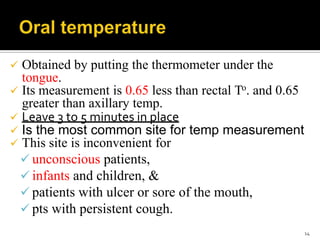
 Oral
 Rectal
 Auxiliary
 Tympanic
 Thermometer: is an instrument used to
measure body temperature
13
 Obtained by putting the thermometer under the
tongue.
 Its measurement is 0.65 less than rectal To. and 0.65
greater than axillary temp.
 Leave 3 to 5 minutes in place
 Is the most common site for temp measurement
 This site is inconvenient for
 unconscious patients,
 infants and children, &
 patients with ulcer or sore of the mouth,
 pts with persistent cough.
14
 Advantage – easy access & pt comfort
 Disadvantage It can lead to a false reading if
a person has taken hot or cold food/ drink by
mouth, & has smoked so we have to wait for
at least 10-15min, after meal or smoking.
15
 Pts who cannot follow instruction to keep their
mouth closed
 Child below 7 yrs
 Epileptic, or mentally ill patients
 Unconscious
 Clients receiving O2
 Clients with persistent cough
 Uncooperative or in severe pain
 Surgery of the mouth
 Nasal obstruction
 If patient has nasal or gastric tubs in place
16
 Obtained by inserting the thermometer into the
rectum or anus.
 It gives reliable measurement & reflects the core
body temperature.
 Hold the thermometer in place for 3 to 5 minutes
 More accurate, most reliable, is > 0.650 c (1 0F)
higher than the oral temperature. because few
factors can influence the reading
 disadvantages are:
injure the rectum, it needs privacy,
it is inappropriate for patients with diarrhea & anal fissure.
17
Rectal or perennial surgery;
Fecal impaction
Rectal infection
Rectal infection;
newborn infants
18
 it is safe and non-invasive
 Is recommended for infants and children
 disadvantage
long time (5-10min.)
less accurate as it is not close to major vessels.
 Is considered the least accurate & least reliable
of all the sites because the temp obtained using
this route can be influenced by a number of
factors e.g. bathing & friction during cleaning
 Is the route of choice in pt’s that cannot have
their temp measured by other routes.
19
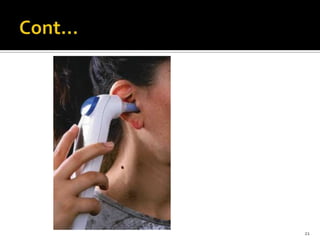
 Placed in to the client’s outer ear canal.
 It reflects the core body temperature
 Is readily accessible and permits rapid temp
readings in pediatric , or unconscious pts
 It is very fast method 1 to2 seconds.
 Disadvantages: –
it may be uncomfortable involves risk of injuring the
membrane
Presence of cerumen (wax) can affect the reading.
Right & left measurements may differ.
20
21
22
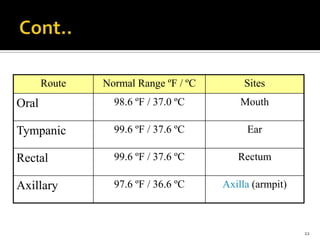
Route Normal Range ºF / ºC Sites
Oral 98.6 ºF / 37.0 ºC Mouth
Tympanic 99.6 ºF / 37.6 ºC Ear
Rectal 99.6 ºF / 37.6 ºC Rectum
Axillary 97.6 ºF / 36.6 ºC Axilla (armpit)
 Pulse is a wave of blood created by the
contraction of left ventricle.
 pulse reflects the heart beat
 Stroke volume and the compliance of arterial
wall are the two important factors influencing
pulse rate.
 Pulse rate is regulated by autonomic nervous
system.
23
 Peripheral Pulse: is a pulse located in the
periphery of the body e.g. in the foot, and or
neck
 Apical Pulse (central pulse): it is located at
the apex of the heart
 The PR is expressed in beats/ minute (BPM)
 The difference between peripheral and apical
pulse is called pulse deficit, and it is usually
zero.
24
 Pulse is assessed for
 rate (60-100bpm),
 rhythm (regularity or irregularity),
 Volume,
 elasticity of arterial wall.
 The pulse is commonly assessed by palpation
(feeling) and auscultation (hearing using a
stethoscope).
25
 Age
 The average pulse rate of an infant ranges from
100 to 160 BPM
 The normal range of the pulse in an adult is 60 to
100 BPM
 Sex: Sex: after puberty the average males
PR is slightly lower than female
26
 Autonomic Nervous system activity
 Stimulation of the parasympathetic nervous
system results in decrease in the PR
 Stimulation of sympathetic nervous system
results in an increased pulse rate
 Sympathetic nervous system activation occurs on
response to a variety of stimuli including
▪ Pain ,anxiety ,Exercise ,Fever
▪ Ingestion of caffeinated beverages
▪ Change in intravascular volume
27
 Exercise: PR increase with exercise
 Fever: increases PR in response to the
lowered B/P that results from peripheral
vasodilatation – increased metabolic rate
 Heat: increase PR as a compensatory
mechanism
 Stress: increases the sympathetic nerve
stimulation
28
* Position changes:
 a sitting or standing position blood usually
pools in dependent vessels of the venous
system. B/c of decrease in the venous
blood return to heart and subsequent
decrease in BP increases heart rate.
29
* Medication
o Cardiac medication such as digoxin decrease heart rate
o Medications that decrease intravascular volume such as
divretics may increase pulse rate
o Atropine in hibits impusses to the heart from the
parasympathetic nervous system, causing increased pusse
rate
o Propranolol blocks sympathetic nervous system action
resulting in decreased heart trate sites used for measuring
pulse rate
30
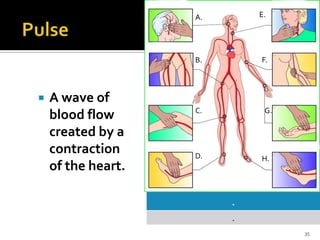
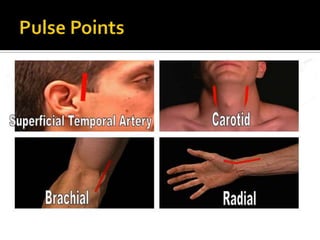
 Carotid: at the side of the neck below tube of
the ear (where the carotid artery runs between
the trachea and the sternocleidomastoid
muscle)
 Temporal: the pulse is taken at temporal bone
area.
 Apical: at the apex of the heart: routinely used
for infant and children < 3 yrs
 In adults – Left mid-clavicular line under the
4th, 5th, 6th intercostal space
31
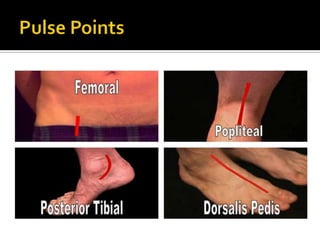
 Brachial: at the inner aspect of the biceps muscle of
the arm or medially in the antecubital space (elbow
crease)
 Radial: on the thumb side of the inner aspect of the
wrist – readily available and routinely used
 Femoral: along the inguinal ligament. Used or
infants and children
 Popiliteal: behind the knee. By flexing the knee
slightly
 Posterior tibial: on the medial surface of the ankle
 Pedal (Dorsal Pedis): palpated by feeling the dorsum
(upper surface) of foot
32
35
 A wave of
blood flow
created by a
contraction
of the heart.
.
.
A.
B.
D.
E.
F.
C. G.
H.
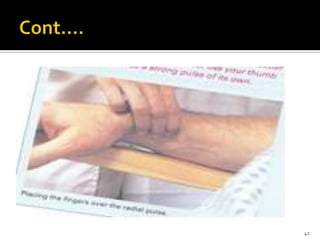
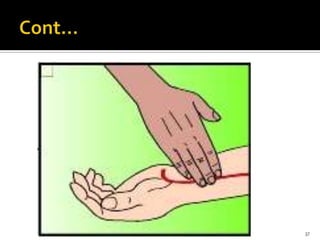
 Pulse: is commonly assessed by palpation
(feeling) or auscultation (hearing)
 The middle 3 fingertips are used with moderate
pressure for palpation of all pulses except apical;
 Assess the pulse for
Rate
Rhythm
Volume
Elasticity of the arterial wall
36
37
Pulse Rate
Normal 60-100 b/min (80/min)
Adult PR > 100 BPM is called tachycardia
Adult PR < 60 BPM is called bradycardia
38
Pulse Rhythm
 The pattern and interval between the beats,
random, irregular beats – dysrythymia
PulseVolume
 the force of blood with each beat
 A normal pulse can be felt with moderate
pressure of the fingers
 Full or bounding pulse forceful or full blood
volume destroy with difficulty
 Weak, feeble readily destroy with pressure from
the finger tips
39
Elasticity of arterial wall
 A healthy, normal artery feels, straight,
smooth, soft, easily bent
 Reflects the status of the clients vascular
system
40
 If the pulse is regular, measure (count) for 30
seconds and multiply by 2
 If it is irregular count for 1 full minute.
 Each heart beat consists of two sounds
 s1 - is caused by closure of the mitral and tricuspid
valves separating the atria from the ventricles
 S2 – is caused by the closure of the plutonic and
aortic values
 The sounds are often described as a muffled “lub –
bub”
41
42
 Respiration rate (RR):-Respiration is the act
of breathing and includes the intake of
oxygen and removal of carbon-dioxide.
 Ventilation is also another word, which refers
to movement of air in and out of the lung.
 Hyperventilation: - is a very deep, rapid
respiration.
 Hypoventilation: - is a very shallow
respiration.
43
1. Costal (thoracic)
 Observed by the movement of the chest up
ward and down ward.
 Commonly used for adults
2. Diaphragmatic (abdominal)
 Involves the contraction and relaxation of the
diaphragm, observed by the movement of
abdomen.
 Commonly used for children.
44
 Age Normal growth from infancy to adult hood
results in a larger lung capacity. As lung capacity
increases, lower respiratory rates are sufficient
to exchange
 Medications Narcotics decrease respiratory rate
& depth
 Stress or strong emotions increases the rate &
depth of respirations.
 Exercise increases the rate & depth of
respirations
45
 AltitudeThe rate & depth of respirations at
higher elevations (altitude) increase to
improve the supply of oxygen available to the
body tissues
 Gender Men may have a lower respirations
rate than women because men normally have
a larger rung capacity than women
 Fever increases respiratory rate
46
o The client should be at rest
o Assessed by watching the movement of the
chest or abdomen.
oRate,
o rhythm,
odepth and
ospecial characteristics of respiration
are assessed
47
Rate:
 Is described in rate per minute (RPM)
 Healthy adult RR = 15- 20/ min. is measured for
full minute, if regular for 30 seconds.
 As the age decreases the respiratory rate
increases.
 Eupnea- normal breathing rate and depth
 Bradypnea- slow respiration
 Tachypnea - fast breathing
 Apnea - temporary cessation of breathing
48
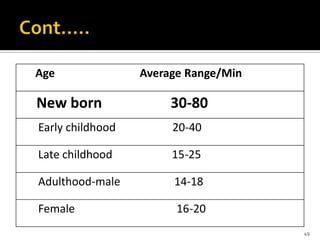
Age Average Range/Min
New born 30-80
Early childhood 20-40
Late childhood 15-25
Adulthood-male 14-18
Female 16-20
49
Rhythm:
 is the regularity of expiration and inspiration
 Normal breathing is automatic & effortless.
Depth:
 described as normal, deep or shallow.
 Deep: a large volume of air inhaled &
exhaled, inflates most of the lungs.
 Shallow: exchange of a small volume of air
minimal use of lung tissue.
50
 It is the force exerted by the blood against
the walls of the arteries in which it is flowing.
 It is expressed in terms of millimeters of
mercury (mm of Hg).
51
 Systolic pressure is the maximum of the
pressure against the wall of the vessel
following ventricular contraction.
 Diastolic pressure is the minimum pressure
of the blood against the walls of the vessels
following closure of aortic valve (ventricular
relaxation).
52
 BP is measured by using an instrument called Bp
cuff (sphygmomanometer) & stethoscope and
 the average normal value is 120/80mmHg for
adults.
 brachial artery and popliteal artery are most
commonly used.
 It is measured by securing the Bp cuff to the
upper arm & thigh placing the stethoscope on
brachial artery in the antecubital space &
popliteal artery at the back of the knee.
 Pulse pressure: is the difference between the
systolic and diastolic pressure
53
 Fever
 Stress
 Arteriosclerosis
 Exposure to cold
 Obesity
 Hemorrhage
 Low hematocrit
 External heat
54
 Upper arm (using brachial artery
(commonest)
 Thigh around popliteal artery
 Fore -arm using radial artery
 Leg using posterior tibial or dorsal pedis
55
 A persistently high Bp, measured for greater than
three times is called hypertension & that
persistently less than normal range is called
hypotension.
 Because of many factors influencing Bp a single
measurement is not necessarily significant to
confirm hypertension.
 When the cause of hypertension is known it is
called secondary hypertension and when the
cause is unknown is called primary/essential
hypertension.
56
Purpose
 To obtain base line measure of arterial blood
pressure for subsequent evaluation
 To determine the clients homodynamic
status
 To identify and monitor changes in blood
pressure.
57
58
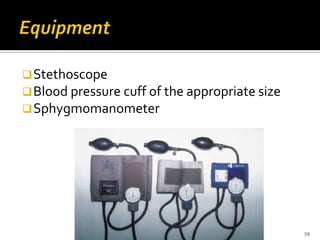
Stethoscope
Blood pressure cuff of the appropriate size
Sphygmomanometer
59
60
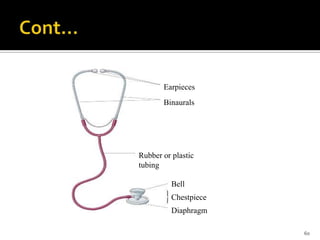
Earpieces
Binaurals
Rubber or plastic
tubing
Bell
Chestpiece
Diaphragm
 Explain the procedure to the patient & remove
any light cloth from patient’s arm
 Make sure that the client has not smoked or
ingested caffeine, within 30 minutes prior to
measurement.
 Position the patient on lying, sitting or standing
position, but always ensure that the
sphygmomanometer is at the level of the heart
with the arm supported & the palm facing
upwards.
61
 apply cuff snugly/securely around the arm ,
2.5cm above the antecubital space/fossa, at the
level of the heart (for every cm the cuff sites
above or below the level of the heart the BP
varies by 0.8mmHg)
 Palpate the radial pulse and inflate the cuff until
the radial pulse can no longer be felt, this
provides an estimation of systolic pressure.
 Inflate cuff 30mmHg higher than estimated
systolic pressure.
62
 palpate the brachial artery & place the bell of the
stethoscope over the site & the ear pieces on
ear, apply enough pressure to keep the
stethoscope in place (the bell of the stethoscope
is designed to amplify/intensify low frequency
sounds)
 Deflate the cuff 2-4mmHg per second.
 The first pulse heard is the systolic reading,
continue to deflate until there is a change in
tone to a muffled beat, this is the diastolic
reading.
63
 Deflate & remove cuff roll neatly and replace.
 Record the systolic and diastolic pressure on
vital sing sheet and compare the present
reading with previous reading.
 report or treat any change
 Clear ear pieces and bell of the stethoscope
with antiseptic swab and return all
equipments.
64
Thank you
65

Vital sign

  • 1.
  • 2.
     Describe theprocedures used to assess the vital signs: temperature, pulse, respiration, and blood pressure.  Identify factors that can influence each vital sign.  Identify equipment routinely used to assess vital signs.  Identify rationales for using different routes for assessing temperature.  Take vital signs and interpret the finding.  Document the vital signs. 2
  • 3.
     Vital signsreflect the body’s physiologic status and provide information critical to evaluating homeostatic balance.  Includes:  temperature,  Pulse Rate,  Respiratory Rate), and  Blood Pressure) 3
  • 4.
     To obtainbase line data about the patient condition  for diagnostic purpose  For therapeutic purpose 4
  • 5.
     Vital signtray  Stethoscope  Sphygmomanometer  Thermometer  Second hand watch  Red and blue pen  Pencil;  Vital sign sheet  Cotton swab in bowel  Disposable gloves if available  Dirty receiver kidney dish 5
  • 6.
     On admission– to obtain baseline date  When a client has a change in health status or reports symptoms such as chest pain or fainting  According to a nursing or medical order  Before and after the administration of certain medications that could affect RR or BP (Respiratory and CVS  Before and after surgery or an invasive diagnostic procedures  Before and after any nursing intervention that could affect the vital signs. E.g. Ambulation  According to hospital /other health institution policy. 6
  • 7.
    it is thehotness or coldness of the body. It is the balance b/n heat production & heat loss of the body. Normal body temperature using oral 370 Celsius or 98.6 0 F. 7
  • 8.
    1. Core Temperature Is the temperature of internal organs and it remains constant most of the time (37oc); with range of 36.5-37.5oc.  Is the Temperature of the deep tissues of the body  Remains relatively constant  measure with thermometer 8
  • 9.
    2. Surface Temperature: oSurface body temperature: - is the temperature of the skin, subcutaneous tissue & fat cells and it rises & falls in response to the environment o (Ranges b/n 20-40oc). o It doesn’t indicate internal physiology. 9
  • 10.
     Normal bodytemperature is 370 C or 98.6 0F  range is 36-38 0c (96.8 – 100 0F)  Body temperature may be abnormal due to fever (high temperature) or hypothermia (low temperature).  Pyrexia, fever: a body temperature above the normal ranges 38 0c – 410 c (100.4 – 105.8 F)  Hyper pyrexia: a very high fever, such as 410 C > 42 0c leads to death.  Hypothermia: – body temperature between 34 0c – 35 0c, < 34 0c is death 10
  • 11.
    1. Intermittent fever:the body temperature alternates at regular intervals between periods of fever and periods of normal or subnormal temperature. 2. Remittent fever: a wide range of temperature fluctuation (more than 2 0c) occurs over the 24 hr period, all of which are above normal 3. Relapsing fever: short febrile periods of a few days are interspersed with periods of 1 or 2 days of normal temperature. 4. Constant fever: the body temperature fluctuates minimally but always remains above normal 11
  • 12.
    1.Age 2.Diurnal variations (circadianrhythm 3.Exercise 4.Hormones 5.Stress 6.Environment 12
  • 13.
     Oral  Rectal Auxiliary  Tympanic  Thermometer: is an instrument used to measure body temperature 13
  • 14.
     Obtained byputting the thermometer under the tongue.  Its measurement is 0.65 less than rectal To. and 0.65 greater than axillary temp.  Leave 3 to 5 minutes in place  Is the most common site for temp measurement  This site is inconvenient for  unconscious patients,  infants and children, &  patients with ulcer or sore of the mouth,  pts with persistent cough. 14
  • 15.
     Advantage –easy access & pt comfort  Disadvantage It can lead to a false reading if a person has taken hot or cold food/ drink by mouth, & has smoked so we have to wait for at least 10-15min, after meal or smoking. 15
  • 16.
     Pts whocannot follow instruction to keep their mouth closed  Child below 7 yrs  Epileptic, or mentally ill patients  Unconscious  Clients receiving O2  Clients with persistent cough  Uncooperative or in severe pain  Surgery of the mouth  Nasal obstruction  If patient has nasal or gastric tubs in place 16
  • 17.
     Obtained byinserting the thermometer into the rectum or anus.  It gives reliable measurement & reflects the core body temperature.  Hold the thermometer in place for 3 to 5 minutes  More accurate, most reliable, is > 0.650 c (1 0F) higher than the oral temperature. because few factors can influence the reading  disadvantages are: injure the rectum, it needs privacy, it is inappropriate for patients with diarrhea & anal fissure. 17
  • 18.
    Rectal or perennialsurgery; Fecal impaction Rectal infection Rectal infection; newborn infants 18
  • 19.
     it issafe and non-invasive  Is recommended for infants and children  disadvantage long time (5-10min.) less accurate as it is not close to major vessels.  Is considered the least accurate & least reliable of all the sites because the temp obtained using this route can be influenced by a number of factors e.g. bathing & friction during cleaning  Is the route of choice in pt’s that cannot have their temp measured by other routes. 19
  • 20.
     Placed into the client’s outer ear canal.  It reflects the core body temperature  Is readily accessible and permits rapid temp readings in pediatric , or unconscious pts  It is very fast method 1 to2 seconds.  Disadvantages: – it may be uncomfortable involves risk of injuring the membrane Presence of cerumen (wax) can affect the reading. Right & left measurements may differ. 20
  • 21.
  • 22.
    22 Route Normal RangeºF / ºC Sites Oral 98.6 ºF / 37.0 ºC Mouth Tympanic 99.6 ºF / 37.6 ºC Ear Rectal 99.6 ºF / 37.6 ºC Rectum Axillary 97.6 ºF / 36.6 ºC Axilla (armpit)
  • 23.
     Pulse isa wave of blood created by the contraction of left ventricle.  pulse reflects the heart beat  Stroke volume and the compliance of arterial wall are the two important factors influencing pulse rate.  Pulse rate is regulated by autonomic nervous system. 23
  • 24.
     Peripheral Pulse:is a pulse located in the periphery of the body e.g. in the foot, and or neck  Apical Pulse (central pulse): it is located at the apex of the heart  The PR is expressed in beats/ minute (BPM)  The difference between peripheral and apical pulse is called pulse deficit, and it is usually zero. 24
  • 25.
     Pulse isassessed for  rate (60-100bpm),  rhythm (regularity or irregularity),  Volume,  elasticity of arterial wall.  The pulse is commonly assessed by palpation (feeling) and auscultation (hearing using a stethoscope). 25
  • 26.
     Age  Theaverage pulse rate of an infant ranges from 100 to 160 BPM  The normal range of the pulse in an adult is 60 to 100 BPM  Sex: Sex: after puberty the average males PR is slightly lower than female 26
  • 27.
     Autonomic Nervoussystem activity  Stimulation of the parasympathetic nervous system results in decrease in the PR  Stimulation of sympathetic nervous system results in an increased pulse rate  Sympathetic nervous system activation occurs on response to a variety of stimuli including ▪ Pain ,anxiety ,Exercise ,Fever ▪ Ingestion of caffeinated beverages ▪ Change in intravascular volume 27
  • 28.
     Exercise: PRincrease with exercise  Fever: increases PR in response to the lowered B/P that results from peripheral vasodilatation – increased metabolic rate  Heat: increase PR as a compensatory mechanism  Stress: increases the sympathetic nerve stimulation 28
  • 29.
    * Position changes: a sitting or standing position blood usually pools in dependent vessels of the venous system. B/c of decrease in the venous blood return to heart and subsequent decrease in BP increases heart rate. 29
  • 30.
    * Medication o Cardiacmedication such as digoxin decrease heart rate o Medications that decrease intravascular volume such as divretics may increase pulse rate o Atropine in hibits impusses to the heart from the parasympathetic nervous system, causing increased pusse rate o Propranolol blocks sympathetic nervous system action resulting in decreased heart trate sites used for measuring pulse rate 30
  • 31.
     Carotid: atthe side of the neck below tube of the ear (where the carotid artery runs between the trachea and the sternocleidomastoid muscle)  Temporal: the pulse is taken at temporal bone area.  Apical: at the apex of the heart: routinely used for infant and children < 3 yrs  In adults – Left mid-clavicular line under the 4th, 5th, 6th intercostal space 31
  • 32.
     Brachial: atthe inner aspect of the biceps muscle of the arm or medially in the antecubital space (elbow crease)  Radial: on the thumb side of the inner aspect of the wrist – readily available and routinely used  Femoral: along the inguinal ligament. Used or infants and children  Popiliteal: behind the knee. By flexing the knee slightly  Posterior tibial: on the medial surface of the ankle  Pedal (Dorsal Pedis): palpated by feeling the dorsum (upper surface) of foot 32
  • 35.
    35  A waveof blood flow created by a contraction of the heart. . . A. B. D. E. F. C. G. H.
  • 36.
     Pulse: iscommonly assessed by palpation (feeling) or auscultation (hearing)  The middle 3 fingertips are used with moderate pressure for palpation of all pulses except apical;  Assess the pulse for Rate Rhythm Volume Elasticity of the arterial wall 36
  • 37.
  • 38.
    Pulse Rate Normal 60-100b/min (80/min) Adult PR > 100 BPM is called tachycardia Adult PR < 60 BPM is called bradycardia 38
  • 39.
    Pulse Rhythm  Thepattern and interval between the beats, random, irregular beats – dysrythymia PulseVolume  the force of blood with each beat  A normal pulse can be felt with moderate pressure of the fingers  Full or bounding pulse forceful or full blood volume destroy with difficulty  Weak, feeble readily destroy with pressure from the finger tips 39
  • 40.
    Elasticity of arterialwall  A healthy, normal artery feels, straight, smooth, soft, easily bent  Reflects the status of the clients vascular system 40
  • 41.
     If thepulse is regular, measure (count) for 30 seconds and multiply by 2  If it is irregular count for 1 full minute.  Each heart beat consists of two sounds  s1 - is caused by closure of the mitral and tricuspid valves separating the atria from the ventricles  S2 – is caused by the closure of the plutonic and aortic values  The sounds are often described as a muffled “lub – bub” 41
  • 42.
  • 43.
     Respiration rate(RR):-Respiration is the act of breathing and includes the intake of oxygen and removal of carbon-dioxide.  Ventilation is also another word, which refers to movement of air in and out of the lung.  Hyperventilation: - is a very deep, rapid respiration.  Hypoventilation: - is a very shallow respiration. 43
  • 44.
    1. Costal (thoracic) Observed by the movement of the chest up ward and down ward.  Commonly used for adults 2. Diaphragmatic (abdominal)  Involves the contraction and relaxation of the diaphragm, observed by the movement of abdomen.  Commonly used for children. 44
  • 45.
     Age Normalgrowth from infancy to adult hood results in a larger lung capacity. As lung capacity increases, lower respiratory rates are sufficient to exchange  Medications Narcotics decrease respiratory rate & depth  Stress or strong emotions increases the rate & depth of respirations.  Exercise increases the rate & depth of respirations 45
  • 46.
     AltitudeThe rate& depth of respirations at higher elevations (altitude) increase to improve the supply of oxygen available to the body tissues  Gender Men may have a lower respirations rate than women because men normally have a larger rung capacity than women  Fever increases respiratory rate 46
  • 47.
    o The clientshould be at rest o Assessed by watching the movement of the chest or abdomen. oRate, o rhythm, odepth and ospecial characteristics of respiration are assessed 47
  • 48.
    Rate:  Is describedin rate per minute (RPM)  Healthy adult RR = 15- 20/ min. is measured for full minute, if regular for 30 seconds.  As the age decreases the respiratory rate increases.  Eupnea- normal breathing rate and depth  Bradypnea- slow respiration  Tachypnea - fast breathing  Apnea - temporary cessation of breathing 48
  • 49.
    Age Average Range/Min Newborn 30-80 Early childhood 20-40 Late childhood 15-25 Adulthood-male 14-18 Female 16-20 49
  • 50.
    Rhythm:  is theregularity of expiration and inspiration  Normal breathing is automatic & effortless. Depth:  described as normal, deep or shallow.  Deep: a large volume of air inhaled & exhaled, inflates most of the lungs.  Shallow: exchange of a small volume of air minimal use of lung tissue. 50
  • 51.
     It isthe force exerted by the blood against the walls of the arteries in which it is flowing.  It is expressed in terms of millimeters of mercury (mm of Hg). 51
  • 52.
     Systolic pressureis the maximum of the pressure against the wall of the vessel following ventricular contraction.  Diastolic pressure is the minimum pressure of the blood against the walls of the vessels following closure of aortic valve (ventricular relaxation). 52
  • 53.
     BP ismeasured by using an instrument called Bp cuff (sphygmomanometer) & stethoscope and  the average normal value is 120/80mmHg for adults.  brachial artery and popliteal artery are most commonly used.  It is measured by securing the Bp cuff to the upper arm & thigh placing the stethoscope on brachial artery in the antecubital space & popliteal artery at the back of the knee.  Pulse pressure: is the difference between the systolic and diastolic pressure 53
  • 54.
     Fever  Stress Arteriosclerosis  Exposure to cold  Obesity  Hemorrhage  Low hematocrit  External heat 54
  • 55.
     Upper arm(using brachial artery (commonest)  Thigh around popliteal artery  Fore -arm using radial artery  Leg using posterior tibial or dorsal pedis 55
  • 56.
     A persistentlyhigh Bp, measured for greater than three times is called hypertension & that persistently less than normal range is called hypotension.  Because of many factors influencing Bp a single measurement is not necessarily significant to confirm hypertension.  When the cause of hypertension is known it is called secondary hypertension and when the cause is unknown is called primary/essential hypertension. 56
  • 57.
    Purpose  To obtainbase line measure of arterial blood pressure for subsequent evaluation  To determine the clients homodynamic status  To identify and monitor changes in blood pressure. 57
  • 58.
  • 59.
    Stethoscope Blood pressure cuffof the appropriate size Sphygmomanometer 59
  • 60.
  • 61.
     Explain theprocedure to the patient & remove any light cloth from patient’s arm  Make sure that the client has not smoked or ingested caffeine, within 30 minutes prior to measurement.  Position the patient on lying, sitting or standing position, but always ensure that the sphygmomanometer is at the level of the heart with the arm supported & the palm facing upwards. 61
  • 62.
     apply cuffsnugly/securely around the arm , 2.5cm above the antecubital space/fossa, at the level of the heart (for every cm the cuff sites above or below the level of the heart the BP varies by 0.8mmHg)  Palpate the radial pulse and inflate the cuff until the radial pulse can no longer be felt, this provides an estimation of systolic pressure.  Inflate cuff 30mmHg higher than estimated systolic pressure. 62
  • 63.
     palpate thebrachial artery & place the bell of the stethoscope over the site & the ear pieces on ear, apply enough pressure to keep the stethoscope in place (the bell of the stethoscope is designed to amplify/intensify low frequency sounds)  Deflate the cuff 2-4mmHg per second.  The first pulse heard is the systolic reading, continue to deflate until there is a change in tone to a muffled beat, this is the diastolic reading. 63
  • 64.
     Deflate &remove cuff roll neatly and replace.  Record the systolic and diastolic pressure on vital sing sheet and compare the present reading with previous reading.  report or treat any change  Clear ear pieces and bell of the stethoscope with antiseptic swab and return all equipments. 64
  • 65.