Best Practices in 
Infection Prevention 
Best Practices in Maternal and 
Newborn Care 
12/15/14 by MB 1
Session Objectives 
By end of session, participants will be able to: 
• Describe disease transmission cycle 
• Outline key IP principles 
• Discuss appropriate handwashing and antisepsis 
• Discuss appropriate gloving and personal protective 
equipment 
• Outline safe handling of sharps 
• Discuss proper instrument processing and waste disposal 
12/15/14 by MB 2
The Six Components of the Disease 
Transmission Cycle 
1. Agent: Disease-producing microorganisms 
2. Reservoir: Place where agent lives, such as in or on 
humans, animals, plants, soil, air, or water 
3. Place of exit: Where agent leaves host 
4. Mode of transmission: How agent travels from place to 
place (or person to person) 
5. Place of entry: Where agent enters next host 
6. Susceptible host: Person who can become infected 
12/15/14 by MB 3
Question ?? 
• How can we prevent the spread of infection? 
12/15/14 by MB 4
How can we prevent the spread of 
infection? 
• Break disease-transmission cycle 
• Inhibit or kill infectious agent (applying antiseptic to skin 
prior to surgery) 
• Block agent’s means of getting from infected person to 
susceptible person (handwashing or using alcohol-based 
hand rub) 
• Ensuring that people, especially healthcare workers, are 
immune or vaccinated 
12/15/14 by MB 5
How can we prevent the spread of 
infection? (cont.) 
• Providing health care workers with proper 
protective equipment to prevent contact with 
infectious agents 
• Give some examples of ways to break 
transmission cycle 
12/15/14 by MB 6
Why is infection prevention 
important? 
• Protects patients/clients—helps provide 
quality care that is also safe 
• Lowers health care costs—prevention is less 
expensive than treatment 
• Prevents infection among health care staff 
and community 
• Limits number and spread of infectious 
agents that can become antibiotic-resistant 
12/15/14 by MB 7
Question ?? 
• What is the most important infection 
prevention practice? 
12/15/14 by MB 8
Handwashing 
• When to wash hands: 
– Before and after examining client 
– After contact with blood, body fluids or soiled 
instruments, even if gloves are worn 
– Before and after removing gloves 
– Upon arriving at and before leaving workplace 
9 
The single most practical procedure for 
preventing infection: Handwashing 
12/15/14 by MB
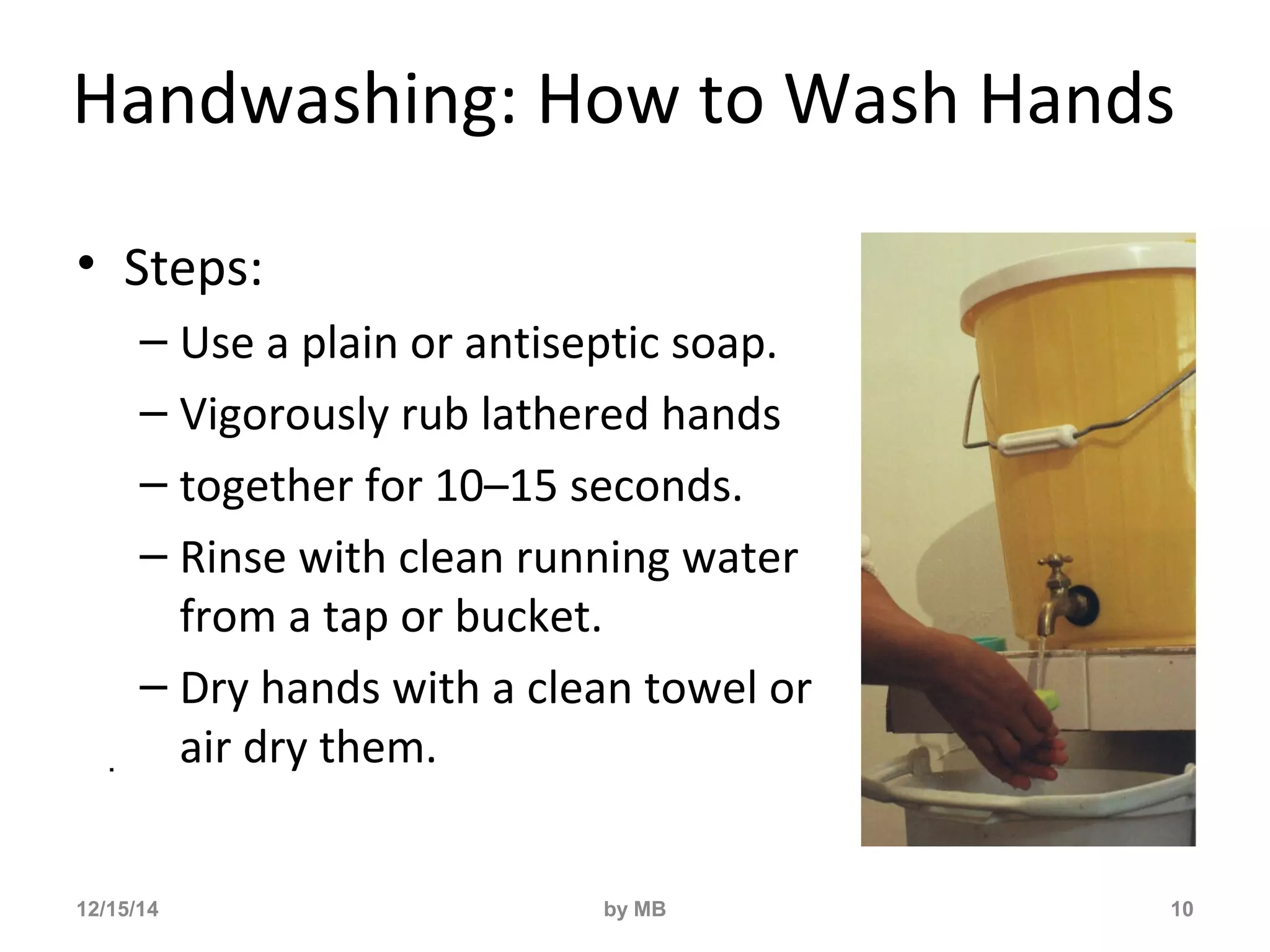
Handwashing: How to Wash Hands 
• Steps: 
– Use a plain or antiseptic soap. 
– Vigorously rub lathered hands 
– together for 10–15 seconds. 
– Rinse with clean running water 
from a tap or bucket. 
– Dry hands with a clean towel or 
air dry them. 
10 
. 
12/15/14 by MB
Alcohol-Based Handrub 
• More effective than handwashing unless 
hands are visibly soiled 
• 2 mL emollient (e.g., glycerin) + 100 mL ethyl 
or isopropyl alcohol 60–90% 
• Use 3 to 5 ml for each application and 
continue rubbing the solution over the hands 
until dry. 
12/15/14 by MB 11
Antisepsis 
• Antisepsis for mucous membranes: 
– Ask about allergic reactions 
– Use water-based product (e.g., iodophor or 
chlorhexidine), as alcohols may burn or irritate 
mucous membranes 
• Skin preparation for injections: 
– If skin is clean, antisepsis is not necessary 
– If skin appears dirty, wash with soap and water 
– Before giving injection, dry with clean towel 
12/15/14 by MB 12
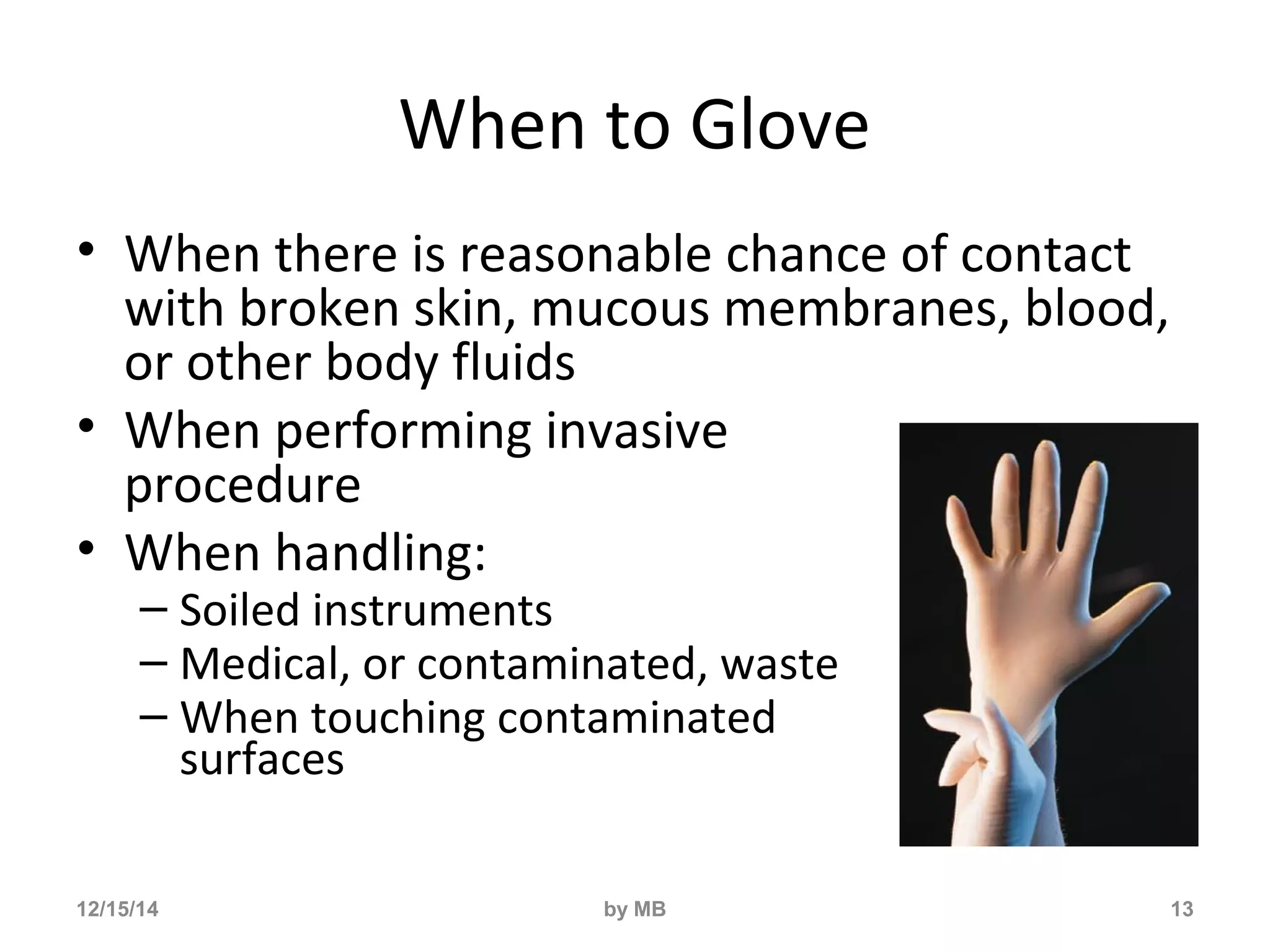
When to Glove 
• When there is reasonable chance of contact 
with broken skin, mucous membranes, blood, 
or other body fluids 
• When performing invasive 
procedure 
• When handling: 
– Soiled instruments 
– Medical, or contaminated, waste 
– When touching contaminated 
surfaces 
12/15/14 by MB 13
Guidelines for Gloving 
• Wear separate pair of gloves for each woman/ newborn to 
prevent spreading infection from client to client 
• What kind of gloves do you wear for: 
– Procedures involving contact with broken skin or tissue under skin? 
– Starting IV, drawing blood, or handling blood or body fluid? 
– Cleaning instruments, handling waste and cleaning up blood and body 
fluids? 
– Never wear gloves that are cracked, peeling or have holes. 
12/15/14 by MB 14
Personal Protective Equipment 
• Gloves: utility, examination, HLD/sterile 
• Eyewear: face shields, goggles, glasses 
• Aprons 
– Should be fluid-resistant 
– Should be decontaminated after use 
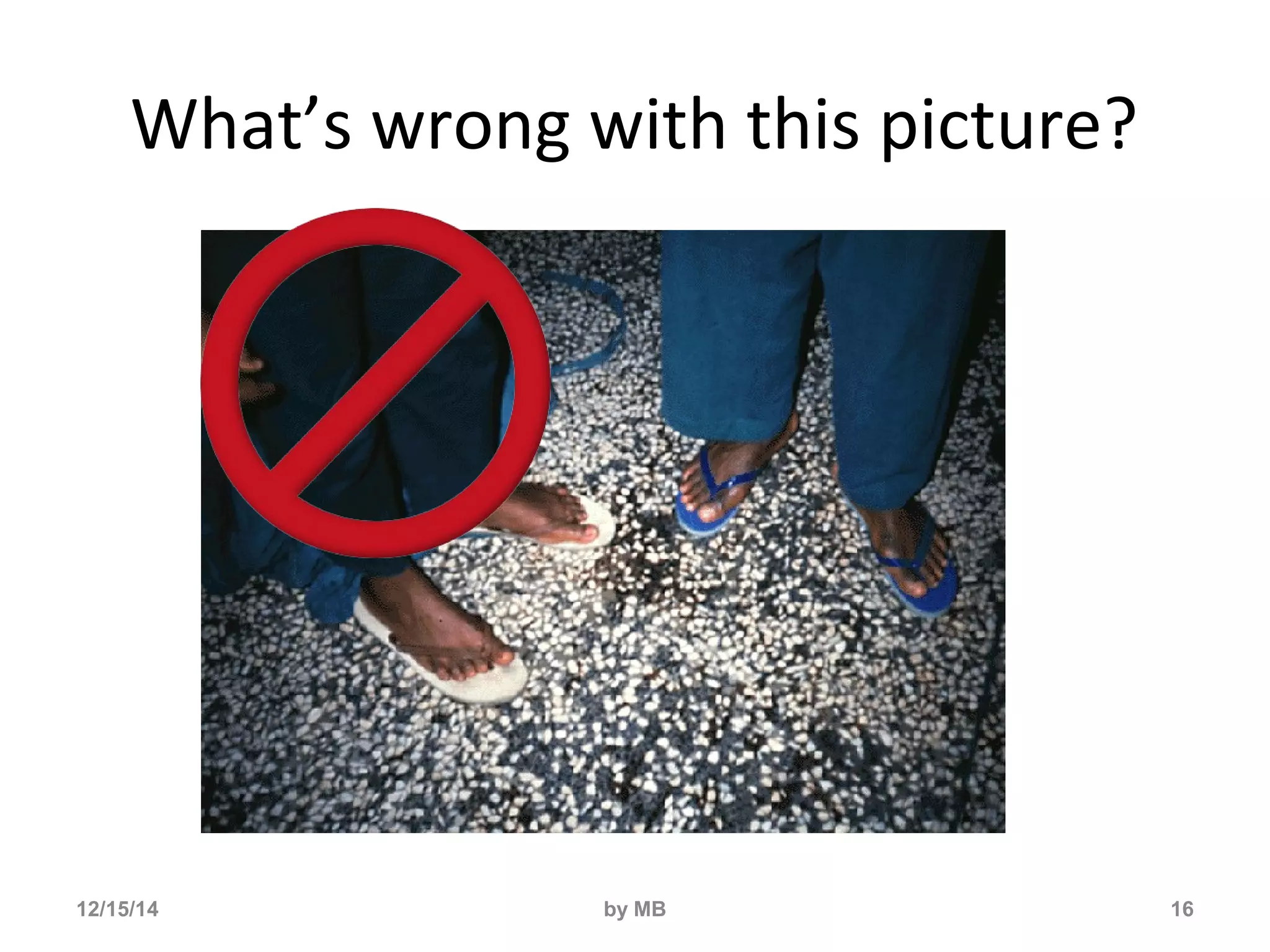
• Protective footwear 
12/15/14 by MB 15
What’s wrong with this picture? 
12/15/14 by MB 16
Global Statistics on 
Occupational Exposure 
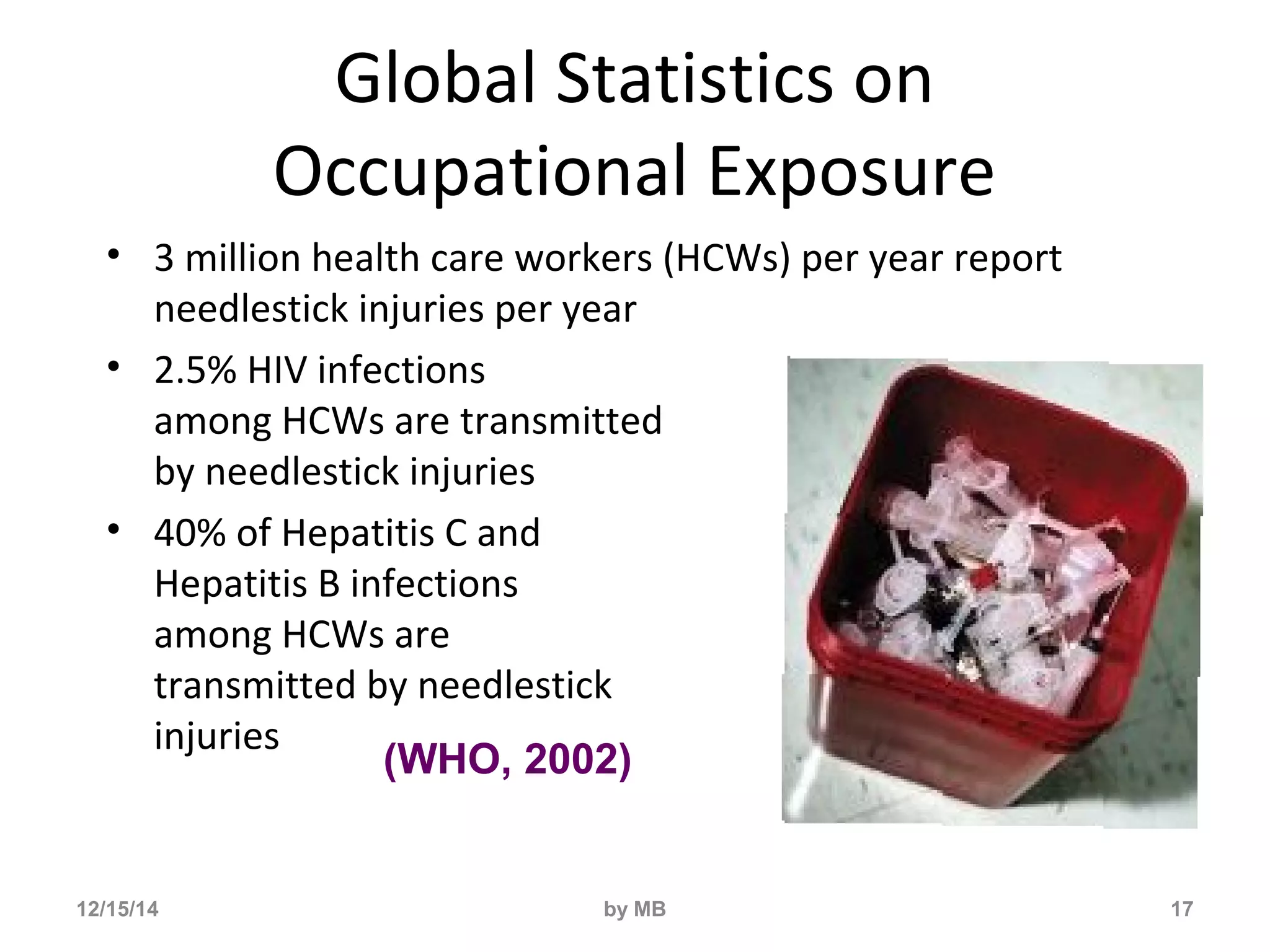
• 3 million health care workers (HCWs) per year report 
needlestick injuries per year 
• 2.5% HIV infections 
among HCWs are transmitted 
by needlestick injuries 
• 40% of Hepatitis C and 
Hepatitis B infections 
among HCWs are 
transmitted by needlestick 
injuries 
17 
(WHO, 2002) 
12/15/14 by MB
Safe Handling of Sharps 
• Never pass sharp instrument from one hand directly to 
another person’s hand 
• After use, decontaminate syringes and needles by flushing 
three times with chlorine solution 
• Immediately dispose of sharps in puncture-proof container 
• Which is greatest, the risk of acquiring Hepatitis B or HIV from 
a needlestick injury? 
12/15/14 by MB 18
Safe Handling of Sharps (cont.) 
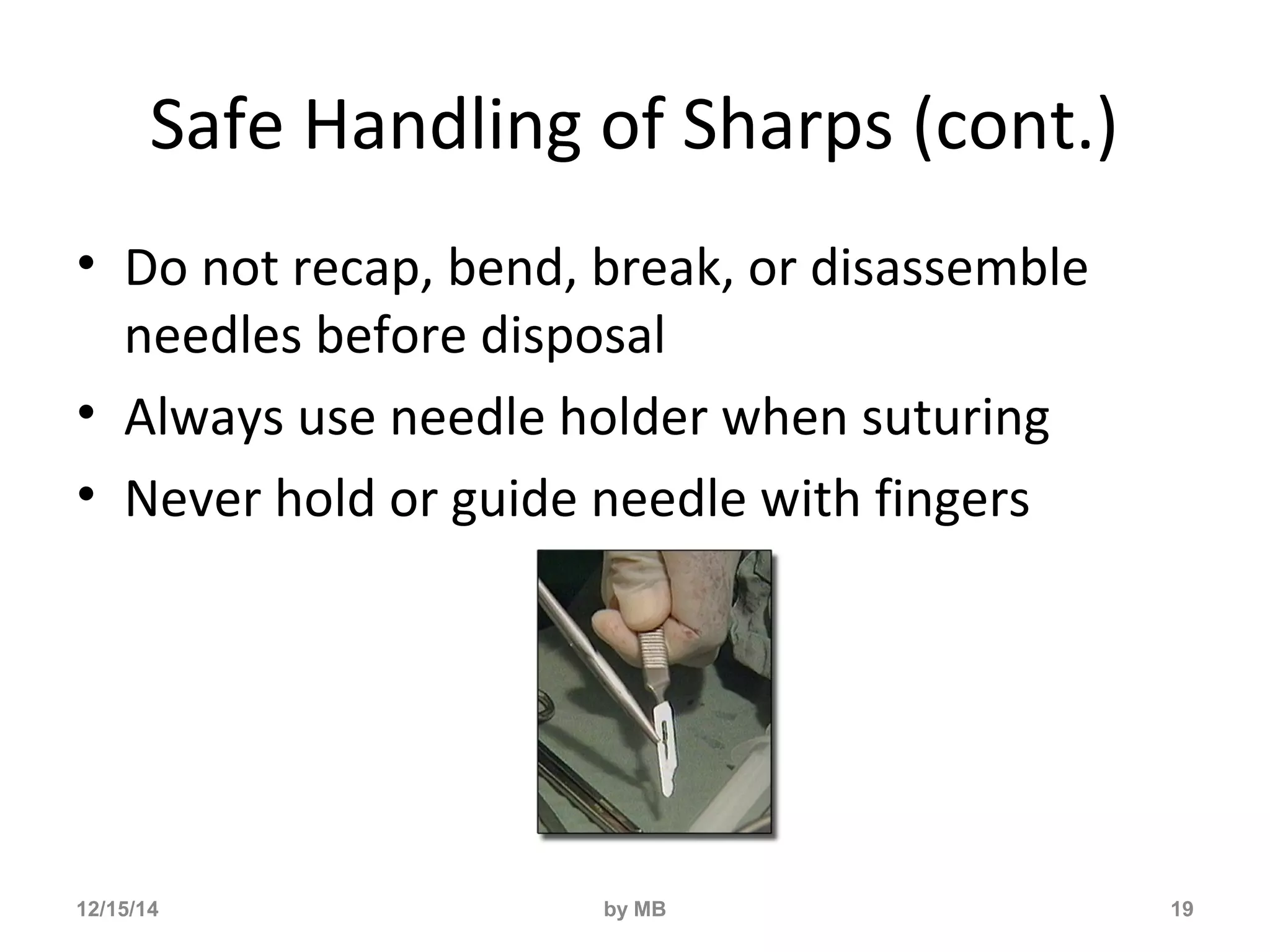
• Do not recap, bend, break, or disassemble 
needles before disposal 
• Always use needle holder when suturing 
• Never hold or guide needle with fingers 
12/15/14 by MB 19
Instrument Processing 
• Decontamination: 
– Should be done immediately after use 
– Makes objects safer to handle 
– How do you make a 0.5% chlorine solution for 
decontamination? 
• Cleaning: 
– Most effective way to reduce number of 
organisms 
– Removes visible dirt and debris 
12/15/14 by MB 20
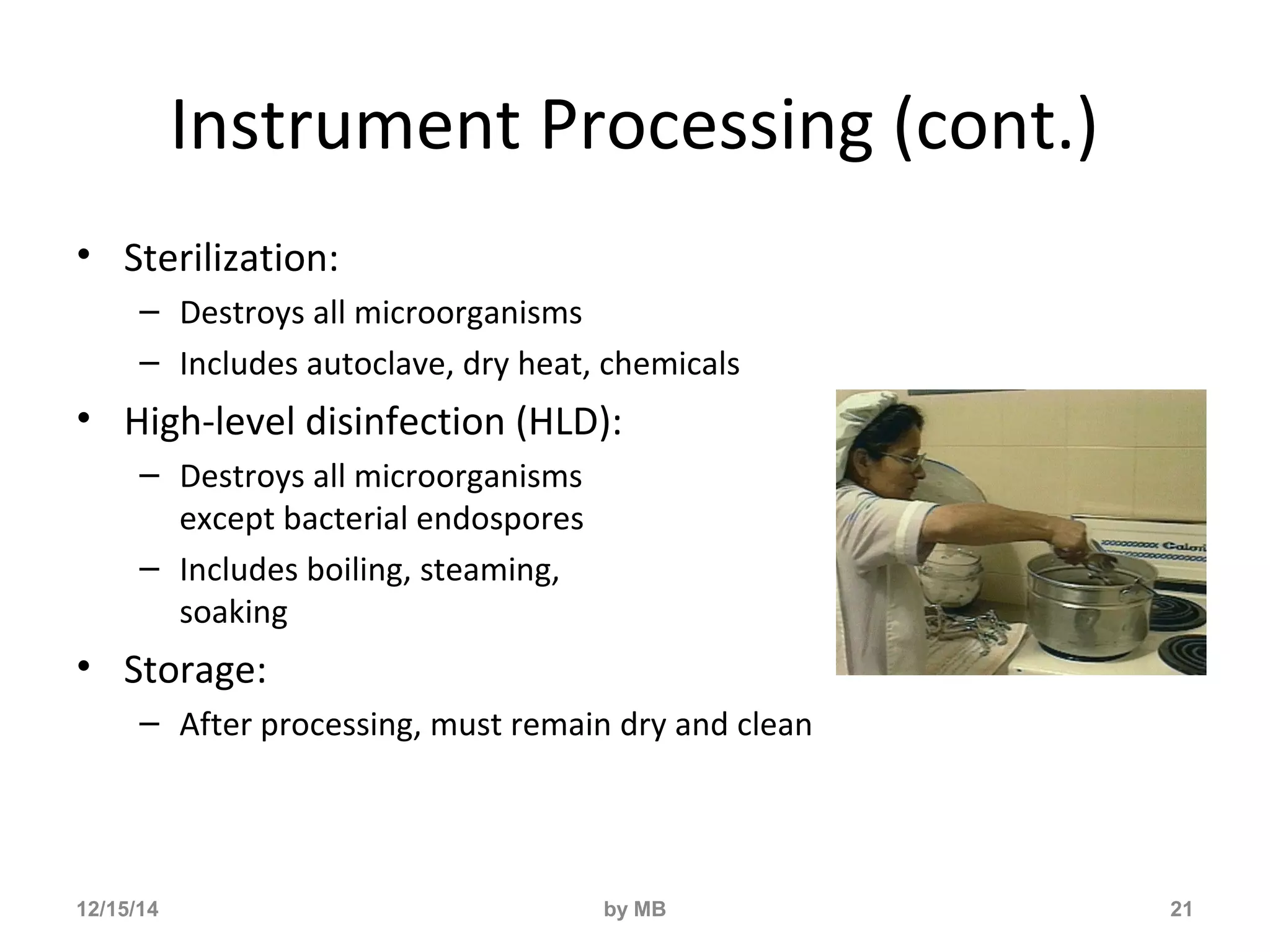
Instrument Processing (cont.) 
• Sterilization: 
– Destroys all microorganisms 
– Includes autoclave, dry heat, chemicals 
• High-level disinfection (HLD): 
– Destroys all microorganisms 
except bacterial endospores 
– Includes boiling, steaming, 
soaking 
• Storage: 
– After processing, must remain dry and clean 
12/15/14 by MB 21
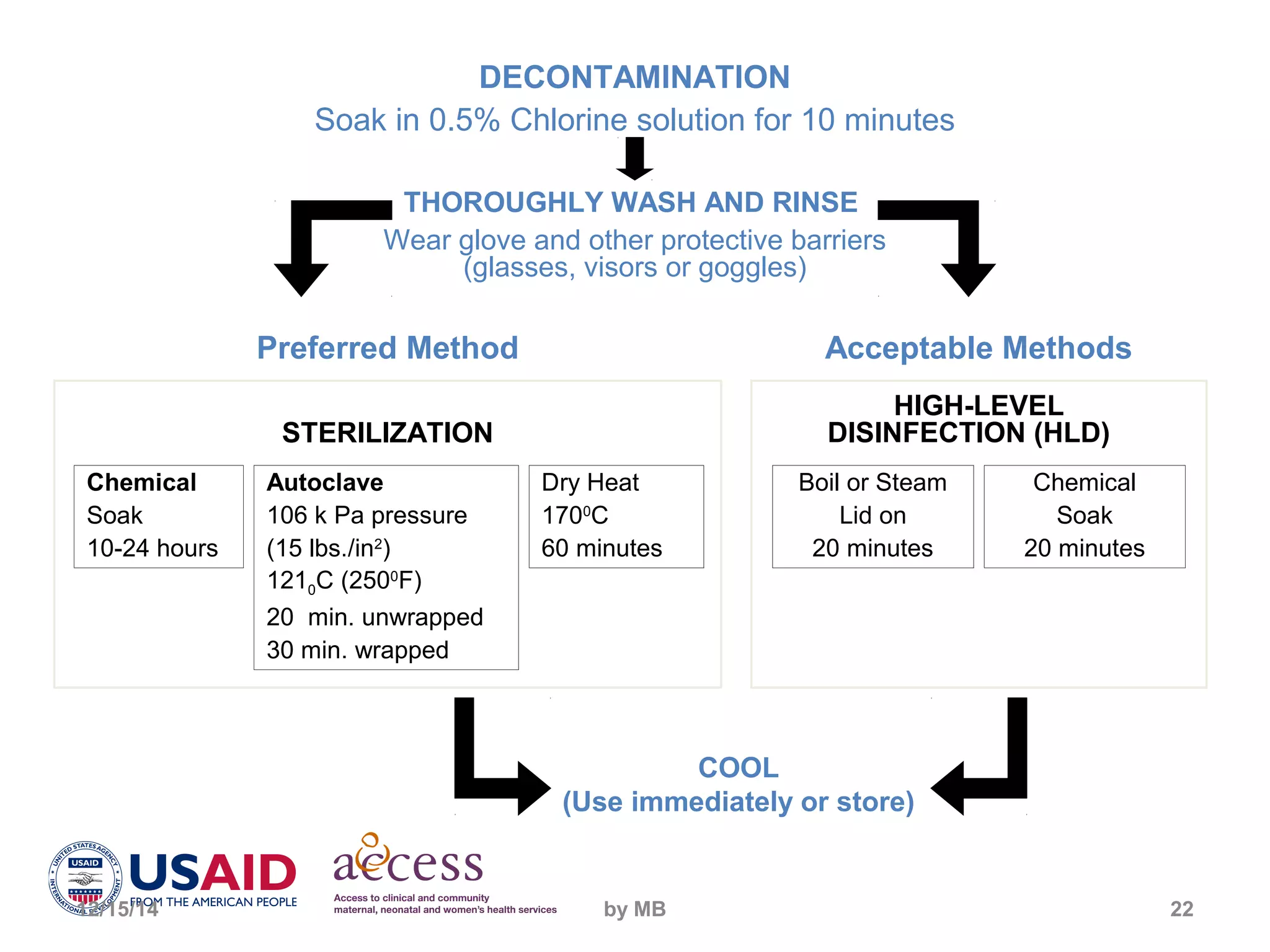
DECONTAMINATION 
Soak in 0.5% Chlorine solution for 10 minutes 
THOROUGHLY WASH AND RINSE 
Wear glove and other protective barriers 
(glasses, visors or goggles) 
Preferred Method Acceptable Methods 
HIGH-LEVEL 
STERILIZATION DISINFECTION (HLD) 
Chemical 
Soak 
10-24 hours 
Autoclave 
106 k Pa pressure 
(15 lbs./in2) 
1210C (2500F) 
20 min. unwrapped 
30 min. wrapped 
Dry Heat 
1700C 
60 minutes 
Boil or Steam 
Lid on 
20 minutes 
Chemical 
Soak 
20 minutes 
COOL 
(Use immediately or store) 
12/15/14 by MB 22
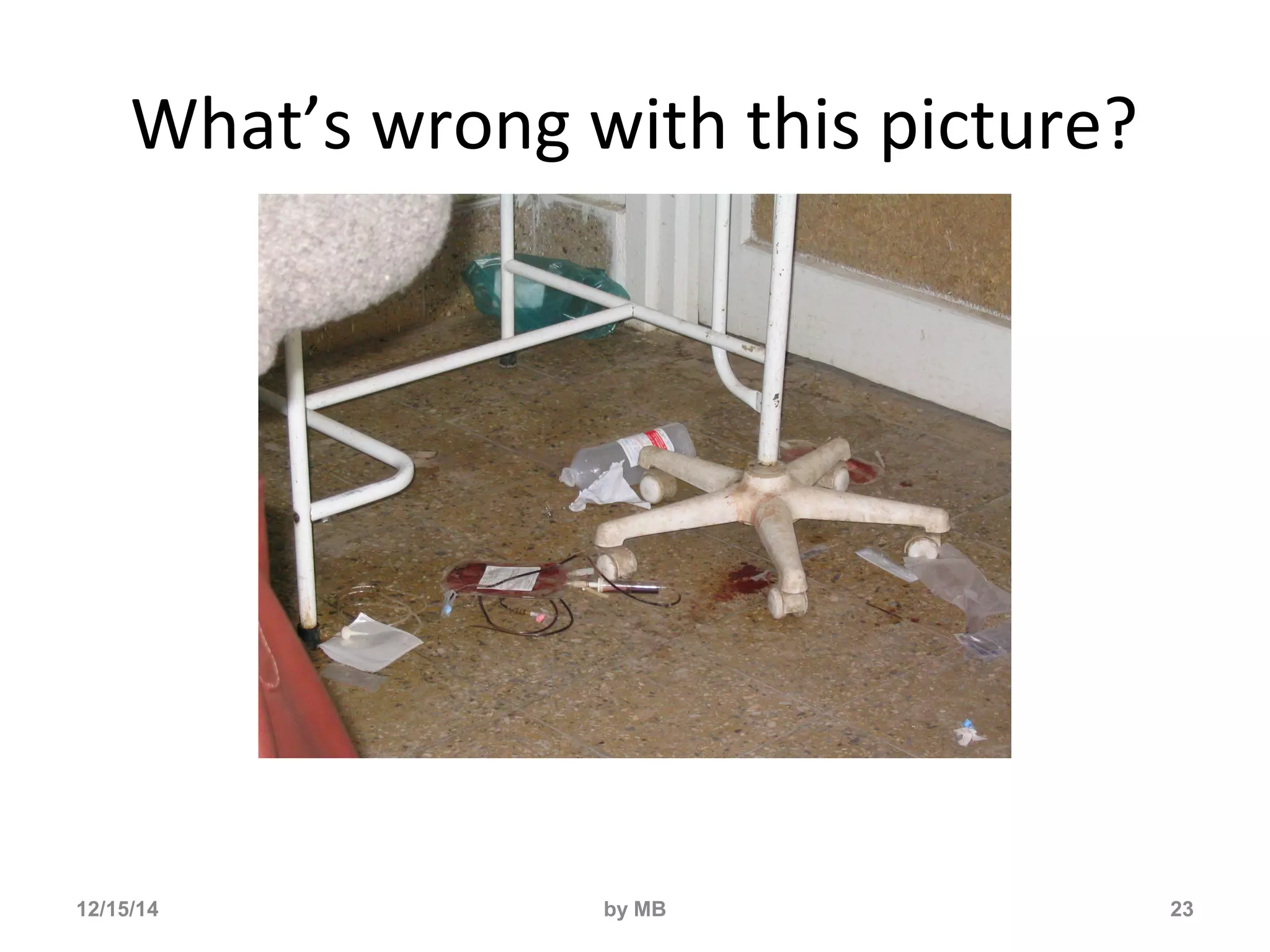
What’s wrong with this picture? 
12/15/14 by MB 23
Housekeeping 
• Each site should follow housekeeping 
schedule 
• Always wear utility gloves when cleaning 
• Clean from top to bottom 
• Ensure that fresh bucket of disinfectant 
solution is available at all times 
12/15/14 by MB 24
Housekeeping (cont.) 
• Immediately clean up spills of blood or body 
fluids 
• After each use, wipe off beds, tables and 
procedure trolleys using disinfectant solution 
• Decontaminate cleaning equipment with 
chlorine solution 
12/15/14 by MB 25
Waste Disposal 
• Separate contaminated waste from 
noncontaminated waste 
• Use puncture-proof container for sharps and 
destroy when two-thirds full 
26 
Contaminated waste includes blood and other body 
fluids, and items that come into contact with them, 
such as dressings. 
12/15/14 by MB
Waste Disposal (cont.) 
• Follow these steps to destroy contaminated 
waste and sharps: 
– Add small amount of kerosene to burn 
– Burn contaminated waste in open area downwind 
from care site 
– Dispose of waste at least 50 meters away from 
water sources 
12/15/14 by MB 27
Summary 
• Everyone (staff and patients) is at risk for 
infection 
• This risk can be reduced through rigorous 
adherence to IP practices: 
– Handwashing or using alcohol-based handrub 
– Antisepsis 
– Personal protective equipment, including gloving 
– Safe handling of sharps and needles 
– Instrument processing 
– Housekeeping and waste disposal 
12/15/14 by MB 28
References 
Clark A. Grab bag of questions adapted from grab bag developed by A. 
Clark/ACNM. 
Ganges F. 2006. Infection Prevention, a presentation in Accra, Ghana in 
Maternal and Newborn Care Technical Update. (April) 
Tietjen L, Bossemeyer D and McIntosh N. 2003. Infection Prevention 
Guidelines for Healthcare Facilities with Limited Resources. Jhpiego: 
Baltimore, MD. Accessed at: 
http://www.reproline.jhu.edu/english/4morerh/4ip/IP_manual/ipmanual. 
htm. 
12/15/14 by MB 29

Ip ppt

  • 1.
    Best Practices in Infection Prevention Best Practices in Maternal and Newborn Care 12/15/14 by MB 1
  • 2.
    Session Objectives Byend of session, participants will be able to: • Describe disease transmission cycle • Outline key IP principles • Discuss appropriate handwashing and antisepsis • Discuss appropriate gloving and personal protective equipment • Outline safe handling of sharps • Discuss proper instrument processing and waste disposal 12/15/14 by MB 2
  • 3.
    The Six Componentsof the Disease Transmission Cycle 1. Agent: Disease-producing microorganisms 2. Reservoir: Place where agent lives, such as in or on humans, animals, plants, soil, air, or water 3. Place of exit: Where agent leaves host 4. Mode of transmission: How agent travels from place to place (or person to person) 5. Place of entry: Where agent enters next host 6. Susceptible host: Person who can become infected 12/15/14 by MB 3
  • 4.
    Question ?? •How can we prevent the spread of infection? 12/15/14 by MB 4
  • 5.
    How can weprevent the spread of infection? • Break disease-transmission cycle • Inhibit or kill infectious agent (applying antiseptic to skin prior to surgery) • Block agent’s means of getting from infected person to susceptible person (handwashing or using alcohol-based hand rub) • Ensuring that people, especially healthcare workers, are immune or vaccinated 12/15/14 by MB 5
  • 6.
    How can weprevent the spread of infection? (cont.) • Providing health care workers with proper protective equipment to prevent contact with infectious agents • Give some examples of ways to break transmission cycle 12/15/14 by MB 6
  • 7.
    Why is infectionprevention important? • Protects patients/clients—helps provide quality care that is also safe • Lowers health care costs—prevention is less expensive than treatment • Prevents infection among health care staff and community • Limits number and spread of infectious agents that can become antibiotic-resistant 12/15/14 by MB 7
  • 8.
    Question ?? •What is the most important infection prevention practice? 12/15/14 by MB 8
  • 9.
    Handwashing • Whento wash hands: – Before and after examining client – After contact with blood, body fluids or soiled instruments, even if gloves are worn – Before and after removing gloves – Upon arriving at and before leaving workplace 9 The single most practical procedure for preventing infection: Handwashing 12/15/14 by MB
  • 10.
    Handwashing: How toWash Hands • Steps: – Use a plain or antiseptic soap. – Vigorously rub lathered hands – together for 10–15 seconds. – Rinse with clean running water from a tap or bucket. – Dry hands with a clean towel or air dry them. 10 . 12/15/14 by MB
  • 11.
    Alcohol-Based Handrub •More effective than handwashing unless hands are visibly soiled • 2 mL emollient (e.g., glycerin) + 100 mL ethyl or isopropyl alcohol 60–90% • Use 3 to 5 ml for each application and continue rubbing the solution over the hands until dry. 12/15/14 by MB 11
  • 12.
    Antisepsis • Antisepsisfor mucous membranes: – Ask about allergic reactions – Use water-based product (e.g., iodophor or chlorhexidine), as alcohols may burn or irritate mucous membranes • Skin preparation for injections: – If skin is clean, antisepsis is not necessary – If skin appears dirty, wash with soap and water – Before giving injection, dry with clean towel 12/15/14 by MB 12
  • 13.
    When to Glove • When there is reasonable chance of contact with broken skin, mucous membranes, blood, or other body fluids • When performing invasive procedure • When handling: – Soiled instruments – Medical, or contaminated, waste – When touching contaminated surfaces 12/15/14 by MB 13
  • 14.
    Guidelines for Gloving • Wear separate pair of gloves for each woman/ newborn to prevent spreading infection from client to client • What kind of gloves do you wear for: – Procedures involving contact with broken skin or tissue under skin? – Starting IV, drawing blood, or handling blood or body fluid? – Cleaning instruments, handling waste and cleaning up blood and body fluids? – Never wear gloves that are cracked, peeling or have holes. 12/15/14 by MB 14
  • 15.
    Personal Protective Equipment • Gloves: utility, examination, HLD/sterile • Eyewear: face shields, goggles, glasses • Aprons – Should be fluid-resistant – Should be decontaminated after use • Protective footwear 12/15/14 by MB 15
  • 16.
    What’s wrong withthis picture? 12/15/14 by MB 16
  • 17.
    Global Statistics on Occupational Exposure • 3 million health care workers (HCWs) per year report needlestick injuries per year • 2.5% HIV infections among HCWs are transmitted by needlestick injuries • 40% of Hepatitis C and Hepatitis B infections among HCWs are transmitted by needlestick injuries 17 (WHO, 2002) 12/15/14 by MB
  • 18.
    Safe Handling ofSharps • Never pass sharp instrument from one hand directly to another person’s hand • After use, decontaminate syringes and needles by flushing three times with chlorine solution • Immediately dispose of sharps in puncture-proof container • Which is greatest, the risk of acquiring Hepatitis B or HIV from a needlestick injury? 12/15/14 by MB 18
  • 19.
    Safe Handling ofSharps (cont.) • Do not recap, bend, break, or disassemble needles before disposal • Always use needle holder when suturing • Never hold or guide needle with fingers 12/15/14 by MB 19
  • 20.
    Instrument Processing •Decontamination: – Should be done immediately after use – Makes objects safer to handle – How do you make a 0.5% chlorine solution for decontamination? • Cleaning: – Most effective way to reduce number of organisms – Removes visible dirt and debris 12/15/14 by MB 20
  • 21.
    Instrument Processing (cont.) • Sterilization: – Destroys all microorganisms – Includes autoclave, dry heat, chemicals • High-level disinfection (HLD): – Destroys all microorganisms except bacterial endospores – Includes boiling, steaming, soaking • Storage: – After processing, must remain dry and clean 12/15/14 by MB 21
  • 22.
    DECONTAMINATION Soak in0.5% Chlorine solution for 10 minutes THOROUGHLY WASH AND RINSE Wear glove and other protective barriers (glasses, visors or goggles) Preferred Method Acceptable Methods HIGH-LEVEL STERILIZATION DISINFECTION (HLD) Chemical Soak 10-24 hours Autoclave 106 k Pa pressure (15 lbs./in2) 1210C (2500F) 20 min. unwrapped 30 min. wrapped Dry Heat 1700C 60 minutes Boil or Steam Lid on 20 minutes Chemical Soak 20 minutes COOL (Use immediately or store) 12/15/14 by MB 22
  • 23.
    What’s wrong withthis picture? 12/15/14 by MB 23
  • 24.
    Housekeeping • Eachsite should follow housekeeping schedule • Always wear utility gloves when cleaning • Clean from top to bottom • Ensure that fresh bucket of disinfectant solution is available at all times 12/15/14 by MB 24
  • 25.
    Housekeeping (cont.) •Immediately clean up spills of blood or body fluids • After each use, wipe off beds, tables and procedure trolleys using disinfectant solution • Decontaminate cleaning equipment with chlorine solution 12/15/14 by MB 25
  • 26.
    Waste Disposal •Separate contaminated waste from noncontaminated waste • Use puncture-proof container for sharps and destroy when two-thirds full 26 Contaminated waste includes blood and other body fluids, and items that come into contact with them, such as dressings. 12/15/14 by MB
  • 27.
    Waste Disposal (cont.) • Follow these steps to destroy contaminated waste and sharps: – Add small amount of kerosene to burn – Burn contaminated waste in open area downwind from care site – Dispose of waste at least 50 meters away from water sources 12/15/14 by MB 27
  • 28.
    Summary • Everyone(staff and patients) is at risk for infection • This risk can be reduced through rigorous adherence to IP practices: – Handwashing or using alcohol-based handrub – Antisepsis – Personal protective equipment, including gloving – Safe handling of sharps and needles – Instrument processing – Housekeeping and waste disposal 12/15/14 by MB 28
  • 29.
    References Clark A.Grab bag of questions adapted from grab bag developed by A. Clark/ACNM. Ganges F. 2006. Infection Prevention, a presentation in Accra, Ghana in Maternal and Newborn Care Technical Update. (April) Tietjen L, Bossemeyer D and McIntosh N. 2003. Infection Prevention Guidelines for Healthcare Facilities with Limited Resources. Jhpiego: Baltimore, MD. Accessed at: http://www.reproline.jhu.edu/english/4morerh/4ip/IP_manual/ipmanual. htm. 12/15/14 by MB 29

Editor's Notes

  • #7 Elicit example about each place where transmission cycle can be broken: 1. Agent: Kill agent with antibiotics, disinfectants, decontaminant 2. Reservoir: Remove standing water so malaria carrying mosquito cannot live. Eliminate contaminated dressings. Burn placenta. 3.Place of exit: cover mouth and nose of person with flu who may be sneezing or coughing 4.Mode of transmission: personal protective equipment blocks transfer of organisms from one person to another 5.Place of entry: Use antiseptic to clean injection site 6.Susceptible host: Give Hep B vaccine or other immunizations or pre-exposure or post-exposure treatment to someone exposed to HIV virus
  • #15 Gloves for procedures involving contact with broken skin or tissue under skin? High-level disinfected or surgical Gloves for starting IV, etc? Examination gloves Gloves for clearning? Utility gloves
  • #16 Why do you wear footwear? To protect from injury from sharps or heavy items Not to prevent transmission of infection (unless foot will be in wound or mucus membrane!)
  • #18 This 3 million is just those that report – number is most likely much larger, considering there are countries which do not have systems in place to document occupational exposure. Worldwide, about 2.5% of HIV infections and 40% of HBV and C infections are due to occupational exposure – needlesticks on the job.
  • #19 The risk of disease after exposure to HBV from a single needle stick injury ranges from 27-37% while the risk following a single needle stick exposure to HIV is much lower, 0.2 – 0.4!
  • #21 To make a 0.5% chlorine solution from 5% bleach mix 1 part bleach to 9 parts water