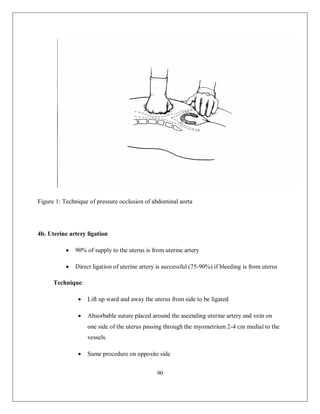







1 
NON REASURING FETAL STATUS (NRFS) 
Introduction 
 Fetal compromise is a complex of signs showing response of the fetus to inadequate oxygenation. 
 Fetal heart rate (FHR) in labor can be monitored using either continuous electronic monitoring or intermittent auscultation using Pinnard sthetoscope. 
 FHR patterns: 
1. Normal: Baseline FHR between 110-170 beats per minute (bpm), accelerations with contraction or fetal 
movement, early deceleration, normal variability (6-25 bpm). 
2. Bradycardia: Baseline FHR ≤ 110 bpm. 
3. Tachycardia: Baseline FHR ≥ 170 bpm. 
4. Accelerations: Transient increase in FHR associated with contraction or fetal 
movement. It is usually favorable sign of fetal wellbeing. 
5. Decelerations: Falls from baseline 
(i) Early deceleration: Slowing in FHR associated with contractions. Mainly due to head compression. 
(ii) Late deceleration: Slowing in FHR which begins at or after the peak of contractions & returns to baseline after the end of contractions. Implies presence of uteroplacental insufficiency. 
(iii)Variable deceleration: Variable onset of abrupt slowing of FHR in association with uterine contractions. Signify possible pressence of cord compression. 
(iv) Prolonged deceleration: A decrease in FHR below baseline of 15 bpm lasting 2-10 minutes (min) from onset to return to baseline. 
6. Beat-to-beat variability: Fluctuations in the baseline FHB. Can be: 
a. Absent / undetectable 
b. Minimal: < 5 bpm 
c. Moderate: 6 - 25 bpm
2 
d. Marked: > 25 bpm 
7. Wandering baseline: Unsteady & wanders between 110 – 170 bpm. Suggests neurologic abnormality. 
8. Sinusoidal pattern: Regular variability resembling sin wave with a fixed periodicity of 3 – 5 cycles / min & amplitude of 5 – 40 bpm. It is a response to moderate fetal hypoxemia scondary to fetal anemia. 
Diagnosis 
 NRFS: Presence of the following signify fetal compromise: 
 Repetitive decelerations (variable / late) 
 Loss of beat – to –beat variability 
 Baseline bradycardia or tachycardia 
 Signs of fetal distress: 
 Abnormal FHR (above) 
 Meconium stained liquor 
 Acidic scalp PH 
Management 
 Digital vaginal examination if there is no contraindication to do so. Done to asses stage of labor, pressence of cord prolapse or cord presentation, and to do artificial rupture of fetal membranes (ARM) to check presence of meconium. 
 Intrauterine resuscitation: 
 Change position of the mother 
 Correct maternal hypotension, dehydration, & hypoglycemia (Intravenous (IV)- fluid) 
 Oxygen via tightly fitting face mask (6-8 liters (lit)/min) 
 Decrease uterine activity by stopping oxytocin &/or administering tocolytic agents 
 Amnioinfusion 
 If fetal tachycardia is secondary to chorioamnionitis, treat the chorioamnionitis 
 Continue with labor follow up if FHR is normal subsequently
3 
 If the FHR abnormality doesn’t resolve with the conservative management, immediate delivery is recommended. 
 Mode of delivery is dectated by presentation, station, position, cervical dilatation, & status of the fetus; 
 Vertex presentation, fully dilated cervix, station at +2 centimeters (cm) or below → Instrumental vaginal delivery(ventouse/forceps). 
 Vertex presentation, cervix not fully dilated, or high station with fully dilated cervix → cesarean delivery (C/d). 
 Malpresentations → C/d, except face presentation with mentum anterior and station +2 cm or below where obstetric forceps can be used.
4 
OBSTRUCTED LABOR (OL) 
Definition: Obstructed labor is failure of descent of fetal presenting part in maternal birth canal for mechanical reasons despite the presence of adequate uterine contractions. 
Causes: 
 Cephalo pelvic disproportion (commonest): Contracted pelvis (commonest), pelvic deformities (Rickets, osteomalacia), malposition, big fetus 
 Malpresentations: Impacted transverse lie, breech presentation, face presentation (mento posterior), brow presentation, compound presentation, shoulder dystocia 
 Soft tissue abnormalities: Cervical stenosis, vaginal stenosis, tumor previa (Myoma) 
 Fetal abnormalities: Hydrocephalus, locked twins, conjoined twins 
Anticipate OL during antenatal period in presence of: 
 Short stature 
 Small shoes number 
 Previous history of prolonged or difficult labor 
 Contracted pelvis on clinical pelvimetry 
 Obstetric palpation to pick malpresentations, big fetus, multifetal gestations. 
 Unengaged head at term in primigravidas (Head fitting test) 
Anticipate OL in labor in presence of: 
 Protracted cervical dilatation 
 Arrest of cervical dilatation 
 Failure/arrest of descent of presenting part 
Clinical features: 
 Prolonged labor 
 Failed instrumental delivery 
 Exhausted and anxious mother
5 
 Dehydration signs present 
 Signs of metabolic acidosis 
 Birth canal infection (offensive vaginal discharge, fever) 
 Bandl’s ring formation (commonly in primigravidas, distended lower uterine segment with a constriction ring separating it from upper uterine segment) 
 Ruptured uterus (multigravidas) 
 Three - tumor abdomen: distended bladder + ballooned out lower uterine segment + contracted fundus with intervening Bandl’s ring. 
 Blood stained urine (edema and echymosis) 
 Edema of lower vagina and vulva (Kanula syndrome) 
 Moulding and excessive caput 
 Fetal death (Alive fetuses usually succumb in first 48 hours after delivery) 
Management 
 Fluid and electrolyte imbalance correction (IV- crystalloids, N/S and R/L be used) 
 Control of infection (use triple antibiotics: Ampicillin 1 gm IV QID/Ceftriaxone 1 gm IV BID + Metronidazole 500 mg IV/PO TID/Chloramphenicol 1 gm IV QID + Gentamycin 80 mg IV TID or 4.0–5.0 mg/kg IV once daily, in an infusion given over a 30-minute period) 
 Emptying bladder: 
 Avoid metalic and hard plastic catheters (traumatic) 
 Relieve compression of the urethra by inserting two fingers, one on either side of the urethra 
 Displace presenting part upwards after anesthesia 
 During cesarean delivery, after abdomen has been opened the bladder can be emptied with a wide bore needle and syringe 
 Emptying the stomach (NGT) 
 Administer antiacid suspension orally 
 Hematocrit/hemoglobin, blood group and Rh, Cross-match blood
6 
 Relieve obstruction using any of the following procedures, whichever is appropriate for the situation: 
1. Cesarean delivery 
 Almost all cases 
 Alive fetus, and dead fetus at high station 
 Lower uterine segment cesarean delivery is prefered 
2. Vaginal operations 
 In absence of uterine rupture and imminent uterine rupture 
 In the operation theatre especially if uterine rupture or imminent rupture cannot be ruled out (destructive deliveries under direct vision) 
 If rupture suspected during procedure (eg. Fresh and excessive vaginal bleeding), abandon the procedure immediately and proceed to laparatomy 
 After difficult procedures explore the uterus 
 Destructive vaginal deliveries (prerequisites should be fulfilled) 
 Craniotomy 
 Cleidotomy 
 Decapitation 
 Evisceration / embryotomy followed by spondylotomy
7 
UMBILICAL CORD PROLAPSE (UCP) 
Introduction 
 UCP is obstetric emergrncy that occurs when the umbilical cord(UC) descends alongside or beyond the fetal presenting part. 
 Classification: 
 Overt UCP: Protrusion of the UC in advance of the fetal presenting part with ruptured fetal membranes. 
 Occult UCP: Cord descends alongside, but not past, the presenting part with intact / ruptured fetal membranes. 
 Cord presentation: Prolapse of UC below the level of the presenting part before rupture of fetal membranes. 
 The incidence of UCP is 0.14 – 0.62 % (varies with fetal presentation: cephalic = 0.5%, frank breech = 0.5%, complete breech = 5%, footling breech = 15%, transverse lie = 20%) & perinatal mortality related to UCP is declining significantly. 
 Risk factors: 
1. Fetomaternal: Inadequate filling of the maternal pelvis by the fetus. Malpresentations, unengaged presenting part, prematurity, multifetal gestation, PROM, abnormal placentation, multiparity, polyhydramnios, long UC, pelvic deformities, uterine tumors/malformations, congenital anomalies 
2. Obstetric interventions: ARM, scalp electrode application, intrauterine pressure monitor catheter insertion, manual rotation of the fetal head, amnioinfusion/amnioreduction, ECV with ROM. 
Diagnosis 
 Occult UCP: Pressence of severe prolonged fetal bradycardia or moderate to severe variable decelerations after a previous normal tracing. 
 Overt UCP: Pressence of palpable cord (pulsatile or non-pulsatile) on pelvic examination or visible cord outside the introitus.
8 
 Cord presentation: Loops of cord are palpated through the fetal membranes. 
Management 
 Intrauterine resuscitation and prompt delivery is recommended when fetus is alive. 
 Manuevers to reduce fetal presenting part pressure on the cord: 
1. Funic decompression: Examiner’s hand is maintained in the vagina to elevate the presenting part off of the UC while preparations for an emergency c/d are being made. 
 Client be placed in steep Trendelenberg or knee-chest position. 
 Do not manipulate the cord. 
 Avoid exposure of the cord to cold environment so as to avoid cord spasm (keep in vagina). 
2. Bladder filling: Insert foley catheter into maternal bladder then fill bladder with 500- 700 ml of normal saline with the patient in Trendelenberg position (used during referral). 
3. Tocolysis 
 Delivery: Mode of delivery depends on: 
 Presentation 
 Cervical dilatation 
 Station of presenting part 
 Whether the fetus is alive or dead and GA when alive. 
 If fetus is dead (previable/GA<28 weeks), follow labor & attend delivery. 
 If fetus is alive with malpresentation or prerequisites for instrumental delivery not fulfilled, immediate c/d. 
 Ventouse is preferred over forceps when cervix is dilated ≥ 8 cm and other prerequisites are fulfilled. 
 The interval between cord prolapse & delivery is a major determining factor in the immediate neonatal outcome & perinatal mortality. 
 In cord presentation with alive fetus, do not rupture fetal membranes at any stage of labor; deliver the fetus by c/d.
9 
 Prevention: 
 ARM should be done when fetal presenting part is well applied to the cervix/engaged. 
 Controlled ARM with small gauge needle & simultaneous fundal pressure if fetal presenting part is not well applied. 
 Avoid disengaging fetal presenting part when performing procedures. 
 Careful pelvic examination immediately after spontaneous rupture of fetal membranes. 
 Incidental finding of cord presentation on U/S should be followed to decide mode of delivery.
10 
Pathway of care in UCP 
Lateral position 
100% oxygen by tightly fitting face mask (6-8 l/min) 
Replace cord in vagina but avoid handling cord as much as possible 
Discontinue oxytocin if present 
↓ 
Assess fetal viability 
FH on Pinnard/Doppler/CTG 
/  
Yes – baby is alive No – FHT 
↓ ↓ 
Is cervix fully dilated? Await spontaneous delivery 
Is baby cephalic? 
/  
No – not fully dilated or Yes – fully dilated/ ≥ 8 cm 
Vaginal delivery deemed inappropriate ↓ 
Or unsuccessul Consider ventouse if easy delivery 
↓ 
Is FHR normal? 
↓  
No – FHR is abnormal Yes – FHR is ok 
↓ ↓ 
Relieve pressure on the cord: Make arrangements for emergency c/d 
 Knee-elbow/lateral position with 
Trendelenberg → Does FHR improve? 
 Manual elevation of presenting part No – FHR stays abnormal 
 Cetheterize & fill the bladder with ↓ 
500 ml N/S then clamp catheter Prepare for emergency c/d as fast as possible
11 
ANTEPARTUM HEMORRHAGE (APH) 
 Definition: Genital tract bleeding from 28th week of gestation till delivery of the fetus. 
 Incidence: 2 – 3 % of all pregnancies. 
 Causes: 
A. Placental and fetal membranes: Placenta previa, abruptio placenta, vasa previa, placenta membranacea, circumvalate placenta 
B. Non – placental: Heavy show, ruptured uterus, bleeding diathesis 
C. Local causes: Cervicitis, cervical Ca, cervical polyp, leech infestation, vaginal & vulvar pathologies 
D. Unknown cause 
NB: The cause of any APH should be taken to be placenta previa unless ruled out otherwise. Hence, vaginal & rectal examinations are contraindicated in women with APH until placenta previa is ruled out. 
Placenta previa 
 It is implatation of placenta at the lower uterine segment within zone of cervical dilatation & effacement. 
 Incidence : 4 per 1000 pregnancies. 
 Risk factors: High parity, advanced age, multifetal gestation, erythroblastosis, previous c/d, other uterine scars, smoking, high altitude, male fetus, early GA. 
NB: In placenta previas diagnosed at early GA there is placental “migration” which results from formation of lower uterine segment & unidirectional trophoblast growth. 
Diagnosis: 
 Clinical features (supportive): Painless & recurrent vaginal bleeding (70-80%), uterine contraction (10-20%), assymptomatic (Incidental finding) in < 10%. 
 Mainly by U/S: -Transvaginal (Gold standard) 
-Trans abdominal: -Accuracy is > 95 %
12 
- Anterior placenta---with empty bladder 
- Posterior placenta---Trendelenberg position 
- Central complete---placenta seen anterior & posterior 
 Classification: 1. Low lying (I): Within 6cm from internal OS of the cervix. 
2. Marginal (II): Placenta edge reaching the internal OS of the cervix. 
3. Partialis (III): Placenta covering internal OS of the cervix partly. 
4. Totalis (IV): Placenta covering the internal OS of the cervix completely. 
 Management: 
 Admit all ladies with APH secondary to placenta previa at time of diagnosis. 
 Resuscitation based on clinical condition. 
 Vaginal & rectal examinations are absolutely contraindicated. 
 Monitor closely maternal & fetal conditions. 
 HCT, BG & Rh, cross-match at least two units of blood 
 Decide on conservative management versus immediate delivery 
 Indications for immediate delivery:Term pregnancy, IUFD, fetal growth restriction, NRFS, excessive bleeding, gross fetal congenital malformation which may not be compatible with life, lady in labor. 
 In absence of any of the above indications to deliver the fetus, conservative management is instituted till an indication comes to picture. 
 Conservative management in preterms includes: 
-Bed rest (in hospital)-----No place for out patient management 
-Dexamethasone 6mg IM Q 12 hours for a total of 4 doses 
-Follow: Maternal V/S, vaginal bleeding, uterine contractions, fundal height, FHB, kick count, BPP, serial HCT. 
- Deliver at 37 completed weeks of gestation after maturity is confirmed
13 
 Route of delivery depends on the type of placenta previa and presence of other obstetric indications: 
 Low lying & anterior marginal → vaginal delivery 
 Partialis, totalis, & posterior marginal → c/d 
 Excessive bleeding, NRFS, other obstetric indications → c/d 
 Double setup examination: Used in areas where U/S is not widely available/not done by experienced people. The procedure: 
 Client taken to operation room 
 Everything must be ready for delivery 
 Speculum examination is done gently to rule out local causes & see the cervical status → Then gentle digital vaginal examination is done to check for pressence of placenta between fornices & presenting part, cervical dilatation & effacement, pressence of placenta through open cervix. 
 Used to decide on mode of delivery 
Placental abruption 
 It is the premature separation of a normally implanted placenta. 
 Immediate cause is rupture of defective maternal vesseles in the decidua basalis, where it interfaces with the anchoring villi. 
Incidence: 1 in 75 – 225 deliveries, severe enough to cause still birth (SB) occurs 1 in 830 deliveries. Accounts for 1/3rd of APH. 
Risk factors: Trauma, hypertension, rapid uterine decompression, high parity, multifetal gestation, previous history of abruption (most predictor, increases 10×), uterine leiomyoma & anomalies, cigarette smoking, cocaine abuse, placental anomalies, inherited thrombophilia. 
Recurrence: 5 – 15 % after an episode, 25 % after two consecutive episodes 
Diagnosis: 
 Primarily clinical: Vaginal bleeding ( > 80 %), abdominal pain ( > 50 %), contractions ( Tachysystole), uterine tenderness, NRFHR, rigid (woody hard) uterus, amount of bleeding doesn’t correlate well with the extent of maternal hemorrhage, DIC ( 10 – 20 % of severe abruptions).
14 
NB: Bleeding in placental abruption can be: 
 Revealed (Vaginal) in 80 % 
 Concealed 
 To amniotic fluid giving it “Port wine” discoloration 
 Into myometrium------“Couvelaire uterus” 
 Clinical diagnosis is supported by: 
 Radiologic findings: High resolution U/S with experienced hand can reveal retroplacental clot. 
 Laboratory findings: Hypofibrinogenemia 
 Pathologic findings: Retroplacental clot after delivery, depression on maternal surface of placenta (long standing abruption), bluish uterus at c/d (Couvelaire). 
 Grading of abruptio placentae: Sher, 1978 
 Grade 0: Retrospective diagnosis of abruption 
 Grade 1: Vaginal bleeding 
 Grade 2: Vaginal bleeding, concealed hemorrhage, uterine tenderness, NRFHR 
 Grade 3: Vaginal bleeding, shock, extensive concealed hemorrhage, uterine tenderness, IUFD 
Grade 3 A: With no coagulopathy 
Grade 3 B: With coagulopathy 
 Management: 
 All cases: Asses hemodynamic status, then 
 IV line to be opened 
 Fetal well being monitoring 
 HCT, BGP & Rh, platelets, fibrinogen, PT, aPTT 
 Grade 2 – 3: Asses maternal hemodynamic status, then stabilize the mother 
 Maintain U.O.P > 30 ml/hr & HCT > 30% 
 Platelets (6U) transfusion if thrombocytopenia 
 FFP if fibrinogen < 100mg/dl 
 Delivery: -Vaginal----Amniotomy & induction with oxytocin 
-C/d for uncontroled hemorrhage & other obstetric indications
15 
 Hysterectomy---Uncontrolled hemorrhage 
 Couvelaire uterus---Uterotonic agents, hysterectomy if unresponsive 
 Grade 1: Conservative management 
 Steroid in < 34 weeks of gestation 
 Keep in ward till bleeding subsides 
 Tocolysis in < 33 weeks of gestation 
 Follow maternal V/S, bleeding, uterine contraction & tenderness, FHB, kick count, BPP, fetal growth 
 Indications for delivery: Term, IUFD, malformed fetus, NRFHR, advanced labor, excessive bleeding 
NB: 
 All cases of APH be admitted at initial diagnosis & stabilized. 
 Placenta previa must be considered unless ruled out in all cases of APH. 
 Local causes be ruled out 48 hrs after last episode of bleeding with speculum examination in those with no placenta previa. 
 In APH secondary to local causes, the primary cause be treated. 
 Pregnancies with APH of unknown cause be induced at 37 copmleted weeks after confirmation of maturity. 
 In vasa previa, bleeding is mainly fetal. Emergency c/d is indicated if fetus is alive.
16 
MULTIFETAL GESTATION 
Etiology 
 Etiology of MZ twining is unknown 
 DZ twining appears to result from ovulation of multiple follicles (Elevated FSH, ovarian stimulation, in vitro fertilization). 
Placentation 
 DZ twins have dichorionic-diamniotic placentas 
 In MZ twins the timing of egg division determines placentation: 
-Division within 3 days of fertilization: DADC 
-Division between days 4 & 8: DAMC 
-Between days 8 & 12 : MAMC 
-Division at or after day 13 results in conjoined twins 
Diagnosis 
 Persistent hyperemesis gravidarum 
 Pregnancy heavier than previous pregnancies 
 Personal or family history of twins 
 Early onset preeclampsia 
 Pregnancy following assisted reproductive technology 
 Big for date uterus 
 Excessive weight gain 
 Obstetric palpation revealing more than two poles 
 FHR heared by two people at different areas with rate difference of at least 10 bpm (with different rate to the maternal pulse). 
 U/S: Presence of two or more GS/fetuses, dividing membranes 
Management 
 Increase energy consumption (increase 300 Kcal more)
17 
 Supplements ( Iron, Folic acid) 
 Frequent ANC visits, rest and antepartum fetal surveillance as indicated 
 U/S:- Placentation, number of fetuses, AF, placental abnormalities, fetal growth, presence of congenital anomalies 
 Preterm labor: Tocolysis, steroids before 34 weeks of GA 
 VBAC is contraindicated 
 Timing of delivery: - Elective delivery before 38 weeks should be after lung maturity is ascertained. 
- No twin pregnancy should be allowed to go beyond 40 weeks of GA. 
 Induction and augmentation: Contraindicated 
 Route of delivery: Depends on presentation & GA (rarely) 
 Both twins vertex: Deliver vaginally, c/d reserved for indications similar to singleton. 
 Twin 1 non-vertex: C/d 
 Twin 1 vertex & twin 2 non-vertex: deliver 1st twin vaginally, then options for 2nd twin are: ECV, internal podalic version followed by total breech extraction, vaginal breech delivery 
 C/d in cases of: Conjoined twins, monoamniotic twins, locked twins. 
 Intrapartum both twins should be monitored using continuous monitoring methods (One- to-one Pinnard sthetoscope auscultation if continuous monitoring is not feasible). 
Complications 
 Interval between delivery of the two twins: 
- There doesn’t have to be finite intervel between delivery of 1st & 2nd twin as long as FHR tracing is reasuring. 
- Continuous fetal monitoring & real-time U/S help to identify those second twins who would benefit from expedited delivery allowing most cases to be managed expectantly. 
 Conjoined twins:
18 
 Incidence: 1 in 50,000 to 1 in 100,000 live births with female to male ratio = 3:1. 
 Classification based on site of most prominent union: 
- Cephalopagus: Head 
- Thoracopagus: Chest 
- Omphalopagus: Abdomen 
- Parapagus: Pelvis & variable trunk 
- Rachiopagus: Vertebral column 
- Pygopagus: Sacrum 
 Diagnosis: U/S typical features include: 
- Fixed position of the fetal heads (both at same level) 
- Parallel lie / persistently similar lie 
- Inability to detect separate bodies or skin contours 
- Lack of separating membranes 
 Management: 
- Elective termination at time of diagnosis when there is a cardiac or cerebral fusion, as separation is rarely successful, & if severe deformities are anticipated after separation. 
- If pregnancy is continued, elective c/d after lung maturation. 
- Destructive delivery may be considered in dead and partly delivered fetuses. 
- After birth, elective separation is indicated (survival rate is 80%). 
- Emergency separation is indicated if: 
One of the twins is dead 
One of the twins threatens survival of the other twin 
Life threatening condition exists in one of the twins 
 Twin-twin transfusion syndrome: Almost always due to artery-to-vein anastomoses 
 Diagnostic criteria antenatally: 
- Same sex 
- Monochorionic with vascular anastomoses 
- Weight difference > 20%
19 
- Polyhydramnios in the larger fetus 
- Oligohydramnios (stuck) in the smaller fetus 
- Hgb defference > 5 gm/dl 
 Management: Amnioreduction, septostomy, laser ablation of vascular anastomoses, selective feticide. 
 Death of one fetus: Prognosis of the surviving fetus depends on: 
- GA at time of death 
- Chorionicity 
- Length of time between death & delivery of the surviving fetus 
 Management depends on cause of death & risk to surviving fetus 
 Generally conservative management is recommended with close follow up of maternal clotting profiles & fetal surveillance. 
 Discordant twins: EFW difference of > 20% between the smaller twin as compared to the larger twin; fetal surveillance is recommended till delivery which is at term or when the surveillance shows compromise. 
 Locked twins: Can be chin to chin interlocking, collision, impaction, compaction. 
 Chin to chin locking: 1st breech & 2nd cephalic 
- Avoid traction on 1st twin 
- If both alive, c/d 
- If 1st twin is dead, decapitate & deliver 2nd twin then deliver the decapitated head of the 1st twin. 
NB: - Higher order multifetal gestations should be suspected whenever twin pegnancy is considered. 
-All higher order pregnancies be delivered by c/d unless c/d is contraindicated or the fetuses are extemely premature.
20 
PREMATURE RUPTURE OF FETAL MEMBRANES (PROM) 
PROM: is rupture of fetal membranes at least an hour before onset of labor. 
Prolonged PROM: is rupture of fetal membranes for more than 8 hours. 
Latency period: is the period between the rupture of fetal membranes and onset of labor. 
Types of PROM 
1. Preterm PROM: is the rupture of fetal membranes between the GA of 28 and 37 completed weeks. 
2. Term PROM: is the rupture of fetal membranes after GA of 37 completed weeks. 
Incidence: 
PROM occurs in approximately 8-10% of pregnancies. 
Preterm PROM complicates 3% of pregnancies. 
Etiology: 
Predisposing factors: Cervical insufficiency, polyhydramnios, multiple pregnancies, mal presentations, intra amnionic infection (chorioamnionitis), low tensile strength of the fetal membranes, lower socioeconomic status, cigarette smoking, sexually transmitted infections, fetal malformations, amniocentesis, and previous conization. 
Symptoms: 
 Over 90% of women with PROM report a history of ‘gush of fluid’ per vaginum. 
DIAGNOSIS OF PROM 
 PROM is diagnosed by the presence of the following findings: 
1. History of gush of fluid per vaginum followed by continuous trickling that moists vulval pads. 
NB: Vulval pads can be moistened with urine or other vaginal discharge.
21 
2. Sterile speculum examination: Visualization of a pool of fluid in the posterior vaginal fornix with evidence of clear fluid passing from the cervical canal. 
NB: Digital cervical examinations should not be performed in patients with PROM who are not in labor and in whom immediate delivery is not planned. 
3. Nitrazine paper test: the color turns from yellow to deep blue, due to alkalinity of the amniotic fluid. 
NB: Blood, semen or presence of vaginal infections make the environment alkaline, giving the same result. 
4. Fern test: - Visualization of fern-like pattern of dried amniotic fluid on a glass slide under microscopy due to presence of protein. 
NB: Protein may be present in urine. 
5. Ultrasound: is an ideal non-invasive technique for the detection of the residual amount of amniotic fluid. Oligohydramnios is diagnosed if the measurements of the largest pocket of the amniotic fluid are less than 2cm. The largest pocket is usually present between the anterior shoulder and the neck. 
6. Dye injection: - through abdominal needle under ultrasonic guidance into the amniotic sac and observation of its passage through the external os or even in the vulval pad. 
Eg. Ultrasonographically guided transabdominal instillation of indigo carmine dye (1 mL in 9 mL sterile normal saline), followed by observation for passage of blue fluid from the vagina within 30 minutes of amniocentesis. 
Complications: 
1. Preterm labor: with the risk of prematurity like respiratory distress syndrome, necrotizing enterocolitis, intraventricular hemorrhage, sepsis, hypoglycemia, and hypothermia. 
2. Infection: chorio-amnionitis, septicaemia and fetal Pneumonia. 
3. Fetal skeletal deformities and distress: due to oligohydramnios.
22 
4. Postpartum endometritis. 
Signs of infection (chorioamnionitis): 
1. Maternal Temperature ≥ 38°c 
2. Uterine tenderness 
3. Foul smelling amniotic fluid through the vagina 
4. Maternal or fetal tachycardia 
5. Increased WBC count 
Management of PROM 
Management depends on: Gestational age, duration of rupture of fetal membranes, fetal condition (dead, fetal distress, congenital malformations), presence of infection, labor and previous cesarean scar, and other obstetric indications. 
1. Gestational age greater than 34 weeks 
I. Rupture of fetal membranes greater than 8hours and no previous c/s: 
- Start Ampicillin 2gm IV QID until delivery 
- Start induction with oxytocin if no labor 
- Caesarean delivery is indicated in malpresentations 
II. Rupture of fetal membranes greater than 8hours and previous c/s: 
- Prophylactic antibiotics (eg. Ampicillin 2gm iv stat) 
- Immediate cesarean delivery 
III. Rupture of fetal membranes less than 8 hours and no previous c/s: 
- Follow fetal and maternal condition for spontaneous onset of labor for total of 8 hours duration and then start induction if labor does not start 
- Caesarean delivery is indicated immediately in mal presentations 
IV. Rupture of fetal membrane less than 8hours and previous c/s: 
-Depends on mother’s preference whether she wants observation for spontaneous onset of labor for 8 hours or immediate delivery by cesarean. 
-Caesarean section is indicated immediately in mal presentations
23 
2. Gestational age between 28- 34 weeks and alive fetus: 
I. Rupture of fetal membranes in absence of infection: 
 Ampicillin 2gm IV QID for 48 hours then amoxicillin 500 mg PO TID for 7-10 days. 
 Erythromycin 500 mg IV QID for 48 hours then 500 mg PO QID for 7-10 days. 
 Start dexamethasone 6 mg IM BID for four doses or Betamethasone 12 mg IM daily for two doses. 
 Follow till 34-37 weeks of GA or till an indication for delivery comes into picture during follow up. 
II. Rupture of fetal membranes in presence of infection and no previous c/s: 
- Start Ampicillin 2gm iv QID + Gentamycin 80 mg IV TID (Ceftriaxone 1 gm IV BID alone) 
- Start induction with oxytocin if no labor 
- Caesarean delivery is indicated in malpresentations 
III. Rupture of membrane with fetal death or severely malformed fetus: 
- Deliver immediately with induction if there is no previous c/s or by cesarean if there is previous c/s. 
NB: Tocolysis may be utilized in patients with preterm PROM to permit administration of antenatal corticosteroids and antibiotics. 
Immediate delivery of the fetus may be indicated in the following circumstances: Malformed fetus, chorioamnionitis (maternal fever, uterine tenderness, maternal or fetal tachycardia, offensive vaginal discharge), non-reassuring fetal testing, fetal death, evidence of placental abruption with significant vaginal bleeding, active labor with advanced cervical dilation and/or fetal mal presentation with increased concern for umbilical cord prolapse. 
Components of conservative management:
24 
1. Bed rest as long as there is leakage of liquor with restriction of efforts that increase intra-abdominal pressure. 
2. Temperature is recorded every 4- 6 hours. 
3. Observation for malaise, abdominal pain, uterine tenderness and smell of liquor on sterile vulval pads. 
4. Leucocyte count and C-reactive protein may be done every other day. 
5. Prophylactic antibiotics be given as in the above. 
6. Tocolytic drugs are given if uterine activity starts. 
7. Corticosteroid therapy is given for gestations before 34 weeks. 
Treatment with antibiotics along with conservative management can potentially treat or prevent ascending infection, prevent chorioamnionitis, reduce neonatal sepsis, and prolong the latency period. 
Management of PROM with viral infection (Herpes genitalis and HIV) 
Route of delivery is abdominal by c/d if duration of rupture of fetal membranes is less than 4 hours and active herpes genitalis is present.
25 
INTRAUTERINE FETAL DEATH (IUFD) 
Intrauterine fetal death (IUFD) is fetal death after 28 weeks of gestation but before the onset of labor. 
It complicates about 1% of pregnancies. ETIOLOGY  In more than 50% of cases, the etiology of antepartum fetal death is not known or cannot be determined.  Associated causes: hypertensive diseases of pregnancy, diabetes mellitus, erythroblastosis fetalis, umbilical cord accidents, fetal congenital anomalies, fetal or maternal infections, fetomaternal hemorrhage, antiphospholipid antibodies and hereditary thrombophilias. DIAGNOSIS  Clinically, fetal death should be suspected when the patient reports the absence of fetal movements (the usual reason for consultation), if the uterus is small for date or if the fetal heart tones are not detected.  Confirm the lack of fetal movement and absence of fetal cardiac activity with real-time ultrasonography.  Because the placenta may continue to produce hCG, a positive pregnancy test does not exclude an IUFD. 
Management 
Management includes: 1. Watchful expectancy 
2. Immediate induction of labor 
The mother must be involved in the decision. 
1. Watchful expectancy:
26 
 About 80% of patients experience the spontaneous onset of labor within 2 to 3 weeks of fetal demise.  Weekly determination of fibrinogen levels, hematocrit and platelet count should be done and monitored during the period of expectant management.  If the fibrinogen level is decreasing, even a "normal" fibrinogen level of 300 mg/dL may be an early sign of consumptive coagulopathy in cases of fetal demise.  An elevated prothrombin and partial thromboplastin time, the presence of fibrinogen- fibrin degradation products, and a decreased platelet count may clarify the diagnosis.  If laboratory evidence of mild disseminated intravascular coagulation is noted in the absence of bleeding, delivery by the most appropriate means is recommended.  If the clotting defect is more severe or if there is evidence of bleeding, blood volume support or use of component therapy (fresh-frozen plasma) should be given prior to intervention.  However, conservative approach may prove unacceptable when mother’s feelings of personal loss and guilt create anxiety.  Expectant management is also not possible in the phase of obstetric complications like PROM, chrioamnionitis , Rh isoimmunization, severe maternal disease (eg congestive heart disease). 2. Induction of labor 
 Justifications for early intervention include the emotional burden on the patient associated with carrying a dead fetus, the slight possibility of chorioamnionitis, and the 10% risk of disseminated intravascular coagulation when a dead fetus is retained for more than 5 weeks in the 2nd or 3rd trimester. 
 If the cervix is favourable, then start induction with Oxytocin drip.
27 
 For unfavourable cervix, priming cervix with misoprostol vaginally 25 - 50 microgram every 4 - 6 hours (2 to 3 doses are usually enough ) followed by Oxytocin drip after 4 hours of the last dose of misoprostol. 
 Induction should always be on elective basis, unless emergency conditions arise like chorioamnionitis. 
 In case of malpresentations or fetopelvic disproportions during labor, try everything possible to avoid Cesarean sections. 
 Perform destructive delivery when pre-requisites are fulfilled. Care should be taken to prevent maternal injury. 
 Cesarean section is done only as last resort, or if a clear cut indication for cesarean section is present. Follow-up  It is important to determine the cause of a fetal death so that the parents can be counseled, that will help to describe risk of recurrence and help to develop the plan for care of subsequent pregnancy.  The obstetrician should write a detailed note describing the stillborn (sex, birth weight, grade of the maceration, look for malformations, growth restriction or hydropic features ), amniotic fluid ( amount, meconium staining), umbilical cord (malformations, number of vessels), placenta (weight, malformations, degree of calcification), and membranes. Investigations:  Testing for syphilis (VDRL), maternal diabetes (fasting blood sugar) and Rh-isoimmunization (Rh type) should be done.  Because significant fetal-maternal hemorrhage has been observed in approximately 5 percent of all fetal deaths, a Kleihauer-Betke test should be obtained.
28 
 Postmortem autopsy should be requested if available and parents consent. Managing perinatal grieving:  Keep parents informed; be honest and forthright.  Encourage the mother to make as many choices about her care as possible.  Support parents in seeing, touching, or holding the still born.  Describe the still born in detail, especially for couples who choose not to see the still born.  Allow photographs of the still born.  Discuss subsequent pregnancy.  Avoid the traditional advice of encouraging the family to embark soon on another pregnancy as a “replacement” for the still born.  Relaxation of many of the traditional hospital routines may be necessary to provide the type of support these families need. For example, allowing a loved one to remain past visiting hours, providing a couple a private setting to be with their deceased infant, or allowing unusually early discharge with provisions for follow-up visits which facilitates the resolution of grief.  Keeping the mother away from rooms where there are mothers with newborns.
29 
INTRAUTERINE GROWTH RESTRICTION (IUGR) Definition: EFW less than or equal to 10th percentile for gestational age.  Definition is not accurate; some consider 5% as a cutoff point.  10% in any population  70% are constitutionally small  Is second to prematurity as a cause of perinatal mortality Classification and pathogenesis: Compared with AGA fetuses, IUGR infants have :  decreased body fat, total protein, DNA/RNA mass,  decreased body glycogen and free fatty acids  altered distribution of weight among organs 1. Asymmetric IUGR  Brain sparing than abdominal organs especially liver  80% of all IUGR  Primarily from decreased cell size than number  Usually due to nutritional deprivation during later half of pregnancy. 2. Symmetric IUGR  Proportionally affects brain and other organs  Primarily from decreased cell numbers  From nutritional deprivation during early pregnancy, genetic disorders, infections.
30 
 Accounts for 20% of IUGR cases Causes: A) Non pathological causes: Maternal/paternal height, primigravidity, fetal sex (females <males: 5% in weight and 2% in height), ethnicity. B) Pathological causes 1. Maternal - Chronic illnesses including hypertension, cardiac disease, anemia, renal disease, chronic obstructive pulmonary disease, chronic liver disease, pancreatitis.  Drug use like alcohol, smoking, heroin/cocaine, anticonvalsants, cytotoxic drugs  Severe malnutrition 2. Fetal factors a) Genetic abnormalities are most common causes;30-50%  autosomal trisomies : trisomy 21, 18 and 13  sex chromosome abnormalities: 45xo, xxx, xxy b) Fetal malformations including NTDs, skeletal dysplasia, abdominal wall defects, renal agenesis osteogenesis imperfecta. c) Congenital infections  Viral: CMV, HSV, VZV, Rubella,  Bacterial: Listeria monocytogens, TB, syphilis  Protozoa: malaria, toxoplasmosis d) Multiple pregnancy
31 
3. Placental and cord factors  Abnormal implantation eg . placenta previa, circummvalate/ battledor  Chronic abruption  Infections, tumors, infarctions  Single umbilical artery Diagnosis Known GA:  Clinical screening by symphysis fundal height with a discordance of at least 3cms  Diagnosis by fetal weight estimation using ultrasound Unknown GA:  Suspected asymmetric IUGR . Using body proportions  HC/AC > 2SD is abnormal and suggestive  FL/AC > 23.5% IS 50 – 60 % sensitive  Fetal pondral index  Transverse cerebellar diameter, TCD/ AC > 2SD Investigations Maternal - Hct, CBC, RFT, LFT, echocardiography, CXR - Infectious workup for common viral diseases - Serum alfa fetoprotein
32 
Fetal - Karyotyping for those < 32wks, < 3 percentile, polyhydraminos as is associated with trisomy 18 - U/S for congenital anomaly, oligohydraminos, placentation, gestation, abruption - 3D U/S increases the yield Treatment: depends on etiology  Control or correction of maternal chronic illness  Correct maternal nutrition  Treat fetal infection  Stop drug use  Treat placental infections  Bed rest doesn’t seem to improve birth weight Obstetric management Serial follow up helps to identify those at high risk for demise 1) Serial weight assessment every 3 - 4 wks 2) Biophysical profile every 1 – 2 wks 3) Doppler velocimetry: Umbilical artery, middle cerebral artery 4) Fetal blood sampling, but not routinely recommended for it is invasive 5) Growth velocity: to identify those which are constitutionally small 6) Medical interventions: Nutritional supplementation, plasma volume expansion, low dose aspirin, bed rest, oxygen therapy, and beta mimetic or calcium channel blockers to increase placental blood flow.
33 
Timing of delivery Depends on gestational age and severity:  Remote from term (≤34wks)  Conservative in majority  Immediate delivery in those with absent or reversed diastolic flow on Doppler velocimetry  The effect of IUGR on accelerating pulmonary maturity is controversial and corticosteroid administration is recommended.  Term or near term (>34wks)  Delivery if: IUGR from maternal hypertension, arrest of growth over 3-4wks, low BPP (<6), and absent or reversed flow on doppler velocity * Expectant management till 37wks if no indication for delivery  In general, pregnancy suspected for IUGR should not extend beyond 40wks of GA. Intrapartum management: Emphasizes the need for continuous intrapartum monitoring; labor and vaginal delivery unless rapid delivery is indicated. Complications Maternal: Related to chronic illness than IUGR; cesarean related complications. Fetal: Hypoxia, acidosis, malformation, stillbirth Neonatal: Hypoglycemia, hypothermia, hypocalcemia, hyperbilirubinemia, meconium aspiration, sudden infant death syndrome. Adults: Lower intelligent quotient, increased seizure disorder, cerebral palsy, mental retardation, and hypertension.
34 
Prevention  Cessation of smoking at 16wks has no risk and at 28wks improves birth weight  Protein and energy supplementation  Antimalarial chemoprophylaxis  Screening for CMV, HSV, Rubella, toxoplasmosis  Avoid drugs  Control maternal chronic illnesses
35 
ANTEPARTUM FETAL SURVEILLANCE 
Definition: Assessment of the wellbeing of fetus/fetuses during pregnancy especially after the fetus is considered viable. 
Goals: 
1. To prevent fetal death. 
2. To avoid fetal neurologic injury. 
Indications: 
All pregnancies require fetal well being evaluation, however due attention and frequent evaluation is needed for complicated pregnancies with increased risk of perinatal morbidity and mortality. 
These conditions include: Prolonged pregnancy, diabetes mellitus, hypertensive disorders of pregnancy (HDP), intra uterine growth restriction (IUGR), Rh-isoimmunization, unexplained previous perinatal loss, ante partum hemorrhage (APH), preterm premature rupture of fetal membranes (PPROM), maternal diseases like cardiac, lung and renal illnesses. 
Techniques: 
Techniques include: fetal movement assessment, NST, contraction stress test (CST), BPP, modified BPP, and umbilical artery Doppler velocimetry. 
Maternal fetal movement assessment 
 Is ideal for routine antepartum fetal surveillance. 
 A decrease in maternal perception of fetal movement can precede fetal death, sometimes by several days. 
 Perception of 10 distinct movements in a period of up to 2 hours is considered reassuring 
 Once 10 movements have been perceived, the count may be discontinued.
36 
 There should be a minimum of 10 movements in 12 hours. 
 More than 12 hours to achieve 10 movements alarms further evaluation. 
Non- stress test (NST) 
 Is usually performed in an outpatient setting. 
 In most cases, 20 minutes are required to complete the test. 
 It has virtually no contraindications. 
 The mother can sit or tilt to the left (left lateral position) 
 Fetal heart rate is monitored using the Doppler, ultrasound transducer, or tocodynamometer. 
Interpretations: 
Reactive (Normal): 2 or more FHR accelerations, at least 15 bpm above the baseline and lasting at least 15 seconds within a 20-minute period. 
Non reactive: If the criteria for reactivity are not met. 
A nonreactive NST is one that lacks sufficient fetal heart rate accelerations over a 40-minute period. 
If the test has been extended for 40 minutes and reactivity has not been seen a BPP or CST should be performed. 
Other unusual FHB patterns that indicate fetal jeopardy during NST include: Persistent late or variable decelerations, bradycardia. 
Consider delivery if this abnormal pattern persist for more than one minute. 
Contraction stress test (CST): 
 Also known as the oxytocin challenge test (OCT)
37 
 Uterine contractions produced a reduction in blood flow to the intervillous space. 
 The CST is based on the response of the fetal heart rate to uterine contractions. 
 Conducted in the labor and delivery suite or in an adjacent area. 
 With the patient in the lateral recumbent position, the fetal heart rate and uterine contractions are simultaneously recorded with an external fetal monitor. 
 If at least three spontaneous contractions of 40 seconds’ duration each or longer are present in a 10-minute period, no uterine stimulation is necessary. 
 If fewer than three contractions of at least 40 seconds’ duration occur in10minutes, contractions are induced with either nipple stimulation or intravenous administration of dilute oxytocin. 
Interpretation: Negative: no late or significant variable decelerations Positive: late decelerations following 50% or more of contractions—even if the contraction frequency is fewer than three in 10 min Equivocal-suspicious: intermittent late decelerations or significant variable decelerations; should be repeated in 24 hours. Most of these tests will become negative. Equivocal-hyperstimulatory: fetal heart rate decelerations that occur in the presence of contractions more frequent than every 2 min or lasting longer than 90 seconds; should be repeated in 24 hours. Unsatisfactory: fewer than three contractions in 10 min or an uninterpretable tracing; should be repeated in 24 hours. 
* Because of high false positive rate of CST Positive results should be supplemented with standard BPP
38 
Contraindications: Premature rupture of fetal membranes, cervical insufficiency, multiple pregnancy, uterine scar, placenta previa, history of previous preterm birth. 
Bio physical profile (BPP): 
The BPP consists of an NST combined with four observations made by real-time ultrasonography 
1. Non stress test (which, if all four ultrasound components are normal, may be omitted without compromising the validity of the test results) 
2. Fetal breathing movements (one or more episodes of rhythmic fetal breathing movements of 30 seconds or more within 30 minutes) 
3. Fetal movement (three or more discrete body or limb movements within 30 minutes) 
4. Fetal tone (one or more episodes of extension of a fetal extremity with return to flexion, or opening or closing of a hand) 
5. Determination of the amniotic fluid volume (a single vertical pocket of amniotic fluid exceeding 2 cm is considered evidence of adequate amniotic fluid) 
 Each of the five components is assigned a score of either 2 (normal or present as defined previously) or 0 (abnormal, absent, or insufficient). 
 A composite score of 8or 10 is normal, a score of 6 is considered equivocal, and a score of 4 or less is abnormal. 
 Regardless of the composite score, in the presence of oligohydramnios (largest vertical pocket of amniotic fluid volume ≤ 2 cm), further evaluation is warranted. 
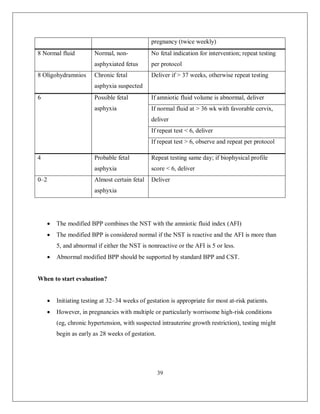
Biophysical Profile Score 
Interpretation 
Recommended Management 
10 
Normal, non- asphyxiated 
No fetal indication for intervention; repeat test weekly except in diabetic patient and prolonged
39 
pregnancy (twice weekly) 
8 Normal fluid 
Normal, non- asphyxiated fetus 
No fetal indication for intervention; repeat testing per protocol 
8 Oligohydramnios 
Chronic fetal asphyxia suspected 
Deliver if > 37 weeks, otherwise repeat testing 
6 
Possible fetal asphyxia 
If amniotic fluid volume is abnormal, deliver 
If normal fluid at > 36 wk with favorable cervix, deliver 
If repeat test < 6, deliver 
If repeat test > 6, observe and repeat per protocol 
4 
Probable fetal asphyxia 
Repeat testing same day; if biophysical profile score < 6, deliver 
0–2 
Almost certain fetal asphyxia 
Deliver 
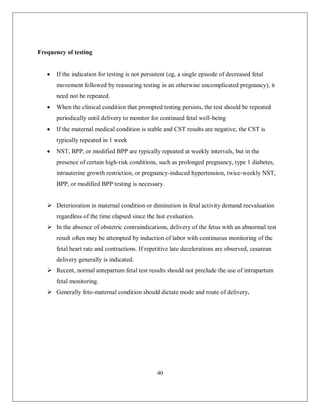
 The modified BPP combines the NST with the amniotic fluid index (AFI) 
 The modified BPP is considered normal if the NST is reactive and the AFI is more than 5, and abnormal if either the NST is nonreactive or the AFI is 5 or less. 
 Abnormal modified BPP should be supported by standard BPP and CST. 
When to start evaluation? 
 Initiating testing at 32–34 weeks of gestation is appropriate for most at-risk patients. 
 However, in pregnancies with multiple or particularly worrisome high-risk conditions (eg, chronic hypertension, with suspected intrauterine growth restriction), testing might begin as early as 28 weeks of gestation.
40 
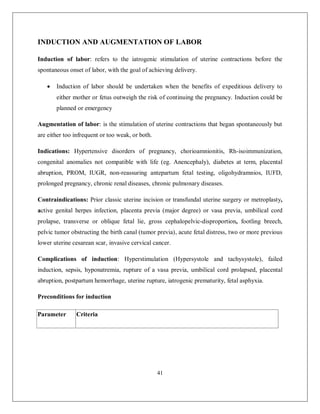
Frequency of testing 
 If the indication for testing is not persistent (eg, a single episode of decreased fetal movement followed by reassuring testing in an otherwise uncomplicated pregnancy), it need not be repeated. 
 When the clinical condition that prompted testing persists, the test should be repeated periodically until delivery to monitor for continued fetal well-being 
 If the maternal medical condition is stable and CST results are negative, the CST is typically repeated in 1 week 
 NST, BPP, or modified BPP are typically repeated at weekly intervals, but in the presence of certain high-risk conditions, such as prolonged pregnancy, type 1 diabetes, intrauterine growth restriction, or pregnancy-induced hypertension, twice-weekly NST, BPP, or modified BPP testing is necessary. 
 Deterioration in maternal condition or diminution in fetal activity demand reevaluation regardless of the time elapsed since the last evaluation. 
 In the absence of obstetric contraindications, delivery of the fetus with an abnormal test result often may be attempted by induction of labor with continuous monitoring of the fetal heart rate and contractions. If repetitive late decelerations are observed, cesarean delivery generally is indicated. 
 Recent, normal antepartum fetal test results should not preclude the use of intrapartum fetal monitoring. 
 Generally feto-maternal condition should dictate mode and route of delivery.
41 
INDUCTION AND AUGMENTATION OF LABOR 
Induction of labor: refers to the iatrogenic stimulation of uterine contractions before the spontaneous onset of labor, with the goal of achieving delivery. 
 Induction of labor should be undertaken when the benefits of expeditious delivery to either mother or fetus outweigh the risk of continuing the pregnancy. Induction could be planned or emergency 
Augmentation of labor: is the stimulation of uterine contractions that began spontaneously but are either too infrequent or too weak, or both. 
Indications: Hypertensive disorders of pregnancy, chorioamnionitis, Rh-isoimmunization, congenital anomalies not compatible with life (eg. Anencephaly), diabetes at term, placental abruption, PROM, IUGR, non-reassuring antepartum fetal testing, oligohydramnios, IUFD, prolonged pregnancy, chronic renal diseases, chronic pulmonary diseases. 
Contraindications: Prior classic uterine incision or transfundal uterine surgery or metroplasty, active genital herpes infection, placenta previa (major degree) or vasa previa, umbilical cord prolapse, transverse or oblique fetal lie, gross cephalopelvic-disproportion, footling breech, pelvic tumor obstructing the birth canal (tumor previa), acute fetal distress, two or more previous lower uterine cesarean scar, invasive cervical cancer. 
Complications of induction: Hyperstimulation (Hypersystole and tachysystole), failed induction, sepsis, hyponatremia, rupture of a vasa previa, umbilical cord prolapsed, placental abruption, postpartum hemorrhage, uterine rupture, iatrogenic prematurity, fetal asphyxia. 
Preconditions for induction Parameter Criteria
42 
Parameter Criteria 
Maternal 
Confirm indication for induction and review contraindications to labor and/or vaginal delivery 
Perform clinical pelvimetry to assess pelvic shape and adequacy of bony pelvis 
Assess cervical condition (assign Bishop score) 
Review risks, benefits and alternatives of induction of labor with patient 
Fetal/neonatal 
Confirm gestational age 
Assess need to document fetal lung maturity status 
Estimate fetal weight (either by clinical or ultrasound examination) 
Determine fetal presentation and lie 
Confirm fetal well-being 
Staff 
Ascertain availability of labor ward staff and capability to perform cesarean section 
Bishop’s pelvic scoring system 
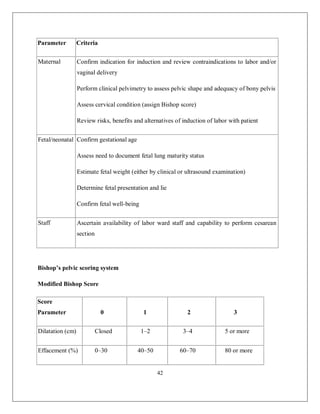
Modified Bishop Score Score Parameter 0 1 2 3 
Dilatation (cm) 
Closed 
1–2 
3–4 
5 or more 
Effacement (%) 
0–30 
40–50 
60–70 
80 or more
43 
Score Parameter 0 1 2 3 
Length * (cm) 
>4 
2–4 
1–2 
1–2 
Station 
-3 
-2 
-1 or 0 
+1 or +2 
Consistency 
Firm 
Medium 
Soft 
Cervical Position 
Posterior 
Midposition 
Anterior 
* 
This modification replaces percent effacement as one of the parameters of the Bishop score. 
 Score ≤ 4 is unfavorable or unripened 
 Score 5 – 8 is intermediate 
 Score ≥ 9 is favorable 
MODES OF INDUCTION 
Preinduction cervical ripening indicated when the Bishop’s score is ≤ 4. 
1. Prostaglandins 
PGE2 (Dinoprostone) 
 0.5 mg dinoprostone (prepidil) in 2.5 mL gel for intacervical every 6-12 hours for maximum of 1.5 mg in 24 hours till the cervix becomes favorable. Oxytocin induction will be initiated after 6-12 hours of the last dose. 
 10 mg dinoprostone vaginal insert (Cervidil), in a timed release (0.3 mg/hour) left in place for 12 hours. Oxytocin administration can be started after 30-60 minutes of removal.
44 
PGE1 (Misoprostol) 
 25 mcg intra vaginal into posterior fornix is as effective as 100 mcg po administered every 3-6 hours till cervix become favorable. Oxytocin can be initiated after 4 hours of the last dose. 
 Patient should remain recumbent for at least 30 minutes after insertion and observed. 
The fetal heart rate and uterine activity should be monitored continuously for a period of 30 minutes to 2 hours after administration of the PGE2 gel. 
2. Transcervical balloon catheter 
 Said to be as effective as prostaglandins and superior to oxytocin in preinduction cervical ripening. 
 A deflated Foley catheter, a 16 French 30 mL balloon (25-50 ml ballon), can be passed through an undilated cervix into the extra-amniotic space and then inflated with 30mL of sterile normal saline. 
 The balloon is then retracted to rest against the internal os. 
 One can just attach the catheter to the thigh. 
 The catheter can be left in place until it is extruded typically within 12 hours (should induce cervical ripening within 8-12 hours). 
 The cervix will be dilated 2-3 cm when the balloon falls out, which will make amniotomy possible, but effacement may be unchanged. 
 Remove non extruded catheters after 24 hours. 
3. Hygroscopic dilators 
 Laminaria tents are made from desiccated stems of the cold-water seaweed Laminaria digitata or L.japonica. 
 When placed in the endocervix for 6-12 hours, the laminaria increases in diameter 3-4 fold by extracting water from cervical tissues, gradually swelling and expanding the cervical canal.
45 
 Synthetic dilators like lamicel, a polyvinyl alcohol polymer sponge impregnated with 450 mg of MgSO4, and dilapan, which is made from a stable nontoxic hydrophilic polymer of polyacrylonitrile, are also noted to be highly effective in mechanical cervical dilatation. 
4. Oxytocin induction: 
 Start early in the morning (at 8 A.M) except for emergency indications. 
 Encourage the mother to empty her rectum on the day of induction 
 Light fluid diet only in the morning. 
 Follow fetomaternal conditions 
 Check recent Hematocrit 
 Oxytocin infusion: 
o Secure intravenous line with number 18 cannula 
o Dosage is the same for primigravida and multigravida 
o Increase the drop rate every 20 minutes until 3-5 contractions are achieved in 10 minutes each lasting for 40-60 seconds. 
*Add 6 IU oxytocin to 1000mL of N/S or R/L and start at 6 mu/min. increasing every 20 min. by 6 mU/min. 
Drops /min mU /min 
20 6 
40 12 
60 18 
80 24 
If no adequate contraction, add 6 IU in the same bag and start with, 
40 27 
60 40 
80 54
46 
If no adequate contraction, add 6 IU in the same bag and start with, 
60 69 
80 92 
After initiation of oxytocin infusion: 
 Follow maternal v/s and input/output 
 Don’t increase the dose of oxytocin once adequate contractions are achieved. 
 In the presence of hyperstimulation, stop infusion and restart when indicated at half the stopping dosage. Thereafter, the dosage is increased at 3 mU/min when appropriate and 1mU/min when hyperstimulation persists. 
 Continue the oxytocin for 1 – 2 hours post partum. 
*Failed induction is diagnosed when there has been no cervical change or descent of the presenting part after 6-8 hours of labor, or contraction of 3 in 10 min. has not been achieved. 
AUGMENTATION OF LABOR 
The dosage and protocol is the same to that of induction for both primigravida and multigravida.
47 
Prolonged pregnancy 
Definition: refers to a pregnancy that has extended to or beyond a gestational age of 42 weeks or 294 days from the first day of the last normal menstrual period or 40 weeks gestation from the time of conception. 
Incidence: Prolonged pregnancy complicates 3-12% of pregnancies. 
Clinical Significance of Prolonged Pregnancy 
Fetal risks: 
1. Perinatal mortality at ≥ 42 weeks of gestation is twice that at term (4 to 7 versus 2 to 3 per 1,000 deliveries) and increases fourfold at 43 weeks and five to seven-fold at 44 weeks which is associated with: Fetoplacental insufficiency, asphyxia (with and without meconium), intrauterine infection, and anencephaly. 
2. Higher incidence of macrosomia (4500 g) (2.5 to 10 versus 0.8 to 1 %) leading to complications including prolonged labor, fetopelvic disproportion, and shoulder dystocia with resultant risks of orthopedic or neurologic injury. 
3. Fetal dysmaturity (postmaturity) syndrome (20 %), which describes infants with characteristics of chronic intrauterine growth restriction from uteroplacental insufficiency. 
Maternal risks: 
 Increase in labor dystocia (9 to 12 percent postterm versus 2 to 7 percent at term), 
 Increase in severe perineal injury related to macrosomia (3.3 versus 2.6 percent at term) 
 Doubling in the rate of cesarean delivery which is associated with higher risks of complications such as endometritis, hemorrhage, and thromboembolic disease. 
Determining Gestational Age: 
 Accurate pregnancy dating is critical to the diagnosis
48 
 There are two categories of pregnancies that reach 42 completed weeks: 
1. Those truly 40 weeks past conception. 
2. Those of less advanced gestation due to inaccurate estimate of gestational age. 
Because there is no method to identify pregnancies that are truly prolonged, all pregnancies judged to be 42 completed weeks should be managed as if abnormally prolonged. 
The diagnosis of prolonged pregnancy is made by confirmation of the gestational age by referring to: 
 The first day of the LNMP to calculate the estimated date of confinement (EDC). 
 Date of quickening (maternal perception of fetal movement) and begins around 16 weeks of gestation in multigravidas and 18 weeks in primigravidas. 
 Uterine size that increases with gestational age. 
 The uterus is a pelvic organ until 12 weeks, at which time the fundus can be palpated at the level of the symphysis pubis. 
 The uterine fundus is palpable at the umbilicus around 20 weeks. 
 Between 20 and 36 weeks, the measurement of the uterus in centimeters from the symphysis pubis to the fundus approximates the gestational age within 2 weeks. 
 Fetal heart tones 
 Pinnard sthetoscope at 18-20 weeks 
 Electronic Doppler ultrasound may detect fetal heart tones as early as 10 to 11 weeks' gestation. 
 Positive pregnancy test in urine by 6 weeks from LNMP 
 Ultrasound examination 
 First trimester measurement of the crown-rump length (CRL) is accurate to within 5 to 7 days of the actual gestational age.
49 
 Second- and third-trimester ultrasound parameters for determining gestational age include biparietal diameter (BPD), femur length (FL), and abdominal circumference (AC). 
 In the second trimester, BPD is the most accurate but only to within 14 days of the actual gestational age. 
 Measurements in the third trimester may have an error up to ±21 days of the actual gestational age. 
Management 
The goal of management of prolonged pregnancy is to decrease the risk of an adverse perinatal outcome. 
Antenatal testing and induction of labor are the two most widely used strategies for management. 
1. Antenatal testing: Generally started twice weekly between 41 and 42 weeks' gestation. It can include nonstress test (NST), contraction stress test (CST), or biophysical profile (BPP) 
 Weekly NST with CST for nonreactive NST. 
 Twice weekly NST with BPP for nonreactive NST with induction for a 4/10 BPP. 
 Twice weekly NST with BPP for nonreactive NST and a weekly determination of the amniotic fluid volume. 
N.B: At each visit determining the bishop’s score should be done 
2. Induction of labor: 
 Induction of labor may be performed at 41 weeks if the cervix is favorable. 
 If the cervix is unfavorable, then expectant management with antepartum fetal surveillance should be continued. 
 Generally, at 42 weeks of gestation, if the cervix remains unfavorable, prostaglandins are administered to ripen the cervix for induction. 
 A cervix is determined to be favorable by its Bishop score. Induction is usually successful with a score of 9 or greater.
50 
 Intrapartum management includes a one-to-one Pinnard sthetoscope follow up, continuous electronic fetal heart rate monitoring.
51 
OPERATIVE VAGINAL DELIVERY 
DEFINITION: Operative vaginal delivery refers to a delivery in which the operator uses forceps or a vacuum device to assist the mother in delivering the fetus. 
INDICATIONS: ACOG outlined the following indications for operative vaginal delivery (forceps or vacuum). 
Indications for Operative Vaginal Delivery 
Type 
Indication 
Fetal 
 Presumed fetal compromise (e.g., non-reassuring fetal heart rate pattern) 
Maternal 
 Medical indications to avoid Valsalva (e.g., cardiac disease Class III or IV hypertensive crises, cerebral vascular disease, particularly uncorrected cerebral vascular malformations, myasthenia gravis, spinal cord injury) 
Prolonged second stage of labor (inadequate progress) 
 Nulliparous women: lack of continuing progress for three hours with regional anaesthesia, or two hours without regional anaesthesia 
 Multiparous women: lack of continuing progress for two hours with regional anaesthesia, or one hour without regional anaesthesia 
 Maternal fatigue/exhaustion 
Prerequisites for Operative Vaginal Delivery 
Preparation 
Essential 
Full abdominal and vaginal examination 
 Head is < 1/5 palpable per abdomen 
 Vertex presentation 
 Cervix is fully dilated (≥8 cm for ventouse) and the membranes
52 
ruptured 
 Exact position of the head can be determined* 
 Fetal size has been estimated** 
 Pelvis is deemed adequate 
Mother 
 Informed consent be obtained and clear explanation given*** 
 A pudendal block may be appropriate, particularly in the context of urgent delivery 
 Maternal bladder has been emptied recently 
 Indwelling catheter should be removed or balloon deflated 
 Aseptic techniques 
Staff 
 Operator must have the knowledge, experience, and skills necessary to use the instruments 
 Adequate facilities and back-up personnel are available 
 Back-up plan in place in case of failure to deliver 
 Anticipation of complications that may arise (e.g., shoulder dystocia, postpartum hemorrhage) 
 Personnel present who are trained in neonatal resuscitation 
*Fetal presentation, position, lie, and any asynclitism are known. The fetus must be in a vertex presentation (unless the purpose is to use forceps to assist in delivery of face presentation in mentum anterior position and an after-coming head in breech presentation).
53 
**Minimum and maximum estimated fetal weight: Instrumental delivery of the macrosomic infant (birth weight >4000 g) may be associated with an increased risk of injury. Vacuum devices should not be used to assist delivery prior to 34 weeks of gestation (mean birth weight 2500 g) because of increased risks of fetal intraventricular hemorrhage in premature infants. 
***The risks of the procedure should be explained to the woman & the informed consent discussion (with specific risks, benefits, and alternatives delineated) should be documented. 
NB: The prerequisites for application of forceps or vacuum extractor are identical. 
Mnemonic checklist: 
Think “FORCEPS” before operative vaginal delivery: 
F: The fetus is in a favorable head position, and an assessment of fetal weight and status done. 
O: The patient has a completely dilated cervical OS, and the operating room is ready if needed. 
R: Membranes are ruptured, and the patient qualifies for operative vaginal delivery under the rule of threes, defined as: "In an OA [occiput anterior] presentation, if the sum of the number of fifths of the fetal head palpated above the pelvic inlet abdominally and the degree of molding of the fetal head palpated vaginally equals or exceeds three, then attempted operative vaginal delivery is likely to be unsuccessful and should be avoided." 
C: Contractions are present, and the patient has given consent for operative vaginal delivery. 
E: The fetal head is engaged, the maternal bladder is empty, and the mother has an epidural or other anesthesia on board. 
P: The maternal pelvis is adequate for operative vaginal delivery, team is prepared for cesarean delivery, and a pediatrician is available. 
S: This stands for stirrups, a reminder to check that the patient is in the lithotomy position with her buttocks over the end of the bed. 
Contraindications:
54 
Most contraindications to instrumental delivery are related to the potential for unacceptable fetal risks. 
 Some other contraindications include: known fetal demineralizing diseases (eg. osteogenesis imperfecta), fetal bleeding diatheses (e.g., hemophilia, alloimmune thrombocytopenia), unengaged head, unknown fetal position, malpresentation (e.g., brow), and suspected feto-pelvic disproportion (FPD). 
 Vacuum devices should not be used to assist delivery prior to 34 weeks of gestation because of the risk of fetal intraventricular hemorrhage, cephalhematoma, and neonatal jaundice. Prior scalp sampling or multiple attempts at fetal scalp electrode placement are also relative contraindications to vacuum extraction since these procedures may increase the risk of cephalhematoma or external bleeding from the scalp wound. 
 Vacuum is also not recommended to perform a rotation. 
 The vacuum extractor is contraindicated with mal presentations. 
Trial of instrumental delivery: 
An operative vaginal delivery should only be considered when the likelihood of success is high. 
Variables associated with an increased risk of failed operative delivery: 
 Two common causes are occiput posterior position and macrosomia. 
 Other factors: more than one fifth of the head palpable abdominally, the presenting part only as far as the ischial spines, excessive molding of the fetal head, protracted labor, and maternal obesity. 
Classification of forceps deliveries: 
 With respect to operative vaginal delivery of the vertex, station is defined as the relationship of the estimated distance, in centimeters, between the leading bony portion of the fetal head and the level of the maternal ischial spines.
55 
Classification for Operative Vaginal Delivery 
Term 
Definition 
Outlet 
 Fetal scalp visible without separating the labia 
 Fetal skull has reached the pelvic floor 
 Sagittal suture is in the antero-posterior diameter or right or left occiput anterior or posterior position (rotation does not exceed 45 degrees) 
 Fetal head is at or on the perineum 
Low 
 Leading point of the skull (not caput) is at station + 2 cm or more and not on the pelvic floor 
 Two subdivisions: 
A. Rotation of 45 degrees or less 
B. Rotation more than 45 degrees 
Mid 
High 
 Better not be done in our setup 
 Not included in the classification 
Choice of instrument: 
 The choice of instrument is determined by level of training with the various forceps and vacuum equipment. 
 In general, vacuum devices are easier to apply, place less force on the fetal head, require less maternal anesthesia, result in less maternal soft tissue trauma, and do not affect the diameter of the fetal head compared to forceps.
56 
 By comparison, the advantages of forceps are that they are unlikely to detach from the head, can be sized to a premature cranium, may be used for a rotation, result in less cephalhematoma and retinal hemorrhage, and do not aggravate bleeding from scalp lacerations. 
 Vacuum delivery is probably safer than forceps for the mother, while forceps are probably safer than vacuum for the fetus. 
Vacuum: 
 Soft vacuum extractor cups (silicone, plastic, rubber) are more likely to fail in achieving vaginal delivery than rigid (metal, plastic). 
 Soft cups are associated with fewer scalp injuries & no differences between groups in regard to maternal injury. 
 Metal or rigid cups are more suitable for occiput posterior, transverse, and difficult occiput anterior deliveries, whereas the soft cups are appropriate for uncomplicated deliveries. 
Forceps: 
 In general, the instrument selected should have cephalic and pelvic curves appropriate to the size and shape of the fetal head, maternal pelvis, and planned procedure. 
 Simpson type forceps tend to fit a long molded head, Elliott or Tucker-McLane type forceps are better suited to a round unmolded head, Kielland forceps are useful for rotations because of their minimal pelvic curve and sliding lock, and Piper forceps is used for after coming head in breech presentation. 
APPLICATION: 
Forceps: Appropriately applied forceps grasp the occiput anterior (OA) fetal head such that: 
 The long axis of the blades corresponds to the occipitomental diameter
57 
 The tips of the blades lie over the cheeks 
 The blades are equidistant from the sagittal suture, which should bisect a horizontal plane through the shanks 
 The posterior fontanelle should be one finger breadth anterior to this plane 
 Fenestrated blades should admit no more than one finger breadth between the heel of the fenestration and the fetal head 
 No maternal tissue has been grasped. 
To reduce the risk of laceration, forceps are disarticulated and removed when expulsion is certain but before the widest diameter of the fetal head passes through the introitus. 
Vacuum: 
 Successful use of the vacuum extractor is determined by proper application on the fetal head and traction within the pelvic axis. 
 The leading point of the fetal head is the ideal position for vacuum cup placement. It is labeled the flexion point or pivot point and is located on the sagittal suture 2 to 3 cm anterior to the posterior fontanele. Placement of the vacuum cup over the pivot point maintains the attitude of flexion for a well-flexed head and creates flexion in a deflexed head if traction is applied correctly. 
Traction: 
 Traction with forceps (or vacuum) should be steady (not rocking) and in the line of the birth canal. 
 Traction should be exerted with each contraction and in conjunction with maternal expulsive efforts; the forceps can be relaxed between contractions to reduce fetal cranial compression.
58 
 In most cases, progress is noted with the first or second pull and delivery occurs by the third pull. 
When to abandon operative delivery: 
 The decision to proceed with operative vaginal delivery is ongoing, decided moment by moment based on assessment of the success of the various steps in the procedure. 
 Operative vaginal delivery should be abandoned where there is no evidence of progressive descent with each pull or where delivery is not imminent following three pulls of a correctly applied instrument by an experienced operator. 
 Operative vaginal delivery should be abandoned if it is difficult to apply the instrument, descent does not easily proceed with traction, or the baby has not been delivered within a reasonable time (15 to 20 minutes). 
 If descent has occurred and delivery is clearly imminent, then proceeding with instrumental delivery after three pulls may be appropriate and less morbid than a cesarean delivery of an infant with its head on the perineum. 
 The operator should not be fixated on effecting a vaginal delivery. 
Sequential attempts at instrumental delivery: 
 ACOG has suggested that multiple attempts at operative vaginal delivery using different instruments (vacuum, different types of forceps) be avoided due to the greater potential for maternal and/or fetal injury. 
 It should not be considered as sequential delivery in situations where proper placement of forceps cannot be achieved or a vacuum device fails to achieve suction and no traction has been applied and then a second instrument is used. 
Should prophylactic antibiotics be given? 
 No sufficient data to make recommendations on prophylactic antibiotics in operative vaginal delivery.
59 
Risks of operative vaginal deliveries: 
Maternal complications 
Short-term: pain at delivery, lower genital tract lacerations and hematomas (periurethral/labial laceration, vaginal laceration, 3rd or 4th degree perineal laceration, vulvar or vaginal hematomas, or cervical lacerations), urinary retention and incontinence, anemia, anal incontinence. 
Severe maternal trauma is primarily associated with rotational and midforceps operations; direct bladder injury, ureteral lacerations/transections, and uterine rupture have been reported in such cases. 
Fetal position also has an impact on the risk of maternal trauma during delivery. The rate of rectal injury is higher for instrumental delivery from the occiput posterior (OP) compared with the occiput anterior (OA) position. 
Long-term: Long-term maternal sequelae from operative delivery are primarily related to potential disturbances in urinary and anal function, such as urinary incontinence, fecal incontinence, pelvic organ prolapse, and, occasionally, fistula formation. 
Neonatal complications 
Short-term: are usually caused by head compression and traction on the fetal intracranial structures, face, and scalp. The most serious complication is intracranial hemorrhage. Others: bruises and lacerations, facial nerve palsy, cephalhematoma, retinal hemorrhage, subgaleal hemorrhage, and skull fracture. 
Long-term: intracranial hemorrhage (subdural, subarachnoid, intraventricular and/or intraparenchymal hemorrhage) and neuromuscular injury. 
Developmental outcome appears to be equivalent for both forceps and vacuum assisted births.
60 
MALPRESENTATIONS 
Etiologies: High parity, pelvic tumors, pelvic contracture, uterine malformation, prematurity, multiple gestations, polyhydramnios, macrosomia, hydrocephaly, trisomies, anencephaly, myotonic dystrophy, placenta previa. 
Deflection attitudes 
 “Attitude” refers to the position of the fetal head in relation to the trunk. 
 The normal attitude of the fetal vertex during labor is one of full flexion on the neck, with the fetal chin against the upper chest. 
 Deflexed attitudes include various degrees of deflection or even extension of the fetal head on the neck. 
 Spontaneous conversion to a more normal flexed attitude or further extension of an intermediate deflection to a fully extended position commonly occurs as labor progresses owing to resistance exerted by the bony pelvis and soft tissues. 
 Although safe vaginal delivery is possible in many cases, experience indicates that cesarean delivery is the only appropriate alternative when arrest of progress is observed. 
Face presentation 
 Face presentation is characterized by a longitudinal lie and full extension of the fetal head on the neck, with the occiput against the upper back. 
 The fetal chin (mentum) is chosen as the point of designation during vaginal examination. 
 The reported incidence of face presentation is about 0.2 percent, or 1 in 500 live births overall. 
 The diagnosis can be suspected anytime abdominal palpation finds the fetal cephalic prominence on the same side of the fetal back; however, face presentation is more often discovered by vaginal examination. 
 Less than 1 in 20 infants with face presentation are diagnosed by abdominal examination.
61 
 At diagnosis, 60 to 80 percent of infants with a face presentation are mentum anterior, 10 to 12 percent are mentum transverse, and 20 to 25 percent are mentum posterior. 
 Most mentum transverse and 25 to 33 percent of mentum posterior fetuses will rotate and deliver vaginally in the mentum anterior position. 
 Prolonged labor is a common feature of face presentation. Therefore, prompt attention to an arrested labor pattern is recommended. 
 In the case of an average or small fetus, adequate pelvis, and hypotonic labor, in mentum anterior position oxytocin may be considered with strict follow up, but an arrest of progress despite adequate labor should call for cesarean delivery. 
 Continuous intrapartum electronic (one-to-one Pinnard stethoscope) fetal heart rate monitoring of a fetus with face presentation is considered mandatory. 
 Cesarean delivery is warranted if a non-reassuring heart rate pattern is identified, even if sufficient progress in labor is occurring. 
 Safe vaginal delivery may be accomplished in many cases of face presentation, and a trial of labor with careful monitoring of fetal condition and labor progress is not contraindicated unless macrosomia or a small maternal pelvis is identified. 
Brow presentation 
 The reported incidence of brow presentation is about 1 in 1,500 deliveries 
Diagnosis: 
 Diagnosed when portion of the fetal head between the orbital ridge and the anterior fontanel presents at the pelvic inlet. 
 Fetal head occupies a position midway between full flexion (occiput) and extension (mentum or face). 
 Except when the fetal head is small or the pelvis is unusually large, engagement of the fetal head and subsequent delivery cannot take place as long as the brow presentation persists. 
 The frontal bones (frontum) are the point of designation.
62 
 Brow presentation is detected more often in early labor before flexion occurs to a normal attitude. Less frequently, further extension results in a face presentation. 
 In general, factors that delay engagement are associated with persistent brow presentation. Cephalopelvic disproportion, prematurity, and great parity are found in more than 2/3 of cases with persistent brow presentation. 
 Brow presentation is detected on vaginal examination. 
 A persistent brow presentation requires engagement and descent of the largest (mento- occipital) diameter or profile of the fetal head. 
 One cause of persistent brow presentation may be an open fetal mouth pressed against the vaginal wall, splinting the head and preventing either flexion or extension. 
 Expectant management may be justified only with a large pelvis, a small fetus, and adequate progress of labor. 
 Consideration of a trial of labor with careful monitoring of maternal and fetal conditions over 4 – 6 hours may be appropriate. 
 If a brow presentation persists with a large baby, successful vaginal delivery is unlikely, and cesarean delivery may be most prudent. 
Compound presentation 
 An extremity prolapses alongside the presenting part, with both presenting in the pelvis simultaneously. 
 Its incidence is about 1 in 1000. 
 Causes of compound presentations are conditions that prevent complete occlusion of the pelvic inlet by the fetal head, including preterm birth. 
 The combination of an upper extremity and the vertex is the most common. 
 This diagnosis should be suspected with any arrest of labor in the active phase or failure to engage during active labor. 
 Diagnosis is made by vaginal examination by discovery of an irregular mobile tissue mass adjacent to the larger presenting part. 
 The very small premature fetus is at great risk of persistent compound presentation.
63 
 In late pregnancy, external cephalic version of a fetus in breech position increases the risk of a compound presentation. 
 Fetal risk in compound presentation is specifically associated with birth trauma, cord prolapse (11 – 20%), neurologic and musculoskeletal damage to the involved extremity. 
 Maternal risks include soft tissue damage and obstetric laceration. 
 Labor is not necessarily contraindicated with a compound presentation; however, the prolapsed extremity should not be manipulated. The accompanying extremity may retract as the major presenting part descends. 
 Seventy-five percent of vertex/upper extremity combinations deliver spontaneously. 
 Occult or undetected cord prolapse is possible, and therefore, continuous electronic (one- to-one Pinnard stethoscope) fetal heart rate monitoring is recommended. 
 The primary indications for surgical intervention are cord prolapse, non-reassuring fetal heart rate patterns, and arrest of labor. 
Breech presentation 
 The infant presenting as a breech occupies a longitudinal axis with the cephalic pole in the uterine fundus. 
 Occurs in 3 - 4 % of labors overall. 
 The three types of breech presentations are: Frank breech (flexed at the hips with extended knees), complete breech (flexed at both hip and knee joints), and footling breech (one or both hips partially or fully extended). 
Diagnosis: abdominal palpation or vaginal examination and ultrasound to confirm the diagnosis 
 The hard, round, readily ballotable fetal head is found to occupy the fundus. 
 If engagement has not occurred, the breech is movable above the pelvic inlet. 
 Fetal heart sounds usually are heard loudest slightly above the umbilicus. 
Vaginal examination
64 
 With the frank breech presentation, ischial tuberosities, the sacrum, and the anus usually are palpable, and after further descent, the external genitalia may be distinguished. The most accurate information, however, is based on the location of the sacrum and its spinous processes, which establishes the diagnosis of position and variety. 
 In complete breech presentations, the feet may be felt alongside the buttocks, and 
 In footling presentations, one or both feet are inferior to the buttocks. In footling presentations, the foot can readily be identified as right or left on the basis of the relation to the great toe. When the breech has descended further into the pelvic cavity, the genitalia may be felt. 
Ultrasonography: 
 It confirms the clinical diagnosis 
 It can detect fetal congenital abnormality, congenital anomalies of the uterus, & placenta location. 
 It measures GA & approximate weight of the fetus 
 Attitude of the fetus 
Positions: The sacrum is the denominator of breech; L.S.A (the commonest), R.S.A, R.S.P, and L.S.P 
Antenatal management: 
 Identification of complicating factors associated with breech 
 External cephalic version, if not contraindicated 
 Formulation of the line of management, if version fails or is contraindicated 
1. ECV: To minimize the high perinatal mortality associated with vaginal breech delivery and to reduce the risk of cesarean section. 
 The success rate of version is about 60%.
65 
 It can be considered at 35 - 37 weeks but can be attempted at any time there after up to early labor. 
 Hypertonus or irritable uterus can be overcome with the use of tocolytic drugs. 
 Successful version is likely in cases of: Complete breech, non-engaged breech, sacroanterior position (fetal back anterior), adequate liquor, non obese patient. 
 Contraindications to ECV: APH, major congenital abnormalities of the fetus, IUFD, hyperextension of the head, IUGR, multiple pregnancy, ruptured membranes, known congenital malformation of the uterus, contracted pelvis, previous C/S, severe pre- eclampsia, obesity, elderly primigravida, bad obstetric history 
 Dangers of version: Preterm labor and PROM, placental abruption, cord entanglement, cord knotting and fetal death, increased chance of fetomaternal bleeding (immunoprophylaxis with anti-D gamma globulin for RH-negative mothers), amniotic fluid embolism 
3. Management of breech presentation if version fails or is contraindicated: 
 Pregnancy is to be continued with usual check up, and spontaneous version may occur. 
 If breech persists, do elective C/S or allow spontaneous labor to start and vaginal breech delivery to occur. 
 Indications for cesarean delivery: 
 Big baby ( EFW > 3500 gms) 
 Hyper extension of the head 
 Footling breech presentation 
 Suspected pelvic contraction 
 Any associated obstetric complication 
 Delivery of preterm breech (weight < 1500 gms) 
 Vaginal breech delivery is considered in those with: 
 Adequate pelvis
66 
 Average fetal weight(1500 - 3500 gms) 
 Flexed head and without any other complication ( frank breech is preferred) 
 A woman with a fetus presenting as a breech should not be allowed to labor unless: 
 Anesthesia coverage is immediately available 
 Cesarean delivery can be undertaken promptly 
 Continuous fetal heart rate monitoring or one-to-one pinnard sthetoscope follow up is used 
 The delivery is attended by someone who is experienced with vaginal breech delivery. 
Management of vaginal breech delivery 
First stage: 
 Spontaneous onset of labor increases the chance of successful vaginal delivery 
 Vaginal examination is indicated at the onset of labor for pelvic assessment and soon after rupture of fetal membranes to exclude cord prolapse. 
 Secure I.V- line with crystalloid, avoid oral intake and determine Hct & blood group. 
 Monitor fetal status and progress of labor. 
Second stage: 
 Methods of vaginal breech delivery: 
 Spontaneous (10%): this is not preferred 
 Assisted breech delivery: delivery is assisted from the beginning to the end. This method should be employed in all cases 
 Breech extraction: when the entire body of the fetus is extracted by the obstetrician. Indication is only in the delivery of the second twin after internal podalic version as a life saving procedure when c/d is not possible.
67 
Assisted breech delivery: 
 Episiotomy is done when required as the bitrochanteric diameter of the fetus crowns 
 Don’t touch the fetus until the buttocks are delivered along with the legs in flexed breech and the trunk slips up to the umbilicus. 
 The Pinnard maneuver may be needed to facilitate delivery of the legs in a frank breech presentation, pressure is applied to the medial aspect of the knee, which causes flexion and subsequent delivery of the lower leg. 
 A cardinal rule in successful breech delivery is to employ steady, gentle, downward rotational traction until the lower halves of the scapulae are delivered outside the vulva, making no attempt at delivery of the shoulders and arms until one axilla becomes visible. 
 Deliver the anterior shoulder first, but if rotation is difficult deliver the posterior shoulder first. 
 Louvset’s maneuver can be used when one or both arms may be fully stretched along the side of the head or lie behind the neck (nuchal displacement) resulting in arrest with delivery of the trunk up to the costal margins. 
 Then the baby is wrapped with sterile towel. 
Delivery of the after coming head: 
 The fetal head may be extracted with Piper forceps or by one of the following maneuvers: 
1. Mauriceau – Smellie - Veit (MSV) Maneuver (Malar flexion and shoulder traction): 
 The index and middle fingers of one hand are applied over the maxilla, to flex the head, while the fetal body rests on the palm of the hand and forearm. 
 Gentle suprapubic pressure simultaneously applied by an assistant helps keep the head flexed. 
 The body then is elevated toward the maternal abdomen.
68 
2. Prague Maneuver 
 Rarely, the back of the fetus fails to rotate to the anterior. 
 Posteriorly, extraction may be accomplished using the MSV maneuver and delivering the fetus back down. If this is impossible, 
 Modified Prague maneuver: two fingers of one hand grasping the shoulders of the back-down fetus from below while the other hand draws the feet up over the maternal abdomen. 
3. Forceps for after-coming head 
 Specialized forceps can be used to deliver the after-coming head. 
 Piper forceps may be applied electively or when the MSV maneuver cannot be accomplished easily. 
4. Burn Marshal Method: down ward traction of the fetus till the fetal occiput, then rotating the fetal back towards the maternal abdomen with gentle traction and an assistant applying suprapubic pressure to facilitate flexion. 
Entrapment of the After-coming Head: 
 With gentle traction on the fetal body, the cervix, at times, may be manually slipped over the occiput. If this is not successful, then 
 Dührssen incision is usually necessary, which is usually done at 2 and 10 O’clock positions on the cervix. 
 Zavanelli maneuver: Replacement of the fetus higher into the vagina and uterus, followed by cesarean delivery, but these days it is obsolete. 
 Symphysiotomy is used to widen the anterior pelvis. 
Habitual / recurrent breech: When it recurs in three or more consecutive pregnancies. The probable causes are uterine malformation & repeated cornu-fundal attachment of the placenta.
69 
ANTENATAL CARE (ANC) 
 ANC is the health care given to a pregnant woman so as to ensure the birth of healthy baby with minimal health risk to the mother. 
 Thus it is a goal oriented with interventions to achieve the medical and psychological needs of pregnant women, which have proven values. 
 Its strategies target pregnant women to help them maintain normal pregnancies & delivery through: 
 Identification of pre-existing health conditions 
 Early detection of complications arising during pregnancy 
 Health promotion & disease prevention 
 Birth preparedness and complication readiness planning 
I) Identification of pre-existing health conditions; current health & pregnancy status of the women 
 Can be identified during initial assessment (1st visit); regardless of trimesters through; detailed history, examinations, and laboratory investigations during subsequent visits. 
Detailed History: 
Includes: 
 Identification: age, address, religion, educational status… 
 HPP: gravidity, parity, abortions… 
 LNMP date (if known), assess reliability of menses, calculate GA & EDD 
 Is the current pregnancy planned/unplanned, wanted/ unwanted, supported / unsupported? 
 Symptoms & signs of pregnancy (if early) 
 Date of quickening 
 Vaginal bleeding, discharge, leakage of liquor
70 
 Any complaint or concerns. 
 Past obstetric History: 
 All previous pregnancies in detail 
 Complications which can recur or have an impact on current pregnancy 
 Complications / health problems during: 
 Antepartum: Preterm labour, APH, Preeclampsia/ eclampsia, PROM 
 Intrapartum: Prolonged labor, mode of delivery (SVD, C/D, instrumental vaginal delivery, repaired uterine rupture), place of delivery, birth outcome (Preterm/term/post-term, Alive/dead, birth weight, congenital anomaly) 
 Postpartum: PPH, infections, ENND 
 Past Gynaecologic History: 
 History of: Female genital mutilation, ectopic pregnancy, STIs & HIV (personal & of the partner), gynecologic operations; myomectomy, removal of septum, fistula repair, cone biopsy, cervical cerclage. 
 Past medical & surgical History: 
 History of: Malaria infection, heart disease, renal disease, anemia, DM, tuberculosis, chronic HTN. 
 Personal, Social & Family History: 
 Family history of: DM, HTN, multiple pregnancies, congenital anomaly. 
 Personal habits of: Smoking, alcohol drinking, illicit drug use. 
Physical Examination focusing on: 
 G/A 
 V/S: BP, PR, RR, Temperature, weight including pre-pregnancy weight, height, BMI. 
 HEENT:- Clinical signs of anemia, icterus, edema 
 Glands: - breasts, thyroid gland, Lymph nodes 
 Abdomen: 
 As in general medical examination of the abdomen 
 Obstetric examination: 
- Uterine size in Weeks (symphysis - fundal height in cm) 
- Fetal presentation, lie, attitude, descent, multiple fetal parts & FHB
71 
 GUS: CVA tenderness, vulvar ulcer, discharge, speculum examination: Evaluation of the vagina & cervix 
- Digital pelvic examination (when indicated); pelvic mass. 
 Signs of violence 
 MSS: edema (site/type, grade) 
 CNS: consciousness, orientation. 
Laboratory Investigation: 
Basic investigations/initial screening should include the following studies: 
 Hct/Hgb level 
 Blood group & Rh 
 U/A for : protienuria, glucose, ketone, infection 
 Serologic examination for syphilis, HBSAg 
 PICT 
 Other investigations as indicated 
II) Early detection of Complications arising during pregnancy 
 Timing: during initial evaluation & during subsequent visits 
 Talk with her & examine her for problems of pregnancy that might need treatment & closer monitoring: Anemia, infection, vaginal bleeding, HDP, abnormal fetal growth & presentations (after 36 weeks) 
History: - Revise history for pre-existing conditions previously identified 
- Ask for: Complaints & concerns, danger signs and symptoms of pregnancy, fetal movements, social support/physical abuse 
Physical Examination: As in initial examination emphasize on: 
 G/A 
 V/S: BP with notation of any change, weight gain (both excessive or under weight gain is dangerous) 
 HEENT: Clinical signs of anemia & edema, icterus
72 
 Systemic examination 
 Abdominal Examination: Obstetric examinations: Uterine fundal height measurement (Weeks/ Cms), fetal presentation, Lie, FHB & fetal well being assessments 
 Signs of physical abuse 
 GUS: CVA tenderness, pelvic examination if indicated 
Laboratory Investigations: 
 Basic laboratory investigations if not done previously 
 Repeat these during 3rd trimester: Hgb/Hct level, DM screening with 1 hr GTT, repeat antibody test in un-sensitized patient who are Rh –ve at 28- 30 Wks. 
 Other investigations based on indications. 
III) Health promotion, Disease prevention & Provision of care 
 Should be provided at each visits 
 Includes counseling, early recognition/detection of complications of pregnancy, provision of care for disease prevention & treatment of identified health problems 
 Counsel about important issues affecting health of the mother & the new born: 
 Danger symptoms & signs of pregnancy: Complication during pregnancy & labor, how to recognize the problems, what to do if encountered, and where to get help. 
 Nutrition: The importance of good nutrition, how to get enough calories & essential nutrients for a healthy pregnancy, micronutrient supplements. 
 Risk of: Tobacco smoking, alcohol drinking, chat chewing, medications & local drugs 
 Rest, activities, avoidance of heavy physical work & sexuality 
 Transportation 
 Personal hygiene, prevention of infections 
 Family planning: Benefit of child spacing, options of family planning services 
 BF: Health & practical benefits, exclusive breast-feeding, importance of breast- feeding immediately after delivery
73 
 HIV & other STIs: Condom’s dual protection, other measures of protection, availability & benefits of testing (including her partner), specific issues related to MTCT & living with AIDS (after positive test result) 
 Provide: Treatment for identified problems, immunization for tetanus HBV, PMTCT, Fe &Folic acid supplementations (folate supplementation prior to conception & throughout first trimester), malaria prophylaxis, and intestinal parasites treatment. 
 Next appointment/visit: Importance of next visits, timing should be individualized according to the risk identified, for pregnancies in which no risk identified follow the countries schedule recommendations 
NB: In addition to the above, at each visits look for and manage risk factors & complications of pregnancy 
IV) Birth preparedness & complication Readiness 
 Discuss and help her in: 
 Preparation for child birth 
 Making arrangements for her new born 
 Need for safe & clean delivery 
 Plan for: Skilled provider to be at birth, place for birth & how to get there 
 Items needed for the birth like money 
 Support from family, neighbors, & community who accompany her 
Frequency of Visits 
 The current available evidence based studies showed that decreasing the number of visits need not compromise maternal & fetal out come. Thus; 
 Reduced number of visits can be safely applied to apparently low risk pregnancies in resource limited setting. 
 WHO recommends a minimum of 4 visits for pregnancies in which risks not identified. 
 Our country has adopted this recommendation and MOH has established this system in health institutions giving ANC.
74 
 Remark: pre-existing maternal health conditions, disease status developing during pregnancy and complications of pregnancy could dictate more frequent visits and 
 They should visit health institution if any complaints or problems encountered. 
Schedules/visits for pregnancies in which risks not identified: 
No. of Visit 
Timing 
1st visit 
Missed period to Better before 16 wks 
2nd visit 
Better 24-28 wks 
3rd visit 
Better 30-32 wks 
4th visit 
Better 36-40 wks 
Minimum services and health care needed to be given during follow- up for current pregnancy recommended by FMOH: 
Activities 
Visits 
1st visit 
2nd visit 
3rd visit 
4th visit 
Date of visit 
GA in completed Wks ( from LNMP) 
BP( mm Hg) 
Weight (Kg) 
Pallor 
Uterine heights(wks) 
Fetal heart beat 
Presentation 
U/A-infection 
U/A-protein 
VDRL 
Hgb/Hct level
75 
Blood Group & Rh 
TT dose 
Iron/folic acid 
Mebendazole 
Use of ITN 
ARV Px (type) 
Danger sign identified & investigation: 
Action, advice and counseling given 
Appointment for next follow-up 
Remark 
Name & signature of care provider 
* Shaded = Not to be done / given.
76 
DIABETES IN PREGNANCY 
Diabetes is complicates 2-3% of pregnancies and 90% of the cases represent women with GDM. 
CLASSIFICATION 
 Pregestational diabetes: diabetes which is diagnosed before pregnancy. It includes type 1 or type 2. 
 Gestational diabetes (GDM): defined as any degree of glucose intolerance with onset or first recognition during pregnancy. 
 During pregnancy, classification of women with diabetes has often relied on the White classification. 
DIAGNOSIS 
Pre gestational or overt diabetes during pregnancy 
 Symptoms of diabetes plus RBS (random plasma glucose) of ≥ 200mg/dL or 
 Fasting plasma glucose ≥ 126mg/dL or 
 2 hr plasma glucose ≥ 200mg/dL. 
Gestational diabetes mellitus 
 Requires glucose challenge test (GCT) followed by OGTT. 
 While universal screening is the most sensitive approach, selective screening is employed based on risk assessment in our country. 
Recommended Screening Strategy Based on Risk Assessment for Detecting Gestational Diabetes 
Low Risk Blood glucose testing not routinely required if all of the following characteristics are present:
77 
Member of an ethnic group with a low prevalence of gestational diabetes No known diabetes in first-degree relatives Age less than 25 years Weight normal before pregnancy No history of abnormal glucose metabolism No history of poor obstetrical outcome Average Risk Perform blood glucose testing at 24–28 weeks using one of the following: Average risk—women of Hispanic, African, Native American, South or East Asian origins High Risk - women with marked obesity, strong family history of type 2 diabetes, prior gestational diabetes, or glucosuria Perform blood glucose testing as soon as feasible. If gestational diabetes is not diagnosed, blood glucose testing should be repeated at 24–28 weeks or at any time a patient has symptoms or signs suggestive of hyperglycemia 
SCREENING PROTOCOL FOR GDM 
 The 50-g glucose challenge may be performed in the fasting or fed state. Sensitivity is improved if the test is performed in the fasting state. 
 A one hour plasma value >130 mg/dl is commonly used as a threshold for performing a 3-hour oral GTT
78 
 The 100-g 3-hour oral glucose tolerance test performed after an overnight fast remains the standard. 
Oral GTT [*] National Diabetic plasma Data Group (NDDG) 
Fasting 105 
1-hour 190 
2-hour 165 
3-hour 145 
* Diagnosis of gestational diabetes is made when any two or more values are met or exceeded. If only one value is met, the test be repeated in a month’s time. 
Treatment of GDM 
The mainstay of treatment is: 
 Nutritional counseling 
 Exercise? 
 Dietary intervention and 
 Surveillance of blood glucose levels (weekly FBS/ postprandial) 
Initiate insulin if: 
 Fasting glucose level is above 105 mg/dL or 2 hours postprandial is >120 mg/dL after 2 weeks of non-drug treatment. 
Glucose monitoring 
 Frequent self–blood glucose monitoring is fundamental to achieve the therapeutic objective of physiologic glucose control. 
 Glucose determinations are made in the fasting state and before lunch, dinner, and bedtime.
79 
Patient-Monitored Capillary Blood Glucose Goals During Pregnancy in Diabetic Women 
Specimen Blood Glucose (mg/dL) Fasting 60 –90 Premeal 60 –105 Postprandial 1 hr 100 –120 
Dietary treatment 
 Caloric requirements during pregnancy are increased by about 300 kcal above basal daily needs in non-pregnant women. Calorie allotment is based upon ideal body weight. 
 The suggested caloric intake is approximately: 
 30 to 35 kcal/kg/day in pregnant women with BMI 22 to 27. 
 24 kcal/kg/day in overweight pregnant women (BMI 27 to 29). 
 12 to 15 kcal/kg/day for obese pregnant women (BMI >30). 
 30 to 40 kcal/kg/day in pregnant women with BMI < 22. 
 Dietary composition should be: 
 50 to 60 percent carbohydrate, 
 20 percent protein, 
 25 to 30 percent fat with less than 10 percent saturated fat. 
 A program consisting of three meals and several snacks is employed for most patients. 
 Folic acid supplementation (pre-conceptional & during pregnancy). 
Exercise
80 
 Brisk walking for 30 minutes at least three times each week may be recommended, if no vascular complications and no obstetric contraindications (HDOP, APH, PROM, etc). 
Insulin therapy 
 In GDM, start insulin when FBS > 105 mg/dL or 1 hr postprandial blood glucose concentration ≥ 120 mg/dL on two or more occasions within a two-week interval despite dietary therapy. 
 The average insulin requirement is 0.7U/kg in the 1st trimester, 0.8U/kg for weeks 13 – 28, 0.9U/kg for weeks 29-34, 1U/kg for weeks 35 – term. In obese women the initial dose may be higher. 
 A combination of intermediate acting (2/3) and short acting (1/3) insulin is good to maintain glucose in acceptable range. 
 Once daily dose before breakfast is commonly used to initiate therapy. 
Obstetric management of diabetes in pregnancy 
First trimester 
 Obtain menstrual history and assess for complications of DM. 
 Perform routine prenatal laboratory evaluations. 
 Glycosylated hemoglobin concentration to counseling her regarding the risks of miscarriage and congenital malformations. 
 RFT, urinary protein – creatinine ratio. 
 TSH and free T4. 
 Ophthalmologic evaluation. 
 First trimester Ultrasound for fetal viability and dating. 
 Emphasize the importance of strict adherence to diet, exercise and medication, self- monitoring of blood glucose, and the need for frequent prenatal visits and intensive fetal surveillance later in pregnancy. 
 During each visit, patient should have evaluation for BP, weight gain, U/A, blood glucose determination.
81 
Second trimester 
 Seen every 2-4 weeks, more frequent if any complication also can be individualized based on glycemic control. 
 Maternal Serum Alpha Feto-Protein screening at 14-22 weeks. 
 Measurement of SFH to assess fetal growth. 
 Ultrasound for anatomic scanning to detect congenital anomalies. 
 And also fetal echocardiography. 
Third trimester 
 Seen every 1-2 weeks until 36 weeks, then weekly until delivery. 
The major concerns of the third trimester are: 
 Continued close monitoring of maternal blood glucose levels 
 Fetal testing and monitoring to minimize the risk of intrauterine fetal demise 
 Monitoring for obstetrical or medical complications necessitating premature delivery 
 Evaluation for excessive or insufficient growth (IUGR or LGA). 
 Ante partum fetal surveillance: start at 32 wks of gestation, twice weekly from 36 weeks until delivery. 
Timing and route of delivery 
 Delivery should be delayed until fetal maturation has taken place, provided that the patient's diabetes is well controlled and ante partum surveillance remains normal. 
 Elective induction of labor is often planned at 38 1/2 to 40 weeks' gestation in well- controlled patients without vascular disease. 
 Before elective delivery prior to 39 weeks' gestation, an amniocentesis be performed to document fetal pulmonary maturity.
82 
Indication for immediate delivery in diabetic pregnancy 
 Hypertension worsens, 
 Significant fetal growth restriction, 
 Biophysical testing mandates early delivery 
 Worsening renal function, 
 Deteriorating vision secondary to proliferative retinopathy. 
 Cesarean section is considered when estimated fetal weight is > 4,500gms. 
Glucoregulation during labor and delivery 
 Morning dose of insulin is withheld. 
 Intravenous infusion of normal saline is begun at 125mL/hr. 
 Begin oxytocin as needed. 
 Monitor blood glucose level every 1-2 hrs. 
 Adjust insulin infusion as follows: 
Blood Glucose (mg/dL) 
Insulin Dosage* (U/hr) 
Intravenous Fluids (125 mL/hr) 
<100 
0 
D5 lactated Ringer 
100–140 
1.0 
D5 lactated Ringer 
141–180 
1.5 
Normal saline 
181–220 
2.0 
Normal saline
83 
> 220 
2.5 
Normal saline 
*Dilution is 25 U of regular insulin in 250 mL of normal saline with 25 mL flushed through line administered intravenously. A finger stick glucose test is performed every 1 to 2 hours. The insulin pump and intravenous solution are adjusted accordingly. 
Postpartum 
 GDM – blood glucose measurement on first postpartum day and at six weeks. 
 Type 1 or type 2 - one third to one half of their end of pregnancy dose of insulin. 
 Screen and treat hypoglycemia in the neonate as it occurs in 50% and 40% in mother with GDM and pregestational DM respectively. 
 Women diagnosed with gestational diabetes undergo evaluation with a 75-g oral glucose tolerance test at 6 to 12 weeks after delivery. Criteria for diagnosis are the same to non pregnant. 
 If the result of postpartum OGTT is abnormal, refer to diabetic unit. 
 If normal, advise on the risks: 
1. GDM will recur in 33- 66%. 
2. Overt DM over the next 20 years ~ 50- 70%. 
 Encourage on Weight loss and exercise to prevent GDM in those with normal OGTT. 
 Reassessment of glycemia should be undertaken at three year intervals, at a minimum, and more often if symptoms suggestive of hyperglycemia develop. 
 In women who did not undergo screening for GDM, but diabetes is suspected postpartum because of infant outcome, postpartum screening for diabetes may be considered. 
Preconceptional counseling, evaluation and care of diabetic patients: 
 History and physical examination 
 Hypertension control 
 Risk reduction 
 Eye evaluation by Ophthalmologist
84 
 Evaluation for organ involvement (heart, renal). 
 TSH, T3, T4. 
 Self glucose monitoring as well as the need for proper dietary management. 
 Folic acid dietary supplementation. 
 Glycosylated hemoglobin measurements less than 1 percent above the upper limit of the normal range. 
Recommendations on contraception 
 Barrier methods safe and inexpensive. 
 Intrauterine device may be used without concerns about an increased risk of infection 
 Low-dose OCs should probably be restricted to patients without serious vascular complications; with complications progestin only may be considered. 
 Permanent method of contraceptions is ideal. 
POSTPARTUM HEMORRHAGE (PPH) 
Definition: Excessive bleeding following delivery (>500 ml in vaginal delivery, >1000 ml in CD and twin vaginal deliveries, >1500 ml following cesarean hysterectomy) or a drop in Hct > 10% from baseline or derangement in vital sign following bleeding after delivery. 
Early PPH: Blood loss during the first 24hrs after delivery. 
Late PPH: Blood loss between 24hrs and 6wks after delivery.
85 
ETIOLOGY 
1. Uterine atony (50%) 
 Uterine atony exists when myometrium cannot contract. 
 Predisposing factors: Excessive manipulation, general anesthesia (halothane), uterine overdistention (twin, polyhydramnios), prolonged labor, oxytocin induction/augmentation, previous PPH, precipitate labor, big fetus, grandmultiparity. 
2. Obstetric Laceration (20%) 
 Usually result from precipitated labor, operative delivery, and uncontrolled labor. 
 Laceration can involve uterus, cervix, vagina and vulva. 
 Bright red bleeding in a well contracted, firm uterus suggests bleeding from laceration. 
 Risk factors: Episiotomy extension, instrumental deliveries, precipitate labor, breech extraction, delivery through undilated cervix. 
3. Retained placental tissue (5%-10%) 
 Inspection of placenta and fetal membranes after delivery for completeness. 
 Ultrasound finding of echogenic mass in endometrial cavity support diagnosis of retained placental tissue 
 Risk factors: Retained placenta, succenturate lobe, morbid adherence, mismanagement of third stage of labor. 
4. Coagulation defects 
 Coagulopathies may be acquired, like in abruptio placentae, excessive thromboplastins from retained dead fetus, amniotic fluid embolism, severe pre-eclampsia/eclampsia, sepsis. 
 Coagulopathy may be in autoimmune thrombocytopenia, leukemia in pregnancy.
86 
Management 
 Prevention of PPH is preferable than best treatment 
 All laboring mothers should be evaluated for risk factors of PPH 
 Active management of third stage of all labors (AMTSL) is the main stay in prevention of PPH 
AMTSL components: 
1. Oxytocin 10 IU IM within one minute of delivery of the last baby 
2. Controlled cord traction (CCT) to deliver the placenta (Brandet- Andrew maneuver) 
3. Uterine massage every 15 minutes for the first 2 hours after delivery 
 If placenta is not delivered with CCT or cord is severed, do manual removal of placenta. 
Manual removal of the placenta 
 In the absence of bleeding, many advocate removal of the placenta in 30min. 
 Technique: 
 Stabilize the uterus by grasping the fundus over the abdomen 
 Trace the umbilical cord with the other hand 
 Hand is inserted between the placenta and the uterine wall 
 Palmar side to the placenta 
 Sweep the hand from side to side and up to down to peel the placenta. 
 When completely separated grasp and pull
87 
 Check for completeness 
 Depending on the patient’s other risks give prophylactic antibiotics 
Evaluation of persistent bleeding 
 If vaginal bleeding persists after delivery of the placenta, aggressive treatment should be initiated. 
 Search for the cause of bleeding and initiate definitive management 
 STEPS: 
1. Compress manually the uterus and insert 2nd IV catheter 
2. While doing that obtain assistance 
3. Obtain blood (type and cross match) 
4. Check blood for clotting to rule out coagulopathy 
5. Begin fluid or blood replacement 
6. Carefully explore the uterus 
7. Inspect the cervix and vagina 
Measures to Control Bleeding 
1. Manual exploration of the uterus 
In circumstances if PPH occurs after: 
 Vaginal delivery following previous c/d 
 Intrauterine manipulation (version, extraction) 
 Malpresentation 
 When abnormal uterine contour has been noted prior to delivery. 
Ensure whole placenta is delivered and intact uterus.
88 
Uterine rupture detected by manual exploration in PPH requires laparatomy 
Hysterectomy is made on the bases of the extent of rupture, patient’s desire for future child bearing (whether she has completed family size or not), and degree of patient’s clinical deterioration. 
2a. Bi-manual compression and massage 
 Most important step in controlling atonic PPH 
 Immediate bimanual compression for 20-30min 
2b. Uterotonic agents 
 Oxytocin 20-40u/L of crystalloid at a rate of 10-15ml/min 
 Methylergonovine 0.2mg IM if mother is not hypertensive 
3. Curettage 
 Ultrasonic evaluation of post partum uterus helps avoid unnecessary curettage 
 Curettage of large, soft post partum uterus has the risk of perforation, increasing bleeding 
 Suction curettage covers only small area of the post partum uterus 
 A large curette (“banjo”curette) is safest 
4. Operative Management 
 The patient’s wish of childbearing should be clear 
 If can’t be ascertained the operator assumes that childbearing is to be retained 
 If possible, spouse/family could be informed 
4a. Pressure occlusion of the abdominal aorta
89 
 Immediate temporary control of pelvic bleeding 
 To provide time to treat hypotension 
 To identify source of bleeding 
 Pressure occlusion can be maintained for several minutes without sequelae 
Technique: 
• First localize the pulsations of the femoral artery in the right groin standing at right side of the patient; 
• Second, after having palpated this pulse, the left fist (with the thumb outside the bent fingers in order to create a 90 degree angle between the metacarpal bones and the proximal phalanges) is placed on the umbilicus, which roughly corresponds to the part of the abdominal aorta immediately above the bifurcation; 
• Third, by slowly moving the left fist vertically, the pulsations of the abdominal aorta will be gradually felt. By proceeding a bit further vertically with the left fist, the abdominal aorta is compressed between the left fist and the anterior wall of the vertebral column. The pulsations of the femoral artery in the inguinal area will disappear – and thereby in the uterine artery with reduced uterine bleeding. 
• Fourth, by the reduced uterine bleeding after successful aorta compression you can identify the source of the bleeding (cervical tear, vaginal lesion, intrauterine bleeding through the cervix etc) and insert a condom through the cervical canal and inflate it to expand in the uterine cavity, thereby stopping the bleeding from the walls of the uterus.
90 
Figure 1: Technique of pressure occlusion of abdominal aorta 
4b. Uterine artery ligation 
 90% of supply to the uterus is from uterine artery 
 Direct ligation of uterine artery is successful (75-90%) if bleeding is from uterus 
Technique: 
 Lift up ward and away the uterus from side to be ligated 
 Absorbable suture placed around the ascending uterine artery and vein on one side of the uterus passing through the myometrium 2-4 cm medial to the vessels. 
 Same procedure on opposite side
91 
4c. B-Lynch Brace Suture 
 An alternative to vessel ligation 
 Used in cases of atony or percreta 
Technique: 
 Laparatomy 
 Make lower transverse uterine incision often bladder is taken down 
 Test the effectiveness, compress uterus manually and check for vaginal bleeding 
 Use number 2 catgut 
 Uterus is punctured 3cm from right lower incision and 3cm from right lateral border 
 The suture is threaded to emerge 3cm above the upper incision margin and 4cm from the lateral border 
 Catgut is now visible anteriorly as it is passed over to compress the uterine fundus approximately 3-4cm from the right cornual border 
 Suture posteriorly and vertically to enter the posterior wall and uterine cavity at the same level 
 After manual compression, the suture is tightened and then passed posteriorly on the left side and passed around the uterine fundus again to left 
 Bring the suture anteriorly to puncture the uterus at the upper part of the left uterine incision 
 Reemerge below the lower incision in symmetric fashion 
 Compress, then other operator throws the knot
92 
 Close hysterotomy incision 
4d. Internal iliac artery ligation 
 Most commonly used method to control severe PPH 
 Exposure can be difficult (big boggy uterus or hematoma) 
Technique: 
 The peritoneum lateral to the infundibulopelvic ligament is incised or round ligament is transected 
 In either side peritoneum to which ureter adhere is dissected medially to remove ureter 
 Para rectal space is enlarged by blunt dissection 
 Internal iliac artery is isolated on either side and double ligature with silk is applied at its origin 
4e. Condom tamponade technique 
 With aseptic precautions, a sterile rubber catheter fitted with a condom is introduced into the uterus. 
 The condom is inflated with 250-500 ml normal saline, according to need. 
 The condom catheter is kept for 24-48 hours, depending upon the initial intensity of blood loss, and gradually deflated when bleeding ceased. 
 Even if the vaginal bleeding has stopped after successful condom tamponade there may be an occult internal bleeding in the abdominal cavity (e.g. uterine rupture).Therefore, it is mandatory to follow vital signs (general status, blood pressure, pulse) in these patients even if there is no vaginal bleeding! 
5. Hysterectomy
93 
 It is the definitive method of controlling PPH 
 It is the procedure of life saving 
Blood and fluid replacement are required to successful Management of PPH 
CARDIAC DISEASES IN PREGNANCY 
Incidence: 1% of pregnancies. 
Causes 
1. Rheumatic heart disease (80%):
94 
- Mitral valve is the commonest followed by aortic valve then both or others. 
2. Congenital heart diseases (15%): 
A. Acyanotic (left to right shunt): 
- More common, includes septal defects and patent ductus arteriosus. 
B. Cyanotic (right to left shunt): 
E.g. Fallot’s tetralogy and Eisenmenger’s syndrome which is more dangerous and carries a maternal mortality rate exceeding 25%. 
3. Others (5%): e.g. ischaemic heart disease, arrhythmias and cardiomyopathy. 
Frequency and severity of heart disease in pregnancy are diminishing currently because: 
1. Most heart diseases in this age group are rheumatic in origin. 
2. Rheumatic fever is much rarer in childhood with better housing and nutrition. 
3. Rheumatic fever is more effectively treated in childhood by chemotherapy 
Marked changes in maternal hemodynamics occur during pregnancy: 
 50% rise in blood volume 
 Increases in uterine blood flow (low resistance shunt) to 500 ml/min at term 
 Marked falls in both pulmonary and systemic vascular resistance 
 Contracting uterus auto transfuses 300–500ml/contraction in labour and 500–1000 ml of total blood in the immediate postpartum 
 Cardiac output raises 3–3.5 l/min during the second stage and the immediate postpartum period. 
Diagnosis
95 
 History of: rheumatic fever, heart diseases, dyspnea, paroxysmal nocturnal dyspnea, orthopnea, haemoptysis, prophylaxis with long acting penicillin 
 Examination may reveal: murmur, accentuated heart sound, arrhythmia, central cyanosis, displaced apex beat, manifestations of left side heart failure e.g. gallop rhythm, crepitations over lung bases and pleural effusion. Manifestations of right side heart failure e.g. congested neck veins, enlarged tender liver, ascites and edema in lower limbs. 
 Investigations: Chest X-ray (may show cardiac enlargement, pulmonary congestion or pleural effusion), electrocardiography (ECG), echo cardiography (shows cardiac structure and function). 
Clinical Classification 
No applicable test for accurately measuring functional cardiac capacity. Classification is based on past and present disability and is uninfluenced by physical signs. 
Class I: Uncompromised (no limitation of physical activity) 
Class II: Slight limitation of physical activity. 
Class III: Marked limitation of physical activity 
Class IV: Severely compromised (inability to perform any physical activity without discomfort) 
Effect of Pregnancy on Heart Disease 
1. Heart failure: 
 During pregnancy: heart failure can occur at any time but the maximum incidence is between 32 and 34 weeks when the blood volume and cardiac output are in their peaks. 
 During the 2nd stage: due to stress on the heart. 
 After delivery: failure may occur due to loading of the circulation by the blood from the placental sinuses after retraction of the uterus.
96 
2. Subacute bacterial endocarditis: may develop in the puerperium. 
Effect of Heart Disease on Pregnancy: Abortion, intrauterine growth restriction, still birth, premature labor. 
These complications are encountered especially in cyanotic heart diseases 
Management 
Management involves a team approach, including an obstetrician, cardiologist, anesthesiologist, and other specialists as needed. 
Four changes that affect management are emphasized by ACOG (1992): 
1. The 50% increase in blood volume and cardiac output by the early third trimester. 
2. Further fluctuations in volume and cardiac output in the peripartum period. 
3. A decline in systemic vascular resistance, reaching a nadir in the second trimester, and then rising to 20% below normal by late pregnancy. 
4. Hypercoagulability, of special importance in women requiring anticoagulation before pregnancy with coumarin derivatives. 
General management: 
 More frequent antenatal visits. 
 More rest. 
 Diet is directed to restrict weight gain and prevent anemia. 
 Infection should be avoided and properly treated 
 Hospitalisation: if signs of decompensation occur, the earliest evidence is tachycardia exceeding 100 beats/ minute and crepitations at the lung bases. 
Specific management: 
I. Medical treatment:
97 
 Digoxin: for atrial fibrillation to slow the ventricular response and in acute heart failure to increase myocardial contractility 
 Diuretics: for acute and chronic heart failure, with potassium supplements in prolonged therapy. 
 Beta-adrenergic blockers: propranolol may be indicated for arrhythmia associated with ischaemic heart disease. 
 Aminophylline: relieves bronchospasm. 
 Heparin: is indicated in patients with artificial valves or atrial fibrillation. 
Acute pulmonary edema is urgently treated by: 
 Morphine 15 mg IV, to allay anxiety and reduce venous return. 
 Oxygen. 
 Digoxin 1 mg IV, except in severe mitral stenosis as the increase in right heart output cannot be handled by the mitral valve. 
 Aminophylline 250 mg IV. 
 Venesection, removing 500 ml blood rapidly may be indicated in severe cases. 
II. Surgical treatment: 
 Therapeutic abortion: may be considered in class III and IV if the patient is seen early in pregnancy. 
 Cardiac surgery: It may be an alternative to therapeutic abortion. The principal indication is recurrent pulmonary edema with mitral stenosis and heart failure not responding to medical treatment. 
Management of labor: 
 No indication to induce labor because of cardiac disease.
98 
 Vaginal delivery is preferable to cesarean section but should be an easy and not a prolonged one. 
 Bed rest in semi-sitting position. 
 Oxygen mask or ventilation if heart failure or cyanosis develops. 
 Adequate analgesia, pethidine or morphine can be used. Epidural anaesthesia is preferable as it abolishes the bearing down desire so decreases the effort load. 
 Shorten the second stage by forceps or ventouse whichever is appropriate. 
 Prophylactic antibiotic (Ampicillin 1 gm IV QID + Gentamycin 80 mg IV TID) is essential to guard against subacute bacterial endocarditis. 
 Avoid use of ergometrine in third stage of labor. 
 Postpartum observation for 48 hours is essential as the risk of heart failure is high in this period. 
 Although bed rest is essential, early ambulation is desirable to avoid thromboembolism. 
Cardiac decompensation: 
- Should be managed as a medical emergency. 
Medical management should include: 
- Administration of morphine sulfate, 
- Supplemental oxygen, 
- Intravenous loop diuretic (e.g., furosemide), 
- IV sodium nitroprusside, 
- Digitalis, and, sometimes, IV aminophylline. 
N.B: Phlebotomy and rotating tourniquets might be considered if the aforementioned measures are not sufficient. 
Continuous pulse oximetry can be very helpful in managing these patients.
99 
HYPERTENSIVE DISORDERS OF PREGNANCY (HDP) 
Introduction 
Hypertensive disorders represent the most common medical complications of pregnancy, with a reported incidence between 5 and 10 percent. The prevalence in Jimma University Specialized Hospital is 8.5%.
100 
Hypertension is defined as a BP greater than or equal to 140 mm Hg systolic or 90 mm Hg diastolic. The hypertension should be present on at least two occasions, at least 4-6 hours apart, but within a maximum of a 1-week period. A single BP record greater than or equal to 160/110 mmHg is considered sufficient to diagnose hypertension. 
Techniques of BP measurement: 
 Sitting position for ambulatory patients and semi recumbent for in-patients after 10 minutes rest 
 Right arm used consistently 
 Measurement taken at the level of the heart 
 The 5th Korotkoff sound used for diagnosis 
Classification 
1. Gestational Hypertension: is the development of an elevated BP during pregnancy (after 20 weeks gestational age) or in the first 24 hours postpartum without other signs or symptoms of preeclampsia or preexisting hypertension. The BP must return to normal within 6 weeks after delivery. 
2. Preeclampsia: is primarily defined as gestational hypertension plus proteinuria. 
Proteinuria: is defined as a concentration of 0.1 g/L or more in at least two random urine specimens collected 4 hours or more apart or 0.3 g (300 mg) in a 24-hour period. 
In the absence of proteinuria, the syndrome of preeclampsia should be considered when gestational hypertension is present in association with persistent cerebral symptoms, epigastric or right upper quadrant pain plus nausea or vomiting, fetal growth restriction, or with abnormal laboratory tests such as thrombocytopenia and elevated liver enzymes. 
In mild preeclampsia, the diastolic BP remains below 110 mm Hg and the systolic BP below 160 mm Hg.
101 
Diagnosis of Severe Preeclampsia 
Preeclampsia is considered severe if one or more of the following criteria are present: 
• BP ≥ 160 mm Hg systolic or ≥ 110 mm Hg diastolic on two occasions at least 4-6 hours apart & patient is on bed rest 
• Proteinuria ≥ 5 gm in a 24-hour urine specimen or ≥ 3+ on two random samples collected at least 4 hours apart 
• Oliguria of less than 500 mL in 24 hours 
• Cerebral or visual disturbances 
• Pulmonary edema or cyanosis 
• Epigastric or right upper-quadrant pain 
• Impaired liver function 
• Thrombocytopenia 
• Intra uterine growth restriction (IUGR) 
3. Eclampsia: The onset of convulsions in a woman with preeclampsia that cannot be attributed to other causes is termed eclampsia. The seizures are generalized and may appear before, during, or after labor. 
4. Chronic hypertension: Hypertension present before the pregnancy or that is diagnosed before the 20th week of gestation unless there is GTD or that persists for more than the duration of puerperium.
102 
5. Superimposed preeclampsia: The diagnosis of superimposed preeclampsia is based on one or more of the following findings: 
 Development of new-onset proteinuria, defined as the urinary excretion of 0.5 g protein or greater in a 24-hour specimen in women with hypertension and no proteinuria before 20 weeks' gestation or 
 In women with hypertension and proteinuria before 20 weeks, severe exacerbation in hypertension plus development of symptoms or thrombocytopenia and abnormal liver enzymes. 
The HELLP syndrome is a variant of preeclampsia that is characterized by hemolysis, elevated liver enzymes, and low platelets. It complicates 10% of cases of severe preeclampsia and up to 50% of cases of eclampsia. Right upper quadrant pain, nausea, vomiting, and malaise are common. The hallmark of the disorder is microangiopathic hemolysis leading to elevation of serum lactate dehydrogenase level and fragmented red blood cells on peripheral smear. Transaminase levels are elevated, thrombocytopenia is present, and DIC may be evident. 
Investigations: 
Baseline investigations: 
 Complete blood count 
 Urine albumin 
 Renal function tests 
 Liver function tests 
 Ultra sound ( fetal growth and BPP) 
Special Investigations: 
 Coagulation profile (if thrombocytopenia or elevated liver enzymes) 
 Peripheral morphology if HELLP syndrome suspected 
 Serum electrolytes in eclampsia (if available)
103 
 Chest x-ray 
 ECG in patients with pulmonary edema and/or CHF 
 CT or MRI in patients with prolonged coma (if available) 
Management 
Gestational Hypertension 
Maternal evaluations: 
 Weekly prenatal visits 
 Education about reporting preeclamptic symptoms 
 Evaluation of complete blood count, platelet count, and liver enzymes. 
 Fetal evaluation includes ultrasound examination of amniotic fluid volume and estimated fetal weight at the time of diagnosis and weekly non-stress testing. 
During labor and immediately postpartum, in most centers they are not given seizure prophylaxis because the rate of eclampsia in these women is less than 1 in 500. It is better to give them anticonvulsant in our setting. 
Preeclampsia 
Basic management objectives: 
 Termination of pregnancy with the least possible trauma to mother and fetus. 
 Birth of an infant who subsequently thrives. 
 Complete restoration of health to the mother. 
Outpatient management in: 
 women with DBP between 90-100 or SBP between 140-160mmHg 
 proteinuria < 1+ or < 500mg over 24 hours 
 compliant patient
104 
 no fetal jeopardy 
Follow up during outpatient management of preeclampsia includes: 
 Urine protein every other day 
 BP measurement daily 
 Weight measurement every other day 
 Fetal movement count daily 
 ANC follow up twice weekly 
 CBC and liver enzymes during each ANC visit 
 NST and serial fetal growth and amniotic fluid evaluation 
 The patient should report the following : 
 Decreased urine output 
 Sudden increase in weight and generalized edema 
 Persistent headache 
 Blurring of vision 
 Right upper quadrant or epigastric pain 
 Decreased fetal movement 
 Vaginal bleeding 
 Convulsion or loss of consciousness 
*If the above criteria are not fulfilled the patient should be hospitalized 
Mild preeclampsia 
If mild preeclampsia is confirmed and the gestational age is 40 weeks or greater, delivery is indicated. 
At gestational ages of 37–40 weeks, cervical status is assessed and, if favorable, induction is initiated. 
If the cervical status is unfavorable, pre-induction cervical ripening agents are used as needed.
105 
Delivery is indicated if the cervical status becomes favorable, antepartum testing is abnormal, the gestational age reaches 40 weeks, or evidence of worsening preeclampsia is seen. 
*If expectant management is undertaken after 37 weeks, the patient should understand that the only known benefit is a possible reduction in the rate of cesarean birth. 
Prophylactic intrapartum magnesium sulfate to prevent convulsions is indicated. 
Severe preeclampsia 
Severe preeclampsia mandates hospitalization. 
Delivery is indicated if: The gestational age is 34 weeks or greater, 
Fetal pulmonary maturity is confirmed, or 
When there is imminent eclampsia (persistent severe symptoms) 
Multiorgan dysfunction 
Severe IUGR (< 5th percentile) 
Suspected abruptio placentae 
Nonreassuring fetal testing 
Acute blood pressure control may be achieved with 
 Hydralazine (peripheral vasodilator) 5–10 mg IV. The onset of action is 10–20 minutes, and the dose can be repeated in 20–30 minutes if necessary (maximum of 60 mg IV or 300 mg PO in 24 hours). 
 Labetalol (Beta blocker) 5–20 mg by slow IV push. The dose can be repeated in 10–20 minutes. 
 Nifedipine (calcium channel blocker) 5–10 mg orally. The dose can be repeated in 20–30 minutes, as needed.
106 
Maintenance antihypertensive 
 Methyl dopa up to 4gm/day PO in divided doses depending on the response 
 Nifedipine 10-20mg PO every 6 hours 
Management of patients with severe preeclampsia before 34 weeks' gestation when the maternal condition is stable and fetal condition is reassuring is prolonging pregnancy until development of maternal or fetal indications for delivery or until achievement of fetal lung maturity or 34 weeks' gestation. 
Intravenous magnesium sulfate is begun to prevent convulsions for 24-48 hours, anticonvulsant should be discontinued if expectant management is planned. 
The aim of antihypertensive therapy is to keep systolic pressure between 140 and 160 mm Hg and diastolic pressure between 90 and 110 mm Hg. 
Corticosteroids to accelerate fetal lung maturity(Dexamethasone 6mg IM BID four doses or Bethamethasone 12 mg IM daily two doses) and delivery after 48 hours 
Maternal evaluation includes monitoring of BP, urine output, cerebral status, and the presence of epigastric pain, tenderness, labor or vaginal bleeding 
Laboratory evaluation includes a platelet count, liver enzymes, and serum creatinine. 
Fetal evaluation includes continuous fetal heart monitoring, a biophysical profile, and ultrasonographic assessment of fetal growth and amniotic fluid. 
Expectant management is contraindicated in the presence of: 
 Fetal compromise / IUFD 
 Uncontrollable hypertension (considered after the use of two anti hypertensive drugs with maximum dose) 
 Eclampsia
107 
 DIC 
 HELLP syndrome 
 Cerebral edema 
 Pulmonary edema, or 
 Evidence of cerebral or hepatic hemorrhage. 
If gestational age is less than 28 weeks immediate delivery is indicated 
Intrapartum 
If there are no contraindications to labor, vaginal delivery is the preferred approach. 
Cervical ripening agents and oxytocin are used as needed. 
Magnesium sulfate is administered for seizure prophylaxis as an IV loading dose of 4 gm over 20–60 minutes and 10 gm IM half on each buttock, followed by a maintenance dose of 3 gm/hour IV or 5 gm IM in alternate buttocks every 4 hours. If convulsion occurs after MgSO4 is started, give 2 gm MgSO4 IV. In absence of magnesium sulfate one may use diazepam 30mg/1000ml D5W 30 drops per minute and 10mg IV bolus if convulsion occurs. 
Urine output is monitored, and the magnesium dose is adjusted accordingly to prevent hypermagnesemia (UOP < 30 ml/hour → reduce magnesium sulfate dose to half). 
Patellar reflexes and respiratory rate should be assessed frequently. 
Depressed DTR discontinue magnesium sulphate. 
Calcium gluconate (10 mL of 10% solution) should be available in the event of hypermagnesemia. 
To avoid pulmonary edema, total IV fluids should not exceed 100 mL/hour. 
Pain control is achieved with regional anesthesia or with intramuscular or IV narcotic analgesics.
108 
The use of either epidural, spinal, or combined techniques of regional anesthesia is the method of choice during cesarean delivery. 
Regional anesthesia is contraindicated in the presence of coagulopathy or severe thrombocytopenia (platelet count <50,000/ml). 
Postpartum Management 
 Close monitoring of BP, of symptoms consistent with severe disease, and accurate measurements of fluid intake and urinary output. 
 Magnesium sulfate should be continued for at least 24 hours. 
 Antihypertensive drug treatment should be undertaken if the systolic BP is at least 160 mm Hg or if the diastolic is at least 110 mm Hg, with oral nifedipine 10 mg every 6 hours. 
 Antihypertensive medications are discontinued if the BP remains below the hypertensive levels for at least 48 hours. 
 5 days of oral furosemide therapy (20 mg/day) enhances recovery and reduces the need for antihypertensive therapy in women with severe preeclampsia. 
 If neurologic symptoms exist, brain imaging (if available) is undertaken to rule out the presence of cerebral pathology. 
Management of eclampsia 
Goals: Control of convulsion & hypertension then delivery once the patient is stable. 
 Prevent Maternal Injury during the Convulsions 
 Assess and establish airway patency 
 Ensure maternal oxygenation. 
 Prevent aspiration (lie in the lateral decubitus position, clear airway) 
 Padded tongue blade is inserted between the teeth (avoid inducing gag reflex). 
Prevention of Recurrent Convulsions
109 
 Magnesium sulfate is the drug of choice to treat and prevent subsequent convulsions in women with eclampsia with the above mentioned dose. 
 In women with recurrent convulsions after magnesium sulfate is given, another bolus of 4 gm magnesium sulfate can be given intravenously over 3 to 5 minutes. 
Control of Severe Hypertension 
 Thus, maintaining systolic BP between 140 and 160 mm Hg and diastolic BP between 90 and 110 mm Hg is a reasonable goal. 
 This can be achieved with bolus 5 to 10 mg doses of hydralazine or labetalol (20 to 40 mg intravenously) every 15 minutes as needed. 
Intrapartum Management 
 The fetal heart rate tracing may reveal bradycardia, transient late decelerations, decreased beat-to-beat variability, and compensatory tachycardia owing to maternal hypoxia and hypercarbia. 
 It is advantageous to the fetus to allow in utero recovery from the maternal convulsion, hypoxia, and hypercarbia before delivery. 
 However, if the bradycardia and/or recurrent late decelerations persist beyond 10–15 minutes despite all resuscitive efforts, then a diagnosis of abruptio placentae or persistent nonreassuring fetal status should be considered. 
 The presence of eclampsia is not an indication for cesarean delivery. 
 Patients having labor or rupture of membranes are allowed to deliver vaginally in the absence of obstetric complications. 
 When labor is indicated, it is initiated with either oxytocin infusions or prostaglandins in all patients. 
 Analgesia and anesthesia use is similar to patients with severe preeclampsia. 
Postpartum Management 
 Postpartum follow up is similar to patients with severe preeclampsia
110 
 Parenteral magnesium sulfate should be continued for at least 24 hours after delivery or for at least 24 hours after the last convulsion whichever comes last. 
 Nifedipine can be used to keep systolic BP below 160 mm Hg and diastolic BP below 110 mm Hg. 
HELLP syndrome 
 Management is similar to that of severe preeclampsia. 
 Dexamethasone is administered IV in 4 doses of 10 mg, 10 mg, 5 mg, and 5 mg at 12- hour intervals or 10 mg IV at 12-hour intervals until improvement or 10 mg IV every 6 hours for 2 doses, followed by 6 mg every 6 hours for 2–4 doses. 
Management of Mild Chronic Hypertension 
 Antihypertensive medication is not usually necessary. 
 Avoidance of alcohol and tobacco is encouraged. 
 Sodium restriction may be considered (2–3 gm/day). 
 Rigorous activity should be avoided. 
 Prenatal visits are scheduled every 2–4 weeks until 34–36 weeks, and weekly thereafter. 
 At each visit, blood pressure, urine protein, and fundal height are evaluated. Patients are questioned regarding signs and symptoms of preeclampsia, including headache, abdominal pain, blurred vision, scotomata, rapid weight gain, or marked swelling of the hands and/or face. 
 Antepartum fetal monitoring usually is started around 32–34 weeks. 
 Delivery is accomplished by 39–40 weeks' gestation. 
Management of Severe Chronic Hypertension 
 Women with sustained blood pressure >180/110 mm Hg are candidates for antihypertensive medication. 
 Frequent prenatal visits may be needed to check the effectiveness of the medication. 
 Fetal growth, blood pressure, and proteinuria are assessed at each visit.
111 
 Evidence of superimposed preeclampsia is aggressively sought. 
 In women with evidence of renal disease, measure creatinine clearance and 24-hour urinary protein excretion each trimester. 
 Sonographic assessment of fetal growth is performed every 2–4 weeks. 
 Antepartum testing is initiated by 32–34 weeks. 
 Delivery is accomplished after 38 weeks or when fetal lung maturity is demonstrated. 
 If exacerbation of chronic hypertension necessitates preterm delivery, corticosteroids should be considered in attempt to accelerate fetal maturity. 
Antihypertensive Therapy in Chronic Hypertension 
 Methyldopa with total daily dosage of 500 mg to 4 gm is administered in 2–4 divided doses. 
 Labetalol is an alternative anti hypertensive drug. The usual starting dose is 100 mg BID, and the dose can be increased weekly to a maximum of 2400 mg daily. 
PRETERM LABOR 
Definition: Labor occurring after 28 weeks of gestation but before 37 completed weeks of gestation. 
Preterm birth complicates 10-15% of all pregnancy. 
Pathogenesis 
Many obstetrics, medical, and anatomical disorders are associated with preterm labor.
112 
The cause of preterm labor in 50% of pregnancies is idiopathic. 
Some of the indications to continue with preterm labor are: 
 Maternal disease and disorders: severe hypertensive diseases, pulmonary or cardiac diseases, maternal hemorrhage. 
 Fetal disease and disorders: fetal death, polyhydramnios, severe IUGR, intrauterine infection, erythroblastosis 
 Miscellaneous: cervical dilatation >4cm and effacement >80%, inaccurate dating of GA, mature fetus 
Clinical Findings: 
 Uterine contractions: regular contraction at frequent intervals documented by uterine palpation, more than 2 contractions in half hour 
 Dilatation and effacement of cervix: cervical change in dilatation and effacement of at least 1cm or a cervix that is well effaced and dilated,>2cm on admission is considered diagnostic 
 Vaginal bleeding: heavy show, if more significant evaluate for abruption or placenta previa. 
Evaluation: 
 Gestational age must be greater than 28 weeks by LNMP, early U/S if there is documentation, physical examination, date of quickening 
 Fetal weight: determine fetal weight by U/S 
 Presenting part: abnormal presentation is more common in earlier gestation. 
 Fetal monitoring to ascertain fetal well being. 
Investigations:
113 
 CBC with differential count 
 Urine analysis, culture and sensitivity. 
 Ultra sound for gestational age 
 Amniocentesis for maturity test 
 Electrolytes and blood sugar level (patient requiring tocolysis) 
Treatment 
 Management of preterm labor depends on: gestational age, estimated fetal weight, existence of contraindication to suppressing preterm labor (mentioned above). 
 Management could be: expectant management or intervention 
Expectant management: Gestational age between 28 to 34 weeks 
A. Bed rest: should be instituted immediately on presentation 
B.Corticosteroids 
 It has been shown to decrease neonatal respiratory distress, intra ventricular hemorrhage, neonatal mortality 
 Steroids can be given: Betamethasone 12mg every 24hrs for total of two doses, Dexamethasone 6mg every 12hrs for total of four doses 
C.Tocolytics 
 It could be for short term (for steroid administration) or long term (till 37 weeks) 
 Tocolytic therapy is considered in cervical dilatation less than 5cm, uterine contraction fewer than 4-5 within an hour with no cervical change. 
 Beta-mimetic and magnesium sulfate are most commonly used. 
1. Protocol for the use of magnesium sulfate:
114 
 4-6gm loading dose IV over 30min then 2-4gm/hr 
 Oral 2gm magnesium gluconate every 4hrs 
 If contractions recur, repeat infusion 
 Assess urine output, respiratory rate and deep tendon reflexes when administering magnesium sulfate 
 Calcium gluconate is its antidote 
 Contraindications to magnesium sulfate use include: Myasthenia gravis, Myocardial damage, Impaired renal function 
2. Beta-mimetic agents: 
 Their use is limited by dose related cardiovascular side effects like pulmonary edema, ARDS, elevated systolic BP, reduced diastolic BP, both maternal and fetal tachycardia 
 Terbutalne: subcutaneous injection of 0.25mg every 3-4hrs for 12hrs 
3. Calcium channel blockers: Taken by mouth 20mg then 10-20mg every 6hr till contractions diminish 
4. Prostaglandin synthase inhibitors: 
 Indomethacin 100mg per rectum loading dose Or by mouth 50mg then 25-50mg by mouth or rectum every 4-6hrs 
 Ultrasound should be done 48-72 hrs to check for oligohydaminos and patency of ductus arteriosus
115
116 
LABOR ABNORMALITIES 
 Labor abnormality is the most common indication for primary caesarean birth. 
 Normal labor refers to the presence of regular uterine contractions that cause progressive dilatation and effacement of the cervix and fetal descent 
 According to Friedman classic studies, labor is divided into three stages: 
1) First stage: - time from the onset of labor until complete cervical dilatation 
- Further subdivided into latent and active phases 
- The onset of latent phase of labor begins from the time when the mother claims to have started perceiving regular contractions or as of the time of admission to labor suite 
- This phase is typically characterized by mild infrequent contractions and a gradual change in cervical dilation (usually <1 cm per hour) and effacement 
 The average duration of latent phase in nulliparous and multiparous women is 6.4 and 4.8 hours respectively and is not influenced by maternal age, birth weight, or obstetric abnormalities 
 Active phase of 1st stage of labor refers to the occurrence of regular uterine contractions, cervical dilatation of 4 cm and cervical length of < 1cm. 
2) Second stage: time from complete cervical dilatation to expulsion of the fetus. 
 The mean duration of the second stage of labor in nulliparous and multiparous women is 66 and 20 minutes, respectively 
3) Third stage: time from expulsion of the fetus to expulsion of the placenta. 
 Adequate uterine contraction is achieved when there are 3-5 strong uterine contractions in 10 minutes each lasting for 45-60seconds (maximum 90 seconds).
117 
 Once active 1st stage of labor has been achieved its progress should be followed by a partograph for it allows detection of labor abnormalities early. 
 Labor abnormalities occur as a result of the following factors which may occur singly or in combinations: 
1) Abnormalities of expulsive force (Power) 
- Either uterine forces insufficiently strong or inappropriately coordinated to efface and dilate the cervix—uterine dysfunction or 
- Inadequate voluntary muscle efforts during 2nd stage of labour 
2) Abnormalities from fetal presentations, positions or development (Passenger) 
3) Abnormalities of maternal pelvis (Passage): Abnormalities related to maternal bony pelvis (pelvic contracture) or soft tissues of reproductive tract that forms an obstacle for fetal descent 
4) Abnormalities of maternal Psychology 
 These causes of labor abnormalities can be abbreviated as “the 4 P’s of causes of labor abnormalities”: Power, Passenger, Passage, Psychology 
Types of labor abnormalities: 
 The common clinical findings in women with ineffective labor are: 
 Inadequate cervical dilatation or fetal descent 
- Protracted labor: slow progress 
- Arrested labor: no progress 
- Inadequate expulsive effort: ineffective pushing 
 Feto-pelvic disproportion 
- Excessive fetal size
118 
- Inadequate pelvic capacity 
- Malpresentations or malpositions of the fetus 
 ROM without labor 
 Thus the different types of labor abnormalities or labor disorders can be categorized as: 
1. Prolonged latent phase of 1st stage of labor 
2. Protraction disorder 
3. Arrest disorder 
4. Precipitate labor disorder 
1. Latent phase disorder 
 Prolonged latent phase of 1st stage of labor 
o Cervix not dilated beyond 4 cm /active phase not achieved after 8 hrs of admission despite regular uterine contraction OR 
o More than 20 hrs for nulliparous & 14 hrs for multiparous women after the mother perceived regular contractions. (Exposed to recall bias & leads to misdiagnosis) 
o Incidence: 4-6% in spontaneously laboring mothers 
o Commonest cause of labor abnormalities: Responsible for 30% of labor abnormalities in nulliparous & 50% in mulitiparous . 
Causes: 
- False labor 
- Uterine dysfunction 
- Premature sedation or administration of conduction analgesia
119 
Importance: Indicates the increased likelihood of subsequent labor abnormalities, operative deliveries, neonatal morbidity (low Apgar score, need for resuscitations), post partum febrile morbidity. 
Management options: 
 Misdiagnosing false labor and prolonged latent phase leads to unnecessary induction or augmentation, which may fail and may lead to unnecessary c/s or amnionitis. 
 Women in latent phase for more than 8 hrs & there is little sign of progress: 
 If there is no change in cervical effacement or dilatation and there is no FHB abnormality: 
- May not be in labor / suspect false labour 
- Give her pethidine 50 mg IM initially & repeat the same dose if inadequate 
- No improvement or uterine contraction continued despite the above treatment - true latent phase 
 If there is a change in cervical effacement & dilation (but not sufficient): 
- Therapeutic rest with narcotics as above if no maternal or fetal heart beat abnormality or 
- Rupture the fetal membrane (not in HIV infected mother) & augment with oxytocin according to the protocol if indicted 
- Reassess every 4 hrs more frequently for progress of labor 
- If failed augmentation, do C/S. 
 If there are signs of infection or other obstetric complication which don’t preclude the use of oxytocin but needs delivery of the fetus as early as possible: 
- There is no need to wait for 8 hrs, 4 hrs suffice to diagnose poor progress
120 
- Undertake the above measures (ARM & augmentation with pitocin) early after 4 hrs of labor progress assessment 
2. Active phase disorders: 
 Abnormalities of active phase of 1st stage of labor can be: 
- Either slower-than-normal progress (protraction) or 
- Complete cessation of progress (arrest) of cervical dilatation 
 To diagnose either of these, labor should be in the active phase with cervical dilation of at least 3-4 cm 
 Protraction disorder: < 1cm/hr cervical dilation over a minimum of 4 hrs duration 
 Active phase arrest: no cervical dilation over > 2 hrs duration 
Summary for criterion to diagnose abnormal labor in active phase of 1st stage due to arrest or protraction disorder of cervical dilatation. 
Labor Pattern 
Nulliparous 
Multipara 
Protraction disorder 
Dilation 
Descent 
< 1.2 cm/hr 
< 1 cm/hr 
< 1.5 cm/hr 
< 2cm/hr 
Arrest disorder 
No dilation 
No descent 
>2hrs 
>1hr 
>2hrs 
>1hr 
Management 
 Is she in active phase labor? Thoroughly re-evaluate
121 
 If there are no signs of CPD or obstruction, no abnormality in FHB, with adequate pelvis & if the cause is: 
 Inefficient uterine contraction (Hypotonic dysfunction): 
o Do ARM (if not ruptured already) & rehydrate her with IV crystalloids (Check HIV status) 
o See for improvement in uterine contraction over next 1 hr 
o If there is no improvement in uterine contraction, oxytocin augmentation according to the protocol 
 Uncoordinated uterine contraction (consider it in nulliparous once): Oxytocin augmentation according to the protocol 
 If there are signs of CPD or obstructed labor: 
 Alive fetus → do c/s 
 Dead fetus: High station → c/s, accessible presenting part → dectructive delivery, imminent uterine rupture → laparatomy and then decide on c/s versus destructive delivery under direct vision. 
 If there is FHB abnormality & arrest or protraction disorder at the same time: 
 Manage the FHB abnormality (see protocol on NRFS) 
3. Second stage disorders 
A. Prolonged 2nd stage of labor 
Table 2: Duration of 2nd stage of labor to diagnose prolongation disorder 
Use of regional analgesia 
Duration of 2nd stage of labor 
Nullipara 
Multipara
122 
Or anesthesia 
No 
> 2hrs 
>1 hr 
Yes 
> 3hrs 
> 2hrs 
B. Abnormalities of descent & rotation 
 Failure of descent for > 1 hr with no descent in decleration phase or in 2nd stage of labor 
Management 
 Thoroughly re-evaluate for FHB abnormality, signs of CPD, malpositions, malpresentation, uterine contractions, pelvic capacity & maternal effort. 
 If there is no FHB abnormality, signs of CPD and there is some degree of descent or rotation: Await spontaneous delivery regardless of how slow is the progress (if the mother is well hydrated and comfortable) 
 If there is inadequate uterine contraction & no FHB abnormality & CPD: Oxytocin augmentation according to the protocol (for nulliparous) 
 If there are signs of CPD with alive fetus, cesareans delivery 
 If there is FHB abnormality & no CPD, instrumental delivery provided indications & criteria are fulfilled 
 If there is poor maternal voluntary effort, encourage & assist, instrumental delivery provided indications & criteria are fulfilled 
 If there is malposition: Management should be individualized according to the malposition. In vertex presentation with malposition of the occiput: 
Occiputo- posterior (OP):
123 
o Spontaneous rotation occurs in 90 % of cases 
o About 10 % persist as OP 
o If OP position persisted & there is no abnormality in FHB & no signs of CPD: 
 Augment if uterine contraction is poor (in nulliparous) and 
 Await spontaneous delivery even if 1st & 2nd stage of labor is prolonged provided fetal condition is ok (within reasonable period of time/ clinician decision) 
o If there is adequate uterine contraction, no sign of disproportion & vaginal delivery is likely: 
- Instrumental delivery - Forceps (low or outlet) 
-Vacuum assisted delivery 
o If there is sign of disproportion, cesarean delivery 
Persistent occipto-transverse: 
o If there is no pelvic contracture or abnormality, occipto- transverse is usually transient 
o Associated with uterine hypotonic action 
o Management: 
 Oxytocin stimulation if there is hypotonic uterine action without CPD 
 Manual rotation to occipto anterior or posterior followed by instrumental delivery 
 Rotation to occipto anterior by keiland forceps followed by instrumental delivery 
Precipitate labor
124 
 Precipitous labor is a labor which terminates in expulsion of the fetus in less than 3 hours. OR 
 A rate of cervical dilatation of 5 cm/hr or faster for nulliparous and 10 cm/hr for multiparous 
 Characterized by uterine contractions more frequently than every 2 minutes 
 Incidence: Complicates ~ 2 % live births of which the majorities (93%) are multiparous 
 Importance: 
 The uterus that contracts with unusual vigour before delivery is likely to be hypotonic after delivery 
 Hemorrhage from the placental implantation site as the consequence 
 Untoward effect for the mother & the foetus 
 Maternal: 
- PPH secondary to birth canal soft tissue laceration, uterine atony 
- Increased risk of amniotic fluid embolism 
 Fetal: Risk of fetal morbidity & mortality increases 
- Increased risk of placental abruption, hypoxia, birth injury 
- Delivery most likely unattended → birth injury 
 Management: 
 General measures 
- Discontinue oxytocin if in use 
- Be ready for management of maternal & fetal complications
125 
CESAREAN DELIVERY (C/D) AND TRIAL OF LABOR AFTER CESAREAN DELIVERY (VBAC/TOL) 
Cesarean delivery 
Introduction: Cesarean delivery is delivery of a viable fetus (≥28 weeks) through an incision in the abdominal wall (laparatomy) and the uterus (hysterotomy). Cesarean deliveries are categorized as either primary (ie, first cesarean delivery) or repeat (ie, after a previous cesarean birth). 
Prevalence: Acceptable cesarean delivery rate worldwide is 5-15% of births. Africa has the lowest (<5%). 
Factors affecting cesarean delivery rate: Changes in physician/patient expectations and attitudes about risk, changes in clinical practice (eg, fewer trials of labor after previous cesarean delivery, vaginal breech births, and instrumental deliveries; more inductions of labor and cesarean deliveries by maternal request), medico legal concerns, and financial issues. Increasing maternal age at delivery, an increase in the proportion of births attributed to previously nulliparous women, and the increased prevalence of multiple gestation and maternal obesity are also factors. 
Indications 
The four most common indications for cesarean delivery account for approximately 80% of these deliveries: 
 Failure to progress during labor (30%) 
 Previous hysterotomy (usually related to cesarean delivery, but also related to myomectomy or other uterine surgery) (30%) 
 Non-reassuring fetal status (10%) 
 Fetal malpresentation (11%)
126 
Less common indications: 
 Abnormal placentation (eg, placenta previa, vasa previa, placenta accreta) 
 Maternal infection (eg, herpes simplex or human immunodeficiency virus) 
 Multiple gestation 
 Fetal bleeding diathesis 
 Impending maternal death 
 Unstable ischemic coronary artery disease and a dilated aortic root with Marfan's syndrome 
 Mechanical obstruction to vaginal birth (eg, large leiomyoma or condyloma acuminata, severely displaced pelvic fracture, macrosomia, fetal anomalies such as severe hydrocephalus) 
 Women with invasive cervical cancer or active perianal inflammatory bowel disease 
 Those who have undergone repair of a vesicovaginal or rectovaginal fistulae. 
Preoperative issues 
Assessment of fetal pulmonary maturity prior to performing a scheduled cesarean delivery before 39 weeks of gestation. 
Anesthesia: Preoperative anaesthesiology consultation. Anesthesia of choice is regional (spinal) unless there is a reason not to use that. 
Laboratory testing: A baseline hemoglobin, blood type and Rh. 
Antibiotic prophylaxis: Single dose of Ampicillin 2gm IV should be administered preoperatively or after umbilical cord is clamped to all women undergoing c/d. 
Fetal heart rate monitoring: The fetal heart rate should be monitored after transfer to the operating room. 
Bladder catheterization: insert a urethral catheter at the start of the case
127 
Hair removal: If hair needs to be removed, it should be clipped rather than shaved. 
Drapes: The surgical site is draped with non-adhesive drapes, as they appear to be associated with a lower rate of wound infection than adhesive drapes for cesarean delivery. 
Uterine displacement: The uterus is displaced 10 to 15 degrees to the left to avoid compression of the vena cava ("supine hypotensive syndrome"). A wedge, pillow, or rolled blanket may be used. 
Emergency delivery: begin an emergency cesarean delivery within 30 minutes of the decision to operate. 
Types of cesarean operations 
Cesarean operations are classified according to the orientation (transverse or vertical) and the site of placement (lower segment or upper segment) of the uterine incision. 
1. Low transverse (Kerr): The low transverse uterine incision is the preferred incision and the one most frequently used today. 
2. Low vertical (Sellheim or Kronig): The vertical incision is done in the non-contractile lower segment. 
3. Classic incision (Sanger): The classic incision is a longitudinal incision in the anterior fundus. 
Surgical techniques 
a. Abdominal incision 
1. The abdominal incision must be pfannensteil unless there is a reason to do other incisions like midline or paramedian. 
2. The approach to the uterus in reference to the peritoneal cavity is made via transperitoneal approach.
128 
b. Uterine incision: The pregnant uterus is palpated and inspected for rotation. The type of uterine incision is selected depending on development of the lower uterine segment, presentation of the infant and placental location. 
1. A bladder flap is created to approach the lower uterine segment. The reflection of bladder peritoneum is incised and dissected free from the anterior uterine wall, exposing the myometrium. This step is not necessary with a classical incision. 
2. Incision of the myometrium is made as indicated. 
c. Delivery of the infant 
 The infant is delivered with the hand, forceps, vacuum extraction, or breech extraction. 
 The placenta is delivered by cord traction. 
d. Wound closure 
 The uterus is often exteriorized to massage the fundus, inspect the adnexa, and facilitate visualization of the wound for repair. 
 The uterine cavity is cleaned. Oxytocics are administered as indicated to facilitate contraction of the myometrium and hemostasis. 
 A transverse uterine incision is closed in one or two layers. A vertical incision usually is closed in three layers because of the myometrial thickness of the upper segment. 
 The peritoneum of the bladder reflection can be left open. 
 The abdominal incision (Pfannensteil) is closed subcuticular or accordingly if not Pfannensteil. Subsequent Care Analgesia: Prevention of pain with continuous analgesia is recommended. Use pethidine 50 mg IM TID, diclofenac 75 mg IM TID.
129 
Vital Signs After transfer to her room, the patient is assessed at least hourly for 4 hours and thereafter, at intervals of 4 hours. Blood pressure, pulse, temperature, uterine tone, urine output, and amount of bleeding are evaluated. Fluid Therapy: As a generalization, 3 L of fluid should prove adequate during the first 24 hours after surgery. Bladder and Bowel Function The bladder catheter most often can be removed by 12 hours postoperatively or, more conveniently, the morning after surgery. Subsequent ability to empty the bladder before over distention develops must be monitored as with vaginal delivery. In uncomplicated cases, solid food may be offered within 8 hours of surgery. Although some degree of adynamic ileus follows virtually every abdominal operation, in most cases of cesarean delivery, it is negligible. Ambulation In most instances, by the day after surgery, the woman should get briefly out of bed with assistance at least twice. Ambulation can be timed so that a recently administered analgesic will minimize the discomfort. By the second day she may walk without assistance. Early ambulation lowers the risk of venous thrombosis and pulmonary embolism. Wound Care: The wound dressing is removed after 24 hours of surgery, and the skin sutures can be removed on the sixth day after surgery if non-absorbable. Laboratory: The hematocrit is routinely measured the morning after surgery (at least 8 hours after surgery).
130 
Breast Care: Breast feeding can be initiated the day of surgery. Hospital Discharge: Unless there are complications during the puerperium, the mother generally is discharged on the third or fourth postpartum day in case of subcuticular skin closure and sixth day if stitch has to be removed. Vaginal Birth After Previous Cesarean Delivery (VBAC) / TRIAL OF LABOR (TOL) Candidates for trial of labor:  One previous lower segment cesarean delivery (transverse/vertical)  Clinically adequate pelvis  No other uterine scars or previous rupture  Singleton and estimated fetal weight < 4000 gm  No malpresentations  Physician immediately available throughout active labor capable of monitoring labor and performing an emergency cesarean delivery  Availability of anesthesia and personnel for emergency cesarean delivery  Consented for VBAC/TOL Contraindications for VBAC:  Previous classical or T-shaped incision or J-shaped incision or extensive transfundal uterine surgery  Previous uterine rupture repair  Medical or obstetric complication that precludes vaginal delivery  Inability to perform emergency cesarean delivery because of unavailable surgeon, anesthesia, sufficient staff, or facility  More than one prior uterine scars  Declined consent for VBAC
131 
Unknown Uterine Scar Type: The uterine scar type usually can be inferred based on the indication for the prior cesarean delivery. Patient counseling  It is reasonable for women to undergo a trial of labor in a safe setting, but the potential complications should be discussed thoroughly and documented.  If the type of previous incision is in doubt, attempts should be made to obtain the patient’s medical records.  After thorough counseling that weighs the individual benefits and risks of VBAC, the ultimate decision to attempt this procedure or undergo a repeat cesarean delivery should be made by the patient.  The informed consent process and the plan of management should be documented in the medical record. 
Intrapartum Management 
 Goal of follow up is to pick scar dehiscence early 
 Follow for: Maternal tachycardia, FHR abnormality, continuous supra pubic pain/tenderness, vaginal bleeding. 
Delivery 
 There is nothing unique about the delivery of the fetus during a trial of labor.
132 
ANEMIA IN PREGNANCY 
Anemia is defined as hemoglobin concentration less than 11 gm/dL in the first and third trimesters and less than 10.5 gm/dL in the second trimester. 
Severity: 
 Severe: Hgb < 7.0 g/dl 
 Moderate: Hgb 7.0 - 9.9 g/dl 
 Mild: Hgb 10.0-10.9 g/dl 
Causes: Common causes (85%) Physiologic anemia Iron deficiency 
Uncommon causes Folic acid deficiency Hemoglobinopathies Sickle cell disease Hemoglonin SC β-Thalassemia minor 
Gastrointestinal bleeding 
Rare causes Hemoglobinopathies β-Thalassemia major α-Thalassemia
133 
Vitamin B-12 deficiency Syndromes of chronic hemolysis Hereditary spherocytosis Paroxysmal nocturnal hemoglobinuria 
Hematologic malignancy 
Iron-Deficiency Anemia 
 The two most common causes of anemia during pregnancy and the puerperium are iron deficiency and acute blood loss. 
 With rapid expansion of blood volume during the second trimester, iron deficiency is often manifested by an appreciable drop in hemoglobin concentration. 
 In the third trimester, additional iron is needed to augment maternal hemoglobin and for transport to the fetus. 
 Because the amount of iron diverted to the fetus is similar in a normal and in an iron- deficient mother, the newborn infant of a severely anemic mother does not suffer from iron-deficiency anemia. 
Diagnosis 
The initial evaluation: hemoglobin/hematocrit, red cell indices (mean corpuscular volumes of less than 79 fL), peripheral blood smear (Erythrocyte hypochromia and microcytosis are classical morphological evidences of iron-deficiency anemia), serum ferritin level lower than normal (Levels less than 15g/L confirm iron-deficiency anemia), there is no stainable bone marrow iron. 
Complications of severe anemia: 
 During pregnancy: Intrecurrent infections, heart failure (especially at 30-32 weeks of pregnancy), preterm labor 
 During labor: uterine inertia, PPH, cardiac failure, shock
134 
 During puerperum: there is increased chance of puerperal sepsis, subinvolution, failing lactation, venous thrombosis, pulmonary embolism 
 Risk periods for sudden maternal death: At 30-32 weeks of GA, during labor, immediate post-partum, 7-10 days following delivery (due to pulmonary embolism) 
 Effects on the baby: increased perinatal loss due to low birth weight and intra uterine fetal death 
Treatment 
Prophylactic: 
 Avoidance of frequent child birth (≥ 2 years interval between pregnancies) 
 Supplementary iron therapy: 60mg of elemental iron along with 1mg of folic acid daily after 20 weeks of GA ( avoid tea within 1hour of iron tablet intake) 
 Dietary prescription: 
 Balanced diet rich in iron and protein which should be within the reach of the patient and easily digestible. 
 Iron utensils should preferably be used for cooking and water used in vegetable & rice cooking should not be discarded. 
 Adequate treatment to eradicate malaria, hook-worm infestation, dysentery, leech infestation, bleeding piles and UTI 
 Early detection of falling hemoglobin level 
 Hgb level should be determined at the first ANC visit, at 30th week and finally at 36th week. 
Curative treatment 
Hospitalization: Those with severe anemia should be considered for inpatient treatment
135 
 General treatment: 
 Diet: A realistic balanced diet rich in iron, proteins and vitamins 
 To eradicate even a minimal septic focus by appropriate antibiotic therapy 
 Effective therapy to cure the disease contributing to the cause of anemia 
 Specific treatment: 
 Aim: to raise the Hgb level as near to normal as possible and restore the iron reserve at least in part 
 Choice of therapy depends on severity of anemia, gestational age, and associated complicating factors 
IRON Therapy: 
Oral therapy: Iron compounds—ferrous sulfate, fumarate, or gluconate—that provide about 200 mg daily of elemental iron. If the woman cannot or will not take oral iron preparations, then parenteral therapy is given. 
Elemental Iron Available from Common Generic Iron Preparations 
Preparation 
Elemental iron (mg) per tablet 
Ferrous gluconate 
325mg 
37–39 
Ferrous sulfate 
325mg 
60–65 
Ferrous fumarate 
325mg 
107 
Ferrous sulfate is widely available and used.
136 
Initially 1 tablet TID is used with or after meal. If larger doses are necessary, it should be stepped up gradually in three to four days 
 The treatment should be continued till the Hgb level becomes near to normal then after 
 Maintenance dose of one tablet daily is to be continued for at least 100 days following delivery (normal Hgb level) to replenish the iron stores. 
Draw backs: 
 GI- intolerance 
 Unpredictable absorption rate: anti acids, oxalates and phosphates will reduce while ascorbic acid, lactate and various amino acids increase its absorption. 
 With therapeutic dose serum iron may be restored but there is difficulty in replenishing the iron store 
 Response of therapy is evidenced by: 1) sense of wellbeing 2) improved appetite 3) improved outlook of the patient 4) hematological examination: 
a. Raise in Hgb level 
b. Hct returning to normal 
c. Reticulocytosis within 7-10 days 
 If no significant improvement is evident clinically and hematologically within three weeks, diagnostic re-evaluation is needed 
 Rate of improvement: After a lapse of few days, the Hgb concentration is expected to raise at the rate of about 0.7gm/dl per week. 
 Contraindications of oral therapy: Intolerance to oral iron, severe anemia in advanced pregnancy 
 In the above conditions parentral therapy is the preferred choice 
Parentral therapy
137 
 Intravenous route: i) Repeated injections ii) total dose infusion (TDI) 
 Intramuscular route 
Indications of parentral therapy: 
 Contraindications of oral route as previously mentioned 
 Patient is not co-operative to take oral iron 
 Case seen for the first time during the last 8-10 weeks with severe anemia 
Advantage: certainty of its administration 
The expected rise in Hgb concentration after parentral therapy is 0.7-1gm/dl/week 
A) IV route 
Total dose infusion (TDI): Iron dextran (50mg elemental iron per 1ml) 
The deficit of iron is first calculated and the total amount of iron is required to correct the deficit is administered by single IV infusion 
Estimation of total iron requirement = 0.204 × wt (kg) × (100 - Hgb%) 
Hgb% is observed hemoglobin concentration in percentage 
Mostly suitable during 30-36 weeks of pregnancy 
The required iron is mixed with 500ml of normal saline. If the iron dextran required is > 50ml the total dose is infused in two consecutive days. 
Adverse reactions like rigor, chest pain or hypotension call for omission of the drip. 
B) IM therapy 
 Iron dextran (imferon) 
 Iron sorbitol citric acid complex in dextrin (iron sorbitol complex = Jecoferon)
138 
Both contain 50mg of elemental iron per ml 
-Total dose is calculated as above 
- Total dose of Jecoferol is to be adjusted because of its 30% excretion in urine 
-Oral iron should be suspended at least 24 hours prior to therapy to avoid reaction 
Administration: initial test dose of 1ml, then injections are given daily or on alternate days in doses of 2ml IM 
Side effects: Dark staining of the skin at the injection site, pain, chance of abscess formation and reactions 
Blood transfusion 
Indications: 
 To correct anemia due to blood loss and to combat PPH 
 Patient with severe anemia seen in later months of pregnancy (beyond 36 weeks) 
 Refractory anemia to either oral or parentral therapy 
 Associated infection 
Packed RBC: 80-100ml at a time 
Shouldn’t be repeated within 24 hours 
Improvement is expected after three days 
The drip rate should be about 10 drops per minute 
Drawbacks: 
 Premature labor may start which is more related to blood reaction 
 Increased chance of cardiac failure with pulmonary edema due to overload
139 
 Features of transfusion reaction , if it occurs, are often exaggerated 
Simple transfusion (whole blood) and exchange transfusion are other options 
 Transfusions of red cells or whole blood seldom are indicated unless hypovolemia from blood loss coexists or an emergency operative procedure must be performed on a severely anemic woman. To replenish iron stores, oral therapy should be continued for 3 months after anemia has been corrected. 
Megaloblastic anemia 
These anemias are characterized by blood and bone marrow abnormalities from impaired DNA synthesis. 
Folic acid deficiency 
Megaloblastic anemia beginning during pregnancy almost always results from folic acid deficiency. 
Pernicious anemia of pregnancy 
 It usually is found in women who do not consume fresh green leafy vegetables, legumes, or animal protein. 
 During pregnancy, requirements are increased, and 400g/day are recommended 
 The earliest biochemical evidence is low plasma folic acid concentrations. 
 The earliest morphological evidence usually is hypersegmentation of neutrophils, and newly formed erythrocytes are macrocytic. 
 With preexisting iron deficiency, macrocytic erythrocytes cannot be detected by measurement of the mean corpuscular volume. 
 Careful examination of a smear of peripheral blood, however, usually demonstrates some macrocytes. As the anemia becomes more intense, peripheral nucleated erythrocytes appear.
140 
 At the same time, examination of the bone marrow discloses megaloblastic erythropoiesis. Anemia may then become severe, and thrombocytopenia, leukopenia, or both may develop. 
Treatment 
The treatment of pregnancy-induced megaloblastic anemia should include folic acid, a nutritious diet, and iron. As little as 1 mg of folic acid administered orally once daily produces a striking hematological response. By 4 to 7 days after beginning treatment, the reticulocyte count is increased, and leukopenia and thrombocytopenia are corrected. 
Prevention 
A diet sufficient in folic acid prevents megaloblastic anemia. A great deal of attention has been devoted to the role of folate deficiency in the genesis of neural-tube. All women of childbearing age consume at least 0.4 mg of folic acid daily. Additional folic acid is given in circumstances in which folate requirements are increased, such as in multifetal pregnancy, hemolytic anemia, Crohn disease, alcoholism, and inflammatory skin disorders. 
There is evidence that women who previously have had infants with neural-tube defects have a lower recurrence rate if daily 4 mg folic acid is given prior to and throughout early pregnancy.
141 
PREVENTION OF MATERNAL TO CHILD TRANSMISSION OF HIV (PMTCT) 
Introduction 
 MTCT of HIV/AIDS occurs in: pregnancy, labor and delivery, lactation 
1. During pregnancy 
 Mainly around the last trimester will be 5-10%. 
 Risk factors for increased transmission are: high maternal viral load, placental infection, STIs, maternal malnutrition. 
2. During labor and delivery 
 Typical Rate 15-20% 
 Risk factors: High maternal viral load ( new or advanced HIV/AIDS), rupture of membranes for more than 4 hours, invasive child birth techniques, injuries to birth canal during birth, first infant in multiple births. 
3. During breast feeding 
 Transmission ranges between 5-15 % 
 Majority take place in the first few months 
 75% of transmission by 6 months 
 Risk factors: High maternal viral Load, duration of breast feeding, early mixed feeding, breast problems (abscess, fissures, mastitis), poor maternal nutrition. 
Comprehensive approach to reducing HIV infection in mothers, infants and young children, which is also called the four prong approach: 
1. Primary prevention of HIV infection 
2. Prevention of unintended pregnancies among HIV infected women 
3. Prevention of HIV transmission from HIV-infected women to their infants
142 
4. Provision of treatment, care and support to HIV infected women, their infants and children, and the whole family. 
1. ABCs of primary HIV prevention for the would be parents: 
A = abstinence 
B = be faithful to one (non-infected) partner 
C = condom use- “use condoms” consistently and correctly 
 Communication for Behavior change (BCC approach) to protect men and women of childbearing age from becoming infected with HIV 
 Provide voluntary counseling and testing services following the National HIV Counseling and Testing Guidelines 
 Promoting correct and consistent use of condoms 
 Encourage open discussion on RH issues between parents and their children 
2. Provide family planning counseling integrated into all potential PMTCT and VCT service sites so as to prevent unwanted pregnancies 
3. Assure the availability of antiretroviral drugs and other appropriate supplies for PMTCT 
Provide testing and counseling services integrated with ANC, labor & delivery and postnatal care 
Safer obstetrical practices 
Provide appropriate counseling on infant feeding and support exclusive breastfeeding 
4. Provide ART for women with advanced disease 
 Provide pregnant women who are not eligible for ART with effective ARV prophylaxis.
143 
 Ensure appropriate follow-up of infants born to HIV-positive women including: OI prophylaxis and early infant diagnosis. PMTCT with care and support initiatives should be organized for infants, HIV-infected women, and the whole family at large. 
Specific Intervention to Prevent MTCT 
Antiretroviral Treatment and Prophylaxis for the Prevention of MTCT 
 ARV treatment: Long-term use of antiretroviral drugs to treat maternal HIV/AIDS. Here while treating maternal illness, PMTCT is also accomplished. 
 ARV prophylaxis: Short-term use of antiretroviral drugs to reduce HIV transmission from mother to infant. 
The aim of Anti retroviral therapy is: 
 Reduces viral replication and viral load 
 Treats maternal infection 
 Protects the HIV-exposed infant 
 Improves overall health of mother 
 Requires ongoing care and monitoring 
ARV prophylaxis for PMTCT: 
 Longer, combination prophylaxis regimens where feasible 
 Short course prophylaxis regimens when combination regimen not provided or not feasible 
Criteria for initiating ART for pregnant women: 
 All women in clinical stage 4, irrespective of the CD4 count
144 
 Women in clinical stage 3, with CD4 < 350 cells ; if count is not possible, all stage 3 
 Women in clinical stage 1 and 2 with cell CD4 < 200 
The treatment should follow the national guideline for ART in Ethiopia, but taking into consideration: 
 The wellbeing of the mother and the fetus, 
 Gestational age of the pregnancy, and 
 Potential side effects of ART, particularly those related to the pregnancy 
Pregnant women who are eligible for ART: 
 Delay initiation till 12 weeks unless the benefits outweigh the risks 
 Start ART after the end of 12 weeks with AZT containing regimens ( AZT + 3TC+ NVP); use D4t + 3TC+NVP if anemic 
 Avoid EFV containing regimen in first trimester 
Pregnant women who are not eligible for ART: 
Mother: 
 Antepartum: AZT( 300mg Bid) starting 28 weeks 
 Intrapartum: Single dose NVP( 200mg)+ AZT( 600mg) at onset of labor + 3TC ( 150 mg) at the onset of labor and every 12 hours until delivery 
 Postpartum: AZT(300mg Bid) and 3TC (150 mg Bid ) for 7 days 
Infant: 
 Single dose NVP (2mg/KG) + AZT (4mg/KG) FOR 7 days 
If mother did not receive adequate dose, less than 4 weeks, then infant dose of AZT should continue for 4 weeks
145 
Women presenting first time in labor 
Mother: 
 Intrapartum: NVP+AZT(600mg in labor)+3TC( 150mg in labor and every 12 hourly until delivery) 
 Postpartum: AZT(300mg Bid) + 3TC ( 150 mg Bid ) for 7 days 
Infant: 
 NVP+ AZT for 4 weeks 
Infant born to women living with HIV and who do not receive any ART prophylaxis: 
 Single dose NVP+ AZT for 4 weeks 
 The time to start ART prophylaxis for the infants is soon after delivery or in 12 hours 
 Avoid double dose of NVP for the mother and infant 
Antenatal Management of Women who are HIV-infected and Women with Unknown HIV Status 
 During ANC: 
 Counsel and test for HIV 
 Diagnose and treat STIs 
 Promote safer sex practices 
 Provide information on HIV 
 Provide infant feeding counseling and support 
 Prevent screen and treat TB and Malaria as per the national protocol. 
 Monitor and provide early treatment for Urinary tract infections, Recurrent vaginal candidiasis, and STIs
146 
 Provide prophylaxis for Opportunistic Infections (OIs) according to National Guidelines 
 Psychosocial and Community Support: Pregnancy is a stressful time, link to: 
 PLWHA support organizations 
 Community services for support with housing, nutritional needs, spiritual needs 
 ARV treatment when indicated 
Management of labor and delivery of women who are HIV-infected and 
Women with unknown HIV status 
Goals which need to be achieved at labor and delivery: 
 Reduce MTCT risk by providing ARV prophylaxis or treatment 
 Minimize exposure of fetus to maternal blood and body fluids 
 Support safer delivery practices 
Reducing MTCT risk during labor and delivery by safe delivery practices: 
 Minimize cervical examinations 
 Use partograph to monitor labor 
 Avoid routine rupture of membranes, prolonged labor and unnecessary trauma during childbirth. 
 Minimize risk of postpartum hemorrhage 
Elective cesarean versus vaginal delivery: 
 Always assess the risks and benefits. 
 Do c/d whenever it is deemed safe and feasible. 
 Also, bear in mind that when ARV prophylaxis or treatment has effectively reduced the viral load, and when interventions are minimal and duration of rupture of fetal membranes is less than four hours- risk of transmission is always minimal.
147 
Reducing MTCT Risk in Women with Unknown HIV Status: Offer rapid HIV testing with right to refuse, discuss benefits of knowing HIV status, describe the testing process, provide posttest counseling, if HIV-positive, provide ARV prophylaxis as per national protocol 
Immediate Postpartum Care: Provide information on symptoms of infection, where to return for care, perineal care, breast care, disposal of blood-stained pads. 
Immediate postpartum care of women with HIV infection: 
 Gynecologic care, including pap smear 
 Monitor for OIs, provide prophylaxis 
 Prevent or treat TB and malaria 
 Refer to ARV treatment, care and support 
 Newborn Feeding: 
 Mother chooses and begins feeding option 
 Support the choice of feeding option 
 Provide training on feeding option 
 Observe feeding technique 
 Signs and Symptoms of Postnatal Infection: 
 Instruct on signs and symptoms of infection 
 Provide information on where and when to seek health care 
 Instruct on perineal and breast care 
 Instruct on safe disposal of lochia & blood stained materials. 
 Family Planning: 
 Prevent unintended pregnancies 
 Support child spacing 
 Promote continued safer sex practices
148 
Women of unknown HIV status: Benefits of HIV testing after delivery: 
 Initiate ARV prophylaxis for infant if indicated 
 Encourage safer feeding option should she test positive 
 Encourage exclusive breastfeeding if she tests negative or refuses to be tested 
Immediate newborn care of HIV- exposed infants and infants with unknown HIV status: 
 Cut cord under cover of light gauze, determine mother’s feeding choice, administer vitamin K, use TTC or Erythromycin eye ointment (within 1 hour of birth), and administer BCG and OPV at birth. 
 Do not: suction unless meconium-stained liquor is present, use mouth-operated suction, use mechanical suction at greater than 100 mm Hg pressure. 
ART prophylaxis for the HIV- exposed infants: 
Nevirapine (NVP) + Zidovudine (ZDV) for 4 weeks 
Single dose Nevirapine (NVP) oral suspension 2 mg/kg within 72 hours of birth if ZDV is not available 
Treatment, care and support of HIV -exposed infant 
 Early detection of HIV infection in infants by DBS (DNA PCR from dried blood sample) as early as 6 weeks 
 Monitoring of infant-feeding 
 General supportive measures: growth monitoring and social support 
 Access to treatment and prophylaxis for OIs (Co-trimoxazole) 
 Early access to clinical care and treatment: 
 Routine assessment for signs/symptoms of HIV (persistent diarrhea, failure to thrive)
149 
 HIV testing 
 PCP Prophylaxis (starting at 6 weeks) 
 Prevention and treatment of malaria and TB
150 
References 
1) F. Gary Cunningham, Kenneth J. Leveno; Williams obstetrics, 22nd edition. 
2) Steven G. Gabbe, Jeniffer R. Neibyl; Normal and problem pregnancies, 5th edition. 
3) American college of Obsetricians and Gynecologists, Compedium of selected Publications, Volume II 2006 
4) Brian J. Koos, Joseph C. Gambone,Anita L.Nelson: Essentials Of Obstetrics and Gynecology, 4th Edition. 
5) Ethiopia DHS report 2005 
6) Up To Date electronic material versions 16.1 to 17.3 
7) HawsRA, Yakoobmy, Soomort, Menezes EV, Darmastadt GL, BhuttaZA: Reducing still birth; screening and monitoring during pregnancy and Labour: 2009 May7; 9 suppl 1:55. 
8) Moore TR: A Prospective evaluation of Fetal movement screening to reduce the incidence of antepartum fetal death, AM J Obstet Gynecol, 1990 Jul; 163(1pt1);: 264-5. 
9) James R. scott, Ronald S.Gsibbs; Danforth’s obstetrics and Gynecology, 9th edition. 
10) ACOG practice bulletin, clinical management guidelines for obstetrician–gynecologists, number 12, january 2000. 
11) Alan H. Decherney, Lauren Nathan; Current diagnosis and treatment in Obstetrics and Gynecology, 10th edition. 
12) ACOG practice bulletin: clinical guideline for Obs/Gyn, No9, October 1999 
13) ACOG practice bulletin, clinical management guidelines for obstetrician–gynecologists number 10, November 1999. 
14) ACOG 2007 
15) Management guideline on selected topics in gyn/obs, 1st edition,department of gyn/obs, Addis Ababa university, Feb.2004 
16) Liabsuetrakult,Choobunt, Peeyananjarassrik, Islamqm.Antibiotic Prophylaxis For Operative Vaginal Delivery. Cochrane Database Of Systematic Reviews 2004, Issue 3. Art. No.: Cd004455. Doi: 10.1002/14651858.Cd004455.Pub2.
151 
17) Operative Vaginal Delivery. Royal College of Obstetricians and Gynecologists (RCOG). Guideline No. 26, October 2005. 
18) Operative Vaginal Delivery. ACOG Practice Bulletin Number 17, June 2000. 
19) Duta's text book of obstetrics, 4th edition 
20) IMPAC; managing complications in pregnancy & childbirth: a guide for midwives and doctors. WHO, 2006 
21) National medical series for independent study, obstetrics &gynecology, 6th edition 
22) National PMCT guideline, 2007. 
23) Antiretroviral drugs for treating pregnant women and preventing HIV infection in infants in resource-limited settings towards universal access, Recommendations for a public health approach, WHO, 2006. 
* Comments are welcome to further enrich the guideline, and can be sent via: hmullu@yahoo.com

Obs.mx guideline jush body

  • 1.
    1 NON REASURINGFETAL STATUS (NRFS) Introduction  Fetal compromise is a complex of signs showing response of the fetus to inadequate oxygenation.  Fetal heart rate (FHR) in labor can be monitored using either continuous electronic monitoring or intermittent auscultation using Pinnard sthetoscope.  FHR patterns: 1. Normal: Baseline FHR between 110-170 beats per minute (bpm), accelerations with contraction or fetal movement, early deceleration, normal variability (6-25 bpm). 2. Bradycardia: Baseline FHR ≤ 110 bpm. 3. Tachycardia: Baseline FHR ≥ 170 bpm. 4. Accelerations: Transient increase in FHR associated with contraction or fetal movement. It is usually favorable sign of fetal wellbeing. 5. Decelerations: Falls from baseline (i) Early deceleration: Slowing in FHR associated with contractions. Mainly due to head compression. (ii) Late deceleration: Slowing in FHR which begins at or after the peak of contractions & returns to baseline after the end of contractions. Implies presence of uteroplacental insufficiency. (iii)Variable deceleration: Variable onset of abrupt slowing of FHR in association with uterine contractions. Signify possible pressence of cord compression. (iv) Prolonged deceleration: A decrease in FHR below baseline of 15 bpm lasting 2-10 minutes (min) from onset to return to baseline. 6. Beat-to-beat variability: Fluctuations in the baseline FHB. Can be: a. Absent / undetectable b. Minimal: < 5 bpm c. Moderate: 6 - 25 bpm
  • 2.
    2 d. Marked:> 25 bpm 7. Wandering baseline: Unsteady & wanders between 110 – 170 bpm. Suggests neurologic abnormality. 8. Sinusoidal pattern: Regular variability resembling sin wave with a fixed periodicity of 3 – 5 cycles / min & amplitude of 5 – 40 bpm. It is a response to moderate fetal hypoxemia scondary to fetal anemia. Diagnosis  NRFS: Presence of the following signify fetal compromise:  Repetitive decelerations (variable / late)  Loss of beat – to –beat variability  Baseline bradycardia or tachycardia  Signs of fetal distress:  Abnormal FHR (above)  Meconium stained liquor  Acidic scalp PH Management  Digital vaginal examination if there is no contraindication to do so. Done to asses stage of labor, pressence of cord prolapse or cord presentation, and to do artificial rupture of fetal membranes (ARM) to check presence of meconium.  Intrauterine resuscitation:  Change position of the mother  Correct maternal hypotension, dehydration, & hypoglycemia (Intravenous (IV)- fluid)  Oxygen via tightly fitting face mask (6-8 liters (lit)/min)  Decrease uterine activity by stopping oxytocin &/or administering tocolytic agents  Amnioinfusion  If fetal tachycardia is secondary to chorioamnionitis, treat the chorioamnionitis  Continue with labor follow up if FHR is normal subsequently
  • 3.
    3  Ifthe FHR abnormality doesn’t resolve with the conservative management, immediate delivery is recommended.  Mode of delivery is dectated by presentation, station, position, cervical dilatation, & status of the fetus;  Vertex presentation, fully dilated cervix, station at +2 centimeters (cm) or below → Instrumental vaginal delivery(ventouse/forceps).  Vertex presentation, cervix not fully dilated, or high station with fully dilated cervix → cesarean delivery (C/d).  Malpresentations → C/d, except face presentation with mentum anterior and station +2 cm or below where obstetric forceps can be used.
  • 4.
    4 OBSTRUCTED LABOR(OL) Definition: Obstructed labor is failure of descent of fetal presenting part in maternal birth canal for mechanical reasons despite the presence of adequate uterine contractions. Causes:  Cephalo pelvic disproportion (commonest): Contracted pelvis (commonest), pelvic deformities (Rickets, osteomalacia), malposition, big fetus  Malpresentations: Impacted transverse lie, breech presentation, face presentation (mento posterior), brow presentation, compound presentation, shoulder dystocia  Soft tissue abnormalities: Cervical stenosis, vaginal stenosis, tumor previa (Myoma)  Fetal abnormalities: Hydrocephalus, locked twins, conjoined twins Anticipate OL during antenatal period in presence of:  Short stature  Small shoes number  Previous history of prolonged or difficult labor  Contracted pelvis on clinical pelvimetry  Obstetric palpation to pick malpresentations, big fetus, multifetal gestations.  Unengaged head at term in primigravidas (Head fitting test) Anticipate OL in labor in presence of:  Protracted cervical dilatation  Arrest of cervical dilatation  Failure/arrest of descent of presenting part Clinical features:  Prolonged labor  Failed instrumental delivery  Exhausted and anxious mother
  • 5.
    5  Dehydrationsigns present  Signs of metabolic acidosis  Birth canal infection (offensive vaginal discharge, fever)  Bandl’s ring formation (commonly in primigravidas, distended lower uterine segment with a constriction ring separating it from upper uterine segment)  Ruptured uterus (multigravidas)  Three - tumor abdomen: distended bladder + ballooned out lower uterine segment + contracted fundus with intervening Bandl’s ring.  Blood stained urine (edema and echymosis)  Edema of lower vagina and vulva (Kanula syndrome)  Moulding and excessive caput  Fetal death (Alive fetuses usually succumb in first 48 hours after delivery) Management  Fluid and electrolyte imbalance correction (IV- crystalloids, N/S and R/L be used)  Control of infection (use triple antibiotics: Ampicillin 1 gm IV QID/Ceftriaxone 1 gm IV BID + Metronidazole 500 mg IV/PO TID/Chloramphenicol 1 gm IV QID + Gentamycin 80 mg IV TID or 4.0–5.0 mg/kg IV once daily, in an infusion given over a 30-minute period)  Emptying bladder:  Avoid metalic and hard plastic catheters (traumatic)  Relieve compression of the urethra by inserting two fingers, one on either side of the urethra  Displace presenting part upwards after anesthesia  During cesarean delivery, after abdomen has been opened the bladder can be emptied with a wide bore needle and syringe  Emptying the stomach (NGT)  Administer antiacid suspension orally  Hematocrit/hemoglobin, blood group and Rh, Cross-match blood
  • 6.
    6  Relieveobstruction using any of the following procedures, whichever is appropriate for the situation: 1. Cesarean delivery  Almost all cases  Alive fetus, and dead fetus at high station  Lower uterine segment cesarean delivery is prefered 2. Vaginal operations  In absence of uterine rupture and imminent uterine rupture  In the operation theatre especially if uterine rupture or imminent rupture cannot be ruled out (destructive deliveries under direct vision)  If rupture suspected during procedure (eg. Fresh and excessive vaginal bleeding), abandon the procedure immediately and proceed to laparatomy  After difficult procedures explore the uterus  Destructive vaginal deliveries (prerequisites should be fulfilled)  Craniotomy  Cleidotomy  Decapitation  Evisceration / embryotomy followed by spondylotomy
  • 7.
    7 UMBILICAL CORDPROLAPSE (UCP) Introduction  UCP is obstetric emergrncy that occurs when the umbilical cord(UC) descends alongside or beyond the fetal presenting part.  Classification:  Overt UCP: Protrusion of the UC in advance of the fetal presenting part with ruptured fetal membranes.  Occult UCP: Cord descends alongside, but not past, the presenting part with intact / ruptured fetal membranes.  Cord presentation: Prolapse of UC below the level of the presenting part before rupture of fetal membranes.  The incidence of UCP is 0.14 – 0.62 % (varies with fetal presentation: cephalic = 0.5%, frank breech = 0.5%, complete breech = 5%, footling breech = 15%, transverse lie = 20%) & perinatal mortality related to UCP is declining significantly.  Risk factors: 1. Fetomaternal: Inadequate filling of the maternal pelvis by the fetus. Malpresentations, unengaged presenting part, prematurity, multifetal gestation, PROM, abnormal placentation, multiparity, polyhydramnios, long UC, pelvic deformities, uterine tumors/malformations, congenital anomalies 2. Obstetric interventions: ARM, scalp electrode application, intrauterine pressure monitor catheter insertion, manual rotation of the fetal head, amnioinfusion/amnioreduction, ECV with ROM. Diagnosis  Occult UCP: Pressence of severe prolonged fetal bradycardia or moderate to severe variable decelerations after a previous normal tracing.  Overt UCP: Pressence of palpable cord (pulsatile or non-pulsatile) on pelvic examination or visible cord outside the introitus.
  • 8.
    8  Cordpresentation: Loops of cord are palpated through the fetal membranes. Management  Intrauterine resuscitation and prompt delivery is recommended when fetus is alive.  Manuevers to reduce fetal presenting part pressure on the cord: 1. Funic decompression: Examiner’s hand is maintained in the vagina to elevate the presenting part off of the UC while preparations for an emergency c/d are being made.  Client be placed in steep Trendelenberg or knee-chest position.  Do not manipulate the cord.  Avoid exposure of the cord to cold environment so as to avoid cord spasm (keep in vagina). 2. Bladder filling: Insert foley catheter into maternal bladder then fill bladder with 500- 700 ml of normal saline with the patient in Trendelenberg position (used during referral). 3. Tocolysis  Delivery: Mode of delivery depends on:  Presentation  Cervical dilatation  Station of presenting part  Whether the fetus is alive or dead and GA when alive.  If fetus is dead (previable/GA<28 weeks), follow labor & attend delivery.  If fetus is alive with malpresentation or prerequisites for instrumental delivery not fulfilled, immediate c/d.  Ventouse is preferred over forceps when cervix is dilated ≥ 8 cm and other prerequisites are fulfilled.  The interval between cord prolapse & delivery is a major determining factor in the immediate neonatal outcome & perinatal mortality.  In cord presentation with alive fetus, do not rupture fetal membranes at any stage of labor; deliver the fetus by c/d.
  • 9.
    9  Prevention:  ARM should be done when fetal presenting part is well applied to the cervix/engaged.  Controlled ARM with small gauge needle & simultaneous fundal pressure if fetal presenting part is not well applied.  Avoid disengaging fetal presenting part when performing procedures.  Careful pelvic examination immediately after spontaneous rupture of fetal membranes.  Incidental finding of cord presentation on U/S should be followed to decide mode of delivery.
  • 10.
    10 Pathway ofcare in UCP Lateral position 100% oxygen by tightly fitting face mask (6-8 l/min) Replace cord in vagina but avoid handling cord as much as possible Discontinue oxytocin if present ↓ Assess fetal viability FH on Pinnard/Doppler/CTG / Yes – baby is alive No – FHT ↓ ↓ Is cervix fully dilated? Await spontaneous delivery Is baby cephalic? / No – not fully dilated or Yes – fully dilated/ ≥ 8 cm Vaginal delivery deemed inappropriate ↓ Or unsuccessul Consider ventouse if easy delivery ↓ Is FHR normal? ↓ No – FHR is abnormal Yes – FHR is ok ↓ ↓ Relieve pressure on the cord: Make arrangements for emergency c/d  Knee-elbow/lateral position with Trendelenberg → Does FHR improve?  Manual elevation of presenting part No – FHR stays abnormal  Cetheterize & fill the bladder with ↓ 500 ml N/S then clamp catheter Prepare for emergency c/d as fast as possible
  • 11.
    11 ANTEPARTUM HEMORRHAGE(APH)  Definition: Genital tract bleeding from 28th week of gestation till delivery of the fetus.  Incidence: 2 – 3 % of all pregnancies.  Causes: A. Placental and fetal membranes: Placenta previa, abruptio placenta, vasa previa, placenta membranacea, circumvalate placenta B. Non – placental: Heavy show, ruptured uterus, bleeding diathesis C. Local causes: Cervicitis, cervical Ca, cervical polyp, leech infestation, vaginal & vulvar pathologies D. Unknown cause NB: The cause of any APH should be taken to be placenta previa unless ruled out otherwise. Hence, vaginal & rectal examinations are contraindicated in women with APH until placenta previa is ruled out. Placenta previa  It is implatation of placenta at the lower uterine segment within zone of cervical dilatation & effacement.  Incidence : 4 per 1000 pregnancies.  Risk factors: High parity, advanced age, multifetal gestation, erythroblastosis, previous c/d, other uterine scars, smoking, high altitude, male fetus, early GA. NB: In placenta previas diagnosed at early GA there is placental “migration” which results from formation of lower uterine segment & unidirectional trophoblast growth. Diagnosis:  Clinical features (supportive): Painless & recurrent vaginal bleeding (70-80%), uterine contraction (10-20%), assymptomatic (Incidental finding) in < 10%.  Mainly by U/S: -Transvaginal (Gold standard) -Trans abdominal: -Accuracy is > 95 %
  • 12.
    12 - Anteriorplacenta---with empty bladder - Posterior placenta---Trendelenberg position - Central complete---placenta seen anterior & posterior  Classification: 1. Low lying (I): Within 6cm from internal OS of the cervix. 2. Marginal (II): Placenta edge reaching the internal OS of the cervix. 3. Partialis (III): Placenta covering internal OS of the cervix partly. 4. Totalis (IV): Placenta covering the internal OS of the cervix completely.  Management:  Admit all ladies with APH secondary to placenta previa at time of diagnosis.  Resuscitation based on clinical condition.  Vaginal & rectal examinations are absolutely contraindicated.  Monitor closely maternal & fetal conditions.  HCT, BG & Rh, cross-match at least two units of blood  Decide on conservative management versus immediate delivery  Indications for immediate delivery:Term pregnancy, IUFD, fetal growth restriction, NRFS, excessive bleeding, gross fetal congenital malformation which may not be compatible with life, lady in labor.  In absence of any of the above indications to deliver the fetus, conservative management is instituted till an indication comes to picture.  Conservative management in preterms includes: -Bed rest (in hospital)-----No place for out patient management -Dexamethasone 6mg IM Q 12 hours for a total of 4 doses -Follow: Maternal V/S, vaginal bleeding, uterine contractions, fundal height, FHB, kick count, BPP, serial HCT. - Deliver at 37 completed weeks of gestation after maturity is confirmed
  • 13.
    13  Routeof delivery depends on the type of placenta previa and presence of other obstetric indications:  Low lying & anterior marginal → vaginal delivery  Partialis, totalis, & posterior marginal → c/d  Excessive bleeding, NRFS, other obstetric indications → c/d  Double setup examination: Used in areas where U/S is not widely available/not done by experienced people. The procedure:  Client taken to operation room  Everything must be ready for delivery  Speculum examination is done gently to rule out local causes & see the cervical status → Then gentle digital vaginal examination is done to check for pressence of placenta between fornices & presenting part, cervical dilatation & effacement, pressence of placenta through open cervix.  Used to decide on mode of delivery Placental abruption  It is the premature separation of a normally implanted placenta.  Immediate cause is rupture of defective maternal vesseles in the decidua basalis, where it interfaces with the anchoring villi. Incidence: 1 in 75 – 225 deliveries, severe enough to cause still birth (SB) occurs 1 in 830 deliveries. Accounts for 1/3rd of APH. Risk factors: Trauma, hypertension, rapid uterine decompression, high parity, multifetal gestation, previous history of abruption (most predictor, increases 10×), uterine leiomyoma & anomalies, cigarette smoking, cocaine abuse, placental anomalies, inherited thrombophilia. Recurrence: 5 – 15 % after an episode, 25 % after two consecutive episodes Diagnosis:  Primarily clinical: Vaginal bleeding ( > 80 %), abdominal pain ( > 50 %), contractions ( Tachysystole), uterine tenderness, NRFHR, rigid (woody hard) uterus, amount of bleeding doesn’t correlate well with the extent of maternal hemorrhage, DIC ( 10 – 20 % of severe abruptions).
  • 14.
    14 NB: Bleedingin placental abruption can be:  Revealed (Vaginal) in 80 %  Concealed  To amniotic fluid giving it “Port wine” discoloration  Into myometrium------“Couvelaire uterus”  Clinical diagnosis is supported by:  Radiologic findings: High resolution U/S with experienced hand can reveal retroplacental clot.  Laboratory findings: Hypofibrinogenemia  Pathologic findings: Retroplacental clot after delivery, depression on maternal surface of placenta (long standing abruption), bluish uterus at c/d (Couvelaire).  Grading of abruptio placentae: Sher, 1978  Grade 0: Retrospective diagnosis of abruption  Grade 1: Vaginal bleeding  Grade 2: Vaginal bleeding, concealed hemorrhage, uterine tenderness, NRFHR  Grade 3: Vaginal bleeding, shock, extensive concealed hemorrhage, uterine tenderness, IUFD Grade 3 A: With no coagulopathy Grade 3 B: With coagulopathy  Management:  All cases: Asses hemodynamic status, then  IV line to be opened  Fetal well being monitoring  HCT, BGP & Rh, platelets, fibrinogen, PT, aPTT  Grade 2 – 3: Asses maternal hemodynamic status, then stabilize the mother  Maintain U.O.P > 30 ml/hr & HCT > 30%  Platelets (6U) transfusion if thrombocytopenia  FFP if fibrinogen < 100mg/dl  Delivery: -Vaginal----Amniotomy & induction with oxytocin -C/d for uncontroled hemorrhage & other obstetric indications
  • 15.
    15  Hysterectomy---Uncontrolledhemorrhage  Couvelaire uterus---Uterotonic agents, hysterectomy if unresponsive  Grade 1: Conservative management  Steroid in < 34 weeks of gestation  Keep in ward till bleeding subsides  Tocolysis in < 33 weeks of gestation  Follow maternal V/S, bleeding, uterine contraction & tenderness, FHB, kick count, BPP, fetal growth  Indications for delivery: Term, IUFD, malformed fetus, NRFHR, advanced labor, excessive bleeding NB:  All cases of APH be admitted at initial diagnosis & stabilized.  Placenta previa must be considered unless ruled out in all cases of APH.  Local causes be ruled out 48 hrs after last episode of bleeding with speculum examination in those with no placenta previa.  In APH secondary to local causes, the primary cause be treated.  Pregnancies with APH of unknown cause be induced at 37 copmleted weeks after confirmation of maturity.  In vasa previa, bleeding is mainly fetal. Emergency c/d is indicated if fetus is alive.
  • 16.
    16 MULTIFETAL GESTATION Etiology  Etiology of MZ twining is unknown  DZ twining appears to result from ovulation of multiple follicles (Elevated FSH, ovarian stimulation, in vitro fertilization). Placentation  DZ twins have dichorionic-diamniotic placentas  In MZ twins the timing of egg division determines placentation: -Division within 3 days of fertilization: DADC -Division between days 4 & 8: DAMC -Between days 8 & 12 : MAMC -Division at or after day 13 results in conjoined twins Diagnosis  Persistent hyperemesis gravidarum  Pregnancy heavier than previous pregnancies  Personal or family history of twins  Early onset preeclampsia  Pregnancy following assisted reproductive technology  Big for date uterus  Excessive weight gain  Obstetric palpation revealing more than two poles  FHR heared by two people at different areas with rate difference of at least 10 bpm (with different rate to the maternal pulse).  U/S: Presence of two or more GS/fetuses, dividing membranes Management  Increase energy consumption (increase 300 Kcal more)
  • 17.
    17  Supplements( Iron, Folic acid)  Frequent ANC visits, rest and antepartum fetal surveillance as indicated  U/S:- Placentation, number of fetuses, AF, placental abnormalities, fetal growth, presence of congenital anomalies  Preterm labor: Tocolysis, steroids before 34 weeks of GA  VBAC is contraindicated  Timing of delivery: - Elective delivery before 38 weeks should be after lung maturity is ascertained. - No twin pregnancy should be allowed to go beyond 40 weeks of GA.  Induction and augmentation: Contraindicated  Route of delivery: Depends on presentation & GA (rarely)  Both twins vertex: Deliver vaginally, c/d reserved for indications similar to singleton.  Twin 1 non-vertex: C/d  Twin 1 vertex & twin 2 non-vertex: deliver 1st twin vaginally, then options for 2nd twin are: ECV, internal podalic version followed by total breech extraction, vaginal breech delivery  C/d in cases of: Conjoined twins, monoamniotic twins, locked twins.  Intrapartum both twins should be monitored using continuous monitoring methods (One- to-one Pinnard sthetoscope auscultation if continuous monitoring is not feasible). Complications  Interval between delivery of the two twins: - There doesn’t have to be finite intervel between delivery of 1st & 2nd twin as long as FHR tracing is reasuring. - Continuous fetal monitoring & real-time U/S help to identify those second twins who would benefit from expedited delivery allowing most cases to be managed expectantly.  Conjoined twins:
  • 18.
    18  Incidence:1 in 50,000 to 1 in 100,000 live births with female to male ratio = 3:1.  Classification based on site of most prominent union: - Cephalopagus: Head - Thoracopagus: Chest - Omphalopagus: Abdomen - Parapagus: Pelvis & variable trunk - Rachiopagus: Vertebral column - Pygopagus: Sacrum  Diagnosis: U/S typical features include: - Fixed position of the fetal heads (both at same level) - Parallel lie / persistently similar lie - Inability to detect separate bodies or skin contours - Lack of separating membranes  Management: - Elective termination at time of diagnosis when there is a cardiac or cerebral fusion, as separation is rarely successful, & if severe deformities are anticipated after separation. - If pregnancy is continued, elective c/d after lung maturation. - Destructive delivery may be considered in dead and partly delivered fetuses. - After birth, elective separation is indicated (survival rate is 80%). - Emergency separation is indicated if: One of the twins is dead One of the twins threatens survival of the other twin Life threatening condition exists in one of the twins  Twin-twin transfusion syndrome: Almost always due to artery-to-vein anastomoses  Diagnostic criteria antenatally: - Same sex - Monochorionic with vascular anastomoses - Weight difference > 20%
  • 19.
    19 - Polyhydramniosin the larger fetus - Oligohydramnios (stuck) in the smaller fetus - Hgb defference > 5 gm/dl  Management: Amnioreduction, septostomy, laser ablation of vascular anastomoses, selective feticide.  Death of one fetus: Prognosis of the surviving fetus depends on: - GA at time of death - Chorionicity - Length of time between death & delivery of the surviving fetus  Management depends on cause of death & risk to surviving fetus  Generally conservative management is recommended with close follow up of maternal clotting profiles & fetal surveillance.  Discordant twins: EFW difference of > 20% between the smaller twin as compared to the larger twin; fetal surveillance is recommended till delivery which is at term or when the surveillance shows compromise.  Locked twins: Can be chin to chin interlocking, collision, impaction, compaction.  Chin to chin locking: 1st breech & 2nd cephalic - Avoid traction on 1st twin - If both alive, c/d - If 1st twin is dead, decapitate & deliver 2nd twin then deliver the decapitated head of the 1st twin. NB: - Higher order multifetal gestations should be suspected whenever twin pegnancy is considered. -All higher order pregnancies be delivered by c/d unless c/d is contraindicated or the fetuses are extemely premature.
  • 20.
    20 PREMATURE RUPTUREOF FETAL MEMBRANES (PROM) PROM: is rupture of fetal membranes at least an hour before onset of labor. Prolonged PROM: is rupture of fetal membranes for more than 8 hours. Latency period: is the period between the rupture of fetal membranes and onset of labor. Types of PROM 1. Preterm PROM: is the rupture of fetal membranes between the GA of 28 and 37 completed weeks. 2. Term PROM: is the rupture of fetal membranes after GA of 37 completed weeks. Incidence: PROM occurs in approximately 8-10% of pregnancies. Preterm PROM complicates 3% of pregnancies. Etiology: Predisposing factors: Cervical insufficiency, polyhydramnios, multiple pregnancies, mal presentations, intra amnionic infection (chorioamnionitis), low tensile strength of the fetal membranes, lower socioeconomic status, cigarette smoking, sexually transmitted infections, fetal malformations, amniocentesis, and previous conization. Symptoms:  Over 90% of women with PROM report a history of ‘gush of fluid’ per vaginum. DIAGNOSIS OF PROM  PROM is diagnosed by the presence of the following findings: 1. History of gush of fluid per vaginum followed by continuous trickling that moists vulval pads. NB: Vulval pads can be moistened with urine or other vaginal discharge.
  • 21.
    21 2. Sterilespeculum examination: Visualization of a pool of fluid in the posterior vaginal fornix with evidence of clear fluid passing from the cervical canal. NB: Digital cervical examinations should not be performed in patients with PROM who are not in labor and in whom immediate delivery is not planned. 3. Nitrazine paper test: the color turns from yellow to deep blue, due to alkalinity of the amniotic fluid. NB: Blood, semen or presence of vaginal infections make the environment alkaline, giving the same result. 4. Fern test: - Visualization of fern-like pattern of dried amniotic fluid on a glass slide under microscopy due to presence of protein. NB: Protein may be present in urine. 5. Ultrasound: is an ideal non-invasive technique for the detection of the residual amount of amniotic fluid. Oligohydramnios is diagnosed if the measurements of the largest pocket of the amniotic fluid are less than 2cm. The largest pocket is usually present between the anterior shoulder and the neck. 6. Dye injection: - through abdominal needle under ultrasonic guidance into the amniotic sac and observation of its passage through the external os or even in the vulval pad. Eg. Ultrasonographically guided transabdominal instillation of indigo carmine dye (1 mL in 9 mL sterile normal saline), followed by observation for passage of blue fluid from the vagina within 30 minutes of amniocentesis. Complications: 1. Preterm labor: with the risk of prematurity like respiratory distress syndrome, necrotizing enterocolitis, intraventricular hemorrhage, sepsis, hypoglycemia, and hypothermia. 2. Infection: chorio-amnionitis, septicaemia and fetal Pneumonia. 3. Fetal skeletal deformities and distress: due to oligohydramnios.
  • 22.
    22 4. Postpartumendometritis. Signs of infection (chorioamnionitis): 1. Maternal Temperature ≥ 38°c 2. Uterine tenderness 3. Foul smelling amniotic fluid through the vagina 4. Maternal or fetal tachycardia 5. Increased WBC count Management of PROM Management depends on: Gestational age, duration of rupture of fetal membranes, fetal condition (dead, fetal distress, congenital malformations), presence of infection, labor and previous cesarean scar, and other obstetric indications. 1. Gestational age greater than 34 weeks I. Rupture of fetal membranes greater than 8hours and no previous c/s: - Start Ampicillin 2gm IV QID until delivery - Start induction with oxytocin if no labor - Caesarean delivery is indicated in malpresentations II. Rupture of fetal membranes greater than 8hours and previous c/s: - Prophylactic antibiotics (eg. Ampicillin 2gm iv stat) - Immediate cesarean delivery III. Rupture of fetal membranes less than 8 hours and no previous c/s: - Follow fetal and maternal condition for spontaneous onset of labor for total of 8 hours duration and then start induction if labor does not start - Caesarean delivery is indicated immediately in mal presentations IV. Rupture of fetal membrane less than 8hours and previous c/s: -Depends on mother’s preference whether she wants observation for spontaneous onset of labor for 8 hours or immediate delivery by cesarean. -Caesarean section is indicated immediately in mal presentations
  • 23.
    23 2. Gestationalage between 28- 34 weeks and alive fetus: I. Rupture of fetal membranes in absence of infection:  Ampicillin 2gm IV QID for 48 hours then amoxicillin 500 mg PO TID for 7-10 days.  Erythromycin 500 mg IV QID for 48 hours then 500 mg PO QID for 7-10 days.  Start dexamethasone 6 mg IM BID for four doses or Betamethasone 12 mg IM daily for two doses.  Follow till 34-37 weeks of GA or till an indication for delivery comes into picture during follow up. II. Rupture of fetal membranes in presence of infection and no previous c/s: - Start Ampicillin 2gm iv QID + Gentamycin 80 mg IV TID (Ceftriaxone 1 gm IV BID alone) - Start induction with oxytocin if no labor - Caesarean delivery is indicated in malpresentations III. Rupture of membrane with fetal death or severely malformed fetus: - Deliver immediately with induction if there is no previous c/s or by cesarean if there is previous c/s. NB: Tocolysis may be utilized in patients with preterm PROM to permit administration of antenatal corticosteroids and antibiotics. Immediate delivery of the fetus may be indicated in the following circumstances: Malformed fetus, chorioamnionitis (maternal fever, uterine tenderness, maternal or fetal tachycardia, offensive vaginal discharge), non-reassuring fetal testing, fetal death, evidence of placental abruption with significant vaginal bleeding, active labor with advanced cervical dilation and/or fetal mal presentation with increased concern for umbilical cord prolapse. Components of conservative management:
  • 24.
    24 1. Bedrest as long as there is leakage of liquor with restriction of efforts that increase intra-abdominal pressure. 2. Temperature is recorded every 4- 6 hours. 3. Observation for malaise, abdominal pain, uterine tenderness and smell of liquor on sterile vulval pads. 4. Leucocyte count and C-reactive protein may be done every other day. 5. Prophylactic antibiotics be given as in the above. 6. Tocolytic drugs are given if uterine activity starts. 7. Corticosteroid therapy is given for gestations before 34 weeks. Treatment with antibiotics along with conservative management can potentially treat or prevent ascending infection, prevent chorioamnionitis, reduce neonatal sepsis, and prolong the latency period. Management of PROM with viral infection (Herpes genitalis and HIV) Route of delivery is abdominal by c/d if duration of rupture of fetal membranes is less than 4 hours and active herpes genitalis is present.
  • 25.
    25 INTRAUTERINE FETALDEATH (IUFD) Intrauterine fetal death (IUFD) is fetal death after 28 weeks of gestation but before the onset of labor. It complicates about 1% of pregnancies. ETIOLOGY  In more than 50% of cases, the etiology of antepartum fetal death is not known or cannot be determined.  Associated causes: hypertensive diseases of pregnancy, diabetes mellitus, erythroblastosis fetalis, umbilical cord accidents, fetal congenital anomalies, fetal or maternal infections, fetomaternal hemorrhage, antiphospholipid antibodies and hereditary thrombophilias. DIAGNOSIS  Clinically, fetal death should be suspected when the patient reports the absence of fetal movements (the usual reason for consultation), if the uterus is small for date or if the fetal heart tones are not detected.  Confirm the lack of fetal movement and absence of fetal cardiac activity with real-time ultrasonography.  Because the placenta may continue to produce hCG, a positive pregnancy test does not exclude an IUFD. Management Management includes: 1. Watchful expectancy 2. Immediate induction of labor The mother must be involved in the decision. 1. Watchful expectancy:
  • 26.
    26  About80% of patients experience the spontaneous onset of labor within 2 to 3 weeks of fetal demise.  Weekly determination of fibrinogen levels, hematocrit and platelet count should be done and monitored during the period of expectant management.  If the fibrinogen level is decreasing, even a "normal" fibrinogen level of 300 mg/dL may be an early sign of consumptive coagulopathy in cases of fetal demise.  An elevated prothrombin and partial thromboplastin time, the presence of fibrinogen- fibrin degradation products, and a decreased platelet count may clarify the diagnosis.  If laboratory evidence of mild disseminated intravascular coagulation is noted in the absence of bleeding, delivery by the most appropriate means is recommended.  If the clotting defect is more severe or if there is evidence of bleeding, blood volume support or use of component therapy (fresh-frozen plasma) should be given prior to intervention.  However, conservative approach may prove unacceptable when mother’s feelings of personal loss and guilt create anxiety.  Expectant management is also not possible in the phase of obstetric complications like PROM, chrioamnionitis , Rh isoimmunization, severe maternal disease (eg congestive heart disease). 2. Induction of labor  Justifications for early intervention include the emotional burden on the patient associated with carrying a dead fetus, the slight possibility of chorioamnionitis, and the 10% risk of disseminated intravascular coagulation when a dead fetus is retained for more than 5 weeks in the 2nd or 3rd trimester.  If the cervix is favourable, then start induction with Oxytocin drip.
  • 27.
    27  Forunfavourable cervix, priming cervix with misoprostol vaginally 25 - 50 microgram every 4 - 6 hours (2 to 3 doses are usually enough ) followed by Oxytocin drip after 4 hours of the last dose of misoprostol.  Induction should always be on elective basis, unless emergency conditions arise like chorioamnionitis.  In case of malpresentations or fetopelvic disproportions during labor, try everything possible to avoid Cesarean sections.  Perform destructive delivery when pre-requisites are fulfilled. Care should be taken to prevent maternal injury.  Cesarean section is done only as last resort, or if a clear cut indication for cesarean section is present. Follow-up  It is important to determine the cause of a fetal death so that the parents can be counseled, that will help to describe risk of recurrence and help to develop the plan for care of subsequent pregnancy.  The obstetrician should write a detailed note describing the stillborn (sex, birth weight, grade of the maceration, look for malformations, growth restriction or hydropic features ), amniotic fluid ( amount, meconium staining), umbilical cord (malformations, number of vessels), placenta (weight, malformations, degree of calcification), and membranes. Investigations:  Testing for syphilis (VDRL), maternal diabetes (fasting blood sugar) and Rh-isoimmunization (Rh type) should be done.  Because significant fetal-maternal hemorrhage has been observed in approximately 5 percent of all fetal deaths, a Kleihauer-Betke test should be obtained.
  • 28.
    28  Postmortemautopsy should be requested if available and parents consent. Managing perinatal grieving:  Keep parents informed; be honest and forthright.  Encourage the mother to make as many choices about her care as possible.  Support parents in seeing, touching, or holding the still born.  Describe the still born in detail, especially for couples who choose not to see the still born.  Allow photographs of the still born.  Discuss subsequent pregnancy.  Avoid the traditional advice of encouraging the family to embark soon on another pregnancy as a “replacement” for the still born.  Relaxation of many of the traditional hospital routines may be necessary to provide the type of support these families need. For example, allowing a loved one to remain past visiting hours, providing a couple a private setting to be with their deceased infant, or allowing unusually early discharge with provisions for follow-up visits which facilitates the resolution of grief.  Keeping the mother away from rooms where there are mothers with newborns.
  • 29.
    29 INTRAUTERINE GROWTHRESTRICTION (IUGR) Definition: EFW less than or equal to 10th percentile for gestational age.  Definition is not accurate; some consider 5% as a cutoff point.  10% in any population  70% are constitutionally small  Is second to prematurity as a cause of perinatal mortality Classification and pathogenesis: Compared with AGA fetuses, IUGR infants have :  decreased body fat, total protein, DNA/RNA mass,  decreased body glycogen and free fatty acids  altered distribution of weight among organs 1. Asymmetric IUGR  Brain sparing than abdominal organs especially liver  80% of all IUGR  Primarily from decreased cell size than number  Usually due to nutritional deprivation during later half of pregnancy. 2. Symmetric IUGR  Proportionally affects brain and other organs  Primarily from decreased cell numbers  From nutritional deprivation during early pregnancy, genetic disorders, infections.
  • 30.
    30  Accountsfor 20% of IUGR cases Causes: A) Non pathological causes: Maternal/paternal height, primigravidity, fetal sex (females <males: 5% in weight and 2% in height), ethnicity. B) Pathological causes 1. Maternal - Chronic illnesses including hypertension, cardiac disease, anemia, renal disease, chronic obstructive pulmonary disease, chronic liver disease, pancreatitis.  Drug use like alcohol, smoking, heroin/cocaine, anticonvalsants, cytotoxic drugs  Severe malnutrition 2. Fetal factors a) Genetic abnormalities are most common causes;30-50%  autosomal trisomies : trisomy 21, 18 and 13  sex chromosome abnormalities: 45xo, xxx, xxy b) Fetal malformations including NTDs, skeletal dysplasia, abdominal wall defects, renal agenesis osteogenesis imperfecta. c) Congenital infections  Viral: CMV, HSV, VZV, Rubella,  Bacterial: Listeria monocytogens, TB, syphilis  Protozoa: malaria, toxoplasmosis d) Multiple pregnancy
  • 31.
    31 3. Placentaland cord factors  Abnormal implantation eg . placenta previa, circummvalate/ battledor  Chronic abruption  Infections, tumors, infarctions  Single umbilical artery Diagnosis Known GA:  Clinical screening by symphysis fundal height with a discordance of at least 3cms  Diagnosis by fetal weight estimation using ultrasound Unknown GA:  Suspected asymmetric IUGR . Using body proportions  HC/AC > 2SD is abnormal and suggestive  FL/AC > 23.5% IS 50 – 60 % sensitive  Fetal pondral index  Transverse cerebellar diameter, TCD/ AC > 2SD Investigations Maternal - Hct, CBC, RFT, LFT, echocardiography, CXR - Infectious workup for common viral diseases - Serum alfa fetoprotein
  • 32.
    32 Fetal -Karyotyping for those < 32wks, < 3 percentile, polyhydraminos as is associated with trisomy 18 - U/S for congenital anomaly, oligohydraminos, placentation, gestation, abruption - 3D U/S increases the yield Treatment: depends on etiology  Control or correction of maternal chronic illness  Correct maternal nutrition  Treat fetal infection  Stop drug use  Treat placental infections  Bed rest doesn’t seem to improve birth weight Obstetric management Serial follow up helps to identify those at high risk for demise 1) Serial weight assessment every 3 - 4 wks 2) Biophysical profile every 1 – 2 wks 3) Doppler velocimetry: Umbilical artery, middle cerebral artery 4) Fetal blood sampling, but not routinely recommended for it is invasive 5) Growth velocity: to identify those which are constitutionally small 6) Medical interventions: Nutritional supplementation, plasma volume expansion, low dose aspirin, bed rest, oxygen therapy, and beta mimetic or calcium channel blockers to increase placental blood flow.
  • 33.
    33 Timing ofdelivery Depends on gestational age and severity:  Remote from term (≤34wks)  Conservative in majority  Immediate delivery in those with absent or reversed diastolic flow on Doppler velocimetry  The effect of IUGR on accelerating pulmonary maturity is controversial and corticosteroid administration is recommended.  Term or near term (>34wks)  Delivery if: IUGR from maternal hypertension, arrest of growth over 3-4wks, low BPP (<6), and absent or reversed flow on doppler velocity * Expectant management till 37wks if no indication for delivery  In general, pregnancy suspected for IUGR should not extend beyond 40wks of GA. Intrapartum management: Emphasizes the need for continuous intrapartum monitoring; labor and vaginal delivery unless rapid delivery is indicated. Complications Maternal: Related to chronic illness than IUGR; cesarean related complications. Fetal: Hypoxia, acidosis, malformation, stillbirth Neonatal: Hypoglycemia, hypothermia, hypocalcemia, hyperbilirubinemia, meconium aspiration, sudden infant death syndrome. Adults: Lower intelligent quotient, increased seizure disorder, cerebral palsy, mental retardation, and hypertension.
  • 34.
    34 Prevention Cessation of smoking at 16wks has no risk and at 28wks improves birth weight  Protein and energy supplementation  Antimalarial chemoprophylaxis  Screening for CMV, HSV, Rubella, toxoplasmosis  Avoid drugs  Control maternal chronic illnesses
  • 35.
    35 ANTEPARTUM FETALSURVEILLANCE Definition: Assessment of the wellbeing of fetus/fetuses during pregnancy especially after the fetus is considered viable. Goals: 1. To prevent fetal death. 2. To avoid fetal neurologic injury. Indications: All pregnancies require fetal well being evaluation, however due attention and frequent evaluation is needed for complicated pregnancies with increased risk of perinatal morbidity and mortality. These conditions include: Prolonged pregnancy, diabetes mellitus, hypertensive disorders of pregnancy (HDP), intra uterine growth restriction (IUGR), Rh-isoimmunization, unexplained previous perinatal loss, ante partum hemorrhage (APH), preterm premature rupture of fetal membranes (PPROM), maternal diseases like cardiac, lung and renal illnesses. Techniques: Techniques include: fetal movement assessment, NST, contraction stress test (CST), BPP, modified BPP, and umbilical artery Doppler velocimetry. Maternal fetal movement assessment  Is ideal for routine antepartum fetal surveillance.  A decrease in maternal perception of fetal movement can precede fetal death, sometimes by several days.  Perception of 10 distinct movements in a period of up to 2 hours is considered reassuring  Once 10 movements have been perceived, the count may be discontinued.
  • 36.
    36  Thereshould be a minimum of 10 movements in 12 hours.  More than 12 hours to achieve 10 movements alarms further evaluation. Non- stress test (NST)  Is usually performed in an outpatient setting.  In most cases, 20 minutes are required to complete the test.  It has virtually no contraindications.  The mother can sit or tilt to the left (left lateral position)  Fetal heart rate is monitored using the Doppler, ultrasound transducer, or tocodynamometer. Interpretations: Reactive (Normal): 2 or more FHR accelerations, at least 15 bpm above the baseline and lasting at least 15 seconds within a 20-minute period. Non reactive: If the criteria for reactivity are not met. A nonreactive NST is one that lacks sufficient fetal heart rate accelerations over a 40-minute period. If the test has been extended for 40 minutes and reactivity has not been seen a BPP or CST should be performed. Other unusual FHB patterns that indicate fetal jeopardy during NST include: Persistent late or variable decelerations, bradycardia. Consider delivery if this abnormal pattern persist for more than one minute. Contraction stress test (CST):  Also known as the oxytocin challenge test (OCT)
  • 37.
    37  Uterinecontractions produced a reduction in blood flow to the intervillous space.  The CST is based on the response of the fetal heart rate to uterine contractions.  Conducted in the labor and delivery suite or in an adjacent area.  With the patient in the lateral recumbent position, the fetal heart rate and uterine contractions are simultaneously recorded with an external fetal monitor.  If at least three spontaneous contractions of 40 seconds’ duration each or longer are present in a 10-minute period, no uterine stimulation is necessary.  If fewer than three contractions of at least 40 seconds’ duration occur in10minutes, contractions are induced with either nipple stimulation or intravenous administration of dilute oxytocin. Interpretation: Negative: no late or significant variable decelerations Positive: late decelerations following 50% or more of contractions—even if the contraction frequency is fewer than three in 10 min Equivocal-suspicious: intermittent late decelerations or significant variable decelerations; should be repeated in 24 hours. Most of these tests will become negative. Equivocal-hyperstimulatory: fetal heart rate decelerations that occur in the presence of contractions more frequent than every 2 min or lasting longer than 90 seconds; should be repeated in 24 hours. Unsatisfactory: fewer than three contractions in 10 min or an uninterpretable tracing; should be repeated in 24 hours. * Because of high false positive rate of CST Positive results should be supplemented with standard BPP
  • 38.
    38 Contraindications: Prematurerupture of fetal membranes, cervical insufficiency, multiple pregnancy, uterine scar, placenta previa, history of previous preterm birth. Bio physical profile (BPP): The BPP consists of an NST combined with four observations made by real-time ultrasonography 1. Non stress test (which, if all four ultrasound components are normal, may be omitted without compromising the validity of the test results) 2. Fetal breathing movements (one or more episodes of rhythmic fetal breathing movements of 30 seconds or more within 30 minutes) 3. Fetal movement (three or more discrete body or limb movements within 30 minutes) 4. Fetal tone (one or more episodes of extension of a fetal extremity with return to flexion, or opening or closing of a hand) 5. Determination of the amniotic fluid volume (a single vertical pocket of amniotic fluid exceeding 2 cm is considered evidence of adequate amniotic fluid)  Each of the five components is assigned a score of either 2 (normal or present as defined previously) or 0 (abnormal, absent, or insufficient).  A composite score of 8or 10 is normal, a score of 6 is considered equivocal, and a score of 4 or less is abnormal.  Regardless of the composite score, in the presence of oligohydramnios (largest vertical pocket of amniotic fluid volume ≤ 2 cm), further evaluation is warranted. Biophysical Profile Score Interpretation Recommended Management 10 Normal, non- asphyxiated No fetal indication for intervention; repeat test weekly except in diabetic patient and prolonged
  • 39.
    39 pregnancy (twiceweekly) 8 Normal fluid Normal, non- asphyxiated fetus No fetal indication for intervention; repeat testing per protocol 8 Oligohydramnios Chronic fetal asphyxia suspected Deliver if > 37 weeks, otherwise repeat testing 6 Possible fetal asphyxia If amniotic fluid volume is abnormal, deliver If normal fluid at > 36 wk with favorable cervix, deliver If repeat test < 6, deliver If repeat test > 6, observe and repeat per protocol 4 Probable fetal asphyxia Repeat testing same day; if biophysical profile score < 6, deliver 0–2 Almost certain fetal asphyxia Deliver  The modified BPP combines the NST with the amniotic fluid index (AFI)  The modified BPP is considered normal if the NST is reactive and the AFI is more than 5, and abnormal if either the NST is nonreactive or the AFI is 5 or less.  Abnormal modified BPP should be supported by standard BPP and CST. When to start evaluation?  Initiating testing at 32–34 weeks of gestation is appropriate for most at-risk patients.  However, in pregnancies with multiple or particularly worrisome high-risk conditions (eg, chronic hypertension, with suspected intrauterine growth restriction), testing might begin as early as 28 weeks of gestation.
  • 40.
    40 Frequency oftesting  If the indication for testing is not persistent (eg, a single episode of decreased fetal movement followed by reassuring testing in an otherwise uncomplicated pregnancy), it need not be repeated.  When the clinical condition that prompted testing persists, the test should be repeated periodically until delivery to monitor for continued fetal well-being  If the maternal medical condition is stable and CST results are negative, the CST is typically repeated in 1 week  NST, BPP, or modified BPP are typically repeated at weekly intervals, but in the presence of certain high-risk conditions, such as prolonged pregnancy, type 1 diabetes, intrauterine growth restriction, or pregnancy-induced hypertension, twice-weekly NST, BPP, or modified BPP testing is necessary.  Deterioration in maternal condition or diminution in fetal activity demand reevaluation regardless of the time elapsed since the last evaluation.  In the absence of obstetric contraindications, delivery of the fetus with an abnormal test result often may be attempted by induction of labor with continuous monitoring of the fetal heart rate and contractions. If repetitive late decelerations are observed, cesarean delivery generally is indicated.  Recent, normal antepartum fetal test results should not preclude the use of intrapartum fetal monitoring.  Generally feto-maternal condition should dictate mode and route of delivery.
  • 41.
    41 INDUCTION ANDAUGMENTATION OF LABOR Induction of labor: refers to the iatrogenic stimulation of uterine contractions before the spontaneous onset of labor, with the goal of achieving delivery.  Induction of labor should be undertaken when the benefits of expeditious delivery to either mother or fetus outweigh the risk of continuing the pregnancy. Induction could be planned or emergency Augmentation of labor: is the stimulation of uterine contractions that began spontaneously but are either too infrequent or too weak, or both. Indications: Hypertensive disorders of pregnancy, chorioamnionitis, Rh-isoimmunization, congenital anomalies not compatible with life (eg. Anencephaly), diabetes at term, placental abruption, PROM, IUGR, non-reassuring antepartum fetal testing, oligohydramnios, IUFD, prolonged pregnancy, chronic renal diseases, chronic pulmonary diseases. Contraindications: Prior classic uterine incision or transfundal uterine surgery or metroplasty, active genital herpes infection, placenta previa (major degree) or vasa previa, umbilical cord prolapse, transverse or oblique fetal lie, gross cephalopelvic-disproportion, footling breech, pelvic tumor obstructing the birth canal (tumor previa), acute fetal distress, two or more previous lower uterine cesarean scar, invasive cervical cancer. Complications of induction: Hyperstimulation (Hypersystole and tachysystole), failed induction, sepsis, hyponatremia, rupture of a vasa previa, umbilical cord prolapsed, placental abruption, postpartum hemorrhage, uterine rupture, iatrogenic prematurity, fetal asphyxia. Preconditions for induction Parameter Criteria
  • 42.
    42 Parameter Criteria Maternal Confirm indication for induction and review contraindications to labor and/or vaginal delivery Perform clinical pelvimetry to assess pelvic shape and adequacy of bony pelvis Assess cervical condition (assign Bishop score) Review risks, benefits and alternatives of induction of labor with patient Fetal/neonatal Confirm gestational age Assess need to document fetal lung maturity status Estimate fetal weight (either by clinical or ultrasound examination) Determine fetal presentation and lie Confirm fetal well-being Staff Ascertain availability of labor ward staff and capability to perform cesarean section Bishop’s pelvic scoring system Modified Bishop Score Score Parameter 0 1 2 3 Dilatation (cm) Closed 1–2 3–4 5 or more Effacement (%) 0–30 40–50 60–70 80 or more
  • 43.
    43 Score Parameter0 1 2 3 Length * (cm) >4 2–4 1–2 1–2 Station -3 -2 -1 or 0 +1 or +2 Consistency Firm Medium Soft Cervical Position Posterior Midposition Anterior * This modification replaces percent effacement as one of the parameters of the Bishop score.  Score ≤ 4 is unfavorable or unripened  Score 5 – 8 is intermediate  Score ≥ 9 is favorable MODES OF INDUCTION Preinduction cervical ripening indicated when the Bishop’s score is ≤ 4. 1. Prostaglandins PGE2 (Dinoprostone)  0.5 mg dinoprostone (prepidil) in 2.5 mL gel for intacervical every 6-12 hours for maximum of 1.5 mg in 24 hours till the cervix becomes favorable. Oxytocin induction will be initiated after 6-12 hours of the last dose.  10 mg dinoprostone vaginal insert (Cervidil), in a timed release (0.3 mg/hour) left in place for 12 hours. Oxytocin administration can be started after 30-60 minutes of removal.
  • 44.
    44 PGE1 (Misoprostol)  25 mcg intra vaginal into posterior fornix is as effective as 100 mcg po administered every 3-6 hours till cervix become favorable. Oxytocin can be initiated after 4 hours of the last dose.  Patient should remain recumbent for at least 30 minutes after insertion and observed. The fetal heart rate and uterine activity should be monitored continuously for a period of 30 minutes to 2 hours after administration of the PGE2 gel. 2. Transcervical balloon catheter  Said to be as effective as prostaglandins and superior to oxytocin in preinduction cervical ripening.  A deflated Foley catheter, a 16 French 30 mL balloon (25-50 ml ballon), can be passed through an undilated cervix into the extra-amniotic space and then inflated with 30mL of sterile normal saline.  The balloon is then retracted to rest against the internal os.  One can just attach the catheter to the thigh.  The catheter can be left in place until it is extruded typically within 12 hours (should induce cervical ripening within 8-12 hours).  The cervix will be dilated 2-3 cm when the balloon falls out, which will make amniotomy possible, but effacement may be unchanged.  Remove non extruded catheters after 24 hours. 3. Hygroscopic dilators  Laminaria tents are made from desiccated stems of the cold-water seaweed Laminaria digitata or L.japonica.  When placed in the endocervix for 6-12 hours, the laminaria increases in diameter 3-4 fold by extracting water from cervical tissues, gradually swelling and expanding the cervical canal.
  • 45.
    45  Syntheticdilators like lamicel, a polyvinyl alcohol polymer sponge impregnated with 450 mg of MgSO4, and dilapan, which is made from a stable nontoxic hydrophilic polymer of polyacrylonitrile, are also noted to be highly effective in mechanical cervical dilatation. 4. Oxytocin induction:  Start early in the morning (at 8 A.M) except for emergency indications.  Encourage the mother to empty her rectum on the day of induction  Light fluid diet only in the morning.  Follow fetomaternal conditions  Check recent Hematocrit  Oxytocin infusion: o Secure intravenous line with number 18 cannula o Dosage is the same for primigravida and multigravida o Increase the drop rate every 20 minutes until 3-5 contractions are achieved in 10 minutes each lasting for 40-60 seconds. *Add 6 IU oxytocin to 1000mL of N/S or R/L and start at 6 mu/min. increasing every 20 min. by 6 mU/min. Drops /min mU /min 20 6 40 12 60 18 80 24 If no adequate contraction, add 6 IU in the same bag and start with, 40 27 60 40 80 54
  • 46.
    46 If noadequate contraction, add 6 IU in the same bag and start with, 60 69 80 92 After initiation of oxytocin infusion:  Follow maternal v/s and input/output  Don’t increase the dose of oxytocin once adequate contractions are achieved.  In the presence of hyperstimulation, stop infusion and restart when indicated at half the stopping dosage. Thereafter, the dosage is increased at 3 mU/min when appropriate and 1mU/min when hyperstimulation persists.  Continue the oxytocin for 1 – 2 hours post partum. *Failed induction is diagnosed when there has been no cervical change or descent of the presenting part after 6-8 hours of labor, or contraction of 3 in 10 min. has not been achieved. AUGMENTATION OF LABOR The dosage and protocol is the same to that of induction for both primigravida and multigravida.
  • 47.
    47 Prolonged pregnancy Definition: refers to a pregnancy that has extended to or beyond a gestational age of 42 weeks or 294 days from the first day of the last normal menstrual period or 40 weeks gestation from the time of conception. Incidence: Prolonged pregnancy complicates 3-12% of pregnancies. Clinical Significance of Prolonged Pregnancy Fetal risks: 1. Perinatal mortality at ≥ 42 weeks of gestation is twice that at term (4 to 7 versus 2 to 3 per 1,000 deliveries) and increases fourfold at 43 weeks and five to seven-fold at 44 weeks which is associated with: Fetoplacental insufficiency, asphyxia (with and without meconium), intrauterine infection, and anencephaly. 2. Higher incidence of macrosomia (4500 g) (2.5 to 10 versus 0.8 to 1 %) leading to complications including prolonged labor, fetopelvic disproportion, and shoulder dystocia with resultant risks of orthopedic or neurologic injury. 3. Fetal dysmaturity (postmaturity) syndrome (20 %), which describes infants with characteristics of chronic intrauterine growth restriction from uteroplacental insufficiency. Maternal risks:  Increase in labor dystocia (9 to 12 percent postterm versus 2 to 7 percent at term),  Increase in severe perineal injury related to macrosomia (3.3 versus 2.6 percent at term)  Doubling in the rate of cesarean delivery which is associated with higher risks of complications such as endometritis, hemorrhage, and thromboembolic disease. Determining Gestational Age:  Accurate pregnancy dating is critical to the diagnosis
  • 48.
    48  Thereare two categories of pregnancies that reach 42 completed weeks: 1. Those truly 40 weeks past conception. 2. Those of less advanced gestation due to inaccurate estimate of gestational age. Because there is no method to identify pregnancies that are truly prolonged, all pregnancies judged to be 42 completed weeks should be managed as if abnormally prolonged. The diagnosis of prolonged pregnancy is made by confirmation of the gestational age by referring to:  The first day of the LNMP to calculate the estimated date of confinement (EDC).  Date of quickening (maternal perception of fetal movement) and begins around 16 weeks of gestation in multigravidas and 18 weeks in primigravidas.  Uterine size that increases with gestational age.  The uterus is a pelvic organ until 12 weeks, at which time the fundus can be palpated at the level of the symphysis pubis.  The uterine fundus is palpable at the umbilicus around 20 weeks.  Between 20 and 36 weeks, the measurement of the uterus in centimeters from the symphysis pubis to the fundus approximates the gestational age within 2 weeks.  Fetal heart tones  Pinnard sthetoscope at 18-20 weeks  Electronic Doppler ultrasound may detect fetal heart tones as early as 10 to 11 weeks' gestation.  Positive pregnancy test in urine by 6 weeks from LNMP  Ultrasound examination  First trimester measurement of the crown-rump length (CRL) is accurate to within 5 to 7 days of the actual gestational age.
  • 49.
    49  Second-and third-trimester ultrasound parameters for determining gestational age include biparietal diameter (BPD), femur length (FL), and abdominal circumference (AC).  In the second trimester, BPD is the most accurate but only to within 14 days of the actual gestational age.  Measurements in the third trimester may have an error up to ±21 days of the actual gestational age. Management The goal of management of prolonged pregnancy is to decrease the risk of an adverse perinatal outcome. Antenatal testing and induction of labor are the two most widely used strategies for management. 1. Antenatal testing: Generally started twice weekly between 41 and 42 weeks' gestation. It can include nonstress test (NST), contraction stress test (CST), or biophysical profile (BPP)  Weekly NST with CST for nonreactive NST.  Twice weekly NST with BPP for nonreactive NST with induction for a 4/10 BPP.  Twice weekly NST with BPP for nonreactive NST and a weekly determination of the amniotic fluid volume. N.B: At each visit determining the bishop’s score should be done 2. Induction of labor:  Induction of labor may be performed at 41 weeks if the cervix is favorable.  If the cervix is unfavorable, then expectant management with antepartum fetal surveillance should be continued.  Generally, at 42 weeks of gestation, if the cervix remains unfavorable, prostaglandins are administered to ripen the cervix for induction.  A cervix is determined to be favorable by its Bishop score. Induction is usually successful with a score of 9 or greater.
  • 50.
    50  Intrapartummanagement includes a one-to-one Pinnard sthetoscope follow up, continuous electronic fetal heart rate monitoring.
  • 51.
    51 OPERATIVE VAGINALDELIVERY DEFINITION: Operative vaginal delivery refers to a delivery in which the operator uses forceps or a vacuum device to assist the mother in delivering the fetus. INDICATIONS: ACOG outlined the following indications for operative vaginal delivery (forceps or vacuum). Indications for Operative Vaginal Delivery Type Indication Fetal  Presumed fetal compromise (e.g., non-reassuring fetal heart rate pattern) Maternal  Medical indications to avoid Valsalva (e.g., cardiac disease Class III or IV hypertensive crises, cerebral vascular disease, particularly uncorrected cerebral vascular malformations, myasthenia gravis, spinal cord injury) Prolonged second stage of labor (inadequate progress)  Nulliparous women: lack of continuing progress for three hours with regional anaesthesia, or two hours without regional anaesthesia  Multiparous women: lack of continuing progress for two hours with regional anaesthesia, or one hour without regional anaesthesia  Maternal fatigue/exhaustion Prerequisites for Operative Vaginal Delivery Preparation Essential Full abdominal and vaginal examination  Head is < 1/5 palpable per abdomen  Vertex presentation  Cervix is fully dilated (≥8 cm for ventouse) and the membranes
  • 52.
    52 ruptured Exact position of the head can be determined*  Fetal size has been estimated**  Pelvis is deemed adequate Mother  Informed consent be obtained and clear explanation given***  A pudendal block may be appropriate, particularly in the context of urgent delivery  Maternal bladder has been emptied recently  Indwelling catheter should be removed or balloon deflated  Aseptic techniques Staff  Operator must have the knowledge, experience, and skills necessary to use the instruments  Adequate facilities and back-up personnel are available  Back-up plan in place in case of failure to deliver  Anticipation of complications that may arise (e.g., shoulder dystocia, postpartum hemorrhage)  Personnel present who are trained in neonatal resuscitation *Fetal presentation, position, lie, and any asynclitism are known. The fetus must be in a vertex presentation (unless the purpose is to use forceps to assist in delivery of face presentation in mentum anterior position and an after-coming head in breech presentation).
  • 53.
    53 **Minimum andmaximum estimated fetal weight: Instrumental delivery of the macrosomic infant (birth weight >4000 g) may be associated with an increased risk of injury. Vacuum devices should not be used to assist delivery prior to 34 weeks of gestation (mean birth weight 2500 g) because of increased risks of fetal intraventricular hemorrhage in premature infants. ***The risks of the procedure should be explained to the woman & the informed consent discussion (with specific risks, benefits, and alternatives delineated) should be documented. NB: The prerequisites for application of forceps or vacuum extractor are identical. Mnemonic checklist: Think “FORCEPS” before operative vaginal delivery: F: The fetus is in a favorable head position, and an assessment of fetal weight and status done. O: The patient has a completely dilated cervical OS, and the operating room is ready if needed. R: Membranes are ruptured, and the patient qualifies for operative vaginal delivery under the rule of threes, defined as: "In an OA [occiput anterior] presentation, if the sum of the number of fifths of the fetal head palpated above the pelvic inlet abdominally and the degree of molding of the fetal head palpated vaginally equals or exceeds three, then attempted operative vaginal delivery is likely to be unsuccessful and should be avoided." C: Contractions are present, and the patient has given consent for operative vaginal delivery. E: The fetal head is engaged, the maternal bladder is empty, and the mother has an epidural or other anesthesia on board. P: The maternal pelvis is adequate for operative vaginal delivery, team is prepared for cesarean delivery, and a pediatrician is available. S: This stands for stirrups, a reminder to check that the patient is in the lithotomy position with her buttocks over the end of the bed. Contraindications:
  • 54.
    54 Most contraindicationsto instrumental delivery are related to the potential for unacceptable fetal risks.  Some other contraindications include: known fetal demineralizing diseases (eg. osteogenesis imperfecta), fetal bleeding diatheses (e.g., hemophilia, alloimmune thrombocytopenia), unengaged head, unknown fetal position, malpresentation (e.g., brow), and suspected feto-pelvic disproportion (FPD).  Vacuum devices should not be used to assist delivery prior to 34 weeks of gestation because of the risk of fetal intraventricular hemorrhage, cephalhematoma, and neonatal jaundice. Prior scalp sampling or multiple attempts at fetal scalp electrode placement are also relative contraindications to vacuum extraction since these procedures may increase the risk of cephalhematoma or external bleeding from the scalp wound.  Vacuum is also not recommended to perform a rotation.  The vacuum extractor is contraindicated with mal presentations. Trial of instrumental delivery: An operative vaginal delivery should only be considered when the likelihood of success is high. Variables associated with an increased risk of failed operative delivery:  Two common causes are occiput posterior position and macrosomia.  Other factors: more than one fifth of the head palpable abdominally, the presenting part only as far as the ischial spines, excessive molding of the fetal head, protracted labor, and maternal obesity. Classification of forceps deliveries:  With respect to operative vaginal delivery of the vertex, station is defined as the relationship of the estimated distance, in centimeters, between the leading bony portion of the fetal head and the level of the maternal ischial spines.
  • 55.
    55 Classification forOperative Vaginal Delivery Term Definition Outlet  Fetal scalp visible without separating the labia  Fetal skull has reached the pelvic floor  Sagittal suture is in the antero-posterior diameter or right or left occiput anterior or posterior position (rotation does not exceed 45 degrees)  Fetal head is at or on the perineum Low  Leading point of the skull (not caput) is at station + 2 cm or more and not on the pelvic floor  Two subdivisions: A. Rotation of 45 degrees or less B. Rotation more than 45 degrees Mid High  Better not be done in our setup  Not included in the classification Choice of instrument:  The choice of instrument is determined by level of training with the various forceps and vacuum equipment.  In general, vacuum devices are easier to apply, place less force on the fetal head, require less maternal anesthesia, result in less maternal soft tissue trauma, and do not affect the diameter of the fetal head compared to forceps.
  • 56.
    56  Bycomparison, the advantages of forceps are that they are unlikely to detach from the head, can be sized to a premature cranium, may be used for a rotation, result in less cephalhematoma and retinal hemorrhage, and do not aggravate bleeding from scalp lacerations.  Vacuum delivery is probably safer than forceps for the mother, while forceps are probably safer than vacuum for the fetus. Vacuum:  Soft vacuum extractor cups (silicone, plastic, rubber) are more likely to fail in achieving vaginal delivery than rigid (metal, plastic).  Soft cups are associated with fewer scalp injuries & no differences between groups in regard to maternal injury.  Metal or rigid cups are more suitable for occiput posterior, transverse, and difficult occiput anterior deliveries, whereas the soft cups are appropriate for uncomplicated deliveries. Forceps:  In general, the instrument selected should have cephalic and pelvic curves appropriate to the size and shape of the fetal head, maternal pelvis, and planned procedure.  Simpson type forceps tend to fit a long molded head, Elliott or Tucker-McLane type forceps are better suited to a round unmolded head, Kielland forceps are useful for rotations because of their minimal pelvic curve and sliding lock, and Piper forceps is used for after coming head in breech presentation. APPLICATION: Forceps: Appropriately applied forceps grasp the occiput anterior (OA) fetal head such that:  The long axis of the blades corresponds to the occipitomental diameter
  • 57.
    57  Thetips of the blades lie over the cheeks  The blades are equidistant from the sagittal suture, which should bisect a horizontal plane through the shanks  The posterior fontanelle should be one finger breadth anterior to this plane  Fenestrated blades should admit no more than one finger breadth between the heel of the fenestration and the fetal head  No maternal tissue has been grasped. To reduce the risk of laceration, forceps are disarticulated and removed when expulsion is certain but before the widest diameter of the fetal head passes through the introitus. Vacuum:  Successful use of the vacuum extractor is determined by proper application on the fetal head and traction within the pelvic axis.  The leading point of the fetal head is the ideal position for vacuum cup placement. It is labeled the flexion point or pivot point and is located on the sagittal suture 2 to 3 cm anterior to the posterior fontanele. Placement of the vacuum cup over the pivot point maintains the attitude of flexion for a well-flexed head and creates flexion in a deflexed head if traction is applied correctly. Traction:  Traction with forceps (or vacuum) should be steady (not rocking) and in the line of the birth canal.  Traction should be exerted with each contraction and in conjunction with maternal expulsive efforts; the forceps can be relaxed between contractions to reduce fetal cranial compression.
  • 58.
    58  Inmost cases, progress is noted with the first or second pull and delivery occurs by the third pull. When to abandon operative delivery:  The decision to proceed with operative vaginal delivery is ongoing, decided moment by moment based on assessment of the success of the various steps in the procedure.  Operative vaginal delivery should be abandoned where there is no evidence of progressive descent with each pull or where delivery is not imminent following three pulls of a correctly applied instrument by an experienced operator.  Operative vaginal delivery should be abandoned if it is difficult to apply the instrument, descent does not easily proceed with traction, or the baby has not been delivered within a reasonable time (15 to 20 minutes).  If descent has occurred and delivery is clearly imminent, then proceeding with instrumental delivery after three pulls may be appropriate and less morbid than a cesarean delivery of an infant with its head on the perineum.  The operator should not be fixated on effecting a vaginal delivery. Sequential attempts at instrumental delivery:  ACOG has suggested that multiple attempts at operative vaginal delivery using different instruments (vacuum, different types of forceps) be avoided due to the greater potential for maternal and/or fetal injury.  It should not be considered as sequential delivery in situations where proper placement of forceps cannot be achieved or a vacuum device fails to achieve suction and no traction has been applied and then a second instrument is used. Should prophylactic antibiotics be given?  No sufficient data to make recommendations on prophylactic antibiotics in operative vaginal delivery.
  • 59.
    59 Risks ofoperative vaginal deliveries: Maternal complications Short-term: pain at delivery, lower genital tract lacerations and hematomas (periurethral/labial laceration, vaginal laceration, 3rd or 4th degree perineal laceration, vulvar or vaginal hematomas, or cervical lacerations), urinary retention and incontinence, anemia, anal incontinence. Severe maternal trauma is primarily associated with rotational and midforceps operations; direct bladder injury, ureteral lacerations/transections, and uterine rupture have been reported in such cases. Fetal position also has an impact on the risk of maternal trauma during delivery. The rate of rectal injury is higher for instrumental delivery from the occiput posterior (OP) compared with the occiput anterior (OA) position. Long-term: Long-term maternal sequelae from operative delivery are primarily related to potential disturbances in urinary and anal function, such as urinary incontinence, fecal incontinence, pelvic organ prolapse, and, occasionally, fistula formation. Neonatal complications Short-term: are usually caused by head compression and traction on the fetal intracranial structures, face, and scalp. The most serious complication is intracranial hemorrhage. Others: bruises and lacerations, facial nerve palsy, cephalhematoma, retinal hemorrhage, subgaleal hemorrhage, and skull fracture. Long-term: intracranial hemorrhage (subdural, subarachnoid, intraventricular and/or intraparenchymal hemorrhage) and neuromuscular injury. Developmental outcome appears to be equivalent for both forceps and vacuum assisted births.
  • 60.
    60 MALPRESENTATIONS Etiologies:High parity, pelvic tumors, pelvic contracture, uterine malformation, prematurity, multiple gestations, polyhydramnios, macrosomia, hydrocephaly, trisomies, anencephaly, myotonic dystrophy, placenta previa. Deflection attitudes  “Attitude” refers to the position of the fetal head in relation to the trunk.  The normal attitude of the fetal vertex during labor is one of full flexion on the neck, with the fetal chin against the upper chest.  Deflexed attitudes include various degrees of deflection or even extension of the fetal head on the neck.  Spontaneous conversion to a more normal flexed attitude or further extension of an intermediate deflection to a fully extended position commonly occurs as labor progresses owing to resistance exerted by the bony pelvis and soft tissues.  Although safe vaginal delivery is possible in many cases, experience indicates that cesarean delivery is the only appropriate alternative when arrest of progress is observed. Face presentation  Face presentation is characterized by a longitudinal lie and full extension of the fetal head on the neck, with the occiput against the upper back.  The fetal chin (mentum) is chosen as the point of designation during vaginal examination.  The reported incidence of face presentation is about 0.2 percent, or 1 in 500 live births overall.  The diagnosis can be suspected anytime abdominal palpation finds the fetal cephalic prominence on the same side of the fetal back; however, face presentation is more often discovered by vaginal examination.  Less than 1 in 20 infants with face presentation are diagnosed by abdominal examination.
  • 61.
    61  Atdiagnosis, 60 to 80 percent of infants with a face presentation are mentum anterior, 10 to 12 percent are mentum transverse, and 20 to 25 percent are mentum posterior.  Most mentum transverse and 25 to 33 percent of mentum posterior fetuses will rotate and deliver vaginally in the mentum anterior position.  Prolonged labor is a common feature of face presentation. Therefore, prompt attention to an arrested labor pattern is recommended.  In the case of an average or small fetus, adequate pelvis, and hypotonic labor, in mentum anterior position oxytocin may be considered with strict follow up, but an arrest of progress despite adequate labor should call for cesarean delivery.  Continuous intrapartum electronic (one-to-one Pinnard stethoscope) fetal heart rate monitoring of a fetus with face presentation is considered mandatory.  Cesarean delivery is warranted if a non-reassuring heart rate pattern is identified, even if sufficient progress in labor is occurring.  Safe vaginal delivery may be accomplished in many cases of face presentation, and a trial of labor with careful monitoring of fetal condition and labor progress is not contraindicated unless macrosomia or a small maternal pelvis is identified. Brow presentation  The reported incidence of brow presentation is about 1 in 1,500 deliveries Diagnosis:  Diagnosed when portion of the fetal head between the orbital ridge and the anterior fontanel presents at the pelvic inlet.  Fetal head occupies a position midway between full flexion (occiput) and extension (mentum or face).  Except when the fetal head is small or the pelvis is unusually large, engagement of the fetal head and subsequent delivery cannot take place as long as the brow presentation persists.  The frontal bones (frontum) are the point of designation.
  • 62.
    62  Browpresentation is detected more often in early labor before flexion occurs to a normal attitude. Less frequently, further extension results in a face presentation.  In general, factors that delay engagement are associated with persistent brow presentation. Cephalopelvic disproportion, prematurity, and great parity are found in more than 2/3 of cases with persistent brow presentation.  Brow presentation is detected on vaginal examination.  A persistent brow presentation requires engagement and descent of the largest (mento- occipital) diameter or profile of the fetal head.  One cause of persistent brow presentation may be an open fetal mouth pressed against the vaginal wall, splinting the head and preventing either flexion or extension.  Expectant management may be justified only with a large pelvis, a small fetus, and adequate progress of labor.  Consideration of a trial of labor with careful monitoring of maternal and fetal conditions over 4 – 6 hours may be appropriate.  If a brow presentation persists with a large baby, successful vaginal delivery is unlikely, and cesarean delivery may be most prudent. Compound presentation  An extremity prolapses alongside the presenting part, with both presenting in the pelvis simultaneously.  Its incidence is about 1 in 1000.  Causes of compound presentations are conditions that prevent complete occlusion of the pelvic inlet by the fetal head, including preterm birth.  The combination of an upper extremity and the vertex is the most common.  This diagnosis should be suspected with any arrest of labor in the active phase or failure to engage during active labor.  Diagnosis is made by vaginal examination by discovery of an irregular mobile tissue mass adjacent to the larger presenting part.  The very small premature fetus is at great risk of persistent compound presentation.
  • 63.
    63  Inlate pregnancy, external cephalic version of a fetus in breech position increases the risk of a compound presentation.  Fetal risk in compound presentation is specifically associated with birth trauma, cord prolapse (11 – 20%), neurologic and musculoskeletal damage to the involved extremity.  Maternal risks include soft tissue damage and obstetric laceration.  Labor is not necessarily contraindicated with a compound presentation; however, the prolapsed extremity should not be manipulated. The accompanying extremity may retract as the major presenting part descends.  Seventy-five percent of vertex/upper extremity combinations deliver spontaneously.  Occult or undetected cord prolapse is possible, and therefore, continuous electronic (one- to-one Pinnard stethoscope) fetal heart rate monitoring is recommended.  The primary indications for surgical intervention are cord prolapse, non-reassuring fetal heart rate patterns, and arrest of labor. Breech presentation  The infant presenting as a breech occupies a longitudinal axis with the cephalic pole in the uterine fundus.  Occurs in 3 - 4 % of labors overall.  The three types of breech presentations are: Frank breech (flexed at the hips with extended knees), complete breech (flexed at both hip and knee joints), and footling breech (one or both hips partially or fully extended). Diagnosis: abdominal palpation or vaginal examination and ultrasound to confirm the diagnosis  The hard, round, readily ballotable fetal head is found to occupy the fundus.  If engagement has not occurred, the breech is movable above the pelvic inlet.  Fetal heart sounds usually are heard loudest slightly above the umbilicus. Vaginal examination
  • 64.
    64  Withthe frank breech presentation, ischial tuberosities, the sacrum, and the anus usually are palpable, and after further descent, the external genitalia may be distinguished. The most accurate information, however, is based on the location of the sacrum and its spinous processes, which establishes the diagnosis of position and variety.  In complete breech presentations, the feet may be felt alongside the buttocks, and  In footling presentations, one or both feet are inferior to the buttocks. In footling presentations, the foot can readily be identified as right or left on the basis of the relation to the great toe. When the breech has descended further into the pelvic cavity, the genitalia may be felt. Ultrasonography:  It confirms the clinical diagnosis  It can detect fetal congenital abnormality, congenital anomalies of the uterus, & placenta location.  It measures GA & approximate weight of the fetus  Attitude of the fetus Positions: The sacrum is the denominator of breech; L.S.A (the commonest), R.S.A, R.S.P, and L.S.P Antenatal management:  Identification of complicating factors associated with breech  External cephalic version, if not contraindicated  Formulation of the line of management, if version fails or is contraindicated 1. ECV: To minimize the high perinatal mortality associated with vaginal breech delivery and to reduce the risk of cesarean section.  The success rate of version is about 60%.
  • 65.
    65  Itcan be considered at 35 - 37 weeks but can be attempted at any time there after up to early labor.  Hypertonus or irritable uterus can be overcome with the use of tocolytic drugs.  Successful version is likely in cases of: Complete breech, non-engaged breech, sacroanterior position (fetal back anterior), adequate liquor, non obese patient.  Contraindications to ECV: APH, major congenital abnormalities of the fetus, IUFD, hyperextension of the head, IUGR, multiple pregnancy, ruptured membranes, known congenital malformation of the uterus, contracted pelvis, previous C/S, severe pre- eclampsia, obesity, elderly primigravida, bad obstetric history  Dangers of version: Preterm labor and PROM, placental abruption, cord entanglement, cord knotting and fetal death, increased chance of fetomaternal bleeding (immunoprophylaxis with anti-D gamma globulin for RH-negative mothers), amniotic fluid embolism 3. Management of breech presentation if version fails or is contraindicated:  Pregnancy is to be continued with usual check up, and spontaneous version may occur.  If breech persists, do elective C/S or allow spontaneous labor to start and vaginal breech delivery to occur.  Indications for cesarean delivery:  Big baby ( EFW > 3500 gms)  Hyper extension of the head  Footling breech presentation  Suspected pelvic contraction  Any associated obstetric complication  Delivery of preterm breech (weight < 1500 gms)  Vaginal breech delivery is considered in those with:  Adequate pelvis
  • 66.
    66  Averagefetal weight(1500 - 3500 gms)  Flexed head and without any other complication ( frank breech is preferred)  A woman with a fetus presenting as a breech should not be allowed to labor unless:  Anesthesia coverage is immediately available  Cesarean delivery can be undertaken promptly  Continuous fetal heart rate monitoring or one-to-one pinnard sthetoscope follow up is used  The delivery is attended by someone who is experienced with vaginal breech delivery. Management of vaginal breech delivery First stage:  Spontaneous onset of labor increases the chance of successful vaginal delivery  Vaginal examination is indicated at the onset of labor for pelvic assessment and soon after rupture of fetal membranes to exclude cord prolapse.  Secure I.V- line with crystalloid, avoid oral intake and determine Hct & blood group.  Monitor fetal status and progress of labor. Second stage:  Methods of vaginal breech delivery:  Spontaneous (10%): this is not preferred  Assisted breech delivery: delivery is assisted from the beginning to the end. This method should be employed in all cases  Breech extraction: when the entire body of the fetus is extracted by the obstetrician. Indication is only in the delivery of the second twin after internal podalic version as a life saving procedure when c/d is not possible.
  • 67.
    67 Assisted breechdelivery:  Episiotomy is done when required as the bitrochanteric diameter of the fetus crowns  Don’t touch the fetus until the buttocks are delivered along with the legs in flexed breech and the trunk slips up to the umbilicus.  The Pinnard maneuver may be needed to facilitate delivery of the legs in a frank breech presentation, pressure is applied to the medial aspect of the knee, which causes flexion and subsequent delivery of the lower leg.  A cardinal rule in successful breech delivery is to employ steady, gentle, downward rotational traction until the lower halves of the scapulae are delivered outside the vulva, making no attempt at delivery of the shoulders and arms until one axilla becomes visible.  Deliver the anterior shoulder first, but if rotation is difficult deliver the posterior shoulder first.  Louvset’s maneuver can be used when one or both arms may be fully stretched along the side of the head or lie behind the neck (nuchal displacement) resulting in arrest with delivery of the trunk up to the costal margins.  Then the baby is wrapped with sterile towel. Delivery of the after coming head:  The fetal head may be extracted with Piper forceps or by one of the following maneuvers: 1. Mauriceau – Smellie - Veit (MSV) Maneuver (Malar flexion and shoulder traction):  The index and middle fingers of one hand are applied over the maxilla, to flex the head, while the fetal body rests on the palm of the hand and forearm.  Gentle suprapubic pressure simultaneously applied by an assistant helps keep the head flexed.  The body then is elevated toward the maternal abdomen.
  • 68.
    68 2. PragueManeuver  Rarely, the back of the fetus fails to rotate to the anterior.  Posteriorly, extraction may be accomplished using the MSV maneuver and delivering the fetus back down. If this is impossible,  Modified Prague maneuver: two fingers of one hand grasping the shoulders of the back-down fetus from below while the other hand draws the feet up over the maternal abdomen. 3. Forceps for after-coming head  Specialized forceps can be used to deliver the after-coming head.  Piper forceps may be applied electively or when the MSV maneuver cannot be accomplished easily. 4. Burn Marshal Method: down ward traction of the fetus till the fetal occiput, then rotating the fetal back towards the maternal abdomen with gentle traction and an assistant applying suprapubic pressure to facilitate flexion. Entrapment of the After-coming Head:  With gentle traction on the fetal body, the cervix, at times, may be manually slipped over the occiput. If this is not successful, then  Dührssen incision is usually necessary, which is usually done at 2 and 10 O’clock positions on the cervix.  Zavanelli maneuver: Replacement of the fetus higher into the vagina and uterus, followed by cesarean delivery, but these days it is obsolete.  Symphysiotomy is used to widen the anterior pelvis. Habitual / recurrent breech: When it recurs in three or more consecutive pregnancies. The probable causes are uterine malformation & repeated cornu-fundal attachment of the placenta.
  • 69.
    69 ANTENATAL CARE(ANC)  ANC is the health care given to a pregnant woman so as to ensure the birth of healthy baby with minimal health risk to the mother.  Thus it is a goal oriented with interventions to achieve the medical and psychological needs of pregnant women, which have proven values.  Its strategies target pregnant women to help them maintain normal pregnancies & delivery through:  Identification of pre-existing health conditions  Early detection of complications arising during pregnancy  Health promotion & disease prevention  Birth preparedness and complication readiness planning I) Identification of pre-existing health conditions; current health & pregnancy status of the women  Can be identified during initial assessment (1st visit); regardless of trimesters through; detailed history, examinations, and laboratory investigations during subsequent visits. Detailed History: Includes:  Identification: age, address, religion, educational status…  HPP: gravidity, parity, abortions…  LNMP date (if known), assess reliability of menses, calculate GA & EDD  Is the current pregnancy planned/unplanned, wanted/ unwanted, supported / unsupported?  Symptoms & signs of pregnancy (if early)  Date of quickening  Vaginal bleeding, discharge, leakage of liquor
  • 70.
    70  Anycomplaint or concerns.  Past obstetric History:  All previous pregnancies in detail  Complications which can recur or have an impact on current pregnancy  Complications / health problems during:  Antepartum: Preterm labour, APH, Preeclampsia/ eclampsia, PROM  Intrapartum: Prolonged labor, mode of delivery (SVD, C/D, instrumental vaginal delivery, repaired uterine rupture), place of delivery, birth outcome (Preterm/term/post-term, Alive/dead, birth weight, congenital anomaly)  Postpartum: PPH, infections, ENND  Past Gynaecologic History:  History of: Female genital mutilation, ectopic pregnancy, STIs & HIV (personal & of the partner), gynecologic operations; myomectomy, removal of septum, fistula repair, cone biopsy, cervical cerclage.  Past medical & surgical History:  History of: Malaria infection, heart disease, renal disease, anemia, DM, tuberculosis, chronic HTN.  Personal, Social & Family History:  Family history of: DM, HTN, multiple pregnancies, congenital anomaly.  Personal habits of: Smoking, alcohol drinking, illicit drug use. Physical Examination focusing on:  G/A  V/S: BP, PR, RR, Temperature, weight including pre-pregnancy weight, height, BMI.  HEENT:- Clinical signs of anemia, icterus, edema  Glands: - breasts, thyroid gland, Lymph nodes  Abdomen:  As in general medical examination of the abdomen  Obstetric examination: - Uterine size in Weeks (symphysis - fundal height in cm) - Fetal presentation, lie, attitude, descent, multiple fetal parts & FHB
  • 71.
    71  GUS:CVA tenderness, vulvar ulcer, discharge, speculum examination: Evaluation of the vagina & cervix - Digital pelvic examination (when indicated); pelvic mass.  Signs of violence  MSS: edema (site/type, grade)  CNS: consciousness, orientation. Laboratory Investigation: Basic investigations/initial screening should include the following studies:  Hct/Hgb level  Blood group & Rh  U/A for : protienuria, glucose, ketone, infection  Serologic examination for syphilis, HBSAg  PICT  Other investigations as indicated II) Early detection of Complications arising during pregnancy  Timing: during initial evaluation & during subsequent visits  Talk with her & examine her for problems of pregnancy that might need treatment & closer monitoring: Anemia, infection, vaginal bleeding, HDP, abnormal fetal growth & presentations (after 36 weeks) History: - Revise history for pre-existing conditions previously identified - Ask for: Complaints & concerns, danger signs and symptoms of pregnancy, fetal movements, social support/physical abuse Physical Examination: As in initial examination emphasize on:  G/A  V/S: BP with notation of any change, weight gain (both excessive or under weight gain is dangerous)  HEENT: Clinical signs of anemia & edema, icterus
  • 72.
    72  Systemicexamination  Abdominal Examination: Obstetric examinations: Uterine fundal height measurement (Weeks/ Cms), fetal presentation, Lie, FHB & fetal well being assessments  Signs of physical abuse  GUS: CVA tenderness, pelvic examination if indicated Laboratory Investigations:  Basic laboratory investigations if not done previously  Repeat these during 3rd trimester: Hgb/Hct level, DM screening with 1 hr GTT, repeat antibody test in un-sensitized patient who are Rh –ve at 28- 30 Wks.  Other investigations based on indications. III) Health promotion, Disease prevention & Provision of care  Should be provided at each visits  Includes counseling, early recognition/detection of complications of pregnancy, provision of care for disease prevention & treatment of identified health problems  Counsel about important issues affecting health of the mother & the new born:  Danger symptoms & signs of pregnancy: Complication during pregnancy & labor, how to recognize the problems, what to do if encountered, and where to get help.  Nutrition: The importance of good nutrition, how to get enough calories & essential nutrients for a healthy pregnancy, micronutrient supplements.  Risk of: Tobacco smoking, alcohol drinking, chat chewing, medications & local drugs  Rest, activities, avoidance of heavy physical work & sexuality  Transportation  Personal hygiene, prevention of infections  Family planning: Benefit of child spacing, options of family planning services  BF: Health & practical benefits, exclusive breast-feeding, importance of breast- feeding immediately after delivery
  • 73.
    73  HIV& other STIs: Condom’s dual protection, other measures of protection, availability & benefits of testing (including her partner), specific issues related to MTCT & living with AIDS (after positive test result)  Provide: Treatment for identified problems, immunization for tetanus HBV, PMTCT, Fe &Folic acid supplementations (folate supplementation prior to conception & throughout first trimester), malaria prophylaxis, and intestinal parasites treatment.  Next appointment/visit: Importance of next visits, timing should be individualized according to the risk identified, for pregnancies in which no risk identified follow the countries schedule recommendations NB: In addition to the above, at each visits look for and manage risk factors & complications of pregnancy IV) Birth preparedness & complication Readiness  Discuss and help her in:  Preparation for child birth  Making arrangements for her new born  Need for safe & clean delivery  Plan for: Skilled provider to be at birth, place for birth & how to get there  Items needed for the birth like money  Support from family, neighbors, & community who accompany her Frequency of Visits  The current available evidence based studies showed that decreasing the number of visits need not compromise maternal & fetal out come. Thus;  Reduced number of visits can be safely applied to apparently low risk pregnancies in resource limited setting.  WHO recommends a minimum of 4 visits for pregnancies in which risks not identified.  Our country has adopted this recommendation and MOH has established this system in health institutions giving ANC.
  • 74.
    74  Remark:pre-existing maternal health conditions, disease status developing during pregnancy and complications of pregnancy could dictate more frequent visits and  They should visit health institution if any complaints or problems encountered. Schedules/visits for pregnancies in which risks not identified: No. of Visit Timing 1st visit Missed period to Better before 16 wks 2nd visit Better 24-28 wks 3rd visit Better 30-32 wks 4th visit Better 36-40 wks Minimum services and health care needed to be given during follow- up for current pregnancy recommended by FMOH: Activities Visits 1st visit 2nd visit 3rd visit 4th visit Date of visit GA in completed Wks ( from LNMP) BP( mm Hg) Weight (Kg) Pallor Uterine heights(wks) Fetal heart beat Presentation U/A-infection U/A-protein VDRL Hgb/Hct level
  • 75.
    75 Blood Group& Rh TT dose Iron/folic acid Mebendazole Use of ITN ARV Px (type) Danger sign identified & investigation: Action, advice and counseling given Appointment for next follow-up Remark Name & signature of care provider * Shaded = Not to be done / given.
  • 76.
    76 DIABETES INPREGNANCY Diabetes is complicates 2-3% of pregnancies and 90% of the cases represent women with GDM. CLASSIFICATION  Pregestational diabetes: diabetes which is diagnosed before pregnancy. It includes type 1 or type 2.  Gestational diabetes (GDM): defined as any degree of glucose intolerance with onset or first recognition during pregnancy.  During pregnancy, classification of women with diabetes has often relied on the White classification. DIAGNOSIS Pre gestational or overt diabetes during pregnancy  Symptoms of diabetes plus RBS (random plasma glucose) of ≥ 200mg/dL or  Fasting plasma glucose ≥ 126mg/dL or  2 hr plasma glucose ≥ 200mg/dL. Gestational diabetes mellitus  Requires glucose challenge test (GCT) followed by OGTT.  While universal screening is the most sensitive approach, selective screening is employed based on risk assessment in our country. Recommended Screening Strategy Based on Risk Assessment for Detecting Gestational Diabetes Low Risk Blood glucose testing not routinely required if all of the following characteristics are present:
  • 77.
    77 Member ofan ethnic group with a low prevalence of gestational diabetes No known diabetes in first-degree relatives Age less than 25 years Weight normal before pregnancy No history of abnormal glucose metabolism No history of poor obstetrical outcome Average Risk Perform blood glucose testing at 24–28 weeks using one of the following: Average risk—women of Hispanic, African, Native American, South or East Asian origins High Risk - women with marked obesity, strong family history of type 2 diabetes, prior gestational diabetes, or glucosuria Perform blood glucose testing as soon as feasible. If gestational diabetes is not diagnosed, blood glucose testing should be repeated at 24–28 weeks or at any time a patient has symptoms or signs suggestive of hyperglycemia SCREENING PROTOCOL FOR GDM  The 50-g glucose challenge may be performed in the fasting or fed state. Sensitivity is improved if the test is performed in the fasting state.  A one hour plasma value >130 mg/dl is commonly used as a threshold for performing a 3-hour oral GTT
  • 78.
    78  The100-g 3-hour oral glucose tolerance test performed after an overnight fast remains the standard. Oral GTT [*] National Diabetic plasma Data Group (NDDG) Fasting 105 1-hour 190 2-hour 165 3-hour 145 * Diagnosis of gestational diabetes is made when any two or more values are met or exceeded. If only one value is met, the test be repeated in a month’s time. Treatment of GDM The mainstay of treatment is:  Nutritional counseling  Exercise?  Dietary intervention and  Surveillance of blood glucose levels (weekly FBS/ postprandial) Initiate insulin if:  Fasting glucose level is above 105 mg/dL or 2 hours postprandial is >120 mg/dL after 2 weeks of non-drug treatment. Glucose monitoring  Frequent self–blood glucose monitoring is fundamental to achieve the therapeutic objective of physiologic glucose control.  Glucose determinations are made in the fasting state and before lunch, dinner, and bedtime.
  • 79.
    79 Patient-Monitored CapillaryBlood Glucose Goals During Pregnancy in Diabetic Women Specimen Blood Glucose (mg/dL) Fasting 60 –90 Premeal 60 –105 Postprandial 1 hr 100 –120 Dietary treatment  Caloric requirements during pregnancy are increased by about 300 kcal above basal daily needs in non-pregnant women. Calorie allotment is based upon ideal body weight.  The suggested caloric intake is approximately:  30 to 35 kcal/kg/day in pregnant women with BMI 22 to 27.  24 kcal/kg/day in overweight pregnant women (BMI 27 to 29).  12 to 15 kcal/kg/day for obese pregnant women (BMI >30).  30 to 40 kcal/kg/day in pregnant women with BMI < 22.  Dietary composition should be:  50 to 60 percent carbohydrate,  20 percent protein,  25 to 30 percent fat with less than 10 percent saturated fat.  A program consisting of three meals and several snacks is employed for most patients.  Folic acid supplementation (pre-conceptional & during pregnancy). Exercise
  • 80.
    80  Briskwalking for 30 minutes at least three times each week may be recommended, if no vascular complications and no obstetric contraindications (HDOP, APH, PROM, etc). Insulin therapy  In GDM, start insulin when FBS > 105 mg/dL or 1 hr postprandial blood glucose concentration ≥ 120 mg/dL on two or more occasions within a two-week interval despite dietary therapy.  The average insulin requirement is 0.7U/kg in the 1st trimester, 0.8U/kg for weeks 13 – 28, 0.9U/kg for weeks 29-34, 1U/kg for weeks 35 – term. In obese women the initial dose may be higher.  A combination of intermediate acting (2/3) and short acting (1/3) insulin is good to maintain glucose in acceptable range.  Once daily dose before breakfast is commonly used to initiate therapy. Obstetric management of diabetes in pregnancy First trimester  Obtain menstrual history and assess for complications of DM.  Perform routine prenatal laboratory evaluations.  Glycosylated hemoglobin concentration to counseling her regarding the risks of miscarriage and congenital malformations.  RFT, urinary protein – creatinine ratio.  TSH and free T4.  Ophthalmologic evaluation.  First trimester Ultrasound for fetal viability and dating.  Emphasize the importance of strict adherence to diet, exercise and medication, self- monitoring of blood glucose, and the need for frequent prenatal visits and intensive fetal surveillance later in pregnancy.  During each visit, patient should have evaluation for BP, weight gain, U/A, blood glucose determination.
  • 81.
    81 Second trimester  Seen every 2-4 weeks, more frequent if any complication also can be individualized based on glycemic control.  Maternal Serum Alpha Feto-Protein screening at 14-22 weeks.  Measurement of SFH to assess fetal growth.  Ultrasound for anatomic scanning to detect congenital anomalies.  And also fetal echocardiography. Third trimester  Seen every 1-2 weeks until 36 weeks, then weekly until delivery. The major concerns of the third trimester are:  Continued close monitoring of maternal blood glucose levels  Fetal testing and monitoring to minimize the risk of intrauterine fetal demise  Monitoring for obstetrical or medical complications necessitating premature delivery  Evaluation for excessive or insufficient growth (IUGR or LGA).  Ante partum fetal surveillance: start at 32 wks of gestation, twice weekly from 36 weeks until delivery. Timing and route of delivery  Delivery should be delayed until fetal maturation has taken place, provided that the patient's diabetes is well controlled and ante partum surveillance remains normal.  Elective induction of labor is often planned at 38 1/2 to 40 weeks' gestation in well- controlled patients without vascular disease.  Before elective delivery prior to 39 weeks' gestation, an amniocentesis be performed to document fetal pulmonary maturity.
  • 82.
    82 Indication forimmediate delivery in diabetic pregnancy  Hypertension worsens,  Significant fetal growth restriction,  Biophysical testing mandates early delivery  Worsening renal function,  Deteriorating vision secondary to proliferative retinopathy.  Cesarean section is considered when estimated fetal weight is > 4,500gms. Glucoregulation during labor and delivery  Morning dose of insulin is withheld.  Intravenous infusion of normal saline is begun at 125mL/hr.  Begin oxytocin as needed.  Monitor blood glucose level every 1-2 hrs.  Adjust insulin infusion as follows: Blood Glucose (mg/dL) Insulin Dosage* (U/hr) Intravenous Fluids (125 mL/hr) <100 0 D5 lactated Ringer 100–140 1.0 D5 lactated Ringer 141–180 1.5 Normal saline 181–220 2.0 Normal saline
  • 83.
    83 > 220 2.5 Normal saline *Dilution is 25 U of regular insulin in 250 mL of normal saline with 25 mL flushed through line administered intravenously. A finger stick glucose test is performed every 1 to 2 hours. The insulin pump and intravenous solution are adjusted accordingly. Postpartum  GDM – blood glucose measurement on first postpartum day and at six weeks.  Type 1 or type 2 - one third to one half of their end of pregnancy dose of insulin.  Screen and treat hypoglycemia in the neonate as it occurs in 50% and 40% in mother with GDM and pregestational DM respectively.  Women diagnosed with gestational diabetes undergo evaluation with a 75-g oral glucose tolerance test at 6 to 12 weeks after delivery. Criteria for diagnosis are the same to non pregnant.  If the result of postpartum OGTT is abnormal, refer to diabetic unit.  If normal, advise on the risks: 1. GDM will recur in 33- 66%. 2. Overt DM over the next 20 years ~ 50- 70%.  Encourage on Weight loss and exercise to prevent GDM in those with normal OGTT.  Reassessment of glycemia should be undertaken at three year intervals, at a minimum, and more often if symptoms suggestive of hyperglycemia develop.  In women who did not undergo screening for GDM, but diabetes is suspected postpartum because of infant outcome, postpartum screening for diabetes may be considered. Preconceptional counseling, evaluation and care of diabetic patients:  History and physical examination  Hypertension control  Risk reduction  Eye evaluation by Ophthalmologist
  • 84.
    84  Evaluationfor organ involvement (heart, renal).  TSH, T3, T4.  Self glucose monitoring as well as the need for proper dietary management.  Folic acid dietary supplementation.  Glycosylated hemoglobin measurements less than 1 percent above the upper limit of the normal range. Recommendations on contraception  Barrier methods safe and inexpensive.  Intrauterine device may be used without concerns about an increased risk of infection  Low-dose OCs should probably be restricted to patients without serious vascular complications; with complications progestin only may be considered.  Permanent method of contraceptions is ideal. POSTPARTUM HEMORRHAGE (PPH) Definition: Excessive bleeding following delivery (>500 ml in vaginal delivery, >1000 ml in CD and twin vaginal deliveries, >1500 ml following cesarean hysterectomy) or a drop in Hct > 10% from baseline or derangement in vital sign following bleeding after delivery. Early PPH: Blood loss during the first 24hrs after delivery. Late PPH: Blood loss between 24hrs and 6wks after delivery.
  • 85.
    85 ETIOLOGY 1.Uterine atony (50%)  Uterine atony exists when myometrium cannot contract.  Predisposing factors: Excessive manipulation, general anesthesia (halothane), uterine overdistention (twin, polyhydramnios), prolonged labor, oxytocin induction/augmentation, previous PPH, precipitate labor, big fetus, grandmultiparity. 2. Obstetric Laceration (20%)  Usually result from precipitated labor, operative delivery, and uncontrolled labor.  Laceration can involve uterus, cervix, vagina and vulva.  Bright red bleeding in a well contracted, firm uterus suggests bleeding from laceration.  Risk factors: Episiotomy extension, instrumental deliveries, precipitate labor, breech extraction, delivery through undilated cervix. 3. Retained placental tissue (5%-10%)  Inspection of placenta and fetal membranes after delivery for completeness.  Ultrasound finding of echogenic mass in endometrial cavity support diagnosis of retained placental tissue  Risk factors: Retained placenta, succenturate lobe, morbid adherence, mismanagement of third stage of labor. 4. Coagulation defects  Coagulopathies may be acquired, like in abruptio placentae, excessive thromboplastins from retained dead fetus, amniotic fluid embolism, severe pre-eclampsia/eclampsia, sepsis.  Coagulopathy may be in autoimmune thrombocytopenia, leukemia in pregnancy.
  • 86.
    86 Management Prevention of PPH is preferable than best treatment  All laboring mothers should be evaluated for risk factors of PPH  Active management of third stage of all labors (AMTSL) is the main stay in prevention of PPH AMTSL components: 1. Oxytocin 10 IU IM within one minute of delivery of the last baby 2. Controlled cord traction (CCT) to deliver the placenta (Brandet- Andrew maneuver) 3. Uterine massage every 15 minutes for the first 2 hours after delivery  If placenta is not delivered with CCT or cord is severed, do manual removal of placenta. Manual removal of the placenta  In the absence of bleeding, many advocate removal of the placenta in 30min.  Technique:  Stabilize the uterus by grasping the fundus over the abdomen  Trace the umbilical cord with the other hand  Hand is inserted between the placenta and the uterine wall  Palmar side to the placenta  Sweep the hand from side to side and up to down to peel the placenta.  When completely separated grasp and pull
  • 87.
    87  Checkfor completeness  Depending on the patient’s other risks give prophylactic antibiotics Evaluation of persistent bleeding  If vaginal bleeding persists after delivery of the placenta, aggressive treatment should be initiated.  Search for the cause of bleeding and initiate definitive management  STEPS: 1. Compress manually the uterus and insert 2nd IV catheter 2. While doing that obtain assistance 3. Obtain blood (type and cross match) 4. Check blood for clotting to rule out coagulopathy 5. Begin fluid or blood replacement 6. Carefully explore the uterus 7. Inspect the cervix and vagina Measures to Control Bleeding 1. Manual exploration of the uterus In circumstances if PPH occurs after:  Vaginal delivery following previous c/d  Intrauterine manipulation (version, extraction)  Malpresentation  When abnormal uterine contour has been noted prior to delivery. Ensure whole placenta is delivered and intact uterus.
  • 88.
    88 Uterine rupturedetected by manual exploration in PPH requires laparatomy Hysterectomy is made on the bases of the extent of rupture, patient’s desire for future child bearing (whether she has completed family size or not), and degree of patient’s clinical deterioration. 2a. Bi-manual compression and massage  Most important step in controlling atonic PPH  Immediate bimanual compression for 20-30min 2b. Uterotonic agents  Oxytocin 20-40u/L of crystalloid at a rate of 10-15ml/min  Methylergonovine 0.2mg IM if mother is not hypertensive 3. Curettage  Ultrasonic evaluation of post partum uterus helps avoid unnecessary curettage  Curettage of large, soft post partum uterus has the risk of perforation, increasing bleeding  Suction curettage covers only small area of the post partum uterus  A large curette (“banjo”curette) is safest 4. Operative Management  The patient’s wish of childbearing should be clear  If can’t be ascertained the operator assumes that childbearing is to be retained  If possible, spouse/family could be informed 4a. Pressure occlusion of the abdominal aorta
  • 89.
    89  Immediatetemporary control of pelvic bleeding  To provide time to treat hypotension  To identify source of bleeding  Pressure occlusion can be maintained for several minutes without sequelae Technique: • First localize the pulsations of the femoral artery in the right groin standing at right side of the patient; • Second, after having palpated this pulse, the left fist (with the thumb outside the bent fingers in order to create a 90 degree angle between the metacarpal bones and the proximal phalanges) is placed on the umbilicus, which roughly corresponds to the part of the abdominal aorta immediately above the bifurcation; • Third, by slowly moving the left fist vertically, the pulsations of the abdominal aorta will be gradually felt. By proceeding a bit further vertically with the left fist, the abdominal aorta is compressed between the left fist and the anterior wall of the vertebral column. The pulsations of the femoral artery in the inguinal area will disappear – and thereby in the uterine artery with reduced uterine bleeding. • Fourth, by the reduced uterine bleeding after successful aorta compression you can identify the source of the bleeding (cervical tear, vaginal lesion, intrauterine bleeding through the cervix etc) and insert a condom through the cervical canal and inflate it to expand in the uterine cavity, thereby stopping the bleeding from the walls of the uterus.
  • 90.
    90 Figure 1:Technique of pressure occlusion of abdominal aorta 4b. Uterine artery ligation  90% of supply to the uterus is from uterine artery  Direct ligation of uterine artery is successful (75-90%) if bleeding is from uterus Technique:  Lift up ward and away the uterus from side to be ligated  Absorbable suture placed around the ascending uterine artery and vein on one side of the uterus passing through the myometrium 2-4 cm medial to the vessels.  Same procedure on opposite side
  • 91.
    91 4c. B-LynchBrace Suture  An alternative to vessel ligation  Used in cases of atony or percreta Technique:  Laparatomy  Make lower transverse uterine incision often bladder is taken down  Test the effectiveness, compress uterus manually and check for vaginal bleeding  Use number 2 catgut  Uterus is punctured 3cm from right lower incision and 3cm from right lateral border  The suture is threaded to emerge 3cm above the upper incision margin and 4cm from the lateral border  Catgut is now visible anteriorly as it is passed over to compress the uterine fundus approximately 3-4cm from the right cornual border  Suture posteriorly and vertically to enter the posterior wall and uterine cavity at the same level  After manual compression, the suture is tightened and then passed posteriorly on the left side and passed around the uterine fundus again to left  Bring the suture anteriorly to puncture the uterus at the upper part of the left uterine incision  Reemerge below the lower incision in symmetric fashion  Compress, then other operator throws the knot
  • 92.
    92  Closehysterotomy incision 4d. Internal iliac artery ligation  Most commonly used method to control severe PPH  Exposure can be difficult (big boggy uterus or hematoma) Technique:  The peritoneum lateral to the infundibulopelvic ligament is incised or round ligament is transected  In either side peritoneum to which ureter adhere is dissected medially to remove ureter  Para rectal space is enlarged by blunt dissection  Internal iliac artery is isolated on either side and double ligature with silk is applied at its origin 4e. Condom tamponade technique  With aseptic precautions, a sterile rubber catheter fitted with a condom is introduced into the uterus.  The condom is inflated with 250-500 ml normal saline, according to need.  The condom catheter is kept for 24-48 hours, depending upon the initial intensity of blood loss, and gradually deflated when bleeding ceased.  Even if the vaginal bleeding has stopped after successful condom tamponade there may be an occult internal bleeding in the abdominal cavity (e.g. uterine rupture).Therefore, it is mandatory to follow vital signs (general status, blood pressure, pulse) in these patients even if there is no vaginal bleeding! 5. Hysterectomy
  • 93.
    93  Itis the definitive method of controlling PPH  It is the procedure of life saving Blood and fluid replacement are required to successful Management of PPH CARDIAC DISEASES IN PREGNANCY Incidence: 1% of pregnancies. Causes 1. Rheumatic heart disease (80%):
  • 94.
    94 - Mitralvalve is the commonest followed by aortic valve then both or others. 2. Congenital heart diseases (15%): A. Acyanotic (left to right shunt): - More common, includes septal defects and patent ductus arteriosus. B. Cyanotic (right to left shunt): E.g. Fallot’s tetralogy and Eisenmenger’s syndrome which is more dangerous and carries a maternal mortality rate exceeding 25%. 3. Others (5%): e.g. ischaemic heart disease, arrhythmias and cardiomyopathy. Frequency and severity of heart disease in pregnancy are diminishing currently because: 1. Most heart diseases in this age group are rheumatic in origin. 2. Rheumatic fever is much rarer in childhood with better housing and nutrition. 3. Rheumatic fever is more effectively treated in childhood by chemotherapy Marked changes in maternal hemodynamics occur during pregnancy:  50% rise in blood volume  Increases in uterine blood flow (low resistance shunt) to 500 ml/min at term  Marked falls in both pulmonary and systemic vascular resistance  Contracting uterus auto transfuses 300–500ml/contraction in labour and 500–1000 ml of total blood in the immediate postpartum  Cardiac output raises 3–3.5 l/min during the second stage and the immediate postpartum period. Diagnosis
  • 95.
    95  Historyof: rheumatic fever, heart diseases, dyspnea, paroxysmal nocturnal dyspnea, orthopnea, haemoptysis, prophylaxis with long acting penicillin  Examination may reveal: murmur, accentuated heart sound, arrhythmia, central cyanosis, displaced apex beat, manifestations of left side heart failure e.g. gallop rhythm, crepitations over lung bases and pleural effusion. Manifestations of right side heart failure e.g. congested neck veins, enlarged tender liver, ascites and edema in lower limbs.  Investigations: Chest X-ray (may show cardiac enlargement, pulmonary congestion or pleural effusion), electrocardiography (ECG), echo cardiography (shows cardiac structure and function). Clinical Classification No applicable test for accurately measuring functional cardiac capacity. Classification is based on past and present disability and is uninfluenced by physical signs. Class I: Uncompromised (no limitation of physical activity) Class II: Slight limitation of physical activity. Class III: Marked limitation of physical activity Class IV: Severely compromised (inability to perform any physical activity without discomfort) Effect of Pregnancy on Heart Disease 1. Heart failure:  During pregnancy: heart failure can occur at any time but the maximum incidence is between 32 and 34 weeks when the blood volume and cardiac output are in their peaks.  During the 2nd stage: due to stress on the heart.  After delivery: failure may occur due to loading of the circulation by the blood from the placental sinuses after retraction of the uterus.
  • 96.
    96 2. Subacutebacterial endocarditis: may develop in the puerperium. Effect of Heart Disease on Pregnancy: Abortion, intrauterine growth restriction, still birth, premature labor. These complications are encountered especially in cyanotic heart diseases Management Management involves a team approach, including an obstetrician, cardiologist, anesthesiologist, and other specialists as needed. Four changes that affect management are emphasized by ACOG (1992): 1. The 50% increase in blood volume and cardiac output by the early third trimester. 2. Further fluctuations in volume and cardiac output in the peripartum period. 3. A decline in systemic vascular resistance, reaching a nadir in the second trimester, and then rising to 20% below normal by late pregnancy. 4. Hypercoagulability, of special importance in women requiring anticoagulation before pregnancy with coumarin derivatives. General management:  More frequent antenatal visits.  More rest.  Diet is directed to restrict weight gain and prevent anemia.  Infection should be avoided and properly treated  Hospitalisation: if signs of decompensation occur, the earliest evidence is tachycardia exceeding 100 beats/ minute and crepitations at the lung bases. Specific management: I. Medical treatment:
  • 97.
    97  Digoxin:for atrial fibrillation to slow the ventricular response and in acute heart failure to increase myocardial contractility  Diuretics: for acute and chronic heart failure, with potassium supplements in prolonged therapy.  Beta-adrenergic blockers: propranolol may be indicated for arrhythmia associated with ischaemic heart disease.  Aminophylline: relieves bronchospasm.  Heparin: is indicated in patients with artificial valves or atrial fibrillation. Acute pulmonary edema is urgently treated by:  Morphine 15 mg IV, to allay anxiety and reduce venous return.  Oxygen.  Digoxin 1 mg IV, except in severe mitral stenosis as the increase in right heart output cannot be handled by the mitral valve.  Aminophylline 250 mg IV.  Venesection, removing 500 ml blood rapidly may be indicated in severe cases. II. Surgical treatment:  Therapeutic abortion: may be considered in class III and IV if the patient is seen early in pregnancy.  Cardiac surgery: It may be an alternative to therapeutic abortion. The principal indication is recurrent pulmonary edema with mitral stenosis and heart failure not responding to medical treatment. Management of labor:  No indication to induce labor because of cardiac disease.
  • 98.
    98  Vaginaldelivery is preferable to cesarean section but should be an easy and not a prolonged one.  Bed rest in semi-sitting position.  Oxygen mask or ventilation if heart failure or cyanosis develops.  Adequate analgesia, pethidine or morphine can be used. Epidural anaesthesia is preferable as it abolishes the bearing down desire so decreases the effort load.  Shorten the second stage by forceps or ventouse whichever is appropriate.  Prophylactic antibiotic (Ampicillin 1 gm IV QID + Gentamycin 80 mg IV TID) is essential to guard against subacute bacterial endocarditis.  Avoid use of ergometrine in third stage of labor.  Postpartum observation for 48 hours is essential as the risk of heart failure is high in this period.  Although bed rest is essential, early ambulation is desirable to avoid thromboembolism. Cardiac decompensation: - Should be managed as a medical emergency. Medical management should include: - Administration of morphine sulfate, - Supplemental oxygen, - Intravenous loop diuretic (e.g., furosemide), - IV sodium nitroprusside, - Digitalis, and, sometimes, IV aminophylline. N.B: Phlebotomy and rotating tourniquets might be considered if the aforementioned measures are not sufficient. Continuous pulse oximetry can be very helpful in managing these patients.
  • 99.
    99 HYPERTENSIVE DISORDERSOF PREGNANCY (HDP) Introduction Hypertensive disorders represent the most common medical complications of pregnancy, with a reported incidence between 5 and 10 percent. The prevalence in Jimma University Specialized Hospital is 8.5%.
  • 100.
    100 Hypertension isdefined as a BP greater than or equal to 140 mm Hg systolic or 90 mm Hg diastolic. The hypertension should be present on at least two occasions, at least 4-6 hours apart, but within a maximum of a 1-week period. A single BP record greater than or equal to 160/110 mmHg is considered sufficient to diagnose hypertension. Techniques of BP measurement:  Sitting position for ambulatory patients and semi recumbent for in-patients after 10 minutes rest  Right arm used consistently  Measurement taken at the level of the heart  The 5th Korotkoff sound used for diagnosis Classification 1. Gestational Hypertension: is the development of an elevated BP during pregnancy (after 20 weeks gestational age) or in the first 24 hours postpartum without other signs or symptoms of preeclampsia or preexisting hypertension. The BP must return to normal within 6 weeks after delivery. 2. Preeclampsia: is primarily defined as gestational hypertension plus proteinuria. Proteinuria: is defined as a concentration of 0.1 g/L or more in at least two random urine specimens collected 4 hours or more apart or 0.3 g (300 mg) in a 24-hour period. In the absence of proteinuria, the syndrome of preeclampsia should be considered when gestational hypertension is present in association with persistent cerebral symptoms, epigastric or right upper quadrant pain plus nausea or vomiting, fetal growth restriction, or with abnormal laboratory tests such as thrombocytopenia and elevated liver enzymes. In mild preeclampsia, the diastolic BP remains below 110 mm Hg and the systolic BP below 160 mm Hg.
  • 101.
    101 Diagnosis ofSevere Preeclampsia Preeclampsia is considered severe if one or more of the following criteria are present: • BP ≥ 160 mm Hg systolic or ≥ 110 mm Hg diastolic on two occasions at least 4-6 hours apart & patient is on bed rest • Proteinuria ≥ 5 gm in a 24-hour urine specimen or ≥ 3+ on two random samples collected at least 4 hours apart • Oliguria of less than 500 mL in 24 hours • Cerebral or visual disturbances • Pulmonary edema or cyanosis • Epigastric or right upper-quadrant pain • Impaired liver function • Thrombocytopenia • Intra uterine growth restriction (IUGR) 3. Eclampsia: The onset of convulsions in a woman with preeclampsia that cannot be attributed to other causes is termed eclampsia. The seizures are generalized and may appear before, during, or after labor. 4. Chronic hypertension: Hypertension present before the pregnancy or that is diagnosed before the 20th week of gestation unless there is GTD or that persists for more than the duration of puerperium.
  • 102.
    102 5. Superimposedpreeclampsia: The diagnosis of superimposed preeclampsia is based on one or more of the following findings:  Development of new-onset proteinuria, defined as the urinary excretion of 0.5 g protein or greater in a 24-hour specimen in women with hypertension and no proteinuria before 20 weeks' gestation or  In women with hypertension and proteinuria before 20 weeks, severe exacerbation in hypertension plus development of symptoms or thrombocytopenia and abnormal liver enzymes. The HELLP syndrome is a variant of preeclampsia that is characterized by hemolysis, elevated liver enzymes, and low platelets. It complicates 10% of cases of severe preeclampsia and up to 50% of cases of eclampsia. Right upper quadrant pain, nausea, vomiting, and malaise are common. The hallmark of the disorder is microangiopathic hemolysis leading to elevation of serum lactate dehydrogenase level and fragmented red blood cells on peripheral smear. Transaminase levels are elevated, thrombocytopenia is present, and DIC may be evident. Investigations: Baseline investigations:  Complete blood count  Urine albumin  Renal function tests  Liver function tests  Ultra sound ( fetal growth and BPP) Special Investigations:  Coagulation profile (if thrombocytopenia or elevated liver enzymes)  Peripheral morphology if HELLP syndrome suspected  Serum electrolytes in eclampsia (if available)
  • 103.
    103  Chestx-ray  ECG in patients with pulmonary edema and/or CHF  CT or MRI in patients with prolonged coma (if available) Management Gestational Hypertension Maternal evaluations:  Weekly prenatal visits  Education about reporting preeclamptic symptoms  Evaluation of complete blood count, platelet count, and liver enzymes.  Fetal evaluation includes ultrasound examination of amniotic fluid volume and estimated fetal weight at the time of diagnosis and weekly non-stress testing. During labor and immediately postpartum, in most centers they are not given seizure prophylaxis because the rate of eclampsia in these women is less than 1 in 500. It is better to give them anticonvulsant in our setting. Preeclampsia Basic management objectives:  Termination of pregnancy with the least possible trauma to mother and fetus.  Birth of an infant who subsequently thrives.  Complete restoration of health to the mother. Outpatient management in:  women with DBP between 90-100 or SBP between 140-160mmHg  proteinuria < 1+ or < 500mg over 24 hours  compliant patient
  • 104.
    104  nofetal jeopardy Follow up during outpatient management of preeclampsia includes:  Urine protein every other day  BP measurement daily  Weight measurement every other day  Fetal movement count daily  ANC follow up twice weekly  CBC and liver enzymes during each ANC visit  NST and serial fetal growth and amniotic fluid evaluation  The patient should report the following :  Decreased urine output  Sudden increase in weight and generalized edema  Persistent headache  Blurring of vision  Right upper quadrant or epigastric pain  Decreased fetal movement  Vaginal bleeding  Convulsion or loss of consciousness *If the above criteria are not fulfilled the patient should be hospitalized Mild preeclampsia If mild preeclampsia is confirmed and the gestational age is 40 weeks or greater, delivery is indicated. At gestational ages of 37–40 weeks, cervical status is assessed and, if favorable, induction is initiated. If the cervical status is unfavorable, pre-induction cervical ripening agents are used as needed.
  • 105.
    105 Delivery isindicated if the cervical status becomes favorable, antepartum testing is abnormal, the gestational age reaches 40 weeks, or evidence of worsening preeclampsia is seen. *If expectant management is undertaken after 37 weeks, the patient should understand that the only known benefit is a possible reduction in the rate of cesarean birth. Prophylactic intrapartum magnesium sulfate to prevent convulsions is indicated. Severe preeclampsia Severe preeclampsia mandates hospitalization. Delivery is indicated if: The gestational age is 34 weeks or greater, Fetal pulmonary maturity is confirmed, or When there is imminent eclampsia (persistent severe symptoms) Multiorgan dysfunction Severe IUGR (< 5th percentile) Suspected abruptio placentae Nonreassuring fetal testing Acute blood pressure control may be achieved with  Hydralazine (peripheral vasodilator) 5–10 mg IV. The onset of action is 10–20 minutes, and the dose can be repeated in 20–30 minutes if necessary (maximum of 60 mg IV or 300 mg PO in 24 hours).  Labetalol (Beta blocker) 5–20 mg by slow IV push. The dose can be repeated in 10–20 minutes.  Nifedipine (calcium channel blocker) 5–10 mg orally. The dose can be repeated in 20–30 minutes, as needed.
  • 106.
    106 Maintenance antihypertensive  Methyl dopa up to 4gm/day PO in divided doses depending on the response  Nifedipine 10-20mg PO every 6 hours Management of patients with severe preeclampsia before 34 weeks' gestation when the maternal condition is stable and fetal condition is reassuring is prolonging pregnancy until development of maternal or fetal indications for delivery or until achievement of fetal lung maturity or 34 weeks' gestation. Intravenous magnesium sulfate is begun to prevent convulsions for 24-48 hours, anticonvulsant should be discontinued if expectant management is planned. The aim of antihypertensive therapy is to keep systolic pressure between 140 and 160 mm Hg and diastolic pressure between 90 and 110 mm Hg. Corticosteroids to accelerate fetal lung maturity(Dexamethasone 6mg IM BID four doses or Bethamethasone 12 mg IM daily two doses) and delivery after 48 hours Maternal evaluation includes monitoring of BP, urine output, cerebral status, and the presence of epigastric pain, tenderness, labor or vaginal bleeding Laboratory evaluation includes a platelet count, liver enzymes, and serum creatinine. Fetal evaluation includes continuous fetal heart monitoring, a biophysical profile, and ultrasonographic assessment of fetal growth and amniotic fluid. Expectant management is contraindicated in the presence of:  Fetal compromise / IUFD  Uncontrollable hypertension (considered after the use of two anti hypertensive drugs with maximum dose)  Eclampsia
  • 107.
    107  DIC  HELLP syndrome  Cerebral edema  Pulmonary edema, or  Evidence of cerebral or hepatic hemorrhage. If gestational age is less than 28 weeks immediate delivery is indicated Intrapartum If there are no contraindications to labor, vaginal delivery is the preferred approach. Cervical ripening agents and oxytocin are used as needed. Magnesium sulfate is administered for seizure prophylaxis as an IV loading dose of 4 gm over 20–60 minutes and 10 gm IM half on each buttock, followed by a maintenance dose of 3 gm/hour IV or 5 gm IM in alternate buttocks every 4 hours. If convulsion occurs after MgSO4 is started, give 2 gm MgSO4 IV. In absence of magnesium sulfate one may use diazepam 30mg/1000ml D5W 30 drops per minute and 10mg IV bolus if convulsion occurs. Urine output is monitored, and the magnesium dose is adjusted accordingly to prevent hypermagnesemia (UOP < 30 ml/hour → reduce magnesium sulfate dose to half). Patellar reflexes and respiratory rate should be assessed frequently. Depressed DTR discontinue magnesium sulphate. Calcium gluconate (10 mL of 10% solution) should be available in the event of hypermagnesemia. To avoid pulmonary edema, total IV fluids should not exceed 100 mL/hour. Pain control is achieved with regional anesthesia or with intramuscular or IV narcotic analgesics.
  • 108.
    108 The useof either epidural, spinal, or combined techniques of regional anesthesia is the method of choice during cesarean delivery. Regional anesthesia is contraindicated in the presence of coagulopathy or severe thrombocytopenia (platelet count <50,000/ml). Postpartum Management  Close monitoring of BP, of symptoms consistent with severe disease, and accurate measurements of fluid intake and urinary output.  Magnesium sulfate should be continued for at least 24 hours.  Antihypertensive drug treatment should be undertaken if the systolic BP is at least 160 mm Hg or if the diastolic is at least 110 mm Hg, with oral nifedipine 10 mg every 6 hours.  Antihypertensive medications are discontinued if the BP remains below the hypertensive levels for at least 48 hours.  5 days of oral furosemide therapy (20 mg/day) enhances recovery and reduces the need for antihypertensive therapy in women with severe preeclampsia.  If neurologic symptoms exist, brain imaging (if available) is undertaken to rule out the presence of cerebral pathology. Management of eclampsia Goals: Control of convulsion & hypertension then delivery once the patient is stable.  Prevent Maternal Injury during the Convulsions  Assess and establish airway patency  Ensure maternal oxygenation.  Prevent aspiration (lie in the lateral decubitus position, clear airway)  Padded tongue blade is inserted between the teeth (avoid inducing gag reflex). Prevention of Recurrent Convulsions
  • 109.
    109  Magnesiumsulfate is the drug of choice to treat and prevent subsequent convulsions in women with eclampsia with the above mentioned dose.  In women with recurrent convulsions after magnesium sulfate is given, another bolus of 4 gm magnesium sulfate can be given intravenously over 3 to 5 minutes. Control of Severe Hypertension  Thus, maintaining systolic BP between 140 and 160 mm Hg and diastolic BP between 90 and 110 mm Hg is a reasonable goal.  This can be achieved with bolus 5 to 10 mg doses of hydralazine or labetalol (20 to 40 mg intravenously) every 15 minutes as needed. Intrapartum Management  The fetal heart rate tracing may reveal bradycardia, transient late decelerations, decreased beat-to-beat variability, and compensatory tachycardia owing to maternal hypoxia and hypercarbia.  It is advantageous to the fetus to allow in utero recovery from the maternal convulsion, hypoxia, and hypercarbia before delivery.  However, if the bradycardia and/or recurrent late decelerations persist beyond 10–15 minutes despite all resuscitive efforts, then a diagnosis of abruptio placentae or persistent nonreassuring fetal status should be considered.  The presence of eclampsia is not an indication for cesarean delivery.  Patients having labor or rupture of membranes are allowed to deliver vaginally in the absence of obstetric complications.  When labor is indicated, it is initiated with either oxytocin infusions or prostaglandins in all patients.  Analgesia and anesthesia use is similar to patients with severe preeclampsia. Postpartum Management  Postpartum follow up is similar to patients with severe preeclampsia
  • 110.
    110  Parenteralmagnesium sulfate should be continued for at least 24 hours after delivery or for at least 24 hours after the last convulsion whichever comes last.  Nifedipine can be used to keep systolic BP below 160 mm Hg and diastolic BP below 110 mm Hg. HELLP syndrome  Management is similar to that of severe preeclampsia.  Dexamethasone is administered IV in 4 doses of 10 mg, 10 mg, 5 mg, and 5 mg at 12- hour intervals or 10 mg IV at 12-hour intervals until improvement or 10 mg IV every 6 hours for 2 doses, followed by 6 mg every 6 hours for 2–4 doses. Management of Mild Chronic Hypertension  Antihypertensive medication is not usually necessary.  Avoidance of alcohol and tobacco is encouraged.  Sodium restriction may be considered (2–3 gm/day).  Rigorous activity should be avoided.  Prenatal visits are scheduled every 2–4 weeks until 34–36 weeks, and weekly thereafter.  At each visit, blood pressure, urine protein, and fundal height are evaluated. Patients are questioned regarding signs and symptoms of preeclampsia, including headache, abdominal pain, blurred vision, scotomata, rapid weight gain, or marked swelling of the hands and/or face.  Antepartum fetal monitoring usually is started around 32–34 weeks.  Delivery is accomplished by 39–40 weeks' gestation. Management of Severe Chronic Hypertension  Women with sustained blood pressure >180/110 mm Hg are candidates for antihypertensive medication.  Frequent prenatal visits may be needed to check the effectiveness of the medication.  Fetal growth, blood pressure, and proteinuria are assessed at each visit.
  • 111.
    111  Evidenceof superimposed preeclampsia is aggressively sought.  In women with evidence of renal disease, measure creatinine clearance and 24-hour urinary protein excretion each trimester.  Sonographic assessment of fetal growth is performed every 2–4 weeks.  Antepartum testing is initiated by 32–34 weeks.  Delivery is accomplished after 38 weeks or when fetal lung maturity is demonstrated.  If exacerbation of chronic hypertension necessitates preterm delivery, corticosteroids should be considered in attempt to accelerate fetal maturity. Antihypertensive Therapy in Chronic Hypertension  Methyldopa with total daily dosage of 500 mg to 4 gm is administered in 2–4 divided doses.  Labetalol is an alternative anti hypertensive drug. The usual starting dose is 100 mg BID, and the dose can be increased weekly to a maximum of 2400 mg daily. PRETERM LABOR Definition: Labor occurring after 28 weeks of gestation but before 37 completed weeks of gestation. Preterm birth complicates 10-15% of all pregnancy. Pathogenesis Many obstetrics, medical, and anatomical disorders are associated with preterm labor.
  • 112.
    112 The causeof preterm labor in 50% of pregnancies is idiopathic. Some of the indications to continue with preterm labor are:  Maternal disease and disorders: severe hypertensive diseases, pulmonary or cardiac diseases, maternal hemorrhage.  Fetal disease and disorders: fetal death, polyhydramnios, severe IUGR, intrauterine infection, erythroblastosis  Miscellaneous: cervical dilatation >4cm and effacement >80%, inaccurate dating of GA, mature fetus Clinical Findings:  Uterine contractions: regular contraction at frequent intervals documented by uterine palpation, more than 2 contractions in half hour  Dilatation and effacement of cervix: cervical change in dilatation and effacement of at least 1cm or a cervix that is well effaced and dilated,>2cm on admission is considered diagnostic  Vaginal bleeding: heavy show, if more significant evaluate for abruption or placenta previa. Evaluation:  Gestational age must be greater than 28 weeks by LNMP, early U/S if there is documentation, physical examination, date of quickening  Fetal weight: determine fetal weight by U/S  Presenting part: abnormal presentation is more common in earlier gestation.  Fetal monitoring to ascertain fetal well being. Investigations:
  • 113.
    113  CBCwith differential count  Urine analysis, culture and sensitivity.  Ultra sound for gestational age  Amniocentesis for maturity test  Electrolytes and blood sugar level (patient requiring tocolysis) Treatment  Management of preterm labor depends on: gestational age, estimated fetal weight, existence of contraindication to suppressing preterm labor (mentioned above).  Management could be: expectant management or intervention Expectant management: Gestational age between 28 to 34 weeks A. Bed rest: should be instituted immediately on presentation B.Corticosteroids  It has been shown to decrease neonatal respiratory distress, intra ventricular hemorrhage, neonatal mortality  Steroids can be given: Betamethasone 12mg every 24hrs for total of two doses, Dexamethasone 6mg every 12hrs for total of four doses C.Tocolytics  It could be for short term (for steroid administration) or long term (till 37 weeks)  Tocolytic therapy is considered in cervical dilatation less than 5cm, uterine contraction fewer than 4-5 within an hour with no cervical change.  Beta-mimetic and magnesium sulfate are most commonly used. 1. Protocol for the use of magnesium sulfate:
  • 114.
    114  4-6gmloading dose IV over 30min then 2-4gm/hr  Oral 2gm magnesium gluconate every 4hrs  If contractions recur, repeat infusion  Assess urine output, respiratory rate and deep tendon reflexes when administering magnesium sulfate  Calcium gluconate is its antidote  Contraindications to magnesium sulfate use include: Myasthenia gravis, Myocardial damage, Impaired renal function 2. Beta-mimetic agents:  Their use is limited by dose related cardiovascular side effects like pulmonary edema, ARDS, elevated systolic BP, reduced diastolic BP, both maternal and fetal tachycardia  Terbutalne: subcutaneous injection of 0.25mg every 3-4hrs for 12hrs 3. Calcium channel blockers: Taken by mouth 20mg then 10-20mg every 6hr till contractions diminish 4. Prostaglandin synthase inhibitors:  Indomethacin 100mg per rectum loading dose Or by mouth 50mg then 25-50mg by mouth or rectum every 4-6hrs  Ultrasound should be done 48-72 hrs to check for oligohydaminos and patency of ductus arteriosus
  • 115.
  • 116.
    116 LABOR ABNORMALITIES  Labor abnormality is the most common indication for primary caesarean birth.  Normal labor refers to the presence of regular uterine contractions that cause progressive dilatation and effacement of the cervix and fetal descent  According to Friedman classic studies, labor is divided into three stages: 1) First stage: - time from the onset of labor until complete cervical dilatation - Further subdivided into latent and active phases - The onset of latent phase of labor begins from the time when the mother claims to have started perceiving regular contractions or as of the time of admission to labor suite - This phase is typically characterized by mild infrequent contractions and a gradual change in cervical dilation (usually <1 cm per hour) and effacement  The average duration of latent phase in nulliparous and multiparous women is 6.4 and 4.8 hours respectively and is not influenced by maternal age, birth weight, or obstetric abnormalities  Active phase of 1st stage of labor refers to the occurrence of regular uterine contractions, cervical dilatation of 4 cm and cervical length of < 1cm. 2) Second stage: time from complete cervical dilatation to expulsion of the fetus.  The mean duration of the second stage of labor in nulliparous and multiparous women is 66 and 20 minutes, respectively 3) Third stage: time from expulsion of the fetus to expulsion of the placenta.  Adequate uterine contraction is achieved when there are 3-5 strong uterine contractions in 10 minutes each lasting for 45-60seconds (maximum 90 seconds).
  • 117.
    117  Onceactive 1st stage of labor has been achieved its progress should be followed by a partograph for it allows detection of labor abnormalities early.  Labor abnormalities occur as a result of the following factors which may occur singly or in combinations: 1) Abnormalities of expulsive force (Power) - Either uterine forces insufficiently strong or inappropriately coordinated to efface and dilate the cervix—uterine dysfunction or - Inadequate voluntary muscle efforts during 2nd stage of labour 2) Abnormalities from fetal presentations, positions or development (Passenger) 3) Abnormalities of maternal pelvis (Passage): Abnormalities related to maternal bony pelvis (pelvic contracture) or soft tissues of reproductive tract that forms an obstacle for fetal descent 4) Abnormalities of maternal Psychology  These causes of labor abnormalities can be abbreviated as “the 4 P’s of causes of labor abnormalities”: Power, Passenger, Passage, Psychology Types of labor abnormalities:  The common clinical findings in women with ineffective labor are:  Inadequate cervical dilatation or fetal descent - Protracted labor: slow progress - Arrested labor: no progress - Inadequate expulsive effort: ineffective pushing  Feto-pelvic disproportion - Excessive fetal size
  • 118.
    118 - Inadequatepelvic capacity - Malpresentations or malpositions of the fetus  ROM without labor  Thus the different types of labor abnormalities or labor disorders can be categorized as: 1. Prolonged latent phase of 1st stage of labor 2. Protraction disorder 3. Arrest disorder 4. Precipitate labor disorder 1. Latent phase disorder  Prolonged latent phase of 1st stage of labor o Cervix not dilated beyond 4 cm /active phase not achieved after 8 hrs of admission despite regular uterine contraction OR o More than 20 hrs for nulliparous & 14 hrs for multiparous women after the mother perceived regular contractions. (Exposed to recall bias & leads to misdiagnosis) o Incidence: 4-6% in spontaneously laboring mothers o Commonest cause of labor abnormalities: Responsible for 30% of labor abnormalities in nulliparous & 50% in mulitiparous . Causes: - False labor - Uterine dysfunction - Premature sedation or administration of conduction analgesia
  • 119.
    119 Importance: Indicatesthe increased likelihood of subsequent labor abnormalities, operative deliveries, neonatal morbidity (low Apgar score, need for resuscitations), post partum febrile morbidity. Management options:  Misdiagnosing false labor and prolonged latent phase leads to unnecessary induction or augmentation, which may fail and may lead to unnecessary c/s or amnionitis.  Women in latent phase for more than 8 hrs & there is little sign of progress:  If there is no change in cervical effacement or dilatation and there is no FHB abnormality: - May not be in labor / suspect false labour - Give her pethidine 50 mg IM initially & repeat the same dose if inadequate - No improvement or uterine contraction continued despite the above treatment - true latent phase  If there is a change in cervical effacement & dilation (but not sufficient): - Therapeutic rest with narcotics as above if no maternal or fetal heart beat abnormality or - Rupture the fetal membrane (not in HIV infected mother) & augment with oxytocin according to the protocol if indicted - Reassess every 4 hrs more frequently for progress of labor - If failed augmentation, do C/S.  If there are signs of infection or other obstetric complication which don’t preclude the use of oxytocin but needs delivery of the fetus as early as possible: - There is no need to wait for 8 hrs, 4 hrs suffice to diagnose poor progress
  • 120.
    120 - Undertakethe above measures (ARM & augmentation with pitocin) early after 4 hrs of labor progress assessment 2. Active phase disorders:  Abnormalities of active phase of 1st stage of labor can be: - Either slower-than-normal progress (protraction) or - Complete cessation of progress (arrest) of cervical dilatation  To diagnose either of these, labor should be in the active phase with cervical dilation of at least 3-4 cm  Protraction disorder: < 1cm/hr cervical dilation over a minimum of 4 hrs duration  Active phase arrest: no cervical dilation over > 2 hrs duration Summary for criterion to diagnose abnormal labor in active phase of 1st stage due to arrest or protraction disorder of cervical dilatation. Labor Pattern Nulliparous Multipara Protraction disorder Dilation Descent < 1.2 cm/hr < 1 cm/hr < 1.5 cm/hr < 2cm/hr Arrest disorder No dilation No descent >2hrs >1hr >2hrs >1hr Management  Is she in active phase labor? Thoroughly re-evaluate
  • 121.
    121  Ifthere are no signs of CPD or obstruction, no abnormality in FHB, with adequate pelvis & if the cause is:  Inefficient uterine contraction (Hypotonic dysfunction): o Do ARM (if not ruptured already) & rehydrate her with IV crystalloids (Check HIV status) o See for improvement in uterine contraction over next 1 hr o If there is no improvement in uterine contraction, oxytocin augmentation according to the protocol  Uncoordinated uterine contraction (consider it in nulliparous once): Oxytocin augmentation according to the protocol  If there are signs of CPD or obstructed labor:  Alive fetus → do c/s  Dead fetus: High station → c/s, accessible presenting part → dectructive delivery, imminent uterine rupture → laparatomy and then decide on c/s versus destructive delivery under direct vision.  If there is FHB abnormality & arrest or protraction disorder at the same time:  Manage the FHB abnormality (see protocol on NRFS) 3. Second stage disorders A. Prolonged 2nd stage of labor Table 2: Duration of 2nd stage of labor to diagnose prolongation disorder Use of regional analgesia Duration of 2nd stage of labor Nullipara Multipara
  • 122.
    122 Or anesthesia No > 2hrs >1 hr Yes > 3hrs > 2hrs B. Abnormalities of descent & rotation  Failure of descent for > 1 hr with no descent in decleration phase or in 2nd stage of labor Management  Thoroughly re-evaluate for FHB abnormality, signs of CPD, malpositions, malpresentation, uterine contractions, pelvic capacity & maternal effort.  If there is no FHB abnormality, signs of CPD and there is some degree of descent or rotation: Await spontaneous delivery regardless of how slow is the progress (if the mother is well hydrated and comfortable)  If there is inadequate uterine contraction & no FHB abnormality & CPD: Oxytocin augmentation according to the protocol (for nulliparous)  If there are signs of CPD with alive fetus, cesareans delivery  If there is FHB abnormality & no CPD, instrumental delivery provided indications & criteria are fulfilled  If there is poor maternal voluntary effort, encourage & assist, instrumental delivery provided indications & criteria are fulfilled  If there is malposition: Management should be individualized according to the malposition. In vertex presentation with malposition of the occiput: Occiputo- posterior (OP):
  • 123.
    123 o Spontaneousrotation occurs in 90 % of cases o About 10 % persist as OP o If OP position persisted & there is no abnormality in FHB & no signs of CPD:  Augment if uterine contraction is poor (in nulliparous) and  Await spontaneous delivery even if 1st & 2nd stage of labor is prolonged provided fetal condition is ok (within reasonable period of time/ clinician decision) o If there is adequate uterine contraction, no sign of disproportion & vaginal delivery is likely: - Instrumental delivery - Forceps (low or outlet) -Vacuum assisted delivery o If there is sign of disproportion, cesarean delivery Persistent occipto-transverse: o If there is no pelvic contracture or abnormality, occipto- transverse is usually transient o Associated with uterine hypotonic action o Management:  Oxytocin stimulation if there is hypotonic uterine action without CPD  Manual rotation to occipto anterior or posterior followed by instrumental delivery  Rotation to occipto anterior by keiland forceps followed by instrumental delivery Precipitate labor
  • 124.
    124  Precipitouslabor is a labor which terminates in expulsion of the fetus in less than 3 hours. OR  A rate of cervical dilatation of 5 cm/hr or faster for nulliparous and 10 cm/hr for multiparous  Characterized by uterine contractions more frequently than every 2 minutes  Incidence: Complicates ~ 2 % live births of which the majorities (93%) are multiparous  Importance:  The uterus that contracts with unusual vigour before delivery is likely to be hypotonic after delivery  Hemorrhage from the placental implantation site as the consequence  Untoward effect for the mother & the foetus  Maternal: - PPH secondary to birth canal soft tissue laceration, uterine atony - Increased risk of amniotic fluid embolism  Fetal: Risk of fetal morbidity & mortality increases - Increased risk of placental abruption, hypoxia, birth injury - Delivery most likely unattended → birth injury  Management:  General measures - Discontinue oxytocin if in use - Be ready for management of maternal & fetal complications
  • 125.
    125 CESAREAN DELIVERY(C/D) AND TRIAL OF LABOR AFTER CESAREAN DELIVERY (VBAC/TOL) Cesarean delivery Introduction: Cesarean delivery is delivery of a viable fetus (≥28 weeks) through an incision in the abdominal wall (laparatomy) and the uterus (hysterotomy). Cesarean deliveries are categorized as either primary (ie, first cesarean delivery) or repeat (ie, after a previous cesarean birth). Prevalence: Acceptable cesarean delivery rate worldwide is 5-15% of births. Africa has the lowest (<5%). Factors affecting cesarean delivery rate: Changes in physician/patient expectations and attitudes about risk, changes in clinical practice (eg, fewer trials of labor after previous cesarean delivery, vaginal breech births, and instrumental deliveries; more inductions of labor and cesarean deliveries by maternal request), medico legal concerns, and financial issues. Increasing maternal age at delivery, an increase in the proportion of births attributed to previously nulliparous women, and the increased prevalence of multiple gestation and maternal obesity are also factors. Indications The four most common indications for cesarean delivery account for approximately 80% of these deliveries:  Failure to progress during labor (30%)  Previous hysterotomy (usually related to cesarean delivery, but also related to myomectomy or other uterine surgery) (30%)  Non-reassuring fetal status (10%)  Fetal malpresentation (11%)
  • 126.
    126 Less commonindications:  Abnormal placentation (eg, placenta previa, vasa previa, placenta accreta)  Maternal infection (eg, herpes simplex or human immunodeficiency virus)  Multiple gestation  Fetal bleeding diathesis  Impending maternal death  Unstable ischemic coronary artery disease and a dilated aortic root with Marfan's syndrome  Mechanical obstruction to vaginal birth (eg, large leiomyoma or condyloma acuminata, severely displaced pelvic fracture, macrosomia, fetal anomalies such as severe hydrocephalus)  Women with invasive cervical cancer or active perianal inflammatory bowel disease  Those who have undergone repair of a vesicovaginal or rectovaginal fistulae. Preoperative issues Assessment of fetal pulmonary maturity prior to performing a scheduled cesarean delivery before 39 weeks of gestation. Anesthesia: Preoperative anaesthesiology consultation. Anesthesia of choice is regional (spinal) unless there is a reason not to use that. Laboratory testing: A baseline hemoglobin, blood type and Rh. Antibiotic prophylaxis: Single dose of Ampicillin 2gm IV should be administered preoperatively or after umbilical cord is clamped to all women undergoing c/d. Fetal heart rate monitoring: The fetal heart rate should be monitored after transfer to the operating room. Bladder catheterization: insert a urethral catheter at the start of the case
  • 127.
    127 Hair removal:If hair needs to be removed, it should be clipped rather than shaved. Drapes: The surgical site is draped with non-adhesive drapes, as they appear to be associated with a lower rate of wound infection than adhesive drapes for cesarean delivery. Uterine displacement: The uterus is displaced 10 to 15 degrees to the left to avoid compression of the vena cava ("supine hypotensive syndrome"). A wedge, pillow, or rolled blanket may be used. Emergency delivery: begin an emergency cesarean delivery within 30 minutes of the decision to operate. Types of cesarean operations Cesarean operations are classified according to the orientation (transverse or vertical) and the site of placement (lower segment or upper segment) of the uterine incision. 1. Low transverse (Kerr): The low transverse uterine incision is the preferred incision and the one most frequently used today. 2. Low vertical (Sellheim or Kronig): The vertical incision is done in the non-contractile lower segment. 3. Classic incision (Sanger): The classic incision is a longitudinal incision in the anterior fundus. Surgical techniques a. Abdominal incision 1. The abdominal incision must be pfannensteil unless there is a reason to do other incisions like midline or paramedian. 2. The approach to the uterus in reference to the peritoneal cavity is made via transperitoneal approach.
  • 128.
    128 b. Uterineincision: The pregnant uterus is palpated and inspected for rotation. The type of uterine incision is selected depending on development of the lower uterine segment, presentation of the infant and placental location. 1. A bladder flap is created to approach the lower uterine segment. The reflection of bladder peritoneum is incised and dissected free from the anterior uterine wall, exposing the myometrium. This step is not necessary with a classical incision. 2. Incision of the myometrium is made as indicated. c. Delivery of the infant  The infant is delivered with the hand, forceps, vacuum extraction, or breech extraction.  The placenta is delivered by cord traction. d. Wound closure  The uterus is often exteriorized to massage the fundus, inspect the adnexa, and facilitate visualization of the wound for repair.  The uterine cavity is cleaned. Oxytocics are administered as indicated to facilitate contraction of the myometrium and hemostasis.  A transverse uterine incision is closed in one or two layers. A vertical incision usually is closed in three layers because of the myometrial thickness of the upper segment.  The peritoneum of the bladder reflection can be left open.  The abdominal incision (Pfannensteil) is closed subcuticular or accordingly if not Pfannensteil. Subsequent Care Analgesia: Prevention of pain with continuous analgesia is recommended. Use pethidine 50 mg IM TID, diclofenac 75 mg IM TID.
  • 129.
    129 Vital SignsAfter transfer to her room, the patient is assessed at least hourly for 4 hours and thereafter, at intervals of 4 hours. Blood pressure, pulse, temperature, uterine tone, urine output, and amount of bleeding are evaluated. Fluid Therapy: As a generalization, 3 L of fluid should prove adequate during the first 24 hours after surgery. Bladder and Bowel Function The bladder catheter most often can be removed by 12 hours postoperatively or, more conveniently, the morning after surgery. Subsequent ability to empty the bladder before over distention develops must be monitored as with vaginal delivery. In uncomplicated cases, solid food may be offered within 8 hours of surgery. Although some degree of adynamic ileus follows virtually every abdominal operation, in most cases of cesarean delivery, it is negligible. Ambulation In most instances, by the day after surgery, the woman should get briefly out of bed with assistance at least twice. Ambulation can be timed so that a recently administered analgesic will minimize the discomfort. By the second day she may walk without assistance. Early ambulation lowers the risk of venous thrombosis and pulmonary embolism. Wound Care: The wound dressing is removed after 24 hours of surgery, and the skin sutures can be removed on the sixth day after surgery if non-absorbable. Laboratory: The hematocrit is routinely measured the morning after surgery (at least 8 hours after surgery).
  • 130.
    130 Breast Care:Breast feeding can be initiated the day of surgery. Hospital Discharge: Unless there are complications during the puerperium, the mother generally is discharged on the third or fourth postpartum day in case of subcuticular skin closure and sixth day if stitch has to be removed. Vaginal Birth After Previous Cesarean Delivery (VBAC) / TRIAL OF LABOR (TOL) Candidates for trial of labor:  One previous lower segment cesarean delivery (transverse/vertical)  Clinically adequate pelvis  No other uterine scars or previous rupture  Singleton and estimated fetal weight < 4000 gm  No malpresentations  Physician immediately available throughout active labor capable of monitoring labor and performing an emergency cesarean delivery  Availability of anesthesia and personnel for emergency cesarean delivery  Consented for VBAC/TOL Contraindications for VBAC:  Previous classical or T-shaped incision or J-shaped incision or extensive transfundal uterine surgery  Previous uterine rupture repair  Medical or obstetric complication that precludes vaginal delivery  Inability to perform emergency cesarean delivery because of unavailable surgeon, anesthesia, sufficient staff, or facility  More than one prior uterine scars  Declined consent for VBAC
  • 131.
    131 Unknown UterineScar Type: The uterine scar type usually can be inferred based on the indication for the prior cesarean delivery. Patient counseling  It is reasonable for women to undergo a trial of labor in a safe setting, but the potential complications should be discussed thoroughly and documented.  If the type of previous incision is in doubt, attempts should be made to obtain the patient’s medical records.  After thorough counseling that weighs the individual benefits and risks of VBAC, the ultimate decision to attempt this procedure or undergo a repeat cesarean delivery should be made by the patient.  The informed consent process and the plan of management should be documented in the medical record. Intrapartum Management  Goal of follow up is to pick scar dehiscence early  Follow for: Maternal tachycardia, FHR abnormality, continuous supra pubic pain/tenderness, vaginal bleeding. Delivery  There is nothing unique about the delivery of the fetus during a trial of labor.
  • 132.
    132 ANEMIA INPREGNANCY Anemia is defined as hemoglobin concentration less than 11 gm/dL in the first and third trimesters and less than 10.5 gm/dL in the second trimester. Severity:  Severe: Hgb < 7.0 g/dl  Moderate: Hgb 7.0 - 9.9 g/dl  Mild: Hgb 10.0-10.9 g/dl Causes: Common causes (85%) Physiologic anemia Iron deficiency Uncommon causes Folic acid deficiency Hemoglobinopathies Sickle cell disease Hemoglonin SC β-Thalassemia minor Gastrointestinal bleeding Rare causes Hemoglobinopathies β-Thalassemia major α-Thalassemia
  • 133.
    133 Vitamin B-12deficiency Syndromes of chronic hemolysis Hereditary spherocytosis Paroxysmal nocturnal hemoglobinuria Hematologic malignancy Iron-Deficiency Anemia  The two most common causes of anemia during pregnancy and the puerperium are iron deficiency and acute blood loss.  With rapid expansion of blood volume during the second trimester, iron deficiency is often manifested by an appreciable drop in hemoglobin concentration.  In the third trimester, additional iron is needed to augment maternal hemoglobin and for transport to the fetus.  Because the amount of iron diverted to the fetus is similar in a normal and in an iron- deficient mother, the newborn infant of a severely anemic mother does not suffer from iron-deficiency anemia. Diagnosis The initial evaluation: hemoglobin/hematocrit, red cell indices (mean corpuscular volumes of less than 79 fL), peripheral blood smear (Erythrocyte hypochromia and microcytosis are classical morphological evidences of iron-deficiency anemia), serum ferritin level lower than normal (Levels less than 15g/L confirm iron-deficiency anemia), there is no stainable bone marrow iron. Complications of severe anemia:  During pregnancy: Intrecurrent infections, heart failure (especially at 30-32 weeks of pregnancy), preterm labor  During labor: uterine inertia, PPH, cardiac failure, shock
  • 134.
    134  Duringpuerperum: there is increased chance of puerperal sepsis, subinvolution, failing lactation, venous thrombosis, pulmonary embolism  Risk periods for sudden maternal death: At 30-32 weeks of GA, during labor, immediate post-partum, 7-10 days following delivery (due to pulmonary embolism)  Effects on the baby: increased perinatal loss due to low birth weight and intra uterine fetal death Treatment Prophylactic:  Avoidance of frequent child birth (≥ 2 years interval between pregnancies)  Supplementary iron therapy: 60mg of elemental iron along with 1mg of folic acid daily after 20 weeks of GA ( avoid tea within 1hour of iron tablet intake)  Dietary prescription:  Balanced diet rich in iron and protein which should be within the reach of the patient and easily digestible.  Iron utensils should preferably be used for cooking and water used in vegetable & rice cooking should not be discarded.  Adequate treatment to eradicate malaria, hook-worm infestation, dysentery, leech infestation, bleeding piles and UTI  Early detection of falling hemoglobin level  Hgb level should be determined at the first ANC visit, at 30th week and finally at 36th week. Curative treatment Hospitalization: Those with severe anemia should be considered for inpatient treatment
  • 135.
    135  Generaltreatment:  Diet: A realistic balanced diet rich in iron, proteins and vitamins  To eradicate even a minimal septic focus by appropriate antibiotic therapy  Effective therapy to cure the disease contributing to the cause of anemia  Specific treatment:  Aim: to raise the Hgb level as near to normal as possible and restore the iron reserve at least in part  Choice of therapy depends on severity of anemia, gestational age, and associated complicating factors IRON Therapy: Oral therapy: Iron compounds—ferrous sulfate, fumarate, or gluconate—that provide about 200 mg daily of elemental iron. If the woman cannot or will not take oral iron preparations, then parenteral therapy is given. Elemental Iron Available from Common Generic Iron Preparations Preparation Elemental iron (mg) per tablet Ferrous gluconate 325mg 37–39 Ferrous sulfate 325mg 60–65 Ferrous fumarate 325mg 107 Ferrous sulfate is widely available and used.
  • 136.
    136 Initially 1tablet TID is used with or after meal. If larger doses are necessary, it should be stepped up gradually in three to four days  The treatment should be continued till the Hgb level becomes near to normal then after  Maintenance dose of one tablet daily is to be continued for at least 100 days following delivery (normal Hgb level) to replenish the iron stores. Draw backs:  GI- intolerance  Unpredictable absorption rate: anti acids, oxalates and phosphates will reduce while ascorbic acid, lactate and various amino acids increase its absorption.  With therapeutic dose serum iron may be restored but there is difficulty in replenishing the iron store  Response of therapy is evidenced by: 1) sense of wellbeing 2) improved appetite 3) improved outlook of the patient 4) hematological examination: a. Raise in Hgb level b. Hct returning to normal c. Reticulocytosis within 7-10 days  If no significant improvement is evident clinically and hematologically within three weeks, diagnostic re-evaluation is needed  Rate of improvement: After a lapse of few days, the Hgb concentration is expected to raise at the rate of about 0.7gm/dl per week.  Contraindications of oral therapy: Intolerance to oral iron, severe anemia in advanced pregnancy  In the above conditions parentral therapy is the preferred choice Parentral therapy
  • 137.
    137  Intravenousroute: i) Repeated injections ii) total dose infusion (TDI)  Intramuscular route Indications of parentral therapy:  Contraindications of oral route as previously mentioned  Patient is not co-operative to take oral iron  Case seen for the first time during the last 8-10 weeks with severe anemia Advantage: certainty of its administration The expected rise in Hgb concentration after parentral therapy is 0.7-1gm/dl/week A) IV route Total dose infusion (TDI): Iron dextran (50mg elemental iron per 1ml) The deficit of iron is first calculated and the total amount of iron is required to correct the deficit is administered by single IV infusion Estimation of total iron requirement = 0.204 × wt (kg) × (100 - Hgb%) Hgb% is observed hemoglobin concentration in percentage Mostly suitable during 30-36 weeks of pregnancy The required iron is mixed with 500ml of normal saline. If the iron dextran required is > 50ml the total dose is infused in two consecutive days. Adverse reactions like rigor, chest pain or hypotension call for omission of the drip. B) IM therapy  Iron dextran (imferon)  Iron sorbitol citric acid complex in dextrin (iron sorbitol complex = Jecoferon)
  • 138.
    138 Both contain50mg of elemental iron per ml -Total dose is calculated as above - Total dose of Jecoferol is to be adjusted because of its 30% excretion in urine -Oral iron should be suspended at least 24 hours prior to therapy to avoid reaction Administration: initial test dose of 1ml, then injections are given daily or on alternate days in doses of 2ml IM Side effects: Dark staining of the skin at the injection site, pain, chance of abscess formation and reactions Blood transfusion Indications:  To correct anemia due to blood loss and to combat PPH  Patient with severe anemia seen in later months of pregnancy (beyond 36 weeks)  Refractory anemia to either oral or parentral therapy  Associated infection Packed RBC: 80-100ml at a time Shouldn’t be repeated within 24 hours Improvement is expected after three days The drip rate should be about 10 drops per minute Drawbacks:  Premature labor may start which is more related to blood reaction  Increased chance of cardiac failure with pulmonary edema due to overload
  • 139.
    139  Featuresof transfusion reaction , if it occurs, are often exaggerated Simple transfusion (whole blood) and exchange transfusion are other options  Transfusions of red cells or whole blood seldom are indicated unless hypovolemia from blood loss coexists or an emergency operative procedure must be performed on a severely anemic woman. To replenish iron stores, oral therapy should be continued for 3 months after anemia has been corrected. Megaloblastic anemia These anemias are characterized by blood and bone marrow abnormalities from impaired DNA synthesis. Folic acid deficiency Megaloblastic anemia beginning during pregnancy almost always results from folic acid deficiency. Pernicious anemia of pregnancy  It usually is found in women who do not consume fresh green leafy vegetables, legumes, or animal protein.  During pregnancy, requirements are increased, and 400g/day are recommended  The earliest biochemical evidence is low plasma folic acid concentrations.  The earliest morphological evidence usually is hypersegmentation of neutrophils, and newly formed erythrocytes are macrocytic.  With preexisting iron deficiency, macrocytic erythrocytes cannot be detected by measurement of the mean corpuscular volume.  Careful examination of a smear of peripheral blood, however, usually demonstrates some macrocytes. As the anemia becomes more intense, peripheral nucleated erythrocytes appear.
  • 140.
    140  Atthe same time, examination of the bone marrow discloses megaloblastic erythropoiesis. Anemia may then become severe, and thrombocytopenia, leukopenia, or both may develop. Treatment The treatment of pregnancy-induced megaloblastic anemia should include folic acid, a nutritious diet, and iron. As little as 1 mg of folic acid administered orally once daily produces a striking hematological response. By 4 to 7 days after beginning treatment, the reticulocyte count is increased, and leukopenia and thrombocytopenia are corrected. Prevention A diet sufficient in folic acid prevents megaloblastic anemia. A great deal of attention has been devoted to the role of folate deficiency in the genesis of neural-tube. All women of childbearing age consume at least 0.4 mg of folic acid daily. Additional folic acid is given in circumstances in which folate requirements are increased, such as in multifetal pregnancy, hemolytic anemia, Crohn disease, alcoholism, and inflammatory skin disorders. There is evidence that women who previously have had infants with neural-tube defects have a lower recurrence rate if daily 4 mg folic acid is given prior to and throughout early pregnancy.
  • 141.
    141 PREVENTION OFMATERNAL TO CHILD TRANSMISSION OF HIV (PMTCT) Introduction  MTCT of HIV/AIDS occurs in: pregnancy, labor and delivery, lactation 1. During pregnancy  Mainly around the last trimester will be 5-10%.  Risk factors for increased transmission are: high maternal viral load, placental infection, STIs, maternal malnutrition. 2. During labor and delivery  Typical Rate 15-20%  Risk factors: High maternal viral load ( new or advanced HIV/AIDS), rupture of membranes for more than 4 hours, invasive child birth techniques, injuries to birth canal during birth, first infant in multiple births. 3. During breast feeding  Transmission ranges between 5-15 %  Majority take place in the first few months  75% of transmission by 6 months  Risk factors: High maternal viral Load, duration of breast feeding, early mixed feeding, breast problems (abscess, fissures, mastitis), poor maternal nutrition. Comprehensive approach to reducing HIV infection in mothers, infants and young children, which is also called the four prong approach: 1. Primary prevention of HIV infection 2. Prevention of unintended pregnancies among HIV infected women 3. Prevention of HIV transmission from HIV-infected women to their infants
  • 142.
    142 4. Provisionof treatment, care and support to HIV infected women, their infants and children, and the whole family. 1. ABCs of primary HIV prevention for the would be parents: A = abstinence B = be faithful to one (non-infected) partner C = condom use- “use condoms” consistently and correctly  Communication for Behavior change (BCC approach) to protect men and women of childbearing age from becoming infected with HIV  Provide voluntary counseling and testing services following the National HIV Counseling and Testing Guidelines  Promoting correct and consistent use of condoms  Encourage open discussion on RH issues between parents and their children 2. Provide family planning counseling integrated into all potential PMTCT and VCT service sites so as to prevent unwanted pregnancies 3. Assure the availability of antiretroviral drugs and other appropriate supplies for PMTCT Provide testing and counseling services integrated with ANC, labor & delivery and postnatal care Safer obstetrical practices Provide appropriate counseling on infant feeding and support exclusive breastfeeding 4. Provide ART for women with advanced disease  Provide pregnant women who are not eligible for ART with effective ARV prophylaxis.
  • 143.
    143  Ensureappropriate follow-up of infants born to HIV-positive women including: OI prophylaxis and early infant diagnosis. PMTCT with care and support initiatives should be organized for infants, HIV-infected women, and the whole family at large. Specific Intervention to Prevent MTCT Antiretroviral Treatment and Prophylaxis for the Prevention of MTCT  ARV treatment: Long-term use of antiretroviral drugs to treat maternal HIV/AIDS. Here while treating maternal illness, PMTCT is also accomplished.  ARV prophylaxis: Short-term use of antiretroviral drugs to reduce HIV transmission from mother to infant. The aim of Anti retroviral therapy is:  Reduces viral replication and viral load  Treats maternal infection  Protects the HIV-exposed infant  Improves overall health of mother  Requires ongoing care and monitoring ARV prophylaxis for PMTCT:  Longer, combination prophylaxis regimens where feasible  Short course prophylaxis regimens when combination regimen not provided or not feasible Criteria for initiating ART for pregnant women:  All women in clinical stage 4, irrespective of the CD4 count
  • 144.
    144  Womenin clinical stage 3, with CD4 < 350 cells ; if count is not possible, all stage 3  Women in clinical stage 1 and 2 with cell CD4 < 200 The treatment should follow the national guideline for ART in Ethiopia, but taking into consideration:  The wellbeing of the mother and the fetus,  Gestational age of the pregnancy, and  Potential side effects of ART, particularly those related to the pregnancy Pregnant women who are eligible for ART:  Delay initiation till 12 weeks unless the benefits outweigh the risks  Start ART after the end of 12 weeks with AZT containing regimens ( AZT + 3TC+ NVP); use D4t + 3TC+NVP if anemic  Avoid EFV containing regimen in first trimester Pregnant women who are not eligible for ART: Mother:  Antepartum: AZT( 300mg Bid) starting 28 weeks  Intrapartum: Single dose NVP( 200mg)+ AZT( 600mg) at onset of labor + 3TC ( 150 mg) at the onset of labor and every 12 hours until delivery  Postpartum: AZT(300mg Bid) and 3TC (150 mg Bid ) for 7 days Infant:  Single dose NVP (2mg/KG) + AZT (4mg/KG) FOR 7 days If mother did not receive adequate dose, less than 4 weeks, then infant dose of AZT should continue for 4 weeks
  • 145.
    145 Women presentingfirst time in labor Mother:  Intrapartum: NVP+AZT(600mg in labor)+3TC( 150mg in labor and every 12 hourly until delivery)  Postpartum: AZT(300mg Bid) + 3TC ( 150 mg Bid ) for 7 days Infant:  NVP+ AZT for 4 weeks Infant born to women living with HIV and who do not receive any ART prophylaxis:  Single dose NVP+ AZT for 4 weeks  The time to start ART prophylaxis for the infants is soon after delivery or in 12 hours  Avoid double dose of NVP for the mother and infant Antenatal Management of Women who are HIV-infected and Women with Unknown HIV Status  During ANC:  Counsel and test for HIV  Diagnose and treat STIs  Promote safer sex practices  Provide information on HIV  Provide infant feeding counseling and support  Prevent screen and treat TB and Malaria as per the national protocol.  Monitor and provide early treatment for Urinary tract infections, Recurrent vaginal candidiasis, and STIs
  • 146.
    146  Provideprophylaxis for Opportunistic Infections (OIs) according to National Guidelines  Psychosocial and Community Support: Pregnancy is a stressful time, link to:  PLWHA support organizations  Community services for support with housing, nutritional needs, spiritual needs  ARV treatment when indicated Management of labor and delivery of women who are HIV-infected and Women with unknown HIV status Goals which need to be achieved at labor and delivery:  Reduce MTCT risk by providing ARV prophylaxis or treatment  Minimize exposure of fetus to maternal blood and body fluids  Support safer delivery practices Reducing MTCT risk during labor and delivery by safe delivery practices:  Minimize cervical examinations  Use partograph to monitor labor  Avoid routine rupture of membranes, prolonged labor and unnecessary trauma during childbirth.  Minimize risk of postpartum hemorrhage Elective cesarean versus vaginal delivery:  Always assess the risks and benefits.  Do c/d whenever it is deemed safe and feasible.  Also, bear in mind that when ARV prophylaxis or treatment has effectively reduced the viral load, and when interventions are minimal and duration of rupture of fetal membranes is less than four hours- risk of transmission is always minimal.
  • 147.
    147 Reducing MTCTRisk in Women with Unknown HIV Status: Offer rapid HIV testing with right to refuse, discuss benefits of knowing HIV status, describe the testing process, provide posttest counseling, if HIV-positive, provide ARV prophylaxis as per national protocol Immediate Postpartum Care: Provide information on symptoms of infection, where to return for care, perineal care, breast care, disposal of blood-stained pads. Immediate postpartum care of women with HIV infection:  Gynecologic care, including pap smear  Monitor for OIs, provide prophylaxis  Prevent or treat TB and malaria  Refer to ARV treatment, care and support  Newborn Feeding:  Mother chooses and begins feeding option  Support the choice of feeding option  Provide training on feeding option  Observe feeding technique  Signs and Symptoms of Postnatal Infection:  Instruct on signs and symptoms of infection  Provide information on where and when to seek health care  Instruct on perineal and breast care  Instruct on safe disposal of lochia & blood stained materials.  Family Planning:  Prevent unintended pregnancies  Support child spacing  Promote continued safer sex practices
  • 148.
    148 Women ofunknown HIV status: Benefits of HIV testing after delivery:  Initiate ARV prophylaxis for infant if indicated  Encourage safer feeding option should she test positive  Encourage exclusive breastfeeding if she tests negative or refuses to be tested Immediate newborn care of HIV- exposed infants and infants with unknown HIV status:  Cut cord under cover of light gauze, determine mother’s feeding choice, administer vitamin K, use TTC or Erythromycin eye ointment (within 1 hour of birth), and administer BCG and OPV at birth.  Do not: suction unless meconium-stained liquor is present, use mouth-operated suction, use mechanical suction at greater than 100 mm Hg pressure. ART prophylaxis for the HIV- exposed infants: Nevirapine (NVP) + Zidovudine (ZDV) for 4 weeks Single dose Nevirapine (NVP) oral suspension 2 mg/kg within 72 hours of birth if ZDV is not available Treatment, care and support of HIV -exposed infant  Early detection of HIV infection in infants by DBS (DNA PCR from dried blood sample) as early as 6 weeks  Monitoring of infant-feeding  General supportive measures: growth monitoring and social support  Access to treatment and prophylaxis for OIs (Co-trimoxazole)  Early access to clinical care and treatment:  Routine assessment for signs/symptoms of HIV (persistent diarrhea, failure to thrive)
  • 149.
    149  HIVtesting  PCP Prophylaxis (starting at 6 weeks)  Prevention and treatment of malaria and TB
  • 150.
    150 References 1)F. Gary Cunningham, Kenneth J. Leveno; Williams obstetrics, 22nd edition. 2) Steven G. Gabbe, Jeniffer R. Neibyl; Normal and problem pregnancies, 5th edition. 3) American college of Obsetricians and Gynecologists, Compedium of selected Publications, Volume II 2006 4) Brian J. Koos, Joseph C. Gambone,Anita L.Nelson: Essentials Of Obstetrics and Gynecology, 4th Edition. 5) Ethiopia DHS report 2005 6) Up To Date electronic material versions 16.1 to 17.3 7) HawsRA, Yakoobmy, Soomort, Menezes EV, Darmastadt GL, BhuttaZA: Reducing still birth; screening and monitoring during pregnancy and Labour: 2009 May7; 9 suppl 1:55. 8) Moore TR: A Prospective evaluation of Fetal movement screening to reduce the incidence of antepartum fetal death, AM J Obstet Gynecol, 1990 Jul; 163(1pt1);: 264-5. 9) James R. scott, Ronald S.Gsibbs; Danforth’s obstetrics and Gynecology, 9th edition. 10) ACOG practice bulletin, clinical management guidelines for obstetrician–gynecologists, number 12, january 2000. 11) Alan H. Decherney, Lauren Nathan; Current diagnosis and treatment in Obstetrics and Gynecology, 10th edition. 12) ACOG practice bulletin: clinical guideline for Obs/Gyn, No9, October 1999 13) ACOG practice bulletin, clinical management guidelines for obstetrician–gynecologists number 10, November 1999. 14) ACOG 2007 15) Management guideline on selected topics in gyn/obs, 1st edition,department of gyn/obs, Addis Ababa university, Feb.2004 16) Liabsuetrakult,Choobunt, Peeyananjarassrik, Islamqm.Antibiotic Prophylaxis For Operative Vaginal Delivery. Cochrane Database Of Systematic Reviews 2004, Issue 3. Art. No.: Cd004455. Doi: 10.1002/14651858.Cd004455.Pub2.
  • 151.
    151 17) OperativeVaginal Delivery. Royal College of Obstetricians and Gynecologists (RCOG). Guideline No. 26, October 2005. 18) Operative Vaginal Delivery. ACOG Practice Bulletin Number 17, June 2000. 19) Duta's text book of obstetrics, 4th edition 20) IMPAC; managing complications in pregnancy & childbirth: a guide for midwives and doctors. WHO, 2006 21) National medical series for independent study, obstetrics &gynecology, 6th edition 22) National PMCT guideline, 2007. 23) Antiretroviral drugs for treating pregnant women and preventing HIV infection in infants in resource-limited settings towards universal access, Recommendations for a public health approach, WHO, 2006. * Comments are welcome to further enrich the guideline, and can be sent via: hmullu@yahoo.com