Visual Thinking and Visual
Thinking Tools:
Space, Time and Simple Cognitive Models to Support Design

Colin Ware
Data Visualization Research Lab, CCOM,
University of New Hampshire
Architecture for visual thinking
Central Problem: How do we perceive
the world in all its rich detail?
The Nature of Visual Space
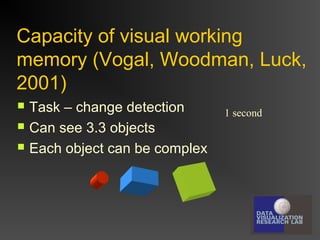
Capacity of visual working
memory (Vogal, Woodman, Luck,
2001)




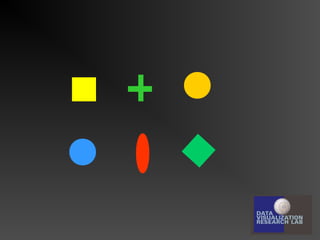
Task – change detection
Can see 3.3 objects
Each object can be complex

1 second
Sequential comparison task
Solution





“The world is its own memory” O’Regan
Task-related active vision
“What you see is what you need”
Treish et al. (2003)



Seeing is a process that helps us solve problems
Task-related eye movements 2005
Hayhoe and Ballard,
Example 2: How to get focus and
context?





Zooming (Bedersen)
Linked windows
(Fowler & Ware)
Fisheye (Furnas,
Carpendale)
Zooming Vs Multiple Windows
(Matt Plumlee)



Problem: When do we need extra
windows?
Comparing parts of a visual scene.



2 solutions: Zooming, multiple windows


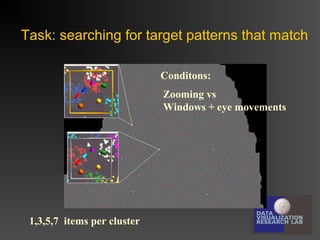
Task: searching for target patterns that match
Conditons:
Zooming vs
Windows + eye movements

1,3,5,7 items per cluster
Cognitive Model (grossly
simplified)


Time = setup cost +
number of “visits” x time per visit

Number of visits is a function of number of
objects to be compared and visual
working memory capacity.
Visits = n/M

Prediction

As targets (and visual working
memory load) increases, multiple
Windows become more attractive.

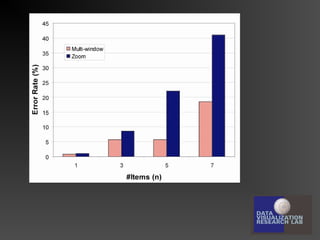
Results
Design heuristic


When we need to compare more two or
three simple pattern components add
windows.
Example 2


Tools for finding new underwater
behaviors from humpback whale tag data
(Why turning time into space is a good idea)
The gear
Antenna

Big
Eyes

DTAG Mark Johnson

Dave Wiley
Task: find new behaviors
= stereotyped patterns
Cognitive Algorithm
 repeat








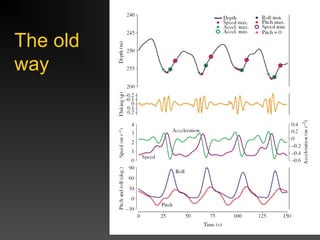
Review behavior sequence looking for
patterns. Remember patterns.
Look for more instances.

until no new patterns
The old
way
Solution 1. GeoZui 4D
Cognitive process for finding new
behaviors
stereotyped patterns
Cognitive Algorithm
 repeat









Review behavior sequence looking for patterns by
playback. Remember patterns using space-time
notes.
Look for more instances. May involve reviewing all
other whale tracks.

Until no new patterns
Cost k*playback time.
Solution 2: trackplot
Foraging patterns
Traversing
2006
Mostly

04

06
07

06
Process for finding new behaviors
stereotyped patterns
Cognitive algorithm
 Get to a good viewpoint
 repeat









Review behavior sequence looking for patterns eye
movements. Remember patterns using visual working
memory.
Look for more instances. May involve reviewing all
other whale tracks. Can be posted on the wall

until no new patterns
Cost Nav + Eye Movement time *pattern
matching.
Gain in efficiency – from
playback tool to pattern finding
tool


Many hours (with playback)
A few minutes (with patterns)



Approximately a factor of 100


Design heuristic


Whenever possible: Turn time into a
spatial pattern – one that converts critical
events into shapes or patterns



Try to make natural mappings – proper
use of texture color, etc.
How to get perceptual and
cognitive principles into the
Anderson
designer’s head?
ACT-R

Shneiderman
Overview
Zoom&filter
Details on Demand
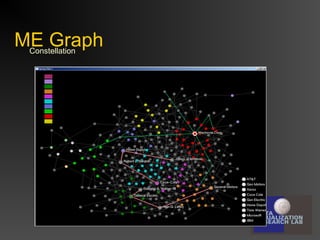
ME Graph
Constellation
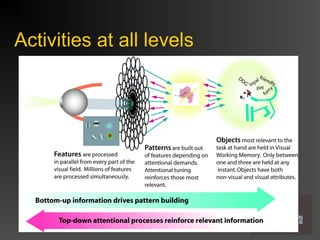
Activities at all levels
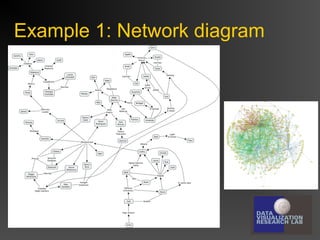
Example 1: Network diagram
Where are we going?


Simple cognitive process models involving



Perceptual and cognitive operations
Interaction methods

For Design
Acknowlegements
NSF ARDA NOAA ONR
David Wiley, Rusty Bobrow, Matt Plumlee, Anne Gilman
Where are we going?
DESIGN of visual thinking tools
We need to understand perception and the cognitive process
The machinery

Display

Features
A
B

Proto-objects and
C
Patterns
D

Verbal
Working
Memory

OBJECT
FILES
“Nexus”

Visual
Working
Memory

GIST

Visual
Query

Egocentric object and
Pattern map
Change Blindness

Simons and Levin
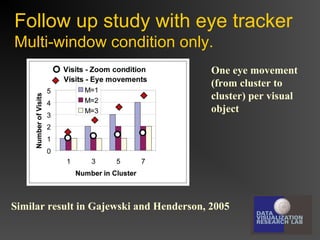
Follow up study with eye tracker
Multi-window condition only.
One eye movement
(from cluster to
cluster) per visual
object

Similar result in Gajewski and Henderson, 2005
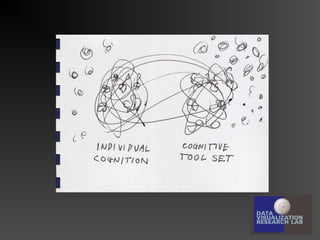
Sketching ideas:
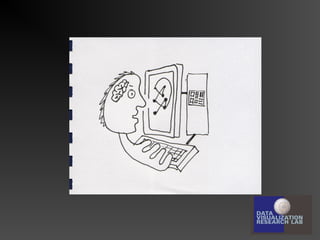
Many people have noted that we
are cognitive cyborgs:
Edwin Hutchins, Herbert Simon,
Don Norman.. Etc.
The query process
Tuning the visual system

Visual thinking colin_ware_lectures_2013_9_visual thinking_1

Editor's Notes

  • #3 Low Level: Basic feature analys – determines what is seen with minimal effort Mid Level: Pattern finding – The demands of attention meets automatic processing High Level: Task related visual queries are formed – objects/ patterns are pulled into working memory and tested against the query - Need to have the right mappings for queries to be easily satisfied. Attention is focused to execute the query. Final element is the cost of search.
  • #6 Active vision, John Findlay and Ian Gilchrist
  • #43 On the human side we have a set of machenery that is more or less fixed – working memory capacity. Every one has the same set of basic components. But we are immensely different when it comes to skills. On the other side we have a constantly evolving set of tools. But to undestand real world cognition. We have no choice. What I tend to think of is what would I want in the ideal program to train practitioners – people who design and develop thinking tools. What should their education be like. Perception. Design Some skills with the tools of our trade – programming. But, also some cognition – enough to give weight to some “artisanal rules of thumb”
  • #47 The first part is that cognitive science Herb Simons, + Edwin Hutchins In the layer above basic capacities are Basic skills
  • #54 We could have all HCI people take perception and cog science courses. But it is not easy to apply that knowledge.