Raffles International Institute
Techniques for analyzing information and
transferring verbal ideas into visual concept


MArch. Dipl.-Ing. Arch.
Interior Design Lecturer ID
Sandra DRASKOVIC
November 12© Draskovic 2012            RAFFLES October 2012
Raffles International Institute                           DESIGN PROCESS

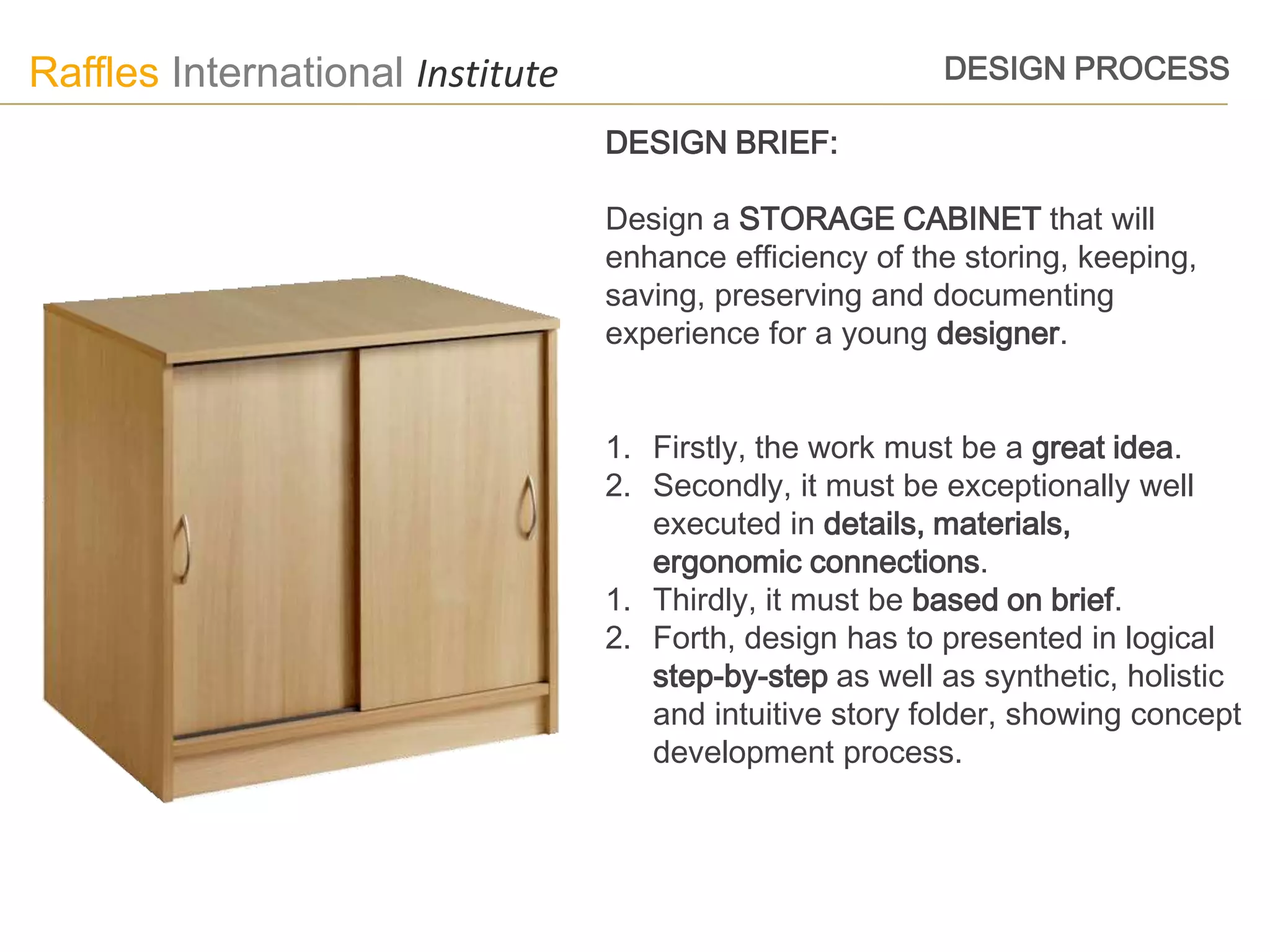
                                  DESIGN BRIEF:

                                  Design a STORAGE CABINET that will
                                  enhance efficiency of the storing, keeping,
                                  saving, preserving and documenting
                                  experience for a young designer.


                                  1. Firstly, the work must be a great idea.
                                  2. Secondly, it must be exceptionally well
                                     executed in details, materials,
                                     ergonomic connections.
                                  1. Thirdly, it must be based on brief.
                                  2. Forth, design has to presented in logical
                                     step-by-step as well as synthetic, holistic
                                     and intuitive story folder, showing concept
                                     development process.
Raffles International Institute   DESIGN PROCESS
Raffles International Institute   LITERATURE


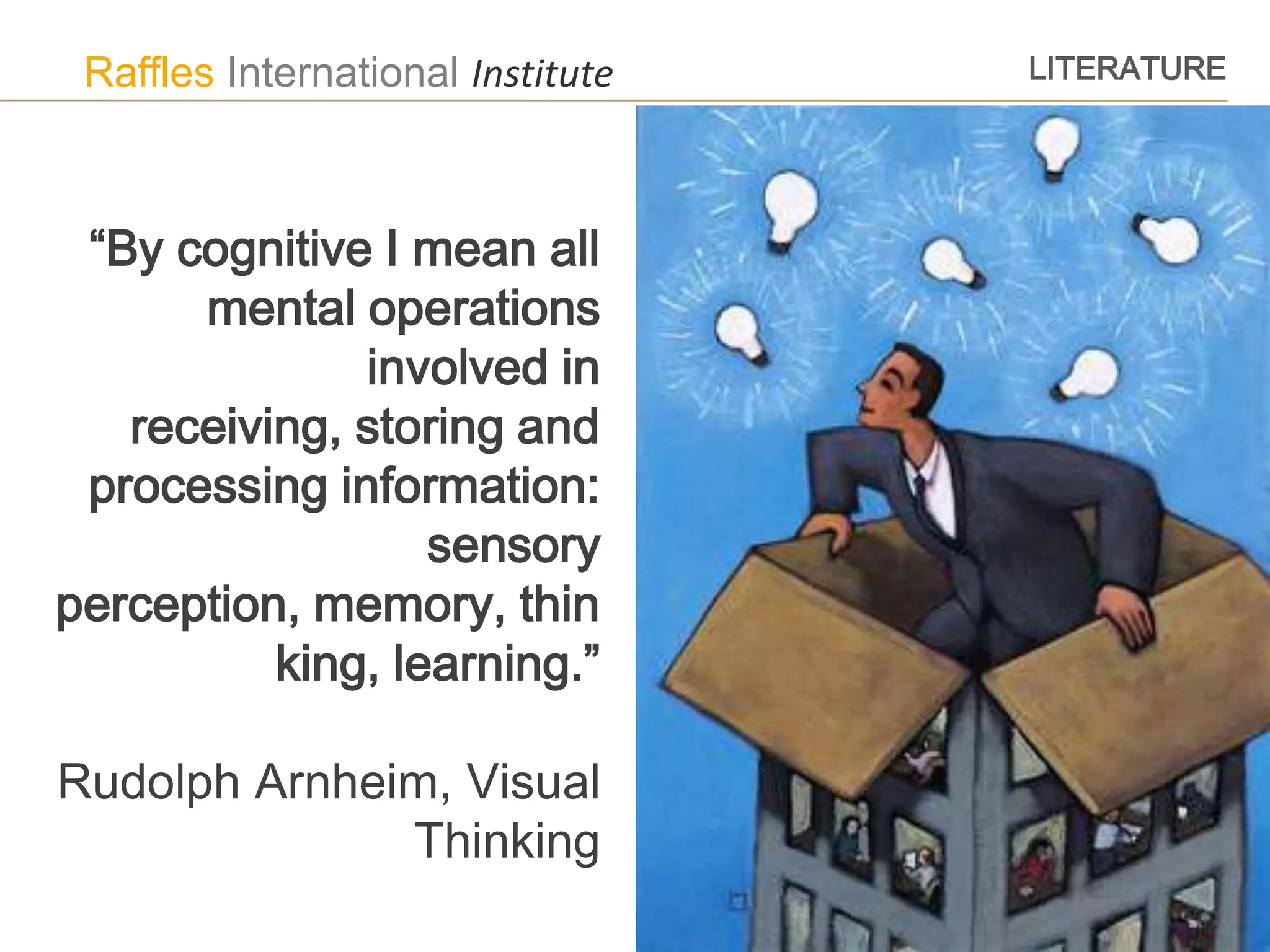
 “By cognitive I mean all
      mental operations
              involved in
   receiving, storing and
 processing information:
                  sensory
perception, memory, thin
          king, learning.”

Rudolph Arnheim, Visual
              Thinking
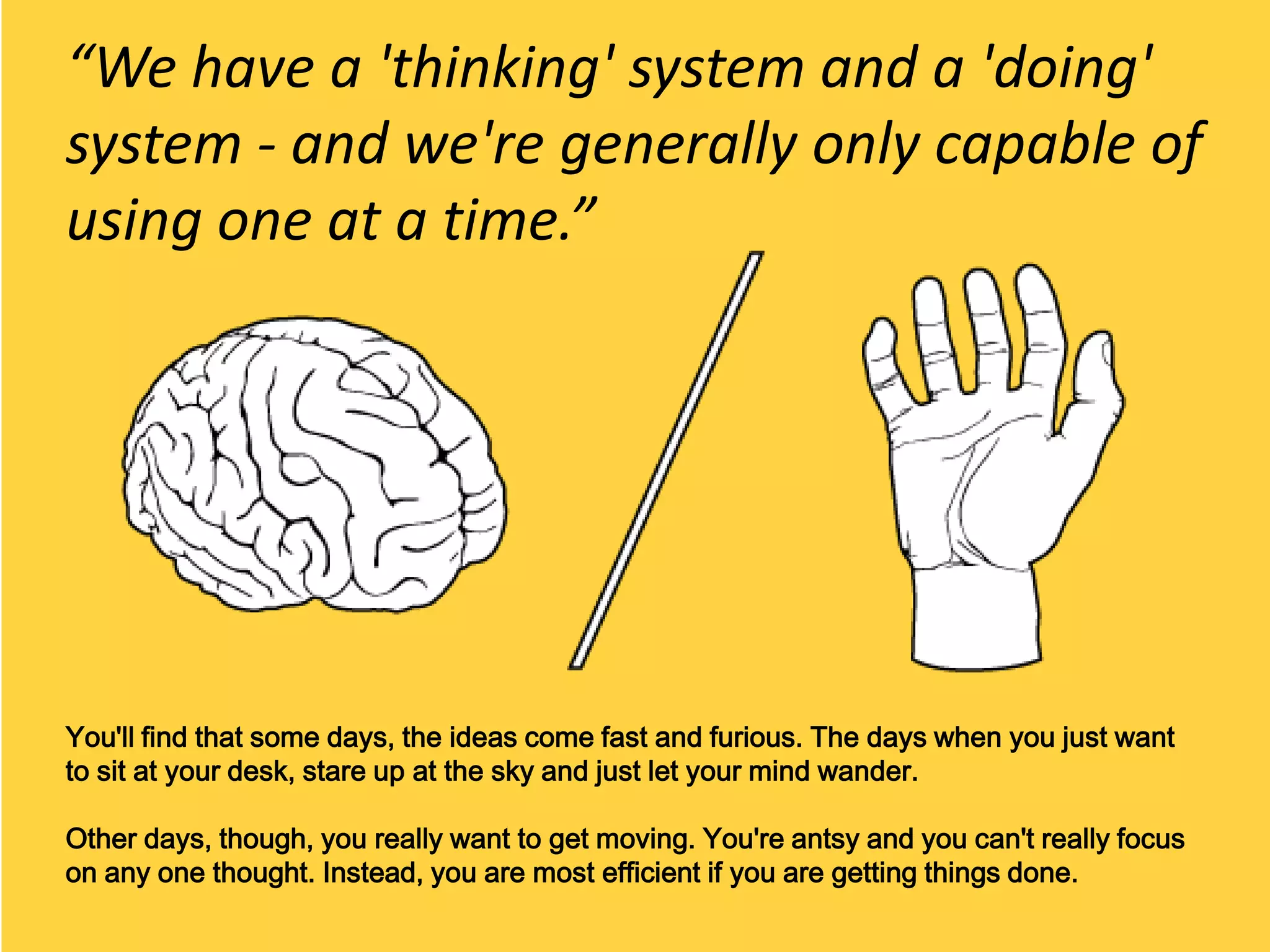
“We have a 'thinking' system and a 'doing'
system - and we're generally only capable of
using one at a time.”


You'll find that some days, the ideas come fast and furious. The days when you just want
to sit at your desk, stare up at the sky and just let your mind wander.

Other days, though, you really want to get moving. You're antsy and you can't really focus
on any one thought. Instead, you are most efficient if you are getting things done.
Raffles International Institute                                 DESIGN PROCESS


  Managing your mindset can help you
  optimize your thinking when you are trying
  to be creative
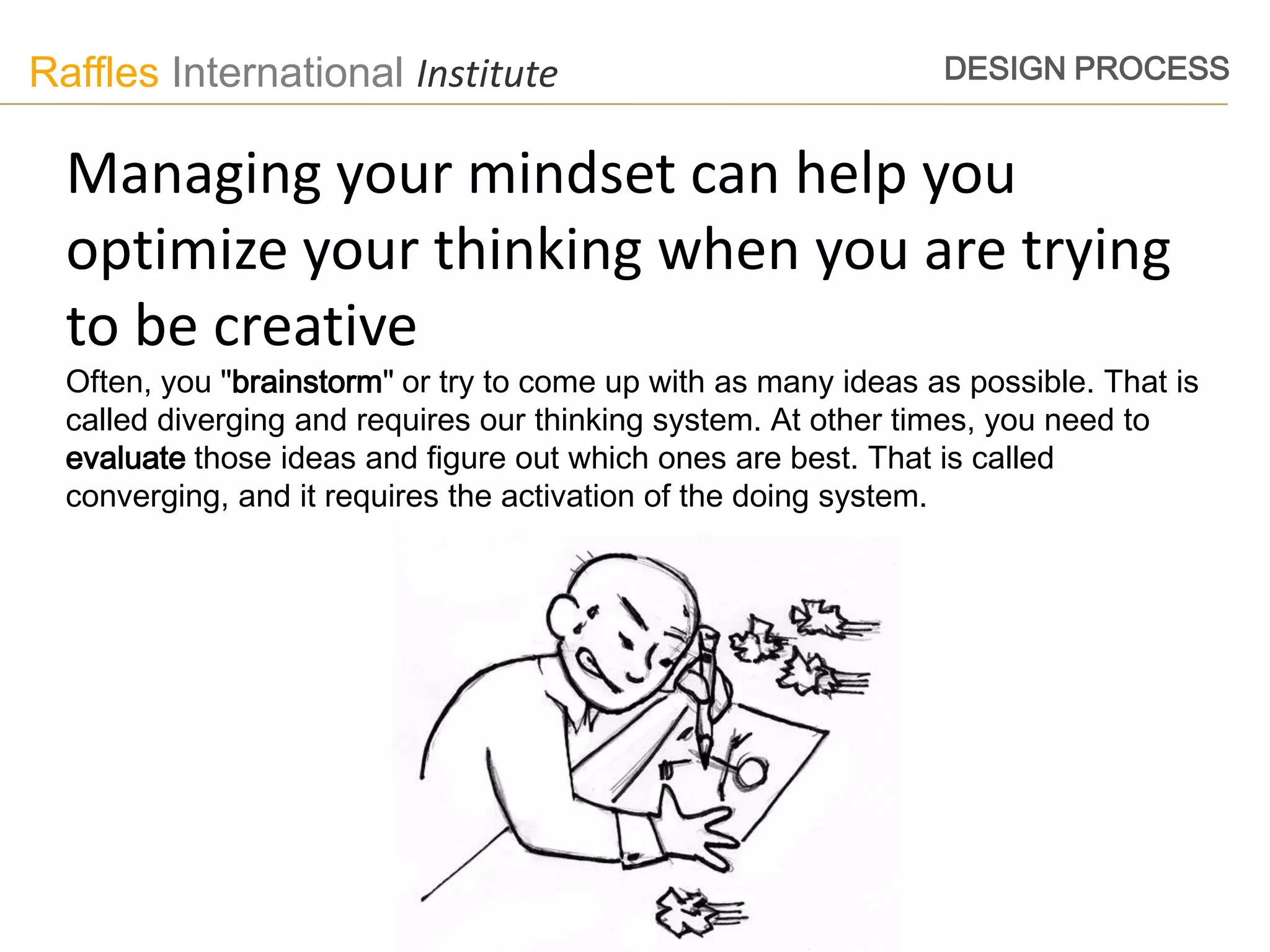
  Often, you "brainstorm" or try to come up with as many ideas as possible. That is
  called diverging and requires our thinking system. At other times, you need to
  evaluate those ideas and figure out which ones are best. That is called
  converging, and it requires the activation of the doing system.
Raffles International Institute                                DESIGN PROCESS


  Change your environment, and you will
  change the way you think.
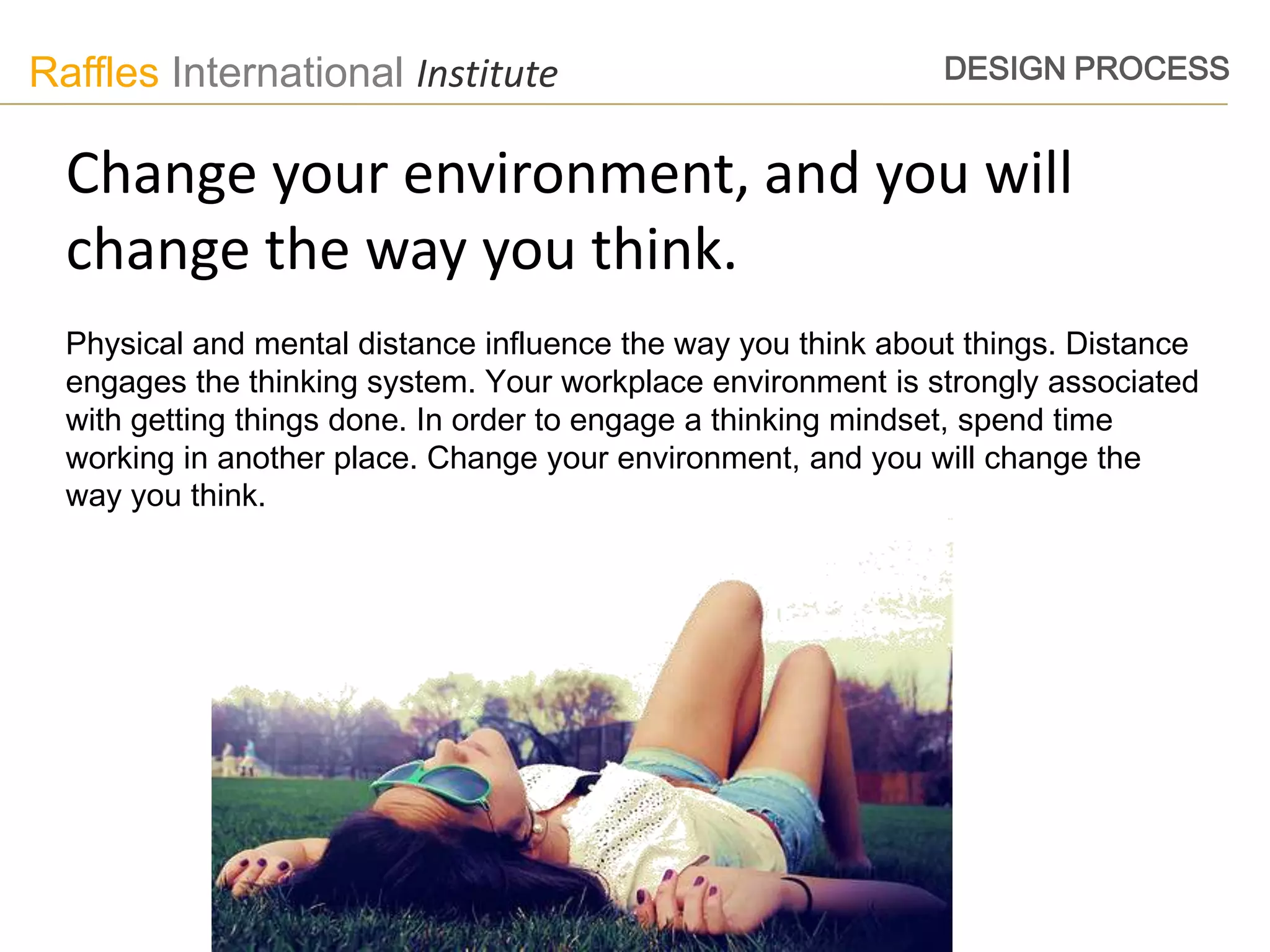
  Physical and mental distance influence the way you think about things. Distance
  engages the thinking system. Your workplace environment is strongly associated
  with getting things done. In order to engage a thinking mindset, spend time
  working in another place. Change your environment, and you will change the
  way you think.
Raffles International Institute                               DESIGN PROCESS


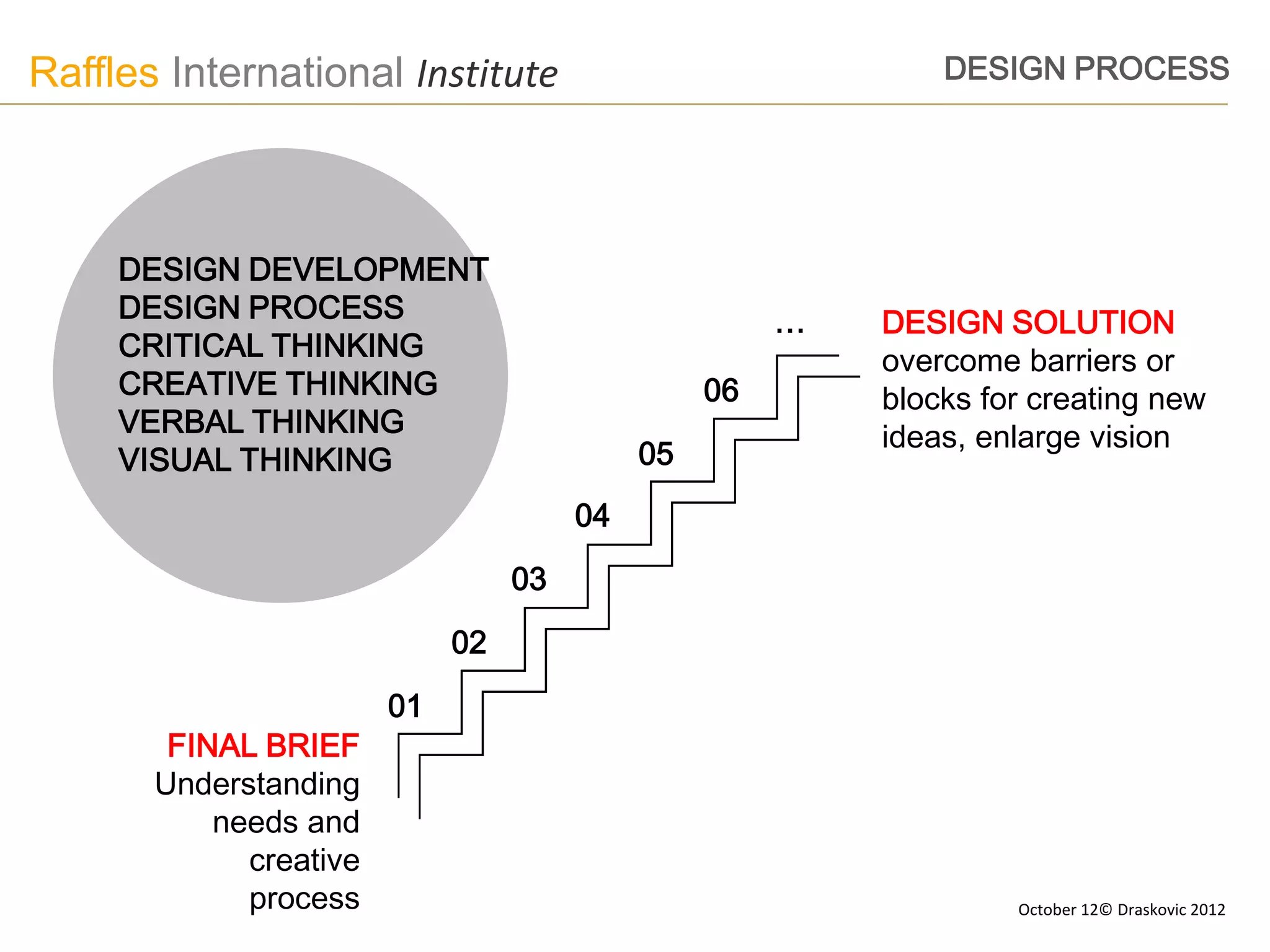
     DESIGN DEVELOPMENT
     DESIGN PROCESS                                   …   DESIGN SOLUTION
     CRITICAL THINKING                                    overcome barriers or
     CREATIVE THINKING                           06       blocks for creating new
     VERBAL THINKING                                      ideas, enlarge vision
     VISUAL THINKING                        05
                                       04

                                  03

                             02

                        01
        FINAL BRIEF
       Understanding
           needs and
             creative
             process                                               October 12© Draskovic 2012
Raffles International Institute   DESIGN PROCESS

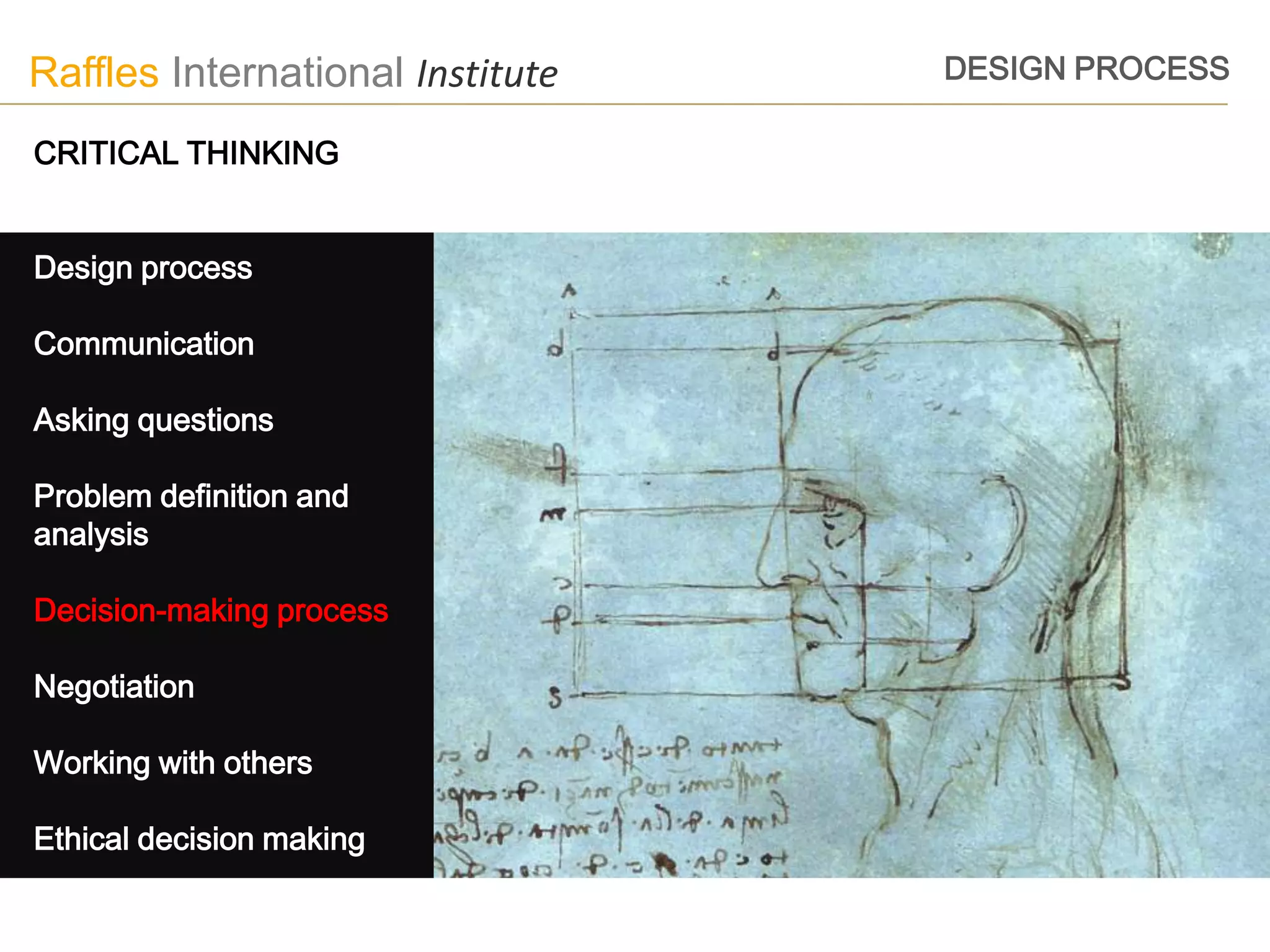
CRITICAL THINKING


Design process

Communication

Asking questions

Problem definition and
analysis

Decision-making process

Negotiation

Working with others

Ethical decision making
Raffles International Institute                            DESIGN PROCESS

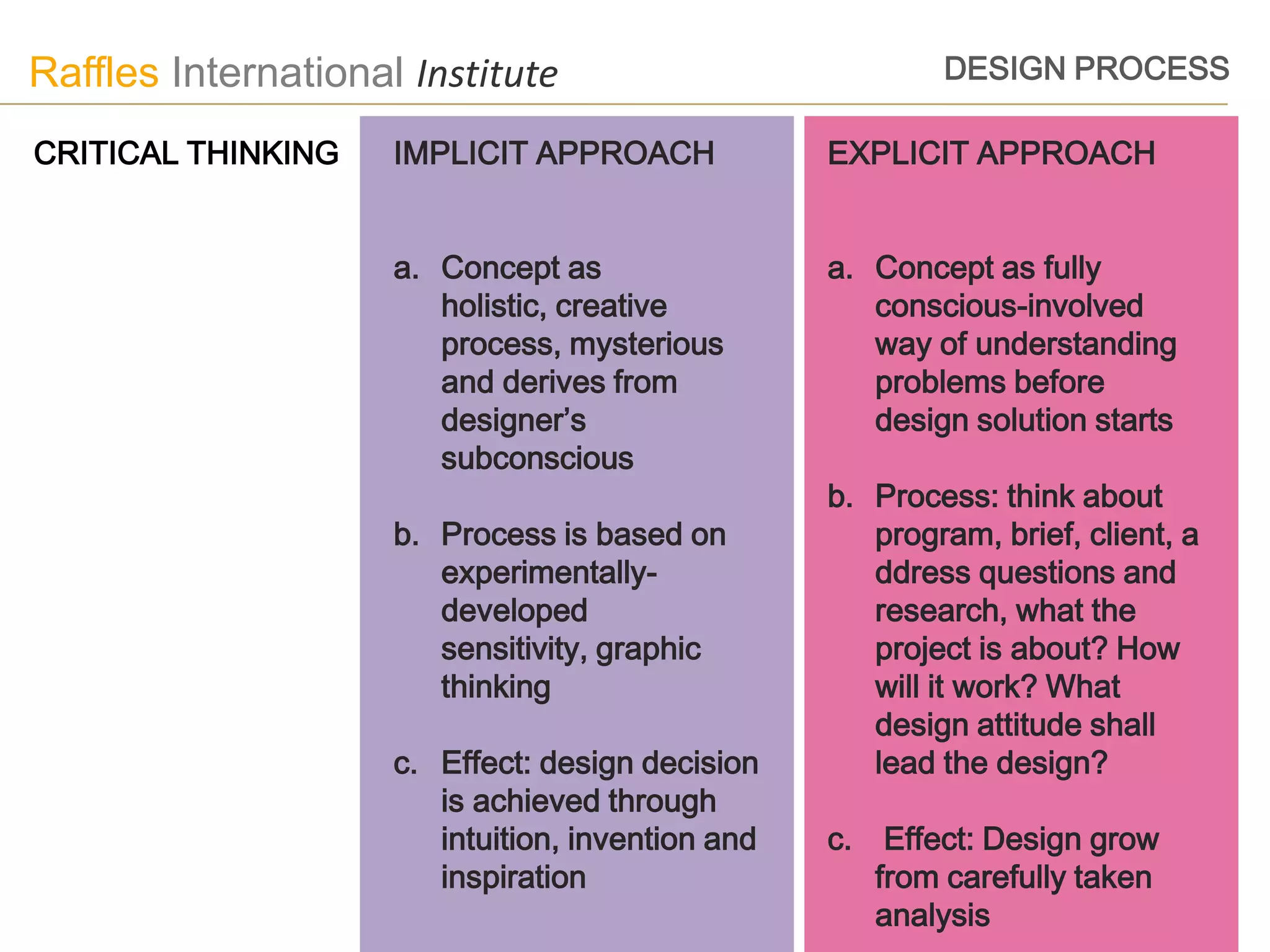
CRITICAL THINKING    IMPLICIT APPROACH             EXPLICIT APPROACH


                     a. Concept as                 a. Concept as fully
                        holistic, creative            conscious-involved
                        process, mysterious           way of understanding
                        and derives from              problems before
                        designer’s                    design solution starts
                        subconscious
                                                   b. Process: think about
                     b. Process is based on           program, brief, client, a
                        experimentally-               ddress questions and
                        developed                     research, what the
                        sensitivity, graphic          project is about? How
                        thinking                      will it work? What
                                                      design attitude shall
                     c. Effect: design decision       lead the design?
                        is achieved through
                        intuition, invention and   c. Effect: Design grow
                        inspiration                   from carefully taken
                                                      analysis
Raffles International Institute   DESIGN PROCESS
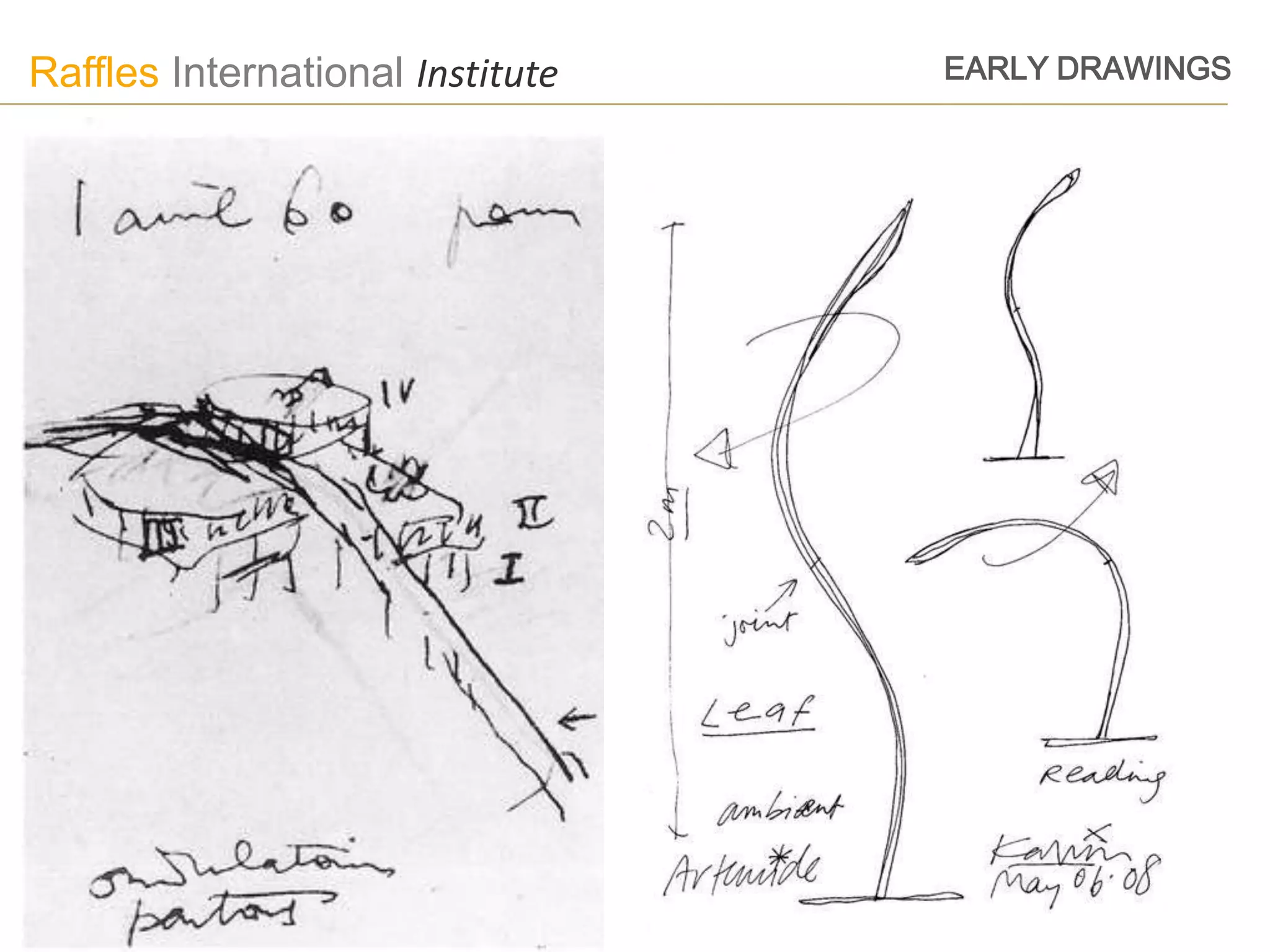
Raffles International Institute   EARLY DRAWINGS

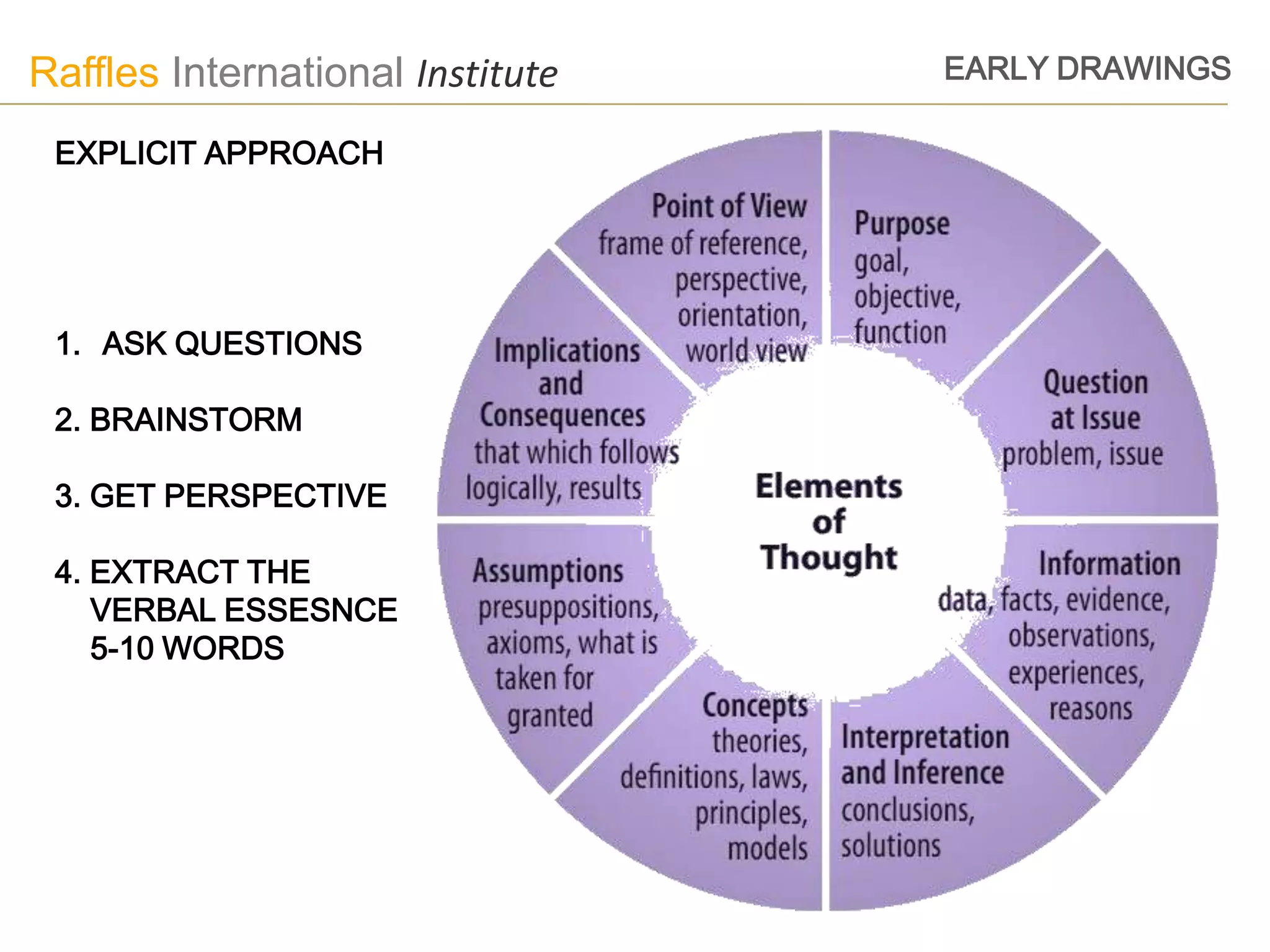
 EXPLICIT APPROACH


 1. ASK QUESTIONS

 2. BRAINSTORM

 3. GET PERSPECTIVE

 4. EXTRACT THE
    VERBAL ESSESNCE
    5-10 WORDS
Raffles International Institute                                EARLY DRAWINGS

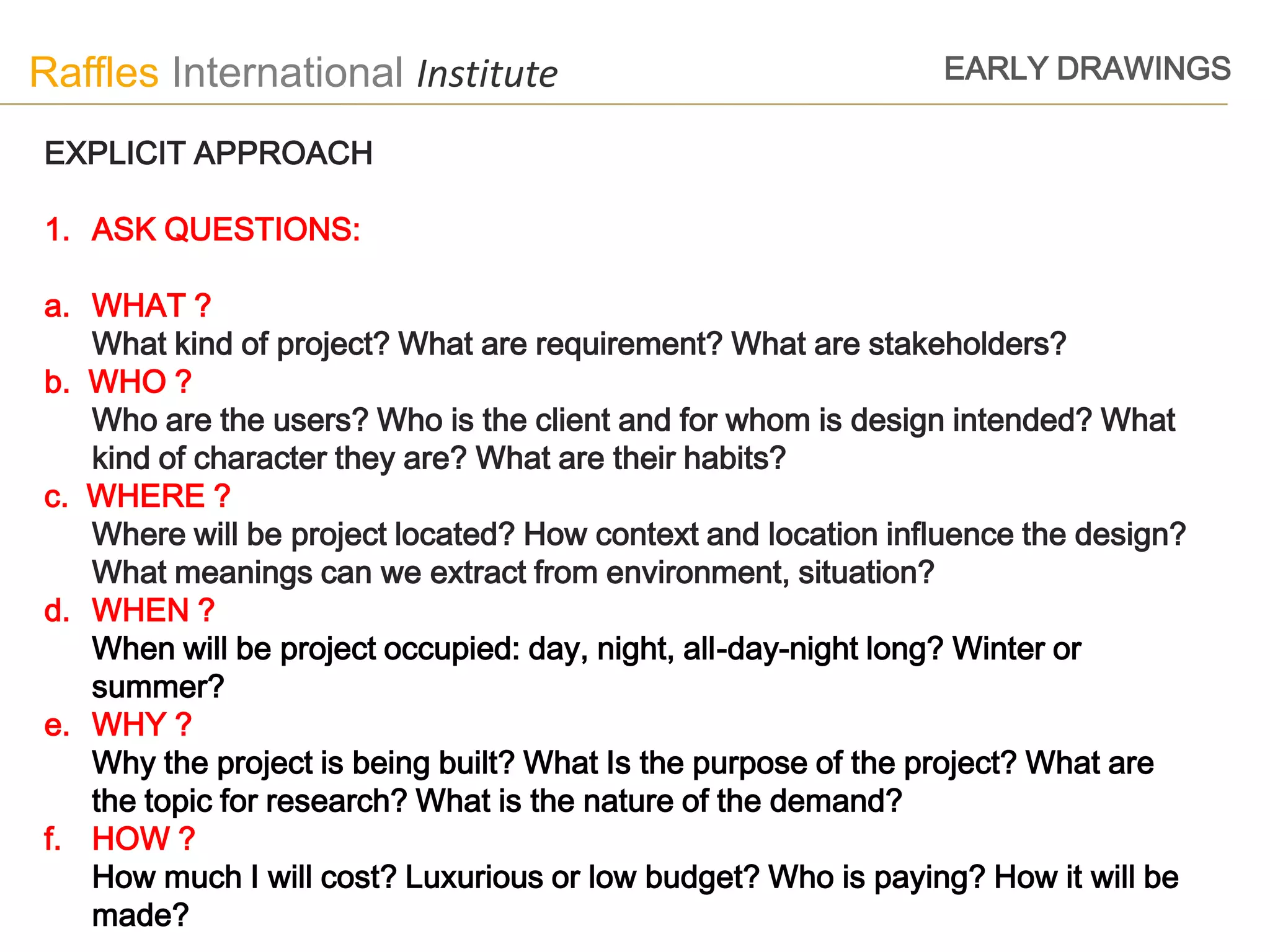
EXPLICIT APPROACH

1. ASK QUESTIONS:

a. WHAT ?
   What kind of project? What are requirement? What are stakeholders?
b. WHO ?
   Who are the users? Who is the client and for whom is design intended? What
   kind of character they are? What are their habits?
c. WHERE ?
   Where will be project located? How context and location influence the design?
   What meanings can we extract from environment, situation?
d. WHEN ?
   When will be project occupied: day, night, all-day-night long? Winter or
   summer?
e. WHY ?
   Why the project is being built? What Is the purpose of the project? What are
   the topic for research? What is the nature of the demand?
f. HOW ?
   How much I will cost? Luxurious or low budget? Who is paying? How it will be
   made?
Raffles International Institute                                 DESIGN PROCESS

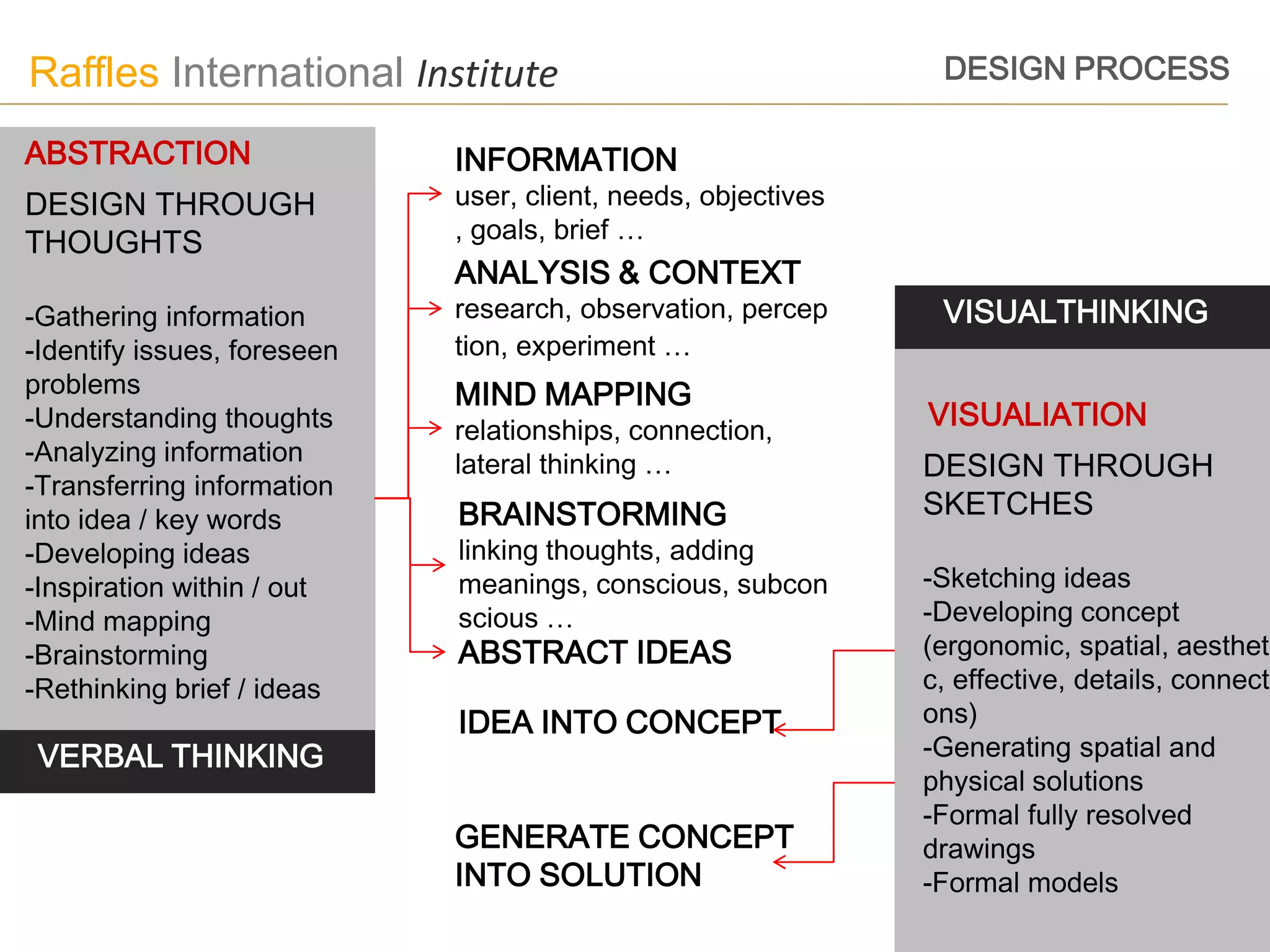
ABSTRACTION                  INFORMATION
DESIGN THROUGH               user, client, needs, objectives
THOUGHTS                     , goals, brief …
                             ANALYSIS & CONTEXT
-Gathering information       research, observation, percep      VISUALTHINKING
-Identify issues, foreseen   tion, experiment …
problems                     MIND MAPPING
-Understanding thoughts      relationships, connection,
                                                               VISUALIATION
-Analyzing information       lateral thinking …                DESIGN THROUGH
-Transferring information
into idea / key words        BRAINSTORMING                     SKETCHES
-Developing ideas            linking thoughts, adding
-Inspiration within / out    meanings, conscious, subcon       -Sketching ideas
-Mind mapping                scious …                          -Developing concept
-Brainstorming               ABSTRACT IDEAS                    (ergonomic, spatial, aestheti
-Rethinking brief / ideas                                      c, effective, details, connecti
                             IDEA INTO CONCEPT                 ons)
 VERBAL THINKING                                               -Generating spatial and
                                                               physical solutions
                                                               -Formal fully resolved
                             GENERATE CONCEPT                  drawings
                             INTO SOLUTION                     -Formal models
Raffles International Institute                   1ST STAGE OF DRAWINGS

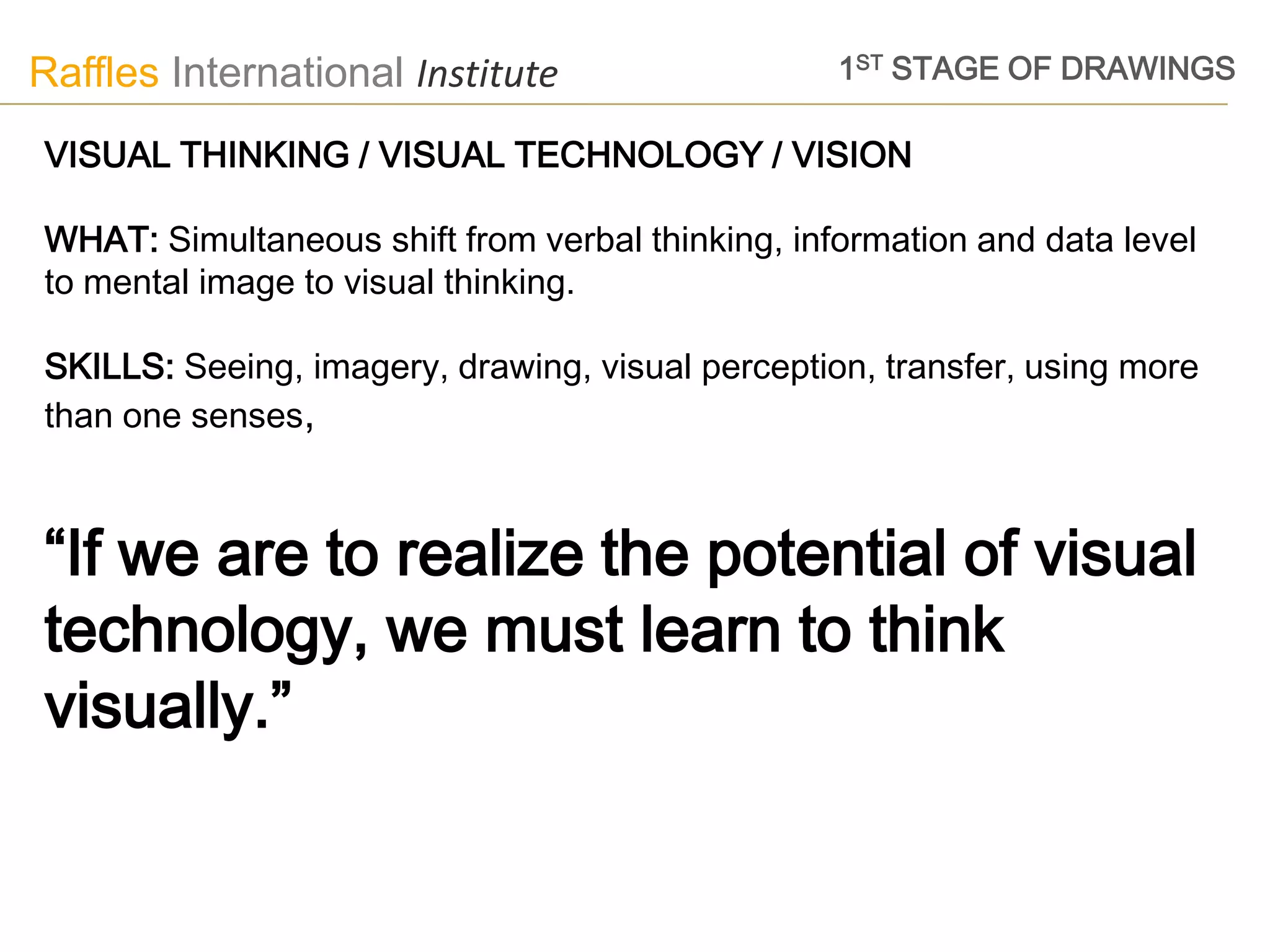
VISUAL THINKING / VISUAL TECHNOLOGY / VISION

WHAT: Simultaneous shift from verbal thinking, information and data level
to mental image to visual thinking.

SKILLS: Seeing, imagery, drawing, visual perception, transfer, using more
than one senses,


“If we are to realize the potential of visual
technology, we must learn to think
visually.”
Raffles International Institute                      DRAWINGS


  DRAWING is expression of analysis, thinking, ideas and
  design concepts.

  WILLINGNESS to commit in design development
  using series of abstractions and drawings.

  Thinking (sketches, diagrams, schemes, images),
  Developing (detailed sketches, perspective, drawings) and
  Communicating (technical drawings, 3D
  models, perspective, parallel projections).

  We are discovering and inventing new design solutions and
  present them with study/technical drawings.
Raffles International Institute              LAYERS OF ABSTRACTION


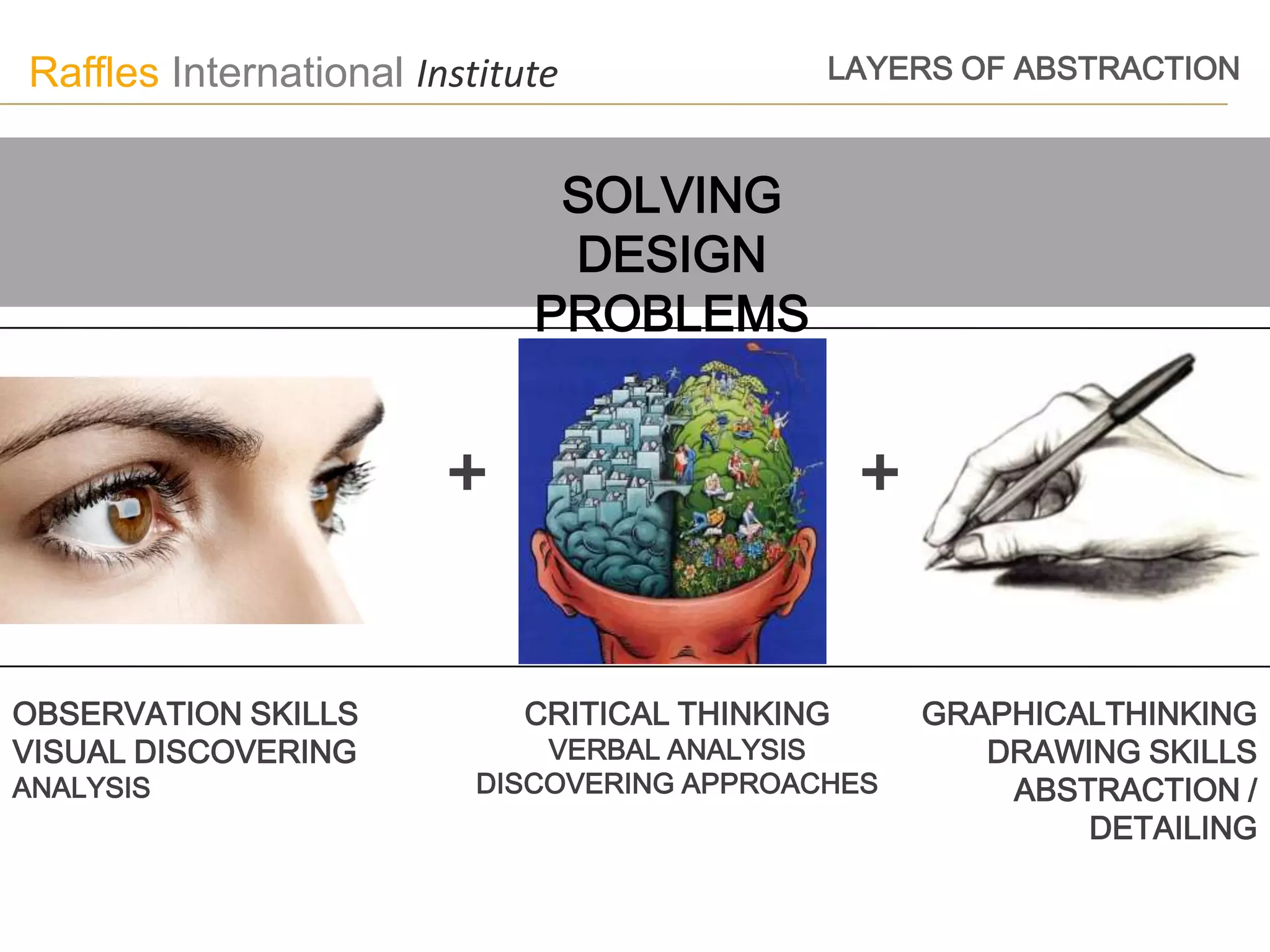
                              SOLVING
                              DESIGN
                             PROBLEMS


                        +                        +


OBSERVATION SKILLS           CRITICAL THINKING       GRAPHICALTHINKING
VISUAL DISCOVERING            VERBAL ANALYSIS           DRAWING SKILLS
ANALYSIS                  DISCOVERING APPROACHES         ABSTRACTION /
                                                             DETAILING
Raffles International Institute                    1ST STAGE OF DRAWINGS

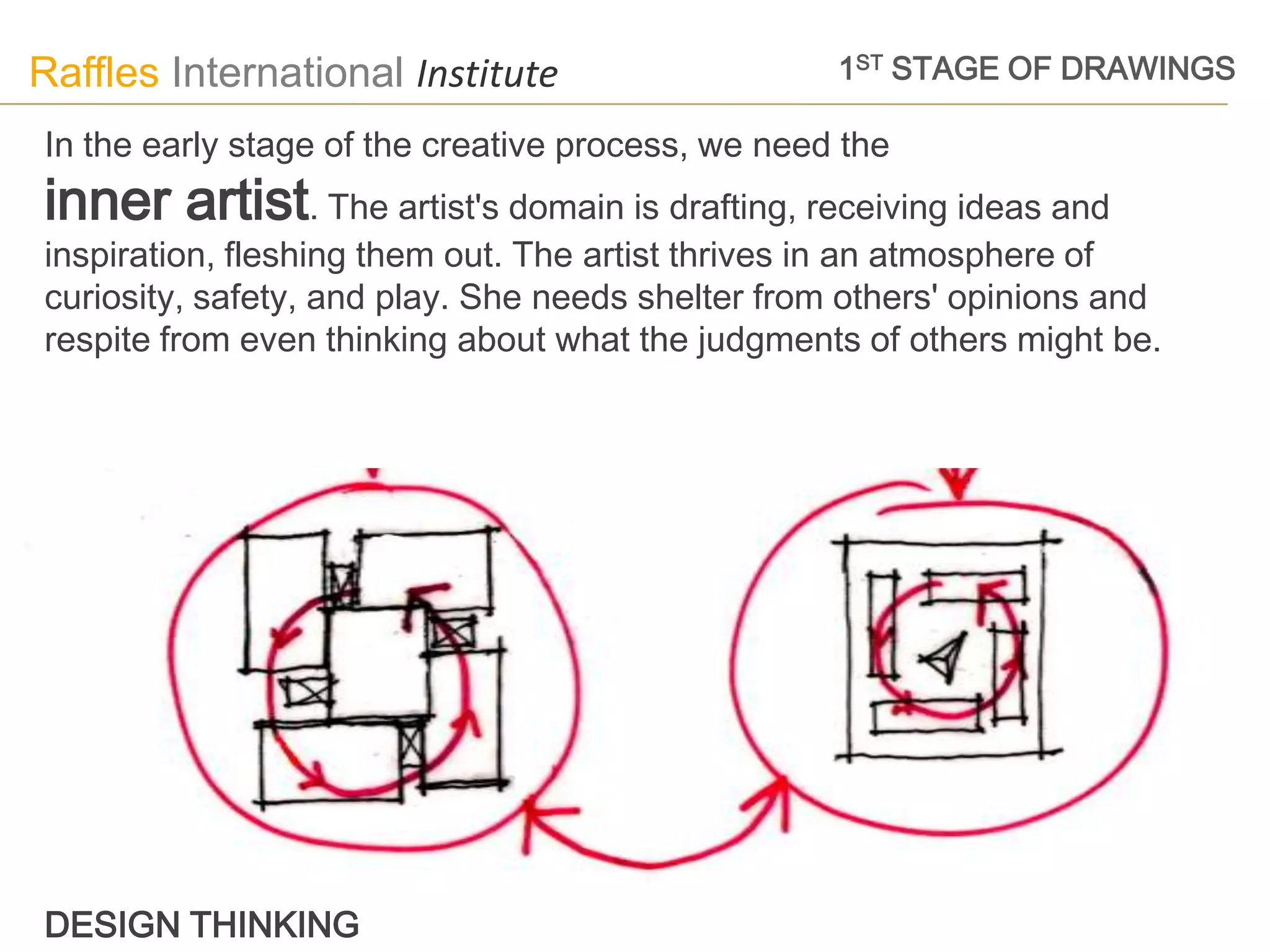
In the early stage of the creative process, we need the
inner artist. The artist's domain is drafting, receiving ideas and
inspiration, fleshing them out. The artist thrives in an atmosphere of
curiosity, safety, and play. She needs shelter from others' opinions and
respite from even thinking about what the judgments of others might be.


DESIGN THINKING
Raffles International Institute                   2nd STAGE OF DRAWINGS


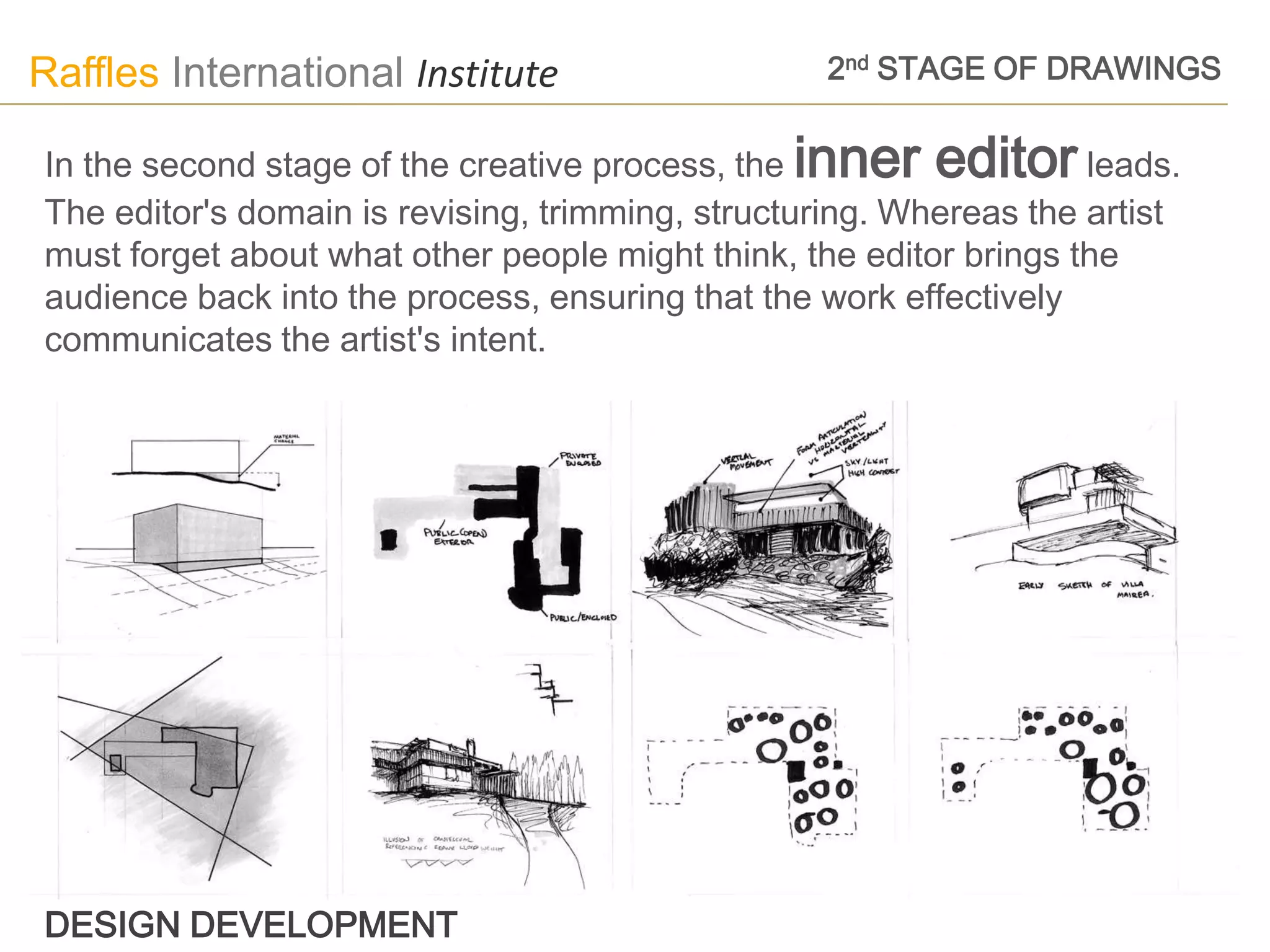
In the second stage of the creative process, the inner editor leads.
The editor's domain is revising, trimming, structuring. Whereas the artist
must forget about what other people might think, the editor brings the
audience back into the process, ensuring that the work effectively
communicates the artist's intent.


DESIGN DEVELOPMENT
Raffles International Institute                    3RD STAGE OF DRAWINGS


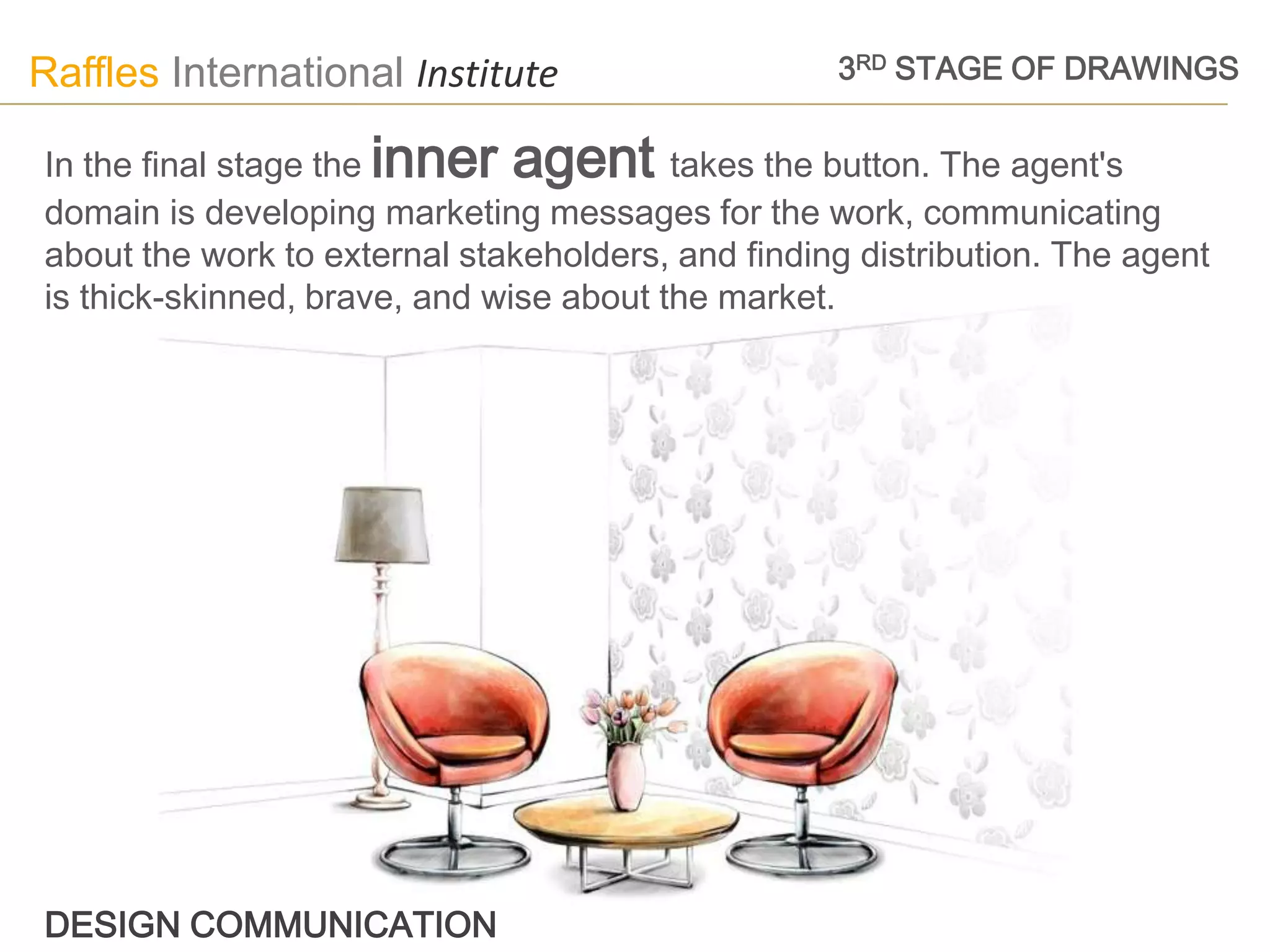
In the final stage the inner agent takes the button. The agent's
domain is developing marketing messages for the work, communicating
about the work to external stakeholders, and finding distribution. The agent
is thick-skinned, brave, and wise about the market.


DESIGN COMMUNICATION
Raffles International Institute                                            LAYERS OF ABSTRACTION


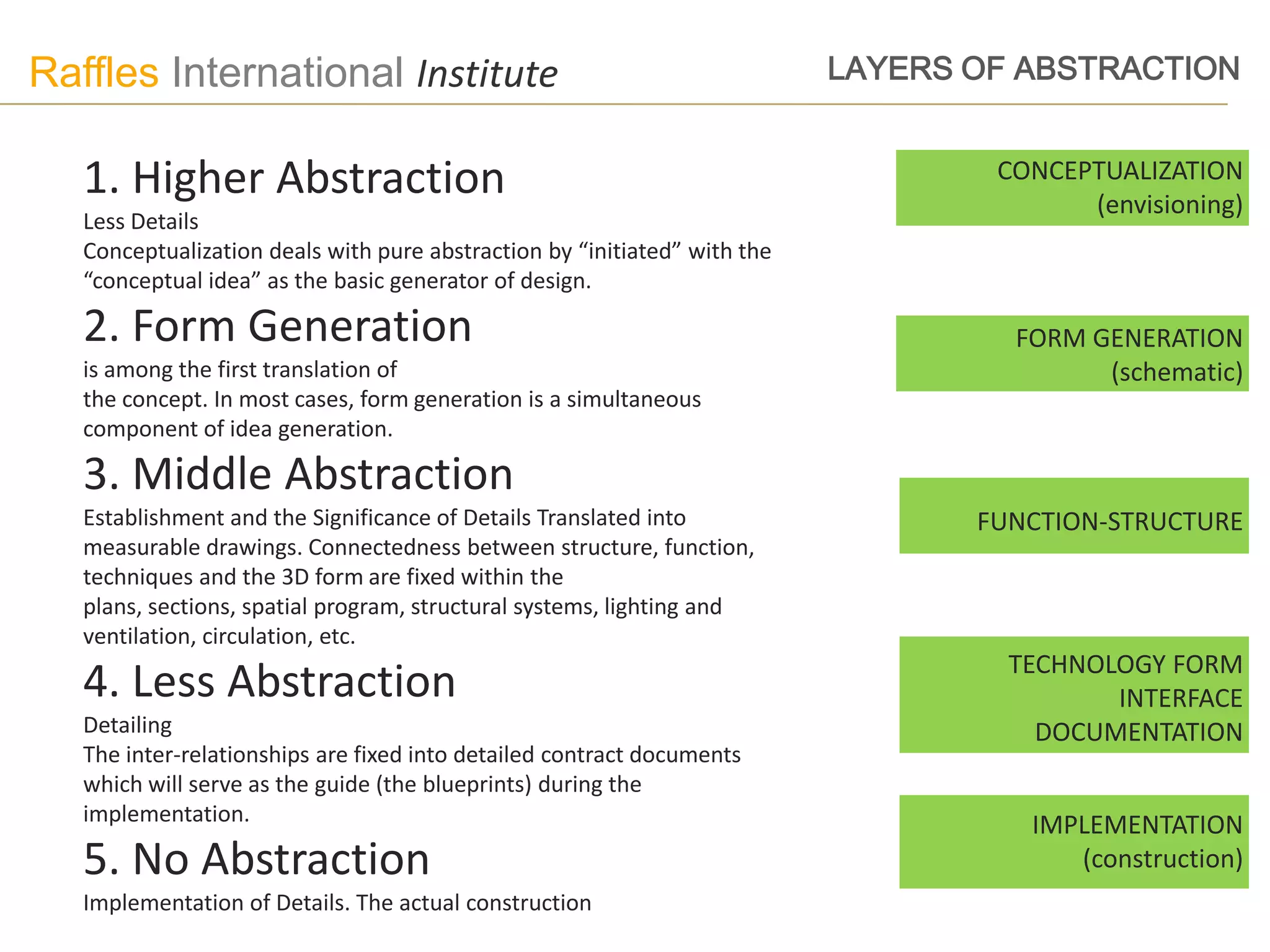
   1. Higher Abstraction                                                           CONCEPTUALIZATION
                                                                                         (envisioning)
   Less Details
   Conceptualization deals with pure abstraction by “initiated” with the
   “conceptual idea” as the basic generator of design.

   2. Form Generation                                                               FORM GENERATION
   is among the first translation of                                                      (schematic)
   the concept. In most cases, form generation is a simultaneous
   component of idea generation.

   3. Middle Abstraction
   Establishment and the Significance of Details Translated into                  FUNCTION-STRUCTURE
   measurable drawings. Connectedness between structure, function,
   techniques and the 3D form are fixed within the
   plans, sections, spatial program, structural systems, lighting and
   ventilation, circulation, etc.
                                                                                    TECHNOLOGY FORM
   4. Less Abstraction                                                                     INTERFACE
   Detailing                                                                          DOCUMENTATION
   The inter-relationships are fixed into detailed contract documents
   which will serve as the guide (the blueprints) during the
   implementation.                                                                   IMPLEMENTATION
   5. No Abstraction                                                                    (construction)
   Implementation of Details. The actual construction
Raffles International Institute   LAYERS OF ABSTRACTION


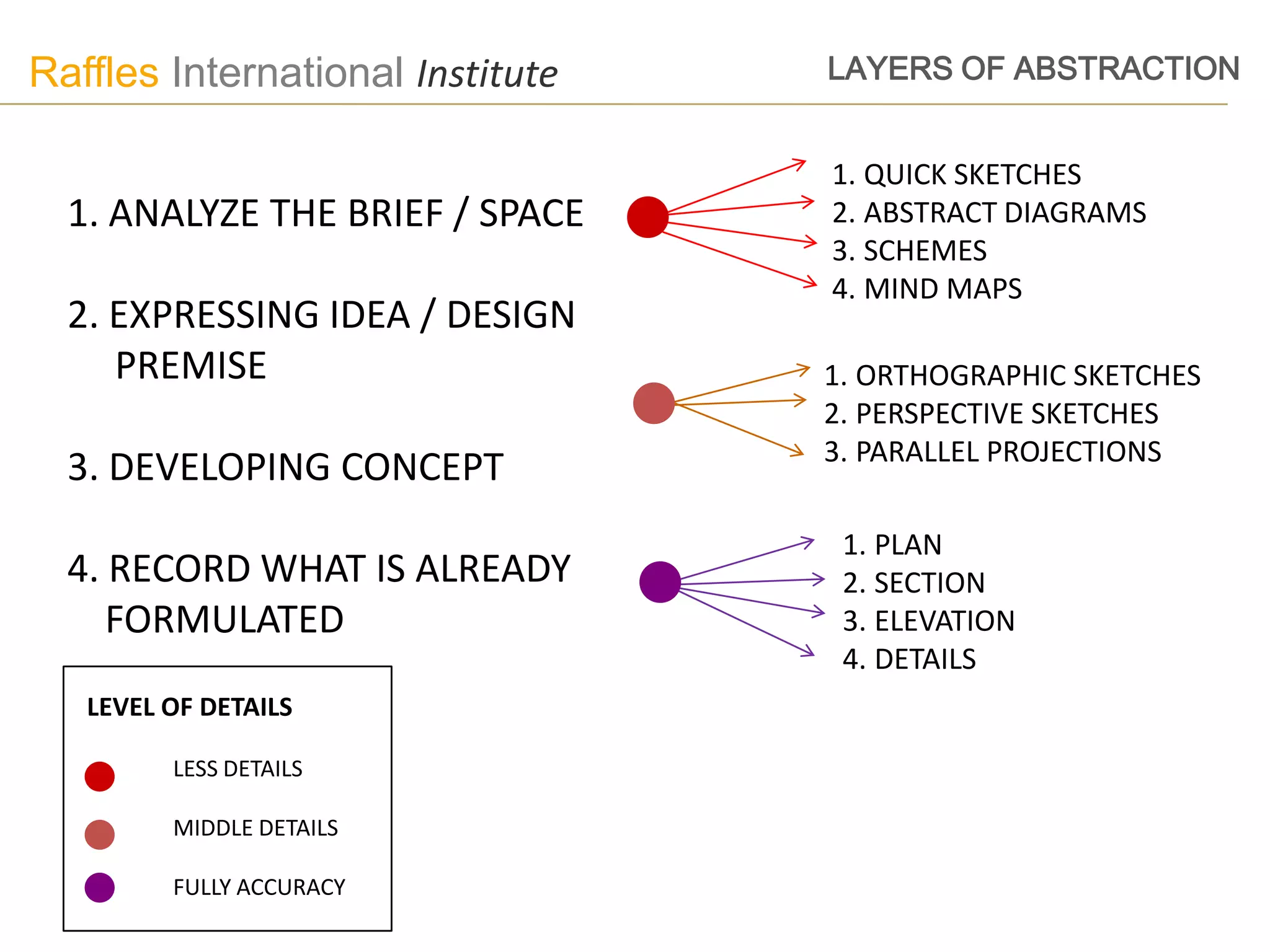
                                  1. QUICK SKETCHES
  1. ANALYZE THE BRIEF / SPACE    2. ABSTRACT DIAGRAMS
                                  3. SCHEMES
                                  4. MIND MAPS
  2. EXPRESSING IDEA / DESIGN
     PREMISE                      1. ORTHOGRAPHIC SKETCHES
                                  2. PERSPECTIVE SKETCHES
                                  3. PARALLEL PROJECTIONS
  3. DEVELOPING CONCEPT
                                   1. PLAN
  4. RECORD WHAT IS ALREADY        2. SECTION
     FORMULATED                    3. ELEVATION
                                   4. DETAILS
   LEVEL OF DETAILS

         LESS DETAILS

         MIDDLE DETAILS

         FULLY ACCURACY
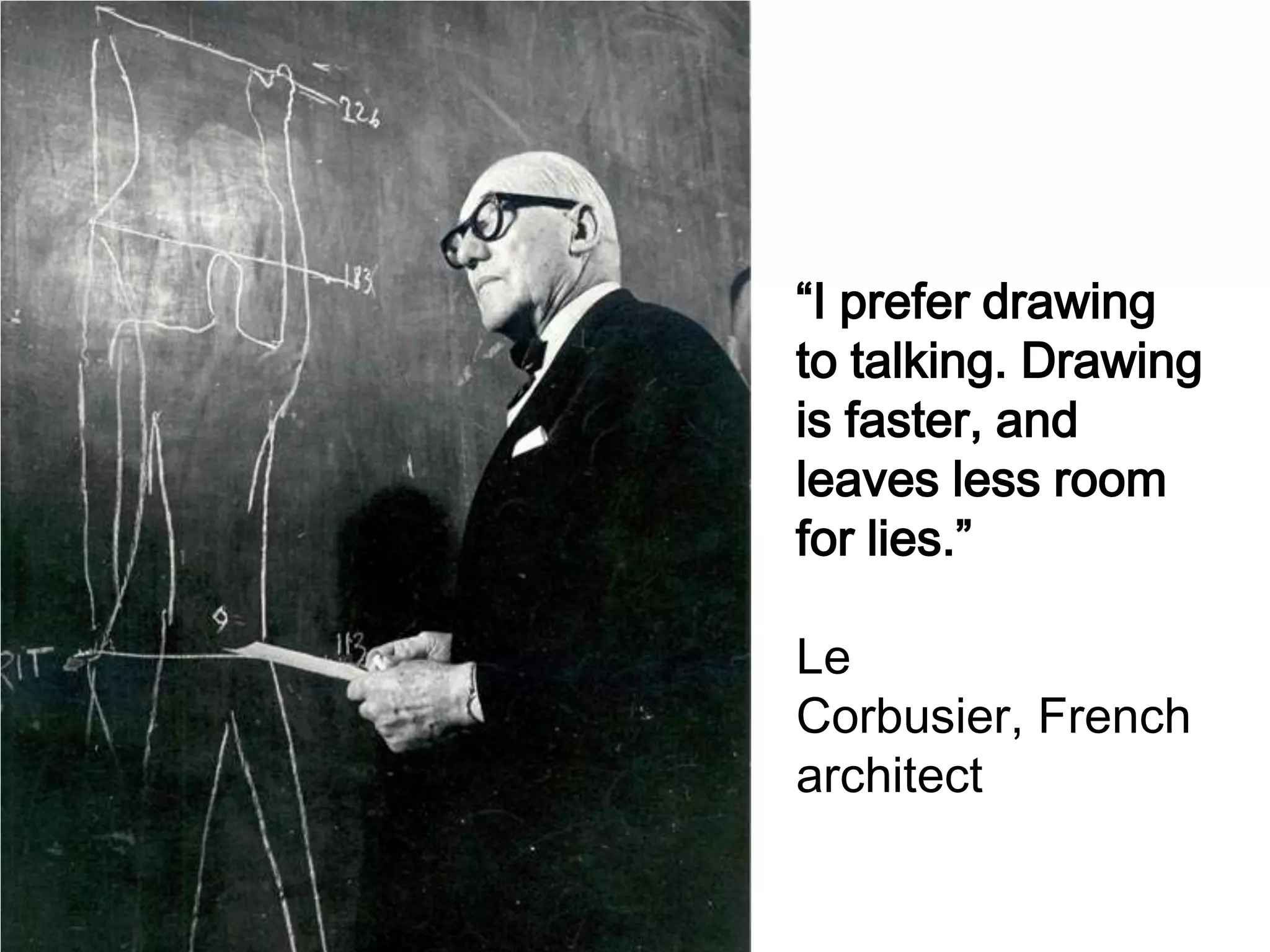
“I prefer drawing
to talking. Drawing
is faster, and
leaves less room
for lies.”

Le
Corbusier, French
architect
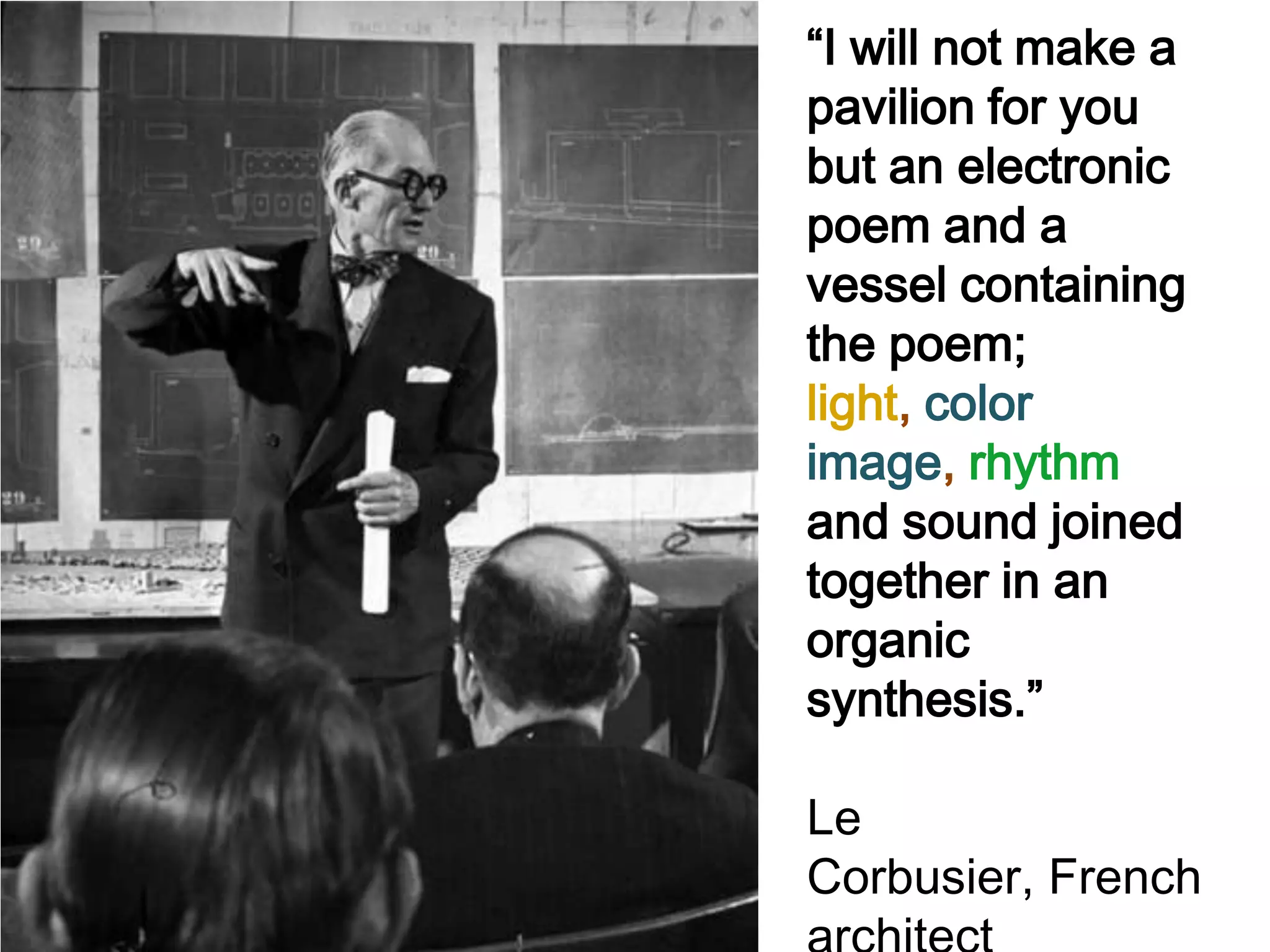
“I will not make a
pavilion for you
but an electronic
poem and a
vessel containing
the poem;
light, color
image, rhythm
and sound joined
together in an
organic
synthesis.”

Le
Corbusier, French
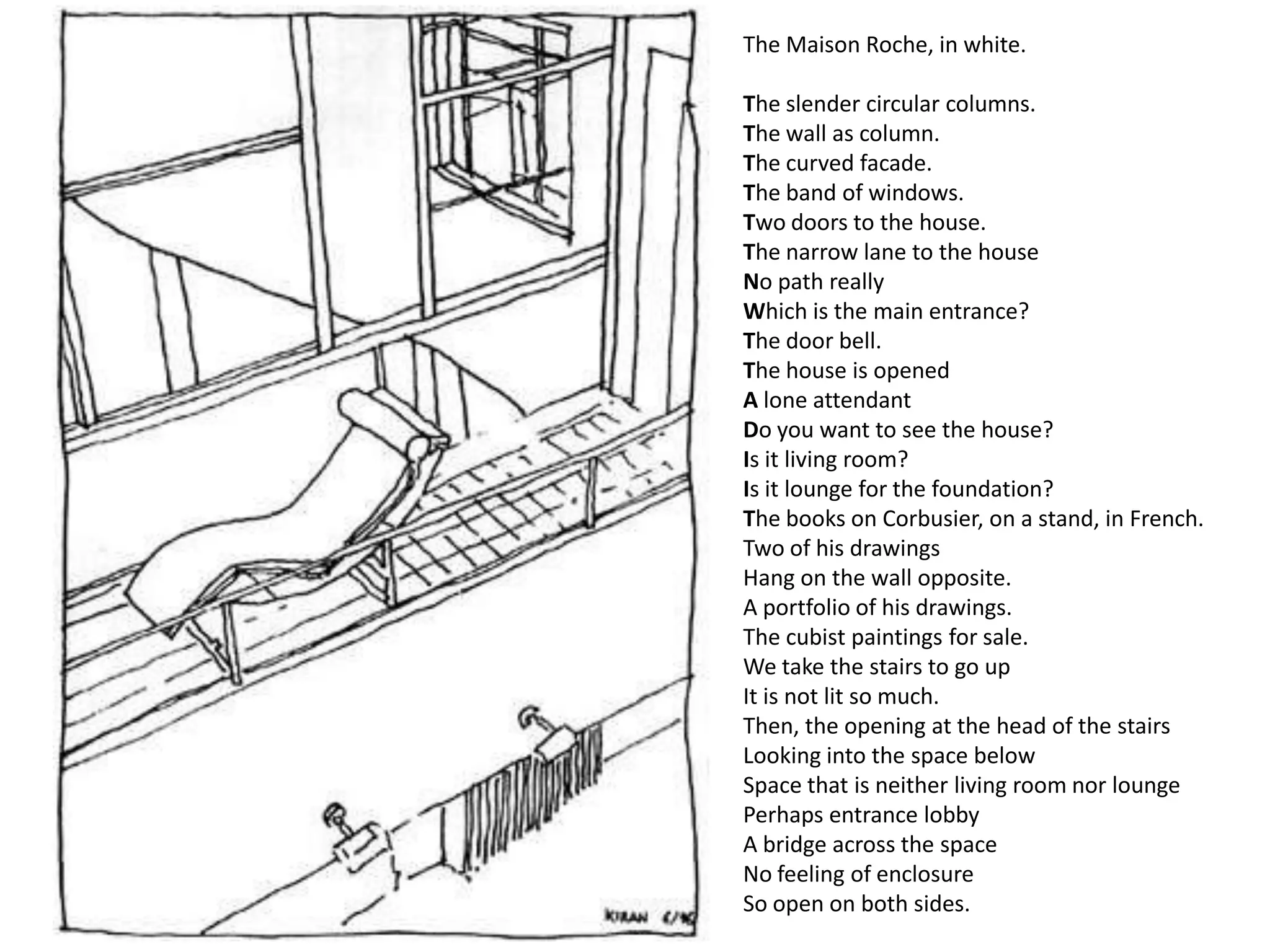
The Maison Roche, in white.

The slender circular columns.
The wall as column.
The curved facade.
The band of windows.
Two doors to the house.
The narrow lane to the house
No path really
Which is the main entrance?
The door bell.
The house is opened
A lone attendant
Do you want to see the house?
Is it living room?
Is it lounge for the foundation?
The books on Corbusier, on a stand, in French.
Two of his drawings
Hang on the wall opposite.
A portfolio of his drawings.
The cubist paintings for sale.
We take the stairs to go up
It is not lit so much.
Then, the opening at the head of the stairs
Looking into the space below
Space that is neither living room nor lounge
Perhaps entrance lobby
A bridge across the space
No feeling of enclosure
So open on both sides.
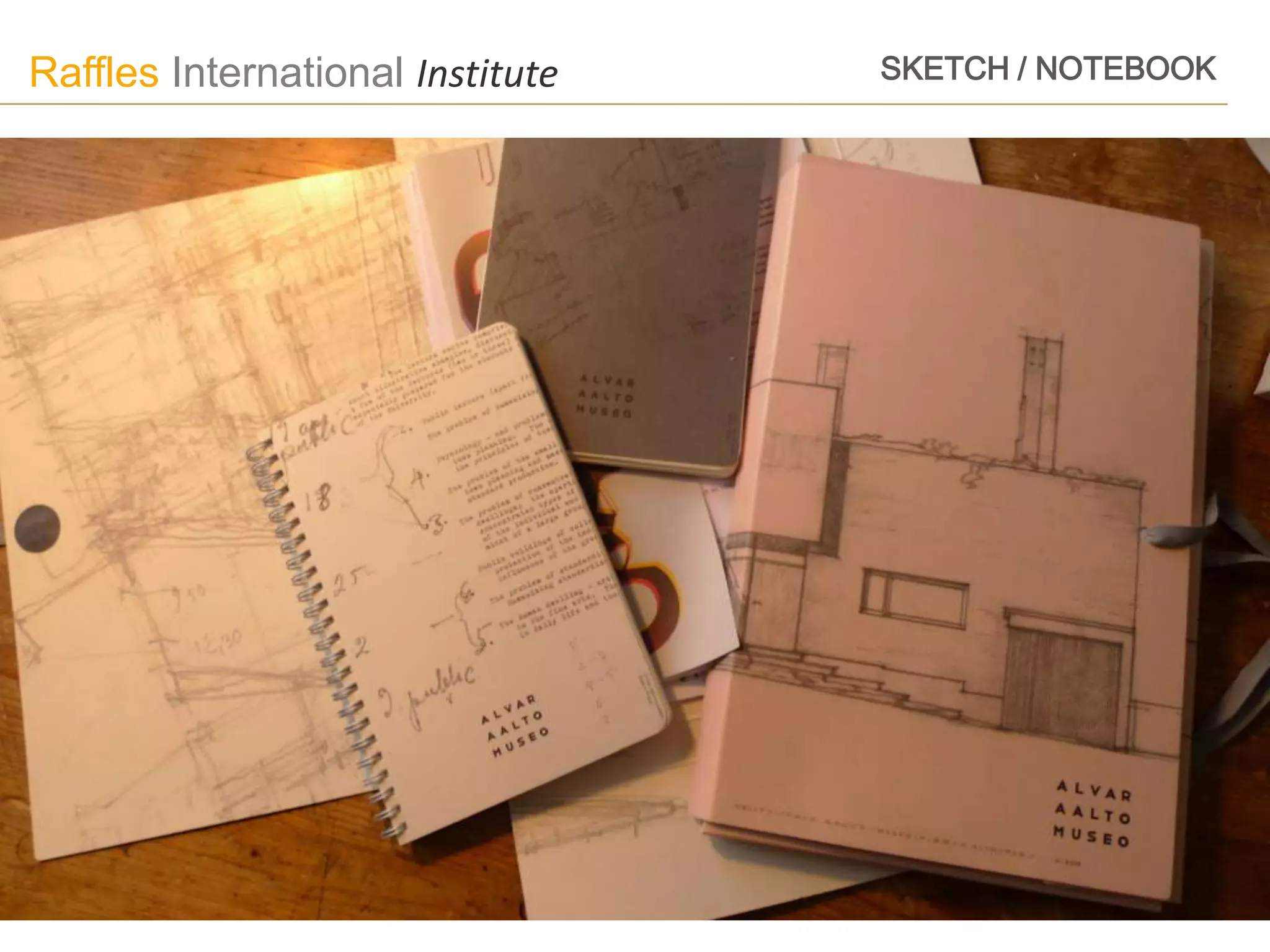
Raffles International Institute   SKETCH / NOTEBOOK
Raffles International Institute           LAYERS OF ABSTRACTION

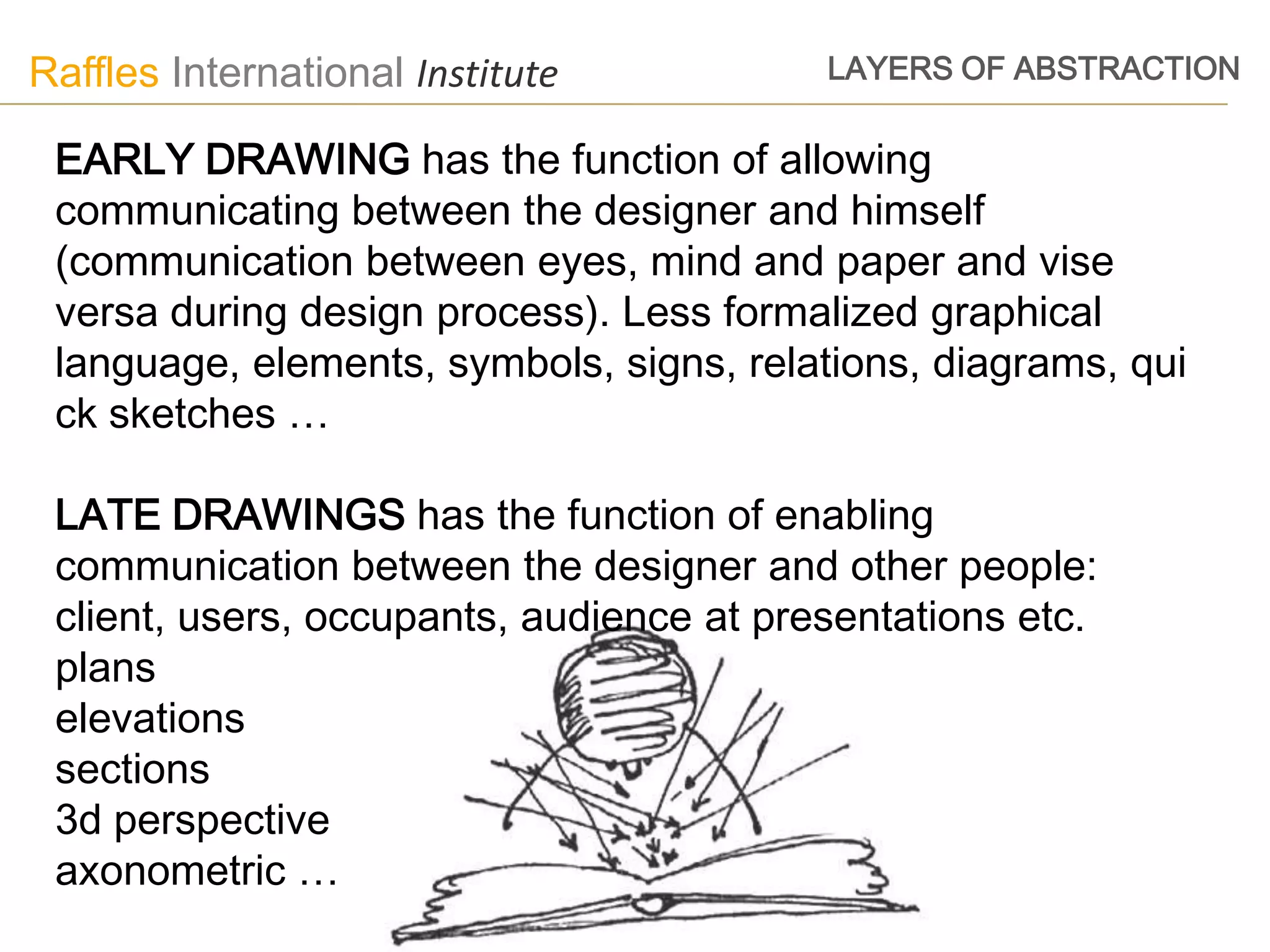
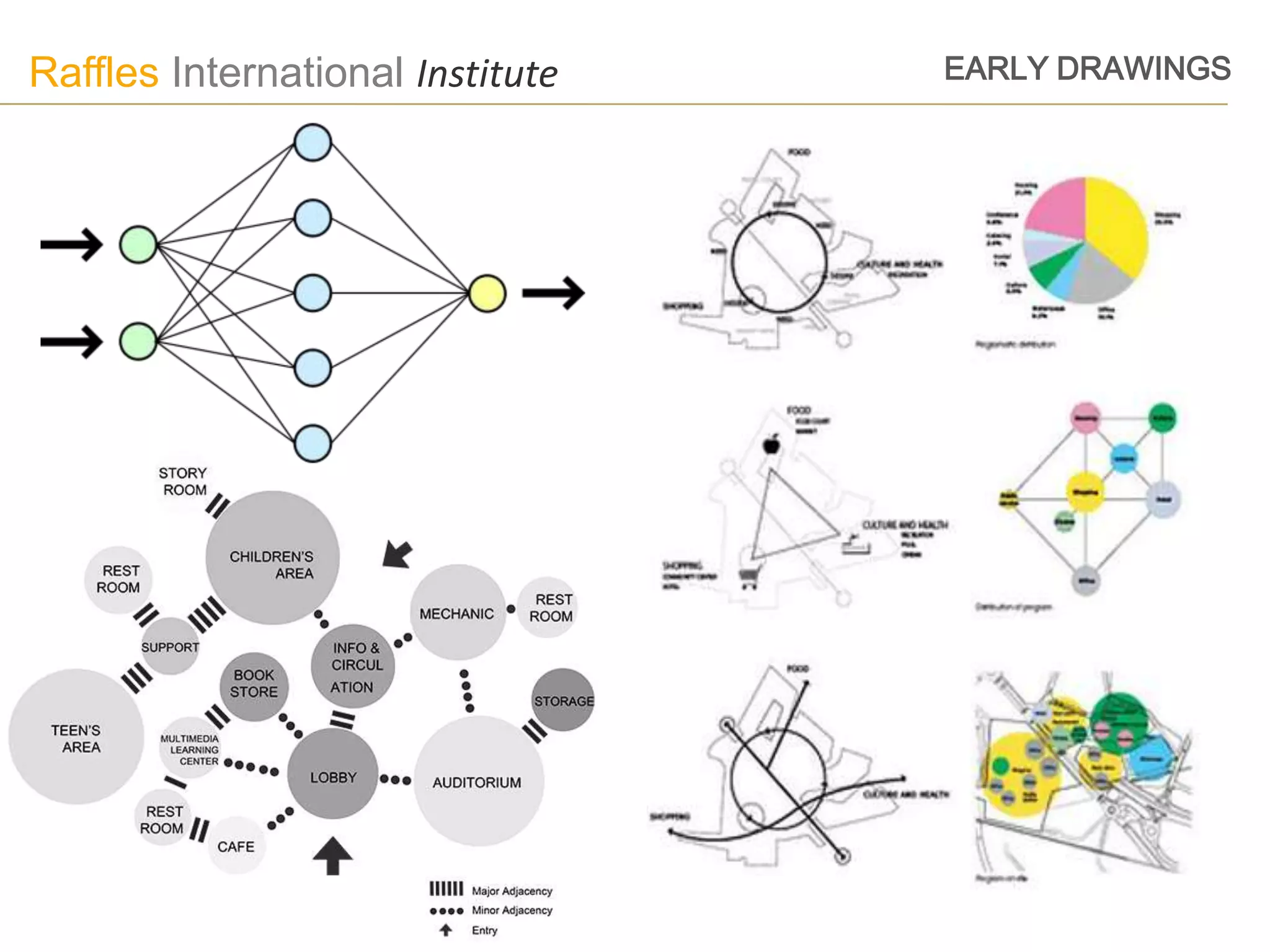
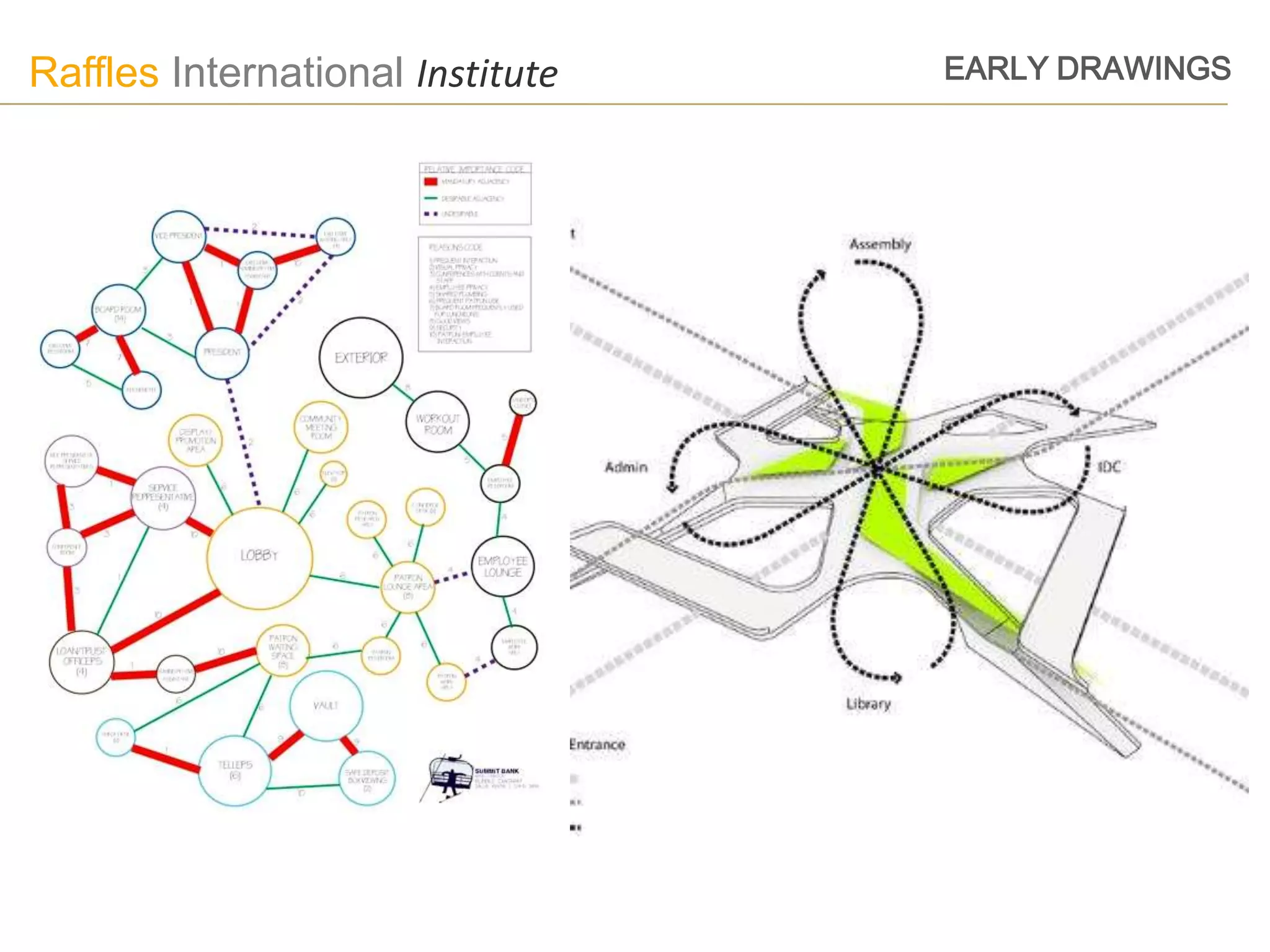
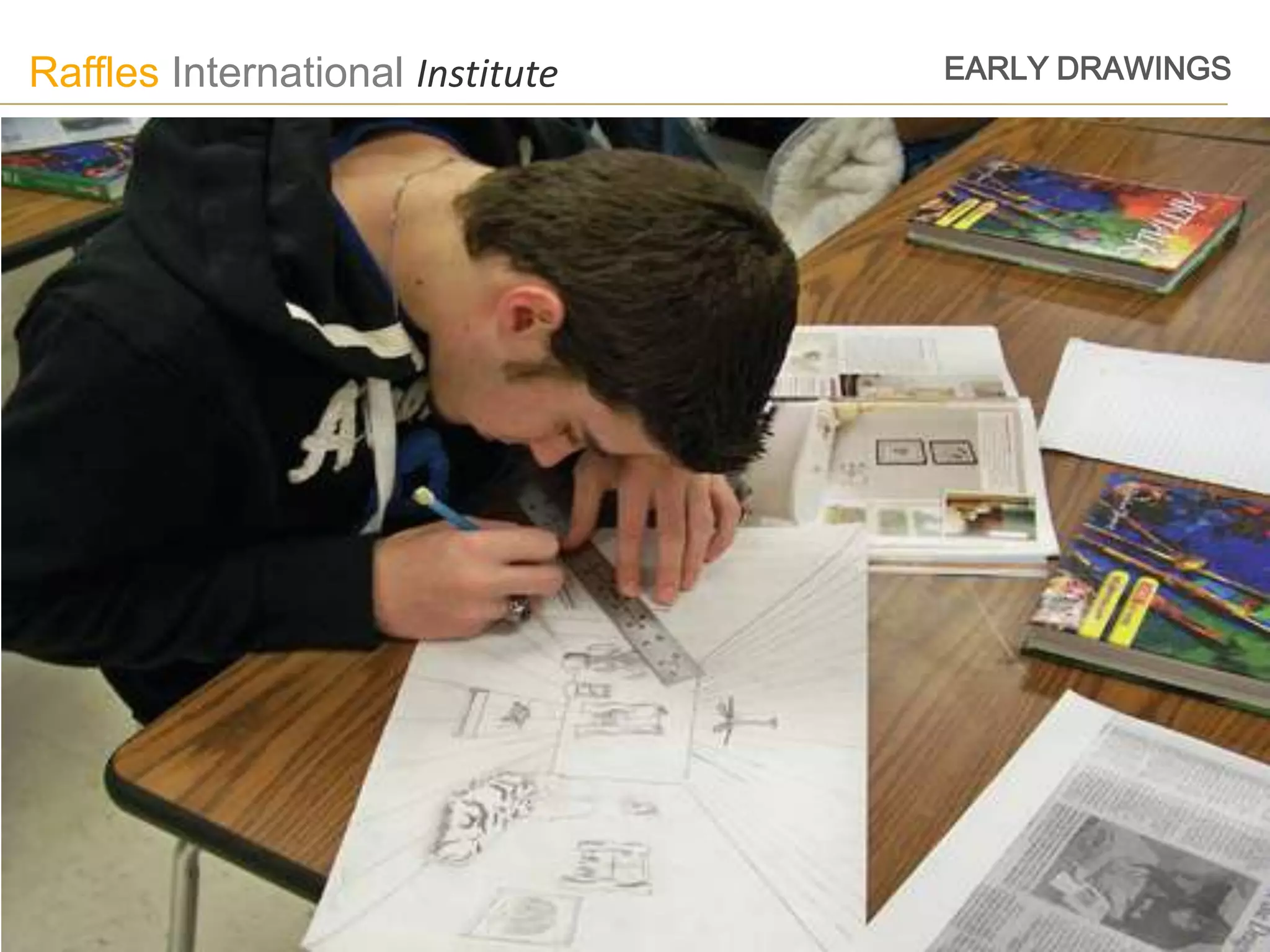
 EARLY DRAWING has the function of allowing
 communicating between the designer and himself
 (communication between eyes, mind and paper and vise
 versa during design process). Less formalized graphical
 language, elements, symbols, signs, relations, diagrams, qui
 ck sketches …

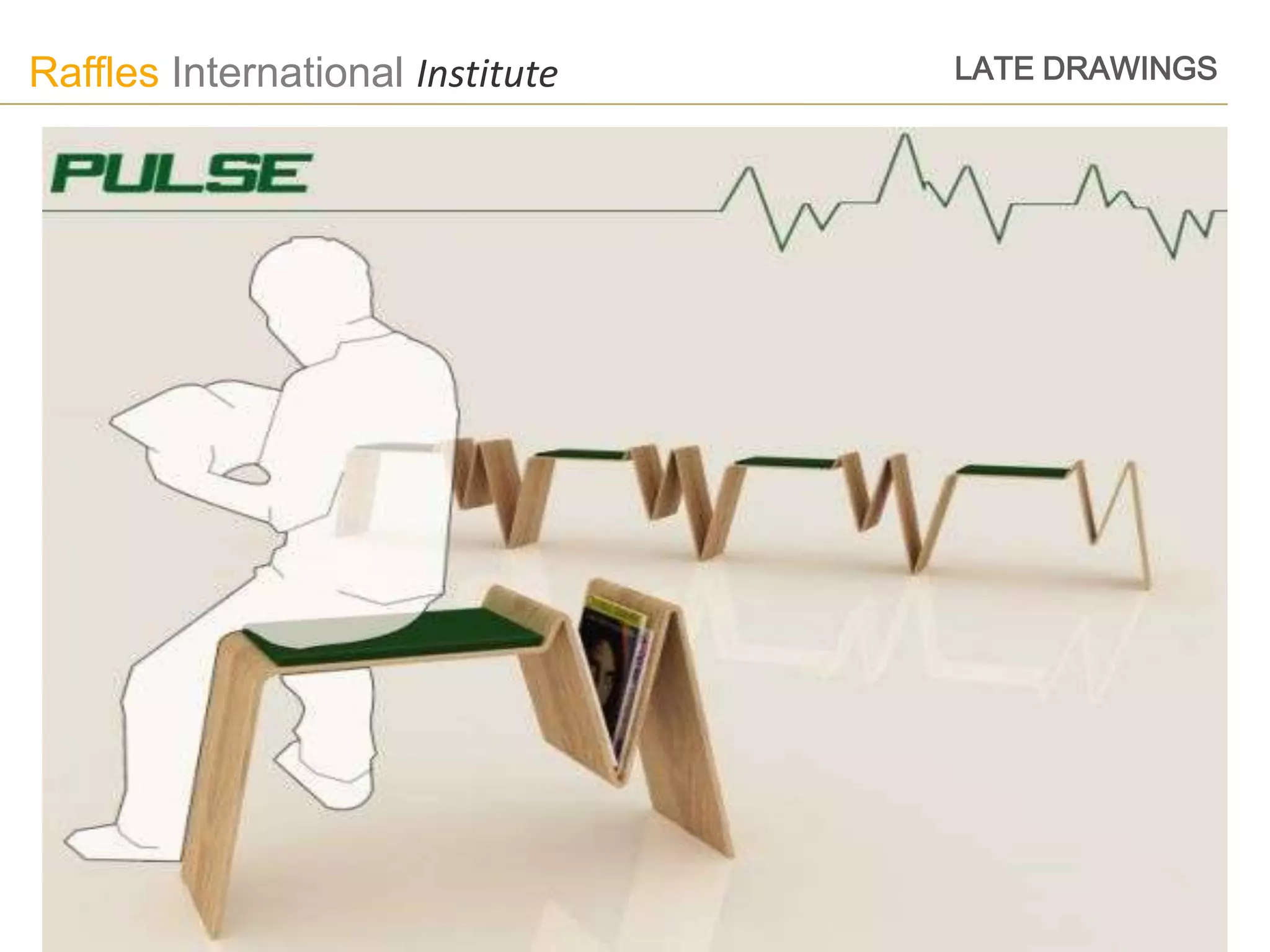
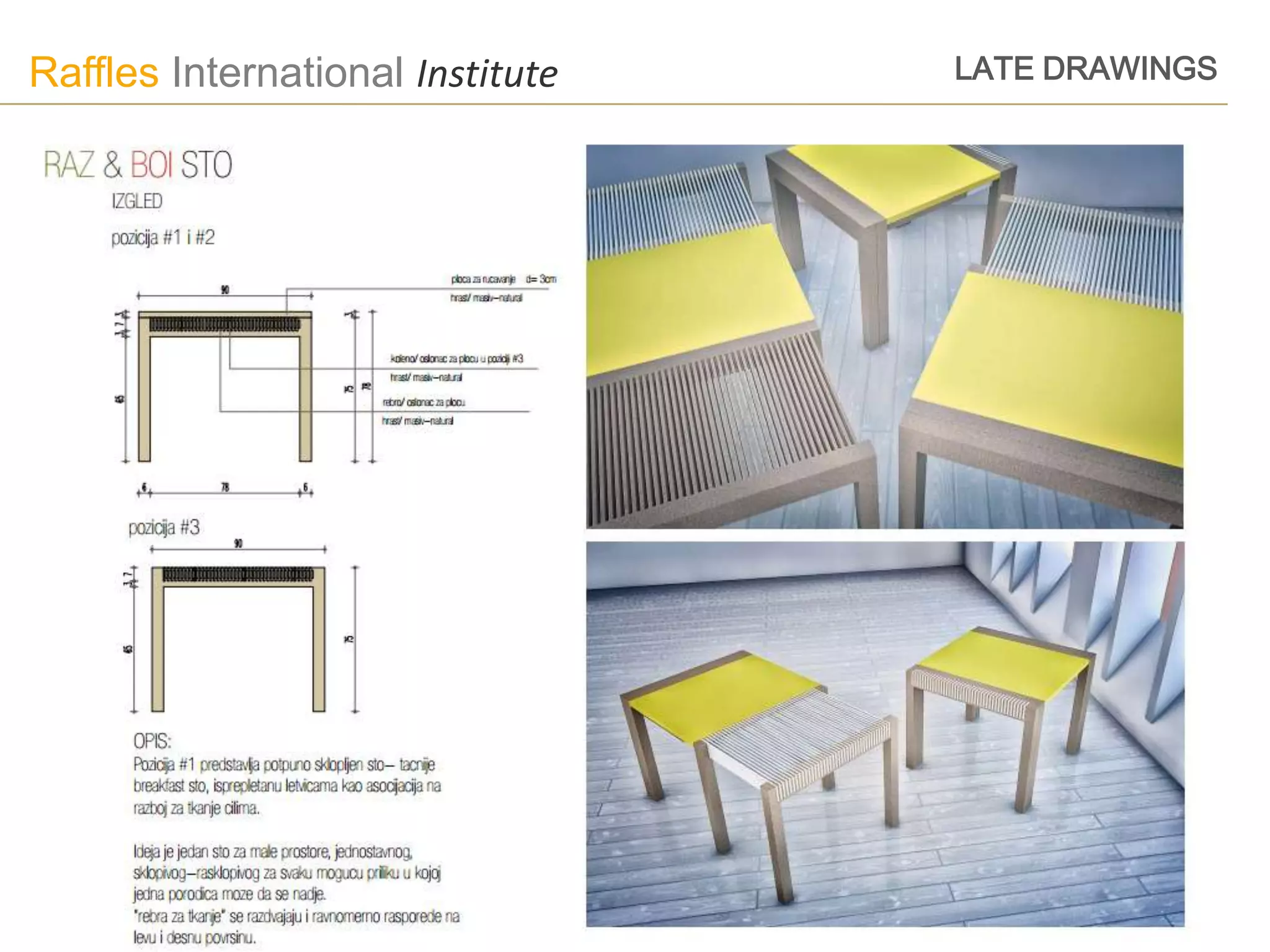
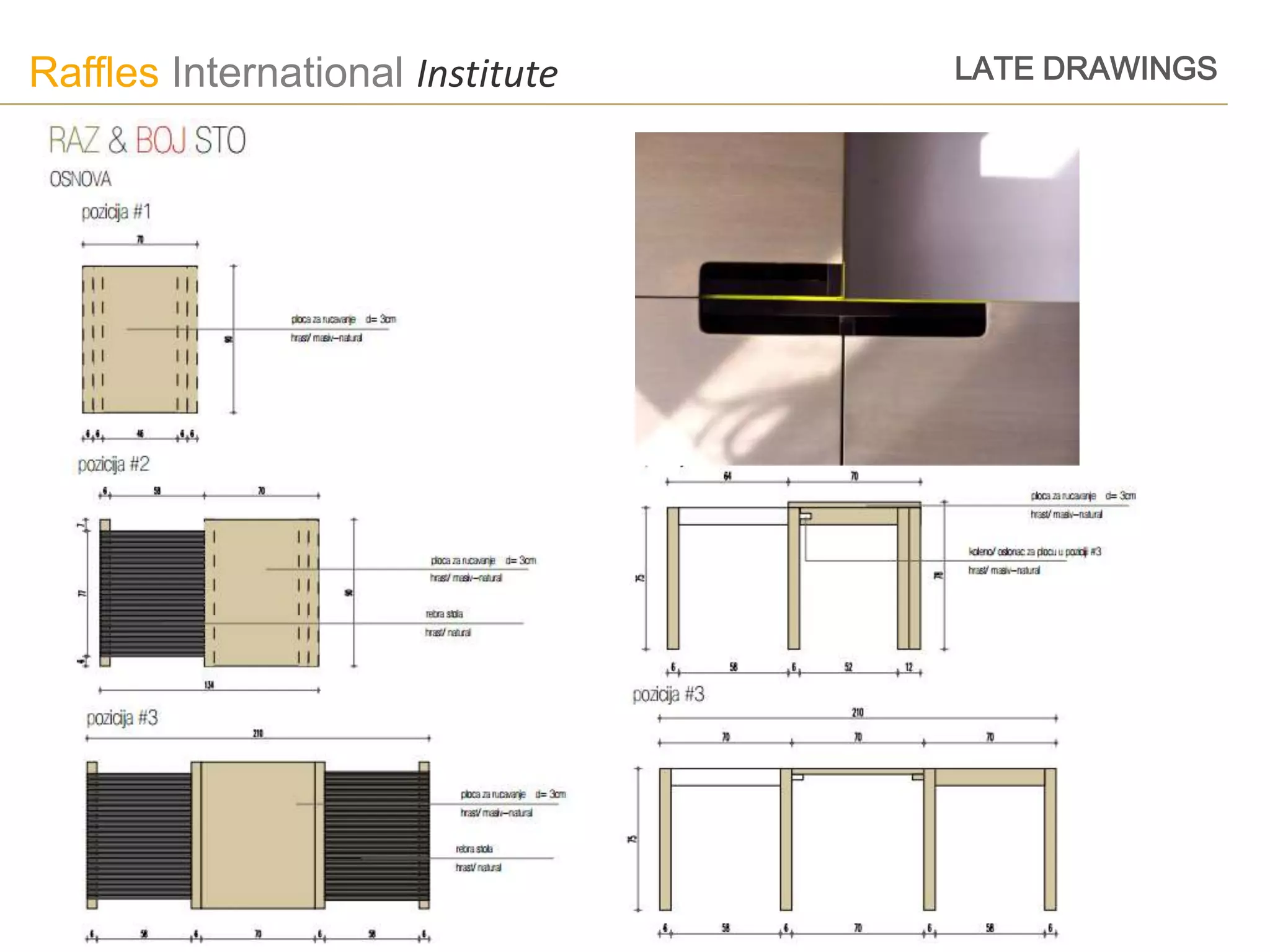
 LATE DRAWINGS has the function of enabling
 communication between the designer and other people:
 client, users, occupants, audience at presentations etc.
 plans
 elevations
 sections
 3d perspective
 axonometric …
Raffles International Institute   LAYERS OF ABSTRACTION


 EXCERCIZE:

 1. Draw something “HOT”, “SWEET”, “SOAR”
 2. Draw “LAZY”, “STUBORN”, “DYNAMIC”
 3. Draw “BEING LATE”
 4. Draw “COLD”, “METAL”, “RUSTY”
 5. Draw “FLUID”, “SOLID”, “LIQUID”
 6. Draw “PERSONAL CHARACTER”
 7. Draw “SERENITY”, “MYSTICISM”, “TRANSPARENT”


 5 min sketch practice for each
Raffles International Institute   EARLY DRAWINGS
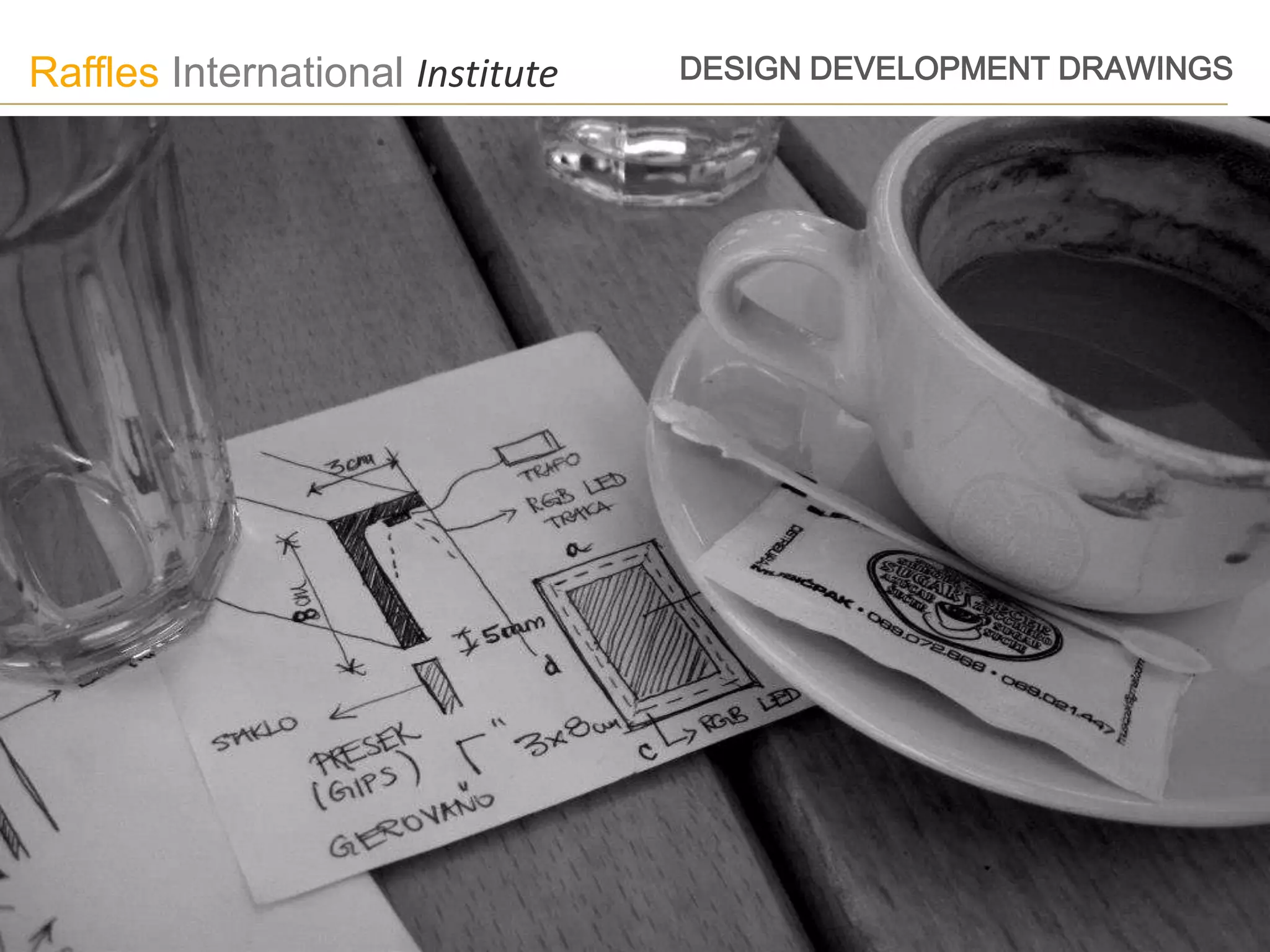
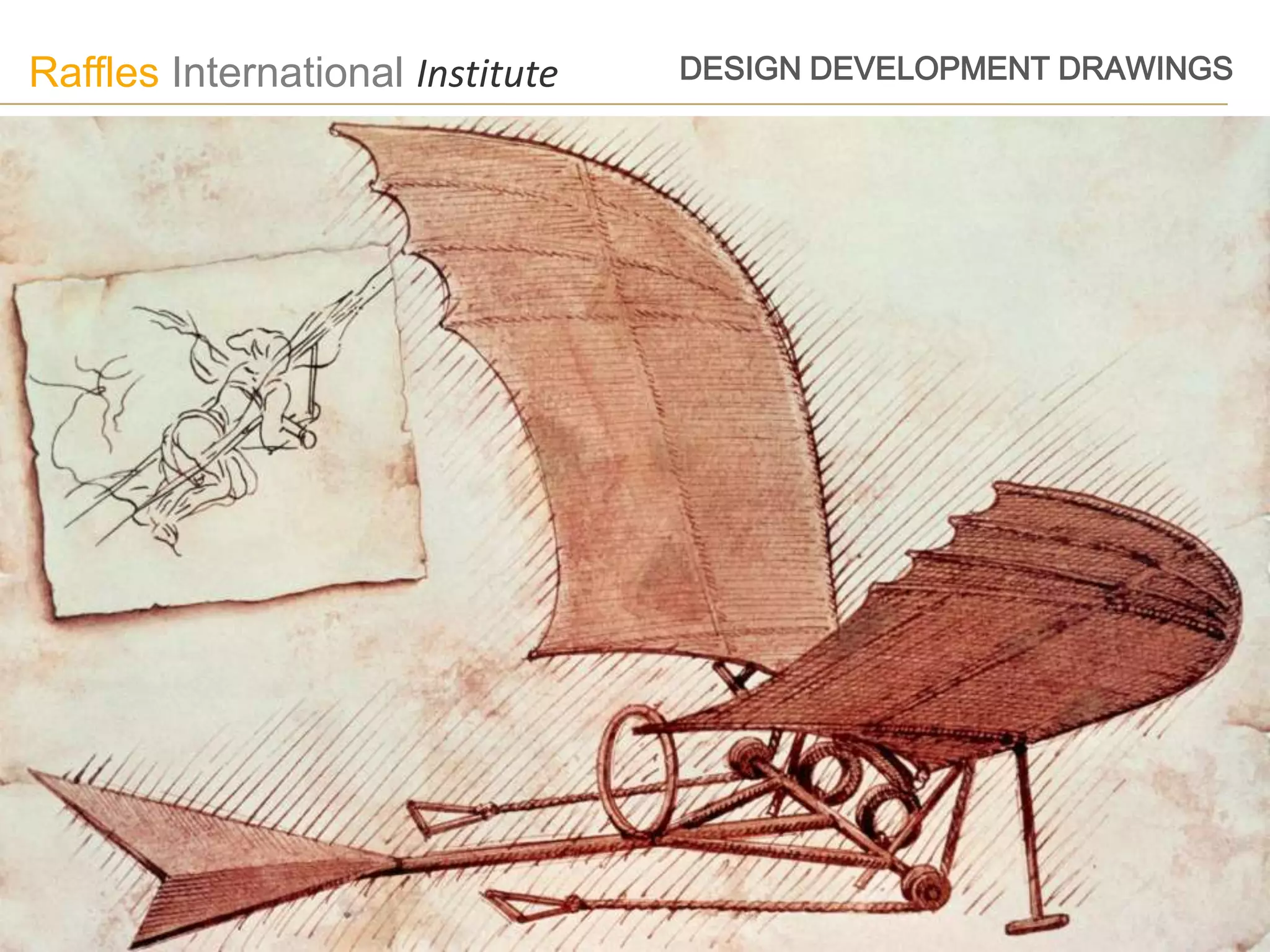
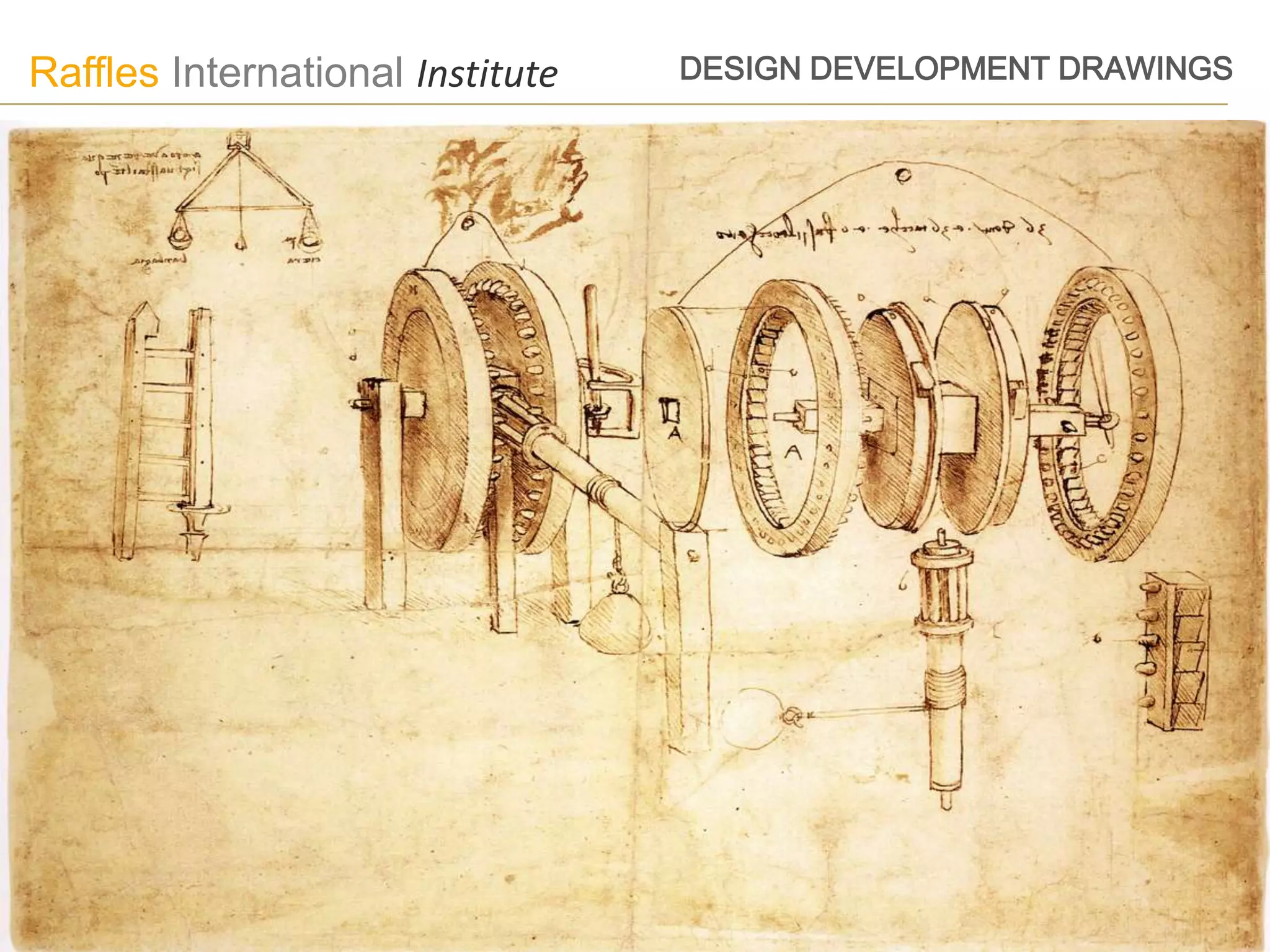
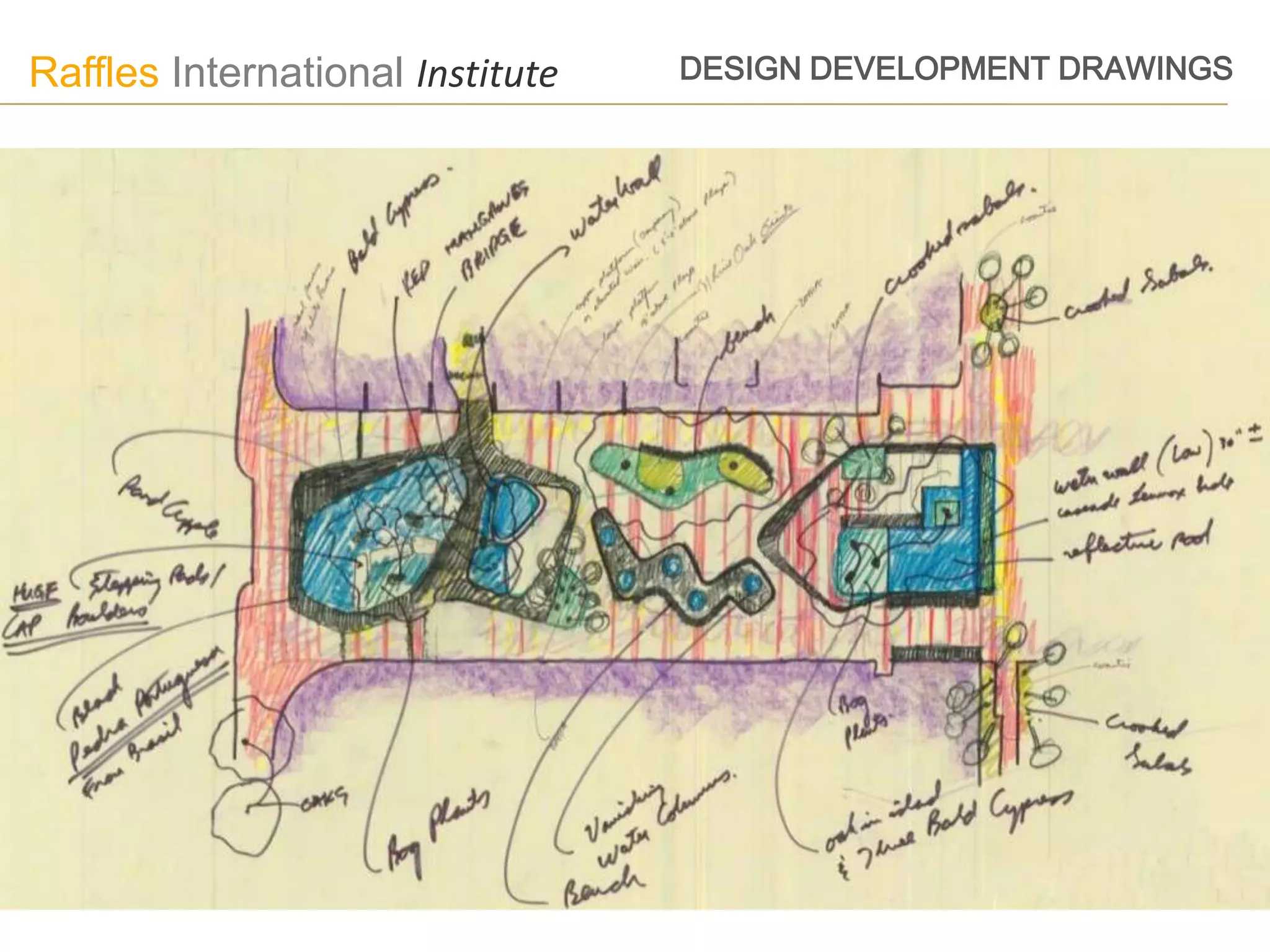
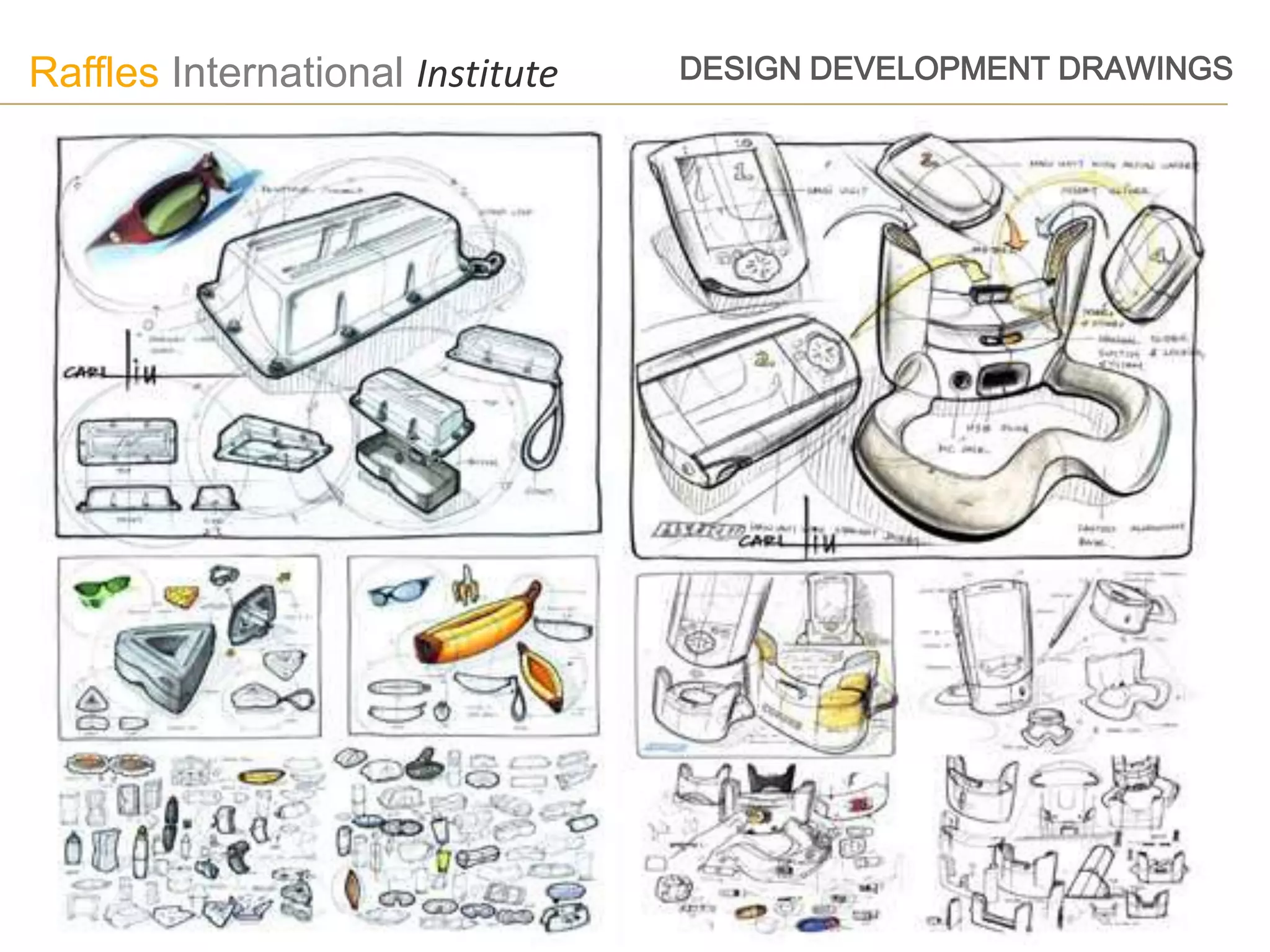
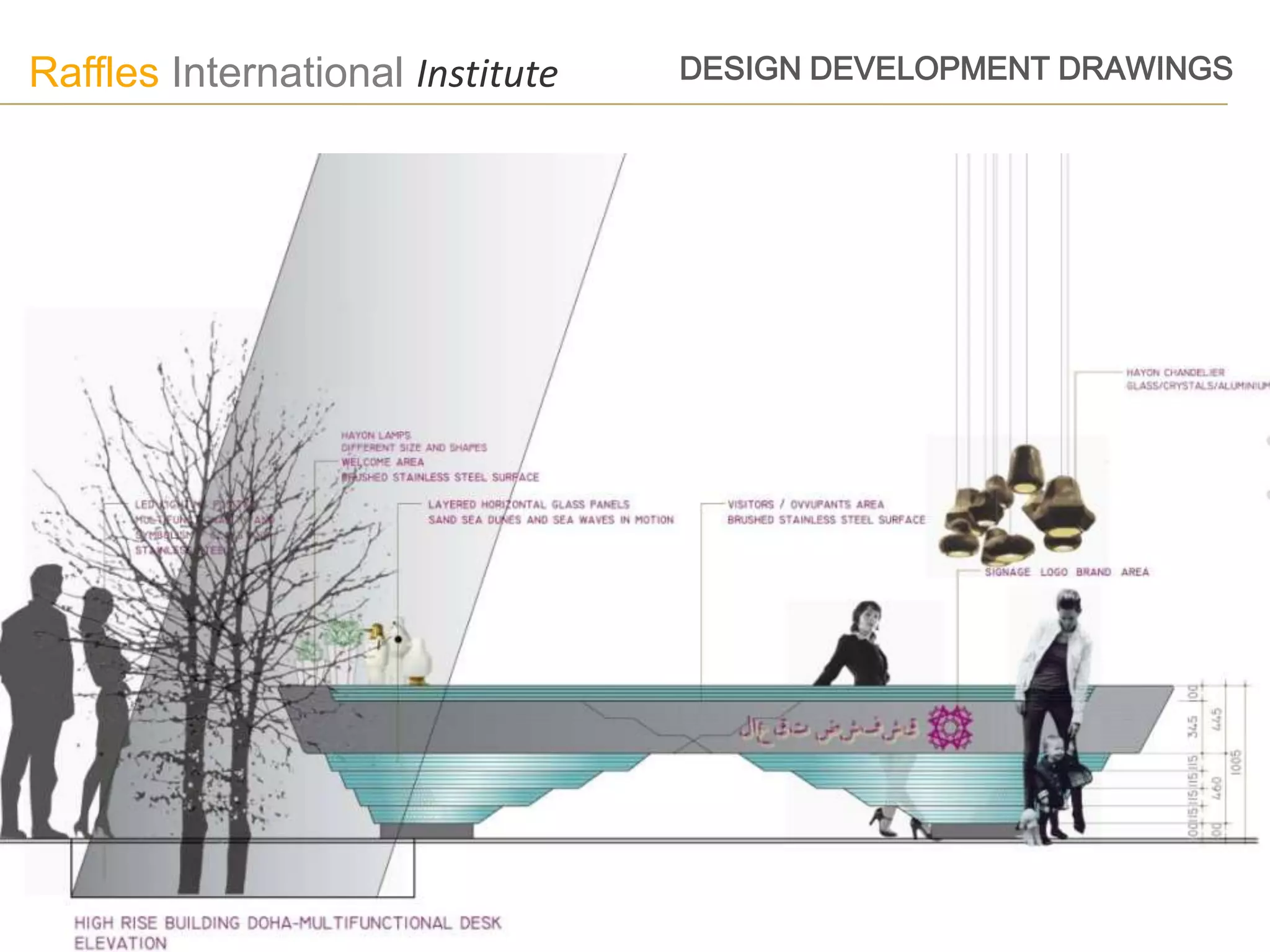
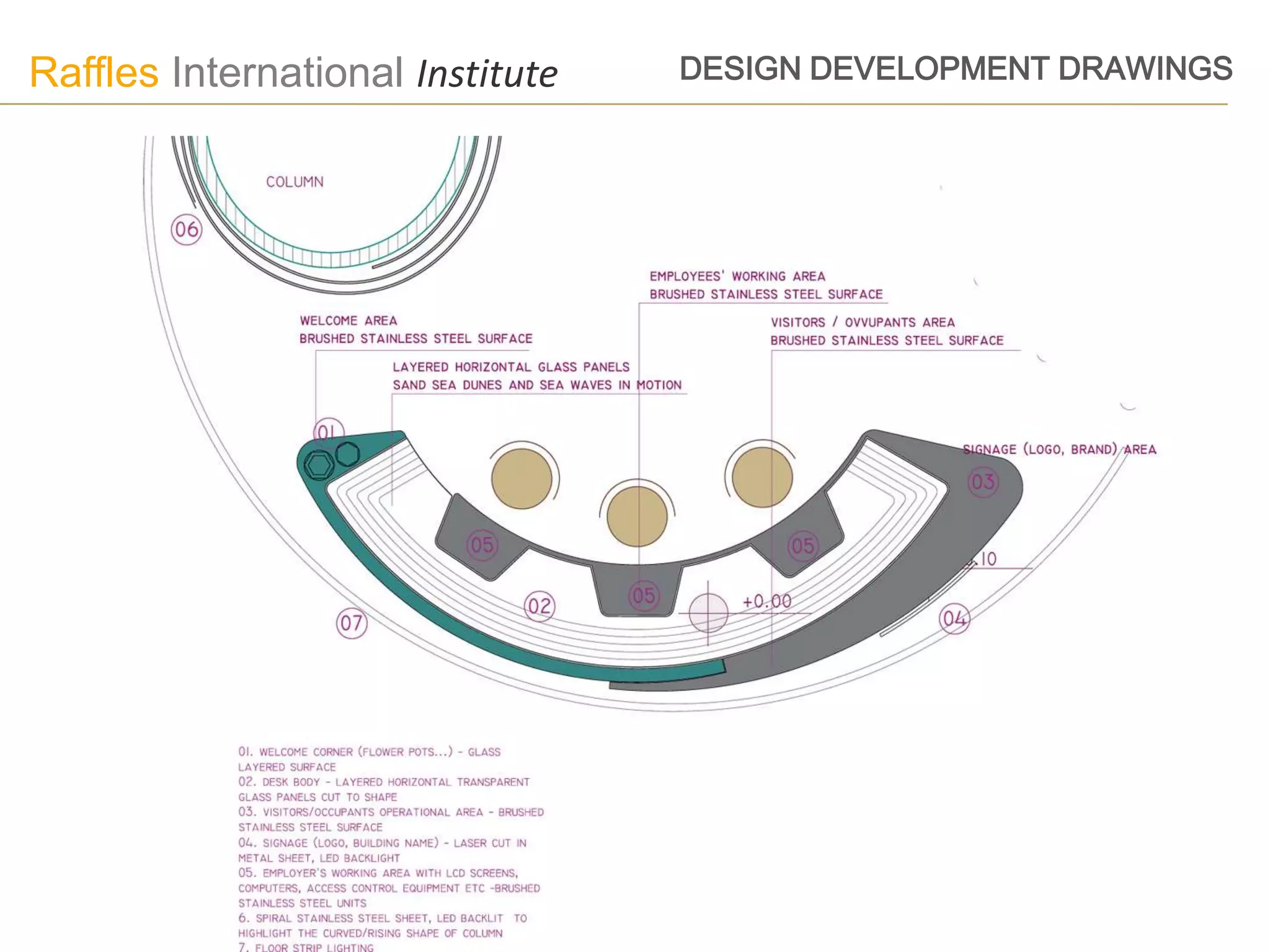
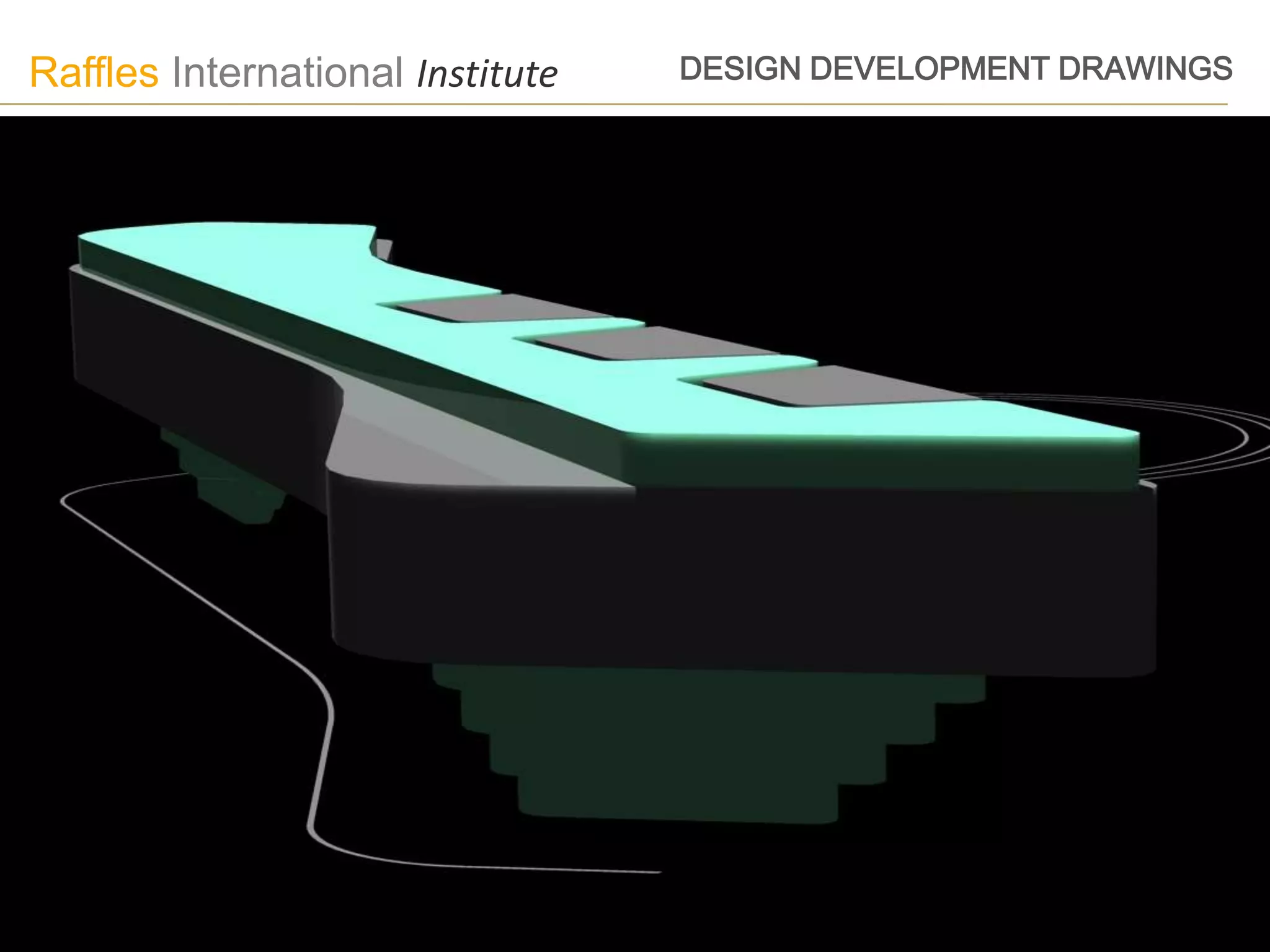
Raffles International Institute   DESIGN DEVELOPMENT DRAWINGS
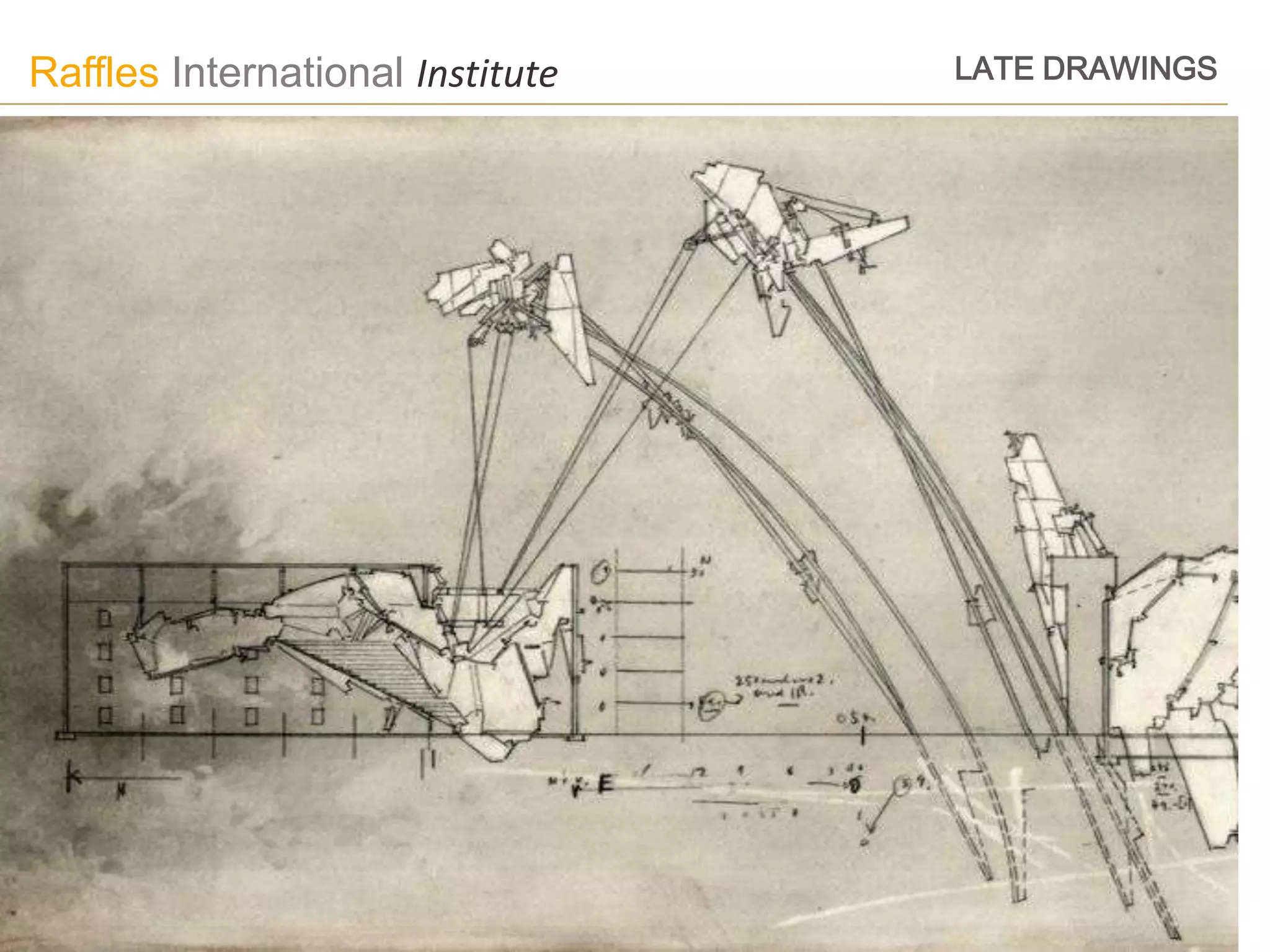
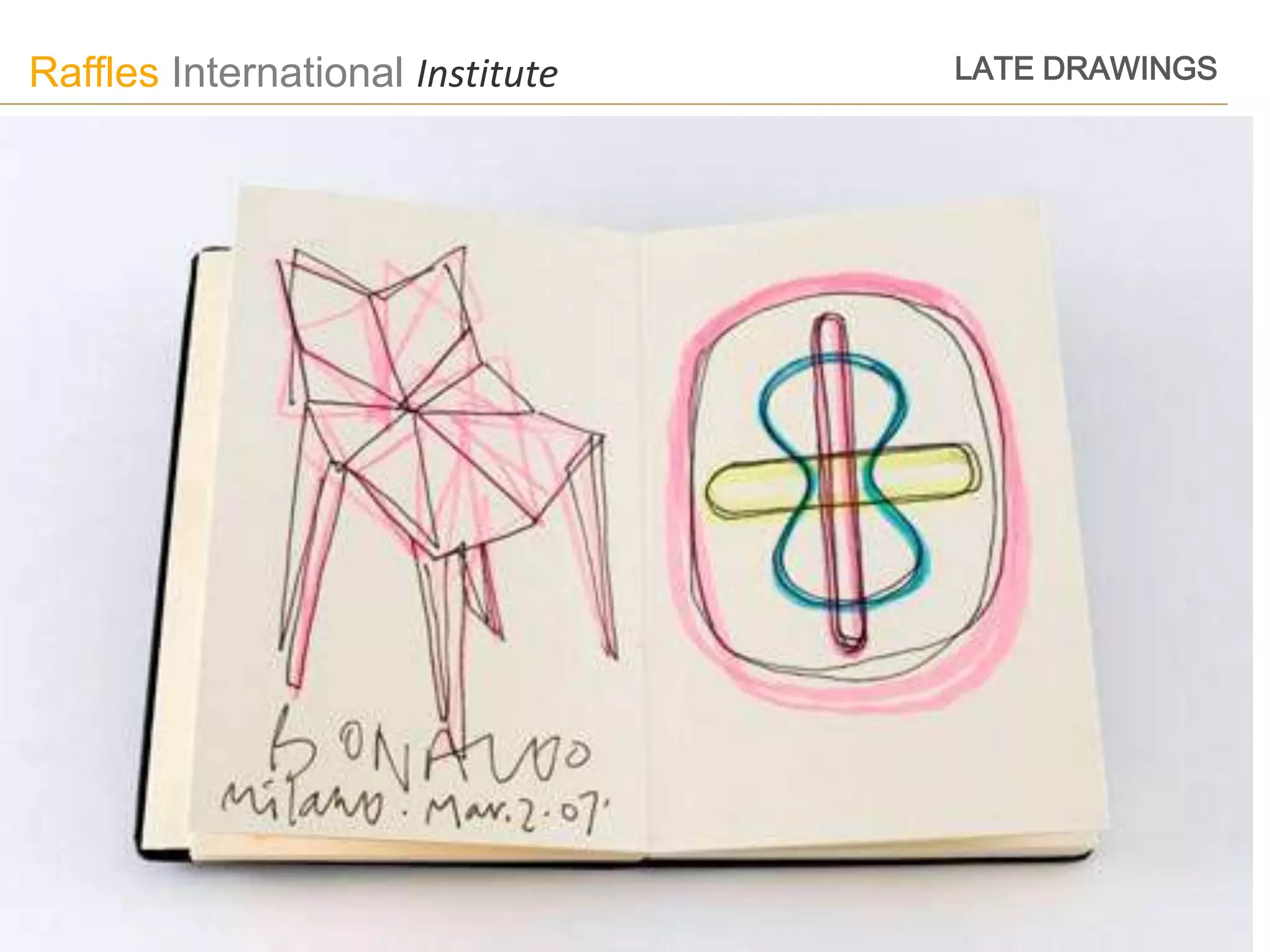
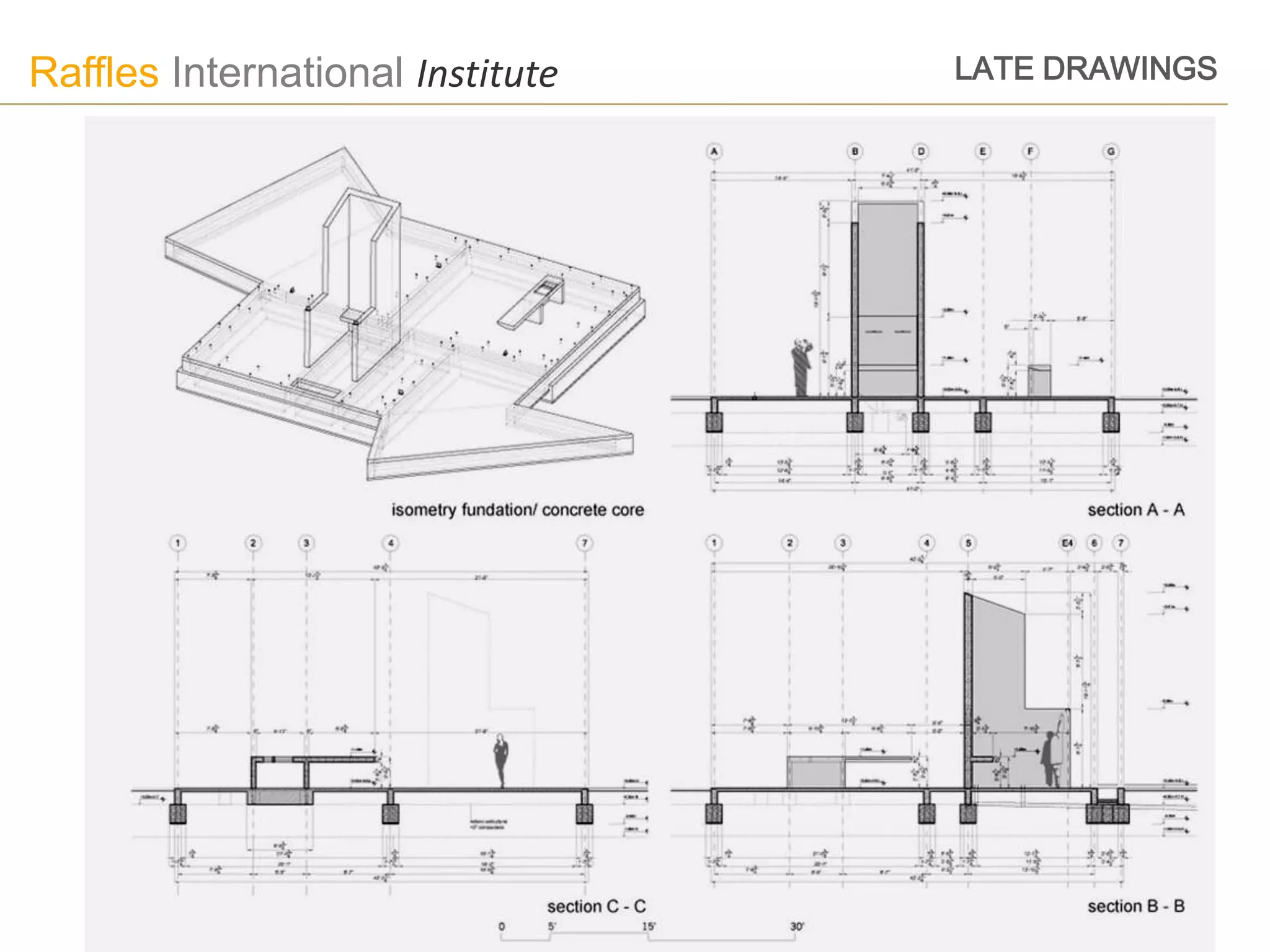
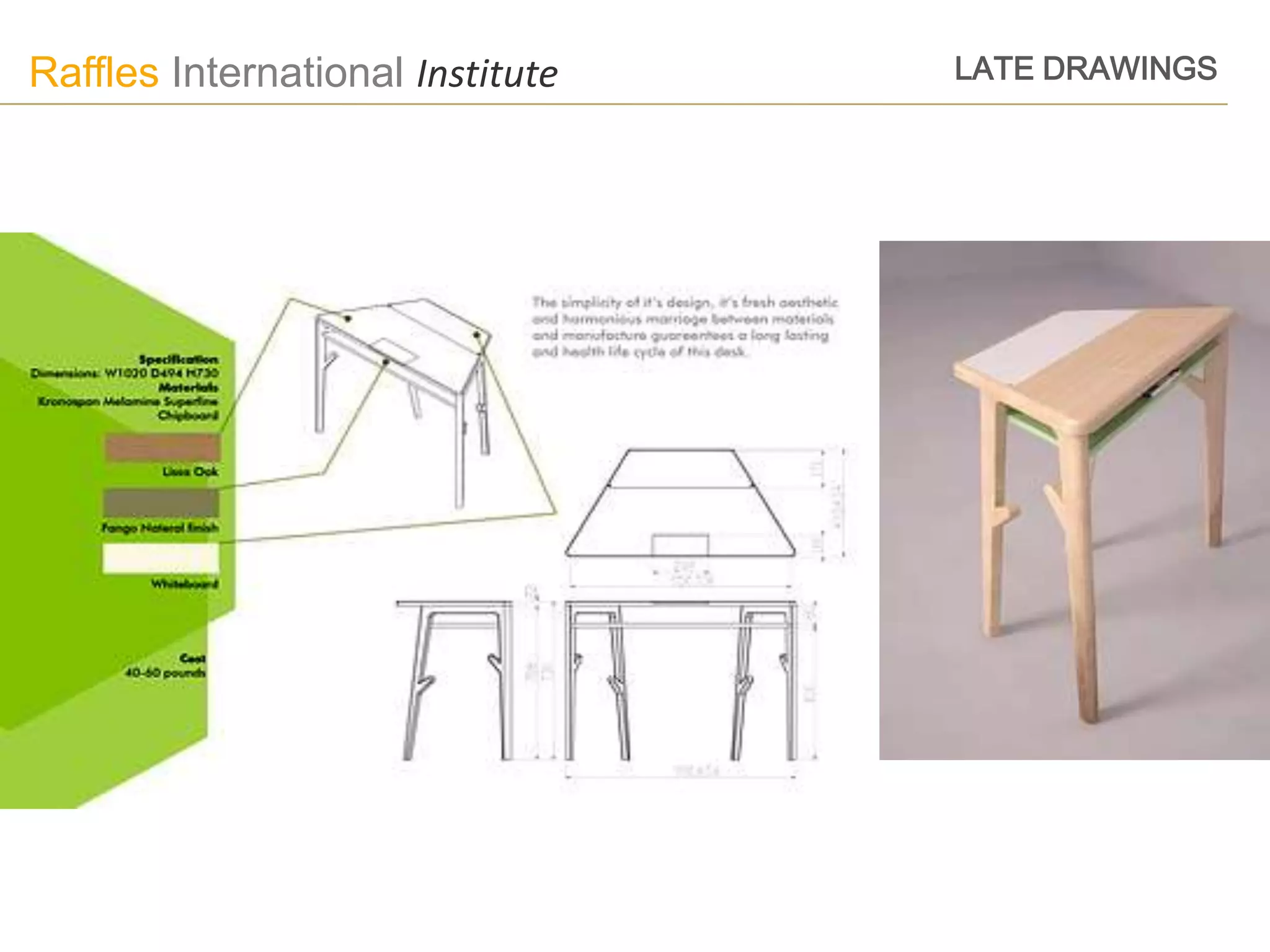
Raffles International Institute   LATE DRAWINGS
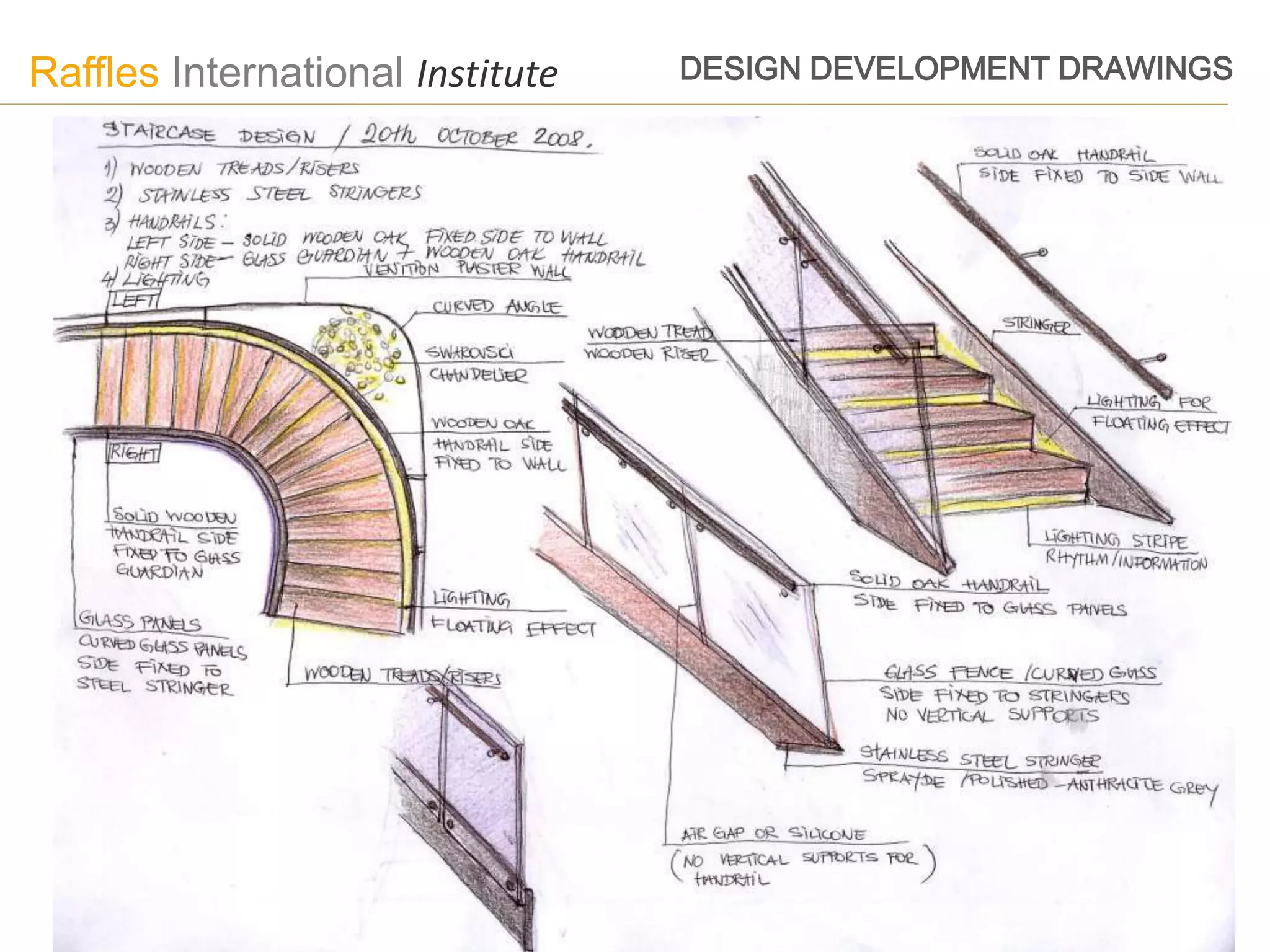
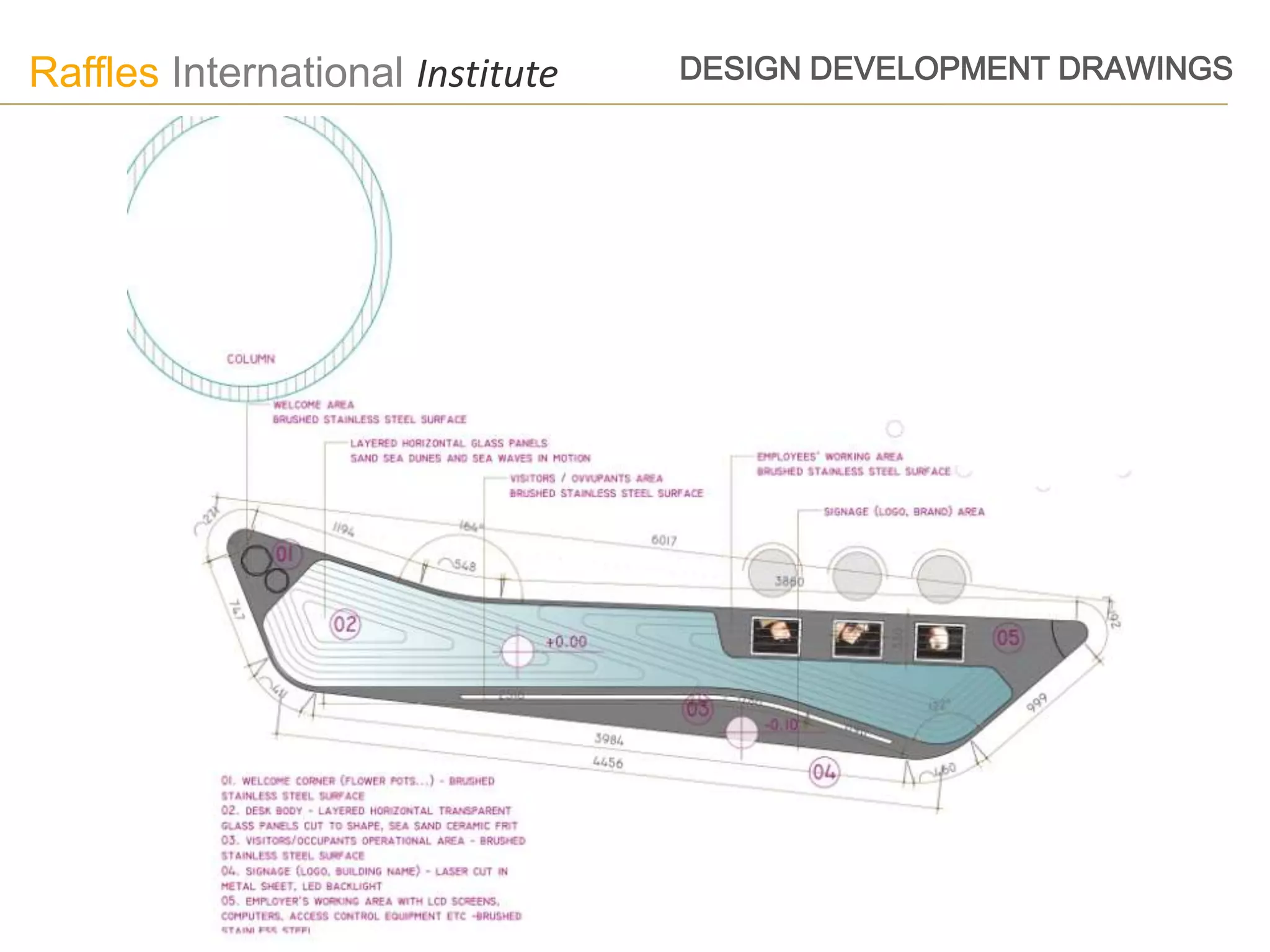
Raffles International Institute   DESIGN DEVELOPMENT DRAWINGS
Raffles International Institute   LATE DRAWINGS
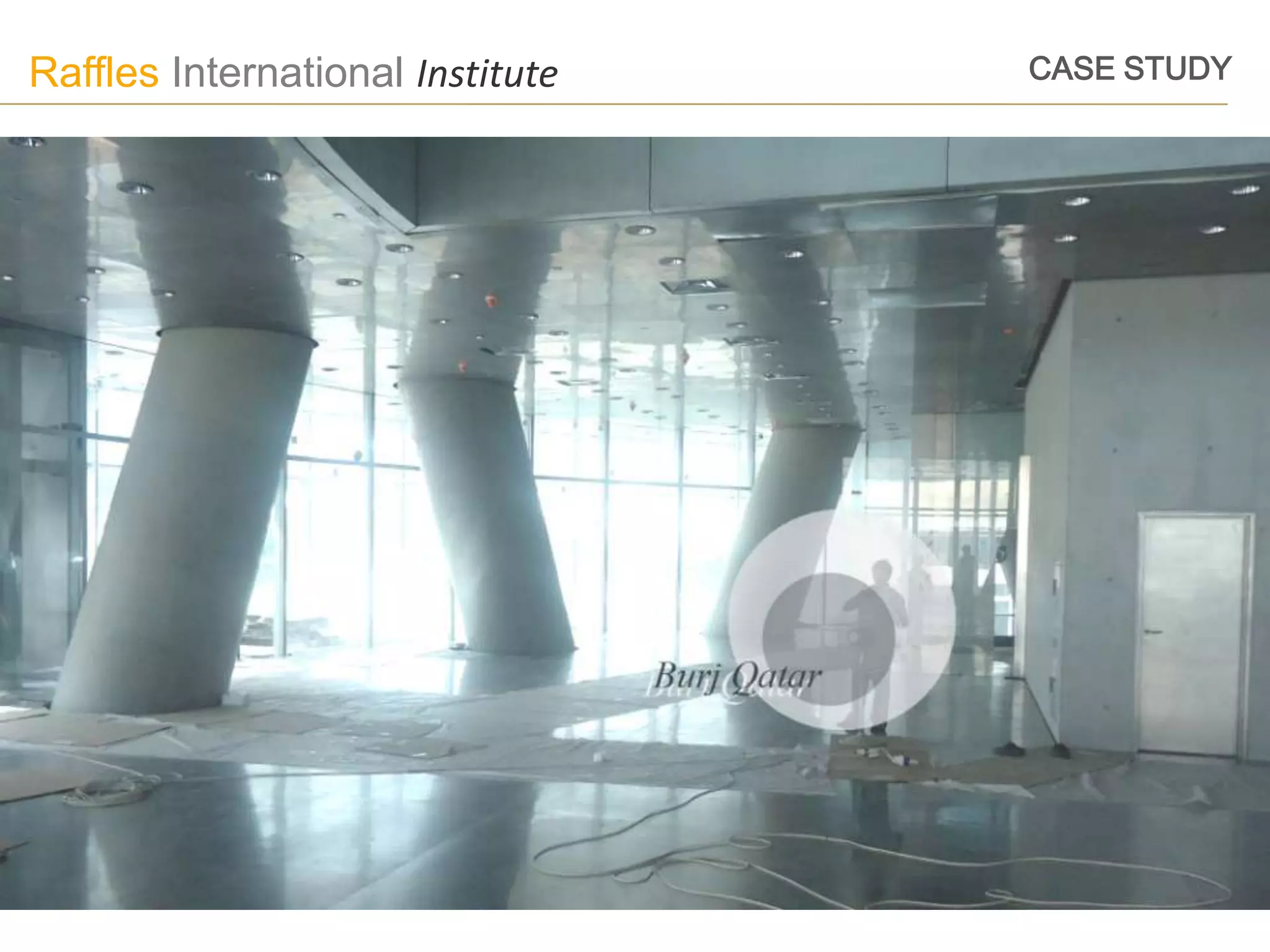
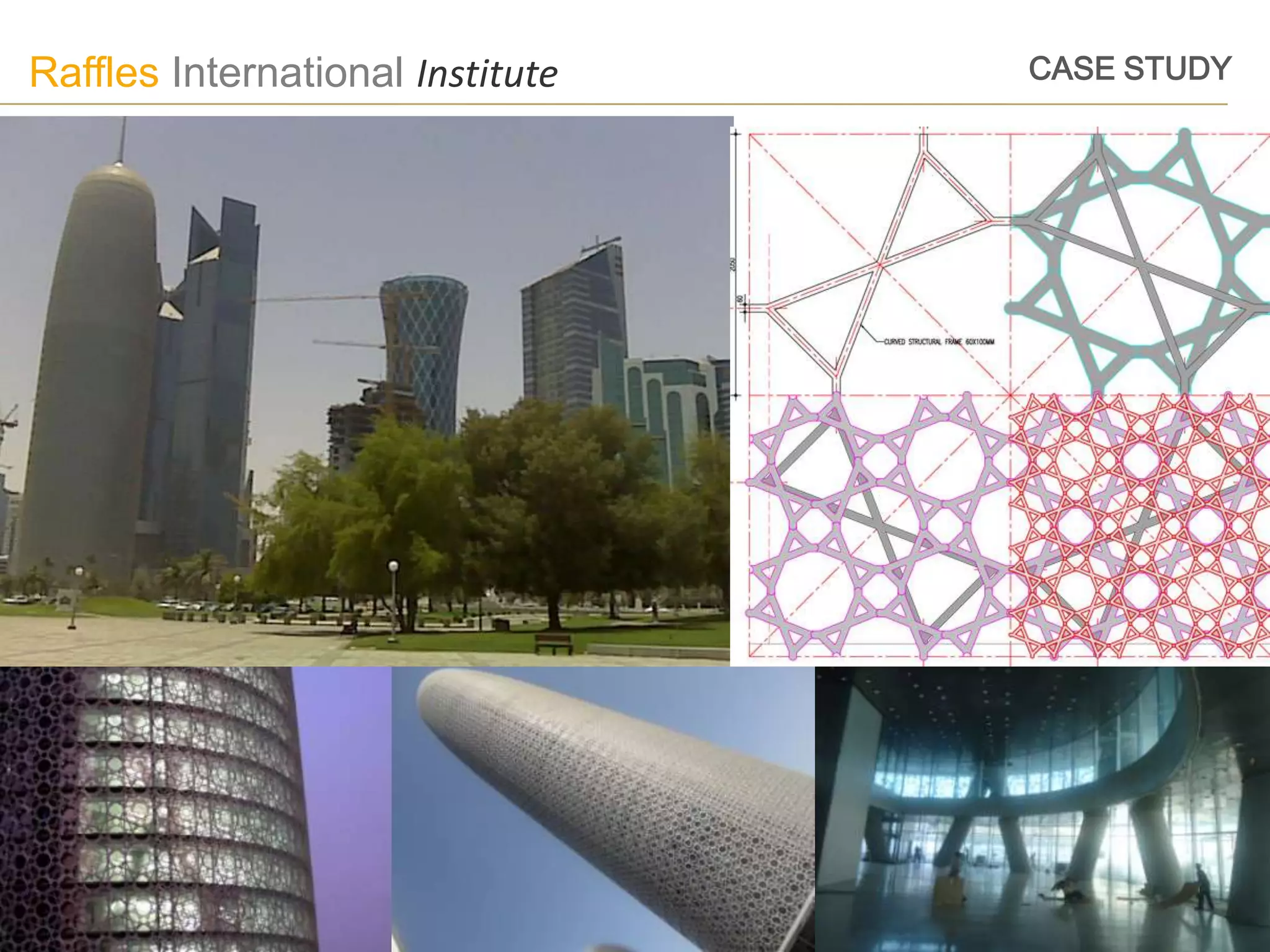
Raffles International Institute   CASE STUDY
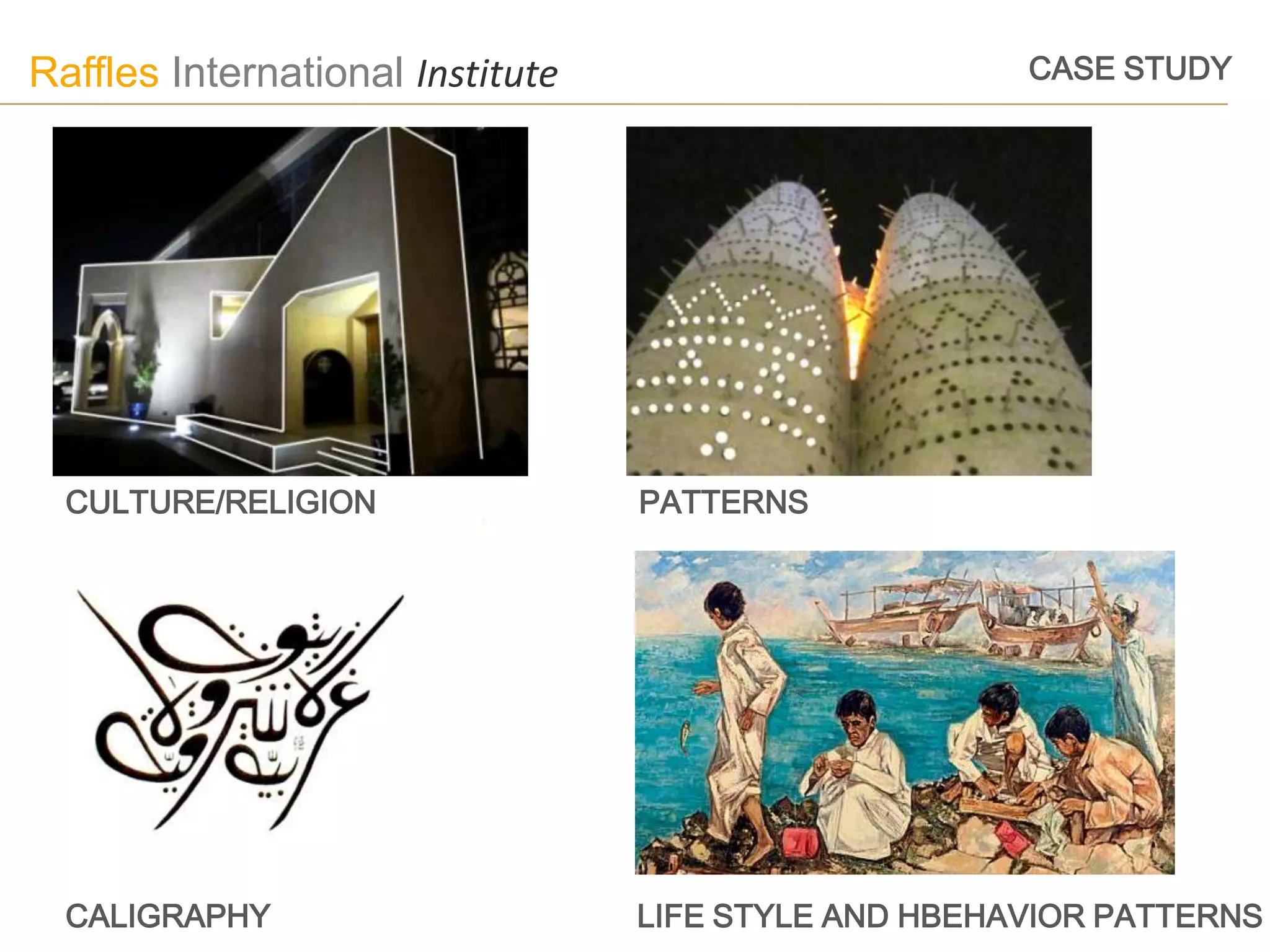
Raffles International Institute                       CASE STUDY


  CULTURE/RELIGION                PATTERNS


  CALIGRAPHY                      LIFE STYLE AND HBEHAVIOR PATTERNS
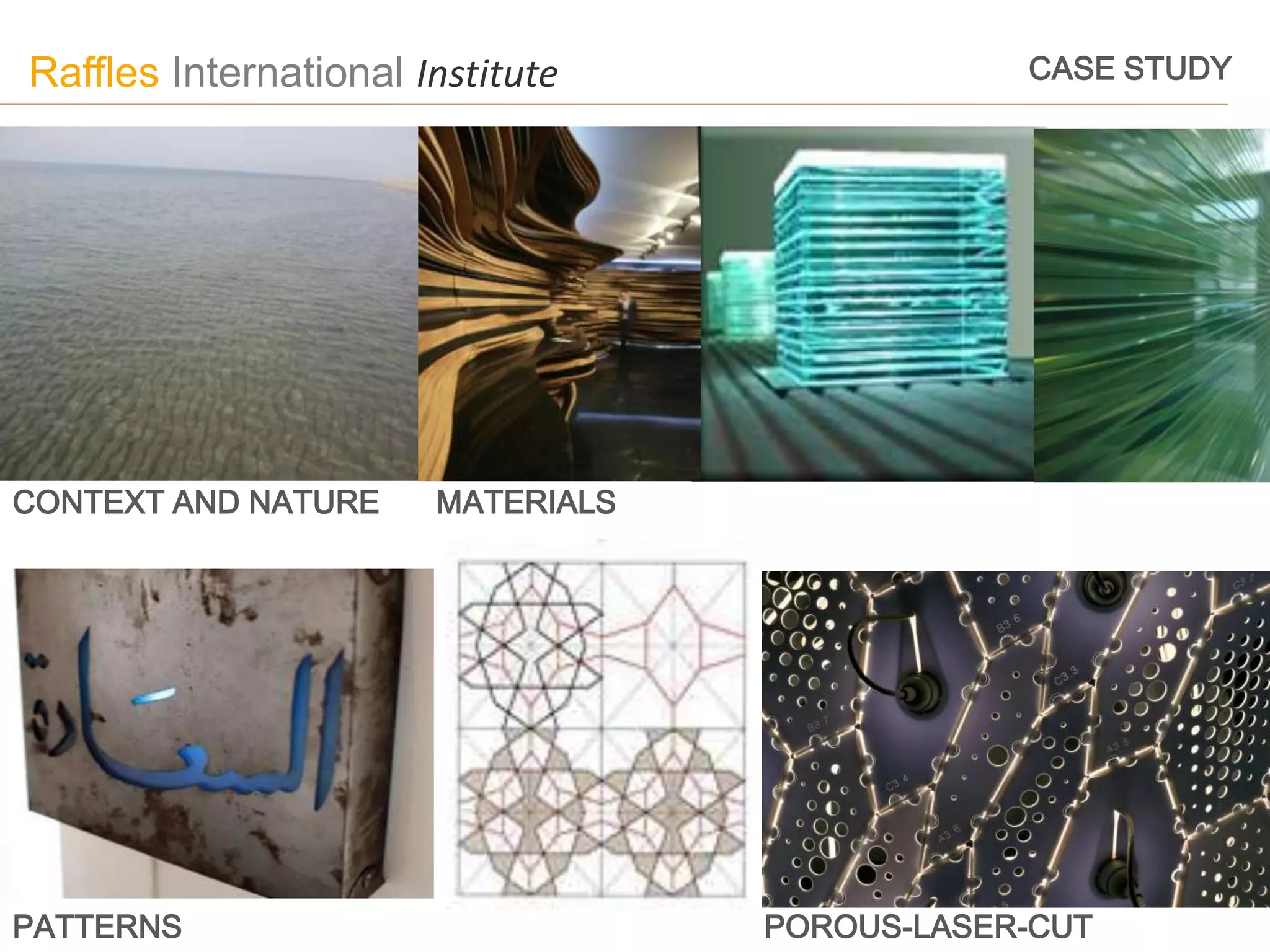
Raffles International Institute                CASE STUDY


CONTEXT AND NATURE     MATERIALS


PATTERNS                           POROUS-LASER-CUT
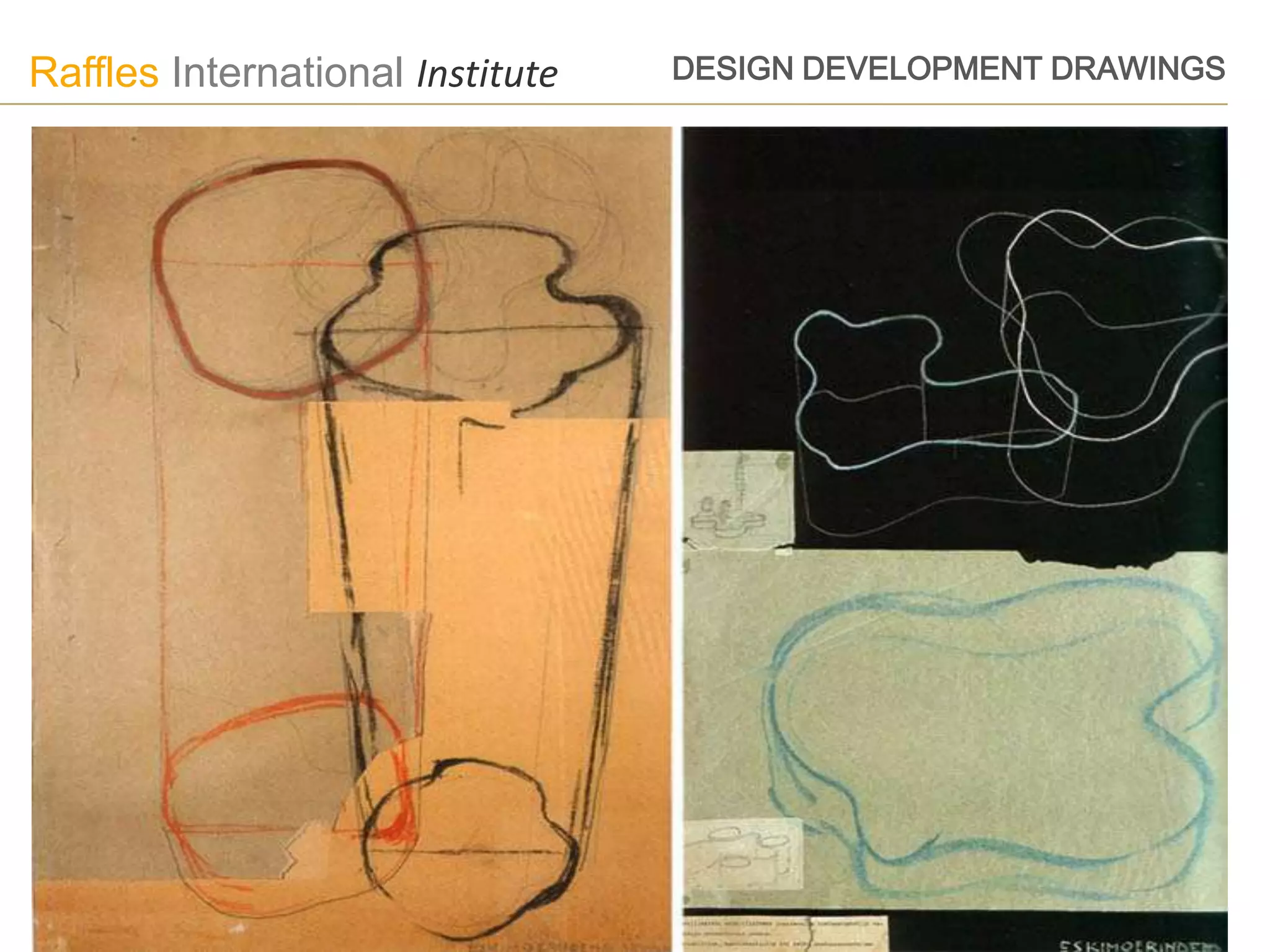
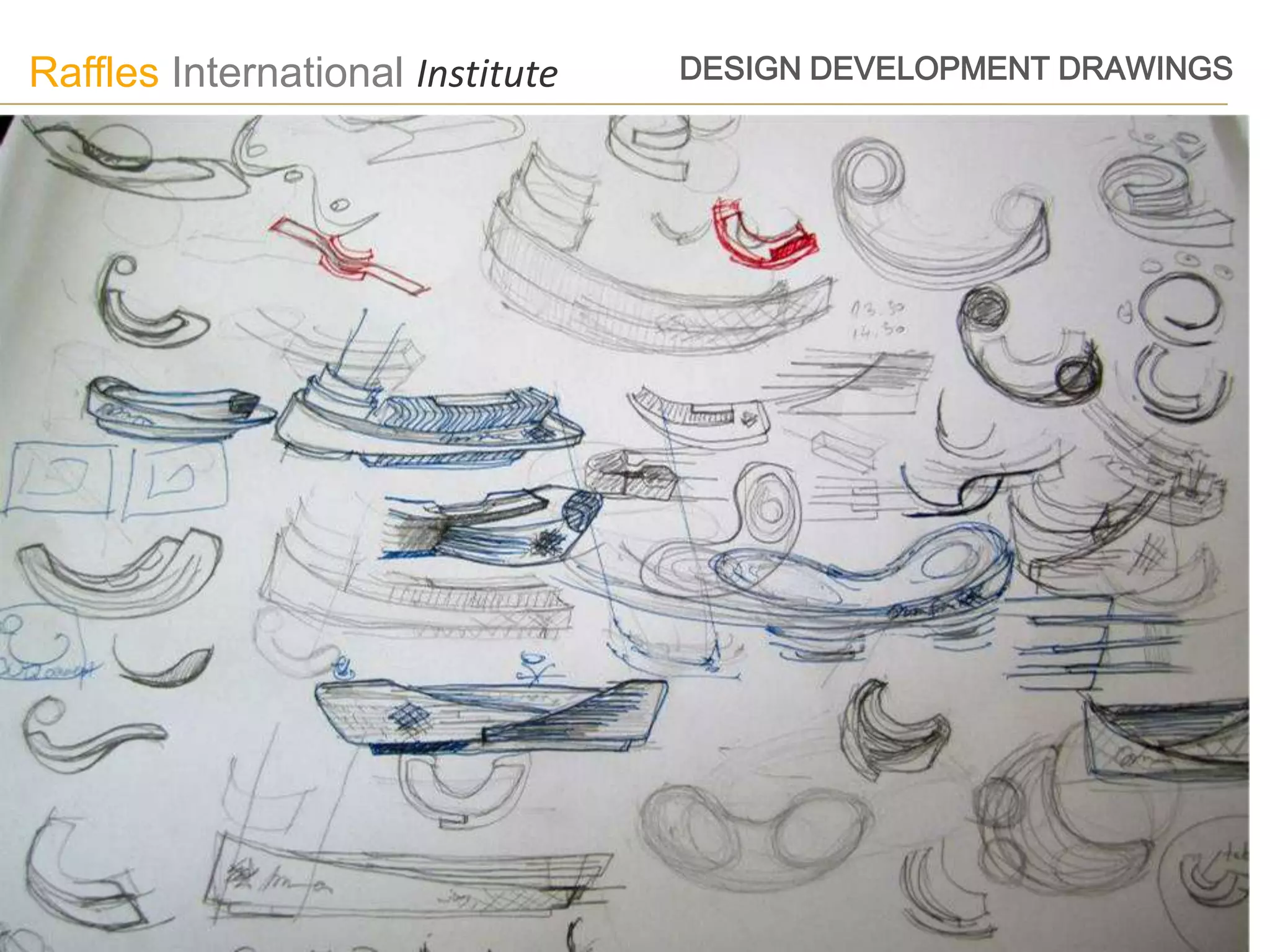
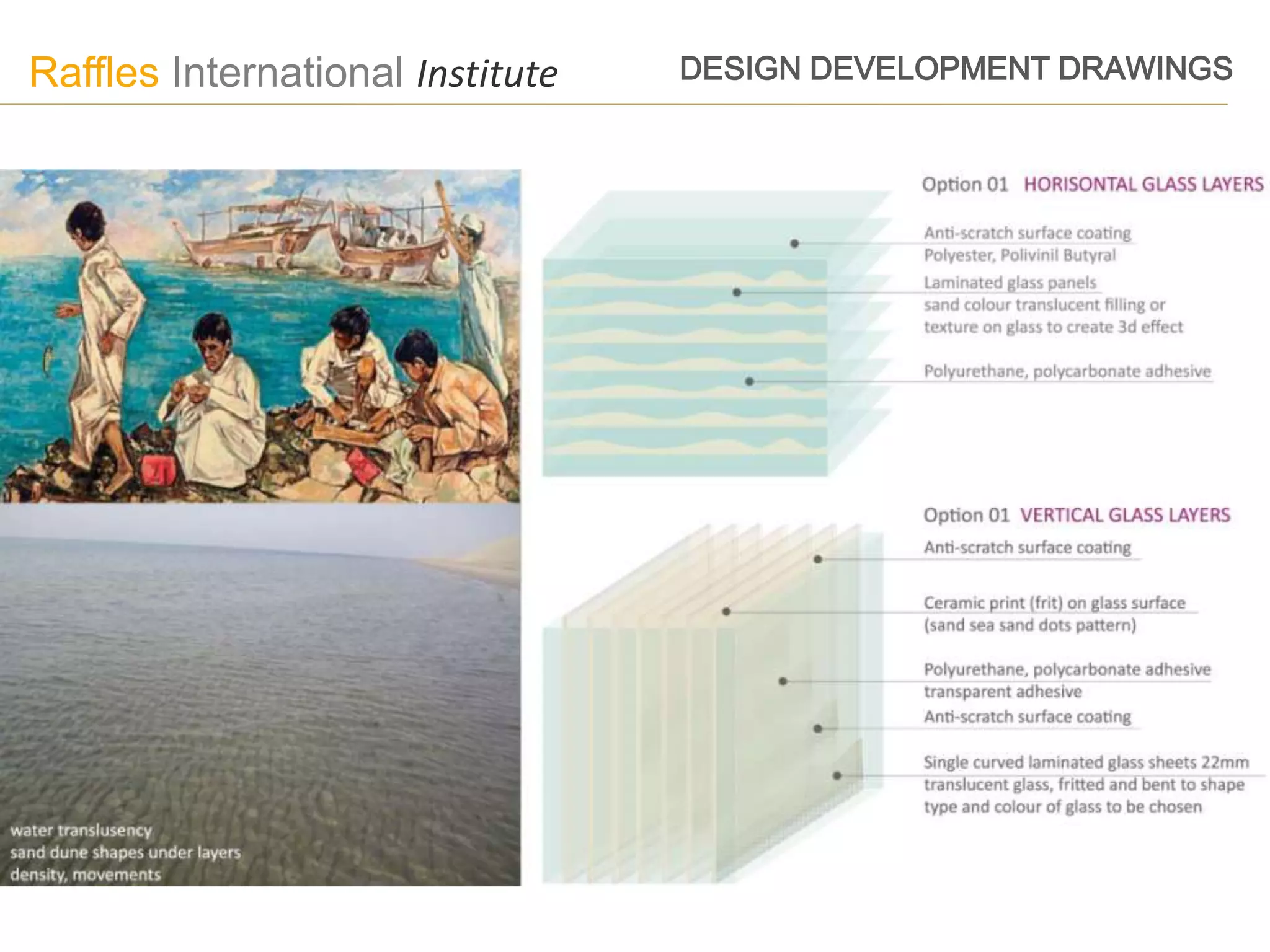
Raffles International Institute   DESIGN DEVELOPMENT DRAWINGS

Raffles Institute_Transfer,concept development and graphical language_04

  • 1.
    Raffles International Institute Techniquesfor analyzing information and transferring verbal ideas into visual concept MArch. Dipl.-Ing. Arch. Interior Design Lecturer ID Sandra DRASKOVIC November 12© Draskovic 2012 RAFFLES October 2012
  • 3.
    Raffles International Institute DESIGN PROCESS DESIGN BRIEF: Design a STORAGE CABINET that will enhance efficiency of the storing, keeping, saving, preserving and documenting experience for a young designer. 1. Firstly, the work must be a great idea. 2. Secondly, it must be exceptionally well executed in details, materials, ergonomic connections. 1. Thirdly, it must be based on brief. 2. Forth, design has to presented in logical step-by-step as well as synthetic, holistic and intuitive story folder, showing concept development process.
  • 4.
  • 5.
    Raffles International Institute LITERATURE “By cognitive I mean all mental operations involved in receiving, storing and processing information: sensory perception, memory, thin king, learning.” Rudolph Arnheim, Visual Thinking
  • 6.
    “We have a'thinking' system and a 'doing' system - and we're generally only capable of using one at a time.” You'll find that some days, the ideas come fast and furious. The days when you just want to sit at your desk, stare up at the sky and just let your mind wander. Other days, though, you really want to get moving. You're antsy and you can't really focus on any one thought. Instead, you are most efficient if you are getting things done.
  • 7.
    Raffles International Institute DESIGN PROCESS Managing your mindset can help you optimize your thinking when you are trying to be creative Often, you "brainstorm" or try to come up with as many ideas as possible. That is called diverging and requires our thinking system. At other times, you need to evaluate those ideas and figure out which ones are best. That is called converging, and it requires the activation of the doing system.
  • 8.
    Raffles International Institute DESIGN PROCESS Change your environment, and you will change the way you think. Physical and mental distance influence the way you think about things. Distance engages the thinking system. Your workplace environment is strongly associated with getting things done. In order to engage a thinking mindset, spend time working in another place. Change your environment, and you will change the way you think.
  • 9.
    Raffles International Institute DESIGN PROCESS DESIGN DEVELOPMENT DESIGN PROCESS … DESIGN SOLUTION CRITICAL THINKING overcome barriers or CREATIVE THINKING 06 blocks for creating new VERBAL THINKING ideas, enlarge vision VISUAL THINKING 05 04 03 02 01 FINAL BRIEF Understanding needs and creative process October 12© Draskovic 2012
  • 10.
    Raffles International Institute DESIGN PROCESS CRITICAL THINKING Design process Communication Asking questions Problem definition and analysis Decision-making process Negotiation Working with others Ethical decision making
  • 11.
    Raffles International Institute DESIGN PROCESS CRITICAL THINKING IMPLICIT APPROACH EXPLICIT APPROACH a. Concept as a. Concept as fully holistic, creative conscious-involved process, mysterious way of understanding and derives from problems before designer’s design solution starts subconscious b. Process: think about b. Process is based on program, brief, client, a experimentally- ddress questions and developed research, what the sensitivity, graphic project is about? How thinking will it work? What design attitude shall c. Effect: design decision lead the design? is achieved through intuition, invention and c. Effect: Design grow inspiration from carefully taken analysis
  • 12.
  • 13.
    Raffles International Institute EARLY DRAWINGS EXPLICIT APPROACH 1. ASK QUESTIONS 2. BRAINSTORM 3. GET PERSPECTIVE 4. EXTRACT THE VERBAL ESSESNCE 5-10 WORDS
  • 14.
    Raffles International Institute EARLY DRAWINGS EXPLICIT APPROACH 1. ASK QUESTIONS: a. WHAT ? What kind of project? What are requirement? What are stakeholders? b. WHO ? Who are the users? Who is the client and for whom is design intended? What kind of character they are? What are their habits? c. WHERE ? Where will be project located? How context and location influence the design? What meanings can we extract from environment, situation? d. WHEN ? When will be project occupied: day, night, all-day-night long? Winter or summer? e. WHY ? Why the project is being built? What Is the purpose of the project? What are the topic for research? What is the nature of the demand? f. HOW ? How much I will cost? Luxurious or low budget? Who is paying? How it will be made?
  • 15.
    Raffles International Institute DESIGN PROCESS ABSTRACTION INFORMATION DESIGN THROUGH user, client, needs, objectives THOUGHTS , goals, brief … ANALYSIS & CONTEXT -Gathering information research, observation, percep VISUALTHINKING -Identify issues, foreseen tion, experiment … problems MIND MAPPING -Understanding thoughts relationships, connection, VISUALIATION -Analyzing information lateral thinking … DESIGN THROUGH -Transferring information into idea / key words BRAINSTORMING SKETCHES -Developing ideas linking thoughts, adding -Inspiration within / out meanings, conscious, subcon -Sketching ideas -Mind mapping scious … -Developing concept -Brainstorming ABSTRACT IDEAS (ergonomic, spatial, aestheti -Rethinking brief / ideas c, effective, details, connecti IDEA INTO CONCEPT ons) VERBAL THINKING -Generating spatial and physical solutions -Formal fully resolved GENERATE CONCEPT drawings INTO SOLUTION -Formal models
  • 16.
    Raffles International Institute 1ST STAGE OF DRAWINGS VISUAL THINKING / VISUAL TECHNOLOGY / VISION WHAT: Simultaneous shift from verbal thinking, information and data level to mental image to visual thinking. SKILLS: Seeing, imagery, drawing, visual perception, transfer, using more than one senses, “If we are to realize the potential of visual technology, we must learn to think visually.”
  • 17.
    Raffles International Institute DRAWINGS DRAWING is expression of analysis, thinking, ideas and design concepts. WILLINGNESS to commit in design development using series of abstractions and drawings. Thinking (sketches, diagrams, schemes, images), Developing (detailed sketches, perspective, drawings) and Communicating (technical drawings, 3D models, perspective, parallel projections). We are discovering and inventing new design solutions and present them with study/technical drawings.
  • 18.
    Raffles International Institute LAYERS OF ABSTRACTION SOLVING DESIGN PROBLEMS + + OBSERVATION SKILLS CRITICAL THINKING GRAPHICALTHINKING VISUAL DISCOVERING VERBAL ANALYSIS DRAWING SKILLS ANALYSIS DISCOVERING APPROACHES ABSTRACTION / DETAILING
  • 19.
    Raffles International Institute 1ST STAGE OF DRAWINGS In the early stage of the creative process, we need the inner artist. The artist's domain is drafting, receiving ideas and inspiration, fleshing them out. The artist thrives in an atmosphere of curiosity, safety, and play. She needs shelter from others' opinions and respite from even thinking about what the judgments of others might be. DESIGN THINKING
  • 20.
    Raffles International Institute 2nd STAGE OF DRAWINGS In the second stage of the creative process, the inner editor leads. The editor's domain is revising, trimming, structuring. Whereas the artist must forget about what other people might think, the editor brings the audience back into the process, ensuring that the work effectively communicates the artist's intent. DESIGN DEVELOPMENT
  • 21.
    Raffles International Institute 3RD STAGE OF DRAWINGS In the final stage the inner agent takes the button. The agent's domain is developing marketing messages for the work, communicating about the work to external stakeholders, and finding distribution. The agent is thick-skinned, brave, and wise about the market. DESIGN COMMUNICATION
  • 22.
    Raffles International Institute LAYERS OF ABSTRACTION 1. Higher Abstraction CONCEPTUALIZATION (envisioning) Less Details Conceptualization deals with pure abstraction by “initiated” with the “conceptual idea” as the basic generator of design. 2. Form Generation FORM GENERATION is among the first translation of (schematic) the concept. In most cases, form generation is a simultaneous component of idea generation. 3. Middle Abstraction Establishment and the Significance of Details Translated into FUNCTION-STRUCTURE measurable drawings. Connectedness between structure, function, techniques and the 3D form are fixed within the plans, sections, spatial program, structural systems, lighting and ventilation, circulation, etc. TECHNOLOGY FORM 4. Less Abstraction INTERFACE Detailing DOCUMENTATION The inter-relationships are fixed into detailed contract documents which will serve as the guide (the blueprints) during the implementation. IMPLEMENTATION 5. No Abstraction (construction) Implementation of Details. The actual construction
  • 23.
    Raffles International Institute LAYERS OF ABSTRACTION 1. QUICK SKETCHES 1. ANALYZE THE BRIEF / SPACE 2. ABSTRACT DIAGRAMS 3. SCHEMES 4. MIND MAPS 2. EXPRESSING IDEA / DESIGN PREMISE 1. ORTHOGRAPHIC SKETCHES 2. PERSPECTIVE SKETCHES 3. PARALLEL PROJECTIONS 3. DEVELOPING CONCEPT 1. PLAN 4. RECORD WHAT IS ALREADY 2. SECTION FORMULATED 3. ELEVATION 4. DETAILS LEVEL OF DETAILS LESS DETAILS MIDDLE DETAILS FULLY ACCURACY
  • 24.
    “I prefer drawing totalking. Drawing is faster, and leaves less room for lies.” Le Corbusier, French architect
  • 25.
    “I will notmake a pavilion for you but an electronic poem and a vessel containing the poem; light, color image, rhythm and sound joined together in an organic synthesis.” Le Corbusier, French
  • 26.
    The Maison Roche,in white. The slender circular columns. The wall as column. The curved facade. The band of windows. Two doors to the house. The narrow lane to the house No path really Which is the main entrance? The door bell. The house is opened A lone attendant Do you want to see the house? Is it living room? Is it lounge for the foundation? The books on Corbusier, on a stand, in French. Two of his drawings Hang on the wall opposite. A portfolio of his drawings. The cubist paintings for sale. We take the stairs to go up It is not lit so much. Then, the opening at the head of the stairs Looking into the space below Space that is neither living room nor lounge Perhaps entrance lobby A bridge across the space No feeling of enclosure So open on both sides.
  • 27.
  • 28.
    Raffles International Institute LAYERS OF ABSTRACTION EARLY DRAWING has the function of allowing communicating between the designer and himself (communication between eyes, mind and paper and vise versa during design process). Less formalized graphical language, elements, symbols, signs, relations, diagrams, qui ck sketches … LATE DRAWINGS has the function of enabling communication between the designer and other people: client, users, occupants, audience at presentations etc. plans elevations sections 3d perspective axonometric …
  • 29.
    Raffles International Institute LAYERS OF ABSTRACTION EXCERCIZE: 1. Draw something “HOT”, “SWEET”, “SOAR” 2. Draw “LAZY”, “STUBORN”, “DYNAMIC” 3. Draw “BEING LATE” 4. Draw “COLD”, “METAL”, “RUSTY” 5. Draw “FLUID”, “SOLID”, “LIQUID” 6. Draw “PERSONAL CHARACTER” 7. Draw “SERENITY”, “MYSTICISM”, “TRANSPARENT” 5 min sketch practice for each
  • 30.
  • 31.
  • 32.
  • 33.
  • 34.
    Raffles International Institute DESIGN DEVELOPMENT DRAWINGS
  • 35.
    Raffles International Institute DESIGN DEVELOPMENT DRAWINGS
  • 36.
    Raffles International Institute DESIGN DEVELOPMENT DRAWINGS
  • 37.
    Raffles International Institute DESIGN DEVELOPMENT DRAWINGS
  • 38.
  • 39.
    Raffles International Institute DESIGN DEVELOPMENT DRAWINGS
  • 40.
    Raffles International Institute DESIGN DEVELOPMENT DRAWINGS
  • 41.
    Raffles International Institute DESIGN DEVELOPMENT DRAWINGS
  • 42.
  • 43.
  • 44.
  • 45.
  • 46.
  • 47.
  • 48.
  • 49.
  • 50.
    Raffles International Institute CASE STUDY CULTURE/RELIGION PATTERNS CALIGRAPHY LIFE STYLE AND HBEHAVIOR PATTERNS
  • 51.
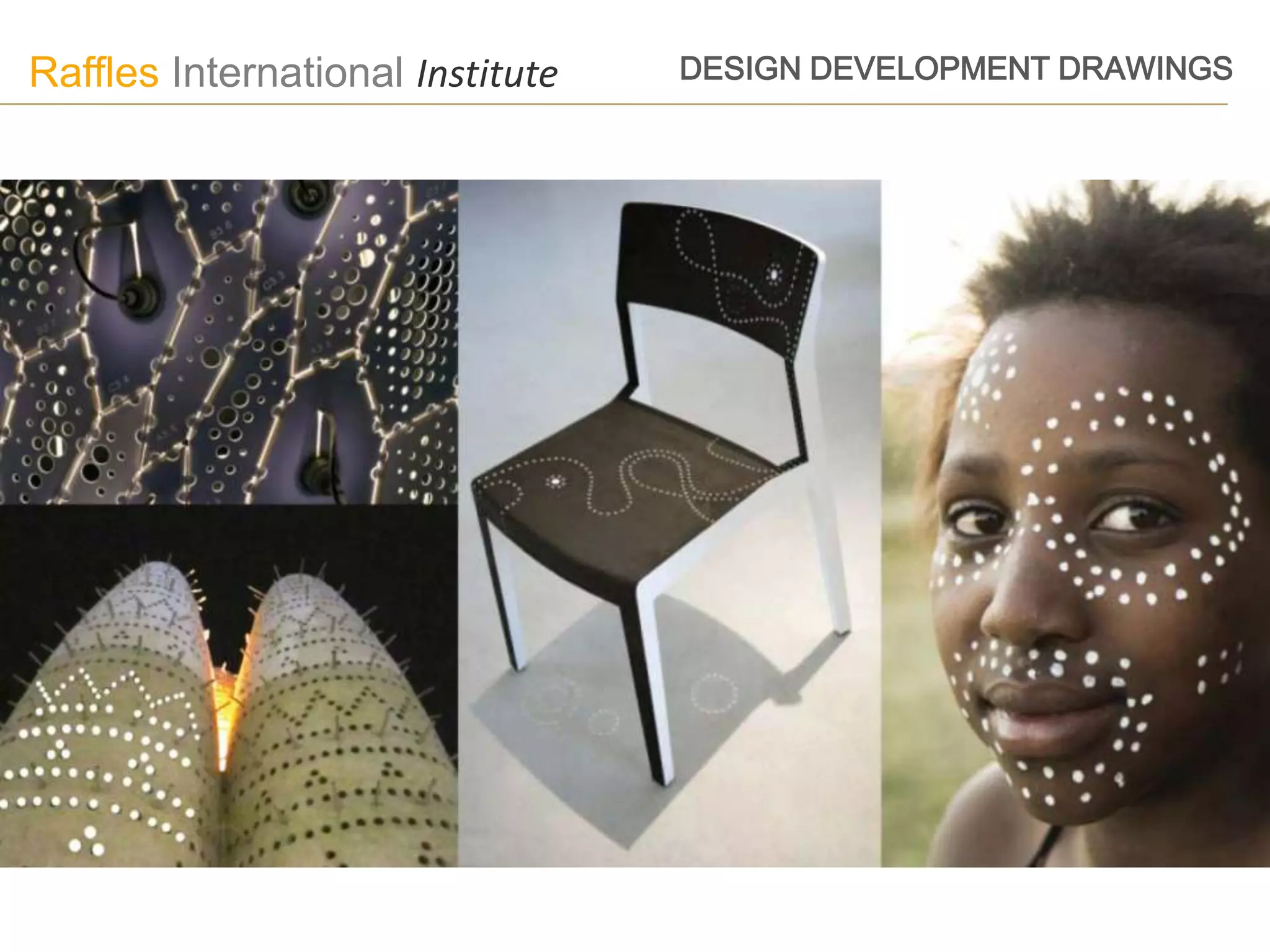
    Raffles International Institute CASE STUDY CONTEXT AND NATURE MATERIALS PATTERNS POROUS-LASER-CUT
  • 52.
    Raffles International Institute DESIGN DEVELOPMENT DRAWINGS
  • 53.
    Raffles International Institute DESIGN DEVELOPMENT DRAWINGS
  • 54.
    Raffles International Institute DESIGN DEVELOPMENT DRAWINGS
  • 55.
    Raffles International Institute DESIGN DEVELOPMENT DRAWINGS
  • 56.
    Raffles International Institute DESIGN DEVELOPMENT DRAWINGS
  • 57.
    Raffles International Institute DESIGN DEVELOPMENT DRAWINGS
  • 58.
    Raffles International Institute DESIGN DEVELOPMENT DRAWINGS