More Related Content

DOCX
Vision plays a critical role in the classroom.docx 
PDF
8-14 Disability Presentation Handouts 
PPTX
ASSESMENT for learning and learning 1 77 
PPTX

RTF

PPTX
ED104_WEEK 13_Students with Visual Impairment.pptx 
PPTX

PPTX
652 visual impairment presentation (2) Similar to Comprehensive overview of Visual Impairment

PPTX
Understanding Visually Impaired Students 
PPT

PPTX
Learners with Difficulty Seeing & Hearing.pptx 
PDF
learnersVisual Impairment Presentation.pdf 
PPTX
Visual Impairment Information and Teaching Strategies 
PDF

PPTX

PDF
Effective classroom-adaptations cec-2001 
PDF
Effective classroom-adaptations cec-2001 
PDF
Effective classroom-adaptations cec-2001 
PDF
Visual Impairment & Development.pdf 
PDF

DOCX
Visual impairment including blindness 
DOCX

PDF
LESSON-4_LEARNERS-WHO-ARE-BLIND-AND-LOW-VISION.pdf 
PPTX
II. LEARNERS WITH DIFFICULTY TO SEEING- BATION, JAMILLE C..pptx 
PPTX

PPT

PPTX
HisKidz Training Module 3 
PPTX
How to teach the blinds.pptx Recently uploaded

PPTX
Extending Horizons of Progestins in Reproductive Medicine 
PPTX
nderstanding Male Sexual Health: Challenges and Solutions 
PPTX
Sexual Dysfunction in infertile couples- Lecture 
PPTX
Sliding Filament Theory | Muscle Physiology | KEMU 
PPTX
IDENTIFICATION OF BACTERIA.by Molecular methods 
PPT
Alzheimer’s Disease Case Conference: Building Confidence in Visual Interpreta... 
PDF
Key Pharmaceutical Advisory Firms for Early-Stage Biotech Businesses 
PPTX
LOW DOSE RADIATHERAPY (LDRT) IN OSTEOARTHRITIS 
PPTX
Sample Acceptance-Rejection-Criteria in lab 
PDF
The Doctor's Balance Sheet By Dr Kanhu Charan Patro 
PDF
SEMINARIO BIOMOL.pdf (Samuel Cantillo y Karen Bohorquez) 
PDF
Rethinking Pulmonary Fibrosis: From Fine-Tuning Diagnosis to Illuminating Nov... 
PPTX
CATARACT SURGERY... KAL AAJ AUR KAL... THE PAST, THE PRESENT AND THE FUTURE. 
PPTX
cardiac transplantation vp copy copy.pptx 
PPTX
BENIGN BREAST DISEASES BBD/ Fibroadenoma, Fibrocystic Diseases/ ANDI.pptx 
PPTX
Approach to Global Developmental Delay (Lecture notes for MBBS) 
PPTX
WHEN NOT TO DO TENDOACHILLES TENOTOMY.pptx 
PPTX
BRONCHIECTASIS.cardio pptx by gokulakrishnan 
PPTX
Dental plaque dental plaque periodontology.pptx 
PDF
Dr. David Ford Wilson - Provides Holistic Mental Health Care Comprehensive overview of Visual Impairment
- 1.
- 2.
11 | 2
Copyright© Cengage Learning. All rights reserved.
• 15 minute Braille hunt on campus. Go to as many buildings
as possible where you can find Braille signs.
• Take sheets of copy paper and pencils to obtain rubbings
of the Braille letters. Place the paper over the Braille and
lightly but firmly rub the pencil over the paper to obtain an
image of the raised dots. Label the paper with the location
of the Braille signage and what the Braille image says
(example: “EXIT,” front door of Turner Hall).
• Are the Braille signs located across campus or clustered
at key points? What signs are not in Braille and why?
• Using a Braille alphabet, translate the Braille for accuracy
and meaning (i.e., does the Braille on someone’s door
have the professor’s name or just the room number, etc.).
Braille exercise: Groups of 2 to 3 people.
• Braille alphabet:
• http://www.braillebug.org/braille_print.asp
- 3.
11 | 3
Copyright© Cengage Learning. All rights reserved.
• Visual impairments fall along a continuum
ranging from normal vision to blindness. If the
child can see only at 20/200 or less, then the
child is legally blind.
• A child with vision between 20/70 and 20/200 is
legally partially sighted. Within the educational
environment, visual impairment classifications
are described as moderate, severe, and
profound—based not on visual acuity but on
the type of special educational services needed
to help the child reach optimal learning and
achievement
- 4.
11 | 4
Copyright© Cengage Learning. All rights reserved.
Definitions
• Blind
– Legal - visual acuity is 20/200 or less
– Educational - cannot use vision for learning
• Low Vision
– Legal visual acuity is 20/70- 20/200
– Education - can use vision for learning with
modifications
- 5.
11 | 5
Copyright© Cengage Learning. All rights reserved.
Prevalence
• Children with visual impairments qualify as
having a low-incidence disability and make up a
very small percentage of the school population.
There are only about 4 of these children for
every 10,000 students (U.S. Department of
Education estimate, 2003).
From U.S. Department of Education, 2003.
- 6.
11 | 6
Copyright© Cengage Learning. All rights reserved.
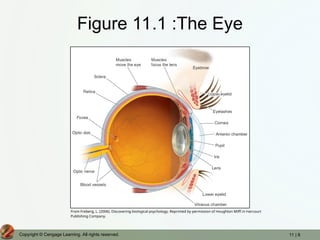
• Vision or visual interpretation is a function of the
brain, experience, and the adequacy of the
sense organ that receives stimuli from the
outside world—the eye (Figure 11.1).
• The eye has been called the camera of the
brain. The iris, a colored muscular partition,
expands and contracts to regulate the amount of
light admitted through the central opening, or
pupil. Behind the iris is the lens, an elastic
biconvex body that focuses onto the retina the
light reflected from objects in the line of vision.
- 7.
11 | 7
Copyright© Cengage Learning. All rights reserved.
• The retina is the light-sensitive innermost layer
of tissue at the back of the eyeball. It contains
neural receptors that translate the physical
energy of light into the neural energy that results
in the experience of seeing.
• The cornea is the transparent anterior (front)
portion of the tough outer coat of the eyeball.
The ciliary muscles change the shape of the
lens so the eye can focus on objects at varying
distances.
- 8.
11 | 8
Copyright© Cengage Learning. All rights reserved.
Figure 11.1 :The Eye
From Freberg, L. (2006). Discovering biological psychology. Reprinted by permission of Houghton Miffl in Harcourt
Publishing Company.
- 9.
11 | 9
Copyright© Cengage Learning. All rights reserved.
Causes of Visual Impairments
• Hereditary conditions
• Infectious diseases
• Injuries
• Retinopathy of prematurity
- 10.
11 | 10
Copyright© Cengage Learning. All rights reserved.
• Visual impairments can be caused by hereditary
conditions, infectious diseases such as rubella,
cancer, injuries, and environmental conditions.
• Retinopathy of prematurity is a disorder that is
associated with the overadministration of oxygen
to premature infants as well as low birth weight.
- 11.
11 | 11
Copyright© Cengage Learning. All rights reserved.
• Project PRISM, a longitudinal study,
administered 2,446 standardized tests to 202
preschool children with visual impairments
(Ferrell, Shaw, & Deitz, 1998). They found that
the majority of developmental milestones for
these children were delayed, in comparison with
those of typical children. Children with additional
impairments achieved these milestones later
than children without such impairments.
- 12.
11 | 12
Copyright© Cengage Learning. All rights reserved.
Characteristics
• Cognitive Development
• Language Development
• Sensory Compensation and Perception
• Personal and Social Adjustment
- 13.
11 | 13
Copyright© Cengage Learning. All rights reserved.
• A visual acuity problem in a young child is a
primary impairment and a condition that can
hamper cognitive development because it limits
the integrating experiences and the
understanding of those experiences that the
visual sense brings naturally to sighted children
(Kephart, Kephart, & Schwartz, 1974; Tillman &
Osborne, 1969).
- 14.
11 | 14
Copyright© Cengage Learning. All rights reserved.
• Children with visual impairment tend to develop
at a slower rate than children without disabilities.
Children with visual impairments need to be
tested to determine what accounts for their
visual impairments. At present the verbal section
of the Weschler scale seems to provide the best
measurement of intelligence for children with
visual impairments.
- 15.
11 | 15
Copyright© Cengage Learning. All rights reserved.
• Children with visual impairments learn language
much the same way as able-sighted children
except they do not have the visual reinforcement.
Research indicates that visual impairments do
not interfere with everyday language usage or
communication abilities; however, children with
visual impairments tend to have word
understandings that are limited to personal
experiences. Warren (1994) found that visual
impairment limits children’s conceptual
understanding and generalizations in language
and vocabulary.
- 16.
11 | 16
Copyright© Cengage Learning. All rights reserved.
• Through sensory compensation our other
senses become strengthened because of the
loss of one or more senses. But research does
not indicate this to be true with children with
visual impairments.
- 17.
11 | 17
Copyright© Cengage Learning. All rights reserved.
Early Intervention
• A child’s experiences during the period from
birth to age 5 are critical to subsequent
development.
• Early intervention programs reduce the number
of secondary problems.
- 18.
11 | 18
Copyright© Cengage Learning. All rights reserved.
• So much of what is important for young children
to learn is learned naturally through the visual
sense. A child’s experiences during the period
from birth to age 5 are critical to subsequent
development. Early intervention programs can
reduce the number of secondary problems that
can occur for a child without treatment.
- 19.
11 | 19
Copyright© Cengage Learning. All rights reserved.
• Parents and physicians identify most children
with severe and profound visual disabilities
before they enter school, unless they are
children with multiple handicaps, in which case
the visual impairment may not have received
primary attention.
• Therefore educators need to become aware of
the components of a comprehensive
assessment. Before age 3, the assessment of
vision concentrates on the use of the eyes; from
ages 3 to 5, both observation and the Snellen E
chart are used.
http://www.youtube.com/watch?v=zDOdAfRurGs
• .
- 20.
11 | 20
Copyright© Cengage Learning. All rights reserved.
• https://www.youtube.com/watch?
v=6rbHOAtBNew
• https://www.youtube.com/watch?
v=H_m0ESrkQkY
• https://www.youtube.com/watch?
v=9RJMKEJf63g
- 21.
11 | 21
Copyright© Cengage Learning. All rights reserved.
• Near-acuity cards:
• http://www.west-op.com/chileyetesca.html
provides an indication of what students can read
as a near point.
• The Titmus Vision Tester is the most widely
used test of visual acuity:
• http://www.west-op.com/titmusi200.html
- 22.
11 | 22
Copyright© Cengage Learning. All rights reserved.
Identification and Assessment
• Preschool vision screening
• Snellen Chart
• Near-Acuity cards
• Titmus Vision Tester
- 23.
11 | 23
Copyright© Cengage Learning. All rights reserved.
Educational Adaptations
• Adapting the Learning Environment
• Adapting the Curriculum
• Adapting Teaching Strategies
• Assistive Technology
- 24.
11 | 24
Copyright© Cengage Learning. All rights reserved.
• Placing children with visual impairments in least
restrictive environments (LREs) gives them a
wide range of services.
• . Sixty-two percent of children with visual
impairments are found in the general education
classroom sixteen or more hours a week,
another 19 percent are out of the classroom 20
to 60 percent of the time, and 19 percent are
away more than fifteen hours a week.
• Only about 10 percent of these children can
now be found in residential schools. Inclusion
must involve a carefully planned approach to
integrate children with visual impairments into
general educational settings.
- 25.
11 | 25
Copyright© Cengage Learning. All rights reserved.
• Erwin (1993) established guidelines for
exclusion of young children with visual
impairments because just placing a child without
careful planning and without support personnel
will not be beneficial to the child.
• Silverman (2000) considers the transdisciplinary
model, which provides collaboration with the
education team, and in which therapists and
other specialists provide direct services to
students in general education classrooms and
other natural environments, to be the most
desirable model for children with visual
impairments.
- 26.
11 | 26
Copyright© Cengage Learning. All rights reserved.
• An itinerant teacher can provide special materials,
consult with school personnel, and provide
individualized instruction to help make inclusion
into a regular classroom successful. A case
coordinator brings together all the information that
relates to the child (the comprehensive
assessment, for example) and leads a team of
professionals who, with the parents, develop an
IEP for the student and see that the IEP is carried
out successfully. A collaborative approach can also
facilitate more effective services for children from
culturally and linguistically diverse backgrounds.
- 27.
11 | 27
Copyright© Cengage Learning. All rights reserved.
• The RTI model Tier I, the enhanced regular
classroom, reportedly serves 62 percent of children
with visual impairments (U.S. Department of
Education, 2007). This is crucial to help children
with visual impairments to succeed in regular
classrooms. Tier I activities can include
technology to aid a student’s visual acuity in
reading, can provide extended core curriculum,
and provide occasional tutorial work. Tier II
activities can help to increase a student’s
independent living skills as well as orientation
and mobility training. Tier III activities can
consist of teaching Braille or other means of
communication and a separate setting for
individual tutoring and extended core
curriculum activities.
- 28.
11 | 28
Copyright© Cengage Learning. All rights reserved.
• Lowenfeld (1973) proposed three principles for
adapting instruction to the educational needs of
children with visual impairments: (1)
concreteness, (2) unifying experiences, and (3)
learning by doing
• For instance, practice in fluency, echo reading,
and choral reading can bring more confidence to
students with visual problems. Bold-lined paper,
felt-tipped pens, magnifiers, computer screen
enlargements, and synthetic speech can help
students with writing tasks. Tactile materials
such as manipulatives and an abacus can assist
students with math activities.
- 29.
11 | 29
Copyright© Cengage Learning. All rights reserved.
• Expanded core curriculum for students with
severe visual impairments include compensatory
or functional academic skills including
communications modes, orientation and mobility
training, social interaction skills, independent
living skills, recreation and leisure skills and
career education.
- 30.
11 | 30
Copyright© Cengage Learning. All rights reserved.
• Emphasis on communication skills remains
extremely important for students with severe and
profound visual impairments. Many students are
instructed in either print or Braille.
• Several different approaches can be helpful
when teaching children with visual impairments.
The language experience approach to reading is
a very good approach to learning for a child with
visual impairments. A directed listening skill in
which the child learns to use auditory cues is
another useful teaching strategy. Recordings for
the Blind and live readers can also help the
students with their class work.
- 31.
11 | 31
Copyright© Cengage Learning. All rights reserved.
• As reported by the American Foundation for the
Blind (2007), students with visual impairment
can complete homework, do research, take
tests, and read books along with their sighted
classmates thanks to advances in technology
(AFB, 2007).
- 32.
11 | 32
Copyright© Cengage Learning. All rights reserved.
• Advances in computer technology have been
responsible for students with visual impairments being
able to receive information and also to deliver
information to others.
• However, the use of technology to compensate for
disabilities is a two-edged sword. Although synthetic
speech programs, talking calculators, and Braille
translators are available, they also call attention to the
child using them. Therefore, it becomes important for
the teacher in the general education environment to
become familiar with technological devices and to
acquaint sighted students with the devices so that they
don’t seem so strange and foreign to the classroom
environment. Access technology involves adaptations to
a computer’s normal operations that allow a student with
disabilities to use and benefit from the computer
- 33.
11 | 33
Copyright© Cengage Learning. All rights reserved.
• A study by Sacks, Wolffe, and Tierney (1998)
revealed that adolescents with visual
impairments were not being adequately
prepared to function independently. The
majority of students with sight had worked
for pay, whereas only 31 percent of students
with low vision and 19 percent of students
with blindness did likewise. The majority of
the students with blindness and low vision
reported that they spent their after-school
time alone. The authors recommended that a
secondary curriculum for adolescents with
visual impairments should include a stronger
focus on career development and social
skills competencies and that travel training
should also be emphasized.
- 34.
11 | 34
Copyright© Cengage Learning. All rights reserved.
• http://www.juniorblind.org/site/
• http://brailleinstitute.org/Services/Children/
Early_Childhood_to_Age_6.aspx
• http://brailleinstitute.org/Volunteer/
Student_Volunteer_Opportunities.aspx
• http://www.youtube.com/watch?v=3D-hBUWb-lA
• http://www.youtube.com/watch?
v=rIGN44XJ7bY&feature=related
• http://www.youtube.com/watch?v=QuSzTi6ZHps
• http://www.afb.org/default.asp