



visual feast or
                                                            Chrissi Nerantzi
visual communication                                        @chrissinerantzi
a webinar for the Creativity and Multicultural Communication MOOC
Where are you?
a
the plan
visual communication
      what is it?
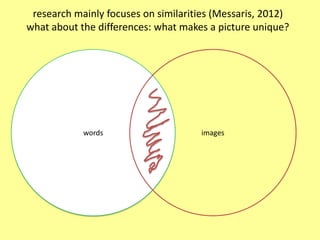
research mainly focuses on similarities (Messaris, 2012)
what about the differences: what makes a picture unique?


            words                    images
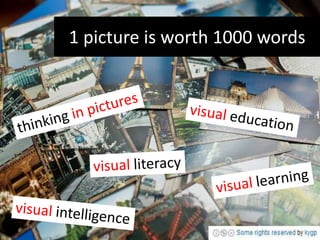
1 picture is worth 1000 words
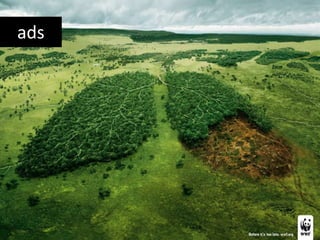
ads
What do you miss now?


                        What do I miss?
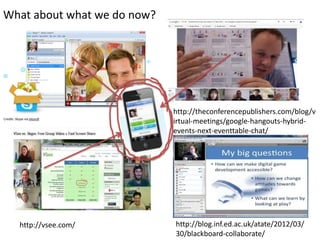
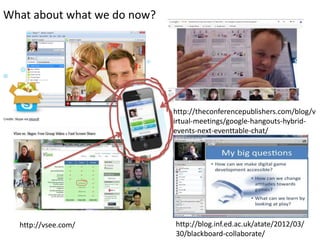
What about what we do now?


                             http://theconferencepublishers.com/blog/v
                             irtual-meetings/google-hangouts-hybrid-
                             events-next-eventtable-chat/


  http://vsee.com/           http://blog.inf.ed.ac.uk/atate/2012/03/
                             30/blackboard-collaborate/
“cameras do lie” Lang & Lang (1952)
selectivity
subjectivity
constructions
interpretations
shaping perceptions
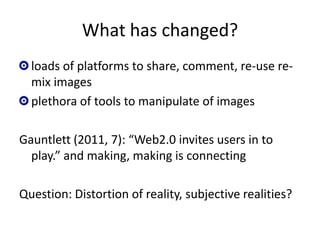
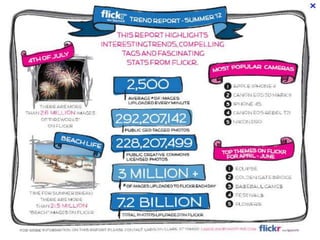
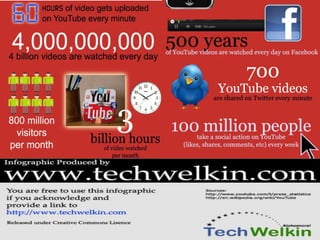
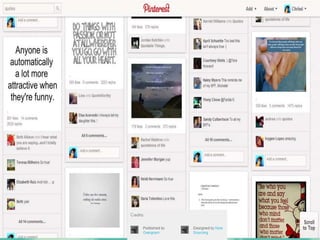
What has changed?
  loads of platforms to share, comment, re-use re-
  mix images
  plethora of tools to manipulate of images

Gauntlett (2011, 7): “Web2.0 invites users in to
  play.” and making, making is connecting

Question: Distortion of reality, subjective realities?
social media
Youtube
Visual literacy, what does this mean for you? Draw it!
visual literacy (John Debes,1969)
“Visual Literacy refers to a group of vision-competencies a human
being can develop by seeing and at the same time having and
integrating other sensory experiences. The development of these
competencies is fundamental to normal human learning. When
developed, they enable a visually literate person to discriminate and
interpret the visible actions, objects, symbols, natural or man-
made, that he encounters in his environment. Through the creative
use of these competencies, he is able to communicate with others.
Through the appreciative use of these competencies, he is able to
comprehend and enjoy the masterworks of visual communication.”
Debes (1969b, 27)
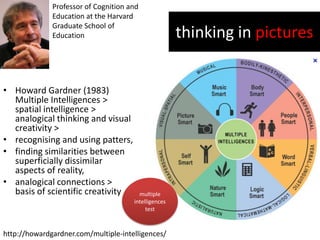
Professor of Cognition and
              Education at the Harvard
              Graduate School of
              Education                               thinking in pictures


• Howard Gardner (1983)
  Multiple Intelligences >
  spatial intelligence >
  analogical thinking and visual
  creativity >
• recognising and using patters,
• finding similarities between
  superficially dissimilar
  aspects of reality,
• analogical connections >
  basis of scientific creativity        multiple
                                      intelligences
                                           test


http://howardgardner.com/multiple-intelligences/
Be honest! Visual learning and teaching, is this actively
     encouraged and practiced in your courses?


            yes                           no
What about what we do now?


                             http://theconferencepublishers.com/blog/v
                             irtual-meetings/google-hangouts-hybrid-
                             events-next-eventtable-chat/


  http://vsee.com/           http://blog.inf.ed.ac.uk/atate/2012/03/
                             30/blackboard-collaborate/
triggers
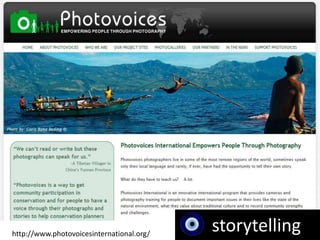
http://www.photovoicesinternational.org/
                                           storytelling
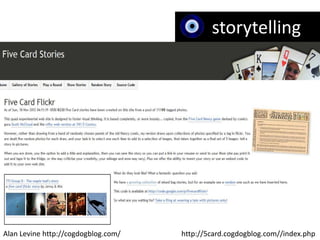
storytelling


Alan Levine http://cogdogblog.com/   http://5card.cogdogblog.com//index.php
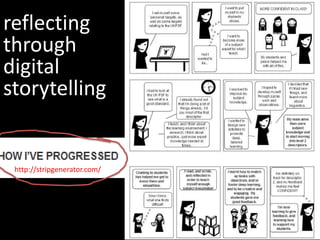
reflecting
through
digital
storytelling


 http://stripgenerator.com/
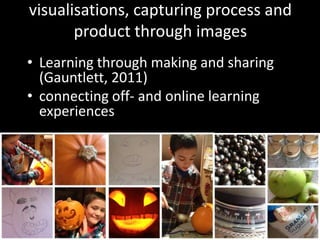
visualisations, capturing process and
       product through images
• Learning through making and sharing
  (Gauntlett, 2011)
• connecting off- and online learning
  experiences
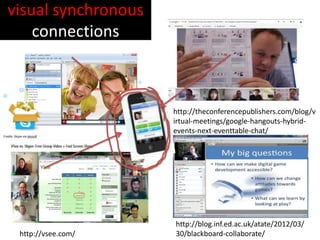
visual synchronous
    connections


                     http://theconferencepublishers.com/blog/v
                     irtual-meetings/google-hangouts-hybrid-
                     events-next-eventtable-chat/


                     http://blog.inf.ed.ac.uk/atate/2012/03/
 http://vsee.com/    30/blackboard-collaborate/
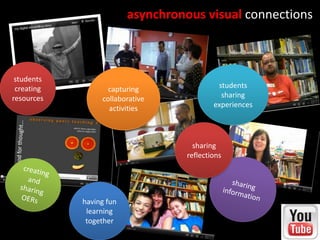
asynchronous visual connections


 students
 creating          capturing                students
resources        collaborative               sharing
                   activities              experiences


                                     sharing
                                   reflections


            having fun
             learning
             together
Your ideas
Any questions/observations?
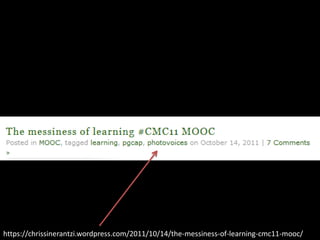
https://chrissinerantzi.wordpress.com/2011/10/14/the-messiness-of-learning-cmc11-mooc/
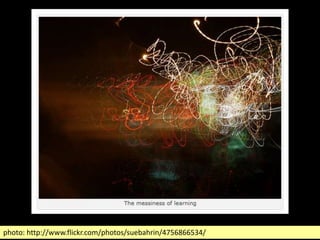
photo: http://www.flickr.com/photos/suebahrin/4756866534/
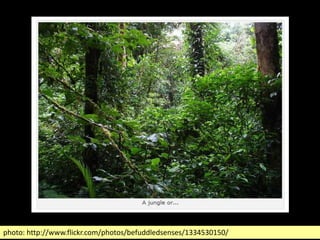
photo: http://www.flickr.com/photos/befuddledsenses/1334530150/
photo: http://www.flickr.com/photos/osakajon/38218718/
photo: http://www.flickr.com/photos/decembre71/2189915831/
photo: http://www.flickr.com/photos/48201832@N05/5346036458/
photo: http://www.flickr.com/photos/thebrumreaper/4248613849/
photo: http://www.flickr.com/photos/jakecaptive/3205277810/
References
• Lang, K., & Lang, G.E. (1952). The unique
  perspective of television and its effect: A pilot
  study. American Sociological Review, 18, 312.
• Messaris, P. (2012) Visual “Literacy” in the
  Digital Age, The Review of
  Communication, Vol 12, No 2, April 2012, pp.
  101-117
• Gauntlett, D. (2011) Making is
  connecting, Cambridge: Polity Press.
useful links
PGCAP on YouTube
   http://www.youtube.com/pgcapsal
   ford

PGCAP on Flickr
   http://www.flickr.com/photos/pgc
   ap

International Visual Literacy
     Assosication
http://www.ivla.org/org_what_vis_lit.h
     tm

How do you look?
   http://nasher.duke.edu/howdoyou
   look/

Chrissi’s photovoices
    https://chrissinerantzi.wordpress.c
    om/tag/photovoices/

Visual feast or visual communication, a webinar for the CMC MOOC

Editor's Notes

  • #2 ChrissiNerantzi for Carol: Is this ok? Chrissi is an experienced Academic Developer at the University of Salford. She is the Programme Leader of the Postgraduate Certificate in Academic Practice which is offered to teachers in HE and leads to a teaching qualification for Higher Education. Her approach is experimental and she enjoys challenging and stretching her students so that they make new discoveries.Say at the beginning:I am not an expert in visual communication, visual literacy. I am just an experimenter who loves using images, artifacts etc for learning and teaching. I will share my experiences with you and would like to engage in a discussion with you about visual communication and learning. Not a monologue but a dialogueWrite on any slide, anytime!Add your comments, questions to the chat.Take the microphone and switch on the video so that we can see you too ;)
  • #5 gestures, facial expressions, body language, emoticons, images, video, comic, infographics, objects, sculptures, installations, doodle, drawing, paintings, signs, charts, diagrams, infographicsVisual communication a universal language?thinking in picturesconsuming pictures, creating, co-creating, mash-up and sharingVisual literacy includes such areas as facial expressions, body language, drawing, painting, sculpture, hand signs, street signs, international symbols, layout of the pictures and words in a textbook, the clarity of type fonts, computer images, pupils producing still pictures, sequences, movies or video, user-friendly equipment design and critical analysis of television advertisements.Important----------------Today’s students are more media savvy than ever, but how well do they critique the images they see around them? Visual literacy is an increasingly important skill and learning to think critically about images is an essential component of a 21st century education. Confronted with a different kind of source material–image rather than text–they are challenged to look at concepts and issues in a new way.
  • #6 Word and images are constructions NOT passive recordings of realityexample: do we need to know a specific language to make sense of an image? quicker and richer ‘to read’ and image?
  • #7 1 video is worth 1000 pictures
  • #8 http://adsoftheworld.com/files/images/WWFLUNGS.jpg
  • #9 not seeing me? people love seeing each otherwhat are we doing now? What I miss now is that I can’t see any of you.
  • #10 Technology does enable seeing each otherBlackboard Collaborate up to 6Google hangout up to 15Skype only 2 then more for paymentaccess to these technologies on computers but also increasingly on tablets and mobile phones
  • #11 activity: ask what participants think about this statement
  • #13 consuming imagescreation, co-creationmash-upsharing
  • #14 http://www.geneticamultimedia.com/images/slides/socialmedia/social-media.jpg
  • #15 http://www.newsilike.in/infographics/flickr-trend-report-2012/
  • #20 activity: ask participants to underline important parts of this paragraph and then briefly discuss.Visual literacy includes such areas as facial expressions, body language, drawing, painting, sculpture, hand signs, street signs, international symbols, layout of the pictures and words in a textbook, the clarity of type fonts, computer images, pupils producing still pictures, sequences, movies or video, user-friendly equipment design and critical analysis of television advertisements.-----------------not about consuming but analysing, making sense of images, learning through images
  • #21 spatial intelligence“Blind populations provide an illustration of the distinction between the spatialintelligence and visual perception. A blind person can recognize shapes by an indirectmethod: running a hand along the object translates into length of time of movement,which in turn is translated into the size of the object. For the blind person, the perceptualsystem of the tactile modality parallels the visual modality in the seeing person. Theanalogy between the spatial reasoning of the blind and the linguistic reasoning of the deafis notable.”http://howardgardner01.files.wordpress.com/2012/06/in-a-nutshell-minh.pdfTEST http://www.bgfl.org/bgfl/custom/resources_ftp/client_ftp/ks3/ict/multiple_int/index.htm visualisation source http://www.silverspiral.org/index.php/home/item/81-using-multiple-intelligences-in-magick
  • #22 meanings in pictures derive largely from analogyimages do not require much prior experience
  • #23 already seen this earlier
  • #24 spontaneous reactions to imagesvisual triggersfor sharing information, emotions, events, learning?
  • #25 Photovoices International is an innovative international program that provides cameras and photography training for people to document important issues in their lives like the state of the natural environment, what they value about traditional culture and to record community strengths and challenges. The Photovoices process--part documentary, part art, part storytelling--provides a way to hear villagers' unfiltered opinions and to learn from their expertise.  By using simple cameras, photographs and stories, people gain a visual voice at the table and a process to communicate indigenous knowledge and concerns from the grassroots to international organizations, government officials and other making plans for the future.  Perhaps most important, the pictures and stories provide people a way to reflect on their own lives and to talk together about what they want to protect and what they want to make better. Click here to find out how the Photovoices process works.~Ann McBride Norton, Director 
  • #29 people love seeing each otherwhat are we doing now? What I miss now is that I can’t see any of you.Technology does enable seeing each otherBlackboard Collaborate up to 6Google hangout up to 15Skype only 2 then more for paymentaccess to these technologies on computers but also increasingly on tablets and mobile phones
  • #31 How could you incorporate images into your curriculum/courses activities and assessment?
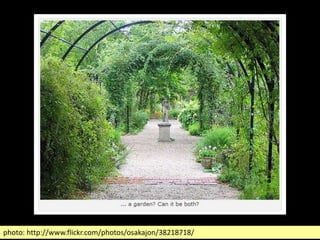
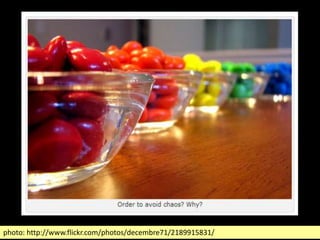
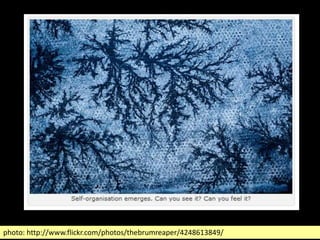
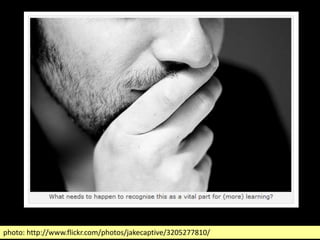
  • #33 Just read the story first before showing the pictures!The messiness of learningA jungle or...... a garden? Can it be both?Order to avoid chaos? Why?Can chaos be bad for us? In what way(s)?Self-organisation emerges. Can you see it? Can you feel it?What needs to happen to recognise this as a vital part for (more) learning?https://chrissinerantzi.wordpress.com/2011/10/14/the-messiness-of-learning-cmc11-mooc/