A D E W I J A Y A , M D
N O V E M B E R 2 0 1 9
Visual Dysfunction in
Parkinson’s Disease
Introduction
 Parkinson’s Disease: motor + non motor symptoms
 Non motor symptoms:
- Autonomic
- Gastrointestinal
- Cognitive
- Visual
(Davidsdottiret al., 2005)
Clinical Presentation
 Difficulty in navigating (using maps)
 Difficulty reading
 Double vision
 Misjudging objects and distances
 Visual hallucinations
Weil, R. S., Schrag, A. E., Warren, J. D., Crutch, S. J., Lees, A. J., & Morris, H. R. (2016). Visual dysfunction in Parkinson’s disease. Brain, 139(11), 2827-2843.
Functional Anatomy of Healthy Human Vision
Manassietal.(2013)
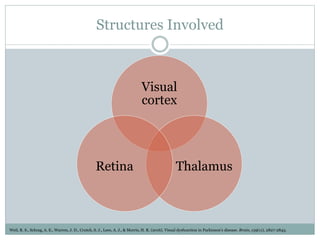
Structures Involved
Visual
cortex
ThalamusRetina
Weil, R. S., Schrag, A. E., Warren, J. D., Crutch, S. J., Lees, A. J., & Morris, H. R. (2016). Visual dysfunction in Parkinson’s disease. Brain, 139(11), 2827-2843.
The Scope of Visual Disturbance
 Visual acuity
 Contrast sensitivity
 Colour vision
 Change in eye movements
 Line orientation, pattern perception, and depth
perception
 Peripheral vision
 Object perception
 Motion perception
 Visuospatial construction
 Spatial neglect
 Face and emotion recognition
Weil, R. S., Schrag, A. E., Warren, J. D., Crutch, S. J., Lees, A. J., & Morris, H. R. (2016). Visual dysfunction in Parkinson’s disease. Brain, 139(11), 2827-2843.
Neurobiology: Genetic Basis
Clinical Relevance
 Two distinc neuropsychological syndromes have
been proposed in Parkinson’s Disease:
1. A frontal-striatal dopamine-mediated dysexecutive
syndrome (does not progress to dementia)
2. Prominent visuospatial and semantic fluency
impairments (associated with dementia)
(Williams-Grayet al., 2009; Kehagiaet al., 2010)
Sleep and Visual Dysfunction in
Parkinson’s Disease
 REM sleep behavioral disorder (RBD) with sensory
abnormalities at baseline (including colour vision
defects)  develop into a form of Parkinson’s
Disease with more prominent cognitive involvement
(Postumaet al., 2011).
 RBD and poor colour discrimination linked with a
more rapid and aggresive disease course
(Fereshtehnejadet al., 2015).
Sleep and Visual Dysfunction in
Parkinson’s Disease
 A subset of retinal ganglion cells, known as melanopsin
photoreceptors, are believed to play a role in regulating circadian
rhythms.
 Dysfunction of these retinal ganglion cells, possibly by-synuclein
deposition, or by a change in dopamine levels,causes unopposed
melatonin production, with subsequent effects on sleep (Schmollet
al., 2011).
 Furthermore, the projection of these cells to brain regions involved
in circadian and sleep functions as well as to visual areas such as the
lateral geniculate nucleus may explain some of the daytime-
dependent (not just luminance-dependent) visual symptoms of
Parkinson’s disease (LaMorgiaet al., 2011).
Motor Symptoms and Visual Dysfunction in
Parkinson’s Disease
 Visual perceptual deficits are frequently associated with
the postural instability and gait disorder phenotype
(PIGD).
 Visual abnormalities are more common in patients with
freezing of gait (Davidsdottiret al., 2005) and correlate
with the severity of gait impairment (Ucet al., 2005).
 Furthermore, visual contrast sensitivity predicts severity
of freezing, independent of duration or severity of disease
(Davidsdottiret al., 2005).
 Conversely, the tremor predominant phenotype isless
associated with visual deficits (Seichepineet al., 2011).
Drugs effects on Visual Symptoms
 Levodopa enhances colour vision and contrast
sensitivity in Parkinson’s disease, also improving
visual evoked potentials abnormality. Supporting a
dopaminergic basis for these deficits in the lower
visual pathways
 On the other hand, the effects of levodopa on higher
visual function are less well documented
 Dopamine agonists, anticholinergic drugs, and
amantadine  higher rate of visual hallucinations
Weil, R. S., Schrag, A. E., Warren, J. D., Crutch, S. J., Lees, A. J., & Morris, H. R. (2016). Visual dysfunction in Parkinson’s disease. Brain, 139(11), 2827-2843.
Visuo-perceptual Measures as
Diagnostic Markers
 Deficits in colour and contrast sensitivity were shown to have
better discriminatory power for early diagnosis of Parkinson’s
disease (Diederichet al., 2010).
 Visual processing abnormalities and oculomotor changes may
prove helpful in differentiating Parkinson Plus Syndromes
from idiopathic Parkinson’s disease
 Visual function may be important in predicting dementia in
Parkinson’s disease (Ananget al., 2014).
 Identifying the presence of visuoperceptual deficits may
therefore have a critical role in stratifying patients in the clinic
for early treatment with cholinesterase inhibitors.
 Optical coherence tomography shows promise as a potential
biomarker for presence of disease in Parkinson’s disease.
Summary
 Alterations in visual function from the retina to
higher cortical brain regions have been found in
Parkinson’s disease.
 Potential as disease marker.
THANK YOU

Visual Dysfunction in Parkinson Disease

  • 1.
    A D EW I J A Y A , M D N O V E M B E R 2 0 1 9 Visual Dysfunction in Parkinson’s Disease
  • 2.
    Introduction  Parkinson’s Disease:motor + non motor symptoms  Non motor symptoms: - Autonomic - Gastrointestinal - Cognitive - Visual (Davidsdottiret al., 2005)
  • 3.
    Clinical Presentation  Difficultyin navigating (using maps)  Difficulty reading  Double vision  Misjudging objects and distances  Visual hallucinations Weil, R. S., Schrag, A. E., Warren, J. D., Crutch, S. J., Lees, A. J., & Morris, H. R. (2016). Visual dysfunction in Parkinson’s disease. Brain, 139(11), 2827-2843.
  • 4.
    Functional Anatomy ofHealthy Human Vision Manassietal.(2013)
  • 5.
    Structures Involved Visual cortex ThalamusRetina Weil, R.S., Schrag, A. E., Warren, J. D., Crutch, S. J., Lees, A. J., & Morris, H. R. (2016). Visual dysfunction in Parkinson’s disease. Brain, 139(11), 2827-2843.
  • 6.
    The Scope ofVisual Disturbance  Visual acuity  Contrast sensitivity  Colour vision  Change in eye movements  Line orientation, pattern perception, and depth perception  Peripheral vision  Object perception  Motion perception  Visuospatial construction  Spatial neglect  Face and emotion recognition Weil, R. S., Schrag, A. E., Warren, J. D., Crutch, S. J., Lees, A. J., & Morris, H. R. (2016). Visual dysfunction in Parkinson’s disease. Brain, 139(11), 2827-2843.
  • 7.
  • 8.
    Clinical Relevance  Twodistinc neuropsychological syndromes have been proposed in Parkinson’s Disease: 1. A frontal-striatal dopamine-mediated dysexecutive syndrome (does not progress to dementia) 2. Prominent visuospatial and semantic fluency impairments (associated with dementia) (Williams-Grayet al., 2009; Kehagiaet al., 2010)
  • 9.
    Sleep and VisualDysfunction in Parkinson’s Disease  REM sleep behavioral disorder (RBD) with sensory abnormalities at baseline (including colour vision defects)  develop into a form of Parkinson’s Disease with more prominent cognitive involvement (Postumaet al., 2011).  RBD and poor colour discrimination linked with a more rapid and aggresive disease course (Fereshtehnejadet al., 2015).
  • 10.
    Sleep and VisualDysfunction in Parkinson’s Disease  A subset of retinal ganglion cells, known as melanopsin photoreceptors, are believed to play a role in regulating circadian rhythms.  Dysfunction of these retinal ganglion cells, possibly by-synuclein deposition, or by a change in dopamine levels,causes unopposed melatonin production, with subsequent effects on sleep (Schmollet al., 2011).  Furthermore, the projection of these cells to brain regions involved in circadian and sleep functions as well as to visual areas such as the lateral geniculate nucleus may explain some of the daytime- dependent (not just luminance-dependent) visual symptoms of Parkinson’s disease (LaMorgiaet al., 2011).
  • 11.
    Motor Symptoms andVisual Dysfunction in Parkinson’s Disease  Visual perceptual deficits are frequently associated with the postural instability and gait disorder phenotype (PIGD).  Visual abnormalities are more common in patients with freezing of gait (Davidsdottiret al., 2005) and correlate with the severity of gait impairment (Ucet al., 2005).  Furthermore, visual contrast sensitivity predicts severity of freezing, independent of duration or severity of disease (Davidsdottiret al., 2005).  Conversely, the tremor predominant phenotype isless associated with visual deficits (Seichepineet al., 2011).
  • 13.
    Drugs effects onVisual Symptoms  Levodopa enhances colour vision and contrast sensitivity in Parkinson’s disease, also improving visual evoked potentials abnormality. Supporting a dopaminergic basis for these deficits in the lower visual pathways  On the other hand, the effects of levodopa on higher visual function are less well documented  Dopamine agonists, anticholinergic drugs, and amantadine  higher rate of visual hallucinations Weil, R. S., Schrag, A. E., Warren, J. D., Crutch, S. J., Lees, A. J., & Morris, H. R. (2016). Visual dysfunction in Parkinson’s disease. Brain, 139(11), 2827-2843.
  • 14.
    Visuo-perceptual Measures as DiagnosticMarkers  Deficits in colour and contrast sensitivity were shown to have better discriminatory power for early diagnosis of Parkinson’s disease (Diederichet al., 2010).  Visual processing abnormalities and oculomotor changes may prove helpful in differentiating Parkinson Plus Syndromes from idiopathic Parkinson’s disease  Visual function may be important in predicting dementia in Parkinson’s disease (Ananget al., 2014).  Identifying the presence of visuoperceptual deficits may therefore have a critical role in stratifying patients in the clinic for early treatment with cholinesterase inhibitors.  Optical coherence tomography shows promise as a potential biomarker for presence of disease in Parkinson’s disease.
  • 15.
    Summary  Alterations invisual function from the retina to higher cortical brain regions have been found in Parkinson’s disease.  Potential as disease marker.
  • 16.