05/18/16Mr. Roger C. Argarin
1
Introduction to visual basic
programming
Lecture 1: Introduction
05/18/16Mr. Roger C. Argarin
2
Introduction – Learning objectives of the class
Introduction to Visual Basic
 Brief History of Visual Basic
 Basic Concept of Visual Basic Programming Language
 Programming Environment
Use Microsoft Visual Studio .NET2005
Learning Objectives
05/18/16Mr. Roger C. Argarin
3
Visual program design and development
Fundamentals of Object Oriented Programming
(OOP)
Event driven programming
Objects, properties and methods
Write Visual Basic projects
History of Visual Basic
05/18/16Mr. Roger C. Argarin
4
The Visual Basic programming language was
developed by Alan Cooper, an American scientist
in the late 1980’
This programming language was created with the
main purpose of teaching programmers and
developers how to design graphical-user interface
(GUI) programs easily.
Overview of Programming
05/18/16Mr. Roger C. Argarin
5
The Structure and Operation of a Computer
Computer system: hardware and software
Processor (registers, primitive operations)
Main memory (RAM, ROM)
Data types (integers, real, floating-point
numbers, strings, etc.)
Sequence and Data Control
Storage management
Operating environment
Overview of Programming (continue)
05/18/16Mr. Roger C. Argarin
6
Computer System (PC)
Hardware Software
Processor,
Memory
Data types,
Sequence and
Data Control,
Storage Management,
Operating Environment
Major Components of Computer
Systems
05/18/16Mr. Roger C. Argarin
7
Input Unit (keyboard, mouse, scanner, Internet
through TCP/IP)
Central Processing Unit (CPU)
Output Unit
Memory Unit
 Primary memory (RAM, ROM)
 Secondary memory (Hard drives, zip disks, floppy disks, etc)
Object Technology
05/18/16Mr. Roger C. Argarin
8
Objects are essentially reusable software
components that model items in the real world, such
as windows cars, vehicles, and so on
Object technology is a packaging scheme that
enables programmers to create meaningful software
units.
Object-Oriented Programming tends to produce
software that is more understandable, better
organized, and easier to maintain, modify and
debug.
Object Model
05/18/16Mr. Roger C. Argarin
9
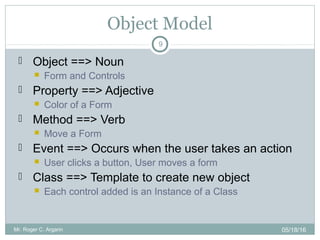
 Object ==> Noun
 Form and Controls
 Property ==> Adjective
 Color of a Form
 Method ==> Verb
 Move a Form
 Event ==> Occurs when the user takes an action
 User clicks a button, User moves a form
 Class ==> Template to create new object
 Each control added is an Instance of a Class
Dot Notation
05/18/16Mr. Roger C. Argarin
10
Used to reference object's properties and events in
code
 Object dot Property
 Form.Text, TextBox.Text
 Object dot Event
 Form.Hide( ), TextBox.Focus( )
To reference an object's events use an underscore
instead of a dot
 Button_Click, ListBox_TextChanged
Object Model Analogy
05/18/16Mr. Roger C. Argarin
11
Class = automobile
Properties = make, model, color, year
Object = each individual car
 Object is also an Instance of the automobile class
Methods = start, stop, speedup, slowdown
Events = car arrives, car crashes
Visual Basic .NET Programming
05/18/16Mr. Roger C. Argarin
12
Learning Visual Basic.NET Programming Language
includes to learn:
 The graphical user interface or GUI (“gooey”) which is an
essential component of visual programming
 The GUI defines how various elements look and function
 Visual Basic programming language
Microsoft Developers Network Homepage for VB.NET:
http://msdn.microsoft.com/vbasic
A Sample Graphical User Interface
(GUI)
05/18/16Mr. Roger C. Argarin
13
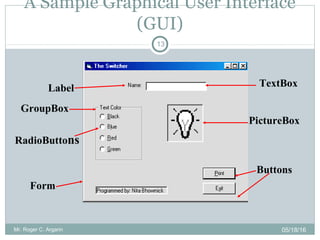
Label
GroupBox
RadioButtons
TextBox
PictureBox
Buttons
Form
VB.NET Program Development
05/18/16Mr. Roger C. Argarin
14
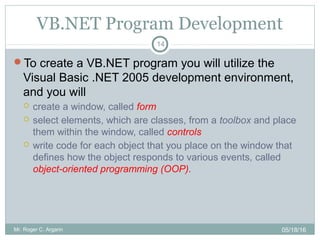
To create a VB.NET program you will utilize the
Visual Basic .NET 2005 development environment,
and you will
 create a window, called form
 select elements, which are classes, from a toolbox and place
them within the window, called controls
 write code for each object that you place on the window that
defines how the object responds to various events, called
object-oriented programming (OOP).
Event-Driven Programming
05/18/16Mr. Roger C. Argarin
15
The style of Execution as shown below is called
event-driven:
 A GUI determines how a user interacts with the program
 Each user interaction with the computer: pressing a key,
clicking a button, or selecting a menu item causes an event to
occur
 Whenever an event occurs, the code you have written to
handle that event is executed
About Visual Studio .NET
Framework
05/18/16Mr. Roger C. Argarin
16
Visual Studio .NET 2005 includes:
 Visual Basic, Visual C++, C#, J#, and the .NET framework.
 The .NET framework allowing objects from different
languages to operate together
 The .NET languages-based programs all compile to a
common machine language, called Microsoft Intermediate
Language (MSIL)
 The MSIL code runs in the Common Language Runtime
(CLR), which is part of the file .NET framework.
VB.NET Program Development
Process
05/18/16Mr. Roger C. Argarin
17
Planning (design)
 design the GUI (user interface)
 list the objects and properties needed
 plan the event procedures (what the code does)
Programming (implementation)
 define the GUI using objects (Forms, Text Boxes, Labels, etc.
 set the properties
 write BASIC code to implement procedures
VB.NET Application Files
05/18/16Mr. Roger C. Argarin
18
 Each Visual Basic application create the following
files with extensions:
 .sln - a solution file that holds information about the
project. This is the only file that is opened
 .suo - a solution user options file that stores
information about the selected options
 .vb - a .vb file that holds the definition of a form
 .resx - a resource file for the form
 .vbproj - a project file that describes the project and
lists the files are included
 .vbproj.user - a project user option file that holds
project option settings
Using Microsoft Visual Studio .NET
05/18/16Mr. Roger C. Argarin
19
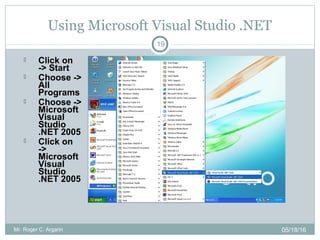
 Click on
-> Start
 Choose ->
All
Programs
 Choose ->
Microsoft
Visual
Studio
.NET 2005
 Click on
->
Microsoft
Visual
Studio
.NET 2005
Using Microsoft Visual Studio .NET
(continue)
05/18/16Mr. Roger C. Argarin
20
• Click
on->
File
• Choose
-> New
• Select-
>
Project
Using Microsoft Visual Studio .NET
(continue)
05/18/16Mr. Roger C. Argarin
21
The Microsoft VS Development Environment is also
called integrated development environment (IDE):
 A form designer
 A code editor
 A compiler
 A debugger
 An object browser
Using Microsoft Visual Studio .NET (continue)
05/18/16Mr. Roger C. Argarin
22
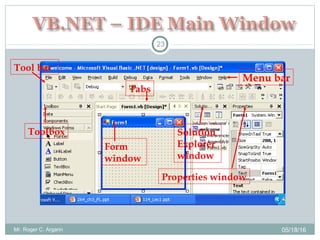
 Menu bar – includes file, edit, view, project, build, debug, data, format, tools,
window, and help menu
 Toolbar - includes many buttons as shortcuts for frequently used operations.
Each button represents a command that can be selected from a menu. Most
toolbars’ buttons are displayed in the main window of the IDE
 Each window can be moved, resized,
opened, closed, or customized
 Menu bar
 Toolbar
Menu bar
Toolbar
05/18/16Mr. Roger C. Argarin
23
Form
window
Properties window
Solution
Explorer
window
Menu bar
Tabs
Toolbox
Tool bar
The Toolbox
05/18/16Mr. Roger C. Argarin
24
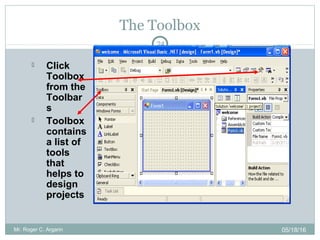
 Click
Toolbox
from the
Toolbar
s
 Toolbox
contains
a list of
tools
that
helps to
design
projects
Solution Explorer
05/18/16Mr. Roger C. Argarin
25
 View Code
 View
Design/
Form
 Properties
welcome.slnwelcome.sln
The Property Window
05/18/16Mr. Roger C. Argarin
26
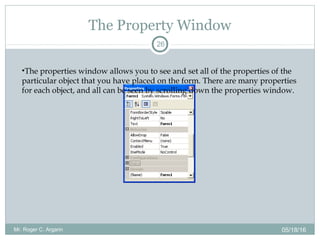
•The properties window allows you to see and set all of the properties of the
particular object that you have placed on the form. There are many properties
for each object, and all can be seen by scrolling down the properties window.
Summary
05/18/16Mr. Roger C. Argarin
27
Introduction – Learning Objectives of the class
Introduction to Visual Basic .NET2005
 Basic Concept of Visual Basic
 Visual Basic Programming Language
Use Microsoft Visual Studio .NET2005
Next - First Visual Basic Planning and Programming

Visual basic

  • 1.
    05/18/16Mr. Roger C.Argarin 1 Introduction to visual basic programming
  • 2.
    Lecture 1: Introduction 05/18/16Mr.Roger C. Argarin 2 Introduction – Learning objectives of the class Introduction to Visual Basic  Brief History of Visual Basic  Basic Concept of Visual Basic Programming Language  Programming Environment Use Microsoft Visual Studio .NET2005
  • 3.
    Learning Objectives 05/18/16Mr. RogerC. Argarin 3 Visual program design and development Fundamentals of Object Oriented Programming (OOP) Event driven programming Objects, properties and methods Write Visual Basic projects
  • 4.
    History of VisualBasic 05/18/16Mr. Roger C. Argarin 4 The Visual Basic programming language was developed by Alan Cooper, an American scientist in the late 1980’ This programming language was created with the main purpose of teaching programmers and developers how to design graphical-user interface (GUI) programs easily.
  • 5.
    Overview of Programming 05/18/16Mr.Roger C. Argarin 5 The Structure and Operation of a Computer Computer system: hardware and software Processor (registers, primitive operations) Main memory (RAM, ROM) Data types (integers, real, floating-point numbers, strings, etc.) Sequence and Data Control Storage management Operating environment
  • 6.
    Overview of Programming(continue) 05/18/16Mr. Roger C. Argarin 6 Computer System (PC) Hardware Software Processor, Memory Data types, Sequence and Data Control, Storage Management, Operating Environment
  • 7.
    Major Components ofComputer Systems 05/18/16Mr. Roger C. Argarin 7 Input Unit (keyboard, mouse, scanner, Internet through TCP/IP) Central Processing Unit (CPU) Output Unit Memory Unit  Primary memory (RAM, ROM)  Secondary memory (Hard drives, zip disks, floppy disks, etc)
  • 8.
    Object Technology 05/18/16Mr. RogerC. Argarin 8 Objects are essentially reusable software components that model items in the real world, such as windows cars, vehicles, and so on Object technology is a packaging scheme that enables programmers to create meaningful software units. Object-Oriented Programming tends to produce software that is more understandable, better organized, and easier to maintain, modify and debug.
  • 9.
    Object Model 05/18/16Mr. RogerC. Argarin 9  Object ==> Noun  Form and Controls  Property ==> Adjective  Color of a Form  Method ==> Verb  Move a Form  Event ==> Occurs when the user takes an action  User clicks a button, User moves a form  Class ==> Template to create new object  Each control added is an Instance of a Class
  • 10.
    Dot Notation 05/18/16Mr. RogerC. Argarin 10 Used to reference object's properties and events in code  Object dot Property  Form.Text, TextBox.Text  Object dot Event  Form.Hide( ), TextBox.Focus( ) To reference an object's events use an underscore instead of a dot  Button_Click, ListBox_TextChanged
  • 11.
    Object Model Analogy 05/18/16Mr.Roger C. Argarin 11 Class = automobile Properties = make, model, color, year Object = each individual car  Object is also an Instance of the automobile class Methods = start, stop, speedup, slowdown Events = car arrives, car crashes
  • 12.
    Visual Basic .NETProgramming 05/18/16Mr. Roger C. Argarin 12 Learning Visual Basic.NET Programming Language includes to learn:  The graphical user interface or GUI (“gooey”) which is an essential component of visual programming  The GUI defines how various elements look and function  Visual Basic programming language Microsoft Developers Network Homepage for VB.NET: http://msdn.microsoft.com/vbasic
  • 13.
    A Sample GraphicalUser Interface (GUI) 05/18/16Mr. Roger C. Argarin 13 Label GroupBox RadioButtons TextBox PictureBox Buttons Form
  • 14.
    VB.NET Program Development 05/18/16Mr.Roger C. Argarin 14 To create a VB.NET program you will utilize the Visual Basic .NET 2005 development environment, and you will  create a window, called form  select elements, which are classes, from a toolbox and place them within the window, called controls  write code for each object that you place on the window that defines how the object responds to various events, called object-oriented programming (OOP).
  • 15.
    Event-Driven Programming 05/18/16Mr. RogerC. Argarin 15 The style of Execution as shown below is called event-driven:  A GUI determines how a user interacts with the program  Each user interaction with the computer: pressing a key, clicking a button, or selecting a menu item causes an event to occur  Whenever an event occurs, the code you have written to handle that event is executed
  • 16.
    About Visual Studio.NET Framework 05/18/16Mr. Roger C. Argarin 16 Visual Studio .NET 2005 includes:  Visual Basic, Visual C++, C#, J#, and the .NET framework.  The .NET framework allowing objects from different languages to operate together  The .NET languages-based programs all compile to a common machine language, called Microsoft Intermediate Language (MSIL)  The MSIL code runs in the Common Language Runtime (CLR), which is part of the file .NET framework.
  • 17.
    VB.NET Program Development Process 05/18/16Mr.Roger C. Argarin 17 Planning (design)  design the GUI (user interface)  list the objects and properties needed  plan the event procedures (what the code does) Programming (implementation)  define the GUI using objects (Forms, Text Boxes, Labels, etc.  set the properties  write BASIC code to implement procedures
  • 18.
    VB.NET Application Files 05/18/16Mr.Roger C. Argarin 18  Each Visual Basic application create the following files with extensions:  .sln - a solution file that holds information about the project. This is the only file that is opened  .suo - a solution user options file that stores information about the selected options  .vb - a .vb file that holds the definition of a form  .resx - a resource file for the form  .vbproj - a project file that describes the project and lists the files are included  .vbproj.user - a project user option file that holds project option settings
  • 19.
    Using Microsoft VisualStudio .NET 05/18/16Mr. Roger C. Argarin 19  Click on -> Start  Choose -> All Programs  Choose -> Microsoft Visual Studio .NET 2005  Click on -> Microsoft Visual Studio .NET 2005
  • 20.
    Using Microsoft VisualStudio .NET (continue) 05/18/16Mr. Roger C. Argarin 20 • Click on-> File • Choose -> New • Select- > Project
  • 21.
    Using Microsoft VisualStudio .NET (continue) 05/18/16Mr. Roger C. Argarin 21 The Microsoft VS Development Environment is also called integrated development environment (IDE):  A form designer  A code editor  A compiler  A debugger  An object browser
  • 22.
    Using Microsoft VisualStudio .NET (continue) 05/18/16Mr. Roger C. Argarin 22  Menu bar – includes file, edit, view, project, build, debug, data, format, tools, window, and help menu  Toolbar - includes many buttons as shortcuts for frequently used operations. Each button represents a command that can be selected from a menu. Most toolbars’ buttons are displayed in the main window of the IDE  Each window can be moved, resized, opened, closed, or customized  Menu bar  Toolbar Menu bar Toolbar
  • 23.
    05/18/16Mr. Roger C.Argarin 23 Form window Properties window Solution Explorer window Menu bar Tabs Toolbox Tool bar
  • 24.
    The Toolbox 05/18/16Mr. RogerC. Argarin 24  Click Toolbox from the Toolbar s  Toolbox contains a list of tools that helps to design projects
  • 25.
    Solution Explorer 05/18/16Mr. RogerC. Argarin 25  View Code  View Design/ Form  Properties welcome.slnwelcome.sln
  • 26.
    The Property Window 05/18/16Mr.Roger C. Argarin 26 •The properties window allows you to see and set all of the properties of the particular object that you have placed on the form. There are many properties for each object, and all can be seen by scrolling down the properties window.
  • 27.
    Summary 05/18/16Mr. Roger C.Argarin 27 Introduction – Learning Objectives of the class Introduction to Visual Basic .NET2005  Basic Concept of Visual Basic  Visual Basic Programming Language Use Microsoft Visual Studio .NET2005 Next - First Visual Basic Planning and Programming

Editor's Notes

  • #24 Here are more details of each window that opens when you Start a New Project in Microsoft Visual Basic .NET2005. The IDE main window includes Toolbars, Document Window, Form Designer, Solution Explorer Window, Properties Window, and Toolbox. You should make the Visual Basic main window full-screen in order to see all of the smaller windows. You see the menu bar at the top, and the toolbar right below. If you do not have the same layout as above, go to the View menu from menu bar and select whichever of the windows are not presented. After that, you see the Form window is at the center. The Form window is where you design a form that makes up your user interface. The Form design window of Form1 is currently displaying, you can drag the form’s sizing handles to change the size of the form. When you begin a new Visual Basic windows project, a new form is added to the project with the default name Form1. The most used window is the Toolbox, which is located at the left side of screen. The Toolbox appears when you press the Toolbox Tab on the left of the window, The Toolbox contains all of the controls to be used this semester. The solution explorer window is right next to the Form window. The solution explorer window enables you to select the form or module you want to see or to switch between a form and a Basic code for the project. The properties window is at the right side of screen. The Properties window contains all of the properties of whichever control you have selected on the form and is extremely important because this is where you will change many properties of each object.
  • #25 The toolbox holds the tools you need to place controls on a form. You may have more or different tools in your toolbox, depending on the edition of visual basic you are using, such as standard edition, professional edition, or enterprise edition.
  • #26 The Solution Explorer window holds the filenames for the files included in your project welcome and a list of the classes it references. The window’s title bar holds the name of your solution file (welcome.sln), which is the name you give it in the New Project dialog box. Here, there is just one form, named Form1, but later we will have more than one form visible in this window.