Visual Basic (Introduction)
Shabista imam
Introduction
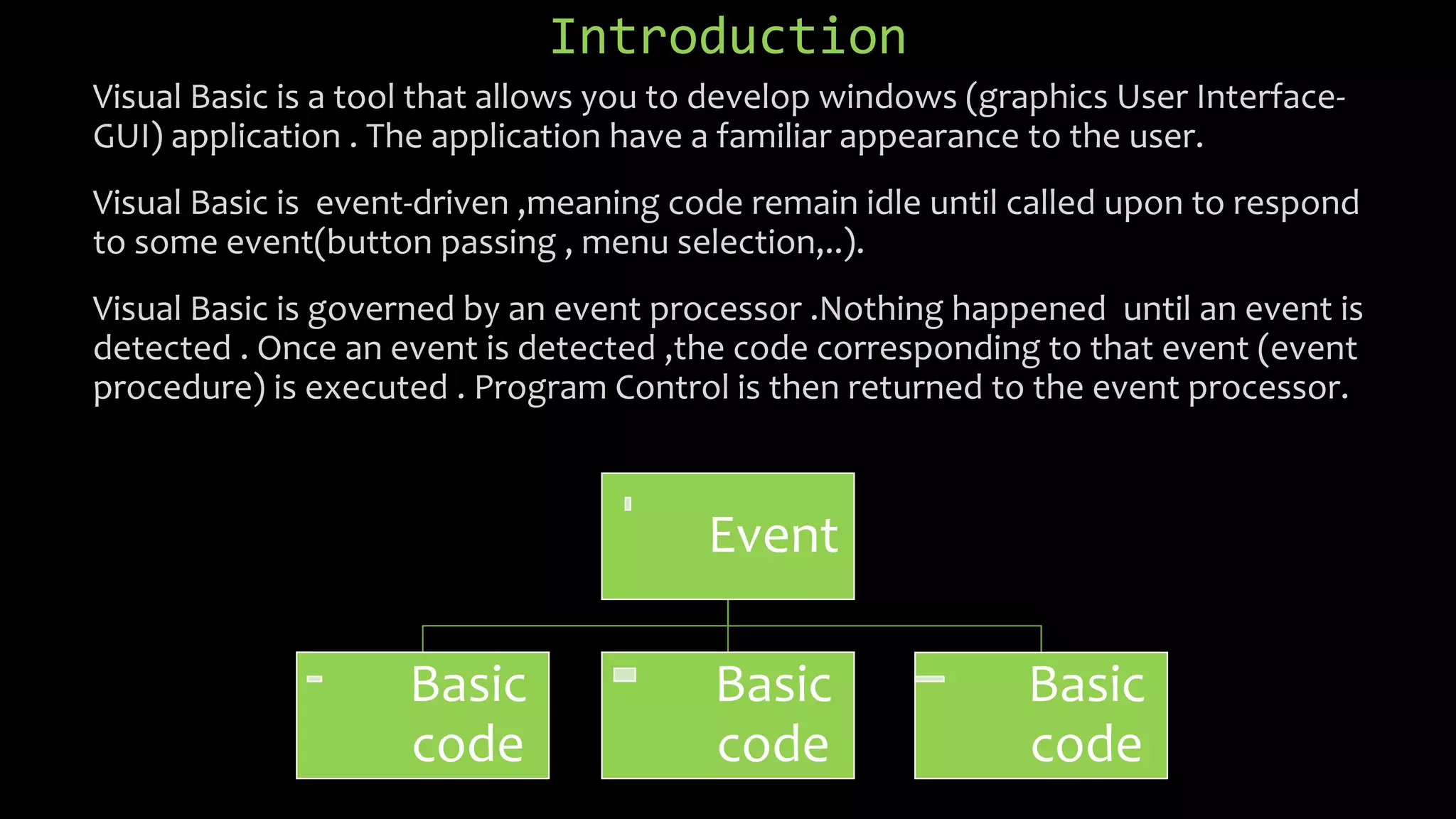
Visual Basic is a tool that allows you to develop windows (graphics User Interface-
GUI) application . The application have a familiar appearance to the user.
Visual Basic is event-driven ,meaning code remain idle until called upon to respond
to some event(button passing , menu selection,..).
Visual Basic is governed by an event processor .Nothing happened until an event is
detected . Once an event is detected ,the code corresponding to that event (event
procedure) is executed . Program Control is then returned to the event processor.
Event
Basic
code
Basic
code
Basic
code
Some features of Visual Basic
• Full sets of object you draw the application.
• Lots of Icons and picture for use.
• Response to mouse and keyboard action.
• Clipboard and printer access.
• Full array of mathematical ,string handling and graphics function.
• It can handle fixed and dynamic variable and control arrays.
• Sequential and random access file support.
• Useful debugger and error handling facilities.
• Powerful database access tools.
• Active X support.
• Package & development wizard makes distributing your application simple.
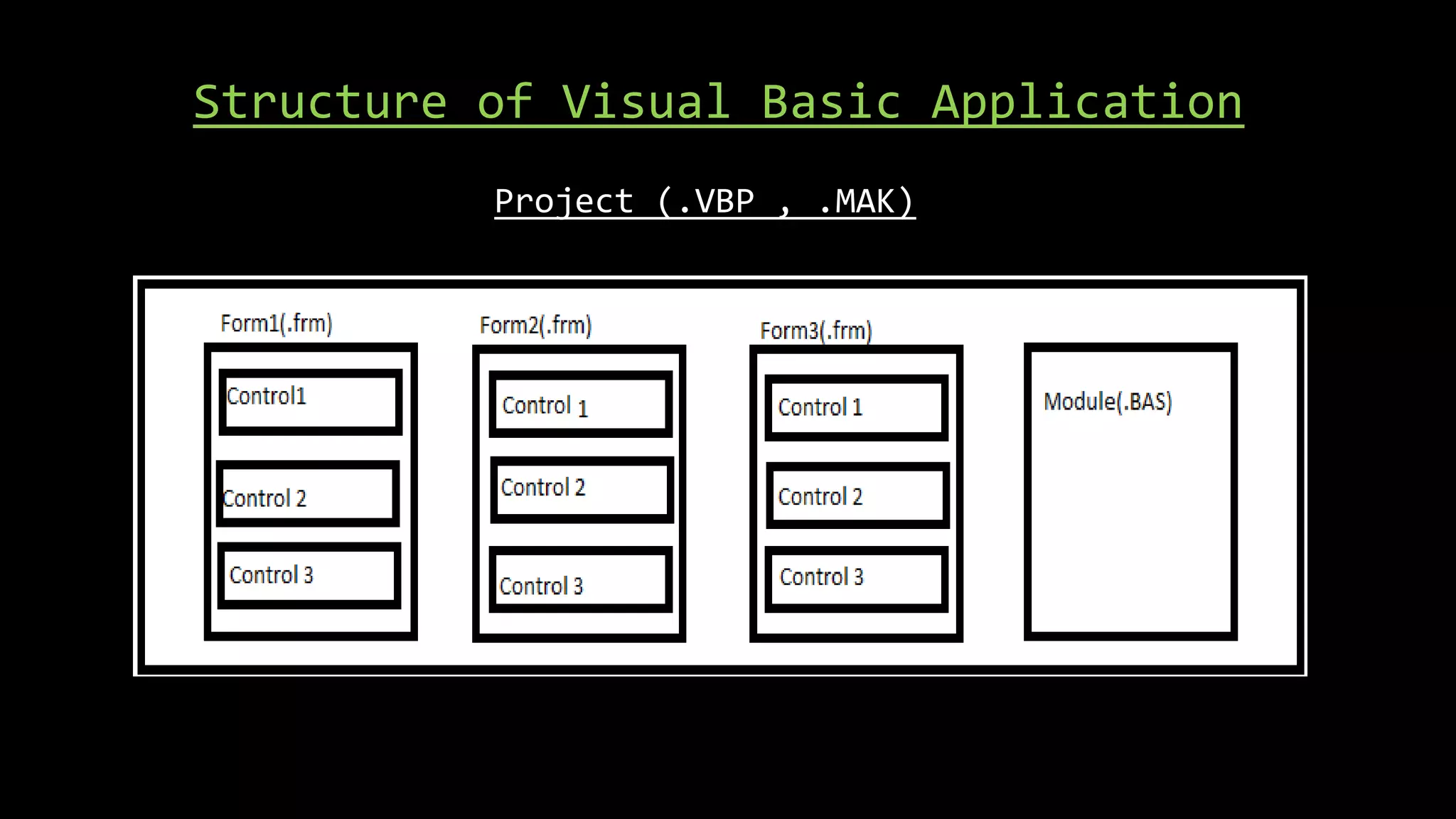
Structure of Visual Basic Application
Project (.VBP , .MAK)
Application is made of the followings terms :-
• Forms :- Windows that you create for user interface.
• Controls:- Graphical features drawn on forms to allows user interaction
(textboxes, labels, scroll bar , command buttons etc.),(Forms and Controls are
Object).
• Properties :- Every characteristics of form or control is specified by a property.
Ex- names , Caption size , color , position content , visual basic applies
default properties . You can change it at design time or run time.
• Methods :- Built in procedure that can be invoked to import some action to a
particular object.
• Event Procedure :- Code related to some object .This is the code that is executed
when a certain event occurs.
• General Procedure :- Code not related to object. This code must be invoked by the
application.
• Modules :- Collection of general procedures variable declaration and constant
definition used by application.
Steps in Developing Applications
There are 3 primary steps involved in building Visual Basic Application.
1. Draw the user interface
2. Assign properties to controls
3. Attach code to controls
1.Drawing User Interface and setting Properties:
Visual Basic operates in 3 modes:-
• Design Mode :- Used to build application.
• Run Mode :- Used to run application.
• Break Mode :- application is halted and debugger is available.
Design Mode
Six windows appears when you start Visual Basic.
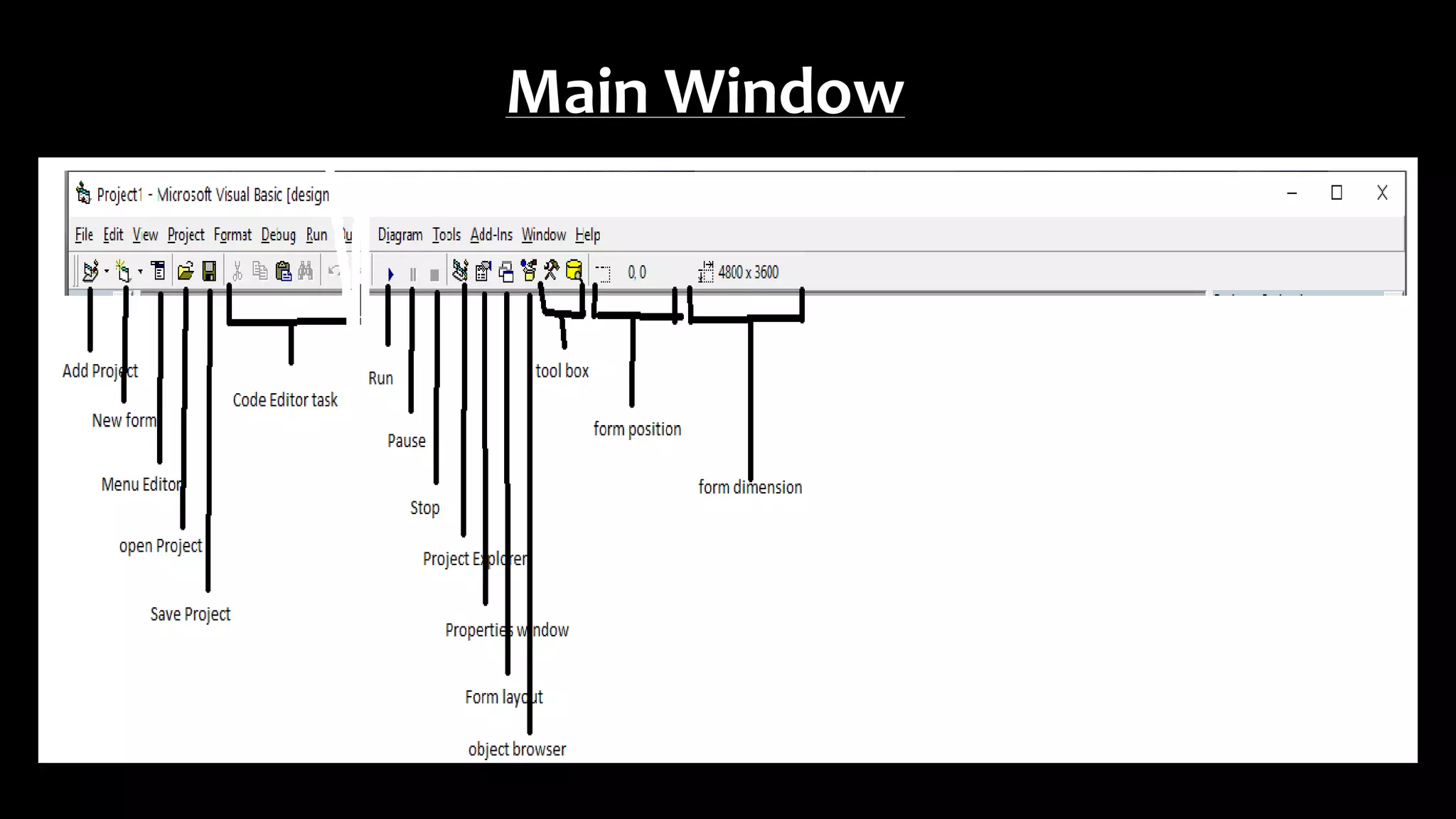
1. Main Window :- It consist of title bar , menu bar and toolbar. The title bar
indicates the project name, the current VB operating modes, and the current form.
The menu bar has dropdown menus from which you control the operation of VB
environment .The toolbar has buttons that provide shortcuts to some of the menus
options . The main window also shows the location of current from relative to the
upper left corner of the screen (measured in twips) and the width and length of the
current from.
Main Window
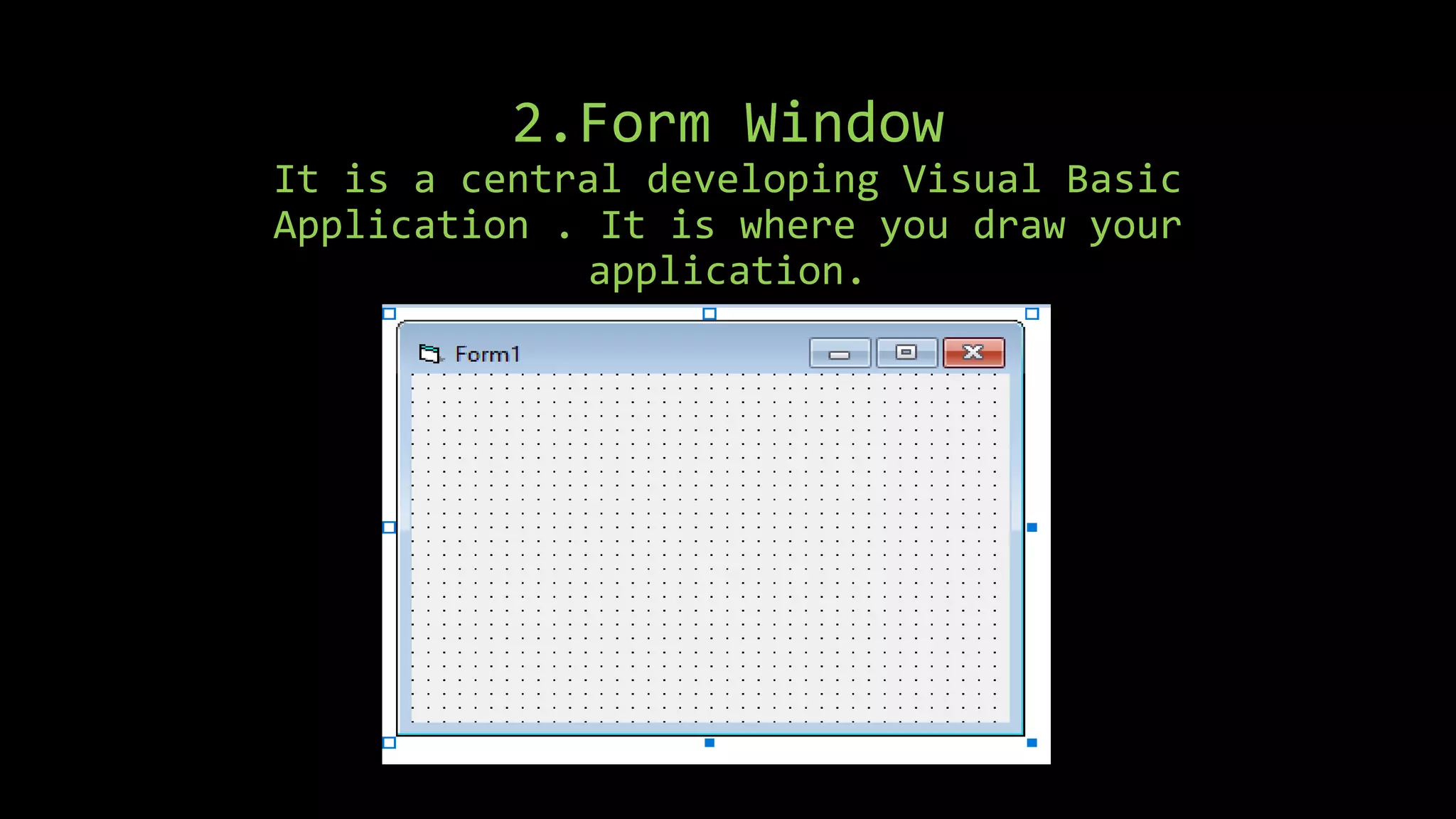
2.Form Window
It is a central developing Visual Basic
Application . It is where you draw your
application.
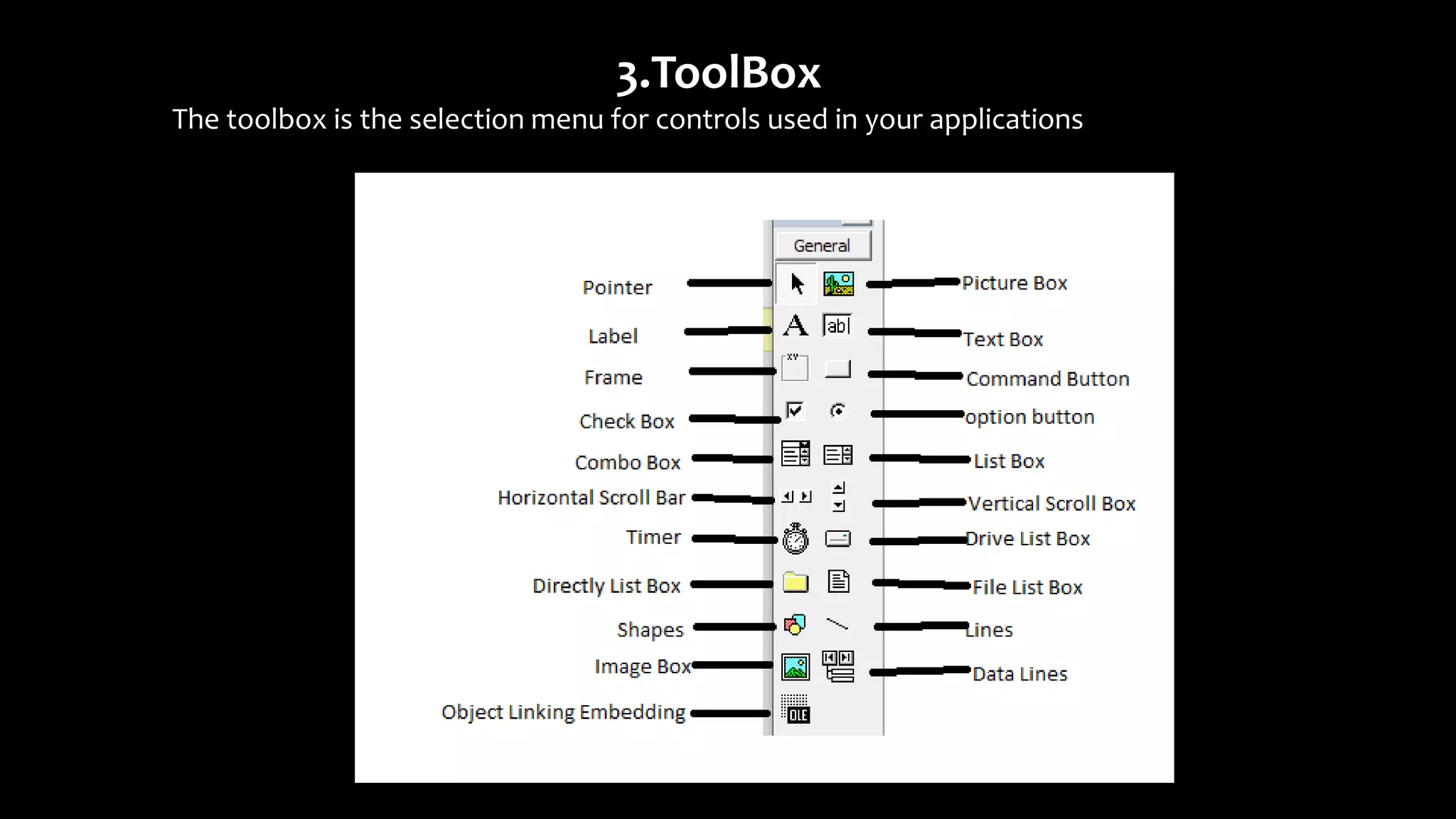
3.ToolBox
The toolbox is the selection menu for controls used in your applications
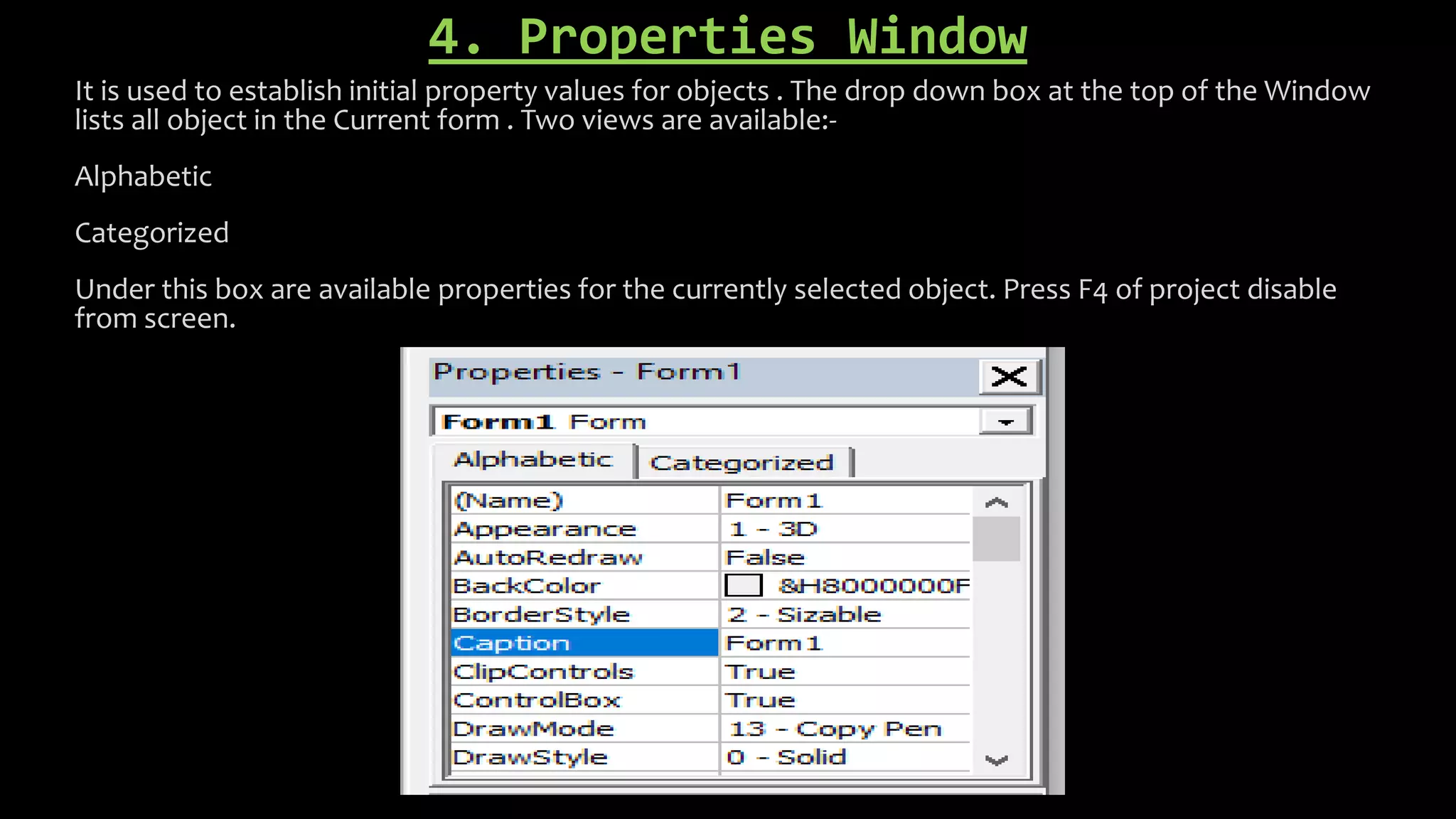
4. Properties Window
It is used to establish initial property values for objects . The drop down box at the top of the Window
lists all object in the Current form . Two views are available:-
Alphabetic
Categorized
Under this box are available properties for the currently selected object. Press F4 of project disable
from screen.
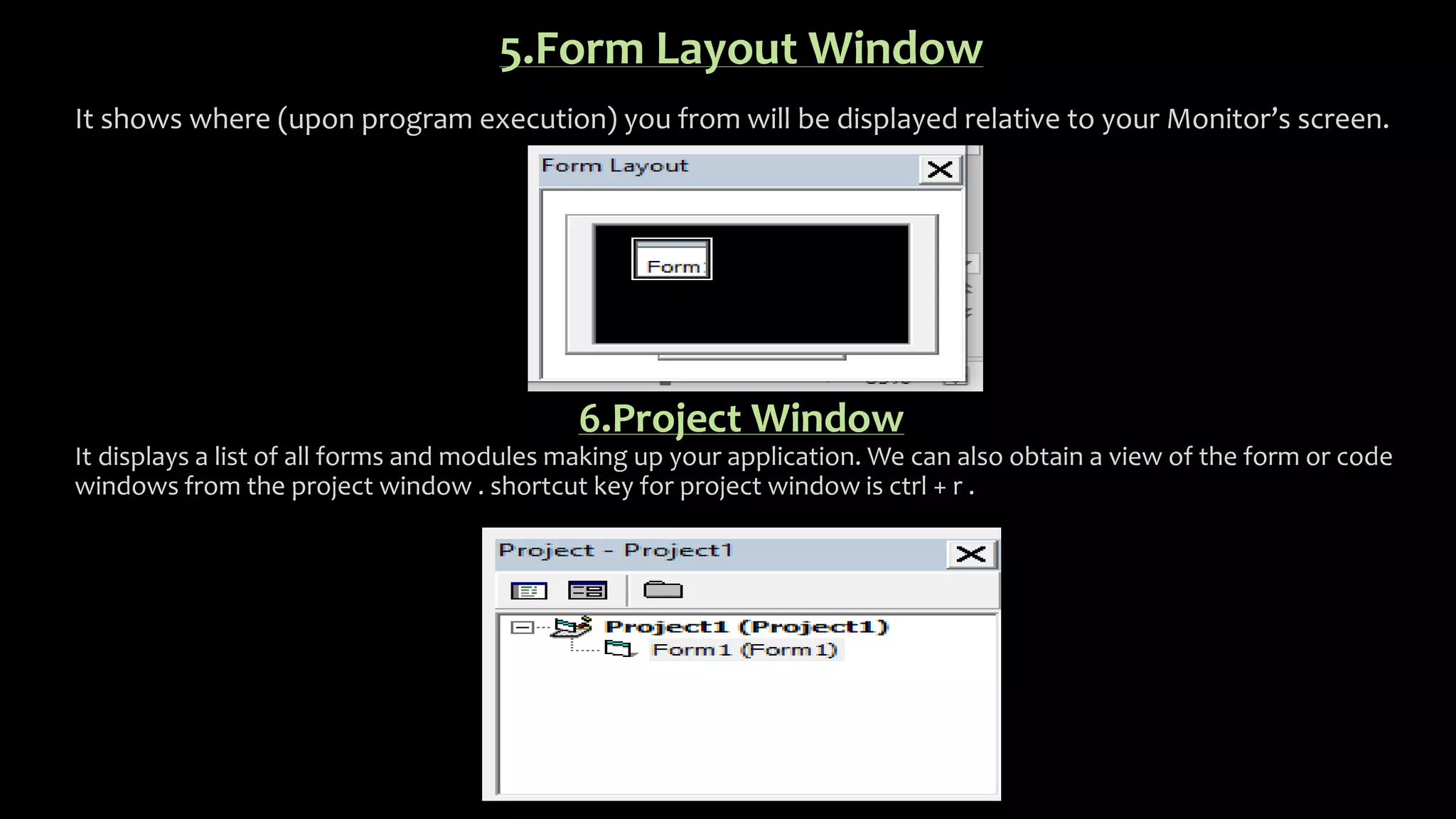
5.Form Layout Window
It shows where (upon program execution) you from will be displayed relative to your Monitor’s screen.
6.Project Window
It displays a list of all forms and modules making up your application. We can also obtain a view of the form or code
windows from the project window . shortcut key for project window is ctrl + r .
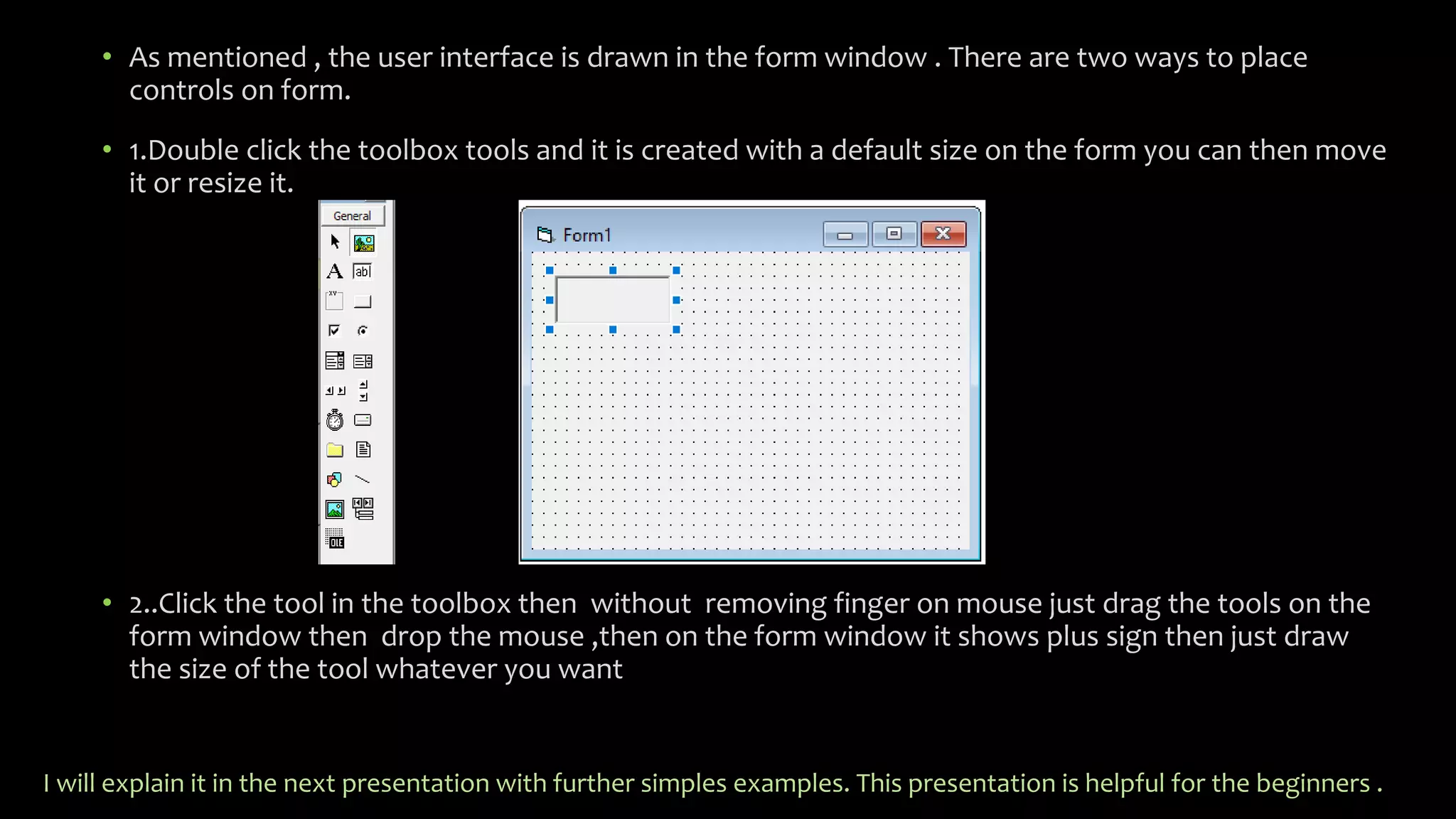
• As mentioned , the user interface is drawn in the form window . There are two ways to place
controls on form.
• 1.Double click the toolbox tools and it is created with a default size on the form you can then move
it or resize it.
• 2..Click the tool in the toolbox then without removing finger on mouse just drag the tools on the
form window then drop the mouse ,then on the form window it shows plus sign then just draw
the size of the tool whatever you want
I will explain it in the next presentation with further simples examples. This presentation is helpful for the beginners .
Visual basic

Visual basic

  • 1.
  • 2.
    Introduction Visual Basic isa tool that allows you to develop windows (graphics User Interface- GUI) application . The application have a familiar appearance to the user. Visual Basic is event-driven ,meaning code remain idle until called upon to respond to some event(button passing , menu selection,..). Visual Basic is governed by an event processor .Nothing happened until an event is detected . Once an event is detected ,the code corresponding to that event (event procedure) is executed . Program Control is then returned to the event processor. Event Basic code Basic code Basic code
  • 3.
    Some features ofVisual Basic • Full sets of object you draw the application. • Lots of Icons and picture for use. • Response to mouse and keyboard action. • Clipboard and printer access. • Full array of mathematical ,string handling and graphics function. • It can handle fixed and dynamic variable and control arrays. • Sequential and random access file support. • Useful debugger and error handling facilities. • Powerful database access tools. • Active X support. • Package & development wizard makes distributing your application simple.
  • 4.
    Structure of VisualBasic Application Project (.VBP , .MAK)
  • 5.
    Application is madeof the followings terms :- • Forms :- Windows that you create for user interface. • Controls:- Graphical features drawn on forms to allows user interaction (textboxes, labels, scroll bar , command buttons etc.),(Forms and Controls are Object). • Properties :- Every characteristics of form or control is specified by a property. Ex- names , Caption size , color , position content , visual basic applies default properties . You can change it at design time or run time. • Methods :- Built in procedure that can be invoked to import some action to a particular object. • Event Procedure :- Code related to some object .This is the code that is executed when a certain event occurs. • General Procedure :- Code not related to object. This code must be invoked by the application. • Modules :- Collection of general procedures variable declaration and constant definition used by application.
  • 6.
    Steps in DevelopingApplications There are 3 primary steps involved in building Visual Basic Application. 1. Draw the user interface 2. Assign properties to controls 3. Attach code to controls 1.Drawing User Interface and setting Properties: Visual Basic operates in 3 modes:- • Design Mode :- Used to build application. • Run Mode :- Used to run application. • Break Mode :- application is halted and debugger is available. Design Mode Six windows appears when you start Visual Basic. 1. Main Window :- It consist of title bar , menu bar and toolbar. The title bar indicates the project name, the current VB operating modes, and the current form. The menu bar has dropdown menus from which you control the operation of VB environment .The toolbar has buttons that provide shortcuts to some of the menus options . The main window also shows the location of current from relative to the upper left corner of the screen (measured in twips) and the width and length of the current from.
  • 7.
  • 8.
    2.Form Window It isa central developing Visual Basic Application . It is where you draw your application.
  • 9.
    3.ToolBox The toolbox isthe selection menu for controls used in your applications
  • 10.
    4. Properties Window Itis used to establish initial property values for objects . The drop down box at the top of the Window lists all object in the Current form . Two views are available:- Alphabetic Categorized Under this box are available properties for the currently selected object. Press F4 of project disable from screen.
  • 11.
    5.Form Layout Window Itshows where (upon program execution) you from will be displayed relative to your Monitor’s screen. 6.Project Window It displays a list of all forms and modules making up your application. We can also obtain a view of the form or code windows from the project window . shortcut key for project window is ctrl + r .
  • 12.
    • As mentioned, the user interface is drawn in the form window . There are two ways to place controls on form. • 1.Double click the toolbox tools and it is created with a default size on the form you can then move it or resize it. • 2..Click the tool in the toolbox then without removing finger on mouse just drag the tools on the form window then drop the mouse ,then on the form window it shows plus sign then just draw the size of the tool whatever you want I will explain it in the next presentation with further simples examples. This presentation is helpful for the beginners .