The Lahore Project
                                       Vision
                        The Global Context*


* Based on Kamil Khan Mumtaz, ―Celebrating The Past, Designing for the Future‖ IAPEX 2012,
POPULATION GROWTH
VS ECONOMIC GROWTH


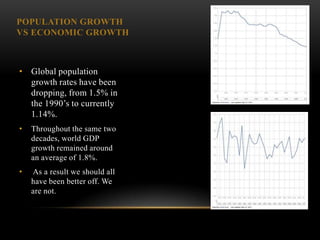
• Global population
  growth rates have been
  dropping, from 1.5% in
  the 1990‘s to currently
  1.14%.
•   Throughout the same two
    decades, world GDP
    growth remained around
    an average of 1.8%.
•   As a result we should all
    have been better off. We
    are not.
INEQUALITY


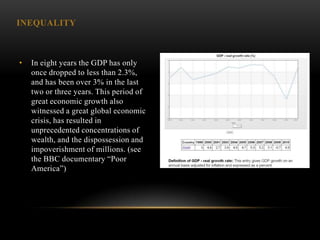
•   In eight years the GDP has only
    once dropped to less than 2.3%,
    and has been over 3% in the last
    two or three years. This period of
    great economic growth also
    witnessed a great global economic
    crisis, has resulted in
    unprecedented concentrations of
    wealth, and the dispossession and
    impoverishment of millions. (see
    the BBC documentary ―Poor
    America‖)
HUNGER
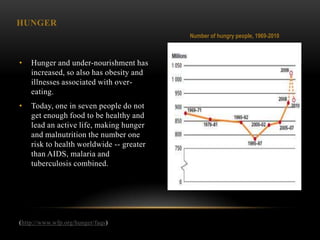
                                          Number of hungry people, 1969-2010


•   Hunger and under-nourishment has
    increased, so also has obesity and
    illnesses associated with over-
    eating.
•   Today, one in seven people do not
    get enough food to be healthy and
    lead an active life, making hunger
    and malnutrition the number one
    risk to health worldwide -- greater
    than AIDS, malaria and
    tuberculosis combined.


(http://www.wfp.org/hunger/faqs)
SOCIAL CRIME/INCOME DISPARITY

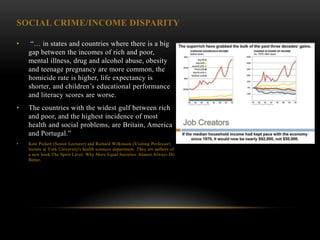
•    ―… in states and countries where there is a big
    gap between the incomes of rich and poor,
    mental illness, drug and alcohol abuse, obesity
    and teenage pregnancy are more common, the
    homicide rate is higher, life expectancy is
    shorter, and children‘s educational performance
    and literacy scores are worse.
•   The countries with the widest gulf between rich
    and poor, and the highest incidence of most
    health and social problems, are Britain, America
    and Portugal.‖
•   Kate Pickett (Senior Lecturer) and Richard Wilkinson (Visiting Professor)
    lecture at York University's health sciences department. They are authors of
    a new book The Spirit Level: Why More Equal Societies Almost Always Do
    Better.
GLOBAL HAPPY PLANET INDEX

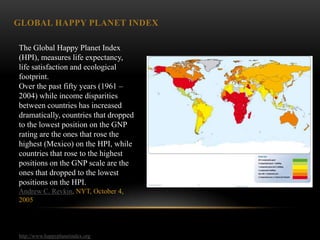
The Global Happy Planet Index
(HPI), measures life expectancy,
life satisfaction and ecological
footprint.
Over the past fifty years (1961 –
2004) while income disparities
between countries has increased
dramatically, countries that dropped
to the lowest position on the GNP
rating are the ones that rose the
highest (Mexico) on the HPI, while
countries that rose to the highest
positions on the GNP scale are the
ones that dropped to the lowest
positions on the HPI.
Andrew C. Revkin, NYT, October 4,
2005


http://www.happyplanetindex.org
GLOBAL HAPPY PLANET
INDEX
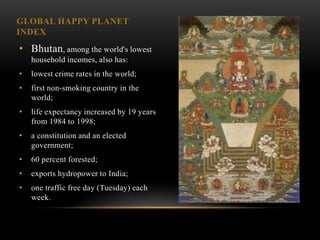
• Bhutan, among the world's lowest
    household incomes, also has:
•   lowest crime rates in the world;
•   first non-smoking country in the
    world;
•   life expectancy increased by 19 years
    from 1984 to 1998;
•   a constitution and an elected
    government;
•   60 percent forested;
•   exports hydropower to India;
•   one traffic free day (Tuesday) each
    week.
AGRICULTURE


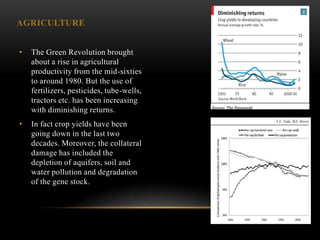
•   The Green Revolution brought
    about a rise in agricultural
    productivity from the mid-sixties
    to around 1980. But the use of
    fertilizers, pesticides, tube-wells,
    tractors etc. has been increasing
    with diminishing returns.
•   In fact crop yields have been
    going down in the last two
    decades. Moreover, the collateral
    damage has included the
    depletion of aquifers, soil and
    water pollution and degradation
    of the gene stock.
MASS EXTINCTION OF
SPECIES

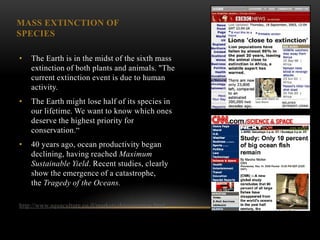
•   The Earth is in the midst of the sixth mass
    extinction of both plants and animals. "The
    current extinction event is due to human
    activity.
•   The Earth might lose half of its species in
    our lifetime. We want to know which ones
    deserve the highest priority for
    conservation.―
•   40 years ago, ocean productivity began
    declining, having reached Maximum
    Sustainable Yield. Recent studies, clearly
    show the emergence of a catastrophe,
    the Tragedy of the Oceans.

http://www.aquaculture.co.il/markets/deterioration.html
MASS EXTINCTION OF
SPECIES

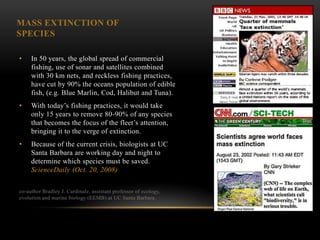
•    In 50 years, the global spread of commercial
     fishing, use of sonar and satellites combined
     with 30 km nets, and reckless fishing practices,
     have cut by 90% the oceans population of edible
     fish, (e.g. Blue Marlin, Cod, Halibut and Tuna).
•    With today‘s fishing practices, it would take
     only 15 years to remove 80-90% of any species
     that becomes the focus of the fleet‘s attention,
     bringing it to the verge of extinction.
•    Because of the current crisis, biologists at UC
     Santa Barbara are working day and night to
     determine which species must be saved.
     ScienceDaily (Oct. 20, 2008)

co-author Bradley J. Cardinale, assistant professor of ecology,
evolution and marine biology (EEMB) at UC Santa Barbara.
GLOBAL WARMING


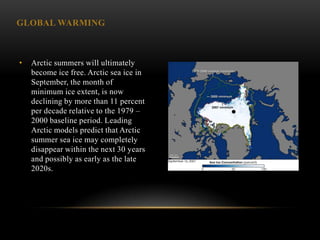
•   Arctic summers will ultimately
    become ice free. Arctic sea ice in
    September, the month of
    minimum ice extent, is now
    declining by more than 11 percent
    per decade relative to the 1979 –
    2000 baseline period. Leading
    Arctic models predict that Arctic
    summer sea ice may completely
    disappear within the next 30 years
    and possibly as early as the late
    2020s.
GLOBAL WARMING
•    Sea ice coverage in 1980 (bottom) and 2012 (top), as
     observed by passive microwave sensors on NASA‘s Nimbus-7
     satellite and by the Special Sensor Microwave
     Imager/Sounder (SSMIS) from the Defense Meteorological
     Satellite Program (DMSP)..
     http://en.wikipedia.org/wiki/File:Oldest_Arctic_Sea_Ice_is_Disappear
     ing.png

•    Dr Maslowski's model, along with his claim that the Arctic
     sea ice is in a "death spiral", were controversial but Prof
     Wadhams, a leading authority on the polar regions, said "His
     [model] is the most extreme but he is also the best modeller
     around.
•    "It is really showing the fall-off in ice volume is so fast that it
     is going to bring us to zero very quickly. 2015 is a very
     serious prediction and I think I am pretty much persuaded that
     that's when it will happen."
•    The ice would come back the following winter but its absence
     in summer would encourage more shipping and oil
     exploration in the Arctic and could threaten native species, he
     added.
http://globalwarming.house.gov/impactzones/arctic

http://www.telegraph.co.uk/earth/environment/globalwarming/8877491/Arct
ic-sea-ice-to-melt-by-2015.html
ECOLOGICAL FOOTPRINT

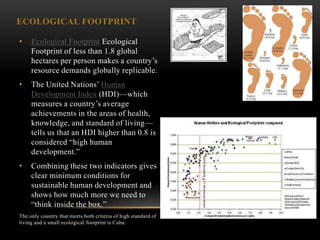
•    Ecological Footprint Ecological
     Footprint of less than 1.8 global
     hectares per person makes a country‘s
     resource demands globally replicable.
•    The United Nations‘ Human
     Development Index (HDI)—which
     measures a country‘s average
     achievements in the areas of health,
     knowledge, and standard of living—
     tells us that an HDI higher than 0.8 is
     considered ―high human
     development.‖
•    Combining these two indicators gives
     clear minimum conditions for
     sustainable human development and
     shows how much more we need to
     ―think inside the box.‖
The only country that meets both criteria of high standard of
living and a small ecological footprint is Cuba.
ECOLOGICAL FOOTPRINT

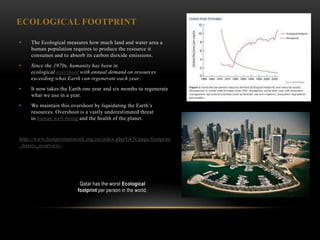
•    The Ecological measures how much land and water area a
     human population requires to produce the resource it
     consumes and to absorb its carbon dioxide emissions.
•    Since the 1970s, humanity has been in
     ecological overshoot with annual demand on resources
     exceeding what Earth can regenerate each year.
•    It now takes the Earth one year and six months to regenerate
     what we use in a year.
•    We maintain this overshoot by liquidating the Earth‘s
     resources. Overshoot is a vastly underestimated threat
     to human well-being and the health of the planet.


http://www.footprintnetwork.org/en/index.php/GFN/page/footprint
_basics_overview/


                          Qatar has the worst Ecological
                         footprint per person in the world.
RACE TO THE BOTTOM


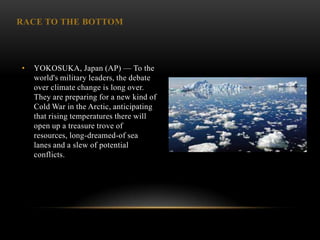
•   YOKOSUKA, Japan (AP) — To the
    world's military leaders, the debate
    over climate change is long over.
    They are preparing for a new kind of
    Cold War in the Arctic, anticipating
    that rising temperatures there will
    open up a treasure trove of
    resources, long-dreamed-of sea
    lanes and a slew of potential
    conflicts.
RACE TO THE BOTTOM


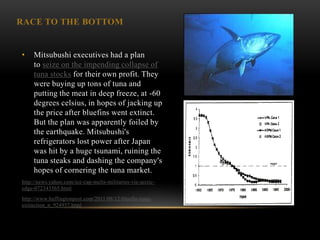
•    Mitsubushi executives had a plan
     to seize on the impending collapse of
     tuna stocks for their own profit. They
     were buying up tons of tuna and
     putting the meat in deep freeze, at -60
     degrees celsius, in hopes of jacking up
     the price after bluefins went extinct.
     But the plan was apparently foiled by
     the earthquake. Mitsubushi's
     refrigerators lost power after Japan
     was hit by a huge tsunami, ruining the
     tuna steaks and dashing the company's
     hopes of cornering the tuna market.
http://news.yahoo.com/ice-cap-melts-militaries-vie-arctic-
edge-072343565.html
http://www.huffingtonpost.com/2011/08/12/bluefin-tuna-
extinction_n_924957.html
SUSTAINABLE HUMAN
DEVELOPMENT


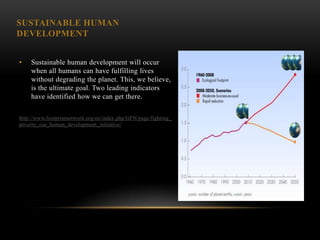
•   Sustainable human development will occur
    when all humans can have fulfilling lives
    without degrading the planet. This, we believe,
    is the ultimate goal. Two leading indicators
    have identified how we can get there.

http://www.footprintnetwork.org/en/index.php/GFN/page/fighting_
poverty_our_human_development_initiative/
WHAT IS TO BE
 DONE?
 WHEN IN FREE FALL
 GET UNPLUGGED!
 DESIGN PARACHUTES!

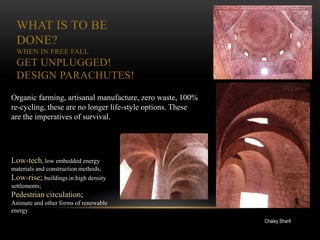
Organic farming, artisanal manufacture, zero waste, 100%
re-cycling, these are no longer life-style options. These
are the imperatives of survival.


Low-tech, low embedded energy
materials and construction methods;
Low-rise; buildings in high density
settlements;
Pedestrian circulation;
Animate and other forms of renewable
energy
                                                            Chaley Sharif
WHAT IS TO BE
DONE?
WHEN IN FREE FALL
GET UNPLUGGED!
DESIGN PARACHUTES!


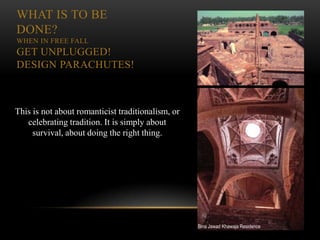
This is not about romanticist traditionalism, or
   celebrating tradition. It is simply about
     survival, about doing the right thing.


                                                   Bina Jawad Khawaja Residence
The Lahore Project
                                          Vision

                        Lahore Context
•   Population: 8.5 million (Lahore

•
    District)
    Urban: 82 %
                                                    Large, Growing &
•
•
    Rural: 18%
    Growth Rate: 2.5% (national                     Young Population
    and provincial: 1.9%)
•   Densities
•   Highest: 1500 persons per
    hectare (Mustafabad)
•   Lowest: 37 persons per hectare
    (Jauhar Town)
•   Average: 208 persons per
    hectare.
•   Age Profile
•   Below 14 years: 39.2%
•   Between 15 – 49: 50%
Economy

                                                •Declining
•   Occupations:
•   Services: 38.8 %;
•   White collar: 31 %;
•   ‗lumpen‘: 19.5 %;
•   Manufacturing: 10.4 %                       economic growth
•   Employment by zone of residence
•
•
    Primary: 4.4%
    Secondary: 14.6%
                                                •Non Productive
•   Tertiary: 81%
•
•
    Employment Participation rate: 27%
    Unemployment
                                                Occupations
•
•
    Exceeds those employed by 27%
    Female residents unemployment: 99%          •Under-
•   GDP: average growth rate declined from 6%

•
    in the 1980s to 3% in the last five years
    Incomes: Average Household Income for
    Towns/Tehsils(Pak Rs/month)
                                                Employment
•   Highest: 43,397 in Cantonment
•   Lowest: 22,26 in Muridke.
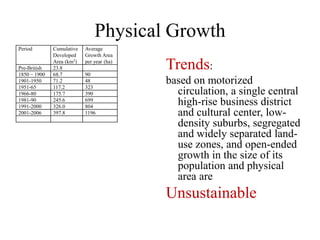
Physical Growth
Period        Cumulative   Average
              Developed    Growth Area

Pre-British
1850 – 1900
              Area (km2)
              23.8
              68.7
                           per year (ha)

                           90
                                           Trends:
1901-1950
1951-65
              71.2
              117.2
                           48
                           323
                                           based on motorized
1966-80       175.7        390               circulation, a single central
1981-90
1991-2000
              245.6
              326.0
                           699
                           804
                                             high-rise business district
2001-2006     397.8        1196              and cultural center, low-
                                             density suburbs, segregated
                                             and widely separated land-
                                             use zones, and open-ended
                                             growth in the size of its
                                             population and physical
                                             area are
                                           Unsustainable
The Lahore Project

• a citizens‘ initiative that has grown out of the
  strategic framework adopted by the Lahore
  Conservation Society in 2006.
• to know who we are (identity), where we are
  (environment), where we are coming from
  (history), where we want to be (goals), and
  how to act for the achievement of our goals.
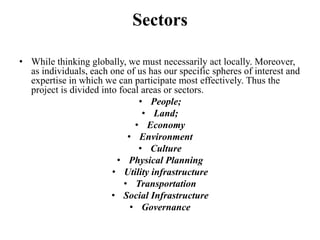
Sectors

• While thinking globally, we must necessarily act locally. Moreover,
  as individuals, each one of us has our specific spheres of interest and
  expertise in which we can participate most effectively. Thus the
  project is divided into focal areas or sectors.
                               • People;
                                • Land;
                              • Economy
                            • Environment
                               • Culture
                         • Physical Planning
                        • Utility infrastructure
                           • Transportation
                        • Social Infrastructure
                             • Governance
Methodology

• a space for the pooling and sharing of
  information (Data),
• free and open discussion (Forum),
• formulation of strategies (Sectors) through a
  process of informed debate and concrete plans
  for action:
ISDP
    (LDA‘s Integrated Strategic Development Plan for Lahore Region)

• ―Urbanization presents one of the key challenges and,
  at the same time, opportunities in the new millennium‖
• ―Those cities that fail to plan ahead and execute the
  plans will not be competitive in the globalized world.
  Urban economies are contributing significantly more to
  national exchequer and at the same time have become
  key employment markets. Cities indeed are important
  engines of economic growth and provide significant
  economies of scale in the provision of jobs, housing and
  services.‖ (our italics)
Rapid Pace of Urbanization
• a symptom of the present global ecological
  crisis.
• principal cause is the modern development
  paradigm.
• It is the pursuit of never-ending economic
  growth that has resulted in over-production,
  depletion of resources, waste, environmental
  degradation, social disintegration and
  dehumanization.
Global Capitalism‘s Vision
                           is

         A Recipe for Disaster!
• We do not share this corporate business vision
  of rapid urbanization as an investment
  opportunity, and cities as employment markets,
  whose expanding size provides economies of
  scale for profiteers who are valorized for their
  contribution to the national exchequer.
The City & its Region

• Cities process primary raw materials,
  manufacturer secondary products and provide
  services.
• Economically they are integrated with the
  region that produces the primary products, and
  the region to which they provide goods and
  services.
Parasite & Host
• In a symbiotic relationship, the value of what
  each takes from the other is more or less
  equivalent to what it gives.
• In a parasitic relationship the city extracts
  resources in excess of their rates of renewal
  and re-generation, and produces toxic and non-
  recyclable waste.
Our Goal
• Realization of our highest human potential.
• the greatest challenges of the new millennium is
  the conservation of our humanity and our
  environment
• Our humanity is defined by the universal set of
  qualities and values that define what it means to
  be ―human‖ – qualities such as Love,
  Compassion, Justice and Beauty – not by
  quantities such as gross national product,
  monetary wealth and material possessions
Our strategy
• sustainable economy based on need rather than
  greed;
• an economy in which
  – extraction from resources does not exceed their
    rates of renewal and re-generation;
  – all that is consumed is fully recycled;
  – toxic and non-recyclable waste is eliminated;
Our Vision for Lahore
     A center of urbanity and civilization
A city that thrives in a symbiotic relationship
                 with its region.

Vision presentation (Updated)

  • 1.
    The Lahore Project Vision The Global Context* * Based on Kamil Khan Mumtaz, ―Celebrating The Past, Designing for the Future‖ IAPEX 2012,
  • 2.
    POPULATION GROWTH VS ECONOMICGROWTH • Global population growth rates have been dropping, from 1.5% in the 1990‘s to currently 1.14%. • Throughout the same two decades, world GDP growth remained around an average of 1.8%. • As a result we should all have been better off. We are not.
  • 3.
    INEQUALITY • In eight years the GDP has only once dropped to less than 2.3%, and has been over 3% in the last two or three years. This period of great economic growth also witnessed a great global economic crisis, has resulted in unprecedented concentrations of wealth, and the dispossession and impoverishment of millions. (see the BBC documentary ―Poor America‖)
  • 4.
    HUNGER Number of hungry people, 1969-2010 • Hunger and under-nourishment has increased, so also has obesity and illnesses associated with over- eating. • Today, one in seven people do not get enough food to be healthy and lead an active life, making hunger and malnutrition the number one risk to health worldwide -- greater than AIDS, malaria and tuberculosis combined. (http://www.wfp.org/hunger/faqs)
  • 5.
    SOCIAL CRIME/INCOME DISPARITY • ―… in states and countries where there is a big gap between the incomes of rich and poor, mental illness, drug and alcohol abuse, obesity and teenage pregnancy are more common, the homicide rate is higher, life expectancy is shorter, and children‘s educational performance and literacy scores are worse. • The countries with the widest gulf between rich and poor, and the highest incidence of most health and social problems, are Britain, America and Portugal.‖ • Kate Pickett (Senior Lecturer) and Richard Wilkinson (Visiting Professor) lecture at York University's health sciences department. They are authors of a new book The Spirit Level: Why More Equal Societies Almost Always Do Better.
  • 6.
    GLOBAL HAPPY PLANETINDEX The Global Happy Planet Index (HPI), measures life expectancy, life satisfaction and ecological footprint. Over the past fifty years (1961 – 2004) while income disparities between countries has increased dramatically, countries that dropped to the lowest position on the GNP rating are the ones that rose the highest (Mexico) on the HPI, while countries that rose to the highest positions on the GNP scale are the ones that dropped to the lowest positions on the HPI. Andrew C. Revkin, NYT, October 4, 2005 http://www.happyplanetindex.org
  • 7.
    GLOBAL HAPPY PLANET INDEX •Bhutan, among the world's lowest household incomes, also has: • lowest crime rates in the world; • first non-smoking country in the world; • life expectancy increased by 19 years from 1984 to 1998; • a constitution and an elected government; • 60 percent forested; • exports hydropower to India; • one traffic free day (Tuesday) each week.
  • 8.
    AGRICULTURE • The Green Revolution brought about a rise in agricultural productivity from the mid-sixties to around 1980. But the use of fertilizers, pesticides, tube-wells, tractors etc. has been increasing with diminishing returns. • In fact crop yields have been going down in the last two decades. Moreover, the collateral damage has included the depletion of aquifers, soil and water pollution and degradation of the gene stock.
  • 9.
    MASS EXTINCTION OF SPECIES • The Earth is in the midst of the sixth mass extinction of both plants and animals. "The current extinction event is due to human activity. • The Earth might lose half of its species in our lifetime. We want to know which ones deserve the highest priority for conservation.― • 40 years ago, ocean productivity began declining, having reached Maximum Sustainable Yield. Recent studies, clearly show the emergence of a catastrophe, the Tragedy of the Oceans. http://www.aquaculture.co.il/markets/deterioration.html
  • 10.
    MASS EXTINCTION OF SPECIES • In 50 years, the global spread of commercial fishing, use of sonar and satellites combined with 30 km nets, and reckless fishing practices, have cut by 90% the oceans population of edible fish, (e.g. Blue Marlin, Cod, Halibut and Tuna). • With today‘s fishing practices, it would take only 15 years to remove 80-90% of any species that becomes the focus of the fleet‘s attention, bringing it to the verge of extinction. • Because of the current crisis, biologists at UC Santa Barbara are working day and night to determine which species must be saved. ScienceDaily (Oct. 20, 2008) co-author Bradley J. Cardinale, assistant professor of ecology, evolution and marine biology (EEMB) at UC Santa Barbara.
  • 11.
    GLOBAL WARMING • Arctic summers will ultimately become ice free. Arctic sea ice in September, the month of minimum ice extent, is now declining by more than 11 percent per decade relative to the 1979 – 2000 baseline period. Leading Arctic models predict that Arctic summer sea ice may completely disappear within the next 30 years and possibly as early as the late 2020s.
  • 12.
    GLOBAL WARMING • Sea ice coverage in 1980 (bottom) and 2012 (top), as observed by passive microwave sensors on NASA‘s Nimbus-7 satellite and by the Special Sensor Microwave Imager/Sounder (SSMIS) from the Defense Meteorological Satellite Program (DMSP).. http://en.wikipedia.org/wiki/File:Oldest_Arctic_Sea_Ice_is_Disappear ing.png • Dr Maslowski's model, along with his claim that the Arctic sea ice is in a "death spiral", were controversial but Prof Wadhams, a leading authority on the polar regions, said "His [model] is the most extreme but he is also the best modeller around. • "It is really showing the fall-off in ice volume is so fast that it is going to bring us to zero very quickly. 2015 is a very serious prediction and I think I am pretty much persuaded that that's when it will happen." • The ice would come back the following winter but its absence in summer would encourage more shipping and oil exploration in the Arctic and could threaten native species, he added. http://globalwarming.house.gov/impactzones/arctic http://www.telegraph.co.uk/earth/environment/globalwarming/8877491/Arct ic-sea-ice-to-melt-by-2015.html
  • 13.
    ECOLOGICAL FOOTPRINT • Ecological Footprint Ecological Footprint of less than 1.8 global hectares per person makes a country‘s resource demands globally replicable. • The United Nations‘ Human Development Index (HDI)—which measures a country‘s average achievements in the areas of health, knowledge, and standard of living— tells us that an HDI higher than 0.8 is considered ―high human development.‖ • Combining these two indicators gives clear minimum conditions for sustainable human development and shows how much more we need to ―think inside the box.‖ The only country that meets both criteria of high standard of living and a small ecological footprint is Cuba.
  • 14.
    ECOLOGICAL FOOTPRINT • The Ecological measures how much land and water area a human population requires to produce the resource it consumes and to absorb its carbon dioxide emissions. • Since the 1970s, humanity has been in ecological overshoot with annual demand on resources exceeding what Earth can regenerate each year. • It now takes the Earth one year and six months to regenerate what we use in a year. • We maintain this overshoot by liquidating the Earth‘s resources. Overshoot is a vastly underestimated threat to human well-being and the health of the planet. http://www.footprintnetwork.org/en/index.php/GFN/page/footprint _basics_overview/ Qatar has the worst Ecological footprint per person in the world.
  • 15.
    RACE TO THEBOTTOM • YOKOSUKA, Japan (AP) — To the world's military leaders, the debate over climate change is long over. They are preparing for a new kind of Cold War in the Arctic, anticipating that rising temperatures there will open up a treasure trove of resources, long-dreamed-of sea lanes and a slew of potential conflicts.
  • 16.
    RACE TO THEBOTTOM • Mitsubushi executives had a plan to seize on the impending collapse of tuna stocks for their own profit. They were buying up tons of tuna and putting the meat in deep freeze, at -60 degrees celsius, in hopes of jacking up the price after bluefins went extinct. But the plan was apparently foiled by the earthquake. Mitsubushi's refrigerators lost power after Japan was hit by a huge tsunami, ruining the tuna steaks and dashing the company's hopes of cornering the tuna market. http://news.yahoo.com/ice-cap-melts-militaries-vie-arctic- edge-072343565.html http://www.huffingtonpost.com/2011/08/12/bluefin-tuna- extinction_n_924957.html
  • 17.
    SUSTAINABLE HUMAN DEVELOPMENT • Sustainable human development will occur when all humans can have fulfilling lives without degrading the planet. This, we believe, is the ultimate goal. Two leading indicators have identified how we can get there. http://www.footprintnetwork.org/en/index.php/GFN/page/fighting_ poverty_our_human_development_initiative/
  • 18.
    WHAT IS TOBE DONE? WHEN IN FREE FALL GET UNPLUGGED! DESIGN PARACHUTES! Organic farming, artisanal manufacture, zero waste, 100% re-cycling, these are no longer life-style options. These are the imperatives of survival. Low-tech, low embedded energy materials and construction methods; Low-rise; buildings in high density settlements; Pedestrian circulation; Animate and other forms of renewable energy Chaley Sharif
  • 19.
    WHAT IS TOBE DONE? WHEN IN FREE FALL GET UNPLUGGED! DESIGN PARACHUTES! This is not about romanticist traditionalism, or celebrating tradition. It is simply about survival, about doing the right thing. Bina Jawad Khawaja Residence
  • 20.
    The Lahore Project Vision Lahore Context • Population: 8.5 million (Lahore • District) Urban: 82 % Large, Growing & • • Rural: 18% Growth Rate: 2.5% (national Young Population and provincial: 1.9%) • Densities • Highest: 1500 persons per hectare (Mustafabad) • Lowest: 37 persons per hectare (Jauhar Town) • Average: 208 persons per hectare. • Age Profile • Below 14 years: 39.2% • Between 15 – 49: 50%
  • 21.
    Economy •Declining • Occupations: • Services: 38.8 %; • White collar: 31 %; • ‗lumpen‘: 19.5 %; • Manufacturing: 10.4 % economic growth • Employment by zone of residence • • Primary: 4.4% Secondary: 14.6% •Non Productive • Tertiary: 81% • • Employment Participation rate: 27% Unemployment Occupations • • Exceeds those employed by 27% Female residents unemployment: 99% •Under- • GDP: average growth rate declined from 6% • in the 1980s to 3% in the last five years Incomes: Average Household Income for Towns/Tehsils(Pak Rs/month) Employment • Highest: 43,397 in Cantonment • Lowest: 22,26 in Muridke.
  • 22.
    Physical Growth Period Cumulative Average Developed Growth Area Pre-British 1850 – 1900 Area (km2) 23.8 68.7 per year (ha) 90 Trends: 1901-1950 1951-65 71.2 117.2 48 323 based on motorized 1966-80 175.7 390 circulation, a single central 1981-90 1991-2000 245.6 326.0 699 804 high-rise business district 2001-2006 397.8 1196 and cultural center, low- density suburbs, segregated and widely separated land- use zones, and open-ended growth in the size of its population and physical area are Unsustainable
  • 23.
    The Lahore Project •a citizens‘ initiative that has grown out of the strategic framework adopted by the Lahore Conservation Society in 2006. • to know who we are (identity), where we are (environment), where we are coming from (history), where we want to be (goals), and how to act for the achievement of our goals.
  • 24.
    Sectors • While thinkingglobally, we must necessarily act locally. Moreover, as individuals, each one of us has our specific spheres of interest and expertise in which we can participate most effectively. Thus the project is divided into focal areas or sectors. • People; • Land; • Economy • Environment • Culture • Physical Planning • Utility infrastructure • Transportation • Social Infrastructure • Governance
  • 25.
    Methodology • a spacefor the pooling and sharing of information (Data), • free and open discussion (Forum), • formulation of strategies (Sectors) through a process of informed debate and concrete plans for action:
  • 26.
    ISDP (LDA‘s Integrated Strategic Development Plan for Lahore Region) • ―Urbanization presents one of the key challenges and, at the same time, opportunities in the new millennium‖ • ―Those cities that fail to plan ahead and execute the plans will not be competitive in the globalized world. Urban economies are contributing significantly more to national exchequer and at the same time have become key employment markets. Cities indeed are important engines of economic growth and provide significant economies of scale in the provision of jobs, housing and services.‖ (our italics)
  • 27.
    Rapid Pace ofUrbanization • a symptom of the present global ecological crisis. • principal cause is the modern development paradigm. • It is the pursuit of never-ending economic growth that has resulted in over-production, depletion of resources, waste, environmental degradation, social disintegration and dehumanization.
  • 28.
    Global Capitalism‘s Vision is A Recipe for Disaster! • We do not share this corporate business vision of rapid urbanization as an investment opportunity, and cities as employment markets, whose expanding size provides economies of scale for profiteers who are valorized for their contribution to the national exchequer.
  • 29.
    The City &its Region • Cities process primary raw materials, manufacturer secondary products and provide services. • Economically they are integrated with the region that produces the primary products, and the region to which they provide goods and services.
  • 30.
    Parasite & Host •In a symbiotic relationship, the value of what each takes from the other is more or less equivalent to what it gives. • In a parasitic relationship the city extracts resources in excess of their rates of renewal and re-generation, and produces toxic and non- recyclable waste.
  • 31.
    Our Goal • Realizationof our highest human potential. • the greatest challenges of the new millennium is the conservation of our humanity and our environment • Our humanity is defined by the universal set of qualities and values that define what it means to be ―human‖ – qualities such as Love, Compassion, Justice and Beauty – not by quantities such as gross national product, monetary wealth and material possessions
  • 32.
    Our strategy • sustainableeconomy based on need rather than greed; • an economy in which – extraction from resources does not exceed their rates of renewal and re-generation; – all that is consumed is fully recycled; – toxic and non-recyclable waste is eliminated;
  • 33.
    Our Vision forLahore A center of urbanity and civilization A city that thrives in a symbiotic relationship with its region.