Vision, Mission, GoalsVision, Mission, Goals
and Policy Settingand Policy Setting
Fatima S. Alviarne
Reporter
MPA 207 Planning Process
Prof. Josefina B. Bitonio, DPA
 Communicates the
organization’s reason for
being, and how it aims to
serve its key stakeholders
 Often integrates a
summation of the firm’s
values
 Mission statements tend to
be longer than vision
statements
 A future-oriented
declaration of the
organization’s purpose and
aspirations.
 Addresses what a firm
wants to become
 Vision statements tend to be
relatively brief
 The mission statement
incorporates specifics about
the organization that make it
unique and describes “the
organization’s achievement
hopes, such as the size of the
organization, the scope of
endeavor and the number and
diversity of the organization’s
businesses, markets and
customers” (Alkhafaji, 2003).
 According to Collins and
Porras (Buble et al. 2005:86),
vision has two key
components: a base ideology
and visionary future.
 Provides strong foundation for
developing a comprehensive
mission statement
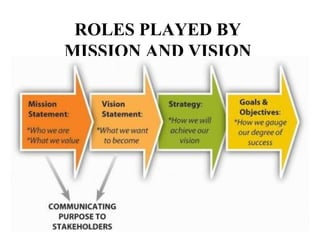
ROLES PLAYED BY
MISSION AND VISION
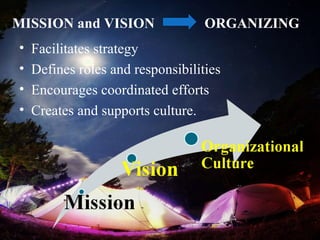
MISSION and VISION ORGANIZING
• Facilitates strategy
• Defines roles and responsibilities
• Encourages coordinated efforts
• Creates and supports culture.
1. Achieve clarity of purpose among all managers and
employees.
2. Provide a basis for all other strategic planning
activities, including internal and external assessment,
establishing objectives, developing strategies,
choosing among alternative strategies, devising
policies, establishing organizational structure,
allocating resources, and evaluating performance.
Benefits of having a clear mission and vision
3. Provide direction.
4. Provide a focal point for all stakeholders of the firm.
5. Resolve divergent views among managers.
Benefits of having a clear mission and vision
6. Promote a sense of shared
expectations among all managers and
employees.
7. Project a sense of worth and intent
to all stakeholders.
8. Project an organized, motivated
organization worthy of support.
9. Achieve higher organizational
performance.
10. Achieve synergy among all
managers and employees.
Benefits of having a clear mission and vision
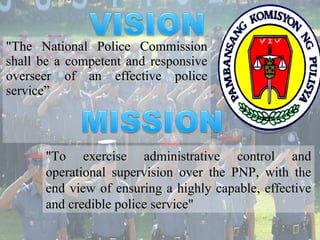
"The National Police Commission"The National Police Commission
shall be a competent and responsiveshall be a competent and responsive
overseer of an effective policeoverseer of an effective police
service”service”
"To exercise administrative control and"To exercise administrative control and
operational supervision over the PNP, with theoperational supervision over the PNP, with the
end view of ensuring a highly capable, effectiveend view of ensuring a highly capable, effective
and credible police service"and credible police service"
• A goal is a general statement
of what you want to achieve.
More specifically, a goal is a
milestone(s) in the process of
implementing a strategy
• Goal is a target to achieve
within a specific time.
Goal
• Goal can be one or more objectives that
need to be achieved by specific time.
• Goal setting is a powerful technique that
provides a direction.
• Goal setting gives a long-term vision of
where the organization want to be, steps
to get there, and the motivation to begin.
Goal
• Policy is a course or
principle of action
adopted or proposed
by an organization.
• It is a guiding
principle used to set
direction in the
organization.http://ispatguru.com/policy-and-strategy/
• A policy contains the
‘what’ and the ‘why’.
• It is developed within
(i) a legal framework,
(ii) an organizational
mission, and an
ideological
framework.http://ispatguru.com/policy-and-strategy/
• Policies are normally
developed within the
following regulatory
environment.
a)Statute, laws, and
regulations governing the
sector and general business
environment under which
the organization operates
http://ispatguru.com/policy-and-strategy/
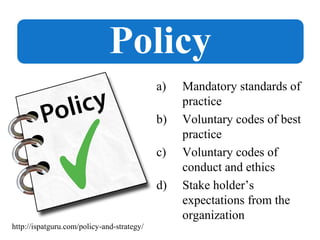
a) Mandatory standards of
practice
b) Voluntary codes of best
practice
c) Voluntary codes of
conduct and ethics
d) Stake holder’s
expectations from the
organization
http://ispatguru.com/policy-and-strategy/
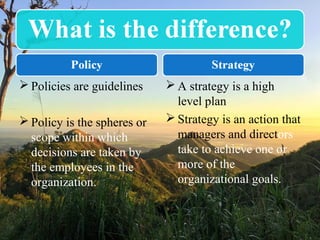
 Policies are guidelines
 Policy is the spheres or
scope within which
decisions are taken by
the employees in the
organization.
 A strategy is a high
level plan
 Strategy is an action that
managers and directors
take to achieve one or
more of the
organizational goals.
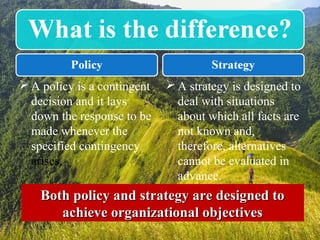
 A policy is a contingent
decision and it lays
down the response to be
made whenever the
specified contingency
arises.
 A strategy is designed to
deal with situations
about which all facts are
not known and,
therefore, alternatives
cannot be evaluated in
advance.
Both policy and strategy are designed toBoth policy and strategy are designed to
achieve organizational objectivesachieve organizational objectives
https://peakon.com/resources/mini-guides/how-to-effectively-
communicate-strategy-to-employees/
Vision, Mission, Goals & Policy Setting

Vision, Mission, Goals & Policy Setting

  • 1.
    Vision, Mission, GoalsVision,Mission, Goals and Policy Settingand Policy Setting Fatima S. Alviarne Reporter MPA 207 Planning Process Prof. Josefina B. Bitonio, DPA
  • 3.
     Communicates the organization’sreason for being, and how it aims to serve its key stakeholders  Often integrates a summation of the firm’s values  Mission statements tend to be longer than vision statements  A future-oriented declaration of the organization’s purpose and aspirations.  Addresses what a firm wants to become  Vision statements tend to be relatively brief
  • 4.
     The missionstatement incorporates specifics about the organization that make it unique and describes “the organization’s achievement hopes, such as the size of the organization, the scope of endeavor and the number and diversity of the organization’s businesses, markets and customers” (Alkhafaji, 2003).  According to Collins and Porras (Buble et al. 2005:86), vision has two key components: a base ideology and visionary future.  Provides strong foundation for developing a comprehensive mission statement
  • 5.
  • 6.
    MISSION and VISIONORGANIZING • Facilitates strategy • Defines roles and responsibilities • Encourages coordinated efforts • Creates and supports culture.
  • 7.
    1. Achieve clarityof purpose among all managers and employees. 2. Provide a basis for all other strategic planning activities, including internal and external assessment, establishing objectives, developing strategies, choosing among alternative strategies, devising policies, establishing organizational structure, allocating resources, and evaluating performance. Benefits of having a clear mission and vision
  • 8.
    3. Provide direction. 4.Provide a focal point for all stakeholders of the firm. 5. Resolve divergent views among managers. Benefits of having a clear mission and vision
  • 9.
    6. Promote asense of shared expectations among all managers and employees. 7. Project a sense of worth and intent to all stakeholders. 8. Project an organized, motivated organization worthy of support. 9. Achieve higher organizational performance. 10. Achieve synergy among all managers and employees. Benefits of having a clear mission and vision
  • 10.
    "The National PoliceCommission"The National Police Commission shall be a competent and responsiveshall be a competent and responsive overseer of an effective policeoverseer of an effective police service”service” "To exercise administrative control and"To exercise administrative control and operational supervision over the PNP, with theoperational supervision over the PNP, with the end view of ensuring a highly capable, effectiveend view of ensuring a highly capable, effective and credible police service"and credible police service"
  • 11.
    • A goalis a general statement of what you want to achieve. More specifically, a goal is a milestone(s) in the process of implementing a strategy • Goal is a target to achieve within a specific time. Goal
  • 12.
    • Goal canbe one or more objectives that need to be achieved by specific time. • Goal setting is a powerful technique that provides a direction. • Goal setting gives a long-term vision of where the organization want to be, steps to get there, and the motivation to begin. Goal
  • 17.
    • Policy isa course or principle of action adopted or proposed by an organization. • It is a guiding principle used to set direction in the organization.http://ispatguru.com/policy-and-strategy/
  • 18.
    • A policycontains the ‘what’ and the ‘why’. • It is developed within (i) a legal framework, (ii) an organizational mission, and an ideological framework.http://ispatguru.com/policy-and-strategy/
  • 19.
    • Policies arenormally developed within the following regulatory environment. a)Statute, laws, and regulations governing the sector and general business environment under which the organization operates http://ispatguru.com/policy-and-strategy/
  • 20.
    a) Mandatory standardsof practice b) Voluntary codes of best practice c) Voluntary codes of conduct and ethics d) Stake holder’s expectations from the organization http://ispatguru.com/policy-and-strategy/
  • 23.
     Policies areguidelines  Policy is the spheres or scope within which decisions are taken by the employees in the organization.  A strategy is a high level plan  Strategy is an action that managers and directors take to achieve one or more of the organizational goals.
  • 24.
     A policyis a contingent decision and it lays down the response to be made whenever the specified contingency arises.  A strategy is designed to deal with situations about which all facts are not known and, therefore, alternatives cannot be evaluated in advance. Both policy and strategy are designed toBoth policy and strategy are designed to achieve organizational objectivesachieve organizational objectives
  • 25.

Editor's Notes

  • #2 Part of the Planning Process is the setting of Vision, Mission, Goals and Policy.
  • #3 The Mission, Vision, Goals and Objectives are components of the P-O-L-C (Planning, Organizing, Leading and Controlling). The Target and Strategy Formulation will be discussed by Ms. Geraldine Abedania later.
  • #11 We in the NAPOLCOM envisions to be competent and responsive overseer of an effective police service. The NAPOLCOM exists to exercise administrative control and operational supervision over the PNP, with the end view of ensuring a highly capable, effective and credible police service.
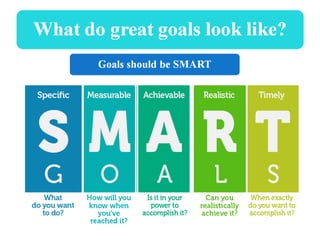
  • #14 Goals should be, at a minimum, SMART. SMART is an acronym that stands for specific, measurable, attainable, relevant, and timely.
  • #15 S: Be Super Specific Setting a specific goal helps focus efforts and clearly defines what you hope to accomplish. A specific resolution will usually answer the five “W” questions: Who: Who is involved? What: What do I want to accomplish? Where: Identify a location to work towards the goal (i.e. gym, outside etc.) When: When should it be performed? Why: Specific reasons, purpose or benefits of accomplishing your goals. M: Must be Measureable Establish a method of measuring your progress and evaluating your accomplishments. Measuring your progress ensures you stay on track.  A measurable goal will usually answer questions such as: How much? How many? How will I know when it is accomplished?  A: Attainable & Achievable Goals should be attainable and achievable. You need to set a goal that requires energy and discipline to accomplish, but they shouldn’t be so difficult that you cannot reach it. An attainable goal usually answers the question: How can the goal be accomplished and is it realistic? R: Not Just Realistic but Relevant   Goals should not only be specific, measurable, and attainable but they should be relevant and they should MATTER.  A goal that supports or is in alignment with other goals would be considered a relevant goal. A relevant goal answers yes to these questions: Does this seem worthwhile? Is this the right time to focus on this goal? Does this match my other efforts/needs? T: Be Timely Goals have an end point that can be found on a calendar. Timeframes tied to your goals provide a sense of urgency to help motivate you. You should identify how long it will take to complete each step in your action plan and set up a timeline. After all, a goal without a plan is just a wish. A time-specific goal will usually answer the question: When will I reach my goal? What can I do 6 months from now? What can I do 6 weeks from now? What can I do today?  E: Evaluate Your Goals Regularly It is important to continually evaluate your progress. This should be done throughout the entire goal process, as well as after the goal is met. The idea is to create a progress report to evaluate where you are in reaching your goal and to adjust your goals regularly to account for any changes. R:  Redo and Don’t Forget to Reward Yourself! Just to emphasize the point again, goals should be redone after evaluating whether or not you are on the right track to achieving them or if circumstances have changed since you initially made your resolution. Once you have gone through all of the steps of the SMARTER resolutions, it’s time to reward yourself in a healthy way! Rewarding yourself for achieving major milestone can help keep you focused on your goals. Reward yourself once you achieve all of your short term goals and again when you reach your long term goal. Every step towards your goal is a step in the right direction and that should be celebrated!
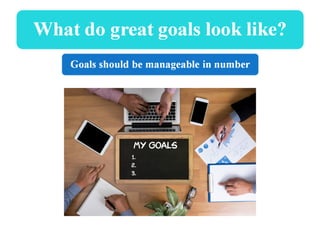
  • #16 2. Goals should be manageable in number. Five or six meaningful stretch goals are sufficient to challenge employees and keep them engaged in their contribution to the business. Adding more goals is likely to have a negative impact on productivity and derail progress toward achieving any of them.
  • #17 -       In order to achieve the identified Vision, the organization should formulate a strategy.  A strategy is illustrated using a Strategy Map which is composed of objectives and goals that indicate how it will achieve the vision.  The outcomes of these objectives or goals are within the direct influence or control of the organization.   -       The NAPOLCOM Strategy Map summarizes the strategic priorities that the Commission will pursue towards tha attainment of its Vision.  The Map highlights the NAPOLCOM’s breakthrough goals as well as the steps to be taken ina ddressing htree strategic perspectives- CORE PROCESSESS, LEARNING AND GROWTH, AND FINANCE.  It also includes the Charter Statement (i.e., Mission, Vision and Core Values) and the Strategic Objectives.  
  • #26 This pyramid shows how strategy fits in with other business planning processes A strategy can only be communicated effectively if it is first clearly and explicitly defined. The strategy should be aligned with both its vision, mission statement and core values.