FORMULATING THE
BUSINESS
VISION AND MISSION
VISION STATEMENT
Your vision is your dream. It's what your
organization believes are the ideal conditions for your
community; that is, how things would look if the issue
important to you were completely, perfectly addressed.
It might be a world without war, or a community in
which all people are treated as equals, regardless of
gender or racial background.
VISION STATEMENT
Whatever your organization's dream is, it may be well
articulated by one or more vision statements, which are short
phrases or sentences that convey your community's hopes for
the future. By developing a vision statement or statements,
your organization clarifies the beliefs and governing principles
of your organization, first for yourselves, and then for the
greater community.
CHARACTERISTICS OF A
VISION STATEMENT
• Understood and shared by members of the community
• Broad enough to include a diverse variety of local
perspectives
• Inspiring and uplifting to everyone involved in your effort
• Easy to communicate
MISSION STATEMENT
The next step of the action planning process is to ground
your vision in practical terms. This is where developing
a mission statement comes in. An organization's mission
statement describes what the group is going to do
and why it's going to do that. An example is "Promoting care
and caring at the end of life through coalitions and advocacy."
MISSION STATEMENT
Mission statements are similar to vision statements, in
that they, too, look at the big picture. However, they're more
concrete, and they are definitely more "action-oriented" than
vision statements. Your vision statement should inspire people
to dream; your mission statement should inspire them to
action.
GENERAL GUIDING PRINCIPLES
ABOUT MISSION STATEMENTS
• Concise. While not as short as vision statements, mission
statements generally still get their point across in one sentence.
• Outcome-oriented. Mission statements explain the fundamental
outcomes your organization is working to achieve.
• Inclusive. While mission statements do make statements about
your group's key goals, it's very important that they do so very
broadly. Good mission statements are not limiting in the strategies or
sectors of the community that may become involved in the project.
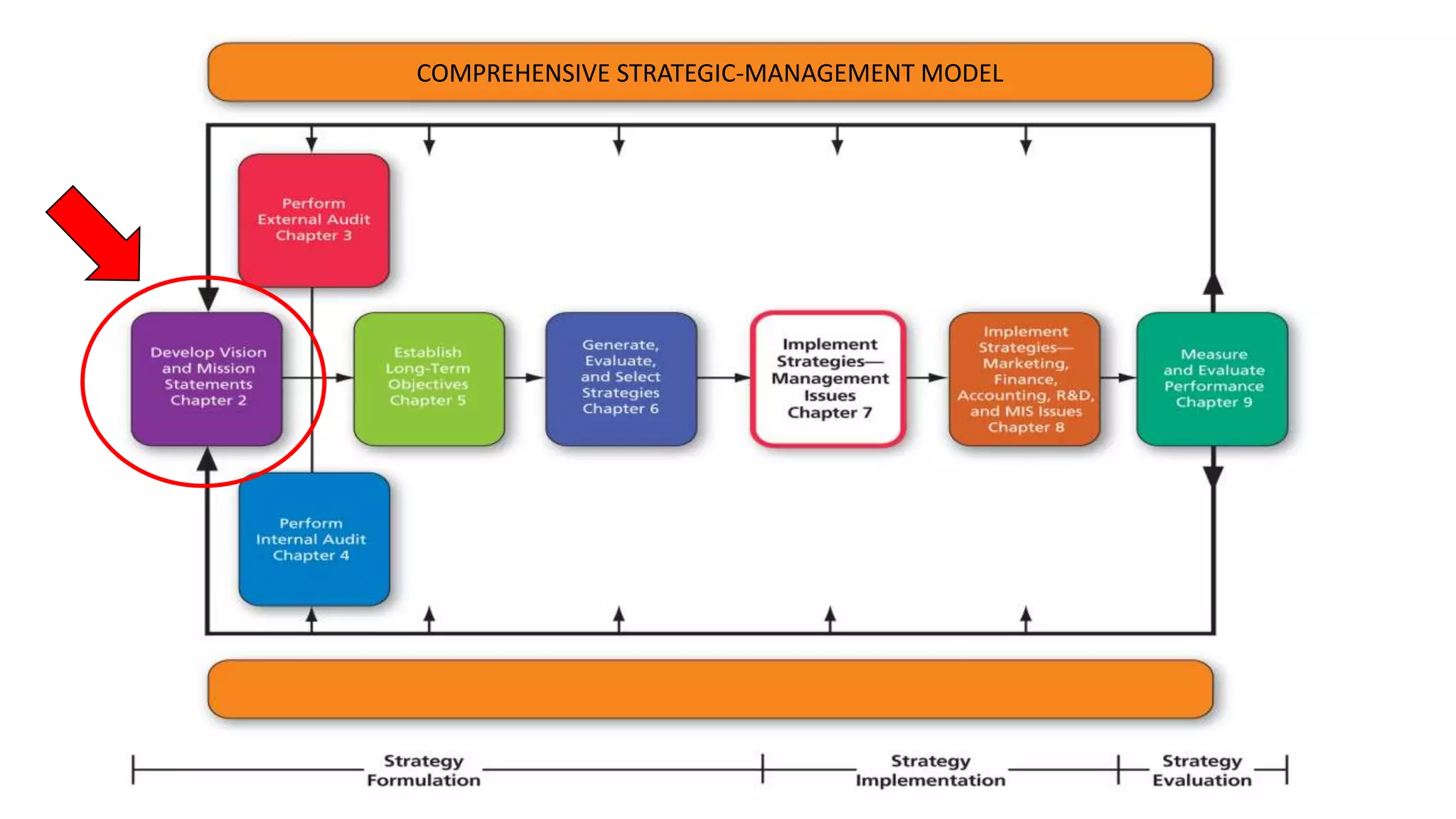
COMPREHENSIVE STRATEGIC-MANAGEMENT MODEL
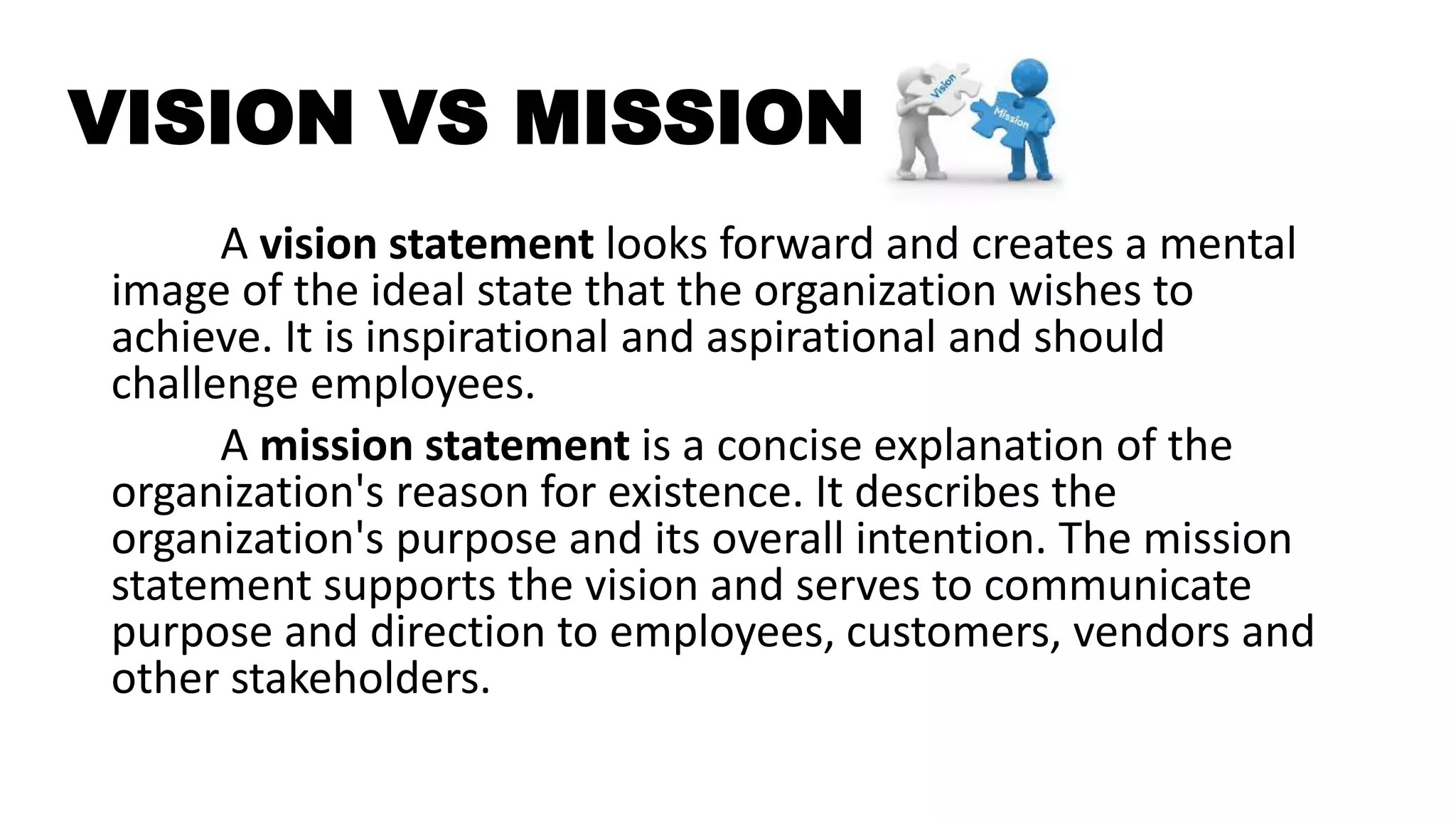
VISION VS MISSION
A vision statement looks forward and creates a mental
image of the ideal state that the organization wishes to
achieve. It is inspirational and aspirational and should
challenge employees.
A mission statement is a concise explanation of the
organization's reason for existence. It describes the
organization's purpose and its overall intention. The mission
statement supports the vision and serves to communicate
purpose and direction to employees, customers, vendors and
other stakeholders.
DEVELOPING VISION AND MISSION
STATEMENT
• LEARN WHAT IS IMPORTANT TO PEOPLE IN YOUR
COMMUNITY
• DECIDE WHAT TO ASK
• DECIDE ON THE GENERAL FOCUS OF YOUR ORGANIZATION
STEPS TO DEVELOPING VISION
& MISSION STATEMENTS
1. Have managers read related articles
2. Have managers prepare a vision and mission
statement for the organization
3. Merge the documents into one and distribute
4. Gather feedback from managers
5. Meet to revise the final document
IMPORTANCE OF VISION AND
MISSION STATEMENT
• The vision and mission statements define the purpose of the organization and instill
a sense of belonging and identity to the employees. This motivates them to work
harder in order to achieve success.
• The mission statement acts as a “North Star”, where it provides the direction that is
to be followed by the organization while the vision statement provides the goal (or
the destination) to be reached by following this direction.
• The vision and mission statements help to properly align the resources of an
organization towards achieving a successful future.
• The mission statement provides the organization with a clear and effective guide for
making decisions, while the vision statement ensures that all the decision made are
properly aligned with what the organization hopes to achieve.
• The vision and mission statements provide a focal point that helps to align everyone
with the organization, thus ensuring that everyone is working towards a single
purpose. This helps to increase efficiency and productivity in the organization.
RESOLUTION OF
DIVERGENT VIEWS
• A genuine decision must be based on divergent views
to have a chance to be a right and effective decision
• Considerable disagreement over vision and mission
statements can cause trouble if not resolved
Broad in scope
Generate strategic alternatives
Not overly specific
Reconciles interests among
diverse stakeholders
Finely balanced between
specificity & generality
Declaration of
Attitude
Arouse positive feelings &
emotions
Motivate readers to action
Generate favorable impression
of the firm
Declaration of
Attitude
Reflect future growth
Provide criteria for strategy
selection
Basis for generating &
evaluating strategic options
Dynamic in nature
Declaration of
Attitude
• Define what the organization is
• Define what it aspires to be
• Limited to exclude some ventures
• Broad enough to allow for growth
• Distinguishes firm from all others
• Framework for evaluating activities
• Stated clearly – understood by all
Mission & Customer Orientation
– Vern McGinnis
Utility of Firm’s Products to Customers
• Do not offer me things.
• Do not offer me clothes. Offer me attractive looks.
• Do not offer me shoes. Offer me comfort for my feet and the pleasure
of walking.
• Do not offer me a house. Offer me security, comfort, and a place that
is clean and happy.
• Do not offer me books. Offer me hours of pleasure and the benefit of
knowledge.
Utility of Firm’s Products to Customers
• Do not offer me CDs. Offer me leisure and the sound
of music.
• Do not offer me tools. Offer me the benefits and the
pleasure that come from making beautiful things.
• Do not offer me furniture. Offer me comfort and the
quietness of a cozy place.
• Do not offer me things. Offer me ideas, emotions,
ambience, feelings, and benefits.
• Please, do not offer me THINGS.
The words social policy embrace managerial philosophy and thinking
at the highest levels of an organization.
For this reason, social policy affects the development of a business
mission statement. Social issues mandate that strategists consider not
only what the organization owes its various stakeholders but also what
responsibilities the firm has to consumers, environmentalists, minorities,
communities, and other groups.
After decades of debate on the topic of social responsibility,
many firms still struggle to determine appropriate social policies
DECLARATION OF SOCIAL POLICY
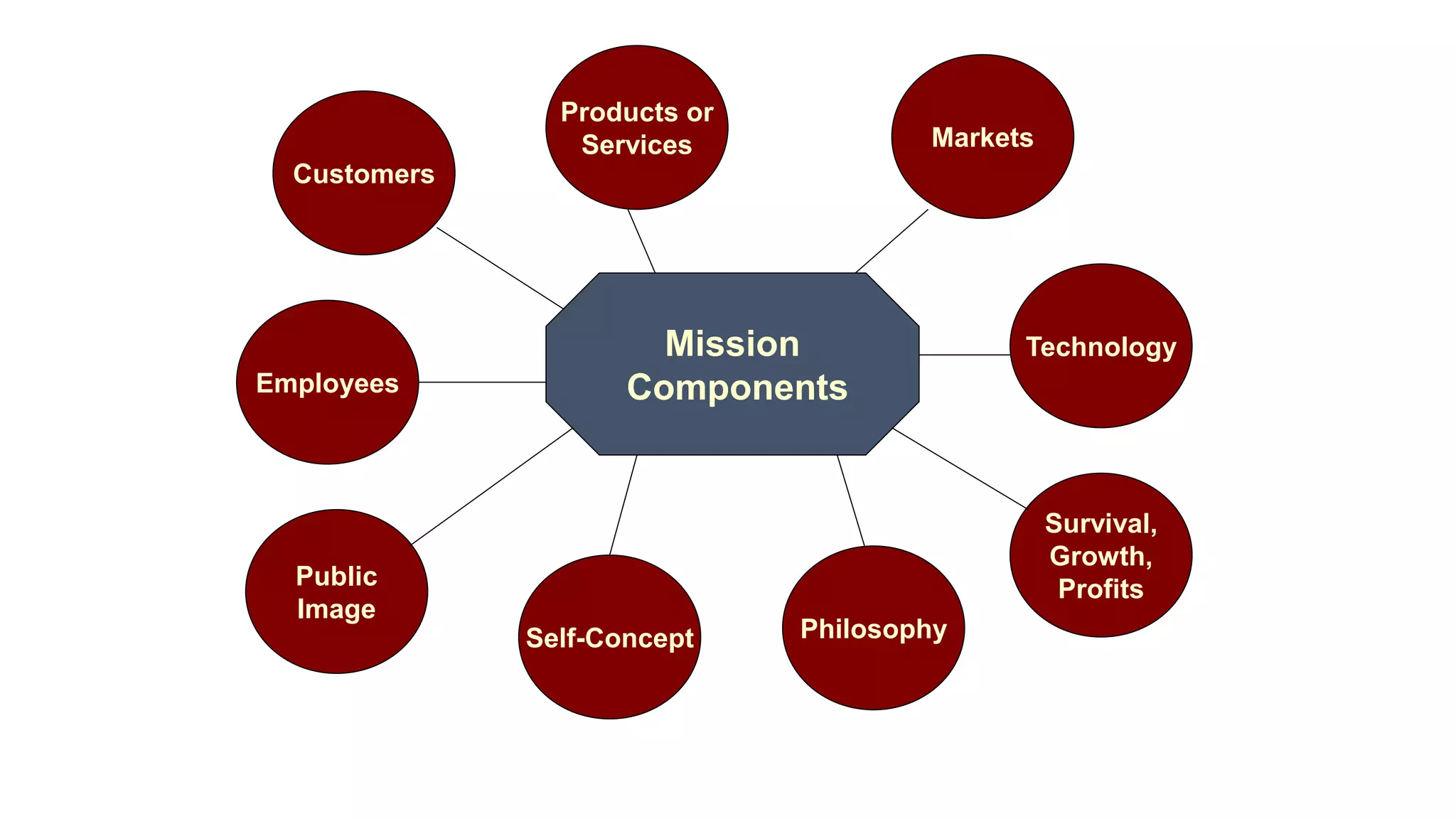
Mission
Components
Customers
Markets
Employees
Public
Image
Self-Concept Philosophy
Survival,
Growth,
Profits
Products or
Services
Technology
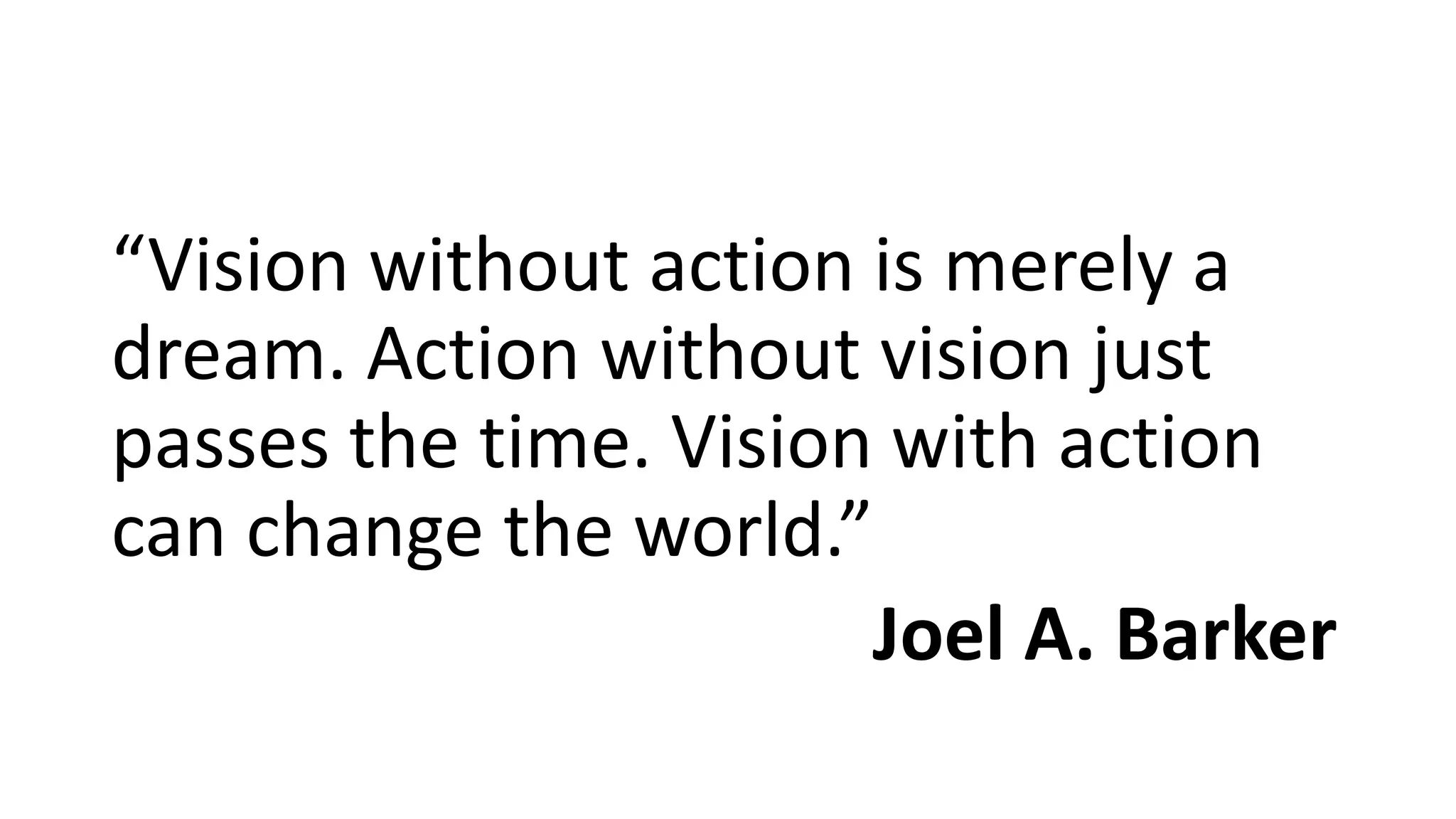
“Vision without action is merely a
dream. Action without vision just
passes the time. Vision with action
can change the world.”
Joel A. Barker
Formulating vision and mission

Formulating vision and mission

  • 1.
  • 2.
    VISION STATEMENT Your visionis your dream. It's what your organization believes are the ideal conditions for your community; that is, how things would look if the issue important to you were completely, perfectly addressed. It might be a world without war, or a community in which all people are treated as equals, regardless of gender or racial background.
  • 3.
    VISION STATEMENT Whatever yourorganization's dream is, it may be well articulated by one or more vision statements, which are short phrases or sentences that convey your community's hopes for the future. By developing a vision statement or statements, your organization clarifies the beliefs and governing principles of your organization, first for yourselves, and then for the greater community.
  • 4.
    CHARACTERISTICS OF A VISIONSTATEMENT • Understood and shared by members of the community • Broad enough to include a diverse variety of local perspectives • Inspiring and uplifting to everyone involved in your effort • Easy to communicate
  • 5.
    MISSION STATEMENT The nextstep of the action planning process is to ground your vision in practical terms. This is where developing a mission statement comes in. An organization's mission statement describes what the group is going to do and why it's going to do that. An example is "Promoting care and caring at the end of life through coalitions and advocacy."
  • 6.
    MISSION STATEMENT Mission statementsare similar to vision statements, in that they, too, look at the big picture. However, they're more concrete, and they are definitely more "action-oriented" than vision statements. Your vision statement should inspire people to dream; your mission statement should inspire them to action.
  • 7.
    GENERAL GUIDING PRINCIPLES ABOUTMISSION STATEMENTS • Concise. While not as short as vision statements, mission statements generally still get their point across in one sentence. • Outcome-oriented. Mission statements explain the fundamental outcomes your organization is working to achieve. • Inclusive. While mission statements do make statements about your group's key goals, it's very important that they do so very broadly. Good mission statements are not limiting in the strategies or sectors of the community that may become involved in the project.
  • 8.
  • 9.
    VISION VS MISSION Avision statement looks forward and creates a mental image of the ideal state that the organization wishes to achieve. It is inspirational and aspirational and should challenge employees. A mission statement is a concise explanation of the organization's reason for existence. It describes the organization's purpose and its overall intention. The mission statement supports the vision and serves to communicate purpose and direction to employees, customers, vendors and other stakeholders.
  • 10.
    DEVELOPING VISION ANDMISSION STATEMENT • LEARN WHAT IS IMPORTANT TO PEOPLE IN YOUR COMMUNITY • DECIDE WHAT TO ASK • DECIDE ON THE GENERAL FOCUS OF YOUR ORGANIZATION
  • 11.
    STEPS TO DEVELOPINGVISION & MISSION STATEMENTS 1. Have managers read related articles 2. Have managers prepare a vision and mission statement for the organization 3. Merge the documents into one and distribute 4. Gather feedback from managers 5. Meet to revise the final document
  • 12.
    IMPORTANCE OF VISIONAND MISSION STATEMENT • The vision and mission statements define the purpose of the organization and instill a sense of belonging and identity to the employees. This motivates them to work harder in order to achieve success. • The mission statement acts as a “North Star”, where it provides the direction that is to be followed by the organization while the vision statement provides the goal (or the destination) to be reached by following this direction. • The vision and mission statements help to properly align the resources of an organization towards achieving a successful future. • The mission statement provides the organization with a clear and effective guide for making decisions, while the vision statement ensures that all the decision made are properly aligned with what the organization hopes to achieve. • The vision and mission statements provide a focal point that helps to align everyone with the organization, thus ensuring that everyone is working towards a single purpose. This helps to increase efficiency and productivity in the organization.
  • 13.
    RESOLUTION OF DIVERGENT VIEWS •A genuine decision must be based on divergent views to have a chance to be a right and effective decision • Considerable disagreement over vision and mission statements can cause trouble if not resolved
  • 14.
    Broad in scope Generatestrategic alternatives Not overly specific Reconciles interests among diverse stakeholders Finely balanced between specificity & generality Declaration of Attitude
  • 15.
    Arouse positive feelings& emotions Motivate readers to action Generate favorable impression of the firm Declaration of Attitude
  • 16.
    Reflect future growth Providecriteria for strategy selection Basis for generating & evaluating strategic options Dynamic in nature Declaration of Attitude
  • 17.
    • Define whatthe organization is • Define what it aspires to be • Limited to exclude some ventures • Broad enough to allow for growth • Distinguishes firm from all others • Framework for evaluating activities • Stated clearly – understood by all Mission & Customer Orientation – Vern McGinnis
  • 18.
    Utility of Firm’sProducts to Customers • Do not offer me things. • Do not offer me clothes. Offer me attractive looks. • Do not offer me shoes. Offer me comfort for my feet and the pleasure of walking. • Do not offer me a house. Offer me security, comfort, and a place that is clean and happy. • Do not offer me books. Offer me hours of pleasure and the benefit of knowledge.
  • 19.
    Utility of Firm’sProducts to Customers • Do not offer me CDs. Offer me leisure and the sound of music. • Do not offer me tools. Offer me the benefits and the pleasure that come from making beautiful things. • Do not offer me furniture. Offer me comfort and the quietness of a cozy place. • Do not offer me things. Offer me ideas, emotions, ambience, feelings, and benefits. • Please, do not offer me THINGS.
  • 20.
    The words socialpolicy embrace managerial philosophy and thinking at the highest levels of an organization. For this reason, social policy affects the development of a business mission statement. Social issues mandate that strategists consider not only what the organization owes its various stakeholders but also what responsibilities the firm has to consumers, environmentalists, minorities, communities, and other groups. After decades of debate on the topic of social responsibility, many firms still struggle to determine appropriate social policies DECLARATION OF SOCIAL POLICY
  • 21.
  • 22.
    “Vision without actionis merely a dream. Action without vision just passes the time. Vision with action can change the world.” Joel A. Barker