BBA 8th
Semester
MGT 208 Business Strategy
By Muna, Kewal and Himal
Unit – 2
Vision and Mission, Objectives and Strategy
Concept of Strategic Vision
The picture of desired future state of an organization that reflects a
firm’s values and aspiration.
Strategic Visions
Characteristics / Qualities of strategic visions
• Future focused
• Directional
• Clear
• Feasible
• Values based
• Challenging
• Unique
• Inspiring
Strategic Visions
Benefits of strategic vision
• Provides direction
• Guides for decisions
• Shapes strategy
• Sets priority
• Aligns people and activities
• Reflects core values and belief
• Empowers employees
• Brings change
Developing Strategic Vision
• A wider participation in development of strategic vision enhances
their effectiveness.
1. All the key factors such as internal strength and weakness, external
changes and trends, emerging needs and service expectations of
customers should be reviewed very carefully.
2. It should be external and market oriented and express in
inspiration……
3. All the managers from top to lower level should be involved in the ,
…… of developing the strategic vision. It enhances commitment
towards organization. It facilitates formulation and implementation
of strategy.
Developing Strategic Vision
4. The managers should be asked to review related literature on the …… and
prepare a strategic vision and mission statement for the organization.
5. The statements prepared by different managers should be merged …
single document and distribute the draft statements to all managers.
6. A meeting of the managers is held for modifications, addition and
deletions if needed and revise the documents.
7. As mentioned earlier, the input and support from the employees
….managers enriches strategy formulation, implementation and evaluate
activities. Hence, the development of strategic vision statement provides
opportunity for strategists to obtain needed support from all the
employees and managers.
Developing Strategic Vision
8. Some organizations use group discussions to develop and modify the
existing statement. An outside consultant or facilitator may also be
….manage the process and help draft the language.
9. After preparing the statements, decisions on how to communicate
…….managers, employees and external stakeholders are needed. A ……
may be prepared to explain the statement.
Communicating the strategic visions
The strategic vision should be well communicated to all managers,
employees, and external stakeholders. A clear communicated strategic
values provides long term direction to the organizations.
Mission
Concept of mission
• The reason of organizational existence defines the business in terms
of customers, employees, suppliers and the community.
Crafting a mission statement
• Define the purpose
• Make it broad in scope
• Precise
• Inspiring
• Distinctive
Importance of mission
• Brings uniformity
• Base of resource allocation
• Develops organizational culture
• Enhances employee ownership
• Defines the business
• Reflects the organizational responsibility
• Shows the operating philosophy
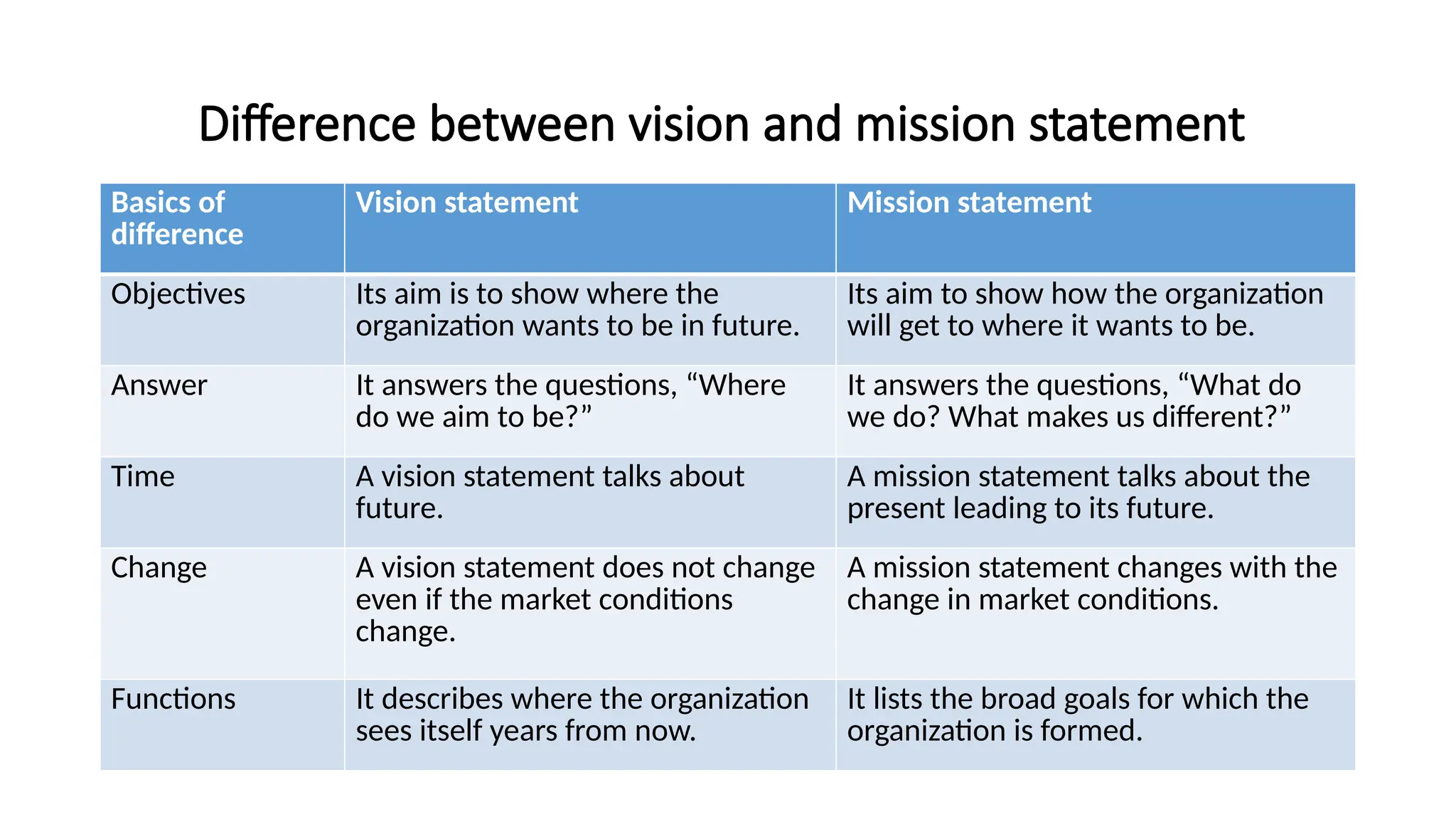
Difference between vision and mission statement
Basics of
difference
Vision statement Mission statement
Objectives Its aim is to show where the
organization wants to be in future.
Its aim to show how the organization
will get to where it wants to be.
Answer It answers the questions, “Where
do we aim to be?”
It answers the questions, “What do
we do? What makes us different?”
Time A vision statement talks about
future.
A mission statement talks about the
present leading to its future.
Change A vision statement does not change
even if the market conditions
change.
A mission statement changes with the
change in market conditions.
Functions It describes where the organization
sees itself years from now.
It lists the broad goals for which the
organization is formed.
Characteristics of mission
• Broad in scope
• Precise
• Inspiring
• Multi components
• Distinctive
• Components of strategy
Linking vision and mission with company values
There is a close linkage between vision, mission and company values.
The vision is the foundation for the mission. A mission statement
defines the business in terms of the customers, employees, suppliers
and its community. The value statement is the description of the
guiding principles of organizational activities . Company values provide
support for the vision and mission.
Objectives
Concept of objectives
• The expected outcomes of an organization are known as objectives. They
convert the strategic visions into specific performance targets. Objectives
shows the managerial commitment towards performance achievement.
Objectives
Components of objectives
• Specific
• Measurable
• Achievable
• Realistic
• Timely
• Motivating
• Flexible
• Hierarchical
• Congruent across departments
Crafting objectives
• Define vision, mission and values
• Environmental analysis
• Determination of strategic objective
• Formulation of financial objective
Levels of objectives
• Corporate level objectives
• Business level objectives
• Functional level objectives
• Individual level objectives
Role of objective in strategic management
• Objectives define the relationship of the organization with its
environment.
• Shows the relevancy of vision and mission of the organization.
• Provide the base of strategic decision making.
• Also provide foundation for the development of work standard.
• Helps develop distinctiveness and existence of an organization and
enhance organizational attractiveness.
Financial versus strategic objective
Financial objectives
• Annual percentage increases in sales
• Annual percentage increase in after tax profit
• Annual percentage increase in earning per share
• Percentage return on capital employed or equity
• Sufficient cash flows
Financial versus strategic objective
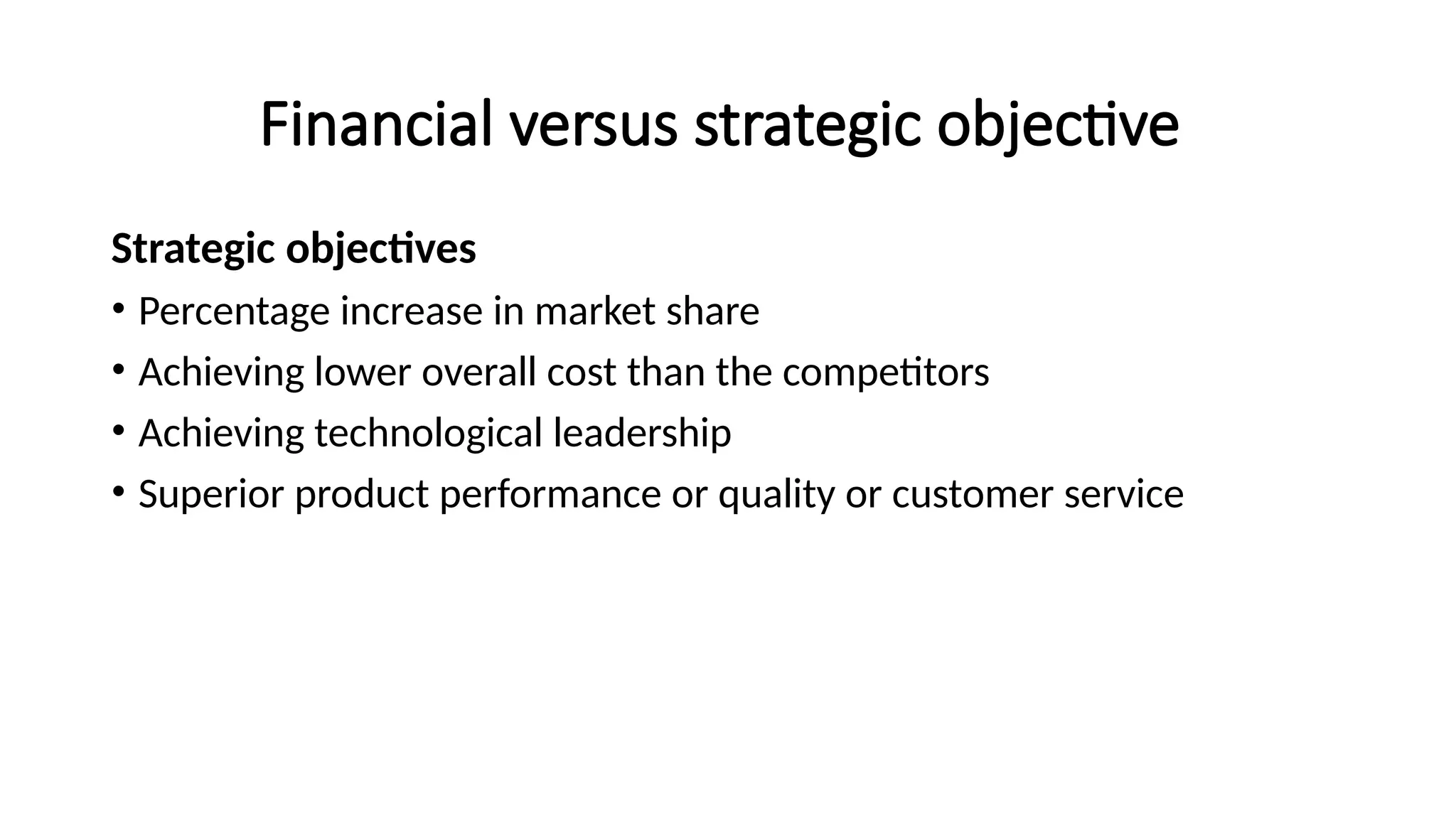
Strategic objectives
• Percentage increase in market share
• Achieving lower overall cost than the competitors
• Achieving technological leadership
• Superior product performance or quality or customer service
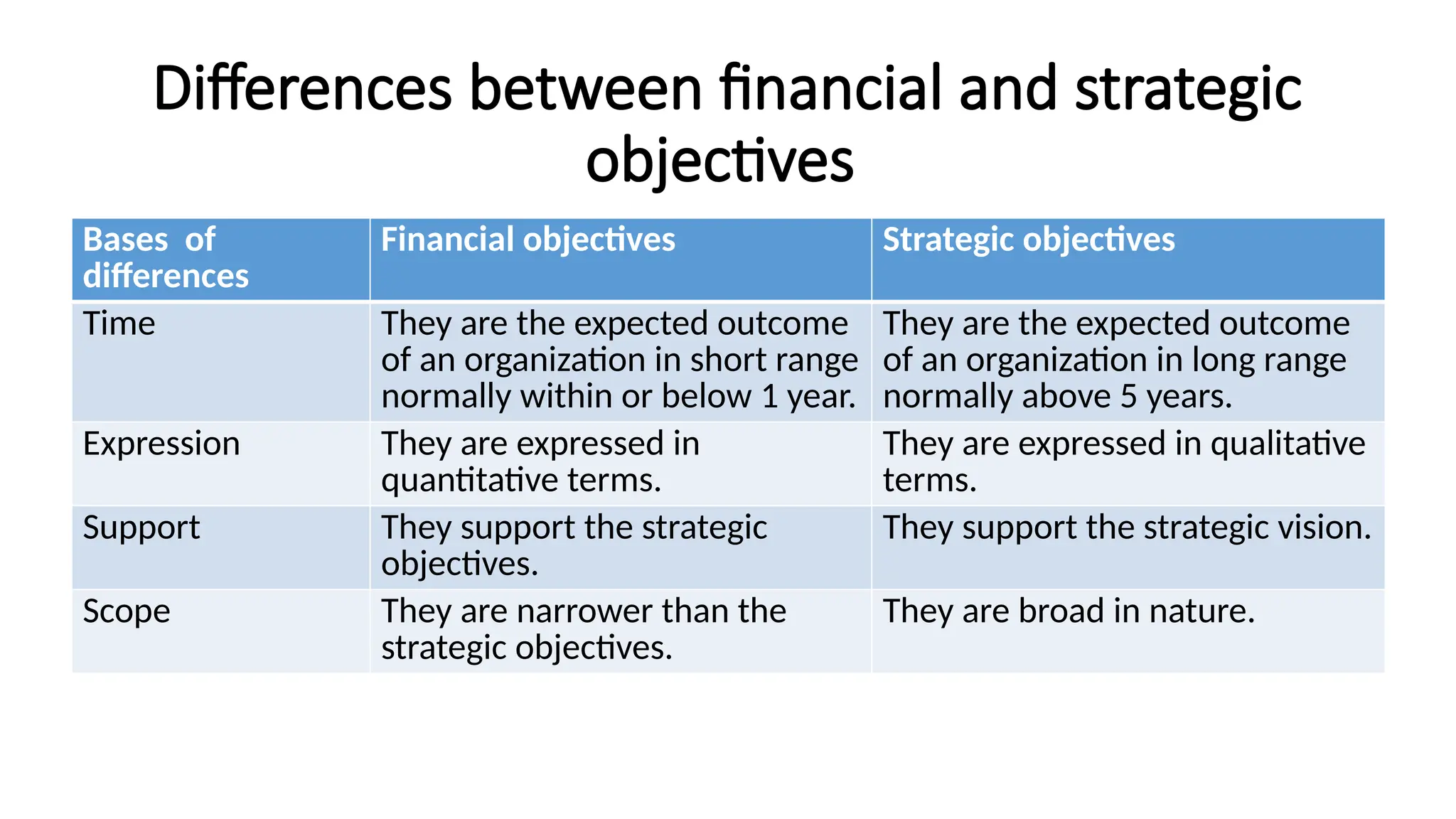
Differences between financial and strategic
objectives
Bases of
differences
Financial objectives Strategic objectives
Time They are the expected outcome
of an organization in short range
normally within or below 1 year.
They are the expected outcome
of an organization in long range
normally above 5 years.
Expression They are expressed in
quantitative terms.
They are expressed in qualitative
terms.
Support They support the strategic
objectives.
They support the strategic vision.
Scope They are narrower than the
strategic objectives.
They are broad in nature.
The End
THANK YOU

unit-2-vision-mission-objectives-and-strategy.pptx

  • 1.
    BBA 8th Semester MGT 208Business Strategy By Muna, Kewal and Himal
  • 2.
    Unit – 2 Visionand Mission, Objectives and Strategy Concept of Strategic Vision The picture of desired future state of an organization that reflects a firm’s values and aspiration.
  • 3.
    Strategic Visions Characteristics /Qualities of strategic visions • Future focused • Directional • Clear • Feasible • Values based • Challenging • Unique • Inspiring
  • 4.
    Strategic Visions Benefits ofstrategic vision • Provides direction • Guides for decisions • Shapes strategy • Sets priority • Aligns people and activities • Reflects core values and belief • Empowers employees • Brings change
  • 5.
    Developing Strategic Vision •A wider participation in development of strategic vision enhances their effectiveness. 1. All the key factors such as internal strength and weakness, external changes and trends, emerging needs and service expectations of customers should be reviewed very carefully. 2. It should be external and market oriented and express in inspiration…… 3. All the managers from top to lower level should be involved in the , …… of developing the strategic vision. It enhances commitment towards organization. It facilitates formulation and implementation of strategy.
  • 6.
    Developing Strategic Vision 4.The managers should be asked to review related literature on the …… and prepare a strategic vision and mission statement for the organization. 5. The statements prepared by different managers should be merged … single document and distribute the draft statements to all managers. 6. A meeting of the managers is held for modifications, addition and deletions if needed and revise the documents. 7. As mentioned earlier, the input and support from the employees ….managers enriches strategy formulation, implementation and evaluate activities. Hence, the development of strategic vision statement provides opportunity for strategists to obtain needed support from all the employees and managers.
  • 7.
    Developing Strategic Vision 8.Some organizations use group discussions to develop and modify the existing statement. An outside consultant or facilitator may also be ….manage the process and help draft the language. 9. After preparing the statements, decisions on how to communicate …….managers, employees and external stakeholders are needed. A …… may be prepared to explain the statement.
  • 8.
    Communicating the strategicvisions The strategic vision should be well communicated to all managers, employees, and external stakeholders. A clear communicated strategic values provides long term direction to the organizations.
  • 9.
    Mission Concept of mission •The reason of organizational existence defines the business in terms of customers, employees, suppliers and the community.
  • 10.
    Crafting a missionstatement • Define the purpose • Make it broad in scope • Precise • Inspiring • Distinctive
  • 11.
    Importance of mission •Brings uniformity • Base of resource allocation • Develops organizational culture • Enhances employee ownership • Defines the business • Reflects the organizational responsibility • Shows the operating philosophy
  • 12.
    Difference between visionand mission statement Basics of difference Vision statement Mission statement Objectives Its aim is to show where the organization wants to be in future. Its aim to show how the organization will get to where it wants to be. Answer It answers the questions, “Where do we aim to be?” It answers the questions, “What do we do? What makes us different?” Time A vision statement talks about future. A mission statement talks about the present leading to its future. Change A vision statement does not change even if the market conditions change. A mission statement changes with the change in market conditions. Functions It describes where the organization sees itself years from now. It lists the broad goals for which the organization is formed.
  • 13.
    Characteristics of mission •Broad in scope • Precise • Inspiring • Multi components • Distinctive • Components of strategy
  • 14.
    Linking vision andmission with company values There is a close linkage between vision, mission and company values. The vision is the foundation for the mission. A mission statement defines the business in terms of the customers, employees, suppliers and its community. The value statement is the description of the guiding principles of organizational activities . Company values provide support for the vision and mission.
  • 15.
    Objectives Concept of objectives •The expected outcomes of an organization are known as objectives. They convert the strategic visions into specific performance targets. Objectives shows the managerial commitment towards performance achievement.
  • 16.
    Objectives Components of objectives •Specific • Measurable • Achievable • Realistic • Timely • Motivating • Flexible • Hierarchical • Congruent across departments
  • 17.
    Crafting objectives • Definevision, mission and values • Environmental analysis • Determination of strategic objective • Formulation of financial objective
  • 18.
    Levels of objectives •Corporate level objectives • Business level objectives • Functional level objectives • Individual level objectives
  • 19.
    Role of objectivein strategic management • Objectives define the relationship of the organization with its environment. • Shows the relevancy of vision and mission of the organization. • Provide the base of strategic decision making. • Also provide foundation for the development of work standard. • Helps develop distinctiveness and existence of an organization and enhance organizational attractiveness.
  • 20.
    Financial versus strategicobjective Financial objectives • Annual percentage increases in sales • Annual percentage increase in after tax profit • Annual percentage increase in earning per share • Percentage return on capital employed or equity • Sufficient cash flows
  • 21.
    Financial versus strategicobjective Strategic objectives • Percentage increase in market share • Achieving lower overall cost than the competitors • Achieving technological leadership • Superior product performance or quality or customer service
  • 22.
    Differences between financialand strategic objectives Bases of differences Financial objectives Strategic objectives Time They are the expected outcome of an organization in short range normally within or below 1 year. They are the expected outcome of an organization in long range normally above 5 years. Expression They are expressed in quantitative terms. They are expressed in qualitative terms. Support They support the strategic objectives. They support the strategic vision. Scope They are narrower than the strategic objectives. They are broad in nature.
  • 23.