IMPACT OF ECOLOGY ON ARCHITECURE
 An ecological building is a structure that is designed to create and sustain mutually
beneficial relationships with all of the elements of its local ecology.
 A building’s local ecology, is made up of particular physical and biological elements
and their interactions.
 The concept is to minimize the negative environmental impact of buildings.
 Ecological building is a positive design goal that sets out to increase beneficial
interactions between man and environment.
 Ecological building can play an integral, beneficial role in improving and sustaining the
health and vitality of their local ecology.
VILLA D’ESTE
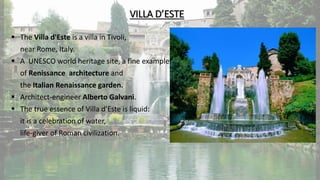
 The Villa d'Este is a villa in Tivoli,
near Rome, Italy.
 A UNESCO world heritage site, a fine example
of Renissance architecture and
the Italian Renaissance garden.
 Architect-engineer Alberto Galvani.
 The true essence of Villa d'Este is liquid:
it is a celebration of water,
life-giver of Roman civilization.
PLANNING
 The villa itself is surrounded on three sides
by a sixteenth-century courtyard.
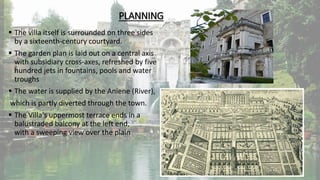
 The garden plan is laid out on a central axis
with subsidiary cross-axes, refreshed by five
hundred jets in fountains, pools and water
troughs
 The water is supplied by the Aniene (River),
which is partly diverted through the town.
 The Villa's uppermost terrace ends in a
balustraded balcony at the left end,
with a sweeping view over the plain
GARDENS
 The garden is organized in a
combination of terraces and
downward slopes.
 Central stairs lead down a wooded
slope.
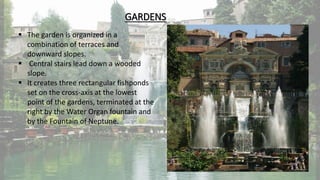
 It creates three rectangular fishponds
set on the cross-axis at the lowest
point of the gardens, terminated at the
right by the Water Organ fountain and
by the Fountain of Neptune.
FEATURES
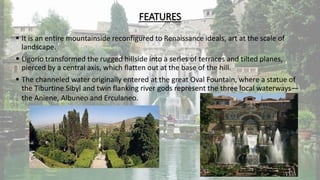
 It is an entire mountainside reconfigured to Renaissance ideals, art at the scale of
landscape.
 Ligorio transformed the rugged hillside into a series of terraces and tilted planes,
pierced by a central axis, which flatten out at the base of the hill.
 The channeled water originally entered at the great Oval Fountain, where a statue of
the Tiburtine Sibyl and twin flanking river gods represent the three local waterways—
the Aniene, Albuneo and Erculaneo.
FEATURES
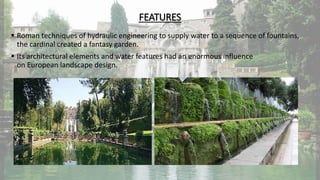
 Roman techniques of hydraulic engineering to supply water to a sequence of fountains,
the cardinal created a fantasy garden.
 Its architectural elements and water features had an enormous influence
on European landscape design.
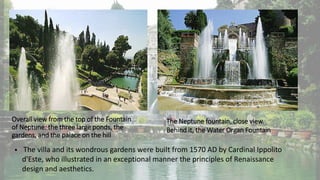
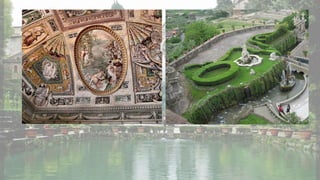
Overall view from the top of the Fountain
of Neptune: the three large ponds, the
gardens, and the palace on the hill
The Neptune fountain, close view.
Behind it, the Water Organ Fountain
 The villa and its wondrous gardens were built from 1570 AD by Cardinal Ippolito
d'Este, who illustrated in an exceptional manner the principles of Renaissance
design and aesthetics.
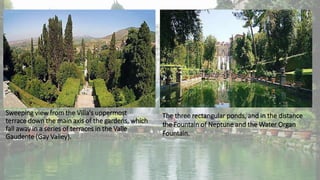
Sweeping view from the Villa's uppermost
terrace down the main axis of the gardens, which
fall away in a series of terraces in the Valle
Gaudente (Gay Valley).
The three rectangular ponds, and in the distance
the Fountain of Neptune and the Water Organ
Fountain.
• reviving Roman techniques of hydraulic engineering to supply water to a sequence of fountains, the cardinal created a
fantasy garden
• Villa d'Este was purchased for the Italian State after World War I, restored, and refurnished with paintings from the
storerooms of the Galleria Nazionale, Rome
• Starting in 1560 great efforts were made to supply the water needed for the numerous fountains that were intended to
embellish the garden
• First, an aqueduct was built turned out to be inadequate and so an underground canal was dug beneath the town to
harness the waters of the Anio river
• The Villa d’Este is one of the most outstanding examples of Renaissance
• The gardens of the Villa d’Este had a profound influence on the development of garden design throughout Europe
• The principles of Renaissance design and aesthetics are illustrated in an exceptional manner by the gardens of the Villa
d’Este
• The lower level is decorated with the Fountain of Leda.
• The main rooms of the villa are arranged in rows on two floors and open on to the garden.
• The private apartment of the cardinal, consisting of four rooms, is on the same level as the courtyard, and the reception
rooms, linked together at the back by a long corridor called the Manica Lunga, are on the lower level.

Villa D'Este

  • 1.
    IMPACT OF ECOLOGYON ARCHITECURE  An ecological building is a structure that is designed to create and sustain mutually beneficial relationships with all of the elements of its local ecology.  A building’s local ecology, is made up of particular physical and biological elements and their interactions.  The concept is to minimize the negative environmental impact of buildings.  Ecological building is a positive design goal that sets out to increase beneficial interactions between man and environment.  Ecological building can play an integral, beneficial role in improving and sustaining the health and vitality of their local ecology.
  • 2.
    VILLA D’ESTE  TheVilla d'Este is a villa in Tivoli, near Rome, Italy.  A UNESCO world heritage site, a fine example of Renissance architecture and the Italian Renaissance garden.  Architect-engineer Alberto Galvani.  The true essence of Villa d'Este is liquid: it is a celebration of water, life-giver of Roman civilization.
  • 3.
    PLANNING  The villaitself is surrounded on three sides by a sixteenth-century courtyard.  The garden plan is laid out on a central axis with subsidiary cross-axes, refreshed by five hundred jets in fountains, pools and water troughs  The water is supplied by the Aniene (River), which is partly diverted through the town.  The Villa's uppermost terrace ends in a balustraded balcony at the left end, with a sweeping view over the plain
  • 4.
    GARDENS  The gardenis organized in a combination of terraces and downward slopes.  Central stairs lead down a wooded slope.  It creates three rectangular fishponds set on the cross-axis at the lowest point of the gardens, terminated at the right by the Water Organ fountain and by the Fountain of Neptune.
  • 5.
    FEATURES  It isan entire mountainside reconfigured to Renaissance ideals, art at the scale of landscape.  Ligorio transformed the rugged hillside into a series of terraces and tilted planes, pierced by a central axis, which flatten out at the base of the hill.  The channeled water originally entered at the great Oval Fountain, where a statue of the Tiburtine Sibyl and twin flanking river gods represent the three local waterways— the Aniene, Albuneo and Erculaneo.
  • 6.
    FEATURES  Roman techniquesof hydraulic engineering to supply water to a sequence of fountains, the cardinal created a fantasy garden.  Its architectural elements and water features had an enormous influence on European landscape design.
  • 7.
    Overall view fromthe top of the Fountain of Neptune: the three large ponds, the gardens, and the palace on the hill The Neptune fountain, close view. Behind it, the Water Organ Fountain  The villa and its wondrous gardens were built from 1570 AD by Cardinal Ippolito d'Este, who illustrated in an exceptional manner the principles of Renaissance design and aesthetics.
  • 8.
    Sweeping view fromthe Villa's uppermost terrace down the main axis of the gardens, which fall away in a series of terraces in the Valle Gaudente (Gay Valley). The three rectangular ponds, and in the distance the Fountain of Neptune and the Water Organ Fountain.
  • 10.
    • reviving Romantechniques of hydraulic engineering to supply water to a sequence of fountains, the cardinal created a fantasy garden • Villa d'Este was purchased for the Italian State after World War I, restored, and refurnished with paintings from the storerooms of the Galleria Nazionale, Rome • Starting in 1560 great efforts were made to supply the water needed for the numerous fountains that were intended to embellish the garden • First, an aqueduct was built turned out to be inadequate and so an underground canal was dug beneath the town to harness the waters of the Anio river • The Villa d’Este is one of the most outstanding examples of Renaissance • The gardens of the Villa d’Este had a profound influence on the development of garden design throughout Europe • The principles of Renaissance design and aesthetics are illustrated in an exceptional manner by the gardens of the Villa d’Este • The lower level is decorated with the Fountain of Leda. • The main rooms of the villa are arranged in rows on two floors and open on to the garden. • The private apartment of the cardinal, consisting of four rooms, is on the same level as the courtyard, and the reception rooms, linked together at the back by a long corridor called the Manica Lunga, are on the lower level.