“TORNADOES”
PRESENTED BY
VIKAS RAWAT
PAPER: ADVANCE CLIMATOLOGY
DEPARTMENT OF GEOGRAPHY
HEMVATI NANDAN BAHUGUNA GARHWAL UNIVERSITY
SRINAGAR, UTTARAKHAND
SCOPE OF PRESENTATION
 CONCEPTUAL UNDERSTANDING
 CHARACTERISTICS OF TORNADO
 FORMATION
 TYPES
 DISTRIBUTION
 IMPACT
 TORNADO RATINGS
 FORECASTING
 CONCLUSION
CONCEPTUAL UNDERSTANDING
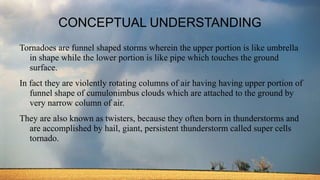
Tornadoes are funnel shaped storms wherein the upper portion is like umbrella
in shape while the lower portion is like pipe which touches the ground
surface.
In fact they are violently rotating columns of air having having upper portion of
funnel shape of cumulonimbus clouds which are attached to the ground by
very narrow column of air.
They are also known as twisters, because they often born in thunderstorms and
are accomplished by hail, giant, persistent thunderstorm called super cells
tornado.
CHARACTERISTICS
 Convective Instability
 Form thunder storms
 Movement of tornado is non predictable
 Tornadoes follow very narrow path
 Average duration of existence of a tornado ranges between 15 to 20 minutes but occasionally they may be
intense for a few hours.
 They look very dark in color
 The arrival of tornado is heralded by dark and thick clouds in the sky resulting into complete darkness,
minimum visibility and low pressure.
 Tornadoes move as a single unit or in a group consisting of an average 7 to 8 in number.
FORMATION OF TORNADO
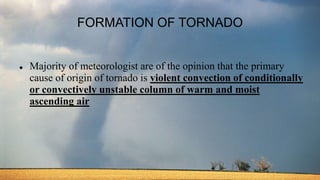
 Majority of meteorologist are of the opinion that the primary
cause of origin of tornado is violent convection of conditionally
or convectively unstable column of warm and moist
ascending air
FORMATION OF TORNADO
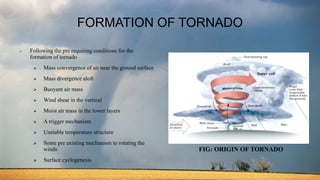
 Following the pre requiring conditions for the
formation of tornado
 Mass convergence of air near the ground surface
 Mass divergence aloft
 Buoyant air mass
 Wind shear in the vertical
 Moist air mass in the lower layers
 A trigger mechanism
 Unstable temperature structure
 Some pre existing mechanism to rotating the
winds
 Surface cyclogenesis
FIG: ORIGIN OF TORNADO
TYPES OF TORNADO
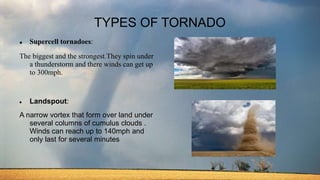
 Supercell tornadoes:
The biggest and the strongest.They spin under
a thunderstorm and there winds can get up
to 300mph.
 Landspout:
A narrow vortex that form over land under
several columns of cumulus clouds .
Winds can reach up to 140mph and
only last for several minutes
TYPES OF TORNADO
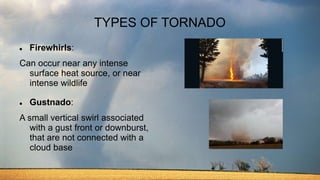
 Firewhirls:
Can occur near any intense
surface heat source, or near
intense wildlife
 Gustnado:
A small vertical swirl associated
with a gust front or downburst,
that are not connected with a
cloud base
TYPES OF TORNADO
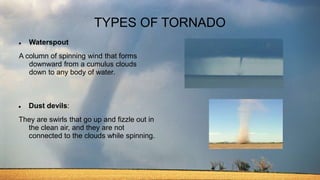
 Waterspout
A column of spinning wind that forms
downward from a cumulus clouds
down to any body of water.
 Dust devils:
They are swirls that go up and fizzle out in
the clean air, and they are not
connected to the clouds while spinning.
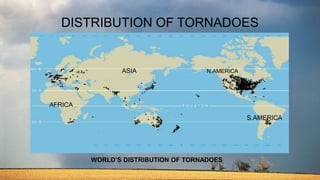
DISTRIBUTION OF TORNADOES
ASIA N.AMERICA
S.AMERICA
AFRICA
WORLD’S DISTRIBUTION OF TORNADOES
IMPACTS OF TORNADO
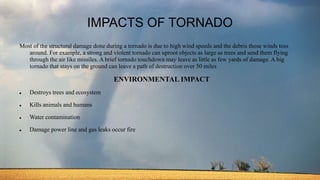
Most of the structural damage done during a tornado is due to high wind speeds and the debris those winds toss
around. For example, a strong and violent tornado can uproot objects as large as trees and send them flying
through the air like missiles. A brief tornado touchdown may leave as little as few yards of damage. A big
tornado that stays on the ground can leave a path of destruction over 50 miles
ENVIRONMENTAL IMPACT
 Destroys trees and ecosystem
 Kills animals and humans
 Water contamination
 Damage power line and gas leaks occur fire
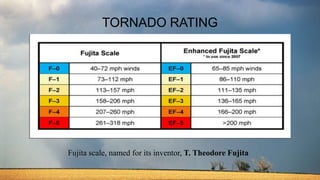
TORNADO RATING
Fujita scale, named for its inventor, T. Theodore Fujita
FORECASTING
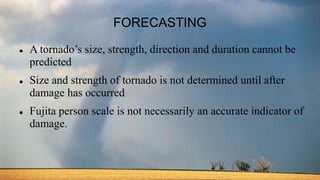
 A tornado’s size, strength, direction and duration cannot be
predicted
 Size and strength of tornado is not determined until after
damage has occurred
 Fujita person scale is not necessarily an accurate indicator of
damage.
CONCLUSION
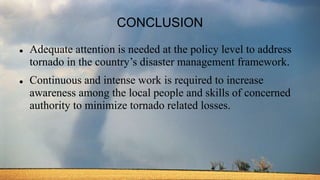
 Adequate attention is needed at the policy level to address
tornado in the country’s disaster management framework.
 Continuous and intense work is required to increase
awareness among the local people and skills of concerned
authority to minimize tornado related losses.
Thank you

Vikas rawat (tornadoes) s.no.49

  • 1.
    “TORNADOES” PRESENTED BY VIKAS RAWAT PAPER:ADVANCE CLIMATOLOGY DEPARTMENT OF GEOGRAPHY HEMVATI NANDAN BAHUGUNA GARHWAL UNIVERSITY SRINAGAR, UTTARAKHAND
  • 2.
    SCOPE OF PRESENTATION CONCEPTUAL UNDERSTANDING  CHARACTERISTICS OF TORNADO  FORMATION  TYPES  DISTRIBUTION  IMPACT  TORNADO RATINGS  FORECASTING  CONCLUSION
  • 3.
    CONCEPTUAL UNDERSTANDING Tornadoes arefunnel shaped storms wherein the upper portion is like umbrella in shape while the lower portion is like pipe which touches the ground surface. In fact they are violently rotating columns of air having having upper portion of funnel shape of cumulonimbus clouds which are attached to the ground by very narrow column of air. They are also known as twisters, because they often born in thunderstorms and are accomplished by hail, giant, persistent thunderstorm called super cells tornado.
  • 4.
    CHARACTERISTICS  Convective Instability Form thunder storms  Movement of tornado is non predictable  Tornadoes follow very narrow path  Average duration of existence of a tornado ranges between 15 to 20 minutes but occasionally they may be intense for a few hours.  They look very dark in color  The arrival of tornado is heralded by dark and thick clouds in the sky resulting into complete darkness, minimum visibility and low pressure.  Tornadoes move as a single unit or in a group consisting of an average 7 to 8 in number.
  • 5.
    FORMATION OF TORNADO Majority of meteorologist are of the opinion that the primary cause of origin of tornado is violent convection of conditionally or convectively unstable column of warm and moist ascending air
  • 6.
    FORMATION OF TORNADO Following the pre requiring conditions for the formation of tornado  Mass convergence of air near the ground surface  Mass divergence aloft  Buoyant air mass  Wind shear in the vertical  Moist air mass in the lower layers  A trigger mechanism  Unstable temperature structure  Some pre existing mechanism to rotating the winds  Surface cyclogenesis FIG: ORIGIN OF TORNADO
  • 7.
    TYPES OF TORNADO Supercell tornadoes: The biggest and the strongest.They spin under a thunderstorm and there winds can get up to 300mph.  Landspout: A narrow vortex that form over land under several columns of cumulus clouds . Winds can reach up to 140mph and only last for several minutes
  • 8.
    TYPES OF TORNADO Firewhirls: Can occur near any intense surface heat source, or near intense wildlife  Gustnado: A small vertical swirl associated with a gust front or downburst, that are not connected with a cloud base
  • 9.
    TYPES OF TORNADO Waterspout A column of spinning wind that forms downward from a cumulus clouds down to any body of water.  Dust devils: They are swirls that go up and fizzle out in the clean air, and they are not connected to the clouds while spinning.
  • 10.
    DISTRIBUTION OF TORNADOES ASIAN.AMERICA S.AMERICA AFRICA WORLD’S DISTRIBUTION OF TORNADOES
  • 11.
    IMPACTS OF TORNADO Mostof the structural damage done during a tornado is due to high wind speeds and the debris those winds toss around. For example, a strong and violent tornado can uproot objects as large as trees and send them flying through the air like missiles. A brief tornado touchdown may leave as little as few yards of damage. A big tornado that stays on the ground can leave a path of destruction over 50 miles ENVIRONMENTAL IMPACT  Destroys trees and ecosystem  Kills animals and humans  Water contamination  Damage power line and gas leaks occur fire
  • 12.
    TORNADO RATING Fujita scale,named for its inventor, T. Theodore Fujita
  • 13.
    FORECASTING  A tornado’ssize, strength, direction and duration cannot be predicted  Size and strength of tornado is not determined until after damage has occurred  Fujita person scale is not necessarily an accurate indicator of damage.
  • 14.
    CONCLUSION  Adequate attentionis needed at the policy level to address tornado in the country’s disaster management framework.  Continuous and intense work is required to increase awareness among the local people and skills of concerned authority to minimize tornado related losses.
  • 15.