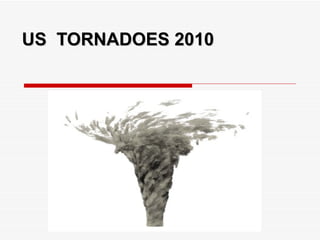
US  TORNADOES 2010
GROUP MEMBERS BUSHRA NAEEM FAZEELAT NIAZ SUMAYYAH KHAN ZAREEN ALI
Tornadoes are one of nature's most powerful and destructive forces
Tornadoes , sometimes called twisters, or cyclones, are violent windstorms that take the form of a rotating column of air, or  vortex , that extends downward from a cumulonimbus cloud.  Some tornadoes consist of a single vortex, but within many stronger tornadoes are smaller intense whirls called  suction vortices  that rotate within the main vortex.
Tornadoes' distinctive funnel clouds are actually transparent. They become visible when water droplets pulled from a storm's moist air condense or when dust and debris are taken up. Funnels typically grow about 660 feet (200 meters) wide.
Path Length and Speed Tornado paths range from 100 yards to one mile wide and are rarely more than 15 miles long. They can last from several seconds to more than an hour, however, most don't exceed 10 minutes. Most tornadoes travel from the southwest to northeast with an average speed of 30 mph, but the speed has been observed to range from almost no motion to 70 mph.
Tornado genesis It is not fully understood.  11 different hypotheses to explain the formation of the tornado.  Typically, tornadoes develop several thousand feet above the earth's surface inside of a severe rotating thunderstorm. This type of storm is called a supercell thunderstorm.
Conditions for Tornadoes Change in wind direction Increase in wind speed Increasing height Rising air within a thunderstorm
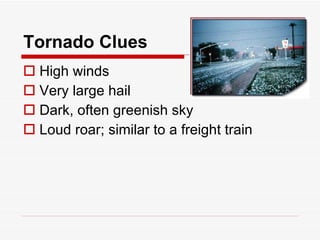
Tornado Clues High winds Very large hail Dark, often greenish sky Loud roar; similar to a freight train
Frequency and Seasonal Pattern They occur more often in late afternoon, when thunderstorms are common  More prevalent in spring and summer.  However, tornadoes can and do form at any time of the day and year.
Classification of Tornadoes Weak Tornadoes 69% of all tornadoes Less than 5% of tornado deaths Lifetime 1-10+ minutes Winds less than 110 mp
Strong Tornadoes 29% of all tornadoes Nearly 30% of all tornado deaths May last 20 minutes or longer Winds 110-205 mph
Violent Tornadoes Only 2% of all tornadoes  70% of all tornado deaths Lifetime can exceed 1 hour
Tornadoes around the Globe
Occurrence in the US: No other country   has nearly as many  tornadoes as  the U.S. The United States has the most tornadoes of any country, nearly four times more than estimated in all of Europe
It has over 1200 tornadoes per year (but only 2% of those are severe) causing70 fatalities and 1,500 injuries The conditions that lead to the formation of tornadoes are most often met in the central and southern U.S., where warm, humid air from the Gulf of Mexico collides with cool, dry air from the Rockies and Canada.
Peak months of tornado  are April, May, and June. However, tornadoes have occurred in every month and at all times of the day or night. A typical time of occurrence is on an unseasonably warm and sultry Spring afternoon between 3 p.m. and 9 p.m
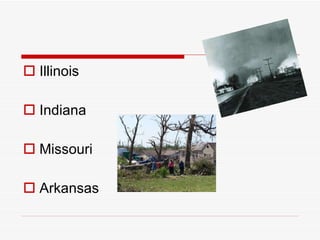
Tornado Alley In the United States, the area where the tornadoes hit the most is called  Tornado Alley .  The states which are in the tornado alley are: Texas Nebraska Colorado Iowa
Illinois Indiana Missouri Arkansas
US Tornadoes 2010 There were 1,531 tornadoes reported in the US in 2010 (of which at least 1,266 were confirmed), with 45 confirmed fatalities.
Tornado Outbreaks The March 2010 Carolinas tornado outbreak  March 28, 2010.  13 confirmed tornadoes Southeast United States The April 2010 tornado outbreak April 22–25, 2010  88 confirmed tornadoes Southern United States, High Plains the Mississippi and Tennessee Valleys.
The May 2010 tornado outbreak  May 10–13, 2010  91 confirmed tornadoes Oklahoma, Kansas, and Missouri   The Mid-June 2010 tornado outbreak  June 16-17, 2010  82 confirmed tornadoes Midwest and Northern Plains of the United States
Forecasting Tornadoes and Outlooks Because severe thunderstorms and tornadoes are small and short-lived phenomena, they are among the most difficult weather features to forecast precisely.  When necessary, the Storm Prediction Center of the National Weather Service issues severe thunderstorm outlooks several times daily.
Doppler Radar With its ability to detect air motion within a cloud,  Doppler radar  technology has greatly advanced the accuracy of tornado warning.  Using the principle known as the  Doppler effect , Doppler radar can identify the initial formation and subsequent development of the mesocyclone within a thunderstorm that frequently precedes tornado development.
Doppler on Wheels -- DOW Mobile radar with tornado © Joshua Wurman
Causes of tarnado
Super cells .   Most strong and violent tornadoes occur with super cell thunderstorms. Winds  turn from south to west with height.
Cont…. Instability   Instability refers to unusually warm and humid conditions in the lower atmosphere, and possibly cooler than usual conditions in the upper atmosphere.  Low pressure system The intense spinning of a tornado is partly the result of the updrafts and downdrafts in the thunderstorm .
Formation of tornado
Step 1 Before a t-storm, a change in wind direction and an increase in speed forms an invisible, horizontal spinning effect in the lower atmosphere (at the base of the storm)
Step 2 Rising air within the t-storm (updrafts) tilts the rotating air from horizontal to vertical
Step 3 Vertical rotation now extends 2-6 miles up into the t-storm. Now a tornado may form and extend from this area of rotation to the ground.
vulnerability vulnerability is conditions (susceptibility) that reduce the ability of people or places to respond to and recover from environmental threats, while vulnerability is the degree to which different social groups are at risk from hazards .
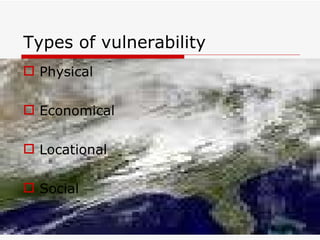
Types of vulnerability Physical Economical Locational Social
Physical vulnerability   Mobile home residents Mobile home residents are known to be highly vulnerable to tornadoes.  Mobile home residents are more vulnerable than permanent home residents.
Locational vulnerability Demographic shifts from the Northeast and Midwest to the South and eastern coastal areas amplified the hazard potential in these areas.  Riebsame. (1986)  noted similar demographic shifts to ‘Sunbelt’ states in the West and the South, which may have helped to increase the vulnerability of these areas to weather-related hazards
Factors effects social vulnerability False Alarm Rate   .  Simmons and Sutter (2010)  noted tornadoes occurring in areas with higher  FAR  tend to cause more death and injury . For example, a one standard deviation increase in the  FAR  raised death rates between  12 and 29%  and injury rates between 14 and 32%.  Ashley  in  2010  identified the American south region is more  vulnerable to tornado.  According to him many factors make south region more vulnerable,  mobile home density, seasonality, the day of time tornado strike and resident attitudes.
Cont… Ashley  in  2010  identified the American south region is more  vulnerable to tornado.  According to him many factors make south region more vulnerable,  mobile home density, seasonality, the day of time tornado strike and resident attitudes.
The Fujita Scale Most tornado damage is caused by tremendously strong winds.  One commonly used guide to tornado intensity is the  Fujita Intensity Scale , or simply  F-scale .  A rating on the F-scale is determined by assessing the  worst  damage produced by a storm.  Although most tornado damage is done by violent winds, most tornado injuries and deaths result from flying debris.
Fujita Wind-Damage Scale Six levels: F0:  Light damage F1:  Moderate damage F2:  Considerable damage F3:  Severe damage F4:  Devastating damage F5:  Incredible damage
Fujita-Pearson Tornado Scale F-0: 40-72 mph, chimney damage, tree branches broken F-1: 73-112 mph, mobile homes pushed off of foundations or overturned F-2: 113-157 mph, considerable damage, mobile homes destroyed, trees uprooted F-3: 158-205 mph, roofs and walls torn down, trains overturned, cars thrown
F-4: 207-260 mph, well constructed walls are leveled F-5: 261-316 mph, homes lifted off foundations and carried considerable distances, autos lifted as far as 100 meters
DESTRUCTION FROM TORNADOES IN U.S
A tornado can be the most horrific and threatening of all natural disasters. Most deaths are caused by flying debris.
CONT . . . . . Tornadoes develop from thunderstorms. Tornadoes vary in speed, size, and time limits.
Regions of Tornadoes in United States: Florida  Tornado Alley
The Alley of Destruction: Tornado Alley Definition  Occurrence What makes this area Tornado Alley? Timing
U.S APRIL 2O1O TORNADOES OUTBREAK:
 
Types of Tornado Damage Tornadoes are violent, unpredictable windstorms in which winds can reach up to 225 mph and devastate the areas through which they pass. Many dangers are associated with tornadoes, both immediate and long-term, and anyone caught in a tornado should seek shelter below ground or in a concrete room away from windows until the storm has passed .
Wind Damage The strong winds present during a tornado can uproot trees and level buildings. Sudden changes in air pressure due to the force of moving air currents can shatter windows and stress structures such as homes and barns when the building expands or contracts. A tornado can tear the roof or entire stories from a building as it passes. Tornado-force winds can also cause phone, power and other utility lines to break and fall.
Damage From Debris Flying debris can destroy property and even kill people during a tornado. Even tiny objects such as pebbles or straw can penetrate much larger objects when speeding through the air, damaging buildings, automobiles and other structures.
Long-Term Damage Even after a tornado has passed, there are dangers in its wake. Downed power lines can pose serious risks of electric shock and death. Bridges and other infrastructure may be weakened from wind damage or debris, and buildings may be unsafe to enter for the same reasons.
High Speed Collisions and Impacts A person, animal or object can be swept through the air or over considerable distances along the ground by tornado winds. When caught in these winds, a collision with stationary objects or the ground is not only likely, but potentially fatal.
Hazards and Impact of U.S Tonadoes: Hazards from Tornadoes Extremely Strong Winds and Flying Debris  Strong Updrafts Subsidiary Vortices Abrupt drop in Pressure
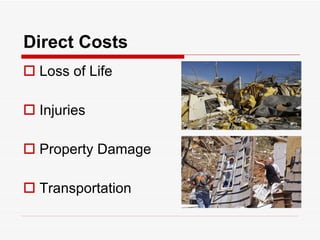
Direct Costs   Loss of Life  Injuries Property Damage  Transportation
Interruption of Economic Activity Disruption of Power, Communications, Drinking Water.
Damage from Tornadoes & Individual Response   Investment in Construction Listening to Radio or Television Response to Visual Signs
Confidence in Warning System Mental and Physical Stress
Social Response   Funding for Research Disaster awareness and Education Community Shelters Community Support Systems
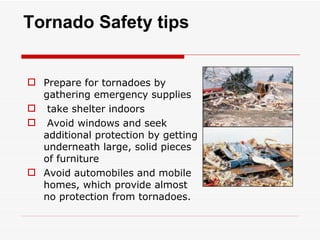
Tornado Safety tips Prepare for tornadoes by gathering emergency supplies  take shelter indoors Avoid windows and seek additional protection by getting underneath large, solid pieces of furniture  Avoid automobiles and mobile homes, which provide almost no protection from tornadoes.
Long-Term Tornado Recovery Disaster Services has worked hard to ensure that families receive the support and care they deserve. This support began with a call for help which was answered by hundreds of volunteers who worked over 1,000 hours to help families clean-up and rebuild. Next, LSSMN Disaster Services helped the citizens of Wadena develop the Wadena/ Otter-Tail Long Term Recovery Committee (WOLTRC), which was
Cont. established to help develop resources for the rebuilding and recovery efforts in Wadena and Otter Tail counties. Then, LSSMN hired and continues to supervise staff in disaster case management, volunteer recruitment and reconstruction management to support families as they work through this difficult time in their lives.
Disaster Case Management has assisted 139 families locate the resources to rebuild their lives and homes and has helped WOLTRC distribute over $265,000. By recruiting dozens of volunteers and supervising those volunteers many homeowners are finally moving back “home”.
financial support can help people in these communities to rebuild and recover.
Emergency Disaster Service (EDS) Emergency Disaster Service (EDS) personnel from divisions in the Southern Territory are providing food, drink, emotional and spiritual care to the victims and other resources, like clean-up kits, are available as needed in a number of areas.
Tornado Safety in Schools Develop a severe weather action plan and have frequent drills, Each school should be inspected and tornado shelter areas designated by a registered engineer or architect If the school's alarm system relies on electricity, have a compressed air horn or megaphone to activate the alarm in case of power failure.

US TORNADOES 2010

  • 1.
  • 2.
    GROUP MEMBERS BUSHRANAEEM FAZEELAT NIAZ SUMAYYAH KHAN ZAREEN ALI
  • 3.
    Tornadoes are oneof nature's most powerful and destructive forces
  • 4.
    Tornadoes , sometimescalled twisters, or cyclones, are violent windstorms that take the form of a rotating column of air, or vortex , that extends downward from a cumulonimbus cloud. Some tornadoes consist of a single vortex, but within many stronger tornadoes are smaller intense whirls called suction vortices that rotate within the main vortex.
  • 5.
    Tornadoes' distinctive funnelclouds are actually transparent. They become visible when water droplets pulled from a storm's moist air condense or when dust and debris are taken up. Funnels typically grow about 660 feet (200 meters) wide.
  • 6.
    Path Length andSpeed Tornado paths range from 100 yards to one mile wide and are rarely more than 15 miles long. They can last from several seconds to more than an hour, however, most don't exceed 10 minutes. Most tornadoes travel from the southwest to northeast with an average speed of 30 mph, but the speed has been observed to range from almost no motion to 70 mph.
  • 7.
    Tornado genesis Itis not fully understood. 11 different hypotheses to explain the formation of the tornado. Typically, tornadoes develop several thousand feet above the earth's surface inside of a severe rotating thunderstorm. This type of storm is called a supercell thunderstorm.
  • 8.
    Conditions for TornadoesChange in wind direction Increase in wind speed Increasing height Rising air within a thunderstorm
  • 9.
    Tornado Clues Highwinds Very large hail Dark, often greenish sky Loud roar; similar to a freight train
  • 10.
    Frequency and SeasonalPattern They occur more often in late afternoon, when thunderstorms are common More prevalent in spring and summer. However, tornadoes can and do form at any time of the day and year.
  • 11.
    Classification of TornadoesWeak Tornadoes 69% of all tornadoes Less than 5% of tornado deaths Lifetime 1-10+ minutes Winds less than 110 mp
  • 12.
    Strong Tornadoes 29%of all tornadoes Nearly 30% of all tornado deaths May last 20 minutes or longer Winds 110-205 mph
  • 13.
    Violent Tornadoes Only2% of all tornadoes 70% of all tornado deaths Lifetime can exceed 1 hour
  • 14.
  • 15.
    Occurrence in theUS: No other country has nearly as many tornadoes as the U.S. The United States has the most tornadoes of any country, nearly four times more than estimated in all of Europe
  • 16.
    It has over1200 tornadoes per year (but only 2% of those are severe) causing70 fatalities and 1,500 injuries The conditions that lead to the formation of tornadoes are most often met in the central and southern U.S., where warm, humid air from the Gulf of Mexico collides with cool, dry air from the Rockies and Canada.
  • 17.
    Peak months oftornado are April, May, and June. However, tornadoes have occurred in every month and at all times of the day or night. A typical time of occurrence is on an unseasonably warm and sultry Spring afternoon between 3 p.m. and 9 p.m
  • 18.
    Tornado Alley Inthe United States, the area where the tornadoes hit the most is called Tornado Alley . The states which are in the tornado alley are: Texas Nebraska Colorado Iowa
  • 19.
  • 20.
    US Tornadoes 2010There were 1,531 tornadoes reported in the US in 2010 (of which at least 1,266 were confirmed), with 45 confirmed fatalities.
  • 21.
    Tornado Outbreaks TheMarch 2010 Carolinas tornado outbreak March 28, 2010. 13 confirmed tornadoes Southeast United States The April 2010 tornado outbreak April 22–25, 2010 88 confirmed tornadoes Southern United States, High Plains the Mississippi and Tennessee Valleys.
  • 22.
    The May 2010tornado outbreak May 10–13, 2010 91 confirmed tornadoes Oklahoma, Kansas, and Missouri The Mid-June 2010 tornado outbreak June 16-17, 2010 82 confirmed tornadoes Midwest and Northern Plains of the United States
  • 23.
    Forecasting Tornadoes andOutlooks Because severe thunderstorms and tornadoes are small and short-lived phenomena, they are among the most difficult weather features to forecast precisely. When necessary, the Storm Prediction Center of the National Weather Service issues severe thunderstorm outlooks several times daily.
  • 24.
    Doppler Radar Withits ability to detect air motion within a cloud, Doppler radar technology has greatly advanced the accuracy of tornado warning. Using the principle known as the Doppler effect , Doppler radar can identify the initial formation and subsequent development of the mesocyclone within a thunderstorm that frequently precedes tornado development.
  • 25.
    Doppler on Wheels-- DOW Mobile radar with tornado © Joshua Wurman
  • 26.
  • 27.
    Super cells . Most strong and violent tornadoes occur with super cell thunderstorms. Winds turn from south to west with height.
  • 28.
    Cont…. Instability Instability refers to unusually warm and humid conditions in the lower atmosphere, and possibly cooler than usual conditions in the upper atmosphere. Low pressure system The intense spinning of a tornado is partly the result of the updrafts and downdrafts in the thunderstorm .
  • 29.
  • 30.
    Step 1 Beforea t-storm, a change in wind direction and an increase in speed forms an invisible, horizontal spinning effect in the lower atmosphere (at the base of the storm)
  • 31.
    Step 2 Risingair within the t-storm (updrafts) tilts the rotating air from horizontal to vertical
  • 32.
    Step 3 Verticalrotation now extends 2-6 miles up into the t-storm. Now a tornado may form and extend from this area of rotation to the ground.
  • 33.
    vulnerability vulnerability isconditions (susceptibility) that reduce the ability of people or places to respond to and recover from environmental threats, while vulnerability is the degree to which different social groups are at risk from hazards .
  • 34.
    Types of vulnerabilityPhysical Economical Locational Social
  • 35.
    Physical vulnerability Mobile home residents Mobile home residents are known to be highly vulnerable to tornadoes. Mobile home residents are more vulnerable than permanent home residents.
  • 36.
    Locational vulnerability Demographicshifts from the Northeast and Midwest to the South and eastern coastal areas amplified the hazard potential in these areas. Riebsame. (1986) noted similar demographic shifts to ‘Sunbelt’ states in the West and the South, which may have helped to increase the vulnerability of these areas to weather-related hazards
  • 37.
    Factors effects socialvulnerability False Alarm Rate . Simmons and Sutter (2010) noted tornadoes occurring in areas with higher FAR tend to cause more death and injury . For example, a one standard deviation increase in the FAR raised death rates between 12 and 29% and injury rates between 14 and 32%. Ashley in 2010 identified the American south region is more vulnerable to tornado. According to him many factors make south region more vulnerable, mobile home density, seasonality, the day of time tornado strike and resident attitudes.
  • 38.
    Cont… Ashley in 2010 identified the American south region is more vulnerable to tornado. According to him many factors make south region more vulnerable, mobile home density, seasonality, the day of time tornado strike and resident attitudes.
  • 39.
    The Fujita ScaleMost tornado damage is caused by tremendously strong winds. One commonly used guide to tornado intensity is the Fujita Intensity Scale , or simply F-scale . A rating on the F-scale is determined by assessing the worst damage produced by a storm. Although most tornado damage is done by violent winds, most tornado injuries and deaths result from flying debris.
  • 40.
    Fujita Wind-Damage ScaleSix levels: F0: Light damage F1: Moderate damage F2: Considerable damage F3: Severe damage F4: Devastating damage F5: Incredible damage
  • 41.
    Fujita-Pearson Tornado ScaleF-0: 40-72 mph, chimney damage, tree branches broken F-1: 73-112 mph, mobile homes pushed off of foundations or overturned F-2: 113-157 mph, considerable damage, mobile homes destroyed, trees uprooted F-3: 158-205 mph, roofs and walls torn down, trains overturned, cars thrown
  • 42.
    F-4: 207-260 mph,well constructed walls are leveled F-5: 261-316 mph, homes lifted off foundations and carried considerable distances, autos lifted as far as 100 meters
  • 43.
  • 44.
    A tornado canbe the most horrific and threatening of all natural disasters. Most deaths are caused by flying debris.
  • 45.
    CONT . .. . . Tornadoes develop from thunderstorms. Tornadoes vary in speed, size, and time limits.
  • 46.
    Regions of Tornadoesin United States: Florida Tornado Alley
  • 47.
    The Alley ofDestruction: Tornado Alley Definition Occurrence What makes this area Tornado Alley? Timing
  • 48.
    U.S APRIL 2O1OTORNADOES OUTBREAK:
  • 49.
  • 50.
    Types of TornadoDamage Tornadoes are violent, unpredictable windstorms in which winds can reach up to 225 mph and devastate the areas through which they pass. Many dangers are associated with tornadoes, both immediate and long-term, and anyone caught in a tornado should seek shelter below ground or in a concrete room away from windows until the storm has passed .
  • 51.
    Wind Damage Thestrong winds present during a tornado can uproot trees and level buildings. Sudden changes in air pressure due to the force of moving air currents can shatter windows and stress structures such as homes and barns when the building expands or contracts. A tornado can tear the roof or entire stories from a building as it passes. Tornado-force winds can also cause phone, power and other utility lines to break and fall.
  • 52.
    Damage From DebrisFlying debris can destroy property and even kill people during a tornado. Even tiny objects such as pebbles or straw can penetrate much larger objects when speeding through the air, damaging buildings, automobiles and other structures.
  • 53.
    Long-Term Damage Evenafter a tornado has passed, there are dangers in its wake. Downed power lines can pose serious risks of electric shock and death. Bridges and other infrastructure may be weakened from wind damage or debris, and buildings may be unsafe to enter for the same reasons.
  • 54.
    High Speed Collisionsand Impacts A person, animal or object can be swept through the air or over considerable distances along the ground by tornado winds. When caught in these winds, a collision with stationary objects or the ground is not only likely, but potentially fatal.
  • 55.
    Hazards and Impactof U.S Tonadoes: Hazards from Tornadoes Extremely Strong Winds and Flying Debris Strong Updrafts Subsidiary Vortices Abrupt drop in Pressure
  • 56.
    Direct Costs Loss of Life Injuries Property Damage Transportation
  • 57.
    Interruption of EconomicActivity Disruption of Power, Communications, Drinking Water.
  • 58.
    Damage from Tornadoes& Individual Response Investment in Construction Listening to Radio or Television Response to Visual Signs
  • 59.
    Confidence in WarningSystem Mental and Physical Stress
  • 60.
    Social Response Funding for Research Disaster awareness and Education Community Shelters Community Support Systems
  • 61.
    Tornado Safety tipsPrepare for tornadoes by gathering emergency supplies take shelter indoors Avoid windows and seek additional protection by getting underneath large, solid pieces of furniture Avoid automobiles and mobile homes, which provide almost no protection from tornadoes.
  • 62.
    Long-Term Tornado RecoveryDisaster Services has worked hard to ensure that families receive the support and care they deserve. This support began with a call for help which was answered by hundreds of volunteers who worked over 1,000 hours to help families clean-up and rebuild. Next, LSSMN Disaster Services helped the citizens of Wadena develop the Wadena/ Otter-Tail Long Term Recovery Committee (WOLTRC), which was
  • 63.
    Cont. established tohelp develop resources for the rebuilding and recovery efforts in Wadena and Otter Tail counties. Then, LSSMN hired and continues to supervise staff in disaster case management, volunteer recruitment and reconstruction management to support families as they work through this difficult time in their lives.
  • 64.
    Disaster Case Managementhas assisted 139 families locate the resources to rebuild their lives and homes and has helped WOLTRC distribute over $265,000. By recruiting dozens of volunteers and supervising those volunteers many homeowners are finally moving back “home”.
  • 65.
    financial support canhelp people in these communities to rebuild and recover.
  • 66.
    Emergency Disaster Service(EDS) Emergency Disaster Service (EDS) personnel from divisions in the Southern Territory are providing food, drink, emotional and spiritual care to the victims and other resources, like clean-up kits, are available as needed in a number of areas.
  • 67.
    Tornado Safety inSchools Develop a severe weather action plan and have frequent drills, Each school should be inspected and tornado shelter areas designated by a registered engineer or architect If the school's alarm system relies on electricity, have a compressed air horn or megaphone to activate the alarm in case of power failure.