TornadoesBy Tammy Ray
What is a tornadoThese are the definitions from a dictionary:A rotating column of air ranging in width from a few yards to more than a mile and whirling at destructively high speeds, usually accompanied by a funnel-shaped downward extension of a cumulonimbus cloud. A violent thunderstorm in western Africa or nearby Atlantic waters. A whirlwind or hurricane. It comes  in a thunderstorm.
What does a tornado do?A tornado  spins around violently.This is what a tornado is capable of:Destroying houses,throw a person above the clouds,rip apart anything in its path.
How a Tornado FormsA tornado begins in a severe thunderstorm called a supercell . A supercell can last longer than a regular thunderstorm. The same property that keeps the storm going also produces most tornadoes. The wind coming into the storm starts to swirl and forms a funnel. The air in the funnel spins faster and faster and creates a very low pressure area which sucks more air (and possibly objects) into it. The severe thunderstorms which produce tornadoes form where cold dry polar air meets warm moist tropical air. This is most common in a section of the United States called Tornado Alley. Also, the atmosphere needs to be very unstable.
How a Tornado Forms (continued)Tornadoes can form any time during the year, but most form in May. But, more severe ones form earlier because the most damage is caused in April. The more north you go, the later the peak tornado season is. This is because it takes longer to warm the northern parts of the plains so tornadoes form later. http://www.windows.ucar.edu/tour/link=/earth/Atmosphere/tornado/formation.html
Types of TornadoesThese are types of tornadoes:Supercell TornadoesDust DevilsFirewhirlsGustnadoLandspoutWaterspout
Supercell TornadoesSome of the most violent tornadoes develop from supercell thunderstorms. A supercell thunderstorm is a long-lived thunderstorm possessing within its structure a continuously rotating updraft of air. These storms are the most impressive of all thunderstorms and can often produce large hail and tornadoes, though less than half of all supercell thunderstorms produce tornadoes. Supercell thunderstorms, and the tornadoes they sometimes produce, are most common in the central part of the United States. Here, a unique combination of geographical influences results in the relatively frequent presence of the extreme atmospheric instability necessary for supercells. Where this arid air meets the humid air from the Gulf of Mexico is known as the “dry line" and is a favored location for supercell development. Winds can exceed 200 mph.
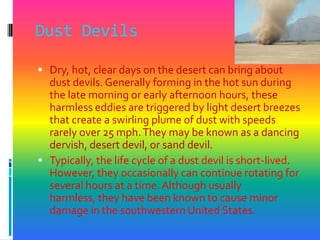
Dust DevilsDry, hot, clear days on the desert can bring about dust devils. Generally forming in the hot sun during the late morning or early afternoon hours, these harmless eddies are triggered by light desert breezes that create a swirling plume of dust with speeds rarely over 25 mph. They may be known as a dancing dervish, desert devil, or sand devil. Typically, the life cycle of a dust devil is short-lived. However, they occasionally can continue rotating for several hours at a time. Although usually harmless, they have been known to cause minor damage in the southwestern United States.
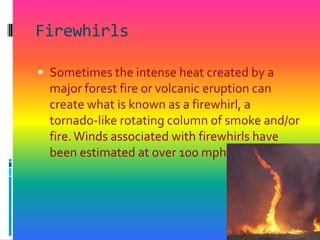
FirewhirlsSometimes the intense heat created by a major forest fire or volcanic eruption can create what is known as a firewhirl, a tornado-like rotating column of smoke and/or fire. Winds associated with firewhirls have been estimated at over 100 mph.
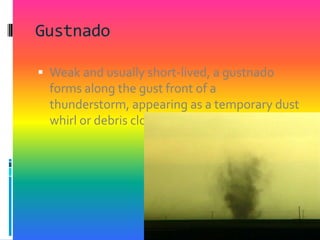
GustnadoWeak and usually short-lived, a gustnado forms along the gust front of a thunderstorm, appearing as a temporary dust whirl or debris cloud.
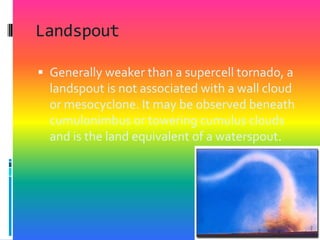
LandspoutGenerally weaker than a supercell tornado, a landspout is not associated with a wall cloud or mesocyclone. It may be observed beneath cumulonimbus or towering cumulus clouds and is the land equivalent of a waterspout.
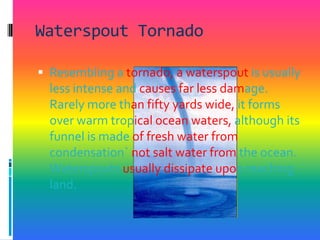
Waterspout TornadoResembling a tornado, a waterspout is usually less intense and causes far less damage. Rarely more than fifty yards wide, it forms over warm tropical ocean waters, although its funnel is made of fresh water from condensation` not salt water from the ocean. Waterspouts usually dissipate upon reaching land.
CitationI got the information on the tornado types from:http://www.weather.com/encyclopedia/tornado/types.html
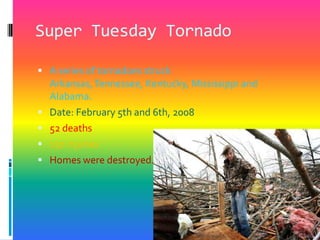
Super Tuesday TornadoA series of tornadoes struck Arkansas, Tennessee, Kentucky, Mississippi and Alabama.Date: February 5th and 6th, 200852 deaths150 injuriesHomes were destroyed.
Fast FactsThere are about 1000 tornadoes per year in the USA.The places that tornadoes hit most are the Midwest, South, and Great PlainsOnce a tornado carried a motel sign 30 miles and dropped it in Arkansas!
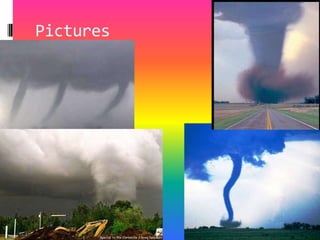
Pictures
The End

Tornadoes

  • 1.
  • 2.
    What is atornadoThese are the definitions from a dictionary:A rotating column of air ranging in width from a few yards to more than a mile and whirling at destructively high speeds, usually accompanied by a funnel-shaped downward extension of a cumulonimbus cloud. A violent thunderstorm in western Africa or nearby Atlantic waters. A whirlwind or hurricane. It comes in a thunderstorm.
  • 3.
    What does atornado do?A tornado spins around violently.This is what a tornado is capable of:Destroying houses,throw a person above the clouds,rip apart anything in its path.
  • 4.
    How a TornadoFormsA tornado begins in a severe thunderstorm called a supercell . A supercell can last longer than a regular thunderstorm. The same property that keeps the storm going also produces most tornadoes. The wind coming into the storm starts to swirl and forms a funnel. The air in the funnel spins faster and faster and creates a very low pressure area which sucks more air (and possibly objects) into it. The severe thunderstorms which produce tornadoes form where cold dry polar air meets warm moist tropical air. This is most common in a section of the United States called Tornado Alley. Also, the atmosphere needs to be very unstable.
  • 5.
    How a TornadoForms (continued)Tornadoes can form any time during the year, but most form in May. But, more severe ones form earlier because the most damage is caused in April. The more north you go, the later the peak tornado season is. This is because it takes longer to warm the northern parts of the plains so tornadoes form later. http://www.windows.ucar.edu/tour/link=/earth/Atmosphere/tornado/formation.html
  • 6.
    Types of TornadoesTheseare types of tornadoes:Supercell TornadoesDust DevilsFirewhirlsGustnadoLandspoutWaterspout
  • 7.
    Supercell TornadoesSome ofthe most violent tornadoes develop from supercell thunderstorms. A supercell thunderstorm is a long-lived thunderstorm possessing within its structure a continuously rotating updraft of air. These storms are the most impressive of all thunderstorms and can often produce large hail and tornadoes, though less than half of all supercell thunderstorms produce tornadoes. Supercell thunderstorms, and the tornadoes they sometimes produce, are most common in the central part of the United States. Here, a unique combination of geographical influences results in the relatively frequent presence of the extreme atmospheric instability necessary for supercells. Where this arid air meets the humid air from the Gulf of Mexico is known as the “dry line" and is a favored location for supercell development. Winds can exceed 200 mph.
  • 8.
    Dust DevilsDry, hot,clear days on the desert can bring about dust devils. Generally forming in the hot sun during the late morning or early afternoon hours, these harmless eddies are triggered by light desert breezes that create a swirling plume of dust with speeds rarely over 25 mph. They may be known as a dancing dervish, desert devil, or sand devil. Typically, the life cycle of a dust devil is short-lived. However, they occasionally can continue rotating for several hours at a time. Although usually harmless, they have been known to cause minor damage in the southwestern United States.
  • 9.
    FirewhirlsSometimes the intenseheat created by a major forest fire or volcanic eruption can create what is known as a firewhirl, a tornado-like rotating column of smoke and/or fire. Winds associated with firewhirls have been estimated at over 100 mph.
  • 10.
    GustnadoWeak and usuallyshort-lived, a gustnado forms along the gust front of a thunderstorm, appearing as a temporary dust whirl or debris cloud.
  • 11.
    LandspoutGenerally weaker thana supercell tornado, a landspout is not associated with a wall cloud or mesocyclone. It may be observed beneath cumulonimbus or towering cumulus clouds and is the land equivalent of a waterspout.
  • 12.
    Waterspout TornadoResembling atornado, a waterspout is usually less intense and causes far less damage. Rarely more than fifty yards wide, it forms over warm tropical ocean waters, although its funnel is made of fresh water from condensation` not salt water from the ocean. Waterspouts usually dissipate upon reaching land.
  • 13.
    CitationI got theinformation on the tornado types from:http://www.weather.com/encyclopedia/tornado/types.html
  • 14.
    Super Tuesday TornadoAseries of tornadoes struck Arkansas, Tennessee, Kentucky, Mississippi and Alabama.Date: February 5th and 6th, 200852 deaths150 injuriesHomes were destroyed.
  • 15.
    Fast FactsThere areabout 1000 tornadoes per year in the USA.The places that tornadoes hit most are the Midwest, South, and Great PlainsOnce a tornado carried a motel sign 30 miles and dropped it in Arkansas!
  • 16.
  • 17.