
SERVICES MARKETING AND MANAGEMENT
PRESENTED BY:-
GROUP MEMBERS PGDM-2/DIV-B
SHARAYU WANI ROLL-103
SAURABH ZULKANTHIWAR ROLL-104
VINAY JAIN ROLL-105
TUSHAR BHADALKAR ROLL-106
SARTHAK GUPTA ROLL-108
NIKITA LUHADIYA ROLL-109
BACKGROUND
• MakeMyTrip.com was launched in the US in 2000
• Offering Airline tickets, Hotel reservations, car rentals, travel packages and
holidays to cater the niche US to India travel market.
• Indian operations of Makemytrip.com (MMT) started in 2005.
FACTS
• Was able to break even by 2002.
• By 2004 it had garnered 3.5 per cent share of this NRI market (Rs. 4,500
crore/US$ 1 billion)
• Emerged as the foremost online travel service provider in the US to India market.
• Reason - 24x7 Customer Service, Online Convenience, good HR Practices.
• Threat – Fierce competition from Expedia, Orbitz, and Travelocity
INDIA LAUNCH
(SEP 2005)
• Identified the gap between demand and supply.
• Decided to offer a user- friendly and convenient online interactive interface.
• Low cost carriers slashed rates.
• Young generation with disposable income to travel.
• Received funding of US $8 million (Rs. 352 million) from SB Asia Infrastructure
Fund (SAIF).
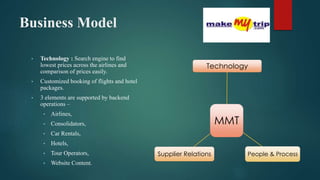
Business Model
• Technology : Search engine to find
lowest prices across the airlines and
comparison of prices easily.
• Customized booking of flights and hotel
packages.
• 3 elements are supported by backend
operations –
• Airlines,
• Consolidators,
• Car Rentals,
• Hotels,
• Tour Operators,
• Website Content.
MMT
Technology
Supplier Relations People & Process
Indian Travel & Tourism
• Domestic air traffic grew at 24.2% 39.86 million in April 2005.
• Govt. of India allowed private airlines to fly on international routes was expected
to facilitate more flow of air passengers.
• Aviation Ministry to modernize 80 airports.
• Annual Plan ( Government of India), 2005-2006 focused on tourism spending.
Drawbacks of Indian Tourism
• High taxes on hotel tariffs.
• Service taxes on foreign exchange earnings of travel agents.
• Union and state governments charges.
• Insufficient facilities and poor maintenance at many holiday destinations and
tourist locations.
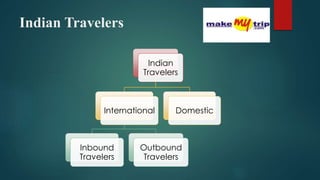
Indian Travelers
Indian
Travelers
International
Inbound
Travelers
Outbound
Travelers
Domestic
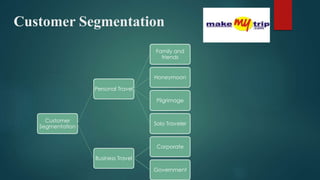
Customer Segmentation
Customer
Segmentation
Personal Travel
Family and
friends
Honeymoon
Pilgrimage
Solo Traveler
Business Travel
Corporate
Government
Internet User Base & Online
Travel in India
• Increasing internet penetration reasons for the growth in the travel market.
• The rate is lower till 2005 contributing to only 4.47% growth rate.
• According to PhoCusWright, report ” showed that gross booking for online leisure/unmanaged
business travel in India totalled US $295 million out of which only 2.2% were booked by OTS.
• Euro monitor Report showed Hotel accommodation in India were valued at Rs. 6 billion in 2005, out
of which Internet contributed a mere 3% of the total sales. While hotel booking by other
intermediaries was growing strongly.
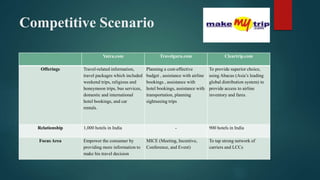
Competitive Scenario
Yatra.com Travelguru.com Cleartrip.com
Offerings Travel-related information,
travel packages which included
weekend trips, religious and
honeymoon trips, bus services,
domestic and international
hotel bookings, and car
rentals.
Planning a cost-effective
budget , assistance with airline
bookings , assistance with
hotel bookings, assistance with
transportation, planning
sightseeing trips
To provide superior choice,
using Abacus (Asia’s leading
global distribution system) to
provide access to airline
inventory and fares.
Relationship 1,000 hotels in India - 900 hotels in India
Focus Area Empower the consumer by
providing more information to
make his travel decision
MICE (Meeting, Incentive,
Conference, and Event)
To tap strong network of
carriers and LCCs
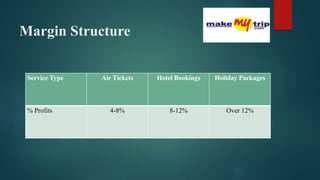
Margin Structure
Service Type Air Tickets Hotel Bookings Holiday Packages
% Profits 4-8% 8-12% Over 12%
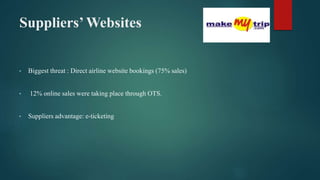
Suppliers’ Websites
• Biggest threat : Direct airline website bookings (75% sales)
• 12% online sales were taking place through OTS.
• Suppliers advantage: e-ticketing
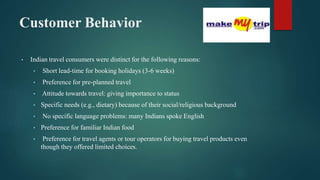
Customer Behavior
• Indian travel consumers were distinct for the following reasons:
• Short lead-time for booking holidays (3-6 weeks)
• Preference for pre-planned travel
• Attitude towards travel: giving importance to status
• Specific needs (e.g., dietary) because of their social/religious background
• No specific language problems: many Indians spoke English
• Preference for familiar Indian food
• Preference for travel agents or tour operators for buying travel products even
though they offered limited choices.
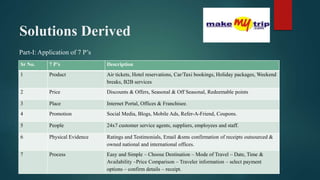
Solutions Derived
Part-I: Application of 7 P’s
Sr No. 7 P’s Description
1 Product Air tickets, Hotel reservations, Car/Taxi bookings, Holiday packages, Weekend
breaks, B2B services
2 Price Discounts & Offers, Seasonal & Off Seasonal, Redeemable points
3 Place Internet Portal, Offices & Franchisee.
4 Promotion Social Media, Blogs, Mobile Ads, Refer-A-Friend, Coupons.
5 People 24x7 customer service agents, suppliers, employees and staff.
6 Physical Evidence Ratings and Testimonials, Email &sms confirmation of receipts outsourced &
owned national and international offices.
7 Process Easy and Simple – Choose Destination – Mode of Travel – Date, Time &
Availability –Price Comparison – Traveler information – select payment
options – confirm details – receipt.
Solutions Derived contd..
Part-II: Marketing Activities to Counterfeit Challenges
• The online travel market in India was getting bigger and bigger.
• In the process, the number of players was expected to increase and competition
would be coming into its own.
Solutions Derived contd..
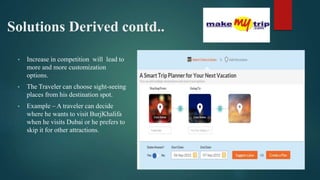
• Increase in competition will lead to
more and more customization
options.
• The Traveler can choose sight-seeing
places from his destination spot.
• Example – A traveler can decide
where he wants to visit BurjKhalifa
when he visits Dubai or he prefers to
skip it for other attractions.
Solutions Derived contd..
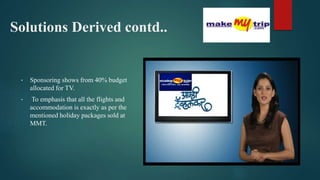
• Sponsoring shows from 40% budget
allocated for TV.
• To emphasis that all the flights and
accommodation is exactly as per the
mentioned holiday packages sold at
MMT.
Solutions Derived contd..
• Providing Matrix Sim Cards for
International Travelers so that their
communication with their loved ones
is easier.
Solutions Derived contd..
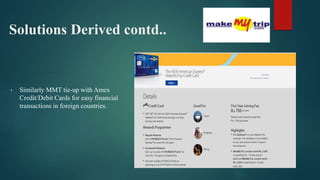
• Similarly MMT tie-up with Amex
Credit/Debit Cards for easy financial
transactions in foreign countries.
Other Challenges Faced
Low internet penetration in India was making the business more difficult for OTS to
reach the mass market.
Solution:
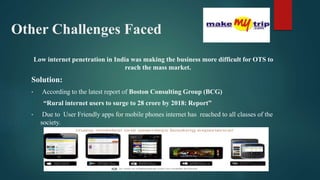
• According to the latest report of Boston Consulting Group (BCG)
“Rural internet users to surge to 28 crore by 2018: Report”
• Due to User Friendly apps for mobile phones internet has reached to all classes of the
society.
Other Challenges Faced
contd..
Suppliers were selling their products online.
Solution:
• Have to offer attractive packages along with the competitive pricing of the tariffs .
• Second bold move can be: decreasing booking fees & charges and charging
cancellation and rescheduling fees at parity with that charged by the airlines
themselves.
• Suppliers have not been able to push their mobile apps to the mobile customer
base who are increasing day-by-day.
Other Challenges Faced
contd..
Hybrid OTS provider models might
evolve in the future.
Solution:
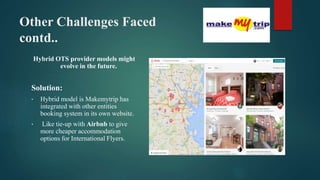
• Hybrid model is Makemytrip has
integrated with other entities
booking system in its own website.
• Like tie-up with Airbnb to give
more cheaper accommodation
options for International Flyers.
Other Challenges Faced
contd..
News
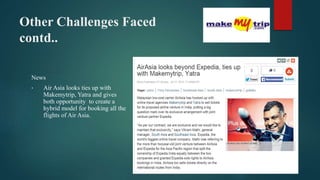
• Air Asia looks ties up with
Makemytrip, Yatra and gives
both opportunity to create a
hybrid model for booking all the
flights of Air Asia.
THANKYOU!!

Vikapla case study - makemytrip.com

  • 1.
    SERVICES MARKETING ANDMANAGEMENT PRESENTED BY:- GROUP MEMBERS PGDM-2/DIV-B SHARAYU WANI ROLL-103 SAURABH ZULKANTHIWAR ROLL-104 VINAY JAIN ROLL-105 TUSHAR BHADALKAR ROLL-106 SARTHAK GUPTA ROLL-108 NIKITA LUHADIYA ROLL-109
  • 2.
    BACKGROUND • MakeMyTrip.com waslaunched in the US in 2000 • Offering Airline tickets, Hotel reservations, car rentals, travel packages and holidays to cater the niche US to India travel market. • Indian operations of Makemytrip.com (MMT) started in 2005.
  • 3.
    FACTS • Was ableto break even by 2002. • By 2004 it had garnered 3.5 per cent share of this NRI market (Rs. 4,500 crore/US$ 1 billion) • Emerged as the foremost online travel service provider in the US to India market. • Reason - 24x7 Customer Service, Online Convenience, good HR Practices. • Threat – Fierce competition from Expedia, Orbitz, and Travelocity
  • 4.
    INDIA LAUNCH (SEP 2005) •Identified the gap between demand and supply. • Decided to offer a user- friendly and convenient online interactive interface. • Low cost carriers slashed rates. • Young generation with disposable income to travel. • Received funding of US $8 million (Rs. 352 million) from SB Asia Infrastructure Fund (SAIF).
  • 5.
    Business Model • Technology: Search engine to find lowest prices across the airlines and comparison of prices easily. • Customized booking of flights and hotel packages. • 3 elements are supported by backend operations – • Airlines, • Consolidators, • Car Rentals, • Hotels, • Tour Operators, • Website Content. MMT Technology Supplier Relations People & Process
  • 6.
    Indian Travel &Tourism • Domestic air traffic grew at 24.2% 39.86 million in April 2005. • Govt. of India allowed private airlines to fly on international routes was expected to facilitate more flow of air passengers. • Aviation Ministry to modernize 80 airports. • Annual Plan ( Government of India), 2005-2006 focused on tourism spending.
  • 7.
    Drawbacks of IndianTourism • High taxes on hotel tariffs. • Service taxes on foreign exchange earnings of travel agents. • Union and state governments charges. • Insufficient facilities and poor maintenance at many holiday destinations and tourist locations.
  • 8.
  • 9.
    Customer Segmentation Customer Segmentation Personal Travel Familyand friends Honeymoon Pilgrimage Solo Traveler Business Travel Corporate Government
  • 10.
    Internet User Base& Online Travel in India • Increasing internet penetration reasons for the growth in the travel market. • The rate is lower till 2005 contributing to only 4.47% growth rate. • According to PhoCusWright, report ” showed that gross booking for online leisure/unmanaged business travel in India totalled US $295 million out of which only 2.2% were booked by OTS. • Euro monitor Report showed Hotel accommodation in India were valued at Rs. 6 billion in 2005, out of which Internet contributed a mere 3% of the total sales. While hotel booking by other intermediaries was growing strongly.
  • 11.
    Competitive Scenario Yatra.com Travelguru.comCleartrip.com Offerings Travel-related information, travel packages which included weekend trips, religious and honeymoon trips, bus services, domestic and international hotel bookings, and car rentals. Planning a cost-effective budget , assistance with airline bookings , assistance with hotel bookings, assistance with transportation, planning sightseeing trips To provide superior choice, using Abacus (Asia’s leading global distribution system) to provide access to airline inventory and fares. Relationship 1,000 hotels in India - 900 hotels in India Focus Area Empower the consumer by providing more information to make his travel decision MICE (Meeting, Incentive, Conference, and Event) To tap strong network of carriers and LCCs
  • 12.
    Margin Structure Service TypeAir Tickets Hotel Bookings Holiday Packages % Profits 4-8% 8-12% Over 12%
  • 13.
    Suppliers’ Websites • Biggestthreat : Direct airline website bookings (75% sales) • 12% online sales were taking place through OTS. • Suppliers advantage: e-ticketing
  • 14.
    Customer Behavior • Indiantravel consumers were distinct for the following reasons: • Short lead-time for booking holidays (3-6 weeks) • Preference for pre-planned travel • Attitude towards travel: giving importance to status • Specific needs (e.g., dietary) because of their social/religious background • No specific language problems: many Indians spoke English • Preference for familiar Indian food • Preference for travel agents or tour operators for buying travel products even though they offered limited choices.
  • 15.
    Solutions Derived Part-I: Applicationof 7 P’s Sr No. 7 P’s Description 1 Product Air tickets, Hotel reservations, Car/Taxi bookings, Holiday packages, Weekend breaks, B2B services 2 Price Discounts & Offers, Seasonal & Off Seasonal, Redeemable points 3 Place Internet Portal, Offices & Franchisee. 4 Promotion Social Media, Blogs, Mobile Ads, Refer-A-Friend, Coupons. 5 People 24x7 customer service agents, suppliers, employees and staff. 6 Physical Evidence Ratings and Testimonials, Email &sms confirmation of receipts outsourced & owned national and international offices. 7 Process Easy and Simple – Choose Destination – Mode of Travel – Date, Time & Availability –Price Comparison – Traveler information – select payment options – confirm details – receipt.
  • 16.
    Solutions Derived contd.. Part-II:Marketing Activities to Counterfeit Challenges • The online travel market in India was getting bigger and bigger. • In the process, the number of players was expected to increase and competition would be coming into its own.
  • 17.
    Solutions Derived contd.. •Increase in competition will lead to more and more customization options. • The Traveler can choose sight-seeing places from his destination spot. • Example – A traveler can decide where he wants to visit BurjKhalifa when he visits Dubai or he prefers to skip it for other attractions.
  • 18.
    Solutions Derived contd.. •Sponsoring shows from 40% budget allocated for TV. • To emphasis that all the flights and accommodation is exactly as per the mentioned holiday packages sold at MMT.
  • 19.
    Solutions Derived contd.. •Providing Matrix Sim Cards for International Travelers so that their communication with their loved ones is easier.
  • 20.
    Solutions Derived contd.. •Similarly MMT tie-up with Amex Credit/Debit Cards for easy financial transactions in foreign countries.
  • 21.
    Other Challenges Faced Lowinternet penetration in India was making the business more difficult for OTS to reach the mass market. Solution: • According to the latest report of Boston Consulting Group (BCG) “Rural internet users to surge to 28 crore by 2018: Report” • Due to User Friendly apps for mobile phones internet has reached to all classes of the society.
  • 22.
    Other Challenges Faced contd.. Supplierswere selling their products online. Solution: • Have to offer attractive packages along with the competitive pricing of the tariffs . • Second bold move can be: decreasing booking fees & charges and charging cancellation and rescheduling fees at parity with that charged by the airlines themselves. • Suppliers have not been able to push their mobile apps to the mobile customer base who are increasing day-by-day.
  • 23.
    Other Challenges Faced contd.. HybridOTS provider models might evolve in the future. Solution: • Hybrid model is Makemytrip has integrated with other entities booking system in its own website. • Like tie-up with Airbnb to give more cheaper accommodation options for International Flyers.
  • 24.
    Other Challenges Faced contd.. News •Air Asia looks ties up with Makemytrip, Yatra and gives both opportunity to create a hybrid model for booking all the flights of Air Asia.
  • 25.