By
Vignesh.s
WORLD BANK SAYS
 “ Empowerment is the process of increasing the capacity of individuals or

groups to make choices and to transform those choices into desired actions and
outcomes.”
EMPOWERMENT
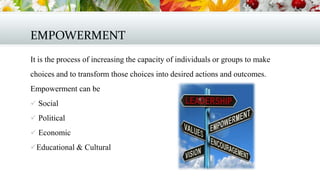
It is the process of increasing the capacity of individuals or groups to make
choices and to transform those choices into desired actions and outcomes.
Empowerment can be
 Social
 Political
 Economic

 Educational & Cultural
EMPOWERMENT
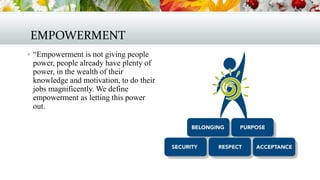
 “Empowerment is not giving people

power, people already have plenty of
power, in the wealth of their
knowledge and motivation, to do their
jobs magnificently. We define
empowerment as letting this power
out.
WHAT IS EMPOWERMENT?
 Responsibility and ownership
 Working independently towards common objectives
 Earned privilege not a given right
EMPLOYERS`S POINT OF VIEW
 To be more proactive
 To take up responsibilities and challenges
 To contribute
 To bring solutions
INDIVIDUAL`S POINT OF VIEW
 More autonomy
 To make decisions
 Visibility and recognition
 Empowering service users
 -- giving the respect, dignity and

encouraging their participation in decision
making, maintaining rights, providing choice
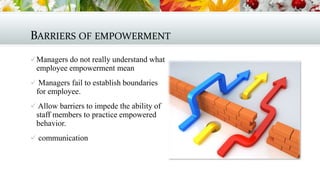
BARRIERS OF EMPOWERMENT
 Managers do not really understand what

employee empowerment mean
 Managers fail to establish boundaries

for employee.
 Allow barriers to impede the ability of

staff members to practice empowered
behavior.
 communication
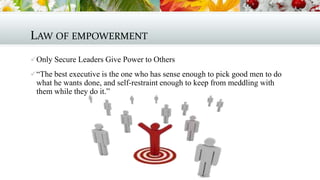
LAW OF EMPOWERMENT
 Only Secure Leaders Give Power to Others
 “The best executive is the one who has sense enough to pick good men to do

what he wants done, and self-restraint enough to keep from meddling with
them while they do it.”
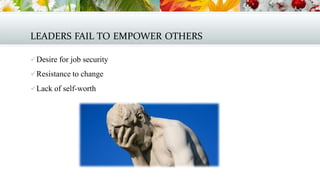
LEADERS FAIL TO EMPOWER OTHERS
 Desire for job security
 Resistance to change
 Lack of self-worth
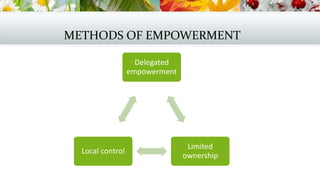
METHODS OF EMPOWERMENT
Delegated
empowerment

Local control

Limited
ownership
CONCLUSION
 "Leadership must be based on goodwill... It means obvious and wholehearted

commitment to helping followers... What we need for leaders are men of
heart who are so helpful that they, in effect, do away with the need of their
jobs. But leaders like that are never out of a job, never out of followers.
Strange as it sounds, great leaders gain authority by giving it away."
empowerment by Vignesh

empowerment by Vignesh

  • 1.
  • 3.
    WORLD BANK SAYS “ Empowerment is the process of increasing the capacity of individuals or groups to make choices and to transform those choices into desired actions and outcomes.”
  • 4.
    EMPOWERMENT It is theprocess of increasing the capacity of individuals or groups to make choices and to transform those choices into desired actions and outcomes. Empowerment can be  Social  Political  Economic  Educational & Cultural
  • 5.
    EMPOWERMENT  “Empowerment isnot giving people power, people already have plenty of power, in the wealth of their knowledge and motivation, to do their jobs magnificently. We define empowerment as letting this power out.
  • 6.
    WHAT IS EMPOWERMENT? Responsibility and ownership  Working independently towards common objectives  Earned privilege not a given right
  • 7.
    EMPLOYERS`S POINT OFVIEW  To be more proactive  To take up responsibilities and challenges  To contribute  To bring solutions
  • 8.
    INDIVIDUAL`S POINT OFVIEW  More autonomy  To make decisions  Visibility and recognition  Empowering service users  -- giving the respect, dignity and encouraging their participation in decision making, maintaining rights, providing choice
  • 9.
    BARRIERS OF EMPOWERMENT Managers do not really understand what employee empowerment mean  Managers fail to establish boundaries for employee.  Allow barriers to impede the ability of staff members to practice empowered behavior.  communication
  • 10.
    LAW OF EMPOWERMENT Only Secure Leaders Give Power to Others  “The best executive is the one who has sense enough to pick good men to do what he wants done, and self-restraint enough to keep from meddling with them while they do it.”
  • 11.
    LEADERS FAIL TOEMPOWER OTHERS  Desire for job security  Resistance to change  Lack of self-worth
  • 12.
  • 13.
    CONCLUSION  "Leadership mustbe based on goodwill... It means obvious and wholehearted commitment to helping followers... What we need for leaders are men of heart who are so helpful that they, in effect, do away with the need of their jobs. But leaders like that are never out of a job, never out of followers. Strange as it sounds, great leaders gain authority by giving it away."