





Responsible Leadership as 
Virtuous Leadership 
Kim Cameron 
Journal of Business Ethics 
September 2011
What is 
“responsible leadership”?
Components of Responsible Leadership 
 responsibility
Accountability 
a responsible leader is accountable for their performance
Dependability 
a responsible leader is dependable in achieving their 
promised performance
Components of Responsible Leadership 
ability and resources to 
achieve an objective 
“response-able”
Freedom of Action 
a responsible leader is able to act freely
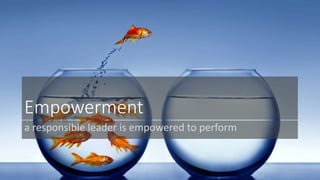
Empowerment 
a responsible leader is empowered to perform
Components of Responsible Leadership 
 play a supportive role 
 maintain a strong character
Role: Stakeholder Theory 
a responsible leader manages many stakeholders
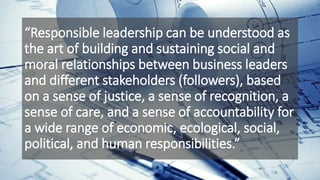
“Responsible leadership can be understood as 
the art of building and sustaining social and 
moral relationships between business leaders 
and different stakeholders (followers), based 
on a sense of justice, a sense of recognition, a 
sense of care, and a sense of accountability for 
a wide range of economic, ecological, social, 
political, and human responsibilities.”
Components of Responsible Leadership 
 behaving in an appropriate manner 
 rarely referred to as a component 
of responsible leadership or the 
business world in general
Virtuousness 
a responsible leader focuses on doing what is right or good
Virtuousness ≠ Ethics 
ethics is essentially the avoidance of negative consequences, not 
necessarily the pursuit of good
Virtuousness = Ultimate Goodness 
virtuousness is the embodiment of goodness in character and behavior 
for the sole purpose of doing good
3 Core Assumptions of 
Virtuous (Responsible) Leadership 
eudaemonic assumption 
inherent value assumption 
amplification assumption
Eudaemonic Assumption 
virtuousness is inborn; an evolutionary component of the human condition that 
promotes healthy social engagement and welfare to support the continuance of 
the species
Inherent Value Assumption 
virtuousness is not a tool to acquire some specific outcome, but rather the 
embodiment of selflessness purely for the good of civilization
Amplification Assumption 
virtuousness is present in and valuable to all people; therefore, it is highly 
influential in that virtuous acts inspire others to act in spirit and creates a chain of 
“good” actions
Virtuous Leader = A Fixed Point 
the inherent ability and desire to do good is unchanging for all agents and 
can guide decision making toward moral and stable goals in difficult times
Virtuousness = Healthy Consequences 
For Individuals 
honesty 
giving behavior 
love 
forgiveness 
hope 
transcendent meaning 
gratitude 
caring 
empathy 
commitment 
satisfaction 
motivation 
positive emotions 
effort 
physical health 
psychological health
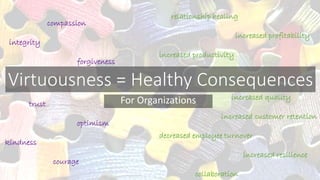
Virtuousness = Healthy Consequences 
For Organizations 
compassion 
integrity 
forgiveness 
trust 
optimism 
kindness 
courage 
relationship healing 
increased profitability 
increased productivity 
increased quality 
increased customer retention 
decreased employee turnover 
increased resilience 
collaboration
Responsible Leadership… 
 responsibility 
 accountability 
 dependability 
 authority 
 empowerment 
 virtuousness  humanity’s greatest attributes 
- addresses: what is the most responsible approach to leadership? 
- often overlooked as a key component of responsible leadership

Responsible leadership by Siara Johnson

  • 1.
    Responsible Leadership as Virtuous Leadership Kim Cameron Journal of Business Ethics September 2011
  • 2.
    What is “responsibleleadership”?
  • 3.
    Components of ResponsibleLeadership  responsibility
  • 4.
    Accountability a responsibleleader is accountable for their performance
  • 5.
    Dependability a responsibleleader is dependable in achieving their promised performance
  • 6.
    Components of ResponsibleLeadership ability and resources to achieve an objective “response-able”
  • 7.
    Freedom of Action a responsible leader is able to act freely
  • 8.
    Empowerment a responsibleleader is empowered to perform
  • 9.
    Components of ResponsibleLeadership  play a supportive role  maintain a strong character
  • 10.
    Role: Stakeholder Theory a responsible leader manages many stakeholders
  • 11.
    “Responsible leadership canbe understood as the art of building and sustaining social and moral relationships between business leaders and different stakeholders (followers), based on a sense of justice, a sense of recognition, a sense of care, and a sense of accountability for a wide range of economic, ecological, social, political, and human responsibilities.”
  • 12.
    Components of ResponsibleLeadership  behaving in an appropriate manner  rarely referred to as a component of responsible leadership or the business world in general
  • 13.
    Virtuousness a responsibleleader focuses on doing what is right or good
  • 14.
    Virtuousness ≠ Ethics ethics is essentially the avoidance of negative consequences, not necessarily the pursuit of good
  • 15.
    Virtuousness = UltimateGoodness virtuousness is the embodiment of goodness in character and behavior for the sole purpose of doing good
  • 16.
    3 Core Assumptionsof Virtuous (Responsible) Leadership eudaemonic assumption inherent value assumption amplification assumption
  • 17.
    Eudaemonic Assumption virtuousnessis inborn; an evolutionary component of the human condition that promotes healthy social engagement and welfare to support the continuance of the species
  • 18.
    Inherent Value Assumption virtuousness is not a tool to acquire some specific outcome, but rather the embodiment of selflessness purely for the good of civilization
  • 19.
    Amplification Assumption virtuousnessis present in and valuable to all people; therefore, it is highly influential in that virtuous acts inspire others to act in spirit and creates a chain of “good” actions
  • 20.
    Virtuous Leader =A Fixed Point the inherent ability and desire to do good is unchanging for all agents and can guide decision making toward moral and stable goals in difficult times
  • 21.
    Virtuousness = HealthyConsequences For Individuals honesty giving behavior love forgiveness hope transcendent meaning gratitude caring empathy commitment satisfaction motivation positive emotions effort physical health psychological health
  • 22.
    Virtuousness = HealthyConsequences For Organizations compassion integrity forgiveness trust optimism kindness courage relationship healing increased profitability increased productivity increased quality increased customer retention decreased employee turnover increased resilience collaboration
  • 23.
    Responsible Leadership… responsibility  accountability  dependability  authority  empowerment  virtuousness  humanity’s greatest attributes - addresses: what is the most responsible approach to leadership? - often overlooked as a key component of responsible leadership