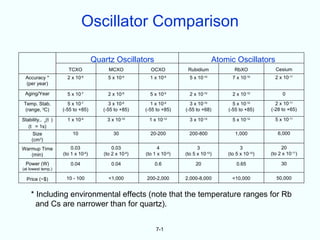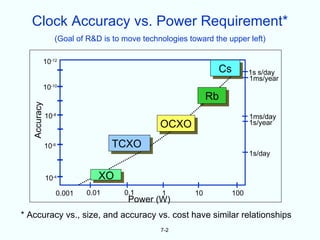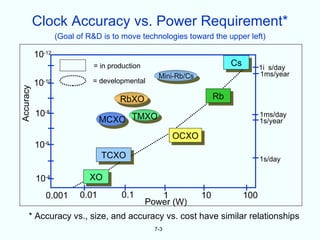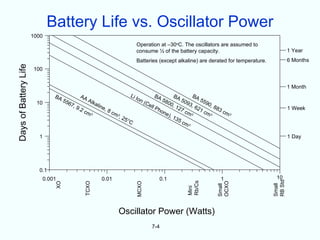
Rev. 8.5.3.6


Quartz Crystal Resonators and Oscillators
 For Frequency Control and Timing Applications - A Tutorial
                                  January 2007


                                 John R. Vig
                                         Consultant.
          Most of this Tutorial was prepared while the author was employed by the
     US Army Communications-Electronics Research, Development & Engineering Center
                                  Fort Monmouth, NJ, USA
                                  J.Vig@IEEE.org
                                 Approved for public release.
                                   Distribution is unlimited
NOTICES
                       Disclaimer


The citation of trade names and names of manufacturers
in this report is not to be construed as official Government
endorsement or consent or approval of commercial
products or services referenced herein.
Table of Contents

Preface………………………………..………………………..                           v
1.    Applications and Requirements……………………….              1
2.    Quartz Crystal Oscillators……………………………….              2
3.    Quartz Crystal Resonators………………………………                3
4.    Oscillator Stability…………………………………………                 4
5.    Quartz Material Properties……………………………...             5
6.    Atomic Frequency Standards……………………………                6
7.    Oscillator Comparison and Specification……………..       7
8.    Time and Timekeeping………………………………….                   8
9.    Related Devices and Applications………………………            9
10.   FCS Proceedings Ordering, Website, and Index…………..   10


                              iii
Preface

                          Why This Tutorial?
  “Everything should be made as simple as                   I was frequently asked for “hard-copies”
possible - but not simpler,” said Einstein. The        of the slides, so I started organizing, adding
main goal of this “tutorial” is to assist with         some text, and filling the gaps in the slide
presenting the most frequently encountered             collection. As the collection grew, I began
concepts in frequency control and timing, as           receiving favorable comments and requests
simply as possible.                                    for additional copies. Apparently, others, too,
                                                       found this collection to be useful. Eventually, I
   I have often been called upon to brief              assembled this document, the “Tutorial”.
visitors, management, and potential users of
precision oscillators, and have also been                   This is a work in progress. I plan to
invited to present seminars, tutorials, and            include additional material, including
review papers before university, IEEE, and             additional notes. Comments, corrections, and
other professional groups. In the beginning, I         suggestions for future revisions will be
spent a great deal of time preparing these             welcome.
presentations. Much of the time was spent on
preparing the slides. As I accumulated more                                    John R. Vig
and more slides, it became easier and easier
to prepare successive presentations.


                                                  iv
Notes and References
   Notes and references can be found in the “Notes” of
most of the pages. To view the notes, use the “Notes
Page View” icon (near the lower left corner of the
screen), or select “Notes Page” in the View menu. In
PowerPoint 2000 (and, presumably, later versions), the
notes also appear in the “Normal view”.
   To print a page so that it includes the notes, select
Print in the File menu, and, near the bottom, at “Print
what:,” select “Notes Pages”.
   Many of the references are to IEEE publications
which are available online in the IEEE UFFC-S digital
archive, www.ieee-uffc.org/archive, or in IEEE Xplore,
www.ieee.org/ieeexplore .

                           v
In all pointed sentences [and tutorials],
some degree of accuracy must be
sacrificed to conciseness.
          Samuel Johnson
CHAPTER 1
Applications and Requirements


              1
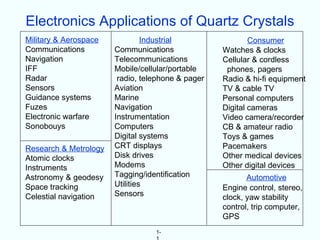
Electronics Applications of Quartz Crystals
Military & Aerospace            Industrial                 Consumer
Communications         Communications              Watches & clocks
Navigation             Telecommunications          Cellular & cordless
IFF                    Mobile/cellular/portable     phones, pagers
Radar                   radio, telephone & pager   Radio & hi-fi equipment
Sensors                Aviation                    TV & cable TV
Guidance systems       Marine                      Personal computers
Fuzes                  Navigation                  Digital cameras
Electronic warfare     Instrumentation             Video camera/recorder
Sonobouys              Computers                   CB & amateur radio
                       Digital systems             Toys & games
Research & Metrology   CRT displays                Pacemakers
Atomic clocks          Disk drives                 Other medical devices
Instruments            Modems                      Other digital devices
Astronomy & geodesy    Tagging/identification             Automotive
Space tracking         Utilities                   Engine control, stereo,
Celestial navigation   Sensors                     clock, yaw stability
                                                   control, trip computer,
                                                   GPS
                                  1-
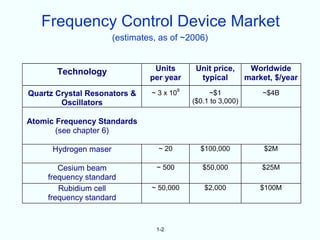
Frequency Control Device Market
                       (estimates, as of ~2006)


       Technology                Units       Unit price,       Worldwide
                                per year      typical         market, $/year
Quartz Crystal Resonators &     ~ 3 x 10⁹        ~$1              ~$4B
        Oscillators                         ($0.1 to 3,000)

Atomic Frequency Standards
       (see chapter 6)

      Hydrogen maser              ~ 20        $100,000             $2M

        Cesium beam               ~ 500        $50,000            $25M
     frequency standard
        Rubidium cell           ~ 50,000       $2,000             $100M
     frequency standard


                                  1-2
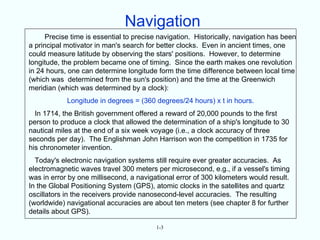
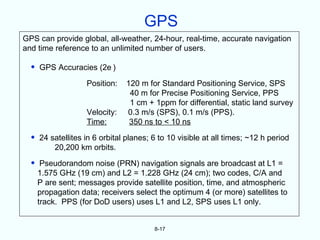
Navigation
      Precise time is essential to precise navigation. Historically, navigation has been
a principal motivator in man's search for better clocks. Even in ancient times, one
could measure latitude by observing the stars' positions. However, to determine
longitude, the problem became one of timing. Since the earth makes one revolution
in 24 hours, one can determine longitude form the time difference between local time
(which was determined from the sun's position) and the time at the Greenwich
meridian (which was determined by a clock):
            Longitude in degrees = (360 degrees/24 hours) x t in hours.
  In 1714, the British government offered a reward of 20,000 pounds to the first
person to produce a clock that allowed the determination of a ship's longitude to 30
nautical miles at the end of a six week voyage (i.e., a clock accuracy of three
seconds per day). The Englishman John Harrison won the competition in 1735 for
his chronometer invention.
  Today's electronic navigation systems still require ever greater accuracies. As
electromagnetic waves travel 300 meters per microsecond, e.g., if a vessel's timing
was in error by one millisecond, a navigational error of 300 kilometers would result.
In the Global Positioning System (GPS), atomic clocks in the satellites and quartz
oscillators in the receivers provide nanosecond-level accuracies. The resulting
(worldwide) navigational accuracies are about ten meters (see chapter 8 for further
details about GPS).

                                          1-3
Commercial Two-way Radio
   Historically, as the number of users of commercial two-way radios
have grown, channel spacings have been narrowed, and higher-
frequency spectra have had to be allocated to accommodate the
demand. Narrower channel spacings and higher operating frequencies
necessitate tighter frequency tolerances for both the transmitters and the
receivers. In 1940, when only a few thousand commercial broadcast
transmitters were in use, a 500 ppm tolerance was adequate. Today,
the oscillators in the many millions of cellular telephones (which operate
at frequency bands above 800 MHz) must maintain a frequency
tolerance of 2.5 ppm and better. The 896-901 MHz and 935-940 MHz
mobile radio bands require frequency tolerances of 0.1 ppm at the base
station and 1.5 ppm at the mobile station.
   The need to accommodate more users will continue to require higher
and higher frequency accuracies. For example, a NASA concept for a
personal satellite communication system would use walkie-talkie-like
hand-held terminals, a 30 GHz uplink, a 20 GHz downlink, and a 10 kHz
channel spacing. The terminals' frequency accuracy requirement is a
few parts in 108.

                                   1-4
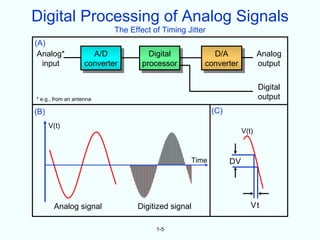
Digital Processing of Analog Signals
                            The Effect of Timing Jitter
(A)
 Analog*              A/D             Digital           D/A                 Analog
  input             converter       processor         converter             output

                                                                            Digital
* e.g., from an antenna                                                     output
(B)                                                       (C)
      V(t)
                                                                     V(t)


                                                  Time          DV


       Analog signal              Digitized signal                      Vt

                                        1-5
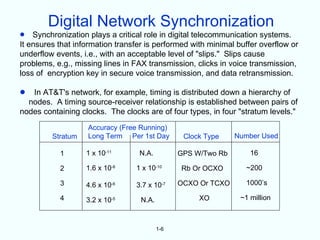
Digital Network Synchronization
•   Synchronization plays a critical role in digital telecommunication systems.
It ensures that information transfer is performed with minimal buffer overflow or
underflow events, i.e., with an acceptable level of "slips." Slips cause
problems, e.g., missing lines in FAX transmission, clicks in voice transmission,
loss of encryption key in secure voice transmission, and data retransmission.

•  In AT&T's network, for example, timing is distributed down a hierarchy of
  nodes. A timing source-receiver relationship is established between pairs of
nodes containing clocks. The clocks are of four types, in four "stratum levels."
                   Accuracy (Free Running)
         Stratum   Long Term Per 1st Day         Clock Type    Number Used

           1       1 x 10-11      N.A.          GPS W/Two Rb       16

           2       1.6 x 10⁻⁸    1 x 10⁻¹⁰      Rb Or OCXO       ~200

           3       4.6 x 10⁻⁶    3.7 x 10⁻⁷     OCXO Or TCXO     1000’s

           4       3.2 x 10⁻⁵      N.A.              XO         ~1 million


                                          1-6
Phase Noise in PLL and PSK Systems
        The phase noise of oscillators can lead to erroneous detection of
phase transitions, i.e., to bit errors, when phase shift keyed (PSK) digital
modulation is used. In digital communications, for example, where          8-
phase PSK is used, the maximum phase tolerance is ±22.5o, of which
±7.5o is the typical allowable carrier noise contribution. Due to the
statistical nature of phase deviations, if the RMS phase deviation is 1.5o,
for example, the probability of exceeding the ±7.5o phase deviation is
6 X 10⁻⁷, which can result in a bit error rate that is significant in some
applications.

        Shock and vibration can produce large phase deviations even in
"low noise" oscillators. Moreover, when the frequency of an oscillator is
multiplied by N, the phase deviations are also multiplied by N. For
example, a phase deviation of 10-3 radian at 10 MHz becomes 1 radian
at 10 GHz. Such large phase excursions can be catastrophic to the
performance of systems, e.g., of those which rely on phase locked loops
(PLL) or phase shift keying (PSK). Low noise, acceleration insensitive
oscillators are essential in such applications.
                                     1-7
Utility Fault Location
                                             Zap!
      ta                                                                               tb
Substation                                                                          Substation
    A                                                                                   B

                                 Insulator
                                 Sportsman
                         X
                                               L
When a fault occurs, e.g., when a "sportsman" shoots out an insulator, a disturbance
propagates down the line. The location of the fault can be determined from the differences
in the times of arrival at the nearest substations:

                    x=1/2[L - c(tb-ta)] = 1/2[L - c t]
where x = distance of the fault from substation A, L = A to B line length, c = speed of light,
and ta and tb= time of arrival of disturbance at A and B, respectively.

Fault locator error = xterror=1/2(cl error); therefore, if o error e 1 microsecond, then
xerror r 150 meters d 1/2 of high voltage tower spacings, so, the utility company
can send a repair crew directly to the tower that is nearest to the fault.


                                             1-8
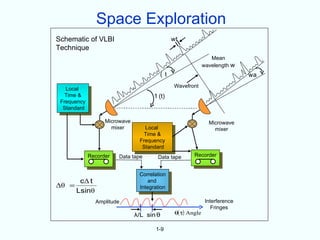
Space Exploration
Schematic of VLBI                             wt
Technique
                                                                Mean
                                                             wavelength w
                                        ( t                                  wa
                                              Wavefront
   Local
   Time &                             1 (t)
 Frequency
  Standard

                   Microwave                                   Microwave
                     mixer        Local                          mixer
                                  Time &
                                Frequency
                                 Standard
             Recorder   Data tape      Data tape       Recorder


                                Correlation
        cΔ t                       and
Δθ =                            Integration
       Lsinθ
               Amplitude                                      Interference
                                                                 Fringes
                               λ/L sin θ       θ( τ) Angle

                                      1-9
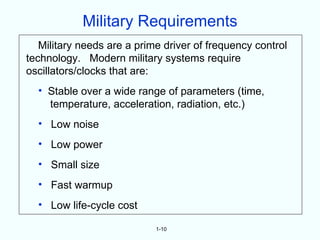
Military Requirements
   Military needs are a prime driver of frequency control
technology. Modern military systems require
oscillators/clocks that are:
  • Stable over a wide range of parameters (time,
    temperature, acceleration, radiation, etc.)
  • Low noise
  • Low power
  • Small size
  • Fast warmup
  • Low life-cycle cost

                            1-10
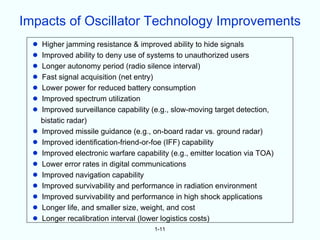
Impacts of Oscillator Technology Improvements
  •   Higher jamming resistance & improved ability to hide signals
  •   Improved ability to deny use of systems to unauthorized users
  •   Longer autonomy period (radio silence interval)
  •   Fast signal acquisition (net entry)
  •   Lower power for reduced battery consumption
  •   Improved spectrum utilization
  •   Improved surveillance capability (e.g., slow-moving target detection,
      bistatic radar)
  •   Improved missile guidance (e.g., on-board radar vs. ground radar)
  •   Improved identification-friend-or-foe (IFF) capability
  •   Improved electronic warfare capability (e.g., emitter location via TOA)
  •   Lower error rates in digital communications
  •   Improved navigation capability
  •   Improved survivability and performance in radiation environment
  •   Improved survivability and performance in high shock applications
  •   Longer life, and smaller size, weight, and cost
  •   Longer recalibration interval (lower logistics costs)
                                        1-11
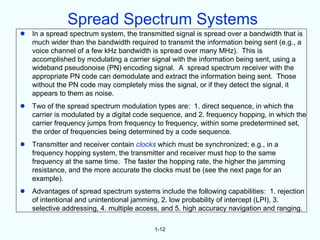
Spread Spectrum Systems
•   In a spread spectrum system, the transmitted signal is spread over a bandwidth that is
    much wider than the bandwidth required to transmit the information being sent (e.g., a
    voice channel of a few kHz bandwidth is spread over many MHz). This is
    accomplished by modulating a carrier signal with the information being sent, using a
    wideband pseudonoise (PN) encoding signal. A spread spectrum receiver with the
    appropriate PN code can demodulate and extract the information being sent. Those
    without the PN code may completely miss the signal, or if they detect the signal, it
    appears to them as noise.
•   Two of the spread spectrum modulation types are: 1. direct sequence, in which the
    carrier is modulated by a digital code sequence, and 2. frequency hopping, in which the
    carrier frequency jumps from frequency to frequency, within some predetermined set,
    the order of frequencies being determined by a code sequence.
•   Transmitter and receiver contain clocks which must be synchronized; e.g., in a
    frequency hopping system, the transmitter and receiver must hop to the same
    frequency at the same time. The faster the hopping rate, the higher the jamming
    resistance, and the more accurate the clocks must be (see the next page for an
    example).
•   Advantages of spread spectrum systems include the following capabilities: 1. rejection
    of intentional and unintentional jamming, 2. low probability of intercept (LPI), 3.
    selective addressing, 4. multiple access, and 5. high accuracy navigation and ranging.

                                          1-12
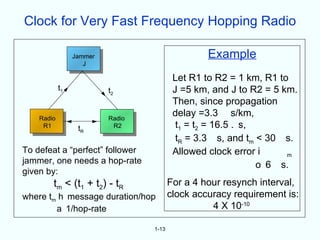
Clock for Very Fast Frequency Hopping Radio

                 Jammer                           Example
                    J

                                          Let R1 to R2 = 1 km, R1 to
            t1            t2              J =5 km, and J to R2 = 5 km.
                                          Then, since propagation
    Radio                 Radio
                                          delay =3.3 s/km,
     R1           tR       R2              t1 = t2 = 16.5 . s,
                                           tR = 3.3 s, and tm < 30 s.
To defeat a “perfect” follower            Allowed clock error i     m
jammer, one needs a hop-rate                                   o 6 s.
given by:
        tm < (t1 + t2) - tR              For a 4 hour resynch interval,
where tm h message duration/hop          clock accuracy requirement is:
        a 1/hop-rate                               4 X 10⁻¹⁰

                                  1-13
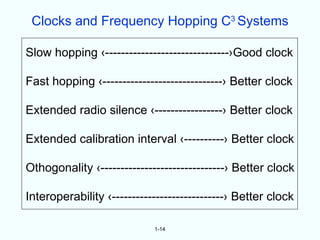
Clocks and Frequency Hopping C3 Systems

Slow hopping ‹-------------------------------›Good clock

Fast hopping ‹------------------------------› Better clock

Extended radio silence ‹-----------------› Better clock

Extended calibration interval ‹----------› Better clock

Othogonality ‹-------------------------------› Better clock

Interoperability ‹----------------------------› Better clock

                            1-14
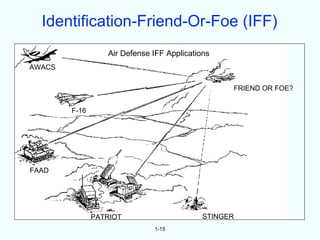
Identification-Friend-Or-Foe (IFF)
                  Air Defense IFF Applications
AWACS

                                                  FRIEND OR FOE?


        F-16


FAAD


               PATRIOT                      STINGER
                              1-15
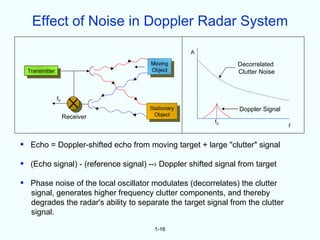
Effect of Noise in Doppler Radar System
                                                     A

                                        Moving                    Decorrelated
    Transmitter                         Object                    Clutter Noise


                  fD
                                        Stationary                Doppler Signal
                       Receiver           Object
                                                           fD
                                                                                   f


•    Echo = Doppler-shifted echo from moving target + large "clutter" signal

•    (Echo signal) - (reference signal) --› Doppler shifted signal from target

•    Phase noise of the local oscillator modulates (decorrelates) the clutter
     signal, generates higher frequency clutter components, and thereby
     degrades the radar's ability to separate the target signal from the clutter
     signal.

                                         1-16
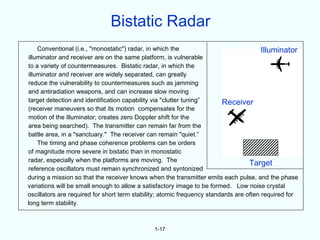
Bistatic Radar
    Conventional (i.e., "monostatic") radar, in which the                               Illuminator
illuminator and receiver are on the same platform, is vulnerable
to a variety of countermeasures. Bistatic radar, in which the
illuminator and receiver are widely separated, can greatly
reduce the vulnerability to countermeasures such as jamming
and antiradiation weapons, and can increase slow moving
target detection and identification capability via "clutter tuning”      Receiver
(receiver maneuvers so that its motion compensates for the
motion of the illuminator; creates zero Doppler shift for the
area being searched). The transmitter can remain far from the
battle area, in a "sanctuary." The receiver can remain "quiet.”
    The timing and phase coherence problems can be orders
of magnitude more severe in bistatic than in monostatic
radar, especially when the platforms are moving. The
                                                                                   Target
reference oscillators must remain synchronized and syntonized
during a mission so that the receiver knows when the transmitter emits each pulse, and the phase
variations will be small enough to allow a satisfactory image to be formed. Low noise crystal
oscillators are required for short term stability; atomic frequency standards are often required for
long term stability.


                                              1-17
Radar Frequency (GHz)


                                                                   0
                                                                        5
                                                                            10
                                                                                             15
                                                                                                     20
                                                                                                              25
                                                                                                                                   40


                                                                                                                       30


                                                                 10
                                                                                 4km/h -
                                                                                                  Man or
                                                                                                         S


                                                                 100
                                                                                                               low Mo
                                                                                                                      ving Ve
                                                                                                                              c         hile


                                                                 1K
                                                                                  100km/
                                                                                                  h - V eh


1-18
                                                                                                             icle, Gro
                                                                                                                         und or A
                                                                                                                                 ir
                                                                                  700km/h

                                                                 10K
                                                                                                    - S ubs o
                                                                                                                nic Aircr
                                                                                                                            af t
                                                                                        2, 400 k
                                                                                                   m/h - M
                                                                                                          ac       h 2 Airc
                                                                                                                              raft
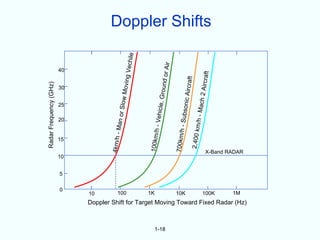
                                                                                                                                               Doppler Shifts


                                                                 100K
                                                                 1M
                                                                             X-Band RADAR


       Doppler Shift for Target Moving Toward Fixed Radar (Hz)
CHAPTER 2
Quartz Crystal Oscillators


            2
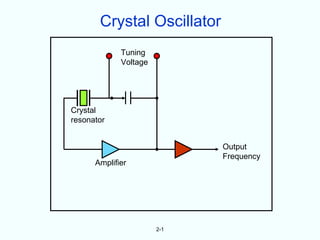
Crystal Oscillator
             Tuning
             Voltage


Crystal
resonator


                             Output
                             Frequency
      Amplifier


                       2-1
Oscillation
•   At the frequency of oscillation, the closed loop phase shift
    = 2nh .
•   When initially energized, the only signal in the circuit is
    noise. That component of noise, the frequency of which
    satisfies the phase condition for oscillation, is propagated
    around the loop with increasing amplitude. The rate of
    increase depends on the excess; i.e., small-signal, loop
    gain and on the BW of the crystal in the network.
•   The amplitude continues to increase until the amplifier gain
    is reduced either by nonlinearities of the active elements
    ("self limiting") or by some automatic level control.
•   At steady state, the closed-loop gain = 1.

                                2-
                                2
Oscillation and Stability
•    If a phase perturbation      occurs, the frequency must shift f to maintain the
    2n phase condition, where c f/f=- t /2QL for a series-resonance oscillator,
    and QL is loaded Q of the crystal in the network. The "phase slope," do
    is proportional to QL in the vicinity of the series resonance frequency (also
    see "Equivalent Circuit" and "Frequency vs. Reactance" in Chapt. 3).

•   Most oscillators operate at "parallel resonance," where the reactance vs.
    frequency slope, dX/df, i.e., the "stiffness," is inversely proportional to C1,
    the motional capacitance of the crystal unit.

•   For maximum frequency stability with respect to phase (or reactance)
    perturbations in the oscillator loop, the phase slope (or reactance slope) must
    be maximum, i.e., C1 should be minimum and QL should be maximum. A
    quartz crystal unit's high Q and high stiffness makes it the primary frequency
    (and frequency stability) determining element in oscillators.


                                           2-3
Tunability and Stability
      Making an oscillator tunable over a wide frequency range degrades its
stability because making an oscillator susceptible to intentional tuning also
makes it susceptible to factors that result in unintentional tuning. The wider
the tuning range, the more difficult it is to maintain a high stability. For
example, if an OCXO is designed to have a short term stability of            1x
10-12 for some averaging time and a tunability of 1 x 10⁻⁷, then the crystal's
load reactance must be stable to 1 x 10⁻⁵ for that averaging time.
Achieving such stability is difficult because the load reactance is affected
by stray capacitances and inductances, by the stability of the varactor's
capacitance vs. voltage characteristic, and by the stability of the voltage on
the varactor. Moreover, the 1 x 10⁻⁵ load reactance stability must be
maintained not only under benign conditions, but also under changing
environmental conditions (temperature, vibration, radiation, etc.).
      Whereas a high stability, ovenized 10 MHz voltage controlled
oscillator may have a frequency adjustment range of 5 x 10⁻⁷ and an aging
rate of 2 x 10⁻⁸ per year, a wide tuning range 10 MHz VCXO may have a
tuning range of 50 ppm and an aging rate of 2 ppm per year.

                                      2-4
Oscillator Acronyms
 Most Commonly Used:

•   XO…………..Crystal Oscillator

•   VCXO………Voltage Controlled Crystal Oscillator

•   OCXO………Oven Controlled Crystal Oscillator

•   TCXO………Temperature Compensated Crystal Oscillator

Others:

•   TCVCXO..…Temperature Compensated/Voltage Controlled Crystal Oscillator

•   OCVCXO.….Oven Controlled/Voltage Controlled Crystal Oscillator

•   MCXO………Microcomputer Compensated Crystal Oscillator

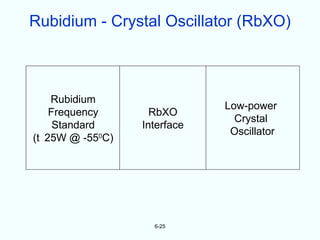
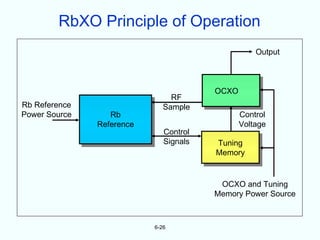
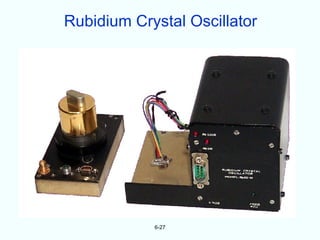
•   RbXO……….Rubidium-Crystal Oscillator

                                         2-5
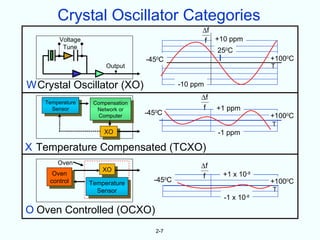
Crystal Oscillator Categories
The three categories, based on the method of dealing with the crystal unit's
frequency vs. temperature (f vs. T) characteristic, are:

•   XO, crystal oscillator, does not contain means for reducing the crystal's
    f vs. T characteristic (also called PXO-packaged crystal oscillator).

•   TCXO, temperature compensated crystal oscillator, in which, e.g., the
    output signal from a temperature sensor (e.g., a thermistor) is used to
    generate a correction voltage that is applied to a variable reactance (e.g., a
    varactor) in the crystal network. The reactance variations compensate for
    the crystal's f vs. T characteristic. Analog TCXO's can provide about a 20X
    improvement over the crystal's f vs. T variation.

•   OCXO, oven controlled crystal oscillator, in which the crystal and other
    temperature sensitive components are in a stable oven which is adjusted to
    the temperature where the crystal's f vs. T has zero slope. OCXO's can
    provide a >1000X improvement over the crystal's f vs. T variation.


                                         2-6
Crystal Oscillator Categories
                                                      ∆f
         Voltage                                      f +10 ppm
          Tune
                                                         250C
                                   -450C                                +1000C
                        Output                                          T


W Crystal Oscillator (XO)                       -10 ppm
                                                      ∆f
    Temperature     Compensation
      Sensor         Network or                        f   +1 ppm
                      Computer     -450C                                +1000C
                                                                        T
                       XO                                  -1 ppm

X Temperature Compensated (TCXO)
        Oven
                       XO
                                                      ∆f
      Oven                                            f     +1 x 10⁻⁸
     control       Temperature       -45 C  0
                                                                        +1000C
                     Sensor                                             T
                                                            -1 x 10⁻⁸
O Oven Controlled (OCXO)
                                      2-7
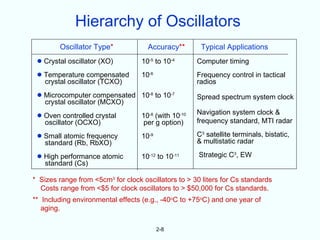
Hierarchy of Oscillators
        Oscillator Type*             Accuracy**        Typical Applications
 • Crystal oscillator (XO)         10-5 to 10-4       Computer timing
 • Temperature compensated         10-6               Frequency control in tactical
    crystal oscillator (TCXO)                         radios
 • Microcomputer compensated       10-8 to 10-7       Spread spectrum system clock
    crystal oscillator (MCXO)
 • Oven controlled crystal         10-8 (with 10-10   Navigation system clock &
                                                      frequency standard, MTI radar
    oscillator (OCXO)              per g option)
 • Small atomic frequency          10-9               C3 satellite terminals, bistatic,
                                                      & multistatic radar
    standard (Rb, RbXO)
 • High performance atomic         10-12 to 10-11     Strategic C3, EW
    standard (Cs)

* Sizes range from <5cm3 for clock oscillators to > 30 liters for Cs standards
  Costs range from <$5 for clock oscillators to > $50,000 for Cs standards.
** Including environmental effects (e.g., -40oC to +75oC) and one year of
   aging.

                                          2-8
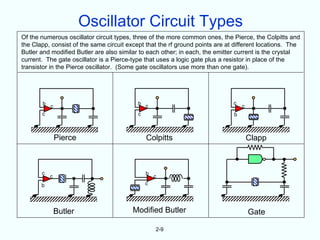
Oscillator Circuit Types
Of the numerous oscillator circuit types, three of the more common ones, the Pierce, the Colpitts and
the Clapp, consist of the same circuit except that the rf ground points are at different locations. The
Butler and modified Butler are also similar to each other; in each, the emitter current is the crystal
current. The gate oscillator is a Pierce-type that uses a logic gate plus a resistor in place of the
transistor in the Pierce oscillator. (Some gate oscillators use more than one gate).


       b                                   b c                                c
           c                                                                      c
       c                                   c                                  b


               Pierce                         Colpitts                                Clapp


       c                                     b
           c                                     c
       b                                     c


               Butler                    Modified Butler                              Gate

                                                 2-9
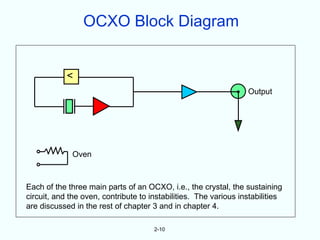
OCXO Block Diagram


                                                                  Output


             Oven


Each of the three main parts of an OCXO, i.e., the crystal, the sustaining
circuit, and the oven, contribute to instabilities. The various instabilities
are discussed in the rest of chapter 3 and in chapter 4.

                                      2-10
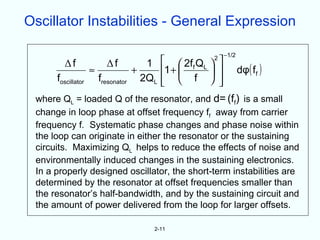
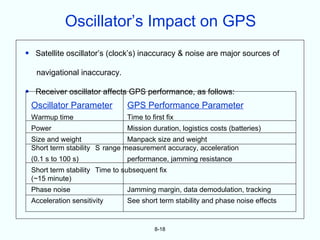
Oscillator Instabilities - General Expression

                                                                    −1/2
         Δf               Δf            1      2ff QL    2
                                                                
                    ≈                +       1 +                       dφ( ff )
      foscillator       fresonator     2QL     f 
                                                               
                                                                
 where QL = loaded Q of the resonator, and d= (ff) is a small
 change in loop phase at offset frequency ff away from carrier
 frequency f. Systematic phase changes and phase noise within
 the loop can originate in either the resonator or the sustaining
 circuits. Maximizing QL helps to reduce the effects of noise and
 environmentally induced changes in the sustaining electronics.
 In a properly designed oscillator, the short-term instabilities are
 determined by the resonator at offset frequencies smaller than
 the resonator’s half-bandwidth, and by the sustaining circuit and
 the amount of power delivered from the loop for larger offsets.

                                         2-11
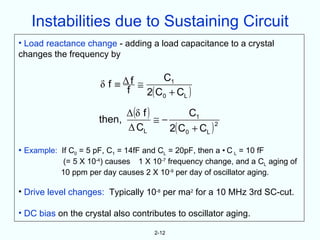
Instabilities due to Sustaining Circuit
• Load reactance change - adding a load capacitance to a crystal
changes the frequency by


                           Δf ≅     C1
                       δf≡
                            f   2( C0 + CL )

                              Δ (δ f )         C1
                      then,            ≅−
                                          2( C0 + CL )
                                                       2
                              Δ CL

• Example: If C0 = 5 pF, C1 = 14fF and CL = 20pF, then a • C L = 10 fF
             (= 5 X 10⁻⁴) causes 1 X 10⁻⁷ frequency change, and a CL aging of
            10 ppm per day causes 2 X 10⁻⁹ per day of oscillator aging.

• Drive level changes: Typically 10-8 per ma2 for a 10 MHz 3rd SC-cut.

• DC bias on the crystal also contributes to oscillator aging.

                                      2-12
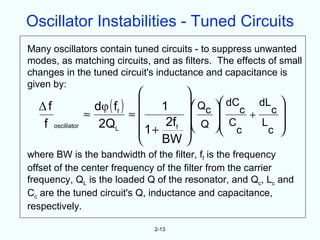
Oscillator Instabilities - Tuned Circuits
Many oscillators contain tuned circuits - to suppress unwanted
modes, as matching circuits, and as filters. The effects of small
changes in the tuned circuit's inductance and capacitance is
given by:
                                         
  Δf                dφ ( ff )  1          Q  dC dL 
                  ≈          ≈            c  c + c 
   f oscillator      2QL       1 + 2ff
                                          Q  Cc
                                               
                                                     L 
                                                       c 
                                  BW     
where BW is the bandwidth of the filter, ff is the frequency
offset of the center frequency of the filter from the carrier
frequency, QL is the loaded Q of the resonator, and Qc, Lc and
Cc are the tuned circuit's Q, inductance and capacitance,
respectively.

                                 2-13
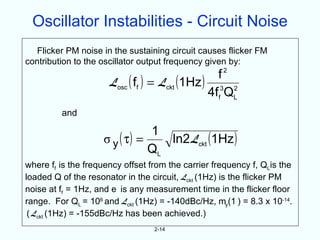
Oscillator Instabilities - Circuit Noise
  Flicker PM noise in the sustaining circuit causes flicker FM
contribution to the oscillator output frequency given by:
                                                 f  2

                      Losc ( ff ) = Lckt (1Hz ) 3 2
                                               4ff QL
         and

                               1
                    σ y ( τ) =    ln2 Lckt (1Hz )
                               QL
where ff is the frequency offset from the carrier frequency f, QLis the
loaded Q of the resonator in the circuit, Lckt (1Hz) is the flicker PM
noise at ff = 1Hz, and e is any measurement time in the flicker floor
range. For QL = 106 and Lckt (1Hz) = -140dBc/Hz, my(1 ) = 8.3 x 10⁻¹⁴.
 ( Lckt (1Hz) = -155dBc/Hz has been achieved.)
                                  2-14
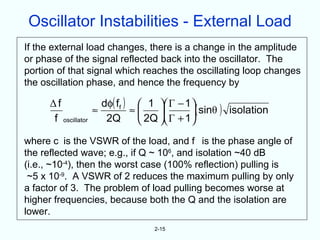
Oscillator Instabilities - External Load
If the external load changes, there is a change in the amplitude
or phase of the signal reflected back into the oscillator. The
portion of that signal which reaches the oscillating loop changes
the oscillation phase, and hence the frequency by

      Δf              dφ( ff )  1  Γ − 1 
                    ≈         ≈          ( sinθ ) isolation
       f oscillator    2Q       2Q  Γ + 1
where c is the VSWR of the load, and f is the phase angle of
the reflected wave; e.g., if Q ~ 106, and isolation ~40 dB
(i.e., ~10-4), then the worst case (100% reflection) pulling is
 ~5 x 10⁻⁹. A VSWR of 2 reduces the maximum pulling by only
a factor of 3. The problem of load pulling becomes worse at
higher frequencies, because both the Q and the isolation are
lower.
                                 2-15
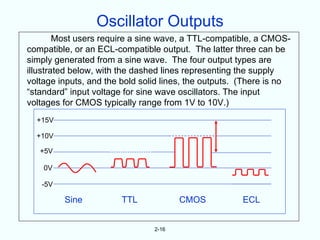
Oscillator Outputs
        Most users require a sine wave, a TTL-compatible, a CMOS-
compatible, or an ECL-compatible output. The latter three can be
simply generated from a sine wave. The four output types are
illustrated below, with the dashed lines representing the supply
voltage inputs, and the bold solid lines, the outputs. (There is no
“standard” input voltage for sine wave oscillators. The input
voltages for CMOS typically range from 1V to 10V.)
  +15V

  +10V

   +5V

    0V

   -5V

         Sine           TTL            CMOS           ECL


                                2-16
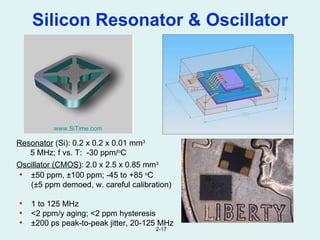
Silicon Resonator & Oscillator


          www.SiTime.com

Resonator (Si): 0.2 x 0.2 x 0.01 mm3
   5 MHz; f vs. T: -30 ppm/oC
Oscillator (CMOS): 2.0 x 2.5 x 0.85 mm3
• ±50 ppm, ±100 ppm; -45 to +85 oC
   (±5 ppm demoed, w. careful calibration)

• 1 to 125 MHz
• <2 ppm/y aging; <2 ppm hysteresis
• ±200 ps peak-to-peak jitter, 20-125 MHz
                                       2-17
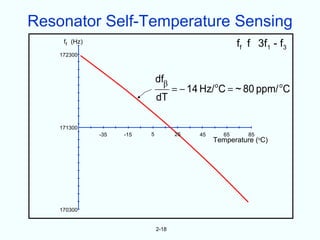
Resonator Self-Temperature Sensing
     ff (Hz)                                             ff f 3f1 - f3
    172300


                               dfβ
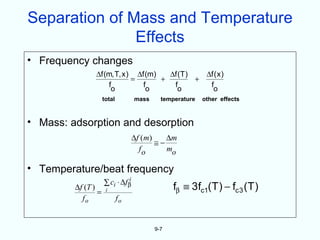
                                      = − 14 Hz/ oC = ~ 80 ppm/ oC
                               dT

    171300
               -35   -15   5          25    45      65      85
                                                 Temperature (oC)


    170300


                               2-18
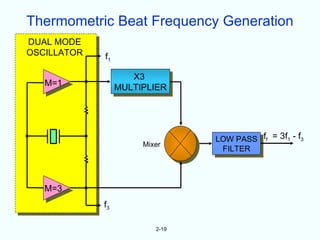
Thermometric Beat Frequency Generation
DUAL MODE
OSCILLATOR   f1

                     X3
   M=1            MULTIPLIER


                                 LOW PASS ff = 3f1 - f3
                       Mixer
                                  FILTER


   M=3
             f3

                          2-19
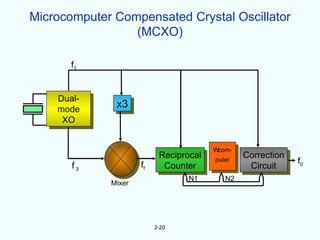
Microcomputer Compensated Crystal Oscillator
                 (MCXO)

       f1


    Dual-
    mode
              x3
     XO


                                        Wcom-
                           Reciprocal           Correction
                     ff
                                        puter                f0
       f3                   Counter              Circuit
                                  N1       N2
             Mixer


                          2-20
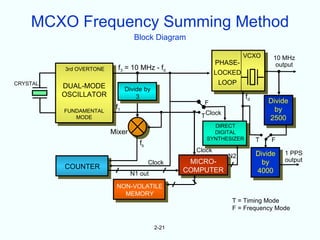
MCXO Frequency Summing Method
                                  Block Diagram

                                                                     VCXO      10 MHz
                                                            PHASE-              output
          3rd OVERTONE     f3 = 10 MHz - fd
                                                            LOCKED
CRYSTAL                                                      LOOP
          DUAL-MODE            Divide by
          OSCILLATOR               3                                 fd
                                                      F                       Divide
                          f1                                                    by
          FUNDAMENTAL
             MODE                                    T Clock                  2500
                                                         DIRECT
                         Mixer                           DIGITAL
                                                       SYNTHESIZER        T   F
                                    fb
                                                    Clock
                                                               N2         Divide   1 PPS
                                         Clock     MICRO-                   by     output
          COUNTER                                 COMPUTER
                                 N1 out                                   4000

                          NON-VOLATILE
                            MEMORY
                                                                T = Timing Mode
                                                                F = Frequency Mode


                                           2-21
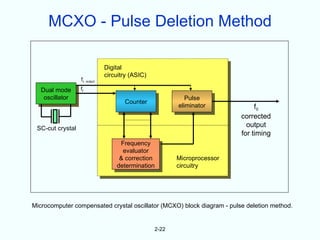
MCXO - Pulse Deletion Method

                                Digital
                                circuitry (ASIC)
                  fc   output


   Dual mode      ff
    oscillator                                               Pulse
                                       Counter
                                                          eliminator            f0
                                                                           corrected
 SC-cut crystal
                                                                             output
                                                                           for timing
                                     Frequency
                                      evaluator
                                     & correction         Microprocessor
                                    determination         circuitry


Microcomputer compensated crystal oscillator (MCXO) block diagram - pulse deletion method.


                                                   2-22
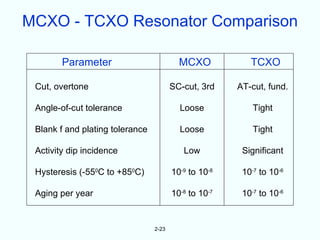
MCXO - TCXO Resonator Comparison

        Parameter                         MCXO            TCXO

 Cut, overtone                          SC-cut, 3rd    AT-cut, fund.

 Angle-of-cut tolerance                   Loose            Tight

 Blank f and plating tolerance            Loose            Tight

 Activity dip incidence                    Low          Significant

 Hysteresis (-550C to +850C)            10-9 to 10-8    10-7 to 10-6

 Aging per year                         10-8 to 10-7    10-7 to 10-6


                                 2-23
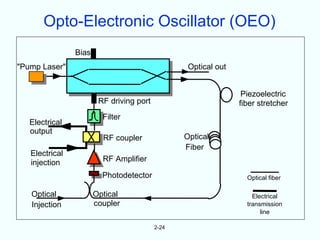
Opto-Electronic Oscillator (OEO)
                Bias
"Pump Laser"                                      Optical out


                                                                 Piezoelectric
                        RF driving port                         fiber stretcher
                         Filter
   Electrical
   output
                         RF coupler              Optical
                                                 Fiber
   Electrical
   injection             RF Amplifier

                         Photodetector                            Optical fiber

   Optical             Optical                                      Electrical
   Injection           coupler                                    transmission
                                                                       line

                                          2-24
CHAPTER 3
Quartz Crystal Resonators


            3
Why Quartz?
  Quartz is the only material known that possesses the following
combination of properties:

• Piezoelectric ("pressure-electric"; piezein = to press, in Greek)

• Zero temperature coefficient cuts exist

• Stress compensated cut exists

• Low loss (i.e., high Q)

• Easy to process; low solubility in everything, under "normal" conditions,
  except the fluoride and hot alkali etchants; hard but not brittle

• Abundant in nature; easy to grow in large quantities, at low cost, and
  with relatively high purity and perfection. Of the man-grown single
  crystals, quartz, at ~3,000 tons per year, is second only to silicon in
  quantity grown (3 to 4 times as much Si is grown annually, as of 1997).

                                      3-1
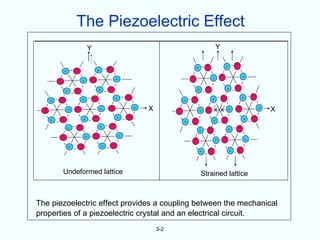
The Piezoelectric Effect
                                      Y                                                                                      Y

                                                                                                                 _                           _
                          _                               _                                             +                            +
                  +                               +
                                                                                                    _                            _
          _                               _                                                                              +                           +
                                  +                               +
                                                          _                                                       _                          _
                          _                                                                                                              +
                  +                               +                                                         +
                                                                          _                                                      _                           _
          _                               _                                                         _                                                +
                                  +                               +                             +                        +
      +
                          _                               _                                                       _ -            +           _
  _
                      +                               +                       +   X         _
                                                                                                            +             X X +                                  +   X
              _                               _                           _                                                                                  _
                                                                  +                                     _                         _
      +                           +                                                                                       +                          +
                              _                               _                                 +
                                                  +                                                                  _                           _
                      +                                                                                                                  +
                                                                                                            +
              _                               _
                                      +                               +                                 _                            _
                                                                                                                          +                              +
                              _                               _
                      +                               +                                                               _                          _
                                                                                                            +                            +


              Undeformed lattice                                                                                Strained lattice


The piezoelectric effect provides a coupling between the mechanical
properties of a piezoelectric crystal and an electrical circuit.
                                                                                      3-2
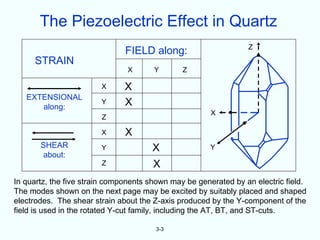
The Piezoelectric Effect in Quartz
                                                                 Z
                               FIELD along:
     STRAIN
                               X       Y       Z

                        X      X
   EXTENSIONAL
      along:
                        Y      X
                                                       X
                        Z

                        X      X
       SHEAR            Y             X                Y
       about:
                        Z              X
In quartz, the five strain components shown may be generated by an electric field.
The modes shown on the next page may be excited by suitably placed and shaped
electrodes. The shear strain about the Z-axis produced by the Y-component of the
field is used in the rotated Y-cut family, including the AT, BT, and ST-cuts.

                                       3-3
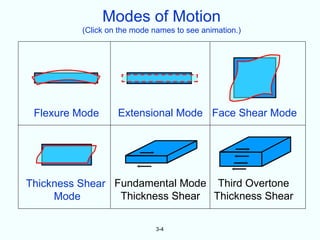
Modes of Motion
          (Click on the mode names to see animation.)


 Flexure Mode      Extensional Mode Face Shear Mode


Thickness Shear Fundamental Mode Third Overtone
     Mode        Thickness Shear Thickness Shear

                             3-4
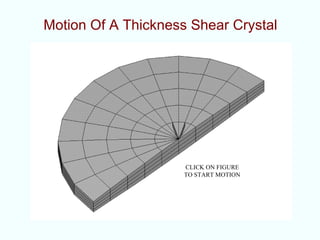
Motion Of A Thickness Shear Crystal


                     CLICK ON FIGURE
                     TO START MOTION
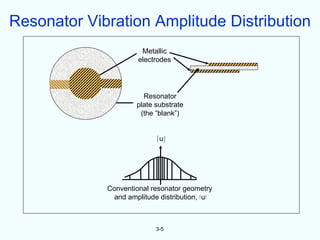
Resonator Vibration Amplitude Distribution
                       Metallic
                      electrodes


                       Resonator
                     plate substrate
                      (the “blank”)


                            u


             Conventional resonator geometry
              and amplitude distribution, u


                           3-5
Resonant Vibrations of a Quartz Plate


                  0 db.


                                                                  3555
                              3200
                              MHZ
       Response


                  -10 db.


                                                           3507
                  -20


                                                                                              3742
                                              3383
                  -30 db.


                                                                         3642

                                                                                3652


                                                                                                       3802


                                                                                                              3852
                                                                                       3707
                                     3256


                  -40 db.


                            3200            3400                   3600                              3800
                                            Frequency, in kHz
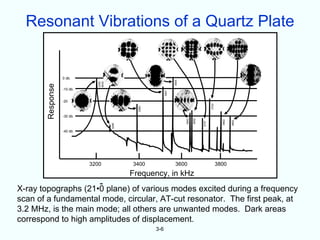
X-ray topographs (21•0 plane) of various modes excited during a frequency
scan of a fundamental mode, circular, AT-cut resonator. The first peak, at
3.2 MHz, is the main mode; all others are unwanted modes. Dark areas
correspond to high amplitudes of displacement.
                                                     3-6
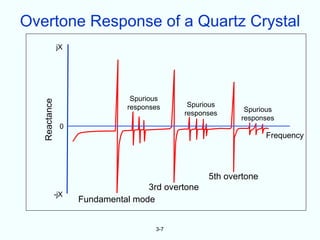
Overtone Response of a Quartz Crystal
               jX


                                Spurious
   Reactance


                               responses     Spurious
                                                           Spurious
                                            responses
                                                          responses
                0
                                                                  Frequency


                                                   5th overtone
                                    3rd overtone
               -jX
                     Fundamental mode


                                      3-7
Unwanted Modes vs. Temperature
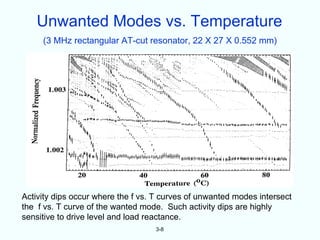
     (3 MHz rectangular AT-cut resonator, 22 X 27 X 0.552 mm)


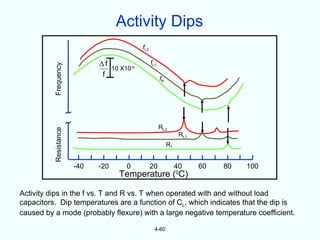
Activity dips occur where the f vs. T curves of unwanted modes intersect
the f vs. T curve of the wanted mode. Such activity dips are highly
sensitive to drive level and load reactance.
                                   3-8
Mathematical Description of a Quartz Resonator
•   In piezoelectric materials, electrical current and voltage are coupled to elastic displacement and stress:

                                       {T} = [c] {S} - [e] {E}
                                       {D} = [e] {S} + [ ] {E}

where {T} = stress tensor, [c] = elastic stiffness matrix, {S} = strain tensor, [e] = piezoelectric matrix
{E} = electric field vector, {D} = electric displacement vector, and [n ] = is the dielectric matrix

•   For a linear piezoelectric material16 e11 1e21 2e31
           T1
                    c11 c12 c13 c14 c15 c
                    c21 c22 c23 c24 c25 c26 2e12 1e22 2e32
                                                               S1         • Elasto-electric matrixSfor -E -E
                                                                             S S S S S
                                                                                                        quartz
                                                                                                                          -E3
           T2                                                  S2               1        2   3    4     5    6    1   2
                    c31 c32 c33 c34 c35 c36 e13 1e23 2e33      S3          T1
           T3
                    c41 c42 c43 c44 c45 c46 e14 1e24 2e34
                                                                                                                      et
           T4                                                  S4          T2
           T5 =     c51 c52 c53 c54 c55 c56 5e15 1e25 2e35     S5          T3
           T6       c61 c62 c63 c64 c65 c66 e16 1e26 2e36      S6          T4
           D1       e11 e12 e13 e14 e15 e16 11 1 12 1 13       E1          T5
           D2       e21 e22 e23 e24 e25 e26 21 2 22 2 23       E2          T6       CE                      X
           D3       e31 e32 e33 e34 e35 e36 31 3 32 3 33       E3          D1
          where
                                                                           D2
                     T1 = T11     S1 = S11                                                                                       6
                                                                                e                                 S
                     T2 = T22     S2 = S22                                 D3                                     W              2
                                                                                                                                 2
                     T3 = T33     S3 = S33                                          LINES JOIN NUMERICAL EQUALITIES             10
                                                                                    EXCEPT FOR COMPLETE RECIPROCITY
                     T4 = T23     S4 = 2S23                                         ACROSS PRINCIPAL DIAGONAL
                     T5 = T13     S5 = 2S13                                            INDICATES NEGATIVE OF
                                                                                       INDICATES TWICE THE NUMERICAL
                     T6 = T12     S6 = 2S12                                              EQUALITIES
                                                                                X     INDICATES 1/2 (c11 - c12)

                                                             3-9
Mathematical Description - Continued
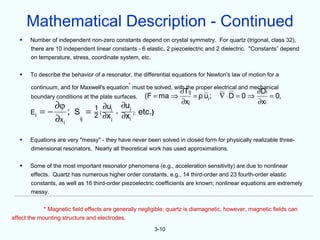
   •   Number of independent non-zero constants depend on crystal symmetry. For quartz (trigonal, class 32),
       there are 10 independent linear constants - 6 elastic, 2 piezoelectric and 2 dielectric. "Constants” depend
       on temperature, stress, coordinate system, etc.

   •   To describe the behavior of a resonator, the differential equations for Newton's law of motion for a

       continuum, and for Maxwell's equation* must be solved, with the proper electrical and mechanical
                                                                       ∂Tij                         ∂Di
       boundary conditions at the plate surfaces.        (F = ma ⇒          = ρ ui ;
                                                                                     ∇ ⋅D = 0 ⇒       = 0,
                                                                       ∂xj                          ∂xi
              ∂φ                 1 ∂ui          ∂u j
       Ei   =− ; S =             2 ( ∂x j   +
                                                ∂xi ) ; etc.)
              ∂x i ij


   •   Equations are very "messy" - they have never been solved in closed form for physically realizable three-
       dimensional resonators. Nearly all theoretical work has used approximations.

   •   Some of the most important resonator phenomena (e.g., acceleration sensitivity) are due to nonlinear
       effects. Quartz has numerous higher order constants, e.g., 14 third-order and 23 fourth-order elastic
       constants, as well as 16 third-order piezoelectric coefficients are known; nonlinear equations are extremely
       messy.

             * Magnetic field effects are generally negligible; quartz is diamagnetic, however, magnetic fields can
affect the mounting structure and electrodes.
                                                                3-10
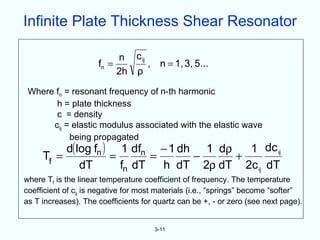
Infinite Plate Thickness Shear Resonator

                          n c ij
                     fn =        , n = 1, 3, 5...
                          2h ρ

 Where fn = resonant frequency of n-th harmonic
       h = plate thickness
       c = density
      cij = elastic modulus associated with the elastic wave
           being propagated
          d( log fn ) 1 dfn − 1 dh 1 dρ    1 dc ij
     Tf =            =       =     −     +
              dT       fn dT   h dT 2ρ dT 2c ij dT
where Tf is the linear temperature coefficient of frequency. The temperature
coefficient of cij is negative for most materials (i.e., “springs” become “softer”
as T increases). The coefficients for quartz can be +, - or zero (see next page).


                                      3-11
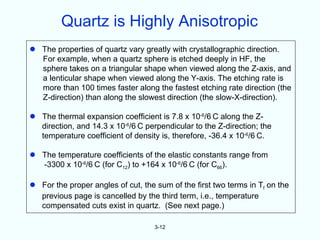
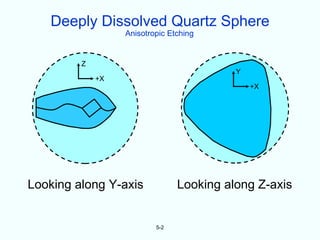
Quartz is Highly Anisotropic
 The properties of quartz vary greatly with crystallographic direction.
  For example, when a quartz sphere is etched deeply in HF, the
  sphere takes on a triangular shape when viewed along the Z-axis, and
  a lenticular shape when viewed along the Y-axis. The etching rate is
  more than 100 times faster along the fastest etching rate direction (the
  Z-direction) than along the slowest direction (the slow-X-direction).

 The thermal expansion coefficient is 7.8 x 10⁻⁶/6 C along the Z-
  direction, and 14.3 x 10⁻⁶/6 C perpendicular to the Z-direction; the
  temperature coefficient of density is, therefore, -36.4 x 10⁻⁶/6 C.

 The temperature coefficients of the elastic constants range from
  -3300 x 10-6/6 C (for C12) to +164 x 10-6/6 C (for C66).

 For the proper angles of cut, the sum of the first two terms in Tf on the
  previous page is cancelled by the third term, i.e., temperature
  compensated cuts exist in quartz. (See next page.)

                                    3-12
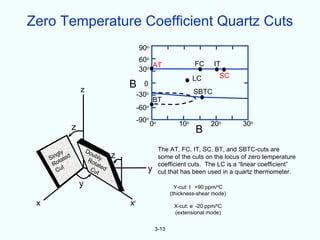
Zero Temperature Coefficient Quartz Cuts
                                           90o
                                           60o
                                               AT                      FC      IT
                                           30o
                                                                       LC        SC
                    z
                                      B      0
                                           -30o                        SBTC
                                                     BT
                                           -60   o


                                           -90o
                                                     0o          10o          20o       30o
                z                                                       B
                        Do                                The AT, FC, IT, SC, BT, and SBTC-cuts are
         ly
      ing ted
     S ta
                          ub
                         Ro ly
                                  z                       some of the cuts on the locus of zero temperature
      Ro t                 tat                            coefficient cuts. The LC is a “linear coefficient”
        Cu                Cu ed                  y
                            t                             cut that has been used in a quartz thermometer.

                    y                                           Y-cut: t +90 ppm/0C
                                                              (thickness-shear mode)
 x                                    xl                       X-cut: e -20 ppm/0C
                                                               (extensional mode)


                                                      3-13
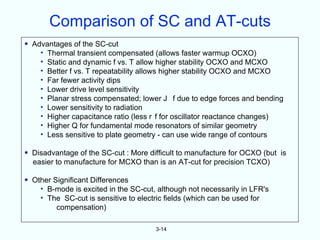
Comparison of SC and AT-cuts
• Advantages of the SC-cut
    • Thermal transient compensated (allows faster warmup OCXO)
    • Static and dynamic f vs. T allow higher stability OCXO and MCXO
    • Better f vs. T repeatability allows higher stability OCXO and MCXO
    • Far fewer activity dips
    • Lower drive level sensitivity
    • Planar stress compensated; lower J f due to edge forces and bending
    • Lower sensitivity to radiation
    • Higher capacitance ratio (less r f for oscillator reactance changes)
    • Higher Q for fundamental mode resonators of similar geometry
    • Less sensitive to plate geometry - can use wide range of contours

• Disadvantage of the SC-cut : More difficult to manufacture for OCXO (but is
  easier to manufacture for MCXO than is an AT-cut for precision TCXO)

• Other Significant Differences
    • B-mode is excited in the SC-cut, although not necessarily in LFR's
    • The SC-cut is sensitive to electric fields (which can be used for
         compensation)

                                      3-14
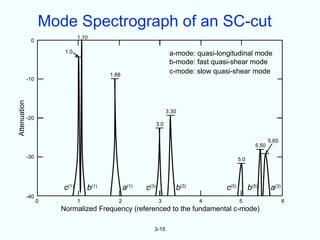
Mode Spectrograph of an SC-cut
                               1.10
               0

                         1.0                                          a-mode: quasi-longitudinal mode
                                                                      b-mode: fast quasi-shear mode
                                          1.88
                                                                      c-mode: slow quasi-shear mode
              -10
Attenuation


                                                                     3.30
              -20
                                                               3.0


                                                                                                              5.65
                                                                                                       5.50

              -30                                                                             5.0


                        c(1)       b(1)          a(1)   c(3)            b(3)           c(5)         b(5)       a(3)
              -40
                    0          1             2                  3              4              5                       6
                        Normalized Frequency (referenced to the fundamental c-mode)

                                                           3-15
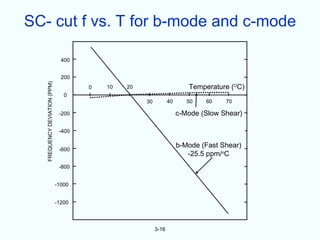
SC- cut f vs. T for b-mode and c-mode

                                 400


                                 200
   FREQUENCY DEVIATION (PPM)


                                       0   10   20                       Temperature (OC)
                                  0
                                                     30          40      50   60    70

                                -200                                  c-Mode (Slow Shear)

                                -400

                                                                      b-Mode (Fast Shear)
                                -600
                                                                         -25.5 ppm/oC
                                -800


                               -1000


                               -1200


                                                          3-16
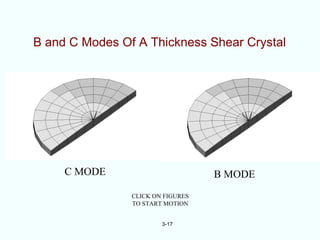
B and C Modes Of A Thickness Shear Crystal


     C MODE                        B MODE
                CLICK ON FIGURES
                TO START MOTION


                        3-17
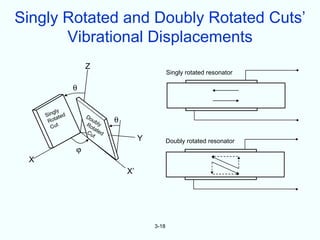
Singly Rotated and Doubly Rotated Cuts’
       Vibrational Displacements
                        Z
                                                     Singly rotated resonator

                    θ

         gly
     Si n a t e d       Do
      Ro
          t
            t
                           ub
                        Ro ly
                                 θ
        Cu                 ta
                        Cu ted
                           t
                                          Y          Doubly rotated resonator
                    ϕ
 X
                                     X’


                                              3-18
Resistance vs. Electrode Thickness
            AT-cut; f1=12 MHz; polished surfaces; evaporated 1.2 cm (0.490”) diameter silver
            electrodes
               60


                                                                  5th
               40
RS (Ohms)


               20                                                 3rd


                                                            Fundamental

                0
                 10                                100                                1000

                                    −∆f (kHz) [fundamental mode]

                                                     3-19
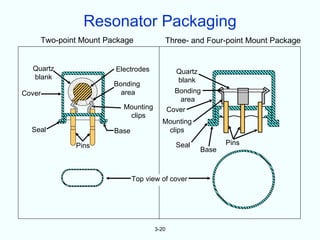
Resonator Packaging
    Two-point Mount Package            Three- and Four-point Mount Package


  Quartz              Electrodes             Quartz
  blank                                      blank
                      Bonding
Cover                   area                 Bonding
                                              area
                        Mounting           Cover
                         clips
                                      Mounting
  Seal                Base             clips

            Pins                             Seal            Pins
                                                      Base


                             Top view of cover


                                    3-20
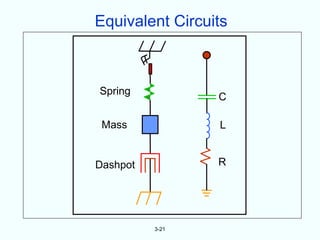
Equivalent Circuits


Spring
                 C

 Mass            L


Dashpot          R


          3-21
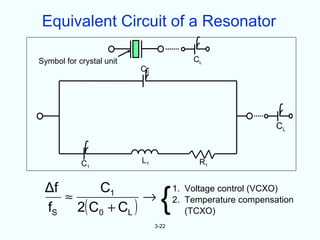
Equivalent Circuit of a Resonator

Symbol for crystal unit                   CL
                          C0


                                                             CL


            C1            L1                R1


 Δf     C1
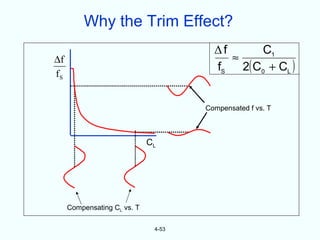
                                 {
                                      1. Voltage control (VCXO)
    ≈            →
 fS 2( C0 + CL )
                                      2. Temperature compensation
                                         (TCXO)
                               3-22
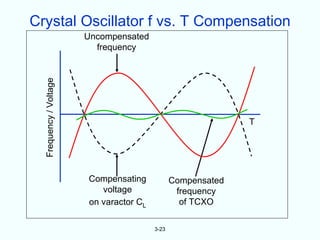
Crystal Oscillator f vs. T Compensation
                        Uncompensated
  Frequency / Voltage     frequency


                                                              T


                        Compensating            Compensated
                           voltage               frequency
                        on varactor CL            of TCXO

                                         3-23
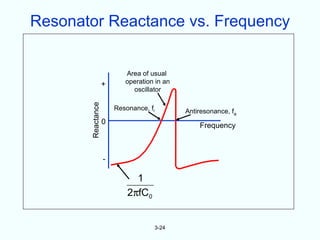
Resonator Reactance vs. Frequency


                          Area of usual
                   +      operation in an
                            oscillator
       Reactance
                       Resonance, fr        Antiresonance, fa
                   0                            Frequency


                   -

                             1
                           2πfC0


                                   3-24
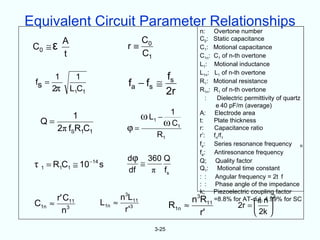
Equivalent Circuit Parameter Relationships
                                                                 n:  Overtone number
           A                               C0                    C0: Static capacitance
 C0 ≅ ε                              r≡                          C1: Motional capacitance
           t                               C1                    C1n:C1 of n-th overtone
                                                                 L1: Motional inductance
                                                                 L1n:L1 of n-th overtone
       1         1                             fs
 fs =
      2π       L1C1
                                     fa − fs ≅                   R1: Motional resistance
                                               2r                R1n:R1 of n-th overtone
                                                                   :   Dielectric permittivity of quartz
                                                                      e 40 pF/m (average)
                                                     1           A: Electrode area
  Q=
          1                                ω L1 −
     2π fSR1C1                       ϕ=
                                                    ω C1         t:
                                                                 r:
                                                                     Plate thickness
                                                                     Capacitance ratio
                                                R1               r’: fn/f1
                                                                 fs: Series resonance frequency R
                                                                 fa: Antiresonance frequency
                                     dϕ 360 Q                    Q; Quality factor
 τ 1 = R1C1 ≅ 10 s    −14
                                        ≅
                                     df   π fs                   Q1: Motional time constant
                                                                 : : Angular frequency = 2t f
                                                                 : : Phase angle of the impedance
                                                                 k; Piezoelectric coupling factor
      r' C                         n3L11                        3
                                                               n R =8.8% for AT-cut, n  2 for SC
                                                                                      π 4.99%
 C1n ≈ 311                  L1n   ≈ 3                  R1n ≈          11
                                                                                2r =     
        n                           r'                           r'                   2k 

                                                3-25
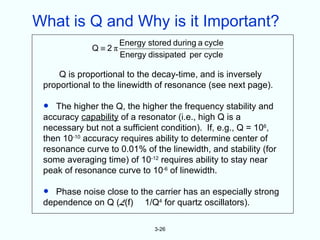
What is Q and Why is it Important?
                    Energy stored during a cycle
             Q≡2π
                    Energy dissipated per cycle

     Q is proportional to the decay-time, and is inversely
 proportional to the linewidth of resonance (see next page).

 •  The higher the Q, the higher the frequency stability and
 accuracy capability of a resonator (i.e., high Q is a
 necessary but not a sufficient condition). If, e.g., Q = 106,
 then 10-10 accuracy requires ability to determine center of
 resonance curve to 0.01% of the linewidth, and stability (for
 some averaging time) of 10-12 requires ability to stay near
 peak of resonance curve to 10-6 of linewidth.

 •  Phase noise close to the carrier has an especially strong
 dependence on Q (L(f) 1/Q4 for quartz oscillators).

                              3-26
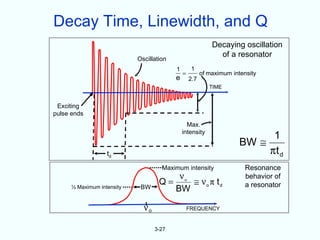
Decay Time, Linewidth, and Q
                                                            Decaying oscillation
                                                              of a resonator
                            Oscillation
                                          1        1
                                              =         of maximum intensity
                                          e       2.7
                                                           TIME


 Exciting
pulse ends
                                                Max.
                                              intensity
                                                                                1
                                                                      BW ≅
                   td                                                          πt d
                                     Maximum intensity                  Resonance
                                           νo                           behavior of
                                    Q=        ≅ νo π t d                a resonator
      ½ Maximum intensity    BW           BW

                              ν0                  FREQUENCY


                                   3-27
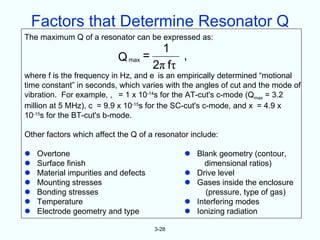
Factors that Determine Resonator Q
The maximum Q of a resonator can be expressed as:
                                     1
                           Q max =       ,
                                   2π fτ
where f is the frequency in Hz, and e is an empirically determined “motional
time constant” in seconds, which varies with the angles of cut and the mode of
vibration. For example, , = 1 x 10-14s for the AT-cut's c-mode (Qmax = 3.2
million at 5 MHz), c = 9.9 x 10⁻¹⁵s for the SC-cut's c-mode, and x = 4.9 x
10-15s for the BT-cut's b-mode.

Other factors which affect the Q of a resonator include:

   Overtone                                   Blank geometry (contour,
   Surface finish                                dimensional ratios)
   Material impurities and defects            Drive level
   Mounting stresses                          Gases inside the enclosure
   Bonding stresses                               (pressure, type of gas)
   Temperature                                Interfering modes
   Electrode geometry and type                Ionizing radiation

                                      3-28
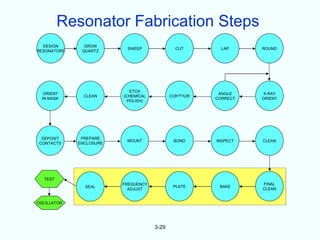
Resonator Fabrication Steps
  DESIGN       GROW
                          SWEEP               CUT       LAP     ROUND
RESONATORS    QUARTZ


                            ETCH
   ORIENT                                              ANGLE    X-RAY
               CLEAN     (CHEMICAL          CONTOUR
  IN MASK                                             CORRECT   ORIENT
                           POLISH)


 DEPOSIT      PREPARE
                          MOUNT              BOND     INSPECT   CLEAN
CONTACTS     ENCLOSURE


  TEST
                         FREQUENCY                              FINAL
               SEAL                          PLATE     BAKE
                           ADJUST                               CLEAN


OSCILLATOR


                                     3-29
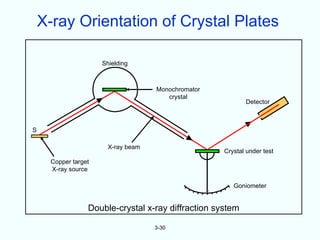
X-ray Orientation of Crystal Plates

                     Shielding


                                    Monochromator
                                       crystal
                                                           Detector


S

                       X-ray beam
                                                    Crystal under test
     Copper target
     X-ray source

                                                       Goniometer


                 Double-crystal x-ray diffraction system

                                    3-30
Contamination Control
    Contamination control is essential during the fabrication of
resonators because contamination can adversely affect:
  • Stability (see chapter 4)
    - aging
    - hysteresis
    - retrace
    - noise
    - nonlinearities and resistance anomalies (high starting
      resistance, second-level of drive, intermodulation in filters)
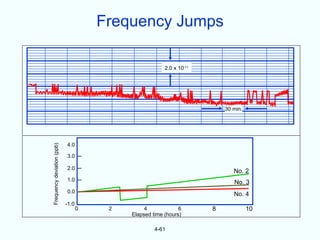
    - frequency jumps?
  • Manufacturing yields
  • Reliability

                                   3-31
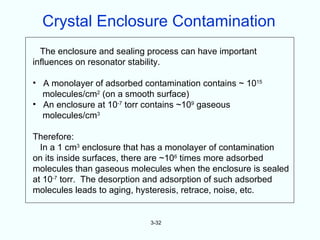
Crystal Enclosure Contamination
  The enclosure and sealing process can have important
influences on resonator stability.

• A monolayer of adsorbed contamination contains ~ 1015
  molecules/cm2 (on a smooth surface)
• An enclosure at 10-7 torr contains ~109 gaseous
  molecules/cm3

Therefore:
  In a 1 cm3 enclosure that has a monolayer of contamination
on its inside surfaces, there are ~106 times more adsorbed
molecules than gaseous molecules when the enclosure is sealed
at 10-7 torr. The desorption and adsorption of such adsorbed
molecules leads to aging, hysteresis, retrace, noise, etc.


                            3-32
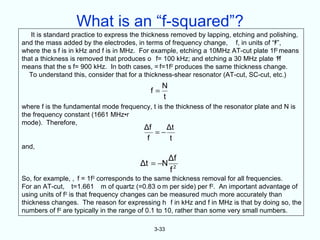
What is an “f-squared”?
   It is standard practice to express the thickness removed by lapping, etching and polishing,
and the mass added by the electrodes, in terms of frequency change, f, in units of “f2”,
where the s f is in kHz and f is in MHz. For example, etching a 10MHz AT-cut plate 1f2 means
that a thickness is removed that produces o f= 100 kHz; and etching a 30 MHz plate 1f 2

means that the s f= 900 kHz. In both cases, = f=1f2 produces the same thickness change.
  To understand this, consider that for a thickness-shear resonator (AT-cut, SC-cut, etc.)
                                                N
                                           f=
                                                t
where f is the fundamental mode frequency, t is the thickness of the resonator plate and N is
the frequency constant (1661 MHz•r
mode). Therefore,
                                         Δf    Δt
                                            =−
                                          f     t
and,
                                                    Δf
                                        Δt = −N
                                                    f2
So, for example, , f = 1f2 corresponds to the same thickness removal for all frequencies.
For an AT-cut, t=1.661 m of quartz (=0.83 o m per side) per f2. An important advantage of
using units of f2 is that frequency changes can be measured much more accurately than
thickness changes. The reason for expressing h f in kHz and f in MHz is that by doing so, the
numbers of f2 are typically in the range of 0.1 to 10, rather than some very small numbers.

                                             3-33
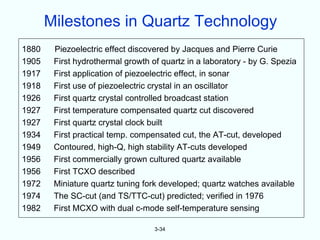
Milestones in Quartz Technology
1880    Piezoelectric effect discovered by Jacques and Pierre Curie
1905    First hydrothermal growth of quartz in a laboratory - by G. Spezia
1917    First application of piezoelectric effect, in sonar
1918    First use of piezoelectric crystal in an oscillator
1926    First quartz crystal controlled broadcast station
1927    First temperature compensated quartz cut discovered
1927    First quartz crystal clock built
1934    First practical temp. compensated cut, the AT-cut, developed
1949    Contoured, high-Q, high stability AT-cuts developed
1956    First commercially grown cultured quartz available
1956    First TCXO described
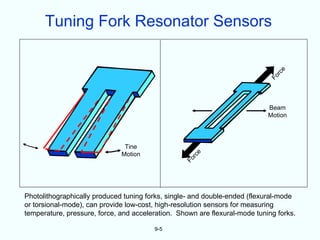
1972    Miniature quartz tuning fork developed; quartz watches available
1974    The SC-cut (and TS/TTC-cut) predicted; verified in 1976
1982    First MCXO with dual c-mode self-temperature sensing

                                   3-34
Quartz Resonators for Wristwatches
Requirements:

 •   Small size

 •   Low power dissipation (including the oscillator)

 •   Low cost

 •   High stability (temperature, aging, shock,
     attitude)

These requirements can be met with 32,768 Hz quartz
tuning forks

                         3-35
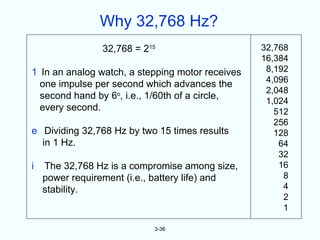
Why 32,768 Hz?
                32,768 = 215                      32,768
                                                  16,384
1 In an analog watch, a stepping motor receives    8,192
                                                   4,096
  one impulse per second which advances the
                                                   2,048
  second hand by 6o, i.e., 1/60th of a circle,
                                                   1,024
  every second.                                      512
                                                     256
e Dividing 32,768 Hz by two 15 times results         128
  in 1 Hz.                                            64
                                                      32
i   The 32,768 Hz is a compromise among size,         16
    power requirement (i.e., battery life) and         8
    stability.                                         4
                                                       2
                                                       1

                            3-36
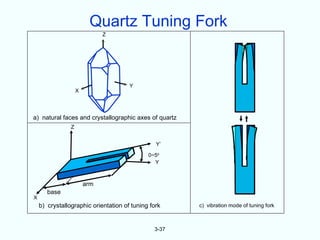
Quartz Tuning Fork
                              Z


                                      Y
                    X


a) natural faces and crystallographic axes of quartz
                Z


                                                Y’

                                             0~50
                                               Y


                        arm
       base
X
    b) crystallographic orientation of tuning fork     c) vibration mode of tuning fork


                                               3-37
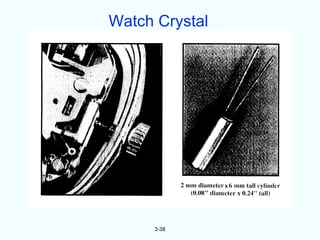
Watch Crystal


     3-38
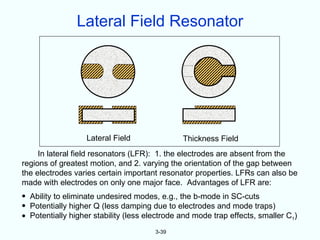
Lateral Field Resonator


                   Lateral Field               Thickness Field
     In lateral field resonators (LFR): 1. the electrodes are absent from the
regions of greatest motion, and 2. varying the orientation of the gap between
the electrodes varies certain important resonator properties. LFRs can also be
made with electrodes on only one major face. Advantages of LFR are:
• Ability to eliminate undesired modes, e.g., the b-mode in SC-cuts
• Potentially higher Q (less damping due to electrodes and mode traps)
• Potentially higher stability (less electrode and mode trap effects, smaller C1)
                                       3-39
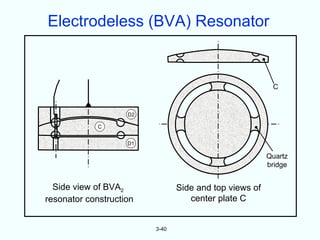
Electrodeless (BVA) Resonator


                                                         C


                    D2

             C


                    D1

                                                        Quartz
                                                        bridge


  Side view of BVA2             Side and top views of
resonator construction             center plate C


                         3-40
CHAPTER 4
Oscillator Stability


         4
The Units of Stability in Perspective

• What is one part in 10 10
                              ? (As in 1 x 10⁻¹⁰/day aging.)
       • ~1/2 cm out of the circumference of the earth.
       • ~1/4 second per human lifetime (of ~80 years).

• Power received on earth from a GPS satellite, -160 dBW, is
  as “bright” as a flashlight in Los Angeles would look in New
  York City, ~5000 km away (neglecting earth’s curvature).

• What is -170 dB?   (As in -170 dBc/Hz phase noise.)
       • -170 dB = 1 part in 1017 7 thickness of a sheet
         of paper out of the total distance traveled by all
         the cars in the world in a day.


                                 4-1
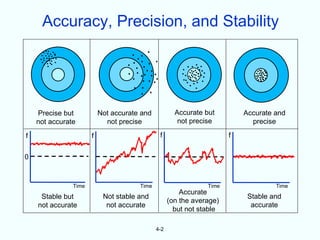
Accuracy, Precision, and Stability


    Precise but           Not accurate and           Accurate but         Accurate and
    not accurate            not precise               not precise           precise

f                     f                       f                       f


0


               Time                   Time                     Time                Time
                                                       Accurate
     Stable but            Not stable and                                  Stable and
                                                   (on the average)
    not accurate            not accurate                                    accurate
                                                     but not stable

                                             4-2
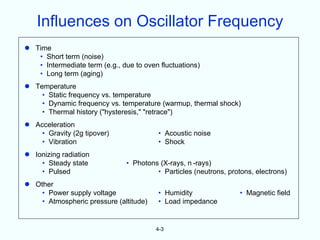
Influences on Oscillator Frequency
 Time
   • Short term (noise)
   • Intermediate term (e.g., due to oven fluctuations)
   • Long term (aging)
 Temperature
    • Static frequency vs. temperature
    • Dynamic frequency vs. temperature (warmup, thermal shock)
    • Thermal history ("hysteresis," "retrace")
 Acceleration
    • Gravity (2g tipover)               • Acoustic noise
    • Vibration                          • Shock
 Ionizing radiation
    • Steady state             • Photons (X-rays, n -rays)
    • Pulsed                            • Particles (neutrons, protons, electrons)
 Other
    • Power supply voltage               • Humidity                • Magnetic field
    • Atmospheric pressure (altitude)    • Load impedance


                                         4-3
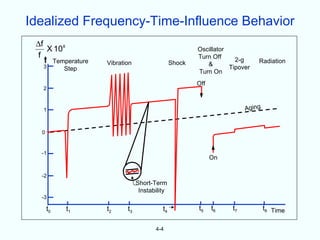
Idealized Frequency-Time-Influence Behavior
 ∆f
    X 108                                                   Oscillator
 f                                                          Turn Off
           Temperature   Vibration                  Shock                2-g     Radiation
   3                                                           &
              Step                                                     Tipover
                                                            Turn On
                                                            Off
   2


   1                                                                         Aging


  0


  -1
                                                                  On

  -2
                                     Short-Term
                                      Instability
  -3

      t0       t1        t2     t3             t4           t5    t6    t7           t8 Time

                                            4-4
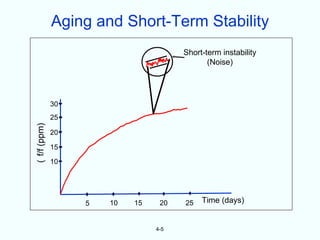
Aging and Short-Term Stability
                                       Short-term instability
                                              (Noise)


              30
              25
( f/f (ppm)


              20

              15

              10


                   5   10   15    20   25   Time (days)


                                 4-5
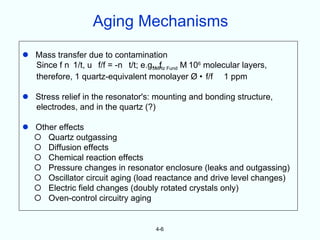
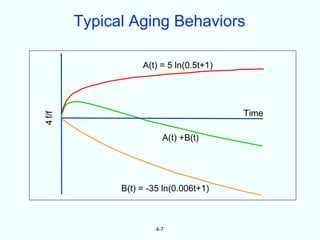
Aging Mechanisms
 Mass transfer due to contamination
  Since f n 1/t, u f/f = -n t/t; e.g., f Fund M 106 molecular layers,
                                    5MHz
  therefore, 1 quartz-equivalent monolayer          f/f 1 ppm

 Stress relief in the resonator's: mounting and bonding structure,
  electrodes, and in the quartz (?)

 Other effects
   Quartz outgassing
   Diffusion effects
   Chemical reaction effects
   Pressure changes in resonator enclosure (leaks and outgassing)
   Oscillator circuit aging (load reactance and drive level changes)
   Electric field changes (doubly rotated crystals only)
   Oven-control circuitry aging


                                     4-6
Typical Aging Behaviors

                   A(t) = 5 ln(0.5t+1)


                                         Time
4 f/f


                         A(t) +B(t)


              B(t) = -35 ln(0.006t+1)


                       4-7
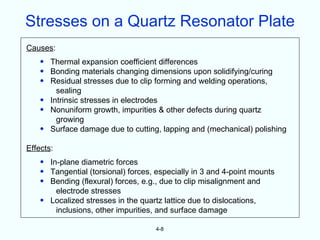
Stresses on a Quartz Resonator Plate
Causes:
    • Thermal expansion coefficient differences
    • Bonding materials changing dimensions upon solidifying/curing
    • Residual stresses due to clip forming and welding operations,
        sealing
    • Intrinsic stresses in electrodes
    • Nonuniform growth, impurities & other defects during quartz
        growing
    • Surface damage due to cutting, lapping and (mechanical) polishing

Effects:
    • In-plane diametric forces
    • Tangential (torsional) forces, especially in 3 and 4-point mounts
    • Bending (flexural) forces, e.g., due to clip misalignment and
        electrode stresses
    • Localized stresses in the quartz lattice due to dislocations,
        inclusions, other impurities, and surface damage

                                     4-8
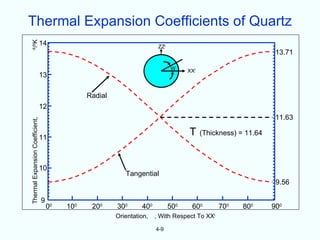
Thermal Expansion Coefficients of Quartz
                                 14
/K
                                                                         ZZl
  -6 0


                                                                                                                  13.71

                                                                               W     XXl
                                 13

                                                Radial
                                 12
                                                                                                                  11.63
Thermal Expansion Coefficient,


                                 11
                                                                                     T     (Thickness) = 11.64


                                 10
                                                            Tangential
                                                                                                                  9.56

                                 9
                                     00   100    200     300      400          500    600       700     800      900
                                                         Orientation,   , With Respect To XXl

                                                                        4-9
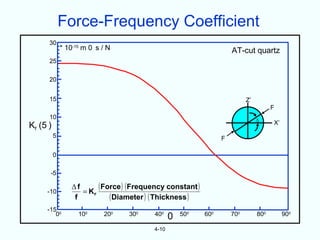
Force-Frequency Coefficient
      30
              * 10-15 m 0 s / N                                        AT-cut quartz
      25

      20


      15                                                                     Z’
                                                                                        F
      10                                                                          Δ
                                                                                        X’
Kf (5 )
          5                                                        F

          0

      -5

     -10
                  Δf
                     = KF
                          ( Force ) ( Frequency constant )
                   f          ( Diameter ) ( Thickness )
     -15 0
        0           100     200    300     400        500    600       700        800        900
                                                  0
                                           4-10
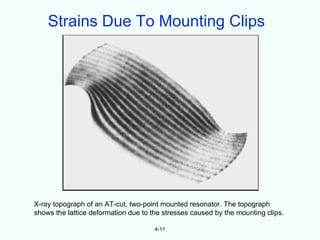
Strains Due To Mounting Clips


X-ray topograph of an AT-cut, two-point mounted resonator. The topograph
shows the lattice deformation due to the stresses caused by the mounting clips.

                                      4-11
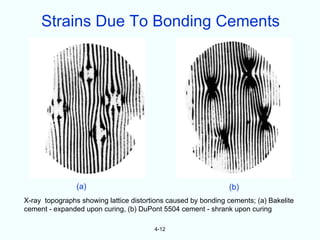
Strains Due To Bonding Cements


                (a)                                            (b)
X-ray topographs showing lattice distortions caused by bonding cements; (a) Bakelite
cement - expanded upon curing, (b) DuPont 5504 cement - shrank upon curing

                                        4-12
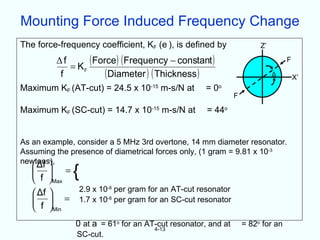
Mounting Force Induced Frequency Change
The force-frequency coefficient, KF (e ), is defined by               Z’

         Δf
            = KF
                 ( Force) ( Frequency − constant )                              F

          f           ( Diameter ) ( Thickness )                           Δ
                                                                                    X’
Maximum KF (AT-cut) = 24.5 x 10⁻¹⁵ m-s/N at        = 0o
                                                             F

Maximum KF (SC-cut) = 14.7 x 10⁻¹⁵ m-s/N at        = 44o


As an example, consider a 5 MHz 3rd overtone, 14 mm diameter resonator.
Assuming the presence of diametrical forces only, (1 gram = 9.81 x 10⁻³
newtons),
    
    Δf
     =
    f Max
              {
            2.9 x 10⁻⁸ per gram for an AT-cut resonator
    Δf 
     = 1.7 x 10⁻⁸ per gram for an SC-cut resonator
    f Min
              0 at a = 61o for an AT-cut resonator, and at       = 82o for an
                                    4-13
               SC-cut.
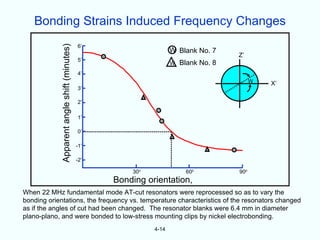
Bonding Strains Induced Frequency Changes
                                             6’


            Apparent angle shift (minutes)
                                                                            W Blank No. 7
                                                   W                                              Z’
                                             5’
                                                                            W   Blank No. 8
                                             4’
                                                                                                        W   X’
                                             3’
                                                                 W
                                             2’
                                                                      W

                                             1’
                                                                       W


                                             0’
                                                                            W

                                             -1’
                                                                                       W      W

                                             -2’

                                                           300                   600              900
                                                       Bonding orientation,
When 22 MHz fundamental mode AT-cut resonators were reprocessed so as to vary the
bonding orientations, the frequency vs. temperature characteristics of the resonators changed
as if the angles of cut had been changed. The resonator blanks were 6.4 mm in diameter
plano-plano, and were bonded to low-stress mounting clips by nickel electrobonding.
                                                                     4-14
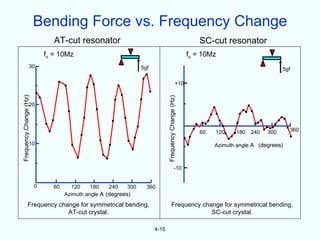
Bending Force vs. Frequency Change
                                   AT-cut resonator                                                                                                            SC-cut resonator
                                fo = 10Mz                                                                                                               fo = 10Mz
                  30                                                                                         5gf                                                                                5gf
                                                             •                                                   •
                                      • •                                                                    •
                                                            • •
                                                                                                                                                  +10
                                                                                       •
                        •                                                                  •                         •
                            •
Frequency Change (Hz)


                                                                                   •                         •


                                                                                                                                Frequency Change (Hz)
                  20
                                                                  •                                                                                                     •           •
                                            •                                                                                                                                     •• •
                                                        •                                      •                                                                       ••       •              •
                                • •                                                •
                                                                                                         •                                                    • • ••        •
                                                                                                                                                                          • •          •• • • •
                                                                                                                                                                                      • •• •
                                 •                                                                                                                           • 60       120• •180
                                                                                                                                                                                           •
                                                                                                                                                                                     240 • 300   360
                                                        •
                                                                      •                            • •                                                  ••                  ••                   •
                  10                            •                              •                                                                         •              Azimuth angle A (degrees)
                                                                                                    •
                                                    •                     ••
                                                                                                                                               -10


                        0          60      120    180    240    300                                              360
                                        Azimuth angle A (degrees)

               Frequency change for symmetrical bending,                                                                                Frequency change for symmetrical bending,
                            AT-cut crystal.                                                                                                          SC-cut crystal.

                                                                                                                         4-15
Short Term Instability (Noise)
                               Stable Frequency (Ideal Oscillator)
                                                 T (t)
        1
   V
       -1
          T1              T2             T3
                                                                                        Time
                   V(t) = V0 sin(2 V 0t)                              t (t) = 2) ] 0t

                       Unstable Frequency (Real Oscillator)
       1                                     T (t)
    V -1
         T1               T2              T3
                                                                                       Time
       V(t) =[V0 + + (t)] sin[2r e 0t +     (t)]                 t (t) = 2) ] 0t + = (t)
                                                    1 d Φ(t )         1 dφ(t )
               Instantaneous frequency,   ν(t) =              = ν0 +
                                                   2π d t            2π d t
V(t) = Oscillator output voltage, V0 = Nominal peak voltage amplitude
 (t) = Amplitude noise,           A 0 = Nominal (or "carrier") frequency
 (t) = Instantaneous phase, and e (t) = Deviation of phase from nominal (i.e., the ideal)
                                                   4-16
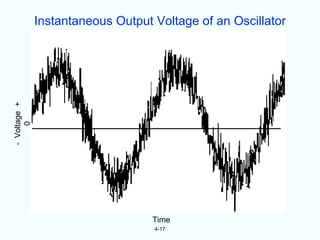
Instantaneous Output Voltage of an Oscillator
                                                  Amplitude
                                                  instability


                                                          Phase
- Voltage +


                                                          instability
     0


                                   Frequency
                                    instability
                                   Time
                                   4-17
Impacts of Oscillator Noise
• Limits the ability to determine the current state and the
predictability of oscillators
•   Limits syntonization and synchronization accuracy
•   Limits receivers' useful dynamic range, channel spacing, and
    selectivity; can limit jamming resistance
•   Limits radar performance (especially Doppler radar's)
•   Causes timing errors [~C       y   (( )]
•   Causes bit errors in digital communication systems
•   Limits number of communication system users, as noise from
    transmitters interfere with receivers in nearby channels
•   Limits navigation accuracy
•   Limits ability to lock to narrow-linewidth resonances
•   Can cause loss of lock; can limit acquisition/reacquisition
    capability in phase-locked-loop systems

                                 4-18
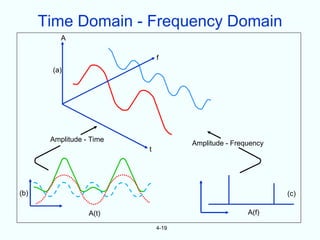
Time Domain - Frequency Domain
          A

                              f
       (a)


       Amplitude - Time
                                     Amplitude - Frequency
                          t


(b)                                                          (c)

                  A(t)                               A(f)

                              4-19
Causes of Short Term Instabilities
 Johnson noise (thermally induced charge fluctuations, i.e., "thermal emf” in
  resistive elements)

 Phonon scattering by defects & quantum fluctuations (related to Q)

 Noise due to oscillator circuitry (active and passive components)

 Temperature fluctuations- thermal transient effects
                          - activity dips at oven set-point

 Random vibration

 Fluctuations in the number of adsorbed molecules

 Stress relief, fluctuations at interfaces (quartz, electrode, mount, bond)

 Shot noise in atomic frequency standards

 ???

                                      4-20
Short-Term Stability Measures
                             Measure                                            Symbol
 Two-sample deviation, also called “Allan deviation”                             * y(
 Spectral density of phase deviations                                             SS (f)
 Spectral density of fractional frequency deviations                              Sy(f)
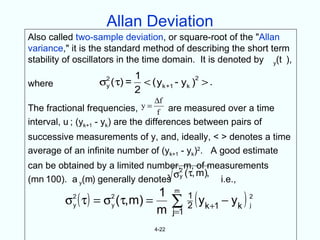
 Phase noise                                                                      L(f)*
          * Most frequently found on oscillator specification sheets


      f2SS (f) =         Sy(f); L(f)
                         2
                                                ½ [S( (f)]            (per IEEE Std.
  1139),
                               2           ∞
                   σ ( τ) =            ∫       S φ (f)sin4 ( πfτ)df
                     2

  and
                     y
                            ( πντ) 2   0


Where = averaging time, = carrier frequency, and f = offset or
Fourier frequency, or “frequency from the carrier”.

                                                   4-21
Allan Deviation
Also called two-sample deviation, or square-root of the "Allan
variance," it is the standard method of describing the short term
stability of oscillators in the time domain. It is denoted by y(t ),
                              1                 2
where             σ2 ( τ) =
                   y            < ( yk +1 - yk ) > .
                              2
                               ∆f
The fractional frequencies, y=
                               f are measured over a time
interval, u ; (yk+1 - yk) are the differences between pairs of
successive measurements of y, and, ideally, < > denotes a time
average of an infinite number of (yk+1 - yk)2. A good estimate
can be obtained by a limited number,2 m, of measurements
                                  σ ( τ, m), i.e.,
(mn 100). a y(m) generally denotes y

                                          ∑ ( yk +1 − yk )
                               1          m
         σ ( τ ) = σ ( τ, m) =
           2
           y
                      2
                      y
                                              1
                                              2
                                                             2
                                                             j
                               m          j=1
                                   4-22
Why σ y(τ)?
 Classical variance:     σ 2i =
                            y
                                    1
                                   m -1
                                          (     )
                                        ∑ yi − y 2,
       diverges for some commonly observed noise
       processes, such as random walk, i.e., the variance
       increases with increasing number of data points.

 Allan variance:
    • Converges for all noise processes observed in precision
       oscillators.
    • Has straightforward relationship to power law spectral
       density types.
    • Is easy to compute.
    • Is faster and more accurate in estimating noise
       processes than the Fast Fourier Transform.

                               4-23
Frequency Noise and σy(τ)
     3 X 10-11       0.1 s averaging time

       ∆f
             0
        f
    -3 X 10-11                                       100 s


    3 X 10-11
                      1.0 s averaging time
        ∆f
             0
         f                                            100 s

    -3 X 10-11


 - y(1 )10   -10


         10-11


         10-12
             0.01   0.1          1         10       100
                                     Averaging time, t , s


                          4-24
Time Domain Stability
                                     Aging* and
                                     random walk
    a y(g   Frequency noise          of frequency

      )


                         1s   1m          1h        Sample time i
            Short-term               Long-term
            stability                stability

*For y(F ) to be a proper measure of random frequency fluctuations,
 aging must be properly subtracted from the data at long o ’s.

                                   4-25
Power Law Dependence of σy(τ)

                        )   -1
    f y(r
      )                              -   -1


                                                  w   -1/2                -   1/2
                                                                                    to o 1
                                                               -   0


            White                Flicker         White       Flicker       Random
Noise type: phase                phase           freq.        freq.        walk freq.
Below the flicker of frequency noise (i.e., the “flicker floor”) region, crystal
oscillators typically show n -1 (white phase noise) dependence. Atomic
standards show o -1/2 (white frequency noise) dependence down to about the
servo-loop time constant, and n -1 dependence at less than that time constant.
Typical n ’s at the start of flicker floors are: 1s for a crystal oscillator, 103s for a
Rb standard and 105s for a Cs standard. At large c ’s, random walk of
frequency and aging dominate.
                                          4-26
Pictures of Noise
                Plot of z(t) vs. t                     Sz(f) = h( ff     Noise name

                                                          f =0               White


                                                          = = -1             Flicker


                                                          = = -2           Random
                                                                            walk
                                                          = = -3


Plots show fluctuations of a quantity z(t), which can be,e.g., the output of a counter ( f vs. t)
or of a phase detector (o [t] vs. t). The plots show simulated time-domain behaviors
corresponding to the most common (power-law) spectral densities; hc is an amplitude
coefficient. Note: since Sc f = f 2SS , e.g. white frequency noise and random walk of phase
are equivalent.
                                           4-27
Spectral Densities

    V(t) = [ V0 + ε ( t ) ] sin [ 2 π ν 0 t + φ (t) ]
    In the frequency domain, due to the phase deviation, (t), some of
the power is at frequencies other than s 0. The stabilities are
characterized by "spectral densities." The spectral density, SV(f), the
mean-square voltage <V2(t)> in a unit bandwidth centered at f, is not a
good measure of frequency stability because both r
contribute to it, and because it is not uniquely related to frequency
fluctuations (although e (t) is often negligible in precision frequency
sources.)
    The spectral densities of phase and fractional-frequency fluctuations,
SS (f) and Sy(f), respectively, are used to measure the stabilities in the
                                                                   ∫
                                                       g RMS (t) =g(t) is(f)d f .
                                                                     S g the
                                                         2
frequency domain. The spectral density Sg(f) of a quantity
                                                                   BW
mean square value of g(t) in a unit bandwidth centered at f. Moreover,
the RMS value of g2 in bandwidth BW is given by
                                      4-28
Mixer Functions
    V1 = A 1sin(ω1t + ϕ1 )                                               V1V2
                                                                                Filter     V0
    V2 = A 2sin (ω 2 t + ϕ 2 )
                 Trigonometric identities: sin(x)sin(y) = ½cos(x-y) - ½cos(x+y)
                                      cos(xc c /2) = sin(x)
    Let ω1 = ω 2 ;Φ1 ≡ ω1t + φ 1, and Φ2 ≡ ω 2 t + φ 2 .            Then the mixer can become :

•   Phase detector: When Φ1 = Φ2 + π / 2 and A 1 = A 2 = 1, then
                 1                1
            V0 = sin(φ 1 − φ 2 ) = (φ 1 − φ 2 ) for small φ ' s
                 2                2
•   AM   detector: When A 2 = 1 and the filter is a low − pass filter, then
                 1                                                  1
          V0 =       A 1cos(φ 1 − φ 2 ); if φ 1 ≈ φ 2 , then V0 ≈       A1
                 2                                          2
•    Frequency multiplier:
                          1
                                         When V1 = V2 and the filter is bandpass at 2s 1
                              A 1 cos( 2ω1t + 2φ 1 ) ⇒ doubles the frequency and phase error.
                               2
          then, V0 =
                          2
                                                    4-29
Phase Detector


  DUT
            V(t)                                                        SS (f)
   ~                           LPF
   fO                  VO(t)         VV (t)
        ( t = 90   0


                                                     Low-Noise
   ~        VR(t)                                     Amplifier   Spectrum Analyzer
Reference

                                      Quadrature
                                       Monitor*
                                 * Or phase-locked loop


                                          4-30
Phase Noise Measurement
                           RF Source

                                 V ( t ) = Vo sin[ 2π0 t + Φ( t ) ]

                         Phase Detector
                          VV (t) = ke (t)

                                 VV(t)


                              RF
                           Voltmeter
Oscilloscope                                            Spectrum Analyzer

    S(t)       (     (t) in BW of meter
                   RMS                                        SS (f) vs. f


                              4-31
Frequency - Phase - Time Relationships
                1 dφ( t )                                             t

ν( t ) = ν 0 +            = " instantaneous" frequency; φ( t ) = φ0 + ∫ 2π[ ν( t' ) − ν 0 ] dt'
               2π dt                                                  0

                            •
             ν( t ) − ν 0    φ( t )
  y( t ) ≡                =         = normalized frequency; φRMS = ∫ S φ ( f ) dt
                                                             2

                  ν0        2πν 0
                             2
            φRMS  ν 0 
             2
 Sφ ( f ) =     =   S y ( f );                     L ( f ) ≡ 1/2 S φ ( f ), per IEEE Standard 1139 − 1988
            BW  f 

                      (             )
                                                             ∞
                                                   2
   σ ( τ) = 1/2 < y k +1 − y k                              S φ ( f ) sin 4 ( πfτ) df
                                        2

                                               ( πν0 τ) 2 ∫
     2
     y                                      >=
                                                          0


 The five common power-law noise processes in precision oscillators are:
                   S y ( f ) = h2 f 2        +    h1f    +       h0     +       h −1f −1   +        h −2 f −2
                           (White PM)         (Flicker PM) (White FM) (Flicker FM) (Random-walk FM)

                                                                                           φ( t )
                                                                            t
                                 Time deviation = x( t ) = ∫ y ( t')dt' =
                                                                            o
                                                                                           2πν

                                                                 4-32
Sφ(f) to SSB Power Ratio Relationship
Consider the “simple” case of sinusoidal phase modulation at frequency fm. Then,
. (t) = , o(t)sin(2 fmt), and V(t) = Vocos[2n fct + 2 (t)] = Vocos[2( fct + 2 0(t)sin() fmt)],
where ( o(t)= peak phase excursion, and fc=carrier frequency. Cosine of a sine
function suggests a Bessel function expansion of V(t) into its components at
various frequencies via the identities:
                             cos( X + Y ) = cosX cosY − sinX sinY
                              cosXcosY = 1/2[ cos( X + Y ) + cos( X − Y ) ]
                              − sinXsinY = [ cos( X + Y ) − cos( X − Y ) ]
                              cos( BsinX ) = J0 (B) + 2 ∑ J2n ( B ) cos( 2nX )
                                                 ∞
                              sin( BsinX ) = 2 ∑ J2n+1 ( B ) sin[ ( 2n + 1) X]
                                                n=0


After some messy algebra, SV(f) and S( (f) are as shown on the next page. Then,
                                                V0 J1 [Φ( fm ) ]
                                                   2 2

             SSB Power Ratio at fm =                        ∞
                                        V0 J0 [Φ( fm ) ] + 2∑ Ji [Φ( fm ) ]
                                           2  2                  2


              if Φ( fm ) << 1, then J0 = 1, J1 = 1/2Φ( fm ), Jn = 0 for n > 1, and
                                                                                 i=1


                                                Φ2 ( fm ) S φ ( fm )
              SSB Power Ratio = L ( fm ) =               =
                                                   4           2
                                                      4-33
Sφ(f), Sv(f) and L (f)
                                                              Sφ ( f )
              Φ( t ) = Φ( fm ) cos( 2πfm t )                                            Φ2
                                                                                           ( fm )
                                                                                         2
                                                              0                 fm                   f

V ( t ) = V0cos[ 2πfC t + Φ( fm ) ]
                                                                  2    2
         SV(f)                                                V0 J0
                                                                    [Φ( fm ) ]
                                                                2        2 2
                                                                     V0 J1
                                                                               [Φ( fm ) ]
                                                                         2          2     2
                                                                                 V0 J2
                                                                                            [Φ( fm ) ]
                                                                                    2            2     2
                                                                                              V0 J3
                                                                                                         [Φ( fm ) ]
                                                                                                 2
                    fC-3fm   fC-2fm       fC-fm          fC           fC+fm    fC+2fm       fC+3fm
                                                                                                          f

                                                  V0 J1 [Φ( fm ) ]                                        Sφ( fm )
                                                     2    2
   SSB Power Ratio =                                                                      ≅ L ( fm ) ≡
                               V0 J0 [Φ( fm ) ] + 2∑ J 2 Φ f 
                                                              ∞
                                  2   2                                                                     2
                                                              
                                                   i=1 i   m 
                                                                
                                                      4-34
Types of Phase Noise
        40 dB/decade (ff-4)
L(ff)   Random walk of frequency

            30 dB/decade (ff-3)
            Flicker of frequency
                     20 dB/decade (ff-2)
                     White frequency; Random walk of phase
                                          10 dB/decade (ff-1)
                                          Flicker of phase
                                                                 0 dB/decade (ff0)
                                                                 White phase


                                                                                 ff
        ~BW of resonator                                      Offset frequency
                                                      (also, Fourier frequency,
                                                          sideband frequency,
                                                      or modulation frequency)


                                   4-35
Noise in Crystal Oscillators
 The resonator is the primary noise source close to the carrier; the oscillator sustaining circuitry is
  the primary source far from the carrier.
 Frequency multiplication by N increases the phase noise by N2 (i.e., by 20log N, in dB's).
 Vibration-induced "noise" dominates all other sources of noise in many applications
  (see acceleration effects section, later).
 Close to the carrier (within BW of resonator), Sy(f) varies as 1/f, S( (f) as 1/f3, where f =
    offset from carrier frequency,     . So (f) also varies as 1/Q4, where Q = unloaded Q. Since
    Qmaxm = const., Sm(f) c n 4. (Qmaxm)BAW = 1.6 x 10¹³ Hz; (Qmaxm)SAW = 1.05 x 10¹³ Hz.
 In the time domain, noise floor is r y(n ) h (2.0 x 10⁻⁷)Q-1 1 1.2 x 10⁻²⁰- , 1 in Hz. In the
    regions where n y(e ) varies as n -1 and a -1/2 (/   -1/2
                                                                occurs in atomic frequency standards),
    s y( )   (QSR)-1, where SR is the signal-to-noise ratio; i.e., the higher the Q and the signal-
    to-noise ratio, the better the short term stability (and the phase noise far from the carrier,
    in the frequency domain).
   It is the loaded Q of the resonator that affects the noise when the oscillator sustaining circuitry is
    a significant noise source.
   Noise floor is limited by Johnson noise; noise power, kT = -174 dBm/Hz at 290r K.
   Resonator amplitude-frequency effect can contribute to amplitude and phase noise.
   Higher signal level improves the noise floor but not the close-in noise. (In fact, high drive
    levels generally degrade the close-in noise, for reasons that are not fully understood.)
   Low noise SAW vs. low noise BAW multiplied up: BAW is lower noise at f < ~1 kHz,
    SAW is lower noise at f > ~1 kHz; can phase lock the two to get the best of both.

                                                         4-36
Low-Noise SAW and BAW Multiplied to 10 GHz
                    (in a nonvibrating environment)

                  0
                                                         BAW = bulk-acoustic wave
                 -20                                           oscillator
                                                         SAW = surface acoustic
                 -40
                                                               wave oscillator
L(f) in dBc/Hz


                 -60

                 -80
                                                                                         BAW
            -100                                                                      5 MHz x 2000

            -120
                                                                                          BAW
            -140                                                                      100 MHz x 100
                                                     BAW is            SAW is             SAW
            -160                                  lower noise          lower noise    500 MHz x 20
                                            200                 5500
                   10-1   100   101       102          103        104           105     106
                                      Offset frequency in Hz
                                                4-37
Low-Noise SAW and BAW Multiplied to 10 GHz
                     (in a vibrating environment)
                     0
                                                       Vibration induced phase noise dominates the phase
                                                         noise of both (whichever has lower acceleration
                    -20                                 sensitivity will have lower phase noise; currently,
                                                          BAW can provide lower sensitivity than SAW.)
                                                            Illustration assumes 1 x 10⁻⁹/g acceleration
                    -40
                                                           sensitivity for both BAW and SAW, and 0.01
                                                               g2 / Hz random vibration power spectral
                    -60                                           density at all vibration frequencies
L(f) in dBc / Hz


                    -80
                                                                             5 MHz x 2000
                                                                                BA                   BAW
                   -100                                                            W
                                                                                     and
                                                                                         S      AW
                   -120

                   -140                                                          100 MHz x 100

                   -160                                                           500 MHz x 20

                      10-1   100   101       102         103           104           105          106

                                         Offset frequency in Hz
                                                4-38
Effects of Frequency Multiplication
    fi ≡ fin                                           fo ≡ fout = Mfi

   Δ fi                                                Δ fo = MΔ fi

    Δ fi                                               Δ fo Δ fi
         ≡y                                                =
     fi                                                 fo   fi

   Δφ i                                                Δ φo = M∆φ i
                           f i x M = fo                L ( f ) o = L ( f ) i + 20 log M
    L( f )i
                             Noiseless
    Sφ ( f ) i                                         Sφ ( f ) o = M2S φ ( f ) i
                             Multiplier
    Sy ( f )i                                          Sy ( f ) o = Sy ( f )i

    σ y ( τ) i                                         σ y ( τ) o = σ y ( τ) i
                 ( f
Note that y =       , Sy(f), and ( y(f ) are unaffected by frequency multiplication.
                  f                          4-39
TCXO Noise
    The short term stabilities of TCXOs are temperature (T) dependent, and are generally
worse than those of OCXOs, for the following reasons:

            w The slope of the TCXO crystal’s frequency (f) vs. T varies with T. For example,
the f vs. T slope may be near zero at ~20oC, but it will be ~1ppm/oC at the T extremes. T
fluctuations will cause small f fluctuations at laboratory ambient T’s, so the stability can be
good there, but millidegree fluctuations will cause ~10-9 f fluctuations at the T extremes. The
TCXO’s f vs. T slopes also vary with T; the zeros and maxima can be at any T, and the
maximum slopes can be on the order of 1 ppm/oC.

            C AT-cut crystals’ thermal transient sensitivity makes the effects of T fluctuations
depend not only on the T but also on the rate of change of T (whereas the SC-cut crystals
typically used in precision OCXOs are insensitive to thermal transients). Under changing T
conditions, the T gradient between the T sensor (thermistor) and the crystal will aggravate the
problems.

            p TCXOs typically use fundamental mode AT-cut crystals which have lower Q and
larger C1 than the crystals typically used in OCXOs. The lower Q makes the crystals
inherently noisier, and the larger C1 makes the oscillators more susceptible to circuitry noise.

               AT-cut crystals’ f vs. T often exhibit activity dips (see “Activity Dips” later in this
chapter). At the T’s where the dips occur, the f vs. T slope can be very high, so the noise due
to T fluctuations will also be very high, e.g., 100x degradation of y(o ) and 30 dB degradation
of phase noise are possible. Activity dips can occur at any T.
                                                 4-40
Quartz Wristwatch Accuracy vs. Temperature
                                           Temperature coefficient of frequency = -0.035 ppm/0C2
Time Error per Day (seconds)


                                0


                               10


                               20

                               -550C      -100C          +280C +490C             +850C
                               Military   Winter         Wrist Desert            Military
                               “Cold”                    Temp.                    “Hot”

                                                      4-41
Frequency vs. Temperature Characteristics


  f (LTP)
      Frequency


                                          Inflection Point


  f (UTP)

                    Lower        Temperature       Upper
                   Turnover                       Turnover
                  Point (LTP)                    Point (UTP)


                                4-42
Resonator f vs. T Determining Factors
  Primary: Angles of cut

  Secondary:
   • Overtone
   • Blank geometry (contour, dimensional ratios)
   • Material impurities and strains
   • Mounting & bonding stresses (magnitude and
        direction)
   • Electrodes (size, shape, thickness, density, stress)
   • Drive level
   • Interfering modes
   • Load reactance (value & temperature coefficient)
   • Temperature rate of change
   • Thermal history
   • Ionizing radiation
                            4-43
Frequency-Temperature vs. Angle-of-Cut, AT-cut
                                                                                               Z
        25
                                                                              AT-cut                           BT-cut
                                                                                                        49o
                              ’ 1                                                       35¼o

        20                                                 R         r                                                       R
                                    8   ’                          m                                                             m          Y
                                                                    R                                                        r            R -1’
        15                          7’
                                                                                                                                               0’
        10                          6’                                                         Z
                                                                                   Y-bar quartz                                                1’
                                    5’
(ppm)


         5
                                    4’                                                                                                         2’
         0
                                    3’
                                                                                                                                               3’
9f
 f


         -5                         2’
                                                                                                                                               4’
        -10                         1’
                                                                                                                                               5’
                                    0’
        -15                                        W= 35o 20’ + ô
                                                   for 5th overtone AT-cut                                                                     6’
                                -1          ’

        -20                                         f = 35o 12.5’+ o v , t = 0 for
                                                fundamental mode plano-plano AT-cut                                                            7’
                                                                                                                                               8’
        -25   -45 -40 -35 -30 -25       -20 -15 -10   -5   0   5   10    15   20   25   30   35    40   45    50   55   60   65      70   75    80   85   90


                                                               Temperature (oC)

                                                                         4-44
Desired f vs. T of SC-cut Resonator
                                     for OCXO Applications

                         20
                         15
Frequency Offset (ppm)


                         10
                         5

                         0

                         -5
                                            Frequency remains within 1 ppm
                         -10
                                               over a c 250C range about Ti
                         -15
                         -20
                           20   40     60       80      100    120   140   160

                                            Temperature (0C)


                                                 4-45
OCXO Oven’s Effect on Stability         TURNOVER


                               Frequency
                                             POINT                      OVEN SET POINT


                                                                        TURNOVER
                                                                          POINT

                                                           OVEN
                                                          OFFSET
                                                          2F To
                                                                              Typical f vs. T characteristic
                                              OVEN CYCLING RANGE
                                                                             for AT and SC-cut resonators


                                                                                  Temperature
                                    Oven Parameters vs. Stability for SC-cut Oscillator
                                              Assuming Ti - TLTP = 100C

              Ti - TLTP =                                      Oven Cycling Range
                    100C                                          (millidegrees)
                                             10                 1               0.1                              0.01
                               100         4 x 10   -12
                                                              4 x 10   -13
                                                                                 4 x 10-14                     4 x 10-15
              (millidegrees)
               Oven Offset


                               10          6 x 10-13          4 x 10-14          4 x 10-15                     4 x 10-16
                               1           2 x 10-13          6 x 10-15          4 x 10-16                     4 x 10-17
                               0.1         2 x 10-13          2 x 10-15          6 x 10-17                     4 x 10-18
                               0           2 x 10-13          2 x 10-15          2 x 10-17                     2 x 10-19
A comparative table for AT and other non-thermal-transient compensated cuts of oscillators
would not be meaningful because the dynamic f vs. T effects would generally dominate the
static f vs. T effects.
                                                                   4-46
Oven Stability Limits
• Thermal gains of 105 has been achieved with a feed-forward
  compensation technique (i.e., measure outside T of case &
  adjust setpoint of the thermistor to anticipate and
  compensate), and with double ovens. For example, with
  a 105 gain, if outside ∆T = 100oC, inside ∆T = 1 mK.
• Stability of a good amplifier ~1µK/K
• Stability of thermistors ~1mK/year to 100mK/year
• Noise < 1µK (Johnson noise in thermistor + amplifier noise

 + shot noise in the bridge current)
• Quantum limit of temperature fluctuations ~ 1nK
• Optimum oven design can provide very high f vs. T stability
                             4-47
Warmup of AT- and SC-cut Resonators
                                                         10-3
Fractional Frequency Deviation From Turnover Frequency


                                                         10-4

                                                         10-5
                                                                                                                                 ~ ,dT


                                                                                        {
                                                         10-6
                                                                                               Deviation from static f vs. t =   a
                                                                                                                                    dt
                                                                                               where, for example,
                                                                                                                      ~ s -2 x 10⁻⁷ s/K2
                                                                                                                      a
                                                         10-7
                                                                                               for a typical AT-cut resonator
                                                         10-8

                                                            0
                                                                         3          6                  9                   12    Time (min)   15
                                                         -10-8
                                                                 Oven Warmup Time

                                                         -10-7

                                                         -10-6


                                                                                        4-48
TCXO Thermal Hysteresis
                                   1.0
Fractional Frequency Error (ppm)


                                   0.5


                                   0.0
                                               -25       -5           15     35       55       75
                                                                           Temperature (0C)


                                   -0.5


                                   -1.0    TCXO = Temperature Compensated Crystal Oscillator


                                                               4-49
Normalized frequency change (ppm)


                          0
                              5
                                    10
                                         15
                                              20
                                                   25
                                                        30
                                                             35
                                                                  40
                                                                       45


                    -55

                    -45

                    -35

                    -25

                    -15

                         -5

                          5


4-50
                         15

                         25


       Temperature (C)
                         35

                         45
                                                                            Apparent Hysteresis


                         55

                         65

                         75

                         85
OCXO Retrace
         15
                                14 days
         10
                         OVEN
             5            OFF
                                           OVEN ON             (a)
        -9


             0
 f X 10


         15
Of


                                 14 days
         10

                     OSCILLATOR
             5
                        OFF
                                           OSCILLATOR ON       (b)
             0

In (a), the oscillator was kept on continuously while the oven was cycled
off and on. In (b), the oven was kept on continuously while the oscillator
was cycled off and on.

                                   4-51
TCXO Trim Effect
            2
                 -6 ppm aging adjustment


            1
         (ppm)


            0


                                                  15
                      -25


                                                            35


                                                                        55
                                                                             T (0C)


                                                                                      75
                                   -5
     - f
      f


            -1
                       +6 ppm aging adjustment


In TCXO’s, temperature sensitive reactances are used to compensate for f vs. T
variations. A variable reactance is also used to compensate for TCXO aging. The effect
of the adjustment for aging on f vs. T stability is the “trim effect”. Curves show f vs. T
stability of a “0.5 ppm TCXO,” at zero trim and at 6 ppm trim. (Curves have been
vertically displaced for clarity.)

                                           4-52
Why the Trim Effect?
                                       Δf     C1
∆f                                        ≈
                                       fS 2( C0 + CL )
fS


                                     Compensated f vs. T


                             CL


     Compensating CL vs. T

                              4-53
Effects of Load Capacitance on f vs. T
       12
                   * 10-6                                                      SC-cut

        8


        4


  ∆f
        0
   f

        -4


        -8
                                  r = Co/C1 = 746
                                     = 0.130
       -12
             -50            200          450        700     950       1200   1450       1700   1950
                                                           T      DEGREES CELSIUS


                                                          4-54
Effects of Harmonics on f vs. T
     50
     40
     30
     20                                                        -
  ∆f 10
                                                                   5
  f 0                                                    3
(ppm)-10
                                                                   1
     -20                                               AT-cut
                                                                 M
                                     Reference angle-of-cut ( ) is about
     -30
                                     8 minutes higher for the overtone modes.
     -40                             (for the overtone modes of the SC-cut,
                                     the reference o -angle-of-cut is about 30
     -50                             minutes higher)

      -100   -80   -60   -40   -20        -0      20      40           60   80   MT, 0C

                                       4-55
Amplitude - Frequency Effect
Normalized current amplitude


                                   10 q W           100   W          400   W   4000   W
                                            10 -6
                                                          Frequency
                               At high drive levels, resonance curves become asymmetric
                               due to the nonlinearities of quartz.


                                                              4-56
Frequency vs. Drive Level
Frequency Change (parts in 109)
                                  80
                                                                                        5 MHz AT

                                  60


                                                                                        3 diopter
                                  40                                                   10 MHz SC
                                                                                       2 diopter
                                                                                      10 MHz SC
                                  20
                                                                                       1 diopter
                                                                                      10 MHz SC
                                   0


                                  -20


                                                                                       10 MHz BT
                                          100   200    300          400   500   600   700
                                                 Crystal Current (microamperes)

                                                             4-57
Drive Level vs. Resistance
                Anomalous     Normal                 Drive level
                starting      operating              effects
                resistance    range
Resistance R1


       10-3            10-2     10-1             1                 10   100
                                       IX (mA)
                                          4-58
Second Level of Drive Effect

                                                      C
Activity (current)


                                         B


                     O   A               D   Drive level (voltage)


                                  4-59
Activity Dips
                                           fL2

                             Δf                  fL1
          Frequency
                                10 X10-6
                              f
                                                       fR


                                                       RL2
          Resistance


                                                                  RL1
                                                            R1


                       -40   -20     0           20              40     60   80   100
                                   Temperature ( C)              0


Activity dips in the f vs. T and R vs. T when operated with and without load
capacitors. Dip temperatures are a function of CL, which indicates that the dip is
caused by a mode (probably flexure) with a large negative temperature coefficient.

                                                   4-60
Frequency Jumps

                                                         2.0 x 10⁻¹¹


                                                                           30 min.


                            4.0
Frequency deviation (ppb)


                            3.0

                            2.0
                                                                              No. 2
                            1.0                                               No. 3
                            0.0
                                                                              No. 4
                            -1.0
                                   0    2        4             6       8             10
                                            Elapsed time (hours)

                                                     4-61
Acceleration vs. Frequency Change
                      Z’
                                                ∆f
                          A5                                    A2
                                                f
                               A4
                                                               A6

               A1               A2
                      O                                        A4
                                          Y’
                                                                     G
              A3               Crystal                         A3
                                plate
                                                               A5
              X’
   Supports            A6
                                                               A1


Frequency shift is a function of the magnitude and direction of the
acceleration, and is usually linear with magnitude up to at least 50 g’s.


                                         4-62
Acceleration Is Everywhere
  Environment                  Acceleration                             e f/f
                                typical levels*, in g’s    x10-11, for 1x10⁻⁹/g oscillator
Buildings**, quiesent        0.02 rms                      2
Tractor-trailer (3-80 Hz)    0.2 peak                      20
Armored personnel carrier    0.5 to 3 rms                  50 to 300
Ship - calm seas             0.02 to 0.1 peak              2 to 10
Ship - rough seas            0.8 peak                      80
Propeller aircraft           0.3 to 5 rms                  30 to 500
Helicopter                   0.1 to 7 rms                  10 to 700
Jet aircraft                 0.02 to 2 rms                 2 to 200
Missile - boost phase        15 peak                       1,500
Railroads                    0.1 to 1 peak                 10 to 100
Spacecraft                   Up to 0.2 peak                Up to 20
* Levels at the oscillator depend on how and where the oscillator is mounted
   Platform resonances can greatly amplify the acceleration levels.
** Building vibrations can have significant effects on noise measurements
                                         4-63
Acceleration Affects “Everything”
•   Acceleration     Force       Deformation (strain)
    Change in material and device properties - to some level

•   Examples:
    - Quartz resonator frequency
    - Amplifier gain (strain changes semiconductor band structure)
    - Laser diode emission frequencies
    - Optical properties - fiber index of refraction (acoustooptics)
    - Cavity frequencies
    - DRO frequency (strain changes dielectric constants)
    - Atomic clock frequencies
    - Stray reactances
    - Clock rates (relativistic effects)

                                4-634
2-g Tipover Test
         (∆f vs. attitude about three axes)

               Axis 3                                  10.000 MHz oscillator’s tipover test
                                 ∆f
                                    X 10 −9                    (f(max) - f(min))/2 = 1.889x10-09 (ccw)
                                                               (f(max) - f(min))/2 = 1.863x10-09 (cw)
                                 f                               delta = 106.0 deg.
                                  4

                                  2
                                  0


                                                             135


                                                                                225


                                                                                        270


                                                                                                315
                                                                       180


                                                                                                         360
                                                  90
                                             45
                                 -2
                                 -4    Axis 1
                        Axis 2    4                                (f(max) - f(min))/2 = 6.841x10⁻¹⁰ (ccw)
                                                                   (f(max) - f(min))/2 = 6.896x10⁻¹⁰ (cw)
                                  2                                delta = 150.0 deg.

                                  0


                                                                       180
                                                             135


                                                                               225


                                                                                        270


                                                                                                315


                                                                                                         360
                                             45


                                                  90
                                 -2
                                 -4    Axis 2
                                                                    (f(max) - f(min))/2 = 1.882x10-09 (ccw)
                                  4                                 (f(max) - f(min))/2 = 1.859x10-09 (cw)
                                                                    delta = 16.0 deg.
                                  2
Axis 1                            0

                                                             135


                                                                       180


                                                                               225


                                                                                       270


                                                                                                315


                                                                                                        360
                                             45


                                                  90

                                 -2

                 g               -4


                                      4-65
Sinusoidal Vibration Modulated Frequency


                                t=0
        f0 - e f    f0 + e f
 Time


                                                   Acceleration
                                      π                           Time
                                t=
        f0 - e f    f0 + e f         2fv

                                     π
                                t=
        f0 - e f    f0 + e f         fv

                                     3π           Voltage
                                t=
        f0 - e f    f0 + e f         2fv
                                                                  Time
                                     2π
                                t=
         f0 - e f    f0 + e f        fv

                                           4-66
Acceleration Sensitivity Vector
           Axis 3
                                      Γ = γ 1ˆ + γ 2 ˆj + γ 3k
                                             i               ˆ

               23
                                     Γ = γ1 + γ 2 + γ 3
                                          2
                                                2
                                                      2

                           Γ


          A1
                               12

 Axis 1                             Axis 2


                    4-67
Vibration-Induced Allan Deviation Degradation

          σ y ( τ)
  10-9
                                                                                   − 12
                                                                                              γA   τν
                                                                σy   ( τ) =   10
                                                                                          +
                                                                                   τ          π τ
 10-10
                                     −12
                  σy   ( τ) =   10

  10-11
                                     τ


  10-12


          0.001                            0.01   τ ( sec )   0.1                                       1


          Example shown: fv = 20, Hz A = 1.0 g along                ,         = 1 x 10⁻⁹/g

                                                    4-68
Vibration-Induced Phase Excursion
The phase of a vibration modulated signal is
                                      Δ f 
                    φ( t ) = 2πf0 t +  sin( 2πfv t )
                                      f 
                                       v 
When the oscillator is subjected to a sinusoidal vibration, the peak
phase excursion is
                     Δ φ peak   =
                                          (
                                  Δ f Γ • A f0
                                     =
                                                 )
                                  fv     fv
Example: if a 10 MHz, 1 x 10⁻⁹/g oscillator is subjected to a 10 Hz
sinusoidal vibration of amplitude 1g, the peak vibration-induced phase
excursion is 1 x 10⁻³ radian. If this oscillator is used as the reference
oscillator in a 10 GHz radar system, the peak phase excursion at 10GHz
will be 1 radian. Such a large phase excursion can be catastrophic to
the performance of many systems, such as those which employ phase
locked loops (PLL) or phase shift keying (PSK).

                                   4-69
Vibration-Induced Sidebands
NOTE: the “sidebands” are spectral          0
lines at fV from the carrier frequency
(where fV = vibration frequency). The     -10        L(f)
lines are broadened because of the finite
bandwidth of the spectrum analyzer.       -20

                                           -30

                                                             10g amplitude @ 100 Hz
                                           -40
                                                             1 = 1.4 x 10⁻⁹ per g
                                           -50

                                           -60

                                           -70

                                           -80

                                           -90

                                          -100
                                                                               f
-250


         -200


                  -150


                                                             100


                                                                   150


                                                                         200


                                                                                   250
                           -100


                                                        50
                                    -50


                                                 0


                                           4-70
Vibration-Induced Sidebands
                      After Frequency Multiplication


                                  L(f) 0        Each frequency multiplication
                                       -10
                                                by 10 increases the sidebands
                                                by 20 dB.
                                       -20

                                       -30

                                       -40
                                                             10X
                                       -50

                                       -60

                                       -70
                                                       1X
                                       -80

                                       -90

                                      -100
                                                                           f


                                                                     200
               -150


                                                       100


                                                               150


                                                                               250
-250


        -200


                         -100


                                -50


                                                50
                                         0


                                         4-71
Sine Vibration-Induced Phase Noise
Sinusoidal vibration produces spectral lines at            fv from the
carrier, where fv is the vibration frequency.
                                         Γ • Af0 
                     L' ( fv ) = 20 log 
                                         2f     
                                             v   
e.g., if   = 1 x 10⁻⁹/g and f0 = 10 MHz, then even if the
oscillator is completely noise free at rest, the phase “noise”
i.e., the spectral lines, due solely to a sine vibration level of
1g will be;
             Vibr. freq., fv, in Hz       L’(fv), in dBc
                       1                          -46
                       10                         -66
                      100                         -86
                     1,000                      -106
                    10,000                      -126

                                  4-72
Random Vibration-Induced Phase Noise
  Random vibration’s contribution to phase noise is given by:
                        Γ • Af0 
      L ( f ) = 20 log                 where lAl = [ ( 2)( PSD ) ]
                                                                      1
                        2f ,
                                                                       2
                                 
                                
  e.g., if   = 1 x 10⁻⁹/g and f0 = 10 MHz, then even if the
  oscillator is completely noise free at rest, the phase “noise”
  i.e., the spectral lines, due solely to a vibration of power
  spectral density, PSD = 0.1 g2/Hz will be:
              Offset freq., f, in Hz        L’(f), in dBc/Hz
                        1                           -53
                       10                           -73
                      100                           -93
                     1,000                         -113
                    10,000                         -133

                                     4-73
Random-Vibration-Induced Phase Noise
   Phase noise under vibration is for n                                                        -9
                                                                                                      per g and f = 10 MHz

                               L(
                  -70            f) u
                                            nd


                                                                                                    PSD (g2/Hz)
                                                 er                                                                             .07
                  -80                               th       er                                                         .04
                  -90                                          an
                                                                 do
                                                                       m
                 -100                                                      v ib
                                                                               rat
                                                                                   io
   L (f) (dBc)


                                                                                                                   5          300     1K 2K
                 -110                                                                ns                                Frequency (Hz)
                                                                                        ho
                        L(                                                                wn
                 -120     f)                                                                                       Typical aircraft
                               wi                                    45 dB
                                    t ho
                 -130                      ut                                                                     random vibration
                                                vib
                                                      ra                                                             envelope
                 -140                                      tio
                                                                 n
                 -150
                 -160

                         5                                           300          1K 2K


                                                                            4-74
Acceleration Sensitivity vs. Vibration Frequency

                              10-8
 Vibration Sensitivity (/g)


                              10-9


                                                                              r ange    limit
                                                             alyzer   dynamic
                                                      m an
                              10          S pec t r u
                                   -10


                                                                                                 100
                                    100                200               300      400      500
                                                                                                  0
                                                                      Vibration Frequency (Hz)


                                                                               4-75
Acceleration Sensitivity of Quartz Resonators
       Resonator acceleration sensitivities range from the low parts in 1010 per g for
the best commercially available SC-cuts, to parts in 107 per g for tuning-fork-type
watch crystals. When a wide range of resonators were examined: AT, BT, FC, IT,
SC, AK, and GT-cuts; 5 MHz 5th overtones to 500 MHz fundamental mode inverted
mesa resonators; resonators made of natural quartz, cultured quartz, and swept
cultured quartz; numerous geometries and mounting configurations (including
rectangular AT-cuts); nearly all of the results were within a factor of three of 1x10⁻⁹
per g. On the other hand, the fact that a few resonators have been found to have
sensitivities of less than 1x10⁻¹⁰ per g indicates that the observed acceleration
sensitivities are not due to any inherent natural limitations.
       Theoretical and experimental evidence indicates that the major variables yet
to be controlled properly are the mode shape and location (i.e., the amplitude of
vibration distribution), and the strain distribution associated with the mode of
vibration. Theoretically, when the mounting is completely symmetrical with respect
to the mode shape, the acceleration sensitivity can be zero, but tiny changes from
this ideal condition can cause a significant sensitivity. Until the acceleration
sensitivity problem is solved, acceleration compensation and vibration isolation can
provide lower than 1x10⁻¹⁰ per g, for a limited range of vibration frequencies, and at
a cost.


                                         4-76
Phase Noise Degradation Due to Vibration
 • Data shown is for a 10 MHz,                              Impacts on Radar Performance
   2 x 10⁻⁹ per g oscillator                                I Lower probability of detection
                                                              e Lower probability of identification
 • Radar spec. shown is for a coherent                         p Shorter range
   radar (e.g., SOTAS)                                           a False targets
                                              -50

                                                                               “Good’ oscillator on
                                                                              vibrating platform (1g)

        Required to
       “see” 4km/hr
          target           53 dB             -100                 “Good’
                                                                 oscillator
                                                                  at rest
                                                    dBc/Hz
                                                                              Radar oscillator
                                                                               specification
                                          -150


         100K 10K     1K   100     10    1              1      10    100      1K   10K 100K
                                 OFFSET FROM CARRIER (Hz)

                                                 4-77
Coherent Radar Probability of Detection
                                                                  To “see” 4 km/h targets, low phase noise 70 Hz from the
                               100                                carrier is required. Shown is the probability of detection of
                                                                  4 km/h targets vs. the phase noise 70 Hz from the carrier
Probability of Detection (%)

                                                                  of a 10 MHz reference oscillator. (After multiplication to 10
                                                                  GHz the phase noise will be at least 60 dB higher.) The
                                                                  phase noise due to platform vibration, e.g., on an aircraft,
                               80                                 reduces the probability of detection of slow-moving targets
                                                                  to zero.


                               60


                               40


                               20


                                           Low Noise                                 High Noise
                                    -140       -135    -130     -125        -120          -115         -110
                                                       Phase Noise (dBc/Hz)
                                                at 70 Hz from carrier, for 4 km/h targets

                                                                   4-78
Vibration Isolation


                                                          Limitations
               1
Transmissibility


                      Region of
                                                  • Poor at low frequencies
                     Amplification

                                                  • Adds size, weight and cost

                               Region of          • Ineffective for acoustic
                               Isolation
                                                     noise


                   0.2               1   2
       Forcing Freq./Resonant Freq.

                                                 4-79
Vibration Compensation
Stimulus                 Response                                    Compensated Oscillator
                                     f                          lt
                                                    -9   / Vo
                                                   10
                 OSC.                         7x                      ACC        AMP               OSC.
                                                                 V

DC Voltage on Crystal            5 MHz fund. SC
                                                                     Vibration Compensated
                                                                             Oscillator
                                                                             ACC = accelerometer
   fv            OSC.

                                                                     Response to Vibration
AC Voltage on Crystal      fO - fV       fO             fO - fV


        fv       OSC.


                                                                            fO - fV    fO    fO - fV
Crystal Being Vibrated     fO - fV       fO              fO - fV


                                         4-80
Vibration Sensitivity Measurement System
                                                 Controller


 Plotter or         Spectrum
  Printer           Analyzer

                                                                     Signal
                                                                    Generator
  Frequency
                                           Synthesizer                 fV
   Multiplier
                                         (Local Oscillator)
     (x10)


  Accelerometer
                                                       Vibration
  Test Oscillator
                                Power                   Level
   Shake Table                 Amplifier               Controller


                                  4-81
Shock
                                                          Δf
                                                             X 10 8
The frequency excursion during a shock is due to           f
                                                             3
the resonator’s stress sensitivity. The magnitude of
the excursion is a function of resonator design, and
                                                             2
of the shock induced stresses on the resonator
(resonances in the mounting structure will                                 Shock
amplify the stresses.) The permanent frequency               1

offset can be due to: shock induced stress
changes, a change in (particulate) contamination             0

on the resonator surfaces, and changes in the
oscillator circuitry. Survival under shock is primarily     -1
a function of resonator surface imperfections.
Chemical-polishing-produced scratch-free resonators         -2
have survived shocks up to 36,000 g in air gun tests,
and have survived the shocks due to being fired from        -3
a 155 mm howitzer (16,000 g, 12 ms duration).
                                                                 tO   t1


                                   4-82
Radiation-Induced Frequency Shifts
             fO                                                              fO = original, preirradiation
                                                                                   frequency
                                                    SfSS
 Frequency


                                                                             fSS = steady-state frequency
                                                                                    (0.2 to 24 hours after
             fSS                                                                     exposure)

                                                                             e fSS = steady-state frequency
             ft
                                                                                     offset

                                                                             fT = frequency at time t
                   t0   t
                                     Time


                                 {
                                       10-11 for natural quartz (and R increase can stop the oscillation)
                        fSS/rad* =     10-12 for cultured quartz
                                       10-13 for swept cultured quartz

                            * for a 1 megarad dose (the coefficients are dose dependent)

Idealized frequency vs. time behavior for a quartz resonator following a pulse
of ionizing radiation.

                                                    4-83
Effects of Repeated Radiations
                            10                        2. Reirradiation (after 2.5 x 10⁴ rad)


                             0
Fractional Frequency, ppb


                                          3. Reirradiation (after >106 rad)

                            -10
                                      Five irradiations; responses during the 4th and 5th
                                      irradiations repeated the results of the 3rd. At least 2
                                      days elapsed between successive irradiations.
                            -20

                                                                              Initial slopes:
                                                                              1st:      -1 x 10⁻⁹/rad
                            -30                1. Initial irradiation         2nd: +1 x 10-11/rad
                                                                              3rd: +3 x 10-12/rad
                                                                              4th: +3 x 10-12/rad
                                                                              5th: +5 x 10-12/rad

                            -40
                               10   102              103                104         105                 106
                                                  Dose, rad(SiO2)
                                                           4-84
Radiation Induced ∆f vs. Dose and Quartz Type

                                                        10 MeV electrons,
                                                       5 MHz 5th overtone
                          50                            AT-cut resonators
  Frequency Change (Hz)


                          30
                                                         Z-growth
                                                         cultured
                          10
                            0
                          -10                          Swept Z-growth
                                                          cultured

                          -30

                          -50
                                                        Natural

                            104   5   105          5      106               5   107
                                                                  Reds (Si)

                                            4-85
Annealing of Radiation Induced f Changes
                              -. f

                          40                         x fS = 41 Hz
   Frequency change, Hz


                                     x           x
                                             x   x
                                     x                                                    X T= 4330K (1600C)
                                                 x                      x
                                                                                          X T= 4540K
                                                                        x
                                                 x                                        X T= 4680K
                                         x
                          20


                                                 x
                                                                                         X T= 4880K (2150C)
                                                     T = 5130K(2400C)

                          0                                             x                 x
                                                       100                         200   300
                                                       Annealing time, minutes
• For a 4 MHz AT-cut resonator, X-ray dose of 6 x 10⁶ rads produced c f = 41 Hz.
• Activiation energies were calculated from the temperature dependence of the
  annealing curves. The experimental results can be reproduced by two
  processes, with activation energies E1 = 0.3 e 0.1 eV and E2 = 1.3 0.3eV.
• Annealing was complete in less than 3 hours at > 2400C.

                                                                            4-86
Transient ∆f After a Pulse of γ Radiation
                                                                                                                              X
                   4
                                                                                                                                     X

                                                                                                                       X                 X


                   0                                                                                              X

                                                                                                              X
                                                                                                          X

                                                                                                      X
                   -4                                                                             X
                           X                                                                 XX
 - f/f (pp 108)


                               X                                                            X
                                                                                        X
                                   X                                                X
                                                                                X
                   -8                  X
                                           X                                X
                                               X
                                                   X                    X
                                                       X
                                                           X        X
                  -12                                           X


                  -16
                                                               Experimental data, dose = 1.3 x 10⁴ rads, SC-cut

                                                   X           Experimental data, dose = 2.3 x 10⁴ rads, AT-cut
                  -20

                                                                    Model Calculation: AT-cut
                  -24
                     0.1                               1.0                                   10                       100          Time         1000
                                                                                                                            (seconds after event)


                                                                                    4-87
Effects of Flash X-rays on RS
                                                                32 MHz AT-cut resonators          14

                    80
                                                                                                  13

                                N-4                                                               12
                    70
                                                       N-4 (Natural)                4.5 x 10 R4


                                                                                                       Value of Q-1 x 10⁶
                                                                                                  11
                                                       C-7 (Unswept synthetic)    4 x 10⁴ R
       RS in Ohms


                    60
                                                       C-22 (Unswept synthetic)   3.5 x 10⁴ R     10
                                                       S-25 Swept synthetic)      4 x 10⁴ R
                                C-7                    S-26 Swept synthetic)      4 x 10⁴ R       9

                    50
                                                                                                  8


                                                                                                  7
                    40
                                C-22
                                                                                                  6

                              (S-25)
                    30                                                                            5
                              (S-26)
                            Preirradiation value RS

                    0.001    0.01        0.1          1.0        10         100        1000
                                       Time following exposure (seconds)
The curves show the series resonance resistance, RS, vs. time following a
4 x 10⁴ rad pulse. Resonators made of swept quartz show no change in RS
from the earliest measurement time (1 ms) after exposure, at room
temperature. Large increases in RS (i.e., large decrease in the Q) will stop the
oscillation.                        4-88
Frequency Change due to Neutrons
                                  1000
                                  900        5 MHz

    Frequency Deviation, f X106
                                             AT-cut
    6f                            800
                                  700
                                  600
                                              Slope = 0.7 x 10⁻²¹/n/cm2
                                  500
                                  400
                                  300
                                  200
                                  100
                                    0
                                         0    1   2     3    4     5      6   7   8   9   10 11 12
                                             Fast Neutron Exposure (nvt)                  x1017


                                                            4-89
Neutron Damage
          (1)             (2)             (3)            (4)


A fast neutron can displace about 50 to 100 atoms before it comes
to rest. Most of the damage is done by the recoiling atoms. Net result
is that each neutron can cause numerous vacancies and interstitials.

                                 4-90
Summary - Steady-State Radiation Results
    Dose vs. frequency change is nonlinear; frequency change per rad is larger at low doses.
    At doses > 1 kRad, frequency change is quartz-impurity dependent. The ionizing radiation
     produces electron-hole pairs; the holes are trapped by the impurity Al sites while the
     compensating cation (e.g., Li+ or Na+) is released. The freed cations are loosely trapped along
     the optic axis. The lattice near the Al is altered, the elastic constant is changed; therefore, the
     frequency shifts. Ge impurity is also troublesome.
    At a 1 MRad dose, frequency change ranges from pp 1011 per rad for natural quartz to pp 1014
     per rad for high quality swept quartz.
    Frequency change is negative for natural quartz; it can be positive or negative for cultured and
     swept cultured quartz.
    Frequency change saturates at doses >> 106 rads.
    Q degrades upon irradiation if the quartz contains a high concentration of alkali impurities; Q of
     resonators made of properly swept cultured quartz is unaffected.
    High dose radiation can also rotate the f vs. T characteristic.
    Frequency change anneals at T > 240 C in less than 3 hours.
    Preconditioning (e.g., with doses > 105 rads) reduces the high dose radiation sensitivities upon
     subsequent irradiations.
  At < 100 rad, frequency change is not well understood. Radiation induced stress relief &
surface  effects (adsorption, desorption, dissociation, polymerization and charging) may be
factors.
                                                  4-91
Summary - Pulse Irradiation Results
   For applications requiring circuits hardened to pulse irradiation, quartz resonators are the
    least tolerant element in properly designed oscillator circuits.

   Resonators made of unswept quartz or natural quartz can experience a large increase in Rs
    following a pulse of radiation. The radiation pulse can stop the oscillation.

   Natural, cultured, and swept cultured AT-cut quartz resonators experience an initial
    negative frequency shift immediately after exposure to a pulse of X-rays (e.g., 104 to
    105 Rad of flash X-rays), t f/f is as large as -3ppm at 0.02sec after burst of 1012 Rad/sec.

   Transient f offset anneals as t-1/2; the nonthermal-transient part of the f offset is probably
    due to the diffusion and retrapping of hydrogen at the Al3+ trap.

   Resonators made of properly swept quartz experience a negligibly small change in Rs
    when subjected to pulsed ionizing radiation (therefore, the oscillator circuit does not require
    a large reserve of gain margin).

   SC-cut quartz resonators made of properly swept high Q quartz do not exhibit transient
    frequency offsets following a pulse of ionizing radiation.

   Crystal oscillators will stop oscillating during an intense pulse of ionizing radiation because
    of the large prompt photoconductivity in quartz and in the transistors comprising the
    oscillator circuit. Oscillation will start up within 15h sec after a burst if swept quartz is used
    in the resonator and the oscillator circuit is properly designed for the radiation environment.

                                                   4-92
Summary - Neutron Irradiation Results
   When a fast neutron (~MeV energy) hurtles into a crystal lattice and collides with an
     atom, it is scattered like a billiard ball. The recoiling atom, having an energy (~104
    to 106 eV) that is much greater than its binding energy in the lattice, leaves behind
     a vacancy and, as it travels through the lattice, it displaces and ionizes other atoms.
     A single fast neutron can thereby produce numerous vacancies, interstitials, and
     broken interatomic bonds. Neutron damage thus changes both the elastic
     constants and the density of quartz. Of the fast neutrons that impinge on a
     resonator, most pass through without any collisions, i.e., without any effects on the
     resonator. The small fraction of neutrons that collide with atoms in the lattice cause
     the damage.
   Frequency increases approximately linearly with fluence. For AT- and SC-cut
    resonators, the slopes range from +0.7 x 10⁻²¹/n/cm2, at very high fluences (1017 to
    1018n/cm2) to 5 x 10-21/n/cm2 at 1012 to 1013n/cm2, and 8 x 10-21/n/cm2at 1010 to
    1012n/cm2. Sensitivity probably depends somewhat on the quartz defect density
    and on the neutron energy distribution. (Thermonuclear neutrons cause more
    damage than reactor neutrons.)
   Neutron irradiation also rotates the frequency vs. temperature characteristic.
   When a heavily neutron irradiated sample was baked at 500a C for six days, 90% of
    the neutron-induced frequency shift was removed (but the 10% remaining was still
    93 ppm).

                                           4-93
Other Effects on Stability
   Electric field - affects doubly-rotated resonators; e.g., a voltage on the electrodes of a 5 MHz
    fundamental mode SC-cut resonator results in a o f/f = 7 x 10⁻⁹ per volt. The voltage can also
    cause sweeping, which can affect the frequency (of all cuts), even at normal operating
    temperatures.

   Magnetic field - quartz is diamagnetic, however, magnetic fields can induce Eddy currents, and
    will affect magnetic materials in the resonator package and the oscillator circuitry. Induced ac
    voltages can affect varactors, AGC circuits and power supplies. Typical frequency change of
a
    "good" quartz oscillator is <<10-10 per gauss.

   Ambient pressure (altitude) - deformation of resonator and oscillator packages, and change in
    heat transfer conditions affect the frequency.

   Humidity - can affect the oscillator circuitry, and the oscillator's thermal properties, e.g.,
    moisture absorbed by organics can affect dielectric constants.

  Power supply voltage, and load impedance - affect the oscillator circuitry, and indirectly, the
   resonator's drive level and load reactance. A change in load impedance changes the
amplitude
   or phase of the signal reflected into the oscillator loop, which changes the phase (and
   frequency) of the oscillation. The effects can be minimized by using a (low noise) voltage
   regulator and buffer amplifier.

   Gas permeation - stability can be affected by excessive levels of atmospheric hydrogen and
    helium diffusing into "hermetically sealed" metal and glass enclosures (e.g., hydrogen diffusion
    through nickel resonator enclosures, and helium diffusion through glass Rb standard bulbs).
                                                  4-94
Interactions Among Influences
In attempting to measure the effect of a single influence, one often encounters
interfering influences, the presence of which may or may not be obvious.

         Measurement                               Interfering Influence

 Resonator aging                       I T due to oven T (i.e., thermistor) aging
                                          drive level due to osc. circuit aging

 Short term stability                  Vibration

 Vibration sensitivity                 Induced voltages due to magnetic fields

 2-g tipover sensitivity               I T due to convection inside oven

 Resonator f vs. T                     Thermal transient effect, humidity
 (static)                               T-coefficient of load reactances

 Radiation sensitivity                 T T, thermal transient effect, aging

                                      4-95
CHAPTER 5
Quartz Material Properties


            5
Hydrothermal Growth of Quartz

                                  •  The autoclave is filled to some
                   Cover          predetermined factor with water plus
                                  mineralizer (NaOH or Na2CO3).
                  Closure
                   area
                                  •  The baffle localizes the temperature
                                  gradient so that each zone is nearly isothermal.

                  Autoclave       •  The seeds are thin slices of (usually)
 Growth                           Z-cut single crystals.
 zone, T1          Seeds
                                  •  The nutrient consists of small (~2½ to 4 cm)
                                  pieces of single-crystal quartz (“lascas”).
                   Baffle
                                  •  The temperatures and pressures are
 Nutrient                         typically about 3500C and 800 to 2,000
                   Solute-
dissolving                        atmospheres; T2 - T1 is typically 40C to 100C.
                   nutrient
 zone, T2
                                  • The nutrient dissolves slowly (30 to 260
                   Nutrient       days per run), diffuses to the growth zone, and
    T2 > T1                       deposits onto the seeds.


                            5-1
Deeply Dissolved Quartz Sphere
                  Anisotropic Etching


         Z
                                          Y
             +X
                                              +X


Looking along Y-axis            Looking along Z-axis


                          5-2
Etching & Chemical Polishing
                                Diffusion Controlled Etching:


Etchant Must:
1. Diffuse to Surface
2. Be Adsorbed
3. React Chemically                  Lapped surface

Reaction Products Must:
4. Be Desorbed
5. Diffuse Away


                                Chemically polished surface


                          5-3
Left-Handed and Right-Handed Quartz
                    X                 X


                                                       Y
           Y
                    r                 r
                            z                     z

  S
  X                 r       z             r       z         S
       Z                                                    X
                                                       Z
  Y                         m                     m
                m                     m                     Y


                z       r             z       r
  Left-Handed                                         Right-Handed

                                5-4
The Quartz Lattice
Si                                    Si
                  Z

              O
                             O

     144.2o
                  109o


                                 Y
        O         Si

                         O


Si                                   Si


                   5-5
Quartz Properties’ Effects on Device Properties

    Quartz Property              Device and Device-Fabrication Property

Q                            Oscillator short-term stability, phase noise
                             close to carrier, long-term stability, filter loss

Purity (Al, Fe, Li, Na, K,   Radiation hardness, susceptibility to twinning,
        -OH, H2O)            optical characteristics

Crystalline Perfection,      Sweepability, etchability for chem. polishing
Strains                      and photolithographic processing, optical
                             properties, strength, aging(?), hysteresis(?)

Inclusions                   High-temperature processing and applications,
                             resonator Q, optical characteristics, etchability


                                      5-6
Ions in Quartz - Simplified Model
A)
a                          B)

                                                                          = Oxygen
     Axis of channel
      H

                                      H
                                                                          = Si4+
          Al                          Al


C)                         D)                               E)


                                           Na
           Li                                                        K


          Al                          Al                             Al


                                                 0.143 eV
                                                            0.2 eV
                0.089 eV
                                                0.055 eV


                                5-7
Aluminum Associated Defects
Al-OH center                                         Al-M+ center
                          Ox
                                                                            Ox
                                         Ox
                                                                                         Ox


                                 Al3+
                                                                             M+   Al3+
                  H   +
                                                       Interstitial
                                         Ox              Alkali
  OH molecule             Ox
                                                                            Ox
                                                                                         Ox


 Al-hole center                                 Ox
                                                                       Ox


                                                          Al3+


                                                Ox
                                                                  h+


                               Hole trapped in nonbonding
                                     oxygen p orbital


                                               5-8
Sweeping
  Oven
T = 500OC                                     Thermometer

                                                Ammeter
     Z      Cr-Au

                         E = 1000 V/cm            High voltage power
            Quartz bar
                                                        supply


             I


                                         0.5 1 a/cm2


                                                Time
                               5-9
Quartz Quality Indicators
•   Infrared absorption coefficient*
•   Etch-channel density *
•   Etch-pit density
•   Inclusion density *
•   Acoustic attenuation
•   Impurity analysis
•   X-ray topography
•   UV absorption
•   Birefringence along the optic axis
•   Thermal shock induced fracture
•   Electron spin resonance
•   ???
* EIA Standard 477-1 contains standard test method for this quantity
                                       5-10
Infrared Absorption of Quartz
                   2.5              3.0               3.5              4.0
                100

                                3500                E parallel to Z

 Transmission (%)   80                              E parallel to X

                                     3410

                    60       3585


                    40
                                             3200
                                          3300

                    20


                     0
                      4000      3500                 3000             2500
                                    Wave number (cm-1)
                                          5-11
Infrared Absorption Coefficient
One of the factors that determine the maximum achievable resonator Q is the
OH content of the quartz. Infrared absorption measurements are routinely used
to measure the intensities of the temperature-broadened OH defect bands.
The infrared absorption coefficient m


                        A (3500 cm-1) - A (3800 cm-1)
                     Y=    Y-cut thickness in cm

where the A’s are the logarithm (base 10) of the fraction of the incident beam
absorbed at the wave numbers in the parentheses.
                              Grade          E, in cm-1       Approx. max. Q*
                                A               0.03                3.0
                                B             0.045                 2.2
                                C             0.060                 1.8
                                D               0.12                1.0
                                E               0.25                0.5
                * In millions, at 5 MHz (r is a quality indicator for unswept quartz only).


                                                  5-12
Quartz Twinning
                                  >>>>
                                 >>>>
                               >>> >>
                              > >>                                        > > >
                              > >>>                                      > >> > > >> > >> > >
                                                                          > >> > > > > > >> >>
                              >>>
                            > >                                                   >> >> > >>> >
                                                                                   >>> > >   >
                            >> >                                                   > >> > > >
                          > > >> >                               > >> >> >> >            >> >
                         > >> > >> >
                             >                                  > > >> > > >> >
                        > >> >>
                      > >> > >
                                                               > >> > > >>>> >
                                                                           >> >
                                 >
                     > > > > > > >> >                        >> >> >> >> >> >> > > > >> >
                                                               > > >
                      > >> >> >> > >> >                      > >> >> >>> >> >> >> > > >> >
                     >> > >> > > >>
                       >      >                 >
                         >>  > > >> > >
                                      >        >> >
                       >> > >> >>> >         >> >
                                  > >>
                        >> > > > > >           >>
                             >> >          >>>> >
                          >> > > >>>>         >
                            > > >>>>>         >
                                                                                       WWW
                             >> > >                                                W WW W
                                                                                  W W WWWW


                    Electrical twinning                      Optical Twinning

•   The X-axes of quartz, the electrical axes, are parallel to the line bisecting
    adjacent prism faces; the +X-direction is positive upon extension due to
    tension.
•   Electric twinning (also called Dauphiné twinning) consists of localized reversal
    of the X-axes. It usually consists of irregular patches, with irregular
    boundaries. It can be produced artificially by inversion from high quartz,
    thermal shock, high local pressure (even at room temperature), and by an
    intense electric field.
•   In right-handed quartz, the plane of polarization is rotated clockwise as seen
     by looking toward the light source; in left handed, it is counterclockwise.
     Optically twinned (also called Brazil twinned) quartz contains both left and
     right-handed quartz. Boundaries between optical twins are usually straight.
•   Etching can reveal both kinds of twinning.

                                                      5-13
Twinning - Axial Relationships

                     -       Z             +                                                                                          -          Z           +

         r               +    r   -                                                                                       r               +      Z   -
                                               r                                                                                                                     r
                 Z                     Z                                                                                          r                          r
             -            Electrical                   -
 +                                         +                                                                      +           -               Optical            +       -
                         (Dauphine)                                                                                                           (Brazil)
                 r                     r                                   -           Z              +                       Z                              Z
     Z                                         Z                                                                      Z                                              Z
                         +   Z    -                                                                                                       +      r       -
                                                               r                   -   r      +               r
                 -            r        +                               Z                          Z                               -              r               +
                                                   +               +           Combined                   -       -
                                                                       r                          r
                                                           Z                   -                              Z
                                                                                       Z      +
                                                                       -               r          +


The diagrams illustrate the relationship between the axial system
and hand of twinned crystals. The arrows indicate the hand.
                                                                                       5-14
Quartz Lattice and Twinning
                                                              Z-axis projection showing electric (Dauphiné)
                                                              twins separated by a twin wall of one unit cell
                                                              thickness. The numbers in the atoms are
                                                              atom heights expressed in units of percent of
                                                              a unit cell height. The atom shifts during
                                                              twinning involve motions of <0.03 nm.


                                                        Domain
                                                           Wall


                              79
                         00
                              21
                    88                        88
               45                  33    45
                    67                            67
Silicon                   55
                               12
               79                            79
          00                            00
Oxygen         21                            21
                               88
                    33    45
                               67


                                                       5-15
Quartz Inversion

•   Quartz undergoes a high-low inversion ( - transformation) at
    5730C. (It is 5730C at 1 atm on rising temperature; it can be 10 to 20C
    lower on falling temperature.)

•   Bond angles between adjoining (SiO4) tetrahedra change at the
    inversion. Whereas low-quartz (i -quartz) is trigonal, high quartz
    ( -quartz) is hexagonal. Both forms are piezoelectric.

•   An abrupt change in nearly all physical properties takes place at the
    inversion point; volume increases by 0.86% during inversion from
    low to high quartz. The changes are reversible, although Dauphiné
    twinning is usually acquired upon cooling through the inversion
    point.

•   Inversion temperature decreases with increasing Al and alkali
     content, increases with Ge content, and increases 10C for each 40
     atm increase in hydrostatic pressure.


                                      5-16
Phase Diagram of Silica (SiO2)
       12

                               Stishovite
       10


         8
    P(gpa)


                                 Coesite
             6


             4                                             Liquid

                                          High or
             2        Low or              H-quartz
                     L -quartz
                                  Tridymite            Cristobalite
             0
                 0       500      1000          1500   2000    2500
                                         T( C)
                                            o


                                      5-17
Internal Friction (i.e., the Q) of Quartz
                                           100

                                           60

                                           40
                                                                             Most probable internal

                 Value of Q, in millions
                                           20
                                                                             friction curve for quartz;
                                                                             excluding mounting losses
                                           10
                                            8
                                            6

                                            4
                                                              90 mm
                                                                             30 mm
                                            2

                                                        Diameter of
                                             1
                                                       shaped quartz               15 mm
                                           0.8
                                                         plates, in
                                           0.6
                                                          vacuum
                                           0.4

                                                                                                     Flat quartz
                                           0.2
                                                                                                    plates, in air

                                           0.1
                                                 0.1   0.2   0.4 0.6   1.0     2      4    6 8 10     20     40 60   100

                                                                             Frequency in MHz

Empirically determined Q vs. frequency curves indicate that the maximum achievable
Q times the frequency is a constant, e.g., 16 million for AT-cut resonators, when f is in MHz.
                                                                             5-18
Langasite and Its Isomorphs
         La3Ga5SiO14                Langasite (LGS)
         La3Ga5.5Nb0.5O14           Langanite (LGN)
         La3Ga5.5Ta0.5O14           Langatate (LGT)
•   Lower acoustic attenuation than quartz (higher Qf than
       AT- or SC-cut quartz)
•   No phase transition (melts at ~1,400 oC vs. phase transition
       at 573 oC for quartz)
•   Higher piezoelectric coupling than quartz
•   Temperature-compensated

•   Gallium phosphate is another promising high-Q,
    temperature-compensated material

                             5-19
CHAPTER 6
          Atomic Frequency Standards*


* There are two important reasons for including this chapter: 1. atomic frequency standards are
one of the most important applications of precision quartz oscillators, and 2. those who study or
use crystal oscillators ought to be aware of what is available in case they need an oscillator with
better long-term stability than what crystal oscillators can provide.


                                                 6
Precision Frequency Standards


• Quartz crystal resonator-based (f ~ 5 MHz, Q ~ 106)
• Atomic resonator-based

    Rubidium cell (f0 = 6.8 GHz, Q ~ 107)

    Cesium beam (f0 = 9.2 GHz, Q ~ 108)

    Hydrogen maser (f0 = 1.4 GHz, Q ~ 109)

    Trapped ions (f0 > 10 GHz, Q > 1011)

    Cesium fountain (f0 = 9.2 GHz, Q ~ 5 x 10¹¹)


                       6-1
Atomic Frequency Standard Basic Concepts
      When an atomic system changes energy from an exited state to a
lower energy state, a photon is emitted. The photon frequency is given
by Planck’s law                   E2 − E 1
                             ν=
                                       h
where E2 and E1 are the energies of the upper and lower states,
respectively, and h is Planck’s constant. An atomic frequency standard
produces an output signal the frequency of which is determined by this
intrinsic frequency rather than by the properties of a solid object and how it
is fabricated (as it is in quartz oscillators).
       The properties of isolated atoms at rest, and in free space, would not
change with space and time. Therefore, the frequency of an ideal atomic
standard would not change with time or with changes in the environment.
Unfortunately, in real atomic frequency standards: 1) the atoms are
moving at thermal velocities, 2) the atoms are not isolated but experience
collisions and electric and magnetic fields, and 3) some of the components
needed for producing and observing the atomic transitions contribute to
instabilities.

                                     6-2
Hydrogen-Like Atoms

                                                                  3                                     MF =
                                                                                                           2
                                      Electron                                                             1
                                      spin and                                                             0
                                                       Nucleus    2                                       -1
                                       dipole            Electron
  Closed
                                                                  1
 electronic
    shell                     N                               F=2
                  S
                                                               FW                   2       3       4      X

                                  S                           F=1
                           Electron                              -1
Nuclear           N
spin and                                                                                                 MF =
 dipole                                                          -2                                       -2
                                                                                                          -1
                                                                                                           0
                                                                 -3                                        1
                                                       Hyperfine structure of 87Rb, with nuclear spin I=3/2,
           Hydrogen-like (or alkali)                     R0=b W/h=6,834,682,605 Hz and X=[(- J/J) +
                  atoms                                 (b I/I)]H0/b W calibrated in units of 2.44 x 10³ Oe.


                                                 6-3
Atomic Frequency Standard*
                                  Block Diagram


                                      Multiplier                    Quartz
      Atomic
                                                                    Crystal
     Resonator
                                     Feedback                      Oscillator


                                                                     5 MHz
                                                                     Output

* Passive microwave atomic standard (e.g., commercial Rb and Cs standards)


                                            6-4
Generalized Microwave Atomic
                Resonator

Prepare Atomic      Apply           Detect Atomic          B
    State        Microwaves         State Change

                                                    hν 0
                 Tune Microwave Frequency                  A
                 For Maximum State Change


                              6-5
Atomic Resonator Concepts
• The energy levels used are due to the spin-spin interaction between the atomic nucleus and
   the outer electron in the ground state (2S1/2) of the atom; i.e., the ground state hyperfine
   transitions.

• Nearly all atomic standards use Rb or Cs atoms; nuclear spins I = 3/2 and 7/2, respectively.

• Energy levels split into 2(I ± 1/2)+1 sublevels in a magnetic field; the "clock transition" is the
   transition between the least magnetic-field-sensitive sublevels. A constant magnetic field, the
  "C-field," is applied to minimize the probability of the more magnetic-field-sensitive transitions.

• Magnetic shielding is used to reduce external magnetic fields (e.g., the earth's) at least
  100-fold.

• The Heisenberg uncertainty principle limits the achievable accuracy:     EΔ t ? h/2           , E = h- ,
  therefore, e r g t n 1, and, long observation time  small frequency uncertainty.

• Resonance linewidth (i.e., 1/Q) is inversely proportional to coherent observation time = t; o
  limited by: 1.) when atom enters and leaves the apparatus, and 2.) when the atom stops
  oscillating due to collisions with other atoms or with container walls (collisions disturb atom's
  electronic structure).

• In microwave atomic standards, as atoms move with respect to the microwave source,
  resonance frequency is shifted due to the Doppler effect (ko v); velocity distribution results in
  "Doppler broadening"; the second-order Doppler shift (1/2 v2/c2) is due to relativistic time
  dilation.

                                                 6-6
Rubidium Cell Frequency Standard
    Energy level diagrams of 85Rb and 87Rb
                                                     F=2
  F=3
  F=2
         363 MHz        52P1/2         816 MHz
                                                     F=1


              795 nm              795 nm


   F=3                                               F=2

         3.045 GHz

                        52S1/2   6.834,682,608 GHz
  F=2

                                                     F=1


          Rb
         85                            87
                                           Rb
                       6-7
Rubidium Cell Frequency Standard
                 Atomic resonator schematic diagram

                                                   Magnetic shield

                                                      “C-Field”
                                                                            Absorption
                                                                               cell

                            Rb
                            85
                                                        Rb-87
          87
            Rb           + buffer
          lamp                            Light       + buffer
                           gas                           gas
                                                                           Photo     Detector
                                 Filter                                     cell      output
                                  Cell
                                                             Cavity

                                                     Frequency
                                                        input
                                                   6.834,685 GHz
   rf              Power supplies                                     C-field
 lamp               for lamp, filter                                  power
exciter            and absorption                                     supply
                   cell thermostats


                                             6-8
Cs Hyperfine Energy Levels
                                                                          (F, mF)
                                                                          (4,4)
                                                                          (4,3)
                                                                          (4,2)
 Energy (Frequency) (GHz)                                                 (4,1)
                            9.2                                           (4,0)
                                                                          (4,-1)
                                                                          (4,-2)
                                                                          (4,-3)
                                                                          (4,-4)
                                      9.192,631,770 GHz
                                                                          (3,-3)
                                                                          (3,-2)
                                                                          (3,-1)
                             0                                            (3,0)
                                                                          (3,1)
                                                                          (3,2)
                                                                          (3,3)
                                  Magnetic Field   HO     Energy states
                                                            at H = HO

                                           6-9
Cesium-Beam Frequency Standard
              Atomic state selection                                  Cs atom detection

                                                                                                  O   R
                                                                      NO SIGNAL                CT
                                                                                             TE
                                                                                           DE

                                                                                    S      NO SIGNAL

 Cs VAPOR, CONTAINING AN EQUAL
                                       KIND 1 - ATOMS
      AMOUNT OF THE TWO
                                       (LOWER STATE) STATE SELECTED
       KINDS OF Cs ATOMS
                                                      ATOMIC BEAM                   N
                                                                      MICROWAVE
                                                                        CAVITY    MAGNET
                            S
                                                                                                       R
                                                              MICROWAVE SIGNAL                    TO
                                                            (OF ATOMIC RESONANCE              T EC
                                                                                            DE
                                                            FREQUENCY)
              ATOMIC BEAM                                                                    MAXIMUM
                            N                                                       S         SIGNAL

ATOMIC BEAM
                        MAGNET
  SOURCE           (STATE SELECTOR)
                                       KIND 2 - ATOMS STATE SELECTED
                                                                                    N
                VACUUM CHAMBER         (UPPER STATE)   ATOMIC BEAM
                                                                    MICROWAVE
                                                                                  MAGNET
                                                                      CAVITY


                                                  6-10
Cesium-Beam Frequency Standard
                Cs atomic resonator schematic diagram

                                               DC       C-FIELD
                MAGNETIC SHIELD                      POWER SUPPLY


                                                               HOT WIRE
                                “C-FIELD”                       IONIZER
                                                    B-MAGNET
   GETTER

                                Cs-BEAM


         A-MAGNET      CAVITY                         GETTER
                                                   ION
                                                COLLECTOR


                                                       DETECTOR PUMP
             VACUUM                                     SIGNAL
            ENVELOPE         FREQUENCY
 OVEN                           INPUT
                                                                PUMP
HEATER                     9,192,631,770 Hz                               DETECTOR
                                                               POWER
POWER                                                          SUPPLY      POWER
SUPPLY                                                                     SUPPLY


                                        6-11
Atomic Hydrogen Energy Levels
                              (F, mF)

                              (1, +1)


                               (1, 0)
                               (1, -1)
                    W


                        1.42040…GHz


                               (0, 0)


                                           H’

Ground state energy levels of atomic hydrogen as a function of magnetic field H’.

                                         6-12
Passive H-Maser Schematic Diagram
     Teflon coated
     storage bulb

Microwave
  cavity                                   Microwave
     Microwave                               output
        input


                             State
                            selector


                                Hydrogen
                                 atoms


                     6-13
Laser Cooling of Atoms
1               Direction of motion


    Light                                        Light


                                      Atom


2           3                                4
                     Direction
                     of force


                   6-14
Cesium Fountain


               Click here for animation


             • Accuracy ~1 x 10-15 or     1
             second in 30 million years
             • 1 x 10-16 is achievable


      6-15
Atomic Resonator Instabilities
• Noise - due to the circuitry, crystal resonator, and atomic resonator. (See next
  page.)

• Cavity pulling - microwave cavity is also a resonator; atoms and cavity behave
  as two coupled oscillators; effect can be minimized by tuning the cavity to the
  atomic resonance frequency, and by maximizing the atomic resonance Q to cavity
  Q ratio.

• Collisions - cause frequency shifts and shortening of oscillation duration.

• Doppler effects - 1st order is classical, can be minimized by design; 2nd
  order is relativistic; can be minimized by slowing the atoms via laser cooling - see
  “Laser Cooling of Atoms” later in this chapter.

• Magnetic field - this is the only influence that directly affects the atomic
  resonance frequency.

• Microwave spectrum - asymmetric frequency distribution causes frequency
  pulling; can be made negligible through proper design.

• Environmental effects - magnetic field changes, temperature changes,
  vibration, shock, radiation, atmospheric pressure changes, and He
  permeation into Rb bulbs.

                                           6-16
Noise in Atomic Frequency Standards
     If the time constant for the atomic-to-crystal servo-loop is to, then
 at h < to, the crystal oscillator determines t y( ), i.e., a y () ) ~ e -1.
 From
 F > to to the . where the "flicker floor" begins, variations in the atomic
 beam intensity (shot-noise) determine g y(e ), and n y(e ) ~ (i )-1/2,
 where
 i = number of signal events per second. Shot noise within the
 feedback loop shows up as white frequency noise (random walk of
 phase). Shot noise is generally present in any electronic device
 (vacuum tube, transistor, photodetector, etc.) where discrete particles
 (electrons, atoms) move across a potential barrier in a random way.

     In commercial standards, to ranges from 0.01 s for a small Rb
 standard to 60 s for a high-performance Cs standard. In the regions
 where r y(h ) varies as -1 and a -1/2, / y( ) (QSR)-1, where SR is the
 signal-to-noise ratio, i.e., the higher the Q and the signal-to-noise
 ratio, the better the short term stability (and the phase noise far from
 the carrier, in the frequency domain).
                                      6-17
Short-Term Stability of a Cs Standard
S y(Y)
  10-9
                                STANDARD TUBE
  10-10
                                S         = 1 SECOND
                                      0


  10-11
                                W = 60 SECONDS*
                                  0


  10-12
            OPTION 004 TUBE
  10-13     O 0   = 1 SECOND


 10-14

 10-15    SYSTEM BW = 100 kHz                             * The 60 s time constant
                                                            provides better short-
                                                            term stability, but it is
 10-16 -3
      10 10-2 10-1 100 101 102 103 104 105             106 usable only in benign
                                                               environments.
              AVERAGING TIME A (SECONDS)

                                6-18
Short-Term Stability of a Rb Standard
- y(1 )                                                          fL (LOOP BW) =
                                                                                   1
                                                                                  2πτ
                                                             fL = 100 Hz (STANDARD)
           fL = 100 Hz
                                                                OTHERS OPTIONAL

   10-9

                                         RUBIDIUM - WORST CASE


   10-10


                                                             fL = 0.01 Hz
                                     fL = 1 Hz
   10-11
                         VCXO


   10-12
        .001             .01    .1               1      10              100   1 (seconds)
                                             6-19
Acceleration Sensitivity of Atomic Standards


                                  Multiplier                           Quartz
  Atomic
                                                                       Crystal
 Resonator
                                 Feedback                             Oscillator
                                                                 5 MHz Output

Let the servo loop time constant = t0, let the atomic standard's t =             , and the
                                                                                 A
crystal oscillator’s (VCXO's) = = O. Then,

 • For fast acceleration changes (fvib >> 1/2t t0),     A   =     O


 • For slow acceleration changes, (fvib << 1/2wt0),         A   << 1 O

 • For fvib i fmod, 2fmod, servo is confused,    A   e O, plus a frequency offset

 • For small fvib, (at Bessel function null), loss of lock, U A          (   O

                                          6-20
Atomic Standard Acceleration Effects
In Rb cell standards, high acceleration can cause f due to light shift,
power shift, and servo effects:
    • Location of molten Rb in the Rb lamp can shift
    • Mechanical changes can deflect light beam
    • Mechanical changes can cause rf power changes

In Cs beam standards, high acceleration can cause f f due to changes in
the atomic trajectory with respect to the tube & microwave cavity
structures:
     • Vibration modulates the amplitude of the detected signal.
       Worst when fvib = f mod.
     • Beam to cavity position change causes cavity phase shift
       effects
     • Velocity distribution of Cs atoms can change
     • Rocking effect can cause Cf even when fvib < f mod

In H-masers, cavity deformation causes e f due to cavity pulling effect

                                   6-21
Magnetic Field Sensitivities of Atomic Clocks

Clock transition frequency = o + CHHo2, where CH is the quadratic
        Zeeman effect coefficient (which varies as 1/ o).
   Atom       Transition Frequency           C-field*    Shielding   Sensitivity
                                          (milligauss)** Factor*     per gauss**

   Rb     v=6.8 GHz + (574 Hz/G2) Bo 2          250         5k         10-11

    Cs    v=9.2 GHz + (427 Hz/G2) Bo 2          60         50k         10-13


    H     v=1.4 GHz + (2750 Hz/G2) B 2
                                    o           0.5        50k         10-13


   * Typical values
   ** 1 gauss = 10-4 Tesla; Tesla is the SI unit of magnetic flux density.


                                         6-22
Crystal’s Influences on Atomic Standard

• Short term stability - for averaging times less than the atomic-to-
  crystal servo loop time constant, n L, the crystal oscillator determines
   c y( ).

• Loss of lock - caused by large phase excursions in t < e L (due to
  shock, attitude change, vibration, thermal transient, radiation pulse).
  At a Rb standard's 6.8 GHz, for a f = 1 x 10⁻⁹ in 1s, as in a 2g
  tipover in 1s, 2 ~ 78 . Control voltage sweeping during
  reacquisition attempt can cause the phase and frequency to change
  wildly.

• Maintenance or end of life - when crystal oscillator frequency
  offset due to aging approaches EFC range (typically ~ 1 to 2 x 10⁻⁷).

• Long term stability - noise at second harmonic of modulation f
  causes time varying - f's; this effect is significant only in the highest
  stability (e.g., H and Hg) standards.

                                   6-23
Optically Pumped Cs Standard
                      Fluorescence Detector
                                                                                              F=5
                                                      2
                                                  6 P 3/2                                     F = 4 453 MHz
                                           F                                                  F=3
                                                                       Tuned laser
                                                                       diode pumps
Oven                                                                                                852 nm
                                                                       Spontaneous                (~350 THz)
                                                                         decays
    Pump                       Detection          62 S 1/2                                    F=4
   laser(s)                      laser                                                      9.192631770 GHz
                                                                                              F=3
                                                          State selection       State detection
Essential Elements of an Optically Pumped
          Cesium Beam Standard                                     Atomic Energy Levels


  The proper atomic energy levels are populated by optical pumping with
  a laser diode. This method provides superior utilization of Cs atoms,
  and provides the potential advantages of: higher S/N, longer life, lower
  weight, and the possibility of trading off size for accuracy. A miniature
  Cs standard of 1 x 10-11 accuracy, and <<1 liter volume, i.e., about 100x
  higher accuracy than a Rb standard, in a smaller volume (but not
  necessarily the same shape factor) seems possible.

                                               6-24
Rubidium - Crystal Oscillator (RbXO)


    Rubidium
                              Low-power
    Frequency       RbXO
                                Crystal
     Standard     Interface
                               Oscillator
(t 25W @ -550C)


                    6-25
RbXO Principle of Operation
                                                   Output


                                        OCXO
                                RF
Rb Reference                  Sample
Power Source      Rb                           Control
               Reference                       Voltage
                              Control
                              Signals   Tuning
                                        Memory


                                         OCXO and Tuning
                                        Memory Power Source


                           6-26
Rubidium Crystal Oscillator


            6-27
CHAPTER 7
Oscillator Comparisons and
       Specifications


            7
Oscillator Comparison

                                    Quartz Oscillators                               Atomic Oscillators
                      TCXO               MCXO            OCXO           Rubidium            RbXO            Cesium
 Accuracy *           2 x 10⁻⁶           5 x 10⁻⁸        1 x 10⁻⁸        5 x 10⁻¹⁰         7 x 10⁻¹⁰        2 x 10-11
 (per year)

 Aging/Year           5 x 10⁻⁷           2 x 10⁻⁸        5 x 10⁻⁹        2 x 10⁻¹⁰         2 x 10⁻¹⁰            0

 Temp. Stab.           5 x 10⁻⁷           3 x 10⁻⁸        1 x 10⁻⁹       3 x 10⁻¹⁰         5 x 10⁻¹⁰        2 x 10-11
  (range, 0C)       (-55 to +85)       (-55 to +85)    (-55 to +85)    (-55 to +68)      (-55 to +85)     (-28 to +65)

Stability,. y(t )     1 x 10⁻⁹          3 x 10⁻¹⁰       1 x 10-12        3 x 10-12         5 x 10-12        5 x 10-11
   (t = 1s)
      Size               10                 30           20-200          200-800            1,000            6,000
     (cm3)
Warmup Time             0.03               0.03              4               3                 3               20
   (min)            (to 1 x 10⁻⁶)      (to 2 x 10⁻⁸)   (to 1 x 10⁻⁸)   (to 5 x 10⁻¹⁰)    (to 5 x 10⁻¹⁰)   (to 2 x 10-11)

  Power (W)             0.04               0.04            0.6              20               0.65              30
(at lowest temp.)

  Price (~$)         10 - 100            <1,000        200-2,000       2,000-8,000         <10,000          50,000


    * Including environmental effects (note that the temperature ranges for Rb
      and Cs are narrower than for quartz).


                                                            7-1
Clock Accuracy vs. Power Requirement*
                  (Goal of R&D is to move technologies toward the upper left)

              10-12
                                                               Cs         1s s/day
                                                                          1ms/year
              10-10
                                                              Rb
   Accuracy


              10-8                                                        1ms/day
                                               OCXO                       1s/year


              10-6                TCXO
                                                                          1s/day


              10-4            XO
                  0.001   0.01       0.1        1        10         100
                                      Power (W)
* Accuracy vs., size, and accuracy vs. cost have similar relationships
                                               7-2
Clock Accuracy vs. Power Requirement*
                     (Goal of R&D is to move technologies toward the upper left)

           10-12
                               = in production                             Cs         1i s/day
                                                    Mini-Rb/Cs                        1ms/year
           10-10               = developmental
Accuracy


                                       RbXO                           Rb
           10-8                                                                       1ms/day
                                   MCXO TMXO                                          1s/year

                                                         OCXO
           10   -6

                                   TCXO                                               1s/day

           10-4               XO

                0.001       0.01       0.1          1            10             100
                                                 Power (W)
      * Accuracy vs., size, and accuracy vs. cost have similar relationships
                                                   7-3
Battery Life vs. Oscillator Power
                       1000
                                                                                            Operation at –30oC. The oscillators are assumed to
                                                                                            consume ½ of the battery capacity.                                                    1 Year
                                                                                            Batteries (except alkaline) are derated for temperature.                              6 Months
Days of Battery Life


                       100


                                                                                                                                                                                  1 Month
                                 BA                  AA                                 Li I               BA                BA                  BA
                                      55                   Al k                                on                 58                   50              55
                        10                 67                    alin                               (Ce                00                   93              90
                                                ,9                      e,                                ll P               ,1                  ,6           ,8
                                                     .2                                                                            27                 21         8                1 Week
                                                          cm 3               8c
                                                                               m3
                                                                                                                 ho
                                                                                                                      ne                cm 3               cm 3 3 cm 3
                                                                                 ,2                                        ), 1
                                                                                      5°C                                         35
                                                                                                                                       cm 3

                         1                                                                                                                                                        1 Day


                         0.1
                             0.001                                      0.01                                     0.1                                              1       10


                                                                                                                                                                         RB Std
                                                                                                                                            Rb/Cs


                                                                                                                                                                 OCXO
                                                          TCXO
                                 XO


                                                                                            MCXO


                                                                                                                                                                         Small
                                                                                                                                                                 Small
                                                                                                                                            Mini


                                                                                  Oscillator Power (Watts)
                                                                                                          7-4
Short Term Stability Ranges of Various
        Frequency Standards
         -9

                                                        z
                                                  u a rt
        -10                                   Q
(o ))


        -11
                                                                          m
                                                                      idiu
  y


                                                                    b
        -12
                                                               Ru
Log (


        -13
                                                                                                   m
                                                                                              e siu
                                                                                          C
        -14


        -15

                                                       Hydrogen Maser
        -16
           -3.0   -2.0   -1.0   0.0   1.0     2.0      3.0   4.0     5.0      6.0   7.0

                                Log ( ), seconds
                                                                   1 day 1 month
                                            7-5
Phase Instabilities of Various Frequency Standards

                        -30


                                           Ru
                        -40


                                              bi
                        -50


                                                di
                                                  Ce

                                                  um
                        -60
       10*Log(S1 (f))


                                                    s iu
                        -70


                                                        m
                                 H


                        -80
                                 yd


                        -90
                                     ro
                                       ge


                        -100
                                       n


                        -110                                              Quartz
                                           M
                                             as


                        -120
                                               er


                        -130
                        -140
                        -150
                        -160
                            -3        -2         -1         0         1   2    3   4
                                                            Log (f)
    Typical one-sided spectral density of phase deviation vs. offset
    frequency, for various standards, calculated at 5 MHz. L(f) = ½ SS
                                                             7-6
Weaknesses and Wearout Mechanisms
         Weaknesses    Wearout Mechanisms
Quartz   Aging        None
         Rad hardness

Rubidium Life                Rubidium depletion
         Power               Buffer gas depletion
         Weight              Glass contaminants

Cesium   Life                Cesium supply depletion
         Power               Spent cesium gettering
         Weight              Ion pump capacity
         Cost                Electron multiplier
         Temp. range

                       7-7
Why Do Crystal Oscillators Fail?
      Crystal oscillators have no inherent failure mechanisms. Some have operated for
decades without failure. Oscillators do fail (go out of spec.) occasionally for reasons
such as:

 •   Poor workmanship & quality control - e.g., wires come loose at poor quality solder
       joints, leaks into the enclosure, and random failure of components
 •   Frequency ages to outside the calibration range due to high aging plus insufficient
       tuning range
 •   TCXO frequency vs. temperature characteristic degrades due to aging and the
       “trim effect”.
 •   OCXO frequency vs. temperature characteristic degrades due to shift of oven set
      point.
 •   Oscillation stops, or frequency shifts out of range or becomes noisy at certain
      temperatures, due to activity dips
 •   Oscillation stops or frequency shifts out of range when exposed to ionizing
      radiation - due to use of unswept quartz or poor choice of circuit components
 •   Oscillator noise exceeds specifications due to vibration induced noise
 •   Crystal breaks under shock due to insufficient surface finish


                                            7-8
Oscillator Selection Considerations
    7 Frequency accuracy or reproducibility requirement

    F Recalibration interval

    R Environmental extremes

    E Power availability - must it operate from batteries?

    P Allowable warmup time

    A Short term stability (phase noise) requirements

    S Size and weight constraints

    S Cost to be minimized - acquisition or life cycle cost


                          7-9
Crystal Oscillator Specification: MIL-PRF-55310
                                                                         MIL-PRF-55310D
                                                                         15 March 1998
                                                                         -----------------------
                                                                         SUPERSEDING
                                                                         MIL-0-55310C
                                                                         15 Mar 1994


                                   PERFORMANCE SPECIFICATION
                               OSCILLATOR, CRYSTAL CONTROLLED
                                   GENERAL SPECIFICATION FOR

This specification is approved for use by all Departments and Agencies of the Department of
Defense.

         1. SCOPE
        1.1 Statement of scope. This specification covers the general requirements for
      quartz crystal oscillators used in electronic equipment.


       ----------------------------------
Full text version is available via a link from <http:www.ieee.org/uffc/fc>

                                                    7-10
CHAPTER 8
Time and Timekeeping


         8
What Is Time?
• "What, then, is time? If no one asks me, I know; if I wish to explain to
   him who asks, I know not." --- Saint Augustine, circa 400 A.D.
• The question, both a philosophical and a scientific one, has no entirely
  satisfactory answer. "Time is what a clock measures." "It defines the
  temporal order of events." "It is an element in the four-dimensional
  geometry of space-time.” “It is nature’s way of making sure that
  everything doesn't happen at once.”
• Why are there "arrows" of time? The arrows are: entropy,
  electromagnetic waves, expansion of the universe, k-meson decay,
  and psychological. Does time have a beginning and an end? (Big
  bang; no more "events", eventually.)
• The unit of time, the second, is one of the seven base units in the
  International System of Units (SI units)*. Since time is the quantity
  that can be measured with the highest accuracy, it plays a central role
  in metrology.


                                    8-1
Dictionary Definition of “Time”
                            (From The Random House Dictionary of the English Language                                                             1987)
time (tim), n., adj., u, timed, tim~ing. —n. 1. the system    the pitcher's time at bat. 21. times, used as a                does h to mark or observe the tempo. c.to perform
of those sequential relations that any event has to any       multiplicative word in phrasal combinations expressing         rhythmic movements in unison. 41. kill time, to occupy
other, as past, present, or future, indefinite and con-       how many instances of a quantity or factor are taken           oneself with some activity to make time pass quickly:
tinuous duration regarded as that in which events suc-        together: Two goes into six three times, five times            While I was waiting, I killed time counting the cars on
ceed one another. 2. duration regarded as belonging to        faster 22. Drama. one of the three unities. Cf. unity          the freight trains. 42. make time, a. to move quickly,
the present life as distinct from the life to come or from    (def. 8) 23. Pros. a unit or a group of units in the           esp. in an attempt to recover lost time. b. to travel at a
eternity; finite duration. 3. (sometimes cap.) a system       measurement of meter. 24. Music a. tempo, relative             particular speed. 43. make time with, Slang. to pursue
or method of measuring or reckoning the passage of            rapidity of movement. b. the metrical duration of a note       or take as a sexual partner. 44. many a time, again
time: mean time; apparent time; Greenwich Time. 4. a          or rest. c. proper or characteristic tempo. d. the general     and again; frequently: Many a time they didn't have
limited period or interval, as between two successive         movement of a particular kind of musical composition           enough to eat and went to bed hungry. 45. mark time,
events: a long time. 5. a particular period considered        with reference to its rhythm, metrical structure, and          a. to suspend progress temporarily, as to await
as distinct from other periods: Youth is the best time of     tempo. e. the movement of a dance or the like to music         developments; fail to advance. b. Mil. to move the feet
life. 6. Often, times. a. a period in the history of the      so arranged: waltz time. 25. Mil. rate of marching,            alternately as in marching, but without advancing. 46.
world, or contemporary with the life or activities of a       calculated on the number of paces taken per minute:            on one's own time, during one's free time; without
notable person: prehistoric times; in Lincoln's time. b.      double time; quick time. 26. Manege. each completed            payment: He worked out more efficient production
the period or era now or previously present: a sign of        action or movement of the horse. 27. against time, in          methods on his own time. 47. on time, a. at the
the times; How times have changed! c. a period                an effort to finish something within a limited period: We      specified time; punctuaBy. b. to be paid for within a
considered with reference to it’s events or prevailing        worked against time to get out the newspaper. 28.              designated period of time, as in installments: Many
conditions, tendencies Ideas, etc.: hard times; a time of     ahead of time, before the time due; early: The building        people are never out of debt because they buy
war. 7. a prescribed or allotted period, as of one's life,    was completed ahead of time. 29. at one time, a.               everything on time. 48. out of time, not in the proper
for payment of a debt, etc. 8. the end of a prescribed or     once; in a former time: At one time they owned a               rhythm: His singing was out of time with the music 49.
allotted period, as of one's life or a pregnancy: His time    restaurant. b. at the same time; at once: They all tried       Pass the time of day. to converse briefly with or greet
had come, but there was no one left to mourn over             to talk at one time. 30. at the same time, nevertheless;       someone: The women would stop in the market to
him. When her time came, her husband accompanied               yet: I'd like to try it but at the same time I'm a little     pass the time of day. 50. take one's time, to be slow
her to the delivery room. 9. a period with reference to       afraid 31. at times at intervals; occasionally: At times       or leisurely; dawdle: Speed was important here, but he
personal experience of a specified kind: to have a good       the city becomes intolerable. 32. beat someone's               just took his time. 51. time after time. again and again;
time; a hot time in the old town tonight. 10. a period of     time. Slang. to compete for or win a person being              repeatedly; often: I've told him time after time not to
work of an employee, or the pay for it; working hours or      dated or courted by another; prevail over a rival: He          slam the door. 52. time and time again, repeatedly;
days or an hourly or daily pay rate. 11. Informal. a term     accused me, his own brother, of trying to beat his time.       often: Time and time again I warned her to stop
of enforced duty or imprisonment: to serve time in the        33. behind the times, old-fashioned; dated: These              smoking. Also, time and again. 53. time of llfe,
army, do time in prison. 12. the period necessary for or      attitudes are behind the times. 34. for the time being,        (one's) age: At your time of life you must be careful not
occupied by something: The time of the basebaII game          temporarily; for the present: Let's forget about it for        to overdo things. 54. time of one's life, Informal. an
was two hours and two minutes. The bus takes too              the time being. 35. from time to time, on occasion;            extremely enjoyable experience: They had the time of
much time, so I'll take a plane. 13. Ieisure time;            occasionally; at intervals: She comes to see us from           their lives on their trip to Europe.. 55. of. pertaining to,
sufficient or spare time: to have time for a vacation; I      time to time. 36. gain time, to postpone in order to           or showing the passage of time 56. (of an explosive
have no time to stop now. 14. a particular or definite        make preparations or gain an advantage delay the               device) containing a clock so that it will detonate at the
point in time, as indicated by a clock: What time is it?      outcome of: He hoped to gain time by putting off               desired moment a time bomb 57. Com. payable at a
15. a particular part of a year, day, etc.; season or         signing the papers for a few days more. 37. in good            stated period of time after presentment: time drafts or
period: It's time for lunch. 16. an appointed, fit, due, or   time, a. at the right time; on time, punctually. b. in ad-     notes. 58. of or pertaining to purchases on the
proper instant or period: A time for sowing; the time         vance of the right time; early: We arrived at the ap-          installment plan, or with payment postponed. v.t. 59. to
when the sun crosses the meridian There is A time for         pointed spot in good time. 38. in no time, in a very           measure or record the speed, duration, or rate of: to
everything. 17. the particular point in time when an          brief time; almost at once: Working together, they             time a race. 60. to fix the duration of: The proctor timed
event Is scheduled to take place: train time; curtain         cleaned the entire house in no time. 39. in time, a.           the test at 16 minutes. 61. to fix the interval between
time. 18. an indefinite, frequently prolonged period or       early enough: to come in time for dinner. b. in the fu-        (actions, events, etc.): They timed their strokes at six
duration in the future: Time will tell if what we have        ture; eventually: In time he'll see what is right. c. in the   per minute. 62. to regulate (a train, clock etc.) as to
done here today was right. 19. the right occasion or          correct rhythm or tempo: There would always be at              time. 63. to appoint or choose the moment or occaslon
opportunity: to watch one's time. 20. each occasion of        least one child who couldn't play in time with the music       for; schedule: He timed the attack perfectly. —v.i. 64.
a recurring action or event: to do a thing five times, It's   40. keep time, a. to record time, as a watch or clock          to keep time; sound or move in unison. [bef. 900; (n.)


                                                                                         8-2
The Second

• The SI unit of time is the second (symbol s).

• The second was defined, by international agreement, in October,
  1967, at the XIII General Conference of Weights and Measures.

• The second is "the duration of 9,192,631,770 periods of the
  radiation corresponding to the transition between the two
  hyperfine levels of the ground state of the cesium atom 133."

• Prior to 1967, the unit of time was based on astronomical
  observations; the second was defined in terms of ephemeris time,
  i.e., as "1/31,556,925.9747 of the tropical year..."

• The unit of frequency is defined as the hertz (symbol Hz). One
  hertz equals the repetitive occurrence of one "event" per second.


                                  8-3
Frequency and Time
                               1
                            f =
                               τ
where f = frequency (= number of “events” per unit time), and
w = period (= time between “events”)
                             Total number of events
Accumulate d clock time =
                          Number of events per unit of time

                     3 rotations of the earth
           Example :                          = 3 days
                          1 rotation/day
        Frequency source + counting mechanism       clock

 Examples of frequency sources: the rotating earth, pendulum,
 quartz crystal oscillator, and atomic frequency standard.


                                 8-4
Typical Clock System

                       Counting
                       Mechanism
Frequency               Setting             Display or
 Source                Mechanism            Time code
                   Synchronization
                       Mechanism


                      t = t0 +
Where t is the time output, t0 is the initial setting,
and t h is the time interval being counted.

                           8-5
Evolution of Clock Technologies
• Sundials, and continuous flow of:
   • Water (clepsydra)
   • Sand (hour glass)
   • Falling weights, with frictional control of rate

• Vibrating, but non-resonant motion - escapement
 mechanisms: falling weight applies torque through train of
 wheels; rate control depends on moments of inertia,
 friction and torque; period is the time it takes to move from
 one angular position to another.
• Resonant control
   • Mechanical: pendulum, hairspring and balance wheel
   • Mechanical, electrically driven: tuning fork, quartz
      resonator
   • Atomic and molecular


                            8-6
Progress in Timekeeping
Time Period                            Clock/Milestone                        Accuracy Per Day
4th millennium B.C. Day & night divided into 12 equal hours
Up to 1280 A.D.     Sundials, water clocks (clepsydrae)                       ~1 h
~1280 A.D.          Mechanical clock invented- assembly time for prayer       ~30 to 60 min
                    was first regular use
14th century        Invention of the escapement; clockmaking becomes          ~15 to 30 min
                    a major industry
~1345               Hour divided into minutes and seconds
15th century        Clock time used to regulate people’s lives (work hours)   ~2 min
16th century        Time’s impact on science becomes significant              ~1 min
                    (Galileo times physical events, e.g., free-fall)
1656                First pendulum clock (Huygens)                            ~100 s
18th century        Temperature compensated pendulum clocks                   1 to 10 s
19th century        Electrically driven free-pendulum clocks                  10-2 to 10-1 s
~1910 to 1920       Wrist watches become widely available
1920 to 1934        Electrically driven tuning forks                          10-3 to 10-2 s
1921 to present     Quartz crystal clocks (and watches. Since ~1971)
                                                                              10-5 to 10-1 s
1949 to present     Atomic clocks
                                                                              10-9 to 10-4 s

                                                  8-7
Clock Errors
             t                                                    t

T(t) = T0 + ∫R(t)dt +      (t) = T0 + (R0t + 1/2At2 + …) + ∫Ei(t)dt + (t)
             0                                                    0

Where,
 T(t) = time difference between two clocks at time t after synchronization
 T0 = synchronization error at t = 0
 R(t) = the rate (i.e., fractional frequency) difference between the two clocks
         under comparison; R(t) = R0 + At + …Ei(t)
 A(t) = error due to random fluctuations = c y y(t )
 R0 = R(t) at t = 0
 A = aging term (higher order terms are included if the aging is not linear)
 Ei(t) = rate difference due to environmental effects (temperature, etc.)

--------------
Example: If a watch is set to within 0.5 seconds of a time tone (T0 = 0.5 s), and the
watch initially gains 2 s/week (R0 = 2 s/week), and the watch rate ages -0.1 s per
week2, (A = -0.1 s/week2), then after 10 weeks (and assuming Ei(t) = 0):
T (10 weeks) = 0.5 (2 x 10) + 1/2(-0.1 x (10)2) = 15.5 seconds.
                                           8-8
Frequency Error vs. Time Error


                                                                             Frequency


                                                                                                               Time Error
Frequency


                                      Time Error
                             fr                                                                   fr

                                  t                            t                                           t                            t


                                                                                                               Time Error
                                                                             Frequency
Frequency


                                      Time Error


                        fr
                                                                                                 fr

                                  t                                t                                   t                            t
                                                   1   2   3                             1 2 3                              1 2 3
            1   2   3


                         fr = reference (i.e., the “correct”) frequency


                                                                       8-9
Clock Error vs. Resynchronization Interval
                   25       Aging/Day                = 5 x 10⁻¹⁰
 Time Error (ms)
                            Temp Stability           = 2 x 10⁻⁸
                   20       Resync Interval           = 4 days
                   15

                   10

                    5


                        0      10    20      30        40       50      60       70        80      90       100
                                                  Days Since Calibration

                                      TCXO               OCXO                MCXO               RbXO
        Avg. Temp. Stab.               1 x 10⁻⁶             2 x 10⁻⁸         2 x 10⁻⁸           2 x 10⁻⁸

                   Aging/Day           1 x 10⁻⁸             1 x 10⁻¹⁰        5 x 10-11          5 x 10-13
       Resynch Interval*
        (A/J & security)            10 min   4 hrs     6 hours 4 days 6 hours 4 days       6 hours 4 days

     Recalibr. Interval *                                                                   None
    (Maintenance cost)              10 yrs 80 days 50 years 1.5 yrs 94 yrs         3 yrs   needed 300 yrs

* Calculated for an accuracy requirement of 25 milliseconds. Many modern systems need much better.

                                                             8-10
Time Error vs. Elapsed Time
                           10 s
                                                                                                      -4
                                    Aging rates are per day                                          10                                      -6                                                -8

                                                                                             1
                                                                                                 X                                          10                 -7                         10
                                                                                                                                                              10
                                                                                                                -5
                                                                                                                                        X                                             X
                                                                                         G                     10                   1                     X                       1
                               1s
                                                                                    IN                     X                    G                     1                      G
                                                                               AG                     1                    IN                     G                     IN
                                                                                                                      AG
                                                                                                  G                                                                                       -9
                                                                     -5
                                                                     0                       IN                                              IN                    AG                 10
                                                               1
                                                                                     AG                                                 AG                                        X
                         100 ms                             1X                                                                                                                1
Accumulated Time Error


                                                      ET                                                                                                                  G
                                                FS                                                                                                                   IN
                                              OF
                                                                                                                                                                                            0
                                                                          -6                                                                                                              -1

                                                               X     10                                                                                        AG                     10
                                                            T1                                                                                                                    X
                         10 ms
                                                    SE                                                                                                                        1
                                                  FF                                                                                                                      G
                                                O                         -7                                                                                        IN                X
                                                                    0                                                                                          AG                 1
                                                             1   X1                                                                                                      G 1
                          1 ms                          ET                                                                                                            IN 01-

                                                    F FS                                                                                                            AG 1         X
                                                O                         -8
                                                                                                                                                                              1
                                                                   0                                                                                                         G 2
                                                             1   X1                                                                                                       IN 01
                                                                                                                                                                        G 1
                                                                                                                                                                              -
                         100 s s
                                                        ET                                                                                                             A
                                                      FS
                                                OF                                                                    -10                                           -11
                                                                     10
                                                                          -9
                                                                                                                     10                                      0
                                                                 X                                             X                                          X1
                                                        T1                                   ET
                                                                                                1                                                 T1
                          10    s
                                                      SE                                   S                                        SE
                                                    FF                              O    FF                                     O FF
                                                O

                           1    s
                                 10      30             2        4             8         16                      2        3 4 5 61                    2       3 1    2                              4
                               minutes          1                                                  1                                                                                                      1
                                               hour                                               day                           week                           MONTH                                    YEAR
                                                                                             Elapsed Time
                                                                                                 8-11
Synchronization, Syntonization
Clocks are synchronized* when
 - They are in agreement as to the time, or
 - Output signals or data streams agree in phase, or
 - Sync patterns are in alignment

Clocks/oscillators are syntonized** when
 - Oscillators have the “same” frequency (the output
   signals need not be in phase)
 - Clocks run at the same rate (the internal oscillators
   need not be of the same frequency)

        * Chron  time
        ** Tone  frequency

                         8-1
                         2
On Using Time for Clock Rate Calibration
    It takes time to measure the clock rate (i.e., frequency) difference between
two clocks. The smaller the rate difference between a clock to be calibrated
and a reference clock, the longer it takes to measure the difference (i t/t e
a f/f).

   For example, assume that a reference timing source (e.g., Loran or GPS)
with a random time uncertainty of 100 ns is used to calibrate the rate of a clock
to 1 x 10-11 accuracy. A frequency offset of 1 x 10-11 will produce1 x 10-11 x
3600 s/hour = 36 ns time error per hour. Then, to have a high certainty that the
measured time difference is due to the frequency offset rather than the
reference clock uncertainty, one must accumulate a sufficient amount (e 100
ns) of time error. It will take hours to perform the calibration. (See the next
page for a different example.) If one wishes to know the frequency offset to a
±1 x 10-12 precision, then the calibration will take more than a day.

   Of course, if one has a cesium standard for frequency reference, then, for
example, with a high resolution frequency counter, one can make frequency
comparisons of the same precision much faster.

                                       8-13
Calibration With a 1 pps Reference
Let       A = desired clock rate accuracy after calibration
          A' = actual clock rate accuracy
          A' = jitter in the 1 pps of the reference clock, rms
          = ' = jitter in the 1 pps of the clock being calibrated, rms
          t = calibration duration
          t t = accumulated time error during calibration

          Then, what should be the t for a given set of A, a t, and s t'?

           Example: The crystal oscillator in a clock is to be calibrated by
comparing the 1 pps output from the clock with the 1 pps output from a standard. If
A = 1 x 10⁻⁹; =                                            2
                                                             + ( = ')2]1/2 / 1.2 ) s, and
when A = A', d t = (1 x 10⁻⁹)t n (1.2 ' s)N, and t = (1200N) s. The value of N to be
chosen depends on the statistics of the noise processes, on the confidence level
desired for A' to be A, and on whether one makes measurements every second
or only at the end points. If one measures at the end points only, and the noise is
white phase noise, and the measurement errors are normally distributed, then, with
N = 1, 68% of the calibrations will be within A; with N = 2, and 3, 95% and 99.7%,
respectively, will be within A. One can reduce t by about a factor 2/N3/2 by making
measurements every second; e.g., from 1200 s to 2 x (1200)2/3 = 226 s.

                                         8-14
Time Transfer Methods
       Method                   Accuracy        ~ Cost (‘95)
Portable Cs clock        10 - 100 ns            $45K - 70K

GPS time dissemination   20 - 100 ns            $100 - 5K
GPS common view          5 - 20 ns

Two-way via satellite    ~1 ns                  $60k

Loran-C                  100 ns                 $1K - 5K

HF (WWV)                 2 ms                   $100 - 5K

Portable quartz & Rb     Calibration interval   $200 - 2K
clocks                   dependent


                             8-15
Global Positioning System (GPS)


             GPS Nominal Constellation:
            24 satellites in 6 orbital planes,
               4 satellites in each plane,
       20,200 km altitude, 55 degree inclinations
                         8-16
GPS
GPS can provide global, all-weather, 24-hour, real-time, accurate navigation
and time reference to an unlimited number of users.

  •   GPS Accuracies (2e )

                    Position:   120 m for Standard Positioning Service, SPS
                                 40 m for Precise Positioning Service, PPS
                                 1 cm + 1ppm for differential, static land survey
                    Velocity:   0.3 m/s (SPS), 0.1 m/s (PPS).
                    Time:        350 ns to < 10 ns

  •   24 satellites in 6 orbital planes; 6 to 10 visible at all times; ~12 h period
          20,200 km orbits.

  •    Pseudorandom noise (PRN) navigation signals are broadcast at L1 =
      1.575 GHz (19 cm) and L2 = 1.228 GHz (24 cm); two codes, C/A and
      P are sent; messages provide satellite position, time, and atmospheric
      propagation data; receivers select the optimum 4 (or more) satellites to
      track. PPS (for DoD users) uses L1 and L2, SPS uses L1 only.


                                         8-17
Oscillator’s Impact on GPS
• Satellite oscillator’s (clock’s) inaccuracy & noise are major sources of

   navigational inaccuracy.

• Receiver oscillator affects GPS performance, as follows:
 Oscillator Parameter          GPS Performance Parameter
 Warmup time                   Time to first fix
 Power                         Mission duration, logistics costs (batteries)
 Size and weight               Manpack size and weight
 Short term stability S range measurement accuracy, acceleration
 (0.1 s to 100 s)              performance, jamming resistance
 Short term stability Time to subsequent fix
 (~15 minute)
 Phase noise                   Jamming margin, data demodulation, tracking
 Acceleration sensitivity      See short term stability and phase noise effects


                                         8-18
Time Scales
• A "time scale" is a system of assigning dates, i.e., a "time," to events; e.g., 6
  January 1989, 13 h, 32 m, 46.382912 s, UTC, is a date.

• A "time interval" is a "length" of time between two events; e.g., five seconds.

• Universal time scales, UT0, UT1, and UT2, are based on the earth's spin on its
  axis, with corrections.

• Celestial navigation: clock (UT1) + sextant               position.

• International Atomic Time (TAI) is maintained by the International Bureau of
  Weights and Measures (BIPM; in France), and is derived from an ensemble of
  more than 200 atomic clocks, from more than 60 laboratories around the world.

• Coordinated Universal Time (UTC) is the time scale today, by international
  agreement. The rate of UTC is determined by TAI, but, in order to not let the
  time vs. the earth's position change indefinitely, UTC is adjusted by means of
  leap seconds so as to keep UTC within 0.9 s of UT1.


                                          8-19
Clock Ensembles and Time Scales
• An ensemble of clocks is a group of clocks in which the time outputs of
  individual clocks are combined, via a “time-scale algorithm,” to form a
  time scale.

• Ensembles are often used in mission critical applications where a
  clock’s failure (or degraded performance) presents an unacceptable
  risk.

• Advantages of an ensemble:
     - system time & frequency are maintained even if a clock in the
       ensemble fails
     - ensemble average can be used to estimate the characteristics of
       each clock; outliers can be detected
     - performance of ensemble can (sometimes) be better than any of
       the contributors
     - a proper algorithm can combine clocks of different characteristics,
       and different duty cycles, in an optimum way


                                   8-20
Relativistic Time
• Time is not absolute. The "time" at which a distant event takes
  place depends on the observer. For example, if two events, A and
  B, are so close in time or so widely separated in space that no
  signal traveling at the speed of light can get from one to the other
  before the latter takes place, then, even after correcting for
  propagation delays, it is possible for one observer to find that A
  took place before B, for a second to find that B took place before
  A, and for a third to find that A and B occurred simultaneously.
  Although it seems bizarre, all three can be right.
• Rapidly moving objects exhibit a "time dilation" effect. (“Twin
  paradox”: Twin on a spaceship moving at 0.87c will age 6 months
  while twin on earth ages 1 year. There is no "paradox" because
  spaceship twin must accelerate; i.e., there is no symmetry to the
  problem.)
• A clock's rate also depends on its position in a gravitational field. A
  high clock runs faster than a low clock.

                                   8-21
Relativistic Time Effects
• Transporting "perfect" clocks slowly around the surface of the earth along
  the equator yields c t = -207 ns eastward and h t = +207 ns westward
  (portable clock is late eastward). The effect is due to the earth's rotation.

• At latitude 40o, for example, the rate of a clock will change by 1.091 x 10⁻¹³
  per kilometer above sea level. Moving a clock from sea level to 1km
  elevation makes it gain 9.4 nsec/day at that latitude.

• In 1971, atomic clocks flown eastward then westward around the world in
  airlines demonstrated relativistic time effects; eastward t = -59 ns,
  westward d t = +273 ns; both values agreed with prediction to within the
  experimental uncertainties.

• Spacecraft Examples:
    • For a space shuttle in a 325 km orbit, e t = tspace - tground = -25 p sec/day
    • For GPS satellites (12 hr period circular orbits), i

• In precise time and frequency comparisons, relativistic effects must be
  included in the comparison procedures.

                                          8-22
Relativistic Time Corrections
   The following expression accounts for relativistic effects, provides for clock rate
accuracies of better than 1 part in 1014, and allows for global-scale clock
comparisons of nanosecond accuracy, via satellites:
                        T
       Δt = −
                   1
                  c2 ∫ 2
                       
                             s (   g      S )
                        1 v 2 − v 2 − ( Φ − Φ )  dt + 2 ω A
                                              g 
                                                       c2
                                                              E
                     0
      Where i t = time difference between spacecraft clock and ground clock, tS-Tg
            VS = spacecraft velocity (<<c), Vg = velocity of ground station
              S = gravitational potential at the spacecraft
              g = gravitational potential at the ground station
             g = angular velocity of rotation of the earth
             AE = the projected area on the earth’s equatorial plane swept out by the vector
                   whose tail is at the center of the earth and whose head is at the position
                   of the portable clock or the electromagnetic signal pulse. The AE is taken
                         positive if the head of the vector moves in the eastward direction.

Within 24 km of sea level, = gh is accurate to 1 x 10-14 where g = (9.780 + 0.052
sin22 )m/s2, ) = the latitude, h = the distance above sea level, and where the sin22
term accounts for the centrifugal potential due to the earth's rotation. The "Sagnac
effect," (2t /c2)AE = (1.6227 x 10⁻²¹s/m2)AE, accounts for the earth-fixed coordinate
system being a rotating, noninertial reference frame.
                                           8-23
Some Useful Relationships
• Propagation delay = 1 ns/30 cm = 1 ns/ft = 3.3     s/km    5   s/mile

• 1 day = 86,400 seconds; 1 year = 31.5 million seconds

• Clock accuracy: 1 ms/day                1 x 10⁻⁸

• At 10 MHz: period = 100 ns; phase deviation of 1° = 0.3 ns of time
  deviation


                    *
• Doppler shift = p f/f = 2v/c
 --------------------------------------
* Doppler shift example:   if v = 4 km/h and f = 10 GHz (e.g., a slow-
moving vehicle approaching an X-band radar), then Gf = 74 Hz, i.e.,
an oscillator with low phase noise at 74Hz from the carrier is
necessary in order to "see" the vehicle.
                                            8-24
One Pulse-Per-Second Timing Signal
                           (MIL-STD-188-115)

                                Rise Time                         Fall Time
                10 Volts    < 20 Nanoseconds                  < 1 Microseconds
                (0 10%)


                0 Volts
               ( 1 Volt
                                              20   sec o 5%


"The leading edge of the BCD code (negative going transitions after extended high
level) shall coincide with the on-time (positive going transition) edge of the one
pulse-per-second signal to within ±1 millisecond." See next page for the MIL-STD
BCD code.
                                       8-25
BCD Time Code
                                (MIL-STD-188-115)

                                                         Rate: 50 Bits per Second
                Example: Selected Time is 12:34:56
                                                         Bit Pulse Width: 20 msec

                                                          H = +6V dc i 1V
                                                          L = -6V dc i 1V
                       LLLH    LLHL     LLHH LHLL        LHLH      LHHL
                 20    8421    8421     8421 8421        8421      8421
                msec
                        1           2     3          4     5         6
                                                                            Level
        Level               Hours         Minutes          Seconds          Held
        Held                                                                Hi
        Hi                                                                  Until
        Until    8 4 2 1 8 4 2 1 8 4 2 1 8 4 2 1 8 4 2 1 8 4 2 1            Start
        Start                                                               of
        of                                                                  Next
        Code-                                                               Code-
        Word                                                                Word


                             24 Bit BCD Time Code*
* May be followed by 12 bits for day-of-year and/or 4 bits for figure-of-merit
  (FOM). The FOM ranges from better than 1 ns (BCD character 1) to greater
  than 10 ms (BCD character 9).

                                              8-26
Time and Frequency Subsystem

             Oscillator and     Power
             Clock Driver       Source


  Frequency              Time Code
  Distribution           Generator

   f1   f2   f3          TOD   1 pps


                  8-27
The MIFTTI Subsystem
MIFTTI = Modular Intelligent Frequency, Time and Time Interval


                                    Oscillator/                   Battery
                                   Clock-Driver

                                  Microcomputer         V1
     External
                                 Compensation and            V2
    Reference
                                     Control

                                            Clock and
                       Frequency                                   DC-DC
                                            Time code
                       Distribution                               Converter
                                            Generator


                                                                    >
                       f1   f2    f3
                                           TOD 1pps                  Vin

   * The microcomputer compensates for systematic effects (after filtering
   random effects), and performs: automatic synchronization and calibration
   when an external reference is available, and built-in-testing.
                                         8-28
"Time" Quotations
 3 o'clock is always too late or too early for anything you want to do..................Jean-Paul Sartre
 Time ripens all things. No man's born wise............Cervantes.
 Time is the rider that breaks youth............George Herbert          Time wounds all heels..................Jane Ace
 Time heals all wounds..................Proverb             The hardest time to tell: when to stop.....Malcolm Forbes
 Time is on our side..................William E. Gladstone       It takes time to save time.............Joe Taylor
 Time, whose tooth gnaws away everything else, is powerless against truth..................Thomas H. Huxley
 Time has a wonderful way of weeding out the trivial..................Richard Ben Sapir
 Time is a file that wears and makes no noise...........English proverb
 The trouble with life is that there are so many beautiful women - and so little time..................John Barrymore
 Life is too short, and the time we waste yawning can never be regained..................Stendahl
 Time goes by: reputation increases, ability declines..................Dag Hammarskjöld
 Remember that time is money...............Benjamin Franklin
 Time is money - says the vulgarest saw known to any age or people. Turn it around, and you get a precious truth -
   Money is time..................George (Robert) Gissing
 The butterfly counts not months but moments, and has time enough..................Rabindranath Tagore
 Everywhere is walking distance if you have the time..................Steven Wright
 The only true time which a man can properly call his own, is that which he has all to himself; the rest, though in
  some sense he may be said to live it, is other people's time, not his..................Charles Lamb
 It is familiarity with life that makes time speed quickly. When every day is a step in the unknown, as for children, the
  days are long with gathering of experience..................George Gissing
 Time is a great teacher, but unfortunately it kills all its pupils..................Hector Berlioz
 To everything there is a season, and a time to every purpose under the heaven..................Ecclesiastes 3:1
 Time goes, you say? Ah no! Time stays, we go..................Henry Austin Dobson

                                                             8-29
Units of Measurement Having Special Names
                     in the International System of Units (SI)
SI Base Units
                                                                          Electric          Temperature            Luminous             Amount of
          Mass                Length                      Time
                                                                          Current             kelvin                Intensity           Substance
        kilogram              meter                      second
                                                                          ampere                                    candela               mole

         kg                    m                            s               A                    K                    cd                 mol
                                                    S                                            K                   cd sr
                                         Coordinated Time                                     Celsius
                                         international atomic time                          Temperature
                                                                                                                 Luminous Flux
                                                                                                                    lumen
  SI Derived Units                                TAI
                                                                                              0
                                                                                                Celsius
                                                                                                 0
                                                                                                   C                  lm
                                                                  s-1
                              kg m s-2                        Frequency
                               Force                             hertz
                              newton                              Hz
                                 N                                                                                  m-2cd sr
               kg m2s-2                     kg m-1s-2                           SA                                 Illuminance
                                            Pressure                      Electric charge                               lux
               Energy                                                                                                    lx
                joule                        pascal                          coulomb
                  J                            Pa                                C
                            kg m s-3                                                      kg m2s-3A-2
Non-SI units                 Power                        kg m2s-3 A-1                    Resistance                 sr: the steradian is the supplementary
                              watt                     Electric Potential                     ohm
recognized                                                    volt                                                   SI unit of solid angle (dimensionless)
                               W                                                               o
for use with SI                              s-1               V                                                       rad: the radian is the supplementary
                                          Activity                      kg-1 m2s4 A2                   kg m2s-2A-1    SI unit of plane angle (dimensionless)
day: 1 d = 86400 s                       becquerel                     Capacitance                    Magnetic Flux
hour: 1 h = 3600 s                          Bq                              farad                         weber
                                                        m2s-1                 F                            Wb
minute: 1 min = 60 s                                                                     kg-1 m2s3 A2               kg m2s-2A-2
                                                    Absorbed Dose
liter: 1 l = 10-3 m3                                     gray                          Conductance                  Inductance
ton: 1 t = 103 kg                                         Gy                              siemens                       henry
                                                                      m2s-2                    S                          H
degree: 1 = (e /180) rad
            0
                                                                Dose Equivalent                         kg s-2 A-1
minute: 1’ = (0 /10800)rad                                          sievert                           Conductance
                                                                       Sv                               siemens
second: 1” = (0 /648000)rad                                                                                         Electromagnetic
                                                                             Health related                S       measurement units
electronvolt: 1 eV 0               -19
                                       J                                  measurement units
unified atomic mass unit: 1 u x 1.660540 x 10-27 kg


                                                                             8-30
Units of Measurement Having Special Names in the SI Units,
NOT Needing Standard Uncertainty in SI Average Frequency


   SI Base Units

                                                                          Amount of
            Mass                                            Temperature
                                                                          Substance
          kilogram                                            kelvin
                                                                           mole

            kg                                                 K          mol
                                                                K
    SI Derived Units                                          Celsius
                                                            Temperature
                                                              0
                                                                Celsius
                                                                 0
                                                                   C


     Non-SI units
     recognized
     for use with SI


     ton: 1 t = 103 kg
     degree: 10 = (e /180) rad
     minute: 1’ = (t /10800)rad
     second: 1” = (t /648000)rad
     unified atomic mass unit: 1 u   1.660540 x 10⁻²⁷ kg

                                                     8-31
CHAPTER 9
Related Devices and Application


               9
Discrete-Resonator Crystal Filter
          A Typical Six-pole Narrow-band Filter

Layout


Circuit


                           9-1
Monolithic Crystal Filters
                          Two-pole filter and its response
                   25.0


                   20.0                                          Four-pole filter
                                                             electrode arrangement
Attenuation (dB)


                   15.0


                   10.0


                   5.0


                     0
                                    Frequency
                                                      9-2
Surface Acoustic Wave (SAW) Devices


λ 2            λ 2
      BAW                  SAW, One-port                    SAW, Two-port

                        Simplified Equivalent Circuits
                   C0                                  L1      C1   R1


        C1    L1            R1                   C0                         C0


      BAW and One-port SAW                            Two-port SAW


                                    9-3
Quartz Bulk-Wave Resonator Sensors
     In frequency control and timekeeping applications, resonators are
 designed to have minimum sensitivity to environmental parameters.
 In sensor applications, the resonator is designed to have a high
 sensitivity to an environmental parameter, such as temperature,
 adsorbed mass, force, pressure and acceleration.

    Quartz resonators' advantages over other sensor technologies are:

 • High resolution and wide dynamic range (due to excellent short-
   term stability); e.g., one part in 107 (10-6 g out of 20 g)
   accelerometers are available, and quartz sorption detectors are
   capable of sensing 10-12 grams.

 • High long-term accuracy and stability, and

 • Frequency counting is inherently digital.


                                   9-4
Tuning Fork Resonator Sensors


                                                                              ce
                                                                               r
                                                                            Fo
                                                                            Beam
                                                                            Motion


                               Tine
                              Motion


                                                    ce
                                                     r
                                                  Fo
Photolithographically produced tuning forks, single- and double-ended (flexural-mode
or torsional-mode), can provide low-cost, high-resolution sensors for measuring
temperature, pressure, force, and acceleration. Shown are flexural-mode tuning forks.

                                        9-5
Dual Mode SC-cut Sensors
•Advantages
       - Self temperature sensing by dual mode operation allows
         separation/compensation of temp. effects
       - Thermal transient compensated
       - Isotropic stress compensated
       - Fewer activity dips than AT-cut
       - Less sensitive to circuit reactance changes
       - Less sensitive to drive level changes


•Disadvantage

       - Severe attenuation in a liquid
       - Fewer SC-cut suppliers than AT-cut suppliers

                                  9-6
Separation of Mass and Temperature
               Effects
• Frequency changes
                ∆f (m, T, x ) ∆f (m)   ∆f (T )   ∆f ( x )
                             =       +         +
                    f           f       f         f
                     o           o        o        o
                     total            mass     temperature   other effects


• Mass: adsorption and desorption
                                      ∆f ( m )    ∆m
                                               ≅−
                                        fo        mo

• Temperature/beat frequency
                                  i
                     ∑ ci ⋅ ∆fβ
         ∆f (T )
                 =    i                            fβ ≡ 3fc1(T ) − fc 3 (T )
           fo                fo


                                             9-7
Dual-Mode Pressure Sensor

 End Caps


                      Electrode

            Resonator
                9-8
Sensor Uncertainty (“Limit of Detection”)
Measurement 2 - Measurement1 = ( X 2 − X 1true ) + (∂x2 − ∂x1 )
                                   true


Expectation Value
                  = (X                   )
                                     true 2
              2                                              2
 M 2 − M1                true
                         2      −X   1         + ∂x2 − ∂x1

" SNR" ≡
         (X       2− X 1true )
                  true

                                                    2-Sample Statistics: 2 * Allan
               ∂x2 − ∂x1                            Variance for continuous
                                                    measurements (no dead-time)
                                 “Signal”
√2 * Allan Deviation
for continuous
measurements             “Limit of Detection” = Signal required for a desired SNR
                         • √2 * ADev D
                         • 2*√2*ADev ~95% of the measurements have SNR >1
                         • 3*√2*ADev ~99% of the measurements have SNR >1
                                 (i.e., ~1% probability that the “signal” is noise)
                                             9-9
Sensor Stability in the Time Domain
    f (l
 Frequency noise
        y                                 Aging and
         )                                random walk
                                          of frequency
                                              3
                    1
                              2


                         1s       1m          1h          Sample time i
               Short-term                     Long-term
               stability                      stability

In region 1, the white noise region, additional averaging (more data) improves
the limit of detection. In region 2, flicker noise, it does not. In region 3, it
makes it worse. For o y(a ) to be a proper measure of random frequency
fluctuations, aging must be properly subtracted from the data at long r ’s.
                                       9-10
CHAPTER 10
Proceedings Ordering Information,
 Standards, Website, and Index


               10
IEEE International Frequency Control Symposium
                                 PROCEEDINGS ORDERING INFORMATION
       NO.              YEAR               DOCUMENT NO.              SOURCE*           NO.              YEAR             DOCUMENT NO.                SOURCE*

       10               1956               AD-298322                NTIS               38               1984             AD-A217381                  NTIS
       11               1957               AD-298323                NTIS               39               1985             AD-A217404                  NTIS
       12               1958               AD-298324                NTIS               40               1986             AD-A235435                  NTIS
       13               1959               AD-298325                NTIS               41               1987             AD-A216858                  NTIS
       14               1960               AD-246500                NTIS               42               1988             AD-A217275                  NTIS
       15               1961               AD-265455                NTIS               43               1989             AD-A235629                  NTIS
       16               1962               AD-285086                NTIS               44               1990             AD-A272017                  NTIS
       17               1963               AD-423381                NTIS               45               1991             AD-A272274                  NTIS
       18               1964               AD-450341                NTIS               46               1992             92CH3083-3                  IEEE
       19               1965               AD-471229                NTIS               47               1993             93CH3244-1                  IEEE
       20               1966               AD-800523                NTIS               48               1994             94CH3446-2                  IEEE
       21               1967               AD-659792                NTIS               49               1995             95CH3575-2                  IEEE
       22               1968               AD-844911                NTIS               50               1996             96CH35935                   IEEE
       23               1969               AD-746209                NTIS               51               1997             97CH36016                   IEEE
       24               1970               AD-746210                NTIS               52               1998             98CH36165                   IEEE
       25               1971               AD-746211                NTIS               53               1999             99CH36313                   IEEE
       26               1972               AD-771043                NTIS               54               2000             00CH37052                   IEEE
       27               1973               AD-771042                NTIS               55               2001             01CH37218                   IEEE
       28               1974               AD-A011113               NTIS               56               2002             02CH37234                   IEEE
       29               1975               AD-A017466               NTIS               57               2003             03CH37409                   IEEE
       30               1976               AD-A046089               NTIS               58               2004             04CH37553C                  IEEE
       31               1977               AD-A088221               NTIS               59               2005             05CH37664                   IEEE
       32               1978               AD-A955718               NTIS               60               2006             06CH37752                   IEEE
       33               1979               AD-A213544               NTIS               61               2007                                         IEEE
       34               1980               AD-A213670               NTIS               62               2008                                         IEEE
       35               1981               AD-A110870               NTIS               63               2009                                         IEEE
       36               1982               AD-A130811               NTIS               64               2010                                         IEEE
       37               1983               AD-A136673               NTIS               65               2011                                         IEEE
     Please check with NTIS or IEEE for current pricing. IEEE members may order IEEE proceedings at half-price.

 *NTIS - National Technical Information Service         *IEEE - Inst. of Electrical & Electronics Engineers
  5285 Port Royal Road, Sills Building                   445 Hoes Lane
  Springfield, VA 22161, U.S.A.                          Piscataway, NJ 08854, U.S.A.
  Tel: 703-487-4650
  Fax: 703-321-8547                                      Tel: 800-678-4333 or 908-981-0060
  E-mail: info@NTIS.fedworld.gov                         E-mail: customer.services@ieee.org
  http://www.fedworld.gov/ntis/search.htm                http://www.ieee.org/ieeestore/ordinfo.html
  ______________________________________________________________________________
  Prior to 1992, the Symposium’s name was the “Annual Symposium on Frequency Control,” and in 1992, the name was IEEE Frequency Control Symposium (i.e., without the
“International”).

                                                                                10-1
Specifications And Standards Relating To Frequency Control - 1
                Institute Of Electrical & Electronic Engineers (IEEE)
                                                       g                            General Specs for:

  Order from:          IEEE Service Center                                          MIL-C-3098 Crystal Unit, Quartz
                       445 Hoes Lane
                       Piscataway, NJ 08854                                         MIL-C-24523 (SHIPS) Chronometer, Quartz Crystal
  Telephone:           (732) 981-0060
  http://standards.ieee.org/catalog/contents.html                                   MIL-F-15733 Filters & Capacitors, Radio Interference

  176-1987 (ANSI/IEEE) Standard on Piezoelectricity                                 MIL-F-18327 Filters, High Pass, Band Pass Suppression and Dual Processing

  177-1966 Standard Definitions & Methods of Measurements of Piezoelectric          MIL-F-28861 Filters and Capacitors, Radio Frequency Electro-magnetic
  Vibrators                                                                         Interference Suppression

  180-1986 (ANSI/IEEE) Definitions of Primary Ferroelectric Crystal Terms           MIL-F-28811 Frequency Standard, Cesium Beam Tube
  (SH10553)
                                                                                    MIL-H-10056 Holders (Encl), Crystal
  319-1971 (Reaff 1978) Piezomagnetic Nomenclature (SH02360)
                                                                                    MIL-O-55310 Oscillators, Crystal
  1139-1988 Standard Definitions of Physical Quantities for Fundamental             MIL-O-39021 Oven
  Frequency & Time Metrology (SH12526)
                                                                                    MIL-S-4933(ER) Surface Acoustic Wave Devices
  IEEE Std 1193-1994 (ANSI) IEEE Guide for Measurement of Environmental
  Sensitivities of Standard Frequency Generators                                    MIL-STD-683 Crystal Units, Quartz/Holders, Crystal

                      Department of Defense (DOD)                                   MIL-STD-188-115 Interoperability & Performance Standards for Communications,
                                                                                    Timing & Synchron-ization Subsystems
  Order from:           Naval Pubs & Form Center
                        5801 Tabor Avenue                                           MIL-STD-1395 Filters & Networks, Selection & Use
                        Philadelphia, PA 19120
  Telephone:            (215) 697-2000                                              MIL-T-28816(EC) Time Frequency Standard, Disciplined AN/URQ-23
  http://www.dscc.dla.mil/Programs/MilSpec/default.asp
  http://stinet.dtic.mil/str/dodiss4_fields.html                                    MIL-W-46374D Watch, wrist: General purpose

                                                                                    MIL-W-87967 Watch, wrist: Digital


                                                                             10-2
Specifications And Standards Relating To Frequency Control - 2
                               US Government Standards                                EIA-417, Crystal Outlines (standard dimensions and pin connections for current
                                                                                      quartz crystal units, 1974)

                                                                                      (b) Production Tests
    FED-STD-1002 Time & Frequency Reference Information in
    Telecommunication Systems
                                                                                      EIA-186-E, (All Sections) Standard Test Methods for Electronic Component
                                                                                      Parts
    Federal Standard 1037C: Glossary of Telecommunications Terms
                                                                                      EIA-512, Standard Methods for Measurement of Equivalent Electrical Parameters
    http://www.its.bldrdoc.gov/fs-1037/
                                                                                      of Quartz Crystal Units, 1 kHz to 1 GHz, 1985
    IRIG Stdrd 200-98 - IRIG Serial Time Code Formats
                                                                                      EIA-IS-17-A, Assessment of Outgoing Non-conforming Levels in Parts per
    http://tecnet0.jcte.jcs.mil/RCC/manuals/200/index.htm
                                                                                      Million (PPM)
    l
                                                                                      EIA-IS-18, Lot Acceptance Procedure for Verifying Compliance with Specified
    A source of many standards:
                                                                                      Quality Level in PPM
    American National Standards Institute (ANSI)
                                                                                      (c) Application Information
    1819 L Street, NW
    Suite 600
                                                                                      EIA Components Bulletin No. CB6-A, Guide for the
    Washington, DC 20036
                                                                                      Use of Quartz Crystal Units for Frequency Control,
    http://webstore.ansi.org/ansidocstore/default.asp
                                                                                      Oct. 1987

                                                                                      (d) EIA-477, Cultured Quartz (Apr. 81)
                       Electronic Industries Association (EIA)
                                                                                      EIA-477-1, Quartz Crystal Test Methods (May 1985)
    Order from:        Electronic Industries Assoc.
                       2001 Eye Street, NW
                                                                                                        International Electro-Technical Commission
                       Washington, DC 20006
                                                                                                                            (IEC)
    Telephone:         (202) 457-4900
                                                                                      Order from:         American Nat'l. Standard Inst.
    (a) Holders and Sockets
                                                                                      (ANSI)              1430 Broadway
                                                                                                          New York NY 1001
    EIA-192-A, Holder Outlines and Pin Connections for Quartz Crystal Units
                                                                                      Telephone:          (212) 354-3300
    (standard dimensions for holder
                                                                                      http://webstore.ansi.org/ansidocstore/default.asp
    types)

    EIA-367, Dimensional & Electrical Characteristics Defining Receiver Type
                                                                                      IEC Publications Prepared by TC 49:
    Sockets (including crystal sockets)


                                                                               10-3
Specifications And Standards Relating To Frequency Control - 3
    122: Quartz crystal units for frequency control and
    selection                                                                            444-1 (1986) Part 1: Basic method for the measurement of resonance frequency
                                                                                         and resonance resistance of quartz crystal units by zero phase technique in a -
    122-2 (1983) Part 2: Guide to the use of quartz crystal units for frequency          network with compensation of the parallel capacitance Co
    control and selection
                                                                                         444-4 (1988) Part 4: Method for the measurement of
    122-2-1 (1991) Section One: Quartz crystal units for microprocessor clock
                                                                                         the load resonance frequency fL, load resonance RL and
    supply (Amendment 1 - 1993)
                                                                                         the calculation of other derived values of quartz
    122-3 (1977) Part 3: Standard outlines and pin connection (Amendment 2               crystal units up 30 MHz
    -1991, Amendment 3 - 1992, Amendment 4 - 1993)
                                                                                         483 (1976) Guide to dynamic measurements of piezoelectric ceramics with high
    283 (1986) Methods for the measurement of frequency and equivalent                   electromechanical coupling
    resistance of unwanted resonances of filter crystal units
                                                                                         642 (1979) Piezoelectric ceramic resonators and resonator units for frequency
    302 (1969) Standard definitions and methods of measurement for                       control and selection.
    piezoelectric vibrators operating over the frequency range up to 30 MHz              Chapter I: Standard Values and Conditions
                                                                                         Chapter II: Measuring and test conditions
    314 (1970) Temperature control devices for quartz crystal units
    (Amendment 1 - 1979)                                                                 642-2 (1994) Part 2: Guide to the use of piezoelectric ceramic resonator units

    314A (1971) First supplement                                                         642-3 (1992) Part 3: Standard outlines

    368: Piezoelectric Filters                                                           679: Quartz Crystal Controlled Oscillators

    368-l (1992) Part 1: General information, standard values and test                   679-1 (1980) Part 1: General information, test conditions and methods
    conditions                                                                           (Amendment 1 - 1985)

    368-2 (1973) Part 2: Guide to the use of piezoelectric filters                       679-2 (1981) Part 2: Guide to the use of quartz crystal controlled oscillators

    368-2-1 (1988) Section One - Quartz crystal filters                                  679-3 (1989) Part 3: Standard outlines and lead connections (First supplement -
                                                                                         1991) (Amendment 1 - 1994)
    368B (1975) Second supplement
                                                                                         689 (1980) Measurements and test methods for 32 kHz quartz crystal units for
    368-3 (1991) Part 3: Standard Outlines                                               wrist watches and standard values

    444: Measurement of quartz crystal unit parameters                                   758 (1993) Synthetic quartz crystal; specifications
                                                                                         and guide for use


                                                                                  10-4
Specifications And Standards Relating To Frequency Control - 4
    862: Surface Acoustic Wave (SAW) Filters:                                            1253: Piezoelectric ceramic resonators - a specification in the IEC quality assessment
                                                                                         system for electronic components (IECQ)
    862-1 (1989) Part 1: General Information, standard values and test conditions,
    Chapter I: General information and standard values, Chapter II: Test conditions      1253-1 (1993) Part 1: Generic specification - qualification approval

    862-2 (1991) Part 2: Guide to the use of surface acoustic wave filters (Chapter      1253-2 (1993) Part 2: Sectional specification - qualification approval
    III)
                                                                                         1253-2-1 (1993) Section 1 - Blank detail specification - Assessment Level E
    862-3 (1986) Part 3: Standard outlines (Chapter IV)
                                                                                         1261: Piezoelectric Ceramic Filters for use in Electronic Equipment, a specification in
    1019: Surface Acoustic Wave (SAW) Resonators                                         the IEC quality assessment system for electronic components (IECQ)

    1019-1-1 (1990) Part 1: General information, standard values and test                1261-1 (1994) Part 1: General specifications, qualification approval
    conditions, Section 1 - General information and standard values
                                                                                         1261-2 (1994) Part 2: Sectional specifications, qualification approval
    1019-1-2 (1993) Section 2: Test conditions
                                                                                         1261-2-1 (1994) Part 2: Section 1, Blank detail specification, Assessment Level E
    1019-1-3 (1991) Part 3: Standout outlines and lead connections
    1080 (1991) Guide to the measurement of equivalent electrical parameters of
    quartz crystal units                                                                 International Telecommunication Union

    1178-1 (1993) Quartz crystal units - a specification in the IEC Quality              Time signals and frequency standards emissions, List of ITU-R Recommendations
                                                                                                                              emissions,
    Assessment System for Electronic Components (IECQ) Part 1: General                   http://www.itu.int/rec/recommendation.asp?type=products&parent=R-REC-tf
    Specification

    1178-2 (1993) Part 2: Sectional specification - Capability approval

    1178-2-1 (1993) Part 2: Sectional specification - Capability approval, Section 1:
    Blank detail specification

    1178-3 (1993) Part 3: Sectional specification - Qualification approval

    1178-3-1 (1993) Part 3: Sectional specification - Qualification approval,
    Section 1: Blank detail specification

    1240 (1994) Piezoelectric devices - preparation of outline drawings of surface-
    mounted devices (MSD) for frequency control and selection, general rules


                                                                                  10-5
IEEE Frequency Control Website
A huge amount of frequency control information can be
found at
                 www.ieee-uffc.org/fc

Available at this website are >100K pages of
information, including the full text of all the papers ever
published in the Proceedings of the Frequency Control
Symposium, i.e., since 1956, reference and tutorial
information, ten complete books, historical information,
and links to other web sites, including a directory of
company web sites. Some of the information is openly
available, and some is available to IEEE UFFC Society
members only. To join, see www.ieee.org/join

                             10-6
IEEE Electronic Library

The IEEE/IEE Electronic Library (IEL) contains more
than 1.2 million documents; almost a third of the world's
electrical engineering and computer science literature. It
features high-quality content from the Institute of
Electrical and Electronics Engineers (IEEE) and the
Institution of Electrical Engineers (IEE). Full-text access
is provided to journals, magazines, transactions and
conference proceedings as well as active IEEE
standards. IEL includes robust search tools powered by
the intuitive IEEE Xplore interface.

                www.ieee.org/ieeexplore

                            10-
                            7

Vig tutorial jan-2007

  • 1.
    Rev. 8.5.3.6 Quartz CrystalResonators and Oscillators For Frequency Control and Timing Applications - A Tutorial January 2007 John R. Vig Consultant. Most of this Tutorial was prepared while the author was employed by the US Army Communications-Electronics Research, Development & Engineering Center Fort Monmouth, NJ, USA J.Vig@IEEE.org Approved for public release. Distribution is unlimited
  • 2.
    NOTICES Disclaimer The citation of trade names and names of manufacturers in this report is not to be construed as official Government endorsement or consent or approval of commercial products or services referenced herein.
  • 3.
    Table of Contents Preface………………………………..……………………….. v 1. Applications and Requirements………………………. 1 2. Quartz Crystal Oscillators………………………………. 2 3. Quartz Crystal Resonators……………………………… 3 4. Oscillator Stability………………………………………… 4 5. Quartz Material Properties……………………………... 5 6. Atomic Frequency Standards…………………………… 6 7. Oscillator Comparison and Specification…………….. 7 8. Time and Timekeeping…………………………………. 8 9. Related Devices and Applications……………………… 9 10. FCS Proceedings Ordering, Website, and Index………….. 10 iii
  • 4.
    Preface Why This Tutorial? “Everything should be made as simple as I was frequently asked for “hard-copies” possible - but not simpler,” said Einstein. The of the slides, so I started organizing, adding main goal of this “tutorial” is to assist with some text, and filling the gaps in the slide presenting the most frequently encountered collection. As the collection grew, I began concepts in frequency control and timing, as receiving favorable comments and requests simply as possible. for additional copies. Apparently, others, too, found this collection to be useful. Eventually, I I have often been called upon to brief assembled this document, the “Tutorial”. visitors, management, and potential users of precision oscillators, and have also been This is a work in progress. I plan to invited to present seminars, tutorials, and include additional material, including review papers before university, IEEE, and additional notes. Comments, corrections, and other professional groups. In the beginning, I suggestions for future revisions will be spent a great deal of time preparing these welcome. presentations. Much of the time was spent on preparing the slides. As I accumulated more John R. Vig and more slides, it became easier and easier to prepare successive presentations. iv
  • 5.
    Notes and References Notes and references can be found in the “Notes” of most of the pages. To view the notes, use the “Notes Page View” icon (near the lower left corner of the screen), or select “Notes Page” in the View menu. In PowerPoint 2000 (and, presumably, later versions), the notes also appear in the “Normal view”. To print a page so that it includes the notes, select Print in the File menu, and, near the bottom, at “Print what:,” select “Notes Pages”. Many of the references are to IEEE publications which are available online in the IEEE UFFC-S digital archive, www.ieee-uffc.org/archive, or in IEEE Xplore, www.ieee.org/ieeexplore . v
  • 6.
    In all pointedsentences [and tutorials], some degree of accuracy must be sacrificed to conciseness. Samuel Johnson
  • 7.
  • 8.
    Electronics Applications ofQuartz Crystals Military & Aerospace Industrial Consumer Communications Communications Watches & clocks Navigation Telecommunications Cellular & cordless IFF Mobile/cellular/portable phones, pagers Radar radio, telephone & pager Radio & hi-fi equipment Sensors Aviation TV & cable TV Guidance systems Marine Personal computers Fuzes Navigation Digital cameras Electronic warfare Instrumentation Video camera/recorder Sonobouys Computers CB & amateur radio Digital systems Toys & games Research & Metrology CRT displays Pacemakers Atomic clocks Disk drives Other medical devices Instruments Modems Other digital devices Astronomy & geodesy Tagging/identification Automotive Space tracking Utilities Engine control, stereo, Celestial navigation Sensors clock, yaw stability control, trip computer, GPS 1-
  • 9.
    Frequency Control DeviceMarket (estimates, as of ~2006) Technology Units Unit price, Worldwide per year typical market, $/year Quartz Crystal Resonators & ~ 3 x 10⁹ ~$1 ~$4B Oscillators ($0.1 to 3,000) Atomic Frequency Standards (see chapter 6) Hydrogen maser ~ 20 $100,000 $2M Cesium beam ~ 500 $50,000 $25M frequency standard Rubidium cell ~ 50,000 $2,000 $100M frequency standard 1-2
  • 10.
    Navigation Precise time is essential to precise navigation. Historically, navigation has been a principal motivator in man's search for better clocks. Even in ancient times, one could measure latitude by observing the stars' positions. However, to determine longitude, the problem became one of timing. Since the earth makes one revolution in 24 hours, one can determine longitude form the time difference between local time (which was determined from the sun's position) and the time at the Greenwich meridian (which was determined by a clock): Longitude in degrees = (360 degrees/24 hours) x t in hours. In 1714, the British government offered a reward of 20,000 pounds to the first person to produce a clock that allowed the determination of a ship's longitude to 30 nautical miles at the end of a six week voyage (i.e., a clock accuracy of three seconds per day). The Englishman John Harrison won the competition in 1735 for his chronometer invention. Today's electronic navigation systems still require ever greater accuracies. As electromagnetic waves travel 300 meters per microsecond, e.g., if a vessel's timing was in error by one millisecond, a navigational error of 300 kilometers would result. In the Global Positioning System (GPS), atomic clocks in the satellites and quartz oscillators in the receivers provide nanosecond-level accuracies. The resulting (worldwide) navigational accuracies are about ten meters (see chapter 8 for further details about GPS). 1-3
  • 11.
    Commercial Two-way Radio Historically, as the number of users of commercial two-way radios have grown, channel spacings have been narrowed, and higher- frequency spectra have had to be allocated to accommodate the demand. Narrower channel spacings and higher operating frequencies necessitate tighter frequency tolerances for both the transmitters and the receivers. In 1940, when only a few thousand commercial broadcast transmitters were in use, a 500 ppm tolerance was adequate. Today, the oscillators in the many millions of cellular telephones (which operate at frequency bands above 800 MHz) must maintain a frequency tolerance of 2.5 ppm and better. The 896-901 MHz and 935-940 MHz mobile radio bands require frequency tolerances of 0.1 ppm at the base station and 1.5 ppm at the mobile station. The need to accommodate more users will continue to require higher and higher frequency accuracies. For example, a NASA concept for a personal satellite communication system would use walkie-talkie-like hand-held terminals, a 30 GHz uplink, a 20 GHz downlink, and a 10 kHz channel spacing. The terminals' frequency accuracy requirement is a few parts in 108. 1-4
  • 12.
    Digital Processing ofAnalog Signals The Effect of Timing Jitter (A) Analog* A/D Digital D/A Analog input converter processor converter output Digital * e.g., from an antenna output (B) (C) V(t) V(t) Time DV Analog signal Digitized signal Vt 1-5
  • 13.
    Digital Network Synchronization • Synchronization plays a critical role in digital telecommunication systems. It ensures that information transfer is performed with minimal buffer overflow or underflow events, i.e., with an acceptable level of "slips." Slips cause problems, e.g., missing lines in FAX transmission, clicks in voice transmission, loss of encryption key in secure voice transmission, and data retransmission. • In AT&T's network, for example, timing is distributed down a hierarchy of nodes. A timing source-receiver relationship is established between pairs of nodes containing clocks. The clocks are of four types, in four "stratum levels." Accuracy (Free Running) Stratum Long Term Per 1st Day Clock Type Number Used 1 1 x 10-11 N.A. GPS W/Two Rb 16 2 1.6 x 10⁻⁸ 1 x 10⁻¹⁰ Rb Or OCXO ~200 3 4.6 x 10⁻⁶ 3.7 x 10⁻⁷ OCXO Or TCXO 1000’s 4 3.2 x 10⁻⁵ N.A. XO ~1 million 1-6
  • 14.
    Phase Noise inPLL and PSK Systems The phase noise of oscillators can lead to erroneous detection of phase transitions, i.e., to bit errors, when phase shift keyed (PSK) digital modulation is used. In digital communications, for example, where 8- phase PSK is used, the maximum phase tolerance is ±22.5o, of which ±7.5o is the typical allowable carrier noise contribution. Due to the statistical nature of phase deviations, if the RMS phase deviation is 1.5o, for example, the probability of exceeding the ±7.5o phase deviation is 6 X 10⁻⁷, which can result in a bit error rate that is significant in some applications. Shock and vibration can produce large phase deviations even in "low noise" oscillators. Moreover, when the frequency of an oscillator is multiplied by N, the phase deviations are also multiplied by N. For example, a phase deviation of 10-3 radian at 10 MHz becomes 1 radian at 10 GHz. Such large phase excursions can be catastrophic to the performance of systems, e.g., of those which rely on phase locked loops (PLL) or phase shift keying (PSK). Low noise, acceleration insensitive oscillators are essential in such applications. 1-7
  • 15.
    Utility Fault Location Zap! ta tb Substation Substation A B Insulator Sportsman X L When a fault occurs, e.g., when a "sportsman" shoots out an insulator, a disturbance propagates down the line. The location of the fault can be determined from the differences in the times of arrival at the nearest substations: x=1/2[L - c(tb-ta)] = 1/2[L - c t] where x = distance of the fault from substation A, L = A to B line length, c = speed of light, and ta and tb= time of arrival of disturbance at A and B, respectively. Fault locator error = xterror=1/2(cl error); therefore, if o error e 1 microsecond, then xerror r 150 meters d 1/2 of high voltage tower spacings, so, the utility company can send a repair crew directly to the tower that is nearest to the fault. 1-8
  • 16.
    Space Exploration Schematic ofVLBI wt Technique Mean wavelength w ( t wa Wavefront Local Time & 1 (t) Frequency Standard Microwave Microwave mixer Local mixer Time & Frequency Standard Recorder Data tape Data tape Recorder Correlation cΔ t and Δθ = Integration Lsinθ Amplitude Interference Fringes λ/L sin θ θ( τ) Angle 1-9
  • 17.
    Military Requirements Military needs are a prime driver of frequency control technology. Modern military systems require oscillators/clocks that are: • Stable over a wide range of parameters (time, temperature, acceleration, radiation, etc.) • Low noise • Low power • Small size • Fast warmup • Low life-cycle cost 1-10
  • 18.
    Impacts of OscillatorTechnology Improvements • Higher jamming resistance & improved ability to hide signals • Improved ability to deny use of systems to unauthorized users • Longer autonomy period (radio silence interval) • Fast signal acquisition (net entry) • Lower power for reduced battery consumption • Improved spectrum utilization • Improved surveillance capability (e.g., slow-moving target detection, bistatic radar) • Improved missile guidance (e.g., on-board radar vs. ground radar) • Improved identification-friend-or-foe (IFF) capability • Improved electronic warfare capability (e.g., emitter location via TOA) • Lower error rates in digital communications • Improved navigation capability • Improved survivability and performance in radiation environment • Improved survivability and performance in high shock applications • Longer life, and smaller size, weight, and cost • Longer recalibration interval (lower logistics costs) 1-11
  • 19.
    Spread Spectrum Systems • In a spread spectrum system, the transmitted signal is spread over a bandwidth that is much wider than the bandwidth required to transmit the information being sent (e.g., a voice channel of a few kHz bandwidth is spread over many MHz). This is accomplished by modulating a carrier signal with the information being sent, using a wideband pseudonoise (PN) encoding signal. A spread spectrum receiver with the appropriate PN code can demodulate and extract the information being sent. Those without the PN code may completely miss the signal, or if they detect the signal, it appears to them as noise. • Two of the spread spectrum modulation types are: 1. direct sequence, in which the carrier is modulated by a digital code sequence, and 2. frequency hopping, in which the carrier frequency jumps from frequency to frequency, within some predetermined set, the order of frequencies being determined by a code sequence. • Transmitter and receiver contain clocks which must be synchronized; e.g., in a frequency hopping system, the transmitter and receiver must hop to the same frequency at the same time. The faster the hopping rate, the higher the jamming resistance, and the more accurate the clocks must be (see the next page for an example). • Advantages of spread spectrum systems include the following capabilities: 1. rejection of intentional and unintentional jamming, 2. low probability of intercept (LPI), 3. selective addressing, 4. multiple access, and 5. high accuracy navigation and ranging. 1-12
  • 20.
    Clock for VeryFast Frequency Hopping Radio Jammer Example J Let R1 to R2 = 1 km, R1 to t1 t2 J =5 km, and J to R2 = 5 km. Then, since propagation Radio Radio delay =3.3 s/km, R1 tR R2 t1 = t2 = 16.5 . s, tR = 3.3 s, and tm < 30 s. To defeat a “perfect” follower Allowed clock error i m jammer, one needs a hop-rate o 6 s. given by: tm < (t1 + t2) - tR For a 4 hour resynch interval, where tm h message duration/hop clock accuracy requirement is: a 1/hop-rate 4 X 10⁻¹⁰ 1-13
  • 21.
    Clocks and FrequencyHopping C3 Systems Slow hopping ‹-------------------------------›Good clock Fast hopping ‹------------------------------› Better clock Extended radio silence ‹-----------------› Better clock Extended calibration interval ‹----------› Better clock Othogonality ‹-------------------------------› Better clock Interoperability ‹----------------------------› Better clock 1-14
  • 22.
    Identification-Friend-Or-Foe (IFF) Air Defense IFF Applications AWACS FRIEND OR FOE? F-16 FAAD PATRIOT STINGER 1-15
  • 23.
    Effect of Noisein Doppler Radar System A Moving Decorrelated Transmitter Object Clutter Noise fD Stationary Doppler Signal Receiver Object fD f • Echo = Doppler-shifted echo from moving target + large "clutter" signal • (Echo signal) - (reference signal) --› Doppler shifted signal from target • Phase noise of the local oscillator modulates (decorrelates) the clutter signal, generates higher frequency clutter components, and thereby degrades the radar's ability to separate the target signal from the clutter signal. 1-16
  • 24.
    Bistatic Radar Conventional (i.e., "monostatic") radar, in which the Illuminator illuminator and receiver are on the same platform, is vulnerable to a variety of countermeasures. Bistatic radar, in which the illuminator and receiver are widely separated, can greatly reduce the vulnerability to countermeasures such as jamming and antiradiation weapons, and can increase slow moving target detection and identification capability via "clutter tuning” Receiver (receiver maneuvers so that its motion compensates for the motion of the illuminator; creates zero Doppler shift for the area being searched). The transmitter can remain far from the battle area, in a "sanctuary." The receiver can remain "quiet.” The timing and phase coherence problems can be orders of magnitude more severe in bistatic than in monostatic radar, especially when the platforms are moving. The Target reference oscillators must remain synchronized and syntonized during a mission so that the receiver knows when the transmitter emits each pulse, and the phase variations will be small enough to allow a satisfactory image to be formed. Low noise crystal oscillators are required for short term stability; atomic frequency standards are often required for long term stability. 1-17
  • 25.
    Radar Frequency (GHz) 0 5 10 15 20 25 40 30 10 4km/h - Man or S 100 low Mo ving Ve c hile 1K 100km/ h - V eh 1-18 icle, Gro und or A ir 700km/h 10K - S ubs o nic Aircr af t 2, 400 k m/h - M ac h 2 Airc raft Doppler Shifts 100K 1M X-Band RADAR Doppler Shift for Target Moving Toward Fixed Radar (Hz)
  • 26.
  • 27.
    Crystal Oscillator Tuning Voltage Crystal resonator Output Frequency Amplifier 2-1
  • 28.
    Oscillation • At the frequency of oscillation, the closed loop phase shift = 2nh . • When initially energized, the only signal in the circuit is noise. That component of noise, the frequency of which satisfies the phase condition for oscillation, is propagated around the loop with increasing amplitude. The rate of increase depends on the excess; i.e., small-signal, loop gain and on the BW of the crystal in the network. • The amplitude continues to increase until the amplifier gain is reduced either by nonlinearities of the active elements ("self limiting") or by some automatic level control. • At steady state, the closed-loop gain = 1. 2- 2
  • 29.
    Oscillation and Stability • If a phase perturbation occurs, the frequency must shift f to maintain the 2n phase condition, where c f/f=- t /2QL for a series-resonance oscillator, and QL is loaded Q of the crystal in the network. The "phase slope," do is proportional to QL in the vicinity of the series resonance frequency (also see "Equivalent Circuit" and "Frequency vs. Reactance" in Chapt. 3). • Most oscillators operate at "parallel resonance," where the reactance vs. frequency slope, dX/df, i.e., the "stiffness," is inversely proportional to C1, the motional capacitance of the crystal unit. • For maximum frequency stability with respect to phase (or reactance) perturbations in the oscillator loop, the phase slope (or reactance slope) must be maximum, i.e., C1 should be minimum and QL should be maximum. A quartz crystal unit's high Q and high stiffness makes it the primary frequency (and frequency stability) determining element in oscillators. 2-3
  • 30.
    Tunability and Stability Making an oscillator tunable over a wide frequency range degrades its stability because making an oscillator susceptible to intentional tuning also makes it susceptible to factors that result in unintentional tuning. The wider the tuning range, the more difficult it is to maintain a high stability. For example, if an OCXO is designed to have a short term stability of 1x 10-12 for some averaging time and a tunability of 1 x 10⁻⁷, then the crystal's load reactance must be stable to 1 x 10⁻⁵ for that averaging time. Achieving such stability is difficult because the load reactance is affected by stray capacitances and inductances, by the stability of the varactor's capacitance vs. voltage characteristic, and by the stability of the voltage on the varactor. Moreover, the 1 x 10⁻⁵ load reactance stability must be maintained not only under benign conditions, but also under changing environmental conditions (temperature, vibration, radiation, etc.). Whereas a high stability, ovenized 10 MHz voltage controlled oscillator may have a frequency adjustment range of 5 x 10⁻⁷ and an aging rate of 2 x 10⁻⁸ per year, a wide tuning range 10 MHz VCXO may have a tuning range of 50 ppm and an aging rate of 2 ppm per year. 2-4
  • 31.
    Oscillator Acronyms MostCommonly Used: • XO…………..Crystal Oscillator • VCXO………Voltage Controlled Crystal Oscillator • OCXO………Oven Controlled Crystal Oscillator • TCXO………Temperature Compensated Crystal Oscillator Others: • TCVCXO..…Temperature Compensated/Voltage Controlled Crystal Oscillator • OCVCXO.….Oven Controlled/Voltage Controlled Crystal Oscillator • MCXO………Microcomputer Compensated Crystal Oscillator • RbXO……….Rubidium-Crystal Oscillator 2-5
  • 32.
    Crystal Oscillator Categories Thethree categories, based on the method of dealing with the crystal unit's frequency vs. temperature (f vs. T) characteristic, are: • XO, crystal oscillator, does not contain means for reducing the crystal's f vs. T characteristic (also called PXO-packaged crystal oscillator). • TCXO, temperature compensated crystal oscillator, in which, e.g., the output signal from a temperature sensor (e.g., a thermistor) is used to generate a correction voltage that is applied to a variable reactance (e.g., a varactor) in the crystal network. The reactance variations compensate for the crystal's f vs. T characteristic. Analog TCXO's can provide about a 20X improvement over the crystal's f vs. T variation. • OCXO, oven controlled crystal oscillator, in which the crystal and other temperature sensitive components are in a stable oven which is adjusted to the temperature where the crystal's f vs. T has zero slope. OCXO's can provide a >1000X improvement over the crystal's f vs. T variation. 2-6
  • 33.
    Crystal Oscillator Categories ∆f Voltage f +10 ppm Tune 250C -450C +1000C Output T W Crystal Oscillator (XO) -10 ppm ∆f Temperature Compensation Sensor Network or f +1 ppm Computer -450C +1000C T XO -1 ppm X Temperature Compensated (TCXO) Oven XO ∆f Oven f +1 x 10⁻⁸ control Temperature -45 C 0 +1000C Sensor T -1 x 10⁻⁸ O Oven Controlled (OCXO) 2-7
  • 34.
    Hierarchy of Oscillators Oscillator Type* Accuracy** Typical Applications • Crystal oscillator (XO) 10-5 to 10-4 Computer timing • Temperature compensated 10-6 Frequency control in tactical crystal oscillator (TCXO) radios • Microcomputer compensated 10-8 to 10-7 Spread spectrum system clock crystal oscillator (MCXO) • Oven controlled crystal 10-8 (with 10-10 Navigation system clock & frequency standard, MTI radar oscillator (OCXO) per g option) • Small atomic frequency 10-9 C3 satellite terminals, bistatic, & multistatic radar standard (Rb, RbXO) • High performance atomic 10-12 to 10-11 Strategic C3, EW standard (Cs) * Sizes range from <5cm3 for clock oscillators to > 30 liters for Cs standards Costs range from <$5 for clock oscillators to > $50,000 for Cs standards. ** Including environmental effects (e.g., -40oC to +75oC) and one year of aging. 2-8
  • 35.
    Oscillator Circuit Types Ofthe numerous oscillator circuit types, three of the more common ones, the Pierce, the Colpitts and the Clapp, consist of the same circuit except that the rf ground points are at different locations. The Butler and modified Butler are also similar to each other; in each, the emitter current is the crystal current. The gate oscillator is a Pierce-type that uses a logic gate plus a resistor in place of the transistor in the Pierce oscillator. (Some gate oscillators use more than one gate). b b c c c c c c b Pierce Colpitts Clapp c b c c b c Butler Modified Butler Gate 2-9
  • 36.
    OCXO Block Diagram Output Oven Each of the three main parts of an OCXO, i.e., the crystal, the sustaining circuit, and the oven, contribute to instabilities. The various instabilities are discussed in the rest of chapter 3 and in chapter 4. 2-10
  • 37.
    Oscillator Instabilities -General Expression −1/2 Δf Δf 1   2ff QL  2  ≈ + 1 +    dφ( ff ) foscillator fresonator 2QL   f     where QL = loaded Q of the resonator, and d= (ff) is a small change in loop phase at offset frequency ff away from carrier frequency f. Systematic phase changes and phase noise within the loop can originate in either the resonator or the sustaining circuits. Maximizing QL helps to reduce the effects of noise and environmentally induced changes in the sustaining electronics. In a properly designed oscillator, the short-term instabilities are determined by the resonator at offset frequencies smaller than the resonator’s half-bandwidth, and by the sustaining circuit and the amount of power delivered from the loop for larger offsets. 2-11
  • 38.
    Instabilities due toSustaining Circuit • Load reactance change - adding a load capacitance to a crystal changes the frequency by Δf ≅ C1 δf≡ f 2( C0 + CL ) Δ (δ f ) C1 then, ≅− 2( C0 + CL ) 2 Δ CL • Example: If C0 = 5 pF, C1 = 14fF and CL = 20pF, then a • C L = 10 fF (= 5 X 10⁻⁴) causes 1 X 10⁻⁷ frequency change, and a CL aging of 10 ppm per day causes 2 X 10⁻⁹ per day of oscillator aging. • Drive level changes: Typically 10-8 per ma2 for a 10 MHz 3rd SC-cut. • DC bias on the crystal also contributes to oscillator aging. 2-12
  • 39.
    Oscillator Instabilities -Tuned Circuits Many oscillators contain tuned circuits - to suppress unwanted modes, as matching circuits, and as filters. The effects of small changes in the tuned circuit's inductance and capacitance is given by:   Δf dφ ( ff )  1  Q  dC dL  ≈ ≈  c  c + c  f oscillator 2QL  1 + 2ff   Q  Cc   L  c   BW  where BW is the bandwidth of the filter, ff is the frequency offset of the center frequency of the filter from the carrier frequency, QL is the loaded Q of the resonator, and Qc, Lc and Cc are the tuned circuit's Q, inductance and capacitance, respectively. 2-13
  • 40.
    Oscillator Instabilities -Circuit Noise Flicker PM noise in the sustaining circuit causes flicker FM contribution to the oscillator output frequency given by: f 2 Losc ( ff ) = Lckt (1Hz ) 3 2 4ff QL and 1 σ y ( τ) = ln2 Lckt (1Hz ) QL where ff is the frequency offset from the carrier frequency f, QLis the loaded Q of the resonator in the circuit, Lckt (1Hz) is the flicker PM noise at ff = 1Hz, and e is any measurement time in the flicker floor range. For QL = 106 and Lckt (1Hz) = -140dBc/Hz, my(1 ) = 8.3 x 10⁻¹⁴. ( Lckt (1Hz) = -155dBc/Hz has been achieved.) 2-14
  • 41.
    Oscillator Instabilities -External Load If the external load changes, there is a change in the amplitude or phase of the signal reflected back into the oscillator. The portion of that signal which reaches the oscillating loop changes the oscillation phase, and hence the frequency by Δf dφ( ff )  1  Γ − 1  ≈ ≈  ( sinθ ) isolation f oscillator 2Q  2Q  Γ + 1 where c is the VSWR of the load, and f is the phase angle of the reflected wave; e.g., if Q ~ 106, and isolation ~40 dB (i.e., ~10-4), then the worst case (100% reflection) pulling is ~5 x 10⁻⁹. A VSWR of 2 reduces the maximum pulling by only a factor of 3. The problem of load pulling becomes worse at higher frequencies, because both the Q and the isolation are lower. 2-15
  • 42.
    Oscillator Outputs Most users require a sine wave, a TTL-compatible, a CMOS- compatible, or an ECL-compatible output. The latter three can be simply generated from a sine wave. The four output types are illustrated below, with the dashed lines representing the supply voltage inputs, and the bold solid lines, the outputs. (There is no “standard” input voltage for sine wave oscillators. The input voltages for CMOS typically range from 1V to 10V.) +15V +10V +5V 0V -5V Sine TTL CMOS ECL 2-16
  • 43.
    Silicon Resonator &Oscillator www.SiTime.com Resonator (Si): 0.2 x 0.2 x 0.01 mm3 5 MHz; f vs. T: -30 ppm/oC Oscillator (CMOS): 2.0 x 2.5 x 0.85 mm3 • ±50 ppm, ±100 ppm; -45 to +85 oC (±5 ppm demoed, w. careful calibration) • 1 to 125 MHz • <2 ppm/y aging; <2 ppm hysteresis • ±200 ps peak-to-peak jitter, 20-125 MHz 2-17
  • 44.
    Resonator Self-Temperature Sensing ff (Hz) ff f 3f1 - f3 172300 dfβ = − 14 Hz/ oC = ~ 80 ppm/ oC dT 171300 -35 -15 5 25 45 65 85 Temperature (oC) 170300 2-18
  • 45.
    Thermometric Beat FrequencyGeneration DUAL MODE OSCILLATOR f1 X3 M=1 MULTIPLIER LOW PASS ff = 3f1 - f3 Mixer FILTER M=3 f3 2-19
  • 46.
    Microcomputer Compensated CrystalOscillator (MCXO) f1 Dual- mode x3 XO Wcom- Reciprocal Correction ff puter f0 f3 Counter Circuit N1 N2 Mixer 2-20
  • 47.
    MCXO Frequency SummingMethod Block Diagram VCXO 10 MHz PHASE- output 3rd OVERTONE f3 = 10 MHz - fd LOCKED CRYSTAL LOOP DUAL-MODE Divide by OSCILLATOR 3 fd F Divide f1 by FUNDAMENTAL MODE T Clock 2500 DIRECT Mixer DIGITAL SYNTHESIZER T F fb Clock N2 Divide 1 PPS Clock MICRO- by output COUNTER COMPUTER N1 out 4000 NON-VOLATILE MEMORY T = Timing Mode F = Frequency Mode 2-21
  • 48.
    MCXO - PulseDeletion Method Digital circuitry (ASIC) fc output Dual mode ff oscillator Pulse Counter eliminator f0 corrected SC-cut crystal output for timing Frequency evaluator & correction Microprocessor determination circuitry Microcomputer compensated crystal oscillator (MCXO) block diagram - pulse deletion method. 2-22
  • 49.
    MCXO - TCXOResonator Comparison Parameter MCXO TCXO Cut, overtone SC-cut, 3rd AT-cut, fund. Angle-of-cut tolerance Loose Tight Blank f and plating tolerance Loose Tight Activity dip incidence Low Significant Hysteresis (-550C to +850C) 10-9 to 10-8 10-7 to 10-6 Aging per year 10-8 to 10-7 10-7 to 10-6 2-23
  • 50.
    Opto-Electronic Oscillator (OEO) Bias "Pump Laser" Optical out Piezoelectric RF driving port fiber stretcher Filter Electrical output RF coupler Optical Fiber Electrical injection RF Amplifier Photodetector Optical fiber Optical Optical Electrical Injection coupler transmission line 2-24
  • 51.
  • 52.
    Why Quartz? Quartz is the only material known that possesses the following combination of properties: • Piezoelectric ("pressure-electric"; piezein = to press, in Greek) • Zero temperature coefficient cuts exist • Stress compensated cut exists • Low loss (i.e., high Q) • Easy to process; low solubility in everything, under "normal" conditions, except the fluoride and hot alkali etchants; hard but not brittle • Abundant in nature; easy to grow in large quantities, at low cost, and with relatively high purity and perfection. Of the man-grown single crystals, quartz, at ~3,000 tons per year, is second only to silicon in quantity grown (3 to 4 times as much Si is grown annually, as of 1997). 3-1
  • 53.
    The Piezoelectric Effect Y Y _ _ _ _ + + + + _ _ _ _ + + + + _ _ _ _ + + + + _ _ _ _ _ _ + + + + + + _ _ _ - + _ _ + + + X _ + X X + + X _ _ _ _ + _ _ + + + + _ _ + + _ _ + + + _ _ + + _ _ + + _ _ + + _ _ + + Undeformed lattice Strained lattice The piezoelectric effect provides a coupling between the mechanical properties of a piezoelectric crystal and an electrical circuit. 3-2
  • 54.
    The Piezoelectric Effectin Quartz Z FIELD along: STRAIN X Y Z X X EXTENSIONAL along: Y X X Z X X SHEAR Y X Y about: Z X In quartz, the five strain components shown may be generated by an electric field. The modes shown on the next page may be excited by suitably placed and shaped electrodes. The shear strain about the Z-axis produced by the Y-component of the field is used in the rotated Y-cut family, including the AT, BT, and ST-cuts. 3-3
  • 55.
    Modes of Motion (Click on the mode names to see animation.) Flexure Mode Extensional Mode Face Shear Mode Thickness Shear Fundamental Mode Third Overtone Mode Thickness Shear Thickness Shear 3-4
  • 56.
    Motion Of AThickness Shear Crystal CLICK ON FIGURE TO START MOTION
  • 57.
    Resonator Vibration AmplitudeDistribution Metallic electrodes Resonator plate substrate (the “blank”) u Conventional resonator geometry and amplitude distribution, u 3-5
  • 58.
    Resonant Vibrations ofa Quartz Plate 0 db. 3555 3200 MHZ Response -10 db. 3507 -20 3742 3383 -30 db. 3642 3652 3802 3852 3707 3256 -40 db. 3200 3400 3600 3800 Frequency, in kHz X-ray topographs (21•0 plane) of various modes excited during a frequency scan of a fundamental mode, circular, AT-cut resonator. The first peak, at 3.2 MHz, is the main mode; all others are unwanted modes. Dark areas correspond to high amplitudes of displacement. 3-6
  • 59.
    Overtone Response ofa Quartz Crystal jX Spurious Reactance responses Spurious Spurious responses responses 0 Frequency 5th overtone 3rd overtone -jX Fundamental mode 3-7
  • 60.
    Unwanted Modes vs.Temperature (3 MHz rectangular AT-cut resonator, 22 X 27 X 0.552 mm) Activity dips occur where the f vs. T curves of unwanted modes intersect the f vs. T curve of the wanted mode. Such activity dips are highly sensitive to drive level and load reactance. 3-8
  • 61.
    Mathematical Description ofa Quartz Resonator • In piezoelectric materials, electrical current and voltage are coupled to elastic displacement and stress: {T} = [c] {S} - [e] {E} {D} = [e] {S} + [ ] {E} where {T} = stress tensor, [c] = elastic stiffness matrix, {S} = strain tensor, [e] = piezoelectric matrix {E} = electric field vector, {D} = electric displacement vector, and [n ] = is the dielectric matrix • For a linear piezoelectric material16 e11 1e21 2e31 T1 c11 c12 c13 c14 c15 c c21 c22 c23 c24 c25 c26 2e12 1e22 2e32 S1 • Elasto-electric matrixSfor -E -E S S S S S quartz -E3 T2 S2 1 2 3 4 5 6 1 2 c31 c32 c33 c34 c35 c36 e13 1e23 2e33 S3 T1 T3 c41 c42 c43 c44 c45 c46 e14 1e24 2e34 et T4 S4 T2 T5 = c51 c52 c53 c54 c55 c56 5e15 1e25 2e35 S5 T3 T6 c61 c62 c63 c64 c65 c66 e16 1e26 2e36 S6 T4 D1 e11 e12 e13 e14 e15 e16 11 1 12 1 13 E1 T5 D2 e21 e22 e23 e24 e25 e26 21 2 22 2 23 E2 T6 CE X D3 e31 e32 e33 e34 e35 e36 31 3 32 3 33 E3 D1 where D2 T1 = T11 S1 = S11 6 e S T2 = T22 S2 = S22 D3 W 2 2 T3 = T33 S3 = S33 LINES JOIN NUMERICAL EQUALITIES 10 EXCEPT FOR COMPLETE RECIPROCITY T4 = T23 S4 = 2S23 ACROSS PRINCIPAL DIAGONAL T5 = T13 S5 = 2S13 INDICATES NEGATIVE OF INDICATES TWICE THE NUMERICAL T6 = T12 S6 = 2S12 EQUALITIES X INDICATES 1/2 (c11 - c12) 3-9
  • 62.
    Mathematical Description -Continued • Number of independent non-zero constants depend on crystal symmetry. For quartz (trigonal, class 32), there are 10 independent linear constants - 6 elastic, 2 piezoelectric and 2 dielectric. "Constants” depend on temperature, stress, coordinate system, etc. • To describe the behavior of a resonator, the differential equations for Newton's law of motion for a continuum, and for Maxwell's equation* must be solved, with the proper electrical and mechanical ∂Tij ∂Di boundary conditions at the plate surfaces. (F = ma ⇒ = ρ ui ;  ∇ ⋅D = 0 ⇒ = 0, ∂xj ∂xi ∂φ 1 ∂ui ∂u j Ei =− ; S = 2 ( ∂x j + ∂xi ) ; etc.) ∂x i ij • Equations are very "messy" - they have never been solved in closed form for physically realizable three- dimensional resonators. Nearly all theoretical work has used approximations. • Some of the most important resonator phenomena (e.g., acceleration sensitivity) are due to nonlinear effects. Quartz has numerous higher order constants, e.g., 14 third-order and 23 fourth-order elastic constants, as well as 16 third-order piezoelectric coefficients are known; nonlinear equations are extremely messy. * Magnetic field effects are generally negligible; quartz is diamagnetic, however, magnetic fields can affect the mounting structure and electrodes. 3-10
  • 63.
    Infinite Plate ThicknessShear Resonator n c ij fn = , n = 1, 3, 5... 2h ρ Where fn = resonant frequency of n-th harmonic h = plate thickness c = density cij = elastic modulus associated with the elastic wave being propagated d( log fn ) 1 dfn − 1 dh 1 dρ 1 dc ij Tf = = = − + dT fn dT h dT 2ρ dT 2c ij dT where Tf is the linear temperature coefficient of frequency. The temperature coefficient of cij is negative for most materials (i.e., “springs” become “softer” as T increases). The coefficients for quartz can be +, - or zero (see next page). 3-11
  • 64.
    Quartz is HighlyAnisotropic  The properties of quartz vary greatly with crystallographic direction. For example, when a quartz sphere is etched deeply in HF, the sphere takes on a triangular shape when viewed along the Z-axis, and a lenticular shape when viewed along the Y-axis. The etching rate is more than 100 times faster along the fastest etching rate direction (the Z-direction) than along the slowest direction (the slow-X-direction).  The thermal expansion coefficient is 7.8 x 10⁻⁶/6 C along the Z- direction, and 14.3 x 10⁻⁶/6 C perpendicular to the Z-direction; the temperature coefficient of density is, therefore, -36.4 x 10⁻⁶/6 C.  The temperature coefficients of the elastic constants range from -3300 x 10-6/6 C (for C12) to +164 x 10-6/6 C (for C66).  For the proper angles of cut, the sum of the first two terms in Tf on the previous page is cancelled by the third term, i.e., temperature compensated cuts exist in quartz. (See next page.) 3-12
  • 65.
    Zero Temperature CoefficientQuartz Cuts 90o 60o AT FC IT 30o LC SC z B 0 -30o SBTC BT -60 o -90o 0o 10o 20o 30o z B Do The AT, FC, IT, SC, BT, and SBTC-cuts are ly ing ted S ta ub Ro ly z some of the cuts on the locus of zero temperature Ro t tat coefficient cuts. The LC is a “linear coefficient” Cu Cu ed y t cut that has been used in a quartz thermometer. y Y-cut: t +90 ppm/0C (thickness-shear mode) x xl X-cut: e -20 ppm/0C (extensional mode) 3-13
  • 66.
    Comparison of SCand AT-cuts • Advantages of the SC-cut • Thermal transient compensated (allows faster warmup OCXO) • Static and dynamic f vs. T allow higher stability OCXO and MCXO • Better f vs. T repeatability allows higher stability OCXO and MCXO • Far fewer activity dips • Lower drive level sensitivity • Planar stress compensated; lower J f due to edge forces and bending • Lower sensitivity to radiation • Higher capacitance ratio (less r f for oscillator reactance changes) • Higher Q for fundamental mode resonators of similar geometry • Less sensitive to plate geometry - can use wide range of contours • Disadvantage of the SC-cut : More difficult to manufacture for OCXO (but is easier to manufacture for MCXO than is an AT-cut for precision TCXO) • Other Significant Differences • B-mode is excited in the SC-cut, although not necessarily in LFR's • The SC-cut is sensitive to electric fields (which can be used for compensation) 3-14
  • 67.
    Mode Spectrograph ofan SC-cut 1.10 0 1.0 a-mode: quasi-longitudinal mode b-mode: fast quasi-shear mode 1.88 c-mode: slow quasi-shear mode -10 Attenuation 3.30 -20 3.0 5.65 5.50 -30 5.0 c(1) b(1) a(1) c(3) b(3) c(5) b(5) a(3) -40 0 1 2 3 4 5 6 Normalized Frequency (referenced to the fundamental c-mode) 3-15
  • 68.
    SC- cut fvs. T for b-mode and c-mode 400 200 FREQUENCY DEVIATION (PPM) 0 10 20 Temperature (OC) 0 30 40 50 60 70 -200 c-Mode (Slow Shear) -400 b-Mode (Fast Shear) -600 -25.5 ppm/oC -800 -1000 -1200 3-16
  • 69.
    B and CModes Of A Thickness Shear Crystal C MODE B MODE CLICK ON FIGURES TO START MOTION 3-17
  • 70.
    Singly Rotated andDoubly Rotated Cuts’ Vibrational Displacements Z Singly rotated resonator θ gly Si n a t e d Do Ro t t ub Ro ly θ Cu ta Cu ted t Y Doubly rotated resonator ϕ X X’ 3-18
  • 71.
    Resistance vs. ElectrodeThickness AT-cut; f1=12 MHz; polished surfaces; evaporated 1.2 cm (0.490”) diameter silver electrodes 60 5th 40 RS (Ohms) 20 3rd Fundamental 0 10 100 1000 −∆f (kHz) [fundamental mode] 3-19
  • 72.
    Resonator Packaging Two-point Mount Package Three- and Four-point Mount Package Quartz Electrodes Quartz blank blank Bonding Cover area Bonding area Mounting Cover clips Mounting Seal Base clips Pins Seal Pins Base Top view of cover 3-20
  • 73.
    Equivalent Circuits Spring C Mass L Dashpot R 3-21
  • 74.
    Equivalent Circuit ofa Resonator Symbol for crystal unit CL C0 CL C1 L1 R1 Δf C1 { 1. Voltage control (VCXO) ≈ → fS 2( C0 + CL ) 2. Temperature compensation (TCXO) 3-22
  • 75.
    Crystal Oscillator fvs. T Compensation Uncompensated Frequency / Voltage frequency T Compensating Compensated voltage frequency on varactor CL of TCXO 3-23
  • 76.
    Resonator Reactance vs.Frequency Area of usual + operation in an oscillator Reactance Resonance, fr Antiresonance, fa 0 Frequency - 1 2πfC0 3-24
  • 77.
    Equivalent Circuit ParameterRelationships n: Overtone number A C0 C0: Static capacitance C0 ≅ ε r≡ C1: Motional capacitance t C1 C1n:C1 of n-th overtone L1: Motional inductance L1n:L1 of n-th overtone 1 1 fs fs = 2π L1C1 fa − fs ≅ R1: Motional resistance 2r R1n:R1 of n-th overtone : Dielectric permittivity of quartz e 40 pF/m (average) 1 A: Electrode area Q= 1 ω L1 − 2π fSR1C1 ϕ= ω C1 t: r: Plate thickness Capacitance ratio R1 r’: fn/f1 fs: Series resonance frequency R fa: Antiresonance frequency dϕ 360 Q Q; Quality factor τ 1 = R1C1 ≅ 10 s −14 ≅ df π fs Q1: Motional time constant : : Angular frequency = 2t f : : Phase angle of the impedance k; Piezoelectric coupling factor r' C n3L11 3 n R =8.8% for AT-cut, n  2 for SC  π 4.99% C1n ≈ 311 L1n ≈ 3 R1n ≈ 11 2r =   n r' r'  2k  3-25
  • 78.
    What is Qand Why is it Important? Energy stored during a cycle Q≡2π Energy dissipated per cycle Q is proportional to the decay-time, and is inversely proportional to the linewidth of resonance (see next page). • The higher the Q, the higher the frequency stability and accuracy capability of a resonator (i.e., high Q is a necessary but not a sufficient condition). If, e.g., Q = 106, then 10-10 accuracy requires ability to determine center of resonance curve to 0.01% of the linewidth, and stability (for some averaging time) of 10-12 requires ability to stay near peak of resonance curve to 10-6 of linewidth. • Phase noise close to the carrier has an especially strong dependence on Q (L(f) 1/Q4 for quartz oscillators). 3-26
  • 79.
    Decay Time, Linewidth,and Q Decaying oscillation of a resonator Oscillation 1 1 = of maximum intensity e 2.7 TIME Exciting pulse ends Max. intensity 1 BW ≅ td πt d Maximum intensity Resonance νo behavior of Q= ≅ νo π t d a resonator ½ Maximum intensity BW BW ν0 FREQUENCY 3-27
  • 80.
    Factors that DetermineResonator Q The maximum Q of a resonator can be expressed as: 1 Q max = , 2π fτ where f is the frequency in Hz, and e is an empirically determined “motional time constant” in seconds, which varies with the angles of cut and the mode of vibration. For example, , = 1 x 10-14s for the AT-cut's c-mode (Qmax = 3.2 million at 5 MHz), c = 9.9 x 10⁻¹⁵s for the SC-cut's c-mode, and x = 4.9 x 10⁻¹⁵s for the BT-cut's b-mode. Other factors which affect the Q of a resonator include:  Overtone  Blank geometry (contour,  Surface finish dimensional ratios)  Material impurities and defects  Drive level  Mounting stresses  Gases inside the enclosure  Bonding stresses (pressure, type of gas)  Temperature  Interfering modes  Electrode geometry and type  Ionizing radiation 3-28
  • 81.
    Resonator Fabrication Steps DESIGN GROW SWEEP CUT LAP ROUND RESONATORS QUARTZ ETCH ORIENT ANGLE X-RAY CLEAN (CHEMICAL CONTOUR IN MASK CORRECT ORIENT POLISH) DEPOSIT PREPARE MOUNT BOND INSPECT CLEAN CONTACTS ENCLOSURE TEST FREQUENCY FINAL SEAL PLATE BAKE ADJUST CLEAN OSCILLATOR 3-29
  • 82.
    X-ray Orientation ofCrystal Plates Shielding Monochromator crystal Detector S X-ray beam Crystal under test Copper target X-ray source Goniometer Double-crystal x-ray diffraction system 3-30
  • 83.
    Contamination Control Contamination control is essential during the fabrication of resonators because contamination can adversely affect: • Stability (see chapter 4) - aging - hysteresis - retrace - noise - nonlinearities and resistance anomalies (high starting resistance, second-level of drive, intermodulation in filters) - frequency jumps? • Manufacturing yields • Reliability 3-31
  • 84.
    Crystal Enclosure Contamination The enclosure and sealing process can have important influences on resonator stability. • A monolayer of adsorbed contamination contains ~ 1015 molecules/cm2 (on a smooth surface) • An enclosure at 10-7 torr contains ~109 gaseous molecules/cm3 Therefore: In a 1 cm3 enclosure that has a monolayer of contamination on its inside surfaces, there are ~106 times more adsorbed molecules than gaseous molecules when the enclosure is sealed at 10-7 torr. The desorption and adsorption of such adsorbed molecules leads to aging, hysteresis, retrace, noise, etc. 3-32
  • 85.
    What is an“f-squared”? It is standard practice to express the thickness removed by lapping, etching and polishing, and the mass added by the electrodes, in terms of frequency change, f, in units of “f2”, where the s f is in kHz and f is in MHz. For example, etching a 10MHz AT-cut plate 1f2 means that a thickness is removed that produces o f= 100 kHz; and etching a 30 MHz plate 1f 2 means that the s f= 900 kHz. In both cases, = f=1f2 produces the same thickness change. To understand this, consider that for a thickness-shear resonator (AT-cut, SC-cut, etc.) N f= t where f is the fundamental mode frequency, t is the thickness of the resonator plate and N is the frequency constant (1661 MHz•r mode). Therefore, Δf Δt =− f t and, Δf Δt = −N f2 So, for example, , f = 1f2 corresponds to the same thickness removal for all frequencies. For an AT-cut, t=1.661 m of quartz (=0.83 o m per side) per f2. An important advantage of using units of f2 is that frequency changes can be measured much more accurately than thickness changes. The reason for expressing h f in kHz and f in MHz is that by doing so, the numbers of f2 are typically in the range of 0.1 to 10, rather than some very small numbers. 3-33
  • 86.
    Milestones in QuartzTechnology 1880 Piezoelectric effect discovered by Jacques and Pierre Curie 1905 First hydrothermal growth of quartz in a laboratory - by G. Spezia 1917 First application of piezoelectric effect, in sonar 1918 First use of piezoelectric crystal in an oscillator 1926 First quartz crystal controlled broadcast station 1927 First temperature compensated quartz cut discovered 1927 First quartz crystal clock built 1934 First practical temp. compensated cut, the AT-cut, developed 1949 Contoured, high-Q, high stability AT-cuts developed 1956 First commercially grown cultured quartz available 1956 First TCXO described 1972 Miniature quartz tuning fork developed; quartz watches available 1974 The SC-cut (and TS/TTC-cut) predicted; verified in 1976 1982 First MCXO with dual c-mode self-temperature sensing 3-34
  • 87.
    Quartz Resonators forWristwatches Requirements: • Small size • Low power dissipation (including the oscillator) • Low cost • High stability (temperature, aging, shock, attitude) These requirements can be met with 32,768 Hz quartz tuning forks 3-35
  • 88.
    Why 32,768 Hz? 32,768 = 215 32,768 16,384 1 In an analog watch, a stepping motor receives 8,192 4,096 one impulse per second which advances the 2,048 second hand by 6o, i.e., 1/60th of a circle, 1,024 every second. 512 256 e Dividing 32,768 Hz by two 15 times results 128 in 1 Hz. 64 32 i The 32,768 Hz is a compromise among size, 16 power requirement (i.e., battery life) and 8 stability. 4 2 1 3-36
  • 89.
    Quartz Tuning Fork Z Y X a) natural faces and crystallographic axes of quartz Z Y’ 0~50 Y arm base X b) crystallographic orientation of tuning fork c) vibration mode of tuning fork 3-37
  • 90.
  • 91.
    Lateral Field Resonator Lateral Field Thickness Field In lateral field resonators (LFR): 1. the electrodes are absent from the regions of greatest motion, and 2. varying the orientation of the gap between the electrodes varies certain important resonator properties. LFRs can also be made with electrodes on only one major face. Advantages of LFR are: • Ability to eliminate undesired modes, e.g., the b-mode in SC-cuts • Potentially higher Q (less damping due to electrodes and mode traps) • Potentially higher stability (less electrode and mode trap effects, smaller C1) 3-39
  • 92.
    Electrodeless (BVA) Resonator C D2 C D1 Quartz bridge Side view of BVA2 Side and top views of resonator construction center plate C 3-40
  • 93.
  • 94.
    The Units ofStability in Perspective • What is one part in 10 10 ? (As in 1 x 10⁻¹⁰/day aging.) • ~1/2 cm out of the circumference of the earth. • ~1/4 second per human lifetime (of ~80 years). • Power received on earth from a GPS satellite, -160 dBW, is as “bright” as a flashlight in Los Angeles would look in New York City, ~5000 km away (neglecting earth’s curvature). • What is -170 dB? (As in -170 dBc/Hz phase noise.) • -170 dB = 1 part in 1017 7 thickness of a sheet of paper out of the total distance traveled by all the cars in the world in a day. 4-1
  • 95.
    Accuracy, Precision, andStability Precise but Not accurate and Accurate but Accurate and not accurate not precise not precise precise f f f f 0 Time Time Time Time Accurate Stable but Not stable and Stable and (on the average) not accurate not accurate accurate but not stable 4-2
  • 96.
    Influences on OscillatorFrequency  Time • Short term (noise) • Intermediate term (e.g., due to oven fluctuations) • Long term (aging)  Temperature • Static frequency vs. temperature • Dynamic frequency vs. temperature (warmup, thermal shock) • Thermal history ("hysteresis," "retrace")  Acceleration • Gravity (2g tipover) • Acoustic noise • Vibration • Shock  Ionizing radiation • Steady state • Photons (X-rays, n -rays) • Pulsed • Particles (neutrons, protons, electrons)  Other • Power supply voltage • Humidity • Magnetic field • Atmospheric pressure (altitude) • Load impedance 4-3
  • 97.
    Idealized Frequency-Time-Influence Behavior ∆f X 108 Oscillator f Turn Off Temperature Vibration Shock 2-g Radiation 3 & Step Tipover Turn On Off 2 1 Aging 0 -1 On -2 Short-Term Instability -3 t0 t1 t2 t3 t4 t5 t6 t7 t8 Time 4-4
  • 98.
    Aging and Short-TermStability Short-term instability (Noise) 30 25 ( f/f (ppm) 20 15 10 5 10 15 20 25 Time (days) 4-5
  • 99.
    Aging Mechanisms  Masstransfer due to contamination Since f n 1/t, u f/f = -n t/t; e.g., f Fund M 106 molecular layers, 5MHz therefore, 1 quartz-equivalent monolayer f/f 1 ppm  Stress relief in the resonator's: mounting and bonding structure, electrodes, and in the quartz (?)  Other effects  Quartz outgassing  Diffusion effects  Chemical reaction effects  Pressure changes in resonator enclosure (leaks and outgassing)  Oscillator circuit aging (load reactance and drive level changes)  Electric field changes (doubly rotated crystals only)  Oven-control circuitry aging 4-6
  • 100.
    Typical Aging Behaviors A(t) = 5 ln(0.5t+1) Time 4 f/f A(t) +B(t) B(t) = -35 ln(0.006t+1) 4-7
  • 101.
    Stresses on aQuartz Resonator Plate Causes: • Thermal expansion coefficient differences • Bonding materials changing dimensions upon solidifying/curing • Residual stresses due to clip forming and welding operations, sealing • Intrinsic stresses in electrodes • Nonuniform growth, impurities & other defects during quartz growing • Surface damage due to cutting, lapping and (mechanical) polishing Effects: • In-plane diametric forces • Tangential (torsional) forces, especially in 3 and 4-point mounts • Bending (flexural) forces, e.g., due to clip misalignment and electrode stresses • Localized stresses in the quartz lattice due to dislocations, inclusions, other impurities, and surface damage 4-8
  • 102.
    Thermal Expansion Coefficientsof Quartz 14 /K ZZl -6 0 13.71 W XXl 13 Radial 12 11.63 Thermal Expansion Coefficient, 11 T (Thickness) = 11.64 10 Tangential 9.56 9 00 100 200 300 400 500 600 700 800 900 Orientation, , With Respect To XXl 4-9
  • 103.
    Force-Frequency Coefficient 30 * 10-15 m 0 s / N AT-cut quartz 25 20 15 Z’ F 10 Δ X’ Kf (5 ) 5 F 0 -5 -10 Δf = KF ( Force ) ( Frequency constant ) f ( Diameter ) ( Thickness ) -15 0 0 100 200 300 400 500 600 700 800 900 0 4-10
  • 104.
    Strains Due ToMounting Clips X-ray topograph of an AT-cut, two-point mounted resonator. The topograph shows the lattice deformation due to the stresses caused by the mounting clips. 4-11
  • 105.
    Strains Due ToBonding Cements (a) (b) X-ray topographs showing lattice distortions caused by bonding cements; (a) Bakelite cement - expanded upon curing, (b) DuPont 5504 cement - shrank upon curing 4-12
  • 106.
    Mounting Force InducedFrequency Change The force-frequency coefficient, KF (e ), is defined by Z’ Δf = KF ( Force) ( Frequency − constant ) F f ( Diameter ) ( Thickness ) Δ X’ Maximum KF (AT-cut) = 24.5 x 10⁻¹⁵ m-s/N at = 0o F Maximum KF (SC-cut) = 14.7 x 10⁻¹⁵ m-s/N at = 44o As an example, consider a 5 MHz 3rd overtone, 14 mm diameter resonator. Assuming the presence of diametrical forces only, (1 gram = 9.81 x 10⁻³ newtons),   Δf   =  f Max { 2.9 x 10⁻⁸ per gram for an AT-cut resonator  Δf    = 1.7 x 10⁻⁸ per gram for an SC-cut resonator  f Min 0 at a = 61o for an AT-cut resonator, and at = 82o for an 4-13 SC-cut.
  • 107.
    Bonding Strains InducedFrequency Changes 6’ Apparent angle shift (minutes) W Blank No. 7 W Z’ 5’ W Blank No. 8 4’ W X’ 3’ W 2’ W 1’ W 0’ W -1’ W W -2’ 300 600 900 Bonding orientation, When 22 MHz fundamental mode AT-cut resonators were reprocessed so as to vary the bonding orientations, the frequency vs. temperature characteristics of the resonators changed as if the angles of cut had been changed. The resonator blanks were 6.4 mm in diameter plano-plano, and were bonded to low-stress mounting clips by nickel electrobonding. 4-14
  • 108.
    Bending Force vs.Frequency Change AT-cut resonator SC-cut resonator fo = 10Mz fo = 10Mz 30 5gf 5gf • • • • • • • +10 • • • • • Frequency Change (Hz) • • Frequency Change (Hz) 20 • • • • •• • • • •• • • • • • • • • •• • • • •• • • • • •• • • • 60 120• •180 • 240 • 300 360 • • • • •• •• • 10 • • • Azimuth angle A (degrees) • • •• -10 0 60 120 180 240 300 360 Azimuth angle A (degrees) Frequency change for symmetrical bending, Frequency change for symmetrical bending, AT-cut crystal. SC-cut crystal. 4-15
  • 109.
    Short Term Instability(Noise) Stable Frequency (Ideal Oscillator) T (t) 1 V -1 T1 T2 T3 Time V(t) = V0 sin(2 V 0t) t (t) = 2) ] 0t Unstable Frequency (Real Oscillator) 1 T (t) V -1 T1 T2 T3 Time V(t) =[V0 + + (t)] sin[2r e 0t + (t)] t (t) = 2) ] 0t + = (t) 1 d Φ(t ) 1 dφ(t ) Instantaneous frequency, ν(t) = = ν0 + 2π d t 2π d t V(t) = Oscillator output voltage, V0 = Nominal peak voltage amplitude (t) = Amplitude noise, A 0 = Nominal (or "carrier") frequency (t) = Instantaneous phase, and e (t) = Deviation of phase from nominal (i.e., the ideal) 4-16
  • 110.
    Instantaneous Output Voltageof an Oscillator Amplitude instability Phase - Voltage + instability 0 Frequency instability Time 4-17
  • 111.
    Impacts of OscillatorNoise • Limits the ability to determine the current state and the predictability of oscillators • Limits syntonization and synchronization accuracy • Limits receivers' useful dynamic range, channel spacing, and selectivity; can limit jamming resistance • Limits radar performance (especially Doppler radar's) • Causes timing errors [~C y (( )] • Causes bit errors in digital communication systems • Limits number of communication system users, as noise from transmitters interfere with receivers in nearby channels • Limits navigation accuracy • Limits ability to lock to narrow-linewidth resonances • Can cause loss of lock; can limit acquisition/reacquisition capability in phase-locked-loop systems 4-18
  • 112.
    Time Domain -Frequency Domain A f (a) Amplitude - Time Amplitude - Frequency t (b) (c) A(t) A(f) 4-19
  • 113.
    Causes of ShortTerm Instabilities  Johnson noise (thermally induced charge fluctuations, i.e., "thermal emf” in resistive elements)  Phonon scattering by defects & quantum fluctuations (related to Q)  Noise due to oscillator circuitry (active and passive components)  Temperature fluctuations- thermal transient effects - activity dips at oven set-point  Random vibration  Fluctuations in the number of adsorbed molecules  Stress relief, fluctuations at interfaces (quartz, electrode, mount, bond)  Shot noise in atomic frequency standards  ??? 4-20
  • 114.
    Short-Term Stability Measures Measure Symbol Two-sample deviation, also called “Allan deviation” * y( Spectral density of phase deviations SS (f) Spectral density of fractional frequency deviations Sy(f) Phase noise L(f)* * Most frequently found on oscillator specification sheets f2SS (f) = Sy(f); L(f) 2 ½ [S( (f)] (per IEEE Std. 1139), 2 ∞ σ ( τ) = ∫ S φ (f)sin4 ( πfτ)df 2 and y ( πντ) 2 0 Where = averaging time, = carrier frequency, and f = offset or Fourier frequency, or “frequency from the carrier”. 4-21
  • 115.
    Allan Deviation Also calledtwo-sample deviation, or square-root of the "Allan variance," it is the standard method of describing the short term stability of oscillators in the time domain. It is denoted by y(t ), 1 2 where σ2 ( τ) = y < ( yk +1 - yk ) > . 2 ∆f The fractional frequencies, y= f are measured over a time interval, u ; (yk+1 - yk) are the differences between pairs of successive measurements of y, and, ideally, < > denotes a time average of an infinite number of (yk+1 - yk)2. A good estimate can be obtained by a limited number,2 m, of measurements σ ( τ, m), i.e., (mn 100). a y(m) generally denotes y ∑ ( yk +1 − yk ) 1 m σ ( τ ) = σ ( τ, m) = 2 y 2 y 1 2 2 j m j=1 4-22
  • 116.
    Why σ y(τ)? Classical variance: σ 2i = y 1 m -1 ( ) ∑ yi − y 2, diverges for some commonly observed noise processes, such as random walk, i.e., the variance increases with increasing number of data points.  Allan variance: • Converges for all noise processes observed in precision oscillators. • Has straightforward relationship to power law spectral density types. • Is easy to compute. • Is faster and more accurate in estimating noise processes than the Fast Fourier Transform. 4-23
  • 117.
    Frequency Noise andσy(τ) 3 X 10-11 0.1 s averaging time ∆f 0 f -3 X 10-11 100 s 3 X 10-11 1.0 s averaging time ∆f 0 f 100 s -3 X 10-11 - y(1 )10 -10 10-11 10-12 0.01 0.1 1 10 100 Averaging time, t , s 4-24
  • 118.
    Time Domain Stability Aging* and random walk a y(g Frequency noise of frequency ) 1s 1m 1h Sample time i Short-term Long-term stability stability *For y(F ) to be a proper measure of random frequency fluctuations, aging must be properly subtracted from the data at long o ’s. 4-25
  • 119.
    Power Law Dependenceof σy(τ) ) -1 f y(r ) - -1 w -1/2 - 1/2 to o 1 - 0 White Flicker White Flicker Random Noise type: phase phase freq. freq. walk freq. Below the flicker of frequency noise (i.e., the “flicker floor”) region, crystal oscillators typically show n -1 (white phase noise) dependence. Atomic standards show o -1/2 (white frequency noise) dependence down to about the servo-loop time constant, and n -1 dependence at less than that time constant. Typical n ’s at the start of flicker floors are: 1s for a crystal oscillator, 103s for a Rb standard and 105s for a Cs standard. At large c ’s, random walk of frequency and aging dominate. 4-26
  • 120.
    Pictures of Noise Plot of z(t) vs. t Sz(f) = h( ff Noise name f =0 White = = -1 Flicker = = -2 Random walk = = -3 Plots show fluctuations of a quantity z(t), which can be,e.g., the output of a counter ( f vs. t) or of a phase detector (o [t] vs. t). The plots show simulated time-domain behaviors corresponding to the most common (power-law) spectral densities; hc is an amplitude coefficient. Note: since Sc f = f 2SS , e.g. white frequency noise and random walk of phase are equivalent. 4-27
  • 121.
    Spectral Densities V(t) = [ V0 + ε ( t ) ] sin [ 2 π ν 0 t + φ (t) ] In the frequency domain, due to the phase deviation, (t), some of the power is at frequencies other than s 0. The stabilities are characterized by "spectral densities." The spectral density, SV(f), the mean-square voltage <V2(t)> in a unit bandwidth centered at f, is not a good measure of frequency stability because both r contribute to it, and because it is not uniquely related to frequency fluctuations (although e (t) is often negligible in precision frequency sources.) The spectral densities of phase and fractional-frequency fluctuations, SS (f) and Sy(f), respectively, are used to measure the stabilities in the ∫ g RMS (t) =g(t) is(f)d f . S g the 2 frequency domain. The spectral density Sg(f) of a quantity BW mean square value of g(t) in a unit bandwidth centered at f. Moreover, the RMS value of g2 in bandwidth BW is given by 4-28
  • 122.
    Mixer Functions V1 = A 1sin(ω1t + ϕ1 ) V1V2 Filter V0 V2 = A 2sin (ω 2 t + ϕ 2 ) Trigonometric identities: sin(x)sin(y) = ½cos(x-y) - ½cos(x+y) cos(xc c /2) = sin(x) Let ω1 = ω 2 ;Φ1 ≡ ω1t + φ 1, and Φ2 ≡ ω 2 t + φ 2 . Then the mixer can become : • Phase detector: When Φ1 = Φ2 + π / 2 and A 1 = A 2 = 1, then 1 1 V0 = sin(φ 1 − φ 2 ) = (φ 1 − φ 2 ) for small φ ' s 2 2 • AM detector: When A 2 = 1 and the filter is a low − pass filter, then 1 1 V0 = A 1cos(φ 1 − φ 2 ); if φ 1 ≈ φ 2 , then V0 ≈ A1 2 2 • Frequency multiplier: 1 When V1 = V2 and the filter is bandpass at 2s 1 A 1 cos( 2ω1t + 2φ 1 ) ⇒ doubles the frequency and phase error. 2 then, V0 = 2 4-29
  • 123.
    Phase Detector DUT V(t) SS (f) ~ LPF fO VO(t) VV (t) ( t = 90 0 Low-Noise ~ VR(t) Amplifier Spectrum Analyzer Reference Quadrature Monitor* * Or phase-locked loop 4-30
  • 124.
    Phase Noise Measurement RF Source V ( t ) = Vo sin[ 2π0 t + Φ( t ) ] Phase Detector VV (t) = ke (t) VV(t) RF Voltmeter Oscilloscope Spectrum Analyzer S(t) ( (t) in BW of meter RMS SS (f) vs. f 4-31
  • 125.
    Frequency - Phase- Time Relationships 1 dφ( t ) t ν( t ) = ν 0 + = " instantaneous" frequency; φ( t ) = φ0 + ∫ 2π[ ν( t' ) − ν 0 ] dt' 2π dt 0 • ν( t ) − ν 0 φ( t ) y( t ) ≡ = = normalized frequency; φRMS = ∫ S φ ( f ) dt 2 ν0 2πν 0 2 φRMS  ν 0  2 Sφ ( f ) = =   S y ( f ); L ( f ) ≡ 1/2 S φ ( f ), per IEEE Standard 1139 − 1988 BW  f  ( ) ∞ 2 σ ( τ) = 1/2 < y k +1 − y k S φ ( f ) sin 4 ( πfτ) df 2 ( πν0 τ) 2 ∫ 2 y >= 0 The five common power-law noise processes in precision oscillators are: S y ( f ) = h2 f 2 + h1f + h0 + h −1f −1 + h −2 f −2 (White PM) (Flicker PM) (White FM) (Flicker FM) (Random-walk FM) φ( t ) t Time deviation = x( t ) = ∫ y ( t')dt' = o 2πν 4-32
  • 126.
    Sφ(f) to SSBPower Ratio Relationship Consider the “simple” case of sinusoidal phase modulation at frequency fm. Then, . (t) = , o(t)sin(2 fmt), and V(t) = Vocos[2n fct + 2 (t)] = Vocos[2( fct + 2 0(t)sin() fmt)], where ( o(t)= peak phase excursion, and fc=carrier frequency. Cosine of a sine function suggests a Bessel function expansion of V(t) into its components at various frequencies via the identities: cos( X + Y ) = cosX cosY − sinX sinY cosXcosY = 1/2[ cos( X + Y ) + cos( X − Y ) ] − sinXsinY = [ cos( X + Y ) − cos( X − Y ) ] cos( BsinX ) = J0 (B) + 2 ∑ J2n ( B ) cos( 2nX ) ∞ sin( BsinX ) = 2 ∑ J2n+1 ( B ) sin[ ( 2n + 1) X] n=0 After some messy algebra, SV(f) and S( (f) are as shown on the next page. Then, V0 J1 [Φ( fm ) ] 2 2 SSB Power Ratio at fm = ∞ V0 J0 [Φ( fm ) ] + 2∑ Ji [Φ( fm ) ] 2 2 2 if Φ( fm ) << 1, then J0 = 1, J1 = 1/2Φ( fm ), Jn = 0 for n > 1, and i=1 Φ2 ( fm ) S φ ( fm ) SSB Power Ratio = L ( fm ) = = 4 2 4-33
  • 127.
    Sφ(f), Sv(f) andL (f) Sφ ( f ) Φ( t ) = Φ( fm ) cos( 2πfm t ) Φ2 ( fm ) 2 0 fm f V ( t ) = V0cos[ 2πfC t + Φ( fm ) ] 2 2 SV(f) V0 J0 [Φ( fm ) ] 2 2 2 V0 J1 [Φ( fm ) ] 2 2 2 V0 J2 [Φ( fm ) ] 2 2 2 V0 J3 [Φ( fm ) ] 2 fC-3fm fC-2fm fC-fm fC fC+fm fC+2fm fC+3fm f V0 J1 [Φ( fm ) ] Sφ( fm ) 2 2 SSB Power Ratio = ≅ L ( fm ) ≡ V0 J0 [Φ( fm ) ] + 2∑ J 2 Φ f  ∞ 2 2 2   i=1 i   m    4-34
  • 128.
    Types of PhaseNoise 40 dB/decade (ff-4) L(ff) Random walk of frequency 30 dB/decade (ff-3) Flicker of frequency 20 dB/decade (ff-2) White frequency; Random walk of phase 10 dB/decade (ff-1) Flicker of phase 0 dB/decade (ff0) White phase ff ~BW of resonator Offset frequency (also, Fourier frequency, sideband frequency, or modulation frequency) 4-35
  • 129.
    Noise in CrystalOscillators  The resonator is the primary noise source close to the carrier; the oscillator sustaining circuitry is the primary source far from the carrier.  Frequency multiplication by N increases the phase noise by N2 (i.e., by 20log N, in dB's).  Vibration-induced "noise" dominates all other sources of noise in many applications (see acceleration effects section, later).  Close to the carrier (within BW of resonator), Sy(f) varies as 1/f, S( (f) as 1/f3, where f = offset from carrier frequency, . So (f) also varies as 1/Q4, where Q = unloaded Q. Since Qmaxm = const., Sm(f) c n 4. (Qmaxm)BAW = 1.6 x 10¹³ Hz; (Qmaxm)SAW = 1.05 x 10¹³ Hz.  In the time domain, noise floor is r y(n ) h (2.0 x 10⁻⁷)Q-1 1 1.2 x 10⁻²⁰- , 1 in Hz. In the regions where n y(e ) varies as n -1 and a -1/2 (/ -1/2 occurs in atomic frequency standards), s y( ) (QSR)-1, where SR is the signal-to-noise ratio; i.e., the higher the Q and the signal- to-noise ratio, the better the short term stability (and the phase noise far from the carrier, in the frequency domain).  It is the loaded Q of the resonator that affects the noise when the oscillator sustaining circuitry is a significant noise source.  Noise floor is limited by Johnson noise; noise power, kT = -174 dBm/Hz at 290r K.  Resonator amplitude-frequency effect can contribute to amplitude and phase noise.  Higher signal level improves the noise floor but not the close-in noise. (In fact, high drive levels generally degrade the close-in noise, for reasons that are not fully understood.)  Low noise SAW vs. low noise BAW multiplied up: BAW is lower noise at f < ~1 kHz, SAW is lower noise at f > ~1 kHz; can phase lock the two to get the best of both. 4-36
  • 130.
    Low-Noise SAW andBAW Multiplied to 10 GHz (in a nonvibrating environment) 0 BAW = bulk-acoustic wave -20 oscillator SAW = surface acoustic -40 wave oscillator L(f) in dBc/Hz -60 -80 BAW -100 5 MHz x 2000 -120 BAW -140 100 MHz x 100 BAW is SAW is SAW -160 lower noise lower noise 500 MHz x 20 200 5500 10-1 100 101 102 103 104 105 106 Offset frequency in Hz 4-37
  • 131.
    Low-Noise SAW andBAW Multiplied to 10 GHz (in a vibrating environment) 0 Vibration induced phase noise dominates the phase noise of both (whichever has lower acceleration -20 sensitivity will have lower phase noise; currently, BAW can provide lower sensitivity than SAW.) Illustration assumes 1 x 10⁻⁹/g acceleration -40 sensitivity for both BAW and SAW, and 0.01 g2 / Hz random vibration power spectral -60 density at all vibration frequencies L(f) in dBc / Hz -80 5 MHz x 2000 BA BAW -100 W and S AW -120 -140 100 MHz x 100 -160 500 MHz x 20 10-1 100 101 102 103 104 105 106 Offset frequency in Hz 4-38
  • 132.
    Effects of FrequencyMultiplication fi ≡ fin fo ≡ fout = Mfi Δ fi Δ fo = MΔ fi Δ fi Δ fo Δ fi ≡y = fi fo fi Δφ i Δ φo = M∆φ i f i x M = fo L ( f ) o = L ( f ) i + 20 log M L( f )i Noiseless Sφ ( f ) i Sφ ( f ) o = M2S φ ( f ) i Multiplier Sy ( f )i Sy ( f ) o = Sy ( f )i σ y ( τ) i σ y ( τ) o = σ y ( τ) i ( f Note that y = , Sy(f), and ( y(f ) are unaffected by frequency multiplication. f 4-39
  • 133.
    TCXO Noise The short term stabilities of TCXOs are temperature (T) dependent, and are generally worse than those of OCXOs, for the following reasons: w The slope of the TCXO crystal’s frequency (f) vs. T varies with T. For example, the f vs. T slope may be near zero at ~20oC, but it will be ~1ppm/oC at the T extremes. T fluctuations will cause small f fluctuations at laboratory ambient T’s, so the stability can be good there, but millidegree fluctuations will cause ~10-9 f fluctuations at the T extremes. The TCXO’s f vs. T slopes also vary with T; the zeros and maxima can be at any T, and the maximum slopes can be on the order of 1 ppm/oC. C AT-cut crystals’ thermal transient sensitivity makes the effects of T fluctuations depend not only on the T but also on the rate of change of T (whereas the SC-cut crystals typically used in precision OCXOs are insensitive to thermal transients). Under changing T conditions, the T gradient between the T sensor (thermistor) and the crystal will aggravate the problems. p TCXOs typically use fundamental mode AT-cut crystals which have lower Q and larger C1 than the crystals typically used in OCXOs. The lower Q makes the crystals inherently noisier, and the larger C1 makes the oscillators more susceptible to circuitry noise. AT-cut crystals’ f vs. T often exhibit activity dips (see “Activity Dips” later in this chapter). At the T’s where the dips occur, the f vs. T slope can be very high, so the noise due to T fluctuations will also be very high, e.g., 100x degradation of y(o ) and 30 dB degradation of phase noise are possible. Activity dips can occur at any T. 4-40
  • 134.
    Quartz Wristwatch Accuracyvs. Temperature Temperature coefficient of frequency = -0.035 ppm/0C2 Time Error per Day (seconds) 0 10 20 -550C -100C +280C +490C +850C Military Winter Wrist Desert Military “Cold” Temp. “Hot” 4-41
  • 135.
    Frequency vs. TemperatureCharacteristics f (LTP) Frequency Inflection Point f (UTP) Lower Temperature Upper Turnover Turnover Point (LTP) Point (UTP) 4-42
  • 136.
    Resonator f vs.T Determining Factors  Primary: Angles of cut  Secondary: • Overtone • Blank geometry (contour, dimensional ratios) • Material impurities and strains • Mounting & bonding stresses (magnitude and direction) • Electrodes (size, shape, thickness, density, stress) • Drive level • Interfering modes • Load reactance (value & temperature coefficient) • Temperature rate of change • Thermal history • Ionizing radiation 4-43
  • 137.
    Frequency-Temperature vs. Angle-of-Cut,AT-cut Z 25 AT-cut BT-cut 49o ’ 1 35¼o 20 R r R 8 ’ m m Y R r R -1’ 15 7’ 0’ 10 6’ Z Y-bar quartz 1’ 5’ (ppm) 5 4’ 2’ 0 3’ 3’ 9f f -5 2’ 4’ -10 1’ 5’ 0’ -15 W= 35o 20’ + ô for 5th overtone AT-cut 6’ -1 ’ -20 f = 35o 12.5’+ o v , t = 0 for fundamental mode plano-plano AT-cut 7’ 8’ -25 -45 -40 -35 -30 -25 -20 -15 -10 -5 0 5 10 15 20 25 30 35 40 45 50 55 60 65 70 75 80 85 90 Temperature (oC) 4-44
  • 138.
    Desired f vs.T of SC-cut Resonator for OCXO Applications 20 15 Frequency Offset (ppm) 10 5 0 -5 Frequency remains within 1 ppm -10 over a c 250C range about Ti -15 -20 20 40 60 80 100 120 140 160 Temperature (0C) 4-45
  • 139.
    OCXO Oven’s Effecton Stability TURNOVER Frequency POINT OVEN SET POINT TURNOVER POINT OVEN OFFSET 2F To Typical f vs. T characteristic OVEN CYCLING RANGE for AT and SC-cut resonators Temperature Oven Parameters vs. Stability for SC-cut Oscillator Assuming Ti - TLTP = 100C Ti - TLTP = Oven Cycling Range 100C (millidegrees) 10 1 0.1 0.01 100 4 x 10 -12 4 x 10 -13 4 x 10-14 4 x 10-15 (millidegrees) Oven Offset 10 6 x 10-13 4 x 10-14 4 x 10-15 4 x 10-16 1 2 x 10-13 6 x 10-15 4 x 10-16 4 x 10-17 0.1 2 x 10-13 2 x 10-15 6 x 10-17 4 x 10-18 0 2 x 10-13 2 x 10-15 2 x 10-17 2 x 10-19 A comparative table for AT and other non-thermal-transient compensated cuts of oscillators would not be meaningful because the dynamic f vs. T effects would generally dominate the static f vs. T effects. 4-46
  • 140.
    Oven Stability Limits •Thermal gains of 105 has been achieved with a feed-forward compensation technique (i.e., measure outside T of case & adjust setpoint of the thermistor to anticipate and compensate), and with double ovens. For example, with a 105 gain, if outside ∆T = 100oC, inside ∆T = 1 mK. • Stability of a good amplifier ~1µK/K • Stability of thermistors ~1mK/year to 100mK/year • Noise < 1µK (Johnson noise in thermistor + amplifier noise + shot noise in the bridge current) • Quantum limit of temperature fluctuations ~ 1nK • Optimum oven design can provide very high f vs. T stability 4-47
  • 141.
    Warmup of AT-and SC-cut Resonators 10-3 Fractional Frequency Deviation From Turnover Frequency 10-4 10-5 ~ ,dT { 10-6 Deviation from static f vs. t = a dt where, for example, ~ s -2 x 10⁻⁷ s/K2 a 10-7 for a typical AT-cut resonator 10-8 0 3 6 9 12 Time (min) 15 -10-8 Oven Warmup Time -10-7 -10-6 4-48
  • 142.
    TCXO Thermal Hysteresis 1.0 Fractional Frequency Error (ppm) 0.5 0.0 -25 -5 15 35 55 75 Temperature (0C) -0.5 -1.0 TCXO = Temperature Compensated Crystal Oscillator 4-49
  • 143.
    Normalized frequency change(ppm) 0 5 10 15 20 25 30 35 40 45 -55 -45 -35 -25 -15 -5 5 4-50 15 25 Temperature (C) 35 45 Apparent Hysteresis 55 65 75 85
  • 144.
    OCXO Retrace 15 14 days 10 OVEN 5 OFF OVEN ON (a) -9 0 f X 10 15 Of 14 days 10 OSCILLATOR 5 OFF OSCILLATOR ON (b) 0 In (a), the oscillator was kept on continuously while the oven was cycled off and on. In (b), the oven was kept on continuously while the oscillator was cycled off and on. 4-51
  • 145.
    TCXO Trim Effect 2 -6 ppm aging adjustment 1 (ppm) 0 15 -25 35 55 T (0C) 75 -5 - f f -1 +6 ppm aging adjustment In TCXO’s, temperature sensitive reactances are used to compensate for f vs. T variations. A variable reactance is also used to compensate for TCXO aging. The effect of the adjustment for aging on f vs. T stability is the “trim effect”. Curves show f vs. T stability of a “0.5 ppm TCXO,” at zero trim and at 6 ppm trim. (Curves have been vertically displaced for clarity.) 4-52
  • 146.
    Why the TrimEffect? Δf C1 ∆f ≈ fS 2( C0 + CL ) fS Compensated f vs. T CL Compensating CL vs. T 4-53
  • 147.
    Effects of LoadCapacitance on f vs. T 12 * 10-6 SC-cut 8 4 ∆f 0 f -4 -8 r = Co/C1 = 746 = 0.130 -12 -50 200 450 700 950 1200 1450 1700 1950 T DEGREES CELSIUS 4-54
  • 148.
    Effects of Harmonicson f vs. T 50 40 30 20 - ∆f 10 5 f 0 3 (ppm)-10 1 -20 AT-cut M Reference angle-of-cut ( ) is about -30 8 minutes higher for the overtone modes. -40 (for the overtone modes of the SC-cut, the reference o -angle-of-cut is about 30 -50 minutes higher) -100 -80 -60 -40 -20 -0 20 40 60 80 MT, 0C 4-55
  • 149.
    Amplitude - FrequencyEffect Normalized current amplitude 10 q W 100 W 400 W 4000 W 10 -6 Frequency At high drive levels, resonance curves become asymmetric due to the nonlinearities of quartz. 4-56
  • 150.
    Frequency vs. DriveLevel Frequency Change (parts in 109) 80 5 MHz AT 60 3 diopter 40 10 MHz SC 2 diopter 10 MHz SC 20 1 diopter 10 MHz SC 0 -20 10 MHz BT 100 200 300 400 500 600 700 Crystal Current (microamperes) 4-57
  • 151.
    Drive Level vs.Resistance Anomalous Normal Drive level starting operating effects resistance range Resistance R1 10-3 10-2 10-1 1 10 100 IX (mA) 4-58
  • 152.
    Second Level ofDrive Effect C Activity (current) B O A D Drive level (voltage) 4-59
  • 153.
    Activity Dips fL2 Δf fL1 Frequency 10 X10-6 f fR RL2 Resistance RL1 R1 -40 -20 0 20 40 60 80 100 Temperature ( C) 0 Activity dips in the f vs. T and R vs. T when operated with and without load capacitors. Dip temperatures are a function of CL, which indicates that the dip is caused by a mode (probably flexure) with a large negative temperature coefficient. 4-60
  • 154.
    Frequency Jumps 2.0 x 10⁻¹¹ 30 min. 4.0 Frequency deviation (ppb) 3.0 2.0 No. 2 1.0 No. 3 0.0 No. 4 -1.0 0 2 4 6 8 10 Elapsed time (hours) 4-61
  • 155.
    Acceleration vs. FrequencyChange Z’ ∆f A5 A2 f A4 A6 A1 A2 O A4 Y’ G A3 Crystal A3 plate A5 X’ Supports A6 A1 Frequency shift is a function of the magnitude and direction of the acceleration, and is usually linear with magnitude up to at least 50 g’s. 4-62
  • 156.
    Acceleration Is Everywhere Environment Acceleration e f/f typical levels*, in g’s x10-11, for 1x10⁻⁹/g oscillator Buildings**, quiesent 0.02 rms 2 Tractor-trailer (3-80 Hz) 0.2 peak 20 Armored personnel carrier 0.5 to 3 rms 50 to 300 Ship - calm seas 0.02 to 0.1 peak 2 to 10 Ship - rough seas 0.8 peak 80 Propeller aircraft 0.3 to 5 rms 30 to 500 Helicopter 0.1 to 7 rms 10 to 700 Jet aircraft 0.02 to 2 rms 2 to 200 Missile - boost phase 15 peak 1,500 Railroads 0.1 to 1 peak 10 to 100 Spacecraft Up to 0.2 peak Up to 20 * Levels at the oscillator depend on how and where the oscillator is mounted Platform resonances can greatly amplify the acceleration levels. ** Building vibrations can have significant effects on noise measurements 4-63
  • 157.
    Acceleration Affects “Everything” • Acceleration Force Deformation (strain) Change in material and device properties - to some level • Examples: - Quartz resonator frequency - Amplifier gain (strain changes semiconductor band structure) - Laser diode emission frequencies - Optical properties - fiber index of refraction (acoustooptics) - Cavity frequencies - DRO frequency (strain changes dielectric constants) - Atomic clock frequencies - Stray reactances - Clock rates (relativistic effects) 4-634
  • 158.
    2-g Tipover Test (∆f vs. attitude about three axes) Axis 3 10.000 MHz oscillator’s tipover test ∆f X 10 −9 (f(max) - f(min))/2 = 1.889x10-09 (ccw) (f(max) - f(min))/2 = 1.863x10-09 (cw) f delta = 106.0 deg. 4 2 0 135 225 270 315 180 360 90 45 -2 -4 Axis 1 Axis 2 4 (f(max) - f(min))/2 = 6.841x10⁻¹⁰ (ccw) (f(max) - f(min))/2 = 6.896x10⁻¹⁰ (cw) 2 delta = 150.0 deg. 0 180 135 225 270 315 360 45 90 -2 -4 Axis 2 (f(max) - f(min))/2 = 1.882x10-09 (ccw) 4 (f(max) - f(min))/2 = 1.859x10-09 (cw) delta = 16.0 deg. 2 Axis 1 0 135 180 225 270 315 360 45 90 -2 g -4 4-65
  • 159.
    Sinusoidal Vibration ModulatedFrequency t=0 f0 - e f f0 + e f Time Acceleration π Time t= f0 - e f f0 + e f 2fv π t= f0 - e f f0 + e f fv 3π Voltage t= f0 - e f f0 + e f 2fv Time 2π t= f0 - e f f0 + e f fv 4-66
  • 160.
    Acceleration Sensitivity Vector Axis 3 Γ = γ 1ˆ + γ 2 ˆj + γ 3k i ˆ 23 Γ = γ1 + γ 2 + γ 3 2 2 2 Γ A1 12 Axis 1 Axis 2 4-67
  • 161.
    Vibration-Induced Allan DeviationDegradation σ y ( τ) 10-9 − 12 γA τν σy ( τ) = 10 + τ π τ 10-10 −12 σy ( τ) = 10 10-11 τ 10-12 0.001 0.01 τ ( sec ) 0.1 1 Example shown: fv = 20, Hz A = 1.0 g along , = 1 x 10⁻⁹/g 4-68
  • 162.
    Vibration-Induced Phase Excursion Thephase of a vibration modulated signal is Δ f  φ( t ) = 2πf0 t +  sin( 2πfv t ) f   v  When the oscillator is subjected to a sinusoidal vibration, the peak phase excursion is Δ φ peak = ( Δ f Γ • A f0 = ) fv fv Example: if a 10 MHz, 1 x 10⁻⁹/g oscillator is subjected to a 10 Hz sinusoidal vibration of amplitude 1g, the peak vibration-induced phase excursion is 1 x 10⁻³ radian. If this oscillator is used as the reference oscillator in a 10 GHz radar system, the peak phase excursion at 10GHz will be 1 radian. Such a large phase excursion can be catastrophic to the performance of many systems, such as those which employ phase locked loops (PLL) or phase shift keying (PSK). 4-69
  • 163.
    Vibration-Induced Sidebands NOTE: the“sidebands” are spectral 0 lines at fV from the carrier frequency (where fV = vibration frequency). The -10 L(f) lines are broadened because of the finite bandwidth of the spectrum analyzer. -20 -30 10g amplitude @ 100 Hz -40 1 = 1.4 x 10⁻⁹ per g -50 -60 -70 -80 -90 -100 f -250 -200 -150 100 150 200 250 -100 50 -50 0 4-70
  • 164.
    Vibration-Induced Sidebands After Frequency Multiplication L(f) 0 Each frequency multiplication -10 by 10 increases the sidebands by 20 dB. -20 -30 -40 10X -50 -60 -70 1X -80 -90 -100 f 200 -150 100 150 250 -250 -200 -100 -50 50 0 4-71
  • 165.
    Sine Vibration-Induced PhaseNoise Sinusoidal vibration produces spectral lines at fv from the carrier, where fv is the vibration frequency.  Γ • Af0  L' ( fv ) = 20 log   2f    v  e.g., if = 1 x 10⁻⁹/g and f0 = 10 MHz, then even if the oscillator is completely noise free at rest, the phase “noise” i.e., the spectral lines, due solely to a sine vibration level of 1g will be; Vibr. freq., fv, in Hz L’(fv), in dBc 1 -46 10 -66 100 -86 1,000 -106 10,000 -126 4-72
  • 166.
    Random Vibration-Induced PhaseNoise Random vibration’s contribution to phase noise is given by:  Γ • Af0  L ( f ) = 20 log  where lAl = [ ( 2)( PSD ) ] 1  2f , 2    e.g., if = 1 x 10⁻⁹/g and f0 = 10 MHz, then even if the oscillator is completely noise free at rest, the phase “noise” i.e., the spectral lines, due solely to a vibration of power spectral density, PSD = 0.1 g2/Hz will be: Offset freq., f, in Hz L’(f), in dBc/Hz 1 -53 10 -73 100 -93 1,000 -113 10,000 -133 4-73
  • 167.
    Random-Vibration-Induced Phase Noise Phase noise under vibration is for n -9 per g and f = 10 MHz L( -70 f) u nd PSD (g2/Hz) er .07 -80 th er .04 -90 an do m -100 v ib rat io L (f) (dBc) 5 300 1K 2K -110 ns Frequency (Hz) ho L( wn -120 f) Typical aircraft wi 45 dB t ho -130 ut random vibration vib ra envelope -140 tio n -150 -160 5 300 1K 2K 4-74
  • 168.
    Acceleration Sensitivity vs.Vibration Frequency 10-8 Vibration Sensitivity (/g) 10-9 r ange limit alyzer dynamic m an 10 S pec t r u -10 100 100 200 300 400 500 0 Vibration Frequency (Hz) 4-75
  • 169.
    Acceleration Sensitivity ofQuartz Resonators Resonator acceleration sensitivities range from the low parts in 1010 per g for the best commercially available SC-cuts, to parts in 107 per g for tuning-fork-type watch crystals. When a wide range of resonators were examined: AT, BT, FC, IT, SC, AK, and GT-cuts; 5 MHz 5th overtones to 500 MHz fundamental mode inverted mesa resonators; resonators made of natural quartz, cultured quartz, and swept cultured quartz; numerous geometries and mounting configurations (including rectangular AT-cuts); nearly all of the results were within a factor of three of 1x10⁻⁹ per g. On the other hand, the fact that a few resonators have been found to have sensitivities of less than 1x10⁻¹⁰ per g indicates that the observed acceleration sensitivities are not due to any inherent natural limitations. Theoretical and experimental evidence indicates that the major variables yet to be controlled properly are the mode shape and location (i.e., the amplitude of vibration distribution), and the strain distribution associated with the mode of vibration. Theoretically, when the mounting is completely symmetrical with respect to the mode shape, the acceleration sensitivity can be zero, but tiny changes from this ideal condition can cause a significant sensitivity. Until the acceleration sensitivity problem is solved, acceleration compensation and vibration isolation can provide lower than 1x10⁻¹⁰ per g, for a limited range of vibration frequencies, and at a cost. 4-76
  • 170.
    Phase Noise DegradationDue to Vibration • Data shown is for a 10 MHz, Impacts on Radar Performance 2 x 10⁻⁹ per g oscillator I Lower probability of detection e Lower probability of identification • Radar spec. shown is for a coherent p Shorter range radar (e.g., SOTAS) a False targets -50 “Good’ oscillator on vibrating platform (1g) Required to “see” 4km/hr target 53 dB -100 “Good’ oscillator at rest dBc/Hz Radar oscillator specification -150 100K 10K 1K 100 10 1 1 10 100 1K 10K 100K OFFSET FROM CARRIER (Hz) 4-77
  • 171.
    Coherent Radar Probabilityof Detection To “see” 4 km/h targets, low phase noise 70 Hz from the 100 carrier is required. Shown is the probability of detection of 4 km/h targets vs. the phase noise 70 Hz from the carrier Probability of Detection (%) of a 10 MHz reference oscillator. (After multiplication to 10 GHz the phase noise will be at least 60 dB higher.) The phase noise due to platform vibration, e.g., on an aircraft, 80 reduces the probability of detection of slow-moving targets to zero. 60 40 20 Low Noise High Noise -140 -135 -130 -125 -120 -115 -110 Phase Noise (dBc/Hz) at 70 Hz from carrier, for 4 km/h targets 4-78
  • 172.
    Vibration Isolation Limitations 1 Transmissibility Region of • Poor at low frequencies Amplification • Adds size, weight and cost Region of • Ineffective for acoustic Isolation noise 0.2 1 2 Forcing Freq./Resonant Freq. 4-79
  • 173.
    Vibration Compensation Stimulus Response Compensated Oscillator f lt -9 / Vo 10 OSC. 7x ACC AMP OSC. V DC Voltage on Crystal 5 MHz fund. SC Vibration Compensated Oscillator ACC = accelerometer fv OSC. Response to Vibration AC Voltage on Crystal fO - fV fO fO - fV fv OSC. fO - fV fO fO - fV Crystal Being Vibrated fO - fV fO fO - fV 4-80
  • 174.
    Vibration Sensitivity MeasurementSystem Controller Plotter or Spectrum Printer Analyzer Signal Generator Frequency Synthesizer fV Multiplier (Local Oscillator) (x10) Accelerometer Vibration Test Oscillator Power Level Shake Table Amplifier Controller 4-81
  • 175.
    Shock Δf X 10 8 The frequency excursion during a shock is due to f 3 the resonator’s stress sensitivity. The magnitude of the excursion is a function of resonator design, and 2 of the shock induced stresses on the resonator (resonances in the mounting structure will Shock amplify the stresses.) The permanent frequency 1 offset can be due to: shock induced stress changes, a change in (particulate) contamination 0 on the resonator surfaces, and changes in the oscillator circuitry. Survival under shock is primarily -1 a function of resonator surface imperfections. Chemical-polishing-produced scratch-free resonators -2 have survived shocks up to 36,000 g in air gun tests, and have survived the shocks due to being fired from -3 a 155 mm howitzer (16,000 g, 12 ms duration). tO t1 4-82
  • 176.
    Radiation-Induced Frequency Shifts fO fO = original, preirradiation frequency SfSS Frequency fSS = steady-state frequency (0.2 to 24 hours after fSS exposure) e fSS = steady-state frequency ft offset fT = frequency at time t t0 t Time { 10-11 for natural quartz (and R increase can stop the oscillation) fSS/rad* = 10-12 for cultured quartz 10-13 for swept cultured quartz * for a 1 megarad dose (the coefficients are dose dependent) Idealized frequency vs. time behavior for a quartz resonator following a pulse of ionizing radiation. 4-83
  • 177.
    Effects of RepeatedRadiations 10 2. Reirradiation (after 2.5 x 10⁴ rad) 0 Fractional Frequency, ppb 3. Reirradiation (after >106 rad) -10 Five irradiations; responses during the 4th and 5th irradiations repeated the results of the 3rd. At least 2 days elapsed between successive irradiations. -20 Initial slopes: 1st: -1 x 10⁻⁹/rad -30 1. Initial irradiation 2nd: +1 x 10-11/rad 3rd: +3 x 10-12/rad 4th: +3 x 10-12/rad 5th: +5 x 10-12/rad -40 10 102 103 104 105 106 Dose, rad(SiO2) 4-84
  • 178.
    Radiation Induced ∆fvs. Dose and Quartz Type 10 MeV electrons, 5 MHz 5th overtone 50 AT-cut resonators Frequency Change (Hz) 30 Z-growth cultured 10 0 -10 Swept Z-growth cultured -30 -50 Natural 104 5 105 5 106 5 107 Reds (Si) 4-85
  • 179.
    Annealing of RadiationInduced f Changes -. f 40 x fS = 41 Hz Frequency change, Hz x x x x x X T= 4330K (1600C) x x X T= 4540K x x X T= 4680K x 20 x X T= 4880K (2150C) T = 5130K(2400C) 0 x x 100 200 300 Annealing time, minutes • For a 4 MHz AT-cut resonator, X-ray dose of 6 x 10⁶ rads produced c f = 41 Hz. • Activiation energies were calculated from the temperature dependence of the annealing curves. The experimental results can be reproduced by two processes, with activation energies E1 = 0.3 e 0.1 eV and E2 = 1.3 0.3eV. • Annealing was complete in less than 3 hours at > 2400C. 4-86
  • 180.
    Transient ∆f Aftera Pulse of γ Radiation X 4 X X X 0 X X X X -4 X X XX - f/f (pp 108) X X X X X X -8 X X X X X X X X X -12 X -16 Experimental data, dose = 1.3 x 10⁴ rads, SC-cut X Experimental data, dose = 2.3 x 10⁴ rads, AT-cut -20 Model Calculation: AT-cut -24 0.1 1.0 10 100 Time 1000 (seconds after event) 4-87
  • 181.
    Effects of FlashX-rays on RS 32 MHz AT-cut resonators 14 80 13 N-4 12 70 N-4 (Natural) 4.5 x 10 R4 Value of Q-1 x 10⁶ 11 C-7 (Unswept synthetic) 4 x 10⁴ R RS in Ohms 60 C-22 (Unswept synthetic) 3.5 x 10⁴ R 10 S-25 Swept synthetic) 4 x 10⁴ R C-7 S-26 Swept synthetic) 4 x 10⁴ R 9 50 8 7 40 C-22 6 (S-25) 30 5 (S-26) Preirradiation value RS 0.001 0.01 0.1 1.0 10 100 1000 Time following exposure (seconds) The curves show the series resonance resistance, RS, vs. time following a 4 x 10⁴ rad pulse. Resonators made of swept quartz show no change in RS from the earliest measurement time (1 ms) after exposure, at room temperature. Large increases in RS (i.e., large decrease in the Q) will stop the oscillation. 4-88
  • 182.
    Frequency Change dueto Neutrons 1000 900 5 MHz Frequency Deviation, f X106 AT-cut 6f 800 700 600 Slope = 0.7 x 10⁻²¹/n/cm2 500 400 300 200 100 0 0 1 2 3 4 5 6 7 8 9 10 11 12 Fast Neutron Exposure (nvt) x1017 4-89
  • 183.
    Neutron Damage (1) (2) (3) (4) A fast neutron can displace about 50 to 100 atoms before it comes to rest. Most of the damage is done by the recoiling atoms. Net result is that each neutron can cause numerous vacancies and interstitials. 4-90
  • 184.
    Summary - Steady-StateRadiation Results  Dose vs. frequency change is nonlinear; frequency change per rad is larger at low doses.  At doses > 1 kRad, frequency change is quartz-impurity dependent. The ionizing radiation produces electron-hole pairs; the holes are trapped by the impurity Al sites while the compensating cation (e.g., Li+ or Na+) is released. The freed cations are loosely trapped along the optic axis. The lattice near the Al is altered, the elastic constant is changed; therefore, the frequency shifts. Ge impurity is also troublesome.  At a 1 MRad dose, frequency change ranges from pp 1011 per rad for natural quartz to pp 1014 per rad for high quality swept quartz.  Frequency change is negative for natural quartz; it can be positive or negative for cultured and swept cultured quartz.  Frequency change saturates at doses >> 106 rads.  Q degrades upon irradiation if the quartz contains a high concentration of alkali impurities; Q of resonators made of properly swept cultured quartz is unaffected.  High dose radiation can also rotate the f vs. T characteristic.  Frequency change anneals at T > 240 C in less than 3 hours.  Preconditioning (e.g., with doses > 105 rads) reduces the high dose radiation sensitivities upon subsequent irradiations.  At < 100 rad, frequency change is not well understood. Radiation induced stress relief & surface effects (adsorption, desorption, dissociation, polymerization and charging) may be factors. 4-91
  • 185.
    Summary - PulseIrradiation Results  For applications requiring circuits hardened to pulse irradiation, quartz resonators are the least tolerant element in properly designed oscillator circuits.  Resonators made of unswept quartz or natural quartz can experience a large increase in Rs following a pulse of radiation. The radiation pulse can stop the oscillation.  Natural, cultured, and swept cultured AT-cut quartz resonators experience an initial negative frequency shift immediately after exposure to a pulse of X-rays (e.g., 104 to 105 Rad of flash X-rays), t f/f is as large as -3ppm at 0.02sec after burst of 1012 Rad/sec.  Transient f offset anneals as t-1/2; the nonthermal-transient part of the f offset is probably due to the diffusion and retrapping of hydrogen at the Al3+ trap.  Resonators made of properly swept quartz experience a negligibly small change in Rs when subjected to pulsed ionizing radiation (therefore, the oscillator circuit does not require a large reserve of gain margin).  SC-cut quartz resonators made of properly swept high Q quartz do not exhibit transient frequency offsets following a pulse of ionizing radiation.  Crystal oscillators will stop oscillating during an intense pulse of ionizing radiation because of the large prompt photoconductivity in quartz and in the transistors comprising the oscillator circuit. Oscillation will start up within 15h sec after a burst if swept quartz is used in the resonator and the oscillator circuit is properly designed for the radiation environment. 4-92
  • 186.
    Summary - NeutronIrradiation Results  When a fast neutron (~MeV energy) hurtles into a crystal lattice and collides with an atom, it is scattered like a billiard ball. The recoiling atom, having an energy (~104 to 106 eV) that is much greater than its binding energy in the lattice, leaves behind a vacancy and, as it travels through the lattice, it displaces and ionizes other atoms. A single fast neutron can thereby produce numerous vacancies, interstitials, and broken interatomic bonds. Neutron damage thus changes both the elastic constants and the density of quartz. Of the fast neutrons that impinge on a resonator, most pass through without any collisions, i.e., without any effects on the resonator. The small fraction of neutrons that collide with atoms in the lattice cause the damage.  Frequency increases approximately linearly with fluence. For AT- and SC-cut resonators, the slopes range from +0.7 x 10⁻²¹/n/cm2, at very high fluences (1017 to 1018n/cm2) to 5 x 10-21/n/cm2 at 1012 to 1013n/cm2, and 8 x 10-21/n/cm2at 1010 to 1012n/cm2. Sensitivity probably depends somewhat on the quartz defect density and on the neutron energy distribution. (Thermonuclear neutrons cause more damage than reactor neutrons.)  Neutron irradiation also rotates the frequency vs. temperature characteristic.  When a heavily neutron irradiated sample was baked at 500a C for six days, 90% of the neutron-induced frequency shift was removed (but the 10% remaining was still 93 ppm). 4-93
  • 187.
    Other Effects onStability  Electric field - affects doubly-rotated resonators; e.g., a voltage on the electrodes of a 5 MHz fundamental mode SC-cut resonator results in a o f/f = 7 x 10⁻⁹ per volt. The voltage can also cause sweeping, which can affect the frequency (of all cuts), even at normal operating temperatures.  Magnetic field - quartz is diamagnetic, however, magnetic fields can induce Eddy currents, and will affect magnetic materials in the resonator package and the oscillator circuitry. Induced ac voltages can affect varactors, AGC circuits and power supplies. Typical frequency change of a "good" quartz oscillator is <<10-10 per gauss.  Ambient pressure (altitude) - deformation of resonator and oscillator packages, and change in heat transfer conditions affect the frequency.  Humidity - can affect the oscillator circuitry, and the oscillator's thermal properties, e.g., moisture absorbed by organics can affect dielectric constants.  Power supply voltage, and load impedance - affect the oscillator circuitry, and indirectly, the resonator's drive level and load reactance. A change in load impedance changes the amplitude or phase of the signal reflected into the oscillator loop, which changes the phase (and frequency) of the oscillation. The effects can be minimized by using a (low noise) voltage regulator and buffer amplifier.  Gas permeation - stability can be affected by excessive levels of atmospheric hydrogen and helium diffusing into "hermetically sealed" metal and glass enclosures (e.g., hydrogen diffusion through nickel resonator enclosures, and helium diffusion through glass Rb standard bulbs). 4-94
  • 188.
    Interactions Among Influences Inattempting to measure the effect of a single influence, one often encounters interfering influences, the presence of which may or may not be obvious. Measurement Interfering Influence Resonator aging I T due to oven T (i.e., thermistor) aging drive level due to osc. circuit aging Short term stability Vibration Vibration sensitivity Induced voltages due to magnetic fields 2-g tipover sensitivity I T due to convection inside oven Resonator f vs. T Thermal transient effect, humidity (static) T-coefficient of load reactances Radiation sensitivity T T, thermal transient effect, aging 4-95
  • 189.
  • 190.
    Hydrothermal Growth ofQuartz • The autoclave is filled to some Cover predetermined factor with water plus mineralizer (NaOH or Na2CO3). Closure area • The baffle localizes the temperature gradient so that each zone is nearly isothermal. Autoclave • The seeds are thin slices of (usually) Growth Z-cut single crystals. zone, T1 Seeds • The nutrient consists of small (~2½ to 4 cm) pieces of single-crystal quartz (“lascas”). Baffle • The temperatures and pressures are Nutrient typically about 3500C and 800 to 2,000 Solute- dissolving atmospheres; T2 - T1 is typically 40C to 100C. nutrient zone, T2 • The nutrient dissolves slowly (30 to 260 Nutrient days per run), diffuses to the growth zone, and T2 > T1 deposits onto the seeds. 5-1
  • 191.
    Deeply Dissolved QuartzSphere Anisotropic Etching Z Y +X +X Looking along Y-axis Looking along Z-axis 5-2
  • 192.
    Etching & ChemicalPolishing Diffusion Controlled Etching: Etchant Must: 1. Diffuse to Surface 2. Be Adsorbed 3. React Chemically Lapped surface Reaction Products Must: 4. Be Desorbed 5. Diffuse Away Chemically polished surface 5-3
  • 193.
    Left-Handed and Right-HandedQuartz X X Y Y r r z z S X r z r z S Z X Z Y m m m m Y z r z r Left-Handed Right-Handed 5-4
  • 194.
    The Quartz Lattice Si Si Z O O 144.2o 109o Y O Si O Si Si 5-5
  • 195.
    Quartz Properties’ Effectson Device Properties Quartz Property Device and Device-Fabrication Property Q Oscillator short-term stability, phase noise close to carrier, long-term stability, filter loss Purity (Al, Fe, Li, Na, K, Radiation hardness, susceptibility to twinning, -OH, H2O) optical characteristics Crystalline Perfection, Sweepability, etchability for chem. polishing Strains and photolithographic processing, optical properties, strength, aging(?), hysteresis(?) Inclusions High-temperature processing and applications, resonator Q, optical characteristics, etchability 5-6
  • 196.
    Ions in Quartz- Simplified Model A) a B) = Oxygen Axis of channel H H = Si4+ Al Al C) D) E) Na Li K Al Al Al 0.143 eV 0.2 eV 0.089 eV 0.055 eV 5-7
  • 197.
    Aluminum Associated Defects Al-OHcenter Al-M+ center Ox Ox Ox Ox Al3+ M+ Al3+ H + Interstitial Ox Alkali OH molecule Ox Ox Ox Al-hole center Ox Ox Al3+ Ox h+ Hole trapped in nonbonding oxygen p orbital 5-8
  • 198.
    Sweeping Oven T= 500OC Thermometer Ammeter Z Cr-Au E = 1000 V/cm High voltage power Quartz bar supply I 0.5 1 a/cm2 Time 5-9
  • 199.
    Quartz Quality Indicators • Infrared absorption coefficient* • Etch-channel density * • Etch-pit density • Inclusion density * • Acoustic attenuation • Impurity analysis • X-ray topography • UV absorption • Birefringence along the optic axis • Thermal shock induced fracture • Electron spin resonance • ??? * EIA Standard 477-1 contains standard test method for this quantity 5-10
  • 200.
    Infrared Absorption ofQuartz 2.5 3.0 3.5 4.0 100 3500 E parallel to Z Transmission (%) 80 E parallel to X 3410 60 3585 40 3200 3300 20 0 4000 3500 3000 2500 Wave number (cm-1) 5-11
  • 201.
    Infrared Absorption Coefficient Oneof the factors that determine the maximum achievable resonator Q is the OH content of the quartz. Infrared absorption measurements are routinely used to measure the intensities of the temperature-broadened OH defect bands. The infrared absorption coefficient m A (3500 cm-1) - A (3800 cm-1) Y= Y-cut thickness in cm where the A’s are the logarithm (base 10) of the fraction of the incident beam absorbed at the wave numbers in the parentheses. Grade E, in cm-1 Approx. max. Q* A 0.03 3.0 B 0.045 2.2 C 0.060 1.8 D 0.12 1.0 E 0.25 0.5 * In millions, at 5 MHz (r is a quality indicator for unswept quartz only). 5-12
  • 202.
    Quartz Twinning >>>> >>>> >>> >> > >> > > > > >>> > >> > > >> > >> > > > >> > > > > > >> >> >>> > > >> >> > >>> > >>> > > > >> > > >> > > > > > >> > > >> >> >> > >> > > >> > >> > > > > >> > > >> > > >> >> > >> > > > >> > > >>>> > >> > > > > > > > > >> > >> >> >> >> >> >> > > > >> > > > > > >> >> >> > >> > > >> >> >>> >> >> >> > > >> > >> > >> > > >> > > > >> > > >> > > > >> > >> > >> >>> > >> > > >> >> > > > > > >> >> > >>>> > >> > > >>>> > > > >>>>> > WWW >> > > W WW W W W WWWW Electrical twinning Optical Twinning • The X-axes of quartz, the electrical axes, are parallel to the line bisecting adjacent prism faces; the +X-direction is positive upon extension due to tension. • Electric twinning (also called Dauphiné twinning) consists of localized reversal of the X-axes. It usually consists of irregular patches, with irregular boundaries. It can be produced artificially by inversion from high quartz, thermal shock, high local pressure (even at room temperature), and by an intense electric field. • In right-handed quartz, the plane of polarization is rotated clockwise as seen by looking toward the light source; in left handed, it is counterclockwise. Optically twinned (also called Brazil twinned) quartz contains both left and right-handed quartz. Boundaries between optical twins are usually straight. • Etching can reveal both kinds of twinning. 5-13
  • 203.
    Twinning - AxialRelationships - Z + - Z + r + r - r + Z - r r Z Z r r - Electrical - + + + - Optical + - (Dauphine) (Brazil) r r - Z + Z Z Z Z Z Z + Z - + r - r - r + r - r + Z Z - r + + + Combined - - r r Z - Z Z + - r + The diagrams illustrate the relationship between the axial system and hand of twinned crystals. The arrows indicate the hand. 5-14
  • 204.
    Quartz Lattice andTwinning Z-axis projection showing electric (Dauphiné) twins separated by a twin wall of one unit cell thickness. The numbers in the atoms are atom heights expressed in units of percent of a unit cell height. The atom shifts during twinning involve motions of <0.03 nm. Domain Wall 79 00 21 88 88 45 33 45 67 67 Silicon 55 12 79 79 00 00 Oxygen 21 21 88 33 45 67 5-15
  • 205.
    Quartz Inversion • Quartz undergoes a high-low inversion ( - transformation) at 5730C. (It is 5730C at 1 atm on rising temperature; it can be 10 to 20C lower on falling temperature.) • Bond angles between adjoining (SiO4) tetrahedra change at the inversion. Whereas low-quartz (i -quartz) is trigonal, high quartz ( -quartz) is hexagonal. Both forms are piezoelectric. • An abrupt change in nearly all physical properties takes place at the inversion point; volume increases by 0.86% during inversion from low to high quartz. The changes are reversible, although Dauphiné twinning is usually acquired upon cooling through the inversion point. • Inversion temperature decreases with increasing Al and alkali content, increases with Ge content, and increases 10C for each 40 atm increase in hydrostatic pressure. 5-16
  • 206.
    Phase Diagram ofSilica (SiO2) 12 Stishovite 10 8 P(gpa) Coesite 6 4 Liquid High or 2 Low or H-quartz L -quartz Tridymite Cristobalite 0 0 500 1000 1500 2000 2500 T( C) o 5-17
  • 207.
    Internal Friction (i.e.,the Q) of Quartz 100 60 40 Most probable internal Value of Q, in millions 20 friction curve for quartz; excluding mounting losses 10 8 6 4 90 mm 30 mm 2 Diameter of 1 shaped quartz 15 mm 0.8 plates, in 0.6 vacuum 0.4 Flat quartz 0.2 plates, in air 0.1 0.1 0.2 0.4 0.6 1.0 2 4 6 8 10 20 40 60 100 Frequency in MHz Empirically determined Q vs. frequency curves indicate that the maximum achievable Q times the frequency is a constant, e.g., 16 million for AT-cut resonators, when f is in MHz. 5-18
  • 208.
    Langasite and ItsIsomorphs La3Ga5SiO14 Langasite (LGS) La3Ga5.5Nb0.5O14 Langanite (LGN) La3Ga5.5Ta0.5O14 Langatate (LGT) • Lower acoustic attenuation than quartz (higher Qf than AT- or SC-cut quartz) • No phase transition (melts at ~1,400 oC vs. phase transition at 573 oC for quartz) • Higher piezoelectric coupling than quartz • Temperature-compensated • Gallium phosphate is another promising high-Q, temperature-compensated material 5-19
  • 209.
    CHAPTER 6 Atomic Frequency Standards* * There are two important reasons for including this chapter: 1. atomic frequency standards are one of the most important applications of precision quartz oscillators, and 2. those who study or use crystal oscillators ought to be aware of what is available in case they need an oscillator with better long-term stability than what crystal oscillators can provide. 6
  • 210.
    Precision Frequency Standards •Quartz crystal resonator-based (f ~ 5 MHz, Q ~ 106) • Atomic resonator-based Rubidium cell (f0 = 6.8 GHz, Q ~ 107) Cesium beam (f0 = 9.2 GHz, Q ~ 108) Hydrogen maser (f0 = 1.4 GHz, Q ~ 109) Trapped ions (f0 > 10 GHz, Q > 1011) Cesium fountain (f0 = 9.2 GHz, Q ~ 5 x 10¹¹) 6-1
  • 211.
    Atomic Frequency StandardBasic Concepts When an atomic system changes energy from an exited state to a lower energy state, a photon is emitted. The photon frequency is given by Planck’s law E2 − E 1 ν= h where E2 and E1 are the energies of the upper and lower states, respectively, and h is Planck’s constant. An atomic frequency standard produces an output signal the frequency of which is determined by this intrinsic frequency rather than by the properties of a solid object and how it is fabricated (as it is in quartz oscillators). The properties of isolated atoms at rest, and in free space, would not change with space and time. Therefore, the frequency of an ideal atomic standard would not change with time or with changes in the environment. Unfortunately, in real atomic frequency standards: 1) the atoms are moving at thermal velocities, 2) the atoms are not isolated but experience collisions and electric and magnetic fields, and 3) some of the components needed for producing and observing the atomic transitions contribute to instabilities. 6-2
  • 212.
    Hydrogen-Like Atoms 3 MF = 2 Electron 1 spin and 0 Nucleus 2 -1 dipole Electron Closed 1 electronic shell N F=2 S FW 2 3 4 X S F=1 Electron -1 Nuclear N spin and MF = dipole -2 -2 -1 0 -3 1 Hyperfine structure of 87Rb, with nuclear spin I=3/2, Hydrogen-like (or alkali) R0=b W/h=6,834,682,605 Hz and X=[(- J/J) + atoms (b I/I)]H0/b W calibrated in units of 2.44 x 10³ Oe. 6-3
  • 213.
    Atomic Frequency Standard* Block Diagram Multiplier Quartz Atomic Crystal Resonator Feedback Oscillator 5 MHz Output * Passive microwave atomic standard (e.g., commercial Rb and Cs standards) 6-4
  • 214.
    Generalized Microwave Atomic Resonator Prepare Atomic Apply Detect Atomic B State Microwaves State Change hν 0 Tune Microwave Frequency A For Maximum State Change 6-5
  • 215.
    Atomic Resonator Concepts •The energy levels used are due to the spin-spin interaction between the atomic nucleus and the outer electron in the ground state (2S1/2) of the atom; i.e., the ground state hyperfine transitions. • Nearly all atomic standards use Rb or Cs atoms; nuclear spins I = 3/2 and 7/2, respectively. • Energy levels split into 2(I ± 1/2)+1 sublevels in a magnetic field; the "clock transition" is the transition between the least magnetic-field-sensitive sublevels. A constant magnetic field, the "C-field," is applied to minimize the probability of the more magnetic-field-sensitive transitions. • Magnetic shielding is used to reduce external magnetic fields (e.g., the earth's) at least 100-fold. • The Heisenberg uncertainty principle limits the achievable accuracy: EΔ t ? h/2 , E = h- , therefore, e r g t n 1, and, long observation time small frequency uncertainty. • Resonance linewidth (i.e., 1/Q) is inversely proportional to coherent observation time = t; o limited by: 1.) when atom enters and leaves the apparatus, and 2.) when the atom stops oscillating due to collisions with other atoms or with container walls (collisions disturb atom's electronic structure). • In microwave atomic standards, as atoms move with respect to the microwave source, resonance frequency is shifted due to the Doppler effect (ko v); velocity distribution results in "Doppler broadening"; the second-order Doppler shift (1/2 v2/c2) is due to relativistic time dilation. 6-6
  • 216.
    Rubidium Cell FrequencyStandard Energy level diagrams of 85Rb and 87Rb F=2 F=3 F=2 363 MHz 52P1/2 816 MHz F=1 795 nm 795 nm F=3 F=2 3.045 GHz 52S1/2 6.834,682,608 GHz F=2 F=1 Rb 85 87 Rb 6-7
  • 217.
    Rubidium Cell FrequencyStandard Atomic resonator schematic diagram Magnetic shield “C-Field” Absorption cell Rb 85 Rb-87 87 Rb + buffer lamp Light + buffer gas gas Photo Detector Filter cell output Cell Cavity Frequency input 6.834,685 GHz rf Power supplies C-field lamp for lamp, filter power exciter and absorption supply cell thermostats 6-8
  • 218.
    Cs Hyperfine EnergyLevels (F, mF) (4,4) (4,3) (4,2) Energy (Frequency) (GHz) (4,1) 9.2 (4,0) (4,-1) (4,-2) (4,-3) (4,-4) 9.192,631,770 GHz (3,-3) (3,-2) (3,-1) 0 (3,0) (3,1) (3,2) (3,3) Magnetic Field HO Energy states at H = HO 6-9
  • 219.
    Cesium-Beam Frequency Standard Atomic state selection Cs atom detection O R NO SIGNAL CT TE DE S NO SIGNAL Cs VAPOR, CONTAINING AN EQUAL KIND 1 - ATOMS AMOUNT OF THE TWO (LOWER STATE) STATE SELECTED KINDS OF Cs ATOMS ATOMIC BEAM N MICROWAVE CAVITY MAGNET S R MICROWAVE SIGNAL TO (OF ATOMIC RESONANCE T EC DE FREQUENCY) ATOMIC BEAM MAXIMUM N S SIGNAL ATOMIC BEAM MAGNET SOURCE (STATE SELECTOR) KIND 2 - ATOMS STATE SELECTED N VACUUM CHAMBER (UPPER STATE) ATOMIC BEAM MICROWAVE MAGNET CAVITY 6-10
  • 220.
    Cesium-Beam Frequency Standard Cs atomic resonator schematic diagram DC C-FIELD MAGNETIC SHIELD POWER SUPPLY HOT WIRE “C-FIELD” IONIZER B-MAGNET GETTER Cs-BEAM A-MAGNET CAVITY GETTER ION COLLECTOR DETECTOR PUMP VACUUM SIGNAL ENVELOPE FREQUENCY OVEN INPUT PUMP HEATER 9,192,631,770 Hz DETECTOR POWER POWER SUPPLY POWER SUPPLY SUPPLY 6-11
  • 221.
    Atomic Hydrogen EnergyLevels (F, mF) (1, +1) (1, 0) (1, -1) W 1.42040…GHz (0, 0) H’ Ground state energy levels of atomic hydrogen as a function of magnetic field H’. 6-12
  • 222.
    Passive H-Maser SchematicDiagram Teflon coated storage bulb Microwave cavity Microwave Microwave output input State selector Hydrogen atoms 6-13
  • 223.
    Laser Cooling ofAtoms 1 Direction of motion Light Light Atom 2 3 4 Direction of force 6-14
  • 224.
    Cesium Fountain Click here for animation • Accuracy ~1 x 10-15 or 1 second in 30 million years • 1 x 10-16 is achievable 6-15
  • 225.
    Atomic Resonator Instabilities •Noise - due to the circuitry, crystal resonator, and atomic resonator. (See next page.) • Cavity pulling - microwave cavity is also a resonator; atoms and cavity behave as two coupled oscillators; effect can be minimized by tuning the cavity to the atomic resonance frequency, and by maximizing the atomic resonance Q to cavity Q ratio. • Collisions - cause frequency shifts and shortening of oscillation duration. • Doppler effects - 1st order is classical, can be minimized by design; 2nd order is relativistic; can be minimized by slowing the atoms via laser cooling - see “Laser Cooling of Atoms” later in this chapter. • Magnetic field - this is the only influence that directly affects the atomic resonance frequency. • Microwave spectrum - asymmetric frequency distribution causes frequency pulling; can be made negligible through proper design. • Environmental effects - magnetic field changes, temperature changes, vibration, shock, radiation, atmospheric pressure changes, and He permeation into Rb bulbs. 6-16
  • 226.
    Noise in AtomicFrequency Standards If the time constant for the atomic-to-crystal servo-loop is to, then at h < to, the crystal oscillator determines t y( ), i.e., a y () ) ~ e -1. From F > to to the . where the "flicker floor" begins, variations in the atomic beam intensity (shot-noise) determine g y(e ), and n y(e ) ~ (i )-1/2, where i = number of signal events per second. Shot noise within the feedback loop shows up as white frequency noise (random walk of phase). Shot noise is generally present in any electronic device (vacuum tube, transistor, photodetector, etc.) where discrete particles (electrons, atoms) move across a potential barrier in a random way. In commercial standards, to ranges from 0.01 s for a small Rb standard to 60 s for a high-performance Cs standard. In the regions where r y(h ) varies as -1 and a -1/2, / y( ) (QSR)-1, where SR is the signal-to-noise ratio, i.e., the higher the Q and the signal-to-noise ratio, the better the short term stability (and the phase noise far from the carrier, in the frequency domain). 6-17
  • 227.
    Short-Term Stability ofa Cs Standard S y(Y) 10-9 STANDARD TUBE 10-10 S = 1 SECOND 0 10-11 W = 60 SECONDS* 0 10-12 OPTION 004 TUBE 10-13 O 0 = 1 SECOND 10-14 10-15 SYSTEM BW = 100 kHz * The 60 s time constant provides better short- term stability, but it is 10-16 -3 10 10-2 10-1 100 101 102 103 104 105 106 usable only in benign environments. AVERAGING TIME A (SECONDS) 6-18
  • 228.
    Short-Term Stability ofa Rb Standard - y(1 ) fL (LOOP BW) = 1 2πτ fL = 100 Hz (STANDARD) fL = 100 Hz OTHERS OPTIONAL 10-9 RUBIDIUM - WORST CASE 10-10 fL = 0.01 Hz fL = 1 Hz 10-11 VCXO 10-12 .001 .01 .1 1 10 100 1 (seconds) 6-19
  • 229.
    Acceleration Sensitivity ofAtomic Standards Multiplier Quartz Atomic Crystal Resonator Feedback Oscillator 5 MHz Output Let the servo loop time constant = t0, let the atomic standard's t = , and the A crystal oscillator’s (VCXO's) = = O. Then, • For fast acceleration changes (fvib >> 1/2t t0), A = O • For slow acceleration changes, (fvib << 1/2wt0), A << 1 O • For fvib i fmod, 2fmod, servo is confused, A e O, plus a frequency offset • For small fvib, (at Bessel function null), loss of lock, U A ( O 6-20
  • 230.
    Atomic Standard AccelerationEffects In Rb cell standards, high acceleration can cause f due to light shift, power shift, and servo effects: • Location of molten Rb in the Rb lamp can shift • Mechanical changes can deflect light beam • Mechanical changes can cause rf power changes In Cs beam standards, high acceleration can cause f f due to changes in the atomic trajectory with respect to the tube & microwave cavity structures: • Vibration modulates the amplitude of the detected signal. Worst when fvib = f mod. • Beam to cavity position change causes cavity phase shift effects • Velocity distribution of Cs atoms can change • Rocking effect can cause Cf even when fvib < f mod In H-masers, cavity deformation causes e f due to cavity pulling effect 6-21
  • 231.
    Magnetic Field Sensitivitiesof Atomic Clocks Clock transition frequency = o + CHHo2, where CH is the quadratic Zeeman effect coefficient (which varies as 1/ o). Atom Transition Frequency C-field* Shielding Sensitivity (milligauss)** Factor* per gauss** Rb v=6.8 GHz + (574 Hz/G2) Bo 2 250 5k 10-11 Cs v=9.2 GHz + (427 Hz/G2) Bo 2 60 50k 10-13 H v=1.4 GHz + (2750 Hz/G2) B 2 o 0.5 50k 10-13 * Typical values ** 1 gauss = 10-4 Tesla; Tesla is the SI unit of magnetic flux density. 6-22
  • 232.
    Crystal’s Influences onAtomic Standard • Short term stability - for averaging times less than the atomic-to- crystal servo loop time constant, n L, the crystal oscillator determines c y( ). • Loss of lock - caused by large phase excursions in t < e L (due to shock, attitude change, vibration, thermal transient, radiation pulse). At a Rb standard's 6.8 GHz, for a f = 1 x 10⁻⁹ in 1s, as in a 2g tipover in 1s, 2 ~ 78 . Control voltage sweeping during reacquisition attempt can cause the phase and frequency to change wildly. • Maintenance or end of life - when crystal oscillator frequency offset due to aging approaches EFC range (typically ~ 1 to 2 x 10⁻⁷). • Long term stability - noise at second harmonic of modulation f causes time varying - f's; this effect is significant only in the highest stability (e.g., H and Hg) standards. 6-23
  • 233.
    Optically Pumped CsStandard Fluorescence Detector F=5 2 6 P 3/2 F = 4 453 MHz F F=3 Tuned laser diode pumps Oven 852 nm Spontaneous (~350 THz) decays Pump Detection 62 S 1/2 F=4 laser(s) laser 9.192631770 GHz F=3 State selection State detection Essential Elements of an Optically Pumped Cesium Beam Standard Atomic Energy Levels The proper atomic energy levels are populated by optical pumping with a laser diode. This method provides superior utilization of Cs atoms, and provides the potential advantages of: higher S/N, longer life, lower weight, and the possibility of trading off size for accuracy. A miniature Cs standard of 1 x 10-11 accuracy, and <<1 liter volume, i.e., about 100x higher accuracy than a Rb standard, in a smaller volume (but not necessarily the same shape factor) seems possible. 6-24
  • 234.
    Rubidium - CrystalOscillator (RbXO) Rubidium Low-power Frequency RbXO Crystal Standard Interface Oscillator (t 25W @ -550C) 6-25
  • 235.
    RbXO Principle ofOperation Output OCXO RF Rb Reference Sample Power Source Rb Control Reference Voltage Control Signals Tuning Memory OCXO and Tuning Memory Power Source 6-26
  • 236.
  • 237.
  • 238.
    Oscillator Comparison Quartz Oscillators Atomic Oscillators TCXO MCXO OCXO Rubidium RbXO Cesium Accuracy * 2 x 10⁻⁶ 5 x 10⁻⁸ 1 x 10⁻⁸ 5 x 10⁻¹⁰ 7 x 10⁻¹⁰ 2 x 10-11 (per year) Aging/Year 5 x 10⁻⁷ 2 x 10⁻⁸ 5 x 10⁻⁹ 2 x 10⁻¹⁰ 2 x 10⁻¹⁰ 0 Temp. Stab. 5 x 10⁻⁷ 3 x 10⁻⁸ 1 x 10⁻⁹ 3 x 10⁻¹⁰ 5 x 10⁻¹⁰ 2 x 10-11 (range, 0C) (-55 to +85) (-55 to +85) (-55 to +85) (-55 to +68) (-55 to +85) (-28 to +65) Stability,. y(t ) 1 x 10⁻⁹ 3 x 10⁻¹⁰ 1 x 10-12 3 x 10-12 5 x 10-12 5 x 10-11 (t = 1s) Size 10 30 20-200 200-800 1,000 6,000 (cm3) Warmup Time 0.03 0.03 4 3 3 20 (min) (to 1 x 10⁻⁶) (to 2 x 10⁻⁸) (to 1 x 10⁻⁸) (to 5 x 10⁻¹⁰) (to 5 x 10⁻¹⁰) (to 2 x 10-11) Power (W) 0.04 0.04 0.6 20 0.65 30 (at lowest temp.) Price (~$) 10 - 100 <1,000 200-2,000 2,000-8,000 <10,000 50,000 * Including environmental effects (note that the temperature ranges for Rb and Cs are narrower than for quartz). 7-1
  • 239.
    Clock Accuracy vs.Power Requirement* (Goal of R&D is to move technologies toward the upper left) 10-12 Cs 1s s/day 1ms/year 10-10 Rb Accuracy 10-8 1ms/day OCXO 1s/year 10-6 TCXO 1s/day 10-4 XO 0.001 0.01 0.1 1 10 100 Power (W) * Accuracy vs., size, and accuracy vs. cost have similar relationships 7-2
  • 240.
    Clock Accuracy vs.Power Requirement* (Goal of R&D is to move technologies toward the upper left) 10-12 = in production Cs 1i s/day Mini-Rb/Cs 1ms/year 10-10 = developmental Accuracy RbXO Rb 10-8 1ms/day MCXO TMXO 1s/year OCXO 10 -6 TCXO 1s/day 10-4 XO 0.001 0.01 0.1 1 10 100 Power (W) * Accuracy vs., size, and accuracy vs. cost have similar relationships 7-3
  • 241.
    Battery Life vs.Oscillator Power 1000 Operation at –30oC. The oscillators are assumed to consume ½ of the battery capacity. 1 Year Batteries (except alkaline) are derated for temperature. 6 Months Days of Battery Life 100 1 Month BA AA Li I BA BA BA 55 Al k on 58 50 55 10 67 alin (Ce 00 93 90 ,9 e, ll P ,1 ,6 ,8 .2 27 21 8 1 Week cm 3 8c m3 ho ne cm 3 cm 3 3 cm 3 ,2 ), 1 5°C 35 cm 3 1 1 Day 0.1 0.001 0.01 0.1 1 10 RB Std Rb/Cs OCXO TCXO XO MCXO Small Small Mini Oscillator Power (Watts) 7-4
  • 242.
    Short Term StabilityRanges of Various Frequency Standards -9 z u a rt -10 Q (o )) -11 m idiu y b -12 Ru Log ( -13 m e siu C -14 -15 Hydrogen Maser -16 -3.0 -2.0 -1.0 0.0 1.0 2.0 3.0 4.0 5.0 6.0 7.0 Log ( ), seconds 1 day 1 month 7-5
  • 243.
    Phase Instabilities ofVarious Frequency Standards -30 Ru -40 bi -50 di Ce um -60 10*Log(S1 (f)) s iu -70 m H -80 yd -90 ro ge -100 n -110 Quartz M as -120 er -130 -140 -150 -160 -3 -2 -1 0 1 2 3 4 Log (f) Typical one-sided spectral density of phase deviation vs. offset frequency, for various standards, calculated at 5 MHz. L(f) = ½ SS 7-6
  • 244.
    Weaknesses and WearoutMechanisms Weaknesses Wearout Mechanisms Quartz Aging None Rad hardness Rubidium Life Rubidium depletion Power Buffer gas depletion Weight Glass contaminants Cesium Life Cesium supply depletion Power Spent cesium gettering Weight Ion pump capacity Cost Electron multiplier Temp. range 7-7
  • 245.
    Why Do CrystalOscillators Fail? Crystal oscillators have no inherent failure mechanisms. Some have operated for decades without failure. Oscillators do fail (go out of spec.) occasionally for reasons such as: • Poor workmanship & quality control - e.g., wires come loose at poor quality solder joints, leaks into the enclosure, and random failure of components • Frequency ages to outside the calibration range due to high aging plus insufficient tuning range • TCXO frequency vs. temperature characteristic degrades due to aging and the “trim effect”. • OCXO frequency vs. temperature characteristic degrades due to shift of oven set point. • Oscillation stops, or frequency shifts out of range or becomes noisy at certain temperatures, due to activity dips • Oscillation stops or frequency shifts out of range when exposed to ionizing radiation - due to use of unswept quartz or poor choice of circuit components • Oscillator noise exceeds specifications due to vibration induced noise • Crystal breaks under shock due to insufficient surface finish 7-8
  • 246.
    Oscillator Selection Considerations 7 Frequency accuracy or reproducibility requirement F Recalibration interval R Environmental extremes E Power availability - must it operate from batteries? P Allowable warmup time A Short term stability (phase noise) requirements S Size and weight constraints S Cost to be minimized - acquisition or life cycle cost 7-9
  • 247.
    Crystal Oscillator Specification:MIL-PRF-55310 MIL-PRF-55310D 15 March 1998 ----------------------- SUPERSEDING MIL-0-55310C 15 Mar 1994 PERFORMANCE SPECIFICATION OSCILLATOR, CRYSTAL CONTROLLED GENERAL SPECIFICATION FOR This specification is approved for use by all Departments and Agencies of the Department of Defense. 1. SCOPE 1.1 Statement of scope. This specification covers the general requirements for quartz crystal oscillators used in electronic equipment. ---------------------------------- Full text version is available via a link from <http:www.ieee.org/uffc/fc> 7-10
  • 248.
    CHAPTER 8 Time andTimekeeping 8
  • 249.
    What Is Time? •"What, then, is time? If no one asks me, I know; if I wish to explain to him who asks, I know not." --- Saint Augustine, circa 400 A.D. • The question, both a philosophical and a scientific one, has no entirely satisfactory answer. "Time is what a clock measures." "It defines the temporal order of events." "It is an element in the four-dimensional geometry of space-time.” “It is nature’s way of making sure that everything doesn't happen at once.” • Why are there "arrows" of time? The arrows are: entropy, electromagnetic waves, expansion of the universe, k-meson decay, and psychological. Does time have a beginning and an end? (Big bang; no more "events", eventually.) • The unit of time, the second, is one of the seven base units in the International System of Units (SI units)*. Since time is the quantity that can be measured with the highest accuracy, it plays a central role in metrology. 8-1
  • 250.
    Dictionary Definition of“Time” (From The Random House Dictionary of the English Language 1987) time (tim), n., adj., u, timed, tim~ing. —n. 1. the system the pitcher's time at bat. 21. times, used as a does h to mark or observe the tempo. c.to perform of those sequential relations that any event has to any multiplicative word in phrasal combinations expressing rhythmic movements in unison. 41. kill time, to occupy other, as past, present, or future, indefinite and con- how many instances of a quantity or factor are taken oneself with some activity to make time pass quickly: tinuous duration regarded as that in which events suc- together: Two goes into six three times, five times While I was waiting, I killed time counting the cars on ceed one another. 2. duration regarded as belonging to faster 22. Drama. one of the three unities. Cf. unity the freight trains. 42. make time, a. to move quickly, the present life as distinct from the life to come or from (def. 8) 23. Pros. a unit or a group of units in the esp. in an attempt to recover lost time. b. to travel at a eternity; finite duration. 3. (sometimes cap.) a system measurement of meter. 24. Music a. tempo, relative particular speed. 43. make time with, Slang. to pursue or method of measuring or reckoning the passage of rapidity of movement. b. the metrical duration of a note or take as a sexual partner. 44. many a time, again time: mean time; apparent time; Greenwich Time. 4. a or rest. c. proper or characteristic tempo. d. the general and again; frequently: Many a time they didn't have limited period or interval, as between two successive movement of a particular kind of musical composition enough to eat and went to bed hungry. 45. mark time, events: a long time. 5. a particular period considered with reference to its rhythm, metrical structure, and a. to suspend progress temporarily, as to await as distinct from other periods: Youth is the best time of tempo. e. the movement of a dance or the like to music developments; fail to advance. b. Mil. to move the feet life. 6. Often, times. a. a period in the history of the so arranged: waltz time. 25. Mil. rate of marching, alternately as in marching, but without advancing. 46. world, or contemporary with the life or activities of a calculated on the number of paces taken per minute: on one's own time, during one's free time; without notable person: prehistoric times; in Lincoln's time. b. double time; quick time. 26. Manege. each completed payment: He worked out more efficient production the period or era now or previously present: a sign of action or movement of the horse. 27. against time, in methods on his own time. 47. on time, a. at the the times; How times have changed! c. a period an effort to finish something within a limited period: We specified time; punctuaBy. b. to be paid for within a considered with reference to it’s events or prevailing worked against time to get out the newspaper. 28. designated period of time, as in installments: Many conditions, tendencies Ideas, etc.: hard times; a time of ahead of time, before the time due; early: The building people are never out of debt because they buy war. 7. a prescribed or allotted period, as of one's life, was completed ahead of time. 29. at one time, a. everything on time. 48. out of time, not in the proper for payment of a debt, etc. 8. the end of a prescribed or once; in a former time: At one time they owned a rhythm: His singing was out of time with the music 49. allotted period, as of one's life or a pregnancy: His time restaurant. b. at the same time; at once: They all tried Pass the time of day. to converse briefly with or greet had come, but there was no one left to mourn over to talk at one time. 30. at the same time, nevertheless; someone: The women would stop in the market to him. When her time came, her husband accompanied yet: I'd like to try it but at the same time I'm a little pass the time of day. 50. take one's time, to be slow her to the delivery room. 9. a period with reference to afraid 31. at times at intervals; occasionally: At times or leisurely; dawdle: Speed was important here, but he personal experience of a specified kind: to have a good the city becomes intolerable. 32. beat someone's just took his time. 51. time after time. again and again; time; a hot time in the old town tonight. 10. a period of time. Slang. to compete for or win a person being repeatedly; often: I've told him time after time not to work of an employee, or the pay for it; working hours or dated or courted by another; prevail over a rival: He slam the door. 52. time and time again, repeatedly; days or an hourly or daily pay rate. 11. Informal. a term accused me, his own brother, of trying to beat his time. often: Time and time again I warned her to stop of enforced duty or imprisonment: to serve time in the 33. behind the times, old-fashioned; dated: These smoking. Also, time and again. 53. time of llfe, army, do time in prison. 12. the period necessary for or attitudes are behind the times. 34. for the time being, (one's) age: At your time of life you must be careful not occupied by something: The time of the basebaII game temporarily; for the present: Let's forget about it for to overdo things. 54. time of one's life, Informal. an was two hours and two minutes. The bus takes too the time being. 35. from time to time, on occasion; extremely enjoyable experience: They had the time of much time, so I'll take a plane. 13. Ieisure time; occasionally; at intervals: She comes to see us from their lives on their trip to Europe.. 55. of. pertaining to, sufficient or spare time: to have time for a vacation; I time to time. 36. gain time, to postpone in order to or showing the passage of time 56. (of an explosive have no time to stop now. 14. a particular or definite make preparations or gain an advantage delay the device) containing a clock so that it will detonate at the point in time, as indicated by a clock: What time is it? outcome of: He hoped to gain time by putting off desired moment a time bomb 57. Com. payable at a 15. a particular part of a year, day, etc.; season or signing the papers for a few days more. 37. in good stated period of time after presentment: time drafts or period: It's time for lunch. 16. an appointed, fit, due, or time, a. at the right time; on time, punctually. b. in ad- notes. 58. of or pertaining to purchases on the proper instant or period: A time for sowing; the time vance of the right time; early: We arrived at the ap- installment plan, or with payment postponed. v.t. 59. to when the sun crosses the meridian There is A time for pointed spot in good time. 38. in no time, in a very measure or record the speed, duration, or rate of: to everything. 17. the particular point in time when an brief time; almost at once: Working together, they time a race. 60. to fix the duration of: The proctor timed event Is scheduled to take place: train time; curtain cleaned the entire house in no time. 39. in time, a. the test at 16 minutes. 61. to fix the interval between time. 18. an indefinite, frequently prolonged period or early enough: to come in time for dinner. b. in the fu- (actions, events, etc.): They timed their strokes at six duration in the future: Time will tell if what we have ture; eventually: In time he'll see what is right. c. in the per minute. 62. to regulate (a train, clock etc.) as to done here today was right. 19. the right occasion or correct rhythm or tempo: There would always be at time. 63. to appoint or choose the moment or occaslon opportunity: to watch one's time. 20. each occasion of least one child who couldn't play in time with the music for; schedule: He timed the attack perfectly. —v.i. 64. a recurring action or event: to do a thing five times, It's 40. keep time, a. to record time, as a watch or clock to keep time; sound or move in unison. [bef. 900; (n.) 8-2
  • 251.
    The Second • TheSI unit of time is the second (symbol s). • The second was defined, by international agreement, in October, 1967, at the XIII General Conference of Weights and Measures. • The second is "the duration of 9,192,631,770 periods of the radiation corresponding to the transition between the two hyperfine levels of the ground state of the cesium atom 133." • Prior to 1967, the unit of time was based on astronomical observations; the second was defined in terms of ephemeris time, i.e., as "1/31,556,925.9747 of the tropical year..." • The unit of frequency is defined as the hertz (symbol Hz). One hertz equals the repetitive occurrence of one "event" per second. 8-3
  • 252.
    Frequency and Time 1 f = τ where f = frequency (= number of “events” per unit time), and w = period (= time between “events”) Total number of events Accumulate d clock time = Number of events per unit of time 3 rotations of the earth Example : = 3 days 1 rotation/day Frequency source + counting mechanism clock Examples of frequency sources: the rotating earth, pendulum, quartz crystal oscillator, and atomic frequency standard. 8-4
  • 253.
    Typical Clock System Counting Mechanism Frequency Setting Display or Source Mechanism Time code Synchronization Mechanism t = t0 + Where t is the time output, t0 is the initial setting, and t h is the time interval being counted. 8-5
  • 254.
    Evolution of ClockTechnologies • Sundials, and continuous flow of: • Water (clepsydra) • Sand (hour glass) • Falling weights, with frictional control of rate • Vibrating, but non-resonant motion - escapement mechanisms: falling weight applies torque through train of wheels; rate control depends on moments of inertia, friction and torque; period is the time it takes to move from one angular position to another. • Resonant control • Mechanical: pendulum, hairspring and balance wheel • Mechanical, electrically driven: tuning fork, quartz resonator • Atomic and molecular 8-6
  • 255.
    Progress in Timekeeping TimePeriod Clock/Milestone Accuracy Per Day 4th millennium B.C. Day & night divided into 12 equal hours Up to 1280 A.D. Sundials, water clocks (clepsydrae) ~1 h ~1280 A.D. Mechanical clock invented- assembly time for prayer ~30 to 60 min was first regular use 14th century Invention of the escapement; clockmaking becomes ~15 to 30 min a major industry ~1345 Hour divided into minutes and seconds 15th century Clock time used to regulate people’s lives (work hours) ~2 min 16th century Time’s impact on science becomes significant ~1 min (Galileo times physical events, e.g., free-fall) 1656 First pendulum clock (Huygens) ~100 s 18th century Temperature compensated pendulum clocks 1 to 10 s 19th century Electrically driven free-pendulum clocks 10-2 to 10-1 s ~1910 to 1920 Wrist watches become widely available 1920 to 1934 Electrically driven tuning forks 10-3 to 10-2 s 1921 to present Quartz crystal clocks (and watches. Since ~1971) 10-5 to 10-1 s 1949 to present Atomic clocks 10-9 to 10-4 s 8-7
  • 256.
    Clock Errors t t T(t) = T0 + ∫R(t)dt + (t) = T0 + (R0t + 1/2At2 + …) + ∫Ei(t)dt + (t) 0 0 Where, T(t) = time difference between two clocks at time t after synchronization T0 = synchronization error at t = 0 R(t) = the rate (i.e., fractional frequency) difference between the two clocks under comparison; R(t) = R0 + At + …Ei(t) A(t) = error due to random fluctuations = c y y(t ) R0 = R(t) at t = 0 A = aging term (higher order terms are included if the aging is not linear) Ei(t) = rate difference due to environmental effects (temperature, etc.) -------------- Example: If a watch is set to within 0.5 seconds of a time tone (T0 = 0.5 s), and the watch initially gains 2 s/week (R0 = 2 s/week), and the watch rate ages -0.1 s per week2, (A = -0.1 s/week2), then after 10 weeks (and assuming Ei(t) = 0): T (10 weeks) = 0.5 (2 x 10) + 1/2(-0.1 x (10)2) = 15.5 seconds. 8-8
  • 257.
    Frequency Error vs.Time Error Frequency Time Error Frequency Time Error fr fr t t t t Time Error Frequency Frequency Time Error fr fr t t t t 1 2 3 1 2 3 1 2 3 1 2 3 fr = reference (i.e., the “correct”) frequency 8-9
  • 258.
    Clock Error vs.Resynchronization Interval 25 Aging/Day = 5 x 10⁻¹⁰ Time Error (ms) Temp Stability = 2 x 10⁻⁸ 20 Resync Interval = 4 days 15 10 5 0 10 20 30 40 50 60 70 80 90 100 Days Since Calibration TCXO OCXO MCXO RbXO Avg. Temp. Stab. 1 x 10⁻⁶ 2 x 10⁻⁸ 2 x 10⁻⁸ 2 x 10⁻⁸ Aging/Day 1 x 10⁻⁸ 1 x 10⁻¹⁰ 5 x 10-11 5 x 10-13 Resynch Interval* (A/J & security) 10 min 4 hrs 6 hours 4 days 6 hours 4 days 6 hours 4 days Recalibr. Interval * None (Maintenance cost) 10 yrs 80 days 50 years 1.5 yrs 94 yrs 3 yrs needed 300 yrs * Calculated for an accuracy requirement of 25 milliseconds. Many modern systems need much better. 8-10
  • 259.
    Time Error vs.Elapsed Time 10 s -4 Aging rates are per day 10 -6 -8 1 X 10 -7 10 10 -5 X X G 10 1 X 1 1s IN X G 1 G AG 1 IN G IN AG G -9 -5 0 IN IN AG 10 1 AG AG X 100 ms 1X 1 Accumulated Time Error ET G FS IN OF 0 -6 -1 X 10 AG 10 T1 X 10 ms SE 1 FF G O -7 IN X 0 AG 1 1 X1 G 1 1 ms ET IN 01- F FS AG 1 X O -8 1 0 G 2 1 X1 IN 01 G 1 - 100 s s ET A FS OF -10 -11 10 -9 10 0 X X X1 T1 ET 1 T1 10 s SE S SE FF O FF O FF O 1 s 10 30 2 4 8 16 2 3 4 5 61 2 3 1 2 4 minutes 1 1 1 hour day week MONTH YEAR Elapsed Time 8-11
  • 260.
    Synchronization, Syntonization Clocks aresynchronized* when - They are in agreement as to the time, or - Output signals or data streams agree in phase, or - Sync patterns are in alignment Clocks/oscillators are syntonized** when - Oscillators have the “same” frequency (the output signals need not be in phase) - Clocks run at the same rate (the internal oscillators need not be of the same frequency) * Chron  time ** Tone  frequency 8-1 2
  • 261.
    On Using Timefor Clock Rate Calibration It takes time to measure the clock rate (i.e., frequency) difference between two clocks. The smaller the rate difference between a clock to be calibrated and a reference clock, the longer it takes to measure the difference (i t/t e a f/f). For example, assume that a reference timing source (e.g., Loran or GPS) with a random time uncertainty of 100 ns is used to calibrate the rate of a clock to 1 x 10-11 accuracy. A frequency offset of 1 x 10-11 will produce1 x 10-11 x 3600 s/hour = 36 ns time error per hour. Then, to have a high certainty that the measured time difference is due to the frequency offset rather than the reference clock uncertainty, one must accumulate a sufficient amount (e 100 ns) of time error. It will take hours to perform the calibration. (See the next page for a different example.) If one wishes to know the frequency offset to a ±1 x 10-12 precision, then the calibration will take more than a day. Of course, if one has a cesium standard for frequency reference, then, for example, with a high resolution frequency counter, one can make frequency comparisons of the same precision much faster. 8-13
  • 262.
    Calibration With a1 pps Reference Let A = desired clock rate accuracy after calibration A' = actual clock rate accuracy A' = jitter in the 1 pps of the reference clock, rms = ' = jitter in the 1 pps of the clock being calibrated, rms t = calibration duration t t = accumulated time error during calibration Then, what should be the t for a given set of A, a t, and s t'? Example: The crystal oscillator in a clock is to be calibrated by comparing the 1 pps output from the clock with the 1 pps output from a standard. If A = 1 x 10⁻⁹; = 2 + ( = ')2]1/2 / 1.2 ) s, and when A = A', d t = (1 x 10⁻⁹)t n (1.2 ' s)N, and t = (1200N) s. The value of N to be chosen depends on the statistics of the noise processes, on the confidence level desired for A' to be A, and on whether one makes measurements every second or only at the end points. If one measures at the end points only, and the noise is white phase noise, and the measurement errors are normally distributed, then, with N = 1, 68% of the calibrations will be within A; with N = 2, and 3, 95% and 99.7%, respectively, will be within A. One can reduce t by about a factor 2/N3/2 by making measurements every second; e.g., from 1200 s to 2 x (1200)2/3 = 226 s. 8-14
  • 263.
    Time Transfer Methods Method Accuracy ~ Cost (‘95) Portable Cs clock 10 - 100 ns $45K - 70K GPS time dissemination 20 - 100 ns $100 - 5K GPS common view 5 - 20 ns Two-way via satellite ~1 ns $60k Loran-C 100 ns $1K - 5K HF (WWV) 2 ms $100 - 5K Portable quartz & Rb Calibration interval $200 - 2K clocks dependent 8-15
  • 264.
    Global Positioning System(GPS) GPS Nominal Constellation: 24 satellites in 6 orbital planes, 4 satellites in each plane, 20,200 km altitude, 55 degree inclinations 8-16
  • 265.
    GPS GPS can provideglobal, all-weather, 24-hour, real-time, accurate navigation and time reference to an unlimited number of users. • GPS Accuracies (2e ) Position: 120 m for Standard Positioning Service, SPS 40 m for Precise Positioning Service, PPS 1 cm + 1ppm for differential, static land survey Velocity: 0.3 m/s (SPS), 0.1 m/s (PPS). Time: 350 ns to < 10 ns • 24 satellites in 6 orbital planes; 6 to 10 visible at all times; ~12 h period 20,200 km orbits. • Pseudorandom noise (PRN) navigation signals are broadcast at L1 = 1.575 GHz (19 cm) and L2 = 1.228 GHz (24 cm); two codes, C/A and P are sent; messages provide satellite position, time, and atmospheric propagation data; receivers select the optimum 4 (or more) satellites to track. PPS (for DoD users) uses L1 and L2, SPS uses L1 only. 8-17
  • 266.
    Oscillator’s Impact onGPS • Satellite oscillator’s (clock’s) inaccuracy & noise are major sources of navigational inaccuracy. • Receiver oscillator affects GPS performance, as follows: Oscillator Parameter GPS Performance Parameter Warmup time Time to first fix Power Mission duration, logistics costs (batteries) Size and weight Manpack size and weight Short term stability S range measurement accuracy, acceleration (0.1 s to 100 s) performance, jamming resistance Short term stability Time to subsequent fix (~15 minute) Phase noise Jamming margin, data demodulation, tracking Acceleration sensitivity See short term stability and phase noise effects 8-18
  • 267.
    Time Scales • A"time scale" is a system of assigning dates, i.e., a "time," to events; e.g., 6 January 1989, 13 h, 32 m, 46.382912 s, UTC, is a date. • A "time interval" is a "length" of time between two events; e.g., five seconds. • Universal time scales, UT0, UT1, and UT2, are based on the earth's spin on its axis, with corrections. • Celestial navigation: clock (UT1) + sextant position. • International Atomic Time (TAI) is maintained by the International Bureau of Weights and Measures (BIPM; in France), and is derived from an ensemble of more than 200 atomic clocks, from more than 60 laboratories around the world. • Coordinated Universal Time (UTC) is the time scale today, by international agreement. The rate of UTC is determined by TAI, but, in order to not let the time vs. the earth's position change indefinitely, UTC is adjusted by means of leap seconds so as to keep UTC within 0.9 s of UT1. 8-19
  • 268.
    Clock Ensembles andTime Scales • An ensemble of clocks is a group of clocks in which the time outputs of individual clocks are combined, via a “time-scale algorithm,” to form a time scale. • Ensembles are often used in mission critical applications where a clock’s failure (or degraded performance) presents an unacceptable risk. • Advantages of an ensemble: - system time & frequency are maintained even if a clock in the ensemble fails - ensemble average can be used to estimate the characteristics of each clock; outliers can be detected - performance of ensemble can (sometimes) be better than any of the contributors - a proper algorithm can combine clocks of different characteristics, and different duty cycles, in an optimum way 8-20
  • 269.
    Relativistic Time • Timeis not absolute. The "time" at which a distant event takes place depends on the observer. For example, if two events, A and B, are so close in time or so widely separated in space that no signal traveling at the speed of light can get from one to the other before the latter takes place, then, even after correcting for propagation delays, it is possible for one observer to find that A took place before B, for a second to find that B took place before A, and for a third to find that A and B occurred simultaneously. Although it seems bizarre, all three can be right. • Rapidly moving objects exhibit a "time dilation" effect. (“Twin paradox”: Twin on a spaceship moving at 0.87c will age 6 months while twin on earth ages 1 year. There is no "paradox" because spaceship twin must accelerate; i.e., there is no symmetry to the problem.) • A clock's rate also depends on its position in a gravitational field. A high clock runs faster than a low clock. 8-21
  • 270.
    Relativistic Time Effects •Transporting "perfect" clocks slowly around the surface of the earth along the equator yields c t = -207 ns eastward and h t = +207 ns westward (portable clock is late eastward). The effect is due to the earth's rotation. • At latitude 40o, for example, the rate of a clock will change by 1.091 x 10⁻¹³ per kilometer above sea level. Moving a clock from sea level to 1km elevation makes it gain 9.4 nsec/day at that latitude. • In 1971, atomic clocks flown eastward then westward around the world in airlines demonstrated relativistic time effects; eastward t = -59 ns, westward d t = +273 ns; both values agreed with prediction to within the experimental uncertainties. • Spacecraft Examples: • For a space shuttle in a 325 km orbit, e t = tspace - tground = -25 p sec/day • For GPS satellites (12 hr period circular orbits), i • In precise time and frequency comparisons, relativistic effects must be included in the comparison procedures. 8-22
  • 271.
    Relativistic Time Corrections The following expression accounts for relativistic effects, provides for clock rate accuracies of better than 1 part in 1014, and allows for global-scale clock comparisons of nanosecond accuracy, via satellites: T Δt = − 1 c2 ∫ 2  s ( g S )  1 v 2 − v 2 − ( Φ − Φ )  dt + 2 ω A g   c2 E 0 Where i t = time difference between spacecraft clock and ground clock, tS-Tg VS = spacecraft velocity (<<c), Vg = velocity of ground station S = gravitational potential at the spacecraft g = gravitational potential at the ground station g = angular velocity of rotation of the earth AE = the projected area on the earth’s equatorial plane swept out by the vector whose tail is at the center of the earth and whose head is at the position of the portable clock or the electromagnetic signal pulse. The AE is taken positive if the head of the vector moves in the eastward direction. Within 24 km of sea level, = gh is accurate to 1 x 10-14 where g = (9.780 + 0.052 sin22 )m/s2, ) = the latitude, h = the distance above sea level, and where the sin22 term accounts for the centrifugal potential due to the earth's rotation. The "Sagnac effect," (2t /c2)AE = (1.6227 x 10⁻²¹s/m2)AE, accounts for the earth-fixed coordinate system being a rotating, noninertial reference frame. 8-23
  • 272.
    Some Useful Relationships •Propagation delay = 1 ns/30 cm = 1 ns/ft = 3.3 s/km 5 s/mile • 1 day = 86,400 seconds; 1 year = 31.5 million seconds • Clock accuracy: 1 ms/day 1 x 10⁻⁸ • At 10 MHz: period = 100 ns; phase deviation of 1° = 0.3 ns of time deviation * • Doppler shift = p f/f = 2v/c -------------------------------------- * Doppler shift example: if v = 4 km/h and f = 10 GHz (e.g., a slow- moving vehicle approaching an X-band radar), then Gf = 74 Hz, i.e., an oscillator with low phase noise at 74Hz from the carrier is necessary in order to "see" the vehicle. 8-24
  • 273.
    One Pulse-Per-Second TimingSignal (MIL-STD-188-115) Rise Time Fall Time 10 Volts < 20 Nanoseconds < 1 Microseconds (0 10%) 0 Volts ( 1 Volt 20 sec o 5% "The leading edge of the BCD code (negative going transitions after extended high level) shall coincide with the on-time (positive going transition) edge of the one pulse-per-second signal to within ±1 millisecond." See next page for the MIL-STD BCD code. 8-25
  • 274.
    BCD Time Code (MIL-STD-188-115) Rate: 50 Bits per Second Example: Selected Time is 12:34:56 Bit Pulse Width: 20 msec H = +6V dc i 1V L = -6V dc i 1V LLLH LLHL LLHH LHLL LHLH LHHL 20 8421 8421 8421 8421 8421 8421 msec 1 2 3 4 5 6 Level Level Hours Minutes Seconds Held Held Hi Hi Until Until 8 4 2 1 8 4 2 1 8 4 2 1 8 4 2 1 8 4 2 1 8 4 2 1 Start Start of of Next Code- Code- Word Word 24 Bit BCD Time Code* * May be followed by 12 bits for day-of-year and/or 4 bits for figure-of-merit (FOM). The FOM ranges from better than 1 ns (BCD character 1) to greater than 10 ms (BCD character 9). 8-26
  • 275.
    Time and FrequencySubsystem Oscillator and Power Clock Driver Source Frequency Time Code Distribution Generator f1 f2 f3 TOD 1 pps 8-27
  • 276.
    The MIFTTI Subsystem MIFTTI= Modular Intelligent Frequency, Time and Time Interval Oscillator/ Battery Clock-Driver Microcomputer V1 External Compensation and V2 Reference Control Clock and Frequency DC-DC Time code Distribution Converter Generator > f1 f2 f3 TOD 1pps Vin * The microcomputer compensates for systematic effects (after filtering random effects), and performs: automatic synchronization and calibration when an external reference is available, and built-in-testing. 8-28
  • 277.
    "Time" Quotations  3o'clock is always too late or too early for anything you want to do..................Jean-Paul Sartre  Time ripens all things. No man's born wise............Cervantes.  Time is the rider that breaks youth............George Herbert  Time wounds all heels..................Jane Ace  Time heals all wounds..................Proverb  The hardest time to tell: when to stop.....Malcolm Forbes  Time is on our side..................William E. Gladstone  It takes time to save time.............Joe Taylor  Time, whose tooth gnaws away everything else, is powerless against truth..................Thomas H. Huxley  Time has a wonderful way of weeding out the trivial..................Richard Ben Sapir  Time is a file that wears and makes no noise...........English proverb  The trouble with life is that there are so many beautiful women - and so little time..................John Barrymore  Life is too short, and the time we waste yawning can never be regained..................Stendahl  Time goes by: reputation increases, ability declines..................Dag Hammarskjöld  Remember that time is money...............Benjamin Franklin  Time is money - says the vulgarest saw known to any age or people. Turn it around, and you get a precious truth - Money is time..................George (Robert) Gissing  The butterfly counts not months but moments, and has time enough..................Rabindranath Tagore  Everywhere is walking distance if you have the time..................Steven Wright  The only true time which a man can properly call his own, is that which he has all to himself; the rest, though in some sense he may be said to live it, is other people's time, not his..................Charles Lamb  It is familiarity with life that makes time speed quickly. When every day is a step in the unknown, as for children, the days are long with gathering of experience..................George Gissing  Time is a great teacher, but unfortunately it kills all its pupils..................Hector Berlioz  To everything there is a season, and a time to every purpose under the heaven..................Ecclesiastes 3:1  Time goes, you say? Ah no! Time stays, we go..................Henry Austin Dobson 8-29
  • 278.
    Units of MeasurementHaving Special Names in the International System of Units (SI) SI Base Units Electric Temperature Luminous Amount of Mass Length Time Current kelvin Intensity Substance kilogram meter second ampere candela mole kg m s A K cd mol S K cd sr Coordinated Time Celsius international atomic time Temperature Luminous Flux lumen SI Derived Units TAI 0 Celsius 0 C lm s-1 kg m s-2 Frequency Force hertz newton Hz N m-2cd sr kg m2s-2 kg m-1s-2 SA Illuminance Pressure Electric charge lux Energy lx joule pascal coulomb J Pa C kg m s-3 kg m2s-3A-2 Non-SI units Power kg m2s-3 A-1 Resistance sr: the steradian is the supplementary watt Electric Potential ohm recognized volt SI unit of solid angle (dimensionless) W o for use with SI s-1 V rad: the radian is the supplementary Activity kg-1 m2s4 A2 kg m2s-2A-1 SI unit of plane angle (dimensionless) day: 1 d = 86400 s becquerel Capacitance Magnetic Flux hour: 1 h = 3600 s Bq farad weber m2s-1 F Wb minute: 1 min = 60 s kg-1 m2s3 A2 kg m2s-2A-2 Absorbed Dose liter: 1 l = 10-3 m3 gray Conductance Inductance ton: 1 t = 103 kg Gy siemens henry m2s-2 S H degree: 1 = (e /180) rad 0 Dose Equivalent kg s-2 A-1 minute: 1’ = (0 /10800)rad sievert Conductance Sv siemens second: 1” = (0 /648000)rad Electromagnetic Health related S measurement units electronvolt: 1 eV 0 -19 J measurement units unified atomic mass unit: 1 u x 1.660540 x 10-27 kg 8-30
  • 279.
    Units of MeasurementHaving Special Names in the SI Units, NOT Needing Standard Uncertainty in SI Average Frequency SI Base Units Amount of Mass Temperature Substance kilogram kelvin mole kg K mol K SI Derived Units Celsius Temperature 0 Celsius 0 C Non-SI units recognized for use with SI ton: 1 t = 103 kg degree: 10 = (e /180) rad minute: 1’ = (t /10800)rad second: 1” = (t /648000)rad unified atomic mass unit: 1 u 1.660540 x 10⁻²⁷ kg 8-31
  • 280.
    CHAPTER 9 Related Devicesand Application 9
  • 281.
    Discrete-Resonator Crystal Filter A Typical Six-pole Narrow-band Filter Layout Circuit 9-1
  • 282.
    Monolithic Crystal Filters Two-pole filter and its response 25.0 20.0 Four-pole filter electrode arrangement Attenuation (dB) 15.0 10.0 5.0 0 Frequency 9-2
  • 283.
    Surface Acoustic Wave(SAW) Devices λ 2 λ 2 BAW SAW, One-port SAW, Two-port Simplified Equivalent Circuits C0 L1 C1 R1 C1 L1 R1 C0 C0 BAW and One-port SAW Two-port SAW 9-3
  • 284.
    Quartz Bulk-Wave ResonatorSensors In frequency control and timekeeping applications, resonators are designed to have minimum sensitivity to environmental parameters. In sensor applications, the resonator is designed to have a high sensitivity to an environmental parameter, such as temperature, adsorbed mass, force, pressure and acceleration. Quartz resonators' advantages over other sensor technologies are: • High resolution and wide dynamic range (due to excellent short- term stability); e.g., one part in 107 (10-6 g out of 20 g) accelerometers are available, and quartz sorption detectors are capable of sensing 10-12 grams. • High long-term accuracy and stability, and • Frequency counting is inherently digital. 9-4
  • 285.
    Tuning Fork ResonatorSensors ce r Fo Beam Motion Tine Motion ce r Fo Photolithographically produced tuning forks, single- and double-ended (flexural-mode or torsional-mode), can provide low-cost, high-resolution sensors for measuring temperature, pressure, force, and acceleration. Shown are flexural-mode tuning forks. 9-5
  • 286.
    Dual Mode SC-cutSensors •Advantages - Self temperature sensing by dual mode operation allows separation/compensation of temp. effects - Thermal transient compensated - Isotropic stress compensated - Fewer activity dips than AT-cut - Less sensitive to circuit reactance changes - Less sensitive to drive level changes •Disadvantage - Severe attenuation in a liquid - Fewer SC-cut suppliers than AT-cut suppliers 9-6
  • 287.
    Separation of Massand Temperature Effects • Frequency changes ∆f (m, T, x ) ∆f (m) ∆f (T ) ∆f ( x ) = + + f f f f o o o o total mass temperature other effects • Mass: adsorption and desorption ∆f ( m ) ∆m ≅− fo mo • Temperature/beat frequency i ∑ ci ⋅ ∆fβ ∆f (T ) = i fβ ≡ 3fc1(T ) − fc 3 (T ) fo fo 9-7
  • 288.
    Dual-Mode Pressure Sensor End Caps Electrode Resonator 9-8
  • 289.
    Sensor Uncertainty (“Limitof Detection”) Measurement 2 - Measurement1 = ( X 2 − X 1true ) + (∂x2 − ∂x1 ) true Expectation Value = (X ) true 2 2 2 M 2 − M1 true 2 −X 1 + ∂x2 − ∂x1 " SNR" ≡ (X 2− X 1true ) true 2-Sample Statistics: 2 * Allan ∂x2 − ∂x1 Variance for continuous measurements (no dead-time) “Signal” √2 * Allan Deviation for continuous measurements “Limit of Detection” = Signal required for a desired SNR • √2 * ADev D • 2*√2*ADev ~95% of the measurements have SNR >1 • 3*√2*ADev ~99% of the measurements have SNR >1 (i.e., ~1% probability that the “signal” is noise) 9-9
  • 290.
    Sensor Stability inthe Time Domain f (l Frequency noise y Aging and ) random walk of frequency 3 1 2 1s 1m 1h Sample time i Short-term Long-term stability stability In region 1, the white noise region, additional averaging (more data) improves the limit of detection. In region 2, flicker noise, it does not. In region 3, it makes it worse. For o y(a ) to be a proper measure of random frequency fluctuations, aging must be properly subtracted from the data at long r ’s. 9-10
  • 291.
    CHAPTER 10 Proceedings OrderingInformation, Standards, Website, and Index 10
  • 292.
    IEEE International FrequencyControl Symposium PROCEEDINGS ORDERING INFORMATION NO. YEAR DOCUMENT NO. SOURCE* NO. YEAR DOCUMENT NO. SOURCE* 10 1956 AD-298322 NTIS 38 1984 AD-A217381 NTIS 11 1957 AD-298323 NTIS 39 1985 AD-A217404 NTIS 12 1958 AD-298324 NTIS 40 1986 AD-A235435 NTIS 13 1959 AD-298325 NTIS 41 1987 AD-A216858 NTIS 14 1960 AD-246500 NTIS 42 1988 AD-A217275 NTIS 15 1961 AD-265455 NTIS 43 1989 AD-A235629 NTIS 16 1962 AD-285086 NTIS 44 1990 AD-A272017 NTIS 17 1963 AD-423381 NTIS 45 1991 AD-A272274 NTIS 18 1964 AD-450341 NTIS 46 1992 92CH3083-3 IEEE 19 1965 AD-471229 NTIS 47 1993 93CH3244-1 IEEE 20 1966 AD-800523 NTIS 48 1994 94CH3446-2 IEEE 21 1967 AD-659792 NTIS 49 1995 95CH3575-2 IEEE 22 1968 AD-844911 NTIS 50 1996 96CH35935 IEEE 23 1969 AD-746209 NTIS 51 1997 97CH36016 IEEE 24 1970 AD-746210 NTIS 52 1998 98CH36165 IEEE 25 1971 AD-746211 NTIS 53 1999 99CH36313 IEEE 26 1972 AD-771043 NTIS 54 2000 00CH37052 IEEE 27 1973 AD-771042 NTIS 55 2001 01CH37218 IEEE 28 1974 AD-A011113 NTIS 56 2002 02CH37234 IEEE 29 1975 AD-A017466 NTIS 57 2003 03CH37409 IEEE 30 1976 AD-A046089 NTIS 58 2004 04CH37553C IEEE 31 1977 AD-A088221 NTIS 59 2005 05CH37664 IEEE 32 1978 AD-A955718 NTIS 60 2006 06CH37752 IEEE 33 1979 AD-A213544 NTIS 61 2007 IEEE 34 1980 AD-A213670 NTIS 62 2008 IEEE 35 1981 AD-A110870 NTIS 63 2009 IEEE 36 1982 AD-A130811 NTIS 64 2010 IEEE 37 1983 AD-A136673 NTIS 65 2011 IEEE Please check with NTIS or IEEE for current pricing. IEEE members may order IEEE proceedings at half-price. *NTIS - National Technical Information Service *IEEE - Inst. of Electrical & Electronics Engineers 5285 Port Royal Road, Sills Building 445 Hoes Lane Springfield, VA 22161, U.S.A. Piscataway, NJ 08854, U.S.A. Tel: 703-487-4650 Fax: 703-321-8547 Tel: 800-678-4333 or 908-981-0060 E-mail: info@NTIS.fedworld.gov E-mail: customer.services@ieee.org http://www.fedworld.gov/ntis/search.htm http://www.ieee.org/ieeestore/ordinfo.html ______________________________________________________________________________ Prior to 1992, the Symposium’s name was the “Annual Symposium on Frequency Control,” and in 1992, the name was IEEE Frequency Control Symposium (i.e., without the “International”). 10-1
  • 293.
    Specifications And StandardsRelating To Frequency Control - 1 Institute Of Electrical & Electronic Engineers (IEEE) g General Specs for: Order from: IEEE Service Center MIL-C-3098 Crystal Unit, Quartz 445 Hoes Lane Piscataway, NJ 08854 MIL-C-24523 (SHIPS) Chronometer, Quartz Crystal Telephone: (732) 981-0060 http://standards.ieee.org/catalog/contents.html MIL-F-15733 Filters & Capacitors, Radio Interference 176-1987 (ANSI/IEEE) Standard on Piezoelectricity MIL-F-18327 Filters, High Pass, Band Pass Suppression and Dual Processing 177-1966 Standard Definitions & Methods of Measurements of Piezoelectric MIL-F-28861 Filters and Capacitors, Radio Frequency Electro-magnetic Vibrators Interference Suppression 180-1986 (ANSI/IEEE) Definitions of Primary Ferroelectric Crystal Terms MIL-F-28811 Frequency Standard, Cesium Beam Tube (SH10553) MIL-H-10056 Holders (Encl), Crystal 319-1971 (Reaff 1978) Piezomagnetic Nomenclature (SH02360) MIL-O-55310 Oscillators, Crystal 1139-1988 Standard Definitions of Physical Quantities for Fundamental MIL-O-39021 Oven Frequency & Time Metrology (SH12526) MIL-S-4933(ER) Surface Acoustic Wave Devices IEEE Std 1193-1994 (ANSI) IEEE Guide for Measurement of Environmental Sensitivities of Standard Frequency Generators MIL-STD-683 Crystal Units, Quartz/Holders, Crystal Department of Defense (DOD) MIL-STD-188-115 Interoperability & Performance Standards for Communications, Timing & Synchron-ization Subsystems Order from: Naval Pubs & Form Center 5801 Tabor Avenue MIL-STD-1395 Filters & Networks, Selection & Use Philadelphia, PA 19120 Telephone: (215) 697-2000 MIL-T-28816(EC) Time Frequency Standard, Disciplined AN/URQ-23 http://www.dscc.dla.mil/Programs/MilSpec/default.asp http://stinet.dtic.mil/str/dodiss4_fields.html MIL-W-46374D Watch, wrist: General purpose MIL-W-87967 Watch, wrist: Digital 10-2
  • 294.
    Specifications And StandardsRelating To Frequency Control - 2 US Government Standards EIA-417, Crystal Outlines (standard dimensions and pin connections for current quartz crystal units, 1974) (b) Production Tests FED-STD-1002 Time & Frequency Reference Information in Telecommunication Systems EIA-186-E, (All Sections) Standard Test Methods for Electronic Component Parts Federal Standard 1037C: Glossary of Telecommunications Terms EIA-512, Standard Methods for Measurement of Equivalent Electrical Parameters http://www.its.bldrdoc.gov/fs-1037/ of Quartz Crystal Units, 1 kHz to 1 GHz, 1985 IRIG Stdrd 200-98 - IRIG Serial Time Code Formats EIA-IS-17-A, Assessment of Outgoing Non-conforming Levels in Parts per http://tecnet0.jcte.jcs.mil/RCC/manuals/200/index.htm Million (PPM) l EIA-IS-18, Lot Acceptance Procedure for Verifying Compliance with Specified A source of many standards: Quality Level in PPM American National Standards Institute (ANSI) (c) Application Information 1819 L Street, NW Suite 600 EIA Components Bulletin No. CB6-A, Guide for the Washington, DC 20036 Use of Quartz Crystal Units for Frequency Control, http://webstore.ansi.org/ansidocstore/default.asp Oct. 1987 (d) EIA-477, Cultured Quartz (Apr. 81) Electronic Industries Association (EIA) EIA-477-1, Quartz Crystal Test Methods (May 1985) Order from: Electronic Industries Assoc. 2001 Eye Street, NW International Electro-Technical Commission Washington, DC 20006 (IEC) Telephone: (202) 457-4900 Order from: American Nat'l. Standard Inst. (a) Holders and Sockets (ANSI) 1430 Broadway New York NY 1001 EIA-192-A, Holder Outlines and Pin Connections for Quartz Crystal Units Telephone: (212) 354-3300 (standard dimensions for holder http://webstore.ansi.org/ansidocstore/default.asp types) EIA-367, Dimensional & Electrical Characteristics Defining Receiver Type IEC Publications Prepared by TC 49: Sockets (including crystal sockets) 10-3
  • 295.
    Specifications And StandardsRelating To Frequency Control - 3 122: Quartz crystal units for frequency control and selection 444-1 (1986) Part 1: Basic method for the measurement of resonance frequency and resonance resistance of quartz crystal units by zero phase technique in a - 122-2 (1983) Part 2: Guide to the use of quartz crystal units for frequency network with compensation of the parallel capacitance Co control and selection 444-4 (1988) Part 4: Method for the measurement of 122-2-1 (1991) Section One: Quartz crystal units for microprocessor clock the load resonance frequency fL, load resonance RL and supply (Amendment 1 - 1993) the calculation of other derived values of quartz 122-3 (1977) Part 3: Standard outlines and pin connection (Amendment 2 crystal units up 30 MHz -1991, Amendment 3 - 1992, Amendment 4 - 1993) 483 (1976) Guide to dynamic measurements of piezoelectric ceramics with high 283 (1986) Methods for the measurement of frequency and equivalent electromechanical coupling resistance of unwanted resonances of filter crystal units 642 (1979) Piezoelectric ceramic resonators and resonator units for frequency 302 (1969) Standard definitions and methods of measurement for control and selection. piezoelectric vibrators operating over the frequency range up to 30 MHz Chapter I: Standard Values and Conditions Chapter II: Measuring and test conditions 314 (1970) Temperature control devices for quartz crystal units (Amendment 1 - 1979) 642-2 (1994) Part 2: Guide to the use of piezoelectric ceramic resonator units 314A (1971) First supplement 642-3 (1992) Part 3: Standard outlines 368: Piezoelectric Filters 679: Quartz Crystal Controlled Oscillators 368-l (1992) Part 1: General information, standard values and test 679-1 (1980) Part 1: General information, test conditions and methods conditions (Amendment 1 - 1985) 368-2 (1973) Part 2: Guide to the use of piezoelectric filters 679-2 (1981) Part 2: Guide to the use of quartz crystal controlled oscillators 368-2-1 (1988) Section One - Quartz crystal filters 679-3 (1989) Part 3: Standard outlines and lead connections (First supplement - 1991) (Amendment 1 - 1994) 368B (1975) Second supplement 689 (1980) Measurements and test methods for 32 kHz quartz crystal units for 368-3 (1991) Part 3: Standard Outlines wrist watches and standard values 444: Measurement of quartz crystal unit parameters 758 (1993) Synthetic quartz crystal; specifications and guide for use 10-4
  • 296.
    Specifications And StandardsRelating To Frequency Control - 4 862: Surface Acoustic Wave (SAW) Filters: 1253: Piezoelectric ceramic resonators - a specification in the IEC quality assessment system for electronic components (IECQ) 862-1 (1989) Part 1: General Information, standard values and test conditions, Chapter I: General information and standard values, Chapter II: Test conditions 1253-1 (1993) Part 1: Generic specification - qualification approval 862-2 (1991) Part 2: Guide to the use of surface acoustic wave filters (Chapter 1253-2 (1993) Part 2: Sectional specification - qualification approval III) 1253-2-1 (1993) Section 1 - Blank detail specification - Assessment Level E 862-3 (1986) Part 3: Standard outlines (Chapter IV) 1261: Piezoelectric Ceramic Filters for use in Electronic Equipment, a specification in 1019: Surface Acoustic Wave (SAW) Resonators the IEC quality assessment system for electronic components (IECQ) 1019-1-1 (1990) Part 1: General information, standard values and test 1261-1 (1994) Part 1: General specifications, qualification approval conditions, Section 1 - General information and standard values 1261-2 (1994) Part 2: Sectional specifications, qualification approval 1019-1-2 (1993) Section 2: Test conditions 1261-2-1 (1994) Part 2: Section 1, Blank detail specification, Assessment Level E 1019-1-3 (1991) Part 3: Standout outlines and lead connections 1080 (1991) Guide to the measurement of equivalent electrical parameters of quartz crystal units International Telecommunication Union 1178-1 (1993) Quartz crystal units - a specification in the IEC Quality Time signals and frequency standards emissions, List of ITU-R Recommendations emissions, Assessment System for Electronic Components (IECQ) Part 1: General http://www.itu.int/rec/recommendation.asp?type=products&parent=R-REC-tf Specification 1178-2 (1993) Part 2: Sectional specification - Capability approval 1178-2-1 (1993) Part 2: Sectional specification - Capability approval, Section 1: Blank detail specification 1178-3 (1993) Part 3: Sectional specification - Qualification approval 1178-3-1 (1993) Part 3: Sectional specification - Qualification approval, Section 1: Blank detail specification 1240 (1994) Piezoelectric devices - preparation of outline drawings of surface- mounted devices (MSD) for frequency control and selection, general rules 10-5
  • 297.
    IEEE Frequency ControlWebsite A huge amount of frequency control information can be found at www.ieee-uffc.org/fc Available at this website are >100K pages of information, including the full text of all the papers ever published in the Proceedings of the Frequency Control Symposium, i.e., since 1956, reference and tutorial information, ten complete books, historical information, and links to other web sites, including a directory of company web sites. Some of the information is openly available, and some is available to IEEE UFFC Society members only. To join, see www.ieee.org/join 10-6
  • 298.
    IEEE Electronic Library TheIEEE/IEE Electronic Library (IEL) contains more than 1.2 million documents; almost a third of the world's electrical engineering and computer science literature. It features high-quality content from the Institute of Electrical and Electronics Engineers (IEEE) and the Institution of Electrical Engineers (IEE). Full-text access is provided to journals, magazines, transactions and conference proceedings as well as active IEEE standards. IEL includes robust search tools powered by the intuitive IEEE Xplore interface. www.ieee.org/ieeexplore 10- 7

Editor's Notes

  • #2 “ QUARTZ CRYSTAL RESONATORS AND OSCILLATORS For Frequency Control and Timing Applications - A TUTORIAL” Rev. 8.5.3.6, by John R. Vig, January 2007. -
  • #3 “ QUARTZ CRYSTAL RESONATORS AND OSCILLATORS For Frequency Control and Timing Applications - A TUTORIAL” Rev. 8.5.3.6, by John R. Vig, January 2007. -
  • #4 “ QUARTZ CRYSTAL RESONATORS AND OSCILLATORS For Frequency Control and Timing Applications - A TUTORIAL” Rev. 8.5.3.6, by John R. Vig, January 2007. -
  • #5 “ QUARTZ CRYSTAL RESONATORS AND OSCILLATORS For Frequency Control and Timing Applications - A TUTORIAL” Rev. 8.5.3.6, by John R. Vig, January 2007. -
  • #6 “ QUARTZ CRYSTAL RESONATORS AND OSCILLATORS For Frequency Control and Timing Applications - A TUTORIAL” Rev. 8.5.3.6, by John R. Vig, January 2007. IEEE Xplore , &lt;http://www.ieee.org/ieeexplore&gt;, provides full-text access to IEEE transactions, journals, magazines and conference proceedings and to all current IEEE standards. Access to tables of contents of IEEE transactions, journals, magazines, conference is free to all. IEEE members can search and access all IEEE abstract/citation records and more... 
  • #7 “ QUARTZ CRYSTAL RESONATORS AND OSCILLATORS For Frequency Control and Timing Applications - A TUTORIAL” Rev. 8.5.3.6, by John R. Vig, January 2007.
  • #8 “ QUARTZ CRYSTAL RESONATORS AND OSCILLATORS For Frequency Control and Timing Applications - A TUTORIAL” Rev. 8.5.3.6, by John R. Vig, January 2007. Quartz for the National Defense Stockpile , Report of the Committee on Cultured Quartz for the National Defense Stockpile, National Materials Advisory Board Commission on Engineering and Technical Systems, National Research Council, NMAB-424, National Academy Press, Washington, D.C., 1985. J. R. Vig, &amp;quot;Military Applications of High Accuracy Frequency Standards and Clocks,&amp;quot; IEEE Transactions on Ultrasonics, Ferroelectrics, and Frequency Control, Vol. 40, pp. 522-527, 1993.
  • #9 “ QUARTZ CRYSTAL RESONATORS AND OSCILLATORS For Frequency Control and Timing Applications - A TUTORIAL” Rev. 8.5.3.6, by John R. Vig, January 2007. Quartz for the National Defense Stockpile , Report of the Committee on Cultured Quartz for the National Defense Stockpile, National Materials Advisory Board Commission on Engineering and Technical Systems, National Research Council, NMAB-424, National Academy Press, Washington, D.C., 1985.
  • #10 “ QUARTZ CRYSTAL RESONATORS AND OSCILLATORS For Frequency Control and Timing Applications - A TUTORIAL” Rev. 8.5.3.6, by John R. Vig, January 2007. The estimates are based on occasional informal surveys of industry leaders. The numbers are probably accurate to a factor of two.
  • #11 “ QUARTZ CRYSTAL RESONATORS AND OSCILLATORS For Frequency Control and Timing Applications - A TUTORIAL” Rev. 8.5.3.6, by John R. Vig, January 2007. Dava Sobel, Longitude , Walker &amp; Co., New York, 1995
  • #12 “ QUARTZ CRYSTAL RESONATORS AND OSCILLATORS For Frequency Control and Timing Applications - A TUTORIAL” Rev. 8.5.3.6, by John R. Vig, January 2007. R. Kinsman and D. Gunn, &amp;quot;Frequency Control Requirements for 800 MHz Land Mobile Communication,&amp;quot; Proc. 35th Ann. Symp. Frequency Control, pp. 501-510, 1981.
  • #13 “ QUARTZ CRYSTAL RESONATORS AND OSCILLATORS For Frequency Control and Timing Applications - A TUTORIAL” Rev. 8.5.3.6, by John R. Vig, January 2007. As microprocessor and digital signal processing (DSP) chips become more and more capable, the digital processing of analog signals, as illustrated in (A) above, becomes more and more advantageous and feasible. Among the advantages of digital (vs. analog) processing are that, in digital systems, many functions may be integrated on a chip (e.g., filtering, differentiation, integration, linearization, modulation, and computation), systems can be easily and inexpensively duplicated and reprogrammed, and systems do not depend on strict component tolerances. Before an analog signal can processed, however, the signal must be converted into digital form. An analog-to-digital (A/D) converter (also abbreviated ADC) samples the analog signal at (usually) equal intervals of time, and converts the analog signal into a sequence of digitized values (i.e., the analog signal is sampled, measured, then converted into quantized numerical values) , as illustrated in (B) above. One of the sources of error in ADCs is jitter, i.e., the uncertainty in the time the signal was sampled. As shown in (C), an error  t in the time of the sampling causes an error  V in the measured value of the signal. The higher the resolution (number of bits) and the speed of the ADC, the smaller the allowable jitter. At GHz frequencies, some 16 bit ADC clock jitter requirements are a few femtoseconds. Phase noise of the oscillator that drives the clock is one of the sources of timing jitter. The oscillator’s contribution to jitter is the integral of the phase noise, L(f), usually from 10 Hz to ~30 MHz. J. A. Wepman, “Analog-to-Digital Converters and Their Applications in Radio Receivers,” IEEE Communications Magazine, pp. 39-45, May 1995. R. J. Lackey and D. W Upmal, “Speakeasy: The Military Software Radio,” IEEE Communications Magazine, pp. 56-61, May 1995.
  • #14 “ QUARTZ CRYSTAL RESONATORS AND OSCILLATORS For Frequency Control and Timing Applications - A TUTORIAL” Rev. 8.5.3.6, by John R. Vig, January 2007. J. E. Abate, E. W. Butterline, R. A. Carley, P. Greendyk, A. M. Montenegro, C. D. Near, S. H. Richman, and G. P. Zampetti, AT&amp;T&apos;s New Approach to the Synchronization of Telecommunication Networks,&amp;quot; IEEE Communications Magazine, pp. 35-45, April 1989. J. Pan, &amp;quot;Present and Future of Synchronization in the US Telephone Network,&amp;quot; IEEE Transactions on Ultrasonics, Ferroelectrics, and Frequency Control, Vol. UFFC-34, No. 6, pp. 629-638, November 1987. P. Kartaschoff, “Synchronization in Digital Communications networks,” Proc. IEEE, vol. 79, pp. 906-914, 1991.
  • #15 “ QUARTZ CRYSTAL RESONATORS AND OSCILLATORS For Frequency Control and Timing Applications - A TUTORIAL” Rev. 8.5.3.6, by John R. Vig, January 2007. See the acceleration effects section in chapter 4 for further information about acceleration induced noise and phase excursions. J. E. Abate, E. W. Butterline, R. A. Carley, P. Greendyk, A. M. Montenegro, C. D. Near, S. H. Richman, and G. P. Zampetti, AT&amp;T&apos;s New Approach to the Synchronization of Telecommunication Networks,&amp;quot; IEEE Communications Magazine, pp. 35-45, April 1989. J. Pan, &amp;quot;Present and Future of Synchronization in the US Telephone Network,&amp;quot; IEEE Transactions on Ultrasonics, Ferroelectrics, and Frequency Control, Vol. UFFC-34, No. 6, pp. 629-638, November 1987. P. Kartaschoff, “Synchronization in Digital Communications networks,” Proc. IEEE, vol. 79, pp. 906-914, 1991.
  • #16 “ QUARTZ CRYSTAL RESONATORS AND OSCILLATORS For Frequency Control and Timing Applications - A TUTORIAL” Rev. 8.5.3.6, by John R. Vig, January 2007. Another application in the power industry is during “intermesh,” the period when power load is transferred between two substations. To avoid a power outage during an intermesh, it is necessary to precisely measure and adjust the phase (within 3 degrees), and also the voltage amplitude differences between the substations. Precise timing, GPS for example, can serve as an absolute time reference for measuring the phases at two widely separated substations. In 1 microsecond, the phase of a 60 Hz waveform advances ~0.2 degree, thus allowing the relative phases to be controlled to well within the required accuracy. -------------------------- M. A. Street, &amp;quot;Delivery and Application of Precise Timing for a Traveling Wave Powerline Fault Locator System,&amp;quot; Proc. 22nd Ann. Precise Time and Time Interval (PTTI) Applications and Planning Meeting, pp. 355-360, 1990, NTIS accession no. N91-25755/0 R. E. Wilson, “Use of Precise Time and Frequency in Power Systems,” Proc. IEEE, vol. 79, pp. 1009-1018, 1991. P. Stergiou, “Keeping the Lights On - GPS and Power Grid Intermesh,” GPS World, November 2003.
  • #17 “ QUARTZ CRYSTAL RESONATORS AND OSCILLATORS For Frequency Control and Timing Applications - A TUTORIAL” Rev. 8.5.3.6, by John R. Vig, January 2007. How does NASA know where a spacecraft is in deep space? The spacecraft&apos;s precise range, velocity and angular position are determined with the aid of highly stable frequency standards. The range is determined from the propagation time of microwave radiation between an antenna on Earth and the spacecraft. The velocity is determined from the &amp;quot;doppler,&amp;quot; i.e., by comparing the phase of the incoming carrier signal with that of a reference signal generated from the ground station frequency standard. The angular position is determined by very long baseline interferometry (VLBI) in which widely separated stations (in California, Spain and Australia) simultaneously receive signals from the spacecraft. Differences between times of arrival coupled with knowledge of the baseline vectors joining the station antennas provide direct geometric determination of the angles between the baseline vectors and the direction to the spacecraft. Hydrogen masers (see chapter 6) provide the best stability (~10 -15 ) for the propagation times of interest, which typically range from minutes to hours. VLBI is also used for high resolution angular measurements in radioastronomy. J. S. Border &amp; E. R. Kursinski, &amp;quot;Deep Space Tracking and Frequency Standards,&amp;quot; Proc. 45th Ann. Symp. on Frequency Control, pp. 594-607, 1991, IEEE Cat. No. 91CH2965-2. R. F. C. Vessot, &amp;quot;Applications of Highly Stable Oscillators to Scientific Measurements,&amp;quot; Proc. of the IEEE, pp. 1040-1053, 1991. W. K. Klemperer, “Long-Baseline Radio Interferometry with Independent Frequency Standards,” Proc. of the IEEE, vol. 60, pp. 602-609, 1972.
  • #18 “ QUARTZ CRYSTAL RESONATORS AND OSCILLATORS For Frequency Control and Timing Applications - A TUTORIAL” Rev. 8.5.3.6, by John R. Vig, January 2007. J. R. Vig, &amp;quot;Military Applications of High Accuracy Frequency Standards and Clocks,&amp;quot; IEEE Transactions on Ultrasonics, Ferroelectrics, and Frequency Control, Vol. 40, pp. 522-527, 1993.
  • #19 “ QUARTZ CRYSTAL RESONATORS AND OSCILLATORS For Frequency Control and Timing Applications - A TUTORIAL” Rev. 8.5.3.6, by John R. Vig, January 2007. J. R. Vig, &amp;quot;Military Applications of High Accuracy Frequency Standards and Clocks,&amp;quot; IEEE Transactions on Ultrasonics, Ferroelectrics, and Frequency Control, Vol. 40, pp. 522-527, 1993.
  • #20 “ QUARTZ CRYSTAL RESONATORS AND OSCILLATORS For Frequency Control and Timing Applications - A TUTORIAL” Rev. 8.5.3.6, by John R. Vig, January 2007. R. C. Dixon, Spread Spectrum Systems , John Wiley and Sons, New York, 1976. D. L. Schilling, R. L. Pickholtz and L. B. Milstein, &amp;quot;Spread Spectrum Goes Commercial,&amp;quot; IEEE Spectrum, Vol. 27, pp. 40-45, 1990.
  • #21 “ QUARTZ CRYSTAL RESONATORS AND OSCILLATORS For Frequency Control and Timing Applications - A TUTORIAL” Rev. 8.5.3.6, by John R. Vig, January 2007. With the availability of fast spectrum analyzers and synthesizers, it is possible to jam frequency hopping systems. If a jammer is fast enough, it can detect the frequency of transmission and tune the jammer to that frequency well before the radio hops to the next frequency. However, with a good enough clock, it is possible to defeat such “follower” jamming. As illustrated above, even a &amp;quot;perfect&amp;quot; follower jammer can be defeated if a good enough clock is available. (A perfect jammer is defined here as one that can identify the frequency of a received signal, tune a synthesizer to that frequency, and transmit the jamming signal in zero time.) Because radio waves travel at the speed of light, the radio-to-jammer-to-radio (R1 to J to R2) and radio-to-radio (R1 to R2) propagation delays are 3.3 µs per km. Therefore, if the hopping rate is fast enough for the propagation delay difference to be greater than 1/hop-rate, i.e., if the radios can hop to the next frequency before the jamming signal reaches the receiver, then the radios are jamming-proof (for follower jammers). In the example above, the propagation delays t 1 , t 2 , and t R imply that the message duration t m be less than 30 µs. Since the clock accuracies required by frequency hopping systems are usually 10% to 20% of t m , the allowed clock error is about 6 µs. In a military environment, such accuracies can be maintained for periods of hours and longer only with atomic clocks. A. D. Robertson and F. C. Painter, &amp;quot;Tactical Jamming,&amp;quot; Defense Science and Engineering, pp. 20-28, September 1985. J. R. Vig, &amp;quot;Military Applications of High Accuracy Frequency Standards and Clocks,&amp;quot; IEEE Transactions on Ultrasonics, Ferroelectrics, and Frequency Control, Vol. 40, pp. 522-527, 1993.
  • #22 “ QUARTZ CRYSTAL RESONATORS AND OSCILLATORS For Frequency Control and Timing Applications - A TUTORIAL” Rev. 8.5.3.6, by John R. Vig, January 2007. The faster the hopping rate, the higher the jamming resistance, and the more accurate the clocks must be. For example, for a system with a hopping rate of 1,000 hops per second, the dwell time at each frequency is 1 millisecond. For such a system to operate properly, the clocks must remain synchronized to about 100 microseconds. When several radio nets operate in an area, self-jamming (also called co-site interference) can be a problem if the nets operate independently of one another, i.e., if the nets are not orthogonal. Radios of neighboring nets can then occasionally hop to the same frequency at the same time, thus producing self-jamming. When the nets are orthogonal, i.e., when the neighboring nets are synchronized and use codes that insure that radios do not hop to the same frequency at the same time, the radios must not only be synchronized within a net, but also to those of neighboring nets. This requires an even higher clock accuracy. The requirement for C 3 systems to be interoperable places yet another stringent requirement on accuracy. For example, when an Army unit calls for air support from an Air Force unit that may be many hundreds of kilometers away, the clocks in the respective units&apos; radios must be synchronized in order for the units to be able to communicate. Maintaining synchronization for extended periods among independent clocks that are widely separated requires very high quality clocks. J. R. Vig, &amp;quot;Military Applications of High Accuracy Frequency Standards and Clocks,&amp;quot; IEEE Transactions on Ultrasonics, Ferroelectrics, and Frequency Control, Vol. 40, pp. 522-527, 1993.
  • #23 “ QUARTZ CRYSTAL RESONATORS AND OSCILLATORS For Frequency Control and Timing Applications - A TUTORIAL” Rev. 8.5.3.6, by John R. Vig, January 2007. In a modern battle, when the sky is filled with friendly and enemy aircraft, and a variety of advanced weapons are ready to fire from both ground and airborne platforms, positive identification of friend and foe is critically important. For example fratricide due to identification errors has been a major problem in all 20th century wars. Current IFF systems use an interrogation/response method which employs cryptographically encoded spread spectrum signals. The interrogation signal received by a friend is supposed to result in the &amp;quot;correct&amp;quot; code being automatically sent back via a transponder on the friendly platform. The &amp;quot;correct&amp;quot; code must change frequently to prevent a foe from recording and transmitting that code (&amp;quot;repeat jamming&amp;quot;), thereby appearing as a friend. The code is changed at the end of what is called the code validity interval (CVI). The better the clock accuracy, the shorter can be the CVI, the more resistant the system can be to repeat jamming, and the longer can be the autonomy period for users who cannot resynchronize their clocks during a mission. J. R. Vig, &amp;quot;Military Applications of High Accuracy Frequency Standards and Clocks,&amp;quot; IEEE Transactions on Ultrasonics, Ferroelectrics, and Frequency Control, Vol. 40, pp. 522-527, 1993.
  • #24 “ QUARTZ CRYSTAL RESONATORS AND OSCILLATORS For Frequency Control and Timing Applications - A TUTORIAL” Rev. 8.5.3.6, by John R. Vig, January 2007. Doppler radars, especially, require low-noise oscillators. The velocity of the target and the radar frequency are primary determinants of the phase noise requirements (see “Doppler Shifts” later in this chapter). Slow-moving targets produce small Doppler shifts, therefore, low phase-noise close to the carrier is required. To detect fast-moving targets, low noise far from the carrier is required. For example, when using an X-band radar to detect a 4 km/hour target (e.g., a slowly moving vehicle), the noise 70 Hz from the carrier is the important parameter, whereas to detect supersonic aircraft, the noise beyond 10 kHz is important. When a radar is on a stationary platform, the phase noise requirements can usually be met with commercially available oscillators. A good quartz crystal (bulk acoustic wave, BAW) oscillator can provide sufficiently low noise close to the carrier, and a good surface acoustic wave (SAW) oscillator can provide sufficiently low noise far from the carrier. Very far from the carrier, dielectric resonator oscillators (DRO) can provide lower noise than either BAW or SAW oscillators. A combination of oscillators can be used to achieve good performance in multiple spectral regions, e.g., a DRO phase locked to a frequency-multiplied BAW oscillator can provide low noise both close to the carrier and far from the carrier. The problem with achieving sufficiently low phase noise occurs when the radar platform vibrates, as is the case when the platform is an aircraft or a missile. The vibration applies time-dependent stresses to the resonator in the oscillator which results in modulation of the output frequency (see Chapter 4). The aircraft&apos;s random vibration, thereby, degrades the phase noise, and discrete frequency vibrations (e.g., due to helicopter blade rotation) produce spectral lines which can result in false target indications. The degradation in noise spectrum occurs in all types of oscillators (BAW, SAW, DRO, atomic frequency standards, etc.). A large phase-noise degradation can have catastrophic effects on radar performance. In a coherent radar, the platform-vibration-induced phase noise can reduce the probability of detection to zero. Oscillator phase noise also affects the ability of a radar system to discern small targets located near large targets. Excess phase noise on local oscillators used to translate radar signals can limit the ability to detect smaller cross-section targets in both the doppler and range domains. Some radar systems also require the ability to coherently integrate radar-pulse returns on time scales of seconds to minutes. M. I. Skolnik, Introduction to Radar Systems , Second Edition, McGraw-Hill Book Co., 1980. D. B. Leeson, and G. F. Johnson,&amp;quot;Short-Term Stability for a Doppler Radar: Requirements, Measurements, and Techniques,&amp;quot; Proc. of the IEEE, Vol. 54, No. 2, pp. 244-248, Feb. 1966.
  • #25 “ QUARTZ CRYSTAL RESONATORS AND OSCILLATORS For Frequency Control and Timing Applications - A TUTORIAL” Rev. 8.5.3.6, by John R. Vig, January 2007. Similar requirements exist in electronic warfare applications. The ability to locate radio and radar emitters is important in modern warfare. One method of locating emitters is to measure the time difference of arrival of the same signal at widely separated locations. Emitter location by means of this method depends on the availability of highly accurate clocks, and on highly accurate methods of synchronizing clocks that are widely separated. Since electromagnetic waves travel at the speed of light, 30 cm per nanosecond, the clocks of emitter locating systems must be kept synchronized to within nanoseconds in order to locate emitters with high accuracy. (Multipath and the geometrical arrangement of emitter locators usually results in a dilution of precision.) Without resynchronization, even the best available militarized atomic clocks can maintain such accuracies for periods of only a few hours. With the availability of GPS and using the &amp;quot;GPS common view&amp;quot; method of time transfer, widely separated clocks can be synchronized to better than 10 ns (assuming that GPS is not jammed). An even more accurate method of synchronization is &amp;quot;two-way time transfer via communication satellites,&amp;quot; which, by means of very small aperture terminals (VSATs) and pseudonoise modems, can attain subnanosecond time transfer accuracies. Another important application for low-noise frequency sources is the ELINT (ELectronic INTelligence) receiver. These receivers are used to search a broad range of frequencies for signals that may be emitted by a potential adversary. The frequency source must be as noise-free as possible so as not to obscure weak incoming signals. The frequency source must also be extremely stable and accurate in order to allow accurate measurement of the incoming signal&apos;s characteristics. N. J. Willis, &amp;quot;Bistatic Radar,&amp;quot; in Radar Handbook , M. I. Skolnik, editor, Chapter 25, Mc-Graw-Hill Publishing Co., 1990. W. Lewandowski and C. Thomas, &amp;quot;GPS Time Transfer,&amp;quot; Proc. IEEE , Vol. 79, pp. 991-1000, July 1991. G. Lippermeier and R. Vernon, &amp;quot;IFFN: Solving the Identification Riddle,&amp;quot; Defense Electronics , pp. 83-88, 1988.
  • #26 “ QUARTZ CRYSTAL RESONATORS AND OSCILLATORS For Frequency Control and Timing Applications - A TUTORIAL” Rev. 8.5.3.6, by John R. Vig, January 2007. Doppler radars require low-phase-noise oscillators. The velocity of the target and the radar frequency are the primary factors that determine the oscillator noise requirements. For example, to detect slow-moving targets, the noise close to the carrier must be low. The Doppler shift* of an object moving towards the observer is given by  f/f = 2v/c, where  f is the Doppler frequency shift, v is the velocity of the object, and c is the speed of light. * Doppler shift example : if v = 4 km/h and f = 10 GHz (e.g., a slow-moving vehicle approaching an X-band radar), then  f = 74 Hz, i.e., an oscillator with low phase noise at 74Hz from the carrier is necessary in order for a coherent radar system to &amp;quot;see&amp;quot; the vehicle.
  • #27 “ QUARTZ CRYSTAL RESONATORS AND OSCILLATORS For Frequency Control and Timing Applications - A TUTORIAL” Rev. 8.5.3.6, by John R. Vig, January 2007. W. L. Smith, &amp;quot;Precision Oscillators,&amp;quot; in E. A. Gerber and A. Ballato, Precision Frequency Control , Vol. 2, pp. 45-98, Academic Press, 1985. B. Parzen, Design of Crystal and Other Harmonic Oscillators , John Wiley and Sons, Inc., 1983. M. E. Frerking, &amp;quot;Temperature Control and Compensation,&amp;quot; in E. A. Gerber and A. Ballato, Precision Frequency Control , Vol. 2, pp. 99-111, Academic Press, 1985. M. E. Frerking, Crystal Oscillator Design and Temperature Compensation , Van Nostrand Reinhold Co., 1978. Hewlett-Packard Co., Test &amp; Measurement Application Notes &lt;http://www.tmo.hp.com/tmo/Notes/English/Oscillators.html&gt; &amp;quot;Fundamentals of Quartz Oscillators,&amp;quot; Hewlett-Packard Application Note AN 200-2, Hewlett-Packard Company. A. Benjaminson, &amp;quot;Computer-Aided Design of Crystal Oscillators,&amp;quot; U. S. Army R &amp; D Technical Report DELET-TR-84-0386-F, August 1985, AD-B096820; &amp;quot;Advanced Crystal Oscillator Design,&amp;quot; U. S. Army R &amp; D Technical Report SLCET-TR-85-0445-F, January 1988, AD-B121288; &amp;quot;Advanced Crystal Oscillator Design,&amp;quot; U. S. Army R &amp; D Technical Report SLCET-TR-88-0804-1, February 1989, AD-B134514; &amp;quot;Advanced Crystal Oscillator Design,&amp;quot; U. S. Army R &amp; D Technical Report SLCET-TR-88-0804-F, December 1991, AD-B163808.
  • #28 “ QUARTZ CRYSTAL RESONATORS AND OSCILLATORS For Frequency Control and Timing Applications - A TUTORIAL” Rev. 8.5.3.6, by John R. Vig, January 2007. Above is a simplified circuit diagram that shows the basic elements of a crystal oscillator (XO). The amplifier of an XO consists of at least one active device, the necessary biasing networks, and may include other elements for band limiting, impedance matching, and gain control. The feedback network consists of the crystal resonator, and may contain other elements, such as a variable capacitor for tuning. W. L. Smith, &amp;quot;Precision Oscillators,&amp;quot; in E. A. Gerber and A. Ballato, Precision Frequency Control , Vol. 2, pp. 45-98, Academic Press, 1985. B. Parzen, Design of Crystal and Other Harmonic Oscillators , John Wiley and Sons, Inc., 1983. M. E. Frerking, &amp;quot;Temperature Control and Compensation,&amp;quot; in E. A. Gerber and A. Ballato, Precision Frequency Control , Vol. 2, pp. 99-111, Academic Press, 1985. M. E. Frerking, Crystal Oscillator Design and Temperature Compensation , Van Nostrand Reinhold Company, 1978. &amp;quot;Fundamentals of Quartz Oscillators,&amp;quot; Hewlett-Packard application note AN 200-2, Hewlett-Packard Company, &lt;http://www.tmo.hp.com/@@2ZcNpBcQ240oRhrt/tmo/Notes/English/5965-7662E.html&gt;
  • #29 “ QUARTZ CRYSTAL RESONATORS AND OSCILLATORS For Frequency Control and Timing Applications - A TUTORIAL” Rev. 8.5.3.6, by John R. Vig, January 2007. See “Decay Time, Linewidth, and Q” in chapter 3 for further information on oscillator startup time. In addition to noise, switching on the DC power supply is another oscillation trigger. W. L. Smith, &amp;quot;Precision Oscillators,&amp;quot; in E. A. Gerber and A. Ballato, Precision Frequency Control , Vol. 2, pp. 45-98, Academic Press, 1985. M. Toki and Y. Tsuzuki, “Analysis of Start-up Characteristics of CMOS Crystal Oscillators,” Proc. 1992 IEEE Frequency Control Symposium, pp. 448-452, 1992.
  • #30 “ QUARTZ CRYSTAL RESONATORS AND OSCILLATORS For Frequency Control and Timing Applications - A TUTORIAL” Rev. 8.5.3.6, by John R. Vig, January 2007. The importance of high Q is further discussed in chapter 3, see, especially, “What is Q and Why is it Important?”.
  • #31 “ QUARTZ CRYSTAL RESONATORS AND OSCILLATORS For Frequency Control and Timing Applications - A TUTORIAL” Rev. 8.5.3.6, by John R. Vig, January 2007. -
  • #32 “ QUARTZ CRYSTAL RESONATORS AND OSCILLATORS For Frequency Control and Timing Applications - A TUTORIAL” Rev. 8.5.3.6, by John R. Vig, January 2007. Historically, in the USA, military requirements have been the main impetus for research on crystal oscillators. The US Army sponsored most of the research, especially in the early days. According to folklore, the abbreviation XO instead of CO came about because, in the military, CO is the abbreviation for &amp;quot;commanding officer&amp;quot; and because &amp;quot;crystal&amp;quot; sounds a little like &amp;quot;xtal&amp;quot;. (Later, someone pointed out that XO is the abbreviation for &amp;quot;executive officer&amp;quot; in the military, but by then, XO was generally accepted as the abbreviation for &amp;quot;crystal oscillator&amp;quot;.)
  • #33 “ QUARTZ CRYSTAL RESONATORS AND OSCILLATORS For Frequency Control and Timing Applications - A TUTORIAL” Rev. 8.5.3.6, by John R. Vig, January 2007. -
  • #34 “ QUARTZ CRYSTAL RESONATORS AND OSCILLATORS For Frequency Control and Timing Applications - A TUTORIAL” Rev. 8.5.3.6, by John R. Vig, January 2007. A wide temperature range XO has a typical f vs. T stability of ~10 to 50 ppm. A TCXO can reduce that to ~1 ppm. An OCXO can reduce that stability to 1 x 10 -8 or better (but at the cost of much higher power consumption). High-end (SC-cut) OCXOs can stay within 1 x 10 -10 over a wide temperature range.
  • #35 “ QUARTZ CRYSTAL RESONATORS AND OSCILLATORS For Frequency Control and Timing Applications - A TUTORIAL” Rev. 8.5.3.6, by John R. Vig, January 2007. See also chapter 7 for more detailed comparisons of various oscillators.
  • #36 “ QUARTZ CRYSTAL RESONATORS AND OSCILLATORS For Frequency Control and Timing Applications - A TUTORIAL” Rev. 8.5.3.6, by John R. Vig, January 2007. The choice of oscillator circuit type depends on factors such as the desired frequency stability, input voltage and power, output power and waveform, tunability, design complexity, cost and the crystal unit&apos;s characteristics. In the Pierce family, the ground point location has a profound effect on the performance. The Pierce configuration is generally superior to the others, e.g., with respect to the effects of stray reactances and biasing resistors, which appear mostly across the capacitors in the circuit rather than the crystal unit. It is one of the most widely used circuits for high stability oscillators. In the Colpitts configuration, a larger part of the strays appears across the crystal, and the biasing resistors are also across the crystal, which can degrade performance. The Clapp is seldom used because, since the collector is tied directly to the crystal, it is difficult to apply a dc voltage to the collector without introducing losses or spurious oscillations. (See the references for more details.) The Pierce family usually operates at &amp;quot;parallel resonance&amp;quot; (see &amp;quot;Resonator Frequency vs. Reactance&amp;quot; in Chapt. 3), although it can be designed to operate at series resonance by connecting an inductor in series with the crystal. The Butler family usually operates at (or near) series resonance. The Pierce can be designed to operate with the crystal current above or below the emitter current. Gate oscillators are common in digital systems when high stability is not a major consideration. A. Benjaminson, &amp;quot;Computer-Aided Design of Crystal Oscillators,&amp;quot; U. S. Army R &amp; D Technical Report DELET-TR-84- 0386-F, August 1985, AD-B096820; &amp;quot;Advanced Crystal Oscillator Design,&amp;quot; U. S. Army R &amp; D Technical Report SLCET-TR-85-0445-F, January 1988, AD-B121288; &amp;quot;Advanced Crystal Oscillator Design,&amp;quot; U. S. Army R &amp; D Technical Report SLCET-TR-88-0804-1, February 1989, AD-B134514; &amp;quot;Advanced Crystal Oscillator Design,&amp;quot; U. S. Army R &amp; D Technical Report SLCET-TR-88-0804-F, December 1991, AD-B163808. J. P. Buchanan, Handbook of Piezoelectric Crystals for Radio Equipment Designers , WADC Technical Report 56-156, October 1956 (692 pages), available from NTIS, AD 110448.
  • #37 “ QUARTZ CRYSTAL RESONATORS AND OSCILLATORS For Frequency Control and Timing Applications - A TUTORIAL” Rev. 8.5.3.6, by John R. Vig, January 2007. F. L. Walls &amp; J. R. Vig, &amp;quot;Fundamental Limits on the Frequency Stabilities of Quartz Crystal Oscillators,&amp;quot; IEEE Transactions on Ultrasonics, Ferroelectrics, and Frequency Control, vol. 42, pp. 576-589, July 1995. F. L. Walls &amp; J.-J. Gagnepain, &amp;quot;Environmental Sensitivities of Quartz Oscillators, IEEE Trans. Ultrasonics, Ferroelectrics and Frequency Control, vol. 39, pp. 241-249, 1992.
  • #38 “ QUARTZ CRYSTAL RESONATORS AND OSCILLATORS For Frequency Control and Timing Applications - A TUTORIAL” Rev. 8.5.3.6, by John R. Vig, January 2007. F. L. Walls &amp; J. R. Vig, &amp;quot;Fundamental Limits on the Frequency Stabilities of Quartz Crystal Oscillators,&amp;quot; IEEE Transactions on Ultrasonics, Ferroelectrics, and Frequency Control, vol. 42, pp. 576-589, July 1995.
  • #39 “ QUARTZ CRYSTAL RESONATORS AND OSCILLATORS For Frequency Control and Timing Applications - A TUTORIAL” Rev. 8.5.3.6, by John R. Vig, January 2007. See “Frequency vs. Drive Level” in Chapter 4. A DC voltage on the resonator can be a significant contributor to aging. To minimize this aging mechanism, the sustaining circuit must be designed so as to not apply a DC voltage to the resonator. This may be accomplished by, e.g., by placing a capacitor in series and a few M  resistor in parallel with the resonator. R.L. Filler, J A. Kosinski, V.J. Rosati and J.R. Vig, “Aging Studies On Quartz Crystal Resonators And Oscillators,” Proc. 38th Ann. Symp. On Frequency Control, pp. 225-231, 1984.
  • #40 “ QUARTZ CRYSTAL RESONATORS AND OSCILLATORS For Frequency Control and Timing Applications - A TUTORIAL” Rev. 8.5.3.6, by John R. Vig, January 2007. F. L. Walls &amp; J. R. Vig, &amp;quot;Fundamental Limits on the Frequency Stabilities of Quartz Crystal Oscillators,&amp;quot; IEEE Transactions on Ultrasonics, Ferroelectrics, and Frequency Control, vol. 42, pp. 576-589, July 1995.
  • #41 “ QUARTZ CRYSTAL RESONATORS AND OSCILLATORS For Frequency Control and Timing Applications - A TUTORIAL” Rev. 8.5.3.6, by John R. Vig, January 2007. F. L. Walls &amp; J. R. Vig, &amp;quot;Fundamental Limits on the Frequency Stabilities of Quartz Crystal Oscillators,&amp;quot; IEEE Transactions on Ultrasonics, Ferroelectrics, and Frequency Control, vol. 42, pp. 576-589, July 1995. E. S. Ferre-Pikal, F. L. Walls &amp; C. W. Nelson, “Design Criteria for BJT Amplifiers with Low 1/f AM and PM Noise,” Proc. 1995 IEEE Int&apos;l Frequency Control Symposium, pp. 305-313, 1995.
  • #42 “ QUARTZ CRYSTAL RESONATORS AND OSCILLATORS For Frequency Control and Timing Applications - A TUTORIAL” Rev. 8.5.3.6, by John R. Vig, January 2007. F. L. Walls &amp; J. R. Vig, &amp;quot;Fundamental Limits on the Frequency Stabilities of Quartz Crystal Oscillators,&amp;quot; IEEE Transactions on Ultrasonics, Ferroelectrics, and Frequency Control, vol. 42, pp. 576-589, July 1995.
  • #43 “ QUARTZ CRYSTAL RESONATORS AND OSCILLATORS For Frequency Control and Timing Applications - A TUTORIAL” Rev. 8.5.3.6, by John R. Vig, January 2007. -
  • #44 “ QUARTZ CRYSTAL RESONATORS AND OSCILLATORS For Frequency Control and Timing Applications - A TUTORIAL” Rev. 8.5.3.6, by John R. Vig, January 2007. The resonator, including its hermetically sealed enclosure, is made of single crystal silicon. The resonator is ~200um on a side by ~10um thick.  The trench gap is nominally 0.4um.  Resonant frequency is ~5 MHz.  Q is ~75k at room temperature. The resonator is integrated into standard silicon CMOS chips. The oscillator is, therefore, inexpensive to produce. All oscillator frequencies are derived from the same 5MHz resonator. The oscillator is compensated by measuring the temperature with a bandgap thermometer on the CMOS die and adjusting a delta-sigma fractional PLL.  The resolution is ~0.05C, giving a frequency resolution of ~1.5ppm.  The spec is +/- 100ppm and +/-50ppm depending on the grade.  Carefully calibrated over temperature, a f vs. T of about +/- 5ppm can be obtained (with a cubic residue). With a simpler one-temperature calibration, typically +/-30 ppm f vs. T is obtained.  Because each part is calibrated after packaging, the initial frequency offset is small, for example under about 5ppm. The resonator is driven with five lines.  The electrodes are doped silicon. At the center there is a bias contact to the resonator element at the anchor that is used to bias it, presently at 5V, the eight electrostatic drive and sense electrodes around the quad are driven at DC of zero.  The four drive electrodes are divided into pairs of drive minus (on the inside of the quad) and drive plus (on the outside of the quad.  Two electrodes in each pair are wired in parallel.  The sense electrodes are wired in a similar way (in fact the drive and sense are interchangeable).  The pairs are organized on adjacent sides so that there is minimal net drive and sense for the wineglass mode.  A substrate ground connection is tied to the cover and the substrate.
  • #45 “ QUARTZ CRYSTAL RESONATORS AND OSCILLATORS For Frequency Control and Timing Applications - A TUTORIAL” Rev. 8.5.3.6, by John R. Vig, January 2007. As is shown in chapter 4, see “Effects of Harmonics on f vs. T,” the f vs. T of the fundamental mode of a resonator is different from that of the third and higher overtones. This fact is exploited for “self-temperature sensing” in the microcomputer compensated crystal oscillator (MCXO). The fundamental (f 1 ) and third overtone (f 3 ) frequencies are excited simultaneously (“dual mode” excitation) and a beat frequency f  is generated such that f  = 3f 1 - f 3 (or f  = f 1 - f 3 /3). The f  is a monotonic and nearly linear function of temperature, as is shown above for a 10 MHz 3rd overtone (3.3. MHz fundamental mode) SC-cut resonator. This resonator was 14 mm in diameter, plano-convex, and had a 3 diopter contour. The f  is a measure of the resonator’s temperature exactly where the resonator is vibrating, thereby eliminating the need for a thermometer other than the resonator. Because the SC-cut is thermal transient compensated, the thermal transient effects are also eliminated, as are the effects of temperature gradients between the thermometer and the resonator. For temperature compensation purposes, the f  vs. T need not be used; the calibration can consist of f vs. f  only. The role of a thermometer during calibration is then only to insure that the specified temperature range is covered. See also “Mode Spectrograph of an SC-cut” and the page that follows it in Chapter 3. S. Schodowski, &amp;quot;Resonator Self-Temperature-Sensing Using a Dual-Harmonic-Mode Crystal Oscillator,&amp;quot; Proc. 43rd Annual Symposium on Frequency Control, pp. 2-7, 1989, IEEE Catalog No. 89CH2690-6. R. Filler and J. Vig, &amp;quot;Resonators for the Microcomputer-Compensated Crystal Oscillator,&amp;quot; Proc. 43rd Annual Symposium on Frequency Control, pp. 8-15, 1989, IEEE Catalog No. 89CH2690-6.
  • #46 “ QUARTZ CRYSTAL RESONATORS AND OSCILLATORS For Frequency Control and Timing Applications - A TUTORIAL” Rev. 8.5.3.6, by John R. Vig, January 2007. The microcomputer compensated crystal oscillator (MCXO) uses a high-stability 10 MHz SC-cut quartz resonator and a dual mode oscillator which simultaneously excites the fundamental and third overtone modes of the resonator. The beat frequency may be generated either by multiplying the fundamental mode frequency by three and subtracting from it the third overtone frequency, as shown above, or by dividing the third overtone frequency by three, in which case the beat frequency is f  = f 1 - f 3 /3. The beat frequency is a monotonic and nearly linear function of temperature, as is shown on the previous page. It provides a high precision, digital measure of the vibrating region’s temperature, thereby eliminating the need for an external thermometer. S. Schodowski, &amp;quot;Resonator Self-Temperature-Sensing Using a Dual-Harmonic-Mode Crystal Oscillator,&amp;quot; Proc. 43rd Annual Symposium on Frequency Control, pp. 2-7, 1989, IEEE Catalog No. 89CH2690-6.
  • #47 “ QUARTZ CRYSTAL RESONATORS AND OSCILLATORS For Frequency Control and Timing Applications - A TUTORIAL” Rev. 8.5.3.6, by John R. Vig, January 2007. The f  is used to gate a reciprocal counter that uses the fundamental mode frequency as the time base. The counter’s output is a number N 1 which varies with temperature. The microcomputer, in which f 1 vs. f  calibration information specific to each resonator is stored, solves an equation and outputs a number N 2 which is used to correct for the variations of f 1 with temperature. Two correction methods have been used. In one, the SC-cut resonator is made to have a frequency that is slightly above the output frequency f o at all temperatures, and pulse deletion is used to obtain an f o that is stable over the temperature range. In the other method, the SC-cut resonator’s frequency is slightly below the output frequency f o at all temperatures, and and a correction frequency (generated by means of a direct digital synthesizer) is added to obtain an f o that is stable over the temperature range. The two methods are explained in more detail on the following pages. S. Schodowski, &amp;quot;Resonator Self-Temperature-Sensing Using a Dual-Harmonic-Mode Crystal Oscillator,&amp;quot; Proc. 43rd Annual Symposium on Frequency Control, pp. 2-7, 1989, IEEE Catalog No. 89CH2690-6. R. Filler and J. Vig, &amp;quot;Resonators for the Microcomputer-Compensated Crystal Oscillator,&amp;quot; Proc. 43rd Annual Symposium on Frequency Control, pp. 8-15, 1989, IEEE Catalog No. 89CH2690-6.
  • #48 “ QUARTZ CRYSTAL RESONATORS AND OSCILLATORS For Frequency Control and Timing Applications - A TUTORIAL” Rev. 8.5.3.6, by John R. Vig, January 2007. In the frequency summing method, the direct digital synthesizer (DDS) generates a correction frequency f d , based on N 2 , such that f 3 + f d = 10 MHz at all temperatures. The phase locked loop locks the VCXO to this precise 10 MHz. In the “frequency mode,” the 1 PPS output is derived by division from 10 MHz. In the power conserving “timing mode,” the 1 PPS is generated directly from f 3 driving the DDS, and by using a different calibration equation. The PLL and portions of the digital circuitry are turned off, the microprocessor goes to “sleep” between corrections, and the time between corrections is increased to reduce the power requirement. A. Benjaminson and S. Stallings, &amp;quot;A Microcomputer-Compensated Crystal Oscillator Using Dual-Mode Resonator,&amp;quot; Proc. 43rd Annual Symposium on Frequency Control, pp. 20-26, 1989, IEEE Catalog No. 89CH2690-6. A. Benjaminson and B. Rose, &amp;quot;Performance Tests on an MCXO Combining ASIC and Hybrid Construction,&amp;quot; Proc. 45th Annual Symposium on Frequency Control, pp. 393-397, IEEE pub. no. 91CH2965-2, 1991. E. Jackson, H. Phillips, B. E. Rose, &amp;quot;The Micro-computer Compensated Crystal Oscillator - A Progress Report,&amp;quot; Proc. 1996 IEEE Int&apos;l Frequency Control Symposium, pp. 687-692, IEEE pub. no. 96CH35935, 1996.
  • #49 “ QUARTZ CRYSTAL RESONATORS AND OSCILLATORS For Frequency Control and Timing Applications - A TUTORIAL” Rev. 8.5.3.6, by John R. Vig, January 2007. In the pulse deletion method, the SC-cut resonator’s frequency is slightly above the output frequency, f o . For example, if f o is 10 MHz, then the SC-cut resonator is made to have a frequency slightly above 10 MHz at all temperatures over the design temperature range. The dual-mode oscillator provides output signals at two frequencies, one of which, f  , is the resonator temperature indicator. The signals are processed by the microcomputer which, from f  , determines the necessary correction to f c and then subtracts the required number of pulses from f c to obtain the corrected output f o . Fractions of pulses that cannot be subtracted within the update interval (~ 1 s) are used as a carry, so that the long-term average is within the ±2 x 10 -8 design accuracy. Correction data in the PROM are unique to each crystal and are obtained from a precise f c vs. f  calibration over the temperature range. The corrected output signal f o can be divided down to produce a 1 pps time reference, or can be used directly to drive a clock. Due to the objectionable noise characteristics created by the pulse deletion process, additional signal processing is necessary to provide a useful RF output for frequency control applications. This can be accomplished by, for example, imparting the MCXO’s frequency accuracy to a low-noise, low-cost voltage controlled crystal oscillator (VCXO) via locking the VCXO frequency to f o . M. Bloch, M. Meirs and J. Ho, &amp;quot;The Microcomputer Compensated Crystal Oscillator (MCXO),&amp;quot; Proc. 43rd Annual Symposium on Frequency Control, pp. 16-19, 1989, IEEE Catalog No. 89CH2690-6.
  • #50 “ QUARTZ CRYSTAL RESONATORS AND OSCILLATORS For Frequency Control and Timing Applications - A TUTORIAL” Rev. 8.5.3.6, by John R. Vig, January 2007. The table shows a comparison between resonators for the MCXO and for precision analog TCXO. Not only is the angle-of-cut tolerance looser for MCXO resonators, but so are the blank frequency and plating tolerances. In both MCXO implementations, pulse deletion and frequency-summing, the resonator target frequency during plating is chosen to ensure that the resonator frequency is either above or below the nominal clock frequency at all temperatures. Therefore, there is no need to specify a tight plating tolerance. In fact, no frequency adjustment should be necessary if the rough plating is reasonably well controlled. The hysteresis and aging are lower for MCXO resonators than for TCXO resonators because third-overtone SC-cut resonators are inherently more stable than the fundamental-mode AT-cut resonators normally used in wide-temperature-range TCXO. Another possible factor may be that the interface between the rough plating and the fine plating can be eliminated in MCXO resonators. Hysteresis is the major limitation on the f vs. T stability that is achievable with the MCXO. Although the majority of resonators so far have exhibited hysteresis at the low 10 -8 level, some have been in the 10 -9 range. This shows that MCXO&apos;s with an f vs. T stability in the 10 -9 range is a reasonable goal for the future, but, for that goal to be met, further research is needed to gain a better understanding of the mechanisms responsible for hysteresis. R. Filler and J. Vig, &amp;quot;Resonators for the Microcomputer-Compensated Crystal Oscillator,&amp;quot; Proc. 43rd Annual Symposium on Frequency Control, pp. 8-15, 1989, IEEE Catalog No. 89CH2690-6. Y. Kim, B. Rose, T. Schuyler &amp; J.R. Vig, “Hysteresis Measurements of 20 MHz Third Overtone SC-cut MCXO Resonators,” Proc. 1998 IEEE Int’l Frequency Control Symp., pp. 126-129, 1998.
  • #51 “ QUARTZ CRYSTAL RESONATORS AND OSCILLATORS For Frequency Control and Timing Applications - A TUTORIAL” Rev. 8.5.3.6, by John R. Vig, January 2007. The OEO utilizes the transmission characteristics of a modulator together with a fiber optic delay line to convert light energy into spectrally pure rf/microwave reference signals. The OEO’s schematic diagram is shown above. Light from a laser is introduced into an electrooptical (E/O) modulator, the output of which is passed through a long fiber optic link, and detected with a photodetector. The output of the photodetector is amplified, filtered and fed back to the electrical port of the modulator. This configuration supports self-sustained oscillations at a frequency determined by the fiber delay length, bias setting of the modulator, and the bandpass characteristics of the filter. It also provides for both electrical and optical outputs. The noise of an OEO has been measured to be -140 dBc/Hz at 10 kHz from a 10 GHz carrier . This is the highest spectral purity demonstrated by an open loop oscillator in this frequency range (as of 1999). How stable an OEO can be with respect to other parameters, such as temperature, acceleration and humidity, is being investigated. S. Yao and L. Maleki, “New Results with the Opto-electronic Oscillators (OEO),” Proc. 1996 IEEE Int’l Frequency Control Symposium, pp. 1219-1222, 1996. X. S. Yao and L. Maleki, &amp;quot;Optoelectronic Oscillator for Photonic Systems,&amp;quot; IEEE Journal of Quantum Electronics, 32 , 1141, 1996. X. S. Yao, L. Maleki and L. Davis, ”Coupled Opto-electronic Oscillators,” Proc. 1998 IEEE Int’l Frequency Control Symposium, pp. 540-544, 1998.
  • #52 “ QUARTZ CRYSTAL RESONATORS AND OSCILLATORS For Frequency Control and Timing Applications - A TUTORIAL” Rev. 8.5.3.6, by John R. Vig, January 2007. General References A. Ballato, &amp;quot;Piezoelectric Resonators,&amp;quot; in B. Parzen, Design of Crystal and Other Harmonic Oscillators , pp. 66-122, John Wiley and Sons, Inc., 1983. V. E. Bottom, Introduction to Quartz Crystal Unit Design , Van Nostrand Reinhold Company, 1982. R. A. Heising, Quartz Crystals for Electrical Circuits , D. Van Nostrand Co., 1946. T. R. Meeker, “Theory and Properties of Piezoelectric Resonators and Waves,” in E. A. Gerber and A. Ballato, Precision Frequency Control , Vol. 1, pp. 48-118, Academic Press, 1985. J. A. Kusters, &amp;quot;Resonator and Device Technology,&amp;quot; in E. A. Gerber and A. Ballato, Precision Frequency Control , Vol. 1, pp. 161-183, Academic Press, 1985. E. Hafner, &amp;quot;Resonator and Device Measurements,&amp;quot; in E. A. Gerber and A. Ballato, Precision Frequency Control , Vol. 2, pp.1-44, Academic Press, 1985. J. C. Brice, &amp;quot;Crystals for Quartz Resonators,&amp;quot; Rev. of Modern Physics, Vol. 57, pp. 105-146, 1985. J. R. Vig &amp; F. L. Walls, &amp;quot;Fundamental Limits on the Frequency Instabilities of Quartz Crystal Oscillators,&amp;quot; Proc. 1994 IEEE Int&apos;l Frequency Control Symposium, pp. 506-523, 1994; also, in IEEE Trans. on Ultrasonics, Ferroelectrics, and Frequency Control, vol. 42, pp. 576-589, July 1995. J. R. Vig, &amp;quot;Introduction to Quartz Frequency Standards,&amp;quot; Army Research Lab. Tech. Rep&apos;t SLCET-TR-92-1 (Rev. 1), October 1992, AD-A256373; also in the Tutorials from the Twenty-third Annual Precise Time and Time Interval (PTTI) Applications and Planning Meeting , Pasadena, CA, pp. 1-49, December 1991, AD-A254745, and at &lt;http://www.ieee.org/uffc/fc&gt;.
  • #53 “ QUARTZ CRYSTAL RESONATORS AND OSCILLATORS For Frequency Control and Timing Applications - A TUTORIAL” Rev. 8.5.3.6, by John R. Vig, January 2007. -
  • #54 “ QUARTZ CRYSTAL RESONATORS AND OSCILLATORS For Frequency Control and Timing Applications - A TUTORIAL” Rev. 8.5.3.6, by John R. Vig, January 2007. The direct piezoelectric effect was discovered by the Curie brothers in 1880. They showed that when a weight was placed on a quartz crystal, charges appeared on the crystal surface; the magnitude of the charge was proportional to the weight. In 1881, the converse piezoelectric effect was illustrated; when a voltage was applied to the crystal, the crystal deformed due to the lattice strains caused by the effect. The strain reversed when the voltage was reversed. The piezoelectric effect can, thereby, provide a coupling between an electrical circuit and the mechanical properties of the crystal. Under the proper conditions, a “good” piezoelectric resonator can stabilize the frequency of an oscillator circuit. Of the 32 crystal classes, 20 exhibit the piezoelectric effect (but only a few of these are useful). Piezoelectric crystals lack a center of symmetry. When a force deforms the lattice, the centers of gravity of the positive and negative charges in the crystal can be separated so as to produce surface charges. The figure shows one example (from Kelvin’s qualitative model) of the effect in quartz. Each silicon atom is represented by a plus, and each oxygen atom by a minus. When a strain is applied so as to elongate the crystal along the Y-axis, there are net movements of negative charges to the left and positive charges to the right (along the X-axis). When a crystal has a center of symmetry, i.e., when the properties of the crystal are the same in both directions along any line in the crystal, no piezoelectric effect can occur. Electrostriction, however, exists in all dielectric solids. It is a deformation quadratic in the applied electric field (whereas, piezoelectricity is a linear effect; reversal of the electric field reverses the mechanical deformation.) Biased electrostriction, where small electric field variations are superimposed on a constant component, is phenomenologically equivalent to linear piezoelectricity; this artifice may be used with nonpiezoelectric crystals such as silicon, but the coupling depends upon the bias, and is often small. R. A. Heising, Quartz Crystals for Electrical Circuits - Their Design and Manufacture, D. Van Nostrand Co., New York, pp. 16-20, 1946.
  • #55 “ QUARTZ CRYSTAL RESONATORS AND OSCILLATORS For Frequency Control and Timing Applications - A TUTORIAL” Rev. 8.5.3.6, by John R. Vig, January 2007. Piezoelectricity is a linear effect. Reversal of the electric field reverses the strain, i.e., the mechanical deformation. The electromechanical (also called piezoelectric) coupling factor k is an important characteristic of a piezoelectric material; k is between zero and one and is dimensionless, e.g., k = 8.8% for AT-cut quartz, and k = 4.99% for SC-cut quartz. It is a measure of the efficacy of piezoelectric transduction, and it is a determinant of important device characteristics such as filter bandwidth, insertion loss, and the location and spacings of resonators&apos; critical frequencies (e.g., the series resonance to antiresonance frequency spacing). ---------------------------- W. G. Cady, Piezoelectricity , Dover Publications, Inc., New York, 1964. A. Ballato, Piezoelectricity: Venerable Effects, Modern Thrusts , Army Research Laboratory Technical Report ARL-TR-70, August 1994. Available from NTIS, and among the “Review Papers” at www.ieee-uffc.org/fc G. S. Kino, Acoustic Waves: Devices, Imaging, and Analog Signal Processing , Prentice-Hall, Inc., 1964. This book is available on-line to IEEE UFFC-S members at www.ieee-uffc.org/archive
  • #56 “ QUARTZ CRYSTAL RESONATORS AND OSCILLATORS For Frequency Control and Timing Applications - A TUTORIAL” Rev. 8.5.3.6, by John R. Vig, January 2007. Shown above are the bulk acoustic wave (BAW) modes of motion. For example, AT-cut and SC-cut resonators vibrate in the thickness shear mode. Above 100 MHz, overtone units that operate at a selected harmonic mode of vibration are often used (e.g., third overtone or 5th overtone). Higher than 100 MHz fundamental mode units can be manufactured by, e.g., chemical polishing (diffusion controlled wet etching), plasma etching, and ion milling techniques. Below 1 MHz, tuning forks, X-Y and NT bars (flexure mode), +5° X-cuts (extensional mode), or CT-cut and DT-cut units (face shear mode) can be used. Tuning forks have become the dominant type of low-frequency units due to their small size and low cost (see “Quartz Resonators for Wristwatches” and the following pages later in this chapter). The velocities of acoustic waves in solids are typically ~3,000 m/s (~10 -5 times the velocity of light).  For the shear waves in AT-cut quartz, for example, the velocity of propagation in the thickness direction is 3,320 m/s; the fundamental mode frequency ~ v/2h, where v is the acoustic wave velocity and h is the plate thickness.  (The thickness of the plate is one half the wavelength.) Animations are courtesy of Raymond L. Filler
  • #57 “ QUARTZ CRYSTAL RESONATORS AND OSCILLATORS For Frequency Control and Timing Applications - A TUTORIAL” Rev. 8.5.3.6, by John R. Vig, January 2007. Note that only the area near the center moves. The edges are inactive in a properly designed resonator. This illustration and animation is “borrowed” from “ Quartz Crystals vs. Their Environment: Time Bases or Sensors? (Keeping the World on Time and Your Tanks Full of Gas),” Errol P. EerNisse, 2000 UFFC Society Distinguished Lecture. (Animation requires Funddemo.avi.)
  • #58 “ QUARTZ CRYSTAL RESONATORS AND OSCILLATORS For Frequency Control and Timing Applications - A TUTORIAL” Rev. 8.5.3.6, by John R. Vig, January 2007. In an ideal resonator, the amplitude of vibration falls off approximately exponentially outside the electrodes. In a properly designed resonator, a negligible amount of energy is lost to the mounting and bonding structure, i.e., the edges must be inactive in order for the resonator to be able to possess a high Q. The displacement of a point on the resonator surface is proportional to the drive current. At the typical drive currents used in (e.g., 10 MHz) thickness shear resonators, the peak displacement is a few atomic spacings. The peak acceleration of a point on the surface is often more than a million ‘g’s. To show this, if the displacement u = u o sin  t, then, the acceleration = d 2 u/dt 2 = -  2 u o sin  t, and the peak acceleration = -  2 u o . If we assume that u o = two lattice spacings ~1 x 10 -9 m, then, at 10 MHz,  2 u o = (2  x 10 7 ) 2 (10 -9 ) ~ 10 6 g. B. Capelle, J. Detaint, A. Zarka, Y. Zheng and J. Schwartzel, “Mode Shape Analysis Techniques Using Synchrotron X-ray Topography,” Proc. 44th Ann. Symp. On Frequency Control, pp. 416-423, 1990. J. S. Yang and H. F. Tiersten, “An Analysis of Contoured Quartz Resonators with Beveled Cylindrical Edges,” Proc. 1995 Int’l Frequency Control Symp., pp. 727-739, 1995. H. F. Tiersten and D. S. Stevens, “The Evaluation of the Coefficients of Nonlinear Resonance for SC-cut Quartz Resonators,” Proc. 39th Annual Symposium on Frequency Control, pp. 325-332, 1985, IEEE Catalog No. 85CH2186-5. V. E. Bottom, Introduction to Quartz Crystal Unit Design , Van Nostrand Reinhold Company, 1982.
  • #59 “ QUARTZ CRYSTAL RESONATORS AND OSCILLATORS For Frequency Control and Timing Applications - A TUTORIAL” Rev. 8.5.3.6, by John R. Vig, January 2007. Resonators of finite dimensions have complicated mode spectra. “Unwanted” modes occur above the main resonance, as is shown above. These unwanted (also called “spurious”) modes are especially troublesome in filter applications. In oscillator applications, controlling the unwanted modes is not as critical because, as long as the unwanted modes are at least 10 dB below the main mode, the oscillation will be at the main mode. Contouring, and “energy trapping” rules are used to minimize the unwanted modes. The energy trapping rules consist of certain relationships between the electrode and plate dimensions. As Shockley, et. al pointed out, “energy trapping” and the concepts of “cutoff frequency” and exponentially decaying waves in piezoelectric resonators are similar to the well-know such phenomena in microwave and optical cavities (related to total internal reflection). Mindlin has been quoted as having said about spurious modes “they aren’t spurious; they are supposed to be there…the theory predicts them!” ------------------------- K. Haruta and W. J. Spencer, &amp;quot;X-ray Diffraction Study of Vibrational Modes,&amp;quot; Proc. 20th Annual Symposium on Frequency Control, pp. 1-13, April 1966, AD-800523. Copies available from National Technical Information Service. W. J. Spencer, &amp;quot;Observation of Resonant Vibrations and Defect Structure in Single Crystals by X-ray Diffraction Topography,&amp;quot; in Physical Acoustics , Vol. V, W. P. Mason and R. N. Thurston, Eds., Academic Press, New York, 1968. B. Capelle, J. Detaint, A. Zarka, Y. Zheng and J. Schwartzel, “Mode Shape Analysis Techniques Using Synchrotron X-ray Topography,” Proc. 44th Ann. Symp. On Frequency Control, pp. 416-423, 1990. W. Shockley, D. R. Curran &amp; D. J. Koneval, “Energy Trapping and Related Studies of Multiple Electrode Filter Crystals,” Proc. 17th Ann. Symp. On Frequency Control, pp. 88-124, 1963. W. Shockley, D. R. Curran &amp; D. J. Koneval, “Trapped Energy Modes in Quartz Crystal Filters,” J. Acoustical Soc. Amer., vol. 41, pp. 981-993, 1967.
  • #60 “ QUARTZ CRYSTAL RESONATORS AND OSCILLATORS For Frequency Control and Timing Applications - A TUTORIAL” Rev. 8.5.3.6, by John R. Vig, January 2007. The above figure illustrates the mode spectrum of a quartz resonator, showing the fundamental mode, third overtone, fifth overtone, and some of the spurious responses (“spurs”), i.e., unwanted modes. In oscillator applications, the oscillator usually selects the strongest mode. Some of the unwanted modes have steep frequency vs. temperature characteristics. Occasionally, as the temperature changes, at a certain temperature, the frequency of an unwanted mode coincides with the oscillator frequency, which causes an “activity dip” (see next page, and “Activity Dips” in chapter 4). At the activity dip, excitation of the unwanted mode results in extra energy dissipation in the resonator, which results in a decrease in the Q, an increase in the equivalent series resistance, and a change in the frequency of the oscillator. When the resistance increase is sufficiently large, the oscillation stops, i.e., the oscillator fails. When the temperature changes away from the activity dip temperature, the oscillation restarts. Unwanted modes can be controlled by proper design and fabrication methods. Maintaining the correct relationships among electrode and resonator plate dimensions (i.e., applying energy trapping rules), and maintaining the parallelism between the major faces of the resonator plate, can minimize the unwanted modes. W. Shockley, D. R. Curran &amp; D. J. Koneval, “Trapped Energy Modes in Quartz Crystal Filters,” J. Acoustical Soc. Amer., vol. 41, pp. 981-993, 1967. G.K. Guttwein, T. J. Lukaszek, and A. D. Ballato, “Practical Consequences of Modal Parameter Control in Crystal Resonators,” Proc. 21st Ann. Symp. On frequency Control, pp. 115-137, 1967. T. R. Meeker, “Theory and Properties of Piezoelectric Resonators and Waves,” in E. A. Gerber and A. Ballato, Precision Frequency Control , Vol. 1, pp. 48-118, Academic Press, 1985.
  • #61 “ QUARTZ CRYSTAL RESONATORS AND OSCILLATORS For Frequency Control and Timing Applications - A TUTORIAL” Rev. 8.5.3.6, by John R. Vig, January 2007. The above “mode chart” shows the frequency vs. temperature characteristics of the unwanted modes of an AT-cut quartz resonator. The temperature coefficients range up to -91 ppm/ o C. Proper design can minimize the unwanted modes. For a given design, the unwanted responses are also a function of the drive level. H. Fukuyo, H. Yoshie, and M. Nakazawa, &amp;quot;The Unwanted Responses of the Crystal Oscillator Controlled by AT-cut Plate,&amp;quot; Proc. 21st Annual Symposium on Frequency Control, pp. 402-419, April 1967, AD-659792.
  • #62 “ QUARTZ CRYSTAL RESONATORS AND OSCILLATORS For Frequency Control and Timing Applications - A TUTORIAL” Rev. 8.5.3.6, by John R. Vig, January 2007. c ij in the matrix on the left  c c in the box at the right, and  ij in the matrix   s at the right ----------------- T. R. Meeker, “Theory and Properties of Piezoelectric Resonators and Waves,” in E. A. Gerber and A. Ballato, Precision Frequency Control , Vol. 1, pp. 48-118, Academic Press, 1985. ANSI/IEEE Std 176 -1987 IEEE Standard on Piezoelectricity A. Ballato, “Piezoelectricity: Old Effect, New Thrusts,” IEEE Trans. UFFC, v.42, pp. 916-926, Sept. 1995
  • #63 “ QUARTZ CRYSTAL RESONATORS AND OSCILLATORS For Frequency Control and Timing Applications - A TUTORIAL” Rev. 8.5.3.6, by John R. Vig, January 2007. -
  • #64 “ QUARTZ CRYSTAL RESONATORS AND OSCILLATORS For Frequency Control and Timing Applications - A TUTORIAL” Rev. 8.5.3.6, by John R. Vig, January 2007. The velocity of propagation, v, of a wave in the thickness direction of a thin plate, and the resonant frequency, f n , of an infinite plate vibrating in a thickness mode are v=  (c ij /  ), and f n = n/2h  (c ij /  ) respectively, where c ij is the elastic stiffness associated with the wave being propagated,  is the density of the plate, and 2h is the thickness. The frequency can also be expressed (taking the logarithm of both sides) as log f n = log(n/2) - log h + 1/2 (log c ij - log  ) Differentiating this equation gives the above expression for T f . Quartz expands when heated; dh/dT is positive along all directions, and d  /dT is negative (see “Thermal Expansion Coefficients of Quartz” in chapter 4). The temperature coefficient of c ij also varies with direction. It is fortunate that, in quartz, directions exist such that the temperature coefficient of c ij balances out the effects of the thermal expansion coefficients, i.e., zero temperature coefficient cuts exist in quartz. V. E. Bottom, Introduction to Quartz Crystal Unit Design , Van Nostrand Reinhold Company, 1982.
  • #65 “ QUARTZ CRYSTAL RESONATORS AND OSCILLATORS For Frequency Control and Timing Applications - A TUTORIAL” Rev. 8.5.3.6, by John R. Vig, January 2007. See chapter 5, especially “Deeply Dissolved Quartz Sphere,” for additional information about quartz and its anisotropy.
  • #66 “ QUARTZ CRYSTAL RESONATORS AND OSCILLATORS For Frequency Control and Timing Applications - A TUTORIAL” Rev. 8.5.3.6, by John R. Vig, January 2007. Zero Temperature Coefficient Quartz Cuts 3-13 x x l y  z   The AT, FC, IT, SC, BT, and SBTC-cuts are some of the cuts on the locus of zero temperature coefficient cuts. The LC is a “linear coefficient” cut that has been used in a quartz thermometer. Y-cut:  +90 ppm/ 0 C (thickness-shear mode) X-cut:  -20 ppm/ 0 C (extensional mode) 90 o 60 o 30 o 0 -30 o -60 o -90 o 0 o 10 o 20 o 30 o AT FC IT LC SC SBTC BT   Singly Rotated Cut Doubly Rotated Cut The locus of zero-temperature-coefficient cuts in quartz is shown above. The cuts usually have two-letter names, where the &amp;quot;T&amp;quot; in the name indicates a temperature-compensated cut; for instance, the AT-cut was the first temperature-compensated cut discovered. The FC, IT, BT, and SBTC-cuts are other cuts along the zero-temperature coefficient locus. These cuts were studied in the past (before the discovery of the SC-cut) for some special properties, but are rarely used today. The highest-stability crystal oscillators employ SC-cut crystal units. The X, Y, and Z directions have been chosen to make the description of properties as simple as possible. The Z-axis is an axis of threefold symmetry in quartz; in other words, the physical properties repeat every 120° as the crystal is rotated about the Z-axis. ------------------------------------ A. Ballato, &amp;quot;Doubly Rotated Thickness Mode Plate Vibrators,&amp;quot; in Physical Acoustics , Vol. XIII, W. P. Mason and R. N. Thurston, Eds., pp. 115-181, Academic Press, New York, 1977. J. P. Buchanan, Handbook of Piezoelectric Crystals for Radio Equipment Designers , WADC Technical Report 56-156, October 1956 (692 pages), available from NTIS, AD 110448. D. L. Hammond, C. A. Adams and P. Schmidt, &amp;quot;A Linear, Quartz Crystal, Temperature Sensing Element,&amp;quot; ISA Transactions , vol. 4, pp. 349-354, 1965. M. Valdois, B. K. Sinha, and J. J. Boy, “Experimental Verification of Stress Compensation in the SBTC-Cut,” IEEE Trans. on Ultrasonics, Ferroelectrics and Frequency Control, vol. 36, pp. 643-651, 1989. ------------------------ A. Ballato, “Doubly rotated thickness mode plate vibrators,” in Physical Acoustics, Vol. XIII, pp. 115-181, Academic Press, 1977.
  • #67 “ QUARTZ CRYSTAL RESONATORS AND OSCILLATORS For Frequency Control and Timing Applications - A TUTORIAL” Rev. 8.5.3.6, by John R. Vig, January 2007. LFR = lateral field resonator - see page of that title later in Chapter 3. See the next chapter for specific comparisons between AT-cut and SC-cut resonators, e.g., see “Warmup of AT- and SC-cut Resonators”. A. Ballato, &amp;quot;Doubly Rotated Thickness Mode Plate Vibrators,&amp;quot; Physical Acoustics , Vol. XIII, pp. 115-181, Academic Press, Inc., 1977. J. A. Kusters, &amp;quot;The SC Cut Crystal - An Overview,&amp;quot; Proc. IEEE Ultrasonics Symposium, pp. 402-409, 1981.
  • #68 “ QUARTZ CRYSTAL RESONATORS AND OSCILLATORS For Frequency Control and Timing Applications - A TUTORIAL” Rev. 8.5.3.6, by John R. Vig, January 2007. In the above mode spectrograph of an SC-cut resonator, the Nth overtone of mode m is labeled m (N) (after Ballato). The frequency of each resonance is normalized to that of the fundamental c-mode. The modal attenuations vary with resonator design. In the above example, the b-modes’ strengths are greater than the c-modes’ (which is often the case). Therefore, the oscillator must include mode selection circuitry in order to insure that the oscillator operates on the desired c-mode. A. Ballato, &amp;quot;Piezoelectric Resonators,&amp;quot; in B. Parzen, Design of Crystal and Other Harmonic Oscillators , pp. 66-122, John Wiley and Sons, Inc., 1983. J. A. Kusters, M. C. Fischer, J. G. Leach, &amp;quot;Dual mode operation of temperature and stress compensated crystals,&amp;quot; Proc. of the 32nd Annual Frequency Control Symposium , 1978. pp. 389-397. R. Bourquin, J.J. Boy, B. Dulmet, “SC-cut Resonator With Reduction of b-mode Electrical Response,” Proc. 1997 IEEE Int’l Frequency Control Symposium, pp. 704-709.
  • #69 “ QUARTZ CRYSTAL RESONATORS AND OSCILLATORS For Frequency Control and Timing Applications - A TUTORIAL” Rev. 8.5.3.6, by John R. Vig, January 2007. Shown above are frequency vs. temperature characteristics of the b-mode and c-mode of a 10 MHz 3rd overtone SC-cut resonator. The b-mode’s f vs. T is monotonic, with a slope of about -25.5 ppm per degree C. The c-mode is temperature compensated; its exact f vs. T characteristic depends on the angles of cut, overtone, contour, etc. The b-mode’s frequency is about 9.4% higher than the c-mode’s (but it can range from ~9% to 10%, depending on design). Both modes can be excited simultaneously, without the modes interfering with each other. The b-mode frequency can be used to instantaneously indicate the temperature of the resonator’s active volume. Dual mode excitation of the b-mode and c-mode frequencies has been used for temperature compensation. In later work, however, dual mode excitation of the fundamental and third overtone c-modes was shown to be superior - see “Resonator Self-temperature Sensing” and subsequent pages in Chapter 2. J. A. Kusters, M. C. Fischer, J. G. Leach, &amp;quot;Dual mode operation of temperature and stress compensated crystals,&amp;quot; Proc. of the 32nd Annual Frequency Control Symposium , 1978. pp. 389-397.
  • #70 “ QUARTZ CRYSTAL RESONATORS AND OSCILLATORS For Frequency Control and Timing Applications - A TUTORIAL” Rev. 8.5.3.6, by John R. Vig, January 2007. Note that the c-mode and b-mode displacements are orthogonal. This illustration and animation is “borrowed” from “ Quartz Crystals vs. Their Environment: Time Bases or Sensors? (Keeping the World on Time and Your Tanks Full of Gas),” Errol P. EerNisse, 2000 UFFC Society Distinguished Lecture. (Animations require Discbfull.avi and diskcmode.avi.)
  • #71 “ QUARTZ CRYSTAL RESONATORS AND OSCILLATORS For Frequency Control and Timing Applications - A TUTORIAL” Rev. 8.5.3.6, by John R. Vig, January 2007. In a vibrating doubly rotated resonator (   35 ° and  &gt; 0°), the displacement is partly out of the plane of the plate, as is illustrated. By controlling the  angle, one may control the ratio of in-plane to out-of-plane displacements. A sensor for sensing the properties of a fluid has been proposed based on this. In a fluid, the out-of-plane component of the displacement propagates a damped compressional wave, while the in-plane component propagates a damped shear wave. The frequency changes of doubly rotated resonators have been measured in glycerol solutions of a variety of concentrations. At each concentration, the frequency change was found to increase with increasing  angle. -------------------------- Y. Kim, J. R. Vig and A. Ballato, “Sensing the properties of liquids with doubly rotated resonators,” Proc. 1998 IEEE Int’l Frequency Control Symp., 1998, pp. 660-666.
  • #72 “ QUARTZ CRYSTAL RESONATORS AND OSCILLATORS For Frequency Control and Timing Applications - A TUTORIAL” Rev. 8.5.3.6, by John R. Vig, January 2007. After the electrode deposition starts, the atoms on the quartz surface form islands through which no current flows. As the deposition continues, the islands grow. Eventually, the islands touch, form larger islands, then further coalesce to form a continuous film. At this point, R s is large due to the high resistivities of the ultrathin films. As the film thickness (the “plateback”) increases, the film resistivity decreases. Eventually, the Q of the resonator rather than the film resistance determines R s . As the film becomes thick, losses in the film decrease the Q and increase the R s . The “Quartz Resonator Handbook…” referenced below suggests minimum and maximum platebacks for fundamental mode, 3 rd overtone and 5 th overtone resonators, and for Al, Ag and Au electrodes (p. 115, Table 5). The figure above is adapted from the “Quartz Resonator Handbook, Manufacturing Guide for AT Type Units,” R.E. Bennett, Union Thermoelectric Division, p, 113, Figure 51, 1960. A copy of this publication can be found at http://www.ieee-uffc.org/archive (available to IEEE UFFC Society members). C. A. Neugebauer, “Condensation, Nucleation, and Growth of Thin Films,“ in Handbook of Thin Film Technology , L. I. Maissel &amp; R. Glang editors, Chapt. 8, McGraw Hill Book Co., 1970.
  • #73 “ QUARTZ CRYSTAL RESONATORS AND OSCILLATORS For Frequency Control and Timing Applications - A TUTORIAL” Rev. 8.5.3.6, by John R. Vig, January 2007. The above illustration shows the typical packages used for AT-cut and SC-cut resonators. Such packages are available in both metal and glass constructions. Other package types include surface mount, ceramic and metal flatpacks, and the cylindrical metal packages used for tuning fork resonators - see “Watch Crystal” later in this chapter. J. A. Kusters, “Resonator and Device Technology,&amp;quot; in E. A. Gerber and A. Ballato, Precision Frequency Control , Vol. 1, pp.161-183, Academic Press, 1985.
  • #74 “ QUARTZ CRYSTAL RESONATORS AND OSCILLATORS For Frequency Control and Timing Applications - A TUTORIAL” Rev. 8.5.3.6, by John R. Vig, January 2007. The mechanically vibrating system and the circuit shown above are &amp;quot;equivalent,&amp;quot; because each can be described by the same differential equation. The mass, spring and damping element (i.e., the dashpot) correspond to the inductor, capacitor and resistor. The driving force corresponds to the voltage, the displacement of the mass to the charge on the capacitor, and the velocity to the current. A crystal resonator is a mechanically vibrating system that is linked, via the piezoelectric effect, to the electrical world. In the (simplified) equivalent circuit (of one mode of vibration) of a resonator, on the next page, C 0 is called the “shunt” capacitance. It is the capacitance due to the electrodes on the crystal plate (plus the stray capacitances due to the crystal enclosure). The R 1 , L 1 , C 1 portion of the circuit is the &amp;quot;motional arm&amp;quot; which arises from the mechanical vibrations of the crystal. The C 0 to C 1 ratio is a measure of the interconversion between electrical and mechanical energy stored in the crystal, i.e., of the piezoelectric coupling factor, k, and C 1 is a measure of the crystal&apos;s &amp;quot;stiffness,&amp;quot; i.e., its tunability - see the equation under the equivalent circuit on the next page. When a dc voltage is applied to the electrodes of a resonator, the C 0 /C 1 is also a measure of the ratio of electrical energy stored in the capacitor formed by the electrodes to the energy stored elastically in the crystal due to the lattice strains produced by the piezoelectric effect. The C 0 /C 1 is also a measure of the antiresonance-resonance frequency separation. (Let r = C 0 /C 1 , then f A - f R  f R /2r, and 2r = (  N/2k) 2 , where N = 1,3,5...is the overtone number.) Some of the numerous advantages of quartz crystal resonator over a tank circuit built from discrete R&apos;s, C&apos;s and L&apos;s are that the crystal is far stiffer and has a far higher Q than what could be built from normal discrete components. For example, a 5 MHz fundamental mode AT-cut crystal may have C 1 = 0.01 pF, L 1 = 0.1 H, R 1 = 5  , and Q = 10 6 . A 0.01pF capacitor is not available, since the leads attached to such a capacitor would alone probably contribute more than 0.01 pF. Similarly, a 0.1 H inductor would be physically large, it would need to include a large number of turns, and would need to be superconducting in order to have a  5  resistance. E. Hafner, &amp;quot;Resonator and Device Measurements,&amp;quot; in E. A. Gerber and A. Ballato, Precision Frequency Control , Vol. 2, pp.1-44, Academic Press, 1985. V. E. Bottom, Introduction to Quartz Crystal Unit Design , Van Nostrand Reinhold Company, 1982.
  • #75 “ QUARTZ CRYSTAL RESONATORS AND OSCILLATORS For Frequency Control and Timing Applications - A TUTORIAL” Rev. 8.5.3.6, by John R. Vig, January 2007. The oscillator designer treats the crystal unit as a circuit component and just deals with the crystal unit&apos;s equivalent circuit. Shown above is a simple equivalent circuit of a single-mode quartz resonator. A resonator is a mechanically vibrating system that is linked, via the piezoelectric effect, to the electrical world. A load capacitor C L is shown in series with the crystal. C 0 , called the &amp;quot;shunt&amp;quot; capacitance, is the capacitance due to the electrodes on the crystal plate plus the stray capacitances due to the crystal enclosure. The R 1 , L 1 , C 1 portion of the circuit is the &amp;quot;motional arm&amp;quot; which arises from the mechanical vibrations of the crystal. The C 0 to C 1 ratio is a measure of the interconversion between electrical and mechanical energy stored in the crystal, i.e., of the piezoelectric coupling factor, k. C 0 /C 1 increases with the square of the overtone number; the relationship of C 0 /C 1 to k and N is 2C 0 /C 1 = [  N/2k] 2 , where N is the overtone number. When a dc voltage is applied to the electrodes of a resonator, the capacitance ratio C 0 /C 1 is also a measure of the ratio of electrical energy stored in the capacitor formed by the electrodes to the energy stored elastically in the crystal due to the lattice strains produced by the piezoelectric effect. The C 0 /C 1 is also inversely proportional to the antiresonance-resonance frequency separation (i.e., the pole-zero spacing - see the page after next) which is an especially important parameter in filter applications. The slope of the reactance vs. frequency curve near f s is inversely proportional to C 1 , i.e.,  X/(  f/f) ~ 1/  fC 1 near f s , where X is the reactance. C 1 is, therefore, a measure of the crystal&apos;s &amp;quot;stiffness,&amp;quot; i.e., its tunability. For a simple RLC circuit, the width of the resonance curve is inversely proportional to the quality factor Q, but in a crystal oscillator, the situation is complicated by the presence of C 0 and by the fact that the operating Q is lower than the resonator Q. For a quartz resonator, Q = (2  f s C 1 R 1 ) -1 . When the load capacitor is connected in series with the crystal, the frequency of operation of the oscillator is increased by a  f, where  f is given by the equation below the equivalent circuit. A variable load capacitor can thus be used to vary the frequency of the resonator-capacitor combination, which may be applied in, e.g., a VCXO or TCXO. ---------------------------- E. Hafner, &amp;quot;Resonator and Device Measurements,&amp;quot; in E. A. Gerber and A. Ballato, Precision Frequency Control , Vol. 2, pp.1-44, Academic Press, 1985. V. E. Bottom, Introduction to Quartz Crystal Unit Design , Chapters 6 and 7, Van Nostrand Reinhold Company, 1982.
  • #76 “ QUARTZ CRYSTAL RESONATORS AND OSCILLATORS For Frequency Control and Timing Applications - A TUTORIAL” Rev. 8.5.3.6, by John R. Vig, January 2007. When the load capacitor is connected in series with the crystal, the frequency of operation of the oscillator is increased by a  f&apos;, where  f&apos; is given by the equation on the previous page. When an inductor is connected in series with the crystal, the frequency of operation is decreased. The ability to change the frequency of operation by adding or changing a reactance allows for compensation of the frequency versus temperature variations of crystal units in TCXOs, and for tuning the output frequency of voltage controlled crystal oscillators (VCXO). In both, the frequency can be changed, e.g., by changing the voltage on a varactor. Other means of temperature compensation include the use of a temperature sensitive reactance element such that the variations of the reactance with temperature compensate for the f vs. T variations of the resonator, and the use digital compensation techniques. The microcomputer compensated crystal oscillator (MCXO), which uses a high-accuracy digital compensation technique, is discussed in chapter 2. M. E. Frerking, “Temperature Control and Compensation,” in E. A. Gerber and A. Ballato, Precision Frequency Control , Vol. 2, pp.1-44, Academic Press, 1985. M. E. Frerking, Crystal Oscillator Design and Temperature Compensation , Van Nostrand Reinhold Company, 1978. S. Okano, T. Mitsuoka &amp; T. Ohshima, “Direct-temperature Compensated Crystal Oscillator for Advanced VHF/UHF Radio Communication Systems,” Proc. 34th Ann. Frequency Control Symposium, pp. 488-497, 1980.
  • #77 “ QUARTZ CRYSTAL RESONATORS AND OSCILLATORS For Frequency Control and Timing Applications - A TUTORIAL” Rev. 8.5.3.6, by John R. Vig, January 2007. At frequencies far from the resonance frequency, the resonator is a simple parallel plate capacitor having a capacitance C o  k  o (A/t), where A is the area of the electrodes, t is the thickness of the plate, k is the dielectric constant and  o is the permittivity of free space. The reactance is zero at resonance, and it is maximum at the antiresonance frequency. The antiresonance to resonance separation, f a - f r  f r /2r’ – r’/2Q 2 , where r’ = C o /C 1. In most oscillator circuits, the frequency is in the region shown, where the resonator’s reactance is inductive. An adjustable capacitance in series (or parallel) with the resonator can then used to adjust the frequency of oscillation. The reactance vs. fractional frequency slope,  X/(  f/f), is a measure of the resonator’s “stiffness,” i.e., the amount the resonator’s frequency changes with load capacitance. The stiffer the resonator, the less the resonator’s frequency changes with a change in load capacitance. Near f S ,  X/(  f/f) = 1/(  f S C 1 ). Overtone resonators are stiffer than fundamental mode units because the C 1 of overtone resonators is smaller than the C 1 of fundamental mode units. A. Ballato, &amp;quot;Piezoelectric Resonators,&amp;quot; in B. Parzen, Design of Crystal and Other Harmonic Oscillators , pp. 66-122, John Wiley and Sons, Inc., 1983. E. Hafner, &amp;quot;Resonator and Device Measurements,&amp;quot; in E. A. Gerber and A. Ballato, Precision Frequency Control , Vol. 2, pp.1-44, Academic Press, 1985. V. E. Bottom, Introduction to Quartz Crystal Unit Design , Chapters 6 and 7, Van Nostrand Reinhold Company, 1982.
  • #78 “ QUARTZ CRYSTAL RESONATORS AND OSCILLATORS For Frequency Control and Timing Applications - A TUTORIAL” Rev. 8.5.3.6, by John R. Vig, January 2007. In the last row, the r’ is the ratio between the fundamental mode and the n-th overtone frequencies. For example, when comparing the parameters of a 10 MHz fundamental mode and a 10 MHz 3rd overtone (of similar design), r’ = 1, and when comparing the parameters of a 10 MHz fundamental mode resonator when excited at the fundamental mode, and when excited at the 3rd overtone frequency, i.e., at ~30 MHz, r’ = 3.
  • #79 “ QUARTZ CRYSTAL RESONATORS AND OSCILLATORS For Frequency Control and Timing Applications - A TUTORIAL” Rev. 8.5.3.6, by John R. Vig, January 2007. See the next page for other definitions of Q, and see chapter 5 for additional information about the Q of quartz resonators. When the signal is decaying, as shown on the next page, the energies in the definition above are averaged over the cycle. Close to the carrier, a factor of two difference in Q results in a factor of 16 difference in phase noise. IEEE Std 100-1996, The IEEE Standard Dictionary of Electrical and Electronics Terms, http://shop.ieee.org/store/ H. Hellwig, &amp;quot;Frequency Standards and Clocks: A Tutorial Introduction,&amp;quot; NBS Technical Note 616, 1977, Time and Frequency Division, NIST, Boulder, CO 80303. V. B. Braginsky, V. P. Mitrofanov &amp; V. I. Panov, Systems with Small Dissipation , The University of Chicago Press, 1985. E. I. Green, &amp;quot;The Story of Q,&amp;quot; American Scientist, pp. 584-595, 1955.
  • #80 “ QUARTZ CRYSTAL RESONATORS AND OSCILLATORS For Frequency Control and Timing Applications - A TUTORIAL” Rev. 8.5.3.6, by John R. Vig, January 2007. In addition to the definition on the previous page, equivalent definitions of Q are shown above. Q is the frequency divided by the bandwidth of resonance, and it also determines the rate at which a signal decays after the vibration excitation stops - the higher the Q, the narrower the bandwidth and the longer it takes for the excitation to decay. Q is proportional to the time it takes for the signal to decay to 1/e of the amplitude of vibration prior to the cessation of excitation. This relationship is used in one method (sometimes referred to as the “logarithmic decrement” method) of measuring Q. The relationship between Q and decay time is also relevant to oscillator startup time. When an oscillator is turned on, it takes a finite amount of time for the oscillation to build up. The oscillator’s startup time depends on the loaded Q of the resonator in the sustaining circuit, and the loop gain of the circuit. H. Hellwig, &amp;quot;Frequency Standards and Clocks: A Tutorial Introduction,&amp;quot; NBS Technical Note 616, 1977, Time and Frequency Division, NIST, Boulder, CO 80303.
  • #81 “ QUARTZ CRYSTAL RESONATORS AND OSCILLATORS For Frequency Control and Timing Applications - A TUTORIAL” Rev. 8.5.3.6, by John R. Vig, January 2007. The motional time constant  = R 1 C 1 (= 10 -14 s for an AT-cut) is related to the internal friction, i.e., to the attenuation of an acoustic wave as the wave travels in a resonator. It is independent of frequency. See also “Ions in Quartz…” and “Internal Friction in Quartz” at the end of Chapter 5. A. Ballato, &amp;quot;Piezoelectric Resonators,&amp;quot; in B. Parzen, Design of Crystal and Other Harmonic Oscillators , pp. 66-122, John Wiley and Sons, Inc., 1983. V. B. Braginsky, V. P. Mitrofanov &amp; V. I. Panov, Systems with Small Dissipation , The University of Chicago Press, 1985.
  • #82 “ QUARTZ CRYSTAL RESONATORS AND OSCILLATORS For Frequency Control and Timing Applications - A TUTORIAL” Rev. 8.5.3.6, by John R. Vig, January 2007. In the manufacturing of typical quartz resonators, wafers are cut from a quartz crystal bar into plates (“blanks”), along precisely controlled directions with respect to the crystallographic axes. The cutting is usually done with a slurry saw. This saw consists of a set of ~100 thin, stretched metal bands moving back and forth across multiple quartz bars in a flood of abrasive slurry. The properties of the resonator depend strongly on the angles of cut (see chapter 4). The angles of cut are determined by x-ray diffraction. After shaping to required dimensions, lapping, etching, (polishing) and cleaning, metal electrodes are applied to the plates which are mounted into holder structures (see “Resonator Packaging” earlier in this chapter). The plates are bonded to the mounting clips of the holder with, e.g., a silver-filled epoxy or polyimide. The assembly, called a crystal unit (or crystal or resonator ) is hermetically sealed. The above flow chart shows the major steps in the fabrication of a resonator. Although all the steps can affect the stability, the steps shown in the box are usually the most important with respect to the long term stability of the resonator. Ideally, these final steps should be performed in an ultrahigh vacuum. Ultrahigh vacuum baking immediately before hermetic sealing is highly desirable in order to produce low aging, especially if the resonator is exposed to air after frequency adjustment. (See “Aging Mechanisms” in chapter 4.) Quartz growing, sweeping and etching/chemical-polishing are discussed in chapter 5. W.L. Bond, Crystal Technology , John Wiley &amp; Sons, New York, 1976. J. A. Kusters, “Resonator and Device Technology,&amp;quot; in E. A. Gerber and A. Ballato, Precision Frequency Control , Vol. 1, pp.161-183, Academic Press, 1985.
  • #83 “ QUARTZ CRYSTAL RESONATORS AND OSCILLATORS For Frequency Control and Timing Applications - A TUTORIAL” Rev. 8.5.3.6, by John R. Vig, January 2007. The frequency vs. temperature characteristics of resonators depend on the angles of cut of the quartz plate with respect to the crystallographic axes (see the section of Chapter 4 starting with “ Quartz Wristwatch Accuracy vs. Temperature”). In some applications, seconds of arc accuracies are required. Because of imperfections in the cutting techniques (and in the quartz), the angles of cut of each blank must be measured, the blanks must be sorted, and, if necessary, angle-corrected in order to achieve the required angle-of-cut precision. Double-crystal X-ray diffraction is generally used to measure the angles of cut - via measuring the angle between the major surface of a blank and a specified set of atomic planes. X-rays are reflected from atomic planes in a crystal in accordance with Bragg’s law: n  2d sin , where n is an integer,  is the wavelength of the reflected X-rays, d is the distance between the reflecting atomic planes, and  is the “Bragg angle,” the angle at which the peak of the reflection occurs. In most X-ray orientation systems, the K radiation from a copper target is used because the wavelength of this radiation is near the typical atomic spacings. In the above drawing, the monochromator crystal serves to collimate the X-rays (which allows a more accurate determination of the Bragg angle than is possible with a single-crystal orientation system), and the goniometer allows variation of the angle of incidence of the X-rays and the determination of the angle at which the reflection is maximum. When a laser is used to define the plane of the blank, a measurement precision of ~2 seconds is possible. ------------------------------------ W.L. Bond, Crystal Technology , John Wiley &amp; Sons, New York, 1976. R. A. Heising, Quartz Crystals for Electrical Circuits , D. Van Nostrand Co., 1946. J. A. Kusters, “Resonator and Device Technology,&amp;quot; in E. A. Gerber and A. Ballato, Precision Frequency Control , Vol. 1, pp.161-183, Academic Press, 1985. V. E. Bottom, Introduction to Quartz Crystal Unit Design , Van Nostrand Reinhold Company, Chapter 11, 1982. J.R. Vig, “A High Precision Laser Assisted X-Ray Goniometer For Circular Plates,” Proc. 29th Ann. Symposium on Frequency Control, pp. 240-247, 1975. -
  • #84 “ QUARTZ CRYSTAL RESONATORS AND OSCILLATORS For Frequency Control and Timing Applications - A TUTORIAL” Rev. 8.5.3.6, by John R. Vig, January 2007. To illustrate the importance of contamination control, consider an AT-cut resonator. The lattice spacing is ~0.52 nm, and the frequency (f)-thickness (t) product is 1.66 MHz-mm. Therefore, a 10 MHz 3rd overtone (~3 MHz fundamental mode) AT-cut quartz plate is about 1 million atomic layers thick. As f 1/t, it follows that f/f = -t/t. Therefore, for t = 10 6 atomic layers, an aging rate of 1 x 10 -10 per day requires that t/t &lt; 10 -4 atomic layers per day. This is not easily achieved because in a vacuum, if all the molecules striking a surface stick: At 10 -6 torr, a monolayer forms in 1 second; 10 -4 monolayer in 10 -4 s Even at 10 -9 torr, a monolayer forms in 1000 s (= 16 min); 10 -4 monolayer forms in 0.1 s. Therefore, it is essential that surface contamination be removed from the resonator and enclosure surfaces prior to hermetically sealing the resonators. Transfer of contamination to and from the resonator’s surfaces is one of the important causes of the instabilities listed above. Surface contamination can also leads to poor or nonuniform adhesion of the electrodes and bonding agents, which can lead to yield and reliability problems. Particulate contamination can lead to high starting resistance (i.e., high resistance at low drive levels), second-level of drive effects, and intermodulation in crystal filters. Unfiltered factory air typically contains 2 million to 10 million &gt; 0.5 m particles per m 3 , and a slowly walking person emits &gt; 1 million such particles per minute. ----------------------------------- Handbook of Semiconductor Wafer Cleaning Technology , W. Kern editor, Noyes Publications, Mill Rd. at Grand Ave., Park Ridge, NJ 07656, U.S.A., 1992 Treatise on Clean Surface Technology , edited by K. L. Mittal, Plenum Press, 1987. Environmental Control in Electronic Manufacturing , edited by P. W. Morrison, Van Nostrand Reinhold, 1973. Handbook of Thin Film Technology , L. I. Maissel &amp; R. Glang editors, Chapt. 2, McGraw Hill Book Co., 1970. Contamination Control Handbook , NASA Publication SP-5076, 1969; NTIS accession no. N70-13566. -
  • #85 “ QUARTZ CRYSTAL RESONATORS AND OSCILLATORS For Frequency Control and Timing Applications - A TUTORIAL” Rev. 8.5.3.6, by John R. Vig, January 2007. Enclosure Outgassing Example : Let the average outgassing rate of an enclosure during the 1st day after it is hermetically sealed = 2 x 10 -9 torr liter/sec/cm 2 , let the enclosure volume = 1cm 3 , let the enclosure area = 5cm 2 , and let the sealing pressure = 0. Then, at the end of the first day after sealing, the pressure inside the enclosure will have risen to (2 x 10 -9 ) (10 3 ) (86,000) (5) torr = 0.86 torr. The number of molecules in the enclosure is then (0.86/760)*(6.02 x 10 23 ) /22,400 = 3.0 x 10 16 molecules. If a blank diameter is 14mm and the lattice spacing is 5 x 10 -8 cm, then number of lattice sites on blank is 3.1 cm 2 /(5 x 10 -8 cm) 2 = 1.2 x 10 15 lattice sites. Therefore there are 3.0 x 10 16 /1.2 x 10 15 = 25 outgassed molecules per lattice site. If the enclosure had been vacuum baked at, e.g., &gt; 250 0 C just before sealing, then the outgassing rate would have been about 1000 times lower (at 20 0 C), and the aging and retrace characteristics would have been substantially better. Desorption rate (the time it takes before a molecule desorbs from a surface) depends exponentially on temperature. A contaminant molecule that did not desorb during a &gt; 250 0 C bake is unlikely to desorb at the normal operating temperatures of a resonator (i.e., the molecule will have a long lifetime on the surface).
  • #86 “ QUARTZ CRYSTAL RESONATORS AND OSCILLATORS For Frequency Control and Timing Applications - A TUTORIAL” Rev. 8.5.3.6, by John R. Vig, January 2007. -
  • #87 “ QUARTZ CRYSTAL RESONATORS AND OSCILLATORS For Frequency Control and Timing Applications - A TUTORIAL” Rev. 8.5.3.6, by John R. Vig, January 2007. The Frequency Control website &lt;http://www.ieee.org/uffc/fc&gt; contains a collection of historical papers on both quartz and atomic frequency control technologies. W. A. Marrison, &amp;quot;The Evolution of the Quartz Crystal Clock,&amp;quot; Bell System Technical Journal, Vol. 27, pp. 510-588, 1948. F. D. Lewis, &amp;quot;Frequency and Time Standards,&amp;quot; Proc. of the Institute of Radio Engineers, pp. 1046-1068, Sept. 1955. V. E. Bottom, &amp;quot;A History of the Quartz Crystal Industry in the USA,&amp;quot; Proc. 35th Annual Symposium on Frequency Control, pp. 3-12, 1981.
  • #88 “ QUARTZ CRYSTAL RESONATORS AND OSCILLATORS For Frequency Control and Timing Applications - A TUTORIAL” Rev. 8.5.3.6, by John R. Vig, January 2007. E. Momosaki, “A Brief Review of Progress in Quartz Tuning Fork Resonators,” Proc. 1997 IEEE Int&apos;l Frequency Control Symposium, pp. 552-565, 1997.
  • #89 “ QUARTZ CRYSTAL RESONATORS AND OSCILLATORS For Frequency Control and Timing Applications - A TUTORIAL” Rev. 8.5.3.6, by John R. Vig, January 2007. -
  • #90 “ QUARTZ CRYSTAL RESONATORS AND OSCILLATORS For Frequency Control and Timing Applications - A TUTORIAL” Rev. 8.5.3.6, by John R. Vig, January 2007. See also “Quartz Wristwatch Accuracy vs. Temperature” in Chapter 4, and “Tuning Fork Resonator Sensors” in Chapter 9. E. Momosaki, “A Brief Review of Progress in Quartz Tuning Fork Resonators,” Proc. 1997 IEEE Int&apos;l Frequency Control Symposium, pp. 552-565, 1997. J. H. Staudte, “Subminiature Quartz Tuning Fork Resonator,” Proc. 27th Ann. Symp. on Frequency Control, pp. 50-54, 1973.
  • #91 “ QUARTZ CRYSTAL RESONATORS AND OSCILLATORS For Frequency Control and Timing Applications - A TUTORIAL” Rev. 8.5.3.6, by John R. Vig, January 2007. More than 10 9 tuning fork resonators are produced annually - mostly for wristwatches. In spite of the numerous steps and the precision required to make such a resonator, the wholesale price of a tuning fork resonator (in 1999) was ~$0.1.
  • #92 “ QUARTZ CRYSTAL RESONATORS AND OSCILLATORS For Frequency Control and Timing Applications - A TUTORIAL” Rev. 8.5.3.6, by John R. Vig, January 2007. The LFR above shows electrodes on both major faces of the quartz plate. LFRs can also be made with electrodes on only one major face (e.g., only on the top). A. W. Warner, &amp;quot;Measurement of Plano-Convex SC Quartz Blanks Using Lateral Field Excitation,&amp;quot; Proc. 42nd Annual Symposium on Frequency Control, pp. 202-204, 1988, AD-A217275.
  • #93 “ QUARTZ CRYSTAL RESONATORS AND OSCILLATORS For Frequency Control and Timing Applications - A TUTORIAL” Rev. 8.5.3.6, by John R. Vig, January 2007. BVA resonators are designed primarily to minimize stresses due to the mounting structure and the instabilities due to the electrodes (see “Stresses on a Quartz Resonator Plate” and subsequent pages in the next chapter). The BVA 2 structure shown above consists of three quartz plates of the same angles of cut and azimuthal orientation. The resonator plate is the plate “C” in the center. The active part of plate C is separated from the outer inactive part near the edges by means of cutouts, and the active area is connected to the inactive area by means of small quartz bridges. The outside plates D1 and D2 contact the C plate only outside the cutouts. The electrodes, deposited onto the center areas of D1 and D2, are separated from the active area of the resonator by means of small, 5  m to 50  m, gaps. The best resonator short term stability measurements reported to date have been obtained with BVA resonators, i.e.,  y (  ) of parts in 10 14 at the flicker floor (see chapter 4). R. J. Besson, “A New ‘Electrodeless’ Resonator Design,” Proc. 31st Ann. Symp. on Frequency Control,” pp. 147-152, 1977 R. J. Besson, J-J Boy, M. M. Maurey, “BVA Resonators and Oscillators: A Review. Relation with Space Requirements and Quartz Material Characterization,” Proc. 1995 IEEE Int’l Frequency Control Symposium, pp. 590-599, 1995
  • #94 “ QUARTZ CRYSTAL RESONATORS AND OSCILLATORS For Frequency Control and Timing Applications - A TUTORIAL” Rev. 8.5.3.6, by John R. Vig, January 2007. E. A. Gerber and A. Ballato, Precision Frequency Control , Academic Press, 1985 P. Kartaschoff, Frequency and Time , Academic Press, 1978. A. Ballato, &amp;quot;Piezoelectric Resonators,&amp;quot; in B. Parzen, Design of Crystal and Other Harmonic Oscillators , John Wiley &amp; Sons, 1983. Characterization of Clocks and Oscillators , edited by D. B. Sullivan, et al., NIST Technical Note 1337, March 1990. Time &amp; Frequency Div., NIST, 325 Broadway, Boulder, CO 80303. J. R. Vig &amp; A. Ballato, &amp;quot;Frequency Control Devices,&amp;quot; in Ultrasonic Instruments &amp; Devices II , edited by R.N. Thurston, A. D. Pierce, vol. ed. E. Papadakis, Physical Acoustics Vol. XXIV , Academic Press, pp. 209-273, 1999. T. R. Meeker, and J. R. Vig, &amp;quot;The Aging of Bulk Acoustic Wave Resonators, Oscillators and Filters,&amp;quot; Proc. 45th Ann. Symp. on Frequency Control 1991, IEEE Cat. No. 91CH2965-2. J. R. Vig &amp; F. L. Walls, &amp;quot;Fundamental Limits on the Frequency Instabilities of Quartz Crystal Oscillators,&amp;quot; Proc. 1994 IEEE Int&apos;l Frequency Control Symposium, pp. 506-523, 1994.
  • #95 “ QUARTZ CRYSTAL RESONATORS AND OSCILLATORS For Frequency Control and Timing Applications - A TUTORIAL” Rev. 8.5.3.6, by John R. Vig, January 2007. The human mind is limited in its ability to understand very small and very large numbers. Above is an attempt to make the small numbers used in the frequency and time field a bit more understandable. GPS analogy is courtesy of Raymond Filler, March 2004.
  • #96 “ QUARTZ CRYSTAL RESONATORS AND OSCILLATORS For Frequency Control and Timing Applications - A TUTORIAL” Rev. 8.5.3.6, by John R. Vig, January 2007. The terms accuracy, stability, and precision are often used in describing an oscillator&apos;s quality. Above is an illustration of the meanings of these terms for a marksman and for a frequency source. (For the marksman, each bullet hole&apos;s distance to the center of the target is the &amp;quot;measurement.&amp;quot;) Accuracy is the extent to which a given measurement, or the average of a set of measurements for one sample, agrees with the definition of the quantity being measured. It is the degree of &amp;quot;correctness&amp;quot; of a quantity. Reproducibility is the ability of a single frequency standard to produce the same frequency, without adjustment, each time it is put into operation. From the user&apos;s point of view, once a frequency standard is calibrated, reproducibility confers the same advantages as accuracy. Stability describes the amount something changes as a function of parameters such as time, temperature, shock, and the like. Precision is the extent to which a given set of measurements of one sample agrees with the mean of the set. (A related meaning of the term is used as a descriptor of the quality of an instrument, as in a &amp;quot;precision instrument.&amp;quot; In that context, the meaning is usually defined as accurate and precise, although a precision instrument can also be inaccurate and precise, in which case the instrument needs to be calibrated.) The military specification for crystal oscillators, MIL-PRF-55310D*, defines “Overall Frequency Accuracy” as “6.4.33 Overall frequency accuracy. The maximum permissible frequency deviation of the oscillator frequency from the assigned nominal value due to all combinations of specified operating and nonoperating parameters within a specified period of time. In the general case, overall accuracy of an oscillator is the sum of the absolute values assigned to the following: a. The initial frequency-temperature accuracy (see 6.4.24). b. Frequency-tolerances due to supply voltage changes (see 6.4.17) and other environmental effects (see 6.4.12). Total frequency change from an initial value due to frequency aging (see 6.4.11) at a specified temperature.” The International System (SI) of units for time and frequency (the second and Hz, respectively) are obtained in laboratories using very accurate frequency standards called primary standards. A primary standard operates at a frequency calculable in terms of the SI definition of the second**: &amp;quot;the duration of 9,192,631,770 periods of the radiation corresponding to the transition between the two hyperfine levels of the ground state of the cesium atom 133”. * MIL-PRF-55310, http://www.dscc.dla.mil/Programs/MilSpec/ListDocs.asp?BasicDoc=MIL-PRF-55310 ** XIIIth General Conference of Weights and Measures, Geneva, Switzerland, October 1967
  • #97 “ QUARTZ CRYSTAL RESONATORS AND OSCILLATORS For Frequency Control and Timing Applications - A TUTORIAL” Rev. 8.5.3.6, by John R. Vig, January 2007. Many factors influence the frequency stability of an oscillator. Changes in the environment can cause especially large instabilities. For example, orders of magnitude (tens of dBs) changes can be observed when the phase noise of an oscillator is measured in a quiet laboratory environment, and in a vibrating environment, such as a moving vehicle.
  • #98 “ QUARTZ CRYSTAL RESONATORS AND OSCILLATORS For Frequency Control and Timing Applications - A TUTORIAL” Rev. 8.5.3.6, by John R. Vig, January 2007. Shown above are the major types of oscillator frequency instabilities. The pages that follow show each of the changes, and some others, in more detail.
  • #99 “ QUARTZ CRYSTAL RESONATORS AND OSCILLATORS For Frequency Control and Timing Applications - A TUTORIAL” Rev. 8.5.3.6, by John R. Vig, January 2007. The difference between aging and short-term instability, i.e., noise, is illustrated above. One is a systematic effect that is observed over long periods of time (days to years), whereas the other is random, observed over periods that are typically measured in fractions of a second to minutes. Over periods of hours, a combination of systematic and random effects are usually observed. The frequency vs. time characteristics over such periods often appear to be random walk (at least some of which is usually environmentally caused). &amp;quot;Aging&amp;quot; and &amp;quot;drift&amp;quot; have occasionally been used interchangeably in the frequency control literature. However, in 1990, recognizing the &amp;quot;need for common terminology for the unambiguous specification and description of frequency and time standard systems,&amp;quot; the CCIR adopted a glossary of terms and definitions. According to this glossary, aging is &amp;quot;the systematic change in frequency with time due to internal changes in the oscillator.&amp;quot; Added to the definition is: &amp;quot;Note - It is the frequency change with time when factors external to the oscillator (environment, power supply, etc.) are kept constant.&amp;quot; Drift is defined as &amp;quot;the systematic change in frequency with time of an oscillator.&amp;quot; Drift is due to a combination of factors, i.e., it due to aging plus changes in the environment and other factors external to the oscillator. Aging is what one specifies and what one measures during oscillator evaluation. Drift is what one observes in an application. For example, the drift of an oscillator in a spacecraft is due to (the algebraic sum of) aging and frequency changes due to radiation, temperature changes in the spacecraft, and power supply changes. CCIR Recommendation No. 686, “[TF.686-1] Glossary,” CCIR 17th Plenary Assembly, Vol. VII, &amp;quot;Standard Frequency and Time Signals (Study Group 7),&amp;quot; 1990. Consultative Committee on International Radio (CCIR); copies available from: International Telecommunications Union, General Secretariat - Sales Section, Place des Nations, CH-1211 Geneva, Switzerland. http://www.itu.int/itudoc/itu-r/rec/tf/
  • #100 “ QUARTZ CRYSTAL RESONATORS AND OSCILLATORS For Frequency Control and Timing Applications - A TUTORIAL” Rev. 8.5.3.6, by John R. Vig, January 2007. The main causes of aging appear to be mass transfer to or from the resonator surfaces (due to adsorption and desorption of contamination) and stress relief within the mounting structure or at the interface between the quartz and the electrodes. Many aging measurements have been reported, but few have included a detailed scientific or statistical study of the aging processes. Our understanding of resonator aging processes is often based on indirect evidence. Because the frequency of a thickness shear resonator, such as an AT-cut or SC-cut, is inversely proportional to the thickness of the crystal plate, and because, for example, a 5-MHz 3rd overtone plate is on the order of 1 million atomic layers thick, the adsorption or desorption of contamination equivalent to the mass of one atomic layer of quartz changes the frequency by about 1 ppm. In general, if contamination equal in mass to 1½ monolayers of quartz is adsorbed or desorbed from the surfaces, the resulting frequency change in parts per million is equal to the resonator&apos;s fundamental mode frequency in megahertz. Therefore, in order to achieve low-aging, crystal units must be fabricated and hermetically sealed in ultraclean, ultrahigh vacuum environments, and hermetically sealed into packages that are capable of maintaining the clean environment for long periods. Stress (and stress relief) effects are discussed on the pages that follow (see, e.g., “Mounting Force Induced Frequency Change”). T. R. Meeker, and J. R. Vig, &amp;quot;The Aging of Bulk Acoustic Wave Resonators, Oscillators and Filters,&amp;quot; Proc. 45th Ann. Symp. on Frequency Control 1991, IEEE Cat. No. 91CH2965-2. This paper is also available at &lt;ht tp://www.ieee.org/uffc/fc&gt; .
  • #101 “ QUARTZ CRYSTAL RESONATORS AND OSCILLATORS For Frequency Control and Timing Applications - A TUTORIAL” Rev. 8.5.3.6, by John R. Vig, January 2007. Aging can be positive or negative. Occasionally, a reversal in aging direction is observed. Typical (computer simulated) aging behaviors are illustrated above. The curve showing the reversal is the sum of the other two curves. The simplest proposed aging model showing a reversal consists of two simultaneously acting aging mechanisms, with different directions and decay times. In the example above, initially, A(t) dominates. It decays faster than B(t), therefore, eventually, the aging mechanism described by B(t) dominates the aging. The aging rate of an oscillator is highest when it is first turned on. Since the aging rate during the first few days to weeks is generally significantly higher than during subsequent intervals, the early part of the aging curve is sometimes referred to as &amp;quot;initial aging&amp;quot; or &amp;quot;stabilization period.&amp;quot; At a constant temperature, aging usually has an approximately logarithmic dependence on time. After a long period, the aging rate often becomes approximately constant (i.e., linear frequency vs. time). When the temperature of a crystal unit is changed, e.g., when an OCXO is turned off, and turned on at a later time, a new aging cycle usually starts (see “Retrace”). T. R. Meeker, and J. R. Vig, &amp;quot;The Aging of Bulk Acoustic Wave Resonators, Oscillators and Filters,&amp;quot; Proc. 45th Ann. Symp. on Frequency Control 1991, IEEE Cat. No. 91CH2965-2.
  • #102 “ QUARTZ CRYSTAL RESONATORS AND OSCILLATORS For Frequency Control and Timing Applications - A TUTORIAL” Rev. 8.5.3.6, by John R. Vig, January 2007. There are a variety of stresses built, inadvertently, into a newly manufactured resonator. The resonator experiences additional stresses due to changes in its environment, as is discussed later in chapter 4. It is the changes in the stresses, and the changes produced by the stresses that cause frequency instabilities. There exists evidence that, on a microscopic level, stress relief is not a continuous process. It can occur in bursts that can, possibly, contribute to noise and frequency jumps.
  • #103 “ QUARTZ CRYSTAL RESONATORS AND OSCILLATORS For Frequency Control and Timing Applications - A TUTORIAL” Rev. 8.5.3.6, by John R. Vig, January 2007. The thermal expansion coefficient of single crystal quartz varies with direction, as shown above*. This makes it virtually impossible to avoid stresses due to thermal expansion coefficient differences - e.g., at interfaces between the quartz plate and its electrodes and the mounting structure. Electrodeless designs, such as the “BVA” resonator, and the “all quartz package,” attempt to eliminate these stresses by mounting the quartz resonator plate on a single crystal quartz structure of the same orientation. However, it is not the stresses but the changes in the stresses that cause instabilities, so, in other designs, compliant, spring-like mounting structures are used to minimize instabilities due to stress relief. *Provided by Arthur Ballato, U.S. Army CECOM, private communication, circa 1978 R.J. Besson, “A New Electrodeless Resonator Design,” Proc. 31st Ann. Symp. On Frequency Control, pp. 147-152, 1977. T.E. Parker, J. Callerame and G.R. Montress, “A New All Quartz Package For SAW Devices,” Proc. 39th Ann. Symp. on Frequency Control, pp. 519-525, 1985.
  • #104 “ QUARTZ CRYSTAL RESONATORS AND OSCILLATORS For Frequency Control and Timing Applications - A TUTORIAL” Rev. 8.5.3.6, by John R. Vig, January 2007. A force applied to a resonator causes lattice deformation that results in a frequency change. The above curve shows the force-frequency coefficient, K F , as a function of the direction of the applied force. An AT-cut quartz plate was squeezed, as shown, by a diametrically applied force. The frequency changes were measured as a function of direction of the force with respect to the x’-axis, and K F was calculated using the expression shown above. The zero crossing is at  = 61 o . However, the the force-frequency coefficient, and it’s zero crossing, also depend on temperature. For both the AT-cut and the SC-cut, the zero crossing is at a few degrees smaller  angle when, e.g., measured at 80 o C vs. 25 o C. A. Ballato, E. P. EerNisse, and T. Lukaszek, &amp;quot;The Force--Frequency Effect in Doubly Rotated Quartz Resonators,&amp;quot; Proc. 31st Annual Symposium on Frequency Control, pp. 8-16, 1977, AD-A088221.
  • #105 “ QUARTZ CRYSTAL RESONATORS AND OSCILLATORS For Frequency Control and Timing Applications - A TUTORIAL” Rev. 8.5.3.6, by John R. Vig, January 2007. R. A. Young, R. B. Belser, A. L. Bennett, W. H. Hicklin, J. C. Meaders, and C. E. Wagner, &amp;quot;Special X-ray Studies of Quartz Frequency Control Units,&amp;quot; Proc. 19th Annual Symposium on Frequency Control, pp. 23-41, 1965, AD-471229.
  • #106 “ QUARTZ CRYSTAL RESONATORS AND OSCILLATORS For Frequency Control and Timing Applications - A TUTORIAL” Rev. 8.5.3.6, by John R. Vig, January 2007. Bonding agents such as silver-filled epoxies and silver-filled polyimides are commonly used to bond quartz plates to the mounting clips. In addition to producing stresses, such bonding agents also absorb water, and can produce aging due to stress relief, and the outgassing of organic materials and water. R. B. Belser and W. H. Hicklin, &amp;quot;Aging Characteristics of Quartz Resonators With Comments on the Effects of Radiation,&amp;quot; Proc. 17th Annual Symposium on Frequency Control, pp. 127-175, 1963, AD423381. J. A. Kusters, &amp;quot;Resonator and Device Technology,&amp;quot; in E. A. Gerber and A. Ballato, Precision Frequency Control , Vol. 1, pp. 161-183, Academic Press, 1985. R. L. Filler*. J. M. Frank**. R. D. Peters, and J. R. Vig, “Polyimide Bonded Resonators” Proc. 32nd Ann. Symp. on Frequency Control, pp. 290-298, 1972. R. J. Byrne, “Thermocompression Bonding To Quartz Crystals,” Proc. 26th Ann. Symp. on Frequency Control, pp. 71-77, 1972.
  • #107 “ QUARTZ CRYSTAL RESONATORS AND OSCILLATORS For Frequency Control and Timing Applications - A TUTORIAL” Rev. 8.5.3.6, by John R. Vig, January 2007. The mounting structure can produce not only in-plane diametric forces but also tangential (torsional) forces, especially in 3 and 4-point mounts, and bending (flexural) forces, e.g., due to clip misalignment and electrode stresses. These stresses produce frequency shifts, and the changes in these stresses result in frequency aging. ------------------------- A. Ballato, E. P. EerNisse, and T. Lukaszek, &amp;quot;The Force--Frequency Effect in Doubly Rotated Quartz Resonators,&amp;quot; Proc. 31st Annual Symposium on Frequency Control, pp. 8-16, 1977, AD-A088221. E. D. Fletcher and A. J. Douglas, “A Comparison Of The Effects Of Bending Moments On The Vibrations Of AT And SC (or TTC) Cuts Of Quartz,” Proc. 33rd Annual Symposium on Frequency Control, pp. 346-350, 1979.
  • #108 “ QUARTZ CRYSTAL RESONATORS AND OSCILLATORS For Frequency Control and Timing Applications - A TUTORIAL” Rev. 8.5.3.6, by John R. Vig, January 2007. The mounting and bonding stresses can affect the f vs. T of resonators. The experimental results shown above demonstrate that the same quartz plate can exhibit a range of f vs. T characteristics depending on the orientation of the bonding stresses. (Thicker plates and more compliant bonding agents produce smaller apparent angle shifts.) R. L. Filler, and J. R. Vig, &amp;quot;The Effect of Bonding on the Frequency vs. Temperature Characteristics of AT-cut Resonators,&amp;quot; Proc. 30th Annual Symposium on Frequency Control, pp. 264-268, 1976, AD-046089.
  • #109 “ QUARTZ CRYSTAL RESONATORS AND OSCILLATORS For Frequency Control and Timing Applications - A TUTORIAL” Rev. 8.5.3.6, by John R. Vig, January 2007. The above shows experimental results of the frequency change vs. the azimuthal angle for symmetrical bending about a diameter. The resonators were 12 mm diameter, AT-cut and SC-cut, plano-plano. A constant force of 5 grams was applied, the measurements were repeated as the resonator was rotated, and the frequency changes were plotted as a function of azimuthal angle  . At all azimuthal angles, the SC-cut is less sensitive to bending than the AT-cut when the force is applied normal to the plane of the resonator, as it was in these experiments. For the AT-cut, the frequency change vs. angle has no zero crossing. The integral of frequency changes from 0 o to 360 o is much smaller for the SC-cut than for the AT-cut (even though there was a significant measurement uncertainty in the SC-cut results). In addition, when the force was varied from zero to ~15 grams, the frequency change vs. applied force was much more linear for the SC-cut than the AT-cut. E. D. Fletcher and A. J. Douglas, “A Comparison Of The Effects Of Bending Moments On The Vibrations Of AT And SC (or TTC) Cuts Of Quartz,” Proc. 33rd Annual Symposium on Frequency Control, pp. 346-350, 1979.
  • #110 “ QUARTZ CRYSTAL RESONATORS AND OSCILLATORS For Frequency Control and Timing Applications - A TUTORIAL” Rev. 8.5.3.6, by John R. Vig, January 2007. The output voltage of an ideal oscillator would be a perfect sine wave. The outputs of all real oscillators deviate from a perfect sine wave due to noise. The amplitude deviation is represented by  (t), and the phase deviation by  (t). As frequency is the rate of change of phase, the frequency deviation is  (t) -  0 = [1/(2  )][d  (t)/dt]. See the next page for another illustration of the amplitude, phase and frequency instabilities. S. R. Stein, &amp;quot;Frequency and Time - Their Measurement and Characterization,&amp;quot; in E. A. Gerber and A. Ballato, Precision Frequency Control, Vol. 2, pp. 191-232, Academic Press, 1985.
  • #111 “ QUARTZ CRYSTAL RESONATORS AND OSCILLATORS For Frequency Control and Timing Applications - A TUTORIAL” Rev. 8.5.3.6, by John R. Vig, January 2007. As shown on the previous page, the instantaneous output voltage of a precision oscillator can be expressed as V(t) = (V o +  (t)) sin(2  o t +  (t)), where V o is the nominal peak voltage amplitude,  (t) is the deviation from the nominal amplitude,  o is the nominal frequency, and  (t) is the phase deviation from the nominal phase 2  o t. The figure illustrates a signal with amplitude, phase and frequency instabilities. Fluctuations in the peak value of the signal is the amplitude instability. Fluctuations in the zero crossings of the voltage is the phase instability. Frequency instability is the fluctuations in the period of the voltage. In the signal shown, the frequency components of the noise are higher than the carrier frequency. This is for illustration purposes only. In general, the measures of stability apply to the frequency components of amplitude, phase and frequency instabilities which are lower in frequency than the carrier frequency. The above figure was provided by Prof. Eva Ferre-Pikal, Univ. of Wyoming, 1999. IEEE Standard 1139-1999
  • #112 “ QUARTZ CRYSTAL RESONATORS AND OSCILLATORS For Frequency Control and Timing Applications - A TUTORIAL” Rev. 8.5.3.6, by John R. Vig, January 2007. Impacts of Oscillator Noise
  • #113 “ QUARTZ CRYSTAL RESONATORS AND OSCILLATORS For Frequency Control and Timing Applications - A TUTORIAL” Rev. 8.5.3.6, by John R. Vig, January 2007. Shown in (a) is the amplitude vs. frequency vs. time plot of two sine waves. An oscilloscope can display such signals in the time domain, e.g., the voltage output vs. time of the two sine waves, and their sum, is shown in (b) above. A spectrum analyzer can display voltage or power as a function of frequency, i.e., it can be used to analyze signals in the frequency domain, as in (c) above. In the frequency domain, signals are separated into their frequency components and the power level at each frequency is displayed. An ideal sine wave appears as a spectral line of zero bandwidth in the frequency domain. Real sine wave outputs are always noisy, so the spectral lines have a finite bandwidth. Noise is usually present over a wide band of frequencies. The total power (or voltage) measured by a spectrum analyzer depends on the resolution bandwidth used. The unit of phase noise is dBc/Hz (dB below the carrier per Hz of bandwidth). Reporting phase noise measurement results must include the bandwidth and the carrier frequency. “ Spectrum Analysis….Spectrum Analyzer Basics,” Hewlett-Packard Application Note 150, April, 1974. “ Spectrum Analysis….Noise Measurements,” Hewlett-Packard Application Note 150-4, April, 1974. &lt;http://www.tmo.hp.com/@@gR622hcQNYU06mWM/tmo/Notes/English/NotesSubjects.html&gt;
  • #114 “ QUARTZ CRYSTAL RESONATORS AND OSCILLATORS For Frequency Control and Timing Applications - A TUTORIAL” Rev. 8.5.3.6, by John R. Vig, January 2007. The irregular, random dancing motions of tiny solid particles suspended in a liquid were observed in the 18th century, and the phenomenon was later described by Robert Brown. The effect, now called Brownian motion, was explained by Einstein. It was theoretically predicted and experimentally verified by J. B. Johnson (at the output of an audio amplifier) that the Brownian motion of electrons would lead to random voltages at the terminals of a resistor. Johnson noise, also called thermal noise, is the basic limit in the amplification of weak signals, and it also limits the noise of crystal oscillators, due to the equivalent series resistance of the resonator, and due to the resistances of other components in the sustaining circuit. According to the equipartition law of Maxwell and Boltzmann, under thermal equilibrium, the energy associated with a degree of freedom of a system is kT/2 = 2 x 10 -21 J per degree of freedom. It can be shown that a pure resistance R is a white thermal noise source with available power = kT = 4 x 10 -21 W/Hz = -204 dBW/Hz = -174 dBm/Hz (dBm is dB referenced to one mW). J. R. Vig &amp; F. L. Walls, &amp;quot;Fundamental Limits on the Frequency Instabilities of Quartz Crystal Oscillators,&amp;quot; Proc. 1994 IEEE Int&apos;l Frequency Control Symposium, pp. 506-523, 1994. W. R. Bennett, Electrical Noise , McGraw-Hill Book Co., New York, 1960. P. H. Handel, “Quantum 1/f Quartz Resonator Theory Versus Experiment,” Proc. 1999 IEEE Frequency Control Symp. Y.-K. Yong and J. R. Vig, “Resonator Surface Contamination - A Cause of Frequency Fluctuations?,” IEEE Tr. Ultrason. Ferroelec. Freq. Contr., vol. UFFC-36, No. 4, pp. 452-458, July 1989. R. L. Filler, “The Acceleration Sensitivity of Quartz Crystal Oscillators: A Review,” IEEE Tr. Ultrason. Ferroelec. Freq. Contr., vol. UFFC-35, pp. 297-305, 1988.
  • #115 “ QUARTZ CRYSTAL RESONATORS AND OSCILLATORS For Frequency Control and Timing Applications - A TUTORIAL” Rev. 8.5.3.6, by John R. Vig, January 2007. IEEE Standard 1139 is the standard for characterizing measurements of frequency, phase, and amplitude instabilities. The standard measure for characterizing phase and frequency instabilities in the frequency domain is L (f), defined as one half of the double-sideband spectral density of phase fluctuations. When expressed in decibels, the units of L (f) are dBc/Hz (dB below the carrier in a 1 Hz bandwidth). A device is to be characterized by a plot of L (f) versus offset frequency f. In some applications, providing L (f) versus discrete values of offset frequency is sufficient. The standard measure for characterizing amplitude instability in the frequency domain is one half of the double-sideband spectral density of the fractional amplitude fluctuations, 1/2 S a (f). When expressed in decibels, the units of S a (f) are dBc/Hz. In the time domain, the standard measure of frequency and phase instabilities is the fully overlapped Allan deviation  y (  ) - see the next few pages. A device shall be characterized by a plot of  y (  ) versus sampling time  . In some cases, providing discrete values of  y (  ) versus  is sufficient. The measurement system bandwidth and the total measurement time shall be indicated. IEEE Standard 1139-1999 Characterization of Clocks and Oscillators , edited by D. B. Sullivan, et al., NIST Technical Note 1337, March 1990. Time &amp; Frequency Div., NIST, 325 Broadway, Boulder, CO 80303. “ PROPERTIES OF OSCILLATOR SIGNALS AND MEASUREMENT METHODS” http://www.bldrdoc.gov/timefreq/phase/Properties/main.htm S. R. Stein, &amp;quot;Frequency and Time - Their Measurement and Characterization,&amp;quot; in E. A. Gerber and A. Ballato, Precision Frequency Control, Vol. 2, pp. 191-232, Academic Press, 1985
  • #116 “ QUARTZ CRYSTAL RESONATORS AND OSCILLATORS For Frequency Control and Timing Applications - A TUTORIAL” Rev. 8.5.3.6, by John R. Vig, January 2007. At long averaging times, especially when the averaging time is a substantial fraction of the record length, “TOTALDEV” statistics yield better results than the two-sample deviation (see the Howe reference below). ------------------------ D. W. Allan, &amp;quot;Time and Frequency (Time-Domain) Characterization, Estimation, and Prediction of Precision Clocks and Oscillators,&amp;quot; IEEE Transactions on Ultrasonics, Ferroelectrics, and Frequency Control, Vol. UFFC-34, No. 6, pp. 647-654, November 1987. “ Characterization of Clocks and Oscillators,” edited by D.B. Sullivan, D.W. Allan, D.A. Howe, F.L. Walls, NIST Technical Note 1337, March 1990. D. A. Howe, “Total Variance Explained,” Proc. 1999 IEEE Int’l Frequency Control Symp., Joint Meeting EFTF-IEEE IFCS, pp. 1093-1099.
  • #117 “ QUARTZ CRYSTAL RESONATORS AND OSCILLATORS For Frequency Control and Timing Applications - A TUTORIAL” Rev. 8.5.3.6, by John R. Vig, January 2007. -
  • #118 “ QUARTZ CRYSTAL RESONATORS AND OSCILLATORS For Frequency Control and Timing Applications - A TUTORIAL” Rev. 8.5.3.6, by John R. Vig, January 2007. “ The noise” is a function of the averaging time (also called “measurement time” or “tau”), as is illustrated above. For the same oscillator, the fluctuations in the frequency vs. time plot measured with a 0.1 second averaging time are larger than when measured with a 1 second averaging time. Also shown are the corresponding Allan deviations. At short averaging times, the longer the averaging time, the lower the noise, up to the “flicker floor,” i.e., for certain noise processes (see the next four pages), the hills and valleys in the frequency vs. time data average out. Longer averaging does not help when the dominant noise process is flicker of frequency. At the flicker floor, the Allan deviation is independent of averaging time. At longer averaging times, the Allan deviation increases because the dominant noise process is random walk of frequency, for which the longer the averaging time, the larger the Allan deviation.
  • #119 “ QUARTZ CRYSTAL RESONATORS AND OSCILLATORS For Frequency Control and Timing Applications - A TUTORIAL” Rev. 8.5.3.6, by John R. Vig, January 2007. “ Characterization of Clocks and Oscillators,” edited by D.B. Sullivan, D.W. Allan, D.A. Howe, F.L. Walls, NIST Technical Note 1337, March 1990.
  • #120 “ QUARTZ CRYSTAL RESONATORS AND OSCILLATORS For Frequency Control and Timing Applications - A TUTORIAL” Rev. 8.5.3.6, by John R. Vig, January 2007. “ Characterization of Clocks and Oscillators,” edited by D.B. Sullivan, D.W. Allan, D.A. Howe, F.L. Walls, NIST Technical Note 1337, March 1990.
  • #121 “ QUARTZ CRYSTAL RESONATORS AND OSCILLATORS For Frequency Control and Timing Applications - A TUTORIAL” Rev. 8.5.3.6, by John R. Vig, January 2007. David W. Allan, “The Measurement of Frequency and Frequency Stability of Precision Oscillators,” David W. Allan, NBS Technical Note 669, May 1975. R. F. Voss, &amp;quot;1/f (Flicker) Noise: A Brief Review,&amp;quot; Proc. 33rd Annual Symposium on Frequency Control, pp. 40-46, 1979, AD-A213544.
  • #122 “ QUARTZ CRYSTAL RESONATORS AND OSCILLATORS For Frequency Control and Timing Applications - A TUTORIAL” Rev. 8.5.3.6, by John R. Vig, January 2007. The Fourier frequency is a fictitious frequency used in Fourier analysis of a signal. Zero Fourier frequency corresponds to the carrier, and a negative Fourier frequency refers to the region below the carrier. The integral of the spectral density over all Fourier frequencies from minus infinity to infinity is the mean-square value of the quantity. The spectral density of phase-noise S  ( f &apos;) is important because it is directly related to the performance of oscillators in RF signal processing applications. Up until 1988, the single-sideband (SSB) noise power per Hz to total signal power ratio was often specified for oscillators instead of the phase spectral density. This ratio has been designated L ( f ). In IEEE standard 1139-1988 (current version is 1139-1999), the definition of L ( f ) was changed to one-half S  ( f &apos;). When defined this way, L ( f ) is equal to the SSB noise-to-signal ratio only as long as the integrated phase-noise from f &apos; to infinity is small compared to one rad 2 . The phase spectral density (phase noise) depends on carrier frequency. When the signal from an oscillator is multiplied by n in a noiseless multiplier, the frequency modulation (FM) sidebands increase in power by n 2 , as does the spectral density of phase. Consequently, it is important to state the oscillator frequency together with the phase noise.
  • #123 “ QUARTZ CRYSTAL RESONATORS AND OSCILLATORS For Frequency Control and Timing Applications - A TUTORIAL” Rev. 8.5.3.6, by John R. Vig, January 2007. A mixer is a versatile device in frequency metrology. As shown above, the input to the mixer are two voltages, and the output is the product of those voltages. Through the application of elementary trigonometry, a mixer can be made into a phase detector, an amplitude detector, and a frequency multiplier. P. Kartaschoff, Frequency and Time , section 3.4 “Frequency Multiplication and Division,” Academic Press, 1978.
  • #124 “ QUARTZ CRYSTAL RESONATORS AND OSCILLATORS For Frequency Control and Timing Applications - A TUTORIAL” Rev. 8.5.3.6, by John R. Vig, January 2007. The device under test (DUT) and a reference source, at the same frequency and in phase quadrature (i.e., 90 0 out of phase), are input to a double-balanced mixer. Then, V 0 (t) = V(t) V R (t) = Kcos[  (t) -  R (t) +  /2] + Kcos[2  (  +  R )t + …]. The low-pass filter (LPF) eliminates the second cosine term. Then, for  R (t) &lt;&lt;  (t) &lt;&lt;  /2, V  (t) = K  (t), i.e., the phase detector converts phase fluctuations to voltage fluctuations.
  • #125 “ QUARTZ CRYSTAL RESONATORS AND OSCILLATORS For Frequency Control and Timing Applications - A TUTORIAL” Rev. 8.5.3.6, by John R. Vig, January 2007. An oscilloscope can display the phase vs. time of a signal. An RF voltmeter can measure the RMS phase fluctuations within the bandwidth of the instrument. A spectrum analyzer can display the phase noise as a function of offset frequency from the carrier frequency. “ Characterization of Clocks and Oscillators,” edited by D.B. Sullivan, D.W. Allan, D.A. Howe, F.L. Walls, NIST Technical Note 1337, March 1990. W. P. Robins, Phase Noise in Signal Sources (Theory and Applications) , IEE Tele-communications Series 9, 1982.
  • #126 “ QUARTZ CRYSTAL RESONATORS AND OSCILLATORS For Frequency Control and Timing Applications - A TUTORIAL” Rev. 8.5.3.6, by John R. Vig, January 2007. S. R. Stein, &amp;quot;Frequency and Time - Their Measurement and Characterization,&amp;quot; in E. A. Gerber and A. Ballato, Precision Frequency Control, Vol. 2, pp. 191-232, Academic Press, 1985.
  • #127 “ QUARTZ CRYSTAL RESONATORS AND OSCILLATORS For Frequency Control and Timing Applications - A TUTORIAL” Rev. 8.5.3.6, by John R. Vig, January 2007. According to IEEE Standard 1139-1999, the phase noise, L (f), is defined as L (f)  ½S  (f) which is equal to the SSB power ratio only when &lt;  2 ( t )&gt; = the integral of S  ( f ) from f = 0 to f =  , is less than about 0.1 rad 2 . S  (f) can always be measured unambiguously, whereas the SSB power ratio (the pre-1988 definition of phase noise) diverges close to the carrier. The above analysis and the graph on the next page were provided by Raymond L. Filler, U.S. Army LABCOM, 1989.
  • #128 “ QUARTZ CRYSTAL RESONATORS AND OSCILLATORS For Frequency Control and Timing Applications - A TUTORIAL” Rev. 8.5.3.6, by John R. Vig, January 2007. -
  • #129 “ QUARTZ CRYSTAL RESONATORS AND OSCILLATORS For Frequency Control and Timing Applications - A TUTORIAL” Rev. 8.5.3.6, by John R. Vig, January 2007. Phase noise is important in many applications, but, the offset frequencies where the noise is important differs from application to application. For example, in many communication systems, the noise far from the carrier is important (e.g., to minimize the interference between a strong transmitted signal and a weak signal received on a neighboring channel), whereas in Doppler radar systems designed for detection of slowly moving targets, noise close to the carrier is important (see in Chapter 1, “Effect of Noise in Doppler Radar System,” and “Doppler Shifts”). “ Characterization of Clocks and Oscillators,” edited by D.B. Sullivan, D.W. Allan, D.A. Howe, F.L. Walls, NIST Technical Note 1337, March 1990.
  • #130 “ QUARTZ CRYSTAL RESONATORS AND OSCILLATORS For Frequency Control and Timing Applications - A TUTORIAL” Rev. 8.5.3.6, by John R. Vig, January 2007. BAW = bulk-acoustic wave resonator (e.g., an AT-cut or SC-cut) SAW = surface acoustic wave oscillator (e.g., an ST-cut) -
  • #131 “ QUARTZ CRYSTAL RESONATORS AND OSCILLATORS For Frequency Control and Timing Applications - A TUTORIAL” Rev. 8.5.3.6, by John R. Vig, January 2007. When low noise is required in the microwave (or higher) frequency range, SAW oscillators and dielectric resonator oscillators (DROs) are sometimes used. When compared with multiplied-up (bulk-acoustic-wave) quartz oscillators, these oscillators can provide lower noise far from the carrier at the expense of poorer noise close to the carrier, poorer aging, and poorer temperature stability. SAW oscillators and DROs can provide lower noise far from the carrier because these devices can be operated at higher drive levels, thereby providing higher signal-to-noise ratios, and because the devices operate at higher frequencies, thereby minimizing the &amp;quot;20 log N&amp;quot; losses due to frequency multiplication by N . L(f) = -185 dBc/Hz noise floor (at 400 kHz from the carrier) has been achieved with a 400 MHz SAW oscillator. Of course, as is the case for high-frequency bulk-wave oscillators, such noise floors are realizable only in environments that are free of vibrations at the offset frequencies of interest. Shown above are the phase noises (with no vibration) of three low-noise oscillators multiplied to 10 GHz: a 5 MHz bulk-acoustic-wave (BAW) oscillator, a 100 MHz BAW oscillator and a 500 MHz SAW oscillator. The SAW oscillator is better at far from the carrier; the BAW oscillators are better close to the carrier. As shown on the next page, in the presence of vibration, it is the vibration induced phase noise that dominates the phase noise (except very far from the carrier). The device that has the lower acceleration sensitivity will have the lower phase noise, independent of the effects of frequency multiplication. G.K. Montress &amp; T.E. Parker,”Design and Performance of an Extremely Low Noise Surface Acoustic Wave Oscillator”, Proc. 1994 IEEE Int’l Frequency Control Symposium, pp. 365-373, 1994.
  • #132 “ QUARTZ CRYSTAL RESONATORS AND OSCILLATORS For Frequency Control and Timing Applications - A TUTORIAL” Rev. 8.5.3.6, by John R. Vig, January 2007. The solid line shows the phase noises under vibration for both BAW and SAW oscillators. The dotted lines show the phase noises without vibration. In the presence of vibration, it is the acceleration sensitivity that determines the phase noise. As is illustrated above, if the BAW and SAW oscillators have equal acceleration sensitivities, then, after multiplication to 10 GHz, they will have equal phase noise levels (up to about 10 kHz from the carrier). Acceleration sensitivity is discussed later in this chapter. See, especially, the notes under “Vibration-Induced Sidebands - After Frequency Multiplication”. R. L. Filler, &amp;quot;The Acceleration Sensitivity of Quartz Crystal Oscillators: A Review,&amp;quot; IEEE Transactions on Ultrasonics, Ferroelectrics, and Frequency Control, Vol. 35, No. 3, pp. 297-305, May 1988.
  • #133 “ QUARTZ CRYSTAL RESONATORS AND OSCILLATORS For Frequency Control and Timing Applications - A TUTORIAL” Rev. 8.5.3.6, by John R. Vig, January 2007. -
  • #134 “ QUARTZ CRYSTAL RESONATORS AND OSCILLATORS For Frequency Control and Timing Applications - A TUTORIAL” Rev. 8.5.3.6, by John R. Vig, January 2007. -
  • #135 “ QUARTZ CRYSTAL RESONATORS AND OSCILLATORS For Frequency Control and Timing Applications - A TUTORIAL” Rev. 8.5.3.6, by John R. Vig, January 2007. The frequencies of crystal (as well as all other) oscillators are sensitive to temperature. Illustrated above is the effect for the oscillators used in quartz watches. Quartz wristwatches are sufficiently accurate, usually, while worn as intended, i.e., on the wrist for ~16 h and off the wrist for ~8 h each day. The accuracies degrade when the watch is off the wrist for extended periods. The further the storage temperature is from the optimum temperature, the faster the watch loses time. At temperature extremes, e.g., in a freezer at - 55 o C, or at the temperature of boiling water, wristwatches lose about 20 s per day. The angle of cut of the resonator used in wristwatches is such that the zero temperature coefficient is at ~25 0 C. This has been found to provide the highest probability of accuracy, based on the typical durations and temperatures while the watch is on the wrist and while it is off the wrist.
  • #136 “ QUARTZ CRYSTAL RESONATORS AND OSCILLATORS For Frequency Control and Timing Applications - A TUTORIAL” Rev. 8.5.3.6, by John R. Vig, January 2007. Shown above is the frequency vs. temperature (f vs. T) characteristic that is typical of e.g., AT-cut and SC-cut resonators. The upper and lower turnover points (UTP and LTP) are the points where the f vs. T has zero slope, i.e., df(T)/dT = 0. The corresponding frequencies are the upper and lower turnover frequencies, respectively. The inflection point is where the curvature of the f vs. T changes from convex to concave, i.e., where d 2 f(T)/dT 2 = 0. The inflection temperatures are  26 0 C for AT-cuts, and  96 0 C for SC-cuts. The values of the inflection temperature, and the dependence of the f vs. T on the angles of cut depend not only on the angles of cut but also on the resonator’s design. For example, whereas a 3rd overtone SC-cut’s inflection temperature is ~96 o C, a fundamental mode SC-cut’s is ~105 o C. “ Quartz Resonator Handbook - Manufacturing Guide for AT-Type Units,” edited by R. E. Bennett, prepared for the US Dep’t of the Army, pp. 77-103, 1960, AD-274031. J. A. Kusters, &amp;quot;The SC Cut Crystal - An Overview,&amp;quot; Proc. 1981 IEEE Ultrasonics Symposium, pp. 402-409.
  • #137 “ QUARTZ CRYSTAL RESONATORS AND OSCILLATORS For Frequency Control and Timing Applications - A TUTORIAL” Rev. 8.5.3.6, by John R. Vig, January 2007. See the next page for the f vs. T vs. angle-of-cut family of curves for the AT-cut (when all secondary effects are constant).
  • #138 “ QUARTZ CRYSTAL RESONATORS AND OSCILLATORS For Frequency Control and Timing Applications - A TUTORIAL” Rev. 8.5.3.6, by John R. Vig, January 2007. The inset in the above illustration shows how an AT-cut plate and a BT-cut plate are related to the directions in a quartz bar. The illustration shows how the AT-cut’s f vs. T characteristics change as the  angle of cut (see “Zero Temperature Coefficient Quartz Cuts” in chapter 3) is varied in one minute of arc increments. The  = 0 curve shows the f vs. T characteristic at the “reference angle,” which is  = 35 o 12.5’ for a fundamental mode AT-cut resonator. At the reference angle, the turnover points coincide with the inflection point. The reference angle varies with design, i.e., with overtone, plate contour, etc. “ Quartz Resonator Handbook - Manufacturing Guide for AT-Type Units,” edited by R. E. Bennett, prepared for the US Dep’t of the Army, pp. 77-103, 1960, AD-274031.
  • #139 “ QUARTZ CRYSTAL RESONATORS AND OSCILLATORS For Frequency Control and Timing Applications - A TUTORIAL” Rev. 8.5.3.6, by John R. Vig, January 2007. When the turnover temperatures coincide with the inflection temperature of an SC-cut resonator, the f vs. T slope remains small over a wide temperature range, as is shown above. Such an f vs. T characteristic is ideal for OCXO applications, but such resonators are difficult to manufacture. However, with angle-correction or recontouring, resonators with close to the ideal f vs. T characteristics can be manufactured. J. R. Vig, W. Washington, and R. L. Filler, &amp;quot;Adjusting the Frequency vs. Temperature Characteristics of SC-cut Resonators by Contouring,&amp;quot; Proc. 35th Ann. Symp. on Frequency Control, pp. 104-109, 1981, AD-A110870.
  • #140 “ QUARTZ CRYSTAL RESONATORS AND OSCILLATORS For Frequency Control and Timing Applications - A TUTORIAL” Rev. 8.5.3.6, by John R. Vig, January 2007. The f vs. T stability of an OCXO depends on the static and dynamic f vs. T characteristics of the resonator, the design temperature range of the OCXO, the stability of the oven and of the components in the sustaining circuitry, and the accuracy with which the oven is set to the turnover temperature of the resonator. The table shows the theoretically achievable f vs. T of an OCXO as functions of oven offset from turnover temperature, and oven stability. The temperature coefficients of components in the oven and sustaining circuitry make the theoretical values in the table difficult to approach. The best OCXOs to date (2004) have ~1 x 10 -10 stability over a -40 o C to +80 o C range. The oven stability depends on the temperature range outside the OCXO and the thermal gain of the oven. The thermal gain is defined as the external to internal temperature excursion ratio. For example, if during an external temperature excursion from -40 o C to +60 o C the temperature inside the oven changes by 0.1 o C, the thermal gain is 10 3 . For precise temperature control, the oven temperature is typically ~15 o C above the maximum operating temperature, e.g., in an OCXO designed for -40 o C to +60 o C operation, the oven temperature is maintained at +75 o C. The thermal transient effect makes small oven offsets more difficult and time consuming to achieve with AT-cut resonators than with SC-cuts (see “Warmup of AT- and SC-cut Resonators” two pages forward in this chapter for a discussion and illustration of the thermal transient effect). Using SC-cut resonators and high thermal gain ovens, OCXO stabilities of ~10 -10 over a -40 o C to +75 o C temperature range have been achieved. High thermal gains can be achieved with a single oven, as described in the Walls reference, or, with double ovens (i.e., an oven in an oven). A. Ballato, and J. R. Vig, &amp;quot;Static and Dynamic Frequency-Temperature Behavior of Singly and Doubly Rotated, Oven-Controlled Quartz Resonators,&amp;quot; Proc. 32nd Annual Symposium on Frequency Control, pp. 180-188, 1978, AD-A955718. ----------------------- F. L. Walls, &amp;quot;Analysis of High Performance Compensated Thermal Enclosures,&amp;quot; Proc. 41st Ann. Symp. on Frequency Control, pp. 439-443, 1987. Warren L. Smith &amp; T. E. Parker, “Precision Oscillators,&amp;quot; in E. A. Gerber and A. Ballato, Precision Frequency Control, Vol. 2, pp. 86-88, Academic Press, 1985. Marvin E. Frerking, “Temperature Control and Compensation,” in E. A. Gerber and A. Ballato, Precision Frequency Control, Vol. 2, pp. 99-111, Academic Press, 1985.
  • #141 “ QUARTZ CRYSTAL RESONATORS AND OSCILLATORS For Frequency Control and Timing Applications - A TUTORIAL” Rev. 8.5.3.6, by John R. Vig, January 2007. When power is applied to a frequency standard, it takes a finite amount of time before the equilibrium frequency stability is reached. The figure on the next page illustrates the warmup of two OCXOs. The warmup time of an oscillator is a function of the thermal properties of the resonator, the oscillator and oven control circuits, the oven construction, the input power, and the oscillator&apos;s temperature prior to turn-on. Typical warmup time specifications of OCXOs (e.g., from a 0°C start) range from 3 minutes to 10 minutes. Even TCXOs, MCXOs, and simple XOs take a few seconds to &amp;quot;warm up,&amp;quot; although these are not ovenized. The reasons for the finite warmup, i.e., the stabilization periods, are that it takes a finite amount of time for the signal to build up in any high- Q circuit, and the few tens of milliwatts of power which are dissipated in these oscillators can change the thermal conditions within the oscillators. Double oven oscillators (in production) have achieved f vs. T stabilities of a few parts in 10 10 over a wide temperature range. F. L. Walls, &amp;quot;Analysis of High Performance Compensated Thermal Enclosures,&amp;quot; Proc. 41st Ann. Symp. on Frequency Control, pp. 439-443, 1987. J. R. Vig &amp; F. L. Walls, &amp;quot;Fundamental Limits on the Frequency Instabilities of Quartz Crystal Oscillators,&amp;quot; Proc. 1994 IEEE Int&apos;l Frequency Control Symposium, pp. 506-523, 1994.
  • #142 “ QUARTZ CRYSTAL RESONATORS AND OSCILLATORS For Frequency Control and Timing Applications - A TUTORIAL” Rev. 8.5.3.6, by John R. Vig, January 2007. Changing the temperature surrounding a crystal unit produces thermal gradients when, for example, heat flows to or from the active area of the resonator plate through the mounting clips. The static f vs. T characteristic is modified by the thermal-transient effect resulting from the thermal-gradient-induced stresses. When an OCXO is turned on, there can be a significant thermal-transient effect. The above figure shows what happens to the frequency output of two OCXOs, each containing an oven that reaches the equilibrium temperature in six minutes. One oven contains an AT-cut, the other, an SC-cut crystal. Thermal gradients in the AT-cut produce a large frequency undershoot that anneals out several minutes after the oven reaches equilibrium. The SC-cut crystal, being &amp;quot;stress-compensated&amp;quot; and thereby insensitive to such thermal-transient-induced stresses, reaches the equilibrium frequency as soon as the oven stabilizes. In addition to extending the warmup time of OCXOs, when crystals other than SC-cuts are used, the thermal-transient effect makes it much more difficult to adjust the temperature of OCXO ovens to the desired turnover points, and the OCXO frequencies are much more sensitive to oven-temperature fluctuations. The testing and compensation accuracies of TCXOs are also adversely affected by the thermal-transient effect. As the temperature is changed, the thermal-transient effect distorts the static f vs. T characteristic, which leads to apparent hysteresis (see “Apparent Hysteresis” later in this chapter). The faster the temperature is changed, the larger is the contribution of the thermal-transient effect to the f vs. T performance. A. Ballato, and J. R. Vig, &amp;quot;Static and Dynamic Frequency-Temperature Behavior of Singly and Doubly Rotated, Oven-Controlled Quartz Resonators,&amp;quot; Proc. 32nd Annual Symposium on Frequency Control, pp. 180-188, 1978, AD-A955718.
  • #143 “ QUARTZ CRYSTAL RESONATORS AND OSCILLATORS For Frequency Control and Timing Applications - A TUTORIAL” Rev. 8.5.3.6, by John R. Vig, January 2007. The f vs. T characteristics of crystal oscillators do not repeat exactly upon temperature cycling. The lack of repeatability in temperature-compensated crystal oscillators (TCXOs), called &amp;quot;thermal hysteresis,&amp;quot; is illustrated above, showing that the f vs. T characteristic upon increasing temperature differs from the characteristic upon decreasing temperature. Hysteresis is defined as the difference between the up-cycle and the down-cycle f vs. T characteristics, and is quantified by the value of the difference at the temperature where the difference is maximum. Hysteresis is determined during at least one complete quasistatic temperature cycle between specified temperature limits. Hysteresis is the major factor limiting the stability achievable with TCXOs. It is especially so in the microcomputer compensated crystal oscillator (MCXO - see chapter 2) because, in principle, the digital compensation method used in the MCXO would be capable of compensating for the f vs. T variations to arbitrary accuracy (up to the noise limit) if the f vs. T characteristics could be described by single-valued functions. Typical values of hysteresis in TCXOs range from 1 ppm to 0.1 ppm when the temperature-cycling ranges are 0°C to 60°C, and -55°C to +85°C. Hysteresis of less than 1 x 10 -8 has been observed in a some SC-cut (MCXO) resonators, but the typical MCXO resonator hysteresis is a few parts in 10 8 . J. A. Kusters and J. R. Vig, &amp;quot;Thermal Hysteresis in Quartz Resonators - A Review,&amp;quot; Proc. 44th Annual Symposium on Frequency Control, pp. 165-175, 1990, IEEE Catalog No. 90CH2818-3. This paper is also available at &lt;ht tp://www.ieee.org/uffc/fc&gt; .
  • #144 “ QUARTZ CRYSTAL RESONATORS AND OSCILLATORS For Frequency Control and Timing Applications - A TUTORIAL” Rev. 8.5.3.6, by John R. Vig, January 2007. Shown above is the -55 o C to +85 o C to -55 o C frequency vs. temperature characteristic of an SC-cut resonator when the temperature was measured with a quartz thermometer external to the resonator. When, during the same temperature cycle, the temperature was measured by means of the self-temperature sensing method, no hysteresis could be detected when observed on the scale shown above (for a discussion of the self-temperature sensing method, see “Effects of Harmonics on f vs. T” later in this chapter, and “Resonator Self-Temperature Sensing” in chapter 2). The apparent hysteresis shown above is due to the thermal lag between the resonator and thermometer during the temperature cycle (the rate of change of temperature was ~0.25 o C/min). The left to right shift between the two curves is an indicator that one is observing apparent, rather than real hysteresis. Real hysteresis usually shifts the curves vertically, i.e., in real hysteresis, at the same temperature, there is a frequency difference between the two curves. In apparent hysteresis, the thermal gradients dominate the f vs. T results. The apparent hysteresis would have been much greater if the resonator had been, e.g., an AT-cut, because of the thermal transient effect (see “Warmup of AT- and SC-cut Resonators,” earlier in this chapter). R. L. Filler, “&amp;quot;Measurement and Analysis of Thermal Hysteresis in Resonators and TCXO&apos;s&amp;quot; Proc. 42nd Ann. Symp. On Frequency Control, pp. 380-388, 1988. J. A. Kusters and J. R. Vig, &amp;quot;Thermal Hysteresis in Quartz Resonators - A Review,&amp;quot; Proc. 44th Annual Symposium on Frequency Control, pp. 165-175, 1990, IEEE Catalog No. 90CH2818-3. R. Filler and J. Vig, &amp;quot;Resonators for the Microcomputer-Compensated Crystal Oscillator,&amp;quot; Proc. 43rd Annual Symposium on Frequency Control, pp. 8-15, 1989, IEEE Catalog No. 89CH2690-6.
  • #145 “ QUARTZ CRYSTAL RESONATORS AND OSCILLATORS For Frequency Control and Timing Applications - A TUTORIAL” Rev. 8.5.3.6, by John R. Vig, January 2007. The lack of repeatability of the f vs. T characteristics of oven controlled crystal oscillators (OCXOs), called &amp;quot;retrace,&amp;quot; is illustrated above. Retrace is defined as the nonrepeatability of the f vs. T characteristic, usually at the oven temperature of an OCXO, upon on-off cycling under specified conditions. Retrace is a function of the storage temperature during the off period. The OCXO retrace example above shows that upon restarting the oscillator after a 14 day off-period, the frequency was about 7x10 -9 lower than what it was just before turn-off, and that the aging rate had increased significantly upon the restart. About a month elapsed before the pre-turn-off aging rate was reached again. (Figure shows  f/f in parts in 10 9 vs. time in days.) Retrace limits the accuracies achievable with OCXOs in applications where the OCXO is on-off cycled. Typical OCXO retrace specifications, after a 24 hour off period at about 25°C, range from 2 x 10 -8 to 1 x 10 -9 . Low-temperature storage during the off period, and extending the off period, often make the retrace worse. The causes of hysteresis and retrace are not well understood. The experimental evidence to date is inconclusive. The mechanisms that can cause these effects include strain changes in the resonator’s mounting structure, changes in the quartz, oscillator circuitry changes, contamination redistribution in the crystal enclosure, and apparent hysteresis or retrace due to thermal gradients. W. L. Smith, and W. J. Spencer, &amp;quot;Quartz Crystal Controlled Oscillators,&amp;quot; Final Report, U.S. Army Contract DA36-039 SC-85373, Report No. 25335-H, 15 March 1963, AD-419717. R. A. Sykes, W. L. Smith, and W. J. Spencer, &amp;quot;Studies on High Precision Resonators,&amp;quot; Proc. 17th Annual Symposium on Frequency Control, pp. 4-27, 1963, AD423381. Proc. copies available from NTIS. J. A. Kusters and J. R. Vig, &amp;quot;Thermal Hysteresis in Quartz Resonators - A Review,&amp;quot; Proc. 44th Annual Symposium on Frequency Control, pp. 165-175, 1990, IEEE Catalog No. 90CH2818-3. This paper is also available at &lt;ht tp://www.ieee.org/uffc/fc&gt;
  • #146 “ QUARTZ CRYSTAL RESONATORS AND OSCILLATORS For Frequency Control and Timing Applications - A TUTORIAL” Rev. 8.5.3.6, by John R. Vig, January 2007. An important effect in TCXOs is the interaction between the frequency adjustment during calibration and the f vs. T stability. This phenomenon is called the trim effect . In TCXOs, temperature-dependent reactance variations are used to compensate for the crystal&apos;s f vs. T variations. During calibration, the crystal&apos;s load reactance is varied to compensate for the TCXO&apos;s aging. Since the frequency versus reactance relationship is nonlinear (see next page), the capacitance change during calibration moves the operating point on the frequency versus reactance curve to a point where the slope of the curve is different, which changes the compensation (i.e., compensating for aging changes the f vs. T stability). The next page shows how, for the same compensating C L vs. T, the compensating f vs. T changes when the operating point is moved to a different C L . Shown above are test results for a “0.5 ppm TCXO” that had a ±6 ppm frequency-adjustment range (to allow for aging compensation for the life of the device). When delivered, this TCXO met its 0.5 ppm f vs. T specification; however, when the frequency was adjusted ±6 ppm during testing, the f vs. T performance degraded significantly. The 0.5 ppm TCXO was shown to be a 2 ppm TCXO. In specifying a TCXO, it is important to require that the f vs. T stability include the hysteresis and trim effects. R. L. Filler, V. J. Rosati, S. S. Schodowski, and J. R. Vig, &amp;quot;Specification and Measurement of the Frequency Versus Temperature Characteristics of Crystal Oscillators,&amp;quot; Proc. 43rd Annual Symposium on Frequency Control, pp. 253-255, 1989, IEEE Catalog No. 89CH2690-6.
  • #147 “ QUARTZ CRYSTAL RESONATORS AND OSCILLATORS For Frequency Control and Timing Applications - A TUTORIAL” Rev. 8.5.3.6, by John R. Vig, January 2007. The same variation of C l with T causes a different f vs. T compensation when the value of C L is changed.
  • #148 “ QUARTZ CRYSTAL RESONATORS AND OSCILLATORS For Frequency Control and Timing Applications - A TUTORIAL” Rev. 8.5.3.6, by John R. Vig, January 2007. A load capacitor, C L , changes not only the frequency (see chapter 3), but also the frequency vs. temperature characteristic. Shown above are the f vs. T characteristics of the same resonator with and without a C L . The C L rotates the f vs. T curve as if the angle of cut had been lowered (because the combined effect of the resonator and C L lowers the effect of piezoelectricity, as explained in the reference below). So, the C L raises the frequency at all temperatures (the curve with f L has been vertically displaced for clarity), and it also rotates the f vs. T to a lower apparent angle of cut, i.e., it reduces the turning-point-to-turning-point frequencies and temperatures. The temperature coefficient of C L can greatly amplify the f vs. T rotation. A. Ballato, &amp;quot;Frequency-Temperature-Load Capacitance Behavior of Resonators for TCXO Application,&amp;quot; IEEE Trans. Sonics Ultrasonics., SU-25, pp.185-191, July 1978.
  • #149 “ QUARTZ CRYSTAL RESONATORS AND OSCILLATORS For Frequency Control and Timing Applications - A TUTORIAL” Rev. 8.5.3.6, by John R. Vig, January 2007. Shown above are the frequency vs. temperature characteristics of a resonator excited on the fundamental mode, third overtone, and fifth and higher overtones. The f vs. T of the fundamental mode is different from that of the same resonator’s third and higher overtones. When excited on the third overtone, the f vs. T is only slightly different from that of the 5th overtone (because the higher the overtone, the less the effects of piezoelectricity, as is explained in the Ballato reference). The rotation of the f vs. T with overtone is as if the angle of cut had been lowered. For example, for an AT-cut, the third overtone’s f vs. T is the same as that of a fundamental mode resonator the angle of cut of which is eight minutes lower. When the f vs. T characteristics are described by polynomials, it is found that the change between the fundamental and 3rd and higher overtones are due almost entirely to a change in the first order temperature coefficient, i.e., the linear terms of the polynomials. This fact is exploited in the microcomputer compensated crystal oscillator (MCXO - see the MCXO discussions in chapter 2). In the MCXO, the fundamental (f 1 ) and third overtone (f 3 ) frequencies are excited simultaneously (“dual mode” excitation) and a beat frequency f  is generated such that f  = 3f 1 - f 3 (or = f 1 - f 3 /3). The f  is then a monotonic and nearly linear function of temperature. The resonator can, thereby, become its own thermometer (“self-temperature sensing”). The f  senses the resonator’s temperature exactly where the resonator is vibrating, thereby eliminating temperature gradient effects, and, because an SC-cut is used, thermal transient effects are also eliminated. “ Quartz Resonator Handbook - Manufacturing Guide for AT-Type Units,” edited by R. E. Bennett, prepared for the US Dep’t of the Army, pp. 77-103, 1960, AD-274031. A. Ballato, and T. Lukaszek, &amp;quot;Higher Order Temperature Coefficients of Frequency of Mass-Loaded Piezoelectric Crystal Plates,&amp;quot; Proc. 29th Ann. Symp. on Frequency Control, pp. 10-25, 1975, AD-A017466. Proc. copies available from NTIS.
  • #150 “ QUARTZ CRYSTAL RESONATORS AND OSCILLATORS For Frequency Control and Timing Applications - A TUTORIAL” Rev. 8.5.3.6, by John R. Vig, January 2007. When the frequency is swept through resonance, as the driving voltage is increased, the resonance curve bends over due to the nonlinear constants of quartz. The peak of each curve is the resonance frequency. The AT-cut, illustrated above, bends towards higher frequencies, i.e., it behaves as a hard spring (a hard spring’s stiffness increases with increasing displacement). Some other cuts behave as soft springs; the resonance curve bends towards lower frequencies. The locus of the maxima of the resonance curves varies as the square of the current,  f/f = a I 2 , where a is typically in the range of 0.02/A 2 to 0.2/A 2 ; a depends on resonator design - angles of cut, overtone, plate contour, etc. At high drive levels, the amplitude vs. frequency curves can be triple valued functions, but only the highest and lowest values are accessible experimentally (upon increasing and decreasing voltages, respectively). The current vs. frequency exhibits discontinuities as the driving voltage (or frequency) is increased or decreased around the resonance peak. --------------------------------------------- D. Hammond, C. Adams, and L. Cutler, &amp;quot;Precision Crystal Units,&amp;quot; Proc. 17th Annual Symposium on Frequency Control, pp. 215-232, 1963, AD-423381. R. L. Filler, &amp;quot;The Amplitude-Frequency Effect in SC-Cut Resonators,&amp;quot; Proc. 39th Annual Symposium on Frequency Control, pp. 311-316, 1985, IEEE Catalog No. 85CH2186-5. H. F. Tiersten and D. S. Stevens, “The Evaluation of the Coefficients of Nonlinear Resonance for SC-cut Quartz Resonators,” Proc. 39th Annual Symposium on Frequency Control, pp. 325-332, 1985, IEEE Catalog No. 85CH2186-5. J.J. Gagnepain and R. Besson, “Nonlinear Effects in Piezoelectric Quartz Crystals,” in Physical Acoustics, Vol. XI, pp. 245-288, W.P. Mason &amp; R.N. Thurston, editors, Academic Press, 1975 William H. Horton, G. Eric Hague, “Amplitude-Frequency Effects in VHF Quartz Resonators,” Proc. 2005 Joint IEEE Int’l Frequency Control Symposium and PTTI Systems Applications Meeting.
  • #151 “ QUARTZ CRYSTAL RESONATORS AND OSCILLATORS For Frequency Control and Timing Applications - A TUTORIAL” Rev. 8.5.3.6, by John R. Vig, January 2007. Frequency varies as the current amplitude squared;  f/f = f 0 (1 + a I 2 ), where a is a constant that is a function of the design, i.e., the appropriate nonlinear elastic constant for the resonator type used, and I is the current. Useful drive levels are limited at the high end by the nonlinearities of quartz and thermal effects, and at the low end by noise (or defects, as discussed on the next page). The current is also proportional to the displacement, i.e., to the amplitude of vibration of a point on the active area of the resonator. The proportionality constant is a function of the location of the point with respect to the mode shape, resonator material, cut, overtone, and electrode area. ---------------------------------------- William H. Horton, G. Eric Hague, “Amplitude-Frequency Effects in VHF Quartz Resonators,” Proc. 2005 Joint IEEE Int’l Frequency Control Symposium and PTTI Systems Applications Meeting. J. A. Kusters, &amp;quot;The SC Cut Crystal - An Overview,&amp;quot; Proc. 1981 IEEE Ultrasonics Symposium, pp. 402-409. J.J. Gagnepain and R. Besson, “Nonlinear Effects in Piezoelectric Quartz Crystals,” in Physical Acoustics , Vol. XI, pp. 245-288, W.P. Mason &amp; R.N. Thurston, editors, Academic Press, 1975 R. L. Filler, &amp;quot;The Amplitude-Frequency Effect in SC-Cut Resonators,&amp;quot; Proc. 39th Annual Symposium on Frequency Control, pp. 311-316, 1985, IEEE Catalog No. 85CH2186-5. D. Hammond, C. Adams, and L. Cutler, &amp;quot;Precision Crystal Units,&amp;quot; Proc. 17th Annual Symposium on Frequency Control, pp. 215-232, 1963, AD-423381.
  • #152 “ QUARTZ CRYSTAL RESONATORS AND OSCILLATORS For Frequency Control and Timing Applications - A TUTORIAL” Rev. 8.5.3.6, by John R. Vig, January 2007. The high resistance at low drive currents, and the “second level of drive” effect shown on the next page, are troublesome because they can appear and cause failure well after the resonator has passed the final manufacturing tests. The effect can prevent oscillator start-up when the oscillator circuit’s gain is insufficient. In some resonators, the effect can be “cured” by applying a high drive level, however, such cures are often not permanent. The effect can reappear long after the high drive level was applied. (Increasing the drive level increases the amplitude of vibration at the resonator’s surface, which can remove surface contamination. However, when the high drive is applied to a hermetically sealed resonator, the contamination stays within the enclosure and can redeposit at a later time.) Removing loose particles and other surface contaminants during processing, before the resonator is sealed into its enclosure, e.g., by properly etching and cleaning the resonators, can significantly reduce the incidence of this effect. Imperfections in the electrodes, such as scratches, blisters and irregular adhesion can also produce the effect. Properly made resonators show no resistance increase at low drive levels - down to at least 10 -5 amperes of drive current*. ------------------------------ * R. Smythe, Piezo Technology, Inc., private communication, April 1999. M. Bernstein, “Increased Crystal Unit Resistance at Oscillator Noise Levels,” Proc. 21st Annual Symposium on Frequency Control, pp. 244-258, 1967. J. E. Knowles, &amp;quot;On the Origin of the &apos;Second Level of Drive&apos; Effect in Quartz Oscillators,&amp;quot; Proc. 29th Annual Symposium on Frequency Control, pp. 230-236, 1975, AD-A017466. E. P. EerNisse, “An Analysis of the Drive Level Sensitivity in Thickness Shear Quartz Resonators,” Proc. 1996 Int’l Frequency Control Symposium, pp. 346-356, 1996, IEEE Cat. No. 96CH35935. E.P EerNisse, E. Benes, M. Schmid, “The Role of Localized Rotational Imbalance in Drive Level Dependence Phenomena,” Pro. 2002 IEEE Int’l Frequency Control Symp., pp. 2-7, 2002.
  • #153 “ QUARTZ CRYSTAL RESONATORS AND OSCILLATORS For Frequency Control and Timing Applications - A TUTORIAL” Rev. 8.5.3.6, by John R. Vig, January 2007. A “good” crystal will follow the path OABCBAO without hysteresis. A “bad” crystal will follow the path OADBCBAO: hence the term “second level of drive”. Upon increasing the drive again, there is a tendency for the magnitude of the effect to decrease, but in a very irregular and irreproducible manner. The effect is usually due to particulate contamination, loose electrodes, or other surface defects. M. Bernstein, “Increased Crystal Unit Resistance at Oscillator Noise Levels,” Proc. 21st Annual Symposium on Frequency Control, pp. 244-258, 1967. J. E. Knowles, &amp;quot;On the Origin of the &apos;Second Level of Drive&apos; Effect in Quartz Oscillators,&amp;quot; Proc. 29th Annual Symposium on Frequency Control, pp. 230-236, 1975, AD-A017466. E. P. EerNisse, “An Analysis of the Drive Level Sensitivity in Thickness Shear Quartz Resonators,” Proc. 1996 Int’l Frequency Control Symposium, pp. 346-356, 1996, IEEE Cat. No. 96CH35935 E.P EerNisse, E. Benes, M. Schmid, “The Role of Localized Rotational Imbalance in Drive Level Dependence Phenomena,” Pro. 2002 IEEE Int’l Frequency Control Symp., pp. 2-7, 2002.
  • #154 “ QUARTZ CRYSTAL RESONATORS AND OSCILLATORS For Frequency Control and Timing Applications - A TUTORIAL” Rev. 8.5.3.6, by John R. Vig, January 2007. Anomalies in the f vs. T and R vs. T characteristics, as illustrated above, are called “activity dips”. The curves labeled f R and R 1 are the f vs. T and R vs. T without a load capacitor. The f L and R L curves are the f vs. T and R vs. T of the same resonator when load capacitors are in series with the resonator. The load capacitors shift the frequency to higher values; the curves have been vertically displaced for clarity. An activity dip can cause intermittent failures. It affects both the frequency and the resistance (i.e., the Q) of resonators. When the oscillator gain is insufficient, the resistance increase stops the oscillation. For example, the clock in one satellite stopped periodically a certain time interval after the satellite entered the earth’s shadow. As the satellite cooled, the oscillator’s temperature reached the activity dip temperature and the oscillation stopped. Upon further temperature change, the oscillation resumed. Even when the resistance increase is not large enough to stop the oscillation, the frequency change can cause intermittent failures, e.g., it can cause a loss of lock in phase locked systems. Activity dips are usually caused by interfering modes (e.g., by high overtone flexure modes). Such activity dips are strongly influenced by the crystal&apos;s drive level and load reactance. The activity-dip temperature is a function of C L because the interfering mode’s frequency usually has a large temperature coefficient and a C 1 that is different from that of the desired mode. When the frequency of the interfering mode coincides with the frequency of the main mode, energy is lost from the main mode and an activity dip occurs. Activity dip like features can also be caused by processing problems, e.g., loose contacts. Such dips usually change with temperature cycling, rather than with load capacitance. -------------------------------- A. Ballato and R. Tilton, &amp;quot;Electronic Activity Dip Measurement,&amp;quot; IEEE Trans. on Instrumentation and Measurement, Vol. IM-27, No. 1, pp. 59-65, March 1978; also “Ovenless Activity Dip Tester,” in Proc. 31st Ann. Symp. On Frequency Control, pp. 102-107, 1977. See also “Overtone Response…” &amp; “Unwanted Modes vs. Temperature” in Chapter 3. E.P EerNisse, E. Benes, M. Schmid, “The Role of Localized Rotational Imbalance in Drive Level Dependence Phenomena,” Pro. 2002 IEEE Int’l Frequency Control Symp., pp. 2-7, 2002.
  • #155 “ QUARTZ CRYSTAL RESONATORS AND OSCILLATORS For Frequency Control and Timing Applications - A TUTORIAL” Rev. 8.5.3.6, by John R. Vig, January 2007. When the frequencies of oscillators are observed for long periods, occasional frequency jumps can be seen. In precision oscillators, the magnitudes of the jumps are typically in the 10 -11 to 10 -9 range. The jumps can be larger in general purpose units. The jumps occur many times a day in some oscillators, and much less than once a day in others. The frequency excursions can be positive or negative. The causes (and cures) are not well understood. The causes are believed to include the resonator - nearby spurious resonances, stress relief, changes in surface and electrode irregularities; and noisy active and passive circuit components, such as the bistable “burst noise” observed in solid state devices and resistors (which look similar to some of the features in the upper curve above). The effect can depend on resonator drive level. In some units, frequency jumps can be produced at certain drive levels (but not below or above, as can be seen in the Koyama reference). Aging affects the incidence. Well aged units show a lower incidence of jumps than new units (or newly turned on units). Minimizing surface and electrode imperfections can contribute to lowering the incidence of jumps (e.g., according to hearsay, unetched or lightly etched crystals exhibit more jumps than deeply etched crystals; and plating and frequency adjustment in two steps result in more jumps than &amp;quot;one-shot&amp;quot; plating). Environmental effects can also produce jumps. Magnetic field, pressure, temperature, and power transients can produce sudden frequency excursions, as can shock and vibration. It is not unusual, for example, to experience shock and vibration levels of &gt;0.01g in buildings as trucks pass by, heavy equipment is moved, boxes are dropped, etc. [Note that, for example, 0.02g x 10 -9 /g = 2 x 10 -11 .] ------------------------- K. K. Tuladhar &amp; G. Jenni, “Frequency Jumps on BVA &amp; Other Precision Quartz Crystal Resonators and Burst-Noise on Overtone Mode High-Frequency Quartz Crystal Resonators,” Proc. 1996 IEEE Int’l Frequency Control Symp., pp. 339-342, 1996, IEEE Cat. No. 96CH35935. M. Koyama, “An Experimental Study of Long Term Aging of Quartz Oscillators,” Proc. 1995 IEEE Int’l Frequency Control Symp., pp. 620-622, 1995, IEEE Cat. No. 95CH35752. G. E. Moulton, “Burst Noise and 1/F Noise in Quartz Crystals and Oscillators,” Proc. 42nd Ann. Symp. on Frequency Control, pp. 389-396, 1988. M. J. Buckingham, Noise in Electronic Devices and Systems, Chapter 7, “Burst Noise,” Ellis Horwood Ltd., Halsted Press: a div. of John Wiley &amp; Sons, New York, 1983.
  • #156 “ QUARTZ CRYSTAL RESONATORS AND OSCILLATORS For Frequency Control and Timing Applications - A TUTORIAL” Rev. 8.5.3.6, by John R. Vig, January 2007. When a resonator experiences an acceleration, the strains due to the acceleration cause frequency changes, as shown above. Under vibration, the time varying strains cause time dependent frequency changes, i.e., the vibration causes frequency modulation, as shown on the pages that follow. The relationship between frequency and acceleration can become nonlinear at high accelerations due to deformation of the mounting structure. The acceleration sensitivity can also be a function of temperature. M. Valdois, J. Besson, and J.J. Gagnepain, “Influence of Environment conditions on a Quartz Resonator,” Proc. 28th Annual Symposium on Frequency control, pp. 19-32, 1794, AD-A011113. R. L. Filler, &amp;quot;The Acceleration Sensitivity of Quartz Crystal Oscillators: A Review,&amp;quot; IEEE Transactions on Ultrasonics, Ferroelectrics, and Frequency Control, Vol. 35, No. 3, pp. 297-305, May 1988. J. R. Vig, C. Audoin, L. S. Cutler, M. M. Driscoll, E. P. EerNisse, R. L. Filler, R. M. Garvey, W. L. Riley, R. C. Smythe, and R. D. Weglein, &amp;quot;Acceleration, Vibration and Shock Effects - IEEE Standards Project P1193,&amp;quot; Proc. 1992 IEEE Frequency Control Symposium, 763-781, 1992; also, The Effects of Acceleration on Precision Frequency Sources , U. S. Army Laboratory Command Research and Development Technical Report SLCET-TR-91-3, March 1991, AD-A235470.
  • #157 “ QUARTZ CRYSTAL RESONATORS AND OSCILLATORS For Frequency Control and Timing Applications - A TUTORIAL” Rev. 8.5.3.6, by John R. Vig, January 2007. Acceleration (vibration) is present nearly everywhere. When an accelerometer is attached to a workbench for a day in a typical “quiet laboratory,” 10 -3 to 10 -2 g peak levels can usually be measured. Buildings vibrate, and these vibrations can affect noise measurements. Even “low” levels of vibration can produce significant errors while evaluating low-noise oscillators. In applications where the platform vibrates, such as in an aircraft, the vibration induced phase noise degradation can cause severe problems - see, for example, “Random-Vibration-Induced Phase Noise,” and “Phase Noise Degradation Due to Vibration,” in the pages that follow. The above table was compiled by Arthur Ballato based on AMC Pamphlet 706-117, Engineering Design Handbook, “Environmental Series, Part Three, Induced Environmental Factors,” HQ US Army Materiel Command, Alexandria, VA 22333, USA, January 1976, chapters 4, 5, and 6.
  • #158 “ QUARTZ CRYSTAL RESONATORS AND OSCILLATORS For Frequency Control and Timing Applications - A TUTORIAL” Rev. 8.5.3.6, by John R. Vig, January 2007.
  • #159 “ QUARTZ CRYSTAL RESONATORS AND OSCILLATORS For Frequency Control and Timing Applications - A TUTORIAL” Rev. 8.5.3.6, by John R. Vig, January 2007. When an oscillator is rotated 180 0 about a horizontal axis, the scalar product of the gravitational field and the unit vector normal to the initial “top” of the oscillator changes from -1g to +1g, i.e., by 2g. A simple “2g tipover” test is sometimes used to test an oscillator’s acceleration sensitivity. Above is actual data of the fractional frequency shifts of an oscillator when the oscillator was rotated about three mutually perpendicular axes in the earth’s gravitational field. For each curve, the axis of rotation was horizontal. The sinusoidal shape of each curve is a consequence of the scalar product being proportional to the cosine of the angle between the acceleration-sensitivity vector (see later) and the acceleration due to gravity. The 2g tipover test must not be used indiscriminately because many oscillators exhibit irregular variations of frequency with attitude when tested in small increments of angle rather than with just simple 180 o rotations. Irregularities can be caused by, for example, temperature changes due to air convection in the oscillator, and tiny movements of components, circuit boards and wires. When the frequency vs. attitude behavior is nonsinusoidal, the results of a simple 2g tipover test can be highly misleading. -------------------------- R. L. Filler, &amp;quot;The Acceleration Sensitivity of Quartz Crystal Oscillators: A Review,&amp;quot; IEEE Transactions on Ultrasonics, Ferroelectrics, and Frequency Control, Vol. 35, No. 3, pp. 297-305, May 1988. J. R. Vig, C. Audoin, L. S. Cutler, M. M. Driscoll, E. P. EerNisse, R. L. Filler, R. M. Garvey, W. L. Riley, R. C. Smythe, and R. D. Weglein, &amp;quot;Acceleration, Vibration and Shock Effects - IEEE Standards Project P1193,&amp;quot; Proc. 1992 IEEE Frequency Control Symposium, 763-781, 1992; also, The Effects of Acceleration on Precision Frequency Sources , U. S. Army Laboratory Command Research and Development Technical Report SLCET-TR-91-3, March 1991, AD-A235470. IEEE Standard 1193-1994, “IEEE Guide for Measurement of Environmental Sensitivities of Standard Frequency Generators”.
  • #160 “ QUARTZ CRYSTAL RESONATORS AND OSCILLATORS For Frequency Control and Timing Applications - A TUTORIAL” Rev. 8.5.3.6, by John R. Vig, January 2007. The above illustration shows how a time varying stress due to a time varying (sinusoidal) acceleration changes the frequency of a resonator, i.e., how the vibration frequency modulates the oscillator’s frequency. R. L. Filler, &amp;quot;The Acceleration Sensitivity of Quartz Crystal Oscillators: A Review,&amp;quot; IEEE Transactions on Ultrasonics, Ferroelectrics, and Frequency Control, Vol. 35, No. 3, pp. 297-305, May 1988.
  • #161 “ QUARTZ CRYSTAL RESONATORS AND OSCILLATORS For Frequency Control and Timing Applications - A TUTORIAL” Rev. 8.5.3.6, by John R. Vig, January 2007. Acceleration-sensitivity is a vector, i.e., the acceleration-induced frequency shift is maximum when the acceleration is along the acceleration-sensitivity vector; It has been shown, empirically, that the acceleration sensitivity of a quartz crystal oscillator is a vector quantity. The frequency of an accelerating oscillator is a maximum when the acceleration is parallel to the acceleration-sensitivity vector. The frequency shift is zero for any acceleration in the plane normal to the acceleration-sensitivity vector, and it is negative when the acceleration is antiparallel to the acceleration-sensitivity vector. Typical values of |  | for precision crystal oscillators are in the range of 10 -9 per g to 10 -10 per g. |  | is independent of acceleration amplitude for the commonly encountered acceleration levels (i.e., at least up to 20g); however, high acceleration levels can result in changes, e.g., in the mounting structure, that can lead to  being a function of acceleration.  can also be a function of temperature. The magnitude of the acceleration sensitivity is the vector sum (square-root of the sum of the squares) of the sensitivities along three mutually perpendicular axes. R. L. Filler, &amp;quot;The Acceleration Sensitivity of Quartz Crystal Oscillators: A Review,&amp;quot; IEEE Transactions on Ultrasonics, Ferroelectrics, and Frequency Control, Vol. 35, No. 3, pp. 297-305, May 1988. J. R. Vig, C. Audoin, L. S. Cutler, M. M. Driscoll, E. P. EerNisse, R. L. Filler, R. M. Garvey, W. L. Riley, R. C. Smythe, and R. D. Weglein, &amp;quot;Acceleration, Vibration and Shock Effects - IEEE Standards Project P1193,&amp;quot; Proc. 1992 IEEE Frequency Control Symposium, 763-781, 1992; also, The Effects of Acceleration on Precision Frequency Sources , U. S. Army Laboratory Command Research and Development Technical Report SLCET-TR-91-3, March 1991, AD-A235470.
  • #162 “ QUARTZ CRYSTAL RESONATORS AND OSCILLATORS For Frequency Control and Timing Applications - A TUTORIAL” Rev. 8.5.3.6, by John R. Vig, January 2007. Vibration modulates the frequency and, thereby, degrades the short-term stability. The typical degradation due to sinusoidal vibration varies with averaging time, as shown. Since a full sine wave averages to zero, the degradation is zero for averaging times that are integer multiples of the period of vibration. The peaks occur at averaging times that are odd multiples of half the period of vibration. The  y (  ) due to a single-frequency vibration is:  y (  ) = (   A /  )(  v /  ) sin 2 [  (  /  v )], where  v is the period of vibration,  is the measurement averaging time,  is the acceleration sensitivity vector, and A is the acceleration. J. R. Vig, C. Audoin, L. S. Cutler, M. M. Driscoll, E. P. EerNisse, R. L. Filler, R. M. Garvey, W. L. Riley, R. C. Smythe, and R. D. Weglein, &amp;quot;Acceleration, Vibration and Shock Effects - IEEE Standards Project P1193,&amp;quot; Proc. 1992 IEEE Frequency Control Symposium, 763-781, 1992; also, The Effects of Acceleration on Precision Frequency Sources , U. S. Army Laboratory Command Research and Development Technical Report SLCET-TR-91-3, March 1991, AD-A235470.
  • #163 “ QUARTZ CRYSTAL RESONATORS AND OSCILLATORS For Frequency Control and Timing Applications - A TUTORIAL” Rev. 8.5.3.6, by John R. Vig, January 2007. J. R. Vig, C. Audoin, L. S. Cutler, M. M. Driscoll, E. P. EerNisse, R. L. Filler, R. M. Garvey, W. L. Riley, R. C. Smythe, and R. D. Weglein, &amp;quot;Acceleration, Vibration and Shock Effects - IEEE Standards Project P1193,&amp;quot; Proc. 1992 IEEE Frequency Control Symposium, 763-781, 1992; also, The Effects of Acceleration on Precision Frequency Sources , U. S. Army Laboratory Command Research and Development Technical Report SLCET-TR-91-3, March 1991, AD-A235470.
  • #164 “ QUARTZ CRYSTAL RESONATORS AND OSCILLATORS For Frequency Control and Timing Applications - A TUTORIAL” Rev. 8.5.3.6, by John R. Vig, January 2007. As shown in the references, for small modulation index  , i.e.,    f/f v = (   A )f o /f v &lt;0.1, sinusoidal vibration produces spectral lines at  f v from the carrier, where f v is the vibration frequency. For an ideal sine wave, the “sidebands” are spectral lines (i.e., delta functions) not spectral densities. Most of the power is in the carrier, a small amount is in the first spectral line pair, and the higher order spectral lines are negligible. On a spectrum analyzer, the spectral lines appear to be sidebands - due to the finite bandwidth of the spectrum analyzer. R. L. Filler, &amp;quot;The Acceleration Sensitivity of Quartz Crystal Oscillators: A Review,&amp;quot; IEEE Transactions on Ultrasonics, Ferroelectrics, and Frequency Control, Vol. 35, No. 3, pp. 297-305, May 1988. J. R. Vig, C. Audoin, L. S. Cutler, M. M. Driscoll, E. P. EerNisse, R. L. Filler, R. M. Garvey, W. L. Riley, R. C. Smythe, and R. D. Weglein, &amp;quot;Acceleration, Vibration and Shock Effects - IEEE Standards Project P1193,&amp;quot; Proc. 1992 IEEE Frequency Control Symposium, 763-781, 1992; also, The Effects of Acceleration on Precision Frequency Sources , U. S. Army Laboratory Command Research and Development Technical Report SLCET-TR-91-3, March 1991, AD-A235470.
  • #165 “ QUARTZ CRYSTAL RESONATORS AND OSCILLATORS For Frequency Control and Timing Applications - A TUTORIAL” Rev. 8.5.3.6, by John R. Vig, January 2007. Upon frequency multiplication by a factor N, the vibrational frequency f v is unaffected, as it is an external influence. The peak frequency change due to vibration,  f, however, becomes  f = (   A ) Nf 0 . The modulation index  is therefore increased by the factor N. Expressed in decibels, frequency multiplication by a factor N increases the phase noise by 20 log N. When exposed to the same vibration, the relationship between the vibration-induced phase noise of two oscillators with the same vibration sensitivity and different carrier frequencies is L B (f) = L A (f) +20 log (f B /f A ), where L A (f) is the sideband level, in dBc/Hz (or dBc for sinusoidal vibration), of the oscillator at frequency f A and L B (f) is the sideband level of the oscillator at frequency f B . For the same acceleration sensitivity, vibration frequency and output frequency, the sidebands are identical, whether the output frequency is obtained by multiplication from a lower frequency or by direct generation at the higher frequency. For example, when a 2 x 10 -9 /g sensitivity 5 MHz oscillator’s frequency is multiplied by a factor of 315 to generate a frequency of 1575 MHz, its output will contain vibration-induced sidebands which are identical to those of a 1575 MHz SAW oscillator that has the same 2 x 10 -9 /g sensitivity. R. L. Filler, &amp;quot;The Acceleration Sensitivity of Quartz Crystal Oscillators: A Review,&amp;quot; IEEE Transactions on Ultrasonics, Ferroelectrics, and Frequency Control, Vol. 35, No. 3, pp. 297-305, May 1988. J. R. Vig, C. Audoin, L. S. Cutler, M. M. Driscoll, E. P. EerNisse, R. L. Filler, R. M. Garvey, W. L. Riley, R. C. Smythe, and R. D. Weglein, &amp;quot;Acceleration, Vibration and Shock Effects - IEEE Standards Project P1193,&amp;quot; Proc. 1992 IEEE Frequency Control Symposium, 763-781, 1992; also, The Effects of Acceleration on Precision Frequency Sources , U. S. Army Laboratory Command Research and Development Technical Report SLCET-TR-91-3, March 1991, AD-A235470.
  • #166 “ QUARTZ CRYSTAL RESONATORS AND OSCILLATORS For Frequency Control and Timing Applications - A TUTORIAL” Rev. 8.5.3.6, by John R. Vig, January 2007. R. L. Filler, &amp;quot;The Acceleration Sensitivity of Quartz Crystal Oscillators: A Review,&amp;quot; IEEE Transactions on Ultrasonics, Ferroelectrics, and Frequency Control, Vol. 35, No. 3, pp. 297-305, May 1988. J. R. Vig, C. Audoin, L. S. Cutler, M. M. Driscoll, E. P. EerNisse, R. L. Filler, R. M. Garvey, W. L. Riley, R. C. Smythe, and R. D. Weglein, &amp;quot;Acceleration, Vibration and Shock Effects - IEEE Standards Project P1193,&amp;quot; Proc. 1992 IEEE Frequency Control Symposium, 763-781, 1992; also, The Effects of Acceleration on Precision Frequency Sources , U. S. Army Laboratory Command Research and Development Technical Report SLCET-TR-91-3, March 1991, AD-A235470.
  • #167 “ QUARTZ CRYSTAL RESONATORS AND OSCILLATORS For Frequency Control and Timing Applications - A TUTORIAL” Rev. 8.5.3.6, by John R. Vig, January 2007. R. L. Filler, &amp;quot;The Acceleration Sensitivity of Quartz Crystal Oscillators: A Review,&amp;quot; IEEE Transactions on Ultrasonics, Ferroelectrics, and Frequency Control, Vol. 35, No. 3, pp. 297-305, May 1988. J. R. Vig, C. Audoin, L. S. Cutler, M. M. Driscoll, E. P. EerNisse, R. L. Filler, R. M. Garvey, W. L. Riley, R. C. Smythe, and R. D. Weglein, &amp;quot;Acceleration, Vibration and Shock Effects - IEEE Standards Project P1193,&amp;quot; Proc. 1992 IEEE Frequency Control Symposium, 763-781, 1992; also, The Effects of Acceleration on Precision Frequency Sources , U. S. Army Laboratory Command Research and Development Technical Report SLCET-TR-91-3, March 1991, AD-A235470.
  • #168 “ QUARTZ CRYSTAL RESONATORS AND OSCILLATORS For Frequency Control and Timing Applications - A TUTORIAL” Rev. 8.5.3.6, by John R. Vig, January 2007. Shown above is a typical aircraft random vibration specification (power spectral density vs. vibration frequency is shown in the upper right portion of the figure) and the resulting vibration-induced phase noise degradation. The degradation of 45 dB can produce severe system performance degradation. R. L. Filler, &amp;quot;The Acceleration Sensitivity of Quartz Crystal Oscillators: A Review,&amp;quot; IEEE Transactions on Ultrasonics, Ferroelectrics, and Frequency Control, Vol. 35, No. 3, pp. 297-305, May 1988.
  • #169 “ QUARTZ CRYSTAL RESONATORS AND OSCILLATORS For Frequency Control and Timing Applications - A TUTORIAL” Rev. 8.5.3.6, by John R. Vig, January 2007. The acceleration sensitivity,  , can be calculated from the vibration induced sidebands. In an ideal oscillator,  vs. f v would be constant, but real oscillators exhibit resonances. In the above example, the resonance at 424 Hz resulted in a 17-fold increase in  . The preferred test method includes measurement of  at multiple vibration frequencies in order to reveal resonances. MIL-PRF-55310 requires that “Measurements shall be made at least 5 equally spaced acceleration levels between 20 percent of the maximum and the maximum specified.” J. R. Vig, C. Audoin, L. S. Cutler, M. M. Driscoll, E. P. EerNisse, R. L. Filler, R. M. Garvey, W. L. Riley, R. C. Smythe, and R. D. Weglein, &amp;quot;Acceleration, Vibration and Shock Effects - IEEE Standards Project P1193,&amp;quot; Proc. 1992 IEEE Frequency Control Symposium, 763-781, 1992; also, The Effects of Acceleration on Precision Frequency Sources , U. S. Army Laboratory Command Research and Development Technical Report SLCET-TR-91-3, March 1991, AD-A235470. The complete MIL-PRF-55310 is available on the Internet via a link from &lt;http:\\\\www.ieee.org/uffc/fc&gt;, or directly, from &lt;http://www.dscc.dla.mil/Programs/MilSpec/ListDocs.asp?BasicDoc=MIL-PRF-55310&gt; Copies of MIL-PRF-55310 are also available by mail from: Military Specifications and Standards, Bldg. 4D, 700 Robbins Avenue, Philadelphia, PA 19111-5094, USA. Customer Service telephone: (215) 697-2667/2179; Telephone Order Entry System (requires a touch tone telephone and a customer number) (215) 697-1187 thru 1195.
  • #170 “ QUARTZ CRYSTAL RESONATORS AND OSCILLATORS For Frequency Control and Timing Applications - A TUTORIAL” Rev. 8.5.3.6, by John R. Vig, January 2007. J. T. Stewart, P. Morley, &amp; D. S. Stevens, “Theoretical and Experimental Results for the Acceleration Sensitivity of Rectangular Crystal resonators,” Proc. 1999 IEEE Int’l Frequency Control Symposium, 1999. B. J. Lwo &amp; H. F. Tiersten, &amp;quot;Calculation of the Optimal Clip Dimensioning to Minimize the Influence of Fabrication Imperfections on the Acceleration Sensitivity of SC-cut Quartz Resonators...,&amp;quot; Proc. IEEE Int&apos;l Frequency Control Symp., pp. 165-171, 1994. E. P. EerNisse, R. W. Ward and O. L. Wood, &amp;quot;Acceleration-Induced Frequency Shifts in Quartz Resonators,&amp;quot; Proc. 43rd Ann. Symposium on Frequency Control, pp. 388-395, 1989, IEEE Cat. No. 89CH2690-6
  • #171 “ QUARTZ CRYSTAL RESONATORS AND OSCILLATORS For Frequency Control and Timing Applications - A TUTORIAL” Rev. 8.5.3.6, by John R. Vig, January 2007. At X-band, for example, low phase noise 70 Hz from the carrier is required to detect slowly moving (4 km/h) objects. Shown above is an example of the phase noise degradation due to vibration - showing phase noise vs. offset frequency from the carrier. The phase noise degradation was 53dB at 70 Hz from the carrier. In the example on the next page, a degradation &gt; ~25 dB causes the radar to have a zero probability of detection for 4 km/hr objects. Therefore, with the degradation shown above, the radar was blind to slow moving objects.
  • #172 “ QUARTZ CRYSTAL RESONATORS AND OSCILLATORS For Frequency Control and Timing Applications - A TUTORIAL” Rev. 8.5.3.6, by John R. Vig, January 2007. Shown above is the probability of detection vs. reference oscillator phase noise for an X-band (~10 GHz) coherent radar system. To detect a slowly moving (4km/h) object with a 90% probability of detection (as was the requirement for one developmental airborne system), the phase noise requirement had to be -130 dBc/Hz at 70 Hz from the carrier frequency. On a quiet, stationary platform, the phase noise requirement is well within the state of the art. However, on an airborne platform, the vibration of the aircraft degrades the phase noise (see previous page) to the point where the probability of detection is zero. To meet the requirements while in an aircraft, the oscillator’s acceleration sensitivity had to be &lt;&lt; 1x 10 -10 per g.
  • #173 “ QUARTZ CRYSTAL RESONATORS AND OSCILLATORS For Frequency Control and Timing Applications - A TUTORIAL” Rev. 8.5.3.6, by John R. Vig, January 2007. A simple vibration isolation system is itself a resonant structure. It can be effective at high frequencies (along one direction), but it amplifies the vibration at, and below its resonant frequency. Moreover, the isolation system’s dimensions must accommodate large displacements at low frequencies and high accelerations. For sinusoidal vibration, the vibration displacement d = d o sin 2  ft, and the acceleration a = -d o (2  f) 2 sin 2  ft, where d o is the peak displacement and f is the vibration frequency. Therefore, d o = 0.50 G/f 2 meters, peak-to-peak, where G is the acceleration in units of g. For example, the peak-to-peak displacement at 1 Hz and 1 g is 0.5 meters. Acoustic noise can be especially troublesome in certain applications. For example, when an extremely low noise oscillator was required in an aircraft radar application, after the system designers built a three-level vibration isolation system to isolate the oscillator from the vibration of the aircraft, they discovered that the isolation system failed to deliver the expected phase noise of the oscillator because the isolation system failed to deal with the acoustic noise in the aircraft; i.e., the isolation system was effective in isolating the oscillator from the vibrations of the airframe, but it was ineffective in blocking the intense sound waves that impinged on the oscillator. J. R. Vig, C. Audoin, L. S. Cutler, M. M. Driscoll, E. P. EerNisse, R. L. Filler, R. M. Garvey, W. L. Riley, R. C. Smythe, and R. D. Weglein, &amp;quot;Acceleration, Vibration and Shock Effects - IEEE Standards Project P1193,&amp;quot; Proc. 1992 IEEE Frequency Control Symposium, 763-781, 1992; also, The Effects of Acceleration on Precision Frequency Sources , U. S. Army Laboratory Command Research and Development Technical Report SLCET-TR-91-3, March 1991, AD-A235470.
  • #174 “ QUARTZ CRYSTAL RESONATORS AND OSCILLATORS For Frequency Control and Timing Applications - A TUTORIAL” Rev. 8.5.3.6, by John R. Vig, January 2007. The frequency of a doubly rotated resonator, such as the SC-cut, varies linearly with a voltage applied to the resonator’s electrodes. (The frequency of a singly rotated, i.e.,  = 0, resonator, such as the AT-cut, does not vary with voltage.) For example, the voltage sensitivity of a 5 MHz fundamental mode SC-cut resonator is 7 x 10 -9 per volt, as shown in the upper middle above. Therefore, when an AC voltage of frequency f v is applied to the electrodes, sidebands (i.e., spectral lines) at  f v from the carrier frequency f o are generated, as shown above, in the middle. By adjusting the magnitude of the AC voltage, the sidebands can be made identical to the sidebands produced by sinusoidal vibration at frequency f v . When the vibration and AC voltage are applied simultaneously, the amplitude and phase of the AC voltage can be adjusted so as to cancel the vibration induced sidebands. A 60 dB suppression of the sidebands, at a single frequency, has been demonstrated. An accelerometer sensed the vibration, and the output signal from the accelerometer was applied to the resonator’s electrodes after calibration of the output’s phase and amplitude. Away from the frequency of optimum suppression, the suppression degraded due to frequency dependent phase shifts in the (simple) circuitry used, and mechanical resonances in the setup. V. J. Rosati and R. L. Filler, &amp;quot;Reduction of the Effects of Vibration on SC-Cut Quartz Crystal Oscillators,&amp;quot; Proc. 35th Annual Symposium on Frequency Control, pp. 117-121, 1981, AD-A110870
  • #175 “ QUARTZ CRYSTAL RESONATORS AND OSCILLATORS For Frequency Control and Timing Applications - A TUTORIAL” Rev. 8.5.3.6, by John R. Vig, January 2007. One method of measuring  is illustrated above. From the vibration induced sidebands, one can calculate  via the equation L (f) = 20 log (   A f 0 /2f v ) from which it follows that  i = (2f v /A i f 0 )10 B , where B = L i (f v )/20 where  i and A i are the components of the acceleration sensitivity vector and of the acceleration, respectively, in the (unit vector) i direction. Measurements along three mutually perpendicular axes characterize  , which becomes  =  i i +  I j +  k k The local oscillator is used to mix the carrier frequency down to the range of the spectrum analyzer. If the local oscillator is not modulated, the relative sideband levels are unchanged by mixing. The frequency multiplier is used to overcome dynamic range limitations of the spectrum analyzer, using the &amp;quot;20 log N&amp;quot; enhancement discussed previously. The measured sideband levels must be adjusted for the multiplication factor prior to insertion into the above equation. (The equation is valid only if  &lt; 0.1. ) The illustration was provided by R.L. Filler, private communication, circa 1988 J. R. Vig, C. Audoin, L. S. Cutler, M. M. Driscoll, E. P. EerNisse, R. L. Filler, R. M. Garvey, W. L. Riley, R. C. Smythe, and R. D. Weglein, &amp;quot;Acceleration, Vibration and Shock Effects - IEEE Standards Project P1193,&amp;quot; Proc. 1992 IEEE Frequency Control Symposium, 763-781, 1992; also, The Effects of Acceleration on Precision Frequency Sources , U. S. Army Laboratory Command Research and Development Technical Report SLCET-TR-91-3, March 1991, AD-A235470.
  • #176 “ QUARTZ CRYSTAL RESONATORS AND OSCILLATORS For Frequency Control and Timing Applications - A TUTORIAL” Rev. 8.5.3.6, by John R. Vig, January 2007. See chapter 5 for further information about the etching and chemical polishing of quartz crystals. The shock testing of a frequency source generally consists of measuring the frequency or phase of the source before and after exposing the device to the specified shock. The phase deviation resulting from the shock (which is the time integral of the fractional frequency change) can provide useful information about the frequency excursion during the shock (including the possible cessation of operation). R. L. Filler, L. J. Keres, T. M. Snowden, and J. R. Vig, &amp;quot;Ceramic Flatpack Enclosed AT and SC-cut Resonators,&amp;quot; Proc. 1980 IEEE Ultrasonic Symp., pp. 819-824, 1980. J. R. Vig, J. W. LeBus, and R. L. Filler, &amp;quot;Chemically Polished Quartz,&amp;quot; Proc. of the 31st Ann. Symp. On Frequency Control, pp. 131-143, 1977
  • #177 “ QUARTZ CRYSTAL RESONATORS AND OSCILLATORS For Frequency Control and Timing Applications - A TUTORIAL” Rev. 8.5.3.6, by John R. Vig, January 2007. The above illustration shows a crystal oscillator&apos;s idealized frequency response due to a pulse of ionizing radiation. The response consists of two parts. Initially, there is a transient frequency change that is due primarily to the thermal-transient effect caused by the sudden deposition of energy into the resonator. This effect is a manifestation of the dynamic f vs. T effect discussed earlier (see “Warmup of AT- and SC-cut Resonators”). The transient effect is absent in SC-cut resonators made of high purity quartz. In the second part of the response, after steady state is reached, there is a permanent frequency offset that is a function of the radiation dose and the nature of the crystal unit. The frequency change versus dose is nonlinear, the change per rad being much larger at low doses than at large doses. At doses above 1 kilorad (SiO 2 ), the rate of frequency change with dose is quartz-impurity-defect dependent. For example, at a 1 megarad dose, the frequency change can be as large as 10 ppm when the crystal unit is made from natural quartz; it is typically 1 to a few ppm when the crystal is made from cultured quartz, and it can be as small as 0.02 ppm when the crystal is made from swept cultured quartz. “ The Effects of Ionizing and Particle Radiation on Precision Frequency Sources (Proposal for IEEE Standards Project P1193),” Proc. 1992 IEEE Frequency Control Symposium, pp. 798-806, 1992. 1193-1994 IEEE Guide for Measurement of Environmental Sensitivities of Standard Frequency Generators. King, J. C., and Koehler, D. R., “Radiation Effects on Resonators” in: Precision Frequency Control, Vol. 2 (E. A. Gerber and A. Ballato, eds.), Academic Press, New York, pp. 147-159, 1985.
  • #178 “ QUARTZ CRYSTAL RESONATORS AND OSCILLATORS For Frequency Control and Timing Applications - A TUTORIAL” Rev. 8.5.3.6, by John R. Vig, January 2007. In the experiments described in the reference, irradiation with X-rays and gamma rays from a cobalt-60 source gave similar results, thus confirming that a “rad is a rad”. The initial irradiations resulted in negative shifts, subsequent irradiations resulted in smaller shifts. The frequency changes vs. time for hours to days after the irradiations significantly exceeded the pre-irradiation aging rates. Higher doses generally resulted in higher increases in aging rates. L. J. Palkuti and Q. T. Truong, &amp;quot;An X-Ray Irradiation System for Total-Dose Testing of Quartz Resonators,&amp;quot; Proc. 38th Annual Symposium on Frequency Control, pp. 55-62, 1984, AD-A217381.
  • #179 “ QUARTZ CRYSTAL RESONATORS AND OSCILLATORS For Frequency Control and Timing Applications - A TUTORIAL” Rev. 8.5.3.6, by John R. Vig, January 2007. The steady-state frequency shifts due to ionizing radiation are due to radiation caused changes at impurity defects. The defect of major concern in quartz is the substitutional Al 3+ defect with its associated interstitial charge compensator, which can be an H + , Li + , or Na + ion, or a hole. This defect substitutes for a Si 4+ in the quartz lattice (see chapter 5). Radiation can result in a change in the position of weakly bound compensators, which changes the elastic constants of quartz and thereby leads to a frequency change. The movement of ions also results in a decrease in the crystal&apos;s Q, i.e., in an increase in the crystal&apos;s equivalent series resistance, especially upon exposure to a pulse of ionizing radiation. If the oscillator&apos;s gain margin is insufficient, the increased resistance can stop the oscillation for periods lasting many seconds. B. R. Capone, A. Kahan, R. N. Brown, and J. R. Buckmelter, &amp;quot;Quartz Crystal Radiation Effects,&amp;quot; IEEE Trans. Nuclear Sci., NS-17, pp. 217-221, 1970. J. C. King and D. R. Koehler, Radiation Effects on Resonators. In: Precision Frequency Control, Vol. 2 (E. A. Gerber and A. Ballato, eds.), Academic Press, New York, pp. 147-159, 1985. J. J. Suter, et al., “The Effects of Ionizing and Particle Radiation on Precision Frequency Sources,” Proc. 1992 IEEE Frequency Control Symposium, IEEE Cat. No. 92CH3083-3, 1992. J. C. King and H. H. Sander, “Rapid Annealing of Frequency Change in High Frequency Crystal Resonators Following Pulsed X-irradiation at Room Temperature,” Proc. 27th Ann. Symp. Frequency Control, pp. 117-119, NTIS Accession No. AD-771042, 1973. R. E. Paradysz, and W. L. Smith, “Crystal Controlled Oscillators for Radiation Environments,” Proc. 27th Ann. Symp. Frequency Control, pp. 120-123, NTIS Accession No. AD-771042, 1973.
  • #180 “ QUARTZ CRYSTAL RESONATORS AND OSCILLATORS For Frequency Control and Timing Applications - A TUTORIAL” Rev. 8.5.3.6, by John R. Vig, January 2007. P. Freymuth and G. Sauerbrey, &amp;quot;Ausheilung von Bestrahlungsschaden in Quarz- Schwingkristallen,&amp;quot; J. Phys. Chem. Solids, Pergamon Press, Vol. 24, pp. 151-155, 1963.
  • #181 “ QUARTZ CRYSTAL RESONATORS AND OSCILLATORS For Frequency Control and Timing Applications - A TUTORIAL” Rev. 8.5.3.6, by John R. Vig, January 2007. J. C. King and D. R. Koehler, &amp;quot;Radiation Effects on Resonators,&amp;quot; in E. A. Gerber and A. Ballato, Precision Frequency Control, Vol. 1, pp. 147-159, Academic Press, 1985. J. C. King and H. H. Sander, “Rapid Annealing of Frequency Change in High Frequency Crystal Resonators Following Pulsed X-irradiation at Room Temperature,” Proc. 27th Ann. Symp. Frequency Control, pp. 117-119, NTIS Accession No. AD-771042, 1973. R. E. Paradysz, and W. L. Smith, “Crystal Controlled Oscillators for Radiation Environments,” Proc. 27th Ann. Symp. Frequency Control, pp. 120-123, NTIS Accession No. AD-771042, 1973.
  • #182 “ QUARTZ CRYSTAL RESONATORS AND OSCILLATORS For Frequency Control and Timing Applications - A TUTORIAL” Rev. 8.5.3.6, by John R. Vig, January 2007. Ionizing radiation changes a crystal oscillator&apos;s frequency primarily because of changes the radiation produces in the crystal unit (also see chapter 5). Under certain conditions, the radiation will also produce an increase in the crystal unit&apos;s equivalent series resistance. The resistance increase can be large enough to stop the oscillation when the oscillator is not radiation hardened. A high level pulse of ionizing radiation will produce photocurrents in the circuit which result in a momentary cessation of oscillation, independent of the type of quartz used in the resonator. In oscillators using properly designed oscillator circuitry and resonators made of swept quartz, the oscillator recovers within 15 µs after exposure. The energy band gap of quartz is ~9 eV; it is an insulator, however, a pulse of ionizing radiation (x-rays,  -rays, high energy particles) creates electrons and holes, and these result in a momentary conductivity that lasts ~5 to 30 ns after the pulse. In addition, the radiation induced electrons and holes lead to a freeing of interstitial H + , Li + and Na + which results in additional conductivity. The conductivity results in losses, i.e., a drop in the resonator’s Q. J. C. King and H. H. Sander, &amp;quot;Transient Change in Q and Frequency of AT-Cut Quartz Resonators Following Exposure to Pulse X-Rays,&amp;quot; IEEE Trans. Nucl. Sci., NS-20, pp. 117-125, 1973. R. E. Paradysz, and W. L. Smith, “Crystal Controlled Oscillators for Radiation Environments,” Proc. 27th Ann. Symp. Frequency Control, pp. 120-123, NTIS Accession No. AD-771042, 1973.
  • #183 “ QUARTZ CRYSTAL RESONATORS AND OSCILLATORS For Frequency Control and Timing Applications - A TUTORIAL” Rev. 8.5.3.6, by John R. Vig, January 2007. When a fast neutron hurtles into a crystal lattice and collides with an atom, it is scattered like a billiard ball. A single such neutron can produce numerous vacancies, interstitials, and broken interatomic bonds (see next page). The effect of this &amp;quot;displacement damage&amp;quot; on oscillator frequency is dependent primarily upon the neutron fluence (and not on the type of quartz). The frequency of oscillation increases nearly linearly with neutron fluence at rates of: 8 x 10 -21 neutrons per square centimeter (n/cm 2 ) at a fluence range of 10 10 to 10 12 n/cm 2 , 5 x 10 -21 /n/cm 2 at 10 12 to 10 13 n/cm 2 , and 0.7 x 10 -21 /n/cm 2 at 10 17 to 10 18 n/cm 2 . J. C. King and D. B. Fraser, &amp;quot;Effects of Reactor Irradiation on Thickness Shear Crystal Resonators,&amp;quot; Proc. 16th Annual Symposium on Frequency Control, pp. 8-31, 1962, AD-285086. T. M. Flanagan &amp; T. F. Wrobel, “Radiation Effects in Swept-Synthetic Quartz,” IEEE Trans. Nuclear Science, vol. NS-16, pp. 130-137, Dec. 1969 W. Primak, “Extrusion of Quartz on Ion Bombardment: Further Evidence for Radiation-Induced Stress Relaxation of the Silica Network,” Phys. Rev. B, vol. 14, pp. 4679-4686, 1976.
  • #184 “ QUARTZ CRYSTAL RESONATORS AND OSCILLATORS For Frequency Control and Timing Applications - A TUTORIAL” Rev. 8.5.3.6, by John R. Vig, January 2007. Shown above is the typical sequence of events when an energetic neutron strikes a crystal. In (1), a neutron has arrived and has dislodged a single atom. The (2), (3) and (4) drawings show how the process builds up and ends, with both the neutron and the recoiling atoms dislodging further atoms. The end result is a number of vacant sites and interstitial atoms. F. Seitz and E. P. Wigner, “The Effects of Radiation on Solids,” Scientific American, pp. 76-84, August 1956.
  • #185 “ QUARTZ CRYSTAL RESONATORS AND OSCILLATORS For Frequency Control and Timing Applications - A TUTORIAL” Rev. 8.5.3.6, by John R. Vig, January 2007. See also “ Ions in Quartz - Simplified Model,” “Aluminum Associated Defects,” and “Sweeping” in Chapter 5. T. M. Flanagan, R. E. Leadon and D. L. Shannon, &amp;quot;Evaluation of Mechanisms for Low-Dose Frequency Shifts in Crystal Oscillators,&amp;quot; Proc. 40th Ann. Symp. on Frequency Control, pp. 127-133, 1986, IEEE Cat. No. 86CH2330-9 J. C. King and D. R. Koehler, Radiation Effects on Resonators. In: Precision Frequency Control, Vol. 2 (E. A. Gerber and A. Ballato, eds.), Academic Press, New York, pp. 147-159, 1985.
  • #186 “ QUARTZ CRYSTAL RESONATORS AND OSCILLATORS For Frequency Control and Timing Applications - A TUTORIAL” Rev. 8.5.3.6, by John R. Vig, January 2007. -
  • #187 “ QUARTZ CRYSTAL RESONATORS AND OSCILLATORS For Frequency Control and Timing Applications - A TUTORIAL” Rev. 8.5.3.6, by John R. Vig, January 2007. -
  • #188 “ QUARTZ CRYSTAL RESONATORS AND OSCILLATORS For Frequency Control and Timing Applications - A TUTORIAL” Rev. 8.5.3.6, by John R. Vig, January 2007. Ambient pressure change (as during an altitude change) can change a crystal oscillator&apos;s frequency if the pressure change produces a deformation of the crystal unit&apos;s or the oscillator&apos;s enclosure (thus changing stray capacitances and stresses). The pressure change can also affect the frequency indirectly through a change in heat-transfer conditions inside the oscillator. Humidity changes can also affect the heat-transfer conditions. In addition, moisture in the atmosphere will condense on surfaces when the temperature falls below the dew point, and can permeate materials such as epoxies and polyimides, and thereby affect the properties (e.g., conductivities and dielectric constants) of the oscillator circuitry. The frequency of a properly designed crystal oscillator changes less than 5 x 10 -9 when the environment changes from one atmosphere of air to a vacuum. The medium and long term stability of some oscillators can be improved by controlling the pressure and humidity around the oscillators. Electric fields can change the frequency of a crystal unit. An ideal AT‑cut is not affected by a dc voltage on the crystal electrodes, but &amp;quot;doubly rotated cuts,&amp;quot; such as the SC‑cut, are affected. For example, the frequency of a 5-MHz fundamental mode SC‑cut crystal changes 7 x 10 -9 per volt. Direct‑current voltages on the electrodes can also cause sweeping, which can affect the frequencies of all cuts. Power-supply and load-impedance changes affect the oscillator circuitry and, indirectly, the crystal&apos;s drive level and load reactance. A change in load impedance changes the amplitude or phase of the signal reflected into the oscillator loop, which changes the phase (and frequency) of the oscillation. The effects can be minimized through voltage regulation and the use of buffer amplifiers. The frequency of a &amp;quot;good&amp;quot; crystal oscillator changes less than 5 x 10 -10 for a 10% change in load impedance. The typical sensitivity of a high‑quality crystal oscillator to power-supply voltage changes is 5 x 10 -11 /V. Gas permeation under conditions where there is an abnormally high concentration of hydrogen or helium in the atmosphere can lead to anomalous aging rates. For example, hydrogen can permeate into &amp;quot;hermetically&amp;quot; sealed crystal units in metal enclosures, and helium can permeate through the walls of glass‑enclosed crystal units, and through the glass of glass-to-metal seals. --------------------------- J. R. Vig &amp; F. L. Walls, &amp;quot;Fundamental Limits on the Frequency Instabilities of Quartz Crystal Oscillators,&amp;quot; Proc. 1994 IEEE Int&apos;l Frequency Control Symposium, pp. 506-523, 1994 IEEE Standard 1193-1994 “IEEE Guide for Measurement of Environmental Sensitivities of Standard Frequency Generators”. R. Brendel, “Influence Of a Magnetic Field on Quartz Crystal Resonators,” IEEE Transactions on Ultrasonics, Ferroelectrics, and Frequency Control, vol. 43 no. 5, pp. 818-831, September 1996. This paper is also available at &lt;ht tp://www.ieee.org/uffc/fc&gt; .
  • #189 “ QUARTZ CRYSTAL RESONATORS AND OSCILLATORS For Frequency Control and Timing Applications - A TUTORIAL” Rev. 8.5.3.6, by John R. Vig, January 2007. The various influences on frequency stability can interact in ways that lead to erroneous test results if the interfering influence is not recognized during testing. For example, building vibrations can interfere with the measurement of short‑term stability. Vibration levels of 10 -3 g to 10 -2 g are commonly present in buildings. Therefore, if an oscillator&apos;s acceleration sensitivity is 1 x 10 -9 /g, then the building vibrations alone can contribute short-term instabilities at the 10 -12 to 10 -11 level. The 2‑g tipover test is often used to measure the acceleration sensitivity of crystal oscillators. Thermal effects can interfere with this test because, when an oscillator is turned upside down, the thermal gradients inside the oven can vary due to changes in convection currents [6]. Other examples of interfering influences include temperature and drive-level changes interfering with aging tests; induced voltages due to magnetic fields interfering with vibration‑sensitivity tests; and the thermal‑transient effect, humidity changes, and the effect of load-reactance temperature coefficient interfering with the measurement of crystal units&apos; static f vs. T characteristics. An important effect in TCXOs is the interaction between the frequency adjustment during calibration and the f vs. T stability [71]. This phenomenon is called the trim effect . IEEE Standard 1193-1994 “IEEE Guide for Measurement of Environmental Sensitivities of Standard Frequency Generators”. Series of papers on IEEE Standard 1193 in the Proc. 1992 IEEE Frequency Control Symposium, pp. 762-830, 1992. S. R. Stein and J. R. Vig, Frequency Standards for Communications , U. S. Army Laboratory Command Research and Development Technical Report SLCET-TR-91-2, January 1991, AD-A231990
  • #190 “ QUARTZ CRYSTAL RESONATORS AND OSCILLATORS For Frequency Control and Timing Applications - A TUTORIAL” Rev. 8.5.3.6, by John R. Vig, January 2007. Quartz for the National Defense Stockpile , Report of the Committee on Cultured Quartz for the National Defense Stockpile, National Materials Advisory Board Commission on Engineering and Technical Systems, National Research Council, NMAB - 424, National Academy Press, Washington, D.C., 1985. R. W. Ward, “The Constants of Alpha Quartz,” Proc. 38th Ann. Symposium on Frequency Control, pp. 22-31, 1984. L. E. Halliburton, J. J. Martin and D. R. Koehler, “Properties of Piezoelectric Materials,” in E. A. Gerber and A. Ballato, Precision Frequency Control , Vol. 1, pp. 1-45, Academic Press, 1985. C. Frondel, The System of Mineralogy , Vol. III, “Silica Minerals”, John Wiley and Sons, Inc., New York, 1962. J. C. Brice, “Crystals for Quartz Resonators,” Reviews of Modern Physics, Vol. 57, No. 1, pp. 105-146, January 1985. J. A. Weil, “A Review of Electron Spin Spectroscopy and Its Application to the Study of Paramagnetic Defects in Crystalline Quartz,” Physics and Chemistry of Minerals, vol. 10, pp. 149-165, 1984.
  • #191 “ QUARTZ CRYSTAL RESONATORS AND OSCILLATORS For Frequency Control and Timing Applications - A TUTORIAL” Rev. 8.5.3.6, by John R. Vig, January 2007. Prior to ~1956, the material used for quartz resonators was natural quartz, i.e., mined quartz. Today, it is “cultured quartz,” i.e., quartz grown in factories. Although this quartz is often referred to as “synthetic quartz,” nobody has yet found a way to synthesize single crystal quartz directly from silicon and oxygen. Large quartz bars (typically ~15 cm long) of uniform size and shape are grown from small, irregularly shaped pieces of quartz (called “lascas” by the culturing process described above. So, strictly speaking, the quartz is “cultured quartz”. Quartz is a common material in the earth’s crust (e.g., sand is mostly quartz), however, the high purity crystals needed for quartz growing are not so common. Most of the nutrient materials used by quartz growers are mined in Brazil and the USA (near Jessieville, Arkansas). The autoclave is a long, thick-walled ~25 to 100 cm inner diameter steel tube that can withstand the high temperatures and pressures of the growth process. The anisotropy of quartz is discussed on the next page, and in chapter 3, where it is pointed out that the highest etching rate direction is the Z-direction. Similarly, during quartz growing, the Z-direction is the fastest direction of growth. R. A. Laudise and R. L. Barns, “Perfection of Quartz and Its Connection to Crystal Growth,” IEEE Transactions on Ultrasonics, Ferroelectrics, and Frequency Control, Vol. 35, No. 3, pp. 277-287, May 1988, IEEE Catalog 88CH2588-2.
  • #192 “ QUARTZ CRYSTAL RESONATORS AND OSCILLATORS For Frequency Control and Timing Applications - A TUTORIAL” Rev. 8.5.3.6, by John R. Vig, January 2007. Polished quartz spheres, when deeply etched in concentrated HF, dissolve in a highly anisotropic manner. The partially dissolved spheres become “triangular, lenticular,” as shown above - the shape is triangular when observed along the Z-axis, and lenticular when observed along the Y-axis. The etching rate along the fastest etching direction, the Z-direction, is nearly 1000 times faster than the rate along the slowest direction, the -X direction. A good review of the early etching studies can be found in C. Frondel, The System of Mineralogy , Vol. III, “Silica Minerals”, John Wiley and Sons, Inc., New York, 1962. R. W. Ward, “Etching of Quartz Crystal Spheres,” Proc. 1993 IEEE Int’l Frequency Control Symposium, pp. 390-396, 1993.
  • #193 “ QUARTZ CRYSTAL RESONATORS AND OSCILLATORS For Frequency Control and Timing Applications - A TUTORIAL” Rev. 8.5.3.6, by John R. Vig, January 2007. The etching of a crystal may be limited by any of the five steps shown above. When the etching rate is reaction limited (i.e., when there is a plentiful supply of etchant molecules at the surface), the morpholgy of the etched surface is determined primarily by the properties of the material being etched. Reaction limited etching of an anisotropic material usually results in a rough, faceted surface. However, when the etching is diffusion limited, i.e., the inherent rate at which a reaction can take place is higher than the rate of diffusion of etchant molecules to the surface, a depleted surface layer of etchant molecules exist, outside which the etchant concentration is uniform, and inside which the concentration decreases to near zero at the surface. When starting with a rough, e.g., a lapped, surface consisting of hills and valleys, as illustrated in the upper right above, the probability of an etchant molecule diffusing to the top of a hill will be greater than the probability of it diffusing to the bottom of a valley. The hills will, therefore, be etched faster than the valleys, and the surface will become smoother as the etching progresses, i.e., the surface will become “chemically polished”. Chemically polished surfaces are not perfectly flat. They are microscopically undulating, but atomically smooth, as illustrated in the lower right above. J. R. Vig, J. W. LeBus and R. L. Filler, &amp;quot;Chemically Polished Quartz,&amp;quot; Proc. 31st Annual Symposium on Frequency Control, pp. 131-143, 1977, AD-A088221. J. R. Vig, R. J. Brandmayr and R. L. Filler, “Etching Studies On Singly And Doubly Rotated Quartz Plates,” Proc. 33rd Annual Symposium on Frequency Control, pp. 131-143, 1979, AD-A213544. M. Deleuze, et. al, “Controlled Dissolution Applied to Berlinite and Quartz Materials,” Proc. 1993 IEEE Int’l Frequency Control Symposium, pp. 381-389, 1993.
  • #194 “ QUARTZ CRYSTAL RESONATORS AND OSCILLATORS For Frequency Control and Timing Applications - A TUTORIAL” Rev. 8.5.3.6, by John R. Vig, January 2007. Quartz is an enantiomorphic crystal, i.e., both right-handed and left-handed crystals exist. The crystal structures of the two forms are mirror images. Neither can be made to look like the other by rotation. Both kinds could be equally useful, however, resonator manufacturing processes have been standardized on right-handed quartz. Quartz has trigonal structure. The ideal crystal is a hexagonal prism with six cap faces at each end. The prism faces are called the m-faces, and the major cap faces are called the r-faces; they are also called the major rhomb faces. The z-faces are called the minor rhomb faces. The Z-axis is also called the “optic axis,” and the “c-axis”. It is an axis of three-fold symmetry, i.e., all the physical properties repeat every 120 o as the crystal is rotated about the Z-axis. The polarization of a beam of plane polarized light passed through quartz along the Z-axis will be rotated by the crystal. The polarization is rotated clockwise in right handed quartz, as seen by an observer looking through the quartz towards the light source. It is rotated counterclockwise by left handed quartz. This “optical rotation” ability is used in optical instruments. (It has no significance in frequency control applications.) C. Frondel, The System of Mineralogy , Vol. III, “Silica Minerals”, John Wiley and Sons, Inc., New York, 1962.
  • #195 “ QUARTZ CRYSTAL RESONATORS AND OSCILLATORS For Frequency Control and Timing Applications - A TUTORIAL” Rev. 8.5.3.6, by John R. Vig, January 2007. For pure  -quartz, the lattice constant a = 0.4913 nm and c/ a = 1.10013. Impurities increase the a lattice constant, and decrease the axial ratio c/ a . Small differences between natural quartz and cultured quartz, and between cultured quartz and swept cultured quartz have been measured. Pressure also affects the lattice constants. The average Si-O bond length is 0.1607 nm, the O-Si-O bond angles vary from 108.3 o to 110.7 o and the Si-O-Si bond angle is 144.2 o . J. D. Jorgensen, “Compression Mechanisms in  -Quartz Structures - SiO 2 and GeO 2 ,” J. Appl. Phys. Vol 49, pp. 5473-78, 1978. J. C. Brice, The Lattice Constants of a-Quartz,&amp;quot; J. Materials Science, vol. 15, pp. 161-167, 1980. R. W. Ward, “The Constants of Alpha Quartz,” Proc. 38th Ann. Symposium on Frequency Control, pp. 22-31, 1984.
  • #196 “ QUARTZ CRYSTAL RESONATORS AND OSCILLATORS For Frequency Control and Timing Applications - A TUTORIAL” Rev. 8.5.3.6, by John R. Vig, January 2007. -
  • #197 “ QUARTZ CRYSTAL RESONATORS AND OSCILLATORS For Frequency Control and Timing Applications - A TUTORIAL” Rev. 8.5.3.6, by John R. Vig, January 2007. The above diagrams show qualitative models of the possible positions of H + and alkali ions in the channels of the quartz lattice, and the corresponding trends in the potential energy curves. The arrows show the main channels in the quartz lattice - along the z-axis. It takes much less force to move ions along this channel than along other directions. The H + ion is strongly bound to the O ions; A) and B) show two possible models of H + in quartz (due to Kats). As the OH bond is very strong, it is unlikely for a H + to move along the channel at normal temperatures. C) to E) show the positions of alkali ions in the channels and the corresponding potentials. There is a potential well of ~1 eV depth around the Al 3+ ion. Superimposed on that are a series of low potential barriers along the channel that are shown above. In the Li + case, only one kind of transition is likely. In the Na + and K + cases, two different kinds of transitions are likely. When the Q of a resonator is measured as a function of temperature, defects such as the Al-alkali centers cause acoustic losses as the thermally activated alkalis couple to the oscillating stress field; e.g., the Al-Na + center causes an acoustic loss peak at 50 K in 5 MHz 5th overtone AT-cut resonators. Above room temperature, the interstitial alkalis are thermally liberated and diffuse along the z-axis which results in Q losses that increase exponentially with temperature. Such Q losses, and the Al-Na + loss peak are not present in swept crystals (see “Sweeping” later in this chapter). Ionizing radiation creates electron-hole pairs that make a transient electrical conductivity increase. It also liberates ions and allows the ions to move from one potential well to another, thereby changing the elastic constants. A pulse of radiation thereby causes both a transient and steady-state change in the resonator’s frequency (see radiation effects discussion in chapter 4). ----------------------------- J. M. Stevels and J. Volger, “Further Experimental Investigations on the Dielectric Losses of Quartz Crystals in Relation to Their Imperfections,” Philips Res. Reports. 17, pp. 283-314, 1962. A. Kats, “Hydrogen in Alpha-quartz, Philips Res. Reports. 17, pp. 133-195, 201-279, 1962. L. E. Halliburton, J. J. Martin &amp; D. R. Koehler, “Properties of Piezoelectric Materials,” in E. A. Gerber and A. Ballato, Precision Frequency Control , Vol. 1, pp. 1-45, Academic Press, 1985.
  • #198 “ QUARTZ CRYSTAL RESONATORS AND OSCILLATORS For Frequency Control and Timing Applications - A TUTORIAL” Rev. 8.5.3.6, by John R. Vig, January 2007. Al 3+ ions readily substitute for Si 4+ ions in quartz. When such substitution occurs, a charge compensator is needed for charge neutrality. Four compensators are known in quartz: H + , Li + , Na + and a hole trapped at an oxygen ion. Above is a schematic representation of the aluminum associated centers: Al-OH - center, Al-M + center (where M is an interstitial alkali, either Li + , or Na + ), and Al-hole center. The Al-OH - center is formed when an interstitial proton bonds to an oxygen ion. The aluminum related centers are related to acoustic losses and radiation induced frequency shifts in quartz resonators. These effects can be reduced by an electrodiffusion process called “sweeping,” a process that removes the interstitial cations (H + , Li + , Na + ) from the quartz lattice - see next two pages. The Al-hole center consists of a hole, i.e., a missing electron, trapped in a nonbonding p orbital of an oxygen ion located near a substitutional Al. These are so weakly bound (0.03 eV) that, at room temperature, the hole is rapidly jumping among the four oxygens surrounding the Al. Al-hole centers affect the optical absorption (smoky coloration) of quartz. Oxygen vacancy centers, called E’ centers, are another class of point defects. These centers affect the ultraviolet absorption of quartz. L. E. Halliburton, J. J. Martin &amp; D. R. Koehler, “Properties of Piezoelectric Materials,” in E. A. Gerber and A. Ballato, Precision Frequency Control , Vol. 1, pp. 1-45, Academic Press, 1985. L. E. Halliburton, M. E. Markes, and J. J. Martin, “Point Defects in Synthetic Quartz: A Survey of Spectroscopic Results With Application to Quality Assurance,” Proc. 34th Annual Symposium on Frequency Control, pp. 1-8, 1980, AD-A213670. Proc. copies available from NTIS. L. E. Halliburton, N. Koumvakalis, M. E. Markes, and J. J. Martin, “Radiation Effects in Crystalline SiO 2 : The Role of Aluminum,” J. Appl. Phys., Vol. 52, pp. 3565-3574, 1981.
  • #199 “ QUARTZ CRYSTAL RESONATORS AND OSCILLATORS For Frequency Control and Timing Applications - A TUTORIAL” Rev. 8.5.3.6, by John R. Vig, January 2007. Sweeping is a purification process which removes certain impurities from the quartz and thereby improves the radiation hardness and etching properties of quartz crystals. It is an electric-field driven, solid-state diffusion process that is performed at an elevated temperature. As illustrated above, the major steps of a typical sweeping process consist of applying electrodes to the Z-surfaces of a lumbered quartz bar, heating the bar slowly to 500 0 C, applying a voltage to the electrodes such that the electric field along the Z-direction is about 1 kV/cm, monitoring the current through the bar (as the sweeping progresses, the current decreases), and, after the current decays to some constant value, cooling the bar slowly to room temperature, then removing the voltage. Under the influences of high electric field and high temperature, the positive impurity ions, such as Li + and Na + , diffuse to the cathode and are removed when the electrodes are removed in subsequent processing. In addition to improving radiation hardness, sweeping also greatly reduces the number of etch channels that are produced when quartz is etched. Quartz has large channels along the c-axis (also called Z-axis). The interstitial ions can readily migrate along these channels. The sweeping rate is much lower when the electric field is applied along other directions. J. J. Martin, “Electrodiffusion (Sweeping) of Ions in Quartz,” IEEE Transactions on Ultrasonics, Ferroelectrics, and Frequency Control, Vol. 35, No. 3, pp. 288-296, May 1988, IEEE Catalog 88CH2588-2. J. G. Gualtieri, “Sweeping Quartz Crystals,” Proc. 1989 IEEE Ultrasonics Symposium, pp. 381-391, 1989.
  • #200 “ QUARTZ CRYSTAL RESONATORS AND OSCILLATORS For Frequency Control and Timing Applications - A TUTORIAL” Rev. 8.5.3.6, by John R. Vig, January 2007. The first four tests listed above are the most commonly used quality indicators. G. R. Johnson and R. A. Irvine, “Etch Channels in Single Crystal Cultured Quartz,” Proc. 41st Annual Symposium on Frequency Control, pp. 175-182, 1987, IEEE Catalog No. 87CH2427-3. J. R. Vig, J. W. LeBus and R. L. Filler, &amp;quot;Chemically Polished Quartz,&amp;quot; Proc. 31st Annual Symposium on Frequency Control, pp. 131-143, 1977, AD-A088221. Proc. copies available from NTIS.
  • #201 “ QUARTZ CRYSTAL RESONATORS AND OSCILLATORS For Frequency Control and Timing Applications - A TUTORIAL” Rev. 8.5.3.6, by John R. Vig, January 2007. The importance of Q, and the factors that influence it, are discussed in chapter 3. The Q of a resonator is due to a combination of factors, one of which is the quartz material. The material can limit a resonator’s Q, but the contribution of the material cannot be determined from measuring the Q of a resonator. Infrared absorption by the quartz material used to make a resonator correlates well with the maximum Q achievable with that resonator, at a particular frequency; 5 MHz is the standard frequency used for correlations. The figure above shows the transmission spectra of a 20 mm thick sample, with the IR incident along two perpendicular directions, X and Z. “ Infrared Q” measurements, per EIA Standard 477-1, are routinely used by quartz growers and users as an indicator of quartz quality (see next page). J. C. Brice and A. M. Cole, &amp;quot;The Characterization of Synthetic Quartz by Using Infrared Absorption,&amp;quot; Proc. 32nd Annual Symposium on Frequency Control, pp. 1-10, 1978. B. Sawyer, &amp;quot;Quality Indications From Infrared Absorption Measurements on Cultured Quartz,&amp;quot; IEEE Transactions on Ultrasonics, Ferroelectrics, and Frequency Control, Vol. UFFC-34, No. 5, pp. 558-565, September 1987. D. M. Dodd and D. B. Fraser, “Infra-red Studies of the Variation of H-bonded OH in Synthetic  -Quartz,” J. Phys. Chem. Solids, vol. 26, pp. 673-686, 1965.
  • #202 “ QUARTZ CRYSTAL RESONATORS AND OSCILLATORS For Frequency Control and Timing Applications - A TUTORIAL” Rev. 8.5.3.6, by John R. Vig, January 2007. EIA Standard 477-1, available from Electronic Industries Alliance, 2500 Wilson Blvd., Arlington, VA 22201-3834, USA, Tel: +1 703 907 7500, &lt;http://www.eia.org&gt;
  • #203 “ QUARTZ CRYSTAL RESONATORS AND OSCILLATORS For Frequency Control and Timing Applications - A TUTORIAL” Rev. 8.5.3.6, by John R. Vig, January 2007. Natural quartz often consists of partly right handed and partly left handed quartz. Such crystals are said to be optically twinned. Optical twins are growth twins, i.e., if absent from a crystal when the crystal is grown, they cannot be induced subsequently without breaking silicon-oxygen bonds. Electrical twins, on the other hand, can be produced in quartz by the application of mechanical and thermal stress. The higher the temperature, the less stress is required to produce this type of twinning. The atomic shifts necessary to produce electrical twinning (~0.03 nm) are less than one-tenth of the lattice spacings; no breaking of bonds takes place. Twinned plates are not useful for frequency control applications. It is, therefore, necessary to avoid high stresses during fabrication, especially at elevated temperatures. Processes such as the thermocompression bonding of mounting clips to the edges of quartz plates can readily produce twinning, if not done carefully. Twinning has also produced failures in quartz pressure transducers used at high pressures and temperatures, e.g., in oil wells. It has been observed that it takes less stress to produce twinning in very high Q, high purity quartz than in lower quality quartz. One company specifies both a minimum and a maximum material Q; a minimum to ensure that the material does not limit the overall electrical Q performance, and a maximum to minimize the incidence of twinning*. C. Frondel, The System of Mineralogy , Vol. III, “Silica Minerals”, John Wiley and Sons, Inc., New York, 1962. T. L. Anderson, R. E. Newnham and L. E. Cross, &amp;quot;Coercive Stress for Ferrobielastic Twinning in Quartz,&amp;quot; Proc. 31st Annual Symposium on Frequency Control, pp. 171-177, 1977, AD-A088221. Jack Kusters, Hewlett-Packard Co., private communication circa 1985, confirmed in 1999.
  • #204 “ QUARTZ CRYSTAL RESONATORS AND OSCILLATORS For Frequency Control and Timing Applications - A TUTORIAL” Rev. 8.5.3.6, by John R. Vig, January 2007. T. L. Anderson, R. E. Newnham &amp; L. E. Cross, &amp;quot;Coercive Stress for Ferrobielastic Twinning in Quartz,&amp;quot; Proc. 31st Annual Symposium on Frequency Control, pp. 171-177, 1977, AD-A088221. Processing Related Twinning References : D. A. Cocuzzi &amp; J. W. Laughner, “Effects of Surface Abrasion And Impurity Levels on Stress-induced Dauphine Twinning in Alpha Quartz,” Proc. 43rd Ann. Symp. On Frequency Control, Pp. 617-622, 1989. E. P. EerNisse &amp; R. W. Ward, “Quartz Resonator Sensors in Extreme Environments,” Proc. 45th Ann. Symp. on Frequency Control, pp. 254-260, 1991. J.J. Boy &amp; P.L. Guzzo, “Quartz Crystal Twinning Under Mechanical Stress: Experimental Measurements,” Proc. 1996 IEEE Frequency Control Symp., pp. 155-160, 1996. T. Uno, “Temperature Compensation of Thickness Shear Mode Resonators Formed on Artificial Twinned Quartz Plates,” Proc. 1996 IEEE Frequency Control Symp., pp. 526-531, 1996.
  • #205 “ QUARTZ CRYSTAL RESONATORS AND OSCILLATORS For Frequency Control and Timing Applications - A TUTORIAL” Rev. 8.5.3.6, by John R. Vig, January 2007. T. L. Anderson, R. E. Newnham and L. E. Cross, &amp;quot;Coercive Stress for Ferrobielastic Twinning in Quartz,&amp;quot; Proc. 31st Annual Symposium on Frequency Control, pp. 171-177, 1977, AD-A088221. Proc. copies available from NTIS.
  • #206 “ QUARTZ CRYSTAL RESONATORS AND OSCILLATORS For Frequency Control and Timing Applications - A TUTORIAL” Rev. 8.5.3.6, by John R. Vig, January 2007. C. Frondel, The System of Mineralogy , Vol. III, “Silica Minerals”, John Wiley and Sons, Inc., New York, 1962.
  • #207 “ QUARTZ CRYSTAL RESONATORS AND OSCILLATORS For Frequency Control and Timing Applications - A TUTORIAL” Rev. 8.5.3.6, by John R. Vig, January 2007. - Shown above is the phase diagram for single crystal silica, SiO 2 . The Y-axis shows pressure in gigapascals. The temperature of phase transition between  -quartz and  -quartz increases with increasing pressure. The  -  transition temperature is 573 o C at one atmosphere pressure. It increases to about 600 o C at the typical pressures used for growing quartz in autoclaves. In frequency control applications, only  -quartz is used. ------------------------------------ R. B. Susman, The Phases of Silica , Rutgers Univ. Press, New Brunswick, NJ 1965. C. Frondel, The System of Mineralogy , Vol. III, “Silica Minerals”, John Wiley and Sons, Inc., New York, 1962.
  • #208 “ QUARTZ CRYSTAL RESONATORS AND OSCILLATORS For Frequency Control and Timing Applications - A TUTORIAL” Rev. 8.5.3.6, by John R. Vig, January 2007. See chapter 3 for further information about Q. Also see “ Ions in Quartz - Simplified Model” earlier in chapter 5 for information about acoustic losses due to aluminum-alkali centers. A. W. Warner, &amp;quot;Design and Performance of Ultraprecise 2.5-mc Quartz Crystal Units,&amp;quot; Bell System Technical Journal, pp. 1193-1217, Sept. 1960; also in &amp;quot;An Ultraprecise Standard of Frequency,&amp;quot; W. L. Smith, final report for U. S. Army contract DA 36-039 sc-73078, p. 13, 1 Dec. 1960, AD-253034. V. B. Braginsky, V. P. Mitrofanov &amp; V. I. Panov, Systems with Small Dissipation , The University of Chicago Press, 1985.
  • #209 “ QUARTZ CRYSTAL RESONATORS AND OSCILLATORS For Frequency Control and Timing Applications - A TUTORIAL” Rev. 8.5.3.6, by John R. Vig, January 2007. Ever since quartz became the material of choice for crystal oscillators (in the 1920s), researchers have been looking for materials that are even better than quartz. Many materials have looked promising, e.g., berlinite, lithium tetraborate, and gallium phosphate, but nothing has equaled quartz. Langasite (also called LGS) and its isomorphs, langanite (LGN), langatate (LGT), etc. look highly promising. Some of the possible consequences of the improved properties of these materials are as follows: Higher Q at the same frequency can lead to lower phase noise close to the carrier (where L (f)  1/Q 4 ) Absence of phase transition and high melting point allows higher temperature processing - which can lead to cleaner, lower aging and lower hysteresis resonators, and to sensors capable of high-temperature operation Higher piezoelectric coupling allows higher overtones; possibly lower hysteresis in higher overtone resonators; greater tunability in VCXOs; and, in filter applications, wider bandwidth, lower impedance, and higher frequency operation Larger thickness at the same frequency implies less deformation under acceleration and hence, possibly, lower acceleration sensitivity. B.V. Mill, E.L. Belokoneva, &amp; Y.V. Pisarevsky, “Synthesis, Growth and Some Properties of Single Crystals with Ca 3 Ga 2 Ge 4 O 14 Structure,” Proc. 1999 IEEE Int’l Frequency Control Symposium, pp. ??, 1999. B. Chai, et al., “Growth and Evaluation of Large Size LGS (La 3 Ga 5 SiO 14 ), LGN (La 3 Ga 5.5 Nb 0.5 O 14 ), &amp; LGT (La 3 Ga 5.5 Ta 0.5 O 14 ) Single Crystals,” Proc. 1998 IEEE Int’l Frequency Control Symposium, pp. 748-760, 1998. R.C. Smythe, et al., “Langasite, Langanite and Langatate Resonators: Recent Results,” Proc. 1999 IEEE Int’l Frequency Control Symposium, pp. ??, 1999.
  • #210 “ QUARTZ CRYSTAL RESONATORS AND OSCILLATORS For Frequency Control and Timing Applications - A TUTORIAL” Rev. 8.5.3.6, by John R. Vig, January 2007. General References H. Hellwig, &amp;quot;Frequency Standards and Clocks: A Tutorial Introduction,&amp;quot; NBS Technical Note 616, 1977, Time and Frequency Division, NIST, 325 Broadway, Boulder, Colorado, 80303. H. Hellwig, &amp;quot;Microwave Frequency and Time Standards,&amp;quot; in E. A. Gerber and A. Ballato, Precision Frequency Control , Vol. 2, pp. 113-176, Academic Press, 1985. H. Hellwig, &amp;quot;Microwave Time and Frequency Standards,&amp;quot; Radio Science, Vol. 14, No. 4, pp. 561-572, July-August 1979. F. G. Major, The Quantum Beat - The Physical Principles of Atomic Clocks, Springer-Verlag, 1998. J. Vanier and C. Audoin, The Quantum Physics of Atomic Frequency Standards , ISBN 0-85274-434-X, Adam Hilger, 1978. S. R. Stein and J. R. Vig, &amp;quot;Frequency Standards for Communications,&amp;quot; U. S. Army Laboratory Command Research and Development Technical Report SLCET-TR-91-2 (Rev. 1), October 1991, AD-A243211. This report is a reprint of a chapter &amp;quot;Communications Frequency Standards,&amp;quot; in The Froehlich/Kent Encyclopedia of Telecommunications , Vol. 3, pp. 445-500, Marcel Dekker, Inc., 1992. L. L. Lewis, “An Introduction to Frequency Standards,” Proc. IEEE, vol. 79, pp. 927-935, 1991. N. F. Ramsey, Molecular Beams , Oxford University Press, 1956. P. Forman, &amp;quot;Atomichron: The Atomic Clock from Concept to Commercial Product,&amp;quot; Proc. of the IEEE, Vol. 73, No. 7, pp. 1181-1204, July 1985. Several review papers, including three on the environmental sensitivities of atomic frequency standards, are contained in the Proc. 22nd Ann. Precise Time and Time Interval (PTTI) Applications and Planning Meeting, NASA Conference Publ. 3116, 1990; AD-A239372. Proceedings of the IEEE, Special Issue on Time and Frequency, J. Jespersen &amp; D. W. Hanson, ed&apos;s., Vol. 79, No. 7, July 1991.
  • #211 “ QUARTZ CRYSTAL RESONATORS AND OSCILLATORS For Frequency Control and Timing Applications - A TUTORIAL” Rev. 8.5.3.6, by John R. Vig, January 2007. A high Q is necessary (but not sufficient) for high frequency stability - see Chapter 3 for a discussion of Q. The higher the Q, the higher the frequency stability and accuracy capability of a resonator. If, e.g., Q = 10 6 , then 10 -10 accuracy requires the ability to determine the center of the resonance curve to 0.01% of the linewidth, and stability (for some averaging time) of 10 -12 requires the ability to stay near the peak of the resonance curve to 10 -6 of linewidth. A high Q is not sufficient for high stability because a high Q resonator may, for example, have a poor temperature stability. Sapphire resonators, for example, can have a very high Q, but their poor temperature stability prevents their use in clocks. The Q, or line width of an atomic transition is determined by the observation time. The atomic resonance Qs listed above are typical values. Laser cooling of atoms can significantly extend the observation time and Q (see “Laser Cooling of Atoms” later in this chapter. Laser cooling is necessary to achieve a Cs fountain).
  • #212 “ QUARTZ CRYSTAL RESONATORS AND OSCILLATORS For Frequency Control and Timing Applications - A TUTORIAL” Rev. 8.5.3.6, by John R. Vig, January 2007. Atomic frequency standards must be understood in terms of the concepts of quantum mechanics. The properties of simple atomic systems cannot assume arbitrary values. For example, the energies of the bound states of an atomic system are constrained to discrete values called energy levels . When an atomic system changes energy from an excited state to a state with lower energy, it emits a quantity of electromagnetic energy called a photon , the frequency of which is determined by the energy difference between the two states, in accordance with Planck’s law, shown above. Atomic systems can be isolated from unwanted perturbations, which result in small sensitivities to temperature, pressure, and other environmental conditions. The low level of interaction also results in extremely sharp resonance features, and reduces errors due to imperfections in the electronics. All atoms of an element are identical, and atomic properties are time invariant, which makes it possible to build very stable devices. Atomic frequency standards are categorized in several ways; most often, they are referred to by the type of atom: hydrogen, rubidium, or cesium. Actually, these three devices are based on the same type of atomic interaction, but there are great practical differences in their implementation. Some atomic frequency standards, called oscillators, are active, in which case the output signal is derived from the radiation emitted by the atom. Others are passive; the atoms are then employed as a discriminator to measure and control the frequency of an electronic oscillator, such as a quartz oscillator. The third classification follows the method of interaction. In atomic beams, the atoms are observed &amp;quot;on the fly&amp;quot;; they pass through the interaction region and are not used again. In contrast, storage devices contain some type of cell that holds the atoms to be observed indefinitely (ideally). S. R. Stein and J. R. Vig, &amp;quot;Frequency Standards for Communications,&amp;quot; U. S. Army Laboratory Command Research and Development Technical Report SLCET-TR-91-2 (Rev. 1), October 1991, AD-A243211. This report is a reprint of a chapter, &amp;quot;Communications Frequency Standards,&amp;quot; in The Froehlich/Kent Encyclopedia of Telecommunications , Vol. 3, pp. 445-500, Marcel Dekker, Inc., 1992.
  • #213 “ QUARTZ CRYSTAL RESONATORS AND OSCILLATORS For Frequency Control and Timing Applications - A TUTORIAL” Rev. 8.5.3.6, by John R. Vig, January 2007. All commercial atomic frequency standards are based on hyperfine transitions of one of three hydrogen-like atoms, rubidium, cesium and hydrogen. The energy levels of an atom are generally classified according to their physical origin. For example, the principal levels of an atom are associated with the radius of the &amp;quot;orbit&amp;quot; of an electron about the nucleus. These levels have the largest atomic energy separations. The principal energy levels are subdivided as a result of the quantization of the angular momentum of the atom. The angular momentum due to the motion of a particle, such as an electron, is called orbital angular momentum . Even when their motion is such that there is no orbital angular momentum, atomic particles may possess an intrinsic angular momentum or spin and a proportional intrinsic magnetic moment. The principal levels are first divided according to the shape of the electron &amp;quot;orbits.&amp;quot; Still finer division occurs as a consequence of the particular orientation of the electron&apos;s spin and the spin of the nucleus. The photons emitted when atoms change states among the principal energy levels are usually in the infrared and higher energy regions of the electromagnetic spectrum. The frequencies of these energetic photons are too high for practical electronic devices. Atomic frequency standards are feasible because of the splitting of the ground state of the atom. Next lower, in terms of energy, is the fine structure of the atom, which results from the interaction of the spin of the electron with the magnetic field due to the motion of the electron through the nuclear electric field. This structure is thousands of times smaller than the separation of the principal energy levels. Laboratory atomic frequency standards based on fine structure in calcium and magnesium have been built, but the fundamental frequencies of the atomic transitions are higher than 600 GHz, which is difficult to synthesize. A finer energy splitting than the spin-orbit coupling is produced by the interaction of the electron and nuclear spins; this is called the hyperfine structure . The ground state of a hydrogen-like atom (e.g., H, Li, Na, K, Rb, Cs, and singly ionized Be) has a single unpaired electron in a symmetric orbit. In this case, there is no orbital angular momentum and no fine structure. The energy splitting due to the intrinsic magnetic moments of the electron and the nucleus can be a million times smaller than the separation of the principal energy levels. The transition frequencies are convenient: 1.4 GHz for hydrogen, 6.8 GHz for rubidium, and 9.2 GHz for cesium.
  • #214 “ QUARTZ CRYSTAL RESONATORS AND OSCILLATORS For Frequency Control and Timing Applications - A TUTORIAL” Rev. 8.5.3.6, by John R. Vig, January 2007. Atomic resonators are inherently noisy due to the discreet nature of atomic transitions. The short term stabilities,  y (  ) vs.  , vary as the square-root of the measurement interval, i.e., as  1/2 , for short intervals. This is due to the statistics of counting atomic transitions;  y (  ) varies as the square-root of the number of transitions. Crystal oscillators are less noisy at small  . Therefore, in all commercial atomic standards, the atomic resonator frequency is generated from the crystal oscillator’s frequency (by frequency multiplication or frequency synthesis), and the crystal oscillator frequency is locked to the frequency of the atomic resonator with a servo loop time constant that is selected to provide optimum performance for the intended application. Of the many atomic transitions available, the ones selected are those which are least sensitive to environmental effects and which can be conveniently locked to the VCXO. The atomic standard behaves as the crystal oscillator for measurement times shorter than the time constant (which, for example, is typically 100 ms to 500 ms for a Rb standard, longer in Cs standards), and it behaves as an atomic oscillator for measurement times longer than the time constant. Since all atomic frequency standards derive their output signal from quartz oscillators, the performance of the atomic standards is significantly affected by the capabilities of the crystal oscillators. In particular, the short‑term frequency stability, the vibration sensitivity, the radiation pulse sensitivity, and the sensitivity to thermal transients depend on the performance of the crystal oscillator. The atomic resonator’s superior long term stability and lower sensitivity to environmental changes is used to “servo out” the crystal oscillator’s aging and some of the crystal oscillator’s environmental sensitivities. ---------------------------- L. L. Lewis, “An Introduction to Frequency Standards,” Proc. IEEE, vol. 79, pp. 927-935, 1991. H. Hellwig, &amp;quot;Frequency Standards and Clocks: A Tutorial Introduction,&amp;quot; NBS Technical Note 616, 1977, Time and Frequency Division, NIST, 325 Broadway, Boulder, Colorado, 80303. H. Hellwig, &amp;quot;Microwave Frequency and Time Standards,&amp;quot; in E. A. Gerber and A. Ballato, Precision Frequency Control , Vol. 2, pp. 113-176, Academic Press, 1985.
  • #215 “ QUARTZ CRYSTAL RESONATORS AND OSCILLATORS For Frequency Control and Timing Applications - A TUTORIAL” Rev. 8.5.3.6, by John R. Vig, January 2007. Let A and B be two possible energy states of an atom, separated by energy h  o ; then  o is the frequency of the electromagnetic radiation required to convert the atoms from A to B, or from B to A;  o is in the microwave range for all currently manufactured atomic standards. Population difference between energy states, when h  o &lt;&lt; kT, is near zero. Therefore, in a natural ensemble of atoms, when  o is applied, about half the atoms absorb h  o and half emit h  o ; the net effect is zero. A nonthermal distribution is prepared, i.e., one of the states is &amp;quot;selected,&amp;quot; by optical excitation from one of the levels to a third level or by magnetic deflection of an atomic beam. Microwave energy is absorbed in the process of converting the selected atoms to the other energy state, e.g., from A to B. Thus, the applied microwave frequency can be &amp;quot;locked&amp;quot; to the frequency corresponding to the atomic transition. The microwave signals that interrogate the atoms are generally modulated at audio frequencies. Phase sensitive detection of the atomic signal is used to adjust the frequency of the crystal oscillator to the frequency that produces the maximum atomic signal. L. L. Lewis, “An Introduction to Frequency Standards,” Proc. IEEE, vol. 79, pp. 927-935, 1991.
  • #216 “ QUARTZ CRYSTAL RESONATORS AND OSCILLATORS For Frequency Control and Timing Applications - A TUTORIAL” Rev. 8.5.3.6, by John R. Vig, January 2007. F. G. Major, The Quantum Beat - The Physical Principles of Atomic Clocks, Springer-Verlag, 1998. J. Vanier and C. Audoin, The Quantum Physics of Atomic Frequency Standards , ISBN 0-85274-434-X, Adam Hilger, 1978.
  • #217 “ QUARTZ CRYSTAL RESONATORS AND OSCILLATORS For Frequency Control and Timing Applications - A TUTORIAL” Rev. 8.5.3.6, by John R. Vig, January 2007. Referring back to “Generalized Atomic Resonator” earlier in this chapter, the A and B levels for a rubidium standard are the energy levels between the 87 Rb F = 1 and F = 2 hyperfine levels of the 5 2 S 1/2 ground states. The difference in the energies of those two levels correspond to 6.834,682,608 GHz, which is the atomic resonance frequency utilized in rubidium standards. Initially, about an equal number of atoms are in the two ground states. A nonthermal distribution can be prepared by optical pumping to a third level, the F = 1 excited state of 87 Rb, as follows. A 87 Rb discharge lamp emits wavelengths that can pump both the A and B levels to the F = 1 excited state. However, due to the natural coincidence of optical resonance frequencies between 85 Rb and 87 Rb, both of which correspond to a 795 nm wavelength, a 85 Rb filter cell can filter the wavelength corresponding to the transition from the F = 2 ground state of 87 Rb. Assuming a perfect filter, the filtered light pumps atoms only from the F = 1 ground state to the excited state, not from the F = 2 ground state. The 87 Rb atoms remain in the excited state for a short time only; they emit a photon and return (with about equal probability) to either the A or B ground states. If they return to A, they will be pumped again to the excited state, if they return to B, they will not be pumped. Eventually, all the atoms end up in the level B (F = 2 ground) state. Light from the discharge lamp then passes through the absorption cell without attenuation. If 6.834,682,608 GHz microwave energy is applied to the atoms, the atoms in level B return to level A (via a spin-flip; see “Hydrogen-Like Atoms,” earlier in this chapter), light is absorbed as the level A atoms are optically pumped, and this light attenuation can be sensed with a photodetector. The microwave frequency can, thereby, be controlled by the dip in the photodetector output, which occurs only when the microwave frequency is at the 6.834,682,608 GHz atomic resonance frequency. When the microwave frequency starts to drift, the change in photodetector output brings the frequency back to the proper frequency, i.e., the microwave frequency is locked to the atomic resonance frequency. The apparatus that can make all this happen is shown schematically on the next page. L. L. Lewis, “An Introduction to Frequency Standards,” Proc. IEEE, vol. 79, pp. 927-935, 1991. H. Hellwig, &amp;quot;Microwave Frequency and Time Standards,&amp;quot; in E. A. Gerber and A. Ballato, Precision Frequency Control , Vol. 2, pp. 113-176, Academic Press, 1985.
  • #218 “ QUARTZ CRYSTAL RESONATORS AND OSCILLATORS For Frequency Control and Timing Applications - A TUTORIAL” Rev. 8.5.3.6, by John R. Vig, January 2007. Light from the 87 Rb (rf discharge) lamp passes through the 85 Rb filter cell and into the absorption cell, which contains 87 Rb gas plus a buffer gas. The 87 Rb lamp emits wavelengths corresponding to both the 87 Rb F = 1 and F = 2 transitions. The 85 Rb filter cell absorbs more of the F=2 transition light. The light which passes through the filter cell is absorbed by the 87 Rb F=1 state, the excited atoms relax to both the F=1 and F=2 states, but the F=1 states are excited again; the F=2 state is overpopulated; the applied 6.8 GHz microwave converts F=2 back to F=1, which provides more atoms to absorb light. The microwave at the correct resonance frequency causes increased light absorption, i.e., a (&lt; 1%) dip, in the light detected by the photocell. The microwave frequency is locked to photocell detection dip, thus the atomic transition frequency controls the microwave frequency, i.e., the frequency of the crystal oscillator. The absorption cell contains Rb gas at ~10 -6 torr and an inert buffer gas at ~1 torr. The Rb atom oscillation lifetime is limited by collisions to ~10 -2 s; the atomic resonance linewidth ~100 Hz; Q ~5 x 10 7 . The buffer gas, a mixture of positive (e.g., N 2 ) and negative (e.g., Ar) pressure-shift gases, provides zero temperature coefficient at some temperature in the operating temperature range, and confines Rb atoms to a small region to reduce wall-collisions and first order Doppler effects. F. G. Major, The Quantum Beat - The Physical Principles of Atomic Clocks, Springer-Verlag, 1998. J. Vanier and C. Audoin, The Quantum Physics of Atomic Frequency Standards , ISBN 0-85274-434-X, Adam Hilger, 1978.
  • #219 “ QUARTZ CRYSTAL RESONATORS AND OSCILLATORS For Frequency Control and Timing Applications - A TUTORIAL” Rev. 8.5.3.6, by John R. Vig, January 2007. Shown are the magnetic field dependence of the hyperfine energy levels in the ground state of the cesium atom (nine in the upper state, seven in the lower). The magnetic field is plotted up to the value H O . The solid arrow represents the “clock” transition; the dashed arrows depict the magnetic-field-sensitive (Zeeman) transitions. F is the hyperfine quantum number, and m F is the magnetic quantum number of the atom. The atomic resonance utilized is at 9,192,631,770 Hz - by definition (of the second*), which corresponds to the (3,0) to (4,0) hyperfine transition, called the clock transition. Referring back to “Generalized Atomic Resonator” earlier in this chapter, the (3,0) and (4,0) levels are the A and B levels. This (3,0) to (4,0) transition has a small quadratic dependence on magnetic field. The C-field must be stable and uniform; high degree of shielding is required for ±1x10 -13 /gauss magnetic field sensitivity (e.g., one laboratory Cs standard uses a triple magnetic shield). It would be desirable to operate at zero magnetic field - all transitions would then behave as a single transition, the signal would be 7X larger, but that would require &lt; 10 -8 gauss for errors &lt; 1 x 10 -12 . This is not feasible; a C-field must be applied. A 0.06 gauss C-field separates the sublevels by 40 kHz, and the the (3,0) and (4,0) levels, the level with the minimum magnetic field sensitivity are utilized in making a Cs frequency standard. The way these levels are utilized is shown schematically on the next two pages. See “Magnetic Field Sensitivities of Atomic Clocks” later in this chapter. * See “The Second” in chapter 8.
  • #220 “ QUARTZ CRYSTAL RESONATORS AND OSCILLATORS For Frequency Control and Timing Applications - A TUTORIAL” Rev. 8.5.3.6, by John R. Vig, January 2007. A Cs vapor is generated in the oven, the atoms are collimated, and the beam of Cs atoms are directed to pass through a strongly diverging field of the “A” magnet, the “state-selector” magnet. The force on an atom of magnetic moment  i in a magnetic field B is F i = -  i (   B) Therefore, the atoms are deflected by amounts that depend on their magnetic moments, i.e., their energy states. The atoms in the (3,0) state are deflected in a different direction than those in the (4,0) state. In this manner, the two types of atoms can be physically separated. The (3,0) and (4,0) levels are the A and B levels, referring back to “Generalized Atomic Resonator” earlier in this chapter, The state selecting magnet &amp;quot;selects&amp;quot; one of the two atomic levels. The applied microwave at the atomic resonance frequency causes a state change (a spin-flip; see “Hydrogen-Like Atoms,” earlier in this chapter); the second magnet deflects those atoms to the detector which have undergone the state change. The magnets&apos; peak field is ~10 kgauss. The atom detector is a ribbon or wire (e.g., W or Pt) at ~ 900°C. The Cs atoms are ionized, the ions are collected, the current is amplified and fed back into feedback network. In this way, the microwave frequency is locked to the frequency of maximum ion current, thus the atomic transition frequency controls the microwave frequency, i.e., the frequency of the crystal oscillator. Much less than 1% of the Cs atoms reach the detector in conventional Cs standards (hence optical pumping&apos;s advantage - see “Optically Pumped Cs Standard” later in this chapter.) F. G. Major, The Quantum Beat - The Physical Principles of Atomic Clocks, Springer-Verlag, 1998. J. Vanier and C. Audoin, The Quantum Physics of Atomic Frequency Standards , ISBN 0-85274-434-X, Adam Hilger, 1978.
  • #221 “ QUARTZ CRYSTAL RESONATORS AND OSCILLATORS For Frequency Control and Timing Applications - A TUTORIAL” Rev. 8.5.3.6, by John R. Vig, January 2007. The A magnet selects one of the states, say the kind 2 state, which is deflected downward by the magnets A and B. (Atoms in the kind 1 state would be deflected upward.) As long as the atoms selected remain in the kind 2 state, none of them reach the hot-wire ionizer detector. However, if microwaves of frequency 9.192,631,770 GHz are applied to the Cs beam, the atoms that absorb this frequency undergo a transition and become a kind 1 atom. The B magnet deflects these atoms upward to the ionizer. The electrical current generated in the ionizer is proportional to the number of atoms that make the microwave induced transitions. Thus the microwave frequency can be locked to the value that produces the maximum current. The oven is at ~100°C, the Cs pressure in the oven is ~10 -3 torr, the cavity is at ~10 -9 torr; the typical average atom speed is 100 m/s; the typical cavity length in commercial standards is 10 to 20 cm; the interaction time is ~1 to 2 x 10 -3 s; the linewidth is ~0.5 to 1 kHz; the Q ~ 10 7 ; in standard laboratories, the cavity length is ~4 meters and the Q ~ 10 8 . Cs standards are more accurate than Rb standards because the Cs atoms pass through a high-vacuum region without collisions with buffer gas molecules or walls which cause frequency instabilities in Rb standards. Instead of confining the atoms to a small cell, as is done in Rb standards, the Cs atoms travel through a relatively long microwave cavity. Cs standards also use the Ramsey separated field method which further narrows the atomic resonance linewidth - see the references for details. H. Hellwig, &amp;quot;Frequency Standards and Clocks: A Tutorial Introduction,&amp;quot; NBS Technical Note 616, 1977, Time and Frequency Division, NIST, 325 Broadway, Boulder, Colorado, 80303. H. Hellwig, &amp;quot;Microwave Frequency and Time Standards,&amp;quot; in E. A. Gerber and A. Ballato, Precision Frequency Control , Vol. 2, pp. 113-176, Academic Press, 1985. L. L. Lewis, “An Introduction to Frequency Standards,” Proc. IEEE, vol. 79, pp. 927-935, 1991.
  • #222 “ QUARTZ CRYSTAL RESONATORS AND OSCILLATORS For Frequency Control and Timing Applications - A TUTORIAL” Rev. 8.5.3.6, by John R. Vig, January 2007. The above figure shows the relevant energy levels of a hydrogen atom in a magnetic field. The hydrogen maser (H-maser) operates on the nearly field independent (at low fields) hyperfine transition between the (1,0) and (0,0) states. The energy difference between these two states corresponds to a 1,420,405,752 Hz frequency (21 cm wavelength). There are two types of hydrogen masers, active and passive. In the active maser, the 1.42 GHz output signal is obtained directly from stimulated radiation by the H atoms (“maser” was originally an abbreviation for m icrowave a mplification by s timulated e mission of r adiation). In the passive H-maser, as in all passive atomic standards, a microwave oscillator stimulates the desired atomic transitions and a control loop provides feedback to tune a quartz oscillator to the frequency that maximizes the transition rate. H. Hellwig, &amp;quot;Microwave Frequency and Time Standards,&amp;quot; in E. A. Gerber and A. Ballato, Precision Frequency Control , Vol. 2, pp. 113-176, Academic Press, 1985. L. L. Lewis, “An Introduction to Frequency Standards,” Proc. IEEE, vol. 79, pp. 927-935, 1991.
  • #223 “ QUARTZ CRYSTAL RESONATORS AND OSCILLATORS For Frequency Control and Timing Applications - A TUTORIAL” Rev. 8.5.3.6, by John R. Vig, January 2007. In a H-maser, molecular hydrogen is dissociated by an electrical discharge, and the resulting atomic hydrogen is collimated into a beam. As is done in the Cs standard, an inhomogeneous magnetic field is used to separate, i.e., “state-select,” atomic states. The maser cavity is coated with Teflon to minimize atomic perturbations due to collisions with the cavity wall. A frequency modulated 1.42…GHz microwave signal is passed through the cavity to interrogate the atoms. As the microwaves induce atomic transitions, the atoms emit 1.42…GHz radiation. In active masers, this 1.42…GHz is detected and is used directly. In passive standards, the applied modulated microwave signal interacts with the atomic resonance line’s frequency. A phase shift of the carrier frequency results, as well as an AM signal at the modulation frequency which is proportional to the offset of the carrier frequency from the atomic resonance frequency. The AM is detected and is used to tune a quartz oscillator so that the center of the carrier frequency coincides with the atomic resonance frequency. Because of their superior resonance line Q (~10 9 ), H-masers have short term stabilities that are superior to those of Cs and Rb standards. Stabilities of &lt;10 -15 at the noise floor and &lt;10 -14 at one day have been reported. H-masers are the principal clocks used for radio astronomy, where the clocks must stay coherent to a small fraction of a radio frequency cycle during the observation period (minutes to hours). The large size of most hydrogen masers (typical active hydrogen masers are ten times the volume of commercial Cs frequency standards) results from the 1.4 GHz microwave cavity and the surrounding layers of magnetic shielding and temperature-stabilizing ovens. Hydrogen masers are not primary standards; they typically exhibit frequency aging of 1 to 10 X 10 -12 per year. H. Hellwig, &amp;quot;Microwave Frequency and Time Standards,&amp;quot; in E. A. Gerber and A. Ballato, Precision Frequency Control , Vol. 2, pp. 113-176, Academic Press, 1985. S. R. Stein and J. R. Vig, &amp;quot;Frequency Standards for Communications,&amp;quot; U. S. Army Laboratory Command Research and Development Technical Report SLCET-TR-91-2 (Rev. 1), October 1991, AD-A243211. This report is a reprint of a chapter &amp;quot;Communications Frequency Standards,&amp;quot; in The Froehlich/Kent Encyclopedia of Telecommunications, Vol. 3, pp. 445-500, Marcel Dekker, Inc., 1992. T. E. Parker, “Environmental Factors and Hydrogen Maser Frequency Stability,” IEEE Trans. UFFC, vol. 46, pp. 745-751, 1999.
  • #224 “ QUARTZ CRYSTAL RESONATORS AND OSCILLATORS For Frequency Control and Timing Applications - A TUTORIAL” Rev. 8.5.3.6, by John R. Vig, January 2007. Laser cooling of atoms can create atoms that move very slowly (equivalent to temperatures of microkelvins). This allows long observation times. The slow speed virtually eliminates Doppler shifts, and the long observation times allow high accuracy determinations of atomic transition frequencies, per the Heisenberg uncertainty principle, i.e.,  E  t ~ h and E = h  , so   ~ 1/  t. Laser cooling promises frequency accuracies of parts in 10 16 . The explanation of laser cooling is as follows. The numbers correspond to the numbers in the illustration above: 1. Consider two rays of light that bombard an atom. One ray travels in the same direction as the atom,; the other moves in the opposite direction. The frequency of the light is slightly lower than the frequency that the atom readily absorbs. 2. From the atom’s perspective, the ray moving in the same direction as the atom is shifted down in frequency; the other ray is shifted up in frequency. 3. The atom is likely to absorb the high-frequency light but not the low. It is therefore pushed in a direction opposite its motion and slows down. 4. The emission of the absorbed light pushes the atom in some random direction, but if the process is repeated many times, the emission exerts no net force. Chu, Steven, ”Laser Trapping of Neutral Particles,&amp;quot; Scientific American , February 1992, pp. 71-76.
  • #225 “ QUARTZ CRYSTAL RESONATORS AND OSCILLATORS For Frequency Control and Timing Applications - A TUTORIAL” Rev. 8.5.3.6, by John R. Vig, January 2007. A fountain clock, such as NIST-F1 shown above, uses a fountain-like movement of atoms to measure frequency and time interval. First, a gas of cesium atoms is introduced into the clock&apos;s vacuum chamber. Six infrared laser beams then are directed at right angles to each other at the center of the chamber. The lasers gently push the cesium atoms together into a ball. In the process of creating this ball, the lasers slow down the movement of the atoms and cool them to temperatures near absolute zero. Two vertical lasers are used to gently toss the ball upward (the &amp;quot;fountain&amp;quot; action), and then all of the lasers are turned off. This little push is just enough to loft the ball about a meter high through a microwave-filled cavity. Under the influence of gravity, the ball then falls back down through the microwave cavity. The round trip up and down through the microwave cavity lasts for about 1 second. During the trip, the atomic states of the atoms might or might not be altered as they interact with the microwave signal. When their trip is finished, another laser is pointed at the atoms. Those atoms whose atomic state were altered by the microwave signal emit light (a state known as fluorescence). The photons, or the tiny packets of light that they emit, are measured by a detector. This process is repeated many times while the microwave signal in the cavity is tuned to different frequencies. Eventually, a microwave frequency is found that alters the states of most of the cesium atoms and maximizes their fluorescence. This frequency is the natural resonance frequency of the cesium atom (9,192,631,770 Hz), or the frequency used to define the second. The combination of laser cooling and the fountain design allows NIST-F1 to observe cesium atoms for longer periods, and thus achieve its unprecedented accuracy. Traditional cesium clocks measure room-temperature atoms moving at several hundred meters per second. Since the atoms are moving so fast, the observation time is limited to a few milliseconds. NIST-F1 uses a different approach. Laser cooling drops the temperature of the atoms to a few millionths of a degree above absolute zero, and reduces their thermal velocity to a few centimeters per second. The laser cooled atoms are launched vertically and pass twice through a microwave cavity, once on the way up and once on the way down. The result is an observation time of about one second, which is limited only by the force of gravity pulling the atoms to the ground. As you might guess, the longer observation times make it easier to tune the microwave frequency. The improved tuning of the microwave frequency leads to a better realization and control of the resonance frequency of cesium. And of course, the improved frequency control leads to what is one of the world&apos;s most accurate clocks. Credits NIST-F1 was developed by Steve Jefferts and Dawn Meekhof of the Time and Frequency Division of NIST&apos;s Physics Laboratory in Boulder, Colorado. It was constructed and tested in less than four years. ----------------------------------- The above figure, text and animation were copied from the NIST Time &amp; Frequency Division website, http://www.boulder.nist.gov/timefreq/cesium/fountain.htm, with the permission of Steve Jefferts.
  • #226 “ QUARTZ CRYSTAL RESONATORS AND OSCILLATORS For Frequency Control and Timing Applications - A TUTORIAL” Rev. 8.5.3.6, by John R. Vig, January 2007. H. Hellwig, &amp;quot;Microwave Frequency and Time Standards,&amp;quot; in E. A. Gerber and A. Ballato, Precision Frequency Control , Vol. 2, pp. 113-176, Academic Press, 1985
  • #227 “ QUARTZ CRYSTAL RESONATORS AND OSCILLATORS For Frequency Control and Timing Applications - A TUTORIAL” Rev. 8.5.3.6, by John R. Vig, January 2007. -
  • #228 “ QUARTZ CRYSTAL RESONATORS AND OSCILLATORS For Frequency Control and Timing Applications - A TUTORIAL” Rev. 8.5.3.6, by John R. Vig, January 2007. - Hewlett-Packard 5061B Data Sheet (Pub. 5952-7912D), Hewlett-Packard Co.
  • #229 “ QUARTZ CRYSTAL RESONATORS AND OSCILLATORS For Frequency Control and Timing Applications - A TUTORIAL” Rev. 8.5.3.6, by John R. Vig, January 2007. Rubidium Atomic Frequency Standard, Model FE-5600A data sheet, Frequency Electronics, Inc., 55 Charles Lindbergh Blvd., Mitchel Field, NY 11553.
  • #230 “ QUARTZ CRYSTAL RESONATORS AND OSCILLATORS For Frequency Control and Timing Applications - A TUTORIAL” Rev. 8.5.3.6, by John R. Vig, January 2007. J. R. Vig, C. Audoin, L. S. Cutler, M. M. Driscoll, E. P. EerNisse, R. L. Filler, R. M. Garvey, W. L. Riley, R. C. Smythe, and R. D. Weglein, &amp;quot;Acceleration, Vibration and Shock Effects - IEEE Standards Project P1193,&amp;quot; Proc. 1992 IEEE Frequency Control Symposium, 763-781, 1992.
  • #231 “ QUARTZ CRYSTAL RESONATORS AND OSCILLATORS For Frequency Control and Timing Applications - A TUTORIAL” Rev. 8.5.3.6, by John R. Vig, January 2007. J. R. Vig, C. Audoin, L. S. Cutler, M. M. Driscoll, E. P. EerNisse, R. L. Filler, R. M. Garvey, W. L. Riley, R. C. Smythe, and R. D. Weglein, &amp;quot;Acceleration, Vibration and Shock Effects - IEEE Standards Project P1193,&amp;quot; Proc. 1992 IEEE Frequency Control Symposium, 763-781, 1992.
  • #232 “ QUARTZ CRYSTAL RESONATORS AND OSCILLATORS For Frequency Control and Timing Applications - A TUTORIAL” Rev. 8.5.3.6, by John R. Vig, January 2007. -
  • #233 “ QUARTZ CRYSTAL RESONATORS AND OSCILLATORS For Frequency Control and Timing Applications - A TUTORIAL” Rev. 8.5.3.6, by John R. Vig, January 2007. -
  • #234 “ QUARTZ CRYSTAL RESONATORS AND OSCILLATORS For Frequency Control and Timing Applications - A TUTORIAL” Rev. 8.5.3.6, by John R. Vig, January 2007. The optical pumping technique manipulates the populations in the hyperfine levels of the ground state by exciting transitions to higher principal quantum states with infrared, or higher frequency, light. As shown above, the atoms in one hyperfine level are excited optically to a higher state from which they decay spontaneously to both ground state hyperfine levels. The population of the hyperfine state involved in the stimulated transition is rapidly depleted; the population of the second hyperfine level is enhanced. Microwaves applied at the 9.192…GHz frequency can be locked to the atomic transition frequency, as in a Cs beam standard. Optical pumping has both advantages and disadvantages compared to magnetic state selection. On the positive side, it can be accomplished in a more compact device and it can enhance the number of atoms in the desired state rather than just rejecting the atoms in the undesired state. On the negative side are increases in complexity, the difficulty of obtaining laser diodes at the proper frequency and with suitable stability (as of 1999), and some additional performance-degrading mechanisms. Optical pumping can eliminate the need for state-selection magnets, and result in a larger number of atoms contributing to the signal which results in a superior signal-to-noise ratio. In addition, the spatial symmetry of the optical pumping reduces certain frequency shifts. L. L. Lewis, “Miniature Optically Pumped Cesium Standards,” Proc. 45th Ann. Symp. on Frequency Control, pp. 521-533, 1991. P. J. Chantry, B. R. McAvoy, J. M. Zomp, and I. Liberman, “Towards A Miniature Laser-pumped Cesium Cell Frequency Standard,” Proc. 1992 IEEE Int’l Frequency Control Symp., pp. 114-122, 1992. P. J. Chantry, I. Liberman, et. al, “Miniature Laser Pumped Cesium Cell Atomic Clock Oscillator,” Proc. 1996 IEEE Int’l Frequency Control Symp., pp. 1002-1010, 1996.
  • #235 “ QUARTZ CRYSTAL RESONATORS AND OSCILLATORS For Frequency Control and Timing Applications - A TUTORIAL” Rev. 8.5.3.6, by John R. Vig, January 2007. The RbXO provides “the best of both worlds” - the long term stability of a Rb standard and the low power of a crystal oscillator. Occasionally, power is applied to the Rb standard for a few minutes. Upon warmup of the Rb standard, the RbXO interface syntonizes the crystal oscillator and cuts off power to the Rb standard. When the crystal oscillator is an MCXO (see chapter 2), the MCXO digital circuit can include the RbXO interface, and the average RbXO power consumption can be less than 100 mW. J. R. Vig and V. J. Rosati, &amp;quot;The Rubidium-Crystal Oscillator Hybrid Development Program,&amp;quot; Proceedings of the 16th Annual PTTI Applications and Planning Meeting, pp. 157-165, 1984, NTIS Accession No. N85-29221/7. W. J. Riley, Jr. and J. R. Vaccaro, &amp;quot;A Rubidium-Crystal Oscillator (RbXO),&amp;quot; IEEE Transactions on Ultrasonics, Ferroelectrics, and Frequency Control, Vol. UFFC-34, No. 6, pp. 612-618, November 1987.
  • #236 “ QUARTZ CRYSTAL RESONATORS AND OSCILLATORS For Frequency Control and Timing Applications - A TUTORIAL” Rev. 8.5.3.6, by John R. Vig, January 2007. The Rb reference is a miniature Rb frequency standard (RFS) that has been modified to control an external crystal oscillator. The OCXO includes a digital tuning memory to hold the frequency control voltage while the Rb reference is off. The OCXO is ON continually. At specified intervals, the system applies power to the RFS. After the warmup of the RFS (a few minutes), the interface circuits adjust the frequency of the OCXO to the RFS reference, then shut off the RFS. For portable applications, the OCXO can be separable from the rest of the RbXO (see the next page) so that one can operate with minimum size, weight, and power, and with nearly the accuracy of the RFS for the duration of a mission. An MCXO can be used for even lower power consumption. W. J. Riley, Jr. and J. R. Vaccaro, &amp;quot;A Rubidium-Crystal Oscillator (RbXO),&amp;quot; IEEE Transactions on Ultrasonics, Ferroelectrics, and Frequency Control, Vol. UFFC-34, No. 6, pp. 612-618, November 1987.
  • #237 “ QUARTZ CRYSTAL RESONATORS AND OSCILLATORS For Frequency Control and Timing Applications - A TUTORIAL” Rev. 8.5.3.6, by John R. Vig, January 2007. Shown above is one implementation of the RbXO - in which the OCXO is detachable. W. J. Riley, Jr. and J. R. Vaccaro, &amp;quot;A Rubidium-Crystal Oscillator (RbXO),&amp;quot; IEEE Transactions on Ultrasonics, Ferroelectrics, and Frequency Control, Vol. UFFC-34, No. 6, pp. 612-618, November 1987.
  • #238 “ QUARTZ CRYSTAL RESONATORS AND OSCILLATORS For Frequency Control and Timing Applications - A TUTORIAL” Rev. 8.5.3.6, by John R. Vig, January 2007. A listing of &amp;quot;Specifications and Standards Relevant to Frequency Control,&amp;quot; appears in the back pages of the Proceedings of the IEEE Frequency Control Symposium - see the proceedings ordering information in chapter 10. E. Hafner, &amp;quot;Specifications and Standards,&amp;quot; in E. A. Gerber and A. Ballato, Precision Frequency Control, Vol. 2, pp. 297-304, Academic Press, 1985. S. R. Stein and J. R. Vig, &amp;quot;Frequency Standards for Communications,&amp;quot; U. S. Army Laboratory Command Research and Development Technical Report SLCET-TR-91-2 (Rev. 1), October 1991, AD-A243211. This report is a reprint of a chapter &amp;quot;Communications Frequency Standards,&amp;quot; in The Froehlich/Kent Encyclopedia of Telecommunications, Vol. 3, pp. 445-500, Marcel Dekker, Inc., 1992.
  • #239 “ QUARTZ CRYSTAL RESONATORS AND OSCILLATORS For Frequency Control and Timing Applications - A TUTORIAL” Rev. 8.5.3.6, by John R. Vig, January 2007. The specifications in this table are typical for oscillators made for a wide temperature range. Laboratory standards that are designed to operate in a benign environment can perform better. This is especially true for laboratory cesium standards, the accuracy of which can be &gt;100x better than what is shown above.
  • #240 “ QUARTZ CRYSTAL RESONATORS AND OSCILLATORS For Frequency Control and Timing Applications - A TUTORIAL” Rev. 8.5.3.6, by John R. Vig, January 2007. Commercially available frequency sources cover an accuracy range of several orders of magnitude - from the simple XO to the cesium-beam frequency standard. As the accuracy increases, so does the power requirement, size, and cost. Shown above is the relationship between accuracy and power requirement. (Note that it is a log-log scale.) Accuracy versus cost would be a similar relationship, ranging from about $1 for a simple XO to about $40,000 for a cesium standard (1997 prices).
  • #241 “ QUARTZ CRYSTAL RESONATORS AND OSCILLATORS For Frequency Control and Timing Applications - A TUTORIAL” Rev. 8.5.3.6, by John R. Vig, January 2007. Shown above is the relationship between accuracy and power requirement for the major classes of frequency standards, and for some developmental standards. The accuracies shown are for wide temperature range devices, and include environmental effects and one year of aging. Laboratory standards, (e.g., the best available cesium standard) have higher accuracies. Power availability often limits the available options. For example, small, handheld devices are limited to XO, TCXO or MCXO. The MCXO and RbXO were discussed earlier. One version of a miniature Cs standard is discussed at “Optically Pumped Cs Standard,” in chapter 6. Other versions of miniature Rb and Cs standards, e.g., using coherent population trapping (CPT), promise to allow small, low power atomic standards in the future. The TMXO was the Tactical Miniature Crystal Oscillator, was an experimental &lt;20 cm 3 , low-power (300 mW @-40 o C, vacuum insulated) OCXO. Similar size OCXOs are now available commercially. J. Messina, D. Bowman, R. Filler, R. Lindenmuth, V. Rosati, S. Schodowski, “Results Of Long Term Testing Of Tactical Miniature Crystal Oscillators,” Proc. 43rd Annual Symposium on Frequency Control, pp. 47-50, 1989.
  • #242 “ QUARTZ CRYSTAL RESONATORS AND OSCILLATORS For Frequency Control and Timing Applications - A TUTORIAL” Rev. 8.5.3.6, by John R. Vig, January 2007. Clock is assumed to run continuously. In most instances, even when the equipment is OFF, the clock continues to operate. Curves are approximations and should not be used for design. Although the curves show battery lifetime derated for temperature, at very low current drains, most of the battery’s energy can be recovered. For example, a D-sized Li SO 2 battery at -40°C retains about 50% of its maximum capacity when providing 0.5A (1.5 W) , 65% of its capacity when providing 0.1A (300 mW), and 85% of its capacity when providing 0.01A (30 mW).“ Conversely, at at high current drain, the batteries deliver less than 50% of capacity. When these factors are taken into account, the curves rise at the left (i.e., at low current drain) and curve downward at the right. D-cell capacity is equivalent to the Li-Ion cell shown on the chart. The AA alkaline battery WAS NOT derated for temperature because at – 30°C the battery is virtually useless. BA batteries are lithium/sulfur dioxide type. The “mini Rb/Cs” power is the goal of a development program; no such atomic standard exists as of 2001. -------------------------- David Linden, ed., Handbook of Batteries and Fuel Cells , McGraw-Hill Book Co., pp. 11-21 to 11-30, 1984. The above chart was prepared April, 2001, by Yoonkee Kim and Vince Rosati, using Sigma Plot to generate the graph, which was imported into Power Point by Vaughn Skidmore.
  • #243 “ QUARTZ CRYSTAL RESONATORS AND OSCILLATORS For Frequency Control and Timing Applications - A TUTORIAL” Rev. 8.5.3.6, by John R. Vig, January 2007. The above graph is based on one prepared and provided by Richard Sydnor, Jet Propulsion Laboratory, 1989.
  • #244 “ QUARTZ CRYSTAL RESONATORS AND OSCILLATORS For Frequency Control and Timing Applications - A TUTORIAL” Rev. 8.5.3.6, by John R. Vig, January 2007. The above graph is based on one prepared and provided by Richard Sydnor, Jet Propulsion Laboratory, 1989.
  • #245 “ QUARTZ CRYSTAL RESONATORS AND OSCILLATORS For Frequency Control and Timing Applications - A TUTORIAL” Rev. 8.5.3.6, by John R. Vig, January 2007. See also “Why Do Crystal Oscillators Fail?” on the next page. The wearout mechanisms listed for Rb standards have become less of a problem in recent years than they were when early GPS satellites failed due to the failure of on-board atomic clocks. D. Ringer, H. Bethke, and M. Van Melle, “Rubidium and Cesium Frequency Standards - Status and Performance on the GPS Program,” Proc. 16th Precise Time and Time Interval (PTTI) Applications and Planning Meeting, pp. 127-141, 1986, NTIS Accession no. N85-29221/7 . M. J. Van Melle, “Cesium and Rubidium Frequency Standards Status and Performance on the GPS Program,” Proc. 27th Precise Time and Time Interval (PTTI) Applications and Planning Meeting, pp. 167-180, 1995, NASA Conference Publication 3334. Lt. R. E. Bower, G. L. Dieter, and M. J. Van Melle, “SVN 20 End-Of-Life Frequency Standard Test Results,” Proc. 29th Precise Time and Time Interval (PTTI) Applications and Planning Meeting, pp. 181- , 1997. PTTI Proc. Availability information: &lt;http://tycho.usno.navy.mil/ptti/orderform.html&gt;
  • #246 “ QUARTZ CRYSTAL RESONATORS AND OSCILLATORS For Frequency Control and Timing Applications - A TUTORIAL” Rev. 8.5.3.6, by John R. Vig, January 2007. Aging, trim effect, oven instability effects, activity dips, vibration-induced noise effects, shock effects, and other instabilities are discussed in chapter 4.
  • #247 “ QUARTZ CRYSTAL RESONATORS AND OSCILLATORS For Frequency Control and Timing Applications - A TUTORIAL” Rev. 8.5.3.6, by John R. Vig, January 2007. In relation to the last item, i.e., what cost is to be minimized, the initial acquisition cost or the life-cycle cost, often, the cost of recalibration is far higher than the added cost of an oscillator that can provide calibration-free life. A better oscillator may also allow simplification of the system&apos;s design. The frequency of the oscillator can be another important consideration, because the choice can have an impact on both cost and performance. Everything else being equal, an oscillator of standard frequency, such as 5 MHz or 10 MHz, will cost less than one of an unusual frequency, such as 8.34289 MHz. Moreover, for thickness-shear crystals, such as the AT-cut and SC-cut, the lower the frequency, the lower the aging. Since at frequencies much below 5 MHz thickness-shear crystals become too large for economical manufacturing, and since all the highest stability oscillators use thickness-shear crystals, the highest stability commercially available oscillator&apos;s frequency is 5 MHz. Such oscillators will also have the lowest phase-noise capability close to the carrier. There are also some excellent 10 MHz oscillators on the market; however, oscillators of much higher frequency than 10 MHz usually have higher aging rates and phase-noise levels close to the carrier than do 5 MHz oscillators. For lowest phase-noise far from the carrier, where the signal-to-noise ratio in the sustaining circuit determines the noise level, higher frequency crystals (e.g., 100 MHz) can provide lower noise because such crystals can tolerate higher drive levels, thereby allowing higher signal levels. When resonator size is an issue, higher frequency resonators are generally smaller than lower frequency resonators (of the same type). For example, a 100 MHz 5th overtone resonator is substantially smaller than a 5 MHz 5th overtone unit. On the other hand, a 32 kHz watch crystal is much smaller than either.
  • #248 “ QUARTZ CRYSTAL RESONATORS AND OSCILLATORS For Frequency Control and Timing Applications - A TUTORIAL” Rev. 8.5.3.6, by John R. Vig, January 2007. This document is a good guide for preparing oscillator specifications, whether it be an oscillator for a military or a civilian application, and whether it be a quartz or atomic oscillator. The complete MIL-PRF-55310 is available on the Internet via a link from &lt;http:\\\\www.ieee.org/uffc/fc&gt;, or directly, from &lt;http://www.dscc.dla.mil/Programs/MilSpec/ListDocs.asp?BasicDoc=MIL-PRF-55310&gt; Copies of MIL-PRF-55310 are also available by mail from: Military Specifications and Standards, Bldg. 4D, 700 Robbins Avenue, Philadelphia, PA 19111-5094, USA. Customer Service telephone: (215) 697-2667/2179; Telephone Order Entry System (requires a touch tone telephone and a customer number): (215) 697-1187 thru 1195.
  • #249 “ QUARTZ CRYSTAL RESONATORS AND OSCILLATORS For Frequency Control and Timing Applications - A TUTORIAL” Rev. 8.5.3.6, by John R. Vig, January 2007. Proceedings of the IEEE, Special Issue on Time and Frequency , J. Jespersen &amp; D. W. Hanson, ed&apos;s., Vol. 79, No. 7, July 1991. P. Kartaschoff, Frequency and Time , Academic Press, 1978. G. M. R. Winkler, &amp;quot;Timekeeping and Its Applications,&amp;quot; Advances in Electronics and Electron Physics , Vol. 44, pp. 34-97, 1977. G. Kamas, &amp; M. A. Lombardi, Time &amp; Frequency Users&apos; Manual , NIST Special Publication 559, revised 1990; Time and Frequency Division, NIST, 325 Broadway, Boulder, Colorado, 80303. Characterization of Clocks and Oscillators , ed. by D. B. Sullivan, et al., NIST Technical Note 1337, 1990, Time and Frequency Division, NIST, 325 Broadway, Boulder, Colorado, 80303. D. W. Allan, &amp;quot;Frequency and Time Coordination, Comparison, and Dissemination,&amp;quot; in E. A. Gerber and A. Ballato, Precision Frequency Control , Vol. 2, pp. 233-273, Academic Press, 1985. H. Hellwig, K. M. Evenson and D. J. Wineland, &amp;quot;Time, Frequency and Physical Measurement,&amp;quot; Physics Today, pp. 23-30, December 1978. “ The Science of Timekeeping,” Application Note 1289, Hewlett Packard Co., 1997. &amp;quot;Fundamentals of Time and Frequency Standards,&amp;quot; Application Note 52-1, Hewlett Packard Co., September 1986. &amp;quot;Timekeeping and Frequency Calibration,” Application Note 52-2, Hewlett Packard Co., November 1986. HP application notes can be found at: &lt;http://www.tmo.hp.com/tmo/Notes/English/&gt; R. Morris, Time&apos;s Arrows - Scientific Attitudes Toward Time , Simon and Schuster, NY, 1985. MIL-HDBK-421, &amp;quot;Communications Timing and Synchronization Subsystems,&amp;quot; Military Handbook (U.S.A.), 17 May 1991. W. A. Marrison, “The Evolution of the Quartz Crystal Clock,” The Bell System Technical Journal, Vol. XXVII, pp. 510-588, 1948. Reprinted at &lt;http://www.ieee.org/uffc/fc&gt;
  • #250 “ QUARTZ CRYSTAL RESONATORS AND OSCILLATORS For Frequency Control and Timing Applications - A TUTORIAL” Rev. 8.5.3.6, by John R. Vig, January 2007. None of the fundamental laws of physics distinguish between the forward and backward directions of time; e.g., the laws of mechanics are valid when time is reversed. If the collision of two particles is recorded, and the recording is played forward and backward, there is no way to tell the “correct” direction. The particles follow the laws of physics in either direction. However, five ways have been found in which the directions of time, the “arrows of time,” can be distinguished. The most important arrow is the second law of thermodynamics, according to which the past and future look different; there will be more entropy tomorrow, there was less entropy yesterday. (The second law is not a fundamental law; it is a statistical law; it cannot be applied to a single particle or a small number of particles.) In the laws of physics, there is no “present moment.” The laws deal only with time intervals. The “flow of time” cannot be measured. “At best, one can say only that time moves onward at the rate of one second per second, which is about as meaningful as defining the word ‘cat’ by saying, ‘A cat is a cat.’ “. ** * See “Units of Measurement Having Special Names in the International System of Units (SI)” and the following page later in this chapter. ** R. Morris, Time&apos;s Arrows - Scientific Attitudes Toward Time , Simon and Schuster, NY, 1985. K. Lippincott, et. al, The Story of Time, Merrell Holberton Publishers in association with National Maritime Museum (UK), 1999.
  • #251 “ QUARTZ CRYSTAL RESONATORS AND OSCILLATORS For Frequency Control and Timing Applications - A TUTORIAL” Rev. 8.5.3.6, by John R. Vig, January 2007. -
  • #252 “ QUARTZ CRYSTAL RESONATORS AND OSCILLATORS For Frequency Control and Timing Applications - A TUTORIAL” Rev. 8.5.3.6, by John R. Vig, January 2007. More information about the SI units can be found later in this chapter.
  • #253 “ QUARTZ CRYSTAL RESONATORS AND OSCILLATORS For Frequency Control and Timing Applications - A TUTORIAL” Rev. 8.5.3.6, by John R. Vig, January 2007. The essential parts of a clock are a frequency source (oscillator) and a counting device.
  • #254 “ QUARTZ CRYSTAL RESONATORS AND OSCILLATORS For Frequency Control and Timing Applications - A TUTORIAL” Rev. 8.5.3.6, by John R. Vig, January 2007. A clock may or may not have a display. In many consumer applications, clocks display the time of day. In many other applications, clocks are used internally only; their output is typically a one-pulse-per-second (1 pps) or a time code signal which are used for sequencing or time-tagging events (see “One Pulse-Per-Second Timing Signal” and “BCD Time Code” later in this chapter.
  • #255 “ QUARTZ CRYSTAL RESONATORS AND OSCILLATORS For Frequency Control and Timing Applications - A TUTORIAL” Rev. 8.5.3.6, by John R. Vig, January 2007. H. Tait, Clocks and Watches , British Museum Publications, 1983 W. A. Marrison, “The Evolution of the Quartz Crystal Clock,” The Bell System Technical Journal, Vol. XXVII, pp. 510-588, 1948. Reprinted at &lt;http://www.ieee.org/uffc/fc&gt; &lt;http://www.horology.com/&gt;
  • #256 “ QUARTZ CRYSTAL RESONATORS AND OSCILLATORS For Frequency Control and Timing Applications - A TUTORIAL” Rev. 8.5.3.6, by John R. Vig, January 2007. H. Tait, Clocks and Watches , British Museum Publications, 1983 W. A. Marrison, “The Evolution of the Quartz Crystal Clock,” The Bell System Technical Journal, Vol. XXVII, pp. 510-588, 1948. Reprinted at &lt;http://www.ieee.org/uffc/fc&gt; &lt;http://www.horology.com/&gt;
  • #257 “ QUARTZ CRYSTAL RESONATORS AND OSCILLATORS For Frequency Control and Timing Applications - A TUTORIAL” Rev. 8.5.3.6, by John R. Vig, January 2007. No clock can ever keep perfect time because all oscillators exhibit random and systematic errors (as discussed in chapters 4 and 6), clocks cannot be set perfectly (e.g., due to noise), and time is a function of position and motion (relativistic effects are discussed later in this chapter).
  • #258 “ QUARTZ CRYSTAL RESONATORS AND OSCILLATORS For Frequency Control and Timing Applications - A TUTORIAL” Rev. 8.5.3.6, by John R. Vig, January 2007. f t = f o + Af r t where f t = f at time t, f o = initial f at time zero, A is the aging (e.g., 5 x 10 -10 per day), and f r = the reference frequency. The time error T(t) is given by the equation two pages back. Neglecting the noise term, T(t) = T 0 + ([f o - f r ]/f r ] t + 1/2At 2 ) The plot of T o vs. t is a parabola (for finite A), for which the vertical displacement is T o . The above illustration shows the relationship between frequency and time errors, for positive and negative constant frequency errors, and for positive and negative aging. &amp;quot;Timekeeping and Frequency Calibration,&amp;quot; Hewlett-Packard Co. Application Note 52-1 &lt; http://www.tmo.hp.com/tmo/Notes/English/ &gt;
  • #259 “ QUARTZ CRYSTAL RESONATORS AND OSCILLATORS For Frequency Control and Timing Applications - A TUTORIAL” Rev. 8.5.3.6, by John R. Vig, January 2007. In the graph above is an example that illustrates how the time error of a clock grows with days since synchronization and syntonization (i.e., calibration). The clock is assumed to be in a system that requires a 25 millisecond accuracy, the clock is assumed to have an average frequency offset due to temperature of 2 x 10 -8 , an aging rate of 5 x 10 -10 per day, and negligible other error sources. Upon calibration, the clock is assumed to have zero frequency and time error. The clock is assumed to be resynchronized every four days. During the initial period, the time error is caused almost entirely by the frequency error due to temperature, i.e., 2 x 10 -8 in the example. Aging, however, adds 5 x 10 -10 to the frequency error every day, so, after 40 days, the frequency error due to aging equals that due to temperature. After 40 days, aging is the dominant cause of the frequency error. The time error increases more and more in each four day resynchronization interval. Eventually, after about 100 days, the time error at the end of the the four days reaches the 25 ms limit. At that point, either the resynchronization interval must be made shorter, or the clock must be recalibrated, i.e., its oscillator’s frequency must be readjusted to the correct value. The table shows other examples - for a TCXO, OCXO, MCXO and RbXO. For each, two resynchronization and recalibration scenarios are shown that result in a 25 ms time error at the end of the recalibration and last resynchronization intervals. Whereas a TCXO in this application needs to be resynchronized/recalibrated frequently, a Rb frequency standard or RbXO can maintain the required accuracy indefinitely.
  • #260 “ QUARTZ CRYSTAL RESONATORS AND OSCILLATORS For Frequency Control and Timing Applications - A TUTORIAL” Rev. 8.5.3.6, by John R. Vig, January 2007. To Estimate The Accumulated Time Error*: 1. Estimate the initial frequency offset plus the average expected offsets due to temperature and other environmental effects. 2. Find the time error caused by the sum of the offsets. 3. Find the time error caused by the oscillator’s specified aging rate 4. Add the results of 2 and 3 to estimate the total time error * In the nomograph, the contribution due to aging assumes no resynchronization. If there is resynchronization, as in the examples on the previous page, then the offset due to aging must first be calculated and added to the other offsets. For example, in the TCXO example on the previous page, in the four hour resynchronization interval, the offset due to temperature causes a time error of ~14 ms. The aging after 80 days results in a frequency offset of 8 x 10 -7 which results in another ~11 ms error, so, after 80 days of aging, the combined offsets due to aging and temperature result in ~25 ms time error four hours after resynchronization.
  • #261 “ QUARTZ CRYSTAL RESONATORS AND OSCILLATORS For Frequency Control and Timing Applications - A TUTORIAL” Rev. 8.5.3.6, by John R. Vig, January 2007. Wristwatch examples: a wristwatch is compared to a time standard, e.g., to the time at www.time.gov, and is found to be 10 seconds off. When the time shown by the wristwatch is adjusted to that of the standard, the watch is synchronized . When the wristwatch is compared again a month later, it is found to be off by 30 seconds. The wristwatch is taken to a watchmaker who finds that the frequency of the internal oscillator is incorrect. He adjusts the frequency to the correct value, i.e., to 32,768.0000 Hz, using a frequency standard (e.g., a GPS disciplined oscillator). At that point, the watch is syntonized to the watchmaker’s frequency standard. After the watch is disconnected, the syntonization will last for a finite amount of time (that time depends on the allowed frequency offset.). When two oscillators are frequency locked, they will remain syntonized as long as they remain locked. In the slide, “in agreement,” “same”… mean that they are within an acceptable or specified range of each other.
  • #262 “ QUARTZ CRYSTAL RESONATORS AND OSCILLATORS For Frequency Control and Timing Applications - A TUTORIAL” Rev. 8.5.3.6, by John R. Vig, January 2007. -
  • #263 “ QUARTZ CRYSTAL RESONATORS AND OSCILLATORS For Frequency Control and Timing Applications - A TUTORIAL” Rev. 8.5.3.6, by John R. Vig, January 2007. The above results are based on an analysis by Samuel R. Stein, Ball Communication Systems Div., private communication, November 1989.
  • #264 “ QUARTZ CRYSTAL RESONATORS AND OSCILLATORS For Frequency Control and Timing Applications - A TUTORIAL” Rev. 8.5.3.6, by John R. Vig, January 2007. Time-transfer techniques provide a method of maintaining synchronization among remote locations which complements the use of independent clocks. In fact, most systems derive time using both external time references and internal clocks. The former provide long-term accuracy and interoperability; the latter provide autonomous capability in the absence of the external references. A variety of time-transfer techniques are in use today. They vary in capability from a few milliseconds to a few nanoseconds. GPS, and the GPS common view technique, are discussed in the following pages. Radio broadcast services, such as WWV and WWVB in the United States, disseminate time with modest accuracy. The high-frequency broadcasts between 2.5 and 20 MHz are usually received after reflection from the ionosphere. As a result, variability in the path delay limits the accuracy to a few milliseconds for most users. The highest accuracy time-synchronization is obtained via two-way satellite techniques. Both the propagation errors and the delays through the receiver are calibrated by transmitting time in both directions between two sites. Each site measures the difference between the time of arrival of the pulse from the other site and the time of the local clock. The difference in the measurements made at the two ends provides the relative time of the two local clocks. The effects of the transmitter and receiver delays, the uplink and downlink propagation delays, and the delays through the satellite are substantially canceled. As a result, time-synchronization accuracy of a few nanoseconds has been obtained using commercial communication satellites and very small aperture terminals (VSAT). A custom spread-spectrum time-transfer modem is necessary. W. Lewandowski &amp; C. Thomas, “GPS Time Transfer,” Proc. IEEE, vol. 79, pp. 991-1000, 1991. D. Kirchner, “Two-way Time Transfer Via Communcations Satellites,” Proc. IEEE, vol. 79, pp. 983-990, 1991. S. Leschiutta, “Time Synchronization Using Laser Techniques,” Proc. IEEE, vol. 79, pp. 1001-1008, 1991.
  • #265 “ QUARTZ CRYSTAL RESONATORS AND OSCILLATORS For Frequency Control and Timing Applications - A TUTORIAL” Rev. 8.5.3.6, by John R. Vig, January 2007. The Global Positioning System (GPS) is the most precise worldwide navigation system available. It is also capable of providing nanosecond-level timing accuracies, so, it is also one of the most accurate time sources. GPS is a satellite-based radio navigation and positioning system that is designed to provide global, all-weather, 24-hour, accurate navigation to an unlimited number of users. Each of the satellites contain atomic clocks. The satellites transmit a navigation message that provides satellite position, time, and atmospheric propagation correction data. The GPS receiver, which contains a quartz crystal clock, measures the transit time of the satellite signal and multiplies that time by the speed of light to compute range to the satellite. The satellite clocks are more accurate than the receiver clocks. Therefore, although three satellites can provide latitude, longitude and altitude, the signal from a fourth satellite is used to correct for the navigational error caused by the receiver clock&apos;s inaccuracy, i.e., the receivers calculate their x, y, z, and t from receiving each of four satellites’ x, y, z, and t. Velocity is determined from the Doppler shifts of the the transmitted carrier frequencies. A. J. Van Dierendonck and M. Birnbaum, &amp;quot;Time Requirements in the NAVSTAR Global Positioning System (GPS),&amp;quot; Proc. 30th Annual Symposium on Frequency Control, pp. 375-383, 1976, AD046089. F. E. Butterfield, &amp;quot;Frequency Control and Time Information in the NAVSTAR/Global Positioning System,&amp;quot; Proc. 30th Annual Symposium on Frequency Control, pp. 371-374, 1976, AD046089 Much information is available on the Internet, e.g., see “Navstar GPS Internet Connections” at http://gauss.gge.unb.ca/GPS.INTERNET.SERVICES.HTML, and “ Global Positioning System Overview” by Peter H. Dana (from which the above illustration was “borrowed,” with permission from Peter H. Dana, The University of Texas at Austin) at http://www.utexas.edu/depts/grg/gcraft/notes/gps/gps.html
  • #266 “ QUARTZ CRYSTAL RESONATORS AND OSCILLATORS For Frequency Control and Timing Applications - A TUTORIAL” Rev. 8.5.3.6, by John R. Vig, January 2007. GPS may also be used in a differential mode, often called common view, to provide improved synchronization capability. For sites located within several thousand kilometers (km) of one another, timing errors due to errors in the ephemeris and the propagation delay are approximately equal. Thus, when the absolute GPS times of arrival of simultaneously observed satellite signals are subtracted from one another, the differential accuracy can be improved to ~ten nanoseconds. W. Lewandowski and C. Thomas, &amp;quot;GPS Time Transfer,&amp;quot; Proc. IEEE , Vol. 79, pp. 991-1000, July 1991. C. Fox and S. R. Stein, &amp;quot;GPS Time Determination and Dissemination,&amp;quot; Tutorials from the Twenty-third Ann. Precise Time and Time Interval (PTTI) Applications and Planning Meeting , 1991, NTIS Accession No. AD-A254745
  • #267 “ QUARTZ CRYSTAL RESONATORS AND OSCILLATORS For Frequency Control and Timing Applications - A TUTORIAL” Rev. 8.5.3.6, by John R. Vig, January 2007. D. L. Hessick and W. C. Euler, &amp;quot;GPS User Receivers and Oscillators,&amp;quot; Proc. 38th Annual Symposium on Frequency Control, pp. 341-362, 1984, IEEE Catalog No. 84CH2062-8. N. Ashby &amp; M. Weiss, “Global Positioning System Receivers and Relativity,” NIST Technical Note 1385, March 1999.
  • #268 “ QUARTZ CRYSTAL RESONATORS AND OSCILLATORS For Frequency Control and Timing Applications - A TUTORIAL” Rev. 8.5.3.6, by John R. Vig, January 2007. UTC is generated (~30 days) after the fact, by The Bureau International des Poids et Mesures near Paris, France, by taking the times of about 230 (as of 1999) of the best (atomic) clocks in the timing laboratories of the world and combining their readings in an optimum way. Each of the 230 clocks receives a weighting factor, depending on its performance. More than 30 countries’ laboratories contribute time data to UTC. The length of the second is determined by evaluations of 11 laboratory Cs primary frequency standards (located in six countries). A weighted combination is used to make the best estimate of the second. The time scale generated from combining the 230 clocks and 11 primary standards is called the Temps Atomique International, TAI, i.e., the International Atomic Time. The source of the “second” is the 11 primary standards, and the 230 clocks are the flywheel that maintain the calibration provided by the primary standards. To obtain real-time estimates of UTC, timing centers around the world generate their own current best estimate of UTC. These are called UTC(k), where k is usually the name of the timing center, e.g., UTC(NIST), UTC(USNO), etc. The BIPM distributes a monthly bulletin which reports all the UTC - UTC(k) for the previous month. GPS time is not adjusted for leap seconds. It is steered to agree with UTC, except for an integer number of seconds. Except for the leap seconds, GPS time is within 40 ns of UTC. UTC, as estimated by the USNO, is available from the GPS signal. T. J. Quinn, “The BIPM and the Accurate Measurement of Time,” Proc. IEEE, vol. 79, pp. 894-905, 1991. D. B. Sullivan, “Time Generation and Distribution,” Proc. IEEE, vol. 79, pp. 906-914, 1991. D. D. McCarthy, “Astronomical Time,” Proc. IEEE, vol. 79, pp. 915-920, 1991. The Science of Timekeeping , Hewlett-Packard Co. Application Note 1289 &lt;http://www.tmo.hp.com/tmo/Notes/English/&gt;
  • #269 “ QUARTZ CRYSTAL RESONATORS AND OSCILLATORS For Frequency Control and Timing Applications - A TUTORIAL” Rev. 8.5.3.6, by John R. Vig, January 2007. P. Tavella &amp; C. Thomas, “Comparative Study of Time Scale Algorithms,” Metrologia, vol. 28, pp. 57-63, 1991. C. Thomas, “Impact of New Clock Technologies on the Stability and Accuracy of the International Atomic Time TAI,” Proc. 1996 IEEE Int’l Frequency Control Symposium, pp. 1123-1130, 1996. Kamas, George and Michael A. Lombardi, Time &amp; Frequency Users&apos; Manual , NIST Special Publication 559, revised 1990.
  • #270 “ QUARTZ CRYSTAL RESONATORS AND OSCILLATORS For Frequency Control and Timing Applications - A TUTORIAL” Rev. 8.5.3.6, by John R. Vig, January 2007. N. Ashby &amp; M. Weiss, “Global Positioning System Receivers and Relativity,” NIST Technical Note 1385, March 1999. C. Alley, &amp;quot;Relativity and Clocks,&amp;quot; Proc. 33rd Annual Symposium on Frequency Control, pp. 4-39, 1979. G. M. R. Winkler, “Synchronization and Relativity,” Proc. IEEE, vol. 79, pp. 1029-1039, 1991. The Science of Timekeeping , Hewlett-Packard Co. Application Note 1289 &lt;http://www.tmo.hp.com/tmo/Notes/English/&gt;
  • #271 “ QUARTZ CRYSTAL RESONATORS AND OSCILLATORS For Frequency Control and Timing Applications - A TUTORIAL” Rev. 8.5.3.6, by John R. Vig, January 2007. N. Ashby &amp; M. Weiss, “Global Positioning System Receivers and Relativity,” NIST Technical Note 1385, March 1999. C. Alley, &amp;quot;Relativity and Clocks,&amp;quot; Proc. 33rd Annual Symposium on Frequency Control, pp. 4-39, 1979. G. M. R. Winkler, “Synchronization and Relativity,” Proc. IEEE, vol. 79, pp. 1029-1039, 1991
  • #272 “ QUARTZ CRYSTAL RESONATORS AND OSCILLATORS For Frequency Control and Timing Applications - A TUTORIAL” Rev. 8.5.3.6, by John R. Vig, January 2007. N. Ashby and D. W. Allan, &amp;quot;Practical Implications of Relativity for a Global Coordinate Time Scale,&amp;quot; Radio Science, Vol. 14, No. 4, pp. 649-669, July-August 1979. C. Alley, &amp;quot;Relativity and Clocks,&amp;quot; Proc. 33rd Annual Symposium on Frequency Control, pp. 4-39, 1979. G. M. R. Winkler, “Synchronization and Relativity,” Proc. IEEE, vol. 79, pp. 1029-1039, 1991.
  • #273 “ QUARTZ CRYSTAL RESONATORS AND OSCILLATORS For Frequency Control and Timing Applications - A TUTORIAL” Rev. 8.5.3.6, by John R. Vig, January 2007. -
  • #274 “ QUARTZ CRYSTAL RESONATORS AND OSCILLATORS For Frequency Control and Timing Applications - A TUTORIAL” Rev. 8.5.3.6, by John R. Vig, January 2007. MIL-STD-188-115, Military Standard, &amp;quot;Interoperability and Performance Standards for Communications Timing and Synchronization Subsystems,&amp;quot; 31 March 1986. Copies are available from Naval Publications and Forms Center, 5801 Tabor Ave., Philadelphia, PA 19120
  • #275 “ QUARTZ CRYSTAL RESONATORS AND OSCILLATORS For Frequency Control and Timing Applications - A TUTORIAL” Rev. 8.5.3.6, by John R. Vig, January 2007. Time codes are used primarily to record time-of-day information with data in order to provide a time reference during data reduction (also called “time tagging”). Time codes originated with requirements during early missile and space programs to correlate test data with precise time. Today, time codes are used widely in applications such as communications systems, medical (patient monitoring) applications, and industrial and commercial data acquisition systems. MIL-STD-188-115, Military Standard, &amp;quot;Interoperability and Performance Standards for Communications Timing and Synchronization Subsystems,&amp;quot; 31 March 1986. Copies are available from Naval Publications and Forms Center, 5801 Tabor Ave., Philadelphia, PA 19120 Parallel time codes are defined in IRIG Standard 205-87 Serial time codes are defined in IRIG Standard 200-98, http://tecnet0.jcte.jcs.mil/RCC/manuals/200/index.html
  • #276 “ QUARTZ CRYSTAL RESONATORS AND OSCILLATORS For Frequency Control and Timing Applications - A TUTORIAL” Rev. 8.5.3.6, by John R. Vig, January 2007. The time and frequency subsystem, also sometimes called a “time and frequency unit (TFU) provides frequencies and time to a system.
  • #277 “ QUARTZ CRYSTAL RESONATORS AND OSCILLATORS For Frequency Control and Timing Applications - A TUTORIAL” Rev. 8.5.3.6, by John R. Vig, January 2007. Time and frequency subsystems can include built-in intelligence to improve performance, as was shown in the MIFFTI development program. Intelligence was used to achieve maximum time and frequency performance from the available frequency sources by providing automatic fault detection, synchronization and syntonization, and by providing compensation for such systematic errors such as short-term aging and temperature sensitivity. Clocks and timing receivers can be combined in a timing system to provide a broader range of timing capabilities than either one can provide alone. Such a system uses the received timing signal to calibrate the local clock, and learn its time, frequency, and frequency aging. When the timing signal is unavailable, the local clock acts as a &amp;quot;flywheel.&amp;quot; Its free-running operation starts using the time and frequency provided by calibration versus the external source. The frequency may subsequently be updated periodically for the predicted frequency aging. This procedure produces the minimum possible free-running timing errors. Commercial &amp;quot;disciplined oscillators&amp;quot; now provide these functions in an integrated package. K.D. Lyon, W.J. Riley, and J.R. Vaccaro, “The Modular Intelligent Frequency, Time And Time Interval (MIFTTI) Subsystem Program,” Proc. 43rd Ann. Frequency Control Symp., pp. 225-231, 1989. S. R. Stein &amp; R. L. Filler, “Kalman Filter Analysis for Real Time Applications of Clocks and Oscillators, Proc. 42nd Ann. Frequency Control Symp., pp. 447-452, 1988. S. R. Stein and J. R. Vig, &amp;quot;Frequency Standards for Communications,&amp;quot; U. S. Army Laboratory Command Research and Development Technical Report SLCET-TR-91-2 (Rev. 1), October 1991, AD-A243211. This report is a reprint of a chapter &amp;quot;Communications Frequency Standards,&amp;quot; in The Froehlich/Kent Encyclopedia of Telecommunications , Vol. 3, pp. 445-500, Marcel Dekker, Inc., 1992.
  • #278 “ QUARTZ CRYSTAL RESONATORS AND OSCILLATORS For Frequency Control and Timing Applications - A TUTORIAL” Rev. 8.5.3.6, by John R. Vig, January 2007. Man must sit in chair with mouth open for very long time before roast duck fly in. - Chinese Proverb The time to repair the roof is when the sun is shining. - John F. Kennedy There may be times when we are powerless to prevent injustice, but there must never be a time when we fail to protest. - Elie Wiesel The time to win a fight is before it starts. - Frederick W. Lewis Nothing is a waste of time if you use the experience wisely. - Auguste Rodin There is one thing stronger than all the armies in the world, and that is an idea whose time has come. - Victor Hugo We didn&apos;t lose the game; we just ran out of time. - Vince Lombardi I have made this letter longer because I lack the time to make it shorter. - Blaise Pascal Begin to make the kind of investment of personal time which will assure that those who come after us will live as well. - Charles W. Bray III Most of us spend too much time on the last twenty-four hours and too little on the last six thousand years. - Will Durant Don&apos;t spend your precious time asking &apos;Why isn&apos;t the world a better place?” It will only be time wasted. The question to ask is &apos;How can I make it better?&apos; To that there is an answer. - Leo F. Buscaglia In Germany they came first for the Communists, and I didn&apos;t speak up because I wasn&apos;t a Communist. Then they came for the Jews, and I didn&apos;t speak up because I wasn&apos;t a Jew. Then they came for the trade unionists, and I didn&apos;t speak up because I wasn&apos;t a trade unionist. Then they came for the Catholics, and I didn&apos;t speak up because I was a Protestant. Then they came for me, and by that time no one was left to speak up. - Martin Niemoeller
  • #279 “ QUARTZ CRYSTAL RESONATORS AND OSCILLATORS For Frequency Control and Timing Applications - A TUTORIAL” Rev. 8.5.3.6, by John R. Vig, January 2007. Time interval (frequency) is the quantity that can be determined with the highest accuracy. It can be measured with an accuracy greater than 1 part in 10 13 . With the help of satellites, it is possible to compare the time scales kept by the national laboratories, worldwide, to an accuracy of ~1 ns. Time, therefore, plays a central role in metrology and in the definitions of SI units. The SI consists of seven base units and a number of derived units, as shown above. Shown on the next page are the units that do NOT depend on the unit of time. ------------------------------- R. J. Douglas, et. al, &amp;quot;Frequency Standards, Timekeeping, and Traceable Services at the National Research Council of Canada,&amp;quot; Proc. 28th Ann. Precise Time &amp; Time Interval (PTTI) Applications &amp; Planning Meeting, pp. 65-80, 1996. The chart above, and the one on the next page, were provided by R.J. Douglas, National Research Council Canada, 1997. E. R. Cohen &amp; B. N. Taylor, “The Fundamental Physical Constants,” Physics Today, pp. BG7-BG14, August 1997. B. W. Petley, &amp;quot;Time and Frequency Fundamental Metrology,&amp;quot; Proceedings of the IEEE, vol. 79, pp. 1070-1076, 1991.
  • #280 “ QUARTZ CRYSTAL RESONATORS AND OSCILLATORS For Frequency Control and Timing Applications - A TUTORIAL” Rev. 8.5.3.6, by John R. Vig, January 2007. -
  • #281 “ QUARTZ CRYSTAL RESONATORS AND OSCILLATORS For Frequency Control and Timing Applications - A TUTORIAL” Rev. 8.5.3.6, by John R. Vig, January 2007. -
  • #282 “ QUARTZ CRYSTAL RESONATORS AND OSCILLATORS For Frequency Control and Timing Applications - A TUTORIAL” Rev. 8.5.3.6, by John R. Vig, January 2007. Most crystal filters are bandpass filters. There are two types, one which consists of discreet resonators, as illustrated above, and the other, monolithic crystal filters which consist of acoustically coupled resonators, as illustrated on the next page. R. C. Smythe and R. S. Wagers, &amp;quot;Piezoelectric and Electromechanical Filters,&amp;quot; in E. A. Gerber and A. Ballato, Precision Frequency Control , Vol. 1, pp. 185-269, Academic Press, 1985. R. G. Kinsman, Crystal Filters , John Wiley &amp; Sons, 1987.
  • #283 “ QUARTZ CRYSTAL RESONATORS AND OSCILLATORS For Frequency Control and Timing Applications - A TUTORIAL” Rev. 8.5.3.6, by John R. Vig, January 2007. R. C. Smythe and R. S. Wagers, &amp;quot;Piezoelectric and Electromechanical Filters,&amp;quot; in E. A. Gerber and A. Ballato, Precision Frequency Control , Vol. 1, pp. 185-269, Academic Press, 1985. R. G. Kinsman, Crystal Filters , John Wiley &amp; Sons, 1987.
  • #284 “ QUARTZ CRYSTAL RESONATORS AND OSCILLATORS For Frequency Control and Timing Applications - A TUTORIAL” Rev. 8.5.3.6, by John R. Vig, January 2007. The primary application of SAW devices is in filters. Applications in precision frequency control and timing are limited because the long term stability and temperature stability of the best bulk-acoustic-wave (BAW) devices are better than those of the best SAW devices. For BAW resonators, the plate thickness determines then fundamental-mode frequency. For SAW resonators, the interdigital transducers&apos; (IDT) spacings determine the frequency. For quartz, a 300 MHz BAW resonator plate is 6  m thick. A 2.6 GHz SAW resonator has 0.3  m IDT spacings, and can be produced by e-beam lithography. In SAW resonators, wave motion is concentrated at the surface of the crystal; motion decays exponentially with distance from surface; 90 to 95% of the energy is within one acoustic wavelength of the surface. In one-port SAW and BAW resonators, the static capacitance, C 0 , provides a low-impedance path that can mask out the desired resonance at high f&apos;s. An external inductor is usually placed in parallel with C 0 to &amp;quot;resonate out&amp;quot; C 0 . In two-port SAW resonators, C 0 does not shunt the motional arm of the equivalent circuit, therefore, two-port SAW resonators are preferred in many applications. See chapter 4 for phase noise comparisons with BAW devices. D. P. Morgan, Surface-Wave Devices for Signal Processing , Elsevier, 1985. D. P. Morgan, “History of SAW Devices,” Proc. 1998 IEEE Int’l Frequency Control Symp., pp. 439-460, 1998. F. S. Hickernell, ”Surface Acoustic Wave Technology - Macrosuccess through Microseisms,&amp;quot; in Ultrasonic Instruments &amp; Devices II , edited by R.N. Thurston, A. D. Pierce, vol. ed. E. Papadakis, Physical Acoustics Vol. XXIV , Academic Press, pp. 135-207, 1999. W. R. Shreve and P. S. Cross, &amp;quot;Surface Acoustic Waves and Resonators,&amp;quot; in E. A. Gerber and A. Ballato, Precision Frequency Control , Vol. 1, pp. 119-145, Academic Press, 1985. R. S. Wagers, “Surface-Acoustic-Wave Filters,” and “SAW Bandpass and Bandstop Filters,” in E. A. Gerber and A. Ballato, Precision Frequency Control , Vol. 1, pp. 230-249, and pp. 257-266, Academic Press, 1985.
  • #285 “ QUARTZ CRYSTAL RESONATORS AND OSCILLATORS For Frequency Control and Timing Applications - A TUTORIAL” Rev. 8.5.3.6, by John R. Vig, January 2007. D. S. Ballantine, Jr., et. al, Acoustic Wave Sensors - Theory, Design, and Physico-Chemical Applications , Academic Press, 1997. Special Issue on Sensors and Actuators, IEEE Trans. on Ultrasonics, Ferroelectrics, and Frequency Control, vol. 45, September 1998. E. P. EerNisse, R. W. Ward and R. B. Wiggins, &amp;quot;Survey of Quartz Bulk Resonator Sensor Technologies,&amp;quot; IEEE Transactions on Ultrasonics, Ferroelectrics, and Frequency Control, Vol. 35, No. 3, pp. 323-330, May 1988. G. G. Guilbault and J. M. Jordan, &amp;quot;Analytical Uses of Piezoelectric Crystals: A Review,&amp;quot; CRC Critical Reviews in Analytical Chemistry, Vol. 19, Issue 1, pp. 1-28, 1988. J. J. McCallum, &amp;quot;Piezoelectric Devices for Mass and Chemical Measurements,&amp;quot; Analyst, Vol. 114, pp. 1173-1189, Oct. 1989.
  • #286 “ QUARTZ CRYSTAL RESONATORS AND OSCILLATORS For Frequency Control and Timing Applications - A TUTORIAL” Rev. 8.5.3.6, by John R. Vig, January 2007. The resonant frequency and Q of a vibrating tuning fork or beam resonator, whether single, double or triple-beam, are sensitive to forces, temperature, and the fluid surrounding the resonator. Such resonators have been used as accelerometers, pressure sensors, force sensors, gas density sensors, vacuum gauges, and thermometers. -------------------------- E. P. EerNisse, R. W. Ward and R. B. Wiggins, &amp;quot;Survey of Quartz Bulk Resonator Sensor Technologies,&amp;quot; IEEE Transactions on Ultrasonics, Ferroelectrics, and Frequency Control, Vol. 35, No. 3, pp. 323-330, May 1988.
  • #287 “ QUARTZ CRYSTAL RESONATORS AND OSCILLATORS For Frequency Control and Timing Applications - A TUTORIAL” Rev. 8.5.3.6, by John R. Vig, January 2007. See discussion of the dual-mode technique in Chapters 2 and 3. ------------------------------ J. R. Vig, “Dual-mode Oscillators for Clocks and Sensors,” Proc. 1999 IEEE Int’l Ultrasonics Symposium
  • #288 “ QUARTZ CRYSTAL RESONATORS AND OSCILLATORS For Frequency Control and Timing Applications - A TUTORIAL” Rev. 8.5.3.6, by John R. Vig, January 2007. When, for example, a mass is deposited onto a resonator (e.g., a quartz crystal microbalance), there is always a temperature change accompanying the mass change. The temperature change is caused by the heat of adsorption, and by the heat emitted by, e.g., the evaporation source. The frequency change due to mass deposition is due to the combined effects of the mass change and the temperature change. The dual mode technique yields two equations with two unknowns which allows the separation of the mass change induced frequency change from the temperature caused frequency change. The mass change alone can be determined without having to calibrate the beat frequency, f  , as a function of temperature. However, by calibrating the f   -------------------------- D. E. Pierce, Y. Kim, and J. R. Vig, &amp;quot;A temperature insensitive quartz microbalance,“ Proc. 1997 IEEE Int’l Frequency Control Symp., pp. 41-48. J. R. Vig, “Dual-mode Oscillators for Clocks and Sensors,” Proc. 1999 IEEE Int’l Ultrasonics Symposium US Pat. No. 5869763, J. R. Vig and R. L. Filler, &amp;quot;Method of measuring mass change using a quartz crystal microbalance,&amp;quot; Feb. 1999. Y. Kim, “ Sensing of organic vapor adsorption on gold using a temperature insensitive microbalance,” Proc. 1999 IEEE Int’l Frequency Control Symp.
  • #289 “ QUARTZ CRYSTAL RESONATORS AND OSCILLATORS For Frequency Control and Timing Applications - A TUTORIAL” Rev. 8.5.3.6, by John R. Vig, January 2007. High precision pressure sensors employ quartz thickness shear resonators. The frequencies of these vary not only with pressure, but also with temperature. Temperature control, or compensation is used to minimize the errors due to temperature effects. Some pressure sensors have used a temperature sensor that is external, but in close proximity, to the pressure sensing resonator, and shielded from the applied pressure. However, when a temperature gradient exists between the pressure and temperature sensors, such as may occur under pressure and temperature transients, the accuracy of pressure measurement is degraded. Dual-mode pressure sensors have been proposed in which the b-mode is stress compensated and the c-mode is temperature compensated. In such a sensor, the b-mode indicates primarily the temperature of the sensing resonator, and the c-mode indicates the applied pressure. As the b-mode’s frequency depends on the temperature of the resonator’s vibrating volume, the effects of temperature gradients are greatly reduced. Under pressure transients, especially, dual-mode pressure sensors allow for superior temperature sensing and compensation accuracy, and superior pressure sensing accuracy. The above diagram shows such a dual mode pressure sensor. ---------------------------- R. J. Besson, J. J. Boy, B. Glotin, Y. Jinzaki, B. Sinha, and M. Valdois, “A dual-mode thickness-shear quartz pressure sensor,” IEEE Trans. Ultrason. Ferroelect. Freq. Contr., Vol. 40, pp. 584-591, 1993. N. Matsumoto, Y. Sudo, B. Sinha and M. Niwa, “Long-term stability and performance characteristics of crystal gauge at high pressures and temperatures,” Proc. 1999 IEEE Int’l Frequency Control Symp.
  • #290 “ QUARTZ CRYSTAL RESONATORS AND OSCILLATORS For Frequency Control and Timing Applications - A TUTORIAL” Rev. 8.5.3.6, by John R. Vig, January 2007. Courtesy of Ray Filler.
  • #291 “ QUARTZ CRYSTAL RESONATORS AND OSCILLATORS For Frequency Control and Timing Applications - A TUTORIAL” Rev. 8.5.3.6, by John R. Vig, January 2007. “ Characterization of Clocks and Oscillators,” edited by D.B. Sullivan, D.W. Allan, D.A. Howe, F.L. Walls, NIST Technical Note 1337, March 1990.
  • #292 “ QUARTZ CRYSTAL RESONATORS AND OSCILLATORS For Frequency Control and Timing Applications - A TUTORIAL” Rev. 8.5.3.6, by John R. Vig, January 2007. -
  • #293 “ QUARTZ CRYSTAL RESONATORS AND OSCILLATORS For Frequency Control and Timing Applications - A TUTORIAL” Rev. 8.5.3.6, by John R. Vig, January 2007. -
  • #294 “ QUARTZ CRYSTAL RESONATORS AND OSCILLATORS For Frequency Control and Timing Applications - A TUTORIAL” Rev. 8.5.3.6, by John R. Vig, January 2007. -
  • #295 “ QUARTZ CRYSTAL RESONATORS AND OSCILLATORS For Frequency Control and Timing Applications - A TUTORIAL” Rev. 8.5.3.6, by John R. Vig, January 2007. -
  • #296 “ QUARTZ CRYSTAL RESONATORS AND OSCILLATORS For Frequency Control and Timing Applications - A TUTORIAL” Rev. 8.5.3.6, by John R. Vig, January 2007. -
  • #297 “ QUARTZ CRYSTAL RESONATORS AND OSCILLATORS For Frequency Control and Timing Applications - A TUTORIAL” Rev. 8.5.3.6, by John R. Vig, January 2007. -
  • #298 “ QUARTZ CRYSTAL RESONATORS AND OSCILLATORS For Frequency Control and Timing Applications - A TUTORIAL” Rev. 8.5.3.6, by John R. Vig, January 2007. Some of the information at this website is available only to IEEE UFFC Society members. To join, see www.ieee.org/join -
  • #299 “ QUARTZ CRYSTAL RESONATORS AND OSCILLATORS For Frequency Control and Timing Applications - A TUTORIAL” Rev. 8.5.3.6, by John R. Vig, January 2007. FREE TO ALL:   Browse tables of contents and access Abstract records of IEEE transactions, journals, magazines, conference proceedings and standards. IEEE MEMBERS:   Browse or search to access any complete Abstract record as well as articles from IEEE Spectrum Magazine. Access your personal online subscriptions using your active IEEE Web Account. If you do not have one, go to &amp;quot;Establish IEEE Web Account&amp;quot; to set up an account. CORPORATE, GOVERNMENT AND UNIVERSITY SUBSCRIBERS:   Search and access complete Abstract records and full-text documents of the IEEE online publications to which your institution subscribes. For subscription options, see http://www.ieee.org/products/onlinepubs/info/comparefeatures.html To order: onlineproducts@ieee.org -