Overview
The psychological basis of behavior.
Psychodynamic factors of behavior.
Learning theory.
Psychological assessment of patients with behavioral
symptoms.
Psychological therapies.
The psychological basis of behavior.
Psychoanalytic theory – Freud`s concept : topographic
theory of the mind
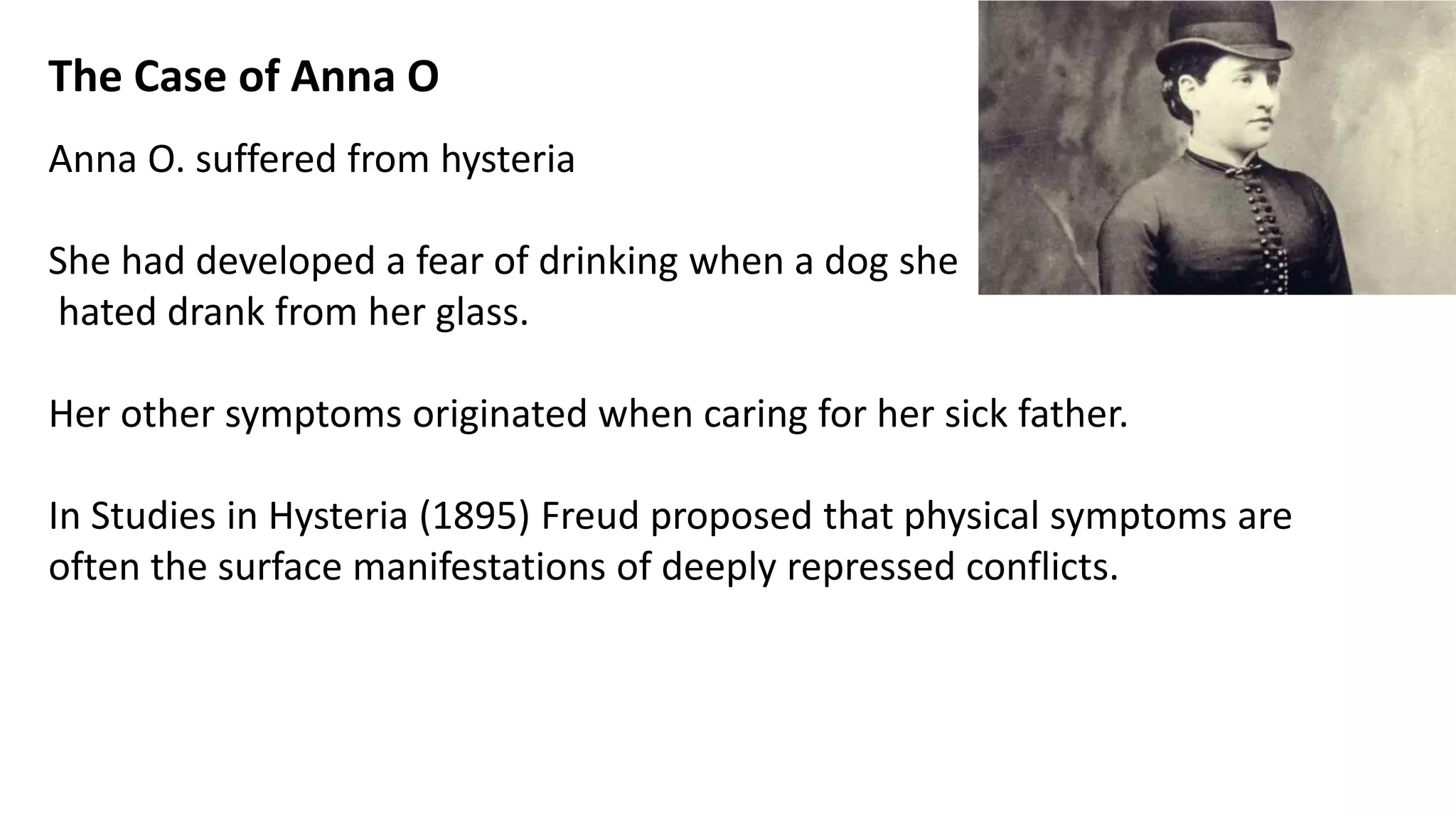
The Case of Anna O
Anna O. suffered from hysteria
She had developed a fear of drinking when a dog she
hated drank from her glass.
Her other symptoms originated when caring for her sick father.
In Studies in Hysteria (1895) Freud proposed that physical symptoms are
often the surface manifestations of deeply repressed conflicts.
The Case of Anna O
Freud was not just advancing an explanation of a particular
illness.
Implicitly he was proposing a revolutionary new theory of the human psyche itself.
This theory emerged “bit by bit” as a result of Freud’s clinical investigations, and it
led him to propose that there were at least three levels of the mind.
The psychological basis of behavior.
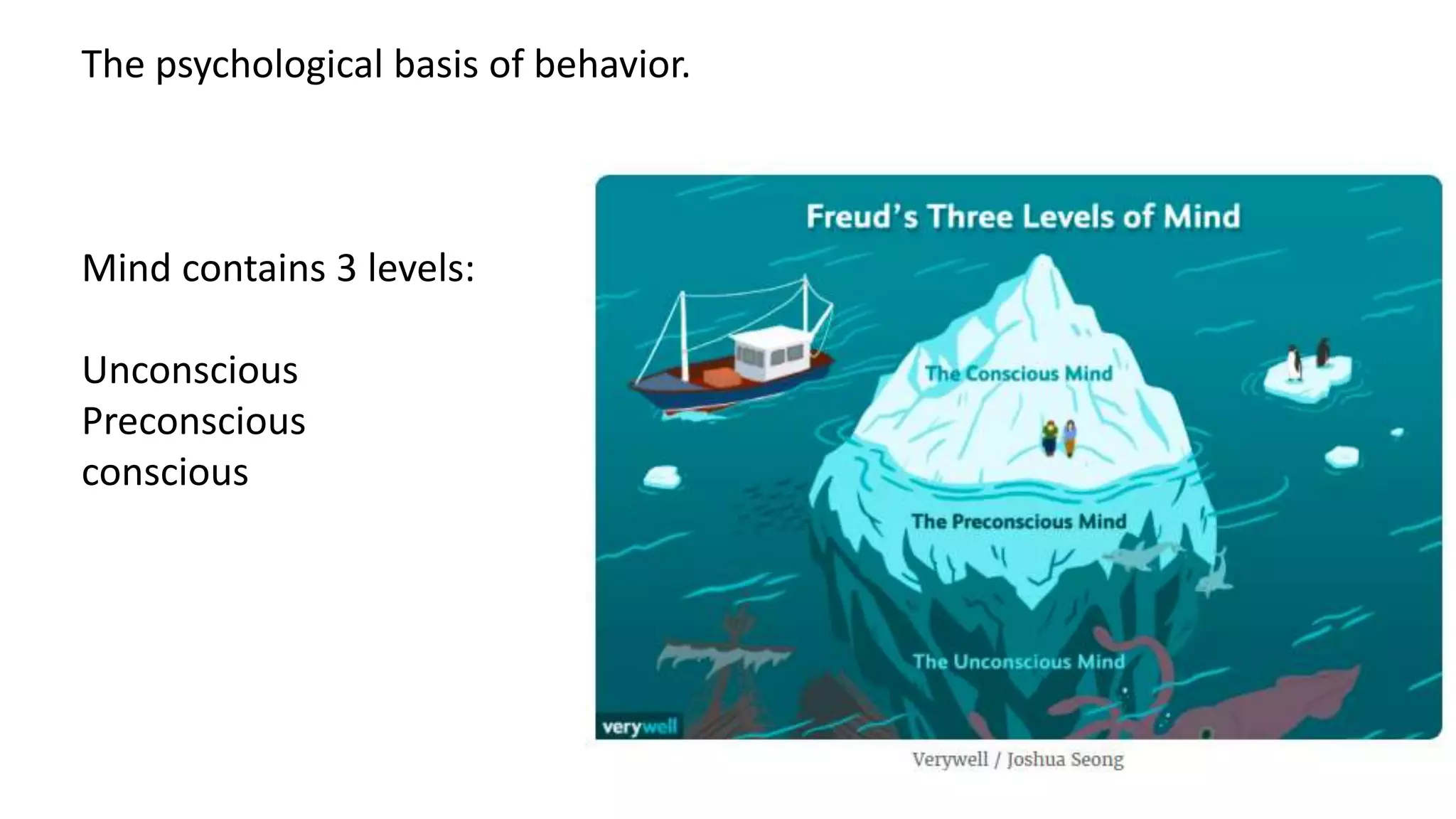
Mind contains 3 levels:
Unconscious
Preconscious
conscious
structural model of the mind comprising the entities:
 Id
 Ego
 Superego
Thanatos or death instinct, is viewed as a
set of destructive forces present in all
human beings.
When this energy is directed outward
onto others, it is expressed as aggression
and violence.
Eros, or life instinct, helps the individual to
survive; it directs life-sustaining activities such
as respiration, eating, and sex.
The energy created by the life instincts is
known as libido.
Freud believed that Eros is stronger than Thanatos, thus enabling people to survive rather than self-destruct.
The ego develops from the id during infancy. The ego's goal is to
satisfy the demands of the id in a safe a socially acceptable way. In
contrast to the id, the ego follows the reality principle as it
operates in both the conscious and unconscious mind.
The superego develops during early childhood (when the
child identifies with the same sex parent) and is responsible for
ensuring moral standards are followed. The superego operates on
the morality principle and motivates us to behave in a socially
responsible and acceptable manner.
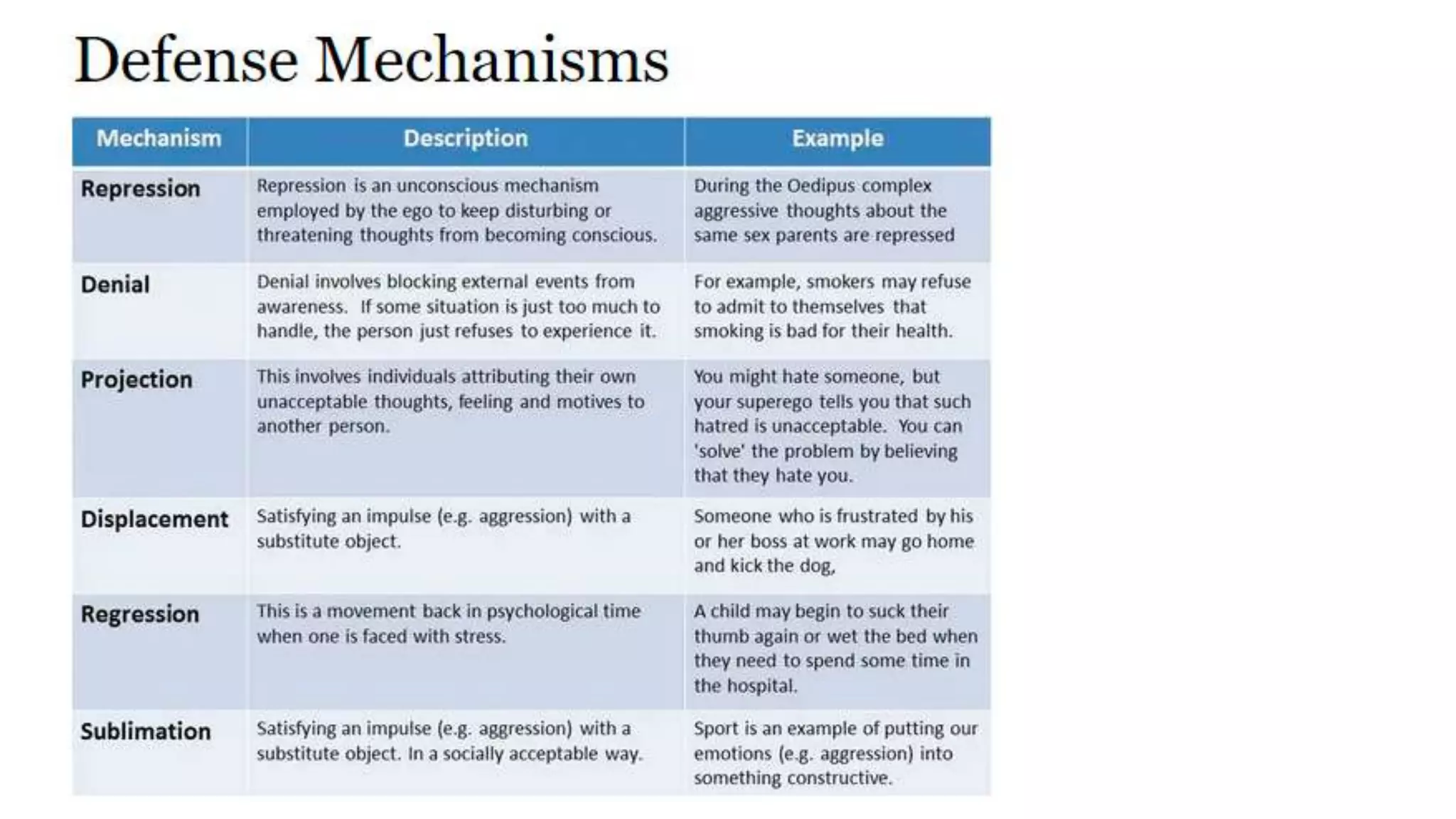
 The ego can deploy various defense mechanisms to
prevent it from becoming overwhelmed by anxiety.
 Unconscious mind
 Decrease anxiety
 Maintain sense of safety, equilibrium, self-esteem
Defense mechanisms
 Immature – baby-like… disturbed behavior…
 Mature – humor, sublimation
 Repression – punishing emotions info unconscious
Defense mechanisms
repression, in psychoanalytic theory, the exclusion of distressing
memories, thoughts, or feelings from the conscious mind.
Often involving sexual or aggressive urges or painful childhood memories,
these unwanted mental contents are pushed into the unconscious mind.
 Denial is a type of defense mechanism
that involves ignoring the reality of a
situation to avoid anxiety.
 Defense mechanisms are strategies that
people use to cope with distressing feelings.
 In the case of denial, it can involve not
acknowledging reality or denying the
consequences of that reality.
Defense mechanisms
https://www.youtube.com/watch?v=2AHskFrTL7Q
 Unconscious mental attitude based on important past
personal relationships:
Positive – confidence.
Negative – anger
 Countertransference – feelings about someone (doctor to
patient) - interfere medical judgment.
Transference reactions:
 Acquisition of new behavior
 Learning methods are the basis of behavioral treatment
techniques
 Habituation – desensitization: Habituation is a form of non-
associative learning in which an innate (non-reinforced)
response to a stimulus decreases after repeated or prolonged
presentations of that stimulus.
For example, organisms may habituate to repeated sudden loud
noises when they learn these have no consequences.
 https://www.youtube.com/watch?v=dlilZh60qdA
 Sensitization is a non-associative learning process in which
repeated administration of a stimulus results in the
progressive amplification of a response.
 Sensitization often is characterized by an enhancement of
response to a whole class of stimuli in addition to the one that
is repeated. Example: snake
 Classical conditioning: Classical conditioning is a process that
involves creating an association between a naturally existing
stimulus and a previously neutral one.
 The classical conditioning process involves pairing a previously
neutral stimulus (such as the sound of a bell) with an
unconditioned stimulus
 Classical conditioning= associative learning
 Classical conditioning is a process that involves creating an
association between a naturally existing stimulus and a
previously neutral one.
 The classical conditioning process involves pairing a previously
neutral stimulus (such as the sound of a bell) with an
unconditioned stimulus
Classical conditioning
 Stimulus automatically produce a response
 Response = reflexive behavior
 Response after learning
 Conditional response = conditioned stimulus + unconditioned
stimulus
Classical conditioning: aversive conditioning:
Unwanted behavior is paired with a painful stimulus
 In movies: https://www.youtube.com/watch?v=NQx83_JkrZw
Classical conditioning: imprinting
Operant conditioning:
 Operant conditioning, sometimes referred to as instrumental
conditioning, is a method of learning that employs rewards
and punishments for behavior.
 Through operant conditioning, an association is made between
a behavior and a consequence (whether negative or positive)
for that behavior.
Operant conditioning:
 Punishment: introduction of an aversive stimulus
 Reinforcement: positive, negative (removal of an aversive
stumulus)
Psychological test:
 Assessment: intelligence, achievement, personality,
psychopathology
 Intelligence: ability to understand abstract concepts; reason;
assimilate, recall, analyze and organize information.
 the ability to acquire and apply knowledge and skills.
Intelligence test:
 Mental age: a person`s level of intellectual functioning
 Chronological age: actual age in years
 IQ = MA/CA X 100
 Cultural background, emotion
 Stable throughout life
 IQ=100, if MA =CA
Intelligence test:
 Classifications of intellectual disability (the overlap or gap in
categories is related to differences in testing instruments) are:
a. Mild (IQ 50–70).
b. Moderate (IQ 35–55).
c. Severe (IQ 20–40).
d. Profound (IQ <20).
71 - 84 borderline intellectual functioning.
IQ >130 - superior intelligence.
Intelligence test:
 The Wechsler intelligence tests and the Vineland Adaptive
Behavior Scales
 The Wechsler Adult Intelligence Scale (WAIS) is an IQ
test designed to measure intelligence and cognitive ability in
index scores:
 Verbal Comprehension Index (VCI)
 Working Memory Index (WMI)
 Perceptual Reasoning Index (PRI)
 Processing Speed Index (PSI).
Intelligence test:
Achievement tests:
 In specific subject area
 Evaluation and career counseling
 Specific achievement tests: Scholastic Aptitude test, Medical
college administration test…
Psychiatric evaluation of patient with emotional symptoms
 Psychiatric history: part of medical history: mental illness, drug,
alcohol…. Source of stress
 Mental status examination:
 Appearance
 Behavior
 Attitude toward the interviewer
 Cognition: orientation, memory, attencenrion, sparial and abstraction
avilities, speech
 Mood and affect, emtions
 Thought
 Perception: illusion, hallutination
 Judgment, insight..
Psychoanalysis:
 Psychoanalysis is defined as a set of psychological theories and
therapeutic techniques that have their origin in the work and
theories of Sigmund Freud.
 The core of psychoanalysis is the belief that all people possess
unconscious thoughts, feelings, desires, and memories.
 method of analyzing psychic phenomena and treating
emotional disorders that involves treatment sessions during
which the patient is encouraged to talk freely about personal
experiences and especially about early childhood and dreams.
Free association:
a practice in psychoanalytic therapy. In this practice,
a therapist asks a person in therapy to freely share
thoughts, words, and anything else that comes to mind.
The thoughts need not be coherent.
In traditional free association, a person in therapy is
encouraged to verbalize or write all thoughts that come to
mind. Free association is not a linear thought pattern.
Rather, a person might produce an incoherent stream of
words, such as dog, red, mother, and scoot
Behavioral therapy:
 symptoms are relieved by unlearning maladaptive behavior
patterns and altering negative thinking patterns.
 the person’s history and unconscious conflicts are irrelevant and
thus are not examined
 Use:
 management of phobias
 aversive conditioning
 manage mild to moderate depression
 somatic symptom disorders
 eating disorders …
Group therapy:
 Groups of up to about eight people with a common problem or
negative life experience
 usually meet weekly or 1–2 hours;
 Members of the group provide the opportunity to express feelings
as well as feedback, support, and friendship to each other.
 The therapist has little input (observation)
Family therapy
 Children with behavioral problems
 Families in conflict
 People with eating or substance use disorders
 Specific techniques are used in family therapy.
 Mutual accommodation is encouraged.
 This is a process in which family members work toward meeting
each other’s needs.
 Normalizing boundaries between subsystems and reducing the
likelihood o triangles is encouraged.

The psychological basis of behavior. Psychodynamic factors of (3).pptx

  • 1.
    Overview The psychological basisof behavior. Psychodynamic factors of behavior. Learning theory. Psychological assessment of patients with behavioral symptoms. Psychological therapies.
  • 2.
    The psychological basisof behavior. Psychoanalytic theory – Freud`s concept : topographic theory of the mind
  • 3.
    The Case ofAnna O Anna O. suffered from hysteria She had developed a fear of drinking when a dog she hated drank from her glass. Her other symptoms originated when caring for her sick father. In Studies in Hysteria (1895) Freud proposed that physical symptoms are often the surface manifestations of deeply repressed conflicts.
  • 4.
    The Case ofAnna O Freud was not just advancing an explanation of a particular illness. Implicitly he was proposing a revolutionary new theory of the human psyche itself. This theory emerged “bit by bit” as a result of Freud’s clinical investigations, and it led him to propose that there were at least three levels of the mind.
  • 5.
    The psychological basisof behavior. Mind contains 3 levels: Unconscious Preconscious conscious
  • 6.
    structural model ofthe mind comprising the entities:  Id  Ego  Superego
  • 7.
    Thanatos or deathinstinct, is viewed as a set of destructive forces present in all human beings. When this energy is directed outward onto others, it is expressed as aggression and violence. Eros, or life instinct, helps the individual to survive; it directs life-sustaining activities such as respiration, eating, and sex. The energy created by the life instincts is known as libido. Freud believed that Eros is stronger than Thanatos, thus enabling people to survive rather than self-destruct.
  • 8.
    The ego developsfrom the id during infancy. The ego's goal is to satisfy the demands of the id in a safe a socially acceptable way. In contrast to the id, the ego follows the reality principle as it operates in both the conscious and unconscious mind. The superego develops during early childhood (when the child identifies with the same sex parent) and is responsible for ensuring moral standards are followed. The superego operates on the morality principle and motivates us to behave in a socially responsible and acceptable manner.
  • 10.
     The egocan deploy various defense mechanisms to prevent it from becoming overwhelmed by anxiety.  Unconscious mind  Decrease anxiety  Maintain sense of safety, equilibrium, self-esteem Defense mechanisms
  • 11.
     Immature –baby-like… disturbed behavior…  Mature – humor, sublimation  Repression – punishing emotions info unconscious Defense mechanisms repression, in psychoanalytic theory, the exclusion of distressing memories, thoughts, or feelings from the conscious mind. Often involving sexual or aggressive urges or painful childhood memories, these unwanted mental contents are pushed into the unconscious mind.
  • 12.
     Denial isa type of defense mechanism that involves ignoring the reality of a situation to avoid anxiety.  Defense mechanisms are strategies that people use to cope with distressing feelings.  In the case of denial, it can involve not acknowledging reality or denying the consequences of that reality. Defense mechanisms https://www.youtube.com/watch?v=2AHskFrTL7Q
  • 14.
     Unconscious mentalattitude based on important past personal relationships: Positive – confidence. Negative – anger  Countertransference – feelings about someone (doctor to patient) - interfere medical judgment. Transference reactions:
  • 16.
     Acquisition ofnew behavior  Learning methods are the basis of behavioral treatment techniques
  • 17.
     Habituation –desensitization: Habituation is a form of non- associative learning in which an innate (non-reinforced) response to a stimulus decreases after repeated or prolonged presentations of that stimulus. For example, organisms may habituate to repeated sudden loud noises when they learn these have no consequences.  https://www.youtube.com/watch?v=dlilZh60qdA
  • 18.
     Sensitization isa non-associative learning process in which repeated administration of a stimulus results in the progressive amplification of a response.  Sensitization often is characterized by an enhancement of response to a whole class of stimuli in addition to the one that is repeated. Example: snake
  • 19.
     Classical conditioning:Classical conditioning is a process that involves creating an association between a naturally existing stimulus and a previously neutral one.  The classical conditioning process involves pairing a previously neutral stimulus (such as the sound of a bell) with an unconditioned stimulus
  • 20.
     Classical conditioning=associative learning  Classical conditioning is a process that involves creating an association between a naturally existing stimulus and a previously neutral one.  The classical conditioning process involves pairing a previously neutral stimulus (such as the sound of a bell) with an unconditioned stimulus
  • 22.
    Classical conditioning  Stimulusautomatically produce a response  Response = reflexive behavior  Response after learning  Conditional response = conditioned stimulus + unconditioned stimulus
  • 23.
    Classical conditioning: aversiveconditioning: Unwanted behavior is paired with a painful stimulus  In movies: https://www.youtube.com/watch?v=NQx83_JkrZw Classical conditioning: imprinting
  • 26.
    Operant conditioning:  Operantconditioning, sometimes referred to as instrumental conditioning, is a method of learning that employs rewards and punishments for behavior.  Through operant conditioning, an association is made between a behavior and a consequence (whether negative or positive) for that behavior.
  • 27.
    Operant conditioning:  Punishment:introduction of an aversive stimulus  Reinforcement: positive, negative (removal of an aversive stumulus)
  • 31.
    Psychological test:  Assessment:intelligence, achievement, personality, psychopathology  Intelligence: ability to understand abstract concepts; reason; assimilate, recall, analyze and organize information.  the ability to acquire and apply knowledge and skills.
  • 32.
    Intelligence test:  Mentalage: a person`s level of intellectual functioning  Chronological age: actual age in years  IQ = MA/CA X 100  Cultural background, emotion  Stable throughout life  IQ=100, if MA =CA
  • 33.
    Intelligence test:  Classificationsof intellectual disability (the overlap or gap in categories is related to differences in testing instruments) are: a. Mild (IQ 50–70). b. Moderate (IQ 35–55). c. Severe (IQ 20–40). d. Profound (IQ <20). 71 - 84 borderline intellectual functioning. IQ >130 - superior intelligence.
  • 34.
    Intelligence test:  TheWechsler intelligence tests and the Vineland Adaptive Behavior Scales  The Wechsler Adult Intelligence Scale (WAIS) is an IQ test designed to measure intelligence and cognitive ability in index scores:  Verbal Comprehension Index (VCI)  Working Memory Index (WMI)  Perceptual Reasoning Index (PRI)  Processing Speed Index (PSI).
  • 35.
    Intelligence test: Achievement tests: In specific subject area  Evaluation and career counseling  Specific achievement tests: Scholastic Aptitude test, Medical college administration test…
  • 36.
    Psychiatric evaluation ofpatient with emotional symptoms  Psychiatric history: part of medical history: mental illness, drug, alcohol…. Source of stress  Mental status examination:  Appearance  Behavior  Attitude toward the interviewer  Cognition: orientation, memory, attencenrion, sparial and abstraction avilities, speech  Mood and affect, emtions  Thought  Perception: illusion, hallutination  Judgment, insight..
  • 38.
    Psychoanalysis:  Psychoanalysis isdefined as a set of psychological theories and therapeutic techniques that have their origin in the work and theories of Sigmund Freud.  The core of psychoanalysis is the belief that all people possess unconscious thoughts, feelings, desires, and memories.  method of analyzing psychic phenomena and treating emotional disorders that involves treatment sessions during which the patient is encouraged to talk freely about personal experiences and especially about early childhood and dreams.
  • 39.
    Free association: a practicein psychoanalytic therapy. In this practice, a therapist asks a person in therapy to freely share thoughts, words, and anything else that comes to mind. The thoughts need not be coherent. In traditional free association, a person in therapy is encouraged to verbalize or write all thoughts that come to mind. Free association is not a linear thought pattern. Rather, a person might produce an incoherent stream of words, such as dog, red, mother, and scoot
  • 40.
    Behavioral therapy:  symptomsare relieved by unlearning maladaptive behavior patterns and altering negative thinking patterns.  the person’s history and unconscious conflicts are irrelevant and thus are not examined  Use:  management of phobias  aversive conditioning  manage mild to moderate depression  somatic symptom disorders  eating disorders …
  • 41.
    Group therapy:  Groupsof up to about eight people with a common problem or negative life experience  usually meet weekly or 1–2 hours;  Members of the group provide the opportunity to express feelings as well as feedback, support, and friendship to each other.  The therapist has little input (observation)
  • 42.
    Family therapy  Childrenwith behavioral problems  Families in conflict  People with eating or substance use disorders  Specific techniques are used in family therapy.  Mutual accommodation is encouraged.  This is a process in which family members work toward meeting each other’s needs.  Normalizing boundaries between subsystems and reducing the likelihood o triangles is encouraged.