Maciej Telszewski
IOCCP Director and Coordinator of GOOS Biogeochemistry Panel
With slides from Dorothee Bakker, Rik Wanninkhof and Benjamin Pfeil
Viewing ICOS in a Global Context
From requirements-driven ocean observations, through high
quality data to fit-for-purpose information delivery
Institute of Oceanology of Polish Academy of Sciences, ul. Powstańców Warszawy 55, 81-712 Sopot, Poland
Phone: +48 58 731 16 10 / Fax: +48 58 551 21 30, www.ioccp.org
Biogeochemistry
Panel
Biogeochemistry
Panel
Biogeochemistry
Panel
Rik Wanninkhof, Dorothee Bakker, Christian Rödenbeck, Benjamin Pfeil, Kevin O’Brien, Are Olsen, Karl
Smith, Simone Alin, Cathy Cosca, Kim Currie, Melchor Gonzalez-Davilla, Steve Jones, Alex Kozyr, Camilla
Landa, Peter Landschützer, Siv Lauvset, Nathalie Lefèvre, Nicolas Metzl, David Munro, Shin-ichiro Nakaoka,
Yukihiro Nojiri, Abdirahman Omar, Denis Pierrot, Chris Sabine, Shu Saito, Ute Schuster, Tobias Steinhoff,
Kevin Sullivan, Adrienne Sutton, Colm Sweeney, Taro Takahashi, Maciej Telszewski, Bronte Tilbrook
and all >100 SOCONET, SOCAT and SOCOM contributors
3rd ICOS Science Conference
11-13 September 2018, Prague, Czech Republic
Biogeochemistry
Panel
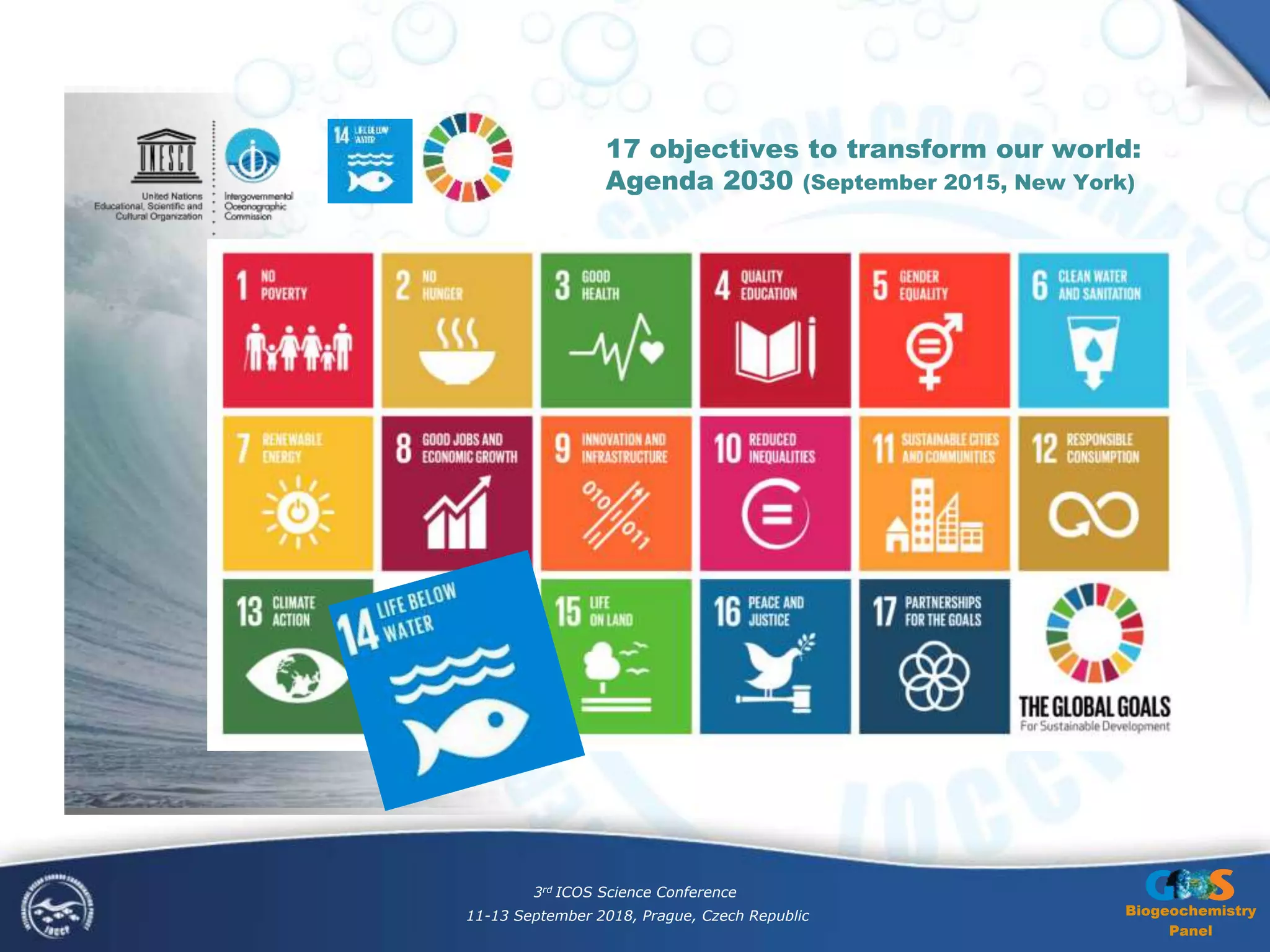
17 objectives to transform our world:
Agenda 2030 (September 2015, New York)
3rd ICOS Science Conference
11-13 September 2018, Prague, Czech Republic
Biogeochemistry
Panel
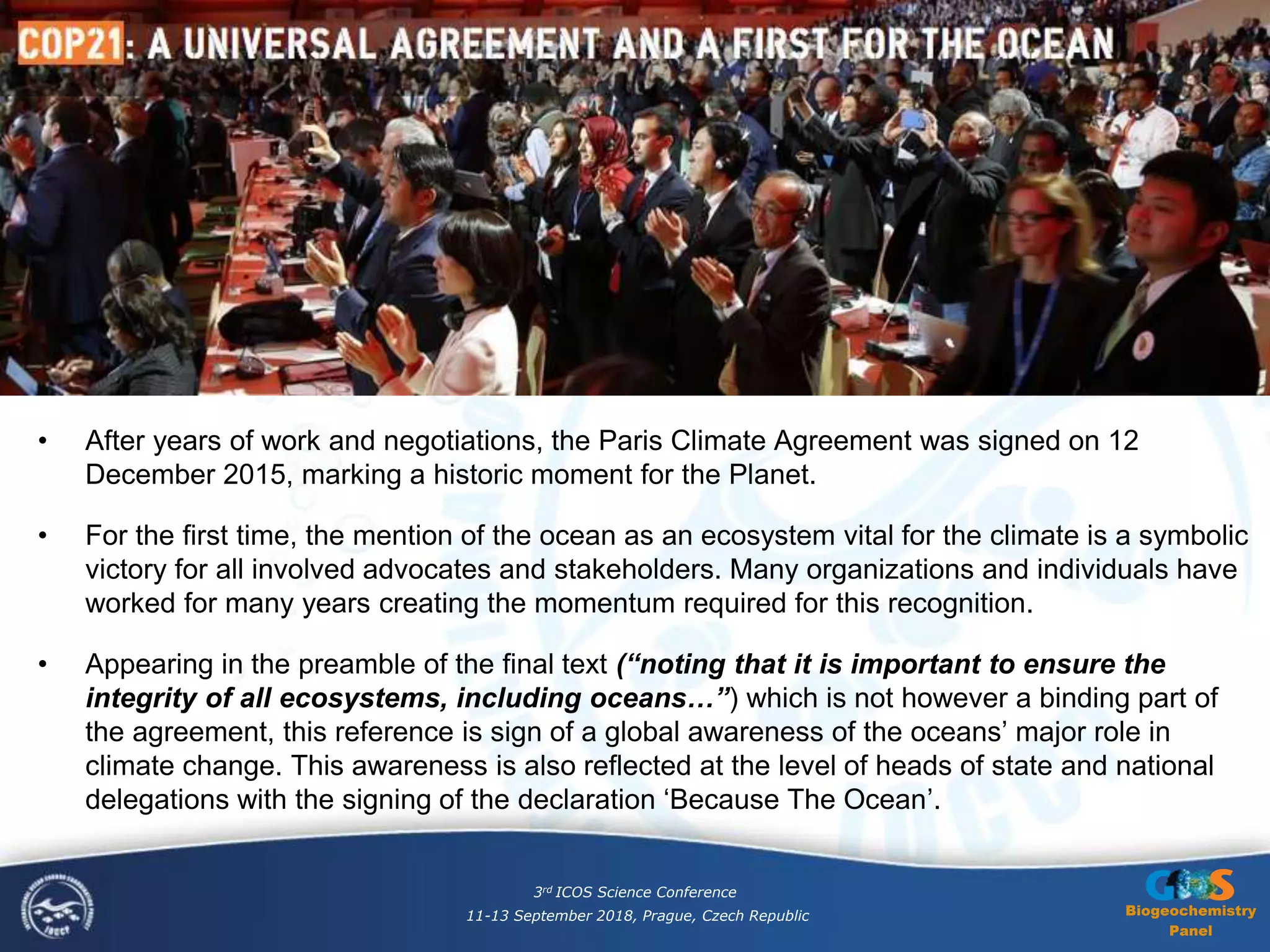
• After years of work and negotiations, the Paris Climate Agreement was signed on 12
December 2015, marking a historic moment for the Planet.
• For the first time, the mention of the ocean as an ecosystem vital for the climate is a symbolic
victory for all involved advocates and stakeholders. Many organizations and individuals have
worked for many years creating the momentum required for this recognition.
• Appearing in the preamble of the final text (“noting that it is important to ensure the
integrity of all ecosystems, including oceans…”) which is not however a binding part of
the agreement, this reference is sign of a global awareness of the oceans’ major role in
climate change. This awareness is also reflected at the level of heads of state and national
delegations with the signing of the declaration ‘Because The Ocean’.
3rd ICOS Science Conference
11-13 September 2018, Prague, Czech Republic
Biogeochemistry
Panel
• Support the development of an initiative for enhanced global sea and ocean
observation required to monitor inter alia climate change and marine biodiversity,
• Support an enhanced system of ocean assessment through the UN Regular Process to
develop a consensus view on the state of the oceans and enable sustainable
management strategies to be developed and implemented
• Promote open science and the improvement of the global data sharing infrastructure to
ensure the discoverability, accessibility, and interoperability of a wide range of ocean and
marine data;
• Strengthen collaborative approaches to encourage the development of regional
observing capabilities and knowledge networks in a coordinated and coherent way,
including supporting the capacity building of developing countries; and
• Promote increased G7 political cooperation by identifying additional actions needed to
enhance future routine ocean observations.
The S&T Ministers of the G7 and the EU met in
May 2016 to discuss science, technology and
innovation aspects across global challenges
such as health, energy, agriculture and the
environment. They issued a Communiqué:
3rd ICOS Science Conference
11-13 September 2018, Prague, Czech Republic
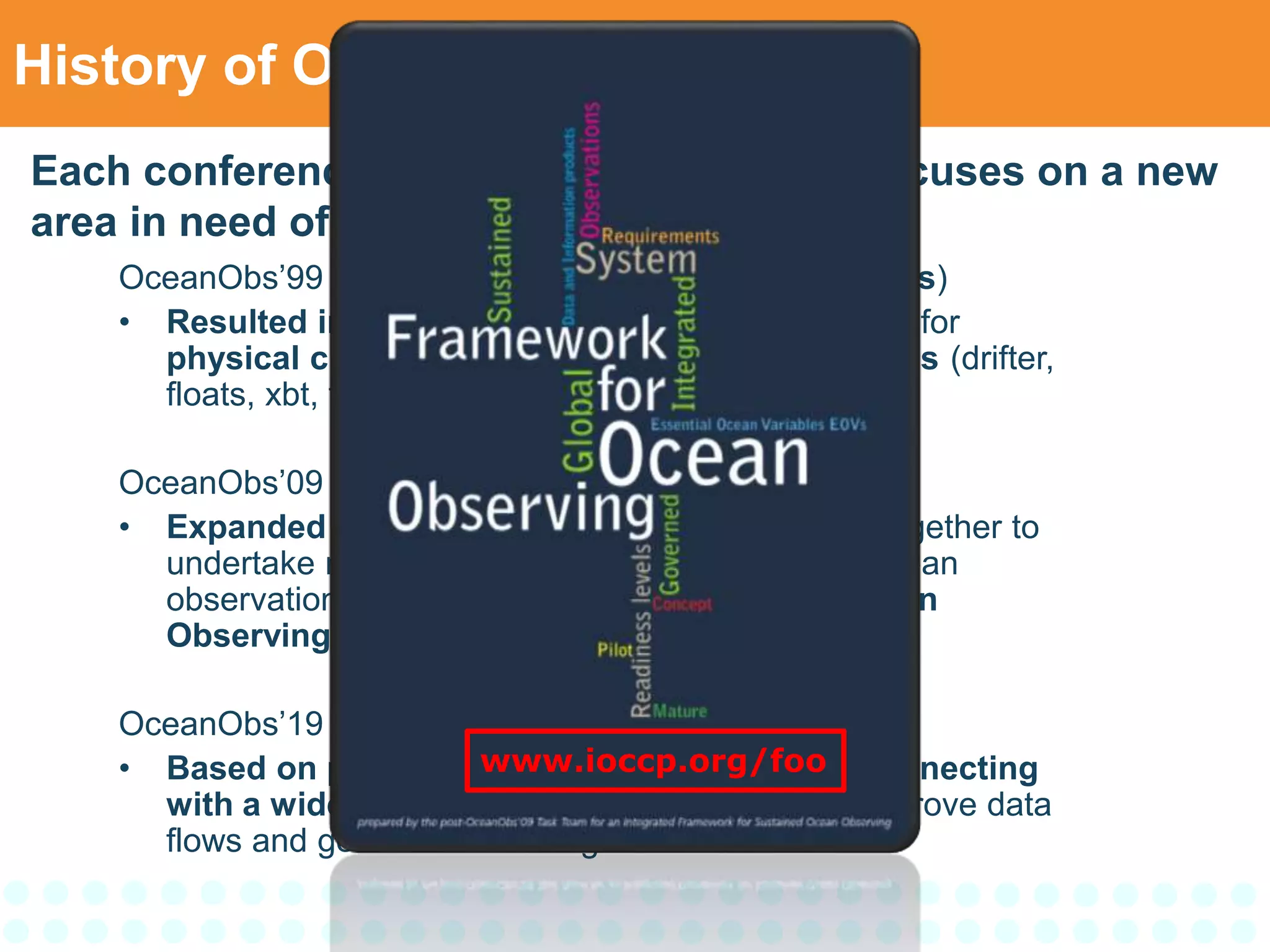
History of OceanObs Series
OceanObs’99 – St. Raphael, France (300 participants)
• Resulted in an internationally coordinated system for
physical climate and ocean carbon observations (drifter,
floats, xbt, tide gauge…)
OceanObs’09 – Venice, Italy (640 participants)
• Expanded the range of communities working together to
undertake more comprehensive and sustainad ocean
observations and led to the Framework for Ocean
Observing (FOO).
OceanObs’19 – Honolulu, USA (1200 participants)
• Based on processes described in the FOO, connecting
with a wide range of user communities and improve data
flows and governance arrangements.
Each conference of the OceanObs series focuses on a new
area in need of enhanced guidance:
www.ioccp.org/foo
Biogeochemistry
Panel
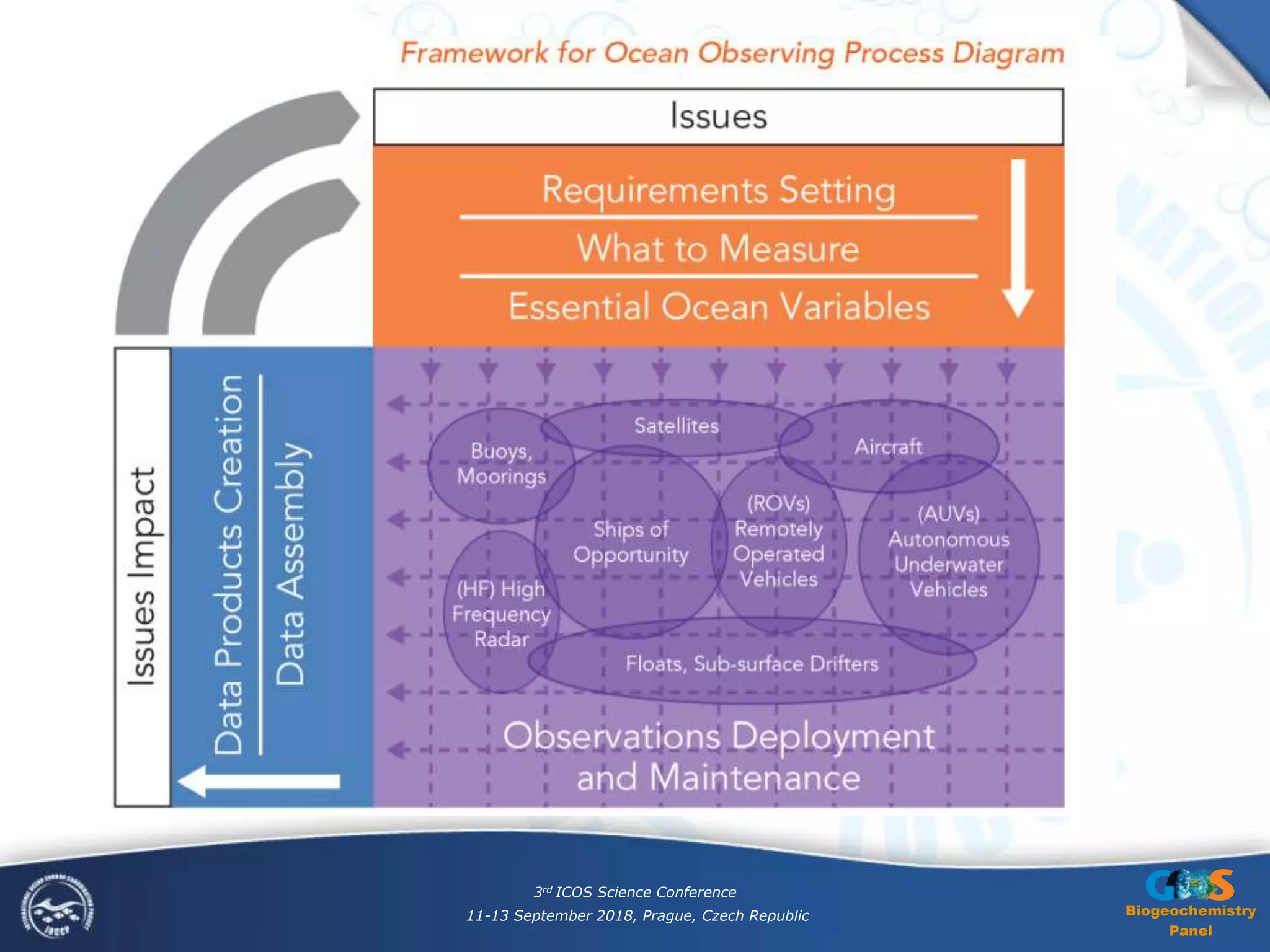
System
A broad schematic of a full value chain in
sustained ocean observing programs
Observations
Coordination
In situ and satellite observations
Global networks and global
approaches
System requirements
Applications/products, knowledge challenges,
phenomena, EOVs, network design
Data
systems
Assembly
and
dissemination
Understanding
Scientific analysis,
indicators
Predicting / Modeling
Ocean forecast systems
Societal benefit from actionable
information
Policy, public and private management and individual decisions
Assessing
Policy-relevant scientific
assessments
Services
[informing]
Early warning, forecasts,
short and long term
direct advice
www.ioccp.org/foo
Climate and
Weather
Real-time
services
Assessments and
management of
ecosystem services
Emission policies
Food security
Tourism
3rd ICOS Science Conference
11-13 September 2018, Prague, Czech Republic
Biogeochemistry
Panel
3rd ICOS Science Conference
11-13 September 2018, Prague, Czech Republic
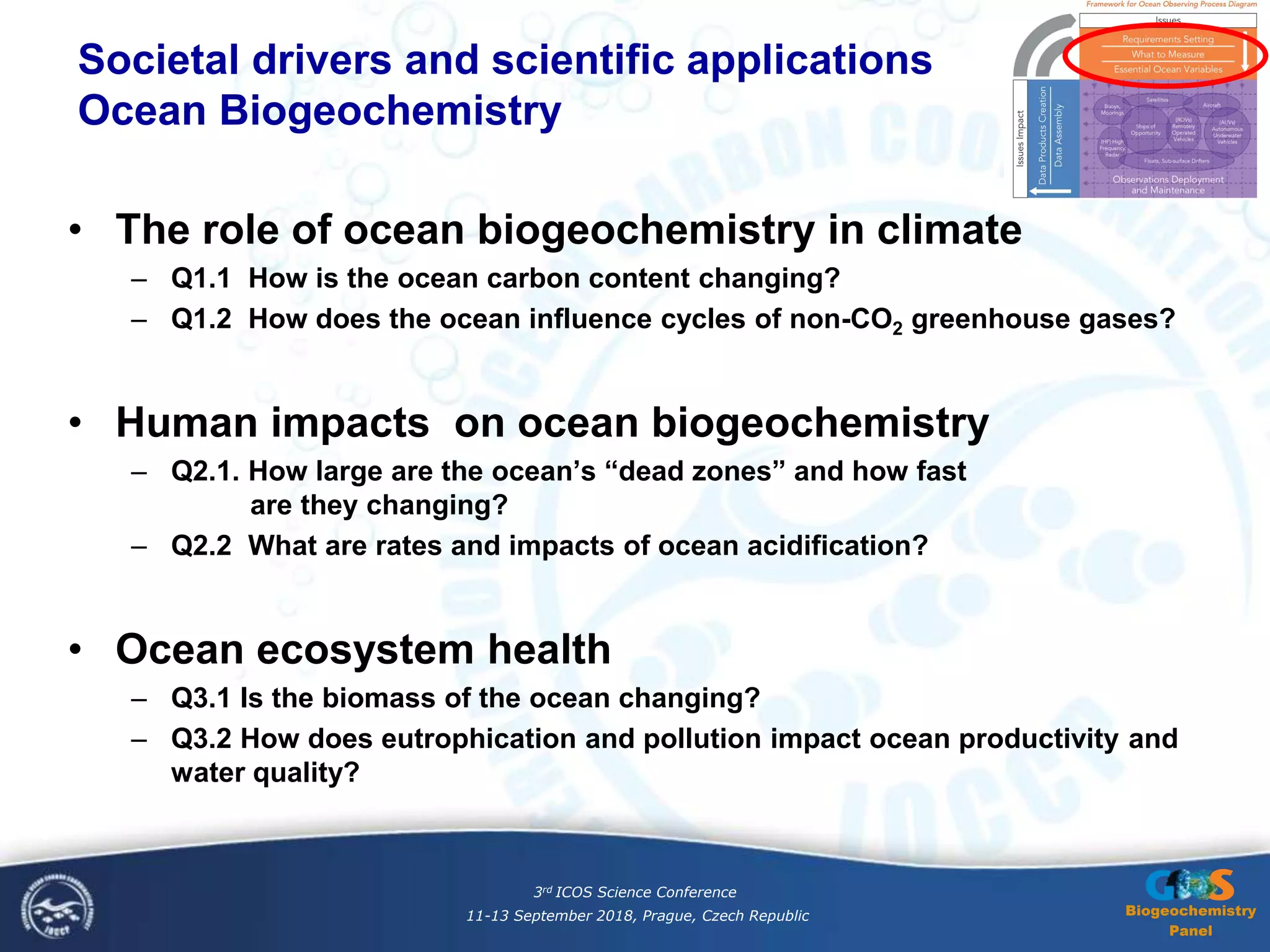
Societal drivers and scientific applications
Ocean Biogeochemistry
• The role of ocean biogeochemistry in climate
– Q1.1 How is the ocean carbon content changing?
– Q1.2 How does the ocean influence cycles of non-CO2 greenhouse gases?
• Human impacts on ocean biogeochemistry
– Q2.1. How large are the ocean’s “dead zones” and how fast
are they changing?
– Q2.2 What are rates and impacts of ocean acidification?
• Ocean ecosystem health
– Q3.1 Is the biomass of the ocean changing?
– Q3.2 How does eutrophication and pollution impact ocean productivity and
water quality?
Biogeochemistry
Panel
3rd ICOS Science Conference
11-13 September 2018, Prague, Czech Republic
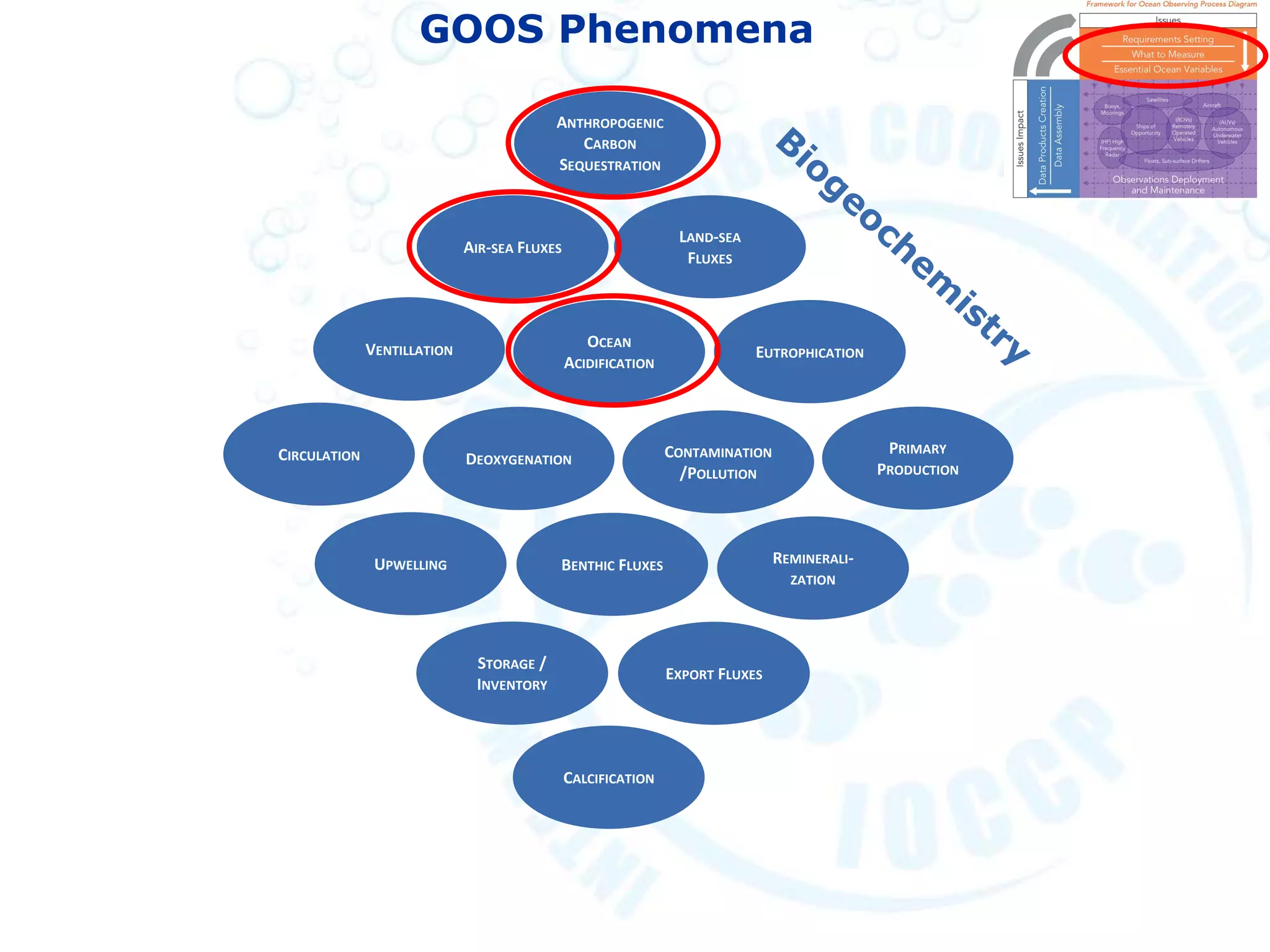
GOOS Phenomena
AIR-SEA FLUXES
ANTHROPOGENIC
CARBON
SEQUESTRATION
UPWELLING
VENTILLATION
CONTAMINATION
/POLLUTION
OCEAN
ACIDIFICATION
DEOXYGENATION
EXPORT FLUXES
EUTROPHICATION
STORAGE /
INVENTORY
CIRCULATION
LAND-SEA
FLUXES
BENTHIC FLUXES
PRIMARY
PRODUCTION
REMINERALI-
ZATION
CALCIFICATION
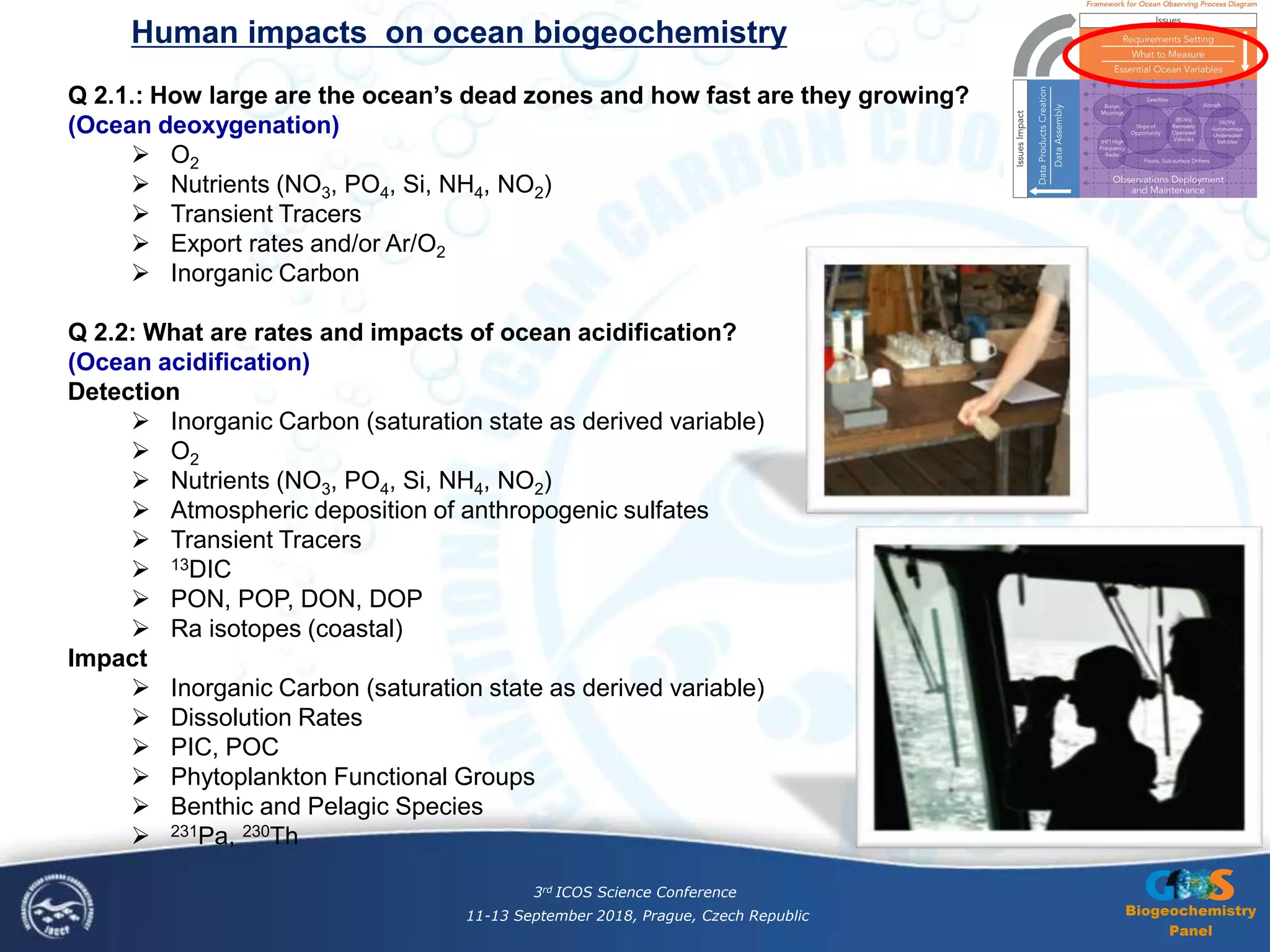
Human impacts on ocean biogeochemistry
Q 2.1.: How large are the ocean’s dead zones and how fast are they growing?
(Ocean deoxygenation)
 O2
 Nutrients (NO3, PO4, Si, NH4, NO2)
 Transient Tracers
 Export rates and/or Ar/O2
 Inorganic Carbon
Q 2.2: What are rates and impacts of ocean acidification?
(Ocean acidification)
Detection
 Inorganic Carbon (saturation state as derived variable)
 O2
 Nutrients (NO3, PO4, Si, NH4, NO2)
 Atmospheric deposition of anthropogenic sulfates
 Transient Tracers
 13DIC
 PON, POP, DON, DOP
 Ra isotopes (coastal)
Impact
 Inorganic Carbon (saturation state as derived variable)
 Dissolution Rates
 PIC, POC
 Phytoplankton Functional Groups
 Benthic and Pelagic Species
 231Pa, 230Th
Biogeochemistry
Panel
3rd ICOS Science Conference
11-13 September 2018, Prague, Czech Republic
Biogeochemistry
Panel
3rd ICOS Science Conference
11-13 September 2018, Prague, Czech Republic
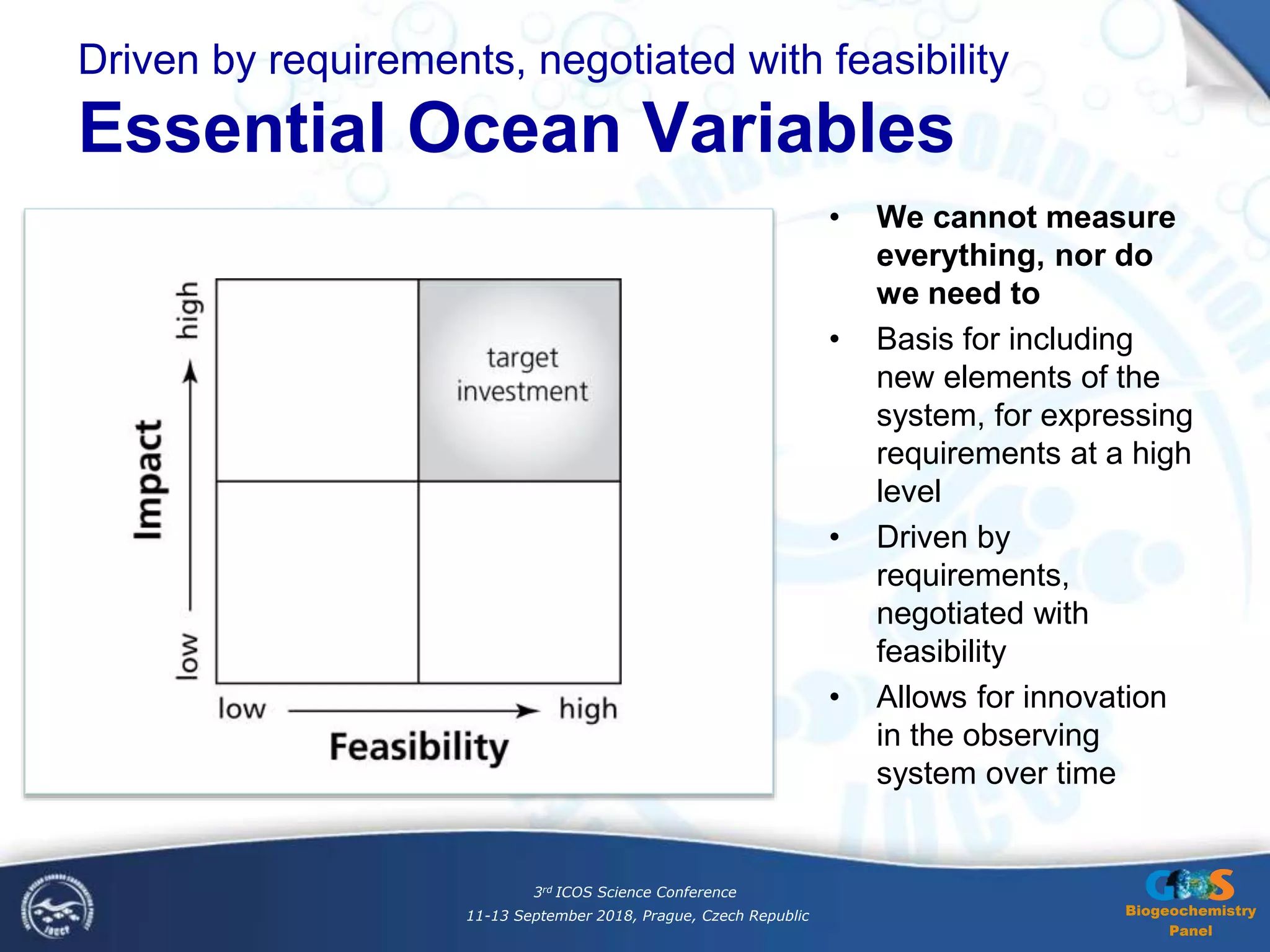
Driven by requirements, negotiated with feasibility
Essential Ocean Variables
• We cannot measure
everything, nor do
we need to
• Basis for including
new elements of the
system, for expressing
requirements at a high
level
• Driven by
requirements,
negotiated with
feasibility
• Allows for innovation
in the observing
system over time
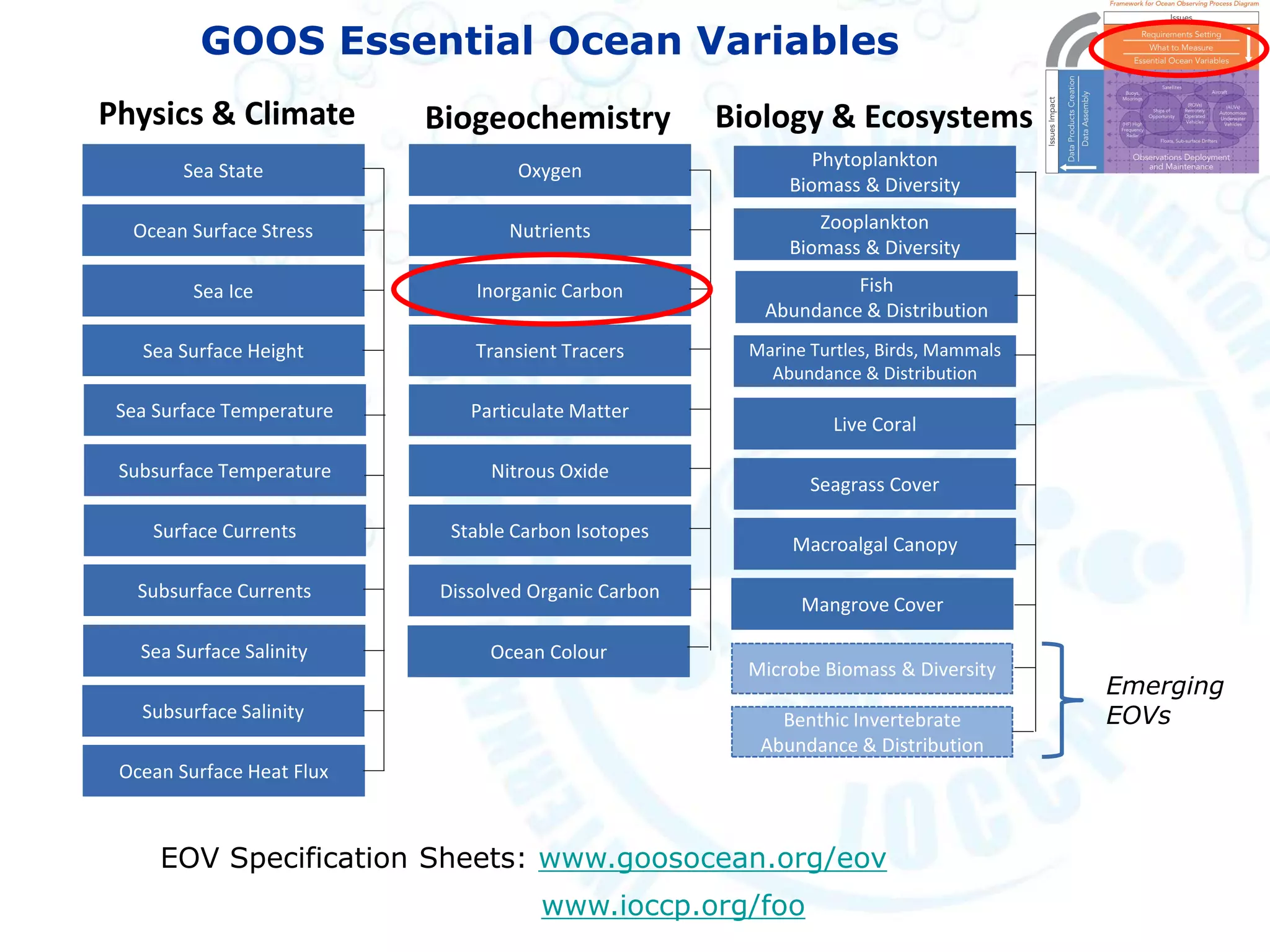
GOOS Essential Ocean Variables
EOV Specification Sheets: www.goosocean.org/eov
www.ioccp.org/foo
Physics & Climate
Oxygen
Nutrients
Particulate Matter
Inorganic Carbon
Transient Tracers
Nitrous Oxide
Stable Carbon Isotopes
Dissolved Organic Carbon
Biogeochemistry
Phytoplankton
Biomass & Diversity
Zooplankton
Biomass & Diversity
Fish
Abundance & Distribution
Biology & Ecosystems
Marine Turtles, Birds, Mammals
Abundance & Distribution
Live Coral
Seagrass Cover
Macroalgal Canopy
Mangrove Cover
Sea Surface Temperature
Ocean Surface Stress
Subsurface Currents
Surface Currents
Subsurface Temperature
Sea State
Ocean Surface Heat Flux
Sea Surface Height
Sea Ice
Sea Surface Salinity
Subsurface Salinity
Ocean Colour
Microbe Biomass & Diversity
Benthic Invertebrate
Abundance & Distribution
Emerging
EOVs
Biogeochemistry
Panel
Essential Ocean Variable (EOV): Inorganic Carbon
Name of EOV Inorganic Carbon
Sub-Variables Dissolved Inorganic Carbon (DIC), Total Alkalinity (TA), Partial pressure of carbon
dioxide (pCO2) and pH.
[At least two of the four Sub-Variables are needed.]
Derived Products Saturation state (aragonite, calcite), Dissolved carbonate ion concentration, Air-sea
flux of CO2, Anthropogenic carbon, Change in total carbon
Supporting Variables Surface and subsurface Temperature, Surface and subsurface Salinity, Ocean vector
stress (wind speed), Atmospheric column-averaged dry-air mole fraction of CO2
(xCO2), Barometric pressure, Oxygen, Calcium concentration, Transient tracers,
Oxygen to argon ratio (O2/Ar)
Responsible GOOS Panel GOOS Biogeochemistry Panel
Contact: ioccp@ioccp.org
The Essential Ocean Variables
Specification Sheets
3rd ICOS Science Conference
11-13 September 2018, Prague, Czech Republic
EOV Specification Sheets:
www.goosocean.org/eov
www.ioccp.org/foo
Table 2: Requirements Setting (Inorganic Carbon)
Societal Drivers 1. The role of ocean biogeochemistry in climate
2. Human impacts on ocean biogeochemistry
3. Ocean ecosystem health
Scientific Application(s) Q 1.1. How is the ocean carbon content changing?
Q 2.1. How large are the ocean’s dead zones and how fast are they growing?
Q 2.2. What are rates and impacts of ocean acidification?
Q 3.1. Is the biomass of the oceans changing?
Readiness Level
[as defined in the FOO]
Mature
Phenomena to Capture 1
Air-Sea Fluxes
2
Storage / inventory
3
Ocean Acidification
4
Primary production
Temporal Scales of the
Phenomena
Monthly Annual Coastal
Daily
Open Ocean
Seasonal
Seasonal to decadal
Spatial Scales of the Phenomena 1-250 km 100-1000 km Coastal
0.1-100 km
Open Ocean
100-1000km
Coastal
1-100 km
Open Ocean
100-1000 km
Magnitudes/Range of the Signal
to Capture
2 Pg C yr-1 20 Pg C decade-1 Saturation states
0.1 decade-1
pH
0.01 decade-1
0.5 Pg C yr-1 decade-1
(net community
production)
Current Uncertainty Relative to
the Signal
Target Uncertainty Relative to the
Signal
±10% ±10% ±20%
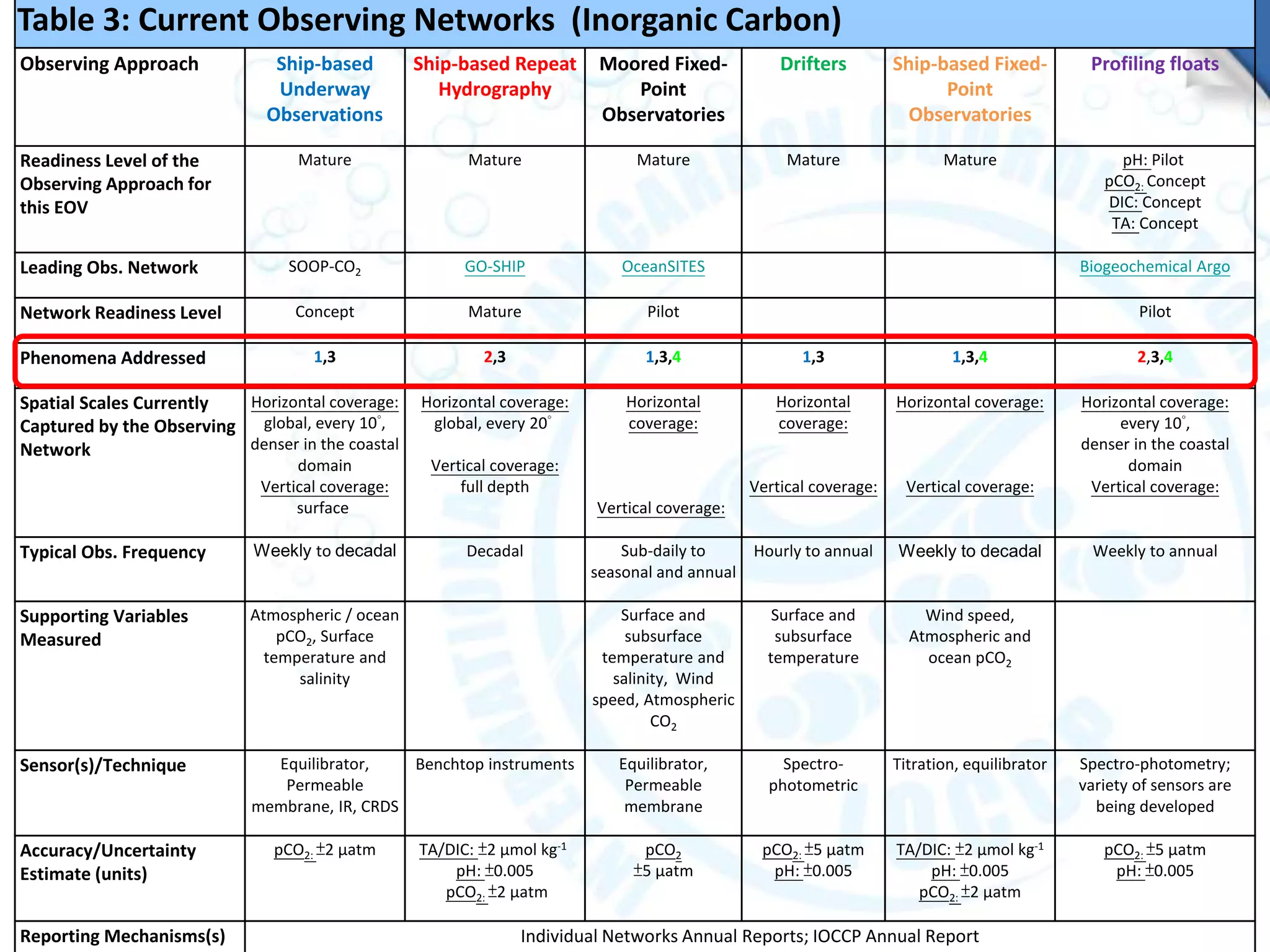
Table 3: Current Observing Networks (Inorganic Carbon)
Observing Approach Ship-based
Underway
Observations
Ship-based Repeat
Hydrography
Moored Fixed-
Point
Observatories
Drifters Ship-based Fixed-
Point
Observatories
Profiling floats
Readiness Level of the
Observing Approach for
this EOV
Mature Mature Mature Mature Mature pH: Pilot
pCO2: Concept
DIC: Concept
TA: Concept
Leading Obs. Network SOOP-CO2 GO-SHIP OceanSITES Biogeochemical Argo
Network Readiness Level Concept Mature Pilot Pilot
Phenomena Addressed 1,3 2,3 1,3,4 1,3 1,3,4 2,3,4
Spatial Scales Currently
Captured by the Observing
Network
Horizontal coverage:
global, every 10°,
denser in the coastal
domain
Vertical coverage:
surface
Horizontal coverage:
global, every 20°
Vertical coverage:
full depth
Horizontal
coverage:
Vertical coverage:
Horizontal
coverage:
Vertical coverage:
Horizontal coverage:
Vertical coverage:
Horizontal coverage:
every 10°,
denser in the coastal
domain
Vertical coverage:
Typical Obs. Frequency Weekly to decadal Decadal Sub-daily to
seasonal and annual
Hourly to annual Weekly to decadal Weekly to annual
Supporting Variables
Measured
Atmospheric / ocean
pCO2, Surface
temperature and
salinity
Surface and
subsurface
temperature and
salinity, Wind
speed, Atmospheric
CO2
Surface and
subsurface
temperature
Wind speed,
Atmospheric and
ocean pCO2
Sensor(s)/Technique Equilibrator,
Permeable
membrane, IR, CRDS
Benchtop instruments Equilibrator,
Permeable
membrane
Spectro-
photometric
Titration, equilibrator Spectro-photometry;
variety of sensors are
being developed
Accuracy/Uncertainty
Estimate (units)
pCO2: ±2 μatm TA/DIC: ±2 μmol kg-1
pH: ±0.005
pCO2: ±2 μatm
pCO2
±5 μatm
pCO2: ±5 μatm
pH: ±0.005
TA/DIC: ±2 μmol kg-1
pH: ±0.005
pCO2: ±2 μatm
pCO2: ±5 µatm
pH: ±0.005
Reporting Mechanisms(s) Individual Networks Annual Reports; IOCCP Annual Report
Biogeochemistry
Panel
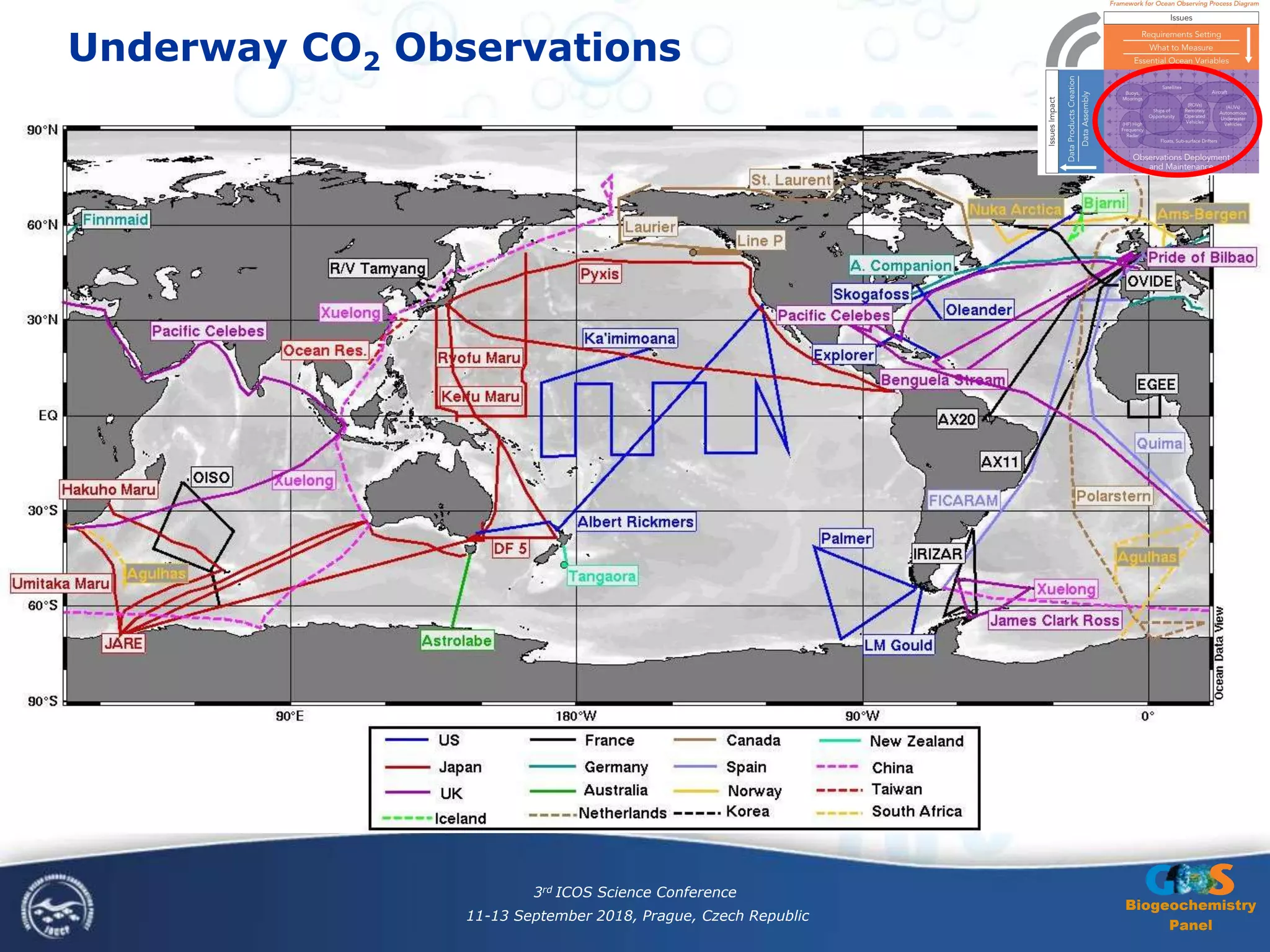
Underway CO2 Observations
3rd ICOS Science Conference
11-13 September 2018, Prague, Czech Republic
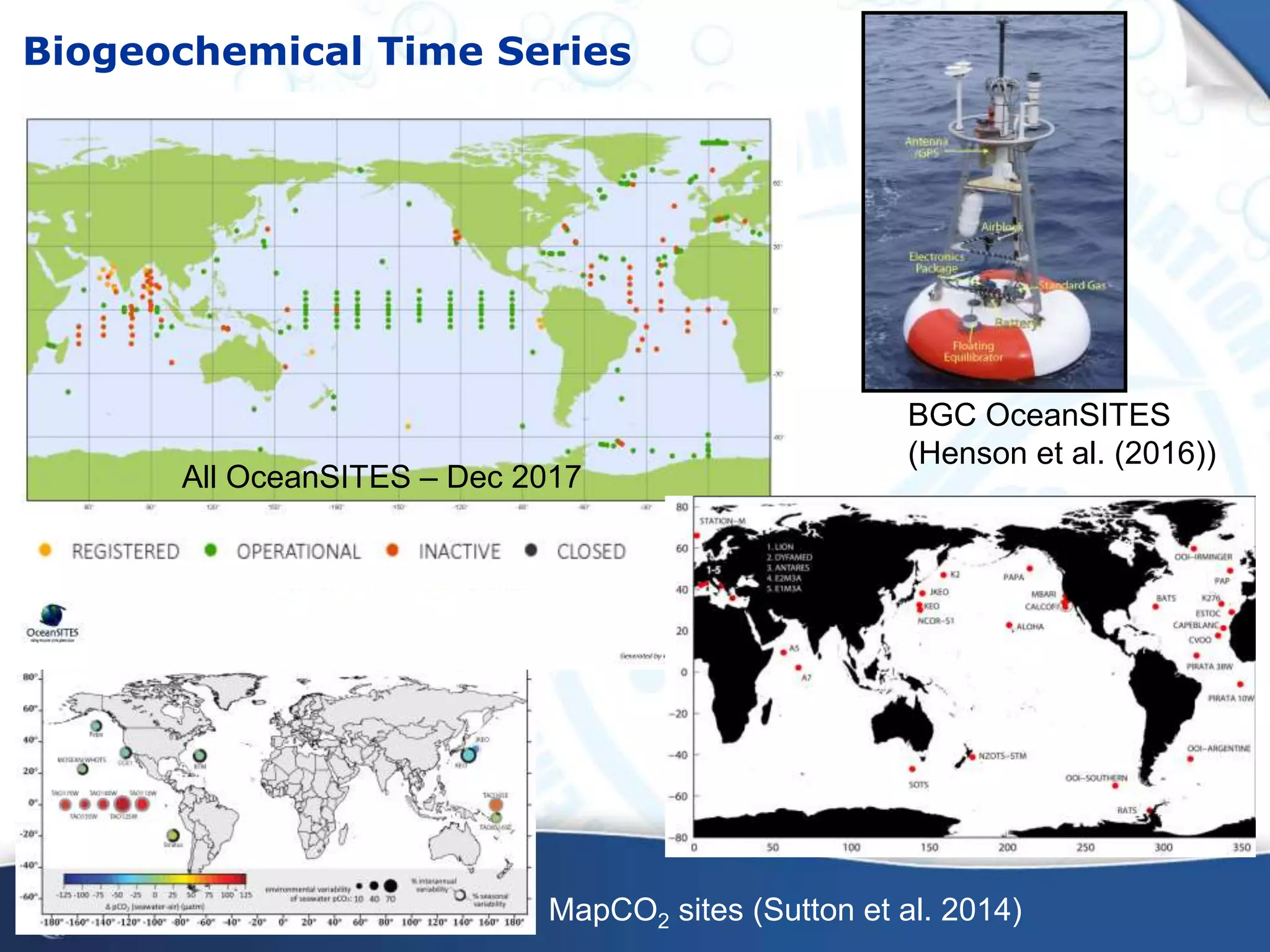
Biogeochemical Time Series
BGC OceanSITES
(Henson et al. (2016))
MapCO2 sites (Sutton et al. 2014)
All OceanSITES – Dec 2017
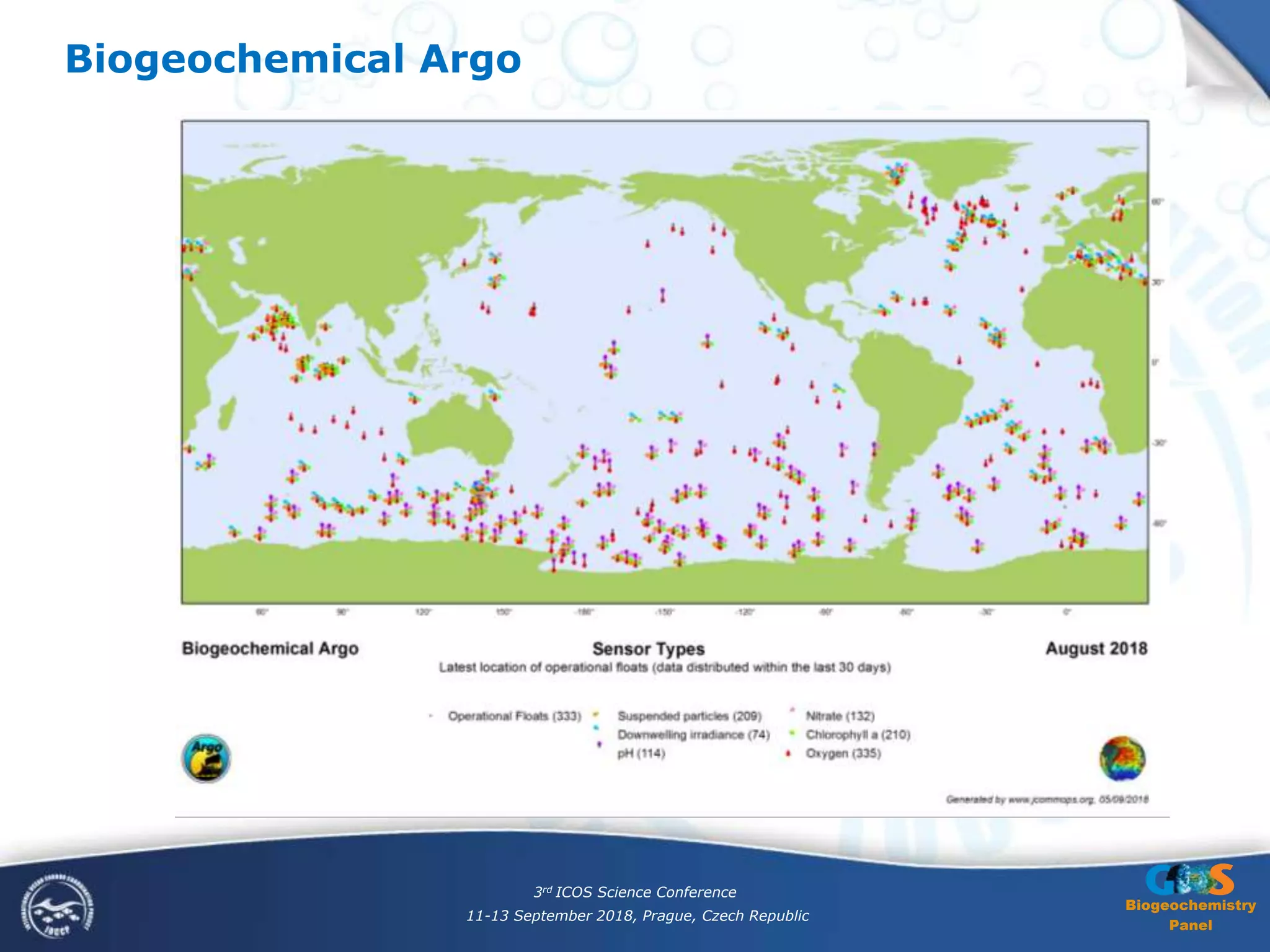
Biogeochemical Argo
Biogeochemistry
Panel
3rd ICOS Science Conference
11-13 September 2018, Prague, Czech Republic
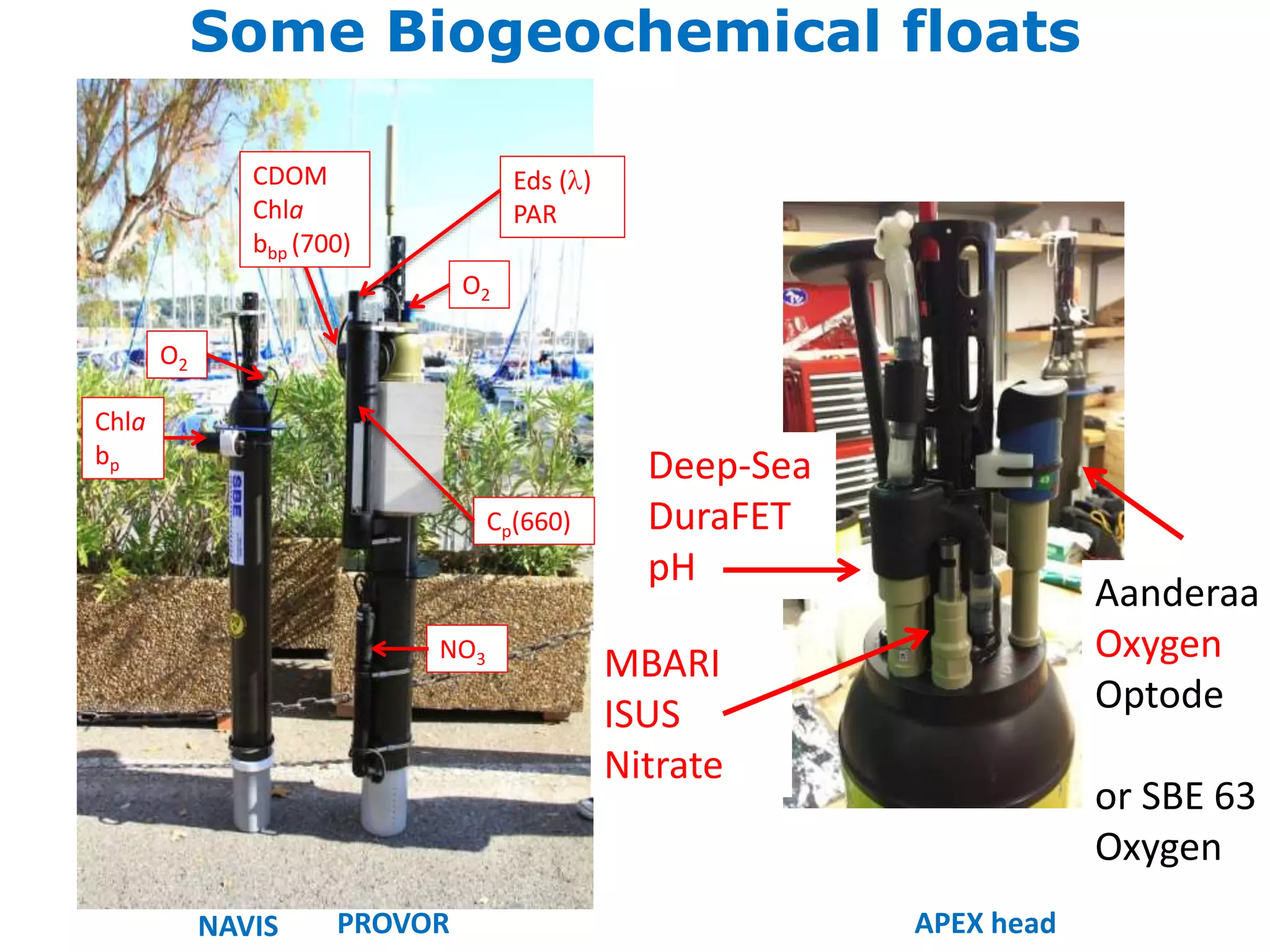
Some Biogeochemical floats
NAVIS PROVOR
NO3
O2
Eds (l)
PAR
O2
APEX head
Chla
bp
Cp(660)
CDOM
Chla
bbp (700)
Deep-Sea
DuraFET
pH
MBARI
ISUS
Nitrate
Aanderaa
Oxygen
Optode
or SBE 63
Oxygen
Biogeochemistry
Panel
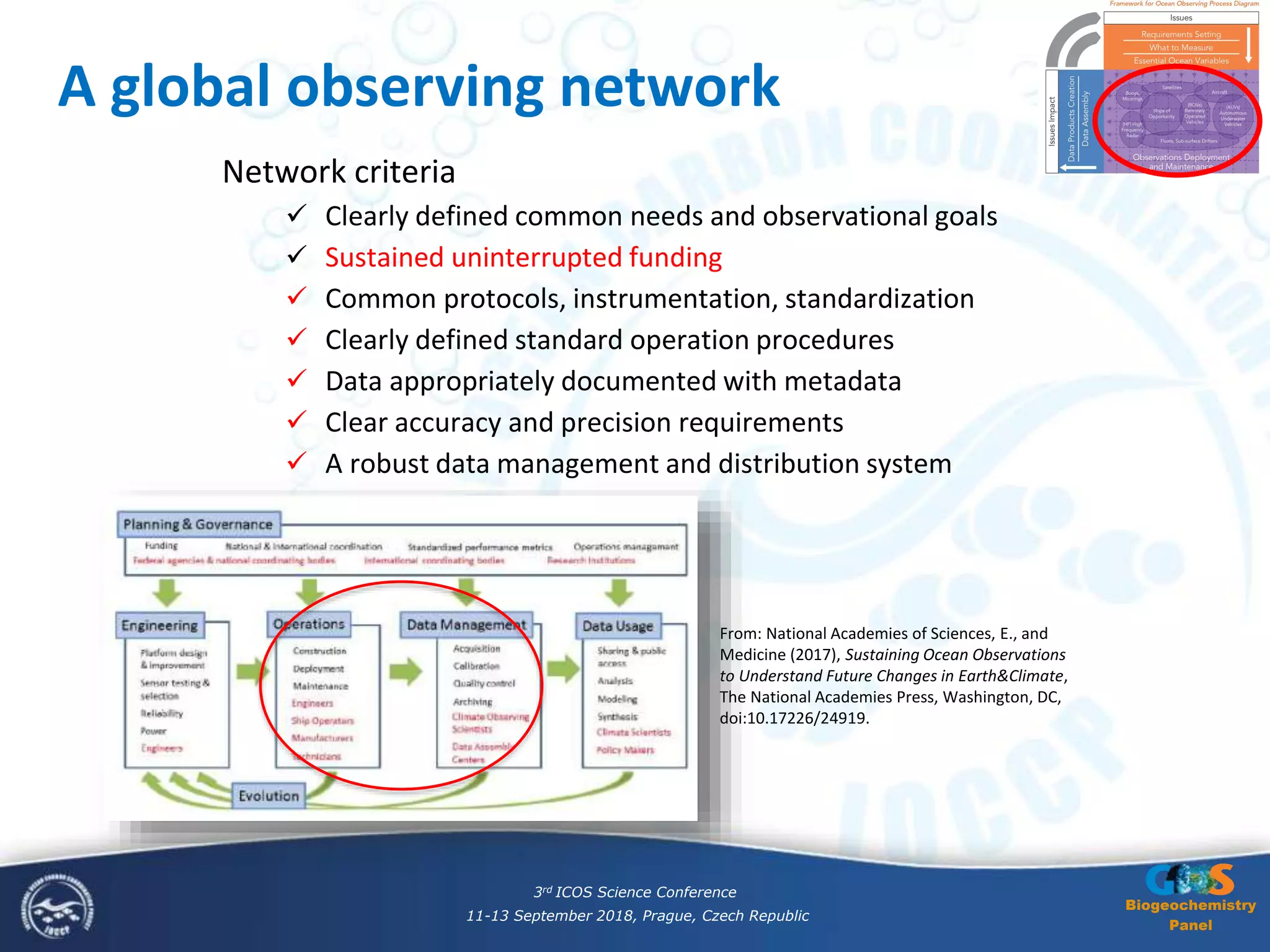
Network criteria
 Clearly defined common needs and observational goals
 Sustained uninterrupted funding
 Common protocols, instrumentation, standardization
 Clearly defined standard operation procedures
 Data appropriately documented with metadata
 Clear accuracy and precision requirements
 A robust data management and distribution system
From: National Academies of Sciences, E., and
Medicine (2017), Sustaining Ocean Observations
to Understand Future Changes in Earth&Climate,
The National Academies Press, Washington, DC,
doi:10.17226/24919.
A global observing network
3rd ICOS Science Conference
11-13 September 2018, Prague, Czech Republic
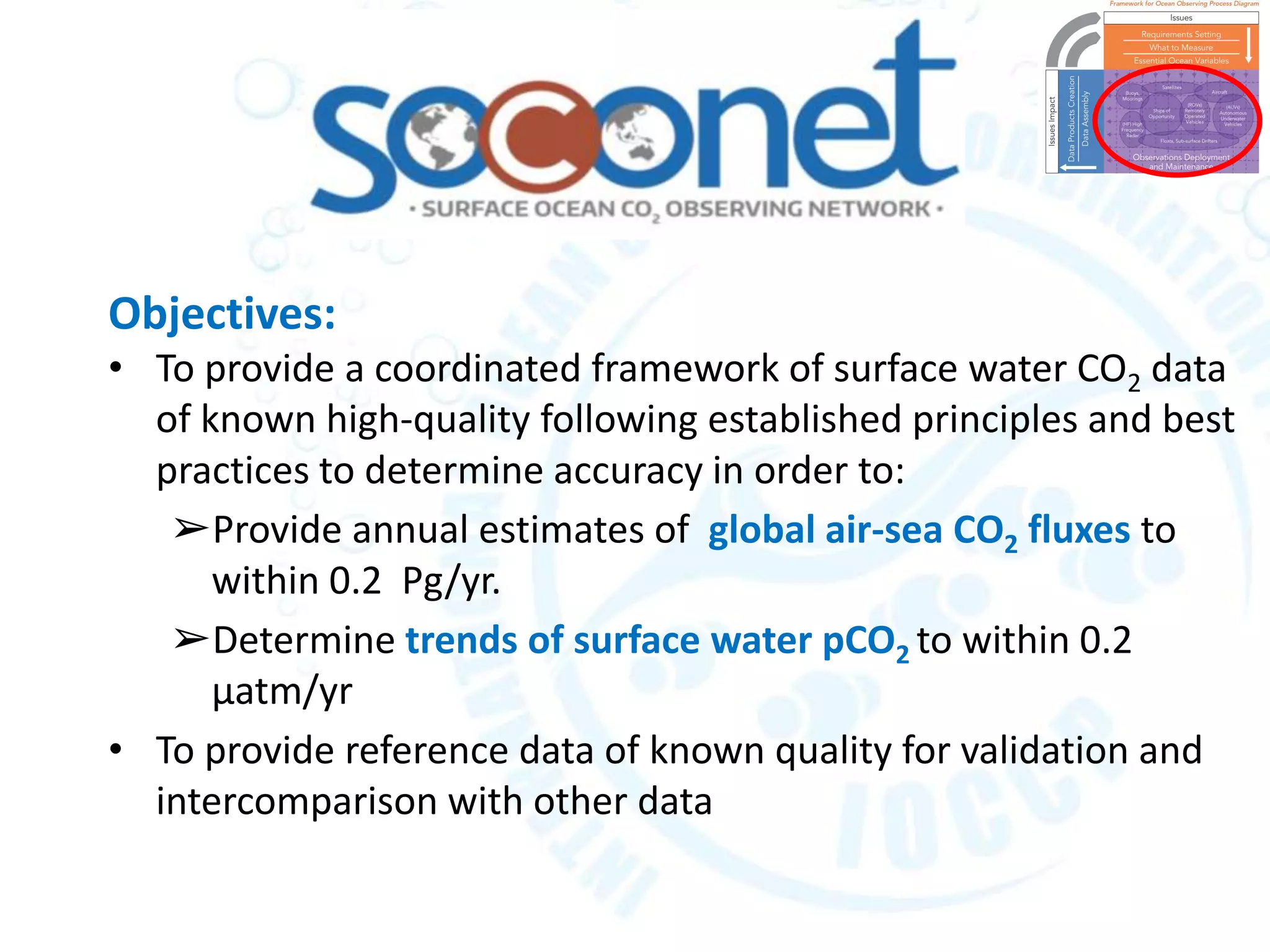
Objectives:
• To provide a coordinated framework of surface water CO2 data
of known high-quality following established principles and best
practices to determine accuracy in order to:
➢Provide annual estimates of global air-sea CO2 fluxes to
within 0.2 Pg/yr.
➢Determine trends of surface water pCO2 to within 0.2
µatm/yr
• To provide reference data of known quality for validation and
intercomparison with other data
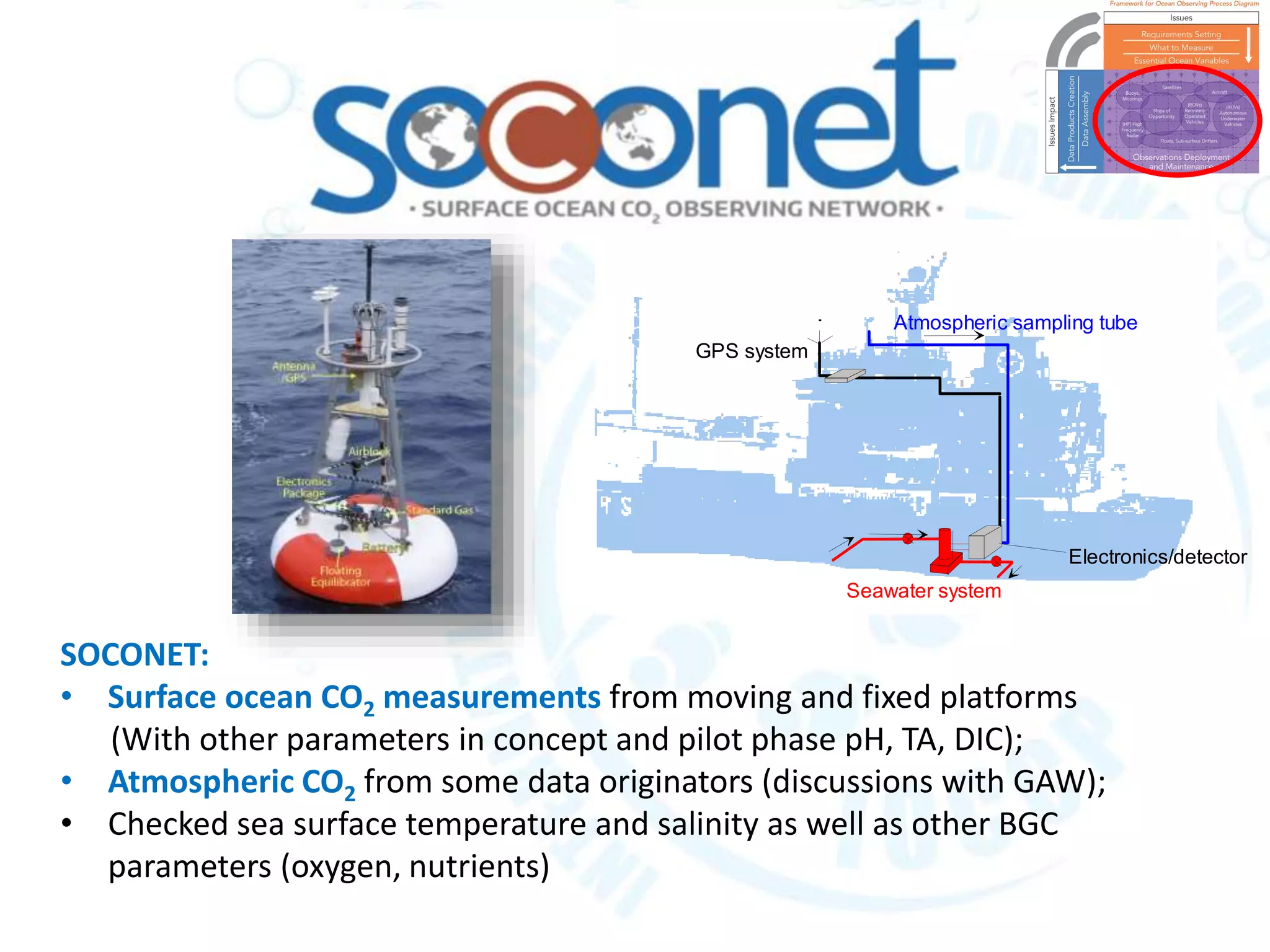
Seawater system
Electronics/detector
Atmospheric sampling tube
GPS system
SOCONET:
• Surface ocean CO2 measurements from moving and fixed platforms
(With other parameters in concept and pilot phase pH, TA, DIC);
• Atmospheric CO2 from some data originators (discussions with GAW);
• Checked sea surface temperature and salinity as well as other BGC
parameters (oxygen, nutrients)
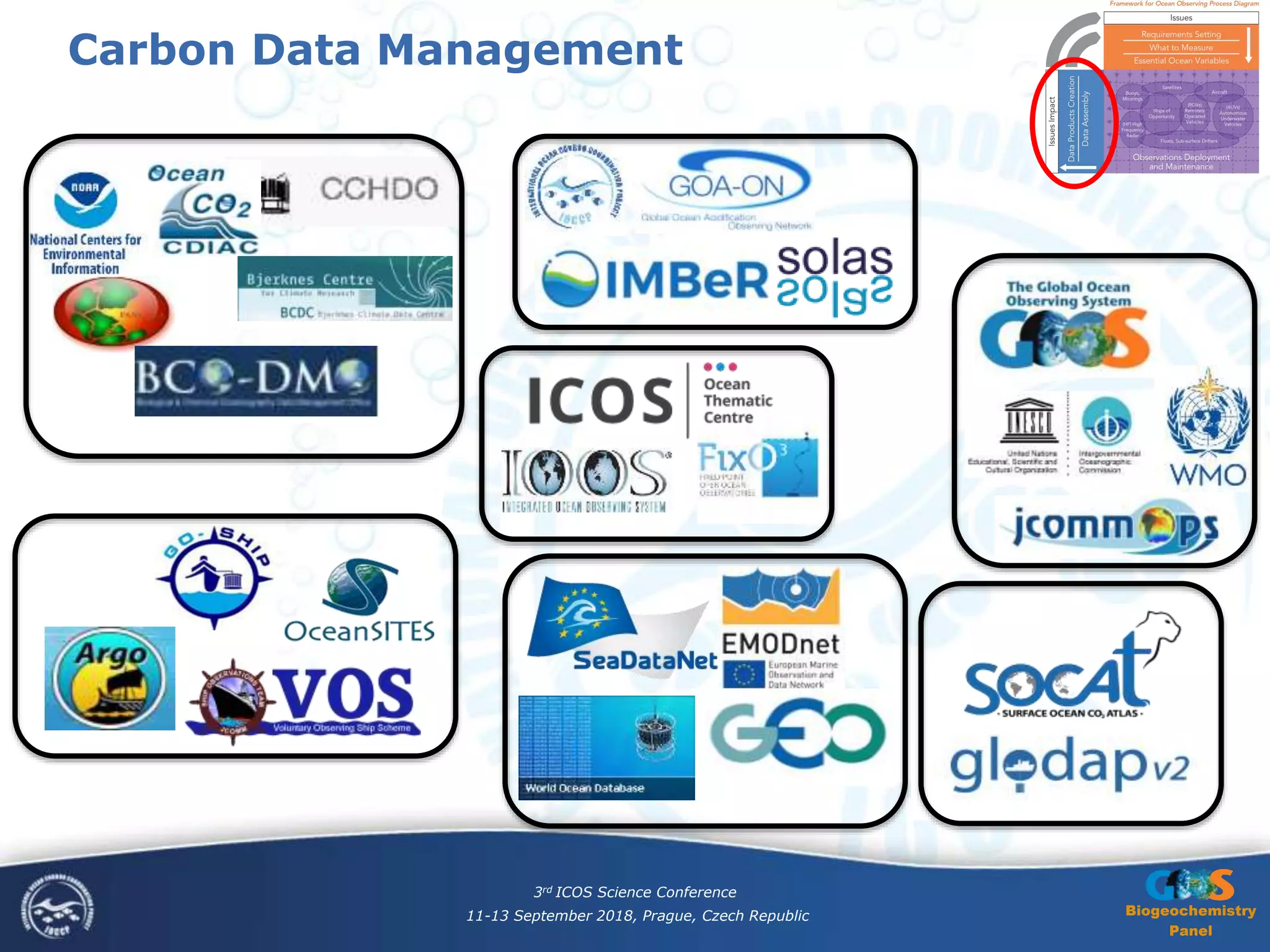
Carbon Data Management
Biogeochemistry
Panel
3rd ICOS Science Conference
11-13 September 2018, Prague, Czech Republic
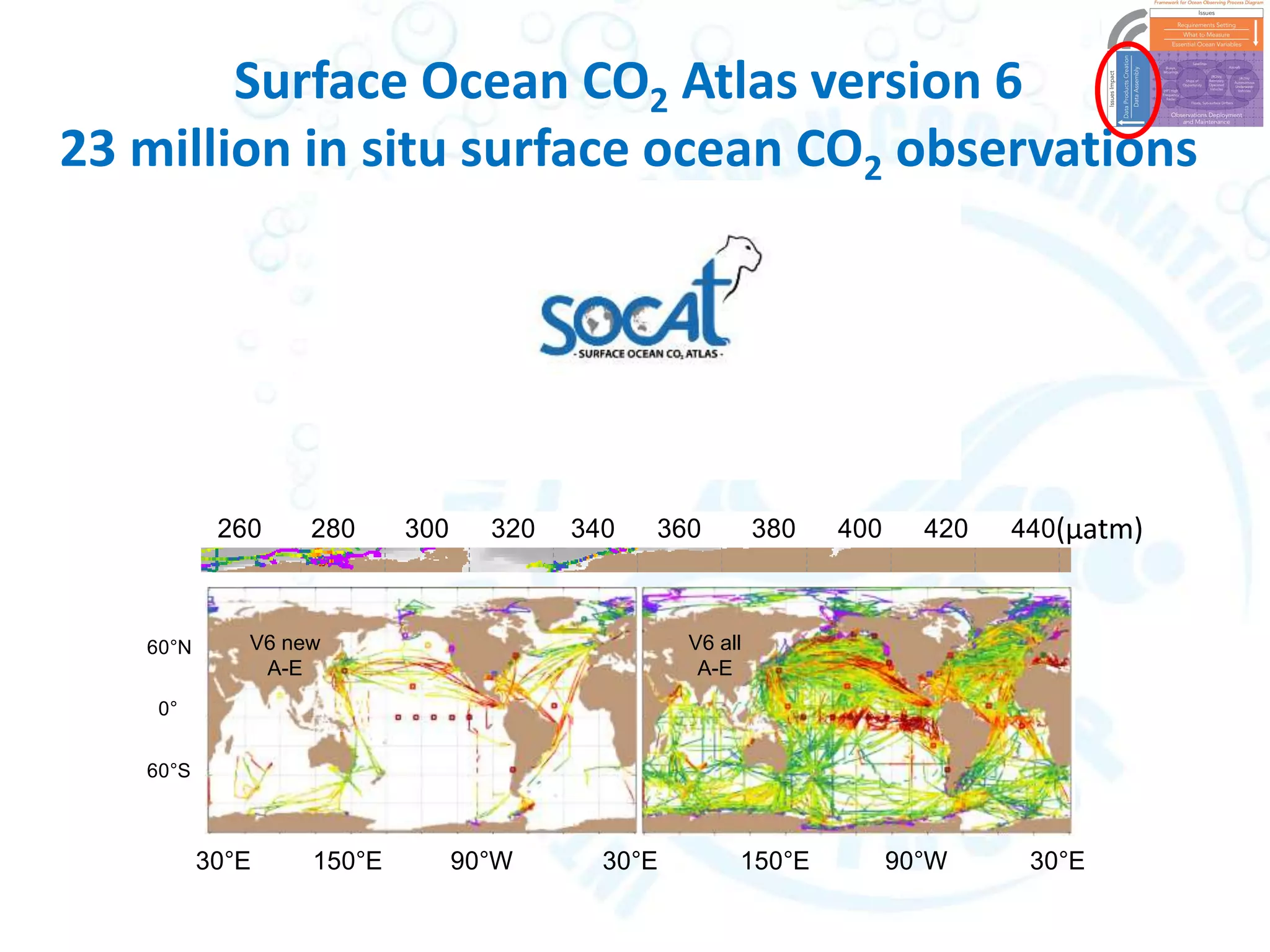
Surface Ocean CO2 Atlas version 6
23 million in situ surface ocean CO2 observations
V6 new
A-E
V6 all
A-E
30°E 150°E 90°W 30°E 150°E 90°W 30°E
60°N
0°
60°S
260 280 300 320 340 360 380 400 420 440(µatm)
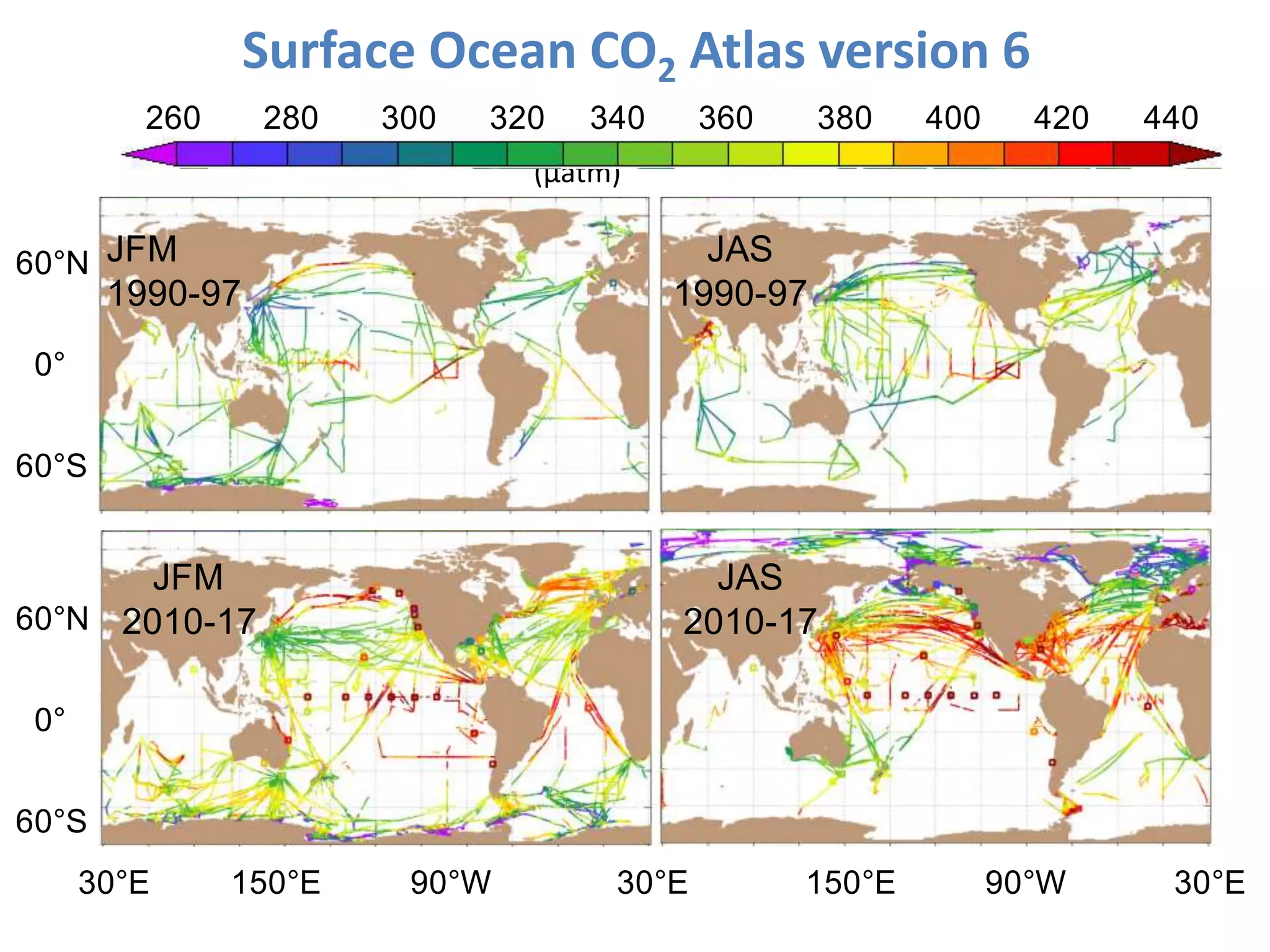
Surface Ocean CO2 Atlas version 6
(µatm)
1957-2017
A-E, V5
260 280 300 320 340 360 380 400 420 440
60°N
0°
60°S
60°N
0°
60°S
30°E 150°E 90°W 30°E 150°E 90°W 30°E
JAS
1990-97
JFM
2010-17
JAS
2010-17
JFM
1990-97
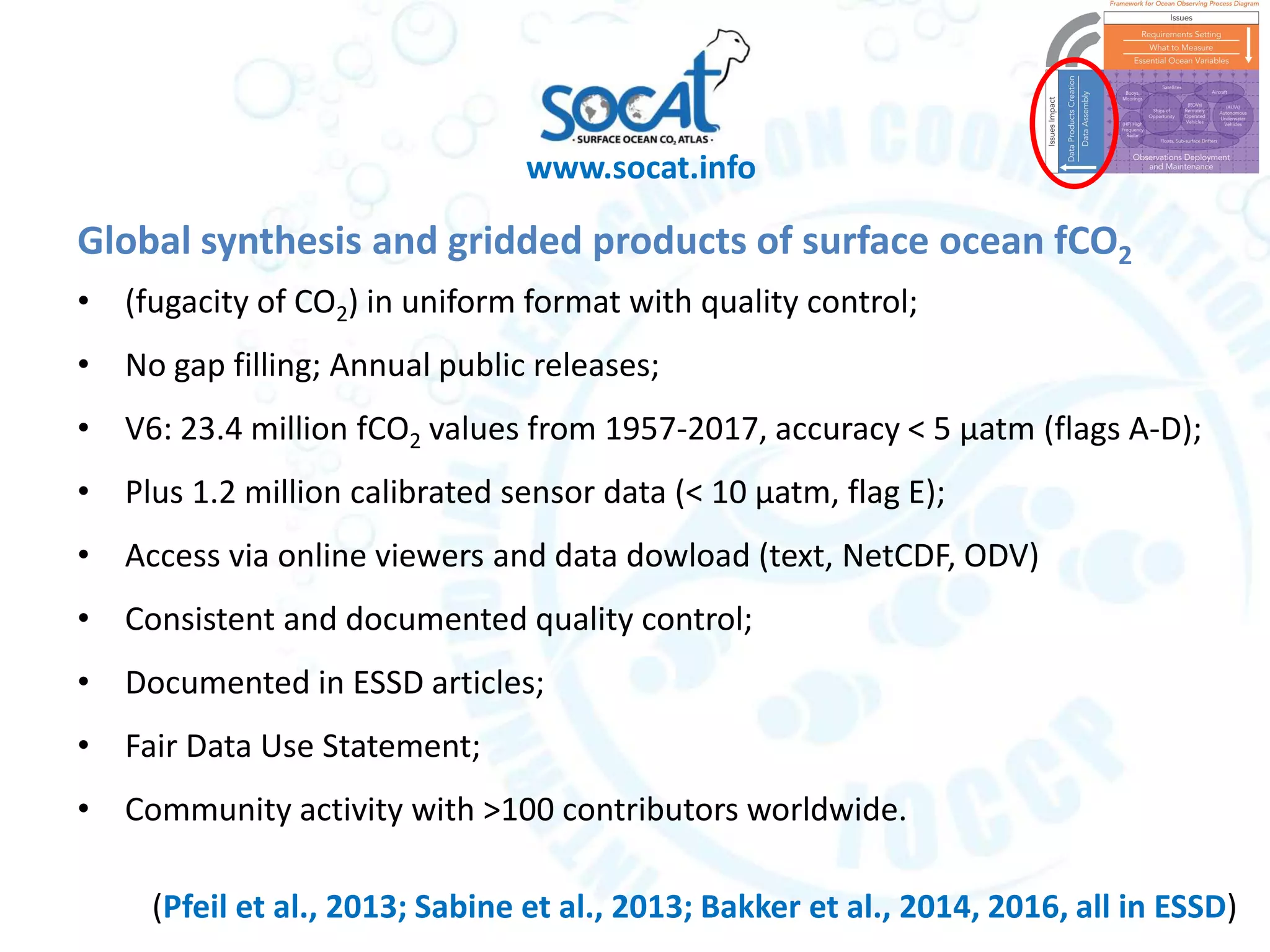
Global synthesis and gridded products of surface ocean fCO2
• (fugacity of CO2) in uniform format with quality control;
• No gap filling; Annual public releases;
• V6: 23.4 million fCO2 values from 1957-2017, accuracy < 5 μatm (flags A-D);
• Plus 1.2 million calibrated sensor data (< 10 μatm, flag E);
• Access via online viewers and data dowload (text, NetCDF, ODV)
• Consistent and documented quality control;
• Documented in ESSD articles;
• Fair Data Use Statement;
• Community activity with >100 contributors worldwide.
www.socat.info
(Pfeil et al., 2013; Sabine et al., 2013; Bakker et al., 2014, 2016, all in ESSD)
NEW data
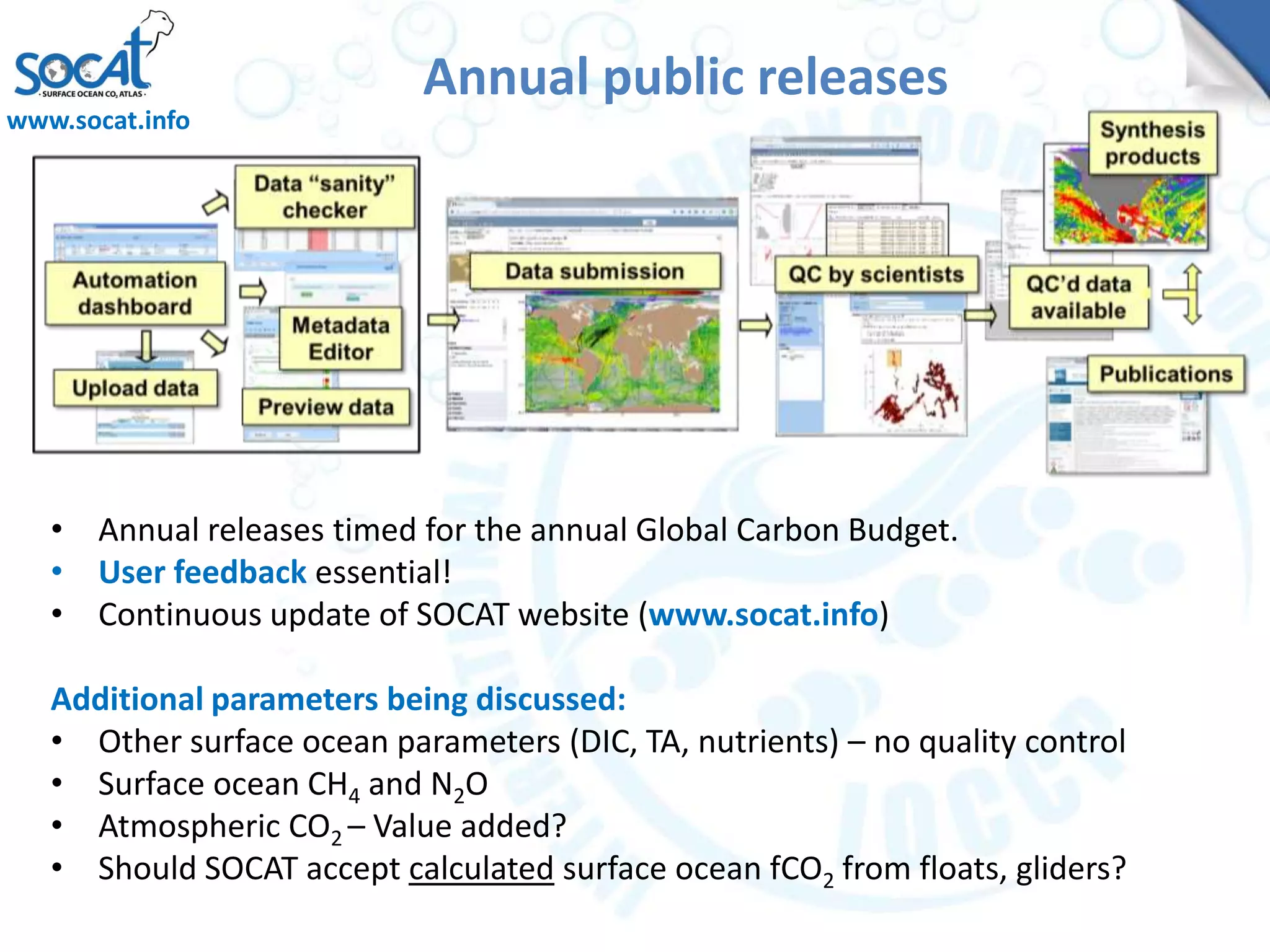
www.socat.info
Annual public releases
• Annual releases timed for the annual Global Carbon Budget.
• User feedback essential!
• Continuous update of SOCAT website (www.socat.info)
Additional parameters being discussed:
• Other surface ocean parameters (DIC, TA, nutrients) – no quality control
• Surface ocean CH4 and N2O
• Atmospheric CO2 – Value added?
• Should SOCAT accept calculated surface ocean fCO2 from floats, gliders?
Applications
www.socat.info
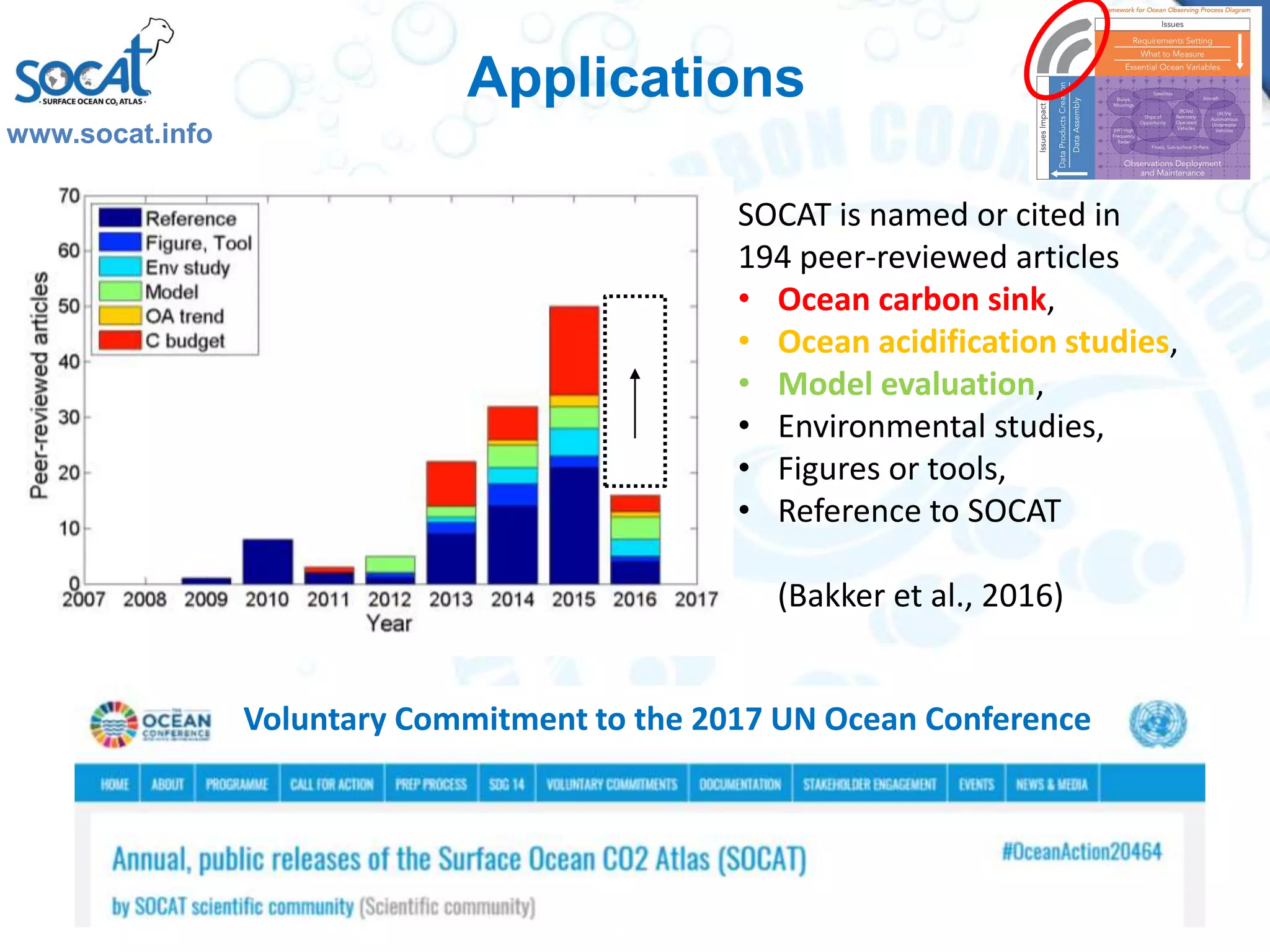
SOCAT is named or cited in
194 peer-reviewed articles
• Ocean carbon sink,
• Ocean acidification studies,
• Model evaluation,
• Environmental studies,
• Figures or tools,
• Reference to SOCAT
(Bakker et al., 2016)
Voluntary Commitment to the 2017 UN Ocean Conference
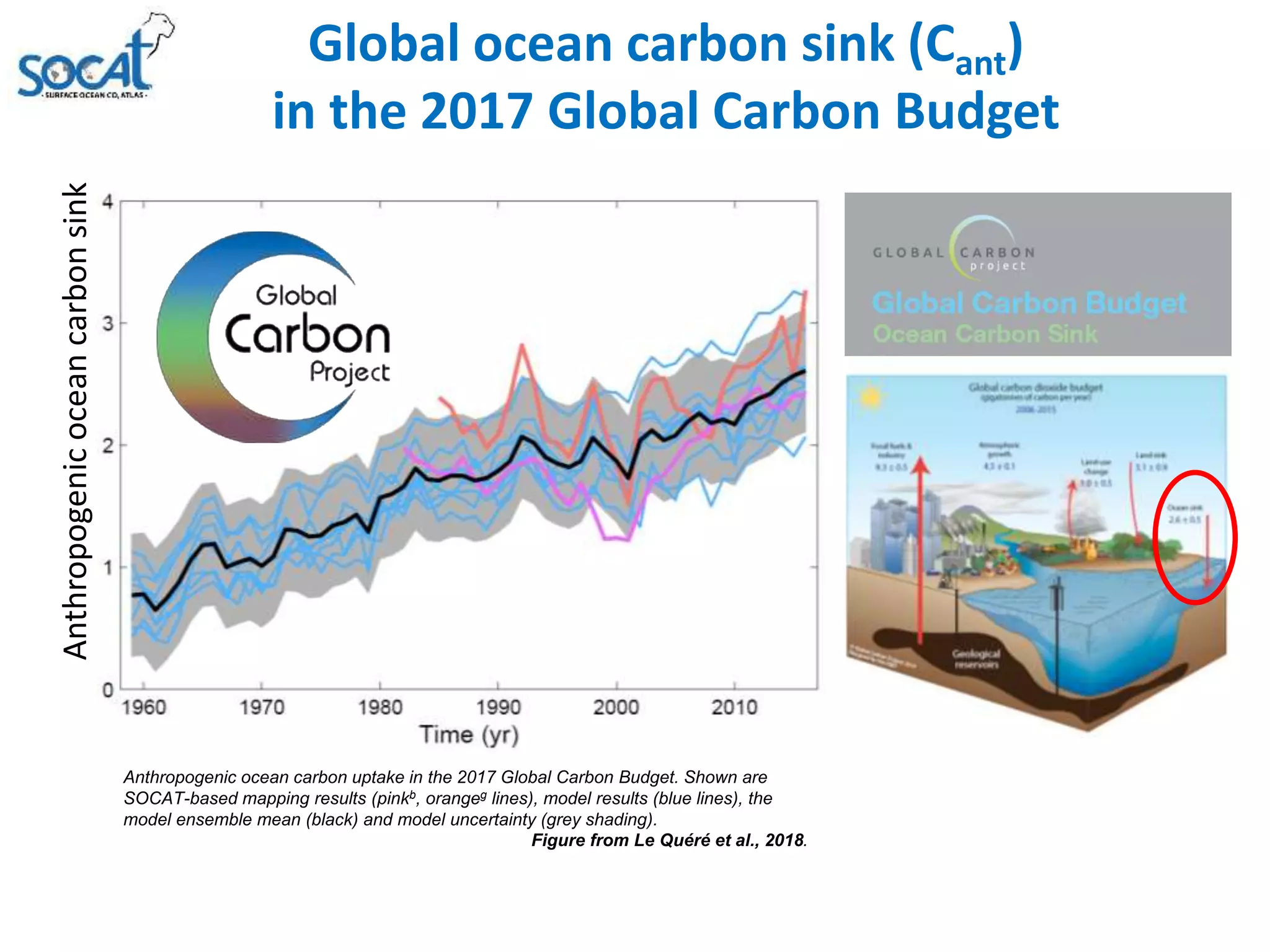
Global ocean carbon sink (Cant)
in the 2017 Global Carbon Budget
Anthropogenicoceancarbonsink
(PgCyr-1)
Anthropogenic ocean carbon uptake in the 2017 Global Carbon Budget. Shown are
SOCAT-based mapping results (pinkb, orangeg lines), model results (blue lines), the
model ensemble mean (black) and model uncertainty (grey shading).
Figure from Le Quéré et al., 2018.
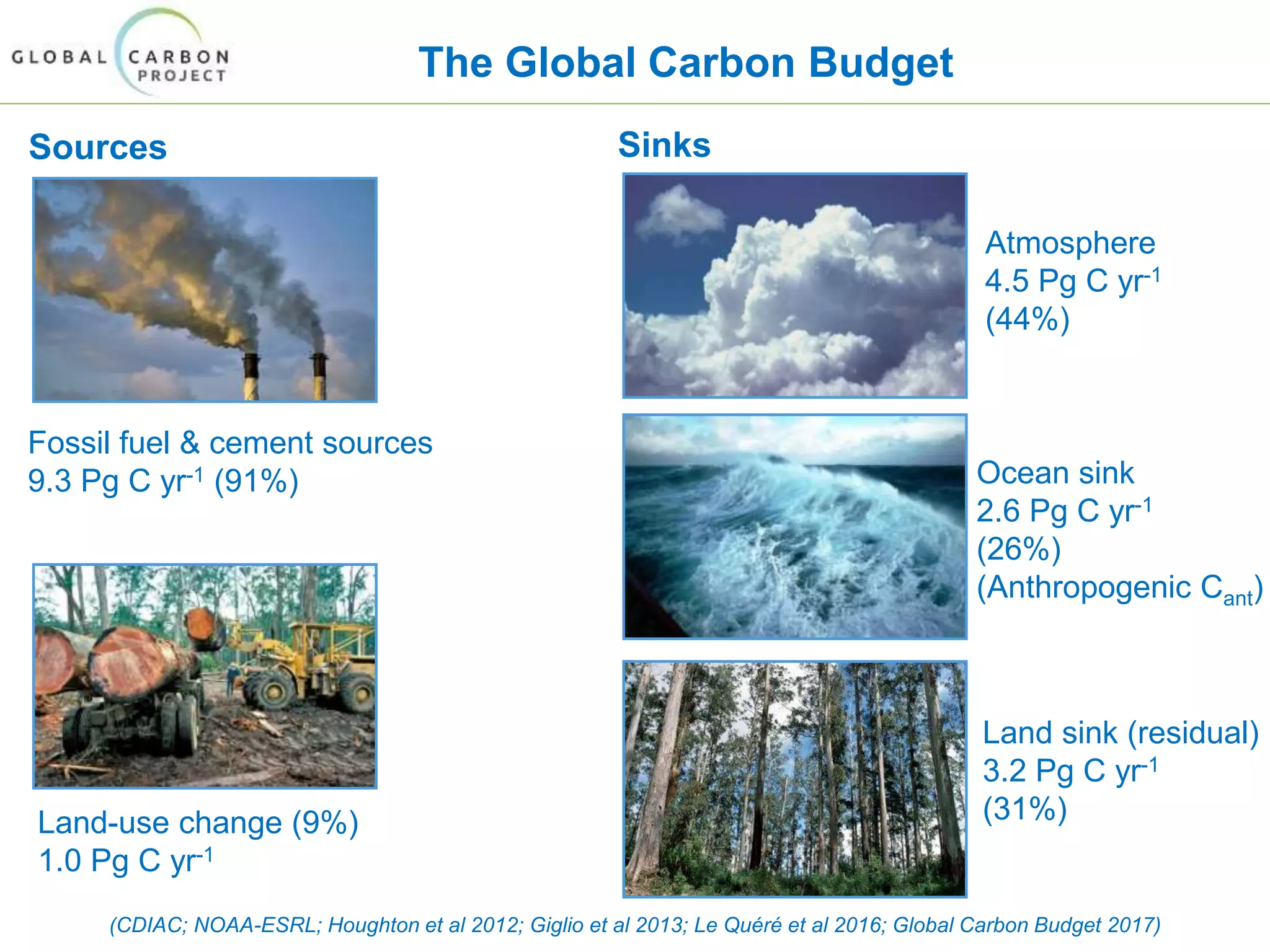
Land sink (residual)
3.2 Pg C yr-1
(31%)
The Global Carbon Budget
(CDIAC; NOAA-ESRL; Houghton et al 2012; Giglio et al 2013; Le Quéré et al 2016; Global Carbon Budget 2017)
Ocean sink
2.6 Pg C yr-1
(26%)
(Anthropogenic Cant)
Fossil fuel & cement sources
9.3 Pg C yr-1 (91%)
Land-use change (9%)
1.0 Pg C yr-1
Atmosphere
4.5 Pg C yr-1
(44%)
Sources Sinks
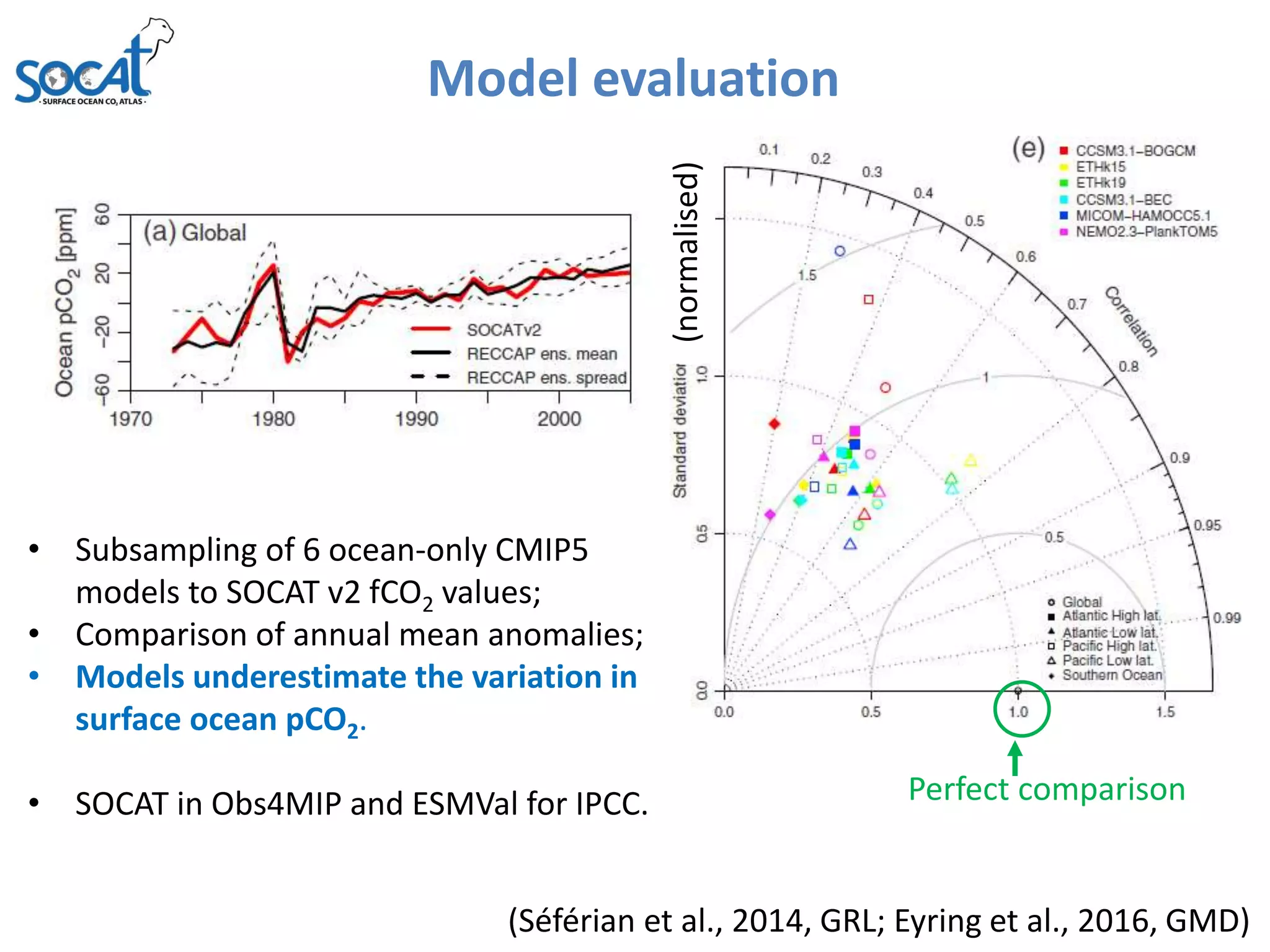
• Subsampling of 6 ocean-only CMIP5
models to SOCAT v2 fCO2 values;
• Comparison of annual mean anomalies;
• Models underestimate the variation in
surface ocean pCO2.
• SOCAT in Obs4MIP and ESMVal for IPCC. Perfect comparison
(normalised)
Model evaluation
(Séférian et al., 2014, GRL; Eyring et al., 2016, GMD)
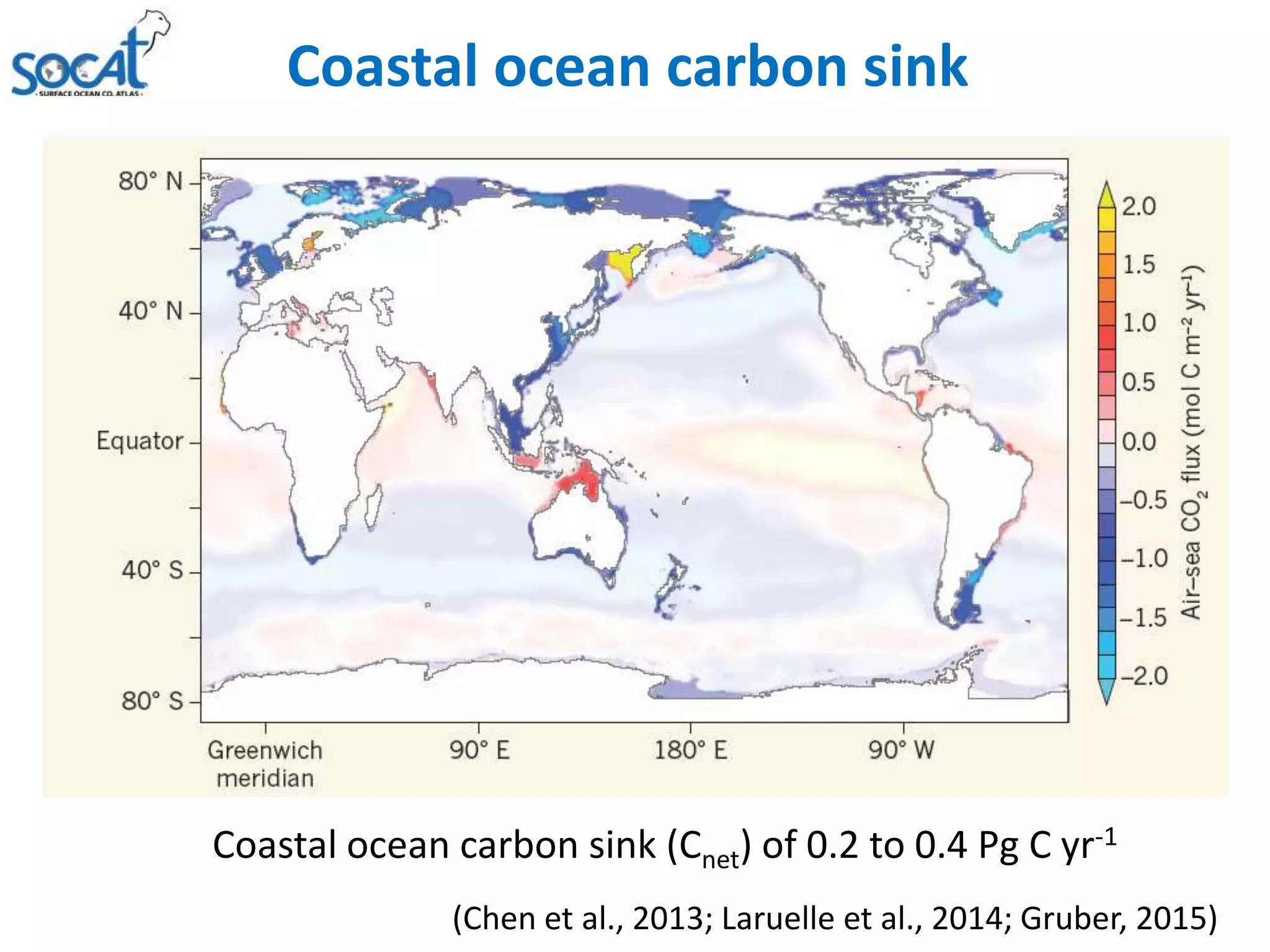
Coastal ocean carbon sink
(Chen et al., 2013; Laruelle et al., 2014; Gruber, 2015)
Coastal ocean carbon sink (Cnet) of 0.2 to 0.4 Pg C yr-1
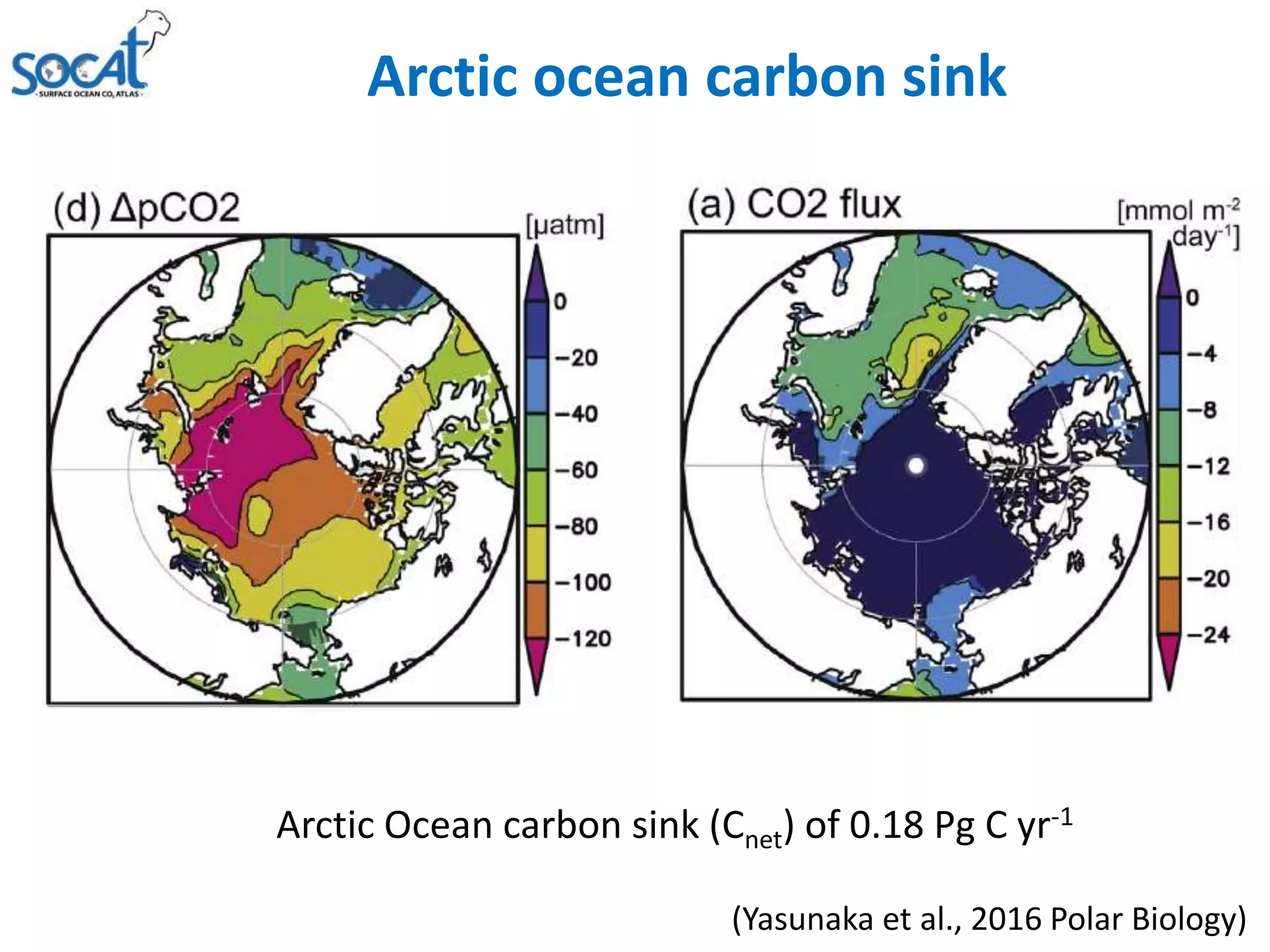
Arctic ocean carbon sink
(Yasunaka et al., 2016 Polar Biology)
Arctic Ocean carbon sink (Cnet) of 0.18 Pg C yr-1
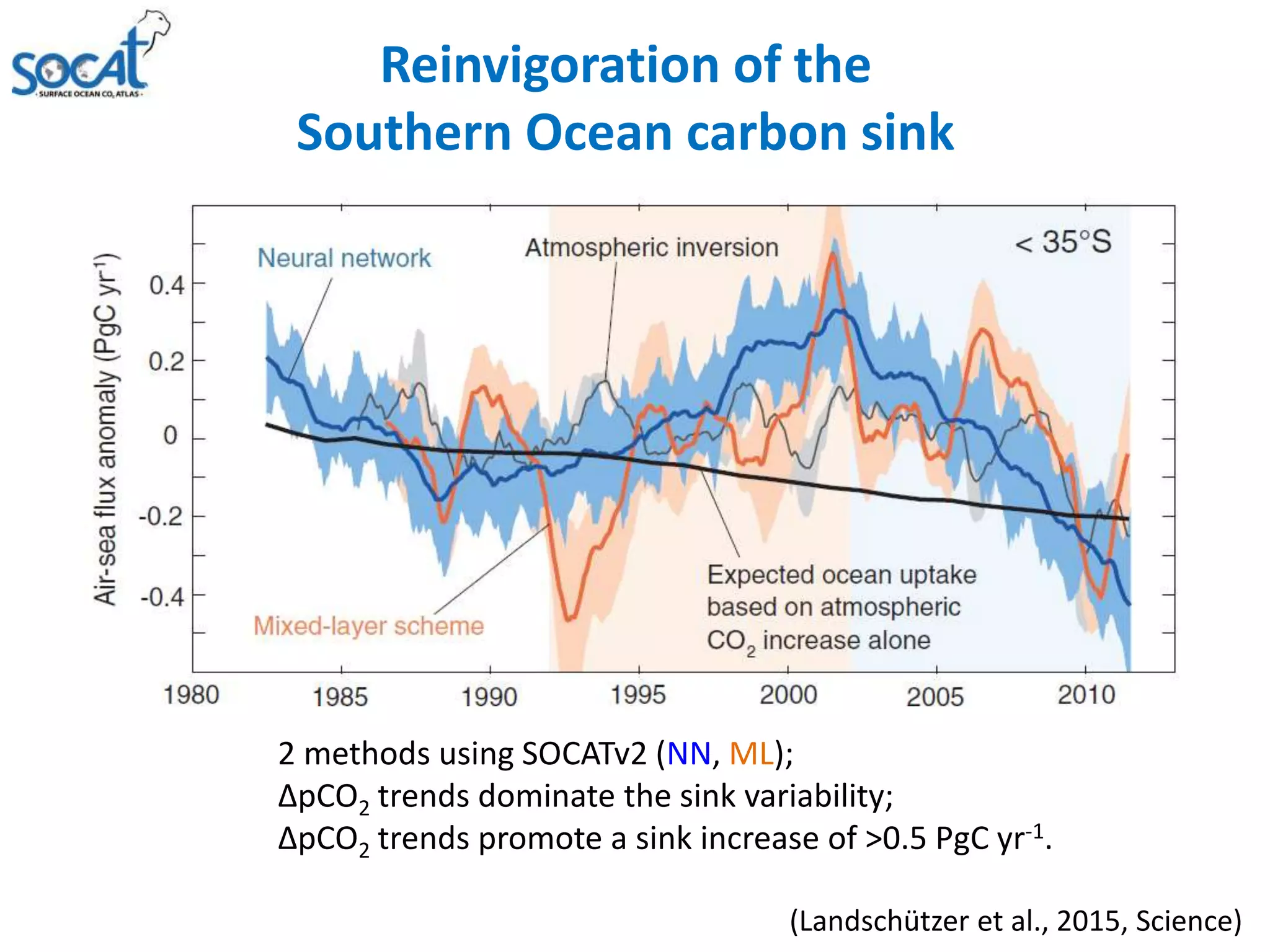
Reinvigoration of the
Southern Ocean carbon sink
(Landschützer et al., 2015, Science)
2 methods using SOCATv2 (NN, ML);
ΔpCO2 trends dominate the sink variability;
ΔpCO2 trends promote a sink increase of >0.5 PgC yr-1.
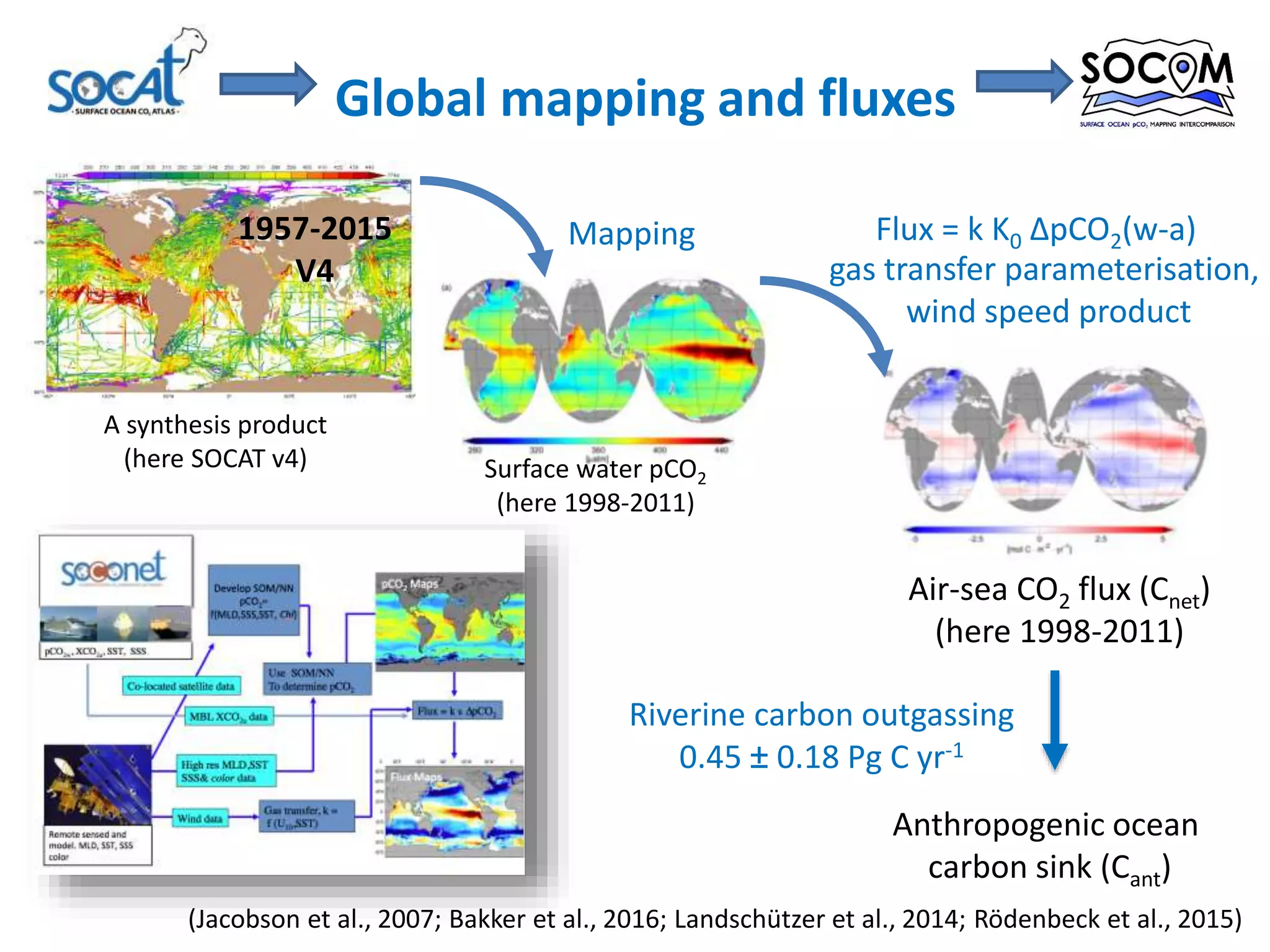
Global mapping and fluxes
A synthesis product
(here SOCAT v4)
Mapping
Surface water pCO2
(here 1998-2011)
Air-sea CO2 flux (Cnet)
(here 1998-2011)
gas transfer parameterisation,
wind speed product
(Jacobson et al., 2007; Bakker et al., 2016; Landschützer et al., 2014; Rödenbeck et al., 2015)
1957-2015
V4
Flux = k K0 ΔpCO2(w-a)
Riverine carbon outgassing
0.45 ± 0.18 Pg C yr-1
Anthropogenic ocean
carbon sink (Cant)
Surface Ocean pCO2 Mapping
intercomparison
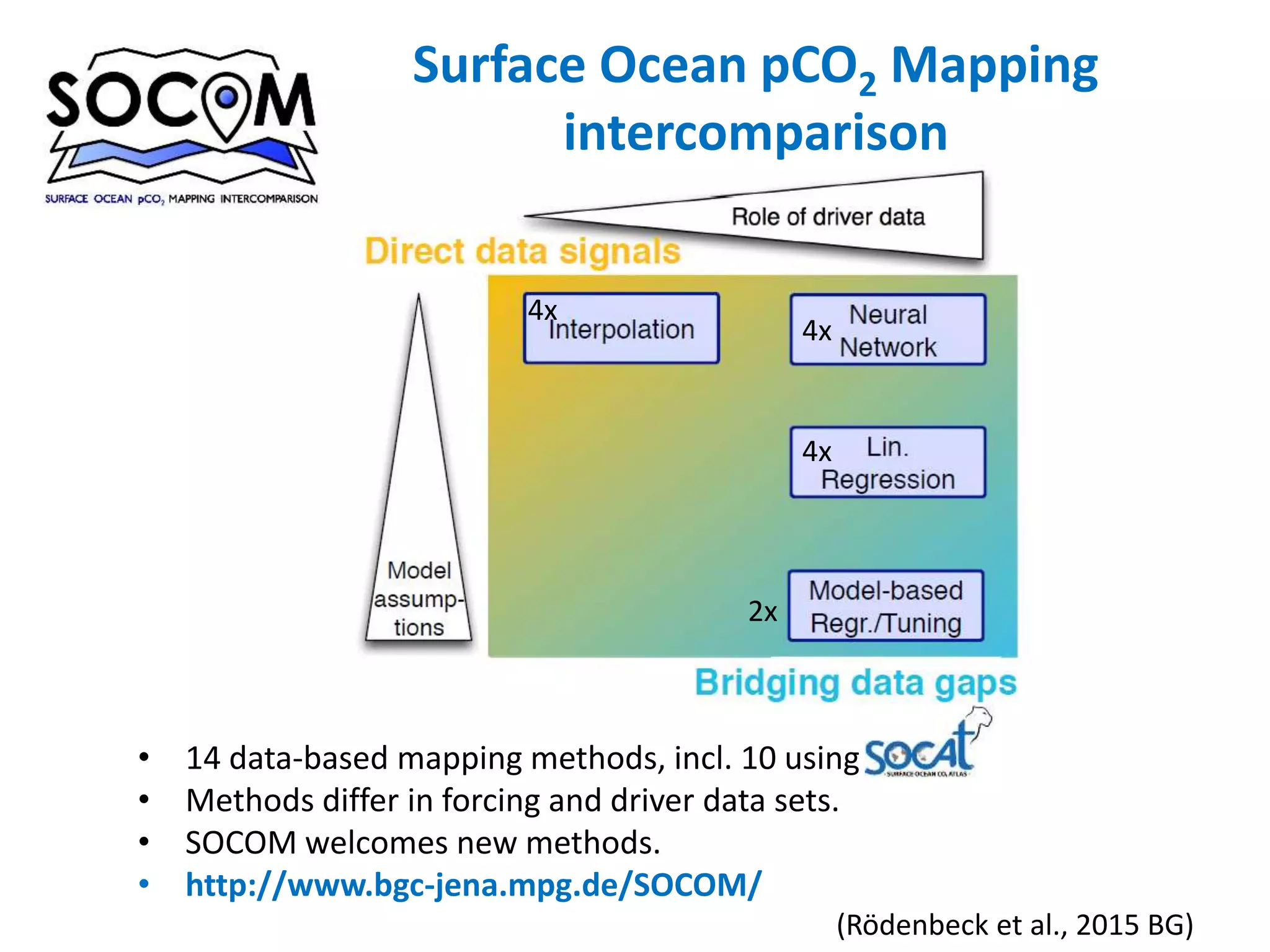
• 14 data-based mapping methods, incl. 10 using SOCAT.
• Methods differ in forcing and driver data sets.
• SOCOM welcomes new methods.
• http://www.bgc-jena.mpg.de/SOCOM/
(Rödenbeck et al., 2015 BG)
4x
4x
4x
2x
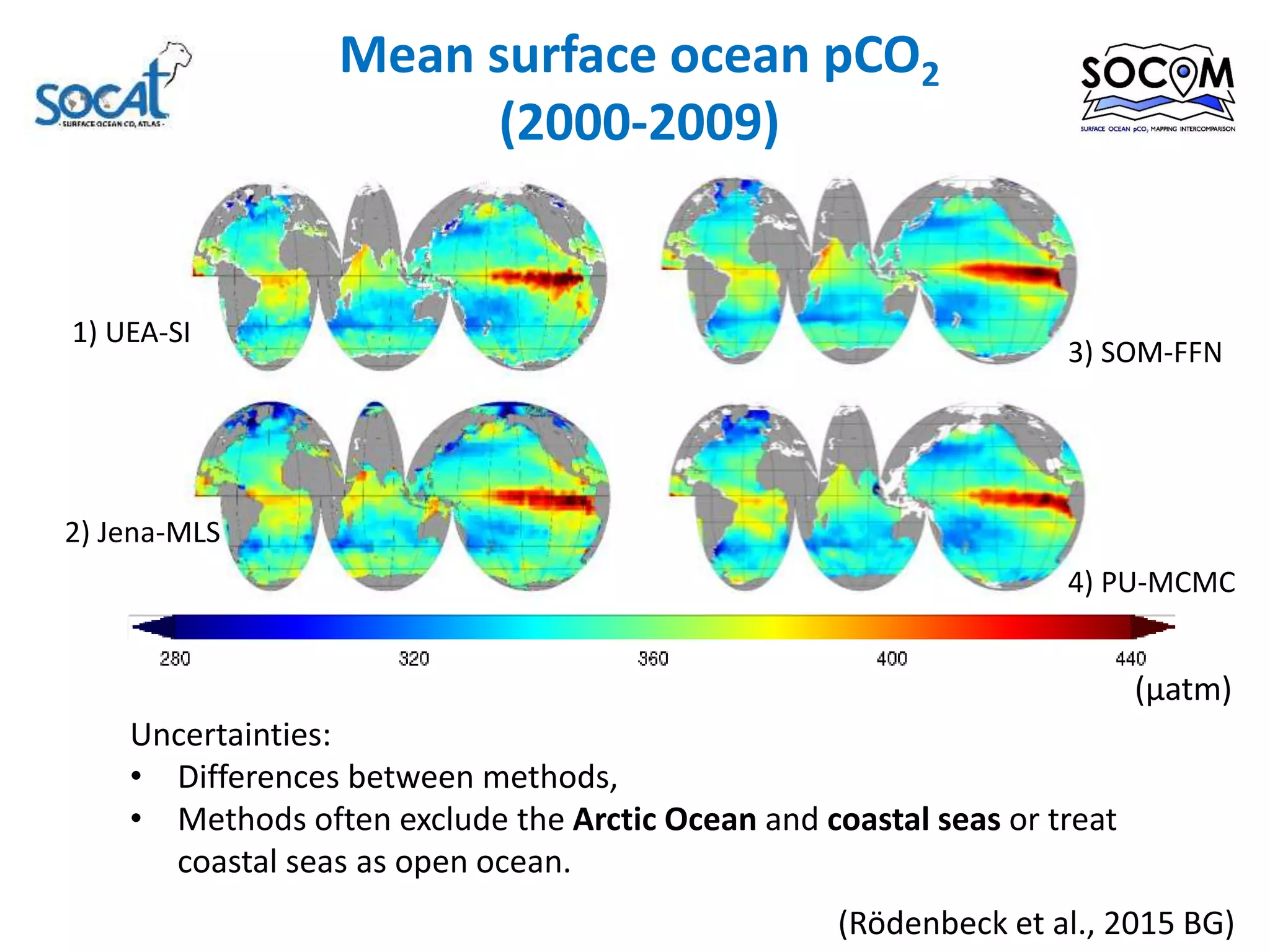
Mean surface ocean pCO2
(2000-2009)
2) Jena-MLS
4) PU-MCMC
3) SOM-FFN
1) UEA-SI
(µatm)
Uncertainties:
• Differences between methods,
• Methods often exclude the Arctic Ocean and coastal seas or treat
coastal seas as open ocean.
(Rödenbeck et al., 2015 BG)
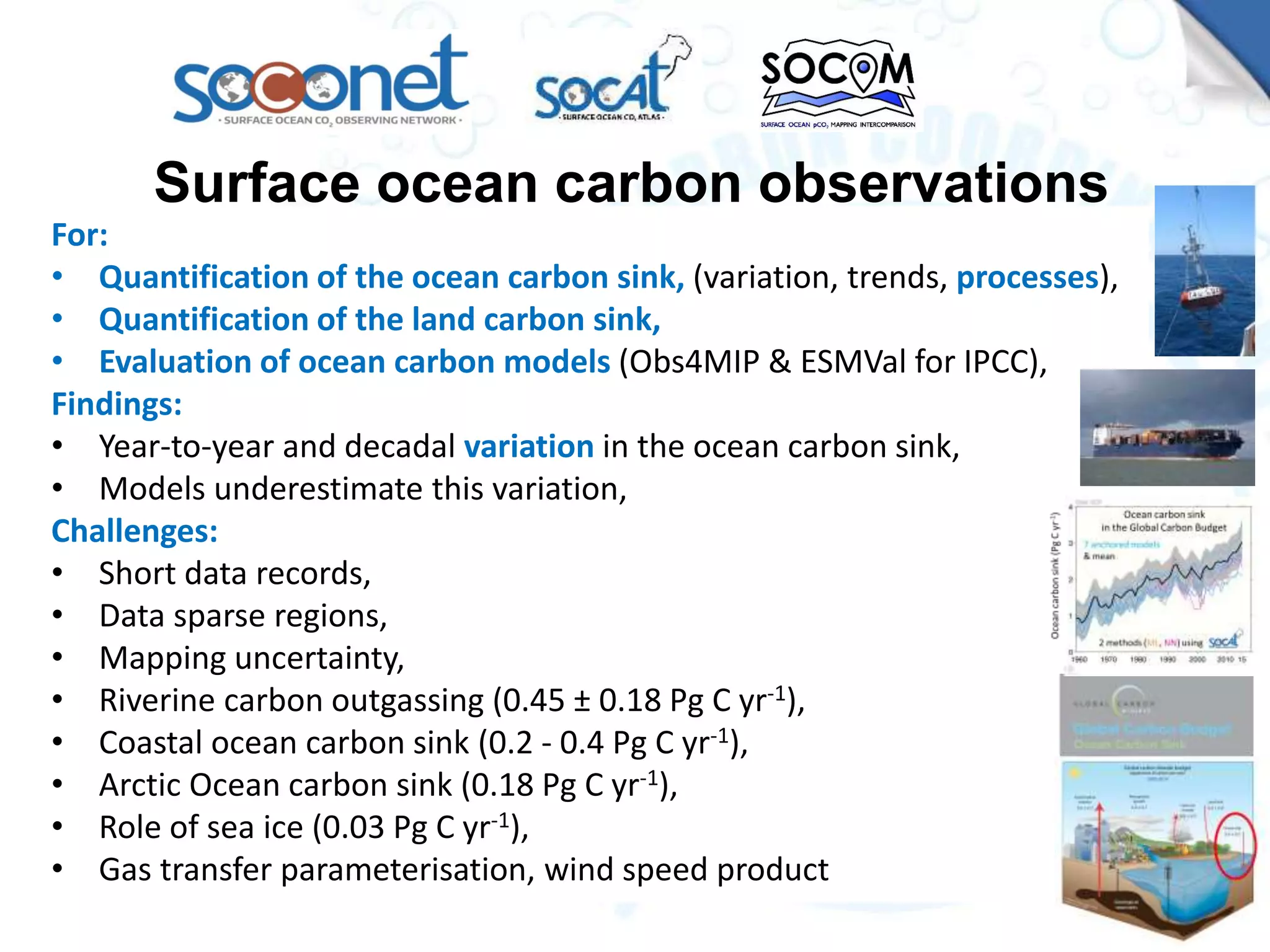
Surface ocean carbon observations
For:
• Quantification of the ocean carbon sink, (variation, trends, processes),
• Quantification of the land carbon sink,
• Evaluation of ocean carbon models (Obs4MIP & ESMVal for IPCC),
Findings:
• Year-to-year and decadal variation in the ocean carbon sink,
• Models underestimate this variation,
Challenges:
• Short data records,
• Data sparse regions,
• Mapping uncertainty,
• Riverine carbon outgassing (0.45 ± 0.18 Pg C yr-1),
• Coastal ocean carbon sink (0.2 - 0.4 Pg C yr-1),
• Arctic Ocean carbon sink (0.18 Pg C yr-1),
• Role of sea ice (0.03 Pg C yr-1),
• Gas transfer parameterisation, wind speed product
Biogeochemistry
Panel
System
A broad schematic of a full value chain in
sustained ocean observing programs
Observations
Coordination
In situ and satellite observations
Global networks and global
approaches
System requirements
Applications/products, knowledge challenges,
phenomena, EOVs, network design
Data
systems
Assembly
and
dissemination
Understanding
Scientific analysis,
indicators
Predicting / Modeling
Ocean forecast systems
Societal benefit from actionable
information
Policy, public and private management and individual decisions
Assessing
Policy-relevant scientific
assessments
Services
[informing]
Early warning, forecasts,
short and long term
direct advice
www.ioccp.org/foo
3rd ICOS Science Conference
11-13 September 2018, Prague, Czech Republic
Biogeochemistry
Panel
Institute of Oceanology of Polish Academy of Sciences, ul. Powstańców Warszawy 55, 81-712 Sopot, Poland
Phone: +48 58 731 16 10 / Fax: +48 58 551 21 30, www.ioccp.org
A communication and coordination
service for marine biogeochemistry
Biogeochemistry
Panel
Biogeochemistry
Panel
Institute of Oceanology of Polish Academy of Sciences, ul. Powstańców Warszawy 55, 81-712 Sopot, Poland
Phone: +48 58 731 16 10 / Fax: +48 58 551 21 30, www.ioccp.org
Biogeochemistry
Panel
Maciej: m.telszewski@ioccp.org
Visit our website: www.ioccp.org

Viewing ICOS in a Global Context From requirements-driven ocean observations, through high quality data to fit-for-purpose information delivery

  • 1.
    Maciej Telszewski IOCCP Directorand Coordinator of GOOS Biogeochemistry Panel With slides from Dorothee Bakker, Rik Wanninkhof and Benjamin Pfeil Viewing ICOS in a Global Context From requirements-driven ocean observations, through high quality data to fit-for-purpose information delivery Institute of Oceanology of Polish Academy of Sciences, ul. Powstańców Warszawy 55, 81-712 Sopot, Poland Phone: +48 58 731 16 10 / Fax: +48 58 551 21 30, www.ioccp.org Biogeochemistry Panel Biogeochemistry Panel
  • 2.
    Biogeochemistry Panel Rik Wanninkhof, DorotheeBakker, Christian Rödenbeck, Benjamin Pfeil, Kevin O’Brien, Are Olsen, Karl Smith, Simone Alin, Cathy Cosca, Kim Currie, Melchor Gonzalez-Davilla, Steve Jones, Alex Kozyr, Camilla Landa, Peter Landschützer, Siv Lauvset, Nathalie Lefèvre, Nicolas Metzl, David Munro, Shin-ichiro Nakaoka, Yukihiro Nojiri, Abdirahman Omar, Denis Pierrot, Chris Sabine, Shu Saito, Ute Schuster, Tobias Steinhoff, Kevin Sullivan, Adrienne Sutton, Colm Sweeney, Taro Takahashi, Maciej Telszewski, Bronte Tilbrook and all >100 SOCONET, SOCAT and SOCOM contributors 3rd ICOS Science Conference 11-13 September 2018, Prague, Czech Republic
  • 3.
    Biogeochemistry Panel 17 objectives totransform our world: Agenda 2030 (September 2015, New York) 3rd ICOS Science Conference 11-13 September 2018, Prague, Czech Republic
  • 4.
    Biogeochemistry Panel • After yearsof work and negotiations, the Paris Climate Agreement was signed on 12 December 2015, marking a historic moment for the Planet. • For the first time, the mention of the ocean as an ecosystem vital for the climate is a symbolic victory for all involved advocates and stakeholders. Many organizations and individuals have worked for many years creating the momentum required for this recognition. • Appearing in the preamble of the final text (“noting that it is important to ensure the integrity of all ecosystems, including oceans…”) which is not however a binding part of the agreement, this reference is sign of a global awareness of the oceans’ major role in climate change. This awareness is also reflected at the level of heads of state and national delegations with the signing of the declaration ‘Because The Ocean’. 3rd ICOS Science Conference 11-13 September 2018, Prague, Czech Republic
  • 5.
    Biogeochemistry Panel • Support thedevelopment of an initiative for enhanced global sea and ocean observation required to monitor inter alia climate change and marine biodiversity, • Support an enhanced system of ocean assessment through the UN Regular Process to develop a consensus view on the state of the oceans and enable sustainable management strategies to be developed and implemented • Promote open science and the improvement of the global data sharing infrastructure to ensure the discoverability, accessibility, and interoperability of a wide range of ocean and marine data; • Strengthen collaborative approaches to encourage the development of regional observing capabilities and knowledge networks in a coordinated and coherent way, including supporting the capacity building of developing countries; and • Promote increased G7 political cooperation by identifying additional actions needed to enhance future routine ocean observations. The S&T Ministers of the G7 and the EU met in May 2016 to discuss science, technology and innovation aspects across global challenges such as health, energy, agriculture and the environment. They issued a Communiqué: 3rd ICOS Science Conference 11-13 September 2018, Prague, Czech Republic
  • 7.
    History of OceanObsSeries OceanObs’99 – St. Raphael, France (300 participants) • Resulted in an internationally coordinated system for physical climate and ocean carbon observations (drifter, floats, xbt, tide gauge…) OceanObs’09 – Venice, Italy (640 participants) • Expanded the range of communities working together to undertake more comprehensive and sustainad ocean observations and led to the Framework for Ocean Observing (FOO). OceanObs’19 – Honolulu, USA (1200 participants) • Based on processes described in the FOO, connecting with a wide range of user communities and improve data flows and governance arrangements. Each conference of the OceanObs series focuses on a new area in need of enhanced guidance: www.ioccp.org/foo
  • 8.
    Biogeochemistry Panel System A broad schematicof a full value chain in sustained ocean observing programs Observations Coordination In situ and satellite observations Global networks and global approaches System requirements Applications/products, knowledge challenges, phenomena, EOVs, network design Data systems Assembly and dissemination Understanding Scientific analysis, indicators Predicting / Modeling Ocean forecast systems Societal benefit from actionable information Policy, public and private management and individual decisions Assessing Policy-relevant scientific assessments Services [informing] Early warning, forecasts, short and long term direct advice www.ioccp.org/foo Climate and Weather Real-time services Assessments and management of ecosystem services Emission policies Food security Tourism 3rd ICOS Science Conference 11-13 September 2018, Prague, Czech Republic
  • 9.
    Biogeochemistry Panel 3rd ICOS ScienceConference 11-13 September 2018, Prague, Czech Republic
  • 10.
    Societal drivers andscientific applications Ocean Biogeochemistry • The role of ocean biogeochemistry in climate – Q1.1 How is the ocean carbon content changing? – Q1.2 How does the ocean influence cycles of non-CO2 greenhouse gases? • Human impacts on ocean biogeochemistry – Q2.1. How large are the ocean’s “dead zones” and how fast are they changing? – Q2.2 What are rates and impacts of ocean acidification? • Ocean ecosystem health – Q3.1 Is the biomass of the ocean changing? – Q3.2 How does eutrophication and pollution impact ocean productivity and water quality? Biogeochemistry Panel 3rd ICOS Science Conference 11-13 September 2018, Prague, Czech Republic
  • 11.
    GOOS Phenomena AIR-SEA FLUXES ANTHROPOGENIC CARBON SEQUESTRATION UPWELLING VENTILLATION CONTAMINATION /POLLUTION OCEAN ACIDIFICATION DEOXYGENATION EXPORTFLUXES EUTROPHICATION STORAGE / INVENTORY CIRCULATION LAND-SEA FLUXES BENTHIC FLUXES PRIMARY PRODUCTION REMINERALI- ZATION CALCIFICATION
  • 12.
    Human impacts onocean biogeochemistry Q 2.1.: How large are the ocean’s dead zones and how fast are they growing? (Ocean deoxygenation)  O2  Nutrients (NO3, PO4, Si, NH4, NO2)  Transient Tracers  Export rates and/or Ar/O2  Inorganic Carbon Q 2.2: What are rates and impacts of ocean acidification? (Ocean acidification) Detection  Inorganic Carbon (saturation state as derived variable)  O2  Nutrients (NO3, PO4, Si, NH4, NO2)  Atmospheric deposition of anthropogenic sulfates  Transient Tracers  13DIC  PON, POP, DON, DOP  Ra isotopes (coastal) Impact  Inorganic Carbon (saturation state as derived variable)  Dissolution Rates  PIC, POC  Phytoplankton Functional Groups  Benthic and Pelagic Species  231Pa, 230Th Biogeochemistry Panel 3rd ICOS Science Conference 11-13 September 2018, Prague, Czech Republic
  • 13.
    Biogeochemistry Panel 3rd ICOS ScienceConference 11-13 September 2018, Prague, Czech Republic Driven by requirements, negotiated with feasibility Essential Ocean Variables • We cannot measure everything, nor do we need to • Basis for including new elements of the system, for expressing requirements at a high level • Driven by requirements, negotiated with feasibility • Allows for innovation in the observing system over time
  • 14.
    GOOS Essential OceanVariables EOV Specification Sheets: www.goosocean.org/eov www.ioccp.org/foo Physics & Climate Oxygen Nutrients Particulate Matter Inorganic Carbon Transient Tracers Nitrous Oxide Stable Carbon Isotopes Dissolved Organic Carbon Biogeochemistry Phytoplankton Biomass & Diversity Zooplankton Biomass & Diversity Fish Abundance & Distribution Biology & Ecosystems Marine Turtles, Birds, Mammals Abundance & Distribution Live Coral Seagrass Cover Macroalgal Canopy Mangrove Cover Sea Surface Temperature Ocean Surface Stress Subsurface Currents Surface Currents Subsurface Temperature Sea State Ocean Surface Heat Flux Sea Surface Height Sea Ice Sea Surface Salinity Subsurface Salinity Ocean Colour Microbe Biomass & Diversity Benthic Invertebrate Abundance & Distribution Emerging EOVs
  • 15.
    Biogeochemistry Panel Essential Ocean Variable(EOV): Inorganic Carbon Name of EOV Inorganic Carbon Sub-Variables Dissolved Inorganic Carbon (DIC), Total Alkalinity (TA), Partial pressure of carbon dioxide (pCO2) and pH. [At least two of the four Sub-Variables are needed.] Derived Products Saturation state (aragonite, calcite), Dissolved carbonate ion concentration, Air-sea flux of CO2, Anthropogenic carbon, Change in total carbon Supporting Variables Surface and subsurface Temperature, Surface and subsurface Salinity, Ocean vector stress (wind speed), Atmospheric column-averaged dry-air mole fraction of CO2 (xCO2), Barometric pressure, Oxygen, Calcium concentration, Transient tracers, Oxygen to argon ratio (O2/Ar) Responsible GOOS Panel GOOS Biogeochemistry Panel Contact: ioccp@ioccp.org The Essential Ocean Variables Specification Sheets 3rd ICOS Science Conference 11-13 September 2018, Prague, Czech Republic EOV Specification Sheets: www.goosocean.org/eov www.ioccp.org/foo
  • 16.
    Table 2: RequirementsSetting (Inorganic Carbon) Societal Drivers 1. The role of ocean biogeochemistry in climate 2. Human impacts on ocean biogeochemistry 3. Ocean ecosystem health Scientific Application(s) Q 1.1. How is the ocean carbon content changing? Q 2.1. How large are the ocean’s dead zones and how fast are they growing? Q 2.2. What are rates and impacts of ocean acidification? Q 3.1. Is the biomass of the oceans changing? Readiness Level [as defined in the FOO] Mature Phenomena to Capture 1 Air-Sea Fluxes 2 Storage / inventory 3 Ocean Acidification 4 Primary production Temporal Scales of the Phenomena Monthly Annual Coastal Daily Open Ocean Seasonal Seasonal to decadal Spatial Scales of the Phenomena 1-250 km 100-1000 km Coastal 0.1-100 km Open Ocean 100-1000km Coastal 1-100 km Open Ocean 100-1000 km Magnitudes/Range of the Signal to Capture 2 Pg C yr-1 20 Pg C decade-1 Saturation states 0.1 decade-1 pH 0.01 decade-1 0.5 Pg C yr-1 decade-1 (net community production) Current Uncertainty Relative to the Signal Target Uncertainty Relative to the Signal ±10% ±10% ±20%
  • 17.
    Table 3: CurrentObserving Networks (Inorganic Carbon) Observing Approach Ship-based Underway Observations Ship-based Repeat Hydrography Moored Fixed- Point Observatories Drifters Ship-based Fixed- Point Observatories Profiling floats Readiness Level of the Observing Approach for this EOV Mature Mature Mature Mature Mature pH: Pilot pCO2: Concept DIC: Concept TA: Concept Leading Obs. Network SOOP-CO2 GO-SHIP OceanSITES Biogeochemical Argo Network Readiness Level Concept Mature Pilot Pilot Phenomena Addressed 1,3 2,3 1,3,4 1,3 1,3,4 2,3,4 Spatial Scales Currently Captured by the Observing Network Horizontal coverage: global, every 10°, denser in the coastal domain Vertical coverage: surface Horizontal coverage: global, every 20° Vertical coverage: full depth Horizontal coverage: Vertical coverage: Horizontal coverage: Vertical coverage: Horizontal coverage: Vertical coverage: Horizontal coverage: every 10°, denser in the coastal domain Vertical coverage: Typical Obs. Frequency Weekly to decadal Decadal Sub-daily to seasonal and annual Hourly to annual Weekly to decadal Weekly to annual Supporting Variables Measured Atmospheric / ocean pCO2, Surface temperature and salinity Surface and subsurface temperature and salinity, Wind speed, Atmospheric CO2 Surface and subsurface temperature Wind speed, Atmospheric and ocean pCO2 Sensor(s)/Technique Equilibrator, Permeable membrane, IR, CRDS Benchtop instruments Equilibrator, Permeable membrane Spectro- photometric Titration, equilibrator Spectro-photometry; variety of sensors are being developed Accuracy/Uncertainty Estimate (units) pCO2: ±2 μatm TA/DIC: ±2 μmol kg-1 pH: ±0.005 pCO2: ±2 μatm pCO2 ±5 μatm pCO2: ±5 μatm pH: ±0.005 TA/DIC: ±2 μmol kg-1 pH: ±0.005 pCO2: ±2 μatm pCO2: ±5 µatm pH: ±0.005 Reporting Mechanisms(s) Individual Networks Annual Reports; IOCCP Annual Report
  • 19.
    Biogeochemistry Panel Underway CO2 Observations 3rdICOS Science Conference 11-13 September 2018, Prague, Czech Republic
  • 20.
    Biogeochemical Time Series BGCOceanSITES (Henson et al. (2016)) MapCO2 sites (Sutton et al. 2014) All OceanSITES – Dec 2017
  • 21.
    Biogeochemical Argo Biogeochemistry Panel 3rd ICOSScience Conference 11-13 September 2018, Prague, Czech Republic
  • 22.
    Some Biogeochemical floats NAVISPROVOR NO3 O2 Eds (l) PAR O2 APEX head Chla bp Cp(660) CDOM Chla bbp (700) Deep-Sea DuraFET pH MBARI ISUS Nitrate Aanderaa Oxygen Optode or SBE 63 Oxygen
  • 23.
    Biogeochemistry Panel Network criteria  Clearlydefined common needs and observational goals  Sustained uninterrupted funding  Common protocols, instrumentation, standardization  Clearly defined standard operation procedures  Data appropriately documented with metadata  Clear accuracy and precision requirements  A robust data management and distribution system From: National Academies of Sciences, E., and Medicine (2017), Sustaining Ocean Observations to Understand Future Changes in Earth&Climate, The National Academies Press, Washington, DC, doi:10.17226/24919. A global observing network 3rd ICOS Science Conference 11-13 September 2018, Prague, Czech Republic
  • 24.
    Objectives: • To providea coordinated framework of surface water CO2 data of known high-quality following established principles and best practices to determine accuracy in order to: ➢Provide annual estimates of global air-sea CO2 fluxes to within 0.2 Pg/yr. ➢Determine trends of surface water pCO2 to within 0.2 µatm/yr • To provide reference data of known quality for validation and intercomparison with other data
  • 25.
    Seawater system Electronics/detector Atmospheric samplingtube GPS system SOCONET: • Surface ocean CO2 measurements from moving and fixed platforms (With other parameters in concept and pilot phase pH, TA, DIC); • Atmospheric CO2 from some data originators (discussions with GAW); • Checked sea surface temperature and salinity as well as other BGC parameters (oxygen, nutrients)
  • 26.
    Carbon Data Management Biogeochemistry Panel 3rdICOS Science Conference 11-13 September 2018, Prague, Czech Republic
  • 27.
    Surface Ocean CO2Atlas version 6 23 million in situ surface ocean CO2 observations V6 new A-E V6 all A-E 30°E 150°E 90°W 30°E 150°E 90°W 30°E 60°N 0° 60°S 260 280 300 320 340 360 380 400 420 440(µatm)
  • 28.
    Surface Ocean CO2Atlas version 6 (µatm) 1957-2017 A-E, V5 260 280 300 320 340 360 380 400 420 440 60°N 0° 60°S 60°N 0° 60°S 30°E 150°E 90°W 30°E 150°E 90°W 30°E JAS 1990-97 JFM 2010-17 JAS 2010-17 JFM 1990-97
  • 29.
    Global synthesis andgridded products of surface ocean fCO2 • (fugacity of CO2) in uniform format with quality control; • No gap filling; Annual public releases; • V6: 23.4 million fCO2 values from 1957-2017, accuracy < 5 μatm (flags A-D); • Plus 1.2 million calibrated sensor data (< 10 μatm, flag E); • Access via online viewers and data dowload (text, NetCDF, ODV) • Consistent and documented quality control; • Documented in ESSD articles; • Fair Data Use Statement; • Community activity with >100 contributors worldwide. www.socat.info (Pfeil et al., 2013; Sabine et al., 2013; Bakker et al., 2014, 2016, all in ESSD)
  • 30.
    NEW data www.socat.info Annual publicreleases • Annual releases timed for the annual Global Carbon Budget. • User feedback essential! • Continuous update of SOCAT website (www.socat.info) Additional parameters being discussed: • Other surface ocean parameters (DIC, TA, nutrients) – no quality control • Surface ocean CH4 and N2O • Atmospheric CO2 – Value added? • Should SOCAT accept calculated surface ocean fCO2 from floats, gliders?
  • 31.
    Applications www.socat.info SOCAT is namedor cited in 194 peer-reviewed articles • Ocean carbon sink, • Ocean acidification studies, • Model evaluation, • Environmental studies, • Figures or tools, • Reference to SOCAT (Bakker et al., 2016) Voluntary Commitment to the 2017 UN Ocean Conference
  • 32.
    Global ocean carbonsink (Cant) in the 2017 Global Carbon Budget Anthropogenicoceancarbonsink (PgCyr-1) Anthropogenic ocean carbon uptake in the 2017 Global Carbon Budget. Shown are SOCAT-based mapping results (pinkb, orangeg lines), model results (blue lines), the model ensemble mean (black) and model uncertainty (grey shading). Figure from Le Quéré et al., 2018.
  • 33.
    Land sink (residual) 3.2Pg C yr-1 (31%) The Global Carbon Budget (CDIAC; NOAA-ESRL; Houghton et al 2012; Giglio et al 2013; Le Quéré et al 2016; Global Carbon Budget 2017) Ocean sink 2.6 Pg C yr-1 (26%) (Anthropogenic Cant) Fossil fuel & cement sources 9.3 Pg C yr-1 (91%) Land-use change (9%) 1.0 Pg C yr-1 Atmosphere 4.5 Pg C yr-1 (44%) Sources Sinks
  • 34.
    • Subsampling of6 ocean-only CMIP5 models to SOCAT v2 fCO2 values; • Comparison of annual mean anomalies; • Models underestimate the variation in surface ocean pCO2. • SOCAT in Obs4MIP and ESMVal for IPCC. Perfect comparison (normalised) Model evaluation (Séférian et al., 2014, GRL; Eyring et al., 2016, GMD)
  • 35.
    Coastal ocean carbonsink (Chen et al., 2013; Laruelle et al., 2014; Gruber, 2015) Coastal ocean carbon sink (Cnet) of 0.2 to 0.4 Pg C yr-1
  • 36.
    Arctic ocean carbonsink (Yasunaka et al., 2016 Polar Biology) Arctic Ocean carbon sink (Cnet) of 0.18 Pg C yr-1
  • 37.
    Reinvigoration of the SouthernOcean carbon sink (Landschützer et al., 2015, Science) 2 methods using SOCATv2 (NN, ML); ΔpCO2 trends dominate the sink variability; ΔpCO2 trends promote a sink increase of >0.5 PgC yr-1.
  • 38.
    Global mapping andfluxes A synthesis product (here SOCAT v4) Mapping Surface water pCO2 (here 1998-2011) Air-sea CO2 flux (Cnet) (here 1998-2011) gas transfer parameterisation, wind speed product (Jacobson et al., 2007; Bakker et al., 2016; Landschützer et al., 2014; Rödenbeck et al., 2015) 1957-2015 V4 Flux = k K0 ΔpCO2(w-a) Riverine carbon outgassing 0.45 ± 0.18 Pg C yr-1 Anthropogenic ocean carbon sink (Cant)
  • 39.
    Surface Ocean pCO2Mapping intercomparison • 14 data-based mapping methods, incl. 10 using SOCAT. • Methods differ in forcing and driver data sets. • SOCOM welcomes new methods. • http://www.bgc-jena.mpg.de/SOCOM/ (Rödenbeck et al., 2015 BG) 4x 4x 4x 2x
  • 40.
    Mean surface oceanpCO2 (2000-2009) 2) Jena-MLS 4) PU-MCMC 3) SOM-FFN 1) UEA-SI (µatm) Uncertainties: • Differences between methods, • Methods often exclude the Arctic Ocean and coastal seas or treat coastal seas as open ocean. (Rödenbeck et al., 2015 BG)
  • 41.
    Surface ocean carbonobservations For: • Quantification of the ocean carbon sink, (variation, trends, processes), • Quantification of the land carbon sink, • Evaluation of ocean carbon models (Obs4MIP & ESMVal for IPCC), Findings: • Year-to-year and decadal variation in the ocean carbon sink, • Models underestimate this variation, Challenges: • Short data records, • Data sparse regions, • Mapping uncertainty, • Riverine carbon outgassing (0.45 ± 0.18 Pg C yr-1), • Coastal ocean carbon sink (0.2 - 0.4 Pg C yr-1), • Arctic Ocean carbon sink (0.18 Pg C yr-1), • Role of sea ice (0.03 Pg C yr-1), • Gas transfer parameterisation, wind speed product
  • 42.
    Biogeochemistry Panel System A broad schematicof a full value chain in sustained ocean observing programs Observations Coordination In situ and satellite observations Global networks and global approaches System requirements Applications/products, knowledge challenges, phenomena, EOVs, network design Data systems Assembly and dissemination Understanding Scientific analysis, indicators Predicting / Modeling Ocean forecast systems Societal benefit from actionable information Policy, public and private management and individual decisions Assessing Policy-relevant scientific assessments Services [informing] Early warning, forecasts, short and long term direct advice www.ioccp.org/foo 3rd ICOS Science Conference 11-13 September 2018, Prague, Czech Republic
  • 43.
    Biogeochemistry Panel Institute of Oceanologyof Polish Academy of Sciences, ul. Powstańców Warszawy 55, 81-712 Sopot, Poland Phone: +48 58 731 16 10 / Fax: +48 58 551 21 30, www.ioccp.org A communication and coordination service for marine biogeochemistry Biogeochemistry Panel
  • 44.
    Biogeochemistry Panel Institute of Oceanologyof Polish Academy of Sciences, ul. Powstańców Warszawy 55, 81-712 Sopot, Poland Phone: +48 58 731 16 10 / Fax: +48 58 551 21 30, www.ioccp.org Biogeochemistry Panel Maciej: m.telszewski@ioccp.org Visit our website: www.ioccp.org

Editor's Notes

  • #3 
  • #4 
  • #5 
  • #6 All these developments are very exciting and critical to our understanding of global climate, health of the planet and our co-existance with the rest of its inhabitants…however it seems to me that we are waiting for these actions on the ocean for the past 2 decades…a bit longer than perhaps necessary…we had the first assessment of IPCC in 1990…followed by the Earth Summit in Rio in 1992…and still oceans were largely left out from the following political attention and implementation strategies…why? Perhaps because we still know so little about the ocean…
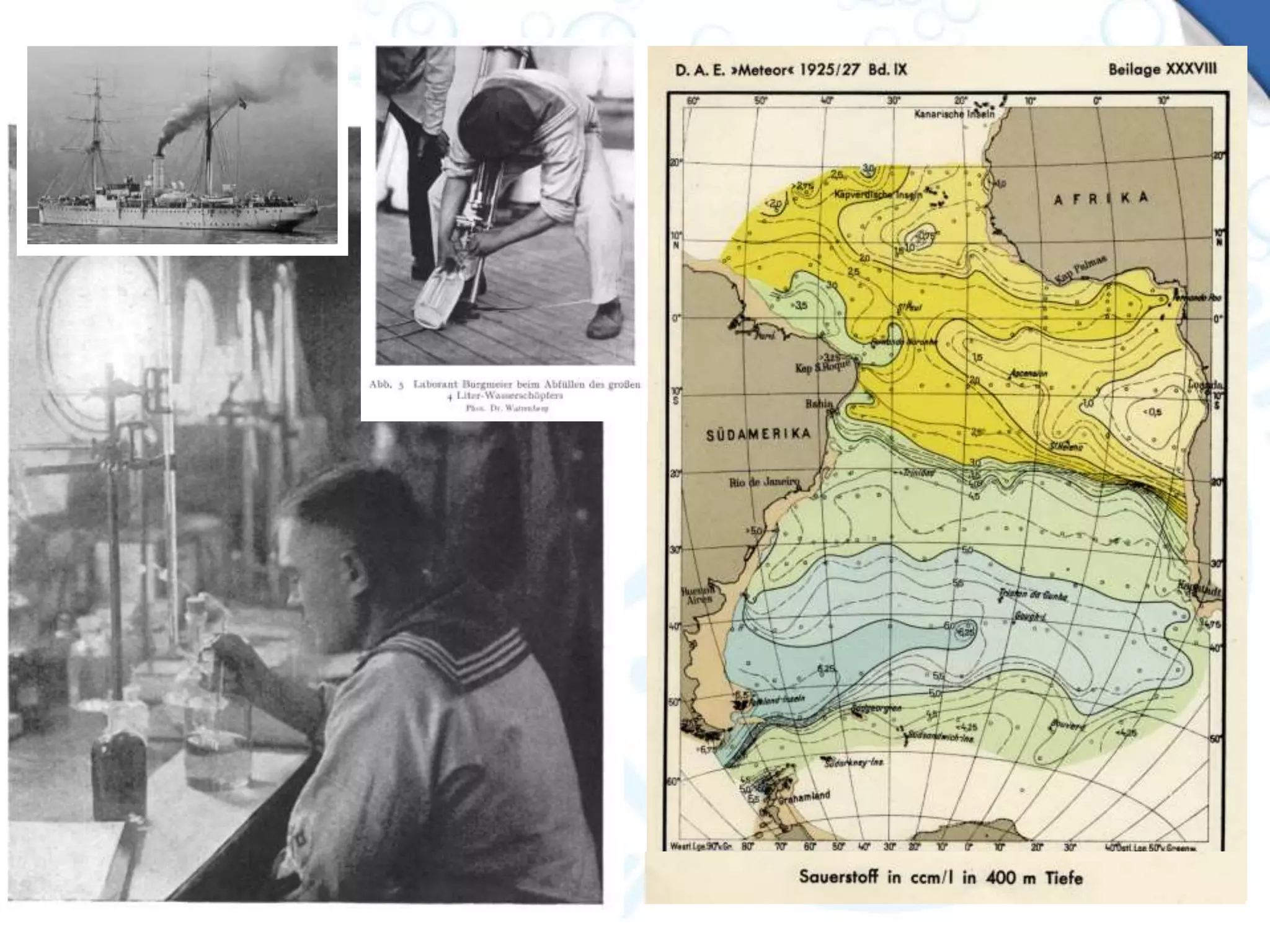
  • #7  Mostly because up until a couple of decades ago or so, most of the BGC observations were driven by curiosity and an urge to discover rather than by a strategiezed thought through plan…this is how little we knew about marine biogeochemistry phenomena, process and feedback loops up until very recently…(this is a figure from 1927 drawn following a semi-scientific cruise on a german vessel Meteor and we are looking at first ever interpolation of oxygen observations in the South Atlantic.
  • #11 
  • #12 This list is substantially revised compared to what was in the previous version. It is important to note that this is not meant to be a list of biogeochemical phenomena, rather a list of oceanic phenomena that biogeochemical measurements inform in one way or another. Hence, some phenomena we tried to align closer to how they appear in the Physics EOVs (circulation, upwelling, air-sea fluxes). Benthic fluxes were added to enable easy alignment with DOOS which is working hard on their EOVs now too... Some more biology oriented phenomena we also renamed and split into several phenomena in order to enable easier harmonization with the corresponding phenomena from the Biology & Ecosystems realm, i.e. Primary production, Calcification, Remineralization, Eutrophication.
  • #13 Stable isotops of Protactinium (231Pa) or Thorium (230Th)
  • #14 Stable isotops of Protactinium (231Pa) or Thorium (230Th)
  • #15 After the publication of the February 2016 version of the Biogeochemistry EOV Specification Sheets, the process of preparing the next updated version started almost immediately. The main goals included: (i) harmonizing the EOV related definitions and Specification Sheet structures across the three disciplinary expert panels of GOOS, (ii) improving internal consistency of the content of the Biogeochemistry EOV Specification Sheets. During GOOS-SC-5, GOOS BGC Panel was also charged with the task of developing an Ocean Colour EOV in consultation with the ocean colour community; and with initiating a dialogue with the United Nations Environment Programme (UNEP) in relation to the potential development of a Marine Pollutants/Contamination EOV. Here you see the current list of all GOOS EOVs.
  • #19 As an observationalist it is amazing to be able to live is a world where we have all these tools to observe changes in the environment and start connect processes, budgets, trends and multidisciplinary interactions never experienced before…. Things have changed dramatically recently, and biogeochemical observations are made hand in hand with physical ones across the global oceans and across platforms, programs and networks. I think that its perfect time for any GODAE OV summer school student to start understanding and taking practical advantage of this change. In my lecture this morning I will try to make you aware: why we observe marine biogeochemistry, what parameters we find essential to measure and how we do it. I will hint on data management and hint on future visions….all that in 45 minutes so many issues will be just highlighted, but I hope that after this lecture you will at least know where to look for certain resources.
  • #25 This list is substantially revised compared to what was in the previous version. It is important to note that this is not meant to be a list of biogeochemical phenomena, rather a list of oceanic phenomena that biogeochemical measurements inform in one way or another. Hence, some phenomena we tried to align closer to how they appear in the Physics EOVs (circulation, upwelling, air-sea fluxes). Benthic fluxes were added to enable easy alignment with DOOS which is working hard on their EOVs now too... Some more biology oriented phenomena we also renamed and split into several phenomena in order to enable easier harmonization with the corresponding phenomena from the Biology & Ecosystems realm, i.e. Primary production, Calcification, Remineralization, Eutrophication.
  • #26 This list is substantially revised compared to what was in the previous version. It is important to note that this is not meant to be a list of biogeochemical phenomena, rather a list of oceanic phenomena that biogeochemical measurements inform in one way or another. Hence, some phenomena we tried to align closer to how they appear in the Physics EOVs (circulation, upwelling, air-sea fluxes). Benthic fluxes were added to enable easy alignment with DOOS which is working hard on their EOVs now too... Some more biology oriented phenomena we also renamed and split into several phenomena in order to enable easier harmonization with the corresponding phenomena from the Biology & Ecosystems realm, i.e. Primary production, Calcification, Remineralization, Eutrophication.