Global J. Environ. Sci. Manage., 1 (1): 41-46, Winter 2015
An investigation on role of salinity, pH and DO on heavy metals
elimination throughout estuarial mixture
*A. R. Karbassi; M. Heidari
Graduate Faculty of Environment, University of Tehran, P.O.Box 1417853111, Tehran, Iran
ABSTRACT: One of the most paramount processes that play a considerable role in reducing the concentration of
heavy metals during estuarine mixing is flocculation. Not only does such a process cause a huge percentage of metals to
come into the particulate phase, but also it provides ample nutrients for the aquatic life. In the present study, impact of
such factors as salinity, pH and DO on flocculation of Cu, Zn, Pb, Ni, Cd and Mn throughout mixing of Chaluse River
with Caspian Sea is investigated. The trend of flocculation of Pb (24.32%) < Zn (24.38%) < Cd (40.00%) < Cu
(64.71%) < Ni (68.00%) < Mn (76.47%) reveals that among the studied elements Mn and lead experience minimum and
maximum flocculation at diverse salinity regimes, respectively. Moreover, flocculation rate of studied metals fluctuates
between 24.32 and 76.47 percent. It is interesting to note that much of metal flocculation occurs at the very lower (less
than 2 ppt) salinity regimes.
Keywords: Dissolved oxygen, Freshwater, Chalus river, Pollution elimination, Diverse salinities
Global J. Environ. Sci. Manage., 1 (1): 41-46, Winter 2015
ISSN 2383 - 3572
*Corresponding Author Email: akarbasi@ut.ac.ir
Tel.: 09122040398; Fax: 09122040398
INTRODUCTION
Heavy elements which have long lasting detrimental
effects on environment are carried from the continents
into the seas by rivers (Meybeck, 1988; Karbassi et
al., 2007, 2008). Chiefly, as a consequence of the
estuarial mixture, heavy metals in the soluble and
insoluble forms are influenced by a wide variety of
reactions in the river which flocculation of metals is
one of these reactions (Boyle et al., 1977; Karbassi et
al., 2007, 2008, 2013). Flocculation process is one of
the vital physicochemical processes, occurred by
estuarial mixture in the upper areas of the estuary where
the salinity is low, and strikingly impacted by such
factors as ionic power, pH, and the amount of
suspended particles in wetlands (Matagi et al., 1998).
On account of the occurrence of flocculation process
at the estuary of the rivers, a large proportion of heavy
metals leave the soluble phase in the form of cotton-
like strings as nutrients, on the one hand, and
contributes to improve and maintain the biological
conditions of the oceans, seas and lakes (Sholkovitz,
1976; Li et al., 1984; Comans and Van Dijk 1988;
Samarghandi et al., 2007). Estuaries are one of the
Received 25 September 2014; revised 28 October 2014; accepted 22 November 2014; available online 1 December 2014
coastal points and considered as construed as the
interface between the sea salinity and rivers (Pritchard
1967; Viswanathan and Chakrapan, 2010), compatible
places for aquatics’ spawning and reproduction, areas
full of nutrients, and celebrated for possessing
diversified fauna and flora among the highly productive
ecosystems in the sea (Dobson and Frid, 1998; Currier
and Small, 2005; Karbassi etal., 2007). Based on results
of comprehensive investigations all around the world,
as a result of estuary mixture, various parameters such
as electrical conductivity, pH, dissolved oxygen,
dissolved organic carbon, etc. change (Eckert and
Sholkovitz, 1976; Fox and Wofsy, 1983; Hunter, 1983;
Saeedi et al., 2003; Karbassi et al., 2007; Biati et al.,
2010a; Biati et al., 2010b; Fazelzadeh et al., 2012;
Karbassi et al., 2013;Valikhani Samani et al., 2014).It is
believed that owing to poison and threat posed by
heavy metals to aquatics as well as the ecological
importance of the estuary, paying meticulous attention
to the geochemical cycle of the elements is necessary.
In the present work, because of the important role of
flocculation process in self-purification of heavy metals,
the influence of pH, salinity and DO on the flocculation
of such soluble metals as Cu, Zn, Pb, Ni, Cd and Mn
Global J. Environ. Sci. Manage., 1 (1): 41-46, Winter 2015A. R. Karbassi, M. Heidari
during the mixture of Chalus River with the Caspian
Sea is studied.
MATERIALS AND METHODS
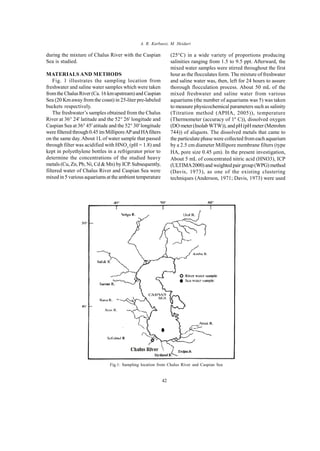
Fig. 1 illustrates the sampling location from
freshwater and saline water samples which were taken
fromthe ChalusRiver (Ca. 16 kmupstream) and Caspian
Sea (20 Kmaway from the coast) in 25-liter pre-labeled
buckets respectively.
The freshwater’s samples obtained from the Chalus
River at 36° 24' latitude and the 52° 26' longitude and
Caspian Sea at 36° 45' atitude and the 52° 30' longitude
were filtered through0.45 ìmMilliporeAPand HAfilters
on the same day.About 1Lof water sample that passed
through filter was acidified with HNO3
(pH = 1.8) and
kept in polyethylene bottles in a refrigerator prior to
determine the concentrations of the studied heavy
metals (Cu, Zn, Pb, Ni, Cd & Mn) by ICP.Subsequently,
filtered water of Chalus River and Caspian Sea were
mixed in 5 various aquariums at the ambient temperature
(25°C) in a wide variety of proportions producing
salinities ranging from 1.5 to 9.5 ppt. Afterward, the
mixed water samples were stirred throughout the first
hour as the flocculates form. The mixture of freshwater
and saline water was, then, left for 24 hours to assure
thorough flocculation process. About 50 mL of the
mixed freshwater and saline water from various
aquariums (the number of aquariums was 5) was taken
to measure physicochemical parameters such as salinity
(Titration method (APHA, 2005)), temperature
(Thermometer (accuracy of 1º C)), dissolved oxygen
(DO meter (Inolab WTW)), and pH(pHmeter (Metrohm
744)) of aliquots. The dissolved metals that came to
the particulate phase were collected fromeach aquarium
by a 2.5 cm diameter Millipore membrane filters (type
HA, pore size 0.45 μm). In the present investigation,
About 5 mL of concentrated nitric acid (HNO3), ICP
(ULTIMA2000)and weighted pair group(WPG) method
(Davis, 1973), as one of the existing clustering
techniques (Anderson, 1971; Davis, 1973) were used
Fig.1: Sampling location from Chalus River and Caspian Sea
42
Global J. Environ. Sci. Manage., 1 (1): 41-46, Winter 2015
to digest Millipore filters overnight, determine the
concentrations of studied elements and found the
relationship between physicochemical parameters and
studied metals respectively. Procedural blanks and
duplicates were conducted with the samples in an
accurate and same manner. The dilution of single
concentrated standards purchased from SPEX Cerprep
Company wasutilized to calibrate theICP in determining
the concentrations of Cu, Zn, Pb, Ni, Cd and Mn in the
water samples. The accuracy of the analysis was ±5%
for mentioned elements (Cu, Zn, Pb, Ni, Cd and Mn) in
the dissolved and flocculent phases approximately.
RESULTS AND DISCUSSION
Caspian Sea is the largest enclosed body all across
the world where encompass three basins with divers
feathers and the salinity of this sea changes from 4 ppt
in the northern parts to about 12.5 ppt in the southern
parts. The length of Caspian Sea is about 1030 km, the
width of the lake ranges from 196 to 435 km and the
areais371,000 km2
.ChalusRiver with 80kmlengthgrafts
to Caspian Sea on Chalus city. The average discharge
of such a river is 53.30 × 10⁶
m3
/year. Table 1 including
the concentration of such elements as cadmium,
copper, manganese, nickel, zinc, and lead occurring in
the flocculates in varied salinity regimes (1.5, 3.5, 5.5,
7.5&9.5ppt),pHs(pH=8.71,8.55,8.57,8.6&8.62)and
DO ( DO = 8.36, 8.12, 7.1, 6.41 & 5.9) does not illustrate
the actual conditions throughout the mixture of
freshwater and saline water; and at every stage, as the
salinity increases, part of the flocculate produced
during the prior stage mixes with the flocculate
produced at the next stage; thus, the amount of the
flocculate produced at each stage should be deducted
from that of the prior stage in establishing the natural
position of estuarial mixture (Table 2) (Zhiqing et al.,
1987; Saeedi et al., 2003; Karbassi et al., 2008a; Biati et
al., 2010b; Shamkhali Chenar et al., 2013; Karbassi et
al.,2014).
According to Table 2, Mn and Pb demonstrate the
maximum and minimum removal at various salinity
regimes (1.5 to 9.5 ppt),pHs(pH=8.71, 8.55,8.57,8.6 &
8.62) and DO (DO = 8.36, 7.78, 7.1, 6.41 & 5.9 mg/L)
respectively which is disagreement with other studies
(Saeedi et al., 2003; Karbassi et al., 2007; Karbassi et
al., 2008). Moreover, Cu, Ni, Cd and Mn show non-
conservative behavior. On the other hand, Zn and Pb
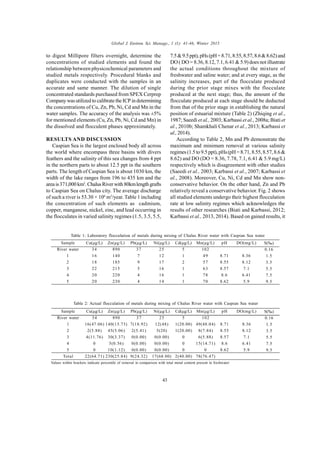
relatively reveal a conservative behavior. Fig. 2 shows
all studied elements undergo their highest flocculation
rate at low salinity regimes which acknowledges the
results of other researches (Biati and Karbassi, 2012;
Karbassi et al., 2013, 2014). Based on gained results, it
Sample
River water
1
2
3
4
5
Cu(μg/L)
34
16
18
22
20
20
Zn(μg/L)
890
140
185
215
220
230
Pb(μg/L)
37
7
9
5
4
4
Ni(μg/L)
25
12
17
16
16
14
Cd(μg/L)
5
1
2
1
1
1
Mn(μg/L)
102
49
57
63
78
70
pH
8.71
8.55
8.57
8.6
8.62
DO(mg/L)
8.36
8.12
7.1
6.41
5.9
S(‰)
0.16
1.5
3.5
5.5
7.5
9.5
Table 1: Laboratory flocculation of metals during mixing of Chalus River water with Caspian Sea water
Sample
River water
1
2
3
4
5
Total
Cu(μg/L)
34
16(47.06)
2(5.88)
4(11.76)
0
0
22(64.71)
Zn(μg/L)
890
140(15.73)
45(5.06)
30(3.37)
5(0.56)
10(1.12)
230(25.84)
Pb(μg/L)
37
7(18.92)
2(5.41)
0(0.00)
0(0.00)
0(0.00)
9(24.32)
Ni(μg/L)
25
12(48)
5(20)
0(0.00)
0(0.00)
0(0.00)
17(68.00)
Cd(μg/L)
5
1(20.00)
1(20.00)
0
0
0
2(40.00)
Mn(μg/L)
102
49(48.04)
8(7.84)
6(5.88)
15(14.71)
0
78(76.47)
pH
8.71
8.55
8.57
8.6
8.62
DO(mg/L)
8.36
8.12
7.1
6.41
5.9
S(‰)
0.16
1.5
3.5
5.5
7.5
9.5
Values within brackets indicate percentile of removal in comparison with total metal content present in freshwater
Table 2: Actual flocculation of metals during mixing of Chalus River water with Caspian Sea water
43
Global J. Environ. Sci. Manage., 1 (1): 41-46, Winter 2015
44
An investigation on role of Salinity, pH and DO on heavy metals elimination
can be clearly seen that during estuarine mixing, about
3% of Zn and 6% of Mn are flocculated at salinity of
5.5 ppt, pH = 8.57 and DO = 7.1 mg/L, while the
flocculation rate of other heavy metals studied here is
0.00%. It is also appealing to note that in the salinity of
9.5 ppt, pH = 8.62 and DO = 5.9 mg/L, only lead has a
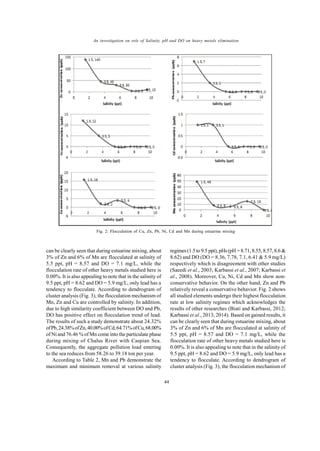
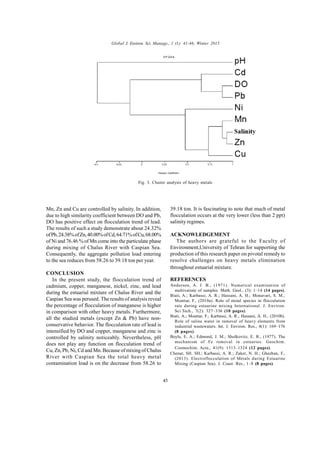
tendency to flocculate. According to dendrogram of
cluster analysis (Fig. 3), the flocculation mechanism of
Mn, Zn and Cu are controlled by salinity. In addition,
due to high similarity coefficient between DO and Pb,
DO has positive effect on flocculation trend of lead.
The results of such a study demonstrate about 24.32%
ofPb,24.38%ofZn,40.00%ofCd,64.71%ofCu,68.00%
of Ni and 76.46 % of Mn come into the particulate phase
during mixing of Chalus River with Caspian Sea.
Consequently, the aggregate pollution load entering
to the sea reduces from 58.26 to 39.18 ton per year.
According to Table 2, Mn and Pb demonstrate the
maximum and minimum removal at various salinity
regimes(1.5 to 9.5 ppt), pHs(pH = 8.71,8.55,8.57, 8.6 &
8.62) and DO (DO = 8.36, 7.78, 7.1, 6.41 & 5.9 mg/L)
respectively which is disagreement with other studies
(Saeedi et al., 2003; Karbassi et al., 2007; Karbassi et
al., 2008). Moreover, Cu, Ni, Cd and Mn show non-
conservative behavior. On the other hand, Zn and Pb
relatively reveal a conservative behavior. Fig. 2 shows
all studied elements undergo their highest flocculation
rate at low salinity regimes which acknowledges the
results of other researches (Biati and Karbassi, 2012;
Karbassi et al., 2013, 2014). Based on gained results, it
can be clearly seen that during estuarine mixing, about
3% of Zn and 6% of Mn are flocculated at salinity of
5.5 ppt, pH = 8.57 and DO = 7.1 mg/L, while the
flocculation rate of other heavy metals studied here is
0.00%. It is also appealing to note that in the salinity of
9.5 ppt, pH = 8.62 and DO = 5.9 mg/L, only lead has a
tendency to flocculate. According to dendrogram of
cluster analysis (Fig. 3), the flocculation mechanism of
Fig. 2: Flocculation of Cu, Zn, Pb, Ni, Cd and Mn during estuarine mixing
Global J. Environ. Sci. Manage., 1 (1): 41-46, Winter 2015
45
Fig. 3. Cluster analysis of heavy metals
Mn, Zn and Cu are controlled by salinity. In addition,
due to high similarity coefficient between DO and Pb,
DO has positive effect on flocculation trend of lead.
The results of such a study demonstrate about 24.32%
ofPb,24.38%ofZn,40.00%ofCd,64.71%ofCu,68.00%
of Ni and 76.46 % of Mn come into the particulate phase
during mixing of Chalus River with Caspian Sea.
Consequently, the aggregate pollution load entering
to the sea reduces from 58.26 to 39.18 ton per year.
CONCLUSION
In the present study, the flocculation trend of
cadmium, copper, manganese, nickel, zinc, and lead
during the estuarial mixture of Chalus River and the
Caspian Sea was perused. The results of analysis reveal
the percentage of flocculation of manganese is higher
in comparison with other heavy metals. Furthermore,
all the studied metals (except Zn & Pb) have non-
conservative behavior. The flocculation rate of lead is
intensified by DO and copper, manganese and zinc is
controlled by salinity noticeably. Nevertheless, pH
does not play any function on flocculation trend of
Cu, Zn, Pb, Ni, Cd and Mn. Because of mixingof Chalus
River with Caspian Sea the total heavy metal
contamination load is on the decrease from 58.26 to
39.18 ton. It is fascinating to note that much of metal
flocculation occurs at the very lower (less than 2 ppt)
salinity regimes.
ACKNOWLEDGEMENT
The authors are grateful to the Faculty of
Environment,University of Tehran for supporting the
production of this research paper on pivotal remedy to
resolve challenges on heavy metals elimination
throughout estuarial mixture.
REFERENCES
Anderson, A. J. B., (1971). Numerical examination of
multivariate of samples. Math. Geol., (3): 1–14 (14 pages).
Biati, A.; Karbassi, A. R.; Hassani, A. H.; Monavari, S. M.;
Moattar, F., (2010a). Role of metal species in flocculation
rate during estuarine mixing International. J. Environ.
Sci.Tech., 7(2): 327–336 (10 pages).
Biati, A.; Moattar, F.; Karbassi, A. R.; Hassani, A. H., (2010b).
Role of saline water in removal of heavy elements from
industrial wastewaters. Int. J. Environ. Res., 4(1): 169–176
(8 pages).
Boyle, E. A.; Edmond, J. M.; Sholkovitz, E. R., (1977). The
mechanism of Fe removal in estuaries. Geochim.
Cosmochim. Acta., 41(9): 1313–1324 (12 pages).
Chenar, SH. SH.; Karbassi, A. R.; Zaker, N. H.; Ghazban, F.,
(2013). Electroflocculation of Metals during Estuarine
Mixing (Caspian Sea). J. Coast. Res., 1–8 (8 pages).
Global J. Environ. Sci. Manage., 1 (1): 41-46, Winter 2015
46
A. R. Karbassi, M. Heidari
Coman, R. N.; Van Dijk, C. P. J., (1988). Role of complexation
processes in cadmium mobilization during estuarine mixing.
Nature, 336(6195): 151-154 (4 pages).
Currier, D. R.; Small, K. J., (2005). Macrobenthic community
responses to long-term environmental change in an east
Australian sub-tropical estuary Estuar. Coast. Shelfs., 63(1-
2): 315-331 (17 pages).
Davis, J. B., (1973). Statistic and data analysis in geology. Wiley.,
New York.
Dobson, M.; Frid, C., (1998). Ecology of aquatic systems.,
Longman.
Eckert, J. M.; Sholkovitz, E. R., (1976). The flocculation of Fe,
Al and humates from river water by electrolytes. Geochim.
Cosmochim. Acta., 40(7): 847–856 (10 pages).
Fazelzadeh, M.; Karbassi, A. R.; Mehrdadi, N., (2012). An
Investigation on the Role of Flocculation Processes in Geo-
Chemical and Biological Cycle of Estuary (Case Study:
Gorganrood River). Int. J. Environ. Res., 6(2): 391–398 (8
pages).
Fox, L. E.; Wofsy, S. C., (1983). Kinetics of removal of iron
colloids from estuaries. Geochim. Cosmochim. Acta., (47):
211–216 (6 pages).
Hunter, K. A., (1983). On the estuarine mixing of dissolved
substances in relation to colloidal stability and surface properties.
Geochim. Cosmochim. Acta., (47): 467–473 (7 pages).
Karbassi, A. R.; Nouri, J.; Ayaz, G. O., (2007). Flocculation of
trace metals during mixing of Talar River water with Caspian
Seawater. Int. J. Environ. Res., 1(1): 66–73 (8 pages).
Karbassi, A. R.; Nouri, J.; Mehrdadi, N.; Ayaz, G. O., (2008).
Flocculation of heavy metals during mixing of freshwater with
Caspian Seawater. Environ. Geo., 53(8): 1811–1816 (6 pages).
Karbassi, A. R.; Heidari, M.; Vaezi, A. R.; Valikhani Samani, A.
R.; Fakhraee, M.; Heidari, F., (2013). Effect of pH and salinity
on flocculation process of heavy metals during mixing of
Aras River water with Caspian Sea water. Environ. Earth Sci.,
1-9 (10 pages).
Karbassi, A. R.; Fakhraee, M.; Heidari, M.; Vaezi, A. R.; Valikhani
Samani, A. R., (2014). Dissolved and particulate trace metal
geochemistry during mixing of Karganrud River with
Caspian Sea water. Arabian J. Geosci., 1-9 (10 pages).
Li, Y. H.; Burkhardt, L.; Teroka, H., (1984). Desorption and
coagulation of trace elements during estuarine mixing.
Geochim. Cosmochim. Acta., 48(10): 1879-1884 (6 pages).
Matagi, S. V.; Swai, D.; Mugabe, R., (1998). A review of
heavy metal removal mechanisms in wetlands Afr. J. Trop.
Hydrobiol. Fish, 8(1): 23-25 (3 pages).
Meybeck, M., (1988). How to establish and use world budgets
of riverine materials, In: Lerman, A., Meybeck,M. (Eds.),
Physical and Chemical Weathering in Geochemical Cycles,
247–272 (26 pages).
Pritchard, D. W., (1967). What is an estuary: Physical
viewpoints Estuaries, G. H. Lauff (Ed.). Am. Assoc. Adv.
Sci., (83): 3–5 (3 pages).
Saeedi, M.; Karbassi, A. R.; Mehrdadi, N., (2003). Flocculation
of dissolved Mn, Zn, Ni and Cu during the estuarine mixing
of Tadjan River water with Caspian Seawater. Int. J.
Environ. Studies, (60): 567–576 (10 pages).
Samarghandi, M. R.; Nouri, J.; Mesdaghinia, A. R.; Mahvi, A.
H.; Naseri, S.; Vaezi, F., (2007). Efficiency removal of
phenol, lead and cadmium by means of UV/TiO2
/H2
O2
processes. Int. J. Environ. Sci. Tech., 4(1): 10-25 (16 pages).
Shokovitz, E. R., (1976). Flocculation of dissolved organic and
inorganic matter during the mixing river water and seawater.
Geochim. Cosmochim. Acta., 40(7): 831–845 (15 pages).
Valikhani Samania, A. R.; Karbassi, A. R.; Fakhraeea, M.;
Heidaria, M.; Vaezia, A. R.; Valikhani, Z., (2014). Effect
of dissolved organic carbon and salinity on flocculation
process of heavy metals during mixing of the Navrud River
water with Caspian Seawater. Desalination and Water
Treatment, 1-9 (9 pages).
Viswanathan, M.; Chakrapani, G. J., (2010). Laboratory
experiments on river–estuary geonanomaterials. Curr. Sci.,
99(2): 213–215 (3 pages).
Zhiqing, L. E.; Jianhu, Z.; Jinsi, C., (1987). Flocculation of
dissolved Fe, Al, Mn, Si, Cu, Pb and Zn during estuarine
mixing. Acta Oceanol. Sin., (6): 567–576 (10 pages).
AUTHOR (S) BIOSKETCHES
Karbassi, A. R., Ph.D., Professor of Environmental Engineering, Graduate Faculty of Environment, University of Tehran, P.O.Box
1417853111, Tehran, Iran. Director in Charge; International Journal of Environmental Research. www.ijer.ir E-mail: akarbasi@ut.ac.ir
Heidari. M., M.Sc. Student of Environmental Engineering, Graduate Faculty of Environment, University of Tehran, P.O.Box 1417853111,
Tehran, Iran. E-mail: mehdiheidari_1364@yahoo.com
How to cite this article: (Harvard style)
Karbassi, A. R.; Heidari, M., (2015). An investigation on role of salinity, pH and DO on heavy metals elimination throughout estuarial
mixture. Global J. Environ. Sci. Manage., 1 (1): 41-46.

An investigation on role of salinity, pH and DO on heavy metals elimination throughout estuarial mixture

  • 1.
    Global J. Environ.Sci. Manage., 1 (1): 41-46, Winter 2015 An investigation on role of salinity, pH and DO on heavy metals elimination throughout estuarial mixture *A. R. Karbassi; M. Heidari Graduate Faculty of Environment, University of Tehran, P.O.Box 1417853111, Tehran, Iran ABSTRACT: One of the most paramount processes that play a considerable role in reducing the concentration of heavy metals during estuarine mixing is flocculation. Not only does such a process cause a huge percentage of metals to come into the particulate phase, but also it provides ample nutrients for the aquatic life. In the present study, impact of such factors as salinity, pH and DO on flocculation of Cu, Zn, Pb, Ni, Cd and Mn throughout mixing of Chaluse River with Caspian Sea is investigated. The trend of flocculation of Pb (24.32%) < Zn (24.38%) < Cd (40.00%) < Cu (64.71%) < Ni (68.00%) < Mn (76.47%) reveals that among the studied elements Mn and lead experience minimum and maximum flocculation at diverse salinity regimes, respectively. Moreover, flocculation rate of studied metals fluctuates between 24.32 and 76.47 percent. It is interesting to note that much of metal flocculation occurs at the very lower (less than 2 ppt) salinity regimes. Keywords: Dissolved oxygen, Freshwater, Chalus river, Pollution elimination, Diverse salinities Global J. Environ. Sci. Manage., 1 (1): 41-46, Winter 2015 ISSN 2383 - 3572 *Corresponding Author Email: akarbasi@ut.ac.ir Tel.: 09122040398; Fax: 09122040398 INTRODUCTION Heavy elements which have long lasting detrimental effects on environment are carried from the continents into the seas by rivers (Meybeck, 1988; Karbassi et al., 2007, 2008). Chiefly, as a consequence of the estuarial mixture, heavy metals in the soluble and insoluble forms are influenced by a wide variety of reactions in the river which flocculation of metals is one of these reactions (Boyle et al., 1977; Karbassi et al., 2007, 2008, 2013). Flocculation process is one of the vital physicochemical processes, occurred by estuarial mixture in the upper areas of the estuary where the salinity is low, and strikingly impacted by such factors as ionic power, pH, and the amount of suspended particles in wetlands (Matagi et al., 1998). On account of the occurrence of flocculation process at the estuary of the rivers, a large proportion of heavy metals leave the soluble phase in the form of cotton- like strings as nutrients, on the one hand, and contributes to improve and maintain the biological conditions of the oceans, seas and lakes (Sholkovitz, 1976; Li et al., 1984; Comans and Van Dijk 1988; Samarghandi et al., 2007). Estuaries are one of the Received 25 September 2014; revised 28 October 2014; accepted 22 November 2014; available online 1 December 2014 coastal points and considered as construed as the interface between the sea salinity and rivers (Pritchard 1967; Viswanathan and Chakrapan, 2010), compatible places for aquatics’ spawning and reproduction, areas full of nutrients, and celebrated for possessing diversified fauna and flora among the highly productive ecosystems in the sea (Dobson and Frid, 1998; Currier and Small, 2005; Karbassi etal., 2007). Based on results of comprehensive investigations all around the world, as a result of estuary mixture, various parameters such as electrical conductivity, pH, dissolved oxygen, dissolved organic carbon, etc. change (Eckert and Sholkovitz, 1976; Fox and Wofsy, 1983; Hunter, 1983; Saeedi et al., 2003; Karbassi et al., 2007; Biati et al., 2010a; Biati et al., 2010b; Fazelzadeh et al., 2012; Karbassi et al., 2013;Valikhani Samani et al., 2014).It is believed that owing to poison and threat posed by heavy metals to aquatics as well as the ecological importance of the estuary, paying meticulous attention to the geochemical cycle of the elements is necessary. In the present work, because of the important role of flocculation process in self-purification of heavy metals, the influence of pH, salinity and DO on the flocculation of such soluble metals as Cu, Zn, Pb, Ni, Cd and Mn
  • 2.
    Global J. Environ.Sci. Manage., 1 (1): 41-46, Winter 2015A. R. Karbassi, M. Heidari during the mixture of Chalus River with the Caspian Sea is studied. MATERIALS AND METHODS Fig. 1 illustrates the sampling location from freshwater and saline water samples which were taken fromthe ChalusRiver (Ca. 16 kmupstream) and Caspian Sea (20 Kmaway from the coast) in 25-liter pre-labeled buckets respectively. The freshwater’s samples obtained from the Chalus River at 36° 24' latitude and the 52° 26' longitude and Caspian Sea at 36° 45' atitude and the 52° 30' longitude were filtered through0.45 ìmMilliporeAPand HAfilters on the same day.About 1Lof water sample that passed through filter was acidified with HNO3 (pH = 1.8) and kept in polyethylene bottles in a refrigerator prior to determine the concentrations of the studied heavy metals (Cu, Zn, Pb, Ni, Cd & Mn) by ICP.Subsequently, filtered water of Chalus River and Caspian Sea were mixed in 5 various aquariums at the ambient temperature (25°C) in a wide variety of proportions producing salinities ranging from 1.5 to 9.5 ppt. Afterward, the mixed water samples were stirred throughout the first hour as the flocculates form. The mixture of freshwater and saline water was, then, left for 24 hours to assure thorough flocculation process. About 50 mL of the mixed freshwater and saline water from various aquariums (the number of aquariums was 5) was taken to measure physicochemical parameters such as salinity (Titration method (APHA, 2005)), temperature (Thermometer (accuracy of 1º C)), dissolved oxygen (DO meter (Inolab WTW)), and pH(pHmeter (Metrohm 744)) of aliquots. The dissolved metals that came to the particulate phase were collected fromeach aquarium by a 2.5 cm diameter Millipore membrane filters (type HA, pore size 0.45 μm). In the present investigation, About 5 mL of concentrated nitric acid (HNO3), ICP (ULTIMA2000)and weighted pair group(WPG) method (Davis, 1973), as one of the existing clustering techniques (Anderson, 1971; Davis, 1973) were used Fig.1: Sampling location from Chalus River and Caspian Sea 42
  • 3.
    Global J. Environ.Sci. Manage., 1 (1): 41-46, Winter 2015 to digest Millipore filters overnight, determine the concentrations of studied elements and found the relationship between physicochemical parameters and studied metals respectively. Procedural blanks and duplicates were conducted with the samples in an accurate and same manner. The dilution of single concentrated standards purchased from SPEX Cerprep Company wasutilized to calibrate theICP in determining the concentrations of Cu, Zn, Pb, Ni, Cd and Mn in the water samples. The accuracy of the analysis was ±5% for mentioned elements (Cu, Zn, Pb, Ni, Cd and Mn) in the dissolved and flocculent phases approximately. RESULTS AND DISCUSSION Caspian Sea is the largest enclosed body all across the world where encompass three basins with divers feathers and the salinity of this sea changes from 4 ppt in the northern parts to about 12.5 ppt in the southern parts. The length of Caspian Sea is about 1030 km, the width of the lake ranges from 196 to 435 km and the areais371,000 km2 .ChalusRiver with 80kmlengthgrafts to Caspian Sea on Chalus city. The average discharge of such a river is 53.30 × 10⁶ m3 /year. Table 1 including the concentration of such elements as cadmium, copper, manganese, nickel, zinc, and lead occurring in the flocculates in varied salinity regimes (1.5, 3.5, 5.5, 7.5&9.5ppt),pHs(pH=8.71,8.55,8.57,8.6&8.62)and DO ( DO = 8.36, 8.12, 7.1, 6.41 & 5.9) does not illustrate the actual conditions throughout the mixture of freshwater and saline water; and at every stage, as the salinity increases, part of the flocculate produced during the prior stage mixes with the flocculate produced at the next stage; thus, the amount of the flocculate produced at each stage should be deducted from that of the prior stage in establishing the natural position of estuarial mixture (Table 2) (Zhiqing et al., 1987; Saeedi et al., 2003; Karbassi et al., 2008a; Biati et al., 2010b; Shamkhali Chenar et al., 2013; Karbassi et al.,2014). According to Table 2, Mn and Pb demonstrate the maximum and minimum removal at various salinity regimes (1.5 to 9.5 ppt),pHs(pH=8.71, 8.55,8.57,8.6 & 8.62) and DO (DO = 8.36, 7.78, 7.1, 6.41 & 5.9 mg/L) respectively which is disagreement with other studies (Saeedi et al., 2003; Karbassi et al., 2007; Karbassi et al., 2008). Moreover, Cu, Ni, Cd and Mn show non- conservative behavior. On the other hand, Zn and Pb relatively reveal a conservative behavior. Fig. 2 shows all studied elements undergo their highest flocculation rate at low salinity regimes which acknowledges the results of other researches (Biati and Karbassi, 2012; Karbassi et al., 2013, 2014). Based on gained results, it Sample River water 1 2 3 4 5 Cu(μg/L) 34 16 18 22 20 20 Zn(μg/L) 890 140 185 215 220 230 Pb(μg/L) 37 7 9 5 4 4 Ni(μg/L) 25 12 17 16 16 14 Cd(μg/L) 5 1 2 1 1 1 Mn(μg/L) 102 49 57 63 78 70 pH 8.71 8.55 8.57 8.6 8.62 DO(mg/L) 8.36 8.12 7.1 6.41 5.9 S(‰) 0.16 1.5 3.5 5.5 7.5 9.5 Table 1: Laboratory flocculation of metals during mixing of Chalus River water with Caspian Sea water Sample River water 1 2 3 4 5 Total Cu(μg/L) 34 16(47.06) 2(5.88) 4(11.76) 0 0 22(64.71) Zn(μg/L) 890 140(15.73) 45(5.06) 30(3.37) 5(0.56) 10(1.12) 230(25.84) Pb(μg/L) 37 7(18.92) 2(5.41) 0(0.00) 0(0.00) 0(0.00) 9(24.32) Ni(μg/L) 25 12(48) 5(20) 0(0.00) 0(0.00) 0(0.00) 17(68.00) Cd(μg/L) 5 1(20.00) 1(20.00) 0 0 0 2(40.00) Mn(μg/L) 102 49(48.04) 8(7.84) 6(5.88) 15(14.71) 0 78(76.47) pH 8.71 8.55 8.57 8.6 8.62 DO(mg/L) 8.36 8.12 7.1 6.41 5.9 S(‰) 0.16 1.5 3.5 5.5 7.5 9.5 Values within brackets indicate percentile of removal in comparison with total metal content present in freshwater Table 2: Actual flocculation of metals during mixing of Chalus River water with Caspian Sea water 43
  • 4.
    Global J. Environ.Sci. Manage., 1 (1): 41-46, Winter 2015 44 An investigation on role of Salinity, pH and DO on heavy metals elimination can be clearly seen that during estuarine mixing, about 3% of Zn and 6% of Mn are flocculated at salinity of 5.5 ppt, pH = 8.57 and DO = 7.1 mg/L, while the flocculation rate of other heavy metals studied here is 0.00%. It is also appealing to note that in the salinity of 9.5 ppt, pH = 8.62 and DO = 5.9 mg/L, only lead has a tendency to flocculate. According to dendrogram of cluster analysis (Fig. 3), the flocculation mechanism of Mn, Zn and Cu are controlled by salinity. In addition, due to high similarity coefficient between DO and Pb, DO has positive effect on flocculation trend of lead. The results of such a study demonstrate about 24.32% ofPb,24.38%ofZn,40.00%ofCd,64.71%ofCu,68.00% of Ni and 76.46 % of Mn come into the particulate phase during mixing of Chalus River with Caspian Sea. Consequently, the aggregate pollution load entering to the sea reduces from 58.26 to 39.18 ton per year. According to Table 2, Mn and Pb demonstrate the maximum and minimum removal at various salinity regimes(1.5 to 9.5 ppt), pHs(pH = 8.71,8.55,8.57, 8.6 & 8.62) and DO (DO = 8.36, 7.78, 7.1, 6.41 & 5.9 mg/L) respectively which is disagreement with other studies (Saeedi et al., 2003; Karbassi et al., 2007; Karbassi et al., 2008). Moreover, Cu, Ni, Cd and Mn show non- conservative behavior. On the other hand, Zn and Pb relatively reveal a conservative behavior. Fig. 2 shows all studied elements undergo their highest flocculation rate at low salinity regimes which acknowledges the results of other researches (Biati and Karbassi, 2012; Karbassi et al., 2013, 2014). Based on gained results, it can be clearly seen that during estuarine mixing, about 3% of Zn and 6% of Mn are flocculated at salinity of 5.5 ppt, pH = 8.57 and DO = 7.1 mg/L, while the flocculation rate of other heavy metals studied here is 0.00%. It is also appealing to note that in the salinity of 9.5 ppt, pH = 8.62 and DO = 5.9 mg/L, only lead has a tendency to flocculate. According to dendrogram of cluster analysis (Fig. 3), the flocculation mechanism of Fig. 2: Flocculation of Cu, Zn, Pb, Ni, Cd and Mn during estuarine mixing
  • 5.
    Global J. Environ.Sci. Manage., 1 (1): 41-46, Winter 2015 45 Fig. 3. Cluster analysis of heavy metals Mn, Zn and Cu are controlled by salinity. In addition, due to high similarity coefficient between DO and Pb, DO has positive effect on flocculation trend of lead. The results of such a study demonstrate about 24.32% ofPb,24.38%ofZn,40.00%ofCd,64.71%ofCu,68.00% of Ni and 76.46 % of Mn come into the particulate phase during mixing of Chalus River with Caspian Sea. Consequently, the aggregate pollution load entering to the sea reduces from 58.26 to 39.18 ton per year. CONCLUSION In the present study, the flocculation trend of cadmium, copper, manganese, nickel, zinc, and lead during the estuarial mixture of Chalus River and the Caspian Sea was perused. The results of analysis reveal the percentage of flocculation of manganese is higher in comparison with other heavy metals. Furthermore, all the studied metals (except Zn & Pb) have non- conservative behavior. The flocculation rate of lead is intensified by DO and copper, manganese and zinc is controlled by salinity noticeably. Nevertheless, pH does not play any function on flocculation trend of Cu, Zn, Pb, Ni, Cd and Mn. Because of mixingof Chalus River with Caspian Sea the total heavy metal contamination load is on the decrease from 58.26 to 39.18 ton. It is fascinating to note that much of metal flocculation occurs at the very lower (less than 2 ppt) salinity regimes. ACKNOWLEDGEMENT The authors are grateful to the Faculty of Environment,University of Tehran for supporting the production of this research paper on pivotal remedy to resolve challenges on heavy metals elimination throughout estuarial mixture. REFERENCES Anderson, A. J. B., (1971). Numerical examination of multivariate of samples. Math. Geol., (3): 1–14 (14 pages). Biati, A.; Karbassi, A. R.; Hassani, A. H.; Monavari, S. M.; Moattar, F., (2010a). Role of metal species in flocculation rate during estuarine mixing International. J. Environ. Sci.Tech., 7(2): 327–336 (10 pages). Biati, A.; Moattar, F.; Karbassi, A. R.; Hassani, A. H., (2010b). Role of saline water in removal of heavy elements from industrial wastewaters. Int. J. Environ. Res., 4(1): 169–176 (8 pages). Boyle, E. A.; Edmond, J. M.; Sholkovitz, E. R., (1977). The mechanism of Fe removal in estuaries. Geochim. Cosmochim. Acta., 41(9): 1313–1324 (12 pages). Chenar, SH. SH.; Karbassi, A. R.; Zaker, N. H.; Ghazban, F., (2013). Electroflocculation of Metals during Estuarine Mixing (Caspian Sea). J. Coast. Res., 1–8 (8 pages).
  • 6.
    Global J. Environ.Sci. Manage., 1 (1): 41-46, Winter 2015 46 A. R. Karbassi, M. Heidari Coman, R. N.; Van Dijk, C. P. J., (1988). Role of complexation processes in cadmium mobilization during estuarine mixing. Nature, 336(6195): 151-154 (4 pages). Currier, D. R.; Small, K. J., (2005). Macrobenthic community responses to long-term environmental change in an east Australian sub-tropical estuary Estuar. Coast. Shelfs., 63(1- 2): 315-331 (17 pages). Davis, J. B., (1973). Statistic and data analysis in geology. Wiley., New York. Dobson, M.; Frid, C., (1998). Ecology of aquatic systems., Longman. Eckert, J. M.; Sholkovitz, E. R., (1976). The flocculation of Fe, Al and humates from river water by electrolytes. Geochim. Cosmochim. Acta., 40(7): 847–856 (10 pages). Fazelzadeh, M.; Karbassi, A. R.; Mehrdadi, N., (2012). An Investigation on the Role of Flocculation Processes in Geo- Chemical and Biological Cycle of Estuary (Case Study: Gorganrood River). Int. J. Environ. Res., 6(2): 391–398 (8 pages). Fox, L. E.; Wofsy, S. C., (1983). Kinetics of removal of iron colloids from estuaries. Geochim. Cosmochim. Acta., (47): 211–216 (6 pages). Hunter, K. A., (1983). On the estuarine mixing of dissolved substances in relation to colloidal stability and surface properties. Geochim. Cosmochim. Acta., (47): 467–473 (7 pages). Karbassi, A. R.; Nouri, J.; Ayaz, G. O., (2007). Flocculation of trace metals during mixing of Talar River water with Caspian Seawater. Int. J. Environ. Res., 1(1): 66–73 (8 pages). Karbassi, A. R.; Nouri, J.; Mehrdadi, N.; Ayaz, G. O., (2008). Flocculation of heavy metals during mixing of freshwater with Caspian Seawater. Environ. Geo., 53(8): 1811–1816 (6 pages). Karbassi, A. R.; Heidari, M.; Vaezi, A. R.; Valikhani Samani, A. R.; Fakhraee, M.; Heidari, F., (2013). Effect of pH and salinity on flocculation process of heavy metals during mixing of Aras River water with Caspian Sea water. Environ. Earth Sci., 1-9 (10 pages). Karbassi, A. R.; Fakhraee, M.; Heidari, M.; Vaezi, A. R.; Valikhani Samani, A. R., (2014). Dissolved and particulate trace metal geochemistry during mixing of Karganrud River with Caspian Sea water. Arabian J. Geosci., 1-9 (10 pages). Li, Y. H.; Burkhardt, L.; Teroka, H., (1984). Desorption and coagulation of trace elements during estuarine mixing. Geochim. Cosmochim. Acta., 48(10): 1879-1884 (6 pages). Matagi, S. V.; Swai, D.; Mugabe, R., (1998). A review of heavy metal removal mechanisms in wetlands Afr. J. Trop. Hydrobiol. Fish, 8(1): 23-25 (3 pages). Meybeck, M., (1988). How to establish and use world budgets of riverine materials, In: Lerman, A., Meybeck,M. (Eds.), Physical and Chemical Weathering in Geochemical Cycles, 247–272 (26 pages). Pritchard, D. W., (1967). What is an estuary: Physical viewpoints Estuaries, G. H. Lauff (Ed.). Am. Assoc. Adv. Sci., (83): 3–5 (3 pages). Saeedi, M.; Karbassi, A. R.; Mehrdadi, N., (2003). Flocculation of dissolved Mn, Zn, Ni and Cu during the estuarine mixing of Tadjan River water with Caspian Seawater. Int. J. Environ. Studies, (60): 567–576 (10 pages). Samarghandi, M. R.; Nouri, J.; Mesdaghinia, A. R.; Mahvi, A. H.; Naseri, S.; Vaezi, F., (2007). Efficiency removal of phenol, lead and cadmium by means of UV/TiO2 /H2 O2 processes. Int. J. Environ. Sci. Tech., 4(1): 10-25 (16 pages). Shokovitz, E. R., (1976). Flocculation of dissolved organic and inorganic matter during the mixing river water and seawater. Geochim. Cosmochim. Acta., 40(7): 831–845 (15 pages). Valikhani Samania, A. R.; Karbassi, A. R.; Fakhraeea, M.; Heidaria, M.; Vaezia, A. R.; Valikhani, Z., (2014). Effect of dissolved organic carbon and salinity on flocculation process of heavy metals during mixing of the Navrud River water with Caspian Seawater. Desalination and Water Treatment, 1-9 (9 pages). Viswanathan, M.; Chakrapani, G. J., (2010). Laboratory experiments on river–estuary geonanomaterials. Curr. Sci., 99(2): 213–215 (3 pages). Zhiqing, L. E.; Jianhu, Z.; Jinsi, C., (1987). Flocculation of dissolved Fe, Al, Mn, Si, Cu, Pb and Zn during estuarine mixing. Acta Oceanol. Sin., (6): 567–576 (10 pages). AUTHOR (S) BIOSKETCHES Karbassi, A. R., Ph.D., Professor of Environmental Engineering, Graduate Faculty of Environment, University of Tehran, P.O.Box 1417853111, Tehran, Iran. Director in Charge; International Journal of Environmental Research. www.ijer.ir E-mail: akarbasi@ut.ac.ir Heidari. M., M.Sc. Student of Environmental Engineering, Graduate Faculty of Environment, University of Tehran, P.O.Box 1417853111, Tehran, Iran. E-mail: mehdiheidari_1364@yahoo.com How to cite this article: (Harvard style) Karbassi, A. R.; Heidari, M., (2015). An investigation on role of salinity, pH and DO on heavy metals elimination throughout estuarial mixture. Global J. Environ. Sci. Manage., 1 (1): 41-46.