CONTENTS
• INTRODUCTION
• STANDARDIZTION PROCESS
• MPEG FAMILY
• H26X FAMILY
• VC-1 STANDARD
• OTHER POPULAR VIDEO CODING STANDARDS
INTRODUCTION TO VIDEO CODING STANDARD
• “A video coding standard is a document describing a bit stream
structure and a decoding method for video compression.”
• The standard does not define the encoder; rather it defines the
output structure that an encoder should produce.
• Video coding standards usually define a toolkit or a set of tools for
compression.
• Video coding format or sometimes video compression format is a
content representation format for storage or transmission of digital
video content(such as in a data file or bit stream).
• Examples of video coding formats include MPEG-2 Part-2,
MPEG-4 Part-2, H.264(MPEG-4 Part-10), HEVC, Theora etc.
• A specific software or hardware implementation capable of
video compression and/or decompression to/from a specific
video coding format is called a video codec.
• Some video coding formats are documented by a detailed
technical specification document known as video coding
specifications. some such specifications are written and
approved by standardization organization as technical
standards, and are thus known as a video coding standard.
WHY STANDARDIZE?
• Standardization enables encoder and decoders from different
manufacturers to work together across a range of applications.
• In order to provide the maximum flexibility and encourage
innovation, the standards do not include all practical issues and
design techniques of the decoding process.
• Standardization allows for decoding of bit stream from
previous and emerging standards.
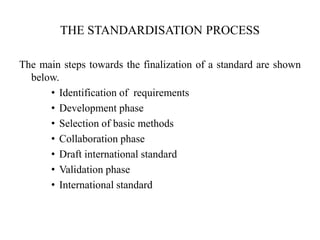
THE STANDARDISATION PROCESS
The main steps towards the finalization of a standard are shown
below.
• Identification of requirements
• Development phase
• Selection of basic methods
• Collaboration phase
• Draft international standard
• Validation phase
• International standard
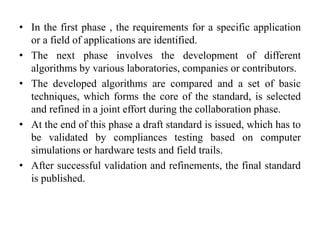
• In the first phase , the requirements for a specific application
or a field of applications are identified.
• The next phase involves the development of different
algorithms by various laboratories, companies or contributors.
• The developed algorithms are compared and a set of basic
techniques, which forms the core of the standard, is selected
and refined in a joint effort during the collaboration phase.
• At the end of this phase a draft standard is issued, which has to
be validated by compliances testing based on computer
simulations or hardware tests and field trails.
• After successful validation and refinements, the final standard
is published.
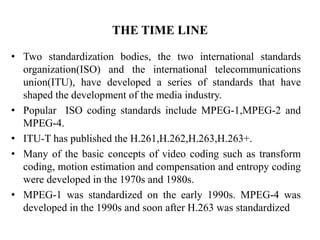
THE TIME LINE
• Two standardization bodies, the two international standards
organization(ISO) and the international telecommunications
union(ITU), have developed a series of standards that have
shaped the development of the media industry.
• Popular ISO coding standards include MPEG-1,MPEG-2 and
MPEG-4.
• ITU-T has published the H.261,H.262,H.263,H.263+.
• Many of the basic concepts of video coding such as transform
coding, motion estimation and compensation and entropy coding
were developed in the 1970s and 1980s.
• MPEG-1 was standardized on the early 1990s. MPEG-4 was
developed in the 1990s and soon after H.263 was standardized
THE MPEG FAMILY OF VIDEO CODING
STANDARDS
• The ISO/IEC motion pictures experts group(MPEG) publish
standards from media coding, storage and transport.
• These standards consist of different parts. each part covers a
certain aspect to the whole specification.
MPEG-1
• Standardised in 1993.
• It is a standard for lossy compression of video and audio.
• Developed for video and audio storage on CD-ROMs, digital
cable/satellite TV and digital audio broadcasting
• The best known part of the MPEG-1 standard is the MP3 audio
format it is introduced.
• Supports YUV 4:2:0 at common intermediate format(355*288)
resolution
• The standard consists of the following five parts:
- Systems(storage and synchronization of video, audio and other data
together)
- Video(compressed video content)
- Audio(compressed audio content)
- Conformance testing(testing the correctness of implementation of the
standard)
- Reference software(example software showing how to encode and decode
according to the standard)
Basic objectives of MPEG-1 standard
• The MPEG-1 standard was primarily targeted for multimedia
CD-ROM applications at a bit rate of 1.5 Mbits/sec.
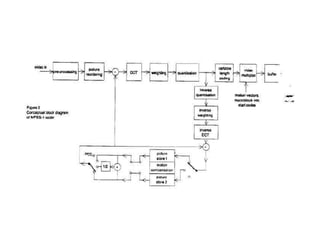
• The syntax supports operations such as
- Motion estimation
- Motion compensated prediction
- Discrete Cosine transforms (DCT)
-Quantization and variable length coding
• MPEG-1 standard supports the following application specified
features:
• Frame–based random access of video:
• Fast-forward and fast reverse (FF/FR)
searches
• Reverse playback of video
• Edit ability of the compressed bit stream
• Reasonable coding / decoding delay of
about 1 sec. To give the impression of
interactivity.
Picture types in mpeg-1
The MPEG-1 standard supports the following three picture
types:
I- picture
P-picture
B-picture
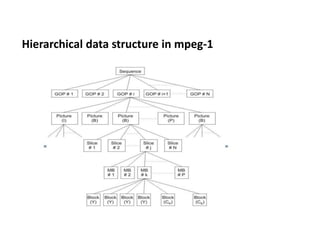
Hierarchical data structure in mpeg-1
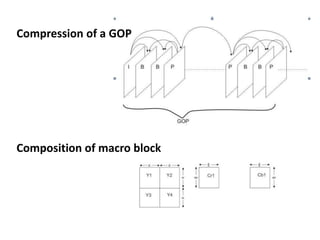
Compression of a GOP
Composition of macro block
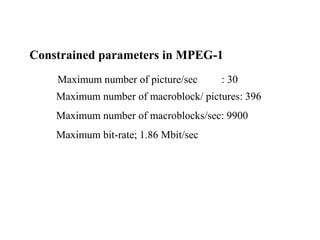
Constrained parameters in MPEG-1
Maximum number of picture/sec : 30
Maximum number of macroblock/ pictures: 396
Maximum number of macroblocks/sec: 9900
Maximum bit-rate; 1.86 Mbit/sec
MPEG-2 part-2
• Standardised n 1995
• Supports video on DVDs, standard definition TVs and high
definition TVs
• Can handle YUV 4:2:0 and YUV 4:2:2 formats
• Supports interlaced and progressively scanned pictures
• Introduction of profiles and levels to define various
capabilities of the standard as sub sets. For example,
MPEG-2 main profile/high level is suitable for high
definition television(HDTV)
• scalable extensions which permit the division of continuous
video signal into two or more coded bit streams representing
the video at different resolutions, picture quality(i.e. SNR), or
picture rates.
• Other features include data portioning, non-linear quantization,
VLC tables and improved mismatch control.
MPEG-4 part-2(visual)
• Standardised in 1999
• Supports video on low-bit rate multimedia applications on
mobile platforms and the internet
• Supports object-based or content-based coding
where video scene is coded as a set of foreground
and background objects
• Supports coding of synthetic video and audio
including animation
• Shares subset with H.263(‘short header mode’)
MPEG-4 PART-10(advanced video coding)
• Standardised in 2003
• Co-published as H.264 AVC.
The following standards gives the key features of H.26X family.
1.H.261
• Standardised in 1988
• Developed for video conferencing over ISDN
• Support for CIF and QCIF resolutions in YUV 4:2:0 format
• Uses block-based hybrid coding with integer pixel motion
compensation.
2.H.262
• Standardised as MPEG-2-part-2(video)in 1995
THE H26X FAMILY OF VIDEO CODING STANDARDS
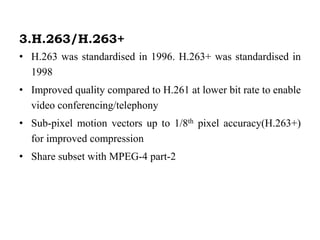
3.H.263/H.263+
• H.263 was standardised in 1996. H.263+ was standardised in
1998
• Improved quality compared to H.261 at lower bit rate to enable
video conferencing/telephony
• Sub-pixel motion vectors up to 1/8th pixel accuracy(H.263+)
for improved compression
• Share subset with MPEG-4 part-2
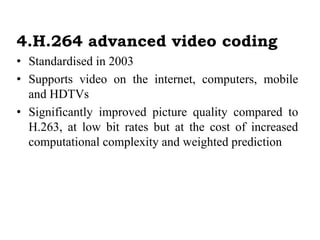
4.H.264 advanced video coding
• Standardised in 2003
• Supports video on the internet, computers, mobile
and HDTVs
• Significantly improved picture quality compared to
H.263, at low bit rates but at the cost of increased
computational complexity and weighted prediction
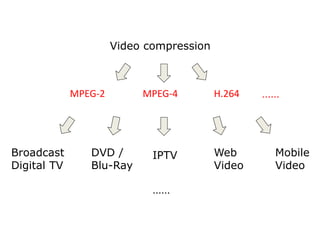
Video compression
H.264MPEG-4MPEG-2
Broadcast
Digital TV
DVD /
Blu-Ray
IPTV Web
Video
Mobile
Video
……
……
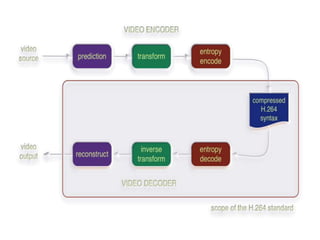
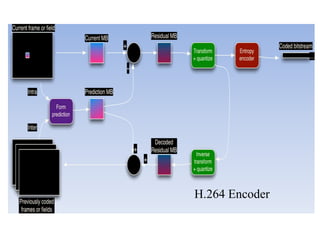
H.264 Encoder
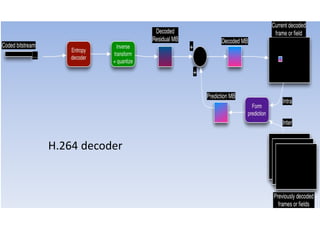
H.264 decoder
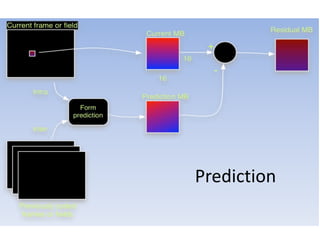
Prediction
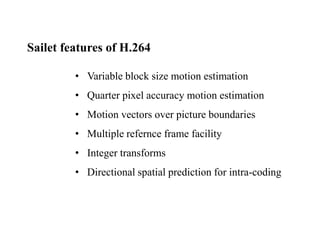
Sailet features of H.264
• Variable block size motion estimation
• Quarter pixel accuracy motion estimation
• Motion vectors over picture boundaries
• Multiple refernce frame facility
• Integer transforms
• Directional spatial prediction for intra-coding
5.H.265/HEVC
Standardises in 2013,HEVCs basic structure is similar to
H.24/AVC with improvements such as
• Support for ultra HD video up to 8k resolutions with frame
rates up to 120 fps
• Greater flexibility in prediction modes and transform block
sizes
• More sophisticated interpolation modes and deblocking filters
• Features to support parallel processing
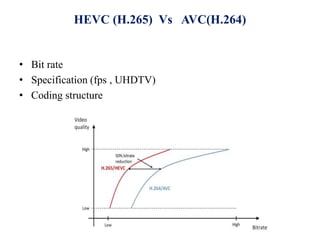
• More efficient compared to H.264 in terms of bit rate savings
for the same picture quality
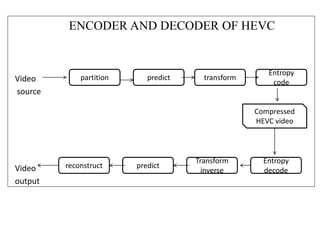
ENCODER AND DECODER OF HEVC
Video
source
Video
output
partition predict transform
predict
Entropy
code
reconstruct
Entropy
decode
Transform
inverse
Compressed
HEVC video
• High Throughput
• Higher coding efficiency
• On portable devices with Lower power
• HEVC supports high flexibility partitioning for video sequence
• The picture is partitioned into slices and then divided into coding
tree unit(CTU) which is furthur divided into coding units(CU)
Prediction:
A coding unit(CU) is partitioned into one or more prediction
units(PU) each of which is predicted by either intra (or) inter
prediction
Transform , quantization and entropy coding
• The residual data remaining after prediction is transformed
using a block transform based on discrete sine/cosine
transform
• The maximum range of transform is increased to 32x32 from
16x16 in H.264
• All elements of coded HEVC bit stream are encoded using
context adaptive binary arithmetic coding(CABAC)
32
HEVC (H.265) Vs AVC(H.264)
• Bit rate
• Specification (fps , UHDTV)
• Coding structure
Applications of HEVC
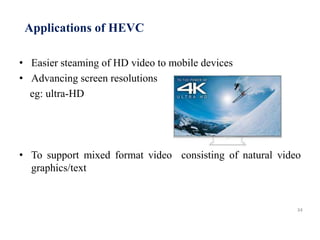
• Easier steaming of HD video to mobile devices
• Advancing screen resolutions
eg: ultra-HD
• To support mixed format video consisting of natural video
graphics/text
34
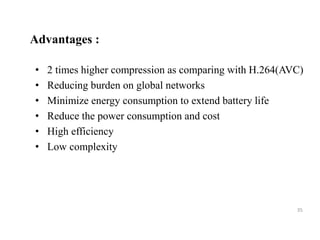
• 2 times higher compression as comparing with H.264(AVC)
• Reducing burden on global networks
• Minimize energy consumption to extend battery life
• Reduce the power consumption and cost
• High efficiency
• Low complexity
35
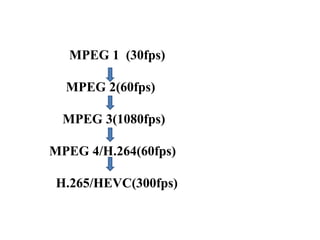
Advantages :
MPEG 1 (30fps)
MPEG 2(60fps)
MPEG 3(1080fps)
MPEG 4/H.264(60fps)
H.265/HEVC(300fps)
VC-1 STANDAD
• Vc-1 is a video codec specification standardised by the society
of motion picture and television engineers(SMPTE) in 2006.
Vc-1 coding standard
• Adaptive block transform where an 8*8 block can be coded
using either an 8*8 transform, two 8*4 transforms, two 4*8
transforms. Or four 4*4 transforms.
• 16-bit transforms for easier implementation on hardware
devices compared to the 8-bit transforms used by MPEG AND
H.26X codecs.
• Fading compensation as a pre-processing step to detect fades
and use alternate methods to adjust luminance.
• In-loop deblocking filter to reduce block discontinuities
OTHER POPULAR VIDEO CODING FORMATS
• This section highlights some of the key features of other
popular video coding formats such as VP8 VP9, theora and
daala..
THEORA
• Based on 2’s VP3.2 format
• Support for video on the internet
• Bit stream format was frozen in 2004
• Support for more pixel formats-YUV444, YUV422 AND
YUV420
• No B-pictures

• No global motion compression
• Only half-pxiel precision motion compensation
• In-loop deblocking filter to reduce block discontinuities
VP8
• designed to operate in low bandwidth environment such as
web video
• Support for web video format-YUV420 ,8-bit colour depth
,progressive scan and resolution up to 4k
• Flexible reference frame with buffer size limited to three
frames
• Efficient intra and prediction with motion vector accuracy of
1/4th pixel for luma and 1/8th pixel for chroma
• Adaptive in-loop deblocking filter to reduce block
discontinuities
• Features such as data portioning enable parallel processing
VP9
has basic structure similar to VP8 with improvements such as:
• Support for resolution up to 8K and frame rate up to 120fpsuse
of superblocks (32*32 and 64*64) to exploit high correlation
over larger areas in HD video
• Enhanced interpolation for motion compensation with 8-tap
filters to achieve 1/8th pixel accuracy in motion vectors
• Reference frame scaling for improved bit rate adjustment,
where the reference frame can be scaled up or down during
inter prediction.
DAALA
Daala is being designed to differ from common video compression
techniques. Some distinguishing features include:
• Lapped transform instead of block based DCT
• Lifting pre and post filtering instead of deblocking filter
• Frequency domain intra prediction instead of pixel domain
prediction
• Time/frequency resolution switching where image blocks can be
split apart or merged together in the frequency domain
Video coding standards ppt

Video coding standards ppt

  • 1.
    CONTENTS • INTRODUCTION • STANDARDIZTIONPROCESS • MPEG FAMILY • H26X FAMILY • VC-1 STANDARD • OTHER POPULAR VIDEO CODING STANDARDS
  • 2.
    INTRODUCTION TO VIDEOCODING STANDARD • “A video coding standard is a document describing a bit stream structure and a decoding method for video compression.” • The standard does not define the encoder; rather it defines the output structure that an encoder should produce. • Video coding standards usually define a toolkit or a set of tools for compression. • Video coding format or sometimes video compression format is a content representation format for storage or transmission of digital video content(such as in a data file or bit stream).
  • 3.
    • Examples ofvideo coding formats include MPEG-2 Part-2, MPEG-4 Part-2, H.264(MPEG-4 Part-10), HEVC, Theora etc. • A specific software or hardware implementation capable of video compression and/or decompression to/from a specific video coding format is called a video codec. • Some video coding formats are documented by a detailed technical specification document known as video coding specifications. some such specifications are written and approved by standardization organization as technical standards, and are thus known as a video coding standard.
  • 4.
    WHY STANDARDIZE? • Standardizationenables encoder and decoders from different manufacturers to work together across a range of applications. • In order to provide the maximum flexibility and encourage innovation, the standards do not include all practical issues and design techniques of the decoding process. • Standardization allows for decoding of bit stream from previous and emerging standards.
  • 5.
    THE STANDARDISATION PROCESS Themain steps towards the finalization of a standard are shown below. • Identification of requirements • Development phase • Selection of basic methods • Collaboration phase • Draft international standard • Validation phase • International standard
  • 6.
    • In thefirst phase , the requirements for a specific application or a field of applications are identified. • The next phase involves the development of different algorithms by various laboratories, companies or contributors. • The developed algorithms are compared and a set of basic techniques, which forms the core of the standard, is selected and refined in a joint effort during the collaboration phase. • At the end of this phase a draft standard is issued, which has to be validated by compliances testing based on computer simulations or hardware tests and field trails. • After successful validation and refinements, the final standard is published.
  • 7.
    THE TIME LINE •Two standardization bodies, the two international standards organization(ISO) and the international telecommunications union(ITU), have developed a series of standards that have shaped the development of the media industry. • Popular ISO coding standards include MPEG-1,MPEG-2 and MPEG-4. • ITU-T has published the H.261,H.262,H.263,H.263+. • Many of the basic concepts of video coding such as transform coding, motion estimation and compensation and entropy coding were developed in the 1970s and 1980s. • MPEG-1 was standardized on the early 1990s. MPEG-4 was developed in the 1990s and soon after H.263 was standardized
  • 8.
    THE MPEG FAMILYOF VIDEO CODING STANDARDS • The ISO/IEC motion pictures experts group(MPEG) publish standards from media coding, storage and transport. • These standards consist of different parts. each part covers a certain aspect to the whole specification. MPEG-1 • Standardised in 1993. • It is a standard for lossy compression of video and audio. • Developed for video and audio storage on CD-ROMs, digital cable/satellite TV and digital audio broadcasting
  • 9.
    • The bestknown part of the MPEG-1 standard is the MP3 audio format it is introduced. • Supports YUV 4:2:0 at common intermediate format(355*288) resolution • The standard consists of the following five parts: - Systems(storage and synchronization of video, audio and other data together) - Video(compressed video content) - Audio(compressed audio content) - Conformance testing(testing the correctness of implementation of the standard) - Reference software(example software showing how to encode and decode according to the standard)
  • 10.
    Basic objectives ofMPEG-1 standard • The MPEG-1 standard was primarily targeted for multimedia CD-ROM applications at a bit rate of 1.5 Mbits/sec. • The syntax supports operations such as - Motion estimation - Motion compensated prediction - Discrete Cosine transforms (DCT) -Quantization and variable length coding • MPEG-1 standard supports the following application specified features: • Frame–based random access of video: • Fast-forward and fast reverse (FF/FR) searches • Reverse playback of video • Edit ability of the compressed bit stream • Reasonable coding / decoding delay of about 1 sec. To give the impression of interactivity.
  • 11.
    Picture types inmpeg-1 The MPEG-1 standard supports the following three picture types: I- picture P-picture B-picture
  • 12.
  • 13.
    Compression of aGOP Composition of macro block
  • 14.
    Constrained parameters inMPEG-1 Maximum number of picture/sec : 30 Maximum number of macroblock/ pictures: 396 Maximum number of macroblocks/sec: 9900 Maximum bit-rate; 1.86 Mbit/sec
  • 16.
    MPEG-2 part-2 • Standardisedn 1995 • Supports video on DVDs, standard definition TVs and high definition TVs • Can handle YUV 4:2:0 and YUV 4:2:2 formats • Supports interlaced and progressively scanned pictures • Introduction of profiles and levels to define various capabilities of the standard as sub sets. For example, MPEG-2 main profile/high level is suitable for high definition television(HDTV)
  • 17.
    • scalable extensionswhich permit the division of continuous video signal into two or more coded bit streams representing the video at different resolutions, picture quality(i.e. SNR), or picture rates. • Other features include data portioning, non-linear quantization, VLC tables and improved mismatch control. MPEG-4 part-2(visual) • Standardised in 1999 • Supports video on low-bit rate multimedia applications on mobile platforms and the internet
  • 18.
    • Supports object-basedor content-based coding where video scene is coded as a set of foreground and background objects • Supports coding of synthetic video and audio including animation • Shares subset with H.263(‘short header mode’) MPEG-4 PART-10(advanced video coding) • Standardised in 2003 • Co-published as H.264 AVC.
  • 19.
    The following standardsgives the key features of H.26X family. 1.H.261 • Standardised in 1988 • Developed for video conferencing over ISDN • Support for CIF and QCIF resolutions in YUV 4:2:0 format • Uses block-based hybrid coding with integer pixel motion compensation. 2.H.262 • Standardised as MPEG-2-part-2(video)in 1995 THE H26X FAMILY OF VIDEO CODING STANDARDS
  • 20.
    3.H.263/H.263+ • H.263 wasstandardised in 1996. H.263+ was standardised in 1998 • Improved quality compared to H.261 at lower bit rate to enable video conferencing/telephony • Sub-pixel motion vectors up to 1/8th pixel accuracy(H.263+) for improved compression • Share subset with MPEG-4 part-2
  • 21.
    4.H.264 advanced videocoding • Standardised in 2003 • Supports video on the internet, computers, mobile and HDTVs • Significantly improved picture quality compared to H.263, at low bit rates but at the cost of increased computational complexity and weighted prediction
  • 22.
    Video compression H.264MPEG-4MPEG-2 Broadcast Digital TV DVD/ Blu-Ray IPTV Web Video Mobile Video …… ……
  • 24.
  • 25.
  • 26.
  • 27.
    Sailet features ofH.264 • Variable block size motion estimation • Quarter pixel accuracy motion estimation • Motion vectors over picture boundaries • Multiple refernce frame facility • Integer transforms • Directional spatial prediction for intra-coding
  • 28.
    5.H.265/HEVC Standardises in 2013,HEVCsbasic structure is similar to H.24/AVC with improvements such as • Support for ultra HD video up to 8k resolutions with frame rates up to 120 fps • Greater flexibility in prediction modes and transform block sizes • More sophisticated interpolation modes and deblocking filters • Features to support parallel processing • More efficient compared to H.264 in terms of bit rate savings for the same picture quality
  • 29.
    ENCODER AND DECODEROF HEVC Video source Video output partition predict transform predict Entropy code reconstruct Entropy decode Transform inverse Compressed HEVC video
  • 30.
    • High Throughput •Higher coding efficiency • On portable devices with Lower power • HEVC supports high flexibility partitioning for video sequence • The picture is partitioned into slices and then divided into coding tree unit(CTU) which is furthur divided into coding units(CU) Prediction: A coding unit(CU) is partitioned into one or more prediction units(PU) each of which is predicted by either intra (or) inter prediction
  • 31.
    Transform , quantizationand entropy coding • The residual data remaining after prediction is transformed using a block transform based on discrete sine/cosine transform • The maximum range of transform is increased to 32x32 from 16x16 in H.264 • All elements of coded HEVC bit stream are encoded using context adaptive binary arithmetic coding(CABAC) 32
  • 32.
    HEVC (H.265) VsAVC(H.264) • Bit rate • Specification (fps , UHDTV) • Coding structure
  • 33.
    Applications of HEVC •Easier steaming of HD video to mobile devices • Advancing screen resolutions eg: ultra-HD • To support mixed format video consisting of natural video graphics/text 34
  • 34.
    • 2 timeshigher compression as comparing with H.264(AVC) • Reducing burden on global networks • Minimize energy consumption to extend battery life • Reduce the power consumption and cost • High efficiency • Low complexity 35 Advantages :
  • 35.
    MPEG 1 (30fps) MPEG2(60fps) MPEG 3(1080fps) MPEG 4/H.264(60fps) H.265/HEVC(300fps)
  • 36.
    VC-1 STANDAD • Vc-1is a video codec specification standardised by the society of motion picture and television engineers(SMPTE) in 2006. Vc-1 coding standard • Adaptive block transform where an 8*8 block can be coded using either an 8*8 transform, two 8*4 transforms, two 4*8 transforms. Or four 4*4 transforms. • 16-bit transforms for easier implementation on hardware devices compared to the 8-bit transforms used by MPEG AND H.26X codecs. • Fading compensation as a pre-processing step to detect fades and use alternate methods to adjust luminance. • In-loop deblocking filter to reduce block discontinuities
  • 37.
    OTHER POPULAR VIDEOCODING FORMATS • This section highlights some of the key features of other popular video coding formats such as VP8 VP9, theora and daala.. THEORA • Based on 2’s VP3.2 format • Support for video on the internet • Bit stream format was frozen in 2004 • Support for more pixel formats-YUV444, YUV422 AND YUV420 • No B-pictures 
  • 38.
    • No globalmotion compression • Only half-pxiel precision motion compensation • In-loop deblocking filter to reduce block discontinuities VP8 • designed to operate in low bandwidth environment such as web video • Support for web video format-YUV420 ,8-bit colour depth ,progressive scan and resolution up to 4k • Flexible reference frame with buffer size limited to three frames • Efficient intra and prediction with motion vector accuracy of 1/4th pixel for luma and 1/8th pixel for chroma
  • 39.
    • Adaptive in-loopdeblocking filter to reduce block discontinuities • Features such as data portioning enable parallel processing VP9 has basic structure similar to VP8 with improvements such as: • Support for resolution up to 8K and frame rate up to 120fpsuse of superblocks (32*32 and 64*64) to exploit high correlation over larger areas in HD video • Enhanced interpolation for motion compensation with 8-tap filters to achieve 1/8th pixel accuracy in motion vectors • Reference frame scaling for improved bit rate adjustment, where the reference frame can be scaled up or down during inter prediction.
  • 40.
    DAALA Daala is beingdesigned to differ from common video compression techniques. Some distinguishing features include: • Lapped transform instead of block based DCT • Lifting pre and post filtering instead of deblocking filter • Frequency domain intra prediction instead of pixel domain prediction • Time/frequency resolution switching where image blocks can be split apart or merged together in the frequency domain